
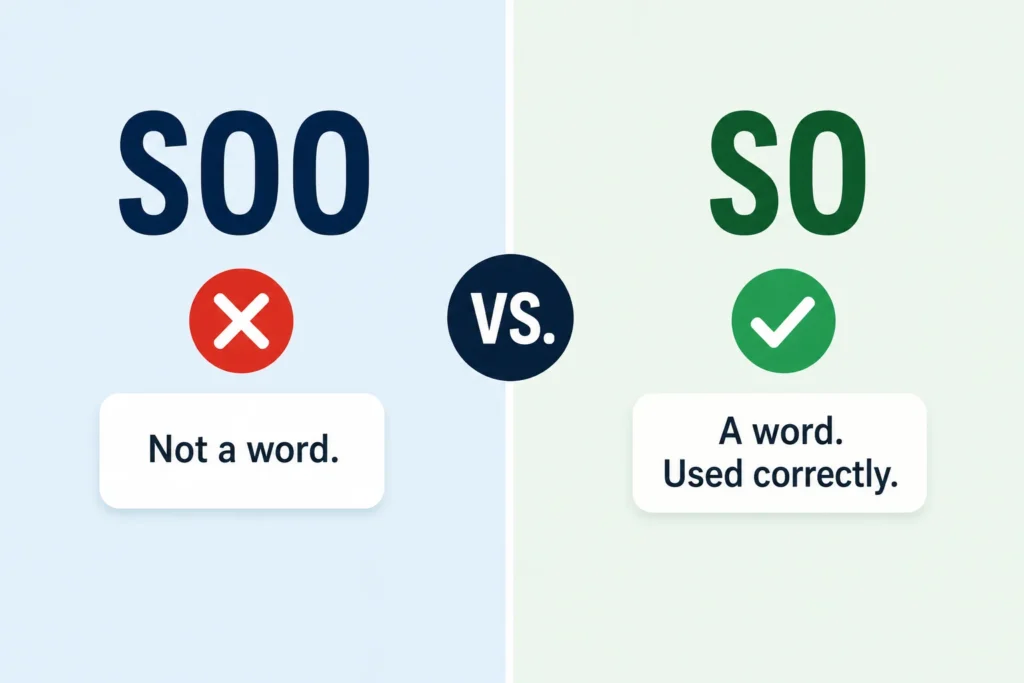
So vs. Soo: The Quick Answer
At first glance, so and soo look almost identical, yet they don’t serve the same purpose in standard English. So is the correct spelling and works as a common English word with several grammatical functions. You can use it to show degree, connect a cause with a result, introduce a thought, or move a conversation forward. Soo, on the other hand, isn’t the standard spelling of so. People often use it in informal writing to stretch the sound of a word, add emphasis, or show stronger emotion. For example, “The movie was so good” follows standard English rules, while “The movie was soo good!” creates a more playful, expressive tone. That small spelling change can affect how a reader perceives the sentence. In formal writing, academic work, business communication, and professional settings, so remains the safer choice. In a casual text or social media post, however, soo can intentionally reflect an informal style.
Is “Soo” a Word in English?
The answer depends on what you mean by “word.” Soo can appear in English-language contexts as a proper noun, name, or informal spelling. However, it generally doesn’t function as the standard English form of so. That’s an important distinction. A spelling can appear frequently online without becoming a standard form recognized for ordinary formal use. Think of soo as a stylistic variation when someone writes “I’m soo excited!” The extra o doesn’t create a new grammatical rule. Instead, it signals how the writer wants the message to sound. This kind of expressive spelling appears often in texting, comments, chats, and social media. Standard English follows a different convention. If you’re writing an essay, email, report, or other formal document, choose so. If you’re chatting with a friend and want to make your excitement obvious, soo may fit the intended context.
What Does “So” Mean?
So has several meanings and grammatical roles, which explains why English speakers use it so often. Its exact function depends on the context and the words around it. In one sentence, it can describe a high degree. In another, it can connect two ideas and show a result. It can also appear at the beginning of a sentence during everyday conversation. Understanding these different uses makes the difference between so and soo much easier to recognize. Rather than treating so as a single-purpose word, look at what it does within the sentence. That simple habit can help you identify its role quickly.
“So” as an Adverb
As an adverb, so often shows degree or intensity. It commonly appears before an adjective or another adverb to emphasize how strongly something applies. For example, “The coffee is so hot” tells you that the coffee has a very high level of heat. Likewise, “She speaks so clearly” emphasizes the degree of clarity in her speech. This use appears constantly in everyday English.
You can also use so to express a strong reaction:
- “That book was so interesting.”
- “The weather is so cold today.”
- “He finished the task so quickly.”
- “You’re so kind.”
Here, so adds emphasis without changing the basic meaning of the adjective or adverb. If you replace it with soo, the grammar doesn’t change. The spelling simply becomes informal and more expressive.
“So” as a Conjunction
So can also act as a conjunction when it connects an action, reason, or situation with its result. This use is especially common in everyday speech and writing.
For example:
“It started raining, so we went inside.”
The first part gives the situation. The second part gives the result. The word so links those two ideas clearly.
You might also see sentences such as:
- “I was tired, so I went to bed early.”
- “She missed the bus, so she called a taxi.”
- “The store was closed, so we came back later.”
- “He studied hard, so he passed the exam.”
In each example, so creates a clear connection between cause and result. You wouldn’t normally replace it with soo because the sentence requires the standard conjunction. Writing soo in this context would look like a spelling mistake unless the writer deliberately wanted an unusual informal effect.
“So” as a Sentence Starter
You may have noticed that people often begin sentences with so, especially during conversations. This use isn’t unusual. Speakers use so to introduce a subject, continue a discussion, explain what happened next, or respond to something already mentioned.
For example:
- “So, what do you want to do?”
- “So, here’s what happened.”
- “So, you’re saying we should leave now?”
- “So, let’s start with the first question.”
The meaning changes slightly according to the conversation. Sometimes so introduces a question. At other times, it signals a transition or helps the speaker organize a thought. This conversational use differs from the degree meaning in “That test was so difficult.” Yet both forms use the same standard word: so.
Common Expressions With “So”
The word so also appears in many familiar expressions. Learning these combinations can make standard English easier to understand and use naturally.
Common examples include so far, so much, so many, so that, if so, and so long as.
Consider these examples:
- “We haven’t received an answer so far.”
- “She has so much work today.”
- “There were so many people at the event.”
- “He left early so that he could avoid traffic.”
- “If so, please let me know.”
- “You can stay so long as you follow the rules.”
These expressions show why so is much more than a simple word used for emphasis. Its grammatical role changes with the sentence, while so generally remains an informal stylistic choice rather than a standard grammatical form.
What Does “Soo” Mean?
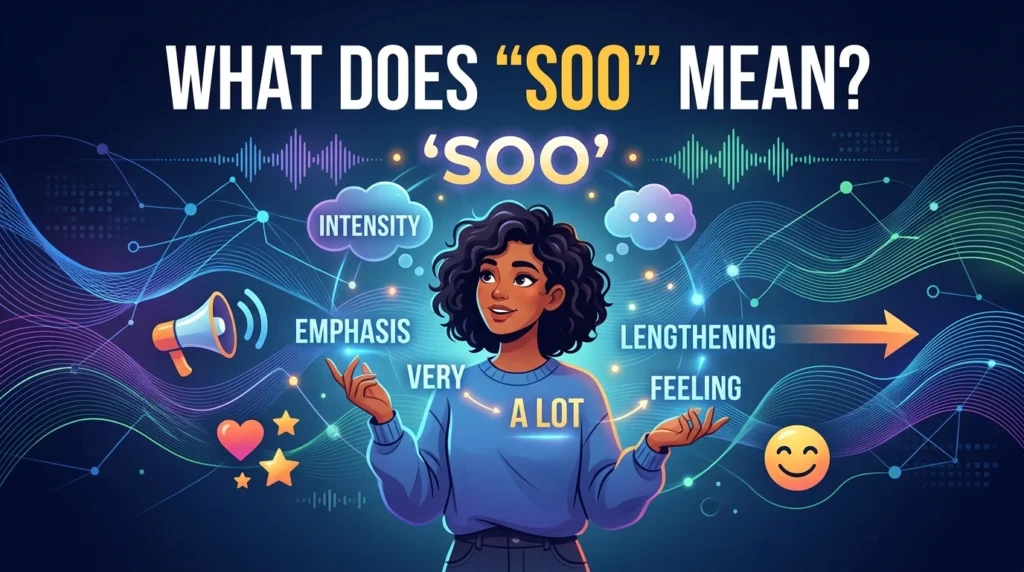
Soo can confuse English learners because it looks like a longer version of so. In most modern informal writing, however, people use it as an expressive spelling rather than as a separate standard English word. The meaning usually stays the same while the tone becomes stronger, softer, playful, dramatic, or more emotional. For example, “I’m so happy” gives a normal statement, while “I’m soo happy!” adds extra feeling. The additional o acts almost like a raised voice or a longer sound in speech. You can understand the intention immediately when you see it in a text or comment. Still, that doesn’t make soo the standard spelling. In polished writing, so remains the appropriate form.
“Soo” as an Informal Spelling
People often type soo when they want to stretch the pronunciation of so. Spoken English naturally includes changes in length and emphasis. Digital writing doesn’t carry those vocal signals, so people sometimes recreate them through spelling.
Compare these examples:
- “That puppy is so cute.”
- “That puppy is soo cute!”
- “I’m so excited.”
- “I’m soo excited!”
The basic meaning remains clear in both versions. The second sentence simply feels more animated. It can suggest excitement, surprise, affection, frustration, or exaggeration depending on the surrounding context.
This pattern isn’t limited to soo. Online writers also use forms such as “nooo,” “yesss,” “pleeease,” and “gooo.” These spellings imitate the way someone might naturally stretch a sound while speaking. They belong mainly to informal communication rather than formal English.
“Soo” in Digital Communication
Texting changed the way people express emotion through written language. Without facial expressions, gestures, or vocal emphasis, a short message can sometimes feel flat. Extra letters give writers a quick way to add personality.
You might see soo in:
- Text messages
- Group chats
- Social media comments
- Online conversations
- Casual captions
- Friendly messages
- Informal forums
For example, a friend might write, “That was soo funny!” The writer probably isn’t making a claim about standard spelling. Instead, the extra letter helps communicate enthusiasm.
However, digital habits don’t automatically become grammar rules. A spelling can become common online while remaining unsuitable for formal writing. That’s why you should consider the audience before using soo. A playful message to a friend has different expectations from a college paper or professional email.
“Soo” as a Name or Proper Noun
There is another important point: Soo can appear independently as a proper noun or part of a person’s name. In that situation, it isn’t simply an informal version of so.
Names follow their own conventions. For example, Soo may occur as a surname or given-name element in different cultural and linguistic contexts. Capitalization can also signal that the term functions as a name rather than an ordinary English word.
This distinction matters when answering the question, “Is soo a word?” A term can exist in English-language use without serving as the standard spelling of another word. Therefore, context matters. If you see Soo in a person’s name, don’t automatically treat it as a misspelling of so.
Why Do People Write “Soo” Instead of “So”?
The reason usually comes down to expression rather than grammar. When people communicate online, they often want their writing to sound like natural speech. Standard spelling doesn’t always capture emotion perfectly. As a result, writers manipulate letters to reproduce the rhythm or intensity of spoken language.
Adding Emotional Emphasis
One extra letter can make a sentence feel surprisingly different. “That cake is so good” sounds straightforward. “That cake is soo good!” feels more enthusiastic and personal.
The writer may use soo to show:
- Excitement
- Surprise
- Affection
- Humor
- Frustration
- Exaggeration
- Strong approval
The spelling itself doesn’t establish a completely new definition. Instead, it gives the reader a clue about the writer’s emotional state.
Creating a Casual Tone
Informal writing gives people more freedom to bend conventional spelling. Friends rarely worry about whether every word follows a style guide. They focus on communicating quickly and naturally.
That’s where soo fits comfortably. It can make a message sound relaxed and conversational. Compare “You are so funny” with “You’re soo funny!” The second version feels more spontaneous, even though the underlying message remains similar.
Still, casual doesn’t mean universally appropriate. If you’re writing to a professor, employer, client, or customer, standard spelling usually creates a clearer and more professional impression.
Social Media and Online Culture
Social media has made expressive spelling extremely visible. Users constantly adapt language to make short posts feel more personal, humorous, or dramatic. Repeated letters work well because they’re quick to type and easy to understand.
A comment such as “That outfit is soo cute” communicates more than simple approval. It can suggest excitement or friendly enthusiasm. Similarly, “I’m sooo done” often signals strong frustration or playful exaggeration.
These patterns are part of online language, not necessarily evidence that English grammar has changed. Digital communication encourages experimentation, while formal English still relies on established spelling conventions.
Mimicking Spoken Language
Written communication normally lacks the sound of a person’s voice. When someone says “sooooo good” aloud, the listener hears the stretched vowel immediately. Writing “sooo good” recreates part of that effect visually.
This makes expressive spelling similar to a small stage direction. The letters tell you how the writer wants the phrase to sound.
For example:
- “No.” — firm or neutral
- “Nooo!” — emotional or playful
- “So.” — ordinary emphasis
- “Sooo!” — exaggerated or dramatic
The number of repeated letters can vary because writers use them for style rather than according to a fixed grammar rule.
When “Soo” Sounds Natural
Soo works best when the purpose of the message is casual expression. If you’re chatting with friends, reacting to a funny video, or writing playful dialogue, the spelling may feel completely natural.
Consider:
“That puppy is soo adorable!”
A reader understands the intended emotion immediately. The writer isn’t trying to follow formal conventions. They’re recreating the enthusiastic way someone might say the sentence aloud.
The same spelling would feel out of place in a formal report:
“The results were soo significant.”
Here, so is the better choice because the writing needs to follow standard English conventions.
The key isn’t simply whether readers understand soo. Most will. The real question is whether the style matches the situation. When standard English matters, use so. When expressive, informal language serves the purpose, soo can communicate the intended feeling more vividly.
So vs. Soo: What’s the Actual Difference?
The difference between so and soo comes down to standard spelling, grammar, and tone. So has an established role in English grammar and can function as an adverb, conjunction, or conversational sentence starter. Soo, in contrast, usually works as an informal spelling that stretches the sound of so for added emphasis. The two forms may communicate nearly the same basic idea in casual conversation, but they don’t carry the same level of formality.
| Feature | So | Soo |
| Standard English spelling | Yes | Generally no |
| Grammatical function | Several established functions | Usually expressive spelling |
| Formal writing | Appropriate | Usually avoid |
| Texting | Common | Common in expressive messages |
| Social media | Common | Sometimes used |
| Main purpose | Meaning and grammar | Emotion and emphasis |
| Tone | Neutral or context-dependent | Casual, playful, or dramatic |
| Extra letters | No | Used intentionally for effect |
For standard English, the rule is simple: so should be your default. Use soo only when you intentionally want an informal effect.
So vs. Soo in Real Sentences
Seeing the two forms side by side makes the distinction much easier. Consider the sentence, “The restaurant was so busy.” Here, so follows standard grammar and expresses degree. Changing it to “The restaurant was soo busy!” doesn’t create a new grammatical structure. Instead, it makes the statement sound more emotional or exaggerated.
The same pattern appears in everyday messages:
- “That movie was so good.”
- “That movie was soo good!”
- “I’m so tired.”
- “I’m soo tired!”
- “She was so excited.”
- “She was soo excited!”
The standard versions work almost anywhere. The soo versions fit better in casual communication where the writer wants the emotion to stand out.
There is an important exception when so performs a grammatical job. Consider “It was late, so we went home.” Here, so connects the situation with its result. Replacing it with soo would normally look like a spelling error because the sentence requires a standard conjunction.
When Should You Use “So”?
When you’re unsure which form to choose, so is the reliable option. It works in both everyday and formal English, which makes it far more versatile than soo.
Academic Writing
Academic writing requires consistent spelling and clear grammar. Use so in essays, assignments, research papers, reports, and formal explanations.
For example:
“The sample size was small, so the findings require further study.”
Writing “The sample size was small, soo the findings require further study” would distract the reader and make the sentence appear careless.
Academic readers expect conventional English. Expressive spellings such as soo generally have no place in this setting unless you’re analyzing the spelling itself.
Business Communication
Professional communication follows the same principle. Emails, proposals, reports, presentations, and workplace messages should normally use so.
For example:
“The deadline changed, so the team adjusted the schedule.”
The standard form keeps the message clean and professional. There’s no need to add an extra letter when the goal is simply to communicate information.
Professional and Public Writing
Website copy, news articles, official announcements, customer communications, and public documents also benefit from standard spelling. Readers shouldn’t have to wonder whether an unusual spelling was intentional.
Using so helps maintain a consistent professional voice. It also prevents an informal internet habit from looking like an accidental typo.
Everyday Standard English
You don’t need to reserve so for formal situations. It remains perfectly natural in ordinary conversation and casual writing.
You can say:
- “I’m so hungry.”
- “That was so funny.”
- “We were so late.”
- “She works so hard.”
In other words, choosing so never makes your English unnecessarily formal. It’s simply the normal spelling.
When Is “Soo” Acceptable?
Soo can make sense when you’re deliberately writing in an informal, expressive style. Think of it as a stylistic tool rather than a grammar rule.
You might use it in a text like:
“That puppy is soo cute!”
The writer wants the reader to hear extra excitement. The extended spelling creates that effect without needing a long explanation.
You may also see soo in:
- Friendly text messages
- Social media comments
- Casual captions
- Online chats
- Playful posts
- Informal dialogue
- Creative writing
The important point is intention. If you accidentally type soo in a professional email, correct it. If you deliberately use soo while joking with a friend, the informal spelling may fit perfectly.
Informal English vs. Formal English
The choice between so and soo becomes clearer when you consider the difference between formal and informal language.
Formal English usually prioritizes consistency, precision, and conventional spelling. Informal English allows more flexibility because people often write the way they speak.
| Situation | Better Choice | Reason |
| College essay | so | Standard English |
| Job application | so | Professional tone |
| Business email | so | Clear communication |
| News article | so | Conventional spelling |
| Text to a friend | so or soo | Depends on intended tone |
| Social media comment | so or soo | Informal expression allows variation |
| Playful dialogue | so or soo | Character voice may justify it |
A useful rule follows from this comparison: formal purpose favors so, while informal expression may allow soo.
Common Mistakes With So and Soo
Using “Soo” in Formal Writing
One of the most common mistakes occurs when people carry texting habits into formal work. A word that feels harmless in a private message can look like a typo in an academic paper.
Instead of:
“The experiment was soo successful.”
Write:
“The experiment was so successful.”
The second version follows standard spelling and keeps attention on the actual information.
Assuming “Soo” Is a Grammar Rule
Adding an extra o doesn’t create a separate grammatical form. Soo doesn’t suddenly become a new adverb or conjunction simply because people use it online.
Its usual purpose is stylistic. The writer changes the appearance of the word to suggest stronger emotion or a stretched pronunciation.
Overusing “Soo” for Emphasis
Too much emphasis can lose its impact. If every sentence contains soo, sooo, or another stretched spelling, the writing can become difficult to read.
Use expressive spelling sparingly. One well-placed “sooo excited!” can communicate enthusiasm. Repeating the pattern throughout an entire message may make the writing feel forced.
Copying Social Media Spelling Everywhere
Online writing often moves quickly. A spelling habit picked up from social media can easily spill into school or work.
Before using soo, ask yourself who will read the message and what impression you want to create. A friend may appreciate the playful tone. A professor or employer probably expects standard English.
Confusing Tone With Grammar
Perhaps the biggest misunderstanding is treating soo as grammatically different from so. In most informal uses, the underlying meaning stays the same. The spelling mainly changes the tone.
“So excited” states the feeling normally. “Soo excited!” adds a stronger emotional signal. The extra letter changes the presentation rather than establishing a new grammatical function.
Why Small Spelling Changes Affect Perception
A tiny spelling change can carry a surprising amount of emotion. Online readers can’t hear your voice, see your expression, or notice your gestures. Written language has to do more work.
That’s why forms such as sooo, “nooo,” and “yesss” appear so often online. They visually stretch a sound and give the reader a hint about how to interpret it.
Compare:
“I’m so happy.”
with:
“I’m soo happy!”
The first sounds neutral and direct. The second feels more energetic and personal. Neither changes the core idea. The difference lies in the emotional signal attached to the spelling.
How to Choose Between “So” and “Soo”
Choosing between so and soo becomes easy once you look at the purpose of your writing. The standard form, so, works in almost every situation. Soo only makes sense when you deliberately want an informal or expressive effect. Before choosing, consider your audience, setting, and intended tone.
Step 1: Check the Setting
Start by asking where your writing will appear. A school assignment, business email, application, report, or professional article calls for standard English. In those settings, choose so.
A private message to a friend works differently. You have more freedom to use expressive spellings such as soo when they match the conversation.
Step 2: Check Your Purpose
Next, consider what you want the sentence to accomplish. If you’re simply expressing degree or connecting ideas, so is the natural choice.
For example:
“The concert was so good.”
If you want to make a casual message sound more excited, you might write:
“The concert was soo good!”
The second version adds feeling rather than changing the basic meaning.
Step 3: Think About Your Audience
Your audience also matters. A friend may understand soo as playful emphasis immediately. A teacher, employer, customer, or professional reader may interpret it as a spelling mistake.
When the audience expects polished writing, don’t let an informal social media habit weaken your message. Standard spelling keeps your meaning clear and your communication credible.
Step 4: Use the Standard Form When Unsure
If you can’t decide, use so. It remains the safest choice because standard English accepts it across formal and informal situations.
You don’t lose emotion by using so. Your surrounding words can carry the feeling. For stronger expression in casual writing, however, soo can work when you use it intentionally.
Quick Reference: So vs. Soo
| Situation | Recommended Form | Why |
| Academic paper | so | Follows standard English |
| School assignment | so | Appropriate for formal writing |
| Business email | so | Maintains a professional tone |
| Job application | so | Uses conventional spelling |
| Website article | so | Clear and professional |
| Everyday conversation | so | Standard and natural |
| Text message to a friend | so or soo | Depends on the intended tone |
| Social media comment | so or soo | Informal expression may suit the setting |
| Playful dialogue | soo can work | May reflect character voice |
| Formal public writing | so | Standard spelling matters |
So vs. Soo: The Simple Rule to Remember
Here’s the easiest way to remember the difference: so is the standard English word, while soo usually acts as an informal spelling used for emphasis. The extra o doesn’t create a new grammatical form.
When you write an essay, email, report, article, or professional message, stick with so. When you’re chatting casually and want to stretch the sound for excitement, humor, affection, or drama, soo can express that feeling.
For example, “That was so funny” works as standard English. “That was soo funny!” sounds more animated and conversational. The reader understands both, yet the second version carries a different tone.
The same principle applies to other stretched spellings. “Nooo!” doesn’t replace “no” in formal grammar. It simply shows how strongly someone feels. Soo works in much the same way.
Final Comparison: Standard English or Expressive Style?
The distinction between so and soo isn’t really about two competing standard spellings. It’s about grammar versus style. So performs several established grammatical roles. It can show degree, connect a cause with a result, introduce a thought, or appear in common expressions. Soo generally doesn’t add another grammatical function. Instead, writers use it to make informal communication feel more expressive.
That difference becomes especially useful when you’re editing your own work. If the sentence needs standard English, choose so without hesitation. If you’re writing a casual message and want the reader to hear extra emotion in your words, soo may fit.
The safest habit is simple: use so by default. Reserve soo for situations where the informal context makes the expressive spelling purposeful.
Conclusion
Understanding soo vs. so is easier once you separate standard English from casual online expression. So is the correct standard spelling and has several grammatical uses. You can use it to show degree, connect ideas, describe results, or introduce a thought in conversation. Soo, however, usually works as an informal spelling that adds emotion, emphasis, or a playful tone. You may see it in texts, social media posts, chats, and creative dialogue where writers want their words to sound more expressive. That doesn’t make soo the standard replacement for so. When you’re writing an essay, professional email, report, or other formal content, so is the better choice. When chatting with friends, soo can work if the relaxed tone suits the situation. In short, choose so for standard English and use soo intentionally when you want extra personality or emotional emphasis.
FAQs
Is “soo” a correct English word?
Soo isn’t generally the standard spelling of so in English. People commonly use it online as an informal, expressive spelling to add emphasis or emotion. However, Soo can also appear as a proper name or part of a name. Therefore, its meaning depends on the context in which you encounter it.
Is “soo” a misspelling of “so”?
In standard English, soo is usually considered a nonstandard spelling of so when someone intends the ordinary word. However, people often type it deliberately to stretch the sound and show stronger emotion. In a formal document, it’s best to replace soo with so unless you’re discussing the spelling itself.
What is the difference between “so” and “soo”?
So is a standard English word with several grammatical functions. Soo is usually an informal spelling that people use to create emphasis, emotion, or a playful tone. The extra o generally doesn’t change the basic meaning. Instead, it changes how the message feels, especially in texts, chats, social media, and casual conversations.
Can I use “soo” in formal writing?
It’s best to avoid soo in formal writing. Academic papers, business emails, reports, applications, and professional articles normally require standard spelling. Use so instead. You can use soo in creative dialogue or informal writing when the unusual spelling serves a clear stylistic purpose, but it shouldn’t replace the standard form without a reason.
Why do people write “soo” in text messages?
People often write soo to make their messages sound more emotional or expressive. The additional o can imitate a stretched pronunciation, much like “nooo” or “yesss.” It may communicate excitement, frustration, affection, surprise, or humor. This style works well in casual digital communication because readers can easily recognize the intended emotion.
Does “soo” have the same meaning as “so”?
In most informal uses, soo carries the basic meaning of so, but it adds a stylistic effect. For example, “so cute” is a normal phrase, while “soo cute” sounds more enthusiastic. The extra letter usually signals emotion rather than creating a separate grammatical meaning or changing the core definition of the word.
Is “soo” acceptable on social media?
Yes, soo can be acceptable on social media when you’re intentionally using an informal or expressive style. Social platforms often encourage creative spelling, especially in comments, captions, and casual posts. However, if you’re publishing professional content or representing a business, so is generally the better choice because it follows standard English conventions.
Should I use “so” or “soo” in an email?
Use so in an email, especially when you’re communicating with a teacher, employer, customer, colleague, or other professional audience. Soo can make a message look overly casual or like a spelling error. Even in friendly workplace communication, standard spelling keeps your writing clear and polished while still allowing your personality to come through naturally.
Can “soo” be used to show emotion?
Yes. Writers often use soo to show stronger emotion in casual communication. The extended spelling can make a phrase sound excited, dramatic, affectionate, frustrated, or playful. For instance, “I’m soo happy!” feels more enthusiastic than “I’m so happy.” The meaning remains similar, but the spelling gives the sentence additional emotional energy.
What is the correct spelling: “so” or “soo”?
So is the correct standard spelling when you’re using the ordinary English word. It works in formal and informal writing and has several grammatical functions. Soo is generally an informal, expressive spelling rather than a standard alternative. If you’re unsure which form to choose, use so because it fits standard English in virtually every normal context.