
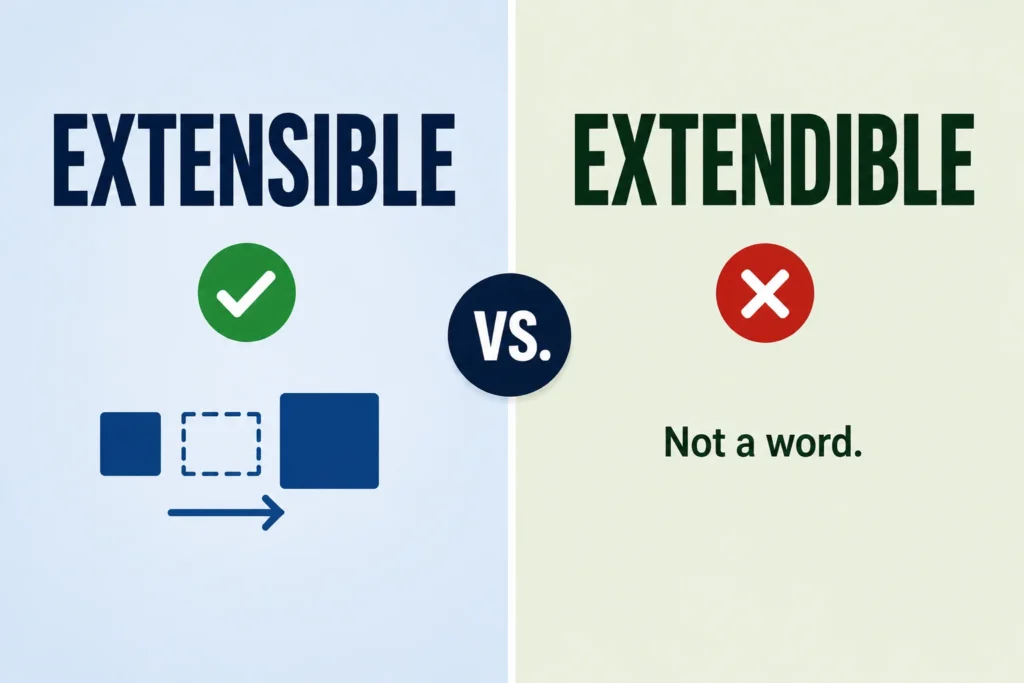
Extensible and extendible look almost interchangeable. Both describe something that can be extended, yet English speakers often use them in different contexts. The distinction becomes especially important in technical writing, where extensible has a well-established meaning related to software, systems, and future functionality. Extendible, meanwhile, commonly describes something that can be made longer, larger, or valid for a longer period.
That difference sounds small. In practice, it can change how clearly your sentence communicates its meaning.
If you’re writing about a software platform that accepts plugins, for example, extensible is usually the better choice. If you’re describing a ladder that can become longer, extendible or extendable fits naturally. Major dictionaries support this broad distinction: Cambridge specifically uses extensible for computer programs and languages that users can change to suit their needs, while Oxford lists extendible as an alternative form of extendable for things that can be made longer or valid for longer.
| Word | Main idea | Common context | Example |
| Extensible | Able to accept additions or extensions | Software, technology, systems | an extensible platform |
| Extendible | Able to be extended | Physical objects, time, scope | an extendible ladder |
| Extendable | Able to be made longer or last longer | General and everyday English | an extendable table |
The easiest rule is simple: think “new capabilities” for extensible and “greater length or duration” for extendible. The words can overlap, but that distinction will usually help you choose naturally.
What Does Extensible Mean?
Extensible means capable of being extended. That basic dictionary definition is broad, but modern usage gives the word a particularly strong association with technology and systems that can gain new capabilities. Collins and Dictionary.com both define it broadly as something that can be extended. Cambridge goes further by identifying a specific IT sense: a computer program or language that users can change to suit what they need to do.
In other words, an extensible thing doesn’t merely become bigger. It can often do more.
Imagine a software application with a small core. Developers build that core to accept plugins. Later, someone adds a calendar plugin, an analytics plugin, or a payment integration. The original application remains in place while its capabilities grow.
That’s extensibility.
The important idea is not simply expansion. It’s planned or supported expansion.
Extensible Definition and Meaning
The adjective extensible describes something that can be extended or expanded. In technical contexts, it often suggests that a system has been designed with future additions in mind.
For example:
An extensible platform allows developers to add new features without rewriting the entire system.
The sentence doesn’t mean that the platform physically gets larger. Instead, its functionality grows.
This distinction matters because “extension” can mean several things. A building extension adds physical space. A contract extension adds time. A software extension can add functionality. Extensible can describe all kinds of things, but technology has given the word a particularly specific flavor.
Cambridge’s current definition reflects that usage by placing its IT meaning front and center.
Extensible in Software and Technology
Software designers use extensible when they want to describe systems that support future additions.
A well-designed extensible system may provide:
- Plugins
- Extensions
- Modules
- APIs
- Hooks
- Add-ons
- Integration points
- Extension interfaces
- Configuration mechanisms
- Developer-facing interfaces
These mechanisms give developers a controlled way to add functionality.
Microsoft’s current Windows documentation, for example, describes several forms of app extensibility, including app extensions, package extensions, optional packages, and app services. Microsoft explains that app extensions can provide a plugin model in which a host application discovers extension packages.
That is a textbook example of the technical meaning of extensible.
An extensible application doesn’t necessarily expose every internal component. Instead, it exposes carefully designed points where additional functionality can connect.
This approach can make a system easier to maintain. Developers can improve one part without rebuilding everything else.
Why Extensibility Matters in Software
Software rarely stays frozen.
Users request new features. Businesses add integrations. Developers discover new use cases. Platforms need to work with technologies that didn’t exist when the original product launched.
An extensible architecture helps a system respond to those changes.
Consider a text editor. The original version might support basic typing and formatting. Later, developers could add:
- Markdown support
- Grammar checking
- AI-assisted editing
- Code highlighting
- Cloud storage
- Custom themes
If the editor provides a supported extension mechanism, developers can add these capabilities without replacing the entire application.
That design creates a useful separation between the core system and its extensions.
Microsoft has documented this principle for application development for years. Its guidance on .NET plug-ins notes that applications can become more attractive when developers allow others to extend them through mechanisms such as plug-ins and macros.
Examples of Extensible Systems
Here are several natural examples:
- An extensible programming language can support additional libraries or language features.
- An extensible application can accept plugins.
- An extensible platform can support third-party integrations.
- An extensible API can accommodate additional functionality or resources.
- An extensible architecture can evolve as requirements change.
- An extensible framework can let developers build specialized components on top of it.
The key question is always: What can you add?
If the answer involves functionality, components, integrations, or capabilities, extensible often makes sense.
What Does Extendible Mean?

Extendible also means capable of being extended. The important difference lies less in the dictionary definition and more in how people commonly use the word.
Oxford’s American and general learner dictionaries treat extendible as an alternative form of extendable. They define the word family around something that can be made longer or remain valid for a longer period. Their examples include an extendable ladder and a visa that can last beyond its original period.
So when you see extendible, think about something whose length, duration, range, or scope can increase.
For example:
The dining table is extendible.
The table can physically become longer.
Or:
The agreement is extendible for another six months.
The agreement can continue beyond its original duration.
The word doesn’t require a technological system or plugin architecture. That’s where it often differs from the modern technical sense of extensible.
Extendible Definition and Meaning
Extendible describes something that can be extended.
That extension may involve:
- Physical length
- Time
- Duration
- Distance
- Scope
- Coverage
- Validity
- Reach
The word therefore works naturally in many situations.
For example:
The contract is extendible for another year.
Here, the contract’s duration increases.
The ladder has an extendible section.
Here, its physical length increases.
The deadline is extendible under certain conditions.
Here, the relevant period becomes longer.
These examples share one central idea: something already exists, and you can extend its reach or duration.
Extendible in Everyday Use
You may encounter extendible when describing objects that physically expand.
Common examples include:
- Ladders
- Tables
- Poles
- Handles
- Arms
- Cables
- Supports
- Furniture
- Structures
The word can also apply to legal or administrative periods.
For instance:
- An extendible lease
- An extendible visa
- An extendible deadline
- An extendible contract
- An extendible agreement
Oxford specifically gives examples involving an extendible ladder and a visa that can be extended from 14 days to one month.
Extendible vs Extendable
There’s another word worth knowing: extendable.
In many everyday contexts, extendable sounds more natural to modern American readers. Cambridge defines it as something that can be made longer and also uses it for something that can last longer. Oxford explicitly lists extendible as an alternative form of extendable.
So you might write:
We bought an extendable ladder.
That sounds completely natural.
You could also encounter:
We bought an extendible ladder.
The meaning remains clear.
The important point is that extendible isn’t simply a misspelling. It is a recognized word. Major dictionaries record it as a legitimate form.
Extensible vs Extendible: The Clear Difference
The difference becomes much easier once you focus on what is being extended.
Extensible often emphasizes additional capabilities.
Extendible often emphasizes greater length, duration, or scope.
Here’s the practical comparison:
| Aspect | Extensible | Extendible |
| Basic meaning | Capable of being extended | Capable of being extended |
| Strongest modern association | Software and technology | General and physical usage |
| Typical focus | Functionality and capabilities | Length, duration, or reach |
| Common with plugins | Yes | Less natural |
| Common with software architecture | Yes | Uncommon |
| Common with ladders | Less common | Yes |
| Common with contracts | Possible but unusual | Natural |
| Common with deadlines | Unusual | Natural |
| Technical term | Extensibility | Extendibility |
| Everyday alternative | — | Extendable |
There’s an important nuance here.
The distinction isn’t an absolute grammatical rule. Dictionaries give both words the basic sense of being capable of extension. Collins, for example, defines extensible simply as capable of being extended.
Therefore, you shouldn’t claim that extendible can never describe software or that extensible can never describe something physical. English doesn’t work that neatly.
Instead, think about conventional usage.
An Easy Memory Trick
Use this mental model:
Extensible = add more ability.
Extendible = make it longer or continue it.
Imagine two objects.
The first is a software platform. You install a plugin, and suddenly it performs a new task. Its capabilities have expanded. That’s extensible.
The second is a dining table. You pull out its leaves and make the tabletop longer. That’s extendible.
The physical table didn’t suddenly learn a new skill. It simply gained length.
That distinction is simple enough to remember when you’re writing quickly.
Is Extensible the Same as Extendible?
Not exactly, although the meanings overlap.
Both words describe something that can be extended. That’s why people sometimes use them interchangeably without confusion.
However, usage creates a meaningful distinction.
Consider these two sentences:
The platform has an extensible architecture.
The table has an extendible design.
Both are understandable. Yet each word feels natural because it matches the subject.
Now switch them:
The platform has an extendible architecture.
The table has an extensible design.
Neither sentence is necessarily impossible. The problem is naturalness and precision.
The first sounds less conventional in software writing. The second can sound more technical or unusual than necessary for an ordinary table.
That’s why good word choice isn’t always about finding a word that’s technically possible. It’s about choosing the word that communicates the intended idea most naturally.
The Role of Context
Context does most of the work.
If you’re discussing:
- Software
- APIs
- Frameworks
- Plugins
- Programming languages
- Application architecture
- Platform design
then extensible will usually be the stronger choice.
If you’re discussing:
- Ladders
- Tables
- Contracts
- Deadlines
- Visas
- Physical length
- Time periods
then extendible or extendable may sound more natural.
This isn’t a rigid divide. It’s a usage preference shaped by context.
Extensible vs Extendible in Software
Software is where the distinction becomes particularly useful.
When developers describe a product as extensible, they usually mean that the system provides a way to add functionality beyond its original capabilities.
The system might expose an API.
The goal is the same: make the core system capable of growing without forcing every new feature into the core itself.
Why Developers Prefer “Extensible”
Modern software often needs to support users with very different requirements.
One customer might need accounting integration. Another might need analytics. A third might need a custom workflow.
Building every possible feature into the core application creates problems.
The software can become:
- Larger
- Harder to maintain
- More expensive to test
- More difficult to understand
- More tightly coupled
- Slower to evolve
An extensible design offers another path.
The core handles essential functionality. Extensions handle specialized needs.
Microsoft’s current Windows App SDK documentation illustrates this approach with app extensions, package extensions, optional packages, and app services. Its extension model allows applications to discover and work with additional functionality.
A Simple Software Example
Imagine an online store platform.
The core system handles:
- Products
- Customers
- Orders
- Payments
- Inventory
Now imagine that users want additional features.
One business wants a loyalty program. Another wants advanced shipping calculations. Another wants a specialized tax integration.
An extensible platform could provide an extension system that lets developers add these capabilities.
The core platform doesn’t need to become a completely different product for every customer.
That’s the practical value of extensibility.
Extensible Architecture
An extensible architecture anticipates future change.
That doesn’t mean developers can predict every future requirement. They can’t.
Instead, they create sensible boundaries and interfaces that make future additions possible.
A strong extensible architecture may use:
- Stable APIs
- Plugin interfaces
- Event hooks
- Modular components
- Dependency injection
- Service interfaces
- Extension points
- Configuration layers
These mechanisms allow additional behavior without requiring extensive changes to the core.
Microsoft Research has described extensible software platforms in terms of public interfaces that support extensions. The research specifically contrasts well-behaved extensions using documented interfaces with ad hoc extensions that depend directly on implementation details.
That distinction matters.
A system isn’t truly useful merely because someone can hack an addition onto it. Good extensibility gives developers a supported and predictable path for extending the system.
Extensibility vs Extendibility
The nouns extensibility and extendibility follow the same general distinction.
What Does Extensibility Mean?
Extensibility is the quality or property of being extensible.
In software, it describes how easily a system can accept new functionality or extensions.
For example:
The framework’s extensibility makes it suitable for large development teams.
The sentence focuses on the system’s ability to grow through additional capabilities.
A highly extensible framework may let developers add features without modifying its central codebase extensively.
That can support:
- Customization
- Integration
- Reuse
- Long-term growth
- Third-party development
- Product variation
Dictionary.com and Collins both recognize extensibility as the noun form associated with extensible.
What Does Extendibility Mean?
Extendibility refers to the ability to extend something.
The concept is broader and can apply to physical or temporal extension.
For example:
The extendibility of the agreement depends on the renewal terms.
Here, the focus is on whether the agreement can continue.
In technical writing, however, extensibility is generally the more established term when discussing software design.
That doesn’t make extendibility grammatically wrong. It simply means that technical readers are more likely to expect extensibility when the subject is software.
Extensible vs Extendible vs Extendable
Adding extendable to the comparison makes the picture clearer.
| Word | Typical meaning | Natural example |
| Extensible | Capable of being extended, especially by adding functionality | an extensible software platform |
| Extendible | Capable of being extended | an extendible ladder |
| Extendable | Capable of being made longer or lasting longer | an extendable table |
Oxford explicitly treats extendible as another form of extendable.
Cambridge likewise defines extendable around making something longer or making something last longer.
This creates a useful practical guideline:
Use “extensible” for systems and capabilities. Use “extendable” or “extendible” for length and duration.
Again, context can override that guideline. But it works well in ordinary writing.
Real-World Examples of Extensible Things
The word extensible appears naturally when something can gain new functionality.
Software Platforms
An extensible software platform lets developers add features through supported mechanisms.
Programming Languages
An extensible programming environment may allow developers to add libraries, tools, syntax, or other capabilities.
APIs
An extensible API can evolve to support additional resources or operations without destroying compatibility with existing users.
Applications
An extensible application can accept plugins or integrations.
Frameworks
An extensible framework gives developers ways to customize or expand its behavior.
Data Models
An extensible data model can accommodate additional fields or concepts without forcing a complete redesign.
The common thread isn’t physical size.
It’s capability.
Real-World Examples of Extendible Things
Extendible works naturally when something can become longer or continue for a greater period.
Extendible Ladder
An extendible ladder can increase its physical reach.
Extendible Table
An extendible table can provide additional seating space when its sections or leaves expand.
Extendible Contract
An extendible contract can continue beyond its initial term.
Extendible Deadline
An extendible deadline can move to a later date under specified conditions.
Extendible Visa
An extendible visa can remain valid for longer than its initial period if the relevant rules allow it.
These examples focus on extension itself, not the addition of unrelated functionality.
Common Mistakes With Extensible and Extendible
The biggest mistake is treating the words as perfect synonyms in every situation.
Mistake: Assuming Only One Word Is Correct
You may see claims that one word is always correct and the other is always wrong.
That’s too simplistic.
Both extensible and extendible are legitimate words. Dictionary sources define extensible as capable of being extended, while Oxford recognizes extendible as an alternative form of extendable.
The real question is usually which word fits the context best.
Mistake: Using Extendible for Every Technical System
A developer might write:
This is an extendible software architecture.
Readers will understand it. Still, extensible software architecture is more idiomatic in modern technical English.
Why?
Because software extensibility has become a recognized design concept.
Microsoft’s own documentation uses extensibility repeatedly when describing mechanisms that let applications work with extensions and additional functionality.
Mistake: Assuming Extensible Means Physically Longer
The word doesn’t only describe physical stretching.
A software platform can be extensible without becoming physically larger.
Its functionality expands.
That’s one of the most important distinctions for language learners.
Mistake: Ignoring Extendable
Sometimes writers debate extensible versus extendible when extendable would be the clearest choice.
For example:
We need an extendable table.
That’s straightforward.
You don’t need a specialized technical word when the ordinary word communicates the idea perfectly.
How to Choose Between Extensible and Extendible
When you’re unsure, don’t stare at the spelling. Look at the type of extension.
Use Extensible When You Mean:
- Adding functionality
- Adding capabilities
- Adding components
- Supporting plugins
- Supporting integrations
- Expanding software behavior
- Allowing future system enhancements
- Designing for third-party extensions
Examples:
The application has an extensible plugin system.
The framework uses an extensible architecture.
We need an extensible API for future integrations.
Use Extendible When You Mean:
- Increasing physical length
- Increasing duration
- Continuing validity
- Extending a deadline
- Extending an agreement
- Increasing range or scope
Examples:
The ladder is extendible.
The agreement is extendible for another year.
The deadline is extendible under certain conditions.
A Five-Second Test
Ask yourself:
Am I adding what something can do?
If yes, extensible will often be the better choice.
Am I making something longer or allowing it to continue?
If yes, extendible or extendable will often fit better.
That quick test won’t solve every unusual case. It will handle most ordinary writing situations.
Extensible vs Extendible Examples in Sentences
Seeing the words in complete sentences makes the distinction easier to absorb.
Extensible Examples
The company built an extensible platform that supports third-party plugins.
The application uses an extensible architecture to accommodate future features.
Developers chose an extensible framework because customers needed custom integrations.
The software provides an extensible API for external services.
The programming environment is highly extensible through community-developed packages.
Each example emphasizes new capabilities.
Extendible Examples
We bought an extendible ladder for the construction project.
The dining table has an extendible section for larger gatherings.
The lease is extendible if both parties agree to renew it.
The deadline is extendible under the terms of the agreement.
The visa may be extendible under applicable regulations.
Each example emphasizes length, duration, or continuation.
Compare the Meaning
Consider these two sentences:
The software is extensible.
The ladder is extendible.
The first suggests that the software can gain functionality.
The second suggests that the ladder can gain physical reach.
That’s the distinction in its simplest form.
Why English Has Confusing Word Pairs Like This
English contains many pairs that overlap in meaning but differ in usage.
That’s partly because English has absorbed vocabulary from many linguistic sources and developed multiple ways to express similar ideas.
Extensible and extendible both connect to the idea of extending something. Collins traces the word family back to the Latin extendere, meaning “to stretch out.” It also lists extendible and extendable as derived forms associated with extend.
Over time, different forms can become more common in particular fields.
Technology is a good example.
Technical communities repeatedly use terms in specific ways. Once a particular expression becomes standard, readers begin to recognize it as part of the field’s vocabulary.
That’s why extensibility now feels completely natural in software engineering.
The word doesn’t merely mean “can be extended.” It often communicates a particular software design property.
A Quick Mental Model to Remember the Difference
Think about two doors.
One door has a mechanism that lets you attach new sections and turn it into a wider modular entrance. Its design anticipates additions.
That’s extensible.
Now imagine a telescoping door handle that slides outward to reach farther.
That’s extendible.
The analogy isn’t a dictionary rule. It’s simply a memory aid.
Extensible asks: “What else can this do?”
Extendible asks: “How much farther can this go?”
That distinction captures the most useful difference between the words.
Extensible vs Extendible: Quick Reference
| If you’re talking about… | Best choice |
| Software plugins | Extensible |
| Application extensions | Extensible |
| Software architecture | Extensible |
| APIs | Extensible |
| Programming frameworks | Extensible |
| Third-party functionality | Extensible |
| A ladder | Extendible / Extendable |
| A table that gets longer | Extendible / Extendable |
| A contract that continues | Extendible / Extendable |
| A deadline that moves later | Extendible / Extendable |
| A visa that lasts longer | Extendible / Extendable |
| Physical reach | Extendible / Extendable |
One caveat matters: extensible has a broader dictionary meaning than its software use. Collins and Dictionary.com both define it generally as capable of being extended.
So don’t treat the table as an unbreakable grammar law. Treat it as a usage guide.
Final Practical Insight
The safest way to remember extensible vs extendible is to focus on the kind of growth you’re describing.
When something can gain new functions, features, integrations, or capabilities, extensible usually fits best. That’s why you commonly see phrases such as extensible software, extensible architecture, and extensible platforms.
When something can become longer, larger, broader, or valid for more time, extendible can work naturally. In everyday American English, extendable is also a common alternative. Oxford specifically identifies extendible as an alternative form of extendable, while Cambridge uses extendable for things that can be made longer or last longer.
The two words aren’t enemies. They overlap. The difference comes from context and conventional usage.
So, if you’re describing a platform that welcomes plugins, choose extensible. If you’re describing a ladder that reaches farther, choose extendible or extendable. When the meaning is ambiguous, choose the word that tells your reader exactly what is being extended.
What Does Extendible Mean?
Extendible has a straightforward core meaning: something can be extended. In everyday English, that usually means you can make an object longer, increase its range, or allow something to continue for a longer period. Oxford lists extendible as an alternative form of extendable and defines the pair as something that can be made longer or made valid for a longer time.
That makes extendible especially useful when the thing being extended already has a clear physical size, reach, duration, or limit.
The important point is that extendible doesn’t necessarily suggest a system designed around future additions. It simply tells you that extension is possible.
Extendible Definition and Meaning
The adjective extendible comes from the same underlying idea as the verb extend: something can be stretched, lengthened, increased, or continued.
The verb extend itself has several related meanings. Cambridge defines it as adding to something to make it bigger or longer, making something last longer, stretching something out, or allowing something to reach or continue farther.
That range explains why extendible can appear in different contexts.
| What can be extended? | What “extendible” means |
| Physical object | It can become longer or reach farther |
| Contract | It can continue beyond its original term |
| Deadline | It can move to a later date |
| Visa | Its validity can continue |
| Range | It can reach farther |
| Structure | It can accommodate additional length or space |
Consider a ladder.
A standard ladder has a fixed maximum length. An extendible ladder uses sections that allow you to increase its reach. The defining feature is physical extension.
Now consider a contract.
If the original agreement lasts one year but the parties can renew it for another year, the contract may be described as extendible. Here, nothing becomes physically longer. The duration increases.
Both examples follow the same basic idea: something can go beyond its original limit.
Extendible in Everyday Use
You’ll most often understand extendible through ordinary objects and situations.
Think about the items around you that change size or duration when you need them to.
The same concept works with time.
A lease can be extendible. A deadline can be extendible. A visa can be extendible. A driving period or authorization can also be extendible when the relevant rules permit additional time.
Cambridge gives extendable examples involving a ladder and a lease. Its Business English definition also uses the word for something that can be made to last longer.
Oxford makes the relationship even clearer by listing extendible as another form of extendable and giving examples involving an extendable ladder and a visa whose validity can increase from 14 days to one month.
Extendible vs Extendable
If you’ve wondered whether extendible or extendable sounds better, you’re not imagining the similarity. The two words have essentially the same core function in many contexts.
Oxford explicitly lists:
extendable — also extendible
Its definition covers something that can be made longer or made valid for a longer time.
In everyday American English, extendable will often feel more familiar.
For example:
We bought an extendable ladder.
That sounds natural and immediately communicates the idea.
You could also write:
We bought an extendible ladder.
The meaning remains clear because extendible is a recognized alternative.
However, when you’re writing for a general audience, extendable may be the more transparent choice for physical objects and time periods. Extendible is still correct when it fits the intended meaning and style.
Examples of Extendible
Here are several examples that show the word in different contexts:
- The ladder is extendible, allowing workers to reach higher windows.
- The table has an extendible section that provides additional seating.
- The contract is extendible for another twelve months.
- The deadline is extendible if the applicant meets the required conditions.
- The visa is extendible under the applicable rules.
- The handle is extendible, giving the user additional reach.
- The support arm is extendible when the equipment needs a wider range.
- The agreement has an extendible term if both parties approve the renewal.
Notice what these examples have in common. They don’t primarily describe a system gaining an entirely new capability through a plugin or extension framework. Instead, they describe something going farther than its original state.
Extensible vs Extendible: The Clear Difference
Now the distinction becomes much easier.
Extensible and extendible share the idea of extension. The difference comes from the kind of extension you have in mind and the context in which people normally use each word.
In modern technical English, extensible strongly connects with systems that can accept additional functionality. Cambridge specifically defines the IT sense as describing a computer program or language that users can change to make it suitable for their needs.
Extendible, meanwhile, commonly points toward something that can become longer or remain valid for longer. Oxford treats it as an alternative to extendable in exactly this sense.
A useful comparison looks like this:
| Feature | Extensible | Extendible |
| Core idea | Capable of being extended | Capable of being extended |
| Strongest association | Added functionality | Increased length or duration |
| Common field | Software and technology | Everyday and physical contexts |
| Typical object | Platform, framework, application | Ladder, table, contract |
| Common noun | Extensibility | Extendibility |
| Common alternative | — | Extendable |
| Main question | “What else can it do?” | “How much farther can it go?” |
That last row gives you the most useful memory trick.
If you add capabilities, think extensible.
If you add length, reach, or time, think extendible.
An Easy Memory Trick
Imagine a software platform with a plugin system.
The platform starts with five functions. You install another plugin, and it gains three more capabilities.
You haven’t simply made the platform “longer.” You’ve expanded what it can do.
That’s extensible.
Now imagine a telescoping ladder.
You pull out another section, and the ladder reaches several feet higher.
You’ve increased its physical reach.
That’s extendible.
The same idea works with time.
A contract originally lasts twelve months. The parties renew it for another six months. You’ve increased its duration.
Again, extendible or extendable fits the situation naturally.
So remember:
Extensible adds capability. Extendible adds reach, length, or time.
It’s a practical memory aid rather than an absolute grammar rule. The two words overlap, and context can influence which one sounds best.
Is Extensible the Same as Extendible?
They’re related, but you shouldn’t treat them as perfect synonyms in every sentence.
At the dictionary level, extensible has a broad meaning connected to the ability to be extended. Collins and other dictionaries recognize that general sense. Yet English speakers have developed a particularly strong technical use for extensible.
That’s why the surrounding noun matters so much.
Compare these examples:
The software has an extensible architecture.
The ladder has an extendible design.
Both sentences feel natural because the adjective matches the type of extension being discussed.
Now reverse them:
The software has an extendible architecture.
The ladder has an extensible design.
Readers can understand both. Still, they don’t sound equally natural.
The software example sounds less conventional because technical writers usually use extensible when discussing architecture that supports additional functionality.
The ladder example isn’t necessarily incorrect with extensible, but extendible or extendable makes the physical meaning clearer.
Context Determines the Better Choice
Context matters more than the spelling.
Use extensible naturally when you’re discussing:
- Software
- Applications
- Frameworks
- Programming languages
- APIs
- Plugins
- Modules
- Architecture
- Platforms
- Third-party integrations
Use extendible or extendable naturally when you’re discussing:
- Ladders
- Tables
- Handles
- Poles
- Contracts
- Leases
- Deadlines
- Visas
- Time periods
- Physical reach
That doesn’t mean extensible can never appear outside technology. It can.
Cambridge’s corpus examples show extensible used beyond conventional software contexts, including extensible structures and physical components.
Likewise, extendable can appear in technical writing. Cambridge’s corpus includes examples such as systems and models that are extendable.
So the distinction is about typical usage and intended meaning, not a rigid grammatical wall.
Extensible vs Extendible in Software
Here’s where the difference becomes especially important.
If you’re writing about software architecture, extensible is usually the term your technical readers expect.
An extensible system provides a way to add functionality without forcing developers to rebuild the entire core system.
That can involve plugins, modules, APIs, hooks, extension points, or other mechanisms.
Cambridge directly identifies extensible as an IT term for a computer program or language that users can change to suit their needs.
That definition captures the heart of software extensibility.
Why Developers Prefer “Extensible”
Software requirements change constantly.
A platform that works perfectly today might need new integrations next year. Users may request capabilities that the original developers never anticipated. Third-party companies may want to connect their own services.
An extensible architecture gives developers room to respond.
For example, imagine an inventory platform with a stable core:
- Product records
- Stock levels
- Orders
- Customers
- Basic reporting
Later, customers request:
- Barcode integrations
- Warehouse automation
- Accounting connections
- Advanced analytics
- Custom notifications
A poorly designed system might require developers to modify large sections of the core code for every addition.
An extensible system can instead provide defined extension points.
Developers can build new components around those points.
That doesn’t mean extensibility automatically makes software well designed. A badly designed extension system can still create maintenance problems. Good extensibility requires clear interfaces, sensible boundaries, documentation, and predictable behavior.
The word therefore carries a useful design implication.
You’re not merely saying:
“Someone can change this.”
You’re often saying:
“This system supports controlled growth through extensions.”
That’s a much more specific idea.
Extensible Architecture
An extensible architecture separates a stable core from additional functionality.
The exact implementation varies by technology, but common mechanisms include:
- Plugin systems
- Extension APIs
- Hooks
- Events
- Modules
- Interfaces
- Service layers
- Configuration points
- Package systems
The architecture defines where and how additions can connect.
This matters because unrestricted modification isn’t the same as extensibility.
Suppose developers can edit every line of a program’s source code. Technically, they can change it. But that doesn’t necessarily make the program extensible in the architectural sense.
A well-designed extensible system gives developers a supported path for extension.
That difference is crucial.
Extensibility vs Extendibility
The noun forms follow the same broad pattern.
What Does Extensibility Mean?
Extensibility describes the quality of being extensible.
In software, it refers to how well a system supports additional functionality.
For example:
The framework’s extensibility allows developers to create custom modules.
Here, extensibility doesn’t mean the framework gets physically larger.
It means developers can add new behavior.
A system with strong extensibility may support:
- Third-party plugins
- Custom integrations
- Additional modules
- New interfaces
- Specialized workflows
- Future features
Cambridge’s examples include technical uses such as an extensible ontology and extensible systems that can accommodate further enhancements.
What Does Extendibility Mean?
Extendibility describes the ability to extend something.
The word can cover many forms of extension, including physical size and duration.
For example:
The contract’s extendibility depends on the renewal clause.
The issue isn’t whether the contract can gain new software functionality. The issue is whether its term can continue.
Similarly:
The extendibility of the ladder depends on its locking sections.
Here, the focus is physical reach.
In software writing, however, extensibility remains the more established choice when you mean a system’s ability to gain new functionality.
Extensible vs Extendible vs Extendable
You can’t fully understand this word pair without considering extendable.
In many everyday situations, extendable is arguably the clearest option.
Oxford explicitly lists extendible as an alternative form of extendable. It defines the word as something that can be made longer or made valid for a longer time.
Cambridge gives the same basic idea for extendable, including an extendable ladder and an extendable lease.
That gives you three useful forms:
| Word | Best understood as | Example |
| Extensible | Able to accept extensions or added capability | extensible software |
| Extendible | Able to be extended | extendible ladder |
| Extendable | Able to become longer or last longer | extendable table |
There’s some overlap.
For example, technical writing can use extendable for systems or methods. Cambridge’s corpus includes technical examples such as an extendable system and an extendable model.
That means you shouldn’t invent a rule saying:
“Extendable is only for physical objects.”
It isn’t.
Instead, think of extensible as the established technical term for systems designed to accommodate extensions.
Common Examples of Extensible Things
The clearest examples involve software and technology.
Extensible Software
An application can be extensible when developers can add functionality through supported mechanisms.
Extensible Platforms
A platform can be extensible when third parties can build integrations or additional features on top of it.
Extensible Frameworks
A framework can be extensible when developers can add components or customize behavior through defined interfaces.
Extensible APIs
An API can be described as extensible when its design allows additional functionality or resources without forcing disruptive changes to existing consumers.
Extensible Programming Languages
A programming language or environment can be extensible when users can adapt or expand its capabilities.
Cambridge specifically uses the term in connection with computer programs and languages that users can change for their needs.
The common thread is capability growth.
Common Examples of Extendible Things
Now switch from functionality to reach and duration.
Extendible Ladder
A ladder can extend upward to provide additional reach.
Extendible Table
A table can extend outward to create more surface area.
Extendible Handle
A handle can extend farther when the user needs additional reach.
Extendible Pole
A pole can become longer by adding or sliding sections.
Extendible Contract
A contract can continue beyond its original term.
Extendible Deadline
A deadline can move later when the applicable conditions allow an extension.
Extendible Visa
A visa can remain valid longer if the relevant legal process permits an extension.
Oxford’s examples specifically include an extendable ladder and a visa that can remain valid for a longer period.
The pattern is easy to spot.
The object or period already has a limit. Extension moves that limit outward.
Common Mistakes With Extensible and Extendible
These words create confusion because their basic meanings overlap. The safest approach is to avoid overly rigid rules.
Treating Them as Perfect Synonyms
You can sometimes substitute one for the other without destroying the meaning. That doesn’t make them equally natural everywhere.
Technical readers expect extensible in phrases such as:
extensible architecture extensible framework extensible platform.
For physical objects, extendible or extendable often makes the meaning more immediate.
Assuming Extendible Is Wrong
It isn’t.
Oxford recognizes extendible as an alternative form of extendable.
So correcting every instance of extendible to extendable would be unnecessary.
The better question is whether the chosen word suits the audience and context.
Assuming Extensible Only Belongs to Software
That’s also too narrow.
The basic meaning of extensible is broader than software. Cambridge’s corpus includes uses involving physical and conceptual extension as well as technical systems.
Still, software remains one of the strongest modern contexts for the word.
Confusing Extensible With Scalable
These terms can appear together in technical writing, but they don’t mean the same thing.
Extensible focuses on the ability to add functionality or extensions.
Scalable focuses on adapting to greater workload, demand, or scale.
Oxford defines scalable software or systems as those that can adapt to greater future needs.
For example:
The platform is extensible because developers can add plugins.
The platform is scalable because it can handle a much larger workload.
A system can be both.
But one property doesn’t automatically imply the other.
How to Choose Between Extensible and Extendible
When you’re writing a sentence, start with the noun rather than the adjective.
Ask what you’re actually describing.
Choose Extensible When You’re Talking About:
- Software architecture
- Applications
- Plugins
- Extensions
- Frameworks
- APIs
- Programming languages
- Platforms
- Added functionality
- Future capabilities
Example:
We need an extensible framework that supports custom modules.
Choose Extendible When You’re Talking About:
- Physical length
- Reach
- Duration
- Validity
- Contracts
- Deadlines
- Ladders
- Tables
- Handles
- Poles
Example:
The extendable ladder reaches the upper floor.
Consider Extendable for General Writing
If you’re writing for a broad audience and mean “can be made longer,” extendable can be especially clear.
For example:
We need an extendable table for the dining room.
There’s no need to make the sentence more technical than necessary.
A Five-Second Test
Before choosing the word, ask:
Are you adding capabilities?
Use extensible.
Are you increasing length, reach, or duration?
Use extendible or extendable.
Are you writing about software architecture?
Extensible is usually the safest and most idiomatic choice.
Are you writing about a physical object?
Extendable or extendible will usually communicate the idea clearly.
This approach keeps your writing precise without forcing English into artificial rules.
Extensible vs Extendible: Quick Reference
| Situation | Recommended word | Example |
| Software can accept plugins | Extensible | an extensible application |
| Framework supports custom modules | Extensible | an extensible framework |
| Platform supports integrations | Extensible | an extensible platform |
| Programming language can be adapted | Extensible | an extensible language |
| Ladder can reach higher | Extendible / Extendable | an extendible ladder |
| Table can become longer | Extendible / Extendable | an extendable table |
| Contract can continue | Extendible / Extendable | an extendible contract |
| Visa can last longer | Extendible / Extendable | an extendable visa |
| Deadline can move later | Extendible / Extendable | an extendable deadline |
| System can add functionality | Extensible | an extensible system |
The simplest rule still wins:
Extensible is strongly associated with added functionality. Extendible is strongly associated with being extended in length, reach, or duration.
Neither word is automatically wrong simply because another form might sound more natural.
Good writing depends on meaning, context, audience, and established usage.
Extensible vs Extendible in Software
When software needs to grow, extensible is usually the word you want. In technology, an extensible system can accept new functionality through defined mechanisms without requiring developers to rebuild its entire foundation. Cambridge specifically recognizes this computing sense, describing extensible programs and languages as ones users can change to suit their needs.
That distinction becomes clearer when you look at how modern software works. A platform might begin with a core set of features, then allow developers to add plugins, modules, integrations, or extensions. The system grows in capability rather than simply becoming physically larger.
For example, imagine a content management system that handles pages, users, and media. A developer could add an SEO plugin, an analytics integration, or an e-commerce module. The original platform remains intact while its capabilities expand. That’s exactly the kind of situation where extensible sounds natural.
Why Developers Prefer “Extensible”
Software developers use extensible because the word captures a specific design goal: future functionality can connect to an existing system.
A genuinely extensible system usually provides defined places where developers can add or modify behavior. Those places might include:
- APIs
- Plugin interfaces
- Extension points
- Hooks
- Modules
- Events
- Interfaces
- Add-ons
- Integration layers
- Configuration mechanisms
These features don’t all work in the same way. However, they share an important purpose. They create a controlled path for extending what the software can do.
Microsoft’s documentation provides a useful real-world example. Its Windows application extensibility model includes app extensions, package extensions, optional packages, and app services. These mechanisms allow applications to discover or use additional functionality beyond their basic implementation.
That’s why a phrase such as extensible application architecture feels natural to technical readers.
By contrast, extendible application architecture is understandable but less conventional. It doesn’t clearly signal the established software-design concept of extensibility.
Extensible Architecture Explained
An extensible architecture anticipates change.
That doesn’t mean developers know exactly which features users will request five years from now. They don’t. Instead, the architecture provides stable boundaries that make future additions practical.
A well-designed extensible system might separate its core responsibilities from optional functionality. Developers can then add new components without changing every part of the application.
Think of it like a building with designated connection points. You can add another room because the original structure anticipated expansion. The important feature isn’t merely that someone can physically alter the building. The design makes expansion easier and more predictable.
Software works similarly.
An application might expose a documented API. Third-party developers can use that API to create additional tools. The core application doesn’t need to know every future tool in advance.
This is where extensibility becomes a valuable engineering property.
Microsoft Research has also examined extensible software platforms in terms of public interfaces and supported extension mechanisms. The research highlights the importance of extensions using documented interfaces rather than depending on internal implementation details.
That point matters because modifiable and extensible aren’t necessarily identical.
A program might allow developers to modify its source code. Yet that doesn’t automatically make it a well-designed extensible platform.
Extensibility implies a more deliberate approach.
Extensibility vs Extendibility
The noun forms follow the same basic distinction.
Extensibility describes the quality or property of being extensible. Extendibility describes the ability to be extended more generally.
In software engineering, extensibility is overwhelmingly the more useful term because the field has developed a specific concept around it.
For example:
The framework’s extensibility allows developers to create custom modules.
Here, the sentence focuses on additional functionality.
Now compare:
The contract’s extendibility depends on the renewal clause.
This sentence focuses on duration.
Both nouns describe an ability to extend something. The surrounding subject tells you which one fits best.
What Does Extensibility Mean?
Extensibility refers to how readily a system can accommodate new capabilities or extensions.
A highly extensible framework might allow developers to introduce custom components through documented interfaces. An extensible application might support third-party plugins. An extensible platform might let businesses connect external services.
This can offer several practical advantages:
- Customization
- Integration
- Reuse
- Future expansion
- Third-party development
- Reduced core-system changes
- Greater flexibility
However, extensibility doesn’t mean “add anything without limits.”
Every extension system has boundaries. A platform might support plugins but restrict access to sensitive functions. An API might expose certain resources while keeping internal services private.
Good extensibility therefore balances freedom with control.
What Does Extendibility Mean?
Extendibility is the ability of something to be extended.
The extension could involve physical size, duration, reach, scope, or another measurable limit.
For example:
The extendibility of the agreement depends on both parties’ approval.
Here, extendibility means the agreement can continue.
Or:
The pole’s extendibility makes it useful for reaching high surfaces.
Here, the word refers to physical length.
The term is valid, but you’ll encounter extensibility much more often when reading software documentation.
Extensible vs Extendible vs Extendable
There’s one more word that deserves attention: extendable.
If you’re talking about an ordinary object or period, extendable often sounds more familiar to American English readers.
Oxford lists extendible as an alternative form of extendable. Its definition covers something that can be made longer or remain valid for a longer period.
Cambridge similarly defines extendable around the idea of making something longer or making something last longer.
That gives you three closely related words:
| Word | Main emphasis | Natural example |
| Extensible | Added capability or extension | extensible software |
| Extendible | Ability to be extended | extendible ladder |
| Extendable | Ability to become longer or last longer | extendable table |
The boundaries aren’t absolute. Extendable can appear in technical contexts, and extensible has uses outside software.
Still, conventional usage gives each word a recognizable “home.”
Extensible belongs especially comfortably in software and technology.
Extendible works naturally when something can be extended.
Extendable often provides the clearest everyday alternative when something can become longer or last longer.
Why Extensibility Matters in Modern Software
Modern software rarely serves one fixed purpose forever.
A business platform might eventually need payment integrations. A design application might need new export formats. A database tool might need custom connectors. A programming environment might need community-built packages.
Developers can’t predict every future requirement.
An extensible design gives the software room to evolve.
A Practical Example
Consider an imaginary project-management application.
Its original version includes:
- Projects
- Tasks
- Users
- Deadlines
- Basic reports
After launch, customers request more capabilities.
One customer wants Slack integration. Another needs advanced time tracking. A third needs custom reporting. A fourth wants an accounting connection.
A rigid application might require developers to add every feature directly into the core.
An extensible application could instead expose APIs and extension points.
Developers could then build separate components for each requirement.
The result isn’t just more features. The architecture becomes capable of supporting different users without forcing one fixed configuration on everyone.
That’s the practical meaning behind software extensibility.
Extensible Doesn’t Mean Unlimited
It’s tempting to think that an extensible system should allow developers to change anything.
That’s not necessarily desirable.
A strong extension model controls what extensions can access.
This protects the core system while still allowing meaningful customization.
In other words, good extensibility isn’t chaos.
It’s structured flexibility.
Extensible vs Extendible in Technical Writing
Word choice becomes particularly important in documentation.
Technical readers often rely on established terminology to understand a system quickly. If a product manual says:
“The platform provides an extensible plugin architecture.”
Most developers immediately understand the intended idea.
The phrase signals that the platform supports additional functionality through an extension mechanism.
If the same manual says:
“The platform provides an extendible plugin architecture.”
Readers will probably understand it, but the wording feels less idiomatic.
The difference isn’t that extendible suddenly becomes grammatically impossible. The issue is technical convention.
When a specialized field consistently favors one term, using that established term improves clarity.
This principle applies beyond software. Professional writing generally benefits from terminology that readers already recognize.
Real-World Examples of Extensible Technology
Several types of technology naturally illustrate extensibility.
Plugin-Based Applications
Applications that accept plugins provide one of the clearest examples. A plugin adds functionality while the main application continues performing its original tasks.
Web Platforms
A web platform can expose extension APIs that allow developers to create additional features.
Development Frameworks
Frameworks often provide interfaces or components that developers can customize or replace.
APIs
An API can support extensions by allowing external applications to interact with additional resources or functionality.
Programming Environments
Development environments may support extensions for debugging, formatting, language support, testing, or source control.
Operating Systems
Operating systems can provide extension mechanisms that allow applications or system components to interact with additional services.
In every case, the central idea remains the same:
The system has room for additional capability.
Extensible vs Extendible: Practical Comparison
| Question | Extensible | Extendible |
| Can it describe something capable of extension? | Yes | Yes |
| Is it strongly associated with software? | Yes | Less so |
| Does it commonly describe added functionality? | Yes | Less commonly |
| Can it describe physical extension? | Sometimes | Yes |
| Can it describe longer duration? | Sometimes | Yes |
| Is it common in software architecture? | Very common | Uncommon |
| Is it a recognized English word? | Yes | Yes |
| Related noun | Extensibility | Extendibility |
| Common everyday alternative | — | Extendable |
The safest interpretation isn’t “one word is right, and the other is wrong.”
Instead, think:
Extensible = designed or suited to gain additional capability.
Extendible = capable of being extended in length, duration, reach, or scope.
That distinction gives you enough precision for most writing situations.
Common Examples of Extensible Things
The following phrases sound natural in technical writing:
- Extensible software
- Extensible architecture
- Extensible framework
- Extensible platform
- Extensible API
- Extensible programming language
- Extensible application
- Extensible data model
- Extensible plugin system
- Extensible interface
Each phrase suggests that someone can add or adapt functionality.
For example:
The company chose an extensible platform to support future integrations.
The platform’s value comes from its ability to accommodate new capabilities.
Common Examples of Extendible Things
Now consider these:
- Extendible ladder
- Extendable table
- Extendible handle
- Extendible pole
- Extendible contract
- Extendible lease
- Extendible deadline
- Extendible visa
- Extendible agreement
- Extendible term
These examples focus on length, reach, or duration.
For instance:
The company signed an extendible contract with a twelve-month renewal option.
The contract isn’t gaining new functionality. Its duration can increase.
Likewise:
The technician used an extendible ladder to reach the upper window.
The ladder isn’t gaining a new capability through software. Its physical reach increases.
A Useful Way to Think About the Difference
Picture a toolbox.
An extensible toolbox lets you add new compartments, attachments, or specialized tools through a planned system. Its range of capabilities grows.
An extendible toolbox would be one whose physical length or capacity can increase.
The distinction is subtle but useful.
Ask yourself:
What exactly is changing?
If the answer is functionality, features, or capability, choose extensible.
If the answer is length, reach, duration, or validity, extendible or extendable may be the better fit.
That one question can eliminate most confusion between these related words.
Common Mistakes With Extensible and Extendible
The biggest mistake with extensible vs extendible is assuming that one word must always be correct while the other must always be wrong. That’s not how these words work. Both describe the possibility of extension, but established usage gives them different strengths. Extensible has a particularly strong place in software and technical language, while extendible often works for things that can become longer or continue for a longer period. Oxford recognizes extendible as an alternative form of extendable, while Cambridge gives extensible a specific computing meaning.
Mistake: Treating Them as Perfect Synonyms
The words overlap, but swapping them freely can make a sentence sound unusual.
Consider:
The application has an extensible architecture.
That sounds natural in software writing because the architecture can accommodate additional functionality.
Now consider:
The ladder has an extendible design.
That also sounds reasonable because the ladder can become longer.
But switching the terms creates less familiar phrasing:
The application has an extendible architecture.
The ladder has an extensible design.
Readers can understand both sentences, yet neither communicates the intended idea as efficiently.
Good word choice isn’t only about grammatical possibility. It also depends on conventional usage.
Mistake: Assuming Extendible Is Incorrect
Some writers mistakenly treat extendible as a spelling error.
It isn’t.
Oxford lists extendible as an alternative form of extendable, and its definition covers things that can be made longer or remain valid for longer.
So this sentence is legitimate:
The ladder is extendible.
However, extendable may sound more familiar in everyday American English:
The ladder is extendable.
Neither needs to be “corrected” simply because another form is more common.
Mistake: Assuming Extensible Only Refers to Software
Although extensible has a strong technical association, its basic meaning is broader.
Cambridge defines extensible in general terms and also identifies its computing sense.
So the word can describe more than software.
Still, when your subject involves plugins, APIs, frameworks, applications, platforms, or software architecture, extensible is usually the clearest choice.
Mistake: Confusing Extensible With Scalable
Technical writing often uses extensible and scalable in the same discussion, but they describe different qualities.
An extensible system can gain new capabilities.
A scalable system can handle increasing workloads or demand.
For example:
The platform is extensible because developers can add plugins.
The platform is scalable because it can support more users.
A system can be both extensible and scalable. One doesn’t automatically imply the other.
How to Choose Between Extensible and Extendible
Choosing the right word becomes much easier when you focus on what is actually being extended.
If you’re adding functionality to an existing system, extensible is usually the stronger choice. If you’re increasing physical length, reach, duration, or validity, extendible or extendable usually fits better.
Use Extensible When You Mean Additional Capability
Choose extensible when the subject can gain:
- New features
- New functions
- Plugins
- Modules
- Integrations
- Extensions
- Custom behavior
- Additional capabilities
For example:
The platform uses an extensible architecture that supports third-party integrations.
Developers built an extensible framework for custom applications.
The application has an extensible plugin system.
These sentences all focus on what the system can do after extension.
Use Extendible When You Mean Greater Length or Duration
Choose extendible when something can become:
- Longer
- Larger
- Wider
- Farther-reaching
- Longer-lasting
- Valid for a longer period
For example:
The ladder is extendible.
The agreement is extendible for another year.
The deadline is extendable under certain conditions.
The table has an extendable section.
Here, extension changes the object’s size or reach or extends a period of time.
Use Extendable When It Sounds More Natural
For general audiences, extendable can often be the easiest choice.
Oxford treats extendible as an alternative form of extendable, while Cambridge defines extendable as something that can be made longer or last longer.
So you might write:
We bought an extendable table for the dining room.
That’s direct and easy to understand.
You don’t need to force extendible into every sentence simply because you’re comparing these words.
Extensible vs Extendible Examples in Sentences
Examples provide the fastest way to see how the words behave.
Extensible Sentence Examples
The company developed an extensible platform for third-party developers.
This extensible framework supports custom modules.
The application uses an extensible architecture that can accommodate future features.
Developers created an extensible API for external integrations.
The programming environment is highly extensible through additional packages.
An extensible system can evolve without requiring major changes to its core.
Each example centers on additional functionality.
Extendible Sentence Examples
The technician used an extendible ladder to reach the roof.
The dining table has an extendible section for large gatherings.
The contract is extendible for another twelve months.
The deadline is extendible when the required conditions are met.
The visa may be extendible under the applicable regulations.
Each example focuses on length, reach, duration, or validity.
Side-by-Side Comparison
| Sentence | Why it works |
| The software is extensible. | Its capabilities can grow. |
| The platform is extensible. | Developers can add functionality. |
| The ladder is extendible. | Its physical reach can increase. |
| The contract is extendible. | Its duration can be extended. |
| The table is extendable. | Its physical size can increase. |
The pattern becomes obvious once you stop focusing on spelling.
Ask what changes after the extension.
If capability changes, think extensible.
If size or duration changes, think extendible or extendable.
Why English Has Confusing Word Pairs Like This
English contains many words that share roots and meanings while developing different patterns of use.
Extensible, extendible, and extendable all connect to the verb extend. Their similarity isn’t accidental. That’s why they look and sound so much alike.
The confusion comes from their overlapping meanings.
If something can be extended, several descriptions might seem possible. Yet repeated usage creates preferences within particular fields.
Technology provides a strong example.
Software developers have used extensibility as a recognized design concept for decades. It describes a system’s ability to accommodate additional functionality through extensions or defined interfaces.
That specialized use makes extensible feel natural in technical writing.
Meanwhile, extendable and extendible remain useful for physical objects and periods of time.
Why It Happens
Language doesn’t always divide meanings into neat boxes.
A word can begin with a broad meaning and develop a specialized meaning within a particular field. Once professionals repeatedly use that form, readers become accustomed to it.
That’s why technical readers immediately recognize phrases such as:
- Extensible architecture
- Extensible framework
- Extensible platform
- Extensible application
- Extensible API
The same readers may find these less conventional:
- Extendible architecture
- Extendible framework
- Extendible platform
The latter aren’t necessarily incomprehensible. They simply don’t match the strongest established technical pattern.
The Simple Truth
Don’t memorize a rigid rule saying:
“Extensible is for software, and extendible is for physical objects.”
That’s too narrow.
Instead, remember the usual emphasis.
Extensible often emphasizes capability and functionality.
Extendible often emphasizes extension of length, reach, duration, or scope.
Extendable commonly expresses the same general idea as extendible.
That approach gives you accuracy without turning a useful guideline into an artificial grammar law.
A Quick Mental Model to Never Forget the Difference
Here’s a simple mental model.
Imagine a smartphone.
You install a new application that adds photo-editing tools. The phone hasn’t become physically longer. It has gained a new capability.
Think:
Extensible.
Now imagine a telescoping phone stand.
You pull its arm outward to increase its reach.
Think:
Extendible.
Now imagine a subscription.
You renew it for another six months.
Again, the duration has increased. Extendible or extendable fits the general idea.
You can reduce the entire distinction to two questions:
What else can it do?
Think extensible.
How much farther or longer can it go?
Think extendible or extendable.
This mental model won’t replace a dictionary in unusual cases. For ordinary writing, however, it provides a quick and reliable starting point.
Extensible vs Extendible: Quick Reference
| Situation | Best choice | Reason |
| Software supports plugins | Extensible | Adds functionality |
| Platform accepts integrations | Extensible | Adds capabilities |
| Framework supports modules | Extensible | Allows additional components |
| Application supports extensions | Extensible | Expands functionality |
| API supports future additions | Extensible | Accommodates new capabilities |
| Ladder reaches higher | Extendible / Extendable | Increases physical reach |
| Table becomes longer | Extendible / Extendable | Increases physical size |
| Contract continues | Extendible / Extendable | Increases duration |
| Deadline moves later | Extendible / Extendable | Increases available time |
| Visa remains valid longer | Extendible / Extendable | Extends validity |
The table isn’t a strict grammatical law. It’s a practical guide based on common usage.
Which Word Should You Use?
When you’re writing a sentence and hesitate between extensible vs extendible, identify the thing that changes.
If the extension gives a system new functions or capabilities, use extensible.
If the extension gives something more length, reach, size, or time, use extendible or extendable.
For software documentation, technical articles, developer guides, and architecture discussions, extensible is generally the natural choice.
For ordinary physical objects and time-based situations, extendable may be the clearest option, while extendible remains valid.
Quick Decision Guide
| Ask yourself | If yes, use |
| Can users add new software features? | Extensible |
| Can developers add plugins? | Extensible |
| Can a platform accept new integrations? | Extensible |
| Can a framework support additional modules? | Extensible |
| Can an object become physically longer? | Extendible / Extendable |
| Can something reach farther? | Extendible / Extendable |
| Can a contract continue longer? | Extendible / Extendable |
| Can a deadline move to a later date? | Extendible / Extendable |
The best word isn’t necessarily the fanciest one. It’s the one that makes the intended meaning obvious.
What do you remmeber
Extendible generally emphasizes the ability to extend something in terms of length, reach, scope, or duration. Extendable often works as an everyday alternative to extendible. Oxford explicitly recognizes the relationship between those two forms, while Cambridge documents the established computing sense of extensible.
So, when you’re describing software that can gain new functionality, extensible is usually your best choice. When you’re describing a ladder that reaches higher, a table that becomes longer, or an agreement that lasts longer, extendible or extendable will usually sound more natural.
The easiest memory trick is this: extensible adds capability; extendible adds length, reach, or time. Keep that distinction in mind, then let the sentence’s context guide your final choice.
Here’s the conclusion, FAQs, and a precisely sized meta description, keeping the language natural and search-friendly.
Conclusion
Understanding extensible vs extendible becomes much easier when you focus on what can actually be extended. Extensible usually describes software, platforms, frameworks, or systems that can gain new features, functions, or capabilities. Extendible generally describes something that can become longer, reach farther, or continue for a longer period. Extendable often works as a familiar alternative in everyday situations. The two words overlap, so context matters more than memorizing a rigid rule. If you’re discussing software architecture or plugins, extensible will usually sound more natural. For ladders, tables, contracts, deadlines, or similar situations, extendible or extendable can fit better. Once you identify whether you’re adding capability or increasing length or duration, choosing the right word becomes much simpler.
FAQs
Is extensible a real word?
Yes, extensible is a standard English word. It means capable of being extended, expanded, or adapted. In modern technical writing, it’s especially common when describing software, platforms, frameworks, and systems that can gain additional functionality. For example, an extensible application may allow developers to add plugins or modules without changing its core structure.
Is extendible a real word?
Yes, extendible is a legitimate English word. It generally means capable of being extended. You can use it for physical objects that become longer or situations involving additional time. For example, an extendible ladder can reach higher, while an extendible contract can continue beyond its original term.
What is the difference between extensible and extendible?
The main difference involves typical usage and context. Extensible commonly describes something that can gain new capabilities, especially software and technology. Extendible usually describes something that can become longer, reach farther, or continue for a longer period. Both words relate to extension, but extensible has a particularly strong technical meaning.
Is extensible or extendible correct?
Both extensible and extendible are correct English words. The better choice depends on what you’re describing. Use extensible when discussing software, platforms, frameworks, or added functionality. Use extendible when discussing increased length, reach, or duration. Context determines which word sounds more natural and precise.
Is extendible the same as extendable?
Yes, extendible and extendable have closely related meanings. Both can describe something that can be made longer or continued for a longer period. Extendable may sound more familiar in everyday American English, while extendible remains a valid alternative. The best choice often depends on your audience and the surrounding sentence.
Should I use extensible for software?
Yes, extensible is generally the preferred term for software that can accept additional functionality. Developers commonly use it when discussing extensible architectures, frameworks, APIs, applications, and plugin systems. The word suggests that a system has mechanisms that allow developers or users to add capabilities without rebuilding its entire core.
Is an extensible system the same as a scalable system?
No. Extensible and scalable describe different properties. An extensible system can gain new features or capabilities through extensions. A scalable system can handle increasing workloads, users, data, or demand. A modern platform can have both qualities, but extensibility concerns functionality while scalability primarily concerns growth in workload or capacity.
What is an example of an extensible system?
A plugin-based application is a simple example of an extensible system. The core application provides its main functions while plugins add specialized features. A web platform that supports third-party integrations is another example. The important point is that the system provides a practical way to add functionality without completely redesigning its original foundation.
What is an example of an extendible object?
An extendible ladder is a clear example. You can increase its length to reach a higher location. An extendible table is another example because you can increase its surface area when you need more space. These examples focus on physical extension rather than adding software functionality or technical capabilities.
How can I remember the difference between extensible and extendible?
Use a simple mental shortcut: extensible adds capability, while extendible adds length, reach, or time. Think about software gaining a plugin and becoming more capable. That’s extensible. Think about a ladder reaching higher or a contract lasting longer. That’s extendible. This distinction will help you choose naturally in most writing situations.