
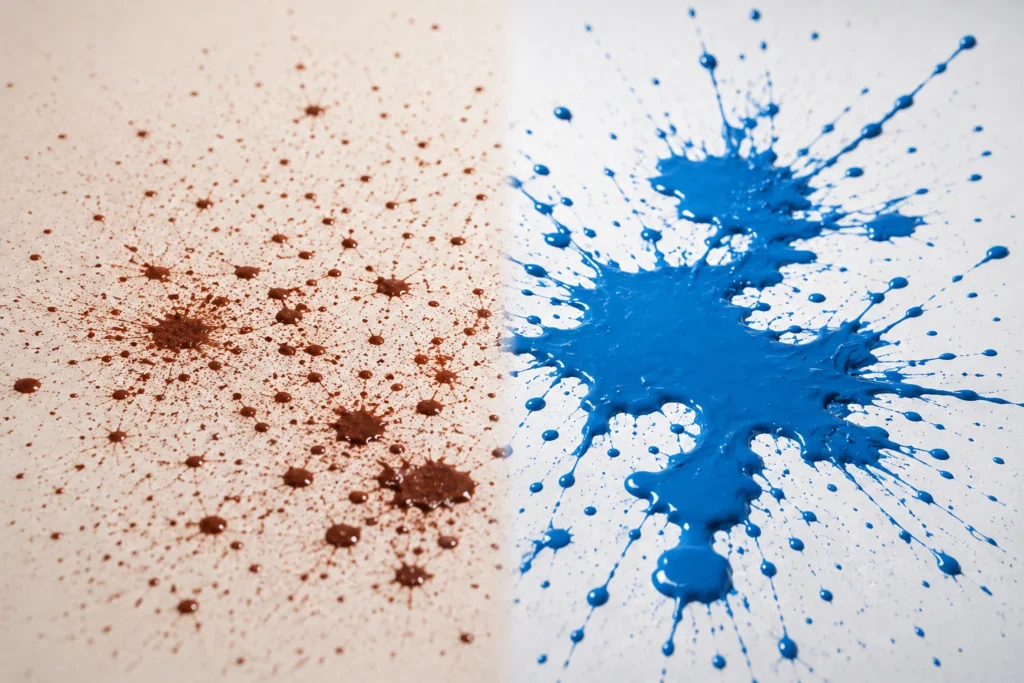
The difference between spatter vs. splatter often comes down to how something spreads, how much force is involved, and the amount of mess created. Both words describe liquids or substances breaking into droplets and spreading across a surface. However, they do not always create the same image.
How Spatter and Splatter Are Used
Spatter and splatter are closely related words that describe the spreading of liquid or another substance into drops. However, they can create slightly different images in the reader’s mind. The main difference often depends on the size of the drops, the amount of force involved, and how widely the substance spreads.
Spatter generally refers to smaller drops scattered across a surface. For example, water may spatter onto a mirror when you wash your face. Paint can also spatter across a wall when a brush moves quickly. In these situations, the drops are usually separate and spread in different directions. Therefore, spatter often sounds more neutral and precise.
Splatter, by contrast, usually suggests a messier or more forceful spread. For instance, hot soup can splatter when it boils, while mud can splatter onto your clothes when you step into a puddle. As a result, splatter often creates a stronger image of a sudden or noticeable mess.
How Spatter and Splatter Are Used
In everyday English, the two words can sometimes overlap. Nevertheless, choosing one word over the other can help make your description more accurate. For example, a painter may describe tiny drops of paint as spatter, while someone cleaning sauce from a kitchen wall may call it splatter.
In addition, both words can be used as verbs and nouns. You can say that water “spattered” across the floor, or you can refer to “paint spatter” on a nearby surface. Similarly, you can say that grease “splattered” while cooking, or describe the result as “grease splatter.”
Ultimately, spatter is often the better choice when you want to emphasize small, scattered drops. Splatter is usually more suitable when the substance spreads more forcefully or creates a larger mess. Understanding this distinction makes it easier to choose the right word in everyday writing and conversation.
| Feature | Spatter | Splatter |
| Main idea | Small drops scattered across an area | Liquid spreading forcefully and creating a mess |
| Droplet size | Usually smaller droplets | Often larger droplets |
| Force involved | Light to moderate | Moderate to strong |
| Common examples | Paint spatter, blood spatter, water spatter | Oil splatter, mud splatter, dramatic effects |
| Overall feeling | Scattered marks | Messy impact |
A simple way to remember the difference is:
- Spatter = scattered spots
- Splatter = stronger splash with more spread
The difference is not always strict. Language changes based on context, and both words can sometimes describe the same event. For example, a person might say “paint splatter” or “paint spatter” when describing small drops left after painting. The better choice depends on the image you want to create.
What Does “Spatter” Mean?
Spatter Definition and Meaning
Spatter means to scatter small drops of liquid or small particles over a surface. The word focuses on the pattern created by the droplets rather than the dramatic force behind the action.
When something spatters, the substance usually breaks into smaller pieces and lands in different locations. The result is often a collection of tiny marks rather than one large area covered with liquid.
For example, imagine stirring a bowl of soup too quickly. A few drops may jump onto the table. Those small marks are a type of spatter because the liquid has separated into tiny droplets.
Another example is painting a wall with a roller. Even with careful work, small drops of paint may escape and land on nearby surfaces. Those marks are commonly called paint spatter.
The word appears in both everyday language and specialized fields. In forensic science, blood spatter refers to the study of blood droplet patterns created during an event. Experts analyze factors such as:
- Droplet size
- Shape
- Direction of travel
- Distribution pattern
- Impact location
This scientific use shows that spatter is not only about a mess. It can also describe meaningful patterns that provide information.
Common Uses of Spatter
The word spatter appears in many situations where small droplets spread across a surface.
| Context | Example of Spatter |
| Painting | Small paint drops around a freshly painted wall |
| Cooking | Oil droplets landing near a frying pan |
| Weather | Rain droplets hitting a window |
| Outdoor activities | Mud spots appearing on clothing |
| Science | Blood spatter pattern analysis |
Some common examples include:
Paint spatter:
Artists and painters sometimes create intentional spatter effects by flicking brushes or using special techniques. This creates texture and movement in artwork.
Blood spatter:
Forensic investigators study blood patterns to understand how droplets moved and where they originated. The term is widely used in scientific discussions.
Water spatter:
A running faucet, a jumping child in a pool, or a wet surface can create tiny water droplets that spread nearby.
Food spatter:
Cooking often creates small droplets from sauces, oils, and liquids. These marks may appear around a stove or countertop.
Everyday Examples of Spatter
Many daily activities create small amounts of spatter without people noticing.
Cooking
When heating oil in a pan, tiny droplets may escape when moisture reaches the hot surface. These droplets can land on the stove or nearby counters. People often call this oil spatter.
Home Improvement
During painting, small drops can travel beyond the intended area. Even experienced painters may leave some paint spatter behind.
Rain and Weather
A heavy rainstorm can create water marks on windows, doors, and vehicles. These scattered droplets are examples of natural spatter.
Outdoor Activities
Walking through wet soil or puddles can leave small muddy marks on shoes and clothing. These spots are often described as mud spatter.
Everyday Accidents
A spilled drink, a dropped wet object, or a quick movement near a sink can create small scattered droplets.
Example Sentences Using Spatter
Understanding how spatter works becomes easier when you see it in real sentences:
- The painter cleaned the small paint spatter from the wooden floor after finishing the room.
- Rainwater spatter covered the car windows after the afternoon storm.
- The chef wiped away oil spatter from the kitchen counter.
- Investigators carefully examined the blood spatter pattern during the analysis.
- His boots had mud spatter after he crossed the wet field.
Each example shows a similar idea: the substance separates into droplets and leaves scattered marks.
Why “Spatter” Often Sounds More Precise
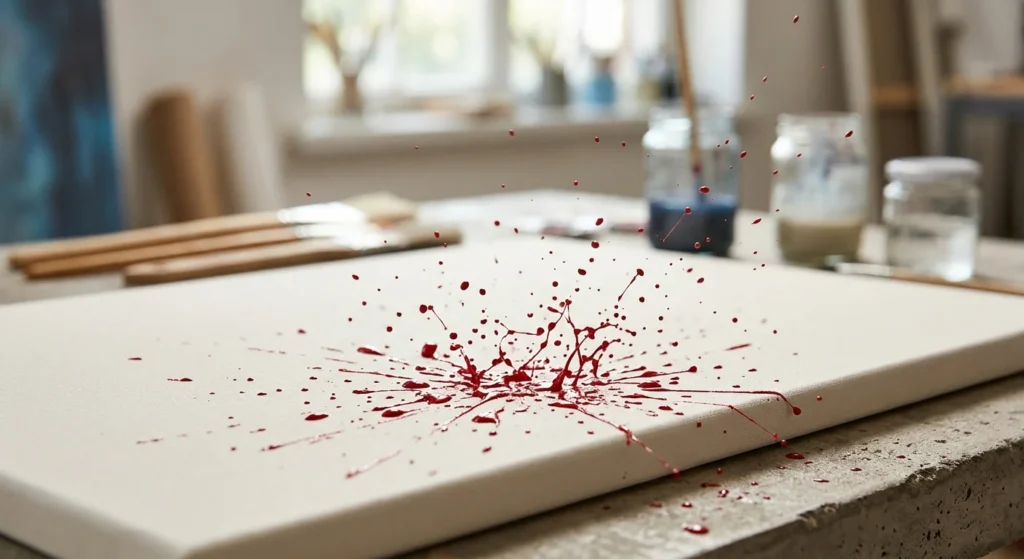
The word spatter often feels more technical because it describes the pattern and distribution of droplets. Scientists, artists, and professionals use it when the arrangement of small drops matters.
For example, saying “blood spatter analysis” gives a specific scientific meaning. It refers to studying patterns, not simply describing a messy scene.
Similarly, an artist may choose the phrase “paint spatter technique” because the focus is on creating controlled marks rather than making a large mess.
The key idea is that spatter highlights the scattered result. It helps the reader imagine separate drops appearing across a surface.
Spatter vs. Splatter: Choosing the Right Word
When deciding between spatter and splatter, consider three questions:
- Did the liquid break into small scattered drops?
- Was there a strong impact or sudden force?
- Does the situation feel controlled or messy?
Use spatter when the focus is on small scattered droplets or a pattern.
Use splatter when the focus is on force, movement, and a bigger mess.
For example:
- A few drops of paint on the floor → paint spatter
- A bucket of paint thrown against a wall → paint splatter
Both can describe paint, but they create different images for the reader.
What Does “Splatter” Mean?
Splatter Definition and Meaning
The word splatter describes a substance spreading outward with force, usually creating a noticeable mess. It often involves a sudden impact, strong movement, or a larger amount of liquid compared with spatter.
When something splatters, the liquid does not simply leave a few scattered drops. Instead, it spreads quickly and widely. The word creates a stronger visual image because it suggests movement, impact, and a less controlled result.
For example, imagine dropping a water-filled balloon onto the ground. The water does not stay in one place. It bursts outward and covers a wider area. That action is more likely to be described as splattering.
Another common example happens in the kitchen. When a thick sauce boils too aggressively, it may jump out of the pan and land across the stove. Those larger, messy drops are often called sauce splatter.
Unlike spatter, which often focuses on individual droplets and patterns, splatter emphasizes the action and the aftermath.
The word is especially common when describing situations involving:
- Sudden impact
- Heavy movement
- Larger amounts of liquid
- Uncontrolled spreading
- A visible mess
Common Uses of Splatter
The word splatter appears in everyday conversations, entertainment, art, and descriptive writing. It often adds intensity because it makes the reader imagine a stronger action.
Cooking and Food Preparation
Cooking is one of the most common places where people experience splatter.
Hot oil, sauces, and liquids can spread quickly when they come into contact with heat or movement. For example:
- Oil splatter from frying food
- Tomato sauce splatter while boiling
- Grease splatter from a hot pan
A cook usually thinks of splatter as something that needs cleaning because it spreads beyond the original cooking area.
Mud and Outdoor Situations
Vehicles, bicycles, and shoes can create mud splatter when moving through wet ground.
For example, a truck driving through a muddy road may throw thick drops of mud onto nearby surfaces. The force of the tires creates a wider spread, making splatter the more natural choice.
Paint and Art
Artists sometimes use paint splatter as a creative technique. Instead of applying paint smoothly with a brush, they throw, drip, or spray paint to create energetic patterns.
This technique appears in:
- Abstract paintings
- Street art
- Decorative designs
- Experimental artwork
The word works well because it suggests movement and freedom rather than a controlled brushstroke.
Movies, Comics, and Entertainment
The word splatter is also strongly connected with entertainment. Filmmakers, comic artists, and writers use it to create dramatic scenes.
Examples include:
- Comic panels showing action effects
- Horror movie descriptions
- Cartoon sound effects
- Visual storytelling
In these settings, splatter is often exaggerated for dramatic impact.
Everyday Examples of Splatter
People encounter splatter in many normal situations.
Example: Frying Food
When water touches hot oil, the oil can jump out of the pan. The droplets may spread across the stove, nearby walls, or clothing.
This is usually called oil splatter because the movement involves force and creates a mess.
Example: Driving Through Mud
A vehicle moving quickly through a muddy puddle can send mud in different directions. The tires create enough force to spread the material over a larger area.
That result is commonly described as mud splatter.
Example: Dropping a Liquid Container
If a container falls and breaks, the liquid may spread outward instantly. The sudden movement creates a strong visual image of splattering.
Example: Painting With a Spray Technique
An artist throwing paint onto a canvas creates a dramatic spread of color. The result is often called paint splatter art because the paint moves freely across the surface.
Example Sentences Using Splatter
These examples show how splatter works in natural sentences:
- The car created mud splatter as it drove through the wet road.
- Hot oil began to splatter when water fell into the frying pan.
- The artist used a splatter technique to add movement to the painting.
- The spilled drink splattered across the floor after the glass fell.
- The comic artist added colorful splatter effects to make the action scene more exciting.
Each sentence gives the impression of movement and impact.
Spatter vs. Splatter: What’s the Real Difference?
Although spatter and splatter are closely related, they create different impressions. The difference is not always about grammar. It is about the image the word creates.
A useful comparison:
| Difference | Spatter | Splatter |
| Focus | Droplet pattern | Forceful action |
| Amount | Usually smaller amounts | Often larger amounts |
| Movement | Scattered drops | Sudden spreading |
| Appearance | Separate spots | Wider mess |
| Tone | More neutral or technical | More dramatic |
Difference in Force and Amount of Liquid
One of the biggest differences between spatter and splatter is the amount of force involved.
Spatter usually happens when small droplets separate naturally or through mild movement.
Examples:
- A brush flicking paint
- Water hitting a surface
- Small cooking droplets
Splatter usually involves stronger energy.
Examples:
- A liquid hitting the ground
- A vehicle throwing mud
- A pan sending oil outward
Think of the difference between gently tapping a wet paintbrush and throwing a bucket of paint. The first creates spatter. The second creates splatter.
Difference in Droplet Size
Droplet size also helps separate the meanings.
With spatter, droplets are often:
- Smaller
- More separated
- Spread across a limited area
With splatter, droplets are often:
- Larger
- More noticeable
- Spread with greater force
However, droplet size alone does not decide the correct word. Context matters.
For example, an artist may create tiny paint marks using a splatter technique because the method involves throwing or flicking paint. The action creates the word choice.
Difference in Level of Mess Created
The amount of cleanup often changes which word sounds more natural.
A few tiny drops on a surface may be called spatter.
A large messy area covered with liquid often feels more like splatter.
Compare these situations:
| Situation | Better Word |
| Small drops of water around a sink | Water spatter |
| Sauce covering the stove after boiling | Sauce splatter |
| Tiny paint marks on a floor | Paint spatter |
| Paint thrown across a wall for artwork | Paint splatter |
The difference comes from the scale and feeling of the event.
Literal and Figurative Uses of Spatter and Splatter
Both words can appear in literal and creative descriptions.
Literal Uses
Literal examples describe actual substances:
- Blood spatter
- Paint spatter
- Mud splatter
- Oil splatter
- Water spatter
Figurative Uses
Writers sometimes use these words creatively to describe ideas, sounds, or emotions.
Examples:
- “The page was filled with a splatter of bright colors.”
- “A spatter of applause broke the silence.”
These uses create a visual feeling. They help readers imagine scattered details appearing suddenly.
Quick Comparison Table: Spatter vs. Splatter
| Category | Spatter | Splatter |
| Meaning | Small drops scattered over a surface | Liquid spread forcefully across an area |
| Main impression | Scattered pattern | Messy impact |
| Common settings | Science, painting, weather, cooking | Accidents, cooking, entertainment, dramatic writing |
| Scientific use | Common in forensic terminology | Less common in technical contexts |
| Emotional tone | Neutral | Stronger and more dramatic |
| Example phrase | Blood spatter analysis | Mud splatter on a vehicle |
Which Word Should You Choose?
Choosing between spatter and splatter depends on the picture you want your reader to see.
Ask yourself:
- Are you describing small scattered marks?
- Are you emphasizing a powerful impact?
- Is the situation controlled or chaotic?
Choose spatter when the focus is on scattered droplets and patterns.
Choose splatter when the focus is on force, movement, and mess.
For professional writing, especially scientific writing, accuracy matters. In casual speech, either word may work if the meaning is clear. The goal is not to memorize a strict rule. The goal is to understand the difference in feeling each word creates.
Is “Spatter” or “Splatter” More Correct?
Dictionary Meanings of Spatter and Splatter
When comparing spatter vs. splatter, many people wonder whether one word is technically correct and the other is incorrect. The answer is that both words are valid English terms. The difference lies in their usual meanings, context, and the image they create.
Dictionaries generally define spatter as the act of scattering small drops or particles over an area. It focuses on scattered marks, patterns, or droplets that separate from a source.
Splatter is usually defined as spreading a liquid or substance in scattered drops, often with more force and creating a messier effect.
The meanings overlap because both words describe substances breaking apart and spreading. English often contains words with similar meanings that develop slightly different uses over time.
A simple comparison:
| Word | Basic Meaning | Main Focus |
| Spatter | To scatter small drops | Pattern and distribution |
| Splatter | To spread drops forcefully | Impact and mess |
Neither word is automatically better. The correct choice depends on what you want to describe.
For example:
- Blood spatter analysis is the standard scientific term because experts study droplet patterns.
- Paint splatter art is common because artists often emphasize movement and energetic application.
The context changes the most natural word choice.
Regional Preferences and Common Usage
Language changes depending on location, profession, and personal habits. The use of spatter and splatter follows the same pattern.
In everyday conversations, many speakers use the words interchangeably. Someone cleaning a kitchen might say:
- “There is oil spatter on the stove.”
- “There is oil splatter on the stove.”
Both sentences communicate the same basic idea. However, many listeners imagine slightly different situations.
Oil spatter sounds like small droplets scattered around the cooking area.
Oil splatter sounds like a stronger reaction where hot oil jumped and created a bigger mess.
Professional fields often use more specific language. Scientists, artists, and writers may choose a word based on accuracy and style.
Examples:
- A forensic expert discusses blood spatter patterns.
- An artist creates paint splatter effects.
- A homeowner cleans paint spatter after renovation work.
The difference is subtle, but word choice helps create a clearer picture.
Are Spatter and Splatter Interchangeable?
In many situations, spatter and splatter can replace each other without confusion. However, they are not perfect synonyms.
The best choice depends on the feeling you want to create.
Situations Where Both Words Work
Some examples allow either word:
- Paint on a floor after painting
- Water drops from movement
- Cooking liquids spreading nearby
For example:
- “The wall had paint spatter.”
- “The wall had paint splatter.”
Both sentences make sense.
Situations Where One Word Sounds Better
Some contexts strongly favor one term.
| Situation | Preferred Word | Reason |
| Forensic investigation | Blood spatter | Scientific terminology |
| Dramatic movie effects | Blood splatter | Entertainment style |
| Small raindrops | Water spatter | Focus on droplets |
| Violent impact | Liquid splatter | Focus on force |
A good writer considers the situation, audience, and purpose before choosing the word.
When Should You Use “Spatter”?
Spatter in Painting and Home Improvement
Painting is one of the most common situations where people encounter spatter.
During a painting project, small drops may escape from a brush, roller, or spray tool. These droplets can land on floors, furniture, walls, or clothing.
Examples include:
- Tiny paint drops around a doorway
- Small marks on a protective sheet
- Fine droplets created while using a roller
In these situations, paint spatter often describes the scattered marks left behind.
Professional painters usually prepare surfaces carefully because even small amounts of spatter can create extra cleanup work.
Common ways to reduce paint spatter include:
- Using the correct roller type
- Avoiding overloading brushes
- Covering nearby surfaces
- Maintaining controlled movements
Artists may also use spatter intentionally. A painter can flick a brush to create texture, depth, and movement.
For example, abstract artists often use controlled paint spatter techniques to create energetic designs.
Spatter in Cooking and Food Preparation
Cooking creates many examples of spatter because liquids often move quickly under heat.
Small droplets may escape from:
- Frying pans
- Boiling pots
- Mixing bowls
- Blenders
Examples:
- Water spatter from a wet spoon entering hot oil
- Sauce spatter around a cooking area
- Small grease marks near a stove
Although people commonly say oil splatter, the word spatter can describe smaller droplets.
Understanding this difference can help describe cooking situations more accurately.
For example:
- A few tiny oil drops around the pan → oil spatter
- Hot oil spraying across the stove → oil splatter
Both describe the same general event, but the intensity changes.
Spatter in Rain, Mud, and Everyday Situations
Nature creates many examples of spatter.
Rain
Raindrops hitting windows, sidewalks, or vehicles can create scattered patterns. A light rainfall may leave small marks that can be described as rain spatter.
Mud
Walking through wet areas often leaves small muddy marks on shoes or clothing.
Examples:
- Mud spatter on hiking boots
- Mud spatter along a car’s lower panels
- Mud spatter on outdoor equipment
Water Activities
Swimming, washing, and outdoor play can create water spatter.
Examples:
- Children creating water spatter in a pool
- A sprinkler leaving water spatter on grass
- A hose creating scattered drops
These examples show that spatter appears in ordinary moments.
Creative Writing Examples Using Spatter
Writers use spatter to create realistic details. The word helps readers imagine small marks without suggesting extreme movement.
Examples:
- “Tiny drops of rain spattered across the old window.”
- “The artist added blue spatter to the canvas, creating the feeling of ocean waves.”
- “Mud spatter covered his boots after the long walk through the trail.”
In descriptive writing, word choice shapes emotion.
Spatter often feels controlled, detailed, and focused on small elements.
A writer describing a quiet kitchen might choose spatter:
“A few drops of sauce spattered across the counter as she stirred the pot.”
A writer describing a dramatic scene might choose splatter:
“The sauce splattered across the floor after the pan slipped.”
The action may be similar, but the reader experiences it differently.
When Should You Use “Splatter”?
Splatter From Heavy Liquid Impacts
Use splatter when a liquid spreads because of strong movement or impact.
Common examples include:
- A dropped container breaking open
- A vehicle moving through deep mud
- A strong hit causing liquid to spread
The word creates a stronger visual image because it suggests sudden action.
Imagine dropping a bucket of water from a height. The water does not gently separate into a few drops. It bursts outward. That is the feeling behind splatter.
Splatter in Accidents and Messy Situations
Accidents often create situations where splatter feels more natural.
Examples:
- A smoothie spilling after a blender lid comes loose
- Paint spilling during a renovation accident
- Food spreading after a plate falls
These situations involve:
- Sudden movement
- Unexpected results
- Larger cleanup areas
The word helps communicate the size and intensity of the event.
For example:
“The dropped paint bucket caused splatter across the garage floor.”
This sentence gives a stronger image than simply saying:
“The dropped paint bucket caused spatter.”
Splatter in Movies, Comics, and Sound Effects
Entertainment uses splatter because it creates a dramatic visual effect.
In movies, comics, and animation, the word often appears with:
- Action scenes
- Horror themes
- Cartoon effects
- Graphic storytelling
The term splatter effects is especially common in discussions about visual entertainment.
Artists and filmmakers use exaggerated splatter to create:
- Shock
- Humor
- Drama
- Visual impact
However, entertainment language does not always follow scientific language. A movie description may use blood splatter because it sounds more dramatic, while forensic experts usually use blood spatter.
Descriptive Writing Examples Using Splatter
Writers choose splatter when they want stronger imagery.
Examples:
- “The waves splattered against the rocks during the storm.”
- “Paint splattered across the wall in bright streaks.”
- “Mud splattered onto the windows as the truck raced down the dirt road.”
The word adds energy and movement.
A useful writing tip:
- Use spatter when you want readers to notice the pattern.
- Use splatter when you want readers to feel the action.
This small difference can make descriptions more vivid and precise.
Spatter and Splatter in Forensic Science
Blood Spatter Pattern Analysis
One of the most recognized uses of the word spatter appears in forensic science. Blood spatter pattern analysis is a specialized field that examines blood droplets, their shapes, and their distribution to understand how a blood event occurred.
Forensic experts do not simply look at stains and make assumptions. They analyze measurable details such as:
- Droplet size
- Shape of individual stains
- Direction of travel
- Angle of impact
- Distribution patterns
- Location of stains
- Surface characteristics
The arrangement of blood droplets can provide information about movement, position, and possible events that created the pattern. Investigators may examine these details as part of a broader forensic investigation.
A blood stain pattern can appear in different forms depending on factors such as:
| Factor | How It Can Affect Blood Patterns |
| Impact force | Can influence droplet size and distribution |
| Surface type | Changes the appearance of stains |
| Distance | Affects the spread and pattern |
| Movement | Can create directional patterns |
The word spatter fits this scientific context because forensic specialists focus on the pattern of individual droplets rather than simply describing a messy scene.
For example, a forensic report may discuss:
- Blood spatter patterns
- Blood spatter analysis
- Blood droplet distribution
These terms focus on scientific observation and evidence.
Why “Blood Splatter” Is Common but Less Accurate
Although blood spatter is the accepted scientific term, many people commonly say blood splatter. This happens because everyday language often favors words that create a stronger visual image.
Movies, television shows, and news reports frequently use dramatic terms. Because of this, blood splatter became familiar to many people.
However, the distinction matters in professional settings.
A forensic scientist usually focuses on:
- How droplets formed
- How they traveled
- What pattern they created
The term blood spatter describes that analytical process more accurately.
The word splatter suggests a more dramatic scene involving force and mess. While that description may work in entertainment, scientific writing requires more precise language.
This difference shows how word choice changes depending on the audience.
| Context | Common Term |
| Forensic reports | Blood spatter |
| Scientific research | Blood spatter analysis |
| Movies and fiction | Blood splatter |
| Casual conversation | Either may appear |
Both expressions are understandable. The difference is mainly about precision and purpose.
Scientific Usage vs. Everyday Speech
Scientific fields often require exact terminology. Everyday speech allows more flexibility.
This pattern appears with many words, not only spatter and splatter.
For example:
- Scientists may use a precise term for a natural process.
- Writers may choose a word that creates stronger emotion.
- Everyday speakers may choose the word that sounds most familiar.
The same event can receive different descriptions depending on the situation.
Consider a paint accident:
Scientific description:
- “Small paint droplets were distributed across the surface.”
Everyday description:
- “Paint splattered everywhere.”
Creative description:
- “Paint exploded across the wall in colorful splashes.”
Each sentence creates a different impression.
Understanding spatter vs. splatter helps writers choose words that match their purpose.
Origin and History of Spatter and Splatter
The History of “Spatter”
The word spatter has a long history in English. It developed from older words connected with scattering or sprinkling liquids and small particles.
Over time, spatter became associated with small drops spreading across a surface. Its meaning remained closely connected to scattered patterns.
Historically, people used the word in everyday situations involving:
- Water
- Mud
- Paint
- Food
- Other liquids
As scientific fields developed, the word gained additional importance. Forensic science adopted blood spatter as a technical phrase because it accurately describes the study of blood droplets and patterns.
Today, spatter appears in both ordinary conversations and professional terminology.
Examples:
- Paint spatter during construction
- Water spatter after rainfall
- Blood spatter analysis in investigations
The word has maintained its central idea: small droplets scattered across an area.
How “Splatter” Developed
The word splatter developed later and is often considered an intensified form of spatter. The added “l” sound helped create a stronger, more expressive word.
English often develops words this way. Slight changes in sound can create differences in feeling.
Compare:
- Spatter → scattered drops
- Splatter → stronger, messier spreading
The word became popular because it captured dramatic movement. Writers and speakers used it to describe situations where liquids spread suddenly.
Over time, splatter became common in:
- Art descriptions
- Entertainment
- Everyday speech
- Informal writing
The word carries more energy than spatter, which is why it works well in dramatic descriptions.
How Their Meanings Changed Over Time
The meanings of spatter and splatter have changed as people used them in different situations.
Originally, both words described similar actions. However, speakers gradually developed different associations.
Today:
Spatter often suggests:
- Small droplets
- Patterns
- Scientific observation
- Controlled effects
Splatter often suggests:
- Strong impact
- Larger messes
- Dramatic action
- Visual intensity
Language does not stay fixed. Words gain new meanings through repeated use.
A good example is art. A controlled painting technique may use the word splatter even when the artist carefully creates the effect. The word works because it communicates movement and energy.
Similarly, a scientific term like blood spatter may describe a serious analytical process rather than simply a messy situation.
Common Mistakes People Make With Spatter and Splatter
Assuming They Mean the Same Thing
The most common mistake is believing that spatter and splatter always mean identical things.
While both describe substances spreading into drops, they create different impressions.
A person saying:
“The pan caused oil spatter.”
may describe a few small droplets.
A person saying:
“The pan caused oil splatter.”
may suggest a larger, messier event.
Neither sentence is impossible. The difference comes from the image created.
Good writing considers the reader’s experience. The chosen word should match the level of force and detail you want to communicate.
Choosing the Wrong Word for Formal Writing
Formal writing requires more attention to word choice.
In scientific, academic, or professional writing, using the more precise term improves clarity.
Examples:
Better:
- “Researchers analyzed blood spatter patterns.”
Less precise:
- “Researchers analyzed blood splatter patterns.”
Better:
- “The study examined droplet distribution.”
Less precise:
- “The study examined the messy liquid effect.”
This does not mean splatter is incorrect. It simply means professional writing often requires more specific language.
Confusing Scientific and Informal Usage
Another common mistake happens when people mix casual expressions with technical terms.
For example:
A movie review might say:
- “The film contains dramatic blood splatter effects.”
A forensic report would say:
- “The investigation included blood spatter analysis.”
The difference comes from purpose.
Entertainment language aims to create emotion.
Scientific language aims to describe evidence accurately.
Knowing the audience helps determine the right word.
Easy Tricks to Remember the Difference
Simple Memory Tips for Spatter vs. Splatter
Remembering the difference does not require memorizing complicated rules.
Try these simple connections:
Spatter starts with “S” like “spots.”
Think:
Spatter = scattered spots
This helps remember that spatter usually describes small droplets or marks.
Splatter has an extra “L,” which can remind you of “large.”
Think:
Splatter = larger, louder, messier impact
This is not a strict grammar rule, but it works as a quick memory tool.
Everyday Examples to Remember the Difference
Real-life examples make the difference easier to understand.
| Situation | Word That Fits Best |
| Tiny drops of water on a mirror | Water spatter |
| Oil jumping from a hot pan | Oil splatter |
| Small paint marks after painting | Paint spatter |
| Paint thrown across a canvas | Paint splatter |
| Mud covering a vehicle after driving fast | Mud splatter |
The more examples you connect with each word, the easier the distinction becomes.
Quick Rule You Can Remember
Use this simple guide:
Choose spatter when you picture small scattered drops.
Choose splatter when you picture a forceful spread or a bigger mess.
When both words seem possible, ask yourself:
“Am I describing the pattern or the impact?”
If the focus is the pattern, spatter usually works better.
If the focus is the impact, splatter usually feels more natural.
Spatter vs. Splatter Examples in Sentences
Understanding the difference between spatter and splatter becomes easier when you see how both words work in real sentences. Context plays the biggest role because the same substance can sometimes use either word depending on the situation.
For example, paint can create both spatter and splatter:
- A painter notices small drops on the floor after using a roller → paint spatter
- An artist throws paint across a canvas for an expressive effect → paint splatter
The substance stays the same, but the action and intensity change the better word choice.
Everyday Conversation Examples
In normal conversations, people often use spatter and splatter casually. The meaning is usually clear from the situation.
Examples Using Spatter
- “I need to clean the water spatter from the bathroom mirror.”
- “The painter covered the furniture because paint spatter could reach nearby surfaces.”
- “There was mud spatter on my shoes after walking through the park.”
- “The rain left small spatter marks on the window.”
- “The chef wiped away the oil spatter near the stove.”
These examples focus on small marks, droplets, or scattered spots.
Examples Using Splatter
- “The sauce started to splatter when it reached a high temperature.”
- “The truck caused mud splatter when it drove through the puddle.”
- “The dropped bottle made juice splatter across the kitchen floor.”
- “The child made water splatter while jumping into the pool.”
- “The artist used a splatter technique to create a bold painting.”
These examples create a stronger image of movement and mess.
Academic Writing Examples
Academic writing requires accuracy and careful word selection. In formal contexts, spatter often appears more frequently because it describes measurable patterns.
Examples:
- “Researchers examined the blood spatter pattern to determine the direction of impact.”
- “The experiment measured water spatter produced by different surface conditions.”
- “The study analyzed droplet size and spatter distribution during liquid impact.”
In academic writing, the word choice should match the purpose of the research.
For example, a scientific paper may focus on:
- Droplet formation
- Movement patterns
- Surface interaction
- Liquid behavior
In these situations, spatter usually provides a more precise description.
However, splatter can appear in academic discussions about:
- Visual art techniques
- Material behavior
- Fluid movement experiments
Example:
“The researchers observed paint splatter patterns created by different spraying methods.”
The key factor is not the subject alone. It is the meaning being emphasized.
Fiction Writing Examples
Writers often choose between spatter and splatter based on the mood they want to create.
Words create images. A writer describing a calm scene may choose spatter, while a writer creating an intense scene may choose splatter.
Examples With Spatter
- “Rain spattered against the window as the old house grew silent.”
- “Drops of paint spattered across the canvas, adding small bursts of color.”
- “Mud spattered his boots as he walked along the forest path.”
These sentences feel detailed and observational.
Examples With Splatter
- “The storm waves splattered against the rocks below.”
- “The paint splattered across the wall in wild streaks.”
- “The spilled drink splattered across the table after the glass tipped over.”
These sentences feel more energetic and dramatic.
A useful writing approach:
- Use spatter for subtle details.
- Use splatter for stronger action.
News and Media Examples
News writing requires clear and responsible language. Reporters usually choose words based on accuracy and audience understanding.
Examples:
- “Investigators analyzed blood spatter patterns at the scene.”
- “Heavy rain caused mud to splatter across roads and vehicles.”
- “The accident caused debris and liquid to splatter across the area.”
In crime reporting, blood spatter is the preferred scientific term. However, media outlets sometimes use blood splatter because it is more familiar to general audiences.
Professional reporting should consider:
- Accuracy
- Clarity
- Audience expectations
- Source terminology
Similar Word Pairs You May Also Confuse
English contains many word pairs that describe similar actions but create different impressions. Spatter vs. splatter is one example of how small differences can change meaning.
Understanding related word pairs helps improve vocabulary and writing precision.
Examples:
- Sprinkling water on plants
- Sprinkling sugar on dessert
- Sprinkling seasoning over food
The action is controlled and usually gentle.
Splash
Splash means liquid hitting a surface and spreading outward.
Examples:
- A child splashing in a pool
- Water splashing from a bucket
- Waves splashing against rocks
Comparison:
| Word | Meaning | Example |
| Sprinkle | Gentle distribution | Sprinkling water on flowers |
| Splash | Liquid hitting and spreading | Water splashing from a pool |
Spray vs. Splash
Although spray and splash both describe liquid movement, the size and direction of droplets are different.
Spray
A spray usually involves many tiny droplets moving through the air.
Examples:
- Perfume spray
- Cleaning spray
- Ocean spray
Spray often comes from pressure or a tool designed to create fine droplets.
Splash
A splash usually involves larger drops caused by impact.
Examples:
- Jumping into water
- Dropping a stone into a puddle
- Pouring liquid too quickly
Comparison:
| Word | Droplet Size | Movement |
| Spray | Very small droplets | Fine distribution |
| Splash | Larger drops | Impact-based movement |
A spill happens when liquid accidentally leaves a container.
Examples:
- Spilling coffee on a desk
- Spilling milk on the floor
- Spilling paint from a bucket
The focus is on the accidental release.
Splash
A splash happens when liquid hits something and moves outward.
Examples:
- Water splashing from a bathtub
- A ball hitting a puddle
- Waves splashing onto a boat
Comparison:
| Word | Main Idea | Example |
| Spill | Liquid escapes from a container | Spilled juice |
| Splash | Liquid spreads after impact | Water splash |
Understanding Spatter and Splatter Through Real-World Contexts
Words become easier to understand when connected to situations people experience every day.
Home Improvement Example
Imagine painting a bedroom.
A careful painter uses a roller and a few tiny drops land on the floor. This is paint spatter.
Now imagine someone throws a bucket of paint against a wall for an artistic effect. This is paint splatter.
The difference comes from:
- Amount of paint
- Force of movement
- Intended result
Cooking Example
Imagine preparing pasta sauce.
A few tiny drops appear around the stove while stirring. This can be called sauce spatter.
If the sauce boils aggressively and covers the nearby area, sauce splatter describes the scene better.
The words help explain the level of activity.
Outdoor Example
Imagine two vehicles driving through mud.
A slow-moving car leaves a few muddy spots behind. That creates mud spatter.
A truck driving quickly through deep mud sends dirt across another vehicle. That creates mud splatter.
The action determines the word.
Practical Guide for Choosing Between Spatter and Splatter
When writing or speaking, use these questions:
| Question | If Yes | Better Choice |
| Are there small scattered droplets? | Focus is on marks | Spatter |
| Did something hit with strong force? | Focus is on impact | Splatter |
| Is it a scientific pattern? | Analysis is involved | Spatter |
| Is it a dramatic or messy scene? | Strong visual effect | Splatter |
The difference may seem small, but choosing the right word improves clarity.
A strong writer does not only know definitions. A strong writer understands the feeling each word creates.
Spatter helps readers notice the pattern.
Splatter helps readers imagine the action.
Spatter vs. Splatter: Final Practical Guide to Using the Right Word
How Context Determines Whether You Should Use Spatter or Splatter
The easiest way to understand spatter vs. splatter is to focus on the situation instead of memorizing strict rules. Both words describe substances spreading into droplets, but the surrounding details decide which word feels more accurate.
A writer describing a scientific process will usually choose spatter because the focus is often on patterns, measurements, and distribution. A writer describing a dramatic accident may choose splatter because the focus is on force, movement, and the visible mess.
The same event can use different words depending on the purpose.
For example:
- “The experiment recorded liquid spatter patterns on the surface.”
- “The dropped container caused liquid to splatter across the floor.”
Both sentences describe liquid movement, but each word creates a different image.
A useful way to think about the difference:
Spatter describes what the droplets look like after they spread.
Splatter describes how dramatically the substance spreads.
How Writers Can Use Spatter and Splatter More Effectively
Word choice plays an important role in creating clear and engaging writing. Using the right term helps readers visualize a scene without needing extra explanation.
Use Spatter When You Want Precision
Choose spatter when your writing focuses on:
- Small details
- Patterns
- Scientific observation
- Controlled effects
- Individual droplets
Examples:
- “Tiny rain spatter covered the window.”
- “The artist added white paint spatter to create texture.”
- “The forensic team studied the blood spatter pattern.”
These examples guide the reader toward a specific image.
Use Splatter When You Want Impact
Choose splatter when your writing focuses on:
- Strong movement
- Sudden action
- Large amounts
- Messy results
- Dramatic effects
Examples:
- “The wave splattered against the rocks.”
- “The sauce splattered across the kitchen wall.”
- “The artist created a bold splatter design.”
The word adds energy and movement to the description.
Common Questions About Spatter and Splatter in Everyday Usage
Is Spatter the Same as Splatter?
No, they are closely related but not the same.
Both words describe liquids or substances spreading into droplets. However, spatter usually suggests smaller scattered drops, while splatter often suggests a stronger impact with more noticeable spreading.
A simple comparison:
| Situation | Better Word |
| Small paint drops after painting | Paint spatter |
| Paint thrown across a canvas | Paint splatter |
| Tiny water marks on glass | Water spatter |
| Water exploding outward after impact | Water splatter |
The difference is about the image you want to create.
Which Word Is Used in Forensic Science?
The accepted scientific term is blood spatter.
Forensic experts analyze blood spatter patterns to understand:
- Droplet size
- Direction
- Distribution
- Impact patterns
- Surface interaction
Although people commonly say blood splatter in movies and everyday conversations, forensic professionals usually use blood spatter because it describes the scientific analysis of droplets.
Is “Blood Splatter” Wrong?
No, blood splatter is not considered meaningless or impossible to understand. It is a common phrase in popular culture, entertainment, and casual conversation.
However, blood spatter is more accurate in scientific and professional contexts.
The difference is similar to many other areas where everyday language and technical language are not identical.
For example:
- Everyday speech may use a general term.
- Experts may use a more specific term.
The correct choice depends on where and how you use it.
Can Spatter and Splatter Describe Paint?
Yes, both words can describe paint.
The difference depends on the painting method and the result.
Paint Spatter
Usually refers to:
- Small drops
- Accidental marks
- Fine scattered spots
Example:
“The painter cleaned paint spatter from the floor.”
Paint Splatter
Usually refers to:
- Intentional artistic effects
- Strong movement
- Large scattered patterns
Example:
“The artist used paint splatter to create an abstract design.”
Many modern artists intentionally use splatter techniques because the movement creates texture and emotion.
How Can I Easily Remember the Difference?
A quick memory trick:
Spatter = small spots
The “S” can remind you of “spots.”
Splatter = stronger spread
The extra sound in “splatter” can remind you of a bigger, messier action.
Another way:
Imagine a few drops of water on a mirror. That is spatter.
Imagine a bucket of water hitting the ground. That is splatter.
Spatter vs. Splatter: A Complete Comparison Chart
| Feature | Spatter | Splatter |
| Meaning | Small droplets scattered over a surface | Substance spread forcefully |
| Main focus | Pattern and distribution | Action and impact |
| Typical amount | Smaller amount | Larger amount |
| Droplets | Usually smaller | Often larger |
| Feeling | More controlled | More dramatic |
| Common fields | Forensics, science, painting | Art, entertainment, accidents |
| Example | Blood spatter analysis | Mud splatter from a truck |
Final Writing Tips for Using Spatter and Splatter Correctly
When choosing between these two words, do not only think about the liquid itself. Think about the story behind the movement.
Ask:
- Did the substance create small scattered marks?
- Did something hit with enough force to spread widely?
- Am I describing a pattern or an action?
- Is the writing scientific, casual, or creative?
If the focus is on droplets and patterns, spatter usually works best.
If the focus is on impact and mess, splatter usually creates a stronger image.
Both words have their place. Understanding their subtle difference helps make descriptions clearer, whether you are writing a scientific report, a news article, a story, or simply explaining an everyday situation.
Conclusion About Spatter or Splatter – What’s the Difference? Understanding the Nuances
Understanding spatter vs. splatter becomes much easier when you focus on the image each word creates. Spatter usually describes smaller scattered drops and patterns, while splatter suggests stronger movement, greater force, and a messier result. Although both words can describe similar situations, the right choice depends on context, audience, and purpose. Whether you are writing a report, describing a painting technique, explaining a cooking accident, or improving everyday vocabulary, knowing this difference helps you communicate more clearly. These subtle language choices add precision and make your writing feel more natural. Once you recognize the difference between scattered droplets and forceful spreading, choosing between spatter and splatter becomes simple.
FAQs About Spatter vs. Splatter
Is spatter the same as splatter?
Spatter and splatter have similar meanings because both describe substances spreading into drops. However, they create different impressions. Spatter usually refers to smaller scattered droplets or patterns, while splatter often suggests stronger impact, more movement, and a larger mess. The best choice depends on the situation and the image you want to create.
What is the main difference between spatter and splatter?
The main difference is the level of force and the resulting pattern. Spatter focuses on scattered drops and their distribution, while splatter emphasizes a forceful spread. For example, small paint marks may be called paint spatter, while paint thrown across a surface for artistic effect may be called paint splatter.
Is blood spatter or blood splatter the correct term?
Blood spatter is the preferred term in forensic science because experts study droplet patterns, direction, and distribution. Blood splatter is commonly used in movies, media, and casual conversations because it sounds more dramatic. Both phrases are understandable, but blood spatter is more accurate for scientific and professional writing.
Can spatter and splatter be used for paint?
Yes, both words can describe paint. Paint spatter usually refers to small accidental drops or scattered marks during painting. Paint splatter often describes a stronger artistic technique where paint is thrown, sprayed, or moved across a surface intentionally. The difference depends on the amount of movement and the effect being described.
When should I use the word spatter?
Use spatter when you want to describe small drops, scattered marks, or a pattern created by droplets. It works well for situations involving paint, water, mud, and scientific analysis. The word is especially useful when the focus is on the location, shape, or distribution of individual droplets rather than a large messy impact.
When should I use the word splatter?
Use splatter when you want to describe a stronger action involving liquid spreading quickly or forcefully. It works well for situations such as oil leaving a hot pan, mud thrown by a vehicle, or paint spread across a canvas with dramatic movement. Splatter creates a stronger sense of impact and mess.
Are spatter and splatter interchangeable?
Sometimes, spatter and splatter can be used interchangeably without confusion. However, they are not always identical in meaning. Spatter usually sounds more precise and focuses on patterns, while splatter feels more dramatic and emphasizes action. Choosing the right word improves clarity and helps readers understand the situation more accurately.
Why is spatter used in forensic science?
Forensic science uses spatter because the field focuses on analyzing droplet patterns. Experts study factors such as size, shape, direction, and distribution to understand how blood moved. The term fits because the investigation focuses on evidence created by scattered droplets rather than simply describing a messy scene.
Is splatter always related to something messy?
Splatter often suggests a mess, but it does not always have a negative meaning. Artists use paint splatter techniques to create interesting designs, textures, and movement. The word simply suggests a stronger spreading action. The context determines whether splatter describes an accident, a creative process, or a dramatic effect.
How can I easily remember the difference between spatter and splatter?
A simple memory trick is to connect spatter with scattered spots. Spatter usually means smaller droplets spread across a surface. Splatter can remind you of a stronger splash or larger spread. Thinking about the difference between a few drops and a forceful burst makes the word choice easier to remember.
SEO Meta Description
Discover spatter vs splatter differences, meanings, examples, and usage tips to choose the right word with confidence in everyday text.