

If someone says a person is “three sheets to the wind,” they mean that person is very drunk or noticeably intoxicated. The expression paints a memorable picture: an unsteady person seems to move with the same lack of control as a sailing vessel whose sheets have come loose. Although the wording may sound mysterious to modern readers, its key term comes from nautical usage. In sailing, a sheet is a line used to control the position or trim of a sail. It isn’t a bed sheet, and it isn’t the sail itself.
The phrase is an informal idiom. In everyday conversation, it can sound humorous, colorful, or slightly old-fashioned rather than harsh or clinical. You might hear it when someone describes a friend who has had far too much to drink at a party, wedding, celebration, or night out. For example, “By midnight, Tom was three sheets to the wind” tells you much more vividly than simply saying “Tom was drunk.” The expression adds character to the description without changing its basic meaning.
What Does “Three Sheets to the Wind” Mean?
“Three sheets to the wind” means very drunk or heavily intoxicated. Dictionaries and language references generally treat the expression as a figurative description of drunkenness, particularly the unsteady condition associated with drinking too much. Collins, for example, defines the expression as “very drunk,” while Merriam-Webster identifies it as a phrase meaning drunk.
The idiom usually describes an obvious level of intoxication. Someone who is merely relaxed after one drink probably wouldn’t fit the expression. Instead, the image suggests a person whose balance, judgment, speech, or coordination has become noticeably impaired.
Consider these examples:
- After several drinks, he was three sheets to the wind.
- She arrived at the party sober but left three sheets to the wind.
- By the end of the celebration, half the group was three sheets to the wind.
- He was so three sheets to the wind that he couldn’t remember where he’d parked.
The expression normally works as a description of a person’s condition. In grammatical terms, it commonly appears after a linking verb such as be:
He was three sheets to the wind.
You can also place it after a noun phrase:
The three-sheets-to-the-wind guest kept telling the same story.
That second construction is less common in ordinary conversation, but it can work in humorous or creative writing.
Three Sheets to the Wind Meaning at a Glance
| Feature | Meaning |
| Definition | Very drunk or heavily intoxicated |
| Expression type | Idiom |
| Register | Informal |
| Tone | Colorful, humorous, vivid, sometimes old-fashioned |
| Main subject | A person who has consumed too much alcohol |
| Literal imagery | A sailing vessel affected by loose sheets and wind |
| Common modern form | Three sheets to the wind |
| Older documented form | Three sheets in the wind |
| Typical use | Informal speech, storytelling, dialogue, humorous writing |
One useful point deserves attention: the phrase doesn’t function as a literal measurement of alcohol consumption. Three drinks don’t automatically make someone “three sheets to the wind.” The expression describes a state of intoxication, not a fixed number of beverages.
That distinction matters because alcohol affects people differently. Body size, food intake, drinking speed, medications, tolerance, and other factors can change how quickly someone becomes impaired. The idiom doesn’t attempt to measure any of those things. It’s simply a colorful way to characterize someone’s condition.
Simple Definition of “Three Sheets to the Wind”
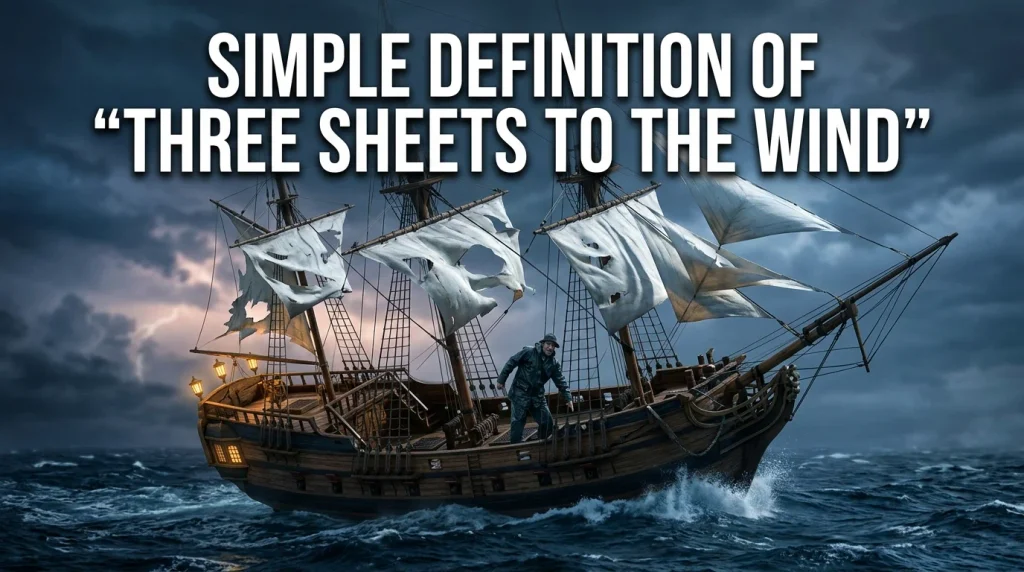
For a quick definition, remember this:
Three sheets to the wind = very drunk or unsteady from drinking.
That’s the essential meaning. You don’t need to understand sailing terminology to use the expression correctly.
Imagine someone leaving a crowded pub after drinking heavily. They aren’t walking steadily. Their speech may sound confused, their movements may become exaggerated, and they may struggle to keep their balance. Calling that person three sheets to the wind highlights the visible lack of control.
The phrase can also carry a playful tone. Someone might say, “I was three sheets to the wind last night,” as a humorous admission about their own behavior. However, context matters. In a serious conversation about alcohol misuse, a direct term such as intoxicated may communicate the situation more clearly and respectfully.
What the Idiom Describes
The expression focuses on observable intoxication rather than simply drinking alcohol.
A person described as three sheets to the wind may:
- stagger while walking
- speak unclearly
- lose track of a conversation
- behave unusually
- have poor coordination
- make careless decisions
- struggle to maintain balance
- appear obviously drunk
Not every person described this way will show every one of these behaviors. The phrase is flexible. It simply gives the listener a strong impression that the person has had too much to drink.
This makes the idiom particularly useful in storytelling. Compare these two sentences:
John was drunk.
John was three sheets to the wind.
The first sentence communicates the fact directly. The second creates a picture. It suggests instability, disorder, and a little humor. That’s one reason colorful idioms survive even when simpler words already exist.
Literal Meaning vs. Figurative Meaning
At first glance, three sheets to the wind seems almost nonsensical. Why would sheets have anything to do with drunkenness? Why three? And why would they be in or to the wind?
The confusion disappears once you recognize sheet as a nautical term.
In sailing, a sheet is a rope or line used to control a sail’s position. Merriam-Webster explains that the sheets in this expression are ropes or chains attached to the lower corners of sails. Their job involves controlling or adjusting the sail rather than serving as the sail itself.
So the literal picture isn’t a person surrounded by household sheets blowing through the air. It’s a sailing vessel with its sail-control lines loose.
That distinction is important because modern readers naturally associate sheet with bedding or paper. The nautical sense is much less familiar today.
The Literal Picture
Think about a sailing ship whose sail-control lines aren’t keeping the sails properly positioned. Wind can make the sails flap or behave unpredictably. The vessel may then move in a way that looks uncontrolled.
Now compare that image with a person who has consumed too much alcohol.
The person may stagger.
The ship may lurch.
The person struggles to maintain balance.
The ship struggles to maintain controlled movement.
That visual comparison gives the idiom its force.
Dictionary sources describe the phrase as an analogy between the staggering movement of a drunken person and the erratic movement of a ship whose sails aren’t properly controlled because its sheets have come loose.
Why “Sheets” Doesn’t Mean Sails
A common misunderstanding is that three sheets mean three sails. That’s not the most accurate explanation.
A sheet is associated with the line used to control a sail. A sail catches the wind, while the sheet helps a sailor position or trim it. Merriam-Webster specifically notes that the sheets in this idiom are not sails.
This small distinction makes the phrase much easier to understand.
| Term | Basic nautical role |
| Sail | Surface that catches the wind |
| Sheet | Line used to control or adjust a sail |
| Wind | Moving air that provides the force acting on the sail |
| Ship | Vessel whose movement depends partly on how its sails are controlled |
Once you know these meanings, the idiom stops looking random. Its language comes from an older sailing world that modern speakers don’t encounter every day.
Why Does “Three Sheets to the Wind” Mean Drunk?
The strongest explanation connects physical instability with loss of control.
A drunk person may stagger unpredictably. A sailing vessel with poorly controlled sails can also move unpredictably. The idiom brings those two images together.
That doesn’t mean the phrase describes a scientific relationship between sailing and intoxication. It works as a metaphor. English speakers often turn physical images into descriptions of human behavior. A person can be “off balance,” “out of control,” or “all over the place” without anyone interpreting those expressions literally.
Three sheets to the wind works in much the same way.
The sailing image supplies the humor. The condition of drunkenness supplies the actual meaning.
The Ship Movement Analogy
Picture a vessel under sail. The wind pushes against the sails, while the crew uses sheets to control their position. If the relevant sheets become loose, the sails can flap, and the vessel can become difficult to control.
Now picture someone attempting to walk after drinking heavily.
They may lean one way.
Then another.
Their steps may become uncertain.
Their judgment may also become unreliable.
The comparison is easy to visualize, which helps explain why the idiom has remained recognizable for generations.
However, it’s worth keeping one historical caution in mind. Modern explanations often describe exactly how three loose sheets supposedly make a ship behave, yet the surviving evidence doesn’t establish every detail of that popular story. Some explanations of the phrase’s mechanics have been repeated so often that they can sound more certain than the historical record allows. The well-supported points are that the sheet is a nautical term, the expression refers to drunkenness, and early examples use forms such as two sheets in the wind and three sheets in the wind.
Does the Idiom Always Refer to Alcohol?
In normal modern usage, three sheets to the wind refers to drunkenness or heavy intoxication. That’s the meaning you should assume when you encounter it in ordinary English.
It isn’t normally used to describe someone simply tired, confused, excited, or careless.
For example:
After the wedding reception, Mark was three sheets to the wind.
The natural interpretation is that Mark was very drunk.
By contrast:
Mark was three sheets to the wind because he hadn’t slept in two days.
That sentence doesn’t fit the idiom’s normal meaning. If exhaustion caused Mark’s instability, phrases such as dead tired, worn out, or barely able to stay awake would communicate the idea more accurately.
The alcohol connection remains central even when speakers use the expression jokingly.
How Strong Is the Expression?
The phrase generally suggests more than being slightly tipsy.
English has many words and expressions for different degrees of intoxication:
| Expression | General impression |
| Had a drink | Drank alcohol without implying intoxication |
| Tipsy | Mildly affected by alcohol |
| Buzzed | Informal term for feeling the effects of alcohol |
| Drunk | Clearly intoxicated |
| Very drunk | Stronger degree of intoxication |
| Three sheets to the wind | Vivid, informal description of being very drunk or unsteady |
| Wasted | Very informal and generally stronger |
| Inebriated | More formal or neutral |
The exact intensity can vary by speaker and situation. Still, three sheets to the wind generally creates a stronger image than merely saying someone is tipsy.
Merriam-Webster gives the expression as meaning drunk, while Collins labels it slang and defines it as very drunk.
When People Use “Three Sheets to the Wind” Today
You’re most likely to encounter this idiom in informal conversation, humorous descriptions, fiction, journalism with a conversational tone, and dialogue.
It works especially well when the writer wants to show personality rather than deliver a clinical description.
For example:
By the time the band finished its final song, the old sailor was three sheets to the wind.
That sentence feels lively. It gives the reader an immediate picture of the character.
In another context, a speaker might say:
I was three sheets to the wind after my cousin’s wedding.
Here, the speaker uses the expression casually and humorously to describe their own drunkenness.
Where the Idiom Fits Best
Good contexts include:
- casual conversations
- humorous stories
- fictional dialogue
- personal anecdotes
- informal articles
- character descriptions
- playful descriptions of a night out
Less suitable contexts include:
- medical records
- clinical discussions
- legal documents
- formal business reports
- academic writing
- safety instructions
- professional assessments of intoxication
In those settings, precision matters more than colorful language. Intoxicated, impaired, or under the influence of alcohol may communicate the situation more clearly.
Three Sheets to the Wind vs. Drunk
These expressions overlap in meaning, but they don’t create the same effect.
Drunk is direct and neutral enough for many situations. Three sheets to the wind is vivid and idiomatic.
Consider the difference:
The driver was drunk.
This statement is direct and serious.
The driver was three sheets to the wind.
This sounds more colorful and conversational. In a serious safety context, the first version would usually be the better choice because it states the condition plainly.
That distinction is useful for writers. Knowing an idiom doesn’t mean you should use it everywhere. Good word choice depends on audience, purpose, tone, and context.
Is “Three Sheets to the Wind” Formal or Informal?
Three sheets to the wind is informal. It has a strong idiomatic and conversational flavor, so it generally belongs in relaxed speech or writing.
Its tone can range from playful to mildly judgmental depending on how someone uses it.
For instance:
Uncle Ray was three sheets to the wind by dessert.
The sentence sounds humorous.
But:
The employee was three sheets to the wind during the safety inspection.
The same phrase can sound flippant if the situation requires a serious description.
The safest rule is simple: use the idiom when its colorful tone adds something, and choose a direct term when accuracy or seriousness matters more.
That approach keeps the expression natural without forcing it into contexts where it doesn’t belong.
A Note on the Phrase’s Historical Form
Modern readers usually encounter three sheets to the wind, but historical sources show that three sheets in the wind is an older form.
Merriam-Webster notes that both forms go back to the early nineteenth century and identifies Pierce Egan’s Real Life in London from 1821 as an early printed use of the three-sheets expression. The quotation there describes someone as “about three sheets in the wind.”
Even earlier evidence exists for a two sheets in the wind variation. Phrase Finder cites an entry from the Journal of Rev. Francis Asbury describing people as “two sheets in the wind” in a record associated with 1813, published later in 1815.
That evidence gives the phrase an interesting history. It also warns against repeating a neat origin story as though every detail were certain.
What can be said confidently is that the expression emerged from an older nautical vocabulary and was already associated with drunkenness in early nineteenth-century English. The exact path from sailor slang to the modern fixed phrase remains less certain than the basic meaning itself.
What Does “Sheet” Mean in Sailing?
To understand the three sheets to the wind idiom definition, you need to understand one unusual nautical word: sheet.
Today, most people hear “sheet” and immediately think of bedding, paper, or a large piece of material. Sailors, however, have long used sheet as a technical term for a line used to control a sail. In this context, a sheet helps adjust the position of a sail relative to the wind.
That distinction is the key to the entire expression.
A sheet isn’t the sail itself. It isn’t simply another word for rope, either, because its nautical function matters. A sailing sheet is a line used to control or adjust a sail, particularly by managing the position of its lower corner. Merriam-Webster describes the sheets in the expression as ropes or chains attached to the lower corners of sails and used to extend or shorten them.
Once this meaning is clear, three sheets to the wind becomes much less mysterious.
A Sheet Is Not a Sail
One of the most common explanations of the idiom incorrectly treats the “three sheets” as three sails. That’s an understandable mistake because modern readers rarely encounter nautical sheets outside dictionaries or historical writing.
The distinction looks simple:
| Nautical term | What it does |
| Sail | Catches the wind and helps propel the vessel |
| Sheet | Controls or adjusts the position of a sail |
| Rigging | General term for the ropes, lines, and equipment used to support and control sails |
| Wind | Moving air that interacts with the sails |
So when someone says “three sheets to the wind,” the word sheets comes from this sailing vocabulary rather than from household linen.
That is also why the idiom can seem strange when encountered without context. Modern English has preserved the expression while the specialized nautical meaning of sheet has become unfamiliar to many speakers.
How Sailors Use Sheets
A sailing vessel needs to control its sails carefully. Wind direction and strength constantly affect the boat, so sailors adjust the sails to achieve the desired course and speed.
Sheets play an important role in that process.
When a sheet is adjusted, the sailor can change the position of the sail. When the sheet is released, the sail can move more freely. The exact arrangement depends on the type of vessel, the sail involved, and the rigging system.
The important point for understanding the idiom is control.
A properly managed sail responds to the sailor’s adjustments. A loose sheet can allow the sail to move or flap rather than remain in the intended position. This provides the physical image behind the expression: something that should be controlled has become loose and unstable.
The National Maritime Museum includes “three sheets to the wind” among common English expressions with maritime origins, emphasizing how seafaring terminology has survived in everyday language.
How Loose Sheets Affect a Sailing Ship
The popular explanation of three sheets to the wind imagines a sailing vessel with multiple sheets loose and blowing freely. The sails would no longer be controlled as intended, producing an image of irregular movement.
This is where the idiom’s metaphor becomes easy to visualize.
Imagine a ship moving steadily across the water. Its sails are positioned deliberately, and the crew is controlling the rigging. Now imagine the relevant sheets becoming loose. Instead of remaining neatly positioned, parts of the rigging and sails can move with the wind.
The resulting picture is one of instability and lack of control.
That image resembles an intoxicated person.
A sober person generally walks with predictable balance. A heavily intoxicated person may stagger, sway, veer, or struggle to maintain a straight course. The comparison between a poorly controlled sailing vessel and a staggering person makes the idiom memorable.
The Drunken-Sailor Image
The phrase works because it combines two familiar ideas:
- wind suggests an external force
- loose sheets suggest reduced control
- unsteady movement suggests physical instability
- three sheets intensifies the image
- drunkenness provides the figurative meaning
The expression therefore isn’t simply saying that a person drank alcohol. It creates a miniature picture of someone who has lost physical control because of alcohol.
That’s why three sheets to the wind has more personality than the single word drunk.
An Important Historical Caution
The general nautical explanation is widely accepted, but some detailed versions of the story should be treated cautiously.
Modern explanations sometimes claim that a ship literally had three specific sheets, that each loose sheet represented a particular stage of drunkenness, or that sailors universally followed a fixed one-sheet, two-sheet, three-sheet scale.
The historical record doesn’t justify treating every one of those details as established fact.
What the evidence does show is stronger and more useful: sheet was a nautical term, early versions of the expression referred to drunkenness, and forms involving one, two, and three sheets appear in historical sources. The exact development of the metaphor is less certain than the basic meaning.
That distinction matters when discussing the origin of the three sheets to the wind idiom. A compelling explanation isn’t automatically the same thing as documented history.
The Origin of “Three Sheets to the Wind”
The phrase belongs to the vocabulary of the early nineteenth century, although it may have circulated orally before anyone recorded it in print.
For many years, 1821 was commonly cited as the earliest known printed appearance of the expression. Pierce Egan’s Real Life in London contains the line:
“Old Wax and Bristles is about three sheets in the wind.”
The quotation is significant because it clearly uses the phrase to describe drunkenness. Merriam-Webster identifies Egan’s 1821 work as the first known printed use in its discussion of nautical expressions.
However, later research has identified earlier evidence for related forms.
That means the history is more interesting than a simple “the phrase was invented in 1821” explanation.
The 1812 Evidence
A particularly important early example appears in the Weekly Register in 1812. The passage describes a person becoming more than two-thirds drunk and explains the condition using the sailor’s expression “three sheets in the wind.”
This is important for two reasons.
First, it shows that the drunken meaning existed before Egan’s 1821 example.
Second, the wording suggests that the phrase was already recognizable enough to be explained to readers. That can indicate an expression that had some life outside the specific passage where it appeared.
Historical language research often works this way. The earliest surviving written example isn’t necessarily the moment a phrase was created. People speak long before their expressions appear in books, newspapers, journals, or dictionaries.
So it is more accurate to say that the early nineteenth century provides documented evidence of the idiom rather than claiming a precise invention date.
The 1813 “Two Sheets in the Wind” Example
Another important piece of evidence comes from the journal of Francis Asbury, a Methodist bishop and traveling preacher.
An entry dated September 26, 1813, later published in The Journal of Rev. Francis Asbury in 1815, describes tavernkeepers as being “two sheets in the wind.”
This is especially interesting because it shows that the expression did not always appear with the number three.
The documented form was:
two sheets in the wind
rather than:
three sheets to the wind
That tells us something important about how idioms develop. A phrase can exist in multiple forms before one version eventually becomes dominant.
It also challenges the idea that three was necessarily part of the expression from the very beginning.
Why the Number Changes
Historical examples show variations involving different numbers:
- one sheet in the wind
- two sheets in the wind
- three sheets in the wind
Later explanations have sometimes presented these as a formal scale of intoxication. According to the traditional interpretation, one sheet suggested mild intoxication, two indicated greater drunkenness, and three represented severe drunkenness or a person who was falling over.
There is historical evidence for this graded use, but it shouldn’t be presented as though sailors operated a universally standardized measurement system.
In other words, “three sheets” was a colorful expression for a high level of drunkenness, not an official nautical alcohol scale.
That distinction keeps the history grounded in evidence.
The 1821 Pierce Egan Reference
Pierce Egan’s Real Life in London provides one of the most frequently cited early examples of the exact three sheets wording.
The work, published in 1821, presents colorful observations of London life and uses informal language to describe different characters and situations. Its famous line about “Old Wax and Bristles” being “about three sheets in the wind” shows the idiom operating naturally as a description of drunkenness.
The wording is valuable because it demonstrates several features of the expression at once:
- Three sheets already functioned as an established phrase.
- In the wind was an early form.
- The phrase clearly referred to intoxication.
- The expression appeared in informal, colorful writing rather than technical nautical prose.
This is exactly the kind of evidence that helps separate the idiom’s documented history from later speculation.
The 1824 “Fisher’s Daughter” Example
Another early example appears in Catherine Ward’s The Fisher’s Daughter, published in 1824.
The passage describes a character who is expected to progress from one sheet in the wind toward three.
This example is particularly useful because it provides evidence for the idea of a graded metaphor.
The implication is straightforward:
one sheet → less intoxicated
three sheets → much more intoxicated
However, the historical evidence still doesn’t establish a universal rule that all sailors used these numbers in exactly the same way. Idiomatic slang can vary by speaker, region, period, and social group.
What the Early Evidence Tells Us
The early record can be summarized like this:
| Date | Form or evidence | Why it matters |
| 1812 | “three sheets in the wind” | Shows the drunken sense in an early printed source |
| 1813 | “two sheets in the wind” in Asbury’s journal | Demonstrates an earlier two-sheet variation |
| 1821 | “three sheets in the wind” in Pierce Egan | Famous early example of the three-sheet form |
| 1824 | “one sheet in the wind” progressing toward three | Supports the idea of varying degrees of intoxication |
| Later 19th century | Increasingly varied forms | Shows continued development and broader usage |
These dates should not be interpreted as the exact birth dates of each form. They represent surviving documentary evidence.
That is a crucial distinction in etymology.
“Three Sheets in the Wind” vs. “Three Sheets to the Wind”
If you encounter both three sheets in the wind and three sheets to the wind, you’re seeing two forms of essentially the same idiom.
The older documented form is generally three sheets in the wind.
The modern form most people recognize is three sheets to the wind.
Merriam-Webster notes that both versions go back to the early nineteenth century and states that “three sheets to the wind” is now the more common phrasing.
Which Form Should You Use?
For modern general English, three sheets to the wind is the safest choice because it is the familiar contemporary version.
For historical writing, literary analysis, or quotations, three sheets in the wind may be more appropriate, especially when reproducing the wording of an older source.
| Form | Status | Typical use |
| Three sheets to the wind | Modern and widely recognized | Everyday modern English |
| Three sheets in the wind | Older form | Historical or literary contexts |
| Two sheets in the wind | Historical variation | Older references to intoxication |
| One sheet in the wind | Historical variation | Milder intoxication in some sources |
The change from in to to is an excellent example of how idioms can shift over time.
An expression can retain its central meaning while its wording gradually changes.
Why Did “In” Become “To”?
There isn’t a single firmly established explanation for why to became more common than in.
One possibility is that speakers naturally reshaped the expression as the original nautical metaphor became less familiar. When people no longer understand the technical background of an idiom, they can reinterpret unusual wording and gradually alter it.
The modern expression to the wind may also feel more intuitive because English has many constructions involving something being exposed or directed to an external force.
However, this should be treated as a linguistic possibility rather than a proven explanation.
The safest historical conclusion is simply that both forms existed, “in” is the older documented form, and “to” became the dominant modern form.
What About “One Sheet,” “Two Sheets,” and “Three Sheets”?
The numbers in this idiom have generated plenty of colorful explanations.
The traditional interpretation is that they describe increasing degrees of drunkenness:
- One sheet in the wind: mildly intoxicated or tipsy
- Two sheets in the wind: more noticeably drunk
- Three sheets in the wind: very drunk or barely in control
Historical sources provide evidence that expressions using different numbers existed. The Fisher’s Daughter example from 1824, for instance, contrasts being at one sheet with progressing toward three.
But it’s important not to turn this historical pattern into a rigid formula.
There was no official sailor’s chart saying:
One sheet = a specific blood alcohol level
Two sheets = another level
Three sheets = a precise level of intoxication
The numbers functioned as figurative slang.
Was “Three Sheets” an Official Scale?
No.
There is no good reason to treat the expression as a standardized system for measuring drunkenness.
The number three works rhetorically. It gives the phrase a sense of escalation. Someone at “three sheets” sounds considerably more out of control than someone at “one sheet.”
That same pattern appears throughout English. Numbers often help intensify idioms without representing literal measurements.
In three sheets to the wind, the number helps build a memorable mental image rather than providing a scientifically meaningful quantity.
Breaking Down the Nautical Terms
The phrase becomes easier to remember when each word has a clear role.
“Three”
The word three contributes to the image of multiple sheets being loose. Historically, other numbers also appeared, but three eventually became the fixed number in the most familiar form.
“Sheets”
Sheets refers to nautical lines used to control sails. It does not refer to bedsheets and does not simply mean sails.
“To the Wind”
The wind represents the force acting on the uncontrolled or poorly controlled sailing equipment. The phrase creates an image of sheets exposed to the wind and therefore of a vessel that has become difficult to control.
Figurative Meaning
Put those ideas together and the expression creates an image of instability and loss of control.
Then English applies that image to a person who is heavily intoxicated.
That’s the core metaphor.
Why Modern Readers Misunderstand the Phrase
The expression survived while the specialized vocabulary behind it became less familiar.
Most people today don’t spend their evenings adjusting sheets on sailing vessels. As a result, a reader encountering three sheets to the wind may reasonably ask:
What sheets?
Why three?
What does wind have to do with drinking?
Those questions are natural.
Idioms often preserve words from older occupations long after the original activity becomes less common. English has many expressions like this, particularly expressions influenced by maritime life.
The Royal Museums Greenwich notes that numerous everyday English phrases have roots in seafaring vocabulary.
Once the original technical meaning fades from everyday knowledge, the idiom can become almost fossilized. Speakers continue using it because they know what it means even if they don’t know precisely how the original equipment worked.
That is exactly what happened with “three sheets to the wind.”
Sheets, Sails, and Ropes: The Difference at a Glance
For quick reference, keep these distinctions in mind:
| Word | Meaning in the sailing context |
| Sheet | A line used to control a sail |
| Sail | Fabric or material that catches wind to propel the vessel |
| Rope | A broad everyday term; nautical lines can have specific names and functions |
| Rigging | The overall system of lines, supports, and equipment associated with a vessel’s sails |
| Wind | Moving air that interacts with the sails |
This vocabulary explains why saying “three sails to the wind” would not preserve the original image. The expression specifically uses sheets, not sails.
The Nautical Metaphor and the Meaning of Intoxication
At its heart, the idiom compares physical instability with loss of control.
A heavily intoxicated person may not move in a straight line. Their balance can become unreliable. Their reactions can slow down, and their behavior may become unpredictable.
The traditional sailing image conveys a similar sense of disorder.
The metaphor therefore has two layers:
Literal layer: sheets are associated with controlling sails on a sailing vessel.
Figurative layer: a person who is extremely drunk may behave as though they have lost control of their movement.
This layered structure is one reason the expression remains memorable.
It doesn’t merely tell you that someone is drunk. It lets you see the condition.
A Short Historical Case Study: From Sailor Slang to Everyday English
The development of the phrase provides a useful example of how idioms enter the broader English vocabulary.
Stage One: Nautical Vocabulary
Words such as sheet had specific meanings aboard sailing vessels. Sailors used specialized language because controlling a ship required precise terminology.
Stage Two: Sailor Slang
The language of sailors became associated with their everyday lives, including drinking and shore leave. Nautical terms could therefore become colorful slang for human behavior.
Stage Three: Figurative Use
The sailing image became a metaphor for drunkenness. Early examples show people being described as one, two, or three sheets in the wind.
Stage Four: General English
The expression moved beyond sailors and maritime settings. Writers could use it to describe an intoxicated person even when neither the speaker nor listener had practical sailing experience.
Stage Five: Modern Fixed Idiom
Three sheets to the wind became the familiar modern form.
This progression illustrates an important feature of idioms: the original image can become obscure while the figurative meaning remains strong.
What the Historical Record Can and Cannot Prove
A reliable explanation of three sheets to the wind idiom definition should separate evidence from folklore.
Well-supported facts
- The phrase means drunk or very drunk.
- Sheet has a genuine nautical meaning.
- Early forms used in the wind.
- Early nineteenth-century sources document the expression.
- Forms involving one, two, and three sheets appear in historical usage.
- Three sheets to the wind is now the more familiar modern form.
Claims that require caution
- The exact moment the phrase was invented.
- The claim that three specific sheets were universally involved on a particular type of vessel.
- The idea that sailors everywhere followed a formal one-to-three intoxication scale.
- The precise reason the preposition changed from in to to.
- Any claim that treats the popular ship-staggering explanation as a complete, proven etymology.
This distinction improves both accuracy and credibility. A good explanation doesn’t need to turn every interesting possibility into a certainty.
The historical record is already fascinating enough: by the early 1800s, sheets in the wind was being used as a vivid way to describe drunkenness, and the expression eventually settled into the modern form three sheets to the wind.
Usage, Examples, Synonyms, and Common Mistakes
Understanding the three sheets to the wind idiom definition is only half the job. The next step is knowing how to use the expression naturally.
Because the phrase is an idiom, you shouldn’t interpret every word literally. You also shouldn’t treat it as a direct synonym for every possible form of alcohol use. Three sheets to the wind usually describes someone who is noticeably or very drunk, often with an emphasis on unsteady behavior or obvious impairment.
It works best when you want to add color to a description. Instead of simply stating that someone is drunk, you can use this maritime expression to create a more vivid picture.
How to Use “Three Sheets to the Wind” in a Sentence
The most natural modern construction is straightforward:
Subject + be + three sheets to the wind
For example:
He was three sheets to the wind.
You can change the tense or add details around the expression without changing its basic meaning.
Common Sentence Patterns
Here are several useful structures:
| Sentence pattern | Example |
| was + three sheets to the wind | He was three sheets to the wind. |
| were + three sheets to the wind | They were three sheets to the wind after the celebration. |
| get + three sheets to the wind | He tends to get three sheets to the wind at parties. |
| got + three sheets to the wind | She got three sheets to the wind during the holiday weekend. |
| become + three sheets to the wind | By midnight, he had become three sheets to the wind. |
| find someone + three sheets to the wind | We found him three sheets to the wind at the bar. |
| leave + three sheets to the wind | They left the party three sheets to the wind. |
The construction “was three sheets to the wind” is particularly natural because the phrase functions as a description of a person’s condition.
Is “Three Sheets to the Wind” an Adjective?
In practical grammatical terms, the phrase works much like an adjectival expression because it describes someone’s state.
For example:
Maria was three sheets to the wind.
The phrase describes Maria’s condition.
However, it is more useful to think of it as an idiomatic expression rather than trying to force it into a single traditional grammatical category. Dictionaries typically classify it as an idiom or phrase associated with drunkenness.
You may also see it used before a noun in creative writing:
The three-sheets-to-the-wind sailor stumbled onto the deck.
When used this way, hyphens can help show that the entire expression modifies the noun. This construction is much less common than the standard “was three sheets to the wind” pattern.
Example Sentences in Everyday English
The easiest way to understand an idiom is to see it in realistic situations.
Casual Conversation Examples
By the end of the bachelor party, Jake was three sheets to the wind.
I left early because everyone else was getting three sheets to the wind.
She was three sheets to the wind when she started telling the same story for the fourth time.
After a few too many drinks, he ended up three sheets to the wind.
The bartender knew he was three sheets to the wind and stopped serving him.
These examples show the phrase doing what it does best: describing noticeable drunkenness in an informal setting.
Storytelling Examples
The expression can be especially effective when telling a story because it gives the reader a quick picture of someone’s condition.
When Daniel finally came downstairs, he was three sheets to the wind and wearing someone else’s hat.
The idiom isn’t necessary to understand the sentence, but it adds personality. The reader immediately expects Daniel to be behaving strangely.
Another example:
By the time the wedding band played its final song, Uncle Frank was three sheets to the wind and dancing with the centerpiece.
Again, the expression establishes the character’s condition while the surrounding details create the humor.
Humorous Examples
The idiom often appears in humorous contexts because its nautical imagery is inherently colorful.
After the office party, Greg was three sheets to the wind and somehow convinced himself he could sing opera.
My neighbor was three sheets to the wind when he tried to explain his new business idea at 2 a.m.
By dessert, everyone was laughing, but Kevin was three sheets to the wind and laughing at his own jokes.
These examples use the phrase playfully. The humor comes from the situation rather than from the idiom alone.
How to Use the Idiom Without Sounding Forced
An idiom can sound unnatural when a writer inserts it simply because they want to use an idiom.
Three sheets to the wind works best when the surrounding language also sounds conversational.
Compare:
The individual was three sheets to the wind following the consumption of alcoholic beverages.
This sentence sounds awkward because the idiom is extremely informal while the rest of the wording sounds bureaucratic.
A more natural version would be:
The man was three sheets to the wind after drinking too much.
Or, in a formal context:
The man appeared heavily intoxicated.
The lesson is simple: match the idiom’s register to the rest of your sentence.
When Not to Use “Three Sheets to the Wind”
Knowing when not to use an expression is just as important as knowing how to use it.
There are situations where a direct term is more appropriate.
Formal Reports
A workplace report should generally prioritize clarity:
The employee appeared intoxicated.
is more precise than:
The employee was three sheets to the wind.
The second version could sound humorous or dismissive.
Medical or Clinical Contexts
Medical writing requires precise descriptions. Intoxicated, impaired, or a specific clinical description is more appropriate than an informal idiom.
Legal Contexts
Legal documents generally benefit from language that has a clear and consistent interpretation. A colorful idiom can introduce unnecessary ambiguity.
Safety Communications
If someone’s condition creates a safety concern, direct language is preferable.
For example:
The driver appeared intoxicated and should not operate the vehicle.
is much clearer than:
The driver was three sheets to the wind.
The first sentence communicates the seriousness of the situation immediately.
Sensitive Conversations About Alcohol
The phrase can sound humorous. That isn’t always appropriate when discussing alcohol dependence, dangerous drinking, injury, or other serious circumstances.
In sensitive situations, choose language that communicates the facts without making the condition sound entertaining.
Is “Three Sheets to the Wind” Offensive?
The expression isn’t inherently offensive. It is an informal idiom for drunkenness, and speakers often use it humorously.
However, context can change how it sounds.
Calling a fictional character three sheets to the wind can create a comic image. Using the same expression to describe someone struggling with alcohol-related problems may sound insensitive.
This is a broader lesson about idioms: meaning and tone aren’t always the same thing.
The dictionary meaning tells you what an expression denotes. Context tells you how the expression feels.
For example:
We were three sheets to the wind at the reunion.
This sounds like a casual anecdote.
But:
He was three sheets to the wind during the accident.
The phrase may sound inappropriate because the situation is serious.
When the circumstances involve injury, danger, addiction, or responsibility for harm, a direct description is usually better.
Three Sheets to the Wind vs. Tipsy
These expressions don’t necessarily describe the same degree of intoxication.
Tipsy generally suggests mild drunkenness. A tipsy person may feel the effects of alcohol without appearing severely impaired.
Three sheets to the wind usually suggests a much stronger condition.
Compare:
She was a little tipsy after dinner.
with:
She was three sheets to the wind by the end of the night.
The first suggests mild effects. The second suggests obvious drunkenness.
The exact boundary isn’t scientific, though. These are ordinary-language descriptions, not medical measurements.
Three Sheets to the Wind vs. Intoxicated
Intoxicated is more neutral and formal.
It can appear in professional, medical, legal, or safety-related writing.
Three sheets to the wind is colorful and informal.
| Expression | Tone | Typical setting |
| Intoxicated | Neutral/formal | Medical, legal, professional |
| Drunk | Direct | General conversation |
| Tipsy | Mild, informal | Casual conversation |
| Buzzed | Informal | Casual conversation |
| Three sheets to the wind | Colorful, humorous | Informal speech and storytelling |
| Wasted | Very informal | Casual speech |
| Inebriated | Formal/literary | Formal or descriptive writing |
Choosing among these terms isn’t simply a matter of finding a synonym. Each expression creates a slightly different impression.
Synonyms for “Three Sheets to the Wind”
If you need a direct replacement, several words and expressions can communicate drunkenness.
Neutral Synonyms
- drunk
- intoxicated
- inebriated
- impaired
- under the influence of alcohol
These choices are useful when clarity matters more than humor.
Informal Synonyms
- wasted
- smashed
- plastered
- hammered
- loaded
- sloshed
- smashed
- bombed
These expressions are strongly informal and can vary by region and social group. Some also carry different levels of intensity or connotation.
Mild Alternatives
- tipsy
- buzzed
- feeling the effects
- a little drunk
- had a few too many
These expressions may suggest less severe intoxication.
Similar Idioms and Expressions
English has an enormous collection of expressions describing drunkenness.
Some are straightforward:
- under the influence
- seeing double
- had one too many
- had a few too many
Others are deliberately colorful:
- three sheets to the wind
- off one’s head
- out of one’s tree
- plastered
- sloshed
- hammered
Not all of these expressions mean exactly the same thing, and some have additional meanings depending on dialect and context.
Expressions With Similar Meaning
Had one too many is relatively mild and often humorous:
I think Sam had one too many last night.
Plastered usually suggests substantial drunkenness:
They were completely plastered by midnight.
Hammered is strongly informal and often implies heavy drinking:
He got hammered at the party.
Inebriated means intoxicated but sounds considerably more formal:
The guest appeared inebriated.
By comparison, three sheets to the wind stands out because its nautical imagery makes it more colorful and distinctive.
Differences in Tone and Formality
Word choice can dramatically change the tone of the same basic statement.
Imagine describing the same person in four ways:
He was intoxicated.
This sounds neutral and factual.
He was drunk.
This is direct and ordinary.
He was three sheets to the wind.
This sounds colorful and humorous.
He was absolutely hammered.
This is strongly informal and modern.
The underlying idea overlaps, but the social effect changes.
For writers, this makes three sheets to the wind particularly useful for dialogue and characterization. A character who says “three sheets to the wind” may sound more playful, literary, traditional, or humorous than someone who simply says “drunk.”
Common Mistakes and Misunderstandings
Because the expression contains unfamiliar nautical vocabulary, it attracts several predictable mistakes.
Mistake: Thinking “Sheets” Means Bed Sheets
This is the most obvious misunderstanding.
The phrase has nothing to do with someone wrapping themselves in three bed sheets and standing in the wind.
In nautical terminology, sheet refers to a line used to control a sail.
Remember:
sheet ≠ bed sheet
in this particular expression.
Mistake: Thinking Sheets Are Sails
Another common error is saying that a sailor has three sails “to the wind.”
That’s not what the expression means.
A sail catches the wind. A sheet is a line associated with controlling the sail.
The distinction may seem technical, but it explains the expression’s unusual wording.
Mistake: Assuming Three Means Three Drinks
The number three doesn’t mean someone consumed exactly three alcoholic drinks.
You cannot logically conclude:
“He had three beers, so he was three sheets to the wind.”
The phrase describes a state of drunkenness. It doesn’t count beverages.
Three people could drink the same amount and experience very different effects.
Mistake: Treating It as a Medical Description
Three sheets to the wind isn’t a clinical measurement.
It doesn’t establish:
- a blood alcohol concentration
- a precise number of drinks
- a particular level of physical impairment
- a legal definition of intoxication
It’s an idiom.
If precision matters, use a precise term.
Mistake: Using It for Any Kind of Confusion
The expression normally refers to drunkenness.
It isn’t a general synonym for:
- confused
- exhausted
- distracted
- emotionally overwhelmed
- sleepy
- disorganized
For example:
After working 20 hours, I was three sheets to the wind.
Most readers will still interpret this as drunkenness rather than exhaustion.
If you mean exhaustion, say:
After working 20 hours, I was completely exhausted.
Does “Three Sheets to the Wind” Mean Extremely Drunk?
Usually, it suggests noticeable or heavy drunkenness, but the precise intensity can vary with context.
The phrase often paints someone as significantly impaired or unsteady. It is stronger and more colorful than simply saying someone had a drink.
Still, idioms don’t have laboratory-grade precision.
One speaker might use three sheets to the wind for someone who is clearly drunk but functioning. Another might reserve it for someone who can barely walk.
Context determines the exact shade of meaning.
Does the Phrase Always Suggest Bad Behavior?
No.
The expression describes a person’s condition, not necessarily their character.
Someone can be three sheets to the wind without becoming aggressive, rude, reckless, or disruptive.
Likewise, describing someone as drunk doesn’t automatically tell you how they behaved.
This distinction matters because idioms can carry stereotypes that aren’t actually part of their literal definition.
The core meaning is intoxication, not misconduct.
“Three Sheets to the Wind” in Dialogue
The idiom works especially well in dialogue because it sounds like something a speaker might naturally use when telling a colorful story.
For example:
“By the time we got back to the hotel, Dave was three sheets to the wind.”
That sounds conversational.
A character who uses the expression may come across as humorous or familiar with older idiomatic language.
In fiction, the phrase can also reveal personality. A character who says inebriated may sound formal. A character who says three sheets to the wind may sound playful or old-fashioned.
Dialogue Example
“Where’s Mike?” Sarah asked.
“Last I saw him, he was three sheets to the wind and trying to dance with the DJ.”
The expression quickly establishes Mike’s condition without requiring a long explanation.
“Three Sheets to the Wind” in Storytelling
The phrase can also strengthen narrative prose.
Compare:
The captain was drunk.
with:
The captain was three sheets to the wind, stumbling across the deck as the crew watched in disbelief.
The second version connects especially well with a maritime setting because the nautical vocabulary echoes the surrounding imagery.
That’s one of the best stylistic uses of the idiom: use it when the imagery fits.
A writer describing a sailor, ship, harbor, tavern, or sea voyage can make the phrase feel particularly natural.
When the Nautical Connection Adds Humor
The phrase becomes even more effective when the surrounding context deliberately plays with its maritime origin.
For example:
After spending all evening at the harbor bar, the sailor was three sheets to the wind and in no condition to steer anything larger than a bathtub.
The humor comes from the contrast between the sailor’s profession and his condition.
This type of wordplay works because readers recognize the phrase’s figurative meaning while also noticing its literal sailing vocabulary.
American English and British English
Three sheets to the wind is recognizable in both American and British English.
Its historical connection to British maritime vocabulary is unsurprising given the long influence of British seafaring language on English idioms. However, the expression is not restricted to Britain.
American English uses the phrase as well, particularly in informal, humorous, literary, and conversational contexts.
Its frequency is much lower than everyday words such as drunk, tipsy, or intoxicated, which makes it feel somewhat colorful or old-fashioned to many modern speakers.
That doesn’t make it incorrect.
It simply means that three sheets to the wind has a marked style. It sounds more expressive than the plain adjective drunk.
Is “Three Sheets to the Wind” Old-Fashioned?
Some speakers may perceive it as old-fashioned, but it remains understandable and usable in modern English.
Its nautical imagery gives it an older flavor. At the same time, people continue to recognize it because dictionaries and contemporary writing preserve the expression.
The phrase is particularly at home in:
- humorous writing
- historical fiction
- maritime stories
- character dialogue
- newspaper or magazine features
- informal anecdotes
- discussions of unusual English expressions
It may sound less natural in highly casual modern slang, where speakers might choose wasted, hammered, or trashed instead.
The choice depends on the voice you want.
If you’re writing a character who speaks in vivid, slightly traditional language, three sheets to the wind can be excellent.
If you’re writing a contemporary teenager’s text message, a different expression may sound more authentic.
How Strong Is “Three Sheets to the Wind” Compared With Other Expressions?
There is no universally fixed intensity scale, but the following guide can help:
| Expression | Approximate impression | Style |
| Had a drink | No clear intoxication | Neutral |
| Tipsy | Mildly drunk | Informal |
| Buzzed | Mildly affected | Informal |
| Drunk | Clearly intoxicated | General |
| Three sheets to the wind | Very drunk or noticeably unsteady | Colorful/informal |
| Plastered | Very drunk | Strongly informal |
| Hammered | Very drunk | Strongly informal |
| Wasted | Heavily intoxicated | Strongly informal |
These aren’t scientific categories. They’re practical language distinctions.
The important point is that three sheets to the wind usually belongs toward the stronger end of ordinary descriptions of drunkenness, while still retaining its humorous or idiomatic quality.
A Practical Usage Test
If you’re unsure whether to use three sheets to the wind, ask yourself three questions:
Is the person drunk?
If the answer is no, choose another expression.
Is the context informal enough?
If you’re writing a casual story, dialogue, humorous article, or personal anecdote, the idiom may fit well.
Would a vivid expression improve the sentence?
If yes, three sheets to the wind may be a strong choice.
If precision matters more than imagery, use drunk, intoxicated, or another direct term.
This three-question test prevents most awkward uses.
Quick Examples: Correct vs. Incorrect Usage
| Correct or natural | Why |
| He was three sheets to the wind after the party. | Correct idiomatic use |
| She got three sheets to the wind at the wedding. | Informal and understandable |
| They were three sheets to the wind by midnight. | Natural description of heavy drunkenness |
| The sailor was three sheets to the wind. | Works especially well with nautical imagery |
| The driver was three sheets to the wind. | Grammatically possible, but a serious context may call for “intoxicated” instead |
| Incorrect or misleading | Problem |
| He was three sheets to the wind because he was tired. | The idiom normally refers to alcohol-related drunkenness |
| She bought three sheets to the wind. | Treats the idiom literally |
| Three sheets means three drinks. | The number isn’t a literal drink count |
| The ship had three sails to the wind. | Confuses sheets with sails |
| The doctor diagnosed him as three sheets to the wind. | The expression isn’t a clinical diagnosis |
The Most Natural Modern Example
If you want one sentence to remember, use this:
By the end of the night, he was three sheets to the wind.
It’s simple, grammatical, natural, and clearly communicates the idiom’s meaning.
If you want a slightly more vivid example:
By midnight, he was three sheets to the wind, staggering down the sidewalk and laughing at everything.
The surrounding details reinforce the idiom’s meaning without requiring an explanation.
Key Takeaways for Using “Three Sheets to the Wind”
The expression becomes easy once you remember a few rules:
- Three sheets to the wind means very drunk or heavily intoxicated.
- It is an informal idiom, not a technical description.
- Sheet has a nautical meaning in this expression.
- A sheet is associated with controlling a sail, not the sail itself.
- The phrase creates an image of instability and lack of control.
- It doesn’t mean someone drank exactly three drinks.
- It isn’t a medical, legal, or scientific measure of intoxication.
- It works especially well in conversation, storytelling, humor, and dialogue.
- Three sheets in the wind is an older form of the expression.
- Three sheets to the wind is the familiar modern form.
- The phrase isn’t inherently offensive, but its humorous tone may be inappropriate in serious situations.
- For formal or sensitive contexts, intoxicated or another precise term is usually better.
The real strength of three sheets to the wind is its imagery. The phrase takes an ordinary idea—being drunk—and gives it a memorable nautical shape. Once you understand what a sheet is and why uncontrolled sailing provides a useful metaphor for staggering movement, the expression becomes far easier to recognize, interpret, and use naturally.
Modern Usage, Regional Differences, and Quick Facts
The expression “three sheets to the wind” has survived far beyond the sailing culture that helped shape its imagery. Modern speakers can use it without knowing anything about rigging, sails, or maritime history. They simply recognize it as a colorful way to describe someone who is very drunk.
That survival says something interesting about English idioms. A phrase doesn’t need its original world to remain useful. Once speakers learn the figurative meaning, an expression can continue traveling from generation to generation even when the literal vocabulary becomes unfamiliar.
Today, three sheets to the wind sounds informal, vivid, and sometimes deliberately old-fashioned. It can appear in conversation, fiction, journalism, humor, and descriptions of colorful characters. Its meaning remains remarkably stable even though its original nautical setting has faded from everyday life.
Is “Three Sheets to the Wind” Still Used Today?
Yes. Three sheets to the wind remains a recognized English idiom, although it isn’t among the most common everyday ways to say that someone is drunk.
Modern speakers have many alternatives, including:
- drunk
- intoxicated
- tipsy
- wasted
- hammered
- plastered
- buzzed
- inebriated
- had a few too many
Compared with these expressions, three sheets to the wind has a distinctive personality. It sounds more colorful than drunk.It sounds less clinical than intoxicated.It sounds more traditional than many modern slang terms.
That makes it especially useful when the writer or speaker wants the wording itself to contribute something to the sentence.
Why the Phrase Has Lasted
Several qualities help explain its durability.
It creates a strong visual image. You don’t simply hear that someone is drunk. You get the image of a person behaving like something unstable in the wind.
It has an unusual vocabulary. The word sheets makes the expression distinctive and memorable.
It has a long documented history. Early nineteenth-century examples show that the phrase was already associated with drunkenness more than two centuries ago.
It works across generations. Even people who don’t know sailing terminology can understand the expression from context.
It has humorous potential. The phrase can make a casual story sound more vivid without requiring a long explanation.
These qualities give it staying power.
Modern American English Usage
In American English, the phrase is generally understood as an informal way to describe someone who is very drunk.
It may appear in conversations such as:
“How was the party?”
“Pretty wild. Dave was three sheets to the wind by eleven.”
It can also appear in narrative writing:
By the end of the reunion, several guests were three sheets to the wind.
The phrase is perfectly understandable to American readers, although its frequency is much lower than direct terms such as drunk or intoxicated.
American speakers may use it deliberately because it sounds amusing or expressive. In other cases, writers choose it because it suits a character’s voice.
Is It Common in Everyday American Conversation?
It is recognizable but relatively colorful.
If someone says:
“He’s drunk.”
nobody has to interpret the expression.
If someone says:
“He’s three sheets to the wind.”
the listener understands the meaning, but the wording attracts more attention.
That’s not a weakness. In many situations, the unusual quality is the point.
The speaker isn’t merely communicating information. They’re choosing a phrase with personality.
American English vs. British English
The expression has deep connections to British maritime vocabulary, but it isn’t exclusively British.
Both American English and British English recognize and use three sheets to the wind. The phrase’s historical association with sailors and maritime culture helped it travel across varieties of English.
There can be differences in how frequently people use individual synonyms for drunkenness, especially because slang changes quickly across regions and generations. However, the central meaning of three sheets to the wind remains stable.
A British reader and an American reader would ordinarily understand the phrase as referring to someone who is very drunk.
Does the Phrase Sound British?
It can have an old maritime or British flavor, especially because of its history and nautical vocabulary.
That doesn’t mean the phrase should be labeled exclusively British.
A modern American writer can use it naturally:
After the tailgate party, everyone was three sheets to the wind.
Likewise, a British writer can use it in a contemporary setting.
The perceived age or style of the expression depends more on context and speaker than on a strict national boundary.
Is “Three Sheets to the Wind” Old-Fashioned?
The answer is somewhat.
The phrase isn’t obsolete. People still recognize it and use it. However, its nautical imagery and unusual structure can give it an older-fashioned feel.Compare these choices:He was drunk.He was wasted.He was three sheets to the wind.The first is ordinary and direct.The second sounds strongly informal and contemporary.
The third feels colorful and somewhat traditional.This makes the idiom especially useful when you want language with character.
When the Old-Fashioned Quality Helps
The phrase can work beautifully in:
- historical fiction
- nautical fiction
- period dialogue
- humorous essays
- literary descriptions
- stories involving sailors
- character-driven writing
- articles about language and idioms
A writer can also use it ironically in a modern setting.
For example:
After two hours at the office Christmas party, Greg was three sheets to the wind.
The contrast between a modern workplace and an old nautical expression can itself create humor.
“Three Sheets to the Wind” in Literature
The expression has a long literary history.
One of the best-known early examples appears in Pierce Egan’s 1821 work Real Life in London, where a character is described as being “about three sheets in the wind.” The quotation demonstrates that the expression was already functioning as a drunkenness metaphor in early nineteenth-century English.
Historical examples matter because they show that the phrase wasn’t invented recently as a humorous description of sailors. Its documented use reaches back to a period when maritime vocabulary had a much stronger presence in everyday English.
The phrase’s literary usefulness comes from its compact imagery.
A writer can describe someone’s drunken state in five words without listing every symptom of intoxication.
Instead of:
He was extremely drunk and could barely walk straight.
a writer might use:
He was three sheets to the wind.
The idiom leaves room for the surrounding narrative to provide the details.
Maritime Writing and the Phrase
The expression naturally fits stories involving ships, sailors, ports, taverns, and ocean travel.
Imagine a historical novel set aboard a nineteenth-century vessel. A sailor has spent the evening drinking heavily in a waterfront tavern.
A character might say:
“You’ll get no sensible directions from him tonight. He’s three sheets to the wind.”
The phrase feels especially appropriate because the literal vocabulary matches the setting.
This creates a useful literary technique: contextual reinforcement.
The surrounding story reminds readers that sheet has a nautical meaning. The idiom then feels less mysterious and more deliberate.
The Phrase in Modern Fiction and Media
Modern authors can use three sheets to the wind even when the story has nothing to do with sailing.
A contemporary character might say:
“Dad came home three sheets to the wind again.”
A comedy might use it to exaggerate a character’s drunkenness.
A historical drama might use it because the phrase fits the period.
A mystery writer might use it to describe an unreliable witness.
The phrase is therefore flexible enough to cross genres.
Its primary limitation is tone. Because it has a playful quality, it may sound inappropriate if the surrounding scene is tragic or highly serious.
Using the Idiom for Characterization
One of the most effective modern uses of three sheets to the wind is character development.
Different characters choose different words for drunkenness.
A physician might say:
“The patient appears intoxicated.”
A police officer might use:
“The driver appeared impaired.”
A teenager might use a slang term.
A storyteller with an old-fashioned sense of humor might say:
“He was three sheets to the wind.”
The word choice reveals something about the speaker.
That makes idioms valuable in fiction. They don’t just communicate the event. They can also communicate personality, age, background, mood, and social setting.
A Practical Case Study: Choosing the Right Expression
Suppose you’re writing three versions of the same event.
Version A: Professional Report
The employee appeared intoxicated during the evening shift.
This version is direct and appropriate for a formal context.
Version B: Newspaper Feature
By closing time, the regular was three sheets to the wind.
This has a more colorful, narrative tone.
Version C: Casual Conversation
He was absolutely wasted by midnight.
This sounds much more informal and contemporary.
All three communicate heavy alcohol use, but they aren’t interchangeable stylistically.
The lesson is important for SEO writers, novelists, students, and everyday communicators alike:
A synonym is not automatically a stylistic equivalent.
Meaning matters, but register matters too.
How to Remember the Meaning of “Three Sheets to the Wind”
The easiest way to remember the idiom is to forget the bed sheets.
Instead, picture a sailing ship.
Imagine a sail whose controlling line has become loose. The wind catches the sail, and the vessel appears harder to control.
Now picture a person who has had far too much to drink.
The person staggers.
The ship becomes unsteady.
That is the mental connection.
A Simple Memory Trick
Use this formula:
Sheets + wind → loss of control → staggering ship → staggering drunk person
You don’t need to memorize a complicated nautical explanation.
Just remember:
Three sheets to the wind = very drunk and unsteady.
Once the image sticks, the meaning becomes easy to recall.
Why the Number Three Is Memorable
The number three makes the phrase more distinctive.
English contains many idioms involving numbers:
- a couple of
- once in a blue moon
- two cents
- three strikes
- dressed to the nines
In these expressions, numbers often contribute to the rhythm or imagery rather than functioning as precise measurements.
The same principle applies here.
Three sheets sounds vivid and exaggerated. It gives the expression a sense of escalation.
Historical examples also show forms involving one and two sheets, which indicates that the numerical element was flexible in earlier usage. The three-sheet version ultimately became the best-known modern form.
Does “Three Sheets to the Wind” Have a Literal Meaning Today?
Technically, the individual nautical words retain literal meanings, but the complete expression is overwhelmingly idiomatic in modern general English.
If someone says:
“John is three sheets to the wind,”
you shouldn’t assume they’re describing the physical condition of an actual ship.
The listener interprets the sentence figuratively.
This is typical of idioms. Their individual words can have ordinary meanings while the complete combination develops a specialized meaning.
Consider:
Break the ice.
The phrase may literally describe breaking frozen water, but in ordinary conversation it usually means starting a social interaction.
Likewise:
Three sheets to the wind.
The expression invokes sailing imagery but means very drunk.
Can “Three Sheets to the Wind” Describe Someone Who Is Only Tipsy?
Usually, it would be an exaggeration.
Tipsy generally suggests mild intoxication. Three sheets to the wind usually creates a stronger image of drunkenness.
Someone who has had one glass of wine and feels slightly relaxed would not normally be described this way.
For example:
She was a little tipsy after dinner.
sounds natural.
By contrast:
She was three sheets to the wind after one glass of wine.
would probably sound humorous or deliberately exaggerated.
That’s because the idiom has an established implication of significant intoxication.
Can You Use It for Someone Who Is Drunk From Something Other Than Alcohol?
In standard usage, three sheets to the wind is associated with alcohol-related drunkenness.
It isn’t the usual expression for intoxication caused by another substance.
If the context involves another cause of impairment, a more precise term is better.
This is another reason to avoid treating idioms as technical terminology. Their meanings develop through common usage, not through scientific definitions.
Does “Three Sheets to the Wind” Mean the Person Is Dangerous?
No.
The phrase describes drunkenness. It doesn’t automatically imply aggression, recklessness, violence, or criminal behavior.
For example:
My uncle was three sheets to the wind and spent the evening singing old songs.
The person is drunk, but nothing in the idiom itself says that he is dangerous.
If the writer wants to communicate dangerous behavior, that information needs to appear separately.
He was three sheets to the wind and tried to drive home.
Here, the danger comes from the action described after the idiom, not from the idiom itself.
Quick Facts About “Three Sheets to the Wind”
| Feature | Quick fact |
| Meaning | Very drunk or heavily intoxicated |
| Type | Idiom |
| Register | Informal |
| Tone | Colorful, humorous, vivid, sometimes old-fashioned |
| Key word | Sheet |
| Nautical meaning of sheet | A line used to control a sail |
| Main figurative idea | Instability or lack of control |
| Modern form | Three sheets to the wind |
| Historical variation | Three sheets in the wind |
| Early documented period | Early nineteenth century |
| Typical context | Casual speech, storytelling, dialogue, humorous writing |
| Formal use | Generally better replaced with a direct term |
| Literal drink count | None; “three” is not three drinks |
| Clinical measurement | None |
| Common misconception | Sheets are not sails or bed sheets |
Pronunciation of “Three Sheets to the Wind”
The phrase is pronounced naturally as a sequence of ordinary English words:
three sheets to the wind
The most important pronunciation point isn’t any unusual vocabulary. The phrase should flow naturally as a unit rather than sounding as though each word carries equal emphasis.
In ordinary speech, three sheets and wind often receive more attention than the smaller grammatical word to.
A learner can practice it in a complete sentence:
He was three sheets to the wind.
Then try:
They were three sheets to the wind after the party.
Using the phrase inside a sentence is usually more useful than memorizing it in isolation.
The Tone and Connotation of the Idiom
The basic denotation is straightforward:
The person is drunk.
But the connotation can vary.
The phrase can sound:
- humorous
- playful
- colorful
- informal
- slightly old-fashioned
- exaggerated
- literary
The surrounding situation determines which quality stands out.
Positive, Neutral, or Negative?
The phrase itself isn’t inherently positive or negative.
It can be used affectionately:
Grandpa was three sheets to the wind and telling everyone the same fishing story.
It can be used critically:
The manager was three sheets to the wind during the event.
Or it can be used purely descriptively:
The sailor was three sheets to the wind after spending the evening ashore.
Context controls the emotional effect.
Related Vocabulary
Learning related words can make the meaning of three sheets to the wind easier to understand.
Alcohol-Related Vocabulary
- alcohol
- drinking
- intoxication
- drunkenness
- inebriation
- tipsy
- drunk
- impaired
- sober
- sobriety
- buzzed
- intoxicated
Nautical Vocabulary
- sail
- sheet
- rigging
- mast
- deck
- vessel
- harbor
- sailor
- crew
- anchor
- windward
- leeward
The most important connection is between sheet, sail, and wind.
Understanding those three words explains why the phrase has such unusual imagery.
A Compact Guide to Choosing the Right Word
When describing someone’s alcohol consumption, consider the purpose of the sentence.Use “tipsy” when the person is mildly affected.Use “drunk” when you want a simple, direct description.Use “intoxicated” when the context calls for a neutral or formal term.Use “three sheets to the wind” when you want an informal, colorful, somewhat humorous description.Use stronger slang only when the audience and context support it.
This approach prevents a common writing problem: choosing an expression simply because it sounds interesting instead of because it fits.
SEO-Friendly Semantic Terms Related to the Idiom
When researching or writing about three sheets to the wind, several closely related concepts naturally belong to the topic.
Useful semantic terms include:
- three sheets to the wind meaning
- three sheets to the wind definition
- three sheets to the wind idiom
- three sheets to the wind origin
- three sheets to the wind phrase
- three sheets in the wind
- meaning of three sheets to the wind
- what does three sheets to the wind mean
- nautical idiom
- sailing terminology
- nautical expression
- idiom for being drunk
- phrase meaning very drunk
- drunk idioms
- expressions for drunkenness
- sailing sheets
- sail sheets
- nautical slang
- maritime expressions
- old English idioms
These terms are closely connected by meaning and context, so they can help readers find the information they need without forcing repetitive keyword usage.
A Useful Distinction: Meaning vs. Origin
One of the most important things to remember about this expression is that its meaning is more certain than every detail of its origin story.
The meaning is clear:
Three sheets to the wind means very drunk.
The nautical sense of sheet is also well established.
Historical evidence confirms that versions of the phrase were being used in the early nineteenth century.
What remains less certain is the exact process by which sailors’ terminology developed into the idiom and why particular numerical forms became popular.
This distinction is especially important when writing educational content. A fascinating theory should not automatically be presented as an established historical fact.
What Makes “Three Sheets to the Wind” a Good Idiom?
The expression succeeds because it combines brevity, imagery, history, and humor.
It takes an ordinary situation and gives it an unusual visual frame.
Instead of saying:
He was very drunk.
you can say:
He was three sheets to the wind.
The second sentence makes the reader pause for a moment.
What sheets?
Why wind?
Why three?
That curiosity is part of the phrase’s appeal.
The answer leads into an older world of sailing terminology, where sheets controlled sails and wind determined how those sails behaved. The figurative meaning then becomes easier to remember because the phrase creates a physical image of something that has become unstable.
Final Quick Reference
| Question | Answer |
| What does “three sheets to the wind” mean? | It means very drunk or heavily intoxicated. |
| Is it an idiom? | Yes. |
| Is it formal? | No. It is informal. |
| What does “sheet” mean? | In nautical language, a line used to control a sail. |
| Does “sheet” mean sail? | No. A sheet and a sail are different things. |
| Does three mean three drinks? | No. The number isn’t a literal alcohol measurement. |
| What is the older version? | “Three sheets in the wind.” |
| When is the phrase documented? | Forms of the expression are documented in the early nineteenth century. |
| Can it describe mild drinking? | Usually not. It generally suggests substantial drunkenness. |
| Is it offensive? | Not inherently, although it can sound inappropriate in serious or sensitive contexts. |
| Can it be used professionally? | It can be understood, but direct terms such as “intoxicated” are usually better. |
| Why is it connected to sailing? | Its imagery uses the nautical meaning of “sheet” and the idea of wind affecting sails. |
| Is it still used today? | Yes, although it is less common than simple modern terms such as “drunk.” |
| Is it British only? | No. It is recognized in both British and American English. |
| What is the easiest way to remember it? | Think of an unsteady ship and an unsteady drunk person. |
Conclusion
Understanding the three sheets to the wind idiom definition becomes much easier once you connect its modern meaning with its nautical imagery. The expression means very drunk or heavily intoxicated, and its unusual wording comes from the sailing term sheet, which refers to a line used to control a sail. Early examples show that forms of the expression were already being used in the early nineteenth century, while “three sheets to the wind” became the familiar modern version.
Today, the phrase remains a colorful and memorable way to describe drunkenness in informal conversation, storytelling, and creative writing. It can add humor and personality where a simple word like drunk might sound plain. However, formal, medical, legal, or sensitive situations usually call for more precise language. Once you remember the image of an unsteady ship, this distinctive idiom is easy to understand, remember, and use naturally.
FAQs
What does “three sheets to the wind” mean?
“Three sheets to the wind” means very drunk or heavily intoxicated. It is an informal English idiom that describes someone whose behavior or movements suggest significant drunkenness. The expression is usually used humorously or vividly rather than as a clinical description. It doesn’t indicate a specific number of drinks or provide a precise measurement of intoxication.
Where did the phrase “three sheets to the wind” come from?
The phrase is associated with nautical language, particularly the sailing term sheet, which refers to a line used to control a sail. Early documented examples of forms such as “three sheets in the wind” date to the early nineteenth century. The exact development of the metaphor is less certain than its meaning, which clearly became associated with drunkenness.
What does “sheet” mean in “three sheets to the wind”?
In this idiom, sheet has a nautical meaning. A sheet is a line used to control or adjust the position of a sail. It does not mean a bed sheet, and it isn’t another word for a sail. Understanding this specialized sailing term explains why the expression uses such unusual wording.
Does “three sheets to the wind” mean three drinks?
No. Three sheets to the wind does not mean that someone had three alcoholic drinks. The word “three” is part of the idiomatic expression rather than a literal measurement. The phrase describes a person’s state of drunkenness. Historical variations involving one, two, and three sheets also show that the number was used figuratively.
Is “three sheets to the wind” formal or informal?
“Three sheets to the wind” is an informal idiom. It works well in casual conversations, humorous writing, storytelling, and fictional dialogue. In medical, legal, academic, workplace, or other formal contexts, clearer terms such as intoxicated or impaired are generally more appropriate because they communicate the person’s condition more directly.
Is “three sheets to the wind” still used today?
Yes. Three sheets to the wind remains a recognizable English expression, although it is less common than straightforward words such as drunk or intoxicated. Modern speakers often use it when they want a colorful, humorous, or slightly old-fashioned way to describe someone who is very drunk.
What is the difference between “three sheets in the wind” and “three sheets to the wind”?
Both expressions refer to being very drunk. “Three sheets in the wind” is an older documented form, while “three sheets to the wind” is the more familiar modern version. The change in wording did not substantially change the meaning. Today, “three sheets to the wind” is generally the preferred form in ordinary modern English.
Can “three sheets to the wind” be used in formal writing?
It can be understood in formal writing, but it usually isn’t the best choice. The phrase has a colorful, informal, and sometimes humorous tone. For professional, academic, legal, or medical writing, terms such as intoxicated, inebriated, or impaired usually provide greater clarity and precision.
Is “three sheets to the wind” offensive?
The expression is not inherently offensive. However, it can sound humorous or lighthearted, so context matters. Using it in a casual story may be perfectly appropriate, while using it to describe a serious alcohol-related problem, accident, or sensitive situation could seem dismissive. A neutral term such as intoxicated may be better in those circumstances.
What are some synonyms for “three sheets to the wind”?
Depending on the context, alternatives include drunk, intoxicated, inebriated, tipsy, buzzed, wasted, plastered, hammered, and had a few too many. These expressions aren’t exact equivalents because they differ in intensity, formality, and tone. Tipsy generally suggests mild intoxication, while wasted or plastered usually suggests heavier drunkenness.