
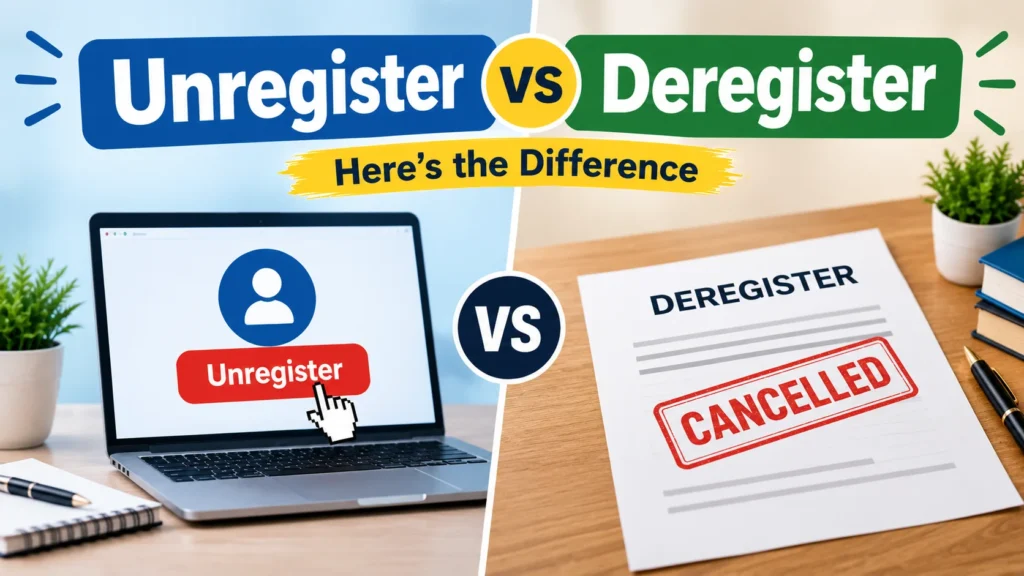
When you come across unregister vs. deregister, the two words can look almost interchangeable. Both describe removing something from a registration, but the situation often determines which word sounds right. Unregister commonly appears in everyday and technical settings, such as websites, apps, accounts, devices, and online services. Deregister, meanwhile, often points to a more formal process involving an official register, record, license, or legal status. That distinction isn’t absolute, though. Some organizations use their preferred term for a specific process, even when another word might seem equally reasonable. Understanding the context helps you choose naturally and avoid awkward wording. The examples below break down the difference without turning a simple vocabulary question into a maze of grammar rules.
Unregister vs. Deregister: The Quick Answer
The simplest way to understand unregister vs. deregister is to look at what you’re removing and where that registration exists. Unregister usually describes removing yourself, an account, a device, or another item from a system or service. For example, you might unregister a phone from an app or unregister from an online event. Deregister tends to appear when someone removes an entity from an official register or ends a formal registration. A business might deregister with an authority, while a vehicle owner might deregister a vehicle according to an official process.
Here’s the practical shortcut:
- Unregister → commonly used for systems, services, accounts, devices, events, and everyday registrations.
- Deregister → commonly used for official registers, administrative records, licenses, businesses, and regulated activities.
Still, don’t treat that shortcut as an unbreakable grammar rule. A software company may choose deregister for a technical feature, while another may use unregister for essentially the same action. When an organization gives you specific instructions, its terminology takes priority.
What Does “Unregister” Mean?
Unregister means to remove someone or something from a registration. The word combines the prefix un- with register, creating the idea of reversing a previous registration.
You can unregister a person, account, device, service, application, or other registered item. The exact meaning depends on what you’re unregistering.
For example, imagine you signed up for an online workshop but later changed your plans. If the website provides an “Unregister” option, clicking it removes your registration for that event. Nothing about the action necessarily involves a government record or legal status. You’re simply reversing a registration you previously made.
The same idea works with technology. Suppose your tablet remains connected to an account even though you no longer use it. A service might let you unregister the device. In that case, unregistering removes the device’s registration from the service rather than changing an official legal record.
Unregister Definition in Plain English
In plain English, unregister means to remove something from a registered system, list, service, or activity.
The term commonly appears when the original registration happened through a website, application, software platform, event system, membership service, or another digital tool.
Consider these examples:
- “Please unregister me from the workshop.”
- “You can unregister the old device from your account.”
- “She decided to unregister from the online course.”
- “The app lets users unregister their devices.”
- “I need to unregister this email address from the service.”
Each sentence describes a registration being reversed or removed. The setting feels practical rather than strongly administrative.
How “Unregister” Works in Everyday Usage
The usefulness of unregister comes from its broad everyday application. You don’t need a government office, legal document, or official register for the word to make sense.
For instance, you might register for a conference in the morning and decide not to attend later. You can then unregister from the event if the organizer uses that wording. Likewise, a website might let you register a device and later remove it from your account through an “Unregister device” button.
You’ll also encounter the term in software documentation. Developers may use unregister when an application removes a callback, service, component, event handler, device, or account association. The technical meaning can become more specific, but the basic idea remains the same: something that had been registered no longer remains registered.
That makes unregister especially useful in digital environments. It describes a reversal without automatically suggesting that you’ve changed a person’s legal or official status.
How to Use “Unregister” in a Sentence
Grammar becomes easier when you pay attention to what comes after the verb. Unregister can work with a direct object or with from, depending on the sentence.
When you remove an item from a system, use the verb with a direct object:
- “Unregister the device from your account.”
- “The administrator unregistered the computer.”
- “You can unregister the application before reinstalling it.”
When you describe a person leaving a registered activity, from often appears:
- “I want to unregister from the course.”
- “They unregistered from the event.”
- “She plans to unregister from the program.”
The wording can vary between platforms and organizations. That’s why checking the sentence’s context matters more than memorizing one rigid formula.
Unregister Verb Forms
The main forms are straightforward:
- Base form: unregister
- Third-person singular: unregisters
- Past tense: unregistered
- Present participle: unregistering
For example:
“The system unregisters inactive devices automatically.”
“He unregistered from the conference yesterday.”
“She is unregistering her old phone.”
The noun unregistration can also appear in technical writing, although ordinary readers will usually encounter the verb more often.
“Unregister” Sentence Examples
Here are practical examples that show how the word works in different contexts:
Online account: “You can unregister the old device from your account.”
This means the device will no longer remain associated with the registered account.
Event: “I had to unregister from the conference after my schedule changed.”
Here, the speaker reverses an earlier event registration.
Course: “Students can unregister from the class before the deadline.”
The word refers to leaving a previously registered class.
Software: “The administrator unregistered the outdated component.”
The software system removes that component from its registered setup.
Service: “The customer asked to unregister the device from the monitoring service.”
The device remains the focus rather than an official legal record.
These examples show why unregister works so well for ordinary systems and digital processes. The action can be important, but it doesn’t necessarily carry the formal weight associated with an official register.
When “Unregister” Is the Better Choice
Choose unregister when the surrounding context involves a system, account, device, service, event, course, or other ordinary registration.
For example, unregistering an account can make sense when a platform uses registration as part of its account system. Unregister a device sounds natural when software tracks registered hardware. Similarly, unregister from an event works when you’re reversing an event sign-up.
However, always consider the terminology used by the actual platform. If its help page specifically says “deregister your device,” replacing that wording with “unregister” may make your explanation less precise.
The key isn’t simply deciding which word sounds more sophisticated. Instead, look at the type of registration, the purpose of the removal, and the language used by the organization or system. That approach gives you a much more reliable answer than relying on the prefixes alone.
What Does “Deregister” Mean?
Deregister means to remove a person, organization, vehicle, business, license, or other entity from an official register or formal registration. Like unregister, it describes reversing an earlier registration. However, deregister often carries a more formal or administrative tone.
You may see it in government procedures, regulatory systems, business records, professional registers, and licensing processes. For example, a company may need to deregister when it ends its official registration with an authority. A vehicle may also be deregistered when its registered status changes under the applicable rules.
That doesn’t mean deregister always refers to something legal. Some technical systems use the word for software components, devices, or services. The surrounding context remains the deciding factor.
Deregister Definition in Plain English
In simple terms, deregister means to remove something from an official or formal register.
Think of a register as an organized record that confirms someone’s or something’s registered status. When an authority removes that entry, the process may be called deregistration.
For example:
- “The company decided to deregister its business.”
- “The owner must deregister the vehicle.”
- “She chose to deregister from the professional register.”
- “The organization was deregistered after failing to meet the requirements.”
These examples involve more than simply removing an account from an app. They suggest a recognized record, registration, or status.
How “Deregister” Works in Formal Usage
The word becomes especially useful when registration has an official purpose. A government agency might maintain a register of businesses. A licensing body might maintain a register of qualified professionals. A transportation authority might maintain vehicle registration records.
In such cases, deregister clearly communicates a formal change.
For example, closing a business and deregistering its official registration aren’t necessarily identical actions. A business owner might stop trading but still need to complete a separate administrative process to remove the business from an official register.
The same distinction applies to vehicles. Selling a car doesn’t automatically mean that every registration record disappears. Depending on the jurisdiction, the owner may need to complete a formal procedure. In that setting, deregister describes the official process more precisely.
Unregister vs. Deregister: The Core Difference
The main difference between unregister and deregister comes down to context. Both words can describe removing something from a registration, yet they often appear in different settings.
Unregister generally feels broader and more practical. It commonly appears in technology, online services, accounts, devices, events, and other everyday systems.
Deregister often sounds more formal. It commonly describes removal from an official register, administrative record, licensing system, or regulated database.
Here’s the distinction in a quick view:
| Context | More natural choice | Example |
| Online account | Unregister | Unregister the device from your account. |
| App or software | Unregister | Unregister the old component. |
| Event registration | Unregister | Unregister from the conference. |
| Official business record | Deregister | Deregister the company. |
| Vehicle registration | Deregister | Deregister the vehicle. |
| Professional register | Deregister | Deregister from the professional register. |
| Government record | Deregister | Deregister the organization. |
This table gives you a useful starting point, but real usage can overlap.
Unregister: Removal From a System or Activity
When you unregister, you typically reverse a registration within a service, platform, event, or technical system.
Imagine that you registered your phone with an online account. Later, you replace the phone and want to remove the old device. If the platform calls this action “unregister,” the wording feels completely natural.
The same principle applies when you leave an online class, cancel an event registration, or remove a registered application from a system.
In these situations, the focus usually rests on removing the registration, not changing an official legal status.
Deregister: Removal From an Official Register
When you deregister, the focus often shifts toward the registered status itself.
Suppose a business appears on an official government register. Removing that business from the register represents a formal administrative action. Deregister fits that context because the registration carries institutional significance.
Likewise, a professional license or vehicle registration may exist within an official system. Removing that registration can involve forms, identification, documentation, approval, or confirmation.
The process matters here. You’re not merely deleting information from a personal account. You’re changing a recognized registration status.
Are “Unregister” and “Deregister” Interchangeable?
Not always. Although the words overlap in meaning, they aren’t perfect synonyms in every situation.
You could understand both as describing the reversal of registration. Yet replacing one with the other can make a sentence sound unusual or change its implied meaning.
For example:
“I need to unregister my phone from the app.”
That sounds natural because the situation involves a digital device and an application.
Now consider:
“The company needs to deregister from the official business register.”
Here, deregister fits the formal setting much better.
Could you technically understand “unregister” in the second example? Probably. Would it be the strongest word for formal administrative writing? Usually not.
The reverse can happen, too. Saying that you need to deregister your phone from an app may sound unnecessarily formal unless that particular app uses the term.
So, don’t ask only, “Are these words synonyms?” Ask a better question: What kind of registration am I talking about?
Why Context Decides the Correct Word
Context provides the missing piece. Look at the noun, the organization involved, and the purpose of the registration.
If you’re talking about an account, device, website, application, event, or online service, unregister will often feel more natural.
If you’re talking about a government record, business, vehicle, license, professional register, or regulated organization, deregister will often fit better.
However, there’s one important exception: the organization’s own terminology wins.
A software company might call its feature “Deregister Device.” Another company might use “Unregister Device.” Neither label automatically becomes grammatically wrong because of that choice.
This matters when you’re writing instructions. If the official interface says Deregister, use Deregister when describing the steps. Matching the system’s wording prevents confusion and helps readers find the correct button or procedure.
A Simple Mental Shortcut
Here’s an easy way to remember the difference:
Unregister = remove from a system, service, or activity.
Deregister = remove from an official or formal register.
Think of unregister as stepping away from something you signed up for. Think of deregister as changing an entry in an official record.
For example, you might unregister from a webinar but deregister a business.
That shortcut won’t cover every specialized use. Still, it works well for most everyday writing and gives you a reliable starting point when you’re unsure which verb to choose.
Where “Unregister” Is Commonly Used
Once you understand the basic difference, real-world examples make unregister much easier to recognize. The word appears frequently in digital environments where users register accounts, devices, applications, events, or services. In these situations, unregister usually describes reversing an earlier sign-up or removing an item from a system.
Websites, Apps, and Online Accounts
Websites and apps often use unregister when users need to remove an account, device, or registration from their platform. For example, a website might allow you to register a device for security purposes and later provide an option to unregister the device.
However, don’t confuse unregistering with deleting an account. Those actions can have very different results. Unregistering a device might simply disconnect it from your profile while leaving your account completely intact.
For example:
“Open your account settings and unregister the old device.”
Here, unregister describes removing the device’s connection to the registered account.
Some platforms may instead use deregister. That’s perfectly possible because companies often choose their own technical terminology. When writing instructions for a specific platform, follow the wording that platform actually uses.
Forums, Newsletters, and Sign-Up Lists
The word can also appear when someone leaves a forum, course, event, membership, or another registered activity.
For example:
“You can unregister from the discussion forum before the deadline.”
Likewise, an educational platform might let students unregister from a class after registration.
Newsletters create a slightly different situation. If you receive marketing emails, unsubscribe is usually the more natural word. You subscribe to a newsletter rather than simply register for it.
That distinction matters because unregister, unsubscribe, and cancel don’t always describe the same action. Choosing the exact verb tells your reader what actually happened.
Everyday Digital Actions Without Legal Steps
The strongest everyday use of unregister involves actions that don’t require a formal authority, legal document, or official record.
You might unregister:
- A phone from an account
- A computer from a software service
- A device from an application
- Yourself from an online event
- Yourself from a course
- An item from a digital platform
- A service connection from a user profile
These actions usually happen through a website, application, account dashboard, or software interface.
For instance, imagine that you bought a new laptop and no longer use the old one. Your account might contain several registered devices. Removing the old laptop from that list is a typical unregister situation.
The action changes how the system recognizes the device. It doesn’t necessarily alter any official legal status.
Where “Deregister” Is the Correct Choice
Now the context shifts. Deregister becomes more appropriate when registration connects to an official record, administrative process, regulatory requirement, or recognized legal status.
That distinction explains why you’ll often see the term in government, business, licensing, and regulatory contexts.
Government Records and Legal Databases
Government agencies often maintain formal registers containing information about people, businesses, organizations, vehicles, or professional credentials. Removing an entry from such a register may involve deregistration.
For example:
“The organization must deregister with the relevant authority.”
The sentence suggests an official process rather than simply deleting an entry from a private website.
Similarly, a government database may contain a registered entity whose status must change through a defined administrative procedure. In that context, deregister communicates the formal nature of the action.
The exact rules vary by jurisdiction, so the word alone shouldn’t be treated as proof that a particular legal consequence follows. The authority’s instructions determine what deregistration actually means.
Vehicles, Businesses, and Official Ownership Systems
Vehicles provide an easy way to see the distinction.
When you own a registered vehicle, its details may appear in an official registration system. If you need to remove that registration through the required administrative process, deregister can be the appropriate term.
For example:
“The owner decided to deregister the vehicle.”
That’s different from simply removing a car from a personal account or deleting a vehicle entry from an app.
Businesses work in much the same way. A company may appear on an official business register. Removing that registration can involve a formal procedure, documentation, fees, deadlines, or confirmation from the relevant authority.
That’s why deregister sounds more natural in this setting.
Banking, Licensing, and Regulated Services
Formal registration also appears in professional licensing, financial services, regulated industries, and other controlled systems.
A professional may need to deregister from an official register when they stop practicing under a particular registration. A regulated organization may also need to complete a formal deregistration process when it no longer operates under a specific authorization.
Here, the word carries an important idea: the registration represents recognized status.
That doesn’t mean every banking or licensing context automatically requires deregistration. The institution may use another term, such as cancel, withdraw, terminate, or deactivate. Always check the terminology used by the relevant organization.
Real-World Scenarios That Make the Difference Clear
Looking at similar situations side by side makes the distinction much easier to remember.
Removing an Online Account vs. Closing a Registered Entity
Suppose you join a website and later decide you don’t want your profile connected to its service. The platform might allow you to unregister the account or device.
Now imagine a company appears on an official business register. Removing that company from the register involves a formal administrative process. Deregister fits that situation more naturally.
The underlying idea is similar: something leaves a registration. The context changes the preferred word.
Selling a Car and Updating Official Records
Selling a car doesn’t necessarily mean you’ve completed every registration requirement. Depending on the applicable rules, the official vehicle record may need to be updated, or the vehicle may need to be deregistered.
If you’re simply removing the car from a personal garage-management app, unregister may make more sense.
This example shows why the object alone doesn’t always determine the verb. The system handling the registration matters just as much.
Ending a Service That Requires Legal Documentation
Consider a service that operates under an official license or registration. Simply stopping your subscription may be a cancellation. Removing the underlying official registration may require deregistration.
That distinction can become important in formal writing because the wrong verb may suggest that a different process occurred.
For everyday readers, the easiest question is:
Am I removing something from a normal system, or am I changing an official registration status?
If you’re dealing with a normal digital system, unregister often works. If you’re dealing with an official register or formal status, deregister often makes the better choice.
A Practical Context Test
When you’re stuck between unregister and deregister, don’t guess based only on how the words look. Identify three things first:
- What is being removed?
- Who maintains the registration?
- Does the registration represent official status?
An app, website, event platform, or software service often points toward unregister.
A government authority, licensing body, business register, or regulated institution often points toward deregister.
There will always be exceptions. Technical systems sometimes borrow formal terminology, while official organizations may use unregister in their interfaces. That’s why actual usage matters more than a rigid rule.
The safest approach is simple: match the word to the context and follow the terminology used by the system or authority involved.
Unregister vs. Unsubscribe vs. Cancel vs. Deregister
The final piece of the puzzle is separating unregister from words that seem similar. These terms can overlap, but they don’t always describe the same action. Choosing the right one depends on what you actually want to stop, remove, or change.
Unregister vs. Unsubscribe
Unregister usually relates to registration, while unsubscribe relates to receiving something you previously subscribed to.
For example:
“I need to unregister from the online course.”
You registered for the course, so unregister makes sense.
Now consider:
“I want to unsubscribe from this newsletter.”
You subscribed to receive emails, so unsubscribe is the natural choice.
The distinction is small but useful. Registration concerns joining or entering something. Subscription concerns receiving ongoing content, updates, or services.
Unregister vs. Cancel
Cancel has a much broader meaning. You can cancel a reservation, appointment, subscription, order, membership, or service.
For example:
“I canceled my hotel reservation.”
That doesn’t necessarily mean you were unregistered from anything.
Likewise:
“I unregistered from the workshop.”
This specifically suggests that you reversed your registration.
Sometimes a system may use cancel registration instead of unregister. In that case, follow the platform’s terminology rather than forcing a particular word.
Deregister vs. Delete
Deregister and delete describe different ideas. Delete generally means removing information, files, accounts, or records from a system. Deregister focuses on removing registered status.
For instance, deleting an account might remove your profile and associated information. Deregistering a business, however, may remove its official registration while following a formal administrative process.
That’s an important distinction in technical and formal writing.
How to Decide Which Word to Use
When you’re unsure whether to write unregister or deregister, start with the setting. Don’t rely solely on which word sounds more formal.
Ask: What Exactly Are You Removing?
If you’re removing an account, device, application, event registration, or digital service connection, unregister often fits naturally.
If you’re removing an official registration involving a business, vehicle, license, organization, or formal register, deregister often works better.
For example:
- Unregister a device from an account.
- Unregister from an event.
- Deregister a vehicle from an official register.
- Deregister a business with an authority.
These examples make the distinction easier to see because the surrounding nouns establish the context.
Ask: Is the Process Official?
Here’s another useful test: determine whether an authority recognizes the registration.
If you’re clicking a button inside an app, the action probably isn’t a formal administrative process. Unregister may be the natural choice.
If you’re submitting forms to an authority to change an official status, deregister may be more appropriate.
However, this isn’t an absolute rule. Some software platforms use deregister for technical actions. Others use unregister for processes that sound quite formal.
The terminology used by the actual organization should always guide you.
Ask: Am I Removing Access or Changing Registration Status?
This question can prevent several common mistakes.
Removing access to an account isn’t necessarily the same as removing its registration. Deleting a device from an account isn’t necessarily the same as deregistering an officially registered device.
Similarly, canceling a service doesn’t automatically mean you’ve deregistered from an official register.
Before choosing a verb, identify the actual action. Are you stopping access, ending a service, reversing a sign-up, deleting information, or changing official registration status?
Once you answer that question, the correct term becomes much easier to spot.
Grammar and Sentence Patterns for “Unregister”
Unregister works as a regular verb, and its sentence structure depends on whether you’re removing something directly or describing a person leaving a registered activity.
“Unregister From” vs. “Unregister Something”
Use unregister from when the sentence focuses on someone leaving a registered activity or service:
“She unregistered from the course.”
Use unregister with a direct object when you’re removing something from a system:
“He unregistered the old device.”
Both patterns are useful. The object and context tell you which construction sounds natural.
Unregister Verb Forms
The main forms are:
- unregister
- unregisters
- unregistered
- unregistering
Examples include:
“The system unregisters inactive devices.”
“She unregistered from the event.”
“They are unregistering the old equipment.”
The noun unregistration exists as well, although everyday readers will encounter unregister much more often.
Grammar and Sentence Patterns for “Deregister”
Deregister follows the same basic verb pattern.
“Deregister From” vs. “Deregister Something”
Use deregister from when a person or organization leaves an official register:
“The professional deregistered from the association.”
Use deregister with a direct object when the registered entity itself undergoes the formal removal:
“The authority deregistered the vehicle.”
Again, the exact construction can vary according to the institution’s preferred language.
Deregister Verb Forms
The standard forms are:
- deregister
- deregisters
- deregistered
- deregistering
The related noun deregistration describes the process itself.
For example:
“The deregistration process requires additional documentation.”
That wording sounds particularly natural in administrative writing.
Common Mistakes With Unregister and Deregister
Treating the Words as Perfect Synonyms
The biggest mistake is assuming that unregister and deregister always work interchangeably.
They share a core idea, but their usual contexts differ. Unregister often fits everyday and technical situations, while deregister frequently appears in formal or official settings.
Using “Deregister” for Every Digital Action
A sophisticated-sounding word isn’t automatically a better word.
If you’re talking about removing a phone from an app, deregister may sound unnecessarily formal unless the software specifically uses that term.
Natural writing should reflect the actual setting.
Using “Unregister” for Every Official Process
The opposite mistake can also create problems.
If you’re discussing an official business register, professional register, or vehicle registration system, deregister may communicate the formal nature of the process much more clearly.
Confusing “Unregister” With “Unsubscribe”
A newsletter is the classic example.
You subscribe to a newsletter, so you normally unsubscribe from it. You don’t usually “unregister” from the newsletter unless the organization specifically uses that wording.
Confusing “Deregister” With “Delete”
Deregistration doesn’t necessarily erase every piece of information connected with a person, business, vehicle, or organization.
The registration status can change while historical records remain available.
Unregister vs. Deregister in US English
In US English, both unregister and deregister are valid words. The important difference comes from how speakers and organizations use them in context.
Unregister commonly feels natural in software, websites, devices, accounts, events, and other everyday digital settings.
Deregister tends to appear more often in formal, administrative, regulatory, or official contexts. However, US organizations can choose either term for their own systems.
For example, one application might display Unregister Device, while another displays Deregister Device. Both labels can describe essentially the same technical action.
That’s why there isn’t a universal rule saying Americans must always choose one word. The system’s terminology matters.
A Simple Memory Trick for Unregister vs. Deregister
Here’s an easy shortcut:
Unregister = remove from a system or ordinary registration.
Deregister = remove from an official or formal register.
Think of unregister as backing out of something you signed up for. Think of deregister as removing an entry from a formal record.
For example:
- You unregister from a webinar.
- You unregister a phone from an app.
- You deregister a vehicle.
- You deregister a business.
This isn’t a perfect rule for every specialized system. Still, it works as a practical guide when ordinary usage leaves you wondering which word sounds right.
Conclusion
Understanding unregister vs. deregister becomes much easier once you focus on context rather than the words alone. Both terms describe reversing a registration, but they often appear in different situations. Unregister usually works well for everyday and technical actions involving accounts, devices, apps, websites, events, and services. Deregister tends to fit formal settings involving official registers, businesses, vehicles, licenses, and regulated records. However, these aren’t rigid rules. A company may choose either term for its software or administrative process, so its official wording should guide you. When you’re writing, ask yourself what you’re removing, who maintains the registration, and whether the registration represents an official status. That simple check can help you choose naturally. Once you understand the context, the difference between unregister and deregister isn’t nearly as confusing as it first appears.
FAQs
Is unregister a correct English word?
Yes, unregister is a correct English verb. It means removing someone or something from a registration, system, service, list, or activity. You’ll commonly see it in technical and digital contexts, such as unregistering a device from an account or unregistering from an event. Its exact meaning depends on what was registered and how the relevant system uses the term.
Is deregister a correct English word?
Yes, deregister is a standard English verb. It generally means removing a person, business, vehicle, organization, or other entity from a register or formal registration. The word frequently appears in administrative, regulatory, licensing, and official contexts. However, some technical systems also use it for digital actions, so the organization’s preferred terminology can determine the most appropriate wording.
Are unregister and deregister synonyms?
Unregister and deregister have overlapping meanings because both can describe reversing a registration. However, they aren’t always interchangeable. Unregister commonly appears in everyday and technical settings, while deregister often suggests formal or official registration. Context matters most. If a particular organization uses one term for its process, follow that terminology to describe the action accurately.
What is the difference between unregister and deregister?
The main difference involves context and formality. Unregister commonly refers to removing an account, device, service, event registration, or similar item from a system. Deregister often refers to removing something from an official register or changing its formal registration status. These patterns aren’t absolute, though, because organizations may use either term for specific processes.
Should I say unregister or deregister an account?
For a typical website or software account, unregister will usually sound more natural. It can describe removing an account, device, or registration from a digital system. However, always check the platform’s own wording. If its instructions specifically say deregister, use that term when describing the process. The system’s terminology provides the clearest guide.
Should I say unregister or deregister a vehicle?
When you’re discussing an official vehicle registration, deregister often fits better because the process can involve an official record or regulatory authority. However, terminology varies by country and agency. If you’re simply removing a vehicle from an app or personal account, unregister may be more appropriate. The specific process determines the best word.
Is unregister more informal than deregister?
Generally, unregister has a more neutral, everyday feel, especially in digital and technical contexts. Deregister often sounds more formal because it frequently appears in administrative, regulatory, and official settings. Still, neither word is automatically informal or formal in every situation. The surrounding context and the terminology chosen by the organization matter more than the words themselves.
Can I use deregister for an online account?
Yes, you can use deregister for an online account if the platform or organization uses that term. Some technical systems use deregister to describe removing an account, device, or service from their records. However, unregister may sound more natural in many digital contexts. When writing instructions, match the terminology displayed by the actual platform.
What is the difference between unregister and unsubscribe?
Unregister relates to registration, while unsubscribe relates to a subscription. For example, you might unregister from an online course because you previously registered for it. You would usually unsubscribe from a newsletter because you subscribed to receive its emails. Although both actions stop something, they involve different types of participation and therefore require different verbs.
What is the difference between deregister and delete?
Deregister means removing something from a register or ending its registered status. Delete generally means removing data, information, files, or an account from a system. Deregistration doesn’t necessarily erase every related record. For example, a business may become deregistered while historical information about that business remains in an official database.