
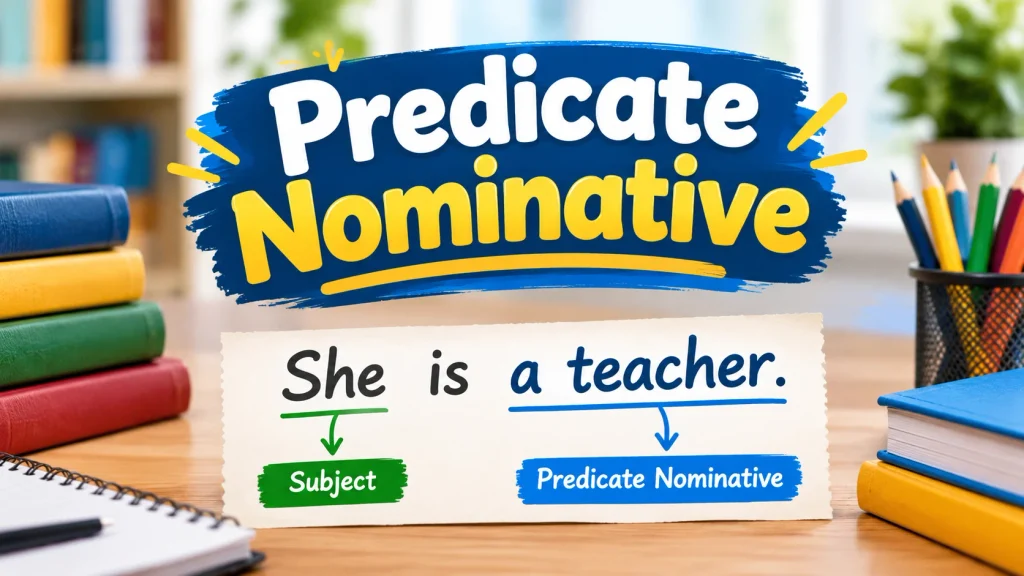
A predicate nominative can look intimidating at first. In practice, though, it answers a fairly simple question: What is the subject? If a linking verb connects the subject to a noun or pronoun that renames or identifies it, that noun or pronoun functions as a predicate nominative. For example, in Maya is a teacher, teacher identifies what Maya is. That small grammatical relationship helps you distinguish predicate nominatives from direct objects and predicate adjectives. This guide breaks the concept into clear steps, practical tests, examples, comparisons, and exercises.
What Is a Predicate Nominative?
A predicate nominative is a noun or pronoun that follows a linking verb and renames or identifies the sentence’s subject. Many grammar references also call it a predicate noun. It belongs to the larger category of subject complements, which complete the subject’s meaning rather than receive an action.
Consider this sentence:
Maria is a doctor.
The sentence contains three important pieces:
| Sentence part | Word | Function |
| Subject | Maria | Tells who the sentence is about |
| Linking verb | is | Connects the subject to its complement |
| Predicate nominative | a doctor | Renames or identifies Maria |
The word doctor doesn’t describe an action that Maria performs. Instead, it tells you what Maria is. You can think of the relationship as:
Maria = doctor
That “equals” relationship provides one of the easiest ways to recognize a predicate nominative.
The predicate itself contains the verb and the words connected to it. When the verb works as a linking verb, the information that follows may function as a subject complement. A noun or pronoun that identifies the subject serves as the predicate nominative.
Predicate Nominative Definition in Simple Terms
Here’s the simplest useful definition:
A predicate nominative is a noun or pronoun after a linking verb that gives the subject another name or identity.
For example:
- Daniel is an engineer.
- My sister became a lawyer.
- The winner was Jordan.
- Their biggest problem is money.
- The person at the door is she. — a formal-style example
In each sentence, the bolded word or phrase identifies the subject.
Notice something important: the predicate nominative doesn’t have to be one word. It can be a noun phrase.
In Daniel is an experienced engineer, the entire phrase an experienced engineer functions as the complement. The noun engineer serves as the head of that noun phrase.
Why Is It Called a Predicate Nominative?
The terminology becomes easier when you split it apart.
Predicate refers to the part of the sentence that states something about the subject. Nominative relates to naming. Put those ideas together, and the term describes a grammatical element in the predicate that names or identifies the subject.
English grammar uses several related labels here. Predicate noun, predicate nominative, and subject complement can overlap, but they don’t always describe exactly the same level of classification.
A subject complement is the broader category. It can be a noun, pronoun, or adjective. When that complement is headed by a noun or pronoun and identifies the subject, it is specifically a predicate nominative. When an adjective describes the subject, it is a predicate adjective.
Quick Predicate Nominative Examples
| Sentence | Subject | Linking verb | Predicate nominative |
| Olivia is a doctor. | Olivia | is | a doctor |
| Mark became a teacher. | Mark | became | a teacher |
| The winner was Sarah. | The winner | was | Sarah |
| My uncle is an engineer. | My uncle | is | an engineer |
| The problem remains a mystery. | The problem | remains | a mystery |
The fastest question to ask is:
Does the noun or pronoun after the linking verb identify the subject?
If the answer is yes, you’ve likely found a predicate nominative.
How a Predicate Nominative Works
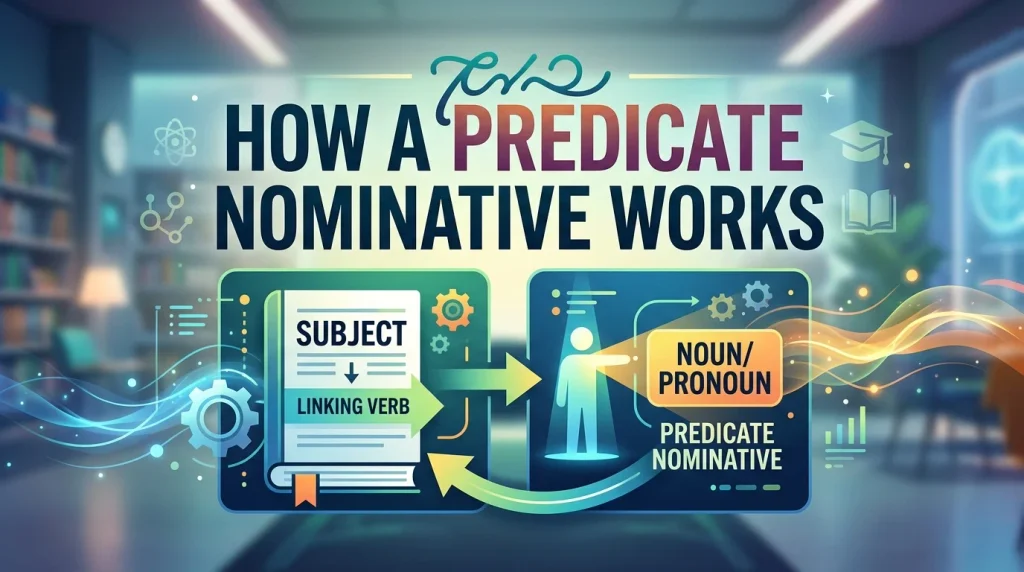
A predicate nominative works through a relationship rather than an action. The subject and complement connect through a linking verb, which expresses a state, identity, condition, or change instead of transferring an action to an object.
Compare these two sentences:
- Emma became a doctor.
- Emma treated a patient.
In the first sentence, a doctor identifies Emma. In the second, a patient receives the action expressed by treated. Therefore, the first contains a predicate nominative, while the second contains a direct object.
The distinction becomes clearer when you focus on what the verb actually does.
A linking verb connects. An action verb acts.
The Language Portal of Canada describes a linking verb as a verb that connects the subject with a subject complement rather than expressing an action.
The Relationship Between the Subject and Predicate Nominative
The predicate nominative creates an identity relationship between two parts of the sentence.
Consider:
Marcus is the captain.
You can mentally rewrite the relationship as:
Marcus = captain
That doesn’t mean Marcus and captain are literally interchangeable in every grammatical sense. It means the sentence presents captain as Marcus’s identity or role.
Now consider:
The building is a library.
Again:
The building = a library
The noun library doesn’t receive an action. It identifies the subject.
This test becomes particularly useful when sentences get longer:
The woman standing near the entrance is the new director.
The extra phrase standing near the entrance may initially distract you. Strip away the modifier:
The woman is the new director.
Now the structure becomes obvious:
woman → is → director
The phrase the new director functions as the predicate nominative.
How Linking Verbs Connect the Subject and Predicate Nominative
The most familiar linking verb is be. Its common forms include:
- am
- is
- are
- was
- were
- be
- been
- being
Other verbs can also function as linking verbs. Common examples include become, seem, appear, remain, grow, turn, feel, look, smell, sound, and taste. However, several of these verbs can perform different grammatical jobs depending on context.
For example:
The soup tastes delicious.
Here, tastes links soup to delicious. The word delicious describes the soup.
Now compare:
Maria tasted the soup.
This time, tasted expresses an action. The soup functions as the direct object.
The verb itself hasn’t changed spelling. Its function has changed.
A useful diagnostic is to see whether a form of be can replace the verb without destroying the intended meaning. The Language Portal of Canada gives this approach for distinguishing linking and action uses of verbs such as taste.
For example:
The pie tasted good.
You can say:
The pie was good.
That strongly suggests tasted functions as a linking verb.
But:
John tasted the pie.
You can’t reasonably turn that into:
John was the pie.
The action meaning is obvious.
Formula for Predicate Nominatives
The core formula is straightforward:
Subject + Linking Verb + Predicate Nominative
Examples:
Nina + is + a student.
Carlos + became + a manager.
The winner + was + Maya.
You can expand the structure without changing its basic logic:
Subject + Linking Verb + Noun Phrase
My brother is an experienced software engineer.
Here, an experienced software engineer is a noun phrase functioning as the predicate nominative.
You can also use a compound predicate nominative:
The new law is an opportunity and a risk.
Both an opportunity and a risk identify or characterize the subject through the linking verb. A compound predicate nominative can therefore contain more than one noun or noun phrase.
Common Linking Verbs That Introduce Predicate Nominatives
Not every predicate nominative follows the verb is. English has several linking verbs that can connect subjects with complements.
The important point is that you shouldn’t memorize a verb list and stop there. Context determines function.
Forms of “Be”
Forms of be are the clearest examples because they commonly establish identity or classification.
Consider:
- My brother is a pilot.
- They are students.
- She was the winner.
- We were volunteers.
- He will be the new manager.
- She has been a teacher for ten years.
In each case, the noun or noun phrase after the linking structure identifies the subject.
The tense can change while the underlying relationship remains intact.
| Tense | Example | Predicate nominative |
| Present | She is a teacher. | a teacher |
| Past | She was a teacher. | a teacher |
| Future | She will be a teacher. | a teacher |
| Present perfect | She has been a teacher. | a teacher |
| Past perfect | She had been a teacher. | a teacher |
The auxiliary verbs don’t erase the predicate nominative. They simply help form the verb phrase.
Other Common Linking Verbs
Several other verbs can connect a subject with a complement:
| Linking verb | Example | Complement |
| become | He became a leader. | a leader |
| remain | The issue remains a mystery. | a mystery |
| seem | She seems a professional. | a professional |
| appear | He appears to be a capable candidate. | a capable candidate |
| grow | The child grew into a confident speaker. | a confident speaker |
| turn | The project turned into a success. | a success |
Some constructions with these verbs sound more natural with an adjective or a different complement depending on context. The key isn’t to force a predicate nominative into every possible pattern.
For example:
She became successful.
Successful is an adjective, so this is a predicate adjective, not a predicate nominative.
Compare:
She became a successful entrepreneur.
Now a successful entrepreneur is a noun phrase that identifies what she became. It functions as a predicate nominative.
Linking Verbs and Action Verbs Can Look Alike
This is one of the most important details for accurate sentence analysis.
Consider feel:
I feel tired.
Here, feel links I with the adjective tired.
Now consider:
I feel the fabric.
Here, feel describes an action directed toward the fabric. The noun phrase the fabric is a direct object.
The same principle applies to look:
She looks a professional.
She looks at the professional.
The first construction uses looks as a linking verb in a less common but grammatically possible pattern. The second clearly uses looks as an action-oriented verb followed by a prepositional phrase.
Likewise:
The room smells strange.
versus:
The chef smelled the sauce.
In the first sentence, smells connects the room with its description. In the second, smelled describes an action performed by the chef.
This distinction matters because a word’s position alone doesn’t determine its grammatical role.
How to Identify a Predicate Nominative
Once you know the basic pattern, identifying a predicate nominative becomes much easier. Instead of guessing, use a short sequence of checks.
Find the Subject
First, determine who or what the sentence discusses.
Consider:
The new employee is an accountant.
The subject is employee.
The word new modifies employee, but they don’t change its role.
Now look at:
The captain of the team is a doctor.
The subject is captain, not team. The phrase of the team simply modifies captain.
Finding the subject first prevents a common mistake: treating a nearby noun as the subject just because it appears closer to the verb.
Find the Verb
Next, identify the main verb or verb phrase.
The captain of the team is a doctor.
The verb is is.
Then ask whether the verb expresses an action or links the subject to information about itself.
Here, is doesn’t describe something the captain does. It connects the subject with an identity.
Look After the Linking Verb
Now examine what follows the linking verb.
The captain of the team is a doctor.
The phrase a doctor contains a noun. It identifies the subject.
That gives you the basic structure:
The captain → is → a doctor
Therefore, a doctor functions as the predicate nominative.
Check for Identity
Now apply the identity test:
The captain of the team = a doctor.
The sentence presents the two ideas as connected identities.
Try another:
My cousin became a chef.
Identity test:
My cousin = a chef.
The phrase a chef identifies what the cousin became.
Now compare:
My cousin cooked dinner.
You can’t make the same identity connection:
My cousin = dinner.
Instead, dinner receives the action of cookingg. Therefore, it is a direct object.
Questions to Ask Yourself
When you’re unsure, run through these questions:
- What is the subject?
- What is the main verb?
- Does the verb function as a linking verb?
- Does a noun or pronoun follow the linking verb?
- Does that noun or pronoun rename or identify the subject?
- Could you reasonably express the relationship with an equals sign?
If the answers line up, you’ve probably found a predicate nominative.
An Easy Shortcut That Helps
Use this mental pattern:
Subject = noun or pronoun after the linking verb
For example:
Jordan is the captain.
Jordan = captain
The object was a gift.
object = gift
Her brother became an architect.
brother = architect
This isn’t a replacement for complete grammatical analysis, but it works remarkably well for straightforward sentences.
Predicate Nominative Examples
Examples become much more useful when they show different structures rather than repeating the same sentence with different nouns.
Simple Everyday Examples
Consider these:
- My sister is a nurse.
- Our neighbor is a musician.
- That animal is a llama.
- The winner was Sarah.
- My uncle became a pilot.
- The problem is money.
In each sentence, the bolded noun or noun phrase identifies the subject.
Now look at:
Our neighbor is a talented musician.
The predicate nominative isn’t simply musician in practical sentence analysis. The complete noun phrase a talented musician serves as the complement. Its head noun, musician, determines its noun-based function.
This distinction becomes useful when sentences become more detailed.
Workplace and Academic Examples
Predicate nominatives appear naturally in professional and academic writing:
Dr. Patel is a researcher.
The new employee became a team leader.
Our department head is an economist.
The final project was a major achievement.
Her goal is a graduate degree.
These constructions identify roles, professions, categories, outcomes, and classifications.
That’s one reason the concept matters beyond grammar exercises. Writers use this structure constantly when they explain what something is, who someone is, or what role someone holds.
Longer Predicate Nominative Examples
Longer sentences can hide the structure beneath modifiers.
Consider:
The woman who spoke at the conference is the new department chair.
At first glance, the sentence seems complicated. Reduce it:
The woman is the new department chair.
Now the relationship becomes clear.
woman → is → department chair
The relative clause who spoke at the conference adds information about the woman. It doesn’t change the basic predicate nominative structure.
Another example:
The winner of this year’s regional competition is an experienced medical student.
Remove the descriptive material:
The winner is a student.
Then restore the detail:
The winner of this year’s regional competition is an experienced medical student.
The grammatical relationship stays intact.
Predicate Nominative vs. Predicate Adjective
This comparison deserves special attention because both structures use linking verbs.
A predicate nominative names or identifies the subject.
A predicate adjective describes the subject.
Both belong to the broader category of subject complements.
Compare:
Lena is a doctor.
Doctor identifies Lena. It’s a predicate nominative.
Lena is intelligent.
Intelligent describes Lena. It’s a predicate adjective.
The difference isn’t about location. Both appear after a linking verb. The difference lies in function and word class.
| Sentence | Complement | Type | Why? |
| She is a doctor. | a doctor | Predicate nominative | Names her role |
| She is talented. | talented | Predicate adjective | Describes her |
| He became a leader. | a leader | Predicate nominative | Identifies what he became |
| He became confident. | confident | Predicate adjective | Describes his state |
| The building is a school. | a school | Predicate nominative | Identifies the building |
| The building is large. | large | Predicate adjective | Describes the building |
The Naming-or-Describing Test
Ask:
Does this word tell me what the subject is, or what the subject is like?
If it tells you what the subject is, you likely have a predicate nominative.
If it tells you what the subject is like, you likely have a predicate adjective.
For example:
Marcus is a lawyer.
What is Marcus?
A lawyer.
Predicate nominative.
Marcus is successful.
What is Marcus like?
Successful.
Predicate adjective.
This simple distinction clears up a surprising number of grammar questions.
Predicate Nominative vs. Direct Object
A predicate nominative and a direct object can both appear after a verb. That’s where confusion often starts.
The grammatical difference comes from the verb’s function.
A direct object receives the action of a transitive verb. A predicate nominative follows a linking verb and identifies the subject. The Language Portal of Canada distinguishes linking structures from transitive structures in precisely this way.
Compare:
Emma became a doctor.
A doctor identifies Emma.
Predicate nominative.
Now:
Emma visited a doctor.
A doctor receives the action of visited.
Direct object.
| Feature | Predicate nominative | Direct object |
| Verb | Linking | Action/transitive |
| Main job | Renames or identifies subject | Receives the action |
| Example | Leo became a teacher. | Leo hired a teacher. |
| Identity test | Leo = teacher | Leo ≠ teacher |
| Question | What is the subject? | What did the subject act upon? |
The Action Test
Ask whether the verb describes an action moving from the subject toward something else.
Sarah painted the wall.
Sarah performs the action. The wall receives it.
Wall is a direct object.
Now:
Sarah became an artist.
Sarah doesn’t perform became upon artist. The noun identifies Sarah’s new role.
Artist is a predicate nominative.
The distinction can become even clearer with the same noun:
James is a teacher.
Teacher = predicate nominative.
James met a teacher.
Teacher = direct object.
Same basic noun. Different grammatical job.
Predicate Nominatives With Pronouns
Pronouns can also function as predicate nominatives. This is where pronoun case enters the discussion.
Traditional grammar often favors nominative forms such as I, he, she, we, and they after linking verbs in formal constructions.
For example:
The person responsible was she.
The winners were they.
However, natural modern English often uses objective forms in everyday speech:
It was me.
That construction is extremely common in contemporary American English. Treating it as though ordinary speakers routinely use the formal alternative can produce writing that sounds unnatural.
The practical lesson is more nuanced than simply declaring one form “right” and the other “wrong.”
For formal grammar exercises, traditional nominative forms may be expected. In ordinary conversation, forms such as me sound entirely natural.
Compound Predicate Nominatives
A predicate nominative can contain more than one noun or noun phrase.
Consider:
The new law is an opportunity and a risk.
The subject is the new law.
The linking verb is is.
The predicate nominative contains two coordinated noun phrases:
- an opportunity
- a risk
Together, they form a compound predicate nominative.
Another example:
My parents became teachers and mentors.
Both nouns identify roles that apply to the subject.
The structure looks like this:
Subject + Linking Verb + Noun + and + Noun
Compound predicate nominatives are especially useful when a subject has multiple roles or identities.
For example:
Maya is a researcher and an educator.
The two noun phrases work together as the complement.
Types of Predicate Nominatives
Predicate nominatives don’t all look identical. Understanding their different forms helps you recognize them in real writing.
Single Nouns
A single noun can serve as the predicate nominative:
He is a doctor.
She became captain.
The noun identifies the subject or its role.
Proper Nouns
A proper noun can identify the subject:
The winner is Maria.
That city is Chicago.
Here, Maria and Chicago provide specific identities.
Pronouns
Pronouns can also function as predicate nominatives:
The person responsible was she.
The winners were they.
Traditional formal grammar generally treats the pronoun as a nominative-form complement in these constructions.
Noun Phrases
A predicate nominative can be an expanded noun phrase:
She is the new department manager.
He became an experienced civil engineer.
The complete phrase functions as the complement.
Compound Nouns
Multiword nouns can also appear:
He is the team captain.
She became the school principal.
The presence of multiple words doesn’t automatically make the structure complicated. Focus on the phrase’s grammatical role.
Predicate Nominatives in Questions and Negative Sentences
Changing a sentence into a question or negative statement doesn’t remove its underlying grammatical relationship.
Predicate Nominatives in Questions
Consider:
Is Maria the winner?
The normal statement is:
Maria is the winner.
The word order changes because English questions often invert the subject and auxiliary or linking verb.
Yet the winner still identifies Maria.
Another example:
Who is the new captain?
The question asks for the identity of the captain.
The sentence structure becomes less obvious because the expected answer appears in the question itself.
Maria is the new captain.
Now the predicate nominative is easy to spot: the new captain.
Predicate Nominatives in Negative Sentences
Negation doesn’t change the complement’s basic role.
Maria isn’t the captain.
The captain still identifies Maria’s possible role.
He wasn’t a doctor.
A doctor still identifies what he was not.
They aren’t students.
Students still identifies the subject’s classification.
The word not changes the truth value of the statement. It doesn’t automatically change the noun’s grammatical function.
Predicate Nominatives in Different Tenses
Predicate nominatives can appear across different tenses because the linking relationship can remain stable while the verb phrase changes.
Present Tense
She is a teacher.
They are engineers.
The present forms is and are link the subjects with their identities.
Past Tense
She was a teacher.
They were engineers.
The identity relationship remains intact even though the time changes.
Future Tense
She will be a teacher.
They will be engineers.
Here, will be forms the future verb phrase.
Perfect Tenses
She has been a teacher for ten years.
He had been the manager before the company reorganized.
The auxiliary verbs create the perfect tense, while been remains part of the linking structure.
This shows why identifying only the first verb can cause trouble. Sometimes the linking verb belongs to a longer verb phrase.
Common Mistakes With Predicate Nominatives
Understanding the rules becomes much easier when you know which mistakes to avoid.
Mistaking a Direct Object for a Predicate Nominative
Wrong analysis:
She bought a dress.
Calling a dress a predicate nominative would be incorrect.
The verb bought expresses an action. The dress receives that action.
Now compare:
She became a designer.
A designer identifies the subject.
Treating Every Noun After a Verb as a Predicate Nominative
A noun after a verb isn’t automatically a predicate nominative.
Tom opened the door.
The door is a direct object.
Tom is a carpenter.
A carpenter is a predicate nominative.
The verb determines the grammatical relationship.
Confusing Predicate Adjectives With Predicate Nominatives
Compare:
The soup is delicious.
Delicious describes the soup. It’s a predicate adjective.
The soup is a meal.
A meal identifies what the soup is. It’s a predicate nominative.
Both follow is, but they perform different jobs.
Misidentifying Action and Linking Uses
Verbs such as feel, look, taste, smell, and sound can cause trouble because they can operate differently depending on context.
Compare:
The flowers smell wonderful.
Smell links the flowers to a description.
She smelled the flowers.
Smelled expresses an action directed toward the flowers.
Context decides the grammatical function.
Misidentifying Noun Phrases
Don’t assume a predicate nominative must be a single noun.
She is an experienced medical researcher.
The entire noun phrase an experienced medical researcher functions as the subject complement.
The head noun is researcher.
This distinction becomes especially useful when analyzing longer academic or professional sentences.
Pronoun Case Errors
Traditional grammar often prefers nominative pronouns in formal predicate-complement constructions:
- I
- he
- she
- we
- they
But everyday English commonly uses objective forms:
- me
- him
- her
- us
- them
The choice can depend heavily on register and context. That’s why treating conversational English as though it must always follow the most formal traditional pattern can misrepresent actual usage.
Pronoun Case After Linking Verbs
Pronoun case has generated grammar debates for generations.
Traditional Grammar
Traditional analysis often treats a pronoun following a linking verb as a subject complement that takes the nominative case.
For example:
It was I.
The person responsible was she.
The reasoning follows the idea that the complement identifies the subject.
English pronouns preserve more case distinctions than ordinary nouns do. He and him, for example, clearly differ in form.
Modern English Usage
Modern American English commonly uses objective forms after be:
It was me.
That’s him.
It’s her.
These forms occur constantly in natural conversation.
The difference between grammatical tradition and actual usage matters. Good grammar instruction should explain both rather than pretending speakers don’t use the forms they use every day.Which Form Should You Use?For formal grammar exercises, follow the convention the assignment expects.For ordinary conversation, use natural modern English.For professional writing, a useful third option often exists: rewrite the sentence.
Instead of debating:
It was me.
versus
It was I.
you can write:
I was the person responsible.
That version removes the case dispute entirely while preserving the meaning.
Predicate Nominative vs. Subject Complement
The term subject complement is broader than predicate nominative.
A subject complement follows a linking verb and completes the meaning of the subject. It can be a noun, pronoun, or adjective.
Think of the classification this way:
Subject Complement
→ Predicate Nominative — names or identifies the subject
→ Predicate Adjective — describes the subject
For example:
Nora is a scientist.
A scientist is a predicate nominative.
Nora is brilliant.
Brilliant is a predicate adjective.
Both are subject complements.
This broader category makes sentence analysis much easier because you can first identify the complement and then determine exactly what kind it is.
Why Predicate Nominatives Matter
You don’t need to memorize grammar terminology for its own sake. The real value comes from understanding how sentences communicate identity, classification, profession, roles, and relationships.
They Clarify Identity
Predicate nominatives let writers identify people and things efficiently.
Dr. Lee is a researcher.
The sentence immediately establishes Dr. Lee’s role.
They Improve Sentence Analysis
Once you recognize predicate nominatives, you can separate:
- subjects
- linking verbs
- subject complements
- predicate adjectives
- direct objects
- noun phrases
- pronouns
That makes complex sentences far less intimidating.
They Strengthen Formal Writing
Academic and professional writing frequently uses linking structures to classify ideas:
The primary concern is cost.
The central issue was access.
The proposed solution is a compromise.
These sentences don’t merely decorate prose. They establish precise relationships between concepts.
They Help Prevent Grammar Mistakes
Understanding predicate nominatives helps you avoid confusing nouns with direct objects or adjectives.
It also helps you recognize why some verbs link while others express action.
Tips for Mastering Predicate Nominatives
The best way to learn predicate nominatives is to look for patterns rather than memorize isolated definitions.
Remember the Identity Rule
A predicate nominative renames or identifies the subject.
Keep that sentence in your mental toolbox.
Ava is a student.
Ava = student.
Use the Equals-Sign Test
When the sentence permits it, mentally replace the linking relationship with an equals sign.
The man is a doctor.
Man = doctor
If the relationship makes sense, you may have found a predicate nominative.
Identify the Verb First
Don’t rush toward the noun.
First ask:
What verb connects the subject to the rest of the sentence?
Then determine whether that verb links or acts.
Practice With Short Sentences
Start with simple structures:
- He is a teacher.
- She became a leader.
- They are students.
- The winner was Maya.
Once those become automatic, move into longer sentences.
Read Quality English Writing
Real examples help you see how grammar works outside worksheets.
Notice how writers use linking verbs to define people, classify ideas, establish roles, and explain relationships. Then strip complicated sentences down to their core structure.
Predicate Nominative Practice Exercises
Try these before checking the answers.
Exercise: Identify the Predicate Nominative
Find the predicate nominative in each sentence.
- Maria is a doctor.
- The winner was James.
- My brother became a teacher.
- The animal is a rabbit.
- Our neighbor is an engineer.
Exercise: Identify the Complete Structure
For each sentence, identify the subject, linking verb, and predicate nominative.
- The new employee is a manager.
- My cousin became a lawyer.
- The final result was a surprise.
- Their biggest challenge remains funding.
Exercise: Predicate Nominative or Predicate Adjective?
Decide whether the bolded complement is a predicate nominative or predicate adjective.
- Sarah is a teacher.
- Sarah is patient.
- The building became a school.
- The building became old.
- The soup smells delicious.
- The soup is a meal.
Exercise: Predicate Nominative or Direct Object?
Identify the bolded noun phrase.
- David became a doctor.
- David visited a doctor.
- The child is a musician.
- The child met a musician.
- The woman became the manager.
- The woman hired the manager.
Answer Key
Exercise 1 Answers
- a doctor — predicate nominative
- James — predicate nominative
- a teacher — predicate nominative
- a rabbit — predicate nominative
- an engineer — predicate nominative
Each complement identifies the subject through a linking verb.
Exercise 2 Answers
| Sentence | Subject | Linking verb | Predicate nominative |
| The new employee is a manager. | The new employee | is | a manager |
| My cousin became a lawyer. | My cousin | became | a lawyer |
| The final result was a surprise. | The final result | was | a surprise |
| Their biggest challenge remains funding. | Their biggest challenge | remains | funding |
Exercise 3 Answers
- a teacher — predicate nominative
- patient — predicate adjective
- a school — predicate nominative
- old — predicate adjective
- delicious — predicate adjective
- a meal — predicate nominative
The key distinction is simple: nouns and pronouns can identify the subject, while adjectives describe it.
Exercise 4 Answers
- a doctor — predicate nominative
- a doctor — direct object
- a musician — predicate nominative
- a musician — direct object
- the manager — predicate nominative
- the manager — direct object
The identical noun doesn’t guarantee an identical grammatical function. The verb and the relationship between the words determine the role.
A Final Quick Reference
| If you see… | Ask… | Likely answer |
| Linking verb + noun | Does the noun identify the subject? | Predicate nominative |
| Linking verb + pronoun | Does the pronoun identify the subject? | Predicate nominative |
| Linking verb + adjective | Does it describe the subject? | Predicate adjective |
| Action verb + noun | Does the noun receive the action? | Direct object |
| Linking verb + noun phrase | Does the phrase rename the subject? | Predicate nominative |
The core idea is worth remembering because it solves most identification problems:
Subject + linking verb + noun or pronoun that identifies the subject = predicate nominative.
Once you can spot the linking verb, identify the subject, and apply the identity test, the terminology becomes much less daunting. The sentence may grow longer, the verb may change tense, or the complement may contain several words. The underlying relationship stays remarkably consistent.
A Closer Look at Identification and Sentence Structure
Identifying a predicate nominative becomes much easier when you stop looking for a particular word and start examining the relationship between the subject, verb, and complement. A predicate nominative follows a linking verb and identifies or renames the subject.
That distinction matters because a noun after a verb isn’t automatically a predicate nominative. The same noun can function as a predicate nominative in one sentence and a direct object in another.
Consider these two examples:
Daniel became a doctor.
Daniel visited a doctor.
In the first sentence, a doctor identifies what Daniel became. It’s a predicate nominative. In the second, a doctor receives the action of visited, so it’s a direct object.
This section takes that distinction further and shows you how to identify predicate nominatives confidently, even in longer or more complicated sentences.
A Reliable Way to Identify a Predicate Nominative
Use these steps whenever you’re analyzing a sentence.
Find the subject → find the verb → determine whether the verb links → examine the complement → test the relationship.
Let’s apply that method to:
The new employee is a manager.
Find the subject
Ask who or what the sentence discusses.
The answer is the new employee.
The noun employee is the head of the subject phrase. The is a determiner, while new modifies employee.
Find the verb
The verb is is.
Because is is a form of be, it commonly functions as a linking verb.
Examine what follows
The words after the verb are:
a manager
This is a noun phrase.
Now ask what that phrase tells you about the subject.
It identifies the employee’s role.
Apply the identity test
You can represent the relationship informally as:
The new employee = a manager
That identity relationship is the central clue.
Therefore:
- Subject: the new employee
- Linking verb: is
- Predicate nominative: a manager
This basic pattern is consistent with traditional grammar explanations of predicate nominatives.
Don’t Assume Every Noun After a Verb Is a Predicate Nominative
This is probably the most important warning to remember.
Look at:
The manager hired an assistant.
The noun phrase an assistant comes immediately after the verb. However, it isn’t a predicate nominative.
Why?
Because hired is an action verb. The manager performs the action, and the assistant is the person affected by that action.
Now compare:
The manager became an assistant.
Here, became links the subject with a new identity or role.
So:
| Sentence | Verb function | Noun phrase | Function |
| The manager hired an assistant. | Action | an assistant | Direct object |
| The manager became an assistant. | Linking | an assistant | Predicate nominative |
The position looks similar. The grammatical relationship doesn’t.
A useful rule is:
A noun after an action verb is not a predicate nominative simply because it appears after the verb.
The verb’s function must come first.
The Identity Test for Predicate Nominatives
The equals-sign test is one of the easiest ways to understand the relationship.
Take this sentence:
My sister is a veterinarian.
You can think of it as:
My sister = a veterinarian
The sentence identifies the subject.
Now try:
My sister adopted a dog.
Would this work?
My sister = a dog
Obviously not.
The noun dog receives the action of adopted. It’s a direct object.
This test works particularly well with forms of be.
Examples of the Identity Test
That building is a library.
Building = library
Predicate nominative.
The winner was Maria.
Winner = Maria
Predicate nominative.
His dream became a business.
Dream = business
Predicate nominative.
The company hired Maria.
Company = Maria
That doesn’t make sense as an identity relationship. Maria is the direct object of hired.
The equals-sign test is a useful diagnostic, not a mathematical rule. Some sentences involve metaphor, classification, or roles rather than literal identity.
For example:
John is the captain.
John and captain aren’t the same kind of thing. One is a person and the other is a role. Yet the sentence identifies John’s role as captain.
So the better interpretation is:
John = the person holding the captain role
That still gives you the grammatical relationship you’re looking for.
Predicate Nominative Examples in Longer Sentences
Short sentences are useful for learning the basic rule. Real writing, however, rarely stays short.
Modifiers, prepositional phrases, relative clauses, and other details can surround the predicate nominative.
Consider:
The woman who spoke at yesterday’s conference is the new director of research.
This sentence contains several pieces of information.
The core structure is:
The woman is the new director.
Everything else adds detail.
- The woman = subject
- who spoke at yesterday’s conference = relative clause modifying woman
- is = linking verb
- the new director of research = predicate nominative
The phrase of research modifies director. It doesn’t create a separate grammatical role.
This is why stripping away modifiers can help.
Reduce the Sentence to Its Core
When a sentence looks complicated, temporarily remove optional details.
Original:
The experienced scientist from the university became the lead researcher on the project.
Reduced:
The scientist became the researcher.
Now the predicate nominative is much easier to recognize.
The full analysis is:
The experienced scientist from the university
→ subject
became
→ linking verb
the lead researcher on the project
→ predicate nominative
The extra phrases don’t change the basic relationship.
Another Complex Example
The person standing beside the entrance is our new department manager.
Remove the modifiers:
The person is our manager.
The identity relationship becomes obvious.
The full predicate nominative is:
our new department manager
It’s a noun phrase, not merely the single word manager.
That distinction is important when you’re asked to identify the complete predicate nominative rather than only its head noun.
Predicate Nominative vs. Predicate Adjective
A predicate nominative and a predicate adjective can look almost identical because both commonly follow linking verbs.
The difference is what they do.
A predicate nominative names or identifies the subject.
A predicate adjective describes the subject.
Compare:
Maria is a doctor.
Maria is intelligent.
In the first sentence, a doctor identifies Maria.
In the second, intelligent describes Maria.
Side-by-Side Comparison
| Feature | Predicate Nominative | Predicate Adjective |
| Typical form | Noun or pronoun | Adjective |
| Follows | Linking verb | Linking verb |
| Main function | Identifies or renames subject | Describes subject |
| Example | She is a teacher. | She is kind. |
| Main question | What is the subject? | What is the subject like? |
| Broader category | Subject complement | Subject complement |
The distinction between the two is recognized in traditional sentence analysis.
Compare These Pairs
Pair one
David is a musician.
A musician identifies David.
→ Predicate nominative
David is talented.
Talented describes David.
→ Predicate adjective
Pair two
The soup became a meal.
A meal identifies what the soup became.
→ Predicate nominative
The soup became cold.
Cold describes the soup.
→ Predicate adjective
Pair three
She seems a professional.
A professional is a noun phrase identifying her.
→ Predicate nominative
She seems professional.
Professional is an adjective describing her.
→ Predicate adjective
The word professional is particularly useful here because the same form can participate in different grammatical structures depending on how it functions.
The Naming-or-Describing Test
Ask yourself:
Does this word name what the subject is, or describe what the subject is like?
If it names or identifies, you’re looking at a predicate nominative.
If it describes a quality, condition, or characteristic, you’re looking at a predicate adjective.
Try this:
The child is a genius.
What is the child?
A genius.
Predicate nominative.
Now:
The child is brilliant.
What is the child like?
Brilliant.
Predicate adjective.
This simple question can save you from memorizing long lists of grammar terminology.
Predicate Nominative vs. Direct Object
The difference between these two structures is even more important.
A direct object receives the action of a transitive verb. A predicate nominative does not receive an action. Instead, it identifies the subject through a linking verb.
Compare:
Emma became a lawyer.
versus:
Emma called a lawyer.
The noun phrase a lawyer appears after the verb in both sentences.
Yet its grammatical function changes.
In “Emma Became a Lawyer”
The verb became links Emma with a new identity or role.
Emma = a lawyer
Therefore:
a lawyer = predicate nominative
In “Emma Called a Lawyer”
The verb called expresses an action.
Emma performed the action.
The lawyer receives that action.
Therefore:
a lawyer = direct object
A Useful Comparison Table
| Question | Predicate Nominative | Direct Object |
| What type of verb? | Linking verb | Transitive action verb |
| Does it identify the subject? | Yes | No |
| Does it receive an action? | No | Yes |
| Example | She became a lawyer. | She called a lawyer. |
| Relationship | Subject = complement | Subject acts on object |
The action test is therefore useful:
If the verb transfers an action from the subject to the noun, you’re probably dealing with a direct object.
If the verb instead establishes a relationship between the subject and the noun, you’re probably dealing with a predicate nominative.
The Same Noun Can Have Different Functions
This is where grammar starts becoming much more interesting.
Consider the noun teacher.
Sarah is a teacher.
Teacher = predicate nominative.
Sarah met a teacher.
Teacher = direct object.
Sarah became a teacher.
Teacher = predicate nominative.
Sarah thanked the teacher.
Teacher = direct object.
The noun doesn’t determine its own grammatical function.
The sentence structure determines the function.
That’s why identifying a predicate nominative requires more than searching for a noun after a verb.
Predicate Nominatives With Pronouns
Pronouns can also function as predicate nominatives.
For example:
The winner was she.
In traditional formal grammar, she is treated as a nominative-form pronoun because it identifies the subject. Traditional grammar sources commonly explain this construction in terms of subject complement and pronoun case.
However, modern everyday English commonly uses:
The winner was her.
And in ordinary conversation:
It was me.
sounds much more natural to many speakers than:
It was I.
This difference deserves careful treatment because grammar rules and actual English usage aren’t always identical.
Traditional Formal Usage
Traditional formal grammar favors:
- I
- he
- she
- we
- they
after linking verbs when the pronoun functions as a subject complement.
Examples include:
It was I.
The winner was she.
The people responsible were they.
This convention comes from the traditional idea that the complement is linked to the subject and therefore uses the nominative form.
Modern Conversational Usage
Modern English frequently uses objective forms:
- me
- him
- her
- us
- them
Examples:
It’s me.
That’s her.
The person at the door is him.
These constructions are common in everyday speech and informal writing.
That doesn’t mean formal grammar has disappeared. It means register matters.
Which Pronoun Should You Use?
A practical approach is:
| Context | Common choice |
| Traditional grammar exercise | Nominative form |
| Highly formal writing | Nominative form may be preferred |
| Everyday conversation | Objective form is extremely common |
| Informal messages | Objective form is natural |
| When clarity matters | Rewrite the sentence if necessary |
For example, instead of debating:
It was I.
or
It was me.
you could write:
I was the person responsible.
That sentence sounds natural and avoids the issue entirely.
Predicate Pronouns and Formal Grammar
A predicate pronoun is simply a pronoun functioning as a predicate nominative.
Consider:
The person responsible was he.
The pronoun he identifies the person represented by the subject.
The structure is:
Subject + linking verb + predicate pronoun
The person responsible → was → he
Another example:
The winners were they.
The subject is the winners.
The linking verb is were.
The pronoun they identifies those winners.
In traditional grammatical analysis, these pronouns are called predicate nominatives because they perform the same identifying function as nouns.
Compound Predicate Nominatives
Sometimes a subject has two or more identities, roles, or classifications.
For example:
Maya is a teacher and a writer.
Both noun phrases identify Maya.
This creates a compound predicate nominative.
The structure is:
Subject + Linking Verb + Predicate Nominative + and + Predicate Nominative
Another example:
My father is a doctor and a researcher.
The subject has two professional roles.
Compound Predicate Nominative Examples
Here are several natural examples:
- The building is a school and a community center.
- Her brother became a teacher and a coach.
- The project was a challenge and an opportunity.
- Maria is a scientist and an author.
- The two men were brothers and business partners.
In each example, the coordinated nouns or noun phrases relate back to the same subject.
Don’t Confuse a Compound Predicate With Two Objects
Compare:
Maria is a teacher and a writer.
The two noun phrases identify Maria.
Now:
Maria interviewed a teacher and a writer.
The two noun phrases are objects of the action verb interviewed.
The surface pattern looks similar, but the verb creates a completely different relationship.
Types of Predicate Nominatives
Predicate nominatives can take several forms. Learning these forms makes sentence analysis more flexible.
Single Nouns
The simplest pattern uses one noun:
James is a doctor.
Lena became captain.
Proper Nouns
A proper noun can identify the subject:
The winner is Maria.
The capital is Islamabad.
The proper noun gives a specific identity.
Pronouns
Pronouns can function as predicate nominatives:
The person responsible was she.
The winners were they.
Again, modern conversational English often chooses objective forms instead.
Noun Phrases
This is one of the most common real-world forms.
He is an experienced software engineer.
The predicate nominative is the full noun phrase:
an experienced software engineer
Its head noun is engineer.
Another example:
She became the youngest manager in the company.
The entire phrase the youngest manager in the company functions as the complement.
Compound Nouns
A multiword noun can also serve as a predicate nominative:
He is the team captain.
She became the school principal.
The fact that the noun phrase contains multiple words doesn’t change its basic role.
Predicate Nominatives in Questions
Questions can make predicate nominatives harder to recognize because English may change word order.
Consider the statement:
Maria is the winner.
Turn it into a question:
Is Maria the winner?
The grammatical relationship hasn’t disappeared.
Maria remains the subject.
Is remains the linking verb.
The winner remains the predicate nominative.
Only the word order changes.
Questions Beginning With “Who”
Consider:
Who is the new manager?
The question asks for an identity.
A possible answer is:
Maria is the new manager.
Now the structure is easy to see.
The predicate nominative is the new manager.
Questions involving who can become especially tricky because the unknown element itself represents an identity.
For example:
Who is the winner?
The answer:
James is the winner.
The structure becomes visible once the sentence is converted into a statement.
A Useful Strategy for Questions
If a question seems confusing, rewrite it as a normal statement.
Is Daniel the new captain?
becomes:
Daniel is the new captain.
Then identify the subject, linking verb, and predicate nominative.
This technique works particularly well for grammar exercises.
Predicate Nominatives in Negative Sentences
Negation doesn’t remove the predicate nominative.
Consider:
Daniel is not the captain.
The word not changes the meaning of the statement, but the captain still identifies the role being denied.
Structure:
- Daniel — subject
- is — linking verb
- not — negator
- the captain — predicate nominative
Another example:
She wasn’t a doctor.
A doctor remains a predicate nominative.
The same principle applies to plural subjects:
They aren’t students.
Students identifies the subject’s classification.
Negation changes whether the relationship is asserted or denied. It doesn’t automatically change the grammatical role of the complement.
Predicate Nominatives in Different Tenses
The basic relationship can survive changes in tense.
Present
Marcus is a teacher.
Past
Marcus was a teacher.
Future
Marcus will be a teacher.
Present Perfect
Marcus has been a teacher for ten years.
Past Perfect
Marcus had been a teacher before moving abroad.
In each case, teacher identifies Marcus’s role.
The verb phrase changes, but the underlying complement remains.
This is especially important when analyzing sentences with multiple auxiliary verbs.
She may have been the manager.
The complete verb phrase is may have been.
The noun phrase the manager still functions as the predicate nominative.
Predicate Nominatives in Complex Sentences
Complex sentences can contain additional clauses without changing the basic subject-complement relationship.
Consider:
The person who won the competition is a professional athlete.
The relative clause:
who won the competition
modifies person.
The main clause is:
The person is a professional athlete.
Therefore:
- The person who won the competition = subject
- is = linking verb
- a professional athlete = predicate nominative
Predicate Nominatives With Dependent Clauses
Sometimes the complement itself can be a clause functioning nominally.
Consider:
The problem is what we should do next.
The clause what we should do next functions as the complement of is and identifies the problem.
This illustrates an important point: predicate complements don’t always have to be a single noun. A nominal clause can occupy the complement position as well. Grammar references discussing sentence structure recognize noun clauses as possible predicate nominatives.
Another example:
The question is whether they will accept the offer.
The clause whether they will accept the offer provides the identity or content of the question.
These structures are more advanced, but they’re useful when analyzing academic or professional writing.
A Practical Decision Tree
When you encounter a difficult sentence, don’t guess. Walk through this checklist.
Is there a subject?
↓
What is the main verb or verb phrase?
↓
Does the verb link the subject to information about itself?
↓
Does the complement identify or rename the subject?
↓
Is that complement a noun, pronoun, noun phrase, or nominal clause?
↓
If yes, you likely have a predicate nominative.
For example:
The winner of the regional contest became an international celebrity.
Ask:
Who is the sentence about?
→ The winner of the regional contest.
What is the verb?
→ became.
Does it link the subject with a new identity?
→ Yes.
What did the winner become?
→ an international celebrity.
Does that phrase identify the subject’s new status?
→ Yes.
Therefore:
an international celebrity = predicate nominative
Quick Comparison: Three Structures You Must Know
These three sentence patterns cause most confusion.
| Sentence | Verb | Complement/Object | Function |
| Lisa is a doctor. | Linking | a doctor | Predicate nominative |
| Lisa is intelligent. | Linking | intelligent | Predicate adjective |
| Lisa called a doctor. | Action | a doctor | Direct object |
The easiest way to remember the difference is:
Predicate nominative = names.
Predicate adjective = describes.
Direct object = receives action.
That three-part distinction gives you a reliable foundation for analyzing much more complicated sentences.
Compound Predicate Nominatives and More Advanced Structures
A predicate nominative doesn’t always appear as one simple noun. Sometimes a sentence gives the subject two or more identities, roles, or classifications. These structures are called compound predicate nominatives.
For example:
Maria is a teacher and a writer.
Both a teacher and a writer identify Maria. Together, they form a compound predicate nominative.
The linking verb is connects the subject to both noun phrases. The conjunction and joins the two complements.
This follows the same basic principle used throughout predicate nominative structures: a linking verb connects the subject with a subject complement that identifies or describes it.
How Compound Predicate Nominatives Work
Consider:
James became a manager and a consultant.
The sentence contains:
- James — subject
- became — linking verb
- a manager — predicate nominative
- a consultant — predicate nominative
You can think of the relationship this way:
James = a manager
James = a consultant
Both identities connect directly to the same subject.
Here are more examples:
- My sister is a doctor and a researcher.
- The building became a hotel and a conference center.
- David was a teacher and a coach.
- The project became a challenge and an opportunity.
- Her uncle remained a friend and a mentor.
In each sentence, the nouns or noun phrases identify the subject rather than receive an action.
Compound Predicate Nominative vs. Compound Direct Object
These structures can look remarkably similar.
Compare:
Sarah is a teacher and a writer.
with:
Sarah interviewed a teacher and a writer.
In the first sentence, a teacher and a writer identify Sarah’s roles.
In the second, Sarah performs the action interviewed on two people.
| Sentence | Verb | Noun phrases | Function |
| Sarah is a teacher and a writer. | is | a teacher, a writer | Compound predicate nominative |
| Sarah interviewed a teacher and a writer. | interviewed | a teacher, a writer | Compound direct object |
The conjunction doesn’t determine the grammatical function. The verb and the relationship between the words do.
Predicate Nominatives With Linking Verbs Other Than “Be”
Forms of be are the clearest linking verbs, but English uses several other verbs in linking constructions.
Common examples include:
- become
- seem
- appear
- remain
- grow
- turn
- feel
- look
- sound
- smell
- taste
Not all of these verbs introduce predicate nominatives in every sentence. Some can introduce predicate adjectives instead, and several can function as action or transitive verbs depending on context.
Become
The verb become frequently introduces a new identity, role, or classification.
She became a lawyer.
The small company became a major competitor.
His hobby became a business.
In each example, the complement identifies what the subject became.
This makes become particularly useful when identifying predicate nominatives.
Remain
Remain can connect a subject with an ongoing identity or status.
He remained the team captain.
The building remained a school.
She remained a loyal friend.
The complement continues to identify or characterize the subject.
Turn
Turn can sometimes function as a linking verb when it means “become.”
The prince turned a villain.
More naturally in many contexts:
The prince turned into a villain.
The second version uses the prepositional phrase into a villain, so the grammatical analysis differs from the simple predicate nominative pattern.
This illustrates why you shouldn’t label every noun after a potentially linking verb without examining the exact construction.
Seem and Appear
These verbs usually introduce descriptions, but some constructions can involve nominal complements.
He seemed a reasonable candidate.
She appeared a capable leader.
However, modern English often prefers an adjective or an expanded construction:
He seemed like a reasonable candidate.
She appeared to be a capable leader.
The key lesson is simple: don’t force every linking verb into one rigid pattern.
Linking Verb or Action Verb? Context Matters
One of the biggest challenges with predicate nominatives is that some verbs have multiple grammatical uses.
Consider feel.
I feel tired.
Here, feel connects I with the adjective tired. It functions as a linking verb.
Now compare:
I felt the fabric.
Here, felt expresses an action. The fabric is its direct object.
The verb looks almost identical, but its function changes.
The same thing happens with taste:
The soup tasted delicious.
Here, tasted links soup with delicious.
The chef tasted the soup.
Here, tasted expresses an action, and the soup is the direct object.
Official grammar guidance specifically notes that verbs such as feel, look, smell, sound, taste, grow, and appear can have different functions depending on context.
A Useful Replacement Test
One practical test is to see whether you can replace the potentially linking verb with a form of be while preserving the basic relationship.
For example:
The soup tasted delicious.
Try:
The soup was delicious.
The relationship still works.
Now:
The chef tasted the soup.
Try:
The chef was the soup.
The replacement clearly fails.
This test isn’t perfect for every sentence, but it’s a helpful diagnostic.
Common Predicate Nominative Mistakes
Once you understand the basic pattern, most errors come from a handful of recurring problems.
Mistaking Every Noun After a Verb for a Predicate Nominative
This is the most common mistake.
The student read a book.
Some learners see a book after the verb and assume it’s a predicate nominative.
It isn’t.
Read expresses an action, and a book receives that action.
Therefore:
- The student = subject
- read = action verb
- a book = direct object
Compare:
The student became an author.
Here, became links the student to a new identity.
An author is the predicate nominative.
Confusing Predicate Nominatives With Predicate Adjectives
Compare:
The child is a genius.
and:
The child is brilliant.
A genius is a noun phrase that identifies the child.
Brilliant is an adjective that describes the child.
Both are subject complements, but only the first is a predicate nominative. A subject complement can be a noun, pronoun, or adjective, while the noun or pronoun performs the identifying function associated with a predicate nominative.
Assuming a Verb Is Always a Linking Verb
Consider:
The flowers smell wonderful.
Here, smell is a linking verb.
Now:
The gardener smelled the flowers.
Here, smelled is an action verb.
The difference comes from what the verb means in context.
Confusing Subject Complements With Objects
This distinction is especially important in formal grammar.
Erica is an engineer.
An engineer is a subject complement.
It isn’t a direct object.
The verb is doesn’t transfer an action to engineer. Instead, it links Erica with another way of identifying her. Grammar guidance from the Language Portal of Canada explicitly distinguishes subject complements from objects after linking verbs.
Predicate Nominative vs. Object Complement
An object complement creates another potential source of confusion.
Compare:
Erica is an engineer.
with:
They appointed Erica engineer.
In the first sentence, an engineer identifies the subject Erica.
In the second, Erica is the direct object of appointed, while engineer describes or renames that object.
That makes engineer an object complement rather than a predicate nominative.
The difference can be represented like this:
Subject → Linking verb → Subject complement
Erica → is → an engineer
versus:
Subject → Action verb → Direct object → Object complement
They → appointed → Erica → engineer
The two structures may contain similar nouns, but their grammatical relationships are different.
Predicate Nominatives in Questions
Word order can make predicate nominatives harder to spot.
Consider the statement:
David is the winner.
The question becomes:
Is David the winner?
The subject and complement haven’t changed roles.
- David = subject
- is = linking verb
- the winner = predicate nominative
The verb simply moves before the subject because English normally changes word order in many questions.
Questions With “Who”
Consider:
Who is the new director?
A useful way to analyze this sentence is to imagine a possible answer:
Maria is the new director.
Now the structure is obvious.
Maria is the subject.
Is is the linking verb.
The new director is the predicate nominative.
Another example:
Who was the winner?
Possible answer:
James was the winner.
Again, the predicate nominative is the winner.
Questions With “What”
The same principle works with what.
What is the problem?
Possible answer:
The broken printer is the problem.
The complement the problem identifies the subject.
Likewise:
What became the company’s biggest challenge?
Possible answer:
The sudden shortage became the company’s biggest challenge.
The longer sentence may look intimidating, but the basic pattern remains intact.
Predicate Nominatives in Negative Sentences
Negation doesn’t change the function of a predicate nominative.
Compare:
Lena is the manager.
Lena isn’t the manager.
In both sentences, the manager identifies Lena’s role.
The word not simply reverses the truth value of the statement.
More examples include:
He wasn’t a doctor.
They aren’t competitors.
This isn’t the solution.
The building wasn’t a hospital.
The predicate nominative remains:
- a doctor
- competitors
- the solution
- a hospital
Negative Questions
Negative questions work the same way:
Isn’t she the director?
Rewrite it as a statement:
She isn’t the director.
Now the structure is easier to analyze.
The director remains the predicate nominative.
Predicate Nominatives Across Different Tenses
Changing tense doesn’t necessarily change the function of the complement.
Present Tense
Maya is a scientist.
A scientist = predicate nominative.
Past Tense
Maya was a scientist.
A scientist = predicate nominative.
Future Tense
Maya will be a scientist.
A scientist = predicate nominative.
Present Perfect
Maya has been a scientist for ten years.
A scientist = predicate nominative.
Past Perfect
Maya had been a scientist before she changed careers.
A scientist = predicate nominative.
Future Perfect
By then, Maya will have been a scientist for twenty years.
The verb phrase becomes much longer, but the noun phrase still identifies the subject.
This is an important analytical skill because a predicate nominative doesn’t have to appear immediately after a single-word verb.
Predicate Nominatives With Auxiliary Verbs
English often combines helping verbs with a main linking verb.
Consider:
She will be the next director.
The complete verb phrase is will be.
The main linking verb is be, while will helps express future time.
The predicate nominative is:
the next director
Another example:
He may become the new chairman.
Here:
- may = modal auxiliary
- become = linking verb
- the new chairman = predicate nominative
The presence of a helping verb doesn’t change the complement’s function.
Perfect Constructions
Consider:
They have become successful entrepreneurs.
The verb phrase is have become.
The predicate nominative is:
successful entrepreneurs
The same pattern appears in:
She had become a respected leader.
and:
He has remained a trusted adviser.
The additional verb forms add tense or aspect. They don’t turn the predicate nominative into an object.
Predicate Nominatives With Modifiers
A predicate nominative can contain several modifiers.
Consider:
She became the youngest department head in the company’s history.
The entire predicate nominative is:
the youngest department head in the company’s history
Its head noun is head.
The phrase youngest modifies head, while in the company’s history further modifies the noun phrase.
Another example:
He is an exceptionally talented professional photographer from Chicago.
The predicate nominative is the entire noun phrase:
an exceptionally talented professional photographer from Chicago
Don’t identify only photographer if an exercise asks for the complete predicate nominative.
Head Noun vs. Complete Predicate Nominative
This distinction is useful:
Maria is an experienced medical researcher.
Head noun: researcher
Complete predicate nominative: an experienced medical researcher
The head noun is the central noun.
The complete predicate nominative includes the modifiers attached to that noun.
Predicate Nominatives With Prepositional Phrases
Prepositional phrases often appear inside predicate nominative noun phrases.
For example:
David is the leader of the research team.
The predicate nominative is:
the leader of the research team
The phrase of the research team modifies leader.
It isn’t a separate predicate nominative.
Another example:
She became the director of the new department.
The full predicate nominative is:
the director of the new department
The prepositional phrase adds information about which director she became.
Predicate Nominatives in Academic and Professional Writing
Predicate nominatives appear frequently in formal writing because they efficiently establish identity, classification, role, or definition.
Consider:
The hippocampus is a brain structure involved in memory processes.
The noun phrase a brain structure involved in memory processes identifies and classifies the hippocampus.
Another example:
A thesis statement is the central claim of an academic argument.
The complement the central claim of an academic argument identifies what a thesis statement is.
Business writing uses the same pattern:
The chief executive officer is the company’s highest-ranking executive.
Technical writing also relies on these structures:
A variable is a named storage location in a computer program.
These sentences are useful because they establish definitions directly.
Why This Structure Works So Well
Predicate nominatives make classification statements concise.
Instead of writing:
A predicate nominative is something that can be described as a noun or pronoun that identifies the subject after a linking verb.
A clearer definition is:
A predicate nominative is a noun or pronoun that identifies the subject after a linking verb.
The construction puts the concept and its definition into a direct relationship.
That clarity makes predicate nominatives particularly valuable in textbooks, dictionaries, technical documentation, and explanatory prose.
Predicate Nominatives and Definitions
Many dictionary-style or instructional sentences use a variation of this pattern:
A predicate nominative is a subject complement.
Here:
- A predicate nominative = subject
- is = linking verb
- a subject complement = predicate nominative
The two noun phrases identify the same grammatical concept.
Another example:
A linking verb is a connector between a subject and its complement.
The structure establishes an equivalence between the subject and its definition.
This pattern is one reason predicate nominatives matter beyond grammar exercises. They provide a clean way to define terms and establish classifications.
A Case Study: One Verb With Three Different Jobs
Consider the verb look.
It can behave differently depending on the sentence.
Maria looks tired.
Here, looks is a linking verb. Tired describes Maria.
Maria looks a professional.
This construction is uncommon in modern everyday English and is generally less natural than alternatives such as Maria looks like a professional.
Now consider:
Maria looked at the photograph.
Here, looked expresses an action directed toward something.
The lesson isn’t that one particular verb always creates a predicate nominative. Instead, context determines grammatical function.
The same issue appears with feel, smell, taste, sound, and turn. Grammar references specifically note that several of these verbs can shift between linking and action or transitive uses.
Common Errors With Linking Verbs
Watch for these misleading patterns.
“The Food Tasted Well”
If taste links the food with a description, use an adjective:
The food tasted good.
Not:
The food tasted well.
Here, good describes the food.
The same principle applies to other sensory linking verbs.
The music sounded beautiful.
The flowers smelled wonderful.
She felt nervous.
The complement describes the subject, so an adjective is appropriate.
However, well can be correct when it functions as an adjective describing health or condition:
After the illness, she finally felt well.
The exact meaning and grammatical function matter.
A Fast Diagnostic Checklist
When you’re unsure whether a sentence contains a predicate nominative, run through this checklist:
- Find the subject.
- Identify the main verb.
- Ask whether the verb is linking.
- Look for a noun or pronoun complement.
- Ask whether that complement identifies or renames the subject.
- Try the equals-sign test.
- Make sure the noun isn’t receiving an action.
- Check whether the word is actually an adjective describing the subject.
- Consider whether the verb changes meaning in this context.
For example:
The young athlete became the team’s captain.
Ask:
Who is the sentence about?
→ The young athlete.
What happened to the subject’s identity or role?
→ The athlete became the team’s captain.
What is the linking verb?
→ became.
What identifies the subject?
→ the team’s captain.
Therefore:
the team’s captain = predicate nominative
A Three-Way Test for Difficult Sentences
When a sentence feels confusing, compare three possibilities.
Is It a Predicate Nominative?
Daniel became a teacher.
A teacher identifies Daniel.
Is It a Predicate Adjective?
Daniel became confident.
Confident describes Daniel.
Is It a Direct Object?
Daniel met a teacher.
A teacher receives the action of met.
This three-way comparison is one of the most useful tools for mastering predicate nominatives.
| Structure | Verb type | What follows? | Main relationship |
| Predicate nominative | Linking | Noun/pronoun | Identifies subject |
| Predicate adjective | Linking | Adjective | Describes subject |
| Direct object | Transitive/action | Noun/pronoun | Receives action |
Once you can distinguish these three patterns, most predicate nominative questions become far easier.
Advanced Practice: Analyze the Complete Sentence
Consider:
The scientist who led the research became the director of the new laboratory.
Start by simplifying:
The scientist became the director.
Now restore the details.
The scientist who led the research
→ complete subject
became
→ linking verb
the director of the new laboratory
→ complete predicate nominative
The relative clause who led the research modifies scientist. The prepositional phrase of the new laboratory modifies director.
Neither changes the fundamental predicate nominative relationship.
Another Example
After several years of training, Elena became a highly respected surgeon in her community.
The introductory phrase After several years of training provides time information.
The core sentence is:
Elena became a surgeon.
The complete predicate nominative is:
a highly respected surgeon in her community
The sentence is longer, but the underlying pattern remains straightforward.
The Most Important Rule to Remember
A predicate nominative isn’t defined merely by its position.
It is defined by its relationship to the subject through a linking verb.
The basic pattern is:
Subject + linking verb + noun/pronoun identifying the subject
Examples:
James is a teacher.
The winner is Maria.
Her goal became a career.
The building remained a school.
The Language Portal of Canada describes a linking verb as connecting the subject to a subject complement, while a subject complement can rename or describe the subject. That distinction provides the foundation for separating predicate nominatives from predicate adjectives and objects.
When in doubt, return to the relationship:
Does the noun identify the subject?
If yes, and the verb is genuinely linking, you likely have a predicate nominative.
Pronoun Case After Linking Verbs
Predicate nominatives don’t have to be nouns. A pronoun can also function as a predicate nominative when it identifies the subject.
Consider:
The winner was she.
In traditional grammatical analysis, she functions as the subject complement because it identifies the winner. English pronouns can show case, and traditional grammar distinguishes subject forms such as he and she from object forms such as him and her.
This creates an interesting difference between formal grammatical conventions and everyday English.
Traditional Formal Usage
Traditional grammar often recommends the subject form after a linking verb when the pronoun functions as a subject complement.
Examples include:
It was I.
The person responsible was he.
The winners were they.
The logic is straightforward. The pronoun identifies or renames the subject rather than functioning as an object.
You may encounter this pattern in grammar exercises, highly formal prose, or traditional style guides.
Everyday English Usage
Modern conversational English commonly uses object-form pronouns in these constructions:
It was me.
The person responsible was him.
The winners were them.
These forms are extremely common in ordinary speech.
The Language Portal of Canada notes that subject-case pronouns can function as subject complements, while also discussing the differences between traditional formal usage and contemporary spoken English.
That means you shouldn’t treat every real-world use of me, him, or her after a linking verb as a simple grammatical blunder.
A Practical Approach
If you’re completing a traditional grammar exercise, the expected answer may be:
It was I.
If you’re writing natural conversational English, this will usually sound more familiar:
It was me.
When the situation demands maximum clarity, you can also rewrite the sentence:
I was the person responsible.
This approach avoids an unnecessary debate about pronoun case.
Predicate Nominative vs. Subject Complement
These terms are closely related, but they aren’t interchangeable in every grammatical analysis.
Subject complement is the broader category.
A subject complement follows a linking verb and provides information about the subject. It can identify the subject or describe it. A predicate nominative is the identifying type of subject complement. A predicate adjective is the describing type. Think of the relationship like this:
Subject Complement
/ \
/ \
Predicate Predicate
Nominative Adjective
| |
names describes
Consider these examples:
Jordan is a teacher.
A teacher is a predicate nominative because it identifies Jordan.
Jordan is patient.
Patient is a predicate adjective because it describes Jordan.
Both are subject complements.
Why This Distinction Matters
If a grammar exercise asks:
What is the subject complement?
You can answer with either the noun or adjective functioning in that role.
If it asks:
What is the predicate nominative?
You need to identify the noun or pronoun that renames or identifies the subject.
This terminology becomes especially useful when studying sentence diagrams, traditional grammar, or advanced syntax.
Predicate Nominative vs. Object Complement
An object complement can also rename a noun, which makes it easy to confuse with a predicate nominative.
Compare:
David is the captain.
and:
They elected David captain.
In the first sentence, the captain identifies the subject David.
Therefore, the captain is a predicate nominative.
In the second sentence, David is the direct object of elected. The word captain then identifies or describes that object.
Therefore, captain is an object complement.
The difference can be summarized as:
| Structure | What gets identified? | Verb type |
| Predicate nominative | Subject | Linking |
| Object complement | Direct object | Action/transitive |
Official grammar guidance makes this distinction by explaining that a subject complement relates to the subject, while an object complement modifies or renames a direct object
Predicate Nominatives and Subject-Verb Agreement
Predicate nominatives can sometimes make subject-verb agreement look confusing.
Consider:
The main problem is the delays.
The subject is the main problem, which is singular.
The predicate nominative is the delays, which is plural.
The verb agrees with the subject:
The main problem is the delays.
Not:
The main problem are the delays.
The noun phrase after the linking verb doesn’t automatically control the verb.
Now reverse the structure:
The delays are the main problem.
Here, delays is the subject, so the plural verb are agrees with it.
This distinction matters because the predicate nominative can appear plural even when the subject is singular.
Compare the Structures
| Sentence | Subject | Predicate nominative | Verb |
| The problem is the delays. | problem | delays | is |
| The delays are the problem. | delays | problem | are |
| My biggest concern is the costs. | concern | costs | is |
| The costs are my biggest concern. | costs | concern | are |
The general lesson is simple:
Don’t choose the verb based only on the noun closest to it.
Identify the grammatical subject first.
Predicate Nominatives and Inverted Sentences
Some sentences use unusual word order, particularly in literary, formal, or rhetorical writing.
Consider:
On the table was the answer.
The normal word order would be:
The answer was on the table.
However, these two sentences don’t have exactly the same grammatical structure. The second contains a prepositional phrase describing location, while the first uses inversion for emphasis.
This is a good reminder that word order alone isn’t enough to identify a predicate nominative.
A genuine predicate nominative still depends on a linking relationship between the subject and its identifying complement.
For example:
In the end, the winner was Maria.
Here, Maria identifies the winner.
The introductory phrase doesn’t change the underlying structure.
Predicate Nominatives With Appositives
An appositive is another structure that can resemble a predicate nominative because both can rename a noun.
Compare:
My brother, Daniel, is a pilot.
Here, Daniel is an appositive that renames my brother.
The predicate nominative is:
a pilot
The sentence therefore contains two different renaming relationships.
Daniel identifies my brother through apposition.
A pilot identifies the subject through the linking verb is.
Removing the appositive makes the predicate nominative easier to see:
My brother is a pilot.
Now the structure is unmistakable.
Punctuation With Predicate Nominatives
Predicate nominatives generally shouldn’t be separated from their linking verbs with a comma.
Incorrect:
My sister is, a doctor.
Correct:
My sister is a doctor.
The linking verb and its subject complement form a close grammatical relationship. Grammar guidance from the Language Portal of Canada specifically warns against inserting a comma between a linking verb and its subject complement.
Another example:
The winner was Maria.
Not:
The winner was, Maria.
When a Comma May Appear
A comma can occur when the sentence contains a separate parenthetical or interrupting element.
For example:
The winner was, as everyone expected, Maria.
The commas surround the interrupting phrase as everyone expected.
They don’t separate the linking verb from the predicate nominative as a normal grammatical unit.
The distinction is important. Don’t add a comma simply because you would pause while speaking.
Why Predicate Nominatives Matter
Predicate nominatives aren’t merely terms used to pass grammar tests. They help explain how English establishes identity, classification, role, and definition.
Consider:
A whale is a mammal.
The sentence classifies a whale.
Dr. Lee is the department chair.
The sentence establishes a professional role.
The blue whale is an endangered species.
The sentence provides a classification.
The central issue is communication.
The sentence identifies the central issue.
These structures let writers make direct, information-rich statements.
They Clarify Identity
A predicate nominative answers questions such as:
- What is the subject?
- Who is the subject?
- What did the subject become?
- What role does the subject hold?
- What category does the subject belong to?
For example:
The building is a museum.
The predicate nominative a museum tells readers what the building is.
They Support Definitions
Definitions often rely on this structure:
A predicate nominative is a subject complement.
A verb is a word that expresses an action, occurrence, or state.
A thesis statement is the central claim of an argument.
These constructions make explanatory writing concise and direct.
They Help With Sentence Analysis
When you can recognize predicate nominatives, you can analyze the relationship among:
- subject
- predicate
- linking verb
- subject complement
- predicate nominative
- predicate adjective
- direct object
- object complement
That vocabulary gives you a more precise way to explain why a sentence works.
How to Remember a Predicate Nominative
Grammar terminology can feel intimidating until you connect it to a simple idea.
Remember:
Predicate nominatives name.
The word nominative relates to naming.
So when a noun or pronoun follows a linking verb and names or identifies the subject, you’re likely looking at a predicate nominative.
Use the Equals-Sign Test
Try:
Subject = complement
For example:
Maria is a doctor.
Think:
Maria = doctor
The relationship works.
Now:
Maria visited a doctor.
Think:
Maria = doctor
That doesn’t work.
The noun doctor is the direct object.
Check the Verb
Ask whether the verb links rather than expresses an action.
Common linking verbs include:
- am
- is
- are
- was
- were
- be
- been
- become
- seem
- appear
- remain
- feel
- look
- sound
- smell
- taste
- grow
Several of these can also function as action or transitive verbs, so context still matters.
Ask “What Is the Subject?”
This question works especially well with definitions and classifications.
The object is a triangle.
What is the object?
A triangle.
Therefore, a triangle is the predicate nominative.
Predicate Nominative Practice Exercises
Now put the rules together. Identify the predicate nominative in each sentence.
Exercise: Find the Predicate Nominative
Sentence 1
The winner was Daniel.
Sentence 2
My aunt is a professor.
Sentence 3
The building became a hotel.
Sentence 4
Her brother is an engineer.
Sentence 5
The problem is the schedule.
Sentence 6
Our new neighbor became a close friend.
Sentence 7
The team’s captain is Marcus.
Sentence 8
That animal is a mammal.
Sentence 9
The old theater became a cultural center.
Sentence 10
Their biggest goal is success.
Exercise: Predicate Nominative or Predicate Adjective?
Identify whether the bolded word or phrase is a predicate nominative or a predicate adjective.
Sentence 1
Olivia is a scientist.
Sentence 2
Olivia is brilliant.
Sentence 3
The soup became a meal.
Sentence 4
The soup became cold.
Sentence 5
His brother is a musician.
Sentence 6
His brother is talented.
Sentence 7
The child became a champion.
Sentence 8
The child became confident.
Exercise: Predicate Nominative or Direct Object?
Identify the bolded noun phrase.
Sentence 1
Sarah became a lawyer.
Sentence 2
Sarah contacted a lawyer.
Sentence 3
The student is the winner.
Sentence 4
The student congratulated the winner.
Sentence 5
James became the team captain.
Sentence 6
James thanked the team captain.
Sentence 7
The chef is a professional.
Sentence 8
The chef hired a professional.
Exercise: Analyze the Full Structure
For each sentence, identify:
- The subject
- The linking verb
- The predicate nominative
Sentence 1
The experienced teacher became the school’s new principal.
Sentence 2
My oldest brother is a successful architect.
Sentence 3
The central problem was the lack of reliable information.
Sentence 4
The woman who spoke first is the committee chair.
Sentence 5
After several years, the small business became a major employer.
Predicate Nominative Answer Key
Answers: Find the Predicate Nominative
1. The winner was Daniel.
Predicate nominative: Daniel
The linking verb was connects Daniel with the subject the winner.
2. My aunt is a professor.
Predicate nominative: a professor
The noun phrase identifies the role or occupation of the subject.
3. The building became a hotel.
Predicate nominative: a hotel
The verb became links the building with its new classification.
4. Her brother is an engineer.
Predicate nominative: an engineer
The noun phrase identifies the subject’s profession.
5. The problem is the schedule.
Predicate nominative: the schedule
The schedule identifies what the problem is.
6. Our new neighbor became a close friend.
Predicate nominative: a close friend
The noun phrase identifies what the neighbor became.
7. The team’s captain is Marcus.
Predicate nominative: Marcus
Marcus identifies who the team’s captain is.
8. That animal is a mammal.
Predicate nominative: a mammal
The phrase classifies the animal.
9. The old theater became a cultural center.
Predicate nominative: a cultural center
The noun phrase identifies the theater’s new function or classification.
10. Their biggest goal is success.
Predicate nominative: success
The noun identifies the subject’s goal.
Answers: Predicate Nominative or Predicate Adjective?
1. Olivia is a scientist.
→ Predicate nominative
A scientist identifies Olivia.
2. Olivia is brilliant.
→ Predicate adjective
Brilliant describes Olivia.
3. The soup became a meal.
→ Predicate nominative
A meal identifies what the soup became.
4. The soup became cold.
→ Predicate adjective
Cold describes the soup.
5. His brother is a musician.
→ Predicate nominative
A musician identifies his brother.
6. His brother is talented.
→ Predicate adjective
Talented describes his brother.
7. The child became a champion.
→ Predicate nominative
A champion identifies what the child became.
8. The child became confident.
→ Predicate adjective
Confident describes the child’s state.
Answers: Predicate Nominative or Direct Object?
1. Sarah became a lawyer.
→ Predicate nominative
Became is functioning as a linking verb.
2. Sarah contacted a lawyer.
→ Direct object
A lawyer receives the action of contacted.
3. The student is the winner.
→ Predicate nominative
The winner identifies the student.
4. The student congratulated the winner.
→ Direct object
The winner receives the action of congratulated.
5. James became the team captain.
→ Predicate nominative
The team captain identifies James’s new role.
6. James thanked the team captain.
→ Direct object
The team captain receives the action of thanked.
7. The chef is a professional.
→ Predicate nominative
A professional identifies the chef’s status.
8. The chef hired a professional.
→ Direct object
A professional receives the action of hired.
Answers: Full Sentence Analysis
1. The experienced teacher became the school’s new principal.
- Subject: The experienced teacher
- Linking verb: became
- Predicate nominative: the school’s new principal
2. My oldest brother is a successful architect.
- Subject: My oldest brother
- Linking verb: is
- Predicate nominative: a successful architect
3. The central problem was the lack of reliable information.
- Subject: The central problem
- Linking verb: was
- Predicate nominative: the lack of reliable information
4. The woman who spoke first is the committee chair.
- Subject: The woman who spoke first
- Linking verb: is
- Predicate nominative: the committee chair
The clause who spoke first modifies woman. It doesn’t change the predicate nominative structure.
5. After several years, the small business became a major employer.
- Introductory phrase: After several years
- Subject: the small business
- Linking verb: became
- Predicate nominative: a major employer
The introductory phrase provides time information, while the core sentence remains:
The small business became a major employer.
A Final Predicate Nominative Checklist
Before labeling a word or phrase as a predicate nominative, run through these questions:
- What is the subject?
- What is the main verb?
- Is the verb functioning as a linking verb?
- Does the following noun or pronoun identify the subject?
- Can you reasonably express the relationship as subject = complement?
- Is the complement a noun, pronoun, noun phrase, or another nominal structure?
- Could the word instead be a predicate adjective?
- Could it be receiving an action as a direct object?
- Does the verb have a different meaning in this particular sentence?
- If the sentence is long, have you separated the modifiers from the core structure?
A strong analysis should consider all of these factors rather than relying on word position alone.
The Core Pattern
Keep this formula in mind:
Subject + Linking Verb + Predicate Nominative
Examples:
Maria is a doctor.
The winner was Daniel.
The building became a hotel.
My brother is an engineer.
The problem is the schedule.
In every case, the predicate nominative provides an identifying label for the subject.
The Three Rules Worth Remembering
If you remember only three ideas, make them these:A predicate nominative identifies or renames the subject.A predicate nominative follows a linking verb rather than an action verb.A predicate nominative is different from a predicate adjective and a direct object.
The broader grammatical category is the subject complement. Subject complements follow linking verbs and either identify or describe the subject. Nouns and pronouns can perform the identifying function associated with predicate nominatives, while adjectives perform the describing function associated with predicate adjectives.
Once that distinction becomes familiar, even long sentences become much easier to unpack. Instead of searching mechanically for a noun after the verb, you can examine the actual relationship among the subject, linking verb, and complement. That approach gives you a reliable way to recognize predicate nominatives in everyday sentences, formal writing, academic definitions, and more advanced grammatical analysis.
Conclusion
A predicate nominative may sound like a complicated grammar term, but the idea is surprisingly simple. It’s a noun, pronoun, or noun phrase that follows a linking verb and identifies or renames the subject. In a sentence like “Maria is a teacher,” teacher is the predicate nominative because it tells you what Maria is.
The easiest way to spot one is to look for a linking verb, such as is, was, became, or seems, and then ask whether the word after it identifies the subject. If the subject and the complement refer to the same person, place, thing, or idea, you’ve likely found a predicate nominative. Remember, though, that not every word after a linking verb is a predicate nominative. A predicate adjective describes the subject instead.
Once you understand this naming relationship, predicate nominatives become much easier to recognize, analyze, and use accurately.
FAQs
What is a predicate nominative?
A predicate nominative is a noun, pronoun, or noun phrase that follows a linking verb and identifies or renames the subject. For example, in “David is a doctor,” doctor is the predicate nominative because it gives another name or identity for David. It completes the meaning of the subject through a linking relationship.
How do you identify a predicate nominative?
First, find the subject and verb. Then determine whether the verb acts as a linking verb. Look for a noun, pronoun, or noun phrase after that verb. Finally, use the identity test: if the complement identifies or renames the subject, it functions as a predicate nominative. For example, “Lena became captain” contains the predicate nominative captain.
What is an example of a predicate nominative?
In the sentence “My brother is an engineer,” engineer is the predicate nominative. The linking verb is connects brother with engineer. Both words refer to the same person. Other examples include “She became the leader,” “Mark is my neighbor,” and “The winner was Jordan.” Each complement identifies or renames the subject.
What is the difference between a predicate nominative and a predicate adjective?
A predicate nominative identifies or renames the subject, while a predicate adjective describes it. In “Sarah is a musician,” musician is a predicate nominative because it identifies Sarah. In “Sarah is talented,” talented is a predicate adjective because it describes Sarah. Both normally follow linking verbs and function as subject complements.
What verbs can introduce a predicate nominative?
The verb be and its forms are the most common linking verbs used with predicate nominatives. Other verbs can also work when they function as linking verbs, including become, seem, and appear. Some verbs, such as look, feel, and sound, can act as either linking or action verbs depending on the sentence.
Is a predicate nominative the same as a subject complement?
A predicate nominative is a type of subject complement. A subject complement follows a linking verb and provides information about the subject. It may rename the subject with a noun or pronoun, or describe it with an adjective. Therefore, every predicate nominative is a subject complement, but not every subject complement is a predicate nominative.
Can a pronoun be a predicate nominative?
Yes. A pronoun can function as a predicate nominative when it follows a linking verb and identifies the subject. For example, “The winner was she” uses she as the predicate nominative under traditional formal grammar. In everyday English, speakers commonly use “The winner was her.” Pronoun case can therefore vary by grammatical tradition and context.
Is a predicate nominative a direct object?
No. A predicate nominative and a direct object perform different grammatical functions. A direct object receives the action of a transitive verb. A predicate nominative follows a linking verb and identifies or renames the subject. For example, coach is a predicate nominative in “Alex became a coach,” while the ball is a direct object in “Alex kicked the ball.”
Can a predicate nominative be a phrase?
Yes. A predicate nominative can be a noun phrase rather than a single noun. In “Maria is an experienced science teacher,” the entire phrase an experienced science teacher functions as the subject complement, with teacher providing the core noun. Modifiers can expand a predicate nominative while preserving its basic role of identifying the subject.
How can you remember what a predicate nominative does?
Think of a predicate nominative as an identity label. It comes after a linking verb and answers the question, “Who or what is the subject?” In “James is the captain,” captain identifies James. The simple equals-sign test can also help: James = captain. When that relationship makes sense, you may have found a predicate nominative.