

Accent, ascent, and assent look remarkably similar on the page, yet they point to three very different ideas. That small difference in spelling can change an entire sentence. Accent usually relates to pronunciation, emphasis, or a written mark. Ascent refers to moving upward, climbing, or rising to a higher position. Assent means agreement or official approval.
The confusion becomes especially tricky with ascent and assent because they are pronounced the same in standard English. When you hear either word without seeing it written, context has to do the heavy lifting. Accent, meanwhile, has a different pronunciation and usually points toward speech, stress, or emphasis.
Accent vs. Ascent vs. Assent at a Glance
Before looking at each word closely, this quick comparison gives you the basic picture:
| Word | Main Meaning | Part of Speech | Common Context | Related Idea |
| Accent | Pronunciation, emphasis, or a written mark | Noun, verb | Speech, language, writing, music | Stress or emphasis |
| Ascent | Movement upward or rise to a higher position | Noun | Climbing, aviation, roads, progress | Ascend |
| Assent | Agreement or approval | Noun, verb | Decisions, proposals, contracts, formal matters | Agree or approve |
A useful shortcut is simple: accent is about how something sounds or what receives emphasis, ascent is about going up, and assent is about saying yes. That distinction covers most everyday situations.
Why These Three Words Cause Confusion
English contains many words that look alike but developed different meanings. Accent, ascent, and assent are a good example. Their spellings share several letters, their sounds overlap in places, and all three appear in formal writing.
The biggest trap involves ascent and assent. Both are pronounced /əˈsent/ in American English. One describes upward movement, while the other describes agreement or approval.
Consider these two sentences:
- The climber began the ascent before sunrise.
- The board gave its assent to the proposal.
If someone reads both sentences aloud, the target words sound identical. Yet the surrounding nouns make their meanings obvious. A climber moves upward. A board can approve a proposal.
Accent works differently. As a noun, its common pronunciation is /ˈæk.sənt/, and it can describe the way someone pronounces words. It can also describe emphasis placed on a syllable, word, or musical note.
That gives you an easy mental map:
Accent = sound or emphasis
Ascent = upward movement
Assent = agreement
Once that pattern becomes familiar, the spelling stops looking like a three-way guessing game.
What Does “Accent” Mean?
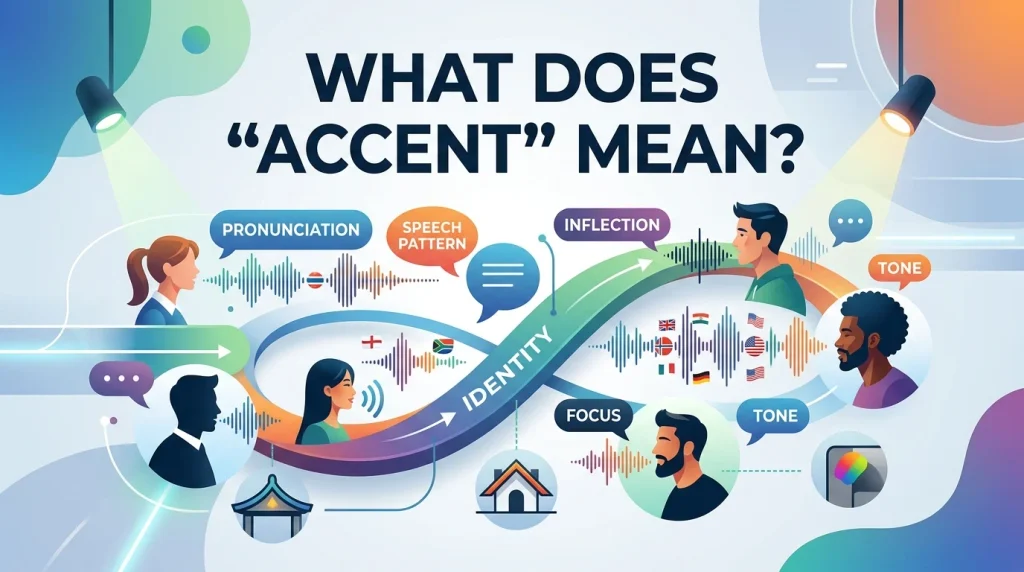
The word accent has several connected meanings. In everyday English, people often use it when talking about pronunciation. However, the word can also describe emphasis in speech, music, writing, or design.
Accent as a Pronunciation Pattern
An accent is a particular way of pronouncing words. Regional background, country, community, and social group can all influence pronunciation. Someone might speak English with a Southern American accent, a Boston accent, a British accent, or a Canadian accent.
An accent doesn’t automatically mean someone speaks incorrectly. It simply describes pronunciation patterns. Two people can speak the same language fluently while using noticeably different accents.
For example:
- She speaks English with a French accent.
- His Southern accent is easy to recognize.
- The actor changed his accent for the role.
- You can hear a slight regional accent in her speech.
This meaning appears constantly in conversations about language and communication. It also explains why accent often gets confused with dialect. They aren’t quite the same thing.
An accent primarily concerns pronunciation. A dialect can involve pronunciation along with vocabulary, grammar, and other language features. So, saying that two people have different accents doesn’t necessarily mean they speak different dialects.
Accent as Word or Syllable Stress
The meaning becomes slightly different when accent refers to emphasis.
When you emphasize one syllable more strongly than another, you can describe that emphasis as an accent. In linguistic contexts, English speakers also commonly use the term stress for this feature. Cambridge describes accent as special emphasis given to a particular syllable, word, or musical note.
For example:
- The accent falls on the first syllable.
- Put the accent on the final syllable.
- The speaker placed an accent on the key phrase.
This sense has an important connection to pronunciation. A regional accent concerns broader speech patterns, while syllable accent concerns where emphasis falls within a word.
Think of it as the difference between the overall musical style of a song and the beat that receives extra force. Both involve sound, but they describe different levels of emphasis.
Accent as a Written Mark
You may also encounter accent in writing. In this sense, an accent is a mark placed over or near a letter to provide information about pronunciation or distinguish words.
Common examples include:
- é
- á
- è
- ê
- ü
The exact function of an accent mark depends on the language. In French, for instance, words such as café use an acute accent. Other languages use marks differently, and some marks affect pronunciation while others can distinguish words or grammatical forms.
So when someone says, “Don’t forget the accent,” they might mean a pronunciation pattern. They might also mean a written mark. Context tells you which sense applies.
Accent as a Verb
Accent can also function as a verb. In that form, it means to emphasize something.
For example:
- The presentation accented the company’s strongest results.
- The musician accented the first note.
- The designer used gold details to accent the room.
- The speaker accented the most important point.
This use is especially helpful because it shows that accent isn’t limited to speech. The verb can describe emphasis in communication, music, advertising, visual design, and other settings. Cambridge likewise defines the verb as meaning to emphasize something.
In practical writing, however, emphasize often sounds more natural than accent when you’re talking about an idea. For instance, “The report emphasizes safety” is generally more straightforward than “The report accents safety.”
Accent in Language and Pronunciation
When language learners discuss an accent, they usually mean the recognizable pronunciation patterns someone uses.
Those patterns can involve several features:
- vowel sounds
- consonant sounds
- syllable stress
- rhythm
- intonation
- speech timing
- connected speech
A person’s accent may change over time, especially after living in another region or using another language regularly. Still, accent isn’t simply a matter of “correct” versus “incorrect” pronunciation. Native speakers themselves use countless regional and social varieties.
For example, an American from Texas may pronounce certain vowels differently from someone in New York. Both can speak standard American English while retaining regional characteristics.
The same principle applies across countries. English speakers in the United States, Canada, the United Kingdom, Ireland, Australia, and New Zealand can use noticeably different pronunciation patterns while communicating easily.
Accent vs. Dialect
The distinction between accent and dialect matters because people often use the two words as if they’re interchangeable.
An accent focuses mainly on pronunciation. A dialect can cover a broader set of language features, including pronunciation, grammar, vocabulary, and expressions.
Imagine two speakers who use different pronunciations for the same sentence. They may have different accents. Now imagine that they also use different vocabulary and grammatical patterns. That broader difference may involve different dialects.
| Term | What It Mainly Describes | Example |
| Accent | Pronunciation | Different ways of pronouncing the same word |
| Dialect | Pronunciation, vocabulary, grammar, and usage | A regional variety with distinctive words and structures |
This distinction becomes useful when discussing regional English. It prevents the common mistake of treating every difference in speech as a dialect difference.
Accent in Everyday Conversation
In ordinary conversation, accent usually appears when people notice how someone speaks.
You might say:
- “She has a strong British accent.”
- “His accent changed after he moved.”
- “I couldn’t place her accent.”
- “The actor adopted a different accent.”
The word can also describe deliberate emphasis:
- “The speech put an accent on education.”
- “The teacher placed an accent on the final syllable.”
These examples show why context matters. Accent can describe a person’s pronunciation, the emphasis within a word, or the emphasis placed on an idea.
Accent in Writing, Music, and Design
The word also travels beyond spoken language.In music, an accent can indicate that a particular note should receive extra emphasis.
In written language, an accent mark can provide pronunciation information. In design, an accent can refer to a feature that draws attention, such as an accent wall or accent color.The common thread is emphasis.
Something receives special attention.
That connection makes the word easier to remember: accent is fundamentally associated with emphasis or a distinctive way something is presented.
Common Mistakes With Accent
The most common mistake is using accent when the sentence actually needs ascent or assent.
For example:
- ❌ The climber began his accent up the mountain.
- ✅ The climber began his ascent up the mountain.
The first sentence uses a real English word, so a basic spell checker may not flag it. Yet the meaning is wrong. A climber doesn’t begin an accent. The climber begins an ascent.
Another example:
- ❌ The committee gave its accent to the proposal.
- ✅ The committee gave its assent to the proposal.
Here, the intended meaning is approval. Therefore, assent fits.
A useful proofreading habit is to ask what the sentence actually describes:
Is it about sound or emphasis? Use accent.
Is something moving upward? Use ascent.
Is someone agreeing or approving? Use assent.
That three-part test catches most mistakes before they reach the final draft.
Accent: Examples in Real Sentences
| Sentence | Meaning of Accent |
| She speaks with a noticeable accent. | A way of pronouncing words |
| The accent falls on the second syllable. | Stress or emphasis |
| The word contains an acute accent. | A written mark |
| The campaign accented its environmental benefits. | Emphasized something |
| The blue cushions add an accent to the room. | A feature that draws attention |
The key is to look beyond spelling. Accent may appear in language, music, writing, advertising, or design, but its underlying idea remains connected to pronunciation, emphasis, or attention.
That makes it much easier to separate it from ascent and assent. The next two words move into completely different territory: one involves going upward, while the other involves agreement.
What Does “Ascent” Mean?
Ascent is a noun that describes movement upward. It can refer to physically climbing or rising, traveling up a slope, or reaching a higher position in a figurative sense. Cambridge Dictionary defines it as the act of climbing or moving upward, a path or slope that rises, and, in formal usage, movement toward greater success or power.
The easiest way to remember ascent is to connect it with the idea of going up.If a mountain climber moves toward a summit, that’s an ascent. If an aircraft rises after takeoff, that’s an ascent. If someone’s career moves rapidly toward a powerful position, you can also describe that progress as an ascent.The word always carries some sense of upward direction or elevation.
Ascent as Upward Movement
The most literal meaning of ascent involves climbing or moving upward.
For example:
- The climbers began their ascent before dawn.
- The aircraft’s ascent was smooth and steady.
- The rescue team monitored the diver’s ascent.
- The hikers faced a difficult ascent toward the summit.
- The rocket accelerated rapidly during its initial ascent.
This meaning appears frequently in descriptions of mountains, aircraft, rockets, diving, hiking, and other activities involving elevation changes.
Cambridge gives examples involving an Everest climb and an airplane rising into the air.
Notice the difference between the action and the person performing it.
The climber ascended the mountain.
The climber’s ascent was difficult.
Ascended is a verb. Ascent is a noun.
That distinction becomes important because English learners sometimes confuse ascent with ascend. The two words are closely related, but they don’t perform the same grammatical job.
Ascent as a Slope or Uphill Path
Ascent can also refer to the actual slope, road, trail, or path that goes upward.
For example:
- The final ascent was extremely steep.
- We struggled through a slippery ascent.
- The trail has a long ascent before the summit.
- Cyclists prepared for a demanding mountain ascent.
- The narrow road begins a sharp ascent after the bridge.
Here, ascent doesn’t necessarily describe the act of climbing itself. It can describe the uphill section that someone must travel.
This meaning is particularly useful in descriptions of roads, hiking routes, mountain trails, and terrain. Cambridge specifically lists a slope, path, or road that rises as one meaning of the noun.
Consider this distinction:
| Sentence | What “ascent” means |
| The climber began the ascent. | The act of moving upward |
| The final ascent was steep. | The uphill section |
| The plane began its ascent. | Movement into higher altitude |
| His ascent to power was rapid. | Movement toward a higher position |
The surrounding words usually make the intended meaning obvious.
Ascent as Progress or Advancement
English also uses ascent figuratively.
Someone doesn’t have to climb a physical mountain for an ascent to occur. The word can describe a person’s rise in status, influence, success, rank, or power.
For example:
- Her ascent to leadership was remarkably fast.
- His ascent to power surprised political observers.
- The company’s rapid ascent transformed the industry.
- The athlete’s ascent to the top attracted global attention.
- Their ascent in the business world took years of preparation.
This figurative meaning is based on the same basic concept: moving from a lower position to a higher one.
The difference is that the “height” isn’t physical.
Someone may rise socially, professionally, financially, politically, or competitively. The language still treats that progress as upward movement. Cambridge specifically recognizes ascent as the process of becoming successful or reaching a higher position.
That makes ascent especially useful in journalism, biographies, business writing, politics, and sports reporting.
For example:
The young executive’s ascent to the top was fueled by several successful product launches.
There is no mountain in that sentence. The metaphor works because success is conceptualized as moving upward.Ascent vs. AscendAscent and ascend are related words, but they have different grammatical roles.Ascent is a noun.Ascend is a verb.
Compare:
- The team’s ascent was difficult.
- The team ascended the mountain.
- Her ascent to leadership was unexpected.
- She ascended to a senior leadership position.
Cambridge defines ascend as moving up or climbing something. It can also mean rising to a higher rank or position.
A quick grammar test can help:
If you need a thing, event, or process, use “ascent.”
If you need an action, use “ascend.”
| Noun | Verb |
| ascent | ascend |
| The ascent was exhausting. | They ascended the mountain. |
| His ascent to power was quick. | He ascended to power. |
| The aircraft began its ascent. | The aircraft ascended rapidly. |
One common mistake is writing something like “They ascent the mountain.” That’s incorrect because ascent cannot function as the ordinary verb in that sentence.
The correct version is:
They ascended the mountain.
Common Expressions With Ascent
Certain combinations make the meaning of ascent especially clear.
Common phrases include:
- ascent of a mountain
- ascent to power
- ascent to the throne
- rapid ascent
- steep ascent
- initial ascent
- final ascent
- successful ascent
- vertical ascent
- upward ascent
Some expressions describe physical movement, while others describe advancement.
For instance:
The climber completed a successful ascent of Everest.
This is physical.
The politician’s ascent to power was unusually rapid.
This is figurative.
Both sentences use the same underlying idea: moving upward from one level to another.
Ascent in Science, Travel, and Everyday Language
You may encounter ascent in technical or specialized writing as well.
Aviation uses the term when an aircraft gains altitude. Spaceflight discussions often describe the early upward phase of a rocket’s journey as its ascent. Diving and underwater operations can also involve an ascent when a person or object moves toward the surface.
The word is therefore more versatile than it may initially seem.
It works in:
- aviation
- mountaineering
- hiking
- spaceflight
- diving
- geography
- politics
- business
- sports
- biographies
- journalism
The shared concept remains movement toward a higher point.
That connection is more useful than memorizing isolated definitions.
What Does “Assent” Mean?
Assent has nothing to do with climbing. It means agreement, approval, or acceptance of an idea, plan, request, or proposal.
Cambridge classifies the noun and verb as formal. As a noun, assent means official agreement or approval. As a verb, it means to agree to or officially approve something.
For example:
- The committee gave its assent to the proposal.
- She nodded in assent.
- The board assented to the revised terms.
- The parents gave their assent.
- The director assented to the request.
The central idea is saying yes.
That’s the fastest way to separate assent from ascent.
Ascent = going up.
Assent = agreeing.
The first describes direction. The second describes approval.
Assent as Agreement or Approval
When someone gives assent, they agree with something or approve it.
The agreement may be expressed verbally, in writing, through a formal decision, or sometimes through a gesture.
For example:
- He nodded his assent.
- The committee gave its assent.
- The manager’s assent was required.
- The shareholders withheld their assent.
- She gave her assent after reviewing the proposal.
The word often appears when the agreement has some degree of formality or significance.
In casual conversation, most people would simply say agree or approval.
For instance:
“I agree with your plan.”
sounds much more conversational than:
“I assent to your plan.”
The second sentence is grammatically valid, but it sounds formal and somewhat unusual in ordinary conversation.
Assent as a Noun
As a noun, assent names the agreement or approval itself.
Typical structures include:
- give assent
- receive assent
- obtain assent
- seek assent
- withhold assent
- express assent
- nod in assent
Examples:
The board gave its assent to the merger.
The proposal cannot proceed without parental assent.
The committee withheld its assent until several concerns were addressed.
He nodded in assent.
These constructions are common in formal, legal, academic, political, and institutional writing.
The noun is generally uncountable when it means agreement or approval. Cambridge lists it as a noun meaning official agreement or approval.
Assent as a Verb
Assent can also work as a verb.
As a verb, it means to agree to something or give official approval.
Examples include:
- The board assented to the proposal.
- The government assented to the revised agreement.
- The committee assented to the recommendation.
- The parties eventually assented to the terms.
A particularly important grammar pattern is:
assent to + something
For example:
The company assented to the terms of the contract.
Not:
❌ The company assented the terms of the contract.
Cambridge specifically identifies assent to something as the standard formal construction.
This small preposition matters. If you’re using assent as a verb, remember that the approved idea normally follows to.
Assent in Legal and Formal English
You are much more likely to encounter assent in formal writing than casual speech.
It appears in contexts involving:
- contracts
- legislation
- government
- corporate decisions
- legal agreements
- institutional approval
- formal requests
- academic discussions
- official procedures
For example:
By signing the document, the parties formally assented to the terms.
This wording emphasizes deliberate agreement rather than casual acceptance.
In legal or administrative contexts, precision matters. Assent can signal that an individual or organization has formally agreed to something that carries consequences.
However, assent should not automatically be treated as identical to every use of consent. Those words overlap, but their typical contexts and implications can differ.
That distinction becomes particularly important in legal, medical, research, and ethical contexts.
What Is Royal Assent?
One of the best-known specialized uses of assent is Royal Assent.
In the United Kingdom, a bill passed by Parliament requires Royal Assent before it becomes law. Cambridge defines Royal Assent as the official signature or approval given by the monarch.
The phrase is capitalized because it is the name of a specific constitutional procedure.
For example:
The bill received Royal Assent before becoming law.
This isn’t simply a casual “yes.” It refers to a formal constitutional stage in the legislative process.
The term demonstrates why understanding assent matters beyond vocabulary exercises. A single spelling difference can change the meaning of a sentence involving government, law, or public policy.
Common Expressions With Assent
Several collocations make assent easier to recognize.
Common examples include:
- give assent
- give one’s assent
- seek assent
- obtain assent
- receive assent
- withhold assent
- express assent
- nod in assent
- assent to a proposal
- assent to the terms
- assent to a request
- official assent
- Royal Assent
For example:
The committee gave its assent to the proposal.
The organization sought the assent of its members.
The parties assented to the terms after several revisions.
These patterns provide a useful clue when proofreading. If the sentence involves approval, agreement, or a formal yes, assent may be the correct word.
Assent in Everyday Communication
Although assent is perfectly valid in everyday English, it tends to sound formal.
People commonly say:
- “I agree.”
- “That’s fine with me.”
- “Yes, I approve.”
- “I’m okay with that.”
They are less likely to say:
- “I assent to that.”
The latter sounds formal, literary, legal, philosophical, or institutional.
Still, the noun can appear naturally in some contexts:
She nodded her assent.
That sentence sounds more natural than:
She nodded her agreement.
The expression nod of assent is particularly useful because it describes nonverbal agreement.
For example:
The chair looked around the room and received several nods of assent.
No one necessarily says “yes.” Their gestures communicate approval.
Accent vs. Ascent vs. Assent: A Meaning Check
At this stage, the three words can be separated by their central ideas:
| Word | Core Question | Basic Meaning |
| Accent | What is being emphasized or how is something pronounced? | Pronunciation, emphasis, or a written mark |
| Ascent | What is moving upward? | Climb, rise, or advancement |
| Assent | Who is saying yes? | Agreement or approval |
This is more effective than memorizing spelling alone.
Imagine three scenes:
Scene one: A language teacher explains why a speaker pronounces a vowel differently. That’s an accent.
Scene two: A hiker struggles toward a mountain summit. That’s an ascent.
Scene three: A committee approves a proposed policy. That’s assent.
The spelling becomes easier once you attach each word to a concrete mental picture.
A Simple Context Test
When you’re unsure which word belongs in a sentence, don’t stare at the spelling. Ask what the sentence is actually describing.
If the sentence involves speech or emphasis
Choose accent.
She has a distinctive accent.
If something is moving upward
Choose ascent.
The aircraft began its ascent.
If someone agrees or approves
Choose assent.
The board gave its assent.
This method works because the three words represent three different semantic fields.
Accent → language and emphasis
Ascent → movement and elevation
Assent → agreement and approval
Common Mistakes With Ascent and Assent
Because ascent and assent sound alike, writers sometimes choose the wrong spelling even when they know both words.
Mistake: Using “Assent” for Upward Movement
Incorrect:
❌ The climber began her assent up the mountain.
Correct:
✅ The climber began her ascent up the mountain.
The sentence describes physical movement upward. Therefore, ascent is required.
Mistake: Using “Ascent” for Agreement
Incorrect:
❌ The board gave its ascent to the proposal.
Correct:
✅ The board gave its assent to the proposal.
The board isn’t climbing anywhere. It is approving.
Mistake: Confusing “Ascent” With “Ascend”
Incorrect:
❌ They will ascent the mountain tomorrow.
Correct:
✅ They will ascend the mountain tomorrow.
Here, the sentence needs a verb. Ascend supplies the action, while ascent supplies the noun.
A Three-Word Mental Picture
When the spellings blur together, picture these three scenes:
| Word | Mental Picture | Meaning |
| Accent | A speaker emphasizing a sound | Pronunciation or emphasis |
| Ascent | A person climbing a mountain | Upward movement |
| Assent | A person nodding “yes” | Agreement |
This simple visualization can be surprisingly effective because it connects spelling to meaning rather than forcing you to memorize three dictionary definitions.
The crucial distinction is now clear: ascent moves upward, while assent moves toward agreement. Once you recognize that difference, the two homophones become much easier to handle in professional writing, schoolwork, conversation, and everyday reading.
Meaning, Grammar, and Pronunciation
The fastest way to master accent vs. ascent vs. assent is to compare meaning, grammar, and pronunciation together. Looking at spelling alone isn’t enough because ascent and assent are homophones.
Each word has a distinct grammatical role and semantic purpose. Once you understand those differences, choosing the correct spelling becomes much more intuitive.
| Feature | Accent | Ascent | Assent |
| Main meaning | Pronunciation, emphasis, or written mark | Upward movement or advancement | Agreement or approval |
| Common part of speech | Noun, verb | Noun | Noun, verb |
| Pronunciation | Usually /ˈæk.sənt/ | /əˈsent/ | /əˈsent/ |
| Homophone | No | Assent | Ascent |
| Related verb | Accent | Ascend | Assent |
| Common setting | Language, speech, writing, music, design | Climbing, aviation, progress | Formal agreement, approval, law |
| Memory clue | Emphasis | Upward movement | Yes or approval |
The table reveals an important pattern.
Accent has the broadest range of everyday meanings. It can relate to speech, syllable stress, written marks, music, or visual emphasis.
Ascent has a directional meaning. Something moves, rises, or progresses upward.
Assent has an interpersonal or institutional meaning. Someone agrees with, accepts, or approves something.
Difference in Meaning
The three words occupy different semantic categories.
Accent deals primarily with sound, emphasis, or distinction.
Ascent deals with rising or advancement.
Assent deals with agreement or approval.
Consider these examples:
Her accent became easier to understand after years of English practice.
The sentence concerns pronunciation.
The hikers’ ascent became harder as the trail grew steeper.
The sentence concerns upward movement.
The committee gave its assent to the revised policy.
The sentence concerns approval.
The words may look related, but their meanings have little overlap.
Difference in Grammar
Grammar gives you another reliable way to distinguish them.
Accent can be either a noun or a verb.
As a noun:
She has a distinctive accent.
As a verb:
The design accents the room’s natural features.
Ascent is primarily a noun.
The ascent took several hours.
Its related verb is ascend.
They ascended the mountain before sunset.
Assent can function as both a noun and a verb.
As a noun:
The proposal received their assent.
As a verb:
They assented to the proposal.
This grammatical distinction is especially useful when you’re writing quickly. If the sentence requires an action verb meaning “go up,” don’t use ascent. If it requires a noun meaning “a climb,” use ascent.
Likewise, if the sentence requires formal agreement, assent may be the appropriate noun or verb.
Difference in Pronunciation
Pronunciation creates the biggest trap in this group.
Ascent and assent are pronounced alike in standard English: /əˈsent/.
That means a listener usually can’t determine which spelling you mean from sound alone.
For example:
“The team gave its assent.”
and
“The team began its ascent.”
The bold words sound identical, but the context changes everything.
Accent, by contrast, is pronounced differently, commonly /ˈæk.sənt/.
You can hear the difference in the opening sound:
- AC-cent
- a-SCENT
- a-SCENT
The stress pattern also helps.
Accent normally receives primary stress on its first syllable.
Ascent and assent receive primary stress on the second syllable.
So although the written forms are visually similar, their spoken patterns aren’t identical across all three words.
Difference in Everyday Usage
The frequency and context of these words also differ.
Accent is extremely common in everyday conversation. You may use it when discussing pronunciation, speech patterns, emphasis, music, or design.
Ascent is common when describing climbing, flying, hiking, mountains, and figurative progress. However, ordinary speakers often choose simpler words such as climb, rise, or increase.
Assent is more formal. Everyday speakers generally prefer agree, approval, or accept.
That means these three sentences differ not only in meaning but also in register:
She has a strong accent.
Natural and conversational.
The aircraft began its ascent.
Natural in aviation or technical contexts.
The committee gave its assent.
Correct and formal.
Recognizing register helps you choose words that fit the situation instead of merely choosing technically correct words.
Accent vs. Ascent vs. Assent: Example Sentences
Seeing the three words in parallel is one of the easiest ways to reinforce their differences.
Examples With Accent
Accent can describe a person’s pronunciation:
Maria speaks English with a noticeable Spanish accent.
It can describe emphasis:
The teacher placed an accent on the final syllable.
It can refer to a written mark:
The French word café contains an accent mark.
It can function as a verb:
The bright cushions accent the neutral furniture.
It can describe emphasis in music:
The conductor asked the musicians to accent the opening note.
Notice that every example involves pronunciation, emphasis, or something receiving special attention.
Examples With Ascent
Ascent commonly describes physical movement upward:
The climbers began their ascent at sunrise.
It can describe an aircraft’s upward movement:
The plane’s ascent was smooth despite the strong wind.
It can describe an uphill path:
The final ascent to the cabin was exhausting.
It can describe figurative advancement:
Her rapid ascent in the company surprised her colleagues.
It can describe movement toward power:
His ascent to power changed the country’s political landscape.
Every example contains the central idea of moving upward or reaching a higher position.
Examples With Assent
Assent describes agreement or approval:
The committee gave its assent to the proposal.
As a verb:
The board assented to the revised terms.
For nonverbal agreement:
She nodded in assent.
For formal approval:
The plan cannot proceed without the director’s assent.
For a group:
The members expressed their assent after a lengthy discussion.
In every case, the key idea is agreement or approval.
Commonly Confused Sentences
Small spelling differences can produce dramatically different meanings.
Compare these pairs:
| Incorrect | Correct | Why? |
| The hikers began their assent. | The hikers began their ascent. | They were climbing upward. |
| The board gave its ascent. | The board gave its assent. | The board approved something. |
| She has a noticeable ascent. | She has a noticeable accent. | The sentence concerns pronunciation. |
| They will ascent the mountain. | They will ascend the mountain. | A verb is required. |
| The committee ascended to the proposal. | The committee assented to the proposal. | The committee agreed to it. |
The incorrect versions are particularly dangerous because some remain grammatically plausible.
For example:
The board gave its ascent to the proposal.
This sentence looks polished. Ascent is a real noun, and the grammar appears normal. The problem is semantic. A board doesn’t “give an upward movement” to a proposal. It gives assent, meaning approval.
This is why proofreading requires more than checking whether every word exists. You also need to check whether the word fits the intended meaning.
Which Word Should You Use?
When you’re deciding between accent, ascent, and assent, identify the central action or idea first.
Use Accent When You Mean Pronunciation or Emphasis
Choose accent for:
- a regional pronunciation pattern
- emphasis on a syllable
- emphasis on a word or idea
- a written accent mark
- a musical emphasis
- a visual feature that draws attention
Example:
Her British accent was easy to recognize.
Use Ascent When You Mean Going Up
Choose ascent for:
- climbing
- rising
- gaining altitude
- traveling uphill
- moving toward a higher position
- progressing toward greater success
Example:
The mountain’s steep ascent took most of the afternoon.
Use Assent When You Mean Agreement
Choose assent for:
- formal agreement
- approval
- acceptance of a proposal
- official authorization or agreement
- a formal “yes”
Example:
The committee gave its assent to the recommendation.
A simple three-question test works well:
Is the sentence about sound or emphasis? → Accent
Is something moving upward? → Ascent
Is someone agreeing or approving? → Assent
Mini Case Study: Choosing the Right Word
Imagine a travel writer describing a mountaineering expedition.
The writer wants to say that the hikers started climbing before sunrise. Which word fits?
The hikers began their ascent before sunrise.
Correct.
Now imagine the same writer wants to explain that one guide spoke English with a distinctive regional pronunciation.
The guide had a noticeable accent.
Again, correct.
Finally, imagine the expedition leader approved a revised safety plan.
The leader gave his assent to the revised safety plan.
Each sentence uses one of the three words correctly because the context determines the meaning.
This illustrates an important lesson: don’t choose these words by appearance or sound alone. Identify what the sentence is describing first.
Accent vs. Dialect: What’s the Difference?
The distinction between accent and dialect is closely connected to understanding the meaning of accent.
An accent primarily concerns pronunciation. A dialect is broader. It can include pronunciation along with vocabulary, grammar, sentence structure, and other language features.
Think of an accent as one layer of a larger language variety.
For example, two speakers might pronounce the same words differently while using nearly identical vocabulary and grammar. Their difference may be described as an accent difference.
Now imagine two regional groups that use different pronunciations, distinctive vocabulary, and different grammatical patterns. That involves a broader dialect difference.
| Feature | Accent | Dialect |
| Pronunciation | Yes | Yes |
| Vocabulary | Not the main focus | Yes |
| Grammar | Not the main focus | Yes |
| Sentence patterns | Not usually | Can differ |
| Regional variation | Common | Common |
| Social variation | Common | Common |
The distinction isn’t always perfectly rigid because linguists study language varieties along a continuum. Still, this basic definition works well for everyday English.
Examples of Accent
Someone might pronounce certain vowels differently because of where they grew up.
Examples include:
- regional American accents
- British regional accents
- Irish accents
- Australian accents
- Canadian accents
- second-language accents
The speaker may use the same grammar and vocabulary as another English speaker while sounding noticeably different.
Examples of Dialect
A dialect can involve much more than pronunciation.
For example, two regional varieties may use different:
- words for the same object
- verb forms
- grammatical constructions
- sentence patterns
- idiomatic expressions
- pronunciation patterns
Therefore, saying someone has an accent doesn’t necessarily tell you anything about their vocabulary or grammar.
Assent vs. Consent: What’s the Difference?
Assent and consent overlap because both can involve agreement. However, they aren’t always interchangeable.
Assent generally emphasizes agreement or approval, often in formal settings.
Consent usually emphasizes permission or agreement to something proposed, requested, or done. In many contexts, consent carries a stronger sense that someone has actively authorized an action.
Consider these examples:
The committee gave its assent to the proposal.
The focus is formal agreement.
The patient gave consent to the procedure.
The focus is permission or authorization.
This distinction becomes especially important in legal, ethical, medical, research, and institutional contexts.
What Does Assent Mean?
Assent means agreement or approval.
It often appears with formal decisions, proposals, requests, or official procedures.
The board gave its assent to the plan.
The board approves the plan.
What Does Consent Mean?
Consent generally means permission or agreement for something to happen.
For example:
The participants provided consent before joining the study.
The emphasis is on their permission to participate.
In ordinary conversation, agree may be the more natural alternative to assent, while permission may be more natural than consent in some casual situations.
However, in sensitive or regulated contexts, consent has a much more specific significance and shouldn’t casually be replaced with assent.
Assent vs. Consent in Real Sentences
Compare:
The committee gave its assent to the proposal.
The participant gave consent to take part in the study.
The monarch granted Royal Assent to the legislation.
The parent provided consent for the child’s participation.
The words can overlap in broad discussions of agreement, but context determines which term communicates the intended relationship most accurately.
For formal writing, precision matters. Don’t automatically substitute one for the other simply because both can relate to saying yes.
Ascent vs. Descent: Understanding Opposites
Another useful comparison is ascent vs. descent.
These words describe opposite directions.
Ascent means movement upward.
Descent means movement downward.
| Word | Direction | Example |
| Ascent | Upward | The aircraft began its ascent. |
| Descent | Downward | The aircraft began its descent. |
The same contrast appears in physical and figurative contexts.
Physical:
The hikers started their ascent toward the summit.
After reaching the peak, they began their descent.
Figurative:
Her career experienced a rapid ascent.
The company later entered a steep descent into financial trouble.
This pair gives you another memory aid. If ascent means going up, then descent points in the opposite direction.
The related verbs are also straightforward:
- ascend = go up
- descend = go down
That makes the vocabulary family easier to remember:
Ascent → ascend → upward
Descent → descend → downward
Why Spell Check May Not Catch Accent, Ascent, and Assent Errors
One reason these mistakes survive editing is that all three words are legitimate English words.
A conventional spell checker primarily looks for misspellings, unusual word forms, or words that don’t fit a recognized dictionary. If you type ascent instead of assent, the software may see a correctly spelled word.
For example:
The board gave its ascent to the proposal.
There is no spelling error in ascent. The problem is that the word doesn’t make semantic sense in the intended context.
This is sometimes called a real-word spelling error. The writer selects a correctly spelled word that is nevertheless the wrong word.
Other common examples in English include:
- their / there / they’re
- your / you’re
- affect / effect
- accept / except
- principal / principle
Accent, ascent, and assent create a similar problem.
How to Catch Real-Word Errors
Don’t rely entirely on automated correction.
Instead:
- Read the sentence for meaning.
- Identify the word’s intended definition.
- Check whether the grammar fits.
- Read homophones carefully.
- Look for context clues.
- Proofread important documents twice.
- Read difficult sentences aloud, then verify the spelling visually.
A dictionary can confirm the definition and grammatical function when you’re uncertain.
The most important question is simple:
Does this word mean what I intend it to mean?
That question catches errors that spell check cannot.
Common Grammar and Usage Traps
A few patterns deserve special attention.
“Assent” Usually Takes “To” as a Verb
Correct:
The committee assented to the proposal.
Incorrect:
❌ The committee assented the proposal.
When assent functions as a verb meaning agree to or approve, to commonly introduces the thing being approved.
“Ascent” Is a Noun
Correct:
The climber began the ascent.
Incorrect:
❌ The climber will ascent the mountain.
Use ascend when you need the verb.
“Accent” Can Be a Noun or Verb
Correct:
She has a strong accent.
Correct:
The dark frame accents the artwork.
The noun concerns pronunciation, emphasis, or a distinctive feature. The verb means to emphasize or highlight.
A Practical Editing Strategy
If you’re editing an essay, report, article, email, or academic assignment, use this quick process.
First, identify the intended meaning.
Ask whether you’re talking about pronunciation, upward movement, or agreement.
Next, check the grammatical role.
Is the word functioning as a noun or verb?
Then, check nearby words.
Phrases such as mountain, climb, summit, altitude, and rise strongly suggest ascent.
Words such as approve, agree, proposal, permission, board, and decision may point toward assent.
Words such as speech, pronunciation, syllable, voice, language, and emphasis commonly point toward accent.
Finally, read the complete sentence rather than focusing on the confusing word in isolation.
Context usually makes the answer obvious.
A Compact Decision Guide
When you hesitate between these three spellings, use this guide:
| If you’re talking about… | Use |
| Someone’s way of pronouncing words | Accent |
| Stress on a syllable | Accent |
| A written mark over a letter | Accent |
| Something climbing upward | Ascent |
| An aircraft gaining altitude | Ascent |
| A person’s rise to power | Ascent |
| Agreement or approval | Assent |
| Formal approval of a proposal | Assent |
| Someone agreeing to terms | Assent |
The decision becomes almost automatic once you focus on meaning instead of spelling.
Accent speaks. Ascent rises. Assent agrees.
That three-word contrast captures the heart of the difference and provides a dependable foundation for using all three correctly.
How to Remember Accent, Ascent, and Assent
The best way to remember accent, ascent, and assent is to connect each spelling with one clear idea. Instead of memorizing three dictionary definitions, attach each word to a simple mental image.
Accent = Speech or Stress
Think about a person speaking.
An accent can describe someone’s pronunciation, stress within a word, or emphasis placed on a particular sound or idea.
A useful memory phrase is:
Accent = how something sounds or what gets emphasis.
Examples:
- She speaks with a noticeable accent.
- The accent falls on the first syllable.
- The designer used gold as an accent color.
- The speaker accented the most important point.
Whenever the sentence involves pronunciation, syllables, emphasis, or highlighting, start with accent.
Ascent = Up
The word ascent contains the idea of moving upward.
Picture a mountain climber walking toward a summit. The climber’s ascent is the upward journey.
You can remember:
Ascent = up.
Examples:
- The hikers began their ascent.
- The aircraft entered its ascent.
- Her career was on a rapid ascent.
The related verb ascend reinforces this connection:
Ascend = go up.
That makes the spelling easier to recall when you’re under time pressure.
Assent = Agreement
Now picture someone nodding their head to say yes.
That person is showing assent.
Remember:
Assent = agreement or approval.
Examples:
- The board gave its assent.
- She nodded in assent.
- The committee assented to the proposal.
If the sentence involves approval, agreement, acceptance, or a formal yes, think assent.
A Three-Word Memory Trick
Put all three ideas together:
| Word | Memory Clue | Meaning |
| Accent | Sound | Pronunciation or emphasis |
| Ascent | Up | Climbing, rising, or advancement |
| Assent | Yes | Agreement or approval |
You can reduce the entire lesson to three words:
Accent = sound.
Ascent = up.
Assent = yes.
This works because each clue represents the central semantic idea of the word.
Memory Trick: Look at the First Letters
The spellings become easier when you focus on what distinguishes them.
Accent begins with acc-.
Think of accent as something that gives extra attention or emphasis to sound.
Ascent begins with asc-.
Connect it with ascend, which means to move upward.
Assent begins with ass-.
Connect it with assent = agree.
The last two are particularly useful:
ASCENT → ASCEND → UP
ASSENT → AGREE → YES
Even though ascent and assent sound identical, their associated concepts are completely different.
Memory Trick: Picture the Situation
Visual memory can make confusing words easier to retrieve.
Imagine three separate scenes.
Scene One: A Speaker
A person stands at a microphone. Their pronunciation sounds distinctive.
That’s an accent.
Scene Two: A Mountain
A hiker climbs a steep trail toward a summit.
That’s an ascent.
Scene Three: A Boardroom
Several people review a proposal. They approve it with a nod.
That’s assent.
Now connect the scenes:
Speaker → accent
Mountain → ascent
Approval → assent
This approach works especially well when you tend to confuse words while writing quickly.
Memory Trick: Ask Yourself One Question
You don’t need a complicated grammar rule to choose the correct word.
Ask:
What is happening in this sentence?
If someone is speaking differently, choose accent.If something is going upward, choose ascent.If someone is agreeing, choose assent.
For example:
The plane began its ___ after takeoff.
What is happening?
The plane is moving upward.
Answer: ascent.
Now:
The committee gave its ___ to the proposal.
What is happening?
The committee is approving the proposal.
Answer: assent.
Finally:
She speaks English with a noticeable ___.
What is happening?
The sentence describes pronunciation.
Answer: accent.
The context provides the answer.
A Simple Story Using All Three Words
A short story can make the distinction easier to remember.
Imagine a group of hikers preparing for a difficult mountain expedition.
One guide speaks several languages and has a distinctive accent. Before sunrise, the group begins its ascent toward the summit.
The trail becomes increasingly steep. After several hours, the expedition leader suggests changing the route.
Everyone discusses the proposal.
Eventually, the team members give their assent to the new plan.
The three words fit naturally:
- The guide has an accent.
- The group makes an ascent.
- The team gives assent.
This story creates three different mental anchors. The pronunciation belongs to accent, the climb belongs to ascent, and the agreement belongs to assent.
Visual Association Method
If you prefer visual learning, use a three-column system.
| Picture in Your Mind | Word | Core Idea |
| 🗣️ Speaker | Accent | Sound |
| 🧗 Mountain climber | Ascent | Upward movement |
| 👍 Approval gesture | Assent | Agreement |
The emojis aren’t grammar rules. They’re simply visual prompts.When you see accent, imagine someone speaking.When you see ascent, imagine someone climbing.When you see assent, imagine someone saying yes.That association can help you recall the correct spelling without mentally searching through a dictionary definition.
One-Minute Memory Test
Try answering these without looking at the explanations.
- A pilot’s movement upward is an ______.
- A speaker’s regional pronunciation is an ______.
- A committee’s formal approval is its ______.
- A mountain climber begins an ______.
- A person nods in ______.
- The word café contains an ______ mark.
- A person’s rise to power can be described as an ______.
- The board ______ to the proposal.
- The designer used gold to ______ the room.
- The aircraft began its ______ after takeoff.
Answers
- ascent
- accent
- assent
- ascent
- assent
- accent
- ascent
- assented
- accent
- ascent
If you got most of these right, you already understand the central distinction.
Practice: Accent, Ascent, or Assent?
Practice becomes more valuable when the examples resemble situations you might encounter in real writing.
Fill in the Blanks
Choose accent, ascent, or assent.
The climbers started their ______ before the sun appeared.
The manager gave her ______ to the revised schedule.
His regional ______ was immediately noticeable.
The aircraft’s ______ lasted several minutes.
The committee refused to give its ______ to the proposal.
The teacher explained where the word’s ______ falls.
Her rapid ______ within the company attracted attention.
The hikers faced a difficult final ______.
The board ______ to the terms after further discussion.
The word requires an ______ mark in this context.
Answer Key
Ascent fits the first sentence because the climbers are moving upward. Assent fits the second because the manager is approving the schedule. Accent fits the third because the sentence concerns pronunciation . Ascent fits the fourth because the aircraft is gaining altitude. Assent fits the fifth because the committee is approving something. Accent fits the sixth because the sentence concerns syllable stress . Ascent fits the seventh because the person’s position is risingfiguratively . Ascent fits the eighth because the hikers are traveling upward. Assented fits the ninth because the board agreed to the term .Accent fits the tenth because the sentence refers to a written mark.
Choose the Correct Word
Read each sentence carefully and choose the word that best fits the context.
The Sentence Set
The climber’s accent/ascent became increasingly difficult as the trail steepened.Correct answer: ascentThe sentence describes an uphill journeyThe committee gave its accent/assent to the recommendation.Correct answer: assentThe committee approved the recommendation.She has a distinctive accent/ascent when speaking English.Correct answer: accentThe sentence concerns pronunciation.The aircraft began its accent/ascent shortly after takeoff.Correct answer: ascentAn aircraft moves upward during its ascent.The director withheld his accent/assent until the contract was revised.Correct answer: assentThe director withheld approval.The actor worked with a coach to perfect his accent/ascent.Correct answer: accentThe actor is working on pronunciation.
Correct the Mistakes
The following sentences contain commonly confused words. Replace each incorrect word with the correct one.
Sentence
The hikers began their assent at dawn.
Correction
The hikers began their ascent at dawn.
Why: The hikers are moving upward.
Sentence
The board gave its ascent to the new policy.
Correction
The board gave its assent to the new policy.
Why: The board is giving approval.
Sentence
She speaks English with a noticeable ascent.
Correction
She speaks English with a noticeable accent.
Why: The sentence concerns pronunciation.
Sentence
The plane will ascent rapidly after takeoff.
Correction
The plane will ascend rapidly after takeoff.
Why: The sentence requires a verb. Ascend means to move upward.
Sentence
The committee ascended to the proposal.
Correction
The committee assented to the proposal.
Why: The committee agreed to the proposal.
Match the Word to Its Meaning
Match each word with the correct definition.
| Word | Definition |
| Accent | A. Agreement or approval |
| Ascent | B. Pronunciation, emphasis, or a written mark |
| Assent | C. Movement upward or advancement |
Correct Matches
- Accent → B
- Ascent → C
- Assent → A
This exercise highlights the fundamental distinction without relying on pronunciation.
Quick Context Test
When proofreading, you can use a rapid context test.
Look for Speech-Related Clues
Words such as these often point toward accent:
- pronunciation
- speech
- speaker
- syllable
- stress
- voice
- language
- sound
- mark
- emphasis
Example:
The speaker’s accent was easy to identify.
Look for Upward-Movement Clues
These often point toward ascent:
- mountain
- summit
- climb
- trail
- aircraft
- altitude
- rise
- upward
- slope
- peak
Example:
The final ascent to the summit was exhausting.
Look for Agreement-Related Clues
These often point toward assent:
- approve
- approval
- agree
- proposal
- committee
- board
- terms
- permission
- decision
- authorization
Example:
The committee gave its assent to the proposal.
These clues aren’t absolute rules. Context always has the final say. However, they provide strong signals when you’re uncertain.
How to Choose Between Accent, Ascent, and Assent
Use this simple decision path when you’re proofreading.
Is the sentence about pronunciation, emphasis, or a written mark?
→ Choose accent.
Is it about movement upward, climbing, rising, or advancement?
→ Choose ascent.
Is it about agreement, approval, or formally saying yes?
→ Choose assent.
Does the sentence need a verb meaning “go upward”?
→ Choose ascend, not ascent.
Does the sentence use assent as a verb?
→ Remember the common structure assent to something.
This process takes only a few seconds once you’ve practiced it.
Accent, Ascent, and Assent in Professional Writing
Choosing the correct word becomes especially important in professional communication.
A spelling mistake in a casual message may cause a brief misunderstanding. In a contract, report, article, academic paper, or official document, the wrong word can undermine clarity and credibility.
Consider:
The committee gave its ascent to the recommendation.
A reader may understand what the writer intended. However, the sentence still contains a real-word error. Ascent means upward movement, while assent means agreement.
The correct version is:
The committee gave its assent to the recommendation.
Now consider:
The company’s rapid accent attracted investors.
The intended meaning may be the company’s rapid rise. In that case, the correct word is:
The company’s rapid ascent attracted investors.
These errors can look minor, but precise word choice demonstrates careful editing.
Why Context Matters More Than Sound
Pronunciation can help with some vocabulary questions, but it cannot distinguish ascent from assent.
Both words sound the same.
Therefore, hearing the sentence isn’t enough.
Imagine someone says:
“The board gave its assent.”
You hear the sound, but you need the sentence’s context to know which spelling belongs on the page.
If someone says:
“The hikers began their ascent.”
the same sound appears again.
This demonstrates why homophones require special attention during writing. Two words can sound identical while having unrelated spellings and meanings.
The solution isn’t to avoid the words. It’s to connect them with their meanings.
Ascent means upward movement.
Assent means agreement.
Once those associations become automatic, homophone errors become much less likely.
Final Quick Reference
Keep this table nearby when you need a quick reminder:
| Word | Pronunciation | Meaning | Example |
| Accent | /ˈæk.sənt/ | Pronunciation, emphasis, or written mark | She has a distinctive accent. |
| Ascent | /əˈsent/ | Upward movement, climb, or advancement | The climbers began their ascent. |
| Assent | /əˈsent/ | Agreement or approval | The board gave its assent. |
The three words may look deceptively similar, but their meanings are easy to separate once you know what to look for.
Accent belongs to the world of speech, pronunciation, and emphasis.
Ascent belongs to the world of climbing, rising, and advancement.
Assent belongs to the world of agreement, approval, and acceptance.
And remember the shortest version:
Accent = sound.
Ascent = up.
Assent = yes.
That distinction will help you choose the right word whether you’re writing a school assignment, professional report, article, email, or everyday message.
Conclusion
Understanding accent vs. ascent vs. assent becomes much easier when you connect each word with its central meaning. Accent relates to pronunciation, emphasis, or a written mark. Ascent describes movement upward, whether you’re climbing a mountain, gaining altitude, or rising toward greater success. Assent means agreement, approval, or a formal expression of acceptance. The biggest challenge comes from ascent and assent, which sound alike but have completely different meanings and spellings. When you’re unsure, focus on the context rather than pronunciation alone. With these simple distinctions in mind, you can use all three words confidently and avoid common homophone mistakes in everyday and professional writing.
FAQs
What is the difference between accent, ascent, and assent?
Accent refers to pronunciation, emphasis, or a written mark. Ascent means upward movement, climbing, rising, or advancement. Assent means agreement or approval. The three words look similar, but their meanings differ significantly. Remembering accent = sound, ascent = up, and assent = agreement provides a quick way to distinguish them when writing or proofreading.
Are ascent and assent homophones?
Yes. Ascent and assent are homophones because they have the same pronunciation but different spellings and meanings. Ascent refers to moving upward or rising, while assent means agreement or approval. Because pronunciation cannot distinguish them, context becomes essential when determining which word belongs in a written sentence.
How is accent pronounced?
In standard American English, accent is commonly pronounced roughly like “AK-sent,” with stress on the first syllable. It differs from ascent and assent, which are pronounced roughly like “uh-SENT.” This pronunciation difference can help distinguish accent from the other two words when speaking, although spelling and context remain important when writing.
What does accent mean in English?
Accent commonly refers to the way someone pronounces words, particularly pronunciation associated with a region, country, language background, or social group. It can also describe stress placed on a syllable or word. Additionally, an accent may be a written mark over a letter, such as the acute accent in café.
What does ascent mean?
Ascent means movement upward. It can describe climbing a mountain, an aircraft gaining altitude, traveling along an uphill path, or figuratively rising to a higher position. For example, “The hikers began their ascent” describes an upward journey. Its related verb is ascend, which means to move or climb upward.
Can ascent describe career success?
Yes. Ascent can have a figurative meaning involving progress, success, status, influence, or power. For example, “Her rapid ascent in the company attracted attention” describes her movement toward a higher professional position. The physical idea of moving upward creates the metaphorical connection between climbing and achieving greater success.
What does assent mean?
Assent means agreement, approval, or acceptance. It can function as both a noun and a verb. For example, “The committee gave its assent” means the committee approved something. As a verb, assent commonly appears with to, as in “The board assented to the proposal.” The word often sounds formal.
Is assent a noun or a verb?
Assent can be both a noun and a verb. As a noun, it means agreement or approval, as in “The plan received her assent.” As a verb, it means to agree to something, commonly followed by to, as in “They assented to the revised terms.” Its formal tone makes it common in official contexts.
What is the difference between assent and consent?
Both words can involve agreement, but assent generally emphasizes agreement or approval, while consent often emphasizes permission or authorization for something to happen. Context matters, particularly in legal, ethical, medical, and research settings. For example, a committee may give assent to a proposal, while a participant may provide consent to participate.
What is the easiest way to remember accent, ascent, and assent?
Use three simple associations: accent = sound, ascent = up, and assent = yes. Think of a person speaking for accent, a climber moving uphill for ascent, and someone nodding in agreement for assent. These mental connections make the spellings easier to recall and help prevent common homophone mistakes.