
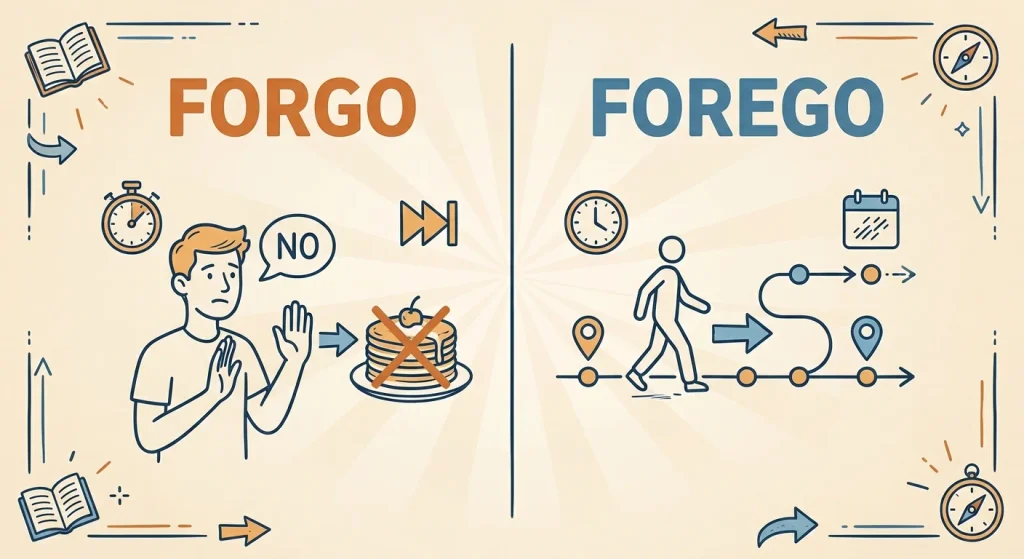
Forgo and forego are two easily confused English words that look almost identical and sound nearly the same. That single e can make a surprisingly important difference in meaning, especially in formal writing.
The good news is that the distinction becomes much easier once you connect each spelling with its main meaning. Forgo generally means to give something up, go without it, or choose not to have or do it. Forego, when used in its traditional sense, means to go before or precede something.
There is an important modern wrinkle, though. Major dictionaries also recognize forego as a less common spelling or variant of forgo in the “give up” sense. Cambridge lists forego as another spelling of forgo, while Merriam-Webster identifies it as a less common variant.
So, is forgo or forego correct? Both can be correct, depending on what you mean. However, forgo is usually the clearest choice when you mean “give up” or “do without.”
The Key Difference
The easiest way to understand forgo vs. forego is to focus on the meaning behind the extra e.
| Word | Main meaning | Example |
| forgo | Give up, skip, or do without | She decided to forgo dessert. |
| forego | Go before or precede | The introduction foregoes the main discussion. |
| forego | Less common variant of forgo | They chose to forego the usual ceremony. |
| forgone | Past participle of forgo | The opportunity was forgone. |
| foregone | Past participle of forego; also common in “foregone conclusion” | It was a foregone conclusion. |
| forgoing | Present participle of forgo | Forgoing the expense saved money. |
| foregoing | Present participle of forego; often means something stated earlier | The foregoing discussion explains the issue. |
In everyday American English, forgo is the spelling to reach for when you mean “give up.” Merriam-Webster defines it as “to give up the enjoyment or advantage of” or “do without.”
By contrast, the traditional verb forego means “to go before” or “precede.” Merriam-Webster still maintains this separate definition.
The Simple Rule
Think of the difference this way:
- Forgo = give up or do without
- Forego = go before or precede
- Forego = also accepted as a less common spelling of forgo
- Foregone = commonly appears in “foregone conclusion”
- Foregoing = often refers to something mentioned earlier
This distinction covers most situations you’ll encounter.
What Does Forgo Mean?
Forgo is a verb that means to give something up, do without something, or deliberately choose not to have or do something.
The choice usually involves some kind of sacrifice. You could forgo dessert to reduce your sugar intake. You might forgo a vacation to save money. A company could forgo immediate profits to invest in long-term growth.
The important idea is voluntary omission.
When you forgo something, you decide not to take advantage of it, use it, experience it, or pursue it.
Merriam-Webster gives examples involving decisions such as forgoing dessert or giving up an advantage. Cambridge similarly defines forgo as giving something up or doing without it.
Forgo Means “Give Up” or “Do Without”
Consider these examples:
- I decided to forgo dessert tonight.
- She chose to forgo the expensive hotel.
- We had to forgo our usual weekend trip.
- The athlete agreed to forgo the opportunity.
- He decided to forgo his bonus and donate the money.
- They chose to forgo unnecessary expenses.
- The restaurant lets customers forgo the automatic gratuity.
In each sentence, the person deliberately gives something up.
That makes forgo especially useful when you’re describing a trade-off. One option is available, but someone decides not to take it.
Forgo Often Implies a Choice
The word can carry more nuance than simply saying skip.
For example:
She skipped dessert.
This tells you what happened.
She forwent dessert.
This emphasizes the decision to do without it.
That distinction matters in formal or analytical writing. Forgo can describe a conscious decision involving an advantage, pleasure, opportunity, benefit, or activity.
You can therefore use it in contexts involving:
- Food: forgo dessert
- Money: forgo a bonus
- Travel: forgo a vacation
- Opportunities: forgo a promotion
- Rights: forgo a legal claim
- Conveniences: forgo air conditioning
- Activities: forgo the ceremony
- Benefits: forgo an advantage
- Purchases: forgo a new car
- Habits: forgo social media for a week
Common Uses of Forgo
Forgo appears frequently when a person or organization weighs one benefit against another.
For instance, someone might forgo a higher salary in exchange for more flexible working hours. A business might forgo short-term revenue to build customer loyalty. A traveler might forgo a luxury hotel to spend more money on experiences.
The word therefore works particularly well when the decision has a purpose.
Personal choices
Maya decided to forgo her morning coffee so she could sleep an extra hour.
Here, Maya gives up one thing to gain another.
Financial decisions
The couple chose to forgo a new car and put the money toward their home.
Again, the word expresses a deliberate trade-off.
Professional decisions
The executive agreed to forgo the bonus while the company recovered from the downturn.
The sentence doesn’t merely say the bonus disappeared. It suggests a conscious decision not to take it.
Formal or legal contexts
The defendant chose to forgo the opportunity to appeal.
This use sounds more formal than simply saying the defendant “gave up” the opportunity.
Forgo in Example Sentences
Seeing forgo in different contexts makes its meaning easier to recognize.
Everyday examples
I’ll forgo dessert tonight.
The speaker chooses not to eat dessert.
We decided to forgo the movie and go home.
The group chooses not to watch the movie.
She forwent breakfast because she was running late.
The past-tense form describes a decision that already happened.
Business examples
The company may forgo immediate profits to expand into new markets.
The company sacrifices a short-term benefit for a possible long-term gain.
Investors sometimes forgo higher returns in exchange for greater stability.
The sentence describes a deliberate trade-off between potential profit and stability.
Academic examples
Researchers may forgo a broader sample when a highly controlled study is more important.
The researchers choose one advantage over another.
Formal examples
The applicant chose to forgo the opportunity to submit additional evidence.
This sounds precise and formal, which makes forgo particularly useful in professional writing.
Forgo Word Forms
One of the easiest ways to recognize forgo is to learn its irregular forms.
Unlike a regular verb such as walk, forgo does not form its past tense by simply adding -ed.
| Form | Word | Example |
| Base form | forgo | They may forgo the offer. |
| Third-person singular | forgoes | She forgoes dessert regularly. |
| Past tense | forwent | He forwent the opportunity. |
| Past participle | forgone | The benefit was forgone. |
| Present participle | forgoing | They are forgoing unnecessary costs. |
Merriam-Webster lists forwent, forgone, forgoing, and forgoes as the standard forms of forgo.
Forgo, Forwent, Forgone, and Forgoing
These forms often cause more confusion than the base word itself.
Forgo is the present or base form:
We may forgo the trip.
Forwent is the simple past:
We forwent the trip last year.
Forgone is the past participle:
We have forgone several luxuries to save money.
Forgoing is the present participle:
By forgoing unnecessary purchases, they reduced their expenses.
Notice that the past tense is forwent, not forgoed.
That is one of the most common mistakes to avoid.
Is “Forgone” the Past Tense of Forgo?
Not exactly.
Forwent is the simple past tense of forgo.
Forgone is the past participle.
Compare these constructions:
She forwent the opportunity.
She has forgone the opportunity.
The first sentence uses the simple past. The second uses the past participle with has.
The same pattern appears in other irregular verbs:
- go → went → gone
- see → saw → seen
- take → took → taken
- forgo → forwent → forgone
That pattern makes forgo easier to remember.
What Does Forego Mean?

The traditional verb forego means to go before, come before, or precede something else.
This is where the extra e becomes meaningful.
The prefix fore- often relates to the idea of being before, earlier, or in front of something. Merriam-Webster explains that the historical distinction between forego and forgo is connected to the different prefixes from which the words developed.
For example:
The introduction foregoes the main argument.
Here, the introduction comes before the argument.
However, this traditional sense of forego is relatively uncommon in modern everyday English. When modern readers see forego, they are more likely to encounter it as a variant spelling of forgo or within related forms such as foregone and foregoing. Merriam-Webster specifically notes that the traditional verb meaning “to go before” is uncommon in modern use.
Forego Means “Go Before”
In its traditional sense, forego describes something that precedes another thing.
For example:
A brief warning foregoes the announcement.
The warning comes first.
The introduction forewent the main discussion.
The introduction came before the discussion.
A short ceremony forewent the formal dinner.
The ceremony happened first.
These examples use forego in its older, literal sense of “precede.”
That meaning is worth knowing, but it isn’t the meaning most people need in ordinary writing.
Can Forego Also Mean “Give Up”?
Yes.
This is where the forgo vs. forego question becomes more complicated than a simple spelling rule.
Modern dictionaries recognize forego as a variant spelling of forgo in the sense of “give up” or “do without.” Cambridge explicitly lists forego as another spelling of forgo, and Merriam-Webster describes it as a “less common spelling” of forgo.
So both of these can be understood as meaning “give up”:
She decided to forgo dessert.
She decided to forego dessert.
The first version is generally the better choice if clarity is your goal.
Why? Forgo is the established modern spelling for this meaning, while forego can make readers wonder whether you mean “precede.”
Merriam-Webster notes that forgo is more frequent in print as the standard verb across its inflected forms.
Should You Use Forego or Forgo?
When you mean give up, do without, or choose not to have something, use forgo.
That choice is simple, familiar, and unlikely to create confusion.
Use forego when you specifically mean precede, particularly if the context clearly calls for that older meaning.
A useful practical guide is:
Give up? → Forgo.
Go before? → Forego.
There is one additional point worth remembering: forego is not an outright spelling error when used to mean “give up.” Major dictionaries recognize that usage. Still, forgo is usually the safer and more precise choice in modern writing.
Forgo or Forego Dessert?
The phrase “forgo dessert” is one of the clearest examples of this spelling difference.
If you mean that someone chooses not to eat dessert, write:
I decided to forgo dessert.
You can also encounter:
I decided to forego dessert.
The second version is recognized in modern dictionaries as a variant, but forgo is the more straightforward choice.
Merriam-Webster famously uses dessert to illustrate the distinction: if you mean “do without dessert,” forgo is the traditional spelling for that meaning, although forego is accepted as a variant.
Now consider a completely different sentence:
Dessert will forego dinner.
This unusual sentence means dessert will come before dinner.
That is the traditional meaning of forego.
The contrast is useful because it exposes the role of the extra e:
- Forgo dessert = do without dessert.
- Dessert foregoes dinner = dessert comes before dinner.
The second sentence sounds unusual because people rarely describe meal order this way. Still, it demonstrates the traditional semantic distinction.
Why Forgo Is Usually the Better Choice
Modern English favors clarity and familiarity. Although forego can mean “give up,” readers generally recognize forgo more readily in that sense.
Compare:
The company decided to forgo the additional expense.
with:
The company decided to forego the additional expense.
Both can communicate the intended meaning. The first, however, removes the possibility that a reader will briefly interpret forego as “precede.”
That matters in professional writing, educational material, business communication, and technical documents. When two accepted spellings exist, but one creates less ambiguity, the clearer option usually wins.
A Practical Usage Guide
Choose forgo when you mean:
- give up something
- do without something
- skip something deliberately
- decline an opportunity
- surrender an advantage
- sacrifice one benefit for another
Choose traditional forego when you mean:
- go before
- come before
- precede
- happen earlier than something else
And remember that forego can also appear as a recognized variant of forgo.
A Quick Test
When you’re unsure which spelling belongs in your sentence, replace the word with “give up.”
If the sentence still makes sense, forgo is probably the word you want.
She decided to give up dessert.
Therefore:
She decided to forgo dessert.
Try the same test with forego:
The introduction decided to give up the main discussion.
That doesn’t express the intended idea.
If you mean the introduction comes before the discussion, forego is the better fit.
This substitution test works because it focuses on meaning rather than appearance. Instead of asking, “Which spelling looks right?” ask, “What does the sentence actually mean?”
That small shift can eliminate most confusion between forgo and forego.
Word Forms and Grammar
The difference between forgo and forego becomes even clearer when you look at their grammatical forms. The base words may confuse, but their past and participle forms create several additional traps.
For forgo, the standard forms are forgo, forgoes, forwent, forgone, and forgoing. Merriam-Webster lists these forms directly, while Cambridge gives the same core pattern.
For the traditional verb forego, meaning “precede,” the forms are forego, foregoes, forewent, foregone, and foregoing. Merriam-Webster also lists forego as a less common spelling of forgo when the intended meaning is “give up” or “do without.”
Forgo, Forwent, Forgone, and Forgoing
The most important forms of forgo are:
| Grammatical form | Word | Example |
| Base form | forgo | We may forgo the trip. |
| Third-person singular | forgoes | She forgoes unnecessary expenses. |
| Simple past | forwent | He forwent the opportunity. |
| Past participle | forgone | They have forgone several luxuries. |
| Present participle | forgoing | She is forgoing dessert. |
The irregular past tense is particularly important.
You should write:
She forwent the opportunity.
Not:
She forgoed the opportunity.
Forwent follows the irregular pattern found in several older English verbs. The past participle is forgone, not forwent.
Compare these sentences:
He forwent the promotion last year.
He has forgone several career opportunities.
The first sentence uses the simple past. The second uses the past participle after has.
This distinction matters because forwent and forgone aren’t interchangeable.
When to Use Forgone
Forgone is the past participle of forgo.
It commonly appears with helping verbs such as has, have, and had.
Examples include:
- She has forgone the opportunity.
- They have forgone several benefits.
- He had forgone the chance to participate.
- The company has forgone short-term profits.
- We had forgone the convenience in favor of lower costs.
You may also see forgone used in formal constructions where someone has deliberately surrendered an option or advantage.
The applicant had forgone the right to appeal.
The meaning is straightforward: the applicant had given up that right.
Cambridge lists forgone as the past participle of forgo, alongside forwent as its past tense.
When to Use Forgoing
Forgoing is the present participle and gerund form of forgo.
It can describe an action happening now:
They are forgoing unnecessary expenses.
It can also function as a noun-like gerund:
Forgoing the purchase saved her money.
In this sentence, forgoing the purchase acts as the subject.
You can also use it after prepositions:
By forgoing the upgrade, the company reduced costs.
Instead of forgoing the opportunity, she accepted the challenge.
The spelling is forgoing, not forgoinge or forgoeing.
The e in forgo isn’t preserved before -ing.
That gives you:
forgo → forgoing
rather than:
forgo → forgoeing
Merriam-Webster identifies forgoing as the present participle of forgo.
Forego, Forewent, Foregone, and Foregoing
The traditional verb forego has a parallel set of forms:
| Grammatical form | Word | Traditional meaning |
| Base form | forego | precede |
| Third-person singular | foregoes | precedes |
| Simple past | forewent | preceded |
| Past participle | foregone | preceded |
| Present participle | foregoing | preceding |
Merriam-Webster defines this traditional forego as “to go before” or “precede” and gives forewent, foregone, foregoing, and foregoes as its forms.
For example:
The opening remarks forego the main presentation.
A short introduction forewent the formal discussion.
The remarks had foregone the main argument.
However, these constructions are uncommon in ordinary modern English. Writers usually choose clearer alternatives such as precede, preceded, or preceding.
That explains why the related words foregone and foregoing are much more familiar than the verb forego itself.
Why “Foregone” Causes Confusion
Foregone can belong to the traditional forego family, but it also appears in the extremely common phrase foregone conclusion.
That phrase doesn’t usually make readers think about the verb forego at all.
Consider:
The election result seemed like a foregone conclusion.
Here, foregone means something that has effectively been determined or anticipated beforehand.
The expression is so established that most readers recognize it as a fixed phrase.
By contrast:
The company has forgone its usual expansion plans.
Here, forgone comes from forgo and means given up or done without.
The two forms differ by only one letter, yet their meanings can diverge considerably.
What’s the Difference?
The easiest way to distinguish forgone and foregone is to ask what happens to the object.
Forgone generally means given up, surrendered, or done without.
Foregone traditionally relates to something that went before, but modern English most commonly encounters it in expressions such as foregone conclusion.
| Word | Typical meaning | Example |
| forgone | Given up or done without | The company has forgone the extra revenue. |
| foregone | Determined or anticipated beforehand | The result was a foregone conclusion. |
Examples With Forgone
She had forgone the opportunity to travel.
The opportunity was voluntarily given up.
The company has forgone immediate profits.
The company chose not to pursue those profits.
They had forgone several conveniences to keep costs low.
They deliberately did without those conveniences.
Examples With Foregone
His victory was a foregone conclusion.
The outcome seemed inevitable before the event was completed.
The committee treated approval as a foregone conclusion.
The committee assumed the result was already predictable.
This distinction is especially valuable in formal writing because forgone and foregone can change the meaning of an entire sentence.
What Is a Foregone Conclusion?
A foregone conclusion is an outcome that appears certain or predictable before the final result occurs.
The phrase usually describes something that seems inevitable.
For example:
With a 20-point lead and only two minutes remaining, the team’s victory looked like a foregone conclusion.
The writer isn’t saying the team “gave up” its victory. Instead, the result appears almost certain.
Another example:
Given the overwhelming evidence, a guilty verdict seemed like a foregone conclusion.
The expected outcome was clear before the final decision.
Foregone Conclusion vs. Forgone
These two expressions can look deceptively similar:
- foregone conclusion = an expected or inevitable result
- forgone opportunity = an opportunity that someone gave up
- foregone benefit = a benefit anticipated or determined beforehand, depending on context
- forgone benefit = a benefit deliberately surrendered or not taken
Compare:
The election result was a foregone conclusion.
with:
The candidate had forgone the opportunity to campaign.
The first sentence concerns predictability.
The second concerns giving something up.
That semantic difference is more important than the single letter separating the spellings.
Forgoing vs. Foregoing
Another major source of confusion is forgoing vs. foregoing.
These words look almost identical, but they normally perform very different jobs.
Forgoing means giving up or doing without.
Foregoing usually means previously mentioned, stated, listed, or occurring before. Merriam-Webster specifically defines foregoing as referring to something listed, mentioned, or occurring earlier.
| Word | Meaning | Example |
| forgoing | Giving up or doing without | Forgoing dessert helped him reduce his sugar intake. |
| foregoing | Previously mentioned or stated | The foregoing discussion explains the decision. |
This distinction becomes particularly useful in formal documents.
What Does Forgoing Mean?
Forgoing comes from forgo.
It means voluntarily giving something up or choosing not to do something.
Forgoing the purchase allowed the family to save money.
She improved her budget by forgoing unnecessary subscriptions.
Forgoing the optional upgrade reduced the final cost.
In every case, the word expresses sacrifice or omission.
What Does Foregoing Mean?
Foregoing has a different role in formal English.
It often means the thing stated earlier or the information mentioned above.
For example:
The foregoing analysis supports the proposed conclusion.
Here, foregoing analysis means the analysis that appeared earlier in the document.
Another example:
For the foregoing reasons, the court rejected the argument.
The phrase means for the reasons stated previously.
This usage is especially common in:
- legal writing
- contracts
- academic writing
- government documents
- formal reports
- technical documents
Merriam-Webster notes that foregoing applies chiefly to statements and can function similarly to words such as preceding or previous.
A Simple Test for Forgoing vs. Foregoing
Try replacing the word with “giving up.”
If the sentence still makes sense, choose forgoing.
Forgoing dessert saved calories.
→ Giving up dessert saved calories.
So forgoing is correct.
Now try:
The foregoing paragraph explains the issue.
→ The giving up paragraph explains the issue.
That doesn’t work.
Instead, replace it with “previous.”
The previous paragraph explains the issue.
That works, so foregoing is correct.
This substitution method makes the distinction much easier.
In Formal Writing
The choice between forgo and forego becomes particularly important in professional documents.
Suppose a business report says:
The company will forgo the proposed expansion.
The meaning is immediately clear: the company will give up or decline the expansion.
Now consider:
The company will forego the proposed expansion.
Most readers will understand this as the same meaning because forego is an accepted variant of forgo. Still, the traditional meaning of forego is “precede,” so the spelling introduces a small amount of unnecessary ambiguity.
For that reason, forgo is generally the stronger choice when writing for a broad audience.
This isn’t about declaring forego incorrect. It is about choosing the form that communicates your intended meaning with the least friction.
When Forego Is Better
The traditional forego makes sense when you genuinely mean precede.
For example:
The introduction foregoes the detailed analysis.
Here, the introduction comes first.
You could replace foregoes with precedes:
The introduction precedes the detailed analysis.
The meaning remains intact.
That’s a useful diagnostic test.
If precedes works, traditional forego may be appropriate.
If gives up works, forgo is the better choice.
Pronunciation
Pronunciation adds another layer to this spelling problem.
In American English, both words are commonly pronounced with a “for-go” sound. Cambridge gives the American pronunciation for forgo as /fɔrˈɡoʊ/ and also lists forego with the same general pronunciation.
That similarity explains why people often confuse the spellings.
When two words sound alike or nearly alike, spelling becomes the main clue to meaning.
This is why relying on pronunciation alone isn’t enough.
Compare:
forgo dessert
and:
forego the discussion
If you hear the words in isolation, the spelling difference disappears. Once you see them in writing, however, the intended meaning becomes much easier to identify.
Does the Extra “E” Always Mean “Before”?
Not necessarily.
This is an important point because simplified memory tricks can become misleading.
Traditionally, fore- often carries the idea of before or in front of. That helps explain the traditional verb forego, meaning “precede.”
However, modern dictionaries also recognize forego as a variant spelling of forgo meaning “give up.” Merriam-Webster explicitly lists the variant, and Cambridge lists forego alongside forgo for the “give up” meaning.
So this is a useful rule:
The extra E can help you remember the traditional meaning, but it isn’t an absolute spelling law.
That’s a more accurate way to approach the pair.
Why Modern Dictionaries Accept Forego for Forgo
English spelling doesn’t always remain perfectly fixed over time.
Words can develop alternate spellings, meanings can overlap, and forms that were once distinct can become interchangeable in some contexts.
That’s what has happened with forego and forgo to some extent.
Merriam-Webster treats the traditional forego (“precede”) as one verb and separately lists forego as a less common spelling of forgo (“give up”).
Cambridge likewise labels forego as another spelling of forgo.
This means a strict rule such as “forego is always wrong” isn’t accurate.
A better rule is:
Use forgo when you mean “give up” because it is the clearer and more established choice. Recognize forego as an accepted variant, but reserve its traditional meaning for contexts where it means “precede.”
That approach respects both dictionary evidence and modern usage.
Common Contexts
The following table can help you identify the appropriate spelling quickly.
| Context | Best choice | Example |
| Giving up dessert | forgo | I decided to forgo dessert. |
| Skipping a vacation | forgo | They chose to forgo their vacation. |
| Giving up an opportunity | forgo | She forwent the opportunity. |
| Sacrificing a benefit | forgo | He forwent the benefit. |
| Something coming first | forego | The introduction foregoes the analysis. |
| Previous statement | foregoing | The foregoing statement explains the decision. |
| Giving something up | forgoing | Forgoing the purchase saved money. |
| Predictable outcome | foregone | It was a foregone conclusion. |
| Past act of giving up | forgone | They had forgone the opportunity. |
The pattern is much easier once you stop treating these words as simple spelling variants and instead connect each form with its semantic function.
A Real-World Usage Pattern
Consider a company deciding whether to launch an expensive advertising campaign.
The company might:
Forgo the campaign to preserve cash.
That means the company chooses not to pursue it.
A report might later state:
The foregoing analysis explains why the company rejected the campaign.
Here, foregoing refers to the analysis presented earlier.
Then an analyst might write:
The company’s decision to forgo the campaign was expected.
And finally:
Its eventual decision was hardly a foregone conclusion six months earlier.
Notice how all four forms can appear in closely related writing while performing different jobs:
- forgo → give up
- foregoing → previously stated
- foregone → anticipated or inevitable in foregone conclusion
- forgone → given up
That distinction is one of the most useful patterns to remember when working with this word family.
Key Takeaways So Far
Before moving into the remaining usage issues, keep these distinctions in mind:
- Forgo means to give up, skip, or do without.
- Forego traditionally means to go before or precede.
- Forego is also accepted as a less common spelling of forgo.
- Forwent is the simple past of forgo.
- Forgone is the past participle of forgo.
- Forgoing means giving up or doing without.
- Foregoing usually refers to something previously stated or occurring earlier.
- Foregone conclusion describes an outcome that seems predetermined or inevitable.
- Forgo is generally the clearest modern choice when you mean “give up.”
- The extra e in forego can be a useful clue for the traditional “precede” meaning, but it isn’t an absolute rule.
The biggest lesson is simple: meaning comes before spelling. Once you identify whether the sentence describes giving something up, something coming before something else, something mentioned earlier, or an apparently inevitable result, the correct form becomes much easier to choose.
A Closer Look
The difference between forgoing and foregoing deserves special attention because these forms appear frequently in polished writing. They differ by only one letter, yet their meanings and grammatical roles are usually distinct.
Forgoing comes from forgo and means giving something up or choosing to do without it.
Foregoing comes from the traditional verb forego and generally means preceding, previously mentioned, or stated earlier.
Consider these two sentences:
Forgoing the expensive option saved the company thousands of dollars.
The foregoing discussion explains the company’s decision.
The first sentence describes an act of giving something up. The second points backward to information that appeared earlier.
That distinction remains useful even though the base verbs have overlapping modern usage.
Examples of Forgoing
Forgoing usually describes a deliberate sacrifice, omission, or decision to do without something.
Forgoing dessert became part of her new eating routine.
The family saved money by forgoing a luxury vacation.
Forgoing the optional features lowered the purchase price.
The athlete considered forgoing the competition to recover from fatigue.
By forgoing immediate profits, the company could invest in research.
In each example, forgoing could be replaced by phrases such as:
- giving up
- doing without
- choosing not to have
- declining
- sacrificing
- skipping
The exact replacement depends on context, but the central idea remains the same.
Examples of Foregoing
Foregoing usually points to something that came earlier.
The foregoing paragraph summarizes the main argument.
For the foregoing reasons, the proposal was rejected.
The foregoing evidence supports the conclusion.
The parties agree to the terms described in the foregoing section.
This usage is particularly common in formal prose.
You may encounter it in legal contracts, academic papers, policy documents, court opinions, and technical reports.
In everyday conversation, however, previous, earlier, or above often sounds more natural.
Compare:
The foregoing explanation answers the question.
with:
The previous explanation answers the question.
Both communicate the general idea, but the second sounds more conversational.
Foregoing Meaning in Legal and Formal Writing
The word foregoing has a distinctive place in formal English.
Legal writers often use it to refer to something already stated in a document.
For example:
For the foregoing reasons, the motion is denied.
The phrase means:
For the reasons stated previously, the motion is denied.
Similarly:
The parties agree to all of the foregoing terms.
This means the parties agree to the terms presented earlier in the document.
The word can therefore function as a compact reference to preceding material.
Why Formal Writers Use Foregoing
Formal documents often contain long sections where repeating information would make the text cumbersome.
Instead of writing:
Based on all of the reasons explained in the preceding paragraphs, the committee rejected the proposal.
a formal writer might write:
For the foregoing reasons, the committee rejected the proposal.
The shorter construction points directly to previously stated material.
Still, foregoing can sound stiff outside formal contexts.
For a general audience, simpler alternatives often improve readability:
- previous
- earlier
- preceding
- above-mentioned
- stated earlier
The best choice depends on your audience and the tone of the document.
Context Determines Meaning
A useful lesson from forgo vs. forego is that spelling alone doesn’t always settle meaning.
Consider:
The company will forego the expense.
Most readers will interpret this as “The company will forgo the expense,” meaning it will give up or avoid it.
Now consider:
The introduction will forego the analysis.
Here, a reader might understand forego in its traditional sense: the introduction will come before the analysis.
The surrounding words provide the clues.
This is why context matters so much in English vocabulary.
Compare These Sentences
| Sentence | Intended meaning |
| She decided to forgo dessert. | She decided to do without dessert. |
| She decided to forego dessert. | Same modern meaning, using the less common variant. |
| The introduction foregoes the main argument. | The introduction comes before the argument. |
| The company has forgone the opportunity. | The company has given up the opportunity. |
| The result was a foregone conclusion. | The result seemed inevitable. |
| The foregoing section explains the issue. | The earlier section explains the issue. |
| Forgoing the purchase saved money. | Giving up the purchase saved money. |
The surrounding context acts like a map. It tells you which sense the writer intends.
Etymology and Word Origins
The history of these words explains why their spellings look so similar while their traditional meanings differ.
Both words contain the familiar element go, but their prefixes developed along different semantic paths.
The distinction is connected to the historical meanings of fore- and for-.
The prefix fore- commonly carries the idea of before, earlier, or in front of.
You can see that meaning in words such as:
- foretell
- forewarn
- forecast
- forehead
- foreword
- foremost
- beforehand
The prefix for- in forgo developed with a different sense involving exclusion, omission, refusal, or abstention.
Merriam-Webster explains that the historical distinction between forego and forgo reflects these different prefixes.
Where Does Forgo Come From?
Forgo is an old English verb with roots extending back to Old English.
Historically, it carried the idea of giving something up or going without something.
That core meaning has remained remarkably stable.
Modern forgo therefore still expresses voluntary omission:
He decided to forgo the reward.
They chose to forgo the convenience.
She will forgo the opportunity.
Merriam-Webster records the first known use of forgo before the 12th century, demonstrating that this isn’t a recently invented business or internet expression.
Where Does Forego Come From?
Traditional forego developed from the idea of going before.
The prefix fore- contributes the sense of something being earlier or ahead.
That makes the traditional definition relatively intuitive:
forego = go before
The verb is much less common today than its related forms foregone and foregoing.
Modern readers are far more likely to encounter:
foregone conclusion
or:
the foregoing discussion
than:
the introduction foregoes the argument.
This uneven distribution helps explain why the base verb can feel unfamiliar even though its related forms remain recognizable.
Don’t Mix Them Up
The fore- prefix appears in several English words associated with something coming before.
Two examples that sometimes create confusion are forego and foreword.
A foreword is an introductory section placed before the main text of a book.
A traditional forego means to come before something.
The shared prefix provides a useful conceptual connection:
- forego → go before
- foreword → words placed before the main text
- foretell → tell beforehand
- forewarn → warn beforehand
- forecast → predict beforehand
This doesn’t mean every word beginning with fore- has exactly the same grammatical function. It simply shows why fore- often suggests priority, position, or time.
Pronunciation
Forgo and forego are generally pronounced alike or very similarly in standard American English.
This creates a classic spelling problem: the ear cannot reliably tell you which spelling belongs on the page.
The usual pronunciation resembles:
for-GOH
The stress falls on the second syllable.
That pronunciation is shared across many uses of the words, which means you shouldn’t rely on sound alone when choosing the spelling.
Why Pronunciation Doesn’t Solve the Problem
Suppose someone says:
“I decided to forgo the opportunity.”
If you only hear the sentence, you don’t see the spelling.
You might write forego by mistake because the two forms sound alike.
That’s why vocabulary knowledge needs both:
- meaning
- spelling
Pronunciation helps you recognize the word when spoken. Context and spelling help you select the correct written form.
Common Mistakes With Forgo and Forego
The confusion between these words produces several recurring mistakes.
Understanding those errors can help you avoid them.
Treating Forego as Always Wrong
One of the most common misconceptions is that forego is simply an incorrect spelling of forgo.
That’s too simplistic.
Major dictionaries recognize forego as a variant spelling of forgo in the “give up” sense. Merriam-Webster calls it a less common spelling, while Cambridge lists it as another spelling.
Therefore:
She decided to forego dessert.
is not necessarily a spelling error.
However, forgo remains the clearer conventional choice for this meaning.
Using Forego for Every Meaning
The opposite mistake is assuming that forego can replace forgo everywhere.
While dictionaries accept forego as a variant in the “give up” sense, the traditional verb has a separate meaning: precede.
For example:
The introduction foregoes the main discussion.
Here, the intended meaning is “comes before.”
Replacing it blindly with forgo could obscure that meaning.
The better approach is to ask what the sentence means before choosing the spelling.
Writing “Forgoed”
Another frequent mistake involves the past tense.
Because many English verbs form their past tense with -ed, writers sometimes create:
❌ forgoed
But the correct simple past is:
✅ forwent
For example:
She forwent the opportunity.
Not:
She forgoed the opportunity.
The past participle is:
forgone
So:
She has forgone the opportunity.
Confusing Forgone and Foregone
These words look nearly interchangeable, but they don’t normally mean the same thing.
The company has forgone the investment.
means the company has given up or done without the investment.
The outcome was a foregone conclusion.
means the outcome was considered inevitable.
A useful memory pair is:
forgone → given up
foregone → expected beforehand
That distinction is particularly important because foregone conclusion is such a common phrase.
Confusing Forgoing and Foregoing
The same issue occurs with the -ing forms.
Forgoing the purchase saved money.
means giving up the purchase saved money.
The foregoing paragraph explains the decision.
means the paragraph appearing earlier explains the decision.
A single letter changes the semantic direction of the word.
Relying Only on Pronunciation
Because the words sound similar, pronunciation cannot reliably distinguish them.
If you are writing rather than speaking, ask yourself:
Am I talking about giving something up or something coming before?
That question usually reveals the answer.
In Everyday English
In everyday English, forgo is considerably more useful.
You might say:
- I decided to forgo dessert.
- She chose to forgo the upgrade.
- We had to forgo our weekend plans.
- He decided to forgo the discount.
- They chose to forgo the invitation.
These sentences all describe deliberate choices.
Traditional forego, by contrast, sounds formal or unusual in ordinary conversation:
The introduction foregoes the main presentation.
A modern speaker would probably say:
The introduction comes before the main presentation.
or:
The introduction precedes the main presentation.
This doesn’t make traditional forego incorrect. It simply makes it less common and less natural for many audiences.
In Academic Writing
Academic writing often benefits from precise distinctions.
Suppose a researcher wants to explain why a study excluded an optional procedure:
The researchers chose to forgo the additional test because it would have increased costs without improving the primary analysis.
The meaning is clear.
Now consider a sentence referring to material already discussed:
The foregoing analysis demonstrates the relationship between the two variables.
Here, foregoing refers to the preceding analysis.
Both forms can appear in the same academic paper, but they perform different semantic jobs.
Better Academic Alternatives
Although foregoing is grammatically legitimate, academic writers should consider whether simpler wording would improve readability.
Instead of:
The foregoing discussion demonstrates…
you might write:
The previous discussion demonstrates…
Instead of:
For the foregoing reasons…
you might write:
For these reasons…
The simpler version often feels more direct.
Still, foregoing remains useful when you want a concise formal reference to material that immediately precedes the current statement.
In Business Writing
Business writing frequently uses forgo because organizations regularly describe trade-offs.
A company might forgo short-term revenue to build a stronger customer base.
A manager might forgo a personal bonus to preserve team funding.
A customer might forgo an expensive service to reduce monthly expenses.
Consider this example:
The company decided to forgo the premium advertising package and invest the savings in product development.
The sentence communicates a clear business decision.
The company gives up one option to pursue another.
Why Forgo Works Well in Business Contexts
Forgo is particularly useful for describing opportunity costs.
An opportunity cost is the value of what you give up when you choose one option instead of another.
For example:
By forgoing immediate revenue, the company gained more time to develop the product.
The sentence shows a trade-off:
What was given up: immediate revenue
What was pursued instead: product development time
This makes forgo especially useful in financial, strategic, and managerial writing.
In Legal Writing
Legal writing presents a more complicated picture.
You may encounter both forgo and forego, along with foregoing and foregone.
For example:
The party chose to forgo its right to appeal.
Here, forgo clearly means surrender or relinquish.
You may also encounter:
For the foregoing reasons, the court grants the motion.
Here, foregoing refers to reasons stated earlier.
These constructions are common because legal writing frequently needs to describe both waivers and preceding statements.
Forgoing a Right
The word forgo can describe giving up something more significant than dessert or entertainment.
For example:
The claimant chose to forgo the right to pursue additional damages.
Here, forgo means voluntarily surrendering an available option.
Similar contexts include:
- forgoing an appeal
- forgoing a claim
- forgoing compensation
- forgoing a benefit
- forgoing an opportunity
- forgoing a contractual option
Because these decisions can carry substantial consequences, the word often appears in formal and legal contexts.
A Useful Semantic Test
When you’re stuck between forgo and forego, use one of these replacement tests.
Test One: “Give Up”
Replace the word with give up.
She decided to give up the opportunity.
Therefore:
She decided to forgo the opportunity.
Test Two: “Precede”
Replace the word with precede.
The introduction precedes the discussion.
Therefore:
The introduction foregoes the discussion.
Test Three: “Previously Mentioned”
For foregoing, substitute previous or previously mentioned.
The previous section explains the issue.
Therefore:
The foregoing section explains the issue.
Test Four: “Given Up”
For forgone, substitute given up.
The company has given up the opportunity.
Therefore:
The company has forgone the opportunity.
These tests aren’t perfect for every literary or historical use, but they work extremely well for modern practical writing.
A Practical Decision Table
| If you mean… | Use… | Example |
| give up | forgo | We chose to forgo the offer. |
| do without | forgo | She decided to forgo dessert. |
| skip deliberately | forgo | He will forgo the ceremony. |
| surrender an opportunity | forgo | They forwent the opportunity. |
| sacrifice a benefit | forgo | She forwent the financial advantage. |
| come before | forego | The introduction foregoes the main discussion. |
| precede | forego | The warning forewent the announcement. |
| refer to earlier material | foregoing | The foregoing section explains the issue. |
| give up in -ing form | forgoing | Forgoing the purchase saved money. |
| inevitable or predetermined result | foregone | It was a foregone conclusion. |
This table captures the most useful distinctions for modern readers.
Why “Foregone Conclusion” Is Different
The expression foregone conclusion deserves special treatment because it can mislead learners into thinking foregone means “given up.”
It doesn’t.
In this expression, foregone conveys the sense of something already determined or predictable.
For example:
Her promotion seemed like a foregone conclusion.
The sentence means that everyone expected her to receive the promotion.
It does not mean that she gave up the promotion.
Compare:
She forwent the promotion.
This means she chose not to accept it.
The two sentences could even describe opposite situations.
Opposite Meanings in Context
Imagine an employee is clearly the strongest candidate for promotion.
Before the announcement:
Her promotion seemed like a foregone conclusion.
After the announcement, suppose she turns it down:
She forwent the promotion.
The first sentence describes an expected outcome.
The second describes a deliberate decision to give something up.
That contrast makes the distinction much easier to remember.
The Role of Contextual Clues
Context can often reveal the correct form even before you consciously remember the grammar rule.
Look at the words surrounding the target word.Words associated with forgo often involve:
- choose
- decide
- give up
- sacrifice
- decline
- skip
- opportunity
- benefit
- expense
- luxury
- reward
Words associated with foregoing often involve:
- section
- paragraph
- statement
- discussion
- reasons
- analysis
- terms
- document
- preceding
- earlier
Words associated with foregone conclusion often involve:
- inevitable
- expected
- predictable
- certain
- outcome
- result
- assumed
These aren’t rigid rules. They’re useful contextual signals.
A Mini Case Study: Choosing the Right Form
Consider a financial advisor explaining a client’s decision.
The client has enough money to purchase a luxury vehicle, but chooses to invest instead.
A clear sentence would be:
The client decided to forgo the luxury vehicle and invest the money.
Now suppose the advisor explains the reasoning in a report:
The foregoing analysis shows that investing the money offers greater long-term potential.
Here, the two words work naturally in the same paragraph.
Later, the advisor writes:
Given the client’s investment history, the decision wasn’t a foregone conclusion.
Again, foregone has its own meaning.
Finally:
The client had forgone several previous purchases to build the portfolio.
This sequence demonstrates how forgo, forgone, foregoing, and foregone can coexist without being interchangeable.
What the Case Study Shows
The four forms communicate four related but distinct ideas:
- forgo → choose to give something up
- forgone → have given something up
- foregoing → refer to something stated earlier
- foregone → describe something determined or anticipated beforehand
Once those relationships become familiar, the spellings stop looking random.
A Memory Framework
A simple memory framework can make these words much easier to recall.
Think:
FORGO = GO WITHOUT
The word contains go, and the meaning involves choosing not to go forward with an option, possession, pleasure, or benefit.
Then think:
FOREGO = GO BEFORE
The fore- element can remind you of words associated with being before or ahead.
This isn’t a complete historical explanation, and it shouldn’t be treated as an absolute spelling rule. Modern forego can also mean “give up” as a recognized variant.
Still, the framework is highly useful for distinguishing the traditional meanings.
Another Easy Memory Trick
Use this two-question method:
What happens to the thing?
If you give it up, think forgo.
If something comes before it, think forego.
For example:
I will forgo dessert.
Dessert is being given up.
The introduction foregoes the conclusion.
The introduction comes first.
That simple contrast can help you make the right choice quickly.
Which One Looks More Natural?
For most contemporary writing, forgo looks more natural when the intended meaning is “give up.”
Readers regularly encounter expressions such as:
- forgo dessert
- forgo a purchase
- forgo an opportunity
- forgo a benefit
- forgo compensation
- forgo convenience
- forgo immediate profits
By comparison, forego is less common as a standalone verb.
Its related forms are much more visible:
- foregone conclusion
- foregoing statement
- foregoing discussion
- foregoing reasons
That distribution can make forego seem strange even though it remains a legitimate word.
The Most Important Distinction
If only one rule stays with you, make it this:
Use “forgo” when you mean “give up” or “do without.” Use traditional “forego” when you mean “go before” or “precede.”
Then add one important qualification:
Forego is also accepted as a less common variant of forgo in the “give up” sense.
This three-part understanding is more accurate than the oversimplified claim that one spelling is always right and the other is always wrong.
For everyday and professional writing, forgo is usually the safest choice when describing a deliberate decision to do without something.
When the meaning involves something appearing earlier, foregoing is often the form you need.
When the outcome seems predetermined, foregone conclusion is the familiar expression.
And when you need the simple past of forgo, remember the irregular form:
forwent
not forgoed.
Examples in Sentences
Examples are often the fastest way to turn a confusing word pair into something familiar. When you see forgo and forego in realistic sentences, the difference becomes much easier to recognize.
The key is to focus on the action each word describes. Forgo centers on giving something up, while traditional forego centers on coming before something else.
Examples With Forgo
I decided to forgo dessert after dinner.
The speaker chooses to do without dessert.
She chose to forgo the expensive upgrade.
She deliberately decided not to purchase the upgrade.
The company may forgo short-term profits to strengthen its long-term position.
The company is willing to sacrifice an immediate financial benefit.
He decided to forgo the opportunity rather than relocate.
The person gives up an available opportunity because the alternative isn’t appealing.
We had to forgo our usual vacation this year.
The vacation is something they chose or needed to do without.
The athlete agreed to forgo the bonus.
The athlete gives up a financial benefit.
They decided to forgo convenience in favor of lower costs.
The sentence describes a deliberate trade-off.
She regularly forgoes unnecessary purchases.
The third-person singular form is forgoes.
He forwent the chance to participate.
The simple past form is forwent.
The organization has forgone several opportunities.
The past participle is forgone.
Forgoing the optional service reduced the final bill.
The present participle or gerund is forgoing.
These examples demonstrate that forgo works across casual, professional, financial, academic, and formal contexts.
Examples With Forego
Traditional forego means to precede or go before.
Because this meaning is less common in modern English, the examples can sound more formal than ordinary conversation.
The introduction foregoes the detailed explanation.
The introduction comes before the explanation.
A brief warning forewent the announcement.
The warning preceded the announcement.
The opening remarks had foregone the main presentation.
The remarks came before the presentation.
The preliminary discussion foregoes the final recommendation.
The discussion occurs first.
In contemporary writing, however, precede will often sound more natural:
The introduction precedes the detailed explanation.
That version eliminates any possible ambiguity.
Examples With Forgone
Forgone is the past participle of forgo.
She has forgone the opportunity.
She has given up the opportunity.
The company had forgone immediate revenue.
The company had chosen to do without that revenue.
He has forgone several luxuries to save money.
He has deliberately given up those luxuries.
The team had forgone the chance to negotiate.
The team had surrendered that opportunity.
Remember the grammatical pattern:
forgo → forwent → forgone
Examples With Foregone
Foregone most commonly appears in modern English in the expression foregone conclusion.
His victory was a foregone conclusion.
The victory seemed inevitable.
The outcome looked like a foregone conclusion from the beginning.
The result appeared predictable from an early stage.
Her selection was almost a foregone conclusion.
People expected her to be selected.
Outside this fixed expression, foregone can retain its connection with the traditional verb forego, although such uses are much less common.Examples With ForgoingForgoing describes the act of giving something up.Forgoing the luxury package saved hundreds of dollars.Forgoing dessert became part of his new routine.
By forgoing the optional features, the buyer lowered the total cost.
Forgoing immediate rewards can sometimes support a larger long-term goal.
The word frequently appears when writers want to emphasize a deliberate trade-off.
Examples With Foregoing
Foregoing usually points backward.
The foregoing discussion explains the central issue.
The foregoing evidence supports the proposed conclusion.
For the foregoing reasons, the committee rejected the proposal.
The foregoing section provides additional context.
In these sentences, foregoing essentially means previous, earlier, or preceding.
Common Collocations
Learning common word combinations can make vocabulary choices much more automatic.
A collocation is a combination of words that frequently appears together in natural English. Recognizing these patterns helps you choose the right form without stopping to analyze every letter.
Common Collocations With Forgo
You may frequently see:
- forgo dessert
- forgo food
- forgo a meal
- forgo a purchase
- forgo an opportunity
- forgo a benefit
- forgo compensation
- forgo a reward
- forgo convenience
- forgo luxury
- forgo immediate profits
- forgo short-term gains
- forgo an advantage
- forgo the chance
- forgo a vacation
- forgo an upgrade
These combinations all involve some form of deliberate omission or sacrifice.
Common Collocations With Foregoing
The word foregoing commonly appears alongside nouns referring to previously presented information.
Examples include:
- foregoing discussion
- foregoing analysis
- foregoing statement
- foregoing paragraph
- foregoing section
- foregoing reasons
- foregoing evidence
- foregoing terms
- foregoing explanation
- foregoing provisions
For example:
The foregoing analysis provides sufficient evidence for the recommendation.
Here, the analysis has already appeared earlier.
Common Collocations With Foregone
The strongest modern collocation is:
foregone conclusion
You may also encounter phrases involving an outcome that was assumed or predetermined, such as:
- foregone outcome
- foregone result
- foregone assumption
However, foregone conclusion is by far the most recognizable expression.
Why Writers Sometimes Choose Forego
If forgo is clearer for the “give up” meaning, why does forego appear so often?
Several factors contribute to this.
First, the words have been historically connected in English spelling and usage. Second, forego is an accepted variant of forgo in the “give up” sense. Third, writers may encounter foregone and foregoing frequently and naturally extend the spelling pattern back to the base verb.
There is also a visual association with other fore- words.
Words such as foresee, forewarn, foretell, and forecast all involve anticipation or something occurring beforehand. That can make forego look intuitively correct whenever a writer thinks about the idea of something being “before.”
The problem is that forgo has its own established history and meaning.
Therefore, the spelling should follow the intended meaning rather than visual similarity with neighboring words.
Is Forgo More Common Than Forego?
For the meaning “give up” or “do without,” forgo is generally the more common and recognizable form.
Merriam-Webster’s usage discussion notes that forgo is more frequent in print as the standard verb, particularly in its inflected forms. Forego remains recognized as a variant, but it is less common in this sense.
This difference matters because dictionary correctness and preferred usage aren’t always identical concepts.
A word can be accepted without being the most common choice.
Think of it this way:
Correctness: Can a recognized dictionary support the spelling?
Usage: Is that spelling the most familiar choice for modern readers?
For forgo vs. forego, both questions produce different but compatible answers.
Dictionary Acceptance vs. Writing Preference
| Question | Answer |
| Is forgo correct for “give up”? | Yes. |
| Is forego ever correct? | Yes. |
| Can forego mean “give up”? | Yes, as an accepted variant. |
| Does traditional forego have another meaning? | Yes. It can mean “precede.” |
| Which spelling is clearer for “give up”? | Forgo. |
| Is forego always wrong? | No. |
| Is forgo usually the safer modern choice? | Yes. |
This distinction prevents an overly rigid rule from replacing the actual evidence.
What Should You Use in SEO Content?
If you’re writing web content, clarity matters.
Search engines can generally understand related forms and contextual meaning, but readers still need straightforward language. A page targeting the phrase “forgo or forego” should explain the distinction accurately rather than presenting an outdated rule such as “forego is always incorrect.”
A strong explanation should cover:
- the primary meaning of forgo
- the traditional meaning of forego
- the accepted variant use of forego
- the difference between forgone and foregone
- the difference between forgoing and foregoing
- the meaning of foregone conclusion
- examples showing each form in context
This creates topical depth without stuffing the same keyword into every sentence.
Natural Keyword Variations
Useful variations include:
- forgo or forego
- forgo vs. forego
- difference between forgo and forego
- forgo meaning
- forego meaning
- is forego a word
- is forgo a word
- forgo definition
- forego definition
- forgone vs. foregone
- forgoing vs. foregoing
- foregone conclusion meaning
- forgo dessert
- forego dessert
- past tense of forgo
- past tense of forego
These variations should appear naturally where they help answer real questions.
How Grammar Changes the Form
One reason learners struggle with these words is that the spelling difference can become harder to notice in longer forms.
Compare:
forgo → forwent → forgone → forgoing
with:
forego → forewent → foregone → foregoing
The base forms differ by one letter. The past forms differ in a more noticeable way.
| Base | Past | Past participle | -ing form |
| forgo | forwent | forgone | forgoing |
| forego | forewent | foregone | foregoing |
The most important pair is:
forgone vs. foregone
and:
forgoing vs. foregoing
These forms should never be treated as automatic spelling variants because their common meanings can be different.
In Context
Compare these examples:
The investor has forgone immediate returns.
The investor gave up immediate returns.
The final decision seemed like a foregone conclusion.
The final decision appeared inevitable.
Now consider:
The company is forgoing the expansion.
The company is choosing not to pursue the expansion.
The foregoing analysis explains the decision.
The analysis appeared earlier in the document.
The pattern becomes clearer when the words are placed side by side:
| Giving something up | Referring to what came before |
| forgo | forego |
| forwent | forewent |
| forgone | foregone |
| forgoing | foregoing |
The spelling alone isn’t enough in every situation. Context completes the picture.
A Second Case Study: A Formal Report
Imagine a university committee evaluating whether to fund a new research project.
The committee has limited funds, so it decides to reject one attractive proposal.
A report might say:
The committee chose to forgo the secondary project in order to fund the primary research initiative.
That sentence uses forgo because the committee gives something up.
Later, the report might state:
The foregoing analysis indicates that the primary initiative offers greater potential value.
Here, foregoing refers to analysis that appeared earlier.
Suppose the committee had initially expected the primary proposal to win:
Its approval was nearly a foregone conclusion.
That expression describes an anticipated outcome.
Finally, the report might explain:
The committee had forgone several smaller projects during the previous funding cycle.
Again, forgone means given up.
What This Example Teaches
The same document can naturally use all of these forms:
- forgo for an active decision to give something up
- forgone for a completed act of giving something up
- foregoing for earlier material
- foregone for something regarded as predetermined
The forms aren’t competing spellings in every sentence. They often perform completely different grammatical and semantic functions.
Mistakes to Avoid
A few errors deserve special attention.
Don’t Write “Forgoed”
The simple past is forwent.
Incorrect:
She forgoed the opportunity.
Correct:
She forwent the opportunity.
Don’t Assume “Forgone” Means “Foregone”
They aren’t interchangeable in their most common uses.
Incorrect:
The company has foregone the opportunity.
If you mean the company gave up the opportunity, forgone is the traditional form:
The company has forgone the opportunity.
However, because forego is accepted as a variant of forgo, real-world usage can be more complicated. The safest modern choice remains forgone for the “given up” meaning.
Don’t Use “Foregoing” When You Mean “Giving Up”
Incorrect for that intended meaning:
Foregoing dessert helped her save calories.
The conventional form is:
Forgoing dessert helped her save calories.
By contrast:
The foregoing paragraph explains the calculation.
Here, foregoing is correct because the paragraph appeared earlier.
Don’t Treat “Foregone Conclusion” as “Forgone Conclusion”
The established expression is:
foregone conclusion
not:
forgone conclusion
The phrase refers to an outcome that seems predetermined or inevitable.
Don’t Assume Every “Fore-” Word Means “Before”
The prefix can provide a helpful clue, but English contains historical exceptions and borrowed forms.
More importantly, forego itself has developed a variant use meaning “give up.”
So use the prefix as a memory aid rather than an inflexible rule.
Formality and Style
Word choice also depends on how your sentence should sound.
Forgo fits comfortably into both everyday and formal English.
For example:
I decided to forgo dessert.
sounds natural.
So does:
The company elected to forgo immediate revenue.
By contrast, traditional forego can sound literary, technical, or archaic because precede is usually more familiar.
For example:
The introduction foregoes the main discussion.
is grammatically understandable, but:
The introduction precedes the main discussion.
is often clearer.
Meanwhile, foregoing remains reasonably common in formal documents because it efficiently points to material already stated.
This gives the word family an interesting distribution:
- forgo → common and versatile
- forego → uncommon as “precede”
- forgone → common enough in formal contexts
- foregone → especially common in “foregone conclusion”
- forgoing → useful when describing sacrifice
- foregoing → common in formal references to earlier text
When “Forgo” Is Better Than “Skip”
The words forgo and skip overlap, but they don’t always carry the same tone.
Compare:
I skipped dessert.
with:
I forwent dessert.
The first sounds casual and factual.
The second emphasizes a deliberate decision to do without something.
Similarly:
The company skipped the expansion.
sounds somewhat informal.
The company forwent the expansion.
sounds more deliberate and formal.
This makes forgo particularly valuable when you want to highlight a trade-off.
The word often suggests:
“This option was available, but someone consciously chose not to take it.”
That subtle implication gives forgo more precision than some simpler alternatives.
When “Forego” Is Better Than “Precede”
Traditional forego and precede can express similar ideas, but precede is generally more familiar.
For example:
A short introduction precedes the main chapter.
This is immediately clear.
A short introduction foregoes the main chapter.
This is grammatically possible in the traditional sense, but many readers may pause because forego is more strongly associated with “give up.”
That ambiguity is a practical reason to prefer precede in many modern sentences.
In other words, knowing the traditional meaning of forego doesn’t mean you must use it.
Sometimes the best way to write clearly is to choose the more familiar synonym.
A Writer’s Checklist
Before publishing a sentence containing one of these words, run through this quick checklist.
If you mean “give up”
Use:
forgo
We decided to forgo the extra expense.
If you mean “precede”
Traditional usage permits:
forego
The introduction foregoes the main discussion.
But consider whether precede would be clearer.
If you mean “gave up”
Use:
forwent
She forwent the opportunity.
If you mean “has given up”
Use:
forgone
She has forgone the opportunity.
If you mean “giving up”
Use:
forgoing
Forgoing the upgrade reduced the cost.
If you mean “previously stated”
Use:
foregoing
The foregoing explanation provides the necessary context.
If you mean “inevitable result”
Use:
foregone conclusion
The result was a foregone conclusion.
This checklist handles the vast majority of practical cases.
A Compact Reference
| Meaning you want | Preferred form | Example |
| Give up | forgo | They decided to forgo the reward. |
| Do without | forgo | She chose to forgo dessert. |
| Give up in the past | forwent | He forwent the opportunity. |
| Have given up | forgone | They have forgone the benefit. |
| Giving up | forgoing | Forgoing the upgrade saved money. |
| Precede | forego | The introduction foregoes the analysis. |
| Previously mentioned | foregoing | The foregoing section explains the issue. |
| Predictable or inevitable | foregone | It was a foregone conclusion. |
| Accepted variant meaning “give up” | forego | They chose to forego the expense. |
The table highlights an important point: preferred doesn’t always mean only correct.
English often allows more than one form, especially when historical usage and modern usage overlap.
Which Word Should You Use?
If you’re writing a sentence today and mean “give up,” “do without,” or “choose not to have,” the safest choice is forgo.
For example:
We decided to forgo dessert.
The company chose to forgo short-term profits.
She decided to forgo the opportunity.
These examples use the most familiar spelling for the intended meaning.
If you mean “go before” or “precede,” traditional forego can express that meaning, although precede will often be clearer for contemporary readers.
The introduction foregoes the main discussion.
If you’re referring to information that appeared earlier, use foregoing:
The foregoing analysis supports the recommendation.
If you’re describing something that has been given up, use forgone:
The company has forgone the additional revenue.
And if you’re describing an outcome that seemed inevitable, use foregone:
The result was a foregone conclusion.
The Modern Usage Rule
The most practical rule is therefore:
Forgo = give up or do without.
Forego = traditionally, go before or precede.
Forego can also be a less common variant of forgo.
That final point matters. Calling forego an outright mistake whenever it means “give up” ignores modern dictionary usage.
At the same time, choosing forego when forgo would be clearer isn’t usually helpful.
For most modern readers, forgo is the cleanest spelling for the “give up” sense. It communicates the intended meaning immediately and avoids confusion with the traditional “precede” meaning.
The related forms follow their own patterns:
forgo → forwent → forgone → forgoing
forego → forewent → foregone → foregoing
Once you connect each form to its meaning, the spelling becomes much easier to control.
The best approach isn’t to memorize an isolated spelling rule. Instead, identify the idea first.
Are you giving something up?
Choose forgo.
Is something coming before something else?
Traditional forego fits, though precede may be clearer.
Are you referring to earlier material?
Choose foregoing.
Are you describing an apparently inevitable result?
Choose foregone, as in foregone conclusion.
That meaning-first approach gives you a reliable way to navigate one of English’s most deceptively similar word pairs.
Conclusion
Choosing between forgo and forego becomes much easier once you focus on meaning rather than spelling alone. Use forgo when you mean to give something up, skip something, or do without it. For example, you might forgo dessert to save room for dinner. Traditional forego, meanwhile, means to go before or precede, although dictionaries also recognize it as a less common variant of forgo. The word forms can create extra confusion, especially with forgone, foregone, forgoing, and foregoing. Remember that forgone usually connects with giving something up, while foregone often relates to something that came before or a predictable outcome. When in doubt, forgo is usually the clearest choice for the “give up” meaning. With these simple distinctions in mind, you can use forgo and forego confidently in everyday, academic, and professional writing.
FAQs
Is it forgo or forego?
Both forgo and forego are recognized spellings, but they traditionally have different meanings. Forgo means to give up, skip, or do without something. Traditional forego means to go before or precede. Because forego is also accepted as a less common variant of forgo, context matters. In modern writing, forgo is usually the clearest choice for “give up.”
What is the difference between forgo and forego?
The main difference is meaning. Forgo means “to give up” or “do without,” while traditional forego means “to go before” or “precede.” For example, “She decided to forgo dessert” means she chose not to have it. “The introduction foregoes the main discussion” would mean it comes before that discussion, although this traditional use is uncommon.
Does forgo mean to give up?
Yes. Forgo means to give up, skip, or do without something you could otherwise have or enjoy. You might forgo a vacation to save money, forgo dessert after a large meal, or forgo an opportunity because of other commitments. Its past tense is forwent, while its past participle is forgone.
Does forego mean to go before?
Traditionally, yes. Forego can mean “to go before,” “precede,” or “come earlier than something else.” This meaning connects directly to the prefix fore-, which suggests something earlier or in front. However, this verb is relatively uncommon in modern English. Most readers are more familiar with forego as a less common variant spelling of forgo.
Can forego mean the same as forgo?
Yes. Major dictionaries recognize forego as a less common spelling variant of forgo when the meaning is “to give up” or “do without.” Even so, forgo remains the more conventional spelling for this meaning in modern writing. If you want maximum clarity, especially for a broad audience, choose forgo when you mean “give up.”
Is forego a correct spelling?
Yes, forego is a correct spelling, but its meaning and usage depend on context. Traditionally, it means “to precede” or “go before.” Dictionaries also recognize forego as a less common variant of forgo, meaning “to give up.” Therefore, calling forego simply “wrong” would be inaccurate. The intended meaning determines which spelling works best.
What is the past tense of forgo?
The simple past tense of forgo is forwent. For example, “She forwent dessert during dinner.” The past participle is forgone, as in “He has forgone unnecessary expenses.” The form forgoed is incorrect. Remember the pattern: forgo → forwent → forgone. Learning these forms together makes the verb much easier to use correctly.
Is it forgone or foregone?
Both forgone and foregone can be correct, but they relate to different meanings and word forms. Forgone is the past participle of forgo, meaning “given up” or “done without.” Foregone traditionally comes from forego, meaning “preceded.” The phrase foregone conclusion uses foregone to describe an outcome regarded as already determined or predictable.
What is the difference between foregoing and forgoing?
Forgoing means giving something up or choosing to do without it. Foregoing usually refers to something previously mentioned, stated, or occurring earlier. For example, “She is forgoing dessert” means she is skipping dessert. “The foregoing discussion explains the issue” refers to the discussion that came before. Their spelling reflects different meanings.
What is a foregone conclusion?
A foregone conclusion is an outcome that seems certain, inevitable, or already decided before the final result occurs. For example, if one team has dominated every game and faces a much weaker opponent, victory may seem like a foregone conclusion. Here, foregone connects with the traditional sense of forego, not the “give up” meaning of forgo.