
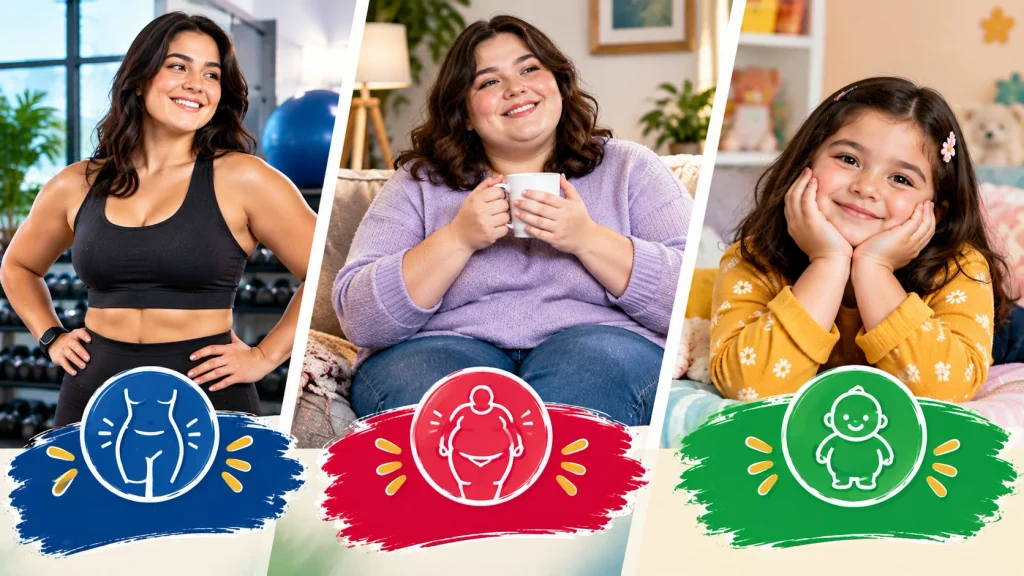
Thick vs. Fat vs. Chubby: The Quick Difference
“Thick,” “fat,” and “chubby” Words such as thick, fat, and chubby describe body size or shape, but they don’t communicate exactly the same thing. Each word carries its own meaning, tone, and social associations. Understanding these differences helps you choose accurate language without making unnecessary or hurtful comments about someone’s appearance.
Thick often describes a body with fuller proportions or noticeable curves. In modern informal English, it can also express admiration, especially when someone has a fuller lower body or a curvy figure. However, its meaning depends on context, and it can describe many things unrelated to body shape.
Chubby usually suggests softness, roundness, or a small amount of extra body fat. People commonly use it when describing a baby’s cheeks, a young child’s arms, or an adult with a rounded appearance. Although the word can sound affectionate, not everyone appreciates being called chubby.
Fat is a more direct term for having a larger body or more body fat. Some people hear it as an insult because it has often been used to shame people about their weight. Others use fat as a neutral description or an identity term without viewing it as inherently offensive.
The main distinction is that thick often emphasizes proportions, chubby emphasizes roundness or softness, and fat refers more broadly to body size or fatness. These are general tendencies, not strict definitions. People may use the same word differently depending on their experiences, culture, and personal preferences.
Definitions at a Glance
| Word | Common meaning | Typical connotation |
| Thick | A fuller figure or particular body proportions | Can be admiring, neutral, or critical |
| Chubby | A rounded, soft-looking body | Often affectionate, but sometimes patronizing |
| Fat | A larger body or greater amount of body fat | Direct; may be neutral or insulting depending on context |
| Curvy | A body with noticeable curves | Often positive or neutral, but subjective |
These descriptions overlap. A person might describe their body as thick and fat, while another person with a similar appearance might prefer curvy. The words don’t establish precise categories, and no single description automatically tells you how someone feels about their body.
The Main Difference in Plain English
Imagine three people discussing a character in a novel. One calls the character thick, another calls the character chubby, and a third calls the character fat. They may all be referring to the same person, but each description directs attention toward a slightly different feature.
Calling the character thick may suggest a fuller figure with particular proportions. Calling the character chubby may bring to mind rounded cheeks, a soft stomach, or a generally plump appearance. Calling the character fat communicates body size more directly without necessarily specifying where the body carries its fat.
Consider these examples:
- “She has a thick figure and wears clothes that highlight her curves.”
- “The baby has chubby cheeks and tiny, rounded arms.”
- “The character is a fat man who struggles to find clothes that fit comfortably.”
Each sentence uses a different descriptor for a different purpose. The first emphasizes shape, the second highlights softness and roundness, and the third describes overall body size.
Notice that the wording alone does not determine whether a sentence is respectful. A person can use thick to mock someone, chubby in a condescending way, or fat in a straightforward and respectful description. Likewise, any of these words may become hurtful when used to embarrass someone or reduce their identity to their appearance.
The most useful question is not simply which word sounds nicest. It is what feature are you trying to describe, and is describing that feature necessary?
Can These Words Describe the Same Person?
Yes. The words thick, fat, and chubby are not mutually exclusive categories. They focus on different aspects of appearance, and their meanings can overlap.
For example, an adult with a fuller figure, rounded cheeks, and a larger overall body might fit all three descriptions in ordinary conversation. One observer might focus on the person’s proportions and say thick. Another might notice their roundness and say chubby. Someone else might choose fat as a broader description of body size.
None of these choices automatically provides a complete or objective account of the person’s body. People have different builds, heights, muscle mass, fat distribution, and proportions. A single adjective cannot capture all those details.
The relationship between these words also changes with context. In a fashion discussion, thick might refer to a fuller silhouette. In a family conversation, chubby cheeks might be an affectionate description of a baby. In a discussion about body image, someone might deliberately use fat to describe themselves without treating the word as shameful.
Personal preference matters, too. Someone may enjoy being called thick but dislike being called chubby. Another person may comfortably use the word fat for themselves but object when a stranger uses it. You cannot reliably determine those preferences by looking at someone.
When precision matters, describe the specific feature rather than assuming one label covers everything. If you’re discussing clothing, you might mention fit, measurements, or silhouette. If you’re describing a fictional character, you can explain the person’s build without relying on a potentially loaded adjective.
Why the Words Are Not Exact Measurements
Although people often use body descriptors as if they represent clear categories, everyday English does not give thick, chubby, or fat fixed numerical boundaries.
There is no universal measurement that makes someone officially thick rather than chubby. The words do not have standardized cutoffs based on weight, waist size, body-fat percentage, or height. Their meanings depend on ordinary language, cultural expectations, and individual interpretation.
For instance, two people may have the same weight but look different because they have different heights, muscle mass, bone structures, or distributions of body fat. Even people with similar physical characteristics may describe themselves differently.
The word curvy illustrates this problem. Some speakers use it for a pronounced waist-to-hip difference, while others use it more broadly for a fuller body. Similarly, thick can refer to particular proportions in one conversation and a generally substantial build in another.
This flexibility is normal in descriptive language. Many everyday adjectives express impressions rather than measurable facts. Words such as tall, slim, and broad also depend partly on comparison and context, even though some aspects of those descriptions can be measured.
The distinction becomes important when body language is used to make assumptions about health, fitness, attractiveness, or personality. A body descriptor cannot establish whether someone is healthy, active, confident, or disciplined. Those conclusions require information that appearance alone cannot provide.
Use these words as ordinary language, not as scientific classifications. If you need an objective description for a medical, research, or clothing-related purpose, use the relevant measurements or professional terminology instead.
What Does “Thick” Mean?
The word thick has several meanings in English. It can describe something with a large distance between its opposite surfaces, such as a thick book or a thick blanket. It can also refer to dense hair, heavy traffic, or a substance that does not flow easily.
When applied to a person’s body, thick usually refers to a fuller build or particular body proportions. In contemporary informal English, especially in some social and popular-media contexts, it often describes someone with noticeable curves or a fuller lower body. It may be used admiringly, neutrally, or critically.
Unlike fat, which more directly refers to overall body size or fatness, thick often draws attention to how the body is shaped. However, that distinction is not absolute. Some speakers use thick as a general synonym for large or heavy, while others associate it specifically with curvy proportions.
The word’s meaning also depends on the sentence. “He has thick legs” describes a physical feature, while “That is a thick coat” refers to the garment’s material. The surrounding words usually make the intended meaning clear.
The Modern Meaning of Thick
In modern informal English, thick can describe a person whose body appears full, solid, or curvy. The term frequently appears in conversations about fashion, attractiveness, fitness, and personal style.
For example, someone might say, “She has a thick figure, so high-waisted trousers suit her preferred silhouette.” Here, the word points toward body proportions rather than providing an exact statement about weight.
In some contexts, thick is a compliment. A person might use it to express attraction to a fuller figure, particularly when referring to prominent hips, thighs, or a rounded lower body. Music, entertainment, and social media have helped make this informal usage familiar to many English speakers.
However, the term does not carry the same meaning for everyone. Some people use thick to celebrate their appearance, while others find it objectifying when strangers use it to comment on their bodies. A word intended as praise can still feel intrusive if the speaker ignores personal boundaries.
The adjective also has unrelated meanings. A thick accent may be strong or easily noticeable. Thick hair may be dense, and thick fog may make it difficult to see. These uses should not be confused with the body-related meaning.
When you use thick to describe a person, make sure the context supports the intended meaning. If you’re talking about clothing or body proportions, a more specific phrase may communicate your point more clearly. If you’re talking about someone’s attractiveness, remember that unsolicited comments about physical appearance may not be welcome.
Body Shape, Proportions, and Curves
When people use thick as a body descriptor, they often focus on proportions rather than overall size alone. The word may suggest fuller thighs, wider hips, a substantial lower body, or a generally solid build. In some contexts, it describes a body with visible curves.
For example, consider someone who has broad hips, full thighs, and a defined waist. A speaker might describe that person as thick because the word captures the overall impression of their proportions. The description does not establish the person’s weight or body-fat percentage.
Another person might have a similarly sized body but carry more of their weight around the middle. Some speakers might still call that person thick, while others might choose heavyset, larger-bodied, or another description. These differences show how subjective everyday body language can be.
The word also does not necessarily mean that a person is muscular. Someone with developed leg muscles might have thick thighs, while someone with more body fat might have thighs of a similar size. The adjective describes an appearance, not the physical composition responsible for it.
If you want to be more precise, name the feature that matters:
- Fuller hips: useful when discussing the shape of the hip area.
- Broad shoulders: appropriate when shoulder width is the relevant feature.
- Muscular legs: clearer when muscle development is what you mean.
- A fuller figure: a broader description of body shape.
- A curvy silhouette: useful in fashion or clothing discussions when curves are relevant.
These alternatives do not automatically eliminate the possibility of offense, but they can reduce ambiguity. More importantly, they help you avoid treating one informal adjective as a complete description of a person’s appearance.
Thick vs. Curvy: What Is the Difference?
Thick and curvy overlap, but they are not identical. Both can describe a fuller figure, yet curvy generally emphasizes the body’s contours, while thick may emphasize fullness, width, or a substantial build.
A person may be described as curvy because their waist, hips, and bust create a visibly curved silhouette. The term does not necessarily mean that the person has a large body. Someone can have noticeable curves at many different sizes.
Thick is often used more specifically in informal conversations about fuller thighs, hips, or a fuller lower body. However, some speakers use it broadly for people with larger builds. Others use the two words almost interchangeably.
Consider these examples:
- “The dress follows her curvy silhouette.” This focuses on the outline created by the garment and the person’s body.
- “The jeans are designed for people with thicker thighs.” This identifies a particular fit requirement.
- “She describes herself as thick and prefers clothes that fit comfortably around her hips.” This reflects a personal description and a practical clothing preference.
Neither word is a formal body classification. Clothing brands may also use curvy to describe a particular cut or sizing range, but those labels vary between brands and do not define a person’s entire body.
When choosing between the two words, consider the feature you want to convey. If the contours of a figure are important, curvy may be more precise. If you’re discussing fullness or a specific area of the body, thick may fit the context better.
Above all, do not assume that either word is automatically welcome as a personal comment. A description that works in a clothing review or in someone’s self-description may feel intrusive when directed at a stranger.
What Does “Chubby” Mean?

The word chubby describes someone or something that looks rounded, plump, or soft. When used for a person, it commonly refers to a body with noticeable roundness or some extra body fat. People often use it to describe a baby’s cheeks, a child’s arms, or an adult’s fuller face or body.
Unlike thick, which often emphasizes body proportions, chubby tends to bring softness and roundness to mind. Unlike fat, which is a more direct description of body size or fatness, chubby can sound gentler or more affectionate. However, that softer tone does not guarantee that everyone will find the word respectful.
For example, “The baby has chubby cheeks” is a familiar expression that often conveys affection. In contrast, telling an adult, “You’ve gotten chubby,” may sound judgmental, especially if the person did not invite a comment about their weight.
The meaning also depends on the speaker, the listener, and the situation. Some people use chubby comfortably to describe themselves. Others dislike it because they hear it as a polite-sounding way to criticize their body. As with other body descriptors, personal preference matters more than the speaker’s assumption that the word is harmless.
Definition and Common Connotations
In everyday English, chubby usually means slightly plump or rounded in appearance. It is an adjective, so it can modify a noun directly or follow a linking verb.
Consider these examples:
- “The toddler has chubby hands.”
- “His cheeks looked chubby in the old family photographs.”
- “The character was drawn with a round face and a chubby build.”
- “She jokingly described herself as chubby after noticing how tightly her old jacket fit.”
The first three sentences describe visible features or a general appearance. The fourth shows how a person might use the term about themselves in a casual conversation. Whether the wording feels appropriate still depends on the circumstances.
The word often carries an affectionate or informal tone, particularly when used for young children. However, it can also sound patronizing when applied to adults. A speaker may intend to be kind by choosing chubby instead of fat, but the listener may still interpret it as criticism.
It is also important not to treat chubby as an objective category. The word has no universal numerical definition. It does not specify a person’s weight, body-fat percentage, or health status. It simply expresses an impression of roundness or fullness.
If accuracy matters, describe the feature that you can actually observe. For instance, round cheeks is more specific than chubby when discussing someone’s face. If a body description is unnecessary, leaving it out may be the most considerate choice.
Softness, Roundness, and Body Fat
The idea of softness is central to many uses of chubby. The word often suggests rounded features or a fuller appearance rather than a particular body proportion. People might use it for round cheeks, a soft-looking stomach, or a generally plump build.
However, appearance alone cannot tell you exactly what makes a body look rounded. Body shape reflects several factors, including genetics, skeletal structure, muscle development, and fat distribution. The word chubby does not identify which factor is responsible.
For example, someone might describe a toddler as having chubby cheeks because the child’s face looks round. Another person might use the word for an adult with a rounded face and fuller arms. In both cases, the adjective communicates an impression rather than a precise measurement.
Compare these sentences:
- “The baby has chubby cheeks.” This focuses on the face.
- “The cartoon character has a chubby body.” This describes the character’s overall appearance.
- “The jacket makes his shoulders look rounder.” This describes a specific visual effect without labeling the person’s body.
The third example is often more useful when discussing clothing because it identifies what the garment does. Similarly, if you’re describing a photograph, you can mention rounded cheeks, a soft outline, or a fuller silhouette instead of relying on a broad label.
Remember that softness, roundness, and body fat are related ideas in some contexts, but they are not interchangeable measurements. A word like chubby cannot tell you how much body fat someone has or whether their body is healthy. Use it carefully, especially when the description concerns a real person rather than a fictional character or a feature relevant to the conversation.
Why Chubby Is Often Used for Babies and Children
People frequently use chubby when talking about babies and young children. Expressions such as “chubby cheeks,” “chubby little hands,” and “chubby legs” are common in affectionate family conversations. The word can suggest softness, roundness, and a child’s youthful appearance.
For example, a parent might say, “Look at his chubby cheeks in this picture!” The phrase may communicate fondness rather than an attempt to assess the child’s size. Similarly, a family member might describe a baby’s round hands as chubby without intending any criticism.
Still, context matters. A child’s body should not become the subject of repeated teasing or unwanted comparisons. Even words adults consider cute can affect how children learn to think and talk about their bodies, particularly when those descriptions are repeated or delivered critically.
There is also a difference between describing a feature and turning it into a judgment. “She has round cheeks” identifies an observable characteristic. “She’s getting too chubby” introduces an evaluation and may create unnecessary concern about appearance.
If you’re writing a family story, describing a fictional child, or sharing a warm memory, chubby cheeks may fit naturally. If you’re discussing a child’s development or health, however, an affectionate adjective is not a substitute for an appropriate professional assessment.
Can Adults Be Described as Chubby?
Yes. Although chubby is strongly associated with babies and children, English speakers also use it for adults. It may describe a round face, fuller arms, a soft-looking stomach, or a generally rounded body shape.
For instance, “The novel describes him as a chubby, cheerful shopkeeper” gives the reader a visual impression of a fictional character. In a different context, “I was a little chubby in college” might be a person’s casual description of their own past appearance.
The word can sound friendly when someone uses it about themselves or when it appears in a character description. However, it may feel dismissive or insulting when someone applies it to another adult without permission. Some people dislike the term because they associate it with childhood teasing or with attempts to make body criticism sound harmless.
Compare these examples:
- Self-description: “I was chubby as a teenager, but my appearance has changed over time.”
- Fictional description: “The story features a chubby baker with a round face and a warm smile.”
- Uninvited comment: “You look chubby in that outfit.”
The first two examples have clear contexts. The third may embarrass the listener, even if the speaker believes it is an innocent observation.
When describing an adult, consider whether body size is relevant. If you’re discussing a character’s appearance, a descriptive phrase may be useful. If you’re talking to a colleague, friend, or stranger, there is usually no need to comment on their body unless the situation genuinely calls for it.
What Does “Fat” Mean?
The word fat has several meanings in English. As a noun, it can refer to a natural substance found in food and living organisms. As an adjective describing a person, it commonly refers to a larger body or a body with a greater amount of fat.
The word is more direct than chubby and often broader than thick. It does not necessarily identify a particular shape or body proportion. However, its emotional impact varies considerably because it has been used both as a plain descriptor and as a tool for body shaming.
For many people, fat brings back experiences of bullying, criticism, or unfair treatment. They may therefore find it hurtful even when a speaker claims to mean no harm. Other people use fat as a neutral descriptive word or as a self-identification term, rejecting the idea that a larger body should automatically be viewed negatively.
Neither response is universal. One person’s comfort with the term does not give everyone permission to use it about them. Likewise, the fact that some people find it offensive does not mean every use of the word is necessarily an insult.
The Literal Meaning of Fat
In its literal sense, fat refers to an oily substance or a type of nutrient found in food and living organisms. For example, nutrition labels list the amount of fat in a serving of food, while biology uses the term to discuss fat tissue and its role in the body.
The word also functions as an adjective in everyday English. People might refer to a fat steak, a fat envelope, or a fat wallet. In these expressions, the meaning depends on the noun: the steak contains a substantial amount of fat, the envelope is thick or bulky, and the wallet may be full of money.
When applied to a person, fat generally refers to a larger body or greater body fat. This use is straightforward in meaning, but it can be socially sensitive because of the negative judgments often attached to body size.
Compare these sentences:
- “This recipe contains less fat than the original version.”
- “The envelope was too fat to fit through the slot.”
- “The character is described as a fat man with a broad face.”
The first sentence concerns nutrition, the second refers to thickness or bulk, and the third describes a person’s body. The same spelling therefore has different meanings depending on its grammatical role and context.
When discussing people, remember that a literal description can still have a social impact. If the word is not necessary, you can often communicate more effectively by focusing on the person’s clothing, actions, or relevant physical features rather than their overall body size.
Fat as a Body Descriptor
As a body descriptor, fat generally refers to a larger body or a noticeable amount of body fat. It is more direct than terms such as chubby, which often imply a softer or more rounded appearance. It does not, however, tell you exactly how a person’s body is shaped.
For example, “The fat character was tired of being judged by strangers” describes a fictional person’s body and connects that description to the way others treat them. Depending on the story, the word may be used neutrally, critically, or as part of a discussion about prejudice.
Some writers deliberately use fat instead of softer-sounding alternatives because they want direct language without suggesting that the body needs to be disguised by euphemisms. Others choose terms such as larger-bodied or plus-size, particularly in fashion, customer service, or contexts where a less personal label is more suitable.
No single alternative works in every situation. Plus-size is often used in clothing and fashion, but it can refer to sizing categories rather than a universal body type. Larger-bodied is more neutral in tone for some readers, though preferences vary. Overweight may be appropriate in specific clinical or technical contexts, but it can imply a comparison against a weight standard.
The best choice depends on the purpose of the description and the preferences of the person involved. If you’re writing about a fictional character, choose language that fits the character and the narrative. If you’re referring to a real person, consider whether body size needs to be mentioned at all.
Is Fat Always an Insult?
No. The word fat is not automatically an insult in every context, although it can be hurtful when used to mock, shame, or demean someone.
Consider the difference between these examples:
- “The story follows a fat protagonist who wants to become a successful artist.” This may be a neutral description of the character.
- “Stop calling him fat just to embarrass him.” Here, the word appears in a discussion about harassment.
- “I’m fat, and I don’t believe that makes me less worthy of respect.” This is an example of self-identification.
- “You’re fat, so you shouldn’t wear that.” This sentence uses body size to criticize and restrict someone.
The final example is hurtful not simply because it contains the word fat, but because it uses the person’s body to shame them and dictate what they should wear. The first three examples serve different purposes.
Some people prefer the directness of fat and use it without shame. Others prefer not to be described that way. Both preferences deserve respect. It is not appropriate to insist that someone accept a label because you believe it is neutral, nor is it necessary to treat every use of the word as hostile.
The surrounding language, relationship, and situation all matter. A term used in a person’s own description may not be welcome when spoken by a stranger. A word that appears in a research paper may carry a different tone from the same word shouted during an argument.
A useful rule is to avoid using body descriptors as weapons. If your purpose is to make someone feel embarrassed, the problem is the intent and behavior, not merely the choice of adjective.
Fat as a Neutral or Self-Identifying Term
Some people use fat as a neutral description of their bodies. Others use it as part of their identity or in conversations about body acceptance, discrimination, fashion, and representation. For these speakers, the word does not necessarily express shame or dissatisfaction.
For example, a person might write, “As a fat traveler, I look for seats and accommodations that meet my needs.” Here, the word identifies a personal experience relevant to the discussion. Another person might say, “I’m fat, and I deserve to find clothes that fit comfortably.” The wording is direct and does not present body size as a moral failure.
This use of the word is connected to efforts to challenge the idea that larger bodies should always be treated as embarrassing or unacceptable. Some people prefer fat because they believe that constantly replacing it with softer alternatives reinforces the notion that it is a word to be avoided.
However, self-identification does not establish a universal rule for everyone else. A person who uses fat about themselves may still dislike hearing it from other people. Another person may prefer plus-size, larger-bodied, or no body label at all.
When writing about body image or representation, it can be useful to follow the language that a person uses for themselves, provided it is relevant and appropriate to the discussion. When you do not know someone’s preference, avoid assuming that a label will be welcomed.
Respectful communication does not require pretending that body differences do not exist. It requires recognizing that people deserve dignity regardless of their size and that no adjective should be used to reduce someone to a single physical characteristic.
Thick vs. Curvy vs. Chubby vs. Fat
The words thick, curvy, chubby, and fat can all describe aspects of body shape or size, but they emphasize different features. Thick often focuses on fullness or body proportions, while curvy highlights the body’s contours. Chubby usually suggests roundness or softness, and fat is a more direct term for a larger body or greater body fat.
These distinctions are useful, but they are not strict categories. A person may fit more than one description, and different speakers may choose different words for the same appearance. Cultural expectations, personal preferences, and the situation all influence how people understand these terms.
For example, someone with fuller hips and thighs might describe themselves as thick. Another person with a similar figure might prefer curvy. A person with a round face might be called chubby, while someone else might use that word for their overall build. None of these choices establishes an objective classification.
The most appropriate term depends on what you actually mean. If you’re discussing clothing, the person’s silhouette or the fit of a garment may matter more than a general body label. If you’re describing a character in a story, you can choose a word that conveys the intended appearance without turning the description into a judgment.
Thick vs. Curvy
Thick and curvy are closely related in some contexts, but they do not always mean the same thing. Both can describe a fuller figure, yet curvy generally emphasizes the body’s contours, while thick often suggests fullness, width, or a substantial build.
A curvy person may have a noticeable difference between their waist and hips, a fuller bust, or a silhouette with pronounced curves. The term does not necessarily imply a larger overall body size. People of different sizes can have curvy figures.
The word thick may draw more attention to fuller thighs, hips, or a generally substantial body. In informal conversations, it can also be used as a compliment, especially when the speaker finds a fuller figure attractive. However, this meaning is not universal, and the word can have other interpretations.
Consider these examples:
- “The dress follows her curvy silhouette.” This focuses on the body’s outline and how the garment fits.
- “These trousers are designed for people with thicker thighs.” This highlights a particular clothing-fit consideration.
- “She describes herself as thick and prefers clothes that feel comfortable around her hips.” This uses the term as part of a person’s own description.
In fashion, curvy may also refer to clothing designed for a particular fit, such as garments with extra room around the hips or thighs. The precise meaning depends on the brand. It should not be treated as a universal body-size category.
Choose curvy when the body’s contours are the main point. Choose thick when you’re referring to fullness or proportions and the context makes the intended meaning clear. If neither word adds useful information, a more specific description may work better.
Thick vs. Chubby
The difference between thick and chubby is often a matter of emphasis. Thick frequently describes fullness or proportions, while chubby usually suggests roundness, softness, or a plump appearance.
For example, a person with fuller thighs and hips might be described as thick, particularly in conversations about clothing or body shape. Someone with rounded cheeks and a generally soft-looking appearance might be described as chubby. However, these are common tendencies rather than fixed rules.
Compare the following sentences:
- “The jeans are made to fit people with thicker thighs.” This emphasizes proportions and garment fit.
- “The cartoon character has chubby cheeks.” This focuses on roundness in the face.
- “He describes himself as thick, while his friend prefers the word chubby.” This illustrates how personal vocabulary can differ.
The terms can overlap. A person may have fuller proportions and rounded features, making either word plausible in everyday conversation. The choice may reflect the speaker’s perception more than any measurable physical difference.
Their emotional tone can also vary. Thick is sometimes used as a compliment in modern informal English, while chubby often sounds affectionate when describing babies and young children. Yet neither word is automatically positive. An unwanted comment can feel intrusive even when the speaker intends to praise someone’s appearance.
If you’re discussing a specific feature, describe it directly. Fuller thighs, round cheeks, or a fuller figure may be more informative than choosing between thick and chubby. When referring to another person, also consider whether the description is necessary and whether they are comfortable with it.
Thick vs. Fat
Thick often emphasizes body proportions or fullness, whereas fat more directly describes a larger body or greater body fat. This is a useful general distinction, although speakers do not always use the words in the same way.
In contemporary informal English, thick can suggest a fuller figure with noticeable hips, thighs, or other proportions. Some people use it as a positive self-description or compliment. Fat is broader and more direct, but it does not automatically indicate where someone carries body fat or how their body is shaped.
Consider these examples:
- “The trousers are designed for people with thick thighs.” This refers to a specific body feature and clothing fit.
- “The character is a fat man who struggles to find suitable clothing.” This describes the character’s overall body size.
- “She describes herself as thick and enjoys clothes that emphasize her curves.” This reflects personal preference.
The distinction is not absolute. Some speakers use thick as a general synonym for large or heavy, while others reserve it for particular proportions. Similarly, fat can be used neutrally, critically, or as a self-identifying term.
It is also important to separate description from judgment. Calling someone fat does not, by itself, establish anything about their character, habits, fitness, or health. Likewise, describing someone as thick does not automatically make the comment respectful. Tone, context, and the speaker’s behavior matter.
When you need to communicate clearly, identify the feature that matters. If you’re discussing body shape, fuller hips or a fuller figure may be more specific. If body size is irrelevant, leaving it out is often the better choice.
Chubby vs. Fat
Chubby generally suggests a rounded, soft-looking, or plump appearance. Fat is more direct and commonly refers to a larger body or greater body fat. Although people sometimes use the words interchangeably, they can create different impressions.
The word chubby often sounds gentler, particularly when used for babies and young children. For example, “The baby has chubby cheeks” is a familiar expression of affection. However, the same adjective may sound patronizing when directed at an adult who has not invited comments about their appearance.
The word fat can sound blunt because it has often been used to shame people. At the same time, some people use it neutrally or positively when describing themselves. It is therefore inaccurate to assume that chubby is always kind and fat is always insulting.
Compare these examples:
- “The toddler has chubby arms.” This describes a child’s rounded appearance and may express affection.
- “The character is a fat woman who runs her own business.” This gives a direct description of a fictional character.
- “You’ve gotten chubby lately.” This unsolicited comment may sound judgmental.
- “I’m fat, and I want clothes that fit me comfortably.” This is a person’s own description and a practical statement about clothing.
The final two examples show why context matters. The first makes a potentially unwelcome observation about another person, while the second uses the term for self-identification without insulting anyone.
Neither word provides a precise measurement. You cannot reliably determine a person’s health, body composition, or personal preferences from the adjective someone chooses. If you are writing a character description, select the word that fits the intended meaning. If you’re speaking to a real person, respect their preferred language and avoid unnecessary body comments.
Where the Meanings Overlap
The meanings of thick, curvy, chubby, and fat overlap because each word describes an aspect of appearance rather than a clearly defined body category. A single person may have fuller proportions, visible curves, rounded features, and a larger overall body. Different observers may focus on different characteristics.
Imagine a fictional character who has broad hips, full thighs, rounded cheeks, and a soft-looking stomach. One writer might call the character thick to emphasize body proportions. Another might describe the character as curvy, while a third might use chubby to highlight roundness. A writer who wants to describe overall body size might choose fat.
These descriptions are not necessarily contradictory. They simply direct the reader’s attention toward different aspects of the same character.
The overlap becomes more noticeable when people use these words as expressions of personal identity or attraction. Someone might proudly describe themselves as thick, while another person with a similar build prefers fat or curvy. These choices may reflect personal experience, community language, or a desire to challenge negative stereotypes.
There is no universal test that determines which label is objectively correct. Everyday descriptions depend on the speaker’s meaning and the listener’s understanding. If a particular distinction matters, explain it rather than expecting the reader to infer it from a single adjective.
For example, instead of writing, “She was thick,” you might write, “She had fuller thighs and broad hips.” Instead of saying, “He looked chubby,” you could describe his round face or the way his clothes fit. Specific details can create a clearer picture while reducing ambiguity.
The important point is that body descriptors are flexible words, not official measurements or judgments of a person’s worth. Use them to communicate relevant information, not to assign someone a social value based on appearance.
How the Meanings and Connotations Have Changed

The meanings and social associations of body descriptors develop over time. A word may be used affectionately in one period, criticized in another, or reclaimed by people who want to challenge negative assumptions. Changes in fashion, popular culture, social media, and public conversations about body image can all influence how people interpret these terms.
Thick has gained wider visibility in some contemporary informal contexts, where it may celebrate a fuller figure rather than criticize it. Chubby continues to appear in affectionate descriptions, especially of children, but some adults dislike the word because they associate it with teasing or judgment. Fat remains especially sensitive because it has long been used as an insult, even as some people now use it as a neutral descriptor or identity term.
These developments do not affect every English speaker in the same way. Age, region, cultural background, community, and personal experience can all shape a person’s response. A word that feels positive in one social group may feel uncomfortable or disrespectful in another.
How the Meaning of Thick Has Evolved
The adjective thick has long had several meanings, including dense, wide, substantial, or closely packed. Its use as a body descriptor builds on the general idea of fullness or size. In contemporary informal English, it is also associated with fuller figures and particular body proportions.
Popular music, entertainment, fashion, and social media have helped increase the visibility of this body-related meaning. In some contexts, thick is used admiringly, particularly when referring to fuller hips and thighs. It may communicate attraction or appreciation rather than simply describing body size.
For example, a fashion post might say, “These jeans are designed for a thick figure.” The phrase may refer to fuller proportions and the fit of the garment. In a personal conversation, someone might say, “I describe myself as thick because I like my natural shape.” Here, the word functions as self-description.
However, the positive association is not universal. Some people dislike being labeled thick, especially when the term is used in a sexualized way or by someone they do not know. Others may interpret it as a general description of size rather than a compliment.
The modern meaning therefore depends on context. It is useful to recognize the word’s informal associations without assuming that everyone shares them. If you’re discussing a person’s body, their own preferred description is more reliable than a general assumption about what thick means.
How People Use Chubby Today
The word chubby remains common in everyday English, especially when describing round cheeks, plump features, or the appearance of babies and young children. Its familiar use in affectionate expressions has helped preserve its softer tone in many contexts.
For example, a family member might look at an old photograph and say, “You had such chubby cheeks as a toddler.” The statement may be intended as a warm memory rather than a judgment. Likewise, a children’s book might describe a chubby puppy or a round-faced character to help readers imagine the subject.
When used for adults, however, chubby can be more complicated. Some people find it friendly or humorous, while others hear it as a polite way of saying that they are overweight. The word can also feel infantilizing when an adult’s body is described with language commonly associated with children.
Social attitudes toward body image have encouraged more discussion about these differences. People increasingly recognize that a supposedly gentle adjective can still be unwelcome when it draws attention to an aspect of someone’s appearance they did not choose to discuss.
If you use chubby in writing, consider the purpose of the description. It may suit a fictional character, an affectionate family memory, or someone’s self-description. When speaking about an adult, avoid assuming that the term will be received positively simply because it sounds softer than fat.
How Fat Became Both a Descriptor and an Identity Term
The word fat has a long history as a direct description of body size, but its social meaning has also been shaped by prejudice and body shaming. In many settings, it has been used to mock people or suggest that a larger body reflects personal failure. These associations explain why the word can feel painful even when a speaker claims to be describing appearance alone.
At the same time, some people and communities have chosen to use fat openly as a neutral descriptor or identity term. They may reject euphemisms because they do not want their bodies treated as something that must be hidden behind softer language. Others use the word in discussions about discrimination, accessibility, fashion, and representation.
For example, a writer might say, “The novel features a fat protagonist whose story focuses on friendship and ambition.” This description identifies the character’s body without making size the character’s defining personality trait. A person might also write, “I’m fat, and I deserve to be treated with respect.” In that sentence, the word supports a statement about dignity rather than shame.
However, reclaiming a word does not mean everyone must feel comfortable with it. Some people still prefer larger-bodied, plus-size, or another term. Others may not want any body label used about them at all.
The most respectful approach is to understand the word’s history without assuming that it has one fixed emotional meaning. Use the language that fits the context, listen when people express their preferences, and never use body size as a reason to demean someone.
How Culture and Beauty Standards Influence Body Descriptions
The way people understand thick, fat, and chubby is influenced by more than dictionary definitions. Culture, beauty standards, family attitudes, entertainment, and social media can all affect whether a body descriptor sounds attractive, neutral, affectionate, or insulting.
In one community, a fuller figure may be celebrated as a sign of beauty. In another, people may face pressure to maintain a slimmer appearance. Even within the same community, opinions can differ by generation, personal experience, and social setting.
These influences help explain why the same word can produce different reactions. Someone might use thick as a compliment because they associate it with curves and confidence. Another person might dislike the term because it makes them feel that others are evaluating their body. Likewise, chubby may sound affectionate to one listener but patronizing to another.
Understanding these differences helps you use body language more thoughtfully. Instead of assuming that a word has one universal emotional meaning, consider the speaker’s purpose, the listener’s preferences, and whether the description is necessary.
Body Ideals Differ Across Cultures
Different cultures and communities have different ideas about attractiveness, body shape, and physical appearance. Some celebrate fuller figures, while others place greater emphasis on thinness, muscularity, or particular proportions. These ideals can also coexist within the same society.
As a result, the words thick, curvy, chubby, and fat may carry different associations depending on the people using them. A term that expresses admiration in one social group may sound inappropriate in another. There is no single cultural interpretation that applies to everyone.
Family attitudes can also influence how people understand body descriptions. Someone who grew up hearing chubby cheeks as an affectionate expression may associate the word with warmth. Another person who experienced teasing about their weight may find the same adjective uncomfortable.
Language also changes across generations. Younger speakers may encounter thick through music, online conversations, and fashion trends, while older speakers may be more familiar with other meanings of the word. These differences do not mean one group understands English correctly and another does not. They reflect different experiences with language.
When communicating across cultural or generational boundaries, avoid assuming that your preferred word will have the same meaning for everyone. Listen to how people describe themselves, and use more specific language when clarity matters.
Beauty Standards Change Over Time
Beauty standards are not fixed. The body shapes praised in advertisements, films, magazines, and popular culture can change over time. A look celebrated in one period may receive less attention in another, while previously overlooked styles may become fashionable.
These shifts influence the way people use descriptive words. A term such as thick may become more prominent in conversations about attractiveness when fuller curves receive greater visibility. Meanwhile, chubby may remain common in affectionate descriptions but sound less appealing when people associate it with childhood teasing or unwanted comments about weight.
However, a change in popular beauty standards does not mean everyone shares the same preferences. Fashion trends may affect public conversation, but individual tastes remain diverse. People also deserve respect regardless of whether their appearance matches a popular ideal.
The problem arises when a trend turns into a standard that people feel pressured to meet. Praising one body type does not require criticizing another. Describing someone as thick, curvy, slim, or fat should not become a way to rank their worth.
A more balanced approach recognizes that physical appearance varies naturally. You can appreciate a particular style or silhouette without implying that everyone should look the same.
The Influence of Fashion and Entertainment
Fashion and entertainment help shape the language people use to describe bodies. Clothing advertisements, films, television programs, music videos, and celebrity interviews often present particular body types as fashionable or desirable. Their language can then spread into everyday conversation.
For example, a clothing brand might use curvy to describe garments designed for fuller hips. Another retailer might use plus-size to identify a range of clothing sizes. In informal discussions, people may use thick to describe a fuller figure they admire.
These terms do not always have the same purpose. A fashion label may focus on garment construction and fit, while a social media comment may express attraction. A fictional character description may help readers picture someone’s appearance. Understanding the purpose helps you interpret the word more accurately.
Entertainment can also reinforce stereotypes. A story that repeatedly portrays fat characters as lazy, comic, or unsuccessful may encourage unfair assumptions about real people. Similarly, a character described as thick should not automatically be reduced to their attractiveness or body shape.
When writing about people, give them characteristics beyond their appearance. A character can be fat, thick, chubby, or curvy while also being intelligent, funny, ambitious, thoughtful, or complicated. Body size does not determine personality.
Social Media and Body Trends
Social media has made body-related language more visible and more widely shared. Users post photographs, fashion advice, fitness content, personal stories, and discussions about body image. As these conversations spread, words such as thick, curvy, chubby, and fat can take on new associations.
Some online communities use thick as a compliment or a form of self-description. Others use fat in discussions about body acceptance, discrimination, and representation. People may also use chubby playfully when talking about themselves or describing fictional characters.
However, online trends can oversimplify complicated ideas. A word that receives positive reactions in one post may not be welcome in a private conversation. Public approval does not tell you how an individual feels about being described in the same way.
Social media also encourages quick judgments based on photographs. A single image cannot reveal a person’s health, personality, lifestyle, or preferred terminology. Filters, camera angles, clothing, and posing can also change how a body appears.
When commenting online, focus on what is relevant to the post. If someone shares an outfit, you can comment on the color, design, or fit without evaluating their body. If they openly discuss their body and invite conversation, follow their lead rather than assuming every personal detail is open for judgment.
Tone, Context, and Intent: Why the Same Word Can Feel Different
A body descriptor does not communicate meaning through its dictionary definition alone. Tone, context, relationship, and intent all affect how a person understands it. The same word can appear in a neutral description, a genuine compliment, an awkward joke, or a deliberate insult.
For example, someone might say, “She describes herself as fat and feels confident in her style.” The word functions as a description. In another situation, a person might shout fat at someone during an argument to embarrass them. The same word now serves a hostile purpose.
The difference is not limited to fat. Thick can be used admiringly or in a way that objectifies someone. Chubby can express affection or sound patronizing. Even a word that seems positive can become uncomfortable when it is used to comment on a person’s body without invitation.
Description vs. Judgment
A description communicates information about an observable feature. A judgment adds an evaluation, often suggesting that a person is better, worse, more attractive, or less worthy because of that feature.
Compare these sentences:
- “The character has a fuller figure.” This describes the character’s appearance.
- “The character is fat, so nobody will take her seriously.” This connects body size with an unfair judgment about how others should treat her.
- “He has thick thighs, so the trousers fit differently.” This identifies a feature relevant to clothing.
- “She is chubby and should stop wearing fitted clothes.” This uses a body descriptor to criticize and restrict someone’s choices.
The distinction depends on the entire statement, not merely the adjective. A neutral term can be used judgmentally, and a direct term can appear in a respectful description.
When writing, ask whether your words communicate information the reader needs. If you’re describing a character’s appearance, one or two relevant details may help. If the person’s body has no bearing on the topic, including a label may distract from the point or invite unnecessary judgment.
Avoid linking body size to character traits, intelligence, discipline, attractiveness, or professional ability. Such assumptions are not established by a person’s appearance.
How Tone Changes the Meaning
Tone can transform an ordinary statement into a compliment, a joke, or an insult. A warm, familiar tone may make a phrase feel affectionate, while sarcasm or contempt can make the same words hurtful.
Imagine a friend describing their own appearance by saying, “I’m feeling thick today, and I love how this outfit fits.” The word expresses confidence in that person’s self-description. Now imagine a stranger saying, “Look at how thick you are,” while laughing at someone’s body. The wording and behavior suggest mockery rather than appreciation.
Similarly, chubby may sound tender when a parent talks about a baby’s cheeks. An adult may interpret the same word differently when a coworker comments on their weight during a meeting.
Tone is not only about the sound of someone’s voice. Facial expressions, timing, body language, the relationship between speakers, and the setting can all influence interpretation. A remark made privately may feel different from the same remark delivered in front of a group.
Still, tone cannot guarantee that a comment will be welcomed. A person may sincerely intend to compliment someone and still make them uncomfortable. If a comment concerns a sensitive feature, consider whether it needs to be said at all.
Why Self-Description Can Differ From Describing Someone Else
People generally have more freedom to choose how they describe their own bodies than other people have to label them. Self-description can reflect personal identity, lived experience, humor, or an effort to challenge negative attitudes.
For example, a person might say, “I’m fat, and I want the story to show my character as a complete person rather than a stereotype.” Another person might describe themselves as thick because they appreciate their proportions. Someone else may prefer not to use any body-related label.
These choices do not create a universal rule for everyone else. A person who uses fat about themselves may not welcome the word from a stranger. Someone who describes themselves as chubby may find it uncomfortable when another person repeats the label without permission.
The same principle applies to compliments. If someone calls themselves thick, that does not automatically mean they want others to comment on their body. Sharing a personal description is not the same as inviting every possible observation.
When you are unsure, use the person’s own terminology only when it is relevant and appropriate. If the conversation does not require a body description, you can avoid labeling them altogether.
Respectful communication means allowing people some control over how they talk about themselves. It also means recognizing that their preferences may differ from yours.
Compliments, Observations, Teasing, and Insults
Body-related language can serve several purposes, and the distinction is important when choosing a word.
A compliment expresses appreciation. An observation provides information. Teasing may be intended as playful, but it depends on the relationship and the listener’s comfort. An insult aims to hurt, humiliate, or diminish someone.
Consider these examples:
- Compliment: “That outfit looks great on you.” This praises the outfit without evaluating body size.
- Observation: “The jacket has a close fit around the hips.” This describes clothing.
- Possible teasing: “You have such chubby cheeks in this picture.” The comment may be affectionate between close friends, but the listener’s response matters.
- Insult: “You’re fat, and you look terrible in that.” This uses body size to demean someone.
The same adjective can appear in more than one category. Calling someone thick might be a welcome compliment in a particular relationship, while the same comment from an unfamiliar person might feel intrusive.
Teasing deserves special care because people sometimes excuse hurtful comments by saying they were only joking. A joke is not automatically harmless because the speaker intended it to be funny. If the listener feels embarrassed or asks the speaker to stop, continuing the joke can turn a misunderstanding into disrespect.
Choose language based on the situation, not simply on whether you believe the word is acceptable. A respectful comment does not require an evaluation of someone’s body.
Why Intent Does Not Always Determine Impact
People often focus on what they meant when making a comment. However, the effect on the listener may differ from the speaker’s intention.
For example, someone might call a friend chubby because they believe the word sounds cute. The friend may hear it as criticism because they have experienced years of unwanted comments about their weight. Both people may understand the word differently, but the listener’s discomfort still deserves consideration.
Likewise, a person might call someone thick as a compliment, unaware that the term makes them feel objectified. Explaining the intended meaning can clarify the misunderstanding, but it does not require the listener to accept the description.
A useful response is to listen rather than argue about the word’s supposed harmlessness. You can say, “I didn’t mean to upset you. I won’t describe you that way again.” This acknowledges the impact and changes the behavior without insisting that the other person should feel differently.
The lesson is simple: good intentions matter, but they do not erase the effect of unwanted comments. You cannot control every interpretation, yet you can pay attention, apologize when appropriate, and avoid repeating language someone has asked you not to use.
How These Words Are Used Online
Online conversations often use body descriptors in ways that differ from face-to-face discussions. Social media posts, dating profiles, captions, memes, and comment sections encourage short expressions, humor, and quick judgments. Without facial expressions or vocal tone, readers may struggle to tell whether a remark is friendly, sarcastic, or hostile.
The words thick, chubby, and fat may appear in body-positive discussions, personal introductions, fashion advice, jokes, or insults. Their meaning depends on the context and how the person being described feels about the language.
Body-Positive Language on Social Media
Body-positive content often challenges the idea that only one body type deserves respect or representation. People may use words such as fat, thick, and curvy to describe themselves openly, share their experiences, or question stereotypes about larger bodies.
For example, someone might post, “I’m fat, and I’m learning to enjoy clothes that express my personal style.” Another person might write, “I love how this outfit fits my thick thighs.” These statements use body-related language to discuss personal experience rather than shame.
However, body-positive language does not mean every person must feel comfortable with every descriptor. One person’s preferred label should not be imposed on someone else. Likewise, a compliment about body shape can still feel intrusive if it is unsolicited or overly personal.
When commenting on a body-positive post, respond to the point the person is making. You might appreciate their outfit, relate to their experience, or discuss the clothing options they recommend. Avoid assuming that their openness gives you permission to make personal remarks about their weight or shape.
Dating Profiles and Personal Preferences
Dating profiles sometimes use words such as thick, curvy, chubby, and fat to describe a person’s body or communicate physical preferences. Someone may identify themselves with one of these words, while another person may use the terms to describe the appearance they find attractive.
For example, a profile might say, “I’m curvy and enjoy hiking, cooking, and live music.” Another might say, “I prefer a fuller figure.” Both examples communicate something about appearance without suggesting that body size determines personality.
Problems arise when preferences become insulting generalizations. Statements that mock certain body types or describe people as less worthy because of their size can create a hostile impression. Physical attraction is personal, but expressing a preference does not require humiliating people who do not match it.
It is also helpful to distinguish between self-description and labeling someone else. If a person identifies as fat or thick in their own profile, you should not assume that they want strangers to comment on every aspect of their body.
Clear, respectful language helps people communicate preferences without reducing one another to physical features. A dating profile can express attraction while still treating people with dignity.
Comments, Captions, and Memes
Social media captions and memes often use short phrases that depend on humor, exaggeration, or shared cultural references. Body descriptors may appear in jokes about clothing, food, photographs, celebrity appearances, or personal experiences.
A person might jokingly describe their own cheeks as chubby in a childhood photograph. Someone else might use thick in a fashion caption to celebrate how an outfit fits. These uses can be playful when the person posting the content is comfortable with the description.
However, humor can become body shaming when it targets another person without consent. A meme that repeatedly portrays fat people as lazy, unintelligent, or unattractive may reinforce harmful stereotypes even when the creator claims it is only a joke.
Before sharing a body-related joke, consider who the joke targets and what it implies. Is the humor about a situation, or does it depend on making a person’s body the reason they deserve ridicule? Would the content still be funny without humiliating someone?
If you’re writing a caption for your own photograph, you can choose whichever self-description feels right to you. When posting about another person, avoid assigning them a body label merely to create a punchline.
Why Written Comments Can Be Misunderstood
Written communication lacks many of the signals that help people interpret spoken language. A face-to-face comment may include a friendly expression, a familiar tone, or an immediate opportunity to clarify. A short online message may provide none of these cues.
For example, “You look thick!” could be intended as a compliment, but a reader may interpret it as an unwanted judgment. “You’re getting chubby” may be intended as friendly teasing, yet it can sound critical when read without context.
Emojis, punctuation, and informal phrasing sometimes help communicate tone, but they cannot guarantee that a message will be understood as intended. A laughing emoji does not automatically make a body-related remark harmless.
If your wording could be misunderstood, make the purpose clearer or choose a different compliment. Instead of commenting on someone’s body size, you might say, “That outfit looks fantastic,” or “I love the colors you chose.” These alternatives express appreciation without making body size the focus.
When someone tells you that a comment was hurtful, avoid assuming that they misunderstood simply because you meant well. Ask yourself whether the wording was necessary and how you can communicate more thoughtfully next time.
Which Word Should You Use?
Choosing between thick, chubby, and fat depends on the feature you want to describe, the reason for mentioning it, and the preferences of the person involved. No word is automatically the best choice in every situation.
Use thick when the context clearly concerns fullness or body proportions. Use chubby when you mean a rounded or soft-looking appearance and the term fits the situation. Use fat when a direct description is appropriate and relevant, without treating body size as a personal failing.
Sometimes, a more specific description communicates the intended meaning more clearly. In other situations, the best choice is not to describe the person’s body at all.
When Thick May Be Appropriate
Thick may be suitable in informal conversations about body proportions, clothing fit, personal style, or a person’s own body description. It is also common in some social and cultural contexts as a positive term for a fuller figure.
For example, “These jeans provide more room for thicker thighs” is useful in a clothing discussion. “I describe myself as thick because I have fuller hips and thighs” is a personal description. In both cases, the word has a clear purpose.
However, thick is informal and can carry different associations. It may sound complimentary in one situation and objectifying in another. Avoid assuming that everyone likes the term simply because it is sometimes used positively.
If precision matters, specify the relevant feature. Phrases such as fuller hips, broad shoulders, or muscular thighs may be clearer, depending on what you mean.
When Chubby May Be Appropriate
Chubby is commonly used for rounded features, soft-looking bodies, and affectionate descriptions of babies or young children. It may also appear in fictional character descriptions or in someone’s own account of their appearance.
For example, “The baby has chubby cheeks” is a familiar expression. “The illustrated puppy has a chubby body” describes a fictional animal’s appearance. Neither example requires a judgment about a person’s worth.
When referring to adults, take extra care. Some people dislike chubby because they associate it with teasing or language that makes adults sound childlike. The fact that a word sounds gentle to you does not mean it will feel gentle to everyone.
If the specific feature matters, consider alternatives such as round cheeks, a rounded face, or a fuller figure. These expressions may communicate the same visual detail more clearly.
When Fat May Be Appropriate
Fat may be appropriate when a direct body descriptor is relevant to the discussion, especially in writing about self-identification, body image, representation, or discrimination. Some people prefer the term because it is straightforward and does not attempt to hide body size behind a euphemism.
For example, “The novel features a fat protagonist whose story explores friendship and ambition” can describe a character without reducing their identity to appearance. A person might also use fat to describe themselves in a discussion about clothing accessibility or personal experience.
Nevertheless, the word has a history of being used to shame people. Avoid using it to insult, threaten, embarrass, or make assumptions about someone’s habits or health. If you’re referring to a real person, follow their stated preference when possible.
In settings where a specific measurement or clinical assessment matters, use the appropriate terminology rather than relying on an everyday adjective.
When a More Specific Description Is Better
A specific description is often more useful than a broad body label. It tells the reader exactly what matters without requiring them to interpret a word that may have several meanings.
For example:
- For clothing: “The trousers have extra room around the hips.”
- For a photograph: “He has a round face and broad shoulders.”
- For a character: “She has a fuller figure and wears loose-fitting jackets.”
- For fitness-related writing: Describe the relevant movement, strength, or physical measurement rather than assuming what a body type implies.
These phrases are not automatically free of sensitivity, but they are often clearer because they focus on the actual feature or practical concern.
Specific wording is particularly helpful in professional writing, product descriptions, and instructions. If a clothing fit depends on waist or hip measurements, explain those measurements rather than relying on labels such as thick or curvy.
When You Should Avoid Commenting on Someone’s Body
Often, you do not need to describe someone’s body at all. If body size has no bearing on the conversation, leaving it out can make your language more respectful and keep attention on the relevant subject.
For instance, if a coworker presents an excellent project, praise the quality of their work rather than commenting on whether they look thinner or thicker. If a friend shares a photograph from a holiday, you can mention the scenery, their outfit, or the enjoyable experience instead of evaluating their weight.
Body comments may be especially unwelcome when they concern recent weight changes, eating habits, clothing size, or a person’s attractiveness. You may not know the circumstances behind someone’s appearance, and a remark that seems harmless to you can create discomfort.
If a body description is genuinely necessary, keep it relevant and factual. If the person has expressed a preference about terminology, respect it. If you are uncertain, focus on the subject rather than making an unsolicited observation.
How to Describe Body Types Respectfully
Respectful body language is not about memorizing a list of forbidden words. It is about communicating accurately, avoiding unfair assumptions, and recognizing that people have different preferences about how their bodies are described.
The words thick, chubby, and fat can all appear in respectful writing, depending on the context. They can also become hurtful when used to shame, stereotype, or objectify someone. What matters is how the words function in the sentence and whether the description serves a legitimate purpose.
Describe the Feature You Actually Mean
Start by identifying the physical feature that matters. If you mean someone’s hips are fuller, say that. If you mean a character has a round face, describe the face. If you’re discussing clothing, explain where the garment fits tightly or loosely.
Specific wording reduces ambiguity. It also helps prevent a broad body label from carrying meanings you did not intend.
For example, “The jacket fits closely around her hips” communicates a clothing detail. “She is thick” offers a less specific impression and may be interpreted in different ways.
Avoid Turning Body Size Into a Character Judgment
Body size does not establish a person’s intelligence, kindness, discipline, ambition, or professional ability. Avoid language that connects fat, chubby, or thick with assumptions about someone’s character.
Instead of describing a fat character as lazy by default, give the character individual motivations, habits, strengths, and weaknesses. If a story includes prejudice against a character because of body size, make sure the narrative does not automatically endorse that prejudice.
Do Not Assume Health From Appearance
A body descriptor is not a medical diagnosis. You cannot determine someone’s overall health, fitness, or medical needs from an adjective or a photograph alone.
If you’re writing about health, rely on relevant measurements, clinical assessments, and qualified professional guidance. Do not use words such as thick, chubby, or fat as substitutes for medical information.
Respect How People Describe Their Own Bodies
People may choose different words for themselves. One person may identify as fat, another may prefer curvy, and someone else may avoid body labels altogether.
When a person tells you how they prefer to be described, respect that choice. Do not insist that they adopt a different term because you consider it more polite, positive, or accurate.
Ask Whether a Body Description Is Necessary
Before mentioning someone’s body, consider why the detail matters. If the purpose is to explain clothing fit, identify a character, or discuss a relevant personal experience, a description may be useful. If the purpose is simply to judge someone’s appearance, it may be better left unsaid.
Medical Language vs. Everyday Body Descriptions
Everyday words and medical terminology serve different purposes. Thick, chubby, and fat are ordinary descriptive terms whose meanings depend on context. They do not provide standardized information about a person’s body composition or health.
Medical professionals may consider several factors when assessing health, including relevant medical history, physical measurements, symptoms, and laboratory results. An everyday adjective cannot replace that information.
Why Body Descriptors Are Not Medical Diagnoses
Calling someone thick, chubby, or fat does not establish a medical condition. These words have no universal clinical cutoffs, and people use them inconsistently.
For example, two people described as fat may differ considerably in height, muscle mass, fat distribution, and medical circumstances. A person described as thick may have a fuller build, more developed muscles, more body fat, or a combination of factors. The adjective alone does not tell you which explanation applies.
Avoid using body labels to diagnose someone or predict their medical needs. When health is the subject, use appropriate clinical language and evidence.
BMI Is Not a Description of Body Shape
Body mass index, or BMI, is a screening measure calculated using a person’s weight and height. It is sometimes used in health assessments, but it does not directly describe body proportions or distinguish fat mass from muscle mass.
As a result, BMI cannot tell you whether a person is thick, curvy, or chubby in the everyday sense. Those words refer to impressions of appearance rather than a standardized mathematical category.
BMI also has limitations and should not be treated as a complete assessment of an individual’s health. Medical interpretation may require additional information and professional judgment.
Why Appearance Alone Cannot Determine Health
A person’s appearance does not reveal everything about their health. A photograph or casual observation cannot establish their blood pressure, medical history, physical capacity, nutritional status, or other relevant factors.
Similarly, someone cannot reliably infer a person’s habits or lifestyle from the fact that they look thick, chubby, or fat. Such assumptions risk replacing evidence with stereotypes.
When discussing health, focus on relevant information rather than judging people by their bodies. If a medical concern exists, it should be assessed using appropriate evidence and professional advice.
Common Myths About Thick, Chubby, and Fat
Body-related words are often misunderstood because people assume they have fixed meanings or universal emotional associations. In reality, their meanings depend on context, personal experience, and the purpose of the description.
Myth: Chubby and Fat Mean Exactly the Same Thing
Reality: The words overlap, but they do not always communicate the same impression. Chubby often suggests roundness or softness, while fat is a more direct term for a larger body or greater body fat. Neither word has a precise universal measurement.
Myth: Fat Is Always an Insult
Reality: Fat can be used as an insult, but some people also use it neutrally or as a self-identifying term. The surrounding language, purpose, and relationship between speakers help determine its effect.
Myth: Thick Always Means Curvy
Reality: Thick often refers to fuller proportions, but its meaning varies. Some people use it for a curvy figure, while others use it more broadly for a substantial build. The word is not an exact body classification.
Myth: Chubby Is Only Used for Children
Reality: Although chubby is common in descriptions of babies and children, English speakers also use it for adults. However, some adults find the term patronizing or unwelcome, so context matters.
Myth: Everyone Interprets These Words the Same Way
Reality: People have different cultural backgrounds, personal experiences, and preferences. A word that sounds affectionate to one person may feel insulting or intrusive to another.
Myth: A Person’s Body Type Tells You Their Health
Reality: Body descriptors do not establish someone’s health, fitness, or medical condition. Health assessment requires relevant evidence and, when appropriate, professional evaluation.
Real-World Examples of Word Choice
Examples help show how the same body-related term can function differently depending on the situation. The following scenarios illustrate how to describe appearance accurately without turning body size into a judgment.
Case Study: A Fashion Description
Imagine a clothing retailer writing a product description for jeans designed to accommodate fuller hips and thighs. The retailer could simply call the jeans suitable for thick women, but that wording may be vague because people interpret thick differently.
A more informative description would explain the garment’s cut, stretch, waist design, and available measurements. For example: “These jeans feature a contoured waistband and extra room through the hips and thighs.”
The revised description focuses on the product’s actual features. It helps customers understand the fit without assuming that every person who identifies as thick has the same proportions.
Case Study: A Parent Describing a Baby
A parent might say, “My baby has the cutest chubby cheeks.” In a warm family conversation, chubby may communicate affection and describe a visible feature.
However, a comment such as “This baby is getting too fat” carries a different implication. It introduces a judgment and may sound like a health assessment without any supporting information.
If the parent has a genuine concern about a child’s growth, the appropriate approach is to discuss it with a qualified healthcare professional rather than rely on casual labels.
Case Study: A Person Describing Their Own Body
Suppose someone says, “I’m fat, and I want to find clothes that make me feel comfortable.” Another person might describe themselves as thick or curvy when explaining their preferred style.
These are personal descriptions. The most respectful response is to follow the person’s lead rather than argue about which word they should use.
If the conversation concerns clothing, offer practical help with sizing, fabric, or fit. Avoid turning the person’s self-description into an invitation to evaluate their appearance.
Case Study: Responding to an Unwanted Body Comment
Imagine someone says, “You’ve gotten chubby,” and the listener feels uncomfortable. The speaker may claim it was meant as a compliment or an innocent observation.
A respectful response might be, “I prefer not to discuss my weight.” The speaker can then acknowledge the boundary and move on without demanding an explanation.
This example demonstrates that people can set limits on body-related conversation. Respect does not depend on proving that a word is universally offensive; it includes recognizing when an individual does not want to be described that way.
Thick vs. Chubby vs. Fat: Quick Reference
| Term | Main emphasis | Common context | Important caution |
| Thick | Fullness or body proportions | Informal conversation, fashion, self-description | Can be interpreted differently across communities |
| Curvy | Noticeable body contours | Fashion and general description | Does not necessarily indicate overall body size |
| Chubby | Roundness or softness | Children’s descriptions, informal conversation | May sound patronizing when used for adults |
| Fat | Larger body or greater body fat | Direct description, self-identification, discussions of body image | Can be hurtful when used to shame someone |
These are general patterns, not strict rules. A person may use several of these terms for themselves, or they may prefer none of them. The best word depends on the feature you mean, the situation, and the person’s preferences.
How to Choose the Most Accurate Word
Choosing an accurate body descriptor starts with understanding your purpose. Are you describing proportions, roundness, overall body size, or a feature relevant to clothing? Or is body size unrelated to what you are trying to say?
The answer helps you choose clearer language. It also prevents you from using a word simply because it sounds fashionable, gentle, or socially acceptable.
If You Mean Body Proportions
If your focus is on fuller hips, thighs, shoulders, or another specific feature, describe that feature directly. Thick may work in an informal context, but a more precise phrase can help readers understand the intended meaning.
For example, “The trousers have extra room through the thighs” is clearer than a broad statement about body type when the subject is garment fit.
If You Mean Softness or Roundness
If you’re describing rounded cheeks or a soft-looking outline, chubby may fit certain informal contexts. However, a phrase such as round cheeks may be more precise, especially when discussing a real person whose preferences you do not know.
If You Mean Overall Body Size
Fat is a direct everyday term that some people use neutrally or as a personal identity label. Others prefer alternatives such as larger-bodied or plus-size, depending on the context.
Do not assume that one alternative is automatically more respectful. Follow a person’s stated preference when possible, and avoid turning body size into a judgment about character or health.
If Body Size Is Not Relevant
Leave the description out. If you’re praising someone’s work, discussing their ideas, or sharing a story about a friend, their body size may add nothing useful.
You can often make your point more clearly by focusing on the person’s actions, personality, clothing, or the subject that matters to the conversation.
Why Self-Identification Matters
Self-identification allows people to choose language that reflects their own experiences and preferences. Someone may proudly call themselves thick, fat, curvy, or chubby, while another person may prefer not to use any body-related label.
These choices can reflect personal history, cultural identity, comfort, or a desire to challenge stereotypes. They do not need to match another person’s preferences to be valid.
When describing someone else, do not assume that their appearance tells you which label they want. If the detail is relevant and you know their preference, use it appropriately. If you do not know, a more specific description or no body label may be the better choice.
Self-identification also has limits: using a term for yourself does not mean you should apply it to everyone with a similar appearance. Respect means recognizing individual preferences rather than turning one person’s choice into a universal rule.
Why Softer-Sounding Words Are Not Always More Respectful
Words such as chubby may sound gentler than fat, but a softer sound does not guarantee a kinder message. A remark can be patronizing, intrusive, or judgmental even when the speaker chooses a word they consider polite.
For example, “You’ve gotten a little chubby” may be intended as a gentle observation, but it still draws attention to a person’s body and may imply criticism. By contrast, someone who describes themselves as fat may be using the term comfortably and without shame.
The purpose of the comment matters more than whether the adjective sounds mild. Consider whether the description is necessary, whether it communicates useful information, and whether the person has expressed a preference.
If you want to compliment someone, focus on something they have chosen or done, such as their outfit, creative work, or personal style. This can express appreciation without making their body the center of the conversation.
When Body Comments Are Unnecessary
Many everyday conversations do not require comments about body size. A person’s appearance may have no relevance to their work, interests, achievements, or relationships.
Instead of commenting on a coworker’s weight, acknowledge their contribution to a project. Instead of evaluating a friend’s body in a photograph, mention the outfit, setting, or shared memory. If someone has not invited a discussion about their body, you do not need to start one.
This is particularly important when discussing weight changes. You may not know why someone’s appearance has changed, and a remark that seems positive or neutral can cause discomfort. Even a compliment such as “You look thinner” can place unwanted attention on weight.
Body comments may be relevant in specific contexts, such as clothing fit, a person’s own story, or a discussion they have chosen to initiate. In those situations, keep your wording focused on the actual subject.
A Simple Test for Respectful Body Language
Before using thick, chubby, fat, or another body descriptor, ask yourself three questions:
- Is the description relevant? If body size does not help communicate your point, leave it out.
- Am I describing rather than judging? Avoid connecting appearance to someone’s character, worth, or abilities.
- Am I respecting the person’s preferences? If someone has asked you not to use a particular label, choose different language.
These questions can help you make better choices in conversation, professional writing, social media posts, and personal descriptions. They do not require you to avoid every direct word. They simply encourage you to use language with care.
Ultimately, thick, chubby, and fat have overlapping meanings, but they are not interchangeable in every situation. The clearest choice depends on what you mean and why the description matters. When you focus on accuracy, context, and respect, you can describe bodies without reducing people to their appearance.
Conclusion
Understanding the differences between thick, fat, and chubby helps you choose words that communicate your meaning more clearly. Although these terms can describe aspects of body size or shape, they carry different connotations. “Thick” often refers to fuller proportions or curves, “chubby” usually suggests softness or roundness, and “fat” is a more direct description of body size. However, their meanings can vary depending on context, culture, and personal preference.
The most important thing to remember is that no single word feels the same to everyone. Some people embrace “fat” as a neutral descriptor, while others may find it hurtful. Similarly, words that sound gentle or complimentary can still make someone uncomfortable when used without permission.
When choosing between thick, fat, and chubby, consider your intention, your audience, and whether describing someone’s body is necessary. Respecting personal preferences and avoiding assumptions about health or character will help you communicate more thoughtfully. Ultimately, accurate language and genuine respect matter more than finding a supposedly perfect label.
FAQs
What is the main difference between thick, fat, and chubby?
“Thick” often describes fuller proportions or curves, while “chubby” generally suggests softness or roundness. “Fat” is a broader, more direct term for a larger body or greater body fat. These meanings overlap, and people may interpret each word differently. Context, tone, and personal preferences influence whether a description feels neutral, complimentary, or offensive.
Is thick the same as chubby?
No, thick and chubby do not usually mean exactly the same thing. “Thick” often emphasizes body proportions, such as fuller thighs, hips, or a curvy figure. “Chubby” tends to emphasize softness or roundness. However, everyday usage varies, and some people use these words interchangeably. The intended meaning usually depends on the speaker and context.
Is calling someone fat always an insult?
No, calling someone fat is not always an insult. Some people use the word as a neutral body descriptor or embrace it as part of their identity. However, it can be hurtful when used to shame, mock, or judge someone. Because personal preferences differ, avoid labeling another person’s body unless the description is relevant and appropriate.
Is thick a compliment?
“Thick” can be intended as a compliment, especially when someone uses it to appreciate fuller curves or body proportions. However, not everyone likes being described this way. Tone, relationship, and context matter. A word that feels flattering to one person may feel intrusive to another, particularly when it comes from someone they do not know well.
What does chubby mean when describing a person?
“Chubby” generally describes a person with a soft, rounded, or fuller appearance. People often use it when talking about babies and young children, but it can also describe adults. Although the term may sound affectionate in some situations, it can feel patronizing or unwelcome in others. Personal preference should guide whether you use it.
Can thick and curvy be used interchangeably?
Sometimes, but the words emphasize different features. “Curvy” generally describes noticeable body contours, such as a defined waist and fuller hips or bust. “Thick” often emphasizes fuller proportions or a substantial build. A person may identify with both terms, but neither word has a precise definition. Choose the term that best reflects the intended description.
Is fat a neutral word for body size?
Yes, “fat” can be a neutral descriptor, although it may carry negative associations because of stigma and past experiences. Some people prefer the word because it is direct, while others dislike it. Neither preference applies to everyone. When describing another person, consider whether the term is necessary and respect how that individual prefers to be described.
Is chubby a more polite word than fat?
Not necessarily. “Chubby” may sound softer or more affectionate, but that does not automatically make it more respectful. Some people find it childish or patronizing, while others dislike being called fat. Respectful communication depends on context, personal preference, and intention. If body size is irrelevant to the conversation, the most considerate choice may be to avoid commenting on it.
Can you tell someone’s health by whether they are thick, chubby, or fat?
No. These everyday words describe aspects of appearance, not a person’s complete health status. Body shape and size alone cannot reveal someone’s medical condition, fitness, nutrition, or overall well-being. Even body mass index, or BMI, is only a screening measure and has limitations. Health assessments require broader information than appearance alone can provide.
How can you describe someone’s body respectfully?
Use accurate, relevant language and avoid making assumptions about someone’s personality, health, or lifestyle based on appearance. Respect the words people use for themselves, and do not treat body size as an invitation for criticism. If describing a person’s body is unnecessary, leave it out. When a description is needed, focus on the specific feature that matters.