
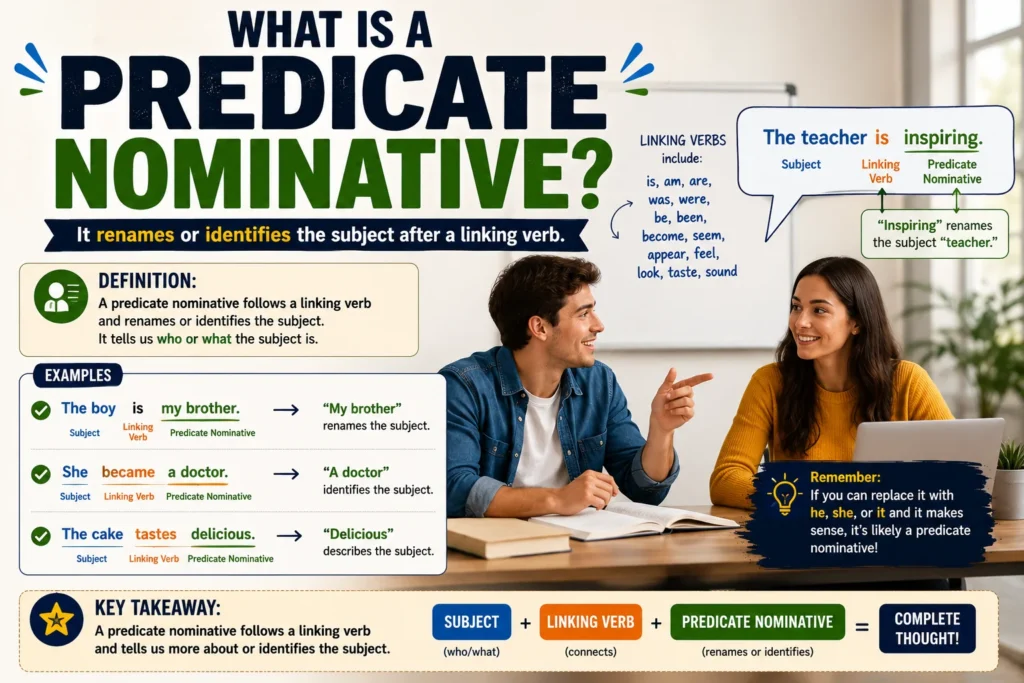
A predicate nominative is a noun, pronoun, or noun phrase that follows a linking verb and identifies, renames, or classifies the subject of a sentence. In simple terms, it tells you what the subject is rather than showing what the subject does. In the sentence “Maria is a teacher,” Maria is the subject, is is the linking verb, and a teacher is the predicate nominative. The phrase identifies Maria by giving her another name or role. Grammar references generally treat the predicate nominative as a type of subject complement.
This grammar concept becomes much easier once you stop treating every noun after a verb as an object. A direct object receives an action, while a predicate nominative connects back to the subject through a linking verb. Think of the structure almost like an equals sign: Maria = teacher. That relationship is the key. Once you can spot it, predicate nominatives become much less mysterious.
What Is a Predicate Nominative in Grammar?
A predicate nominative is a noun or noun-like expression that follows a linking verb and refers back to the subject. Traditional grammar often calls it a predicate noun, while some grammar resources use the broader term predicate nominative. Both terms commonly describe a noun that renames or identifies the subject.
Consider this sentence:
Jordan is a musician.
Here is the grammatical breakdown:
| Part of the sentence | Word or phrase | Function |
| Subject | Jordan | Tells us who the sentence concerns |
| Linking verb | is | Connects the subject to its complement |
| Predicate nominative | a musician | Identifies Jordan |
The phrase a musician does not receive an action. Jordan does not “is” something in the sense of acting. Instead, the verb is connects Jordan with the identity or classification of a musician.
That distinction matters because English sentences often place nouns after verbs. The noun’s position alone doesn’t tell you its function. You need to examine the verb and the relationship between the noun and the subject.
The Basic Predicate Nominative Formula
The most useful pattern to remember is:
Subject + Linking Verb + Predicate Nominative
For example:
- My sister + is + a doctor.
- The winner + was + James.
- Their dog + became + a champion.
- Mr. Lee + remains + the manager.
In each sentence, the final noun or noun phrase identifies the subject.
A predicate nominative can consist of more than one word. In fact, a complete noun phrase often serves as the predicate nominative. For example, “Sarah is the captain of our debate team.” The entire phrase the captain of our debate team functions as the subject complement.
The important question isn’t, “How many words does it contain?” Instead, ask:
Does the noun or noun phrase identify or rename the subject after a linking verb?
If the answer is yes, you probably have a predicate nominative.
Why Is It Called a Predicate Nominative?

The name sounds more complicated than the grammar itself.
Predicate refers to the part of the sentence that says something about the subject. Nominative relates to naming. Therefore, the term points to a noun or pronoun in the predicate that names or identifies the subject.
Look at this example:
Daniel became the team captain.
The subject is Daniel. The linking verb is became. The phrase the team captain identifies Daniel’s role.
You can express the relationship as:
Daniel = the team captain
That doesn’t mean Daniel and “the team captain” are literally the same string of words. It means the second expression identifies the first.
Now compare it with:
Daniel kicked the ball.
Here, the ball does not rename Daniel. Daniel performs the action kicked, and the ball receives that action. Therefore, the ball functions as a direct object rather than a predicate nominative.
This simple comparison reveals why the verb matters so much.
| Sentence | Verb type | Complement | Function |
| Daniel is a captain. | Linking | a captain | Predicate nominative |
| Daniel became a captain. | Linking | a captain | Predicate nominative |
| Daniel kicked the ball. | Action | the ball | Direct object |
| Daniel looks tired. | Linking | tired | Predicate adjective |
The last example introduces another important distinction. Not everything after a linking verb qualifies as a predicate nominative.
Predicate Nominative vs. Subject Complement
A subject complement is the broader grammatical category. A predicate nominative represents one type of subject complement, while a predicate adjective represents another common type. Grammar references describe predicate nominatives as noun phrases and predicate adjectives as adjective phrases that follow linking verbs and connect back to the subject.
For example:
Emma is a scientist.
A scientist is a predicate nominative because it identifies Emma.
Now change the sentence:
Emma is brilliant.
Brilliant describes Emma. It doesn’t give her another name or identity. Therefore, brilliant is a predicate adjective.
The distinction becomes clearer when you place the examples side by side:
| Predicate nominative | Predicate adjective |
| Emma is a scientist. | Emma is brilliant. |
| The animal became a pet. | The animal became friendly. |
| Marcus seems a good leader. | Marcus seems confident. |
| That building is a museum. | That building is beautiful. |
A quick test helps:
Noun or pronoun that identifies the subject → predicate nominative.
Adjective that describes the subject → predicate adjective.
There are cases where the meaning can feel very close. For example:
She became wiser.
She became a wiser person.
In the first sentence, wiser is an adjective. In the second, a wiser person is a noun phrase functioning as a predicate nominative. The sentences communicate related ideas, but their grammatical structures differ.
What Is a Linking Verb?
You cannot identify a predicate nominative correctly without understanding linking verbs.
A linking verb connects the subject with a word or phrase that identifies or describes that subject. Unlike an action verb, it does not express an action directed toward an object.
The verb be supplies the most familiar examples:
- am
- is
- are
- was
- were
- be
- being
- been
For example:
The students are winners.
The verb are connects the students with winners.
My brother was the goalkeeper.
The verb was connects my brother with the goalkeeper.
Those buildings were schools.
The verb were connects those buildings with schools.
However, English has other linking verbs. Common examples include become, seem, appear, remain, feel, look, sound, smell, taste, and grow, depending on how the verb functions in the sentence.
Some Linking Verbs Can Also Act as Action Verbs
This is one of the most important details for accurate sentence analysis.
A verb such as look can function as a linking verb:
The baby looks sleepy.
Here, sleepy describes the baby. The verb connects the subject with a subject complement.
But consider:
The baby looked at the toy.
Now looked describes an action. The phrase at the toy doesn’t function as a predicate nominative.
The same issue occurs with feel:
The fabric feels like silk.
Here, feels expresses a sensory relationship.
Compare:
She felt the fabric.
Here, felt describes an action involving the fabric.
So don’t memorize a list of linking verbs and assume that every occurrence creates a predicate nominative. Context determines the verb’s function.
Common Linking Verbs That Can Introduce Predicate Nominatives
The verb be is the clearest and most common choice, but other linking verbs can connect a subject to a noun or noun phrase.
| Linking verb | Example | Predicate nominative |
| is | Maya is a teacher. | a teacher |
| was | He was the winner. | the winner |
| became | She became a doctor. | a doctor |
| remained | Tom remained the leader. | the leader |
| seemed | He seemed a reliable partner. | a reliable partner |
| appeared | She appeared the obvious choice. | the obvious choice |
Some verbs accept noun complements more naturally than others. Modern grammar also recognizes that verbs such as look, feel, sound, smell, and taste often take adjective complements, while noun complements may require additional wording depending on the construction.
For that reason, the safest approach isn’t to ask only, “Is this verb on my linking-verb list?” Ask what relationship the verb creates in this particular sentence.
Can a Predicate Nominative Be More Than One Word?
Absolutely.
A predicate nominative does not have to be a single noun. It can be a noun phrase, and grammatical descriptions can also treat certain noun clauses as predicate nominatives. (Linguistics Girl)
Compare:
Lena is a teacher.
with:
Lena is a highly experienced science teacher.
In the second sentence, a highly experienced science teacher forms a noun phrase. The head noun is teacher, while the other words add information to that noun.
Consider another example:
My favorite place is the small bookstore near the station.
The entire phrase the small bookstore near the station identifies the subject my favorite place.
The structure still works:
Subject = Predicate Nominative
My favorite place = the small bookstore near the station
You should therefore avoid a common mistake: looking for exactly one word after the linking verb. The grammatical unit may contain several words.
Can a Pronoun Be a Predicate Nominative?
Yes. A pronoun can function as a predicate nominative when it identifies or renames the subject.
For example:
The person responsible was she.
In traditional formal grammar, she appears in the nominative or subject form.
Another traditional example is:
It is I.
The reasoning comes from the idea that the pronoun after the linking verb identifies the subject rather than receiving an action.
Modern everyday English often uses the object form instead:
It’s me.
That’s him.
This is her.
These forms sound completely natural in ordinary conversation. Formal grammar discussions may still prefer It is I or It is she in certain contexts. The choice depends heavily on register, style, and audience rather than a simple rule that one form always works and the other never does.
That distinction becomes especially useful when you’re writing formal academic or professional English.
Predicate Nominative Examples in Everyday English
The fastest way to understand this concept is to see it working repeatedly.
Family and Relationships
Anna is my sister.
- Subject: Anna
- Linking verb: is
- Predicate nominative: my sister
Mr. Carter was our neighbor.
- Subject: Mr. Carter
- Linking verb: was
- Predicate nominative: our neighbor
In both examples, the final noun phrase identifies the subject.
Jobs and Roles
David is a mechanic.
Priya became the project manager.
My uncle was a firefighter.
Each sentence uses a noun or noun phrase to give the subject an occupational or social identity.
Classification
Predicate nominatives can also classify something:
A whale is a mammal.
Here, a mammal identifies the category to which a whale belongs.
Copper is a metal.
The noun metal classifies copper.
A robin is a bird.
The noun bird tells us what type of thing a robin is.
These examples show why the predicate nominative doesn’t have to mean “another personal name.” It can provide a category, role, identity, profession, relationship, or classification.
Predicate Nominative vs. Direct Object
This distinction causes frequent confusion because both structures can place a noun after a verb.
Compare:
Michael is a teacher.
Michael teaches students.
In the first sentence, a teacher identifies Michael. It is a predicate nominative.
In the second sentence, students receive the action of teaches. It is a direct object.
The structural difference is:
Predicate nominative:
Subject + linking verb + complement
Direct object:
Subject + action verb + direct object
| Feature | Predicate nominative | Direct object |
| Follows | Linking verb | Transitive action verb |
| Main function | Identifies or renames subject | Receives the action |
| Relationship | Subject = complement | Subject → action → object |
| Example | Olivia is a lawyer. | Olivia helps clients. |
| Key question | What is the subject? | What or whom did the subject act on? |
Try this test:
Olivia is a lawyer.
Can you say Olivia = lawyer?
Yes.
Now:
Olivia helps clients.
Can you say Olivia = clients?
No.
That simple comparison often exposes the difference immediately.
The Equals-Sign Test for Predicate Nominatives
The equals-sign test provides a useful shortcut.
Take the subject and the noun after the linking verb. Ask whether you can reasonably place an equals sign between them.
James is the captain.
Becomes:
James = the captain
The relationship makes sense.
Now consider:
James kicked the ball.
You would get:
James = the ball
That makes no sense. The ball isn’t another name for James. Therefore, the ball isn’t a predicate nominative.
Try another:
The building became a hospital.
The building = a hospital
The relationship works.
Now:
The workers built a hospital.
The workers = a hospital
The relationship fails. A hospital is the direct object.
The equals-sign test isn’t a complete substitute for grammatical analysis. Still, it provides a quick and memorable way to recognize the central identity relationship behind a predicate nominative.
A Useful Predicate Nominative Identification Method
When you encounter a sentence that seems confusing, work through it in order.
Find the Subject
First, determine who or what the sentence discusses.
My cousin is an architect.
The subject is my cousin.
Find the Verb
Next, identify the main verb or verb phrase.
My cousin is an architect.
Is is the linking verb.
Examine What Follows the Verb
Now look at the complement:
My cousin is an architect.
The phrase an architect contains a noun and identifies the subject.
Ask Whether It Renames or Identifies the Subject
Can you establish an identity relationship?
My cousin = an architect
Yes.
Therefore, an architect is the predicate nominative.
Check Whether It Is an Adjective Instead
Suppose the sentence were:
My cousin is talented.
Talented describes the subject. It doesn’t rename the cousin.
Therefore, it is a predicate adjective, not a predicate nominative.
Check Whether the Verb Expresses Action
Now consider:
My cousin designed a house.
Designed expresses an action. A house receives that action.
Therefore, a house is a direct object.
This five-part process gives you a reliable way to analyze most basic examples.
Predicate Nominative Quick Reference
| Question | If the answer is yes |
| Does the sentence contain a linking verb? | Continue analyzing |
| Does a noun or pronoun follow it? | It may be a predicate nominative |
| Does that noun identify the subject? | Likely a predicate nominative |
| Can you form a reasonable subject = complement relationship? | Strong evidence |
| Does the word describe rather than rename the subject? | It is likely a predicate adjective |
| Does an action verb transfer an action to the noun? | It is likely a direct object |
The Three Structures to Remember
Predicate nominative
Sarah is a doctor.
Predicate adjective
Sarah is intelligent.
Direct object
Sarah helps patients.
The first identifies Sarah. The second describes Sarah. The third tells us what Sarah acts upon.
That difference captures the heart of the entire topic.
Predicate Nominatives and Subject Complements
The term subject complement can make grammar discussions sound more complicated than they need to be. Think of it as a larger category that includes words or phrases connected to the subject through a linking verb.
Two major types are:
- Predicate nominative: names or identifies the subject.
- Predicate adjective: describes the subject.
For example:
The boy is a student.
A student is a predicate nominative.
The boy is nervous.
Nervous is a predicate adjective.
Both complements relate directly to the boy. The difference lies in what kind of expression follows the linking verb and what grammatical job it performs.
This broader perspective helps you understand why learning predicate nominatives also improves your ability to analyze sentence structure.
Compound Predicate Nominatives
A sentence can contain more than one predicate nominative.
For example:
The twins are sisters and best friends.
The subject is the twins.
The linking verb is are.
The sentence contains two identifying expressions:
- sisters
- best friends
Together, they form a compound predicate nominative.
You can visualize the relationship like this:
The twins = sisters + best friends
Each noun or noun phrase contributes an identity or classification connected to the same subject.
Another example:
Marcus became a teacher and a mentor.
Both a teacher and a mentor identify Marcus’s roles.
The conjunction and joins the two predicate nominatives.
This construction differs from a compound subject. Compare:
Marcus and Elena are teachers.
Here, Marcus and Elena form the compound subject. Teachers is the predicate nominative.
Understanding which side of the linking verb contains the compound helps prevent structural confusion.
Predicate Nominatives in Different Tenses
Changing the tense doesn’t automatically change the grammatical function.
Present Tense
Maya is a doctor.
The predicate nominative is a doctor.
Past Tense
Maya was a doctor.
The predicate nominative remains a doctor.
Future Tense
Maya will be a doctor.
The entire verb phrase will be links the subject with a doctor.
Perfect Construction
Maya has been a doctor for ten years.
The verb phrase has been connects the subject with a doctor.
The tense changes the time reference, but the relationship remains:
Maya = a doctor
This is an important point for sentence analysis. Don’t assume that a longer verb phrase means the complement has changed grammatical roles.
Predicate Nominatives in Questions
Questions can make sentence structure harder to recognize because English often changes word order.
Consider:
Is Daniel the winner?
The normal statement would be:
Daniel is the winner.
The question moves is before the subject. However, the winner still identifies Daniel.
Another example:
Who is the captain?
The surface structure differs from an ordinary statement, but the question still connects the subject and its identifying complement through is.
Negative sentences work in much the same way:
Daniel is not the winner.
The word not adds negation, but the winner remains connected to Daniel through the linking verb.
So punctuation, tense, negation, or question order doesn’t automatically change the function of the predicate nominative.
Common Mistakes With Predicate Nominatives
Mistake: Calling Every Noun After a Verb a Direct Object
A noun after a verb isn’t automatically an object.
Lisa is a teacher.
A teacher is not a direct object because it doesn’t transfer an action to it.
Mistake: Confusing Identity With Description
The soup is a meal.
A meal identifies or classifies the soup.
The soup is hot.
Hot describes the soup.
The first contains a predicate nominative. The second contains a predicate adjective.
Mistake: Assuming Every “Be” Construction Has a Predicate Nominative
Forms of be commonly introduce predicate nominatives, but they can also introduce other complements.
She is happy.
Happy is an adjective.
She is a teacher.
A teacher is a predicate nominative.
So don’t stop your analysis after finding is. Examine what comes next.
Mistake: Ignoring Context With Linking Verbs
Consider:
The soup tastes delicious.
Here, tastes links the subject with an adjective.
But:
The chef tasted the soup.
Here, tasted expresses an action and the soup functions as its direct object.
The same verb can participate in different grammatical structures.
Why Predicate Nominatives Matter
You don’t need to memorize grammar terminology simply to sound intelligent. The terminology becomes useful because it gives you a precise way to understand how sentences work.
Recognizing predicate nominatives helps you:
- identify linking verbs more accurately;
- distinguish subject complements from objects;
- separate predicate nouns from predicate adjectives;
- understand pronoun case in formal constructions;
- analyze complex sentence structures;
- improve grammar explanations and editing;
- recognize how English expresses identity and classification.
The concept also helps with concise writing. Compare:
My brother is a teacher.
with:
My brother teaches students.
Both sentences provide useful information, but they organize that information differently. The first identifies his profession. The second focuses on his action and its object.
Good writing depends on knowing what relationship you want your sentence to express.
A Practical Case Study
Imagine a student sees this sentence on a grammar test:
The new principal became a former teacher.
The student identifies teacher as the direct object because it follows a verb.
That answer misses the central relationship.
Start with the subject:
The new principal
Find the verb:
became
Ask whether became functions as a linking verb.
Yes. It connects the subject with a new identity or classification.
Now examine the complement:
a former teacher
Can we create the identity relationship?
The new principal = a former teacher
The relationship works.
Therefore, a former teacher functions as a predicate nominative.
Now change the sentence:
The new principal hired a former teacher.
The verb hired expresses an action. The former teacher receives that action.
So:
The new principal → hired → a former teacher
Now a former teacher functions as the direct object.
This comparison demonstrates why verb function matters more than simply looking at the word that appears after it.
Predicate Nominative Examples at a Glance
| Sentence | Subject | Linking verb | Predicate nominative |
| Emma is a nurse. | Emma | is | a nurse |
| David became the captain. | David | became | the captain |
| My uncle was a pilot. | My uncle | was | a pilot |
| That building is a library. | That building | is | a library |
| The winner was Maria. | The winner | was | Maria |
| Our neighbors are engineers. | Our neighbors | are | engineers |
| The puppy became a champion. | The puppy | became | a champion |
| The problem remains a mystery. | The problem | remains | a mystery |
Notice the recurring pattern. The final noun or noun phrase doesn’t receive an action. Instead, it gives the subject an identity, category, role, or name.
Final Rule to Remember
If you remember only one idea, remember this:
A predicate nominative follows a linking verb and identifies or renames the subject.
Then use three questions:
What is the subject?
Is the verb linking rather than expressing an action?
Does the noun or noun phrase after the verb identify the subject?
If all three answers line up, you’ve probably found the predicate nominative.
For example:
Michael is a scientist.
Michael is the subject.
Is is the linking verb.
A scientist identifies Michael.
Therefore, a scientist is the predicate nominative.
The concept becomes even easier when you compare it with the two structures learners most often confuse it with: the predicate adjective and the direct object. A predicate nominative names, a predicate adjective describes, and a direct object receives an action. Once that three-way distinction becomes familiar, identifying predicate nominatives in everyday, academic, and formal English becomes much more straightforward.
How to Identify a Predicate Nominative
Once you understand what a predicate nominative does, the next step is learning how to spot one quickly. The most reliable method starts with the subject and verb rather than simply looking for a noun near the end of the sentence. A predicate nominative normally follows a linking verb and identifies or renames the subject.
Consider:
Maria is a teacher.
The sentence contains three key parts:
- Maria — subject
- is — linking verb
- a teacher — predicate nominative
The important relationship is:
Maria = a teacher
That identity test gives you a useful shortcut. However, you should still examine the verb because some English verbs can function as either linking or action verbs depending on the sentence.
Find the Subject First
Start by asking who or what the sentence is about. That gives you the subject.
My brother is an engineer.
The sentence talks about my brother, so that phrase serves as the subject.
Now temporarily ignore everything else:
My brother → subject
Once you’ve located the subject, finding the predicate nominative becomes much easier because you can ask what the rest of the sentence says about that subject.
Try another example:
The woman became a doctor.
The subject is the woman.
Don’t immediately label doctor as the predicate nominative. First, identify the verb and determine what kind of relationship it creates.
Identify the Verb
Next, find the main verb or verb phrase.
The woman became a doctor.
The verb became connects the subject with a new identity or role. In this context, it functions as a linking verb.
This matters because a predicate nominative requires a linking relationship. A linking verb connects the subject with a complement instead of expressing an action directed toward an object.
Compare these two sentences:
Laura became a lawyer.
Laura hired a lawyer.
In the first sentence, became links Laura with a lawyer. The phrase identifies Laura’s new profession.
In the second, hired expresses an action. A lawyer receives that action and functions as the direct object.
So the same noun, lawyer, can have different grammatical functions depending on the verb and sentence structure.
| Sentence | Verb | Word or phrase after the verb | Function |
| Laura became a lawyer. | became | a lawyer | Predicate nominative |
| Laura hired a lawyer. | hired | a lawyer | Direct object |
| Laura is successful. | is | successful | Predicate adjective |
| Laura seems a capable lawyer. | seems | a capable lawyer | Predicate nominative |
Check Whether the Verb Is Linking
The most common linking verb is a form of be. English uses forms such as am, is, are, was, were, be, being, and been.
For example:
I am a student.
She is the manager.
They were champions.
He was a teacher.
We are a team.
In each case, the form of be connects the subject with a noun or noun phrase that identifies it. Predicate nominatives commonly follow forms of be, although other linking verbs can perform the same role.
Some other verbs can also function as linking verbs, including become, seem, appear, remain, feel, look, sound, smell, taste, and grow. Their function depends on context.
For example:
The child became a musician.
Here, became links the child with a musician.
But consider:
The child became angry.
Here, angry is an adjective describing the child. It is a predicate adjective, not a predicate nominative.
This distinction shows why identifying the verb alone isn’t enough. You also need to examine the complement that follows it.
Look After the Linking Verb
Once you’ve identified a linking verb, examine what comes after it.
If the following word or phrase is a noun, pronoun, noun phrase, or another noun-like expression that identifies the subject, you may have a predicate nominative. Grammar resources commonly describe predicate nominatives as nouns or noun phrases that rename or identify the subject after a linking verb.
Consider:
James is a pilot.
The phrase a pilot follows.
Ask:
Does “a pilot” identify James?
Yes.
Therefore:
James = a pilot
The phrase a pilot functions as the predicate nominative.
Now compare:
James is nervous.
The word nervous follows the linking verb, but it doesn’t give James another name. It describes his condition.
Therefore:
nervous = predicate adjective
This simple distinction prevents one of the most common errors in sentence analysis.
Check for Identity
The final and most useful step is to check the relationship between the subject and the complement.
Ask:
Does the word or phrase after the linking verb rename, identify, classify, or define the subject?
If yes, you likely have a predicate nominative.
For example:
A whale is a mammal.
Subject: A whale
Linking verb: is
Predicate nominative: a mammal
Identity relationship:
A whale = a mammal
The phrase doesn’t mean every whale is identical to every mammal. Instead, a mammal identifies the category to which a whale belongs.
The same principle works with occupations:
Sarah is a doctor.
Sarah = a doctor
With roles:
Marcus became the captain.
Marcus = the captain
With relationships:
Emily is my sister.
Emily = my sister
With classifications:
Copper is a metal.
Copper = a metal
The predicate nominative can therefore express more than personal identity. It can communicate profession, role, relationship, category, status, or classification.
Use the Equals-Sign Test
The equals-sign test offers one of the easiest ways to recognize a predicate nominative.
Take the subject and the suspected predicate nominative. Mentally replace the linking verb with an equals sign.
David is the winner.
Becomes:
David = the winner
The relationship makes sense.
Try:
The building became a hospital.
The building = a hospital
Again, the relationship makes sense.
Now try:
David kicked the ball.
David = the ball
That relationship doesn’t make sense. The ball isn’t another name for David. The verb kicked expresses an action, so the ball functions as the direct object.
The test works especially well with basic sentences because predicate nominatives establish a subject-to-complement relationship that resembles an equation. Educational grammar resources also use this identity approach to help learners recognize subject complements.
Don’t Rely on Word Position Alone
A common mistake is assuming that the noun appearing after a verb must be a predicate nominative.
English doesn’t work that way.
Compare:
Michael is a teacher.
Michael met a teacher.
Both sentences contain a teacher, but the phrase performs different jobs.
In the first:
Michael = a teacher
So a teacher is the predicate nominative.
In the second:
Michael → met → a teacher
The noun receives the action of met, so a teacher is the direct object.
This is why sentence analysis should focus on function, not simply position.
Distinguish Predicate Nominatives From Predicate Adjectives
After identifying a linking verb, ask what kind of expression follows it.
If it names or identifies the subject, it is a predicate nominative.
If it describes the subject, it is a predicate adjective.
Compare:
The soup is a meal.
The soup is hot.
In the first sentence, a meal identifies or classifies the soup.
In the second, hot describes the soup.
| Sentence | Complement | What does it do? | Result |
| The soup is a meal. | a meal | Identifies/classifies | Predicate nominative |
| The soup is hot. | hot | Describes | Predicate adjective |
| Marcus became a teacher. | a teacher | Identifies a role | Predicate nominative |
| Marcus became tired. | tired | Describes a state | Predicate adjective |
A useful question is:
“What is the subject?”
If the answer contains a noun or noun phrase that identifies the subject, you may have a predicate nominative.
Ask:
“What is the subject like?”
If the answer is an adjective describing the subject, you’re probably looking at a predicate adjective.
Watch for Noun Phrases
A predicate nominative doesn’t have to be one noun.
For example:
Lisa is the new science teacher.
The predicate nominative is the entire noun phrase the new science teacher.
The head noun is teacher, while the new and science contribute additional information.
Another example:
My brother became the captain of our school team.
The entire phrase the captain of our school team identifies the subject.
This distinction matters because students sometimes underline only the final noun:
My brother became the captain of our school team.
That approach misses the grammatical unit. The predicate nominative is the whole noun phrase, not merely the final word.
Noun phrases can contain determiners, modifiers, and complements while still functioning as predicate nominatives.
Watch for Pronouns
Pronouns can also serve as predicate nominatives.
For example:
The winner was she.
In traditional grammar, she uses the nominative form because it identifies the subject.
Another familiar formal construction is:
It is I.
Traditional grammar treats I as the predicate nominative.
However, modern conversational English commonly uses:
It’s me.
The conversational form sounds natural to most speakers. Formal writing may favor the traditional version depending on the style guide and context.
The key point for identification remains the same: the pronoun identifies the subject after a linking verb.
Don’t Confuse Auxiliary “Be” With a Linking “Be”
Forms of be don’t always function as linking verbs.
Consider:
She is a teacher.
Here, is connects she with a teacher. It functions as a linking verb.
Now consider:
She is teaching English.
Here, is helps form the present progressive verb phrase is teaching. The meaningful verb is teaching, which expresses an action.
So you shouldn’t automatically label every occurrence of is as a linking verb.
This distinction becomes particularly important when analyzing longer verb phrases. The form be can function as an auxiliary when it helps another verb express tense or aspect.
Identify the Entire Verb Phrase
Some sentences contain several auxiliary verbs:
John has been a teacher for ten years.
The linking portion is has been.
The predicate nominative is a teacher.
Likewise:
She will be the next director.
The verb phrase is will be, and the next director identifies the subject.
The additional words don’t change the fundamental relationship:
She = the next director
This means you should analyze the whole verb phrase rather than treating every individual word as a separate main verb.
Test More Difficult Sentences
Once the basic method feels comfortable, try sentences with extra information.
The woman standing near the door is our new principal.
At first glance, the sentence looks complicated because standing near the door appears between the subject and the verb.
Strip away the modifier:
The woman is our new principal.
Now the structure becomes obvious.
- Subject: The woman standing near the door
- Linking verb: is
- Predicate nominative: our new principal
The extra phrase doesn’t change the basic relationship.
Try another:
My favorite person in the office is the receptionist.
The subject is My favorite person in the office.
The linking verb is is.
The predicate nominative is the receptionist.
The structure remains:
My favorite person in the office = the receptionist
Predicate Nominatives in Questions
Questions can make identification harder because English often changes word order.
Consider:
Is Daniel the captain?
Turn it into a statement:
Daniel is the captain.
Now the structure is obvious.
- Subject: Daniel
- Linking verb: is
- Predicate nominative: the captain
The question form changes the order but not the underlying relationship.
Another example:
Who is the winner?
Depending on the grammatical analysis and context, identifying subjects and complements in interrogative constructions can require more care than in simple declarative sentences. For basic learner analysis, however, recognizing the linking relationship remains the useful starting point.
Predicate Nominatives in Negative Sentences
Negation doesn’t eliminate a predicate nominative.
Maria is not the winner.
The word not makes the statement negative.
But the winner still identifies Maria in the underlying relationship:
Maria = the winner
The sentence simply denies that relationship.
Likewise:
He wasn’t the manager.
The manager remains the predicate nominative.
So when you encounter not, never, or another negative element, don’t let it distract you from the subject–verb–complement structure.
A Fast Five-Question Method
When you’re under time pressure, use these questions:
Who or what is the subject?
What is the main verb or verb phrase? Does the verb link the subject to a complement?Does the complement contain a noun, pronoun, or noun phrase?Does that expression identify or rename the subject?
If you answer yes to the relevant questions, you’ve probably found a predicate nominative.
Try it with:
The old building became a museum.
Who or what?
The old building.
Verb?
Became.
Linking relationship?
Yes.
Noun phrase after the verb?
A museum.
Does it identify the subject?
Yes.
Therefore:
a museum = predicate nominative
A Quick Comparison Test
When two sentences look similar, place them side by side.
| Sentence | Analysis |
| Kevin is a doctor. | a doctor = predicate nominative |
| Kevin is tired. | tired = predicate adjective |
| Kevin helped a doctor. | a doctor = direct object |
| Kevin became a doctor. | a doctor = predicate nominative |
| Kevin met the doctor. | the doctor = direct object |
The repeated noun doctor demonstrates an important principle: the same word can perform different grammatical functions in different sentences.
Don’t classify a word in isolation. Always examine its relationship with the rest of the sentence.
The Most Reliable Identification Rule
For most ordinary English sentences, the process can be reduced to this:
Find the subject → find the verb → determine whether the verb links → examine the complement → check whether it identifies the subject.
That sequence is more reliable than simply memorizing lists of words.
A predicate nominative normally has this underlying structure:
Subject + linking verb + noun/noun phrase
For example:
Jordan is a student.
The dog became a champion.
My aunt was the manager.
The winner was Sarah.
In each case, the final noun or noun phrase connects back to the subject through a linking verb.
Once this pattern becomes familiar, you can move beyond simple examples and analyze compound predicate nominatives, pronouns, noun phrases, questions, negative sentences, and different verb tenses with much greater confidence. The goal isn’t to memorize a complicated definition. It’s to recognize the relationship that the sentence creates: the subject is being identified, renamed, or classified by what follows the linking verb.
Predicate Nominative Examples
Examples make the idea of a predicate nominative much easier to understand because you can see the subject, linking verb, and complement working together. The central pattern stays simple: subject + linking verb + predicate nominative. The predicate nominative identifies, renames, or classifies the subject. It can be a single noun, a pronoun, a proper noun, a noun phrase, or a compound expression. Once you recognize that relationship, even longer sentences become easier to analyze.
Simple Predicate Nominative Examples
Start with short sentences. These make the identity relationship easy to see.
James is a teacher.
- Subject: James
- Linking verb: is
- Predicate nominative: a teacher
The phrase a teacher identifies James.
My mother is a doctor.
- Subject: My mother
- Linking verb: is
- Predicate nominative: a doctor
The sentence tells us what the subject is.
The animal is a mammal.
- Subject: The animal
- Linking verb: is
- Predicate nominative: a mammal
Here, a mammal classifies the animal.
Sarah became the captain.
- Subject: Sarah
- Linking verb: became
- Predicate nominative: the captain
The word captain identifies Sarah’s role.
That building is a museum.
- Subject: That building
- Linking verb: is
- Predicate nominative: a museum
The phrase identifies the building by its function.
These examples demonstrate an important point: a predicate nominative doesn’t always give the subject a personal name. It can identify a profession, role, category, relationship, position, or type.
Predicate Nominative Examples With “Be”
Forms of be appear frequently in predicate nominative constructions.
| Sentence | Subject | Linking verb | Predicate nominative |
| Emma is a student. | Emma | is | a student |
| They are musicians. | They | are | musicians |
| He was the winner. | He | was | the winner |
| We were classmates. | We | were | classmates |
| I am a writer. | I | am | a writer |
In each example, the final noun or noun phrase identifies the subject.
Consider:
They are musicians.
The word musicians doesn’t receive an action. Instead, it tells us what they are.
The relationship is:
They = musicians
Now compare that sentence with:
They hired musicians.
Here, hired expresses an action, and musicians receives that action. Therefore, musicians functions as a direct object.
The difference comes from the verb and its relationship with the following noun.
Predicate Nominative Examples With “Become”
The verb become often connects a subject with a new identity, position, or classification.
Maria became a lawyer.
The phrase a lawyer identifies Maria’s profession.
The student became the class president.
The phrase the class president identifies the student’s new role.
The small company became a major competitor.
The phrase a major competitor classifies the company in a new way.
The caterpillar became a butterfly.
The phrase a butterfly identifies the creature’s resulting form.
These examples show why become works naturally with predicate nominatives. The verb establishes a transition from one state or identity to another.
Predicate Nominative Examples With Other Linking Verbs
Some verbs besides be and become can link a subject with a noun complement.
The problem remains a mystery.
Here, a mystery identifies the problem’s status.
She seemed a natural leader.
Here, a natural leader identifies how she appeared in terms of role or identity.
He became the team manager.
The team manager identifies his new position.
The proposal appeared a reasonable solution.
In this construction, a reasonable solution identifies the proposal.
The exact behavior of less common linking verbs can depend on context and style. That is why it’s better to analyze the relationship rather than memorize a fixed list.
Predicate Nominative Examples With Proper Nouns
A proper noun can function as a predicate nominative when it identifies the subject.
The winner was Olivia.
Here, Olivia identifies the winner.
The author of the book is Maya Chen.
The proper name Maya Chen identifies the subject.
The new team captain is Daniel.
Daniel identifies the captain.
This construction can appear especially often when introducing or identifying people:
That woman is Dr. Patel.
The proper noun identifies who the woman is.
The important relationship remains:
Subject = Name
Predicate Nominative Examples With Pronouns
Pronouns can also function as predicate nominatives.
A traditional formal example is:
The person responsible was she.
Here, she identifies the person responsible.
Another traditional construction is:
It is I.
Traditional grammar treats I as the predicate nominative because it identifies the subject. However, modern conversational English commonly uses:
It’s me.
Both forms exist in real English, but they belong to different registers. It is I sounds formal and somewhat old-fashioned to many speakers, while It’s me sounds natural in ordinary conversation.
The grammatical lesson is more important than memorizing one preferred phrase: a pronoun can occupy the position of a predicate nominative after a linking verb.
Predicate Nominative Examples With Noun Phrases
The predicate nominative can contain several words.
My sister is a talented medical researcher.
The entire phrase a talented medical researcher functions as the predicate nominative.
David became the new head of marketing.
The phrase the new head of marketing identifies David’s position.
That building is the oldest library in town.
The phrase the oldest library in town identifies the building.
Her brother was the captain of the local soccer team.
The phrase the captain of the local soccer team identifies her brother.
Notice that the predicate nominative isn’t necessarily the final word. In the sentence “David became the new head of marketing,” the entire phrase carries the identifying meaning.
This matters when you analyze sentences because underlining only marketing would give an incomplete answer.
Compound Predicate Nominative Examples
A sentence can contain two or more predicate nominatives connected by a conjunction.
Maria is a teacher and a writer.
The subject is Maria.
The linking verb is is.
The compound predicate nominative contains:
- a teacher
- a writer
Both phrases identify Maria.
The structure can be represented as:
Maria = a teacher + a writer
Another example:
John became the coach and the mentor.
Both the coach and the mentor identify John’s roles.
Consider:
The twins are brothers and teammates.
The compound predicate nominative tells us two things about the twins.
This construction differs from a sentence with a compound subject:
John and Maria are teachers.
Here, John and Maria form the compound subject, while teachers is the predicate nominative.
Predicate Nominative Examples in Different Tenses
Changing the tense doesn’t automatically change the predicate nominative.
Present Tense
Lisa is a manager.
Predicate nominative: a manager
Past Tense
Lisa was a manager.
Predicate nominative: a manager
Future Tense
Lisa will be a manager.
Predicate nominative: a manager
Present Perfect
Lisa has been a manager for five years.
Predicate nominative: a manager
Past Perfect
Lisa had been a manager before the merger.
Predicate nominative: a manager
The verb phrase changes, but the relationship remains:
Lisa = a manager
This illustrates an important grammatical principle. Tense changes when the situation occurs, not necessarily the function of the complement.
Predicate Nominative Examples in Questions
Question structure can make predicate nominatives harder to recognize because the linking verb may come before the subject.
Consider:
Is Daniel the winner?
Change it into a statement:
Daniel is the winner.
Now the relationship becomes easier to see.
Daniel = the winner
Therefore, the winner is the predicate nominative.
Another example:
Was Maria the team captain?
Statement form:
Maria was the team captain.
Predicate nominative:
the team captain
Questions don’t eliminate the grammatical relationship. They simply change the word order.
Predicate Nominative Examples in Negative Sentences
A negative word such as doesn’t change the basic function of the complement.
Daniel is not the winner.
The sentence denies the identification, but the winner still connects to Daniel through the linking verb.
Another example:
Sarah wasn’t the manager.
The manager remains the predicate nominative.
The same principle applies to longer sentences:
The new building is not the headquarters of the company.
The phrase the headquarters of the company identifies the building, even though the sentence uses negation.
Predicate Nominative vs. Predicate Adjective Examples
This comparison is essential because both structures commonly follow linking verbs.
Consider:
The child is a genius.
A genius is a predicate nominative because it identifies the child.
Now:
The child is brilliant.
Brilliant is a predicate adjective because it describes the child.
Compare several pairs:
| Predicate nominative | Predicate adjective |
| The man is a doctor. | The man is kind. |
| The dog became a champion. | The dog became strong. |
| Maria seems a good leader. | Maria seems confident. |
| The building is a museum. | The building is beautiful. |
| The child became a student. | The child became excited. |
The fastest distinction is:
Noun or pronoun = identity
Adjective = description
There can be semantic overlap. Calling someone a genius and saying someone is brilliant may communicate similar praise, but the grammar differs.
Predicate Nominative vs. Direct Object Examples
The next comparison focuses on action verbs.
Michael is a teacher.
A teacher identifies Michael.
Michael teaches students.
Students receive the action of teaches.
Now compare these pairs:
| Predicate nominative | Direct object |
| Rachel is a lawyer. | Rachel represents clients. |
| David became the leader. | David led the group. |
| The building is a school. | The company built a school. |
| James is a coach. | James coaches players. |
A direct object usually answers what? or whom? after an action verb.
A predicate nominative instead establishes an identity relationship with the subject.
Predicate Nominative Examples With Classification
Predicate nominatives often classify subjects.
A dolphin is a mammal.
A mammal tells us the category to which a dolphin belongs.
A rose is a flower.
A flower classifies the rose.
Gold is a metal.
A metal classifies gold.
A square is a shape.
A shape identifies the category of the subject.
These examples are especially useful because the equals-sign test works clearly:
A dolphin = a mammal
A rose = a flower
Gold = a metal
A square = a shape
The relationship doesn’t mean the two terms have the same meaning. Instead, the second term places the first into an identity or classification category.
Predicate Nominative Examples With Relationships
A predicate nominative can express a relationship between people or things.
Emily is my sister.
My sister identifies Emily’s relationship to the speaker.
Robert is our neighbor.
Our neighbor identifies Robert’s relationship to the subject or speaker.
Lisa was their coach.
Their coach identifies Lisa’s role.
Mr. Green is the principal.
The principal identifies Mr. Green’s position.
These examples demonstrate that predicate nominatives can communicate much more than dictionary-style definitions. They can tell readers who someone is, what role someone holds, what category something belongs to, or how one person relates to another.
Predicate Nominative Examples With Occupations
Occupations provide some of the clearest real-world examples.
My father is an engineer.
Her sister is a dentist.
David became a pilot.
Maria is a journalist.
Their neighbor was a firefighter.
In each sentence, the occupation gives the subject an identity or classification.
Now compare:
My father hired an engineer.
Here, an engineer is not the predicate nominative. Hired is an action verb, and the engineer receives the action.
This is a perfect example of why you should examine the verb before labeling the noun.
Predicate Nominative Examples With Roles and Titles
Titles and roles frequently function as predicate nominatives.
James is the president.
Sarah became the team captain.
Maya was the class representative.
Daniel remained the department chair.
Olivia became the project leader.
The complement doesn’t simply describe the subject. It tells the reader what position or role the subject holds.
This use appears naturally in workplace, academic, political, sports, and organizational writing.
Predicate Nominative Examples From Academic English
Academic writing often uses predicate nominatives to define concepts and classify subjects.
Photosynthesis is a biological process.
A triangle is a geometric figure.
Water is a compound.
The thesis is the central argument of an essay.
A metaphor is a figure of speech.
These sentences provide definitions or classifications. That makes predicate nominatives particularly useful when explaining technical concepts.
The structure allows writers to establish a clear relationship:
Concept = category or definition
For example:
A metaphor = a figure of speech
This construction makes explanations direct and efficient.
Predicate Nominative Examples in Professional English
Professional writing also uses this structure frequently.
Mr. Davis is the department director.
The document is the final report.
This meeting is a planning session.
The new employee became the project coordinator.
The proposal is a revised version of the original plan.
In these examples, predicate nominatives help readers understand roles, classifications, documents, positions, and organizational relationships.
Incorrect vs. Correct Predicate Nominative Analysis
Some errors occur because learners focus on the noun rather than the verb.
| Sentence | Incorrect assumption | Correct analysis |
| Maria is a teacher. | “teacher” is a direct object | “teacher” is a predicate nominative |
| Maria teaches a class. | “class” is a predicate nominative | “class” is a direct object |
| The dog is a champion. | “champion” is an adjective | “champion” is a predicate nominative |
| The dog is happy. | “happy” is a predicate nominative | “happy” is a predicate adjective |
| John became a doctor. | “doctor” is a direct object | “doctor” is a predicate nominative |
The most common wrong approach is to label a noun solely because it appears after a verb.
Instead, ask:
What kind of verb is it?
What relationship does the complement have with the subject?
Those two questions usually reveal the answer.
A Detailed Example Analysis
Consider this sentence:
After several years of training, Elena became the lead engineer at the company.
The sentence contains extra information, but its core structure is simple.
Remove the introductory phrase:
Elena became the lead engineer at the company.
Now identify the components:
- Elena — subject
- became — linking verb
- the lead engineer at the company — predicate nominative
The phrase the lead engineer at the company identifies Elena’s professional role.
The prepositional phrase at the company adds information about the engineer. It doesn’t change the core function of the entire noun phrase.
The identity relationship is:
Elena = the lead engineer at the company
This example demonstrates why you shouldn’t let modifiers distract you. Find the core sentence first, then analyze the complete complement.
Another Detailed Example: Predicate Nominative or Direct Object?
Consider:
The company appointed Maria the new director.
This sentence is more complicated because appointed is an action verb. Here, Maria functions as the direct object, while the new director serves as an object complement in a different grammatical construction. It isn’t a simple predicate nominative because the verb doesn’t link the subject to the complement.
Compare:
Maria is the new director.
Now the new director is a predicate nominative because it links Maria with that identity.
This comparison shows why similar meanings don’t necessarily produce identical grammatical structures.
A Quick Practice Set
Try identifying the predicate nominative in each sentence before checking the answers.
The answer is a surprise.
My cousin became a chef.
The winner was Daniel.
That animal is a reptile.
The building remained a school.
Our neighbor is the mayor.
The two sisters are doctors and researchers.
The document is the final agreement.
Answers
| Sentence | Predicate nominative |
| The answer is a surprise. | a surprise |
| My cousin became a chef. | a chef |
| The winner was Daniel. | Daniel |
| That animal is a reptile. | a reptile |
| The building remained a school. | a school |
| Our neighbor is the mayor. | the mayor |
| The two sisters are doctors and researchers. | doctors and researchers |
| The document is the final agreement. | the final agreement |
The repeated pattern should now be easy to see. Each predicate nominative connects to the subject through a linking verb and supplies an identity, role, or classification.
A Final Example That Combines Several Features
Consider this sentence:
After years of experience, Maya became the lead researcher and project coordinator.
The sentence contains a compound predicate nominative.
- Subject: Maya
- Linking verb: became
- First predicate nominative: the lead researcher
- Second predicate nominative: project coordinator
The introductory phrase After years of experience provides context but doesn’t affect the central structure.
The underlying relationship is:
Maya = the lead researcher + project coordinator
That single example brings together several important ideas: an introductory phrase, a linking verb other than be, a noun phrase, and a compound predicate nominative.
The best way to master this grammar point is to compare examples rather than memorize isolated definitions. When you see a noun after a verb, pause and examine the relationship. That three-way comparison gives you a practical framework for analyzing predicate nominatives accurately in everyday, academic, and professional English.
Predicate Nominative vs. Predicate Adjective
A predicate nominative and a predicate adjective can both appear after a linking verb, so it’s easy to confuse them. The key difference is what the complement does to the subject. A predicate nominative identifies, renames, or classifies the subject, while a predicate adjective describes the subject. Once you focus on that function instead of simply looking at the word after the verb, the distinction becomes much clearer.
Maria is a doctor.
Here, a doctor identifies Maria. It tells us what Maria is.
Maria is intelligent.
Here, intelligent describes Maria. It tells us what Maria is like.
That small difference creates two different grammatical structures.
Side-by-Side Comparison
| Feature | Predicate Nominative | Predicate Adjective |
| Main function | Identifies or renames the subject | Describes the subject |
| Usually contains | Noun, pronoun, or noun phrase | Adjective or adjective phrase |
| Follows | A linking verb | A linking verb |
| Example | She is a teacher. | She is kind. |
| Relationship | She = a teacher | She is kind |
| Main question | What is the subject? | What is the subject like? |
The easiest question to ask is:
Does the complement give the subject another name or identity?
If yes, it is probably a predicate nominative.
If it tells you about a quality, condition, appearance, size, emotion, or characteristic, it is probably a predicate adjective.
Predicate Nominative Examples
Consider these sentences:
David is a teacher.
A teacher is a noun phrase that identifies David.
The animal is a mammal.
A mammal classifies the animal.
Sarah became the captain.
The captain identifies Sarah’s role.
My brother is an engineer.
An engineer identifies his profession.
In each sentence, the complement answers a variation of “What is the subject?”
Predicate Adjective Examples
Now compare those examples with adjective complements:
David is patient.
The animal is dangerous.
Sarah became confident.
My brother is successful.
Here, the complements describe the subjects rather than naming them.
You can think of the distinction like this:
Predicate nominative = identity
Predicate adjective = description
That rule works for many straightforward sentences.
The Identity Test
The identity test is one of the fastest ways to recognize a predicate nominative.
Take:
John is a musician.
Ask whether you can understand the relationship as:
John = a musician
Yes. Therefore, a musician is a predicate nominative.
Now try:
John is talented.
Can you say:
John = talented
Not in the same grammatical sense. Talented describes John rather than renaming him.
Therefore, talented is a predicate adjective.
The equals-sign test isn’t a perfect replacement for grammatical analysis, but it provides a useful shortcut when you’re learning the distinction.
The “What?” vs. “What Like?” Test
Another practical method is to ask two different questions.
For a predicate nominative:
What is the subject?
For a predicate adjective:
What is the subject like?
Consider:
Emma is a scientist.
What is Emma?
A scientist.
That answer contains a noun, so a scientist functions as a predicate nominative.
Now:
Emma is brilliant.
What is Emma like?
Brilliant.
That answer describes her, so brilliant is a predicate adjective.
This test becomes especially helpful when you’re working with unfamiliar sentences.
Nouns vs. Adjectives
Word class often gives you an immediate clue.
The boy is a student.
Student is a noun.
The boy is clever.
Clever is an adjective.
However, don’t depend entirely on individual word forms. A noun phrase can contain several words:
The boy is an excellent student.
The entire phrase an excellent student functions as a predicate nominative. The word excellent is an adjective inside that noun phrase, but the head of the phrase is student, a noun.
That distinction matters because grammatical function belongs to the whole phrase, not necessarily to every word inside it.
Predicate Nominative vs. Predicate Adjective With “Become”
The verb become provides useful examples because it can connect subjects to both nouns and adjectives.
The student became a teacher.
A teacher = predicate nominative.
The student became confident.
Confident = predicate adjective.
The first sentence identifies a new role.
The second describes a new state.
Compare:
| Sentence | Complement | Function |
| The student became a teacher. | a teacher | Predicate nominative |
| The student became confident. | confident | Predicate adjective |
| The student became the class leader. | the class leader | Predicate nominative |
| The student became excited. | excited | Predicate adjective |
The verb itself doesn’t tell you which complement you’ll get. You must examine what follows it.
Predicate Nominative vs. Predicate Adjective With “Seem”
The verb seem can also connect a subject with a complement.
David seems a capable leader.
The phrase a capable leader identifies David as a type of person or role.
David seems capable.
The word capable describes David.
The difference becomes even clearer when you expand the sentence:
David seems like a capable leader.
Here, like a capable leader is a prepositional phrase rather than a straightforward predicate nominative. This demonstrates why grammar analysis should consider the entire construction instead of assuming that every complement after a linking verb has the same form.
Predicate Nominative vs. Predicate Adjective in Definitions
Definitions often use predicate nominatives because they identify one concept with a category.
A rectangle is a quadrilateral.
A quadrilateral identifies the category.
A rectangle is four-sided.
Four-sided describes the shape.
Likewise:
A whale is a mammal.
A whale is enormous.
The first sentence classifies the whale.
The second describes it.
This distinction appears frequently in textbooks, dictionaries, academic writing, and educational explanations.
Predicate Nominative vs. Direct Object
Another common source of confusion is the difference between a predicate nominative and a direct object.
Compare:
James is a doctor.
James treats patients.
In the first sentence, a doctor identifies James.
In the second, patients receive the action of treats.
The verbs create completely different relationships.
| Sentence | Verb type | Complement | Function |
| James is a doctor. | Linking | a doctor | Predicate nominative |
| James treats patients. | Action | patients | Direct object |
| James became a doctor. | Linking | a doctor | Predicate nominative |
| James treated patients. | Action | patients | Direct object |
The noun after the verb isn’t enough to determine the function. The verb’s role matters.
The Replacement Test
Try replacing the linking verb with a form of be when the construction permits it.
Maria became a doctor.
The underlying identity is:
Maria = a doctor
That supports the predicate nominative analysis.
Now:
Maria treated a doctor.
You can’t form an identity relationship:
Maria = a doctor
The sentence instead expresses an action involving another person.
This test works particularly well with verbs such as become, remain, and certain uses of seem.
Predicate Nominatives Can Be Pronouns
A predicate nominative isn’t always a noun.
Pronouns can fill the same role.
The winner was she.
The person responsible was he.
Traditional grammar considers she and he nominative-case forms because they identify the subject.
However, everyday English often uses objective pronouns after linking verbs:
The winner was her.
The person responsible was him.
And conversational English overwhelmingly favors expressions such as:
It’s me.
rather than:
It is I.
This creates an important distinction between traditional formal grammar and modern natural usage. If you’re writing for a formal academic context, follow the style requirements expected by your audience. In ordinary conversation, the natural pronoun form may sound more appropriate.
Predicate Nominatives Can Be Long Phrases
A predicate nominative may contain modifiers and additional information.
Sarah is the most experienced engineer on our team.
The predicate nominative is:
the most experienced engineer on our team
The head noun is engineer.
Likewise:
My uncle became the new director of operations.
The entire phrase the new director of operations identifies the subject.
The phrase can therefore contain:
- Determiners
- Adjectives
- Nouns
- Prepositional phrases
- Other modifiers
Don’t isolate the final noun and call it the entire predicate nominative. Analyze the complete noun phrase.
Compound Predicate Nominatives
A sentence may contain more than one predicate nominative.
Sarah is a teacher and a writer.
Both a teacher and a writer identify Sarah.
Another example:
James became the coach and the mentor.
Both expressions identify roles that James holds.
This creates a compound predicate nominative.
The structure looks like:
Subject + linking verb + noun + conjunction + noun
For example:
Sarah + is + a teacher + and + a writer
Compound predicate nominatives are useful when one subject has multiple identities, professions, roles, or classifications.
Predicate Nominative vs. Object Complement
This distinction becomes important in more advanced grammar.
Compare:
Maria is the director.
Here, the director is a predicate nominative because it links Maria with the noun phrase.
Now:
The board appointed Maria director.
The verb appointed expresses an action. Maria receives that action, and director provides additional information about Maria.
This construction involves an object complement, not a simple predicate nominative.
The two sentences can express similar ideas while using different grammatical structures:
Maria is the director.
The board appointed Maria director.
The first uses a linking verb. The second uses an action verb with an object complement.
A Three-Way Comparison
When identifying complements, it helps to compare the three major possibilities.
| Sentence | Complement | Function |
| Maria is a director. | a director | Predicate nominative |
| Maria is experienced. | experienced | Predicate adjective |
| Maria manages a department. | a department | Direct object |
Ask what the complement does:
- a director → identifies Maria
- experienced → describes Maria
- a department → receives the action of manages
This framework can solve many grammar questions without relying on memorized terminology alone.
Predicate Nominative vs. Direct Object
The difference between a predicate nominative and a direct object often causes trouble because both can appear after verbs and both can contain nouns or noun phrases. The best approach is to examine the verb and the relationship between the sentence’s subject and complement.
Comparison Table
| Predicate Nominative | Direct Object |
| Follows a linking verb | Usually follows an action verb |
| Identifies or renames the subject | Receives the action |
| Creates an identity/classification relationship | Creates an action relationship |
| Example: She is a doctor. | Example: She helps patients. |
| Subject and complement are linked | Subject acts upon the object |
Consider:
The chef is a professional.
The word professional identifies the chef.
Now:
The chef prepared a meal.
The phrase a meal receives the action of prepared.
The difference is structural rather than merely semantic.
The Action Test
Ask whether the subject acts on the noun.
David kicked the ball.
David acts.
The ball receives it.
Therefore, the ball is the direct object.
Now:
David is the goalkeeper.
There is no action being transferred to the goalkeeper. Instead, the goalkeeper identifies David.
Therefore, it is a predicate nominative.
The Identity Test
The identity test provides a quick comparison.
David is the goalkeeper.
David = the goalkeeper
Predicate nominative.
David kicked the goalkeeper.
David = the goalkeeper
That interpretation doesn’t work. The goalkeeper is a different participant in the action.
Therefore, the goalkeeper is a direct object.
Why the Same Noun Can Have Different Functions
Consider the word teacher:
Maria is a teacher.
Predicate nominative.
Maria met a teacher.
Direct object.
Maria became a teacher.
Predicate nominative.
Maria interviewed a teacher.
Direct object.
The word itself doesn’t determine the grammatical function. The sentence determines it.
This is one of the most important principles in grammar: a word’s role depends on how it functions within the sentence.
Predicate Nominative vs. Predicate Pronoun
A predicate pronoun is a pronoun functioning as a subject complement after a linking verb. In many grammar discussions, a predicate nominative can therefore be a pronoun when that pronoun identifies or renames the subject.
For example:
The winner is she.
The pronoun she identifies the winner.
The traditional formal analysis treats she as the predicate nominative.
Predicate Pronouns in Formal and Informal English
Pronoun choice after linking verbs can vary according to register.
Traditional grammar often recommends:
It was I.
The person responsible was he.
The winner was she.
Modern everyday English commonly uses:
It was me.
The person responsible was him.
The winner was her.
The second group generally sounds more natural in conversation.
For formal writing, the best choice depends on the publication, instructor, organization, or style guide. The important point is to recognize that traditional grammatical rules and modern usage aren’t always identical.
Examples of Predicate Pronouns
Here are several examples:
The person at the door is she.
The winner was he.
The person you heard was me.
It is I.
In traditional analysis, the pronouns identify or rename the subject.
However, natural modern English strongly favors It’s me in ordinary speech. Grammar learners should understand both the traditional rule and actual usage rather than treating one form as universally appropriate.
Compound Predicate Nominatives
A compound predicate nominative occurs when two or more nouns, pronouns, or noun phrases identify the same subject after a linking verb.
Michael is a teacher and a coach.
Both expressions identify Michael.
The two women are doctors and researchers.
Both nouns identify the subjects’ professional roles.
The animal was a pet and a companion.
Both expressions classify or identify the animal.
Structure of a Compound Predicate Nominative
The basic structure is:
Subject + linking verb + predicate nominative + conjunction + predicate nominative
For example:
Laura is a writer and an editor.
Break it down:
- Laura — subject
- is — linking verb
- a writer — predicate nominative
- and — coordinating conjunction
- an editor — predicate nominative
The two complements work together to identify the same subject.
Compound Predicate Nominative Examples
Daniel is a musician and a producer.
Sarah became the captain and the spokesperson.
My brother is a student and an athlete.
The building was a school and a community center.
The animal became a symbol and a cultural icon.
In each example, the two noun phrases connect back to the same subject.
Don’t confuse a compound predicate nominative with a compound predicate.
For example:
Sarah is a teacher and writes novels.
Here, a teacher is a predicate nominative, but writes novels is an action predicate. The sentence contains two different kinds of predicate structures.
Types of Predicate Nominatives
Predicate nominatives can appear in several forms. Understanding these forms helps you recognize them in more complex sentences.
Single Nouns
A single noun can function as a predicate nominative:
Mark is a teacher.
The animal is a mammal.
Water is a compound.
The noun identifies or classifies the subject.
Pronouns
Pronouns can function as predicate nominatives:
The winner was she.
It is I.
Traditional formal grammar uses nominative-case pronouns in these constructions, although modern usage often favors objective forms.
Noun Phrases
A noun phrase can serve as a predicate nominative:
She is a talented musician.
He became the new department manager.
The building is the oldest library in the area.
The entire noun phrase functions as the complement.
Proper Nouns
Proper nouns can identify subjects:
The winner is Olivia.
The author is James Baldwin.
The new manager is Sarah.
The proper noun provides a specific identity.
Compound Nouns
Compound nouns can also serve as predicate nominatives:
She is a school principal.
He became a football coach.
My uncle is a software engineer.
The noun combination identifies the subject’s occupation or role.
Predicate Nominatives in Questions and Negative Sentences
Changing a sentence into a question or negative statement doesn’t automatically remove the predicate nominative.
Questions
Is Sarah the manager?
Statement form:
Sarah is the manager.
Predicate nominative:
the manager
Another example:
Was John the winner?
Statement:
John was the winner.
Predicate nominative:
the winner
Negative Sentences
Sarah isn’t the manager.
John wasn’t the winner.
The building isn’t a school.
The negative word not changes the meaning of the sentence, but it doesn’t change the grammatical role of the noun phrase that follows the linking verb.
Questions and Answers
Questions can be useful for testing your understanding.
Who is the captain?
Daniel is the captain.
Here, the captain identifies Daniel.
Another example:
What is that building?
It is a museum.
The answer contains a museum, which identifies or classifies the building.
These structures occur constantly in natural conversation, which makes them useful examples for learning how predicate nominatives work outside grammar exercises.
Predicate Nominatives in Different Tenses
A predicate nominative can appear in many verb tenses. Changing the tense usually changes when the subject holds an identity, role, or classification, but it doesn’t necessarily change the function of the noun or noun phrase that follows the linking verb.
For example: Maya is a teacher.Maya was a teacher.Maya will be a teacher.
In all three sentences, a teacher functions as a predicate nominative. The verb changes, but the relationship remains:
Maya = a teacher
Present Tense
The present tense commonly describes a current identity, occupation, role, or classification.
Daniel is a doctor.
The building is a library.
Sarah is the team captain.
Water is a liquid.
The predicate nominative identifies what the subject is now.
Present-tense forms can also appear with plural subjects:
Daniel and Sarah are teachers.
Here, teachers identifies the compound subject.
Past Tense
The past tense places the identity or classification in the past.
Daniel was a doctor.
Sarah was the team captain.
The building was a library.
The predicate nominative remains the noun or noun phrase after the linking verb.
The tense changes:
is → was
But the grammatical relationship stays the same.
Future Tense
Future constructions can also contain predicate nominatives.
Daniel will be a doctor.
Sarah will be the team captain.
The building will be a museum.
Here, will be forms the future verb phrase. The noun phrase that follows identifies the subject’s expected future identity, role, or classification.
Perfect Tenses
Perfect constructions can contain forms of be that function as linking verbs.
Daniel has been a doctor for ten years.
Sarah had been the team captain before the season ended.
They have been successful professionals.
In these examples, the predicate nominative remains:
- a doctor
- the team captain
- successful professionals
The auxiliary verbs express tense and aspect, while been maintains the linking relationship.
Progressive Constructions
Some learners assume every occurrence of be creates a predicate nominative. That’s not correct.
Compare:
Sarah is a teacher.
Here, is links Sarah with a teacher.
But:
Sarah is teaching a class.
Here, is works as an auxiliary verb in the present progressive. Teaching is the main verb.
This distinction is essential when identifying predicate nominatives in longer verb phrases.
Common Mistakes With Predicate Nominatives
Learning the definition is only the beginning. Most errors happen when learners identify a noun based on its position instead of examining the sentence’s structure.
Confusing Predicate Nominatives With Direct Objects
Consider:
James is a teacher.
A teacher is a predicate nominative.
Now:
James teaches a class.
A class is a direct object.
The first sentence establishes identity. The second describes an action.
A useful comparison is:
The chef is a professional.
The chef prepared a meal.
A professional identifies the chef.
A meal receives the chef’s action.
Using Action Verbs Instead of Linking Verbs
A predicate nominative requires a linking relationship.
Maria is a lawyer.
The verb links Maria with a lawyer.
Compare:
Maria hired a lawyer.
The verb hired expresses an action. A lawyer isn’t another name for Maria.
A common mistake is to think that every noun after a verb could be a predicate nominative. It can’t. You must determine whether the verb links the subject to the complement.
Confusing Predicate Adjectives With Predicate Nominatives
Compare:
The boy is a genius.
The boy is brilliant.
A genius is a noun phrase that identifies the boy.
Brilliant is an adjective that describes him.
The quickest question is:
Is the complement naming the subject or describing it?
If it names or classifies the subject, you’re dealing with a predicate nominative. If it describes the subject, you’re dealing with a predicate adjective.
Pronoun Case Errors
Traditional grammar recommends nominative pronouns in certain predicate constructions:
It is I.
The winner was she.
The person responsible was he.
However, modern conversational English usually prefers:
It’s me.
The winner was her.
The person responsible was him.
The difference reflects the gap between traditional formal grammar and ordinary modern usage. When you’re writing formally, check the expectations of your audience or style guide rather than assuming that conversational usage always fits a formal context.
Misidentifying Noun Phrases
A predicate nominative may consist of an entire noun phrase.
She is the most experienced engineer in the department.
The predicate nominative isn’t just engineer.
It is:
the most experienced engineer in the department
Likewise:
He became the new director of operations.
The entire phrase the new director of operations identifies him.
When analyzing a sentence, look for the complete grammatical phrase instead of selecting only one noun.
Pronoun Case After Linking Verbs
Pronoun case after linking verbs can be confusing because traditional grammar and modern English don’t always agree on what sounds natural.
Traditional Grammar
Traditional grammar often treats a pronoun after a linking verb as a subject complement and therefore favors the nominative case.
Examples include:
It is I.
That was she.
The person responsible was he.
The reasoning follows the idea that the complement identifies the subject, so the pronoun should appear in subject form.
Modern English Usage
Modern English frequently uses objective pronouns in the same position.
It’s me.
That was her.
The person responsible was him.
These forms are extremely common in everyday conversation.
The choice isn’t simply about whether one form is “English” and the other isn’t. Register and context matter. A formal grammar exercise may expect the traditional form, while natural conversation will usually favor the modern form.
Which Form Should You Use?
Use the form that fits your audience and context.
| Context | Common choice |
| Traditional grammar exercise | It is I |
| Highly formal style | It is I |
| Everyday conversation | It’s me |
| Casual email | It’s me |
| Natural spoken English | It’s me |
| Style-guide-specific writing | Follow the required style |
If you’re answering a school grammar question that specifically tests predicate nominatives and pronoun case, the traditional nominative form may be expected.
If you’re writing dialogue or ordinary conversational English, forcing “It is I” into every sentence can make the writing sound unnatural.
Why Predicate Nominatives Matter
Understanding predicate nominatives isn’t just about passing a grammar test. They help you recognize how English establishes identity, classification, roles, and relationships.
They Improve Sentence Clarity
Predicate nominatives let writers identify people and things directly.
Dr. Lee is the department chair.
The sentence immediately establishes the relationship between Dr. Lee and the position.
Similarly:
A whale is a mammal.
The sentence provides a clear classification.
This structure works well when readers need information quickly.
They Strengthen Academic Writing
Academic writing frequently defines and classifies ideas.
A thesis is the central argument of an essay.
Photosynthesis is a biological process.
A metaphor is a figure of speech.
These constructions make definitions direct. Instead of surrounding a basic definition with unnecessary wording, the writer connects the subject directly to its category or explanation.
They Make Everyday English More Natural
Predicate nominatives appear in ordinary conversations constantly.
I’m a teacher.
She’s my sister.
He’s the new manager.
That’s the problem.
This is the answer.
You don’t need to consciously identify the grammar every time you speak. Still, understanding the structure helps when you’re editing sentences, learning English, or explaining grammar to someone else.
They Help You Avoid Grammar Mistakes
Knowing the difference between a predicate nominative, predicate adjective, and direct object makes sentence analysis much easier.
Consider: The dog is a champion.The dog is excited.The dog chased the champion.
These three sentences contain similar-looking noun or adjective structures, but their grammatical functions differ.
- a champion → predicate nominative
- excited → predicate adjective
- the champion → direct object
Once you understand these distinctions, many grammar questions become less mysterious.
Tips for Mastering Predicate Nominatives
You don’t need to memorize dozens of complicated rules. A few reliable habits can make the process much faster.
Remember the Identity Rule
The central idea is simple:
A predicate nominative identifies or renames the subject after a linking verb.
Think:
Subject = complement
For example:
Maria is a scientist.
Maria = a scientist
The animal is a mammal.
The animal = a mammal
James became the captain.
James = the captain
This mental pattern is often enough to identify basic predicate nominatives.
Use the Equals Sign Test
Replace the linking relationship mentally with an equals sign.
The winner is Daniel.
Think:
The winner = Daniel
The relationship makes sense, so Daniel functions as a predicate nominative.
Try:
Daniel kicked the ball.
Daniel = the ball
That doesn’t work.
The ball is the object affected by Daniel’s action.
Identify the Verb First
Don’t begin by staring at the final noun.
Find the verb.
Ask:
Is the verb linking or expressing an action?
Compare:
Sarah is a doctor.
Sarah visited a doctor.
The first sentence uses is as a linking verb.
The second uses visited as an action verb.
That single distinction prevents many identification errors.
Practice With Short Sentences
Start with simple structures:
Tom is a student.
The dog is a pet.
Lisa became a doctor.
The winner was John.
Once those become easy, move to longer sentences:
Lisa became the new head of the research department.
Then practice sentences with:
- Compound predicate nominatives
- Pronouns
- Questions
- Negative constructions
- Different tenses
- Long noun phrases
- Introductory modifiers
Building difficulty gradually helps you recognize the underlying pattern instead of relying on surface appearance.
Read Quality English Writing
You can also improve your grammar awareness by paying attention to how real writers use linking constructions.
Look for sentences such as:
The issue is the lack of funding.
The main problem was communication.
The result became a turning point.
The organization is a major provider of educational services.
When you notice these patterns in books, articles, reports, and professional writing, grammar terminology starts connecting with actual language.
Practice Exercises
The best way to test your understanding is to analyze sentences without immediately checking the answer.
Exercise: Identify the Predicate Nominative
Find the predicate nominative in each sentence.
- Emma is a teacher.
- The animal is a reptile.
- My brother became a pilot.
- The winner was Daniel.
- That building is a museum.
- Sarah is the team captain.
- The two women are doctors and researchers.
- The document is the final agreement.
Exercise: Choose the Correct Analysis
Identify whether the bolded expression is a predicate nominative, predicate adjective, or direct object.
- Maria is a scientist.
- Maria is intelligent.
- Maria interviewed a scientist.
- The dog became a champion.
- The dog became excited.
- The dog chased a champion.
Exercise: Predicate Nominative or Predicate Adjective?
Identify the bolded complement.
The child is a genius.
The child is brilliant.
The building became a school.
The building became old.
Sarah is a leader.
Sarah is confident.
Exercise: Rewrite the Sentence
Rewrite each sentence as directed while preserving the basic meaning.
Change the tense:
Maria is a teacher.
Change it to past tense.
Make it negative:
Daniel is the captain.
Turn it into a question:
Sarah is the winner.
Create a compound predicate nominative:
James is a teacher.
Possible answer:
James is a teacher and a writer.
Answer Key
Exercise 1
| Sentence | Predicate nominative |
| Emma is a teacher. | a teacher |
| The animal is a reptile. | a reptile |
| My brother became a pilot. | a pilot |
| The winner was Daniel. | Daniel |
| That building is a museum. | a museum |
| Sarah is the team captain. | the team captain |
| The two women are doctors and researchers. | doctors and researchers |
| The document is the final agreement. | the final agreement |
Exercise 2
| Sentence | Correct function |
| Maria is a scientist. | Predicate nominative |
| Maria is intelligent. | Predicate adjective |
| Maria interviewed a scientist. | Direct object |
| The dog became a champion. | Predicate nominative |
| The dog became excited. | Predicate adjective |
| The dog chased a champion. | Direct object |
The pattern becomes clear when you compare the relationships.
Predicate nominative: identifies the subject.
Predicate adjective: describes the subject.
Direct object: receives the action.
Exercise 3
- a genius → predicate nominative
- brilliant → predicate adjective
- a school → predicate nominative
- old → predicate adjective
- a leader → predicate nominative
- confident → predicate adjective
Exercise 4
Possible answers include:
Maria was a teacher.
Daniel isn’t the captain.
Is Sarah the winner?
James is a teacher and a writer.
There may be other grammatically correct answers depending on the exact wording and intended meaning.
What to Remember About Predicate Nominatives
A predicate nominative becomes much easier once you stop treating it as a mysterious grammar label. Look for a linking verb, identify the subject, and then examine the noun or noun phrase connected to that subject.
If the complement identifies, renames, or classifies the subject, you have a predicate nominative.
For example:
My sister is a doctor.
My sister = a doctor
If the complement describes the subject:
My sister is talented.
Talented is a predicate adjective.
If the verb expresses an action:
My sister helps patients.
Patients is a direct object.
That three-part comparison gives you a dependable way to analyze most common examples. Pay particular attention to the verb, because the same noun can have completely different grammatical functions in different sentences. A phrase such as a teacher can be a predicate nominative in “She is a teacher,” but a direct object in “She hired a teacher.” Once you focus on the relationship between the words rather than their position alone, predicate nominatives become far easier to recognize and use correctly.
Conclusion
Understanding what a predicate nominative is becomes much easier when you focus on its job in a sentence. A predicate nominative follows a linking verb and renames, identifies, or classifies the subject. In a sentence like “Maria is a teacher,” the phrase a teacher identifies Maria, making it a predicate nominative. The most useful way to recognize one is to look for a linking verb and then ask whether the word or phrase after it refers back to the subject. This also helps you distinguish predicate nominatives from predicate adjectives and direct objects. With regular practice, you’ll start spotting these structures naturally in everyday English, academic writing, and grammar exercises. Whether you’re studying sentence structure or polishing your writing, knowing how predicate nominatives work can make grammar clearer and more manageable.
FAQs
What is a predicate nominative?
A predicate nominative is a noun, pronoun, or noun phrase that follows a linking verb and identifies, renames, or classifies the subject. In “James is a teacher,” a teacher is the predicate nominative because it identifies James. The subject and predicate nominative refer to the same person, place, thing, or concept.
How do you identify a predicate nominative?
First, find the subject and verb. Then determine whether the verb functions as a linking verb. Next, examine the word or phrase after the verb. If it identifies, renames, or classifies the subject, it is a predicate nominative. The sentence “Sarah became the captain” contains the captain as its predicate nominative.
What is an example of a predicate nominative?
A simple example is “David is a doctor.” The linking verb is connects the subject David with the noun phrase a doctor. Because “a doctor” identifies David, it functions as a predicate nominative. Other examples include “She is a teacher” and “The animal is a mammal.”
What is the difference between a predicate nominative and a predicate adjective?
A predicate nominative identifies or renames the subject, while a predicate adjective describes the subject. For example, “Maria is a doctor” contains the predicate nominative a doctor. In “Maria is intelligent,” intelligent is a predicate adjective because it describes Maria rather than giving her another name.
Can a predicate nominative be a pronoun?
Yes. A predicate nominative can be a pronoun when the pronoun identifies or renames the subject after a linking verb. Traditional grammar often uses forms such as “It is I.” Modern English commonly uses “It’s me” in conversation. The appropriate form depends on the level of formality and the expectations of the audience.
What verbs can introduce a predicate nominative?
Forms of be, including is, am, are, was, and were, commonly introduce predicate nominatives. Other linking verbs can also connect a subject with a complement, including become, remain, seem, and appear in appropriate contexts. The important point is that the verb must establish a linking relationship rather than express an action.
Is a predicate nominative the same as a direct object?
No. A predicate nominative identifies or renames the subject after a linking verb. A direct object receives the action of an action verb. In “John is a teacher,” a teacher is a predicate nominative. In “John helps a teacher,” a teacher is the direct object because it receives the action of helps.
Can a predicate nominative be a phrase?
Yes. A predicate nominative can be an entire noun phrase rather than a single noun. For example, in “She is the most experienced teacher in the school,” the complete phrase the most experienced teacher in the school functions as the predicate nominative. It identifies the subject rather than merely describing one of her qualities.
What is a compound predicate nominative?
A compound predicate nominative contains two or more nouns, pronouns, or noun phrases that identify the same subject. For example, “Sarah is a teacher and a writer” contains two predicate nominatives: a teacher and a writer. Both expressions identify Sarah and are connected by the coordinating conjunction and.
What is the easiest way to remember a predicate nominative?
Remember the identity rule: a predicate nominative gives the subject another name or identifies what the subject is. Try an equals-sign test. In “Tom is a student,” you can think of it as “Tom = a student.” If the complement describes the subject instead, it is usually a predicate adjective rather than a predicate nominative.