
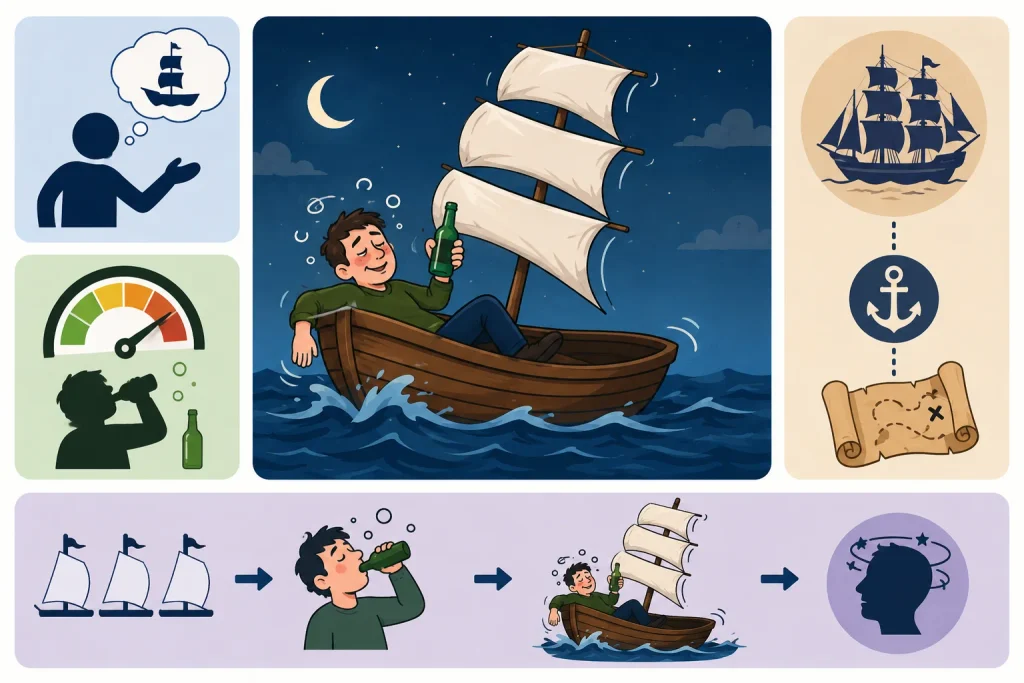
The expression “three sheets to the wind” sounds like something pulled straight from an old sailor’s handbook. Yet you can still hear it in modern English when someone wants to describe a person who has had far too much to drink.
At first glance, the phrase is puzzling. Why would sheets have anything to do with drunkenness? Why three sheets? And why are they supposed to be “to the wind”?
The answer lies in an older nautical meaning of sheet. In sailing terminology, a sheet is a rope or line used to control the position of a sail. When those lines become loose, sails can move unpredictably in the wind. That image provides the foundation for the idiom’s comparison between an unstable vessel and an unsteady, intoxicated person.
The phrase has a documented history reaching back to the early 19th century. Merriam-Webster identifies 1821 as the first known printed use of the expression in Pierce Egan’s Real Life in London. Interestingly, that early example uses the older wording “three sheets in the wind.”
This guide explores the three sheets to the wind idiom definition, its nautical roots, historical development, meaning, and modern usage. It also separates established evidence from explanations that are plausible but not certain.
What Does “Three Sheets to the Wind” Mean?
“Three sheets to the wind” means very drunk or heavily intoxicated.
When you describe someone as being three sheets to the wind, you generally mean that alcohol has affected their behavior, coordination, judgment, or ability to stay steady.
For example:
After hours at the wedding reception, Uncle Ray was three sheets to the wind.
The sentence doesn’t mean Uncle Ray literally has three pieces of fabric blowing around him. It uses an old nautical metaphor to suggest that he is unsteady and lacking control.
Merriam-Webster lists “three sheets in the wind” as a variant and defines the expression simply as “drunk.” The dictionary also notes that “three sheets to the wind” is now the more common phrasing.
Simple Definition of “Three Sheets to the Wind”
In everyday English, you can understand the idiom this way:
Three sheets to the wind = very drunk, intoxicated, or noticeably impaired by alcohol.
It usually suggests more than simply having one drink.
Someone who is tipsy might still behave normally. Someone who is three sheets to the wind is typically imagined as considerably more intoxicated.
| Expression | General meaning |
| Sober | Not affected by alcohol |
| Tipsy | Slightly affected by alcohol |
| Drunk | Clearly affected by alcohol |
| Three sheets to the wind | Very drunk or heavily intoxicated |
The boundaries aren’t scientifically precise. The idiom doesn’t measure a person’s blood alcohol concentration, number of drinks, or physical condition.
Instead, it creates a colorful picture of obvious drunkenness.
What Does the Idiom Describe?
The phrase primarily describes a person’s state of intoxication.
It can appear in several grammatical patterns:
- He was three sheets to the wind.
- She got three sheets to the wind at the party.
- They were three sheets to the wind by midnight.
- He came home three sheets to the wind.
- The entire group was three sheets to the wind.
The expression usually focuses on the person’s condition rather than the drinking itself.
That’s an important distinction.
Saying someone “drank six beers” gives you information about consumption. Saying someone “was three sheets to the wind” describes the resulting condition.
The phrase therefore works as a colorful alternative to drunk, very drunk, or heavily intoxicated.
What Does “Three Sheets to the Wind” Mean in Modern English?
Modern speakers generally understand the expression without knowing anything about sailing.
You don’t need to picture a ship before using it. The idiom has become established enough that its figurative meaning stands on its own.
If someone says:
“By the end of the celebration, Mark was three sheets to the wind.”
Most readers immediately understand that Mark was extremely intoxicated.
The nautical origin adds flavor, but it isn’t necessary for comprehension.
That is typical of idioms. Over time, an expression can become separated from the literal technical language that created it.
Consider expressions such as “hit the nail on the head” or “spill the beans.” Modern speakers don’t necessarily perform the literal actions suggested by those phrases.
“Three sheets to the wind” works the same way.
Is It Always Used to Mean “Drunk”?
In its established idiomatic sense, yes, the phrase refers to drunkenness or intoxication.
It isn’t normally used to mean merely tired, confused, careless, or physically unsteady.
However, context can make the comparison broader. A writer might use the nautical image creatively to suggest someone behaving wildly or without control. Even then, the traditional idiomatic meaning remains connected to being drunk.
For ordinary usage, the safest interpretation is:
Three sheets to the wind describes someone very drunk.
That definition matches major dictionary references and historical explanations of the expression.
Three Sheets to the Wind Meaning at a Glance
Here’s the expression in a quick reference format:
| Feature | Explanation |
| Idiom | Three sheets to the wind |
| Meaning | Very drunk or heavily intoxicated |
| Literal vocabulary | Nautical |
| “Sheet” | A rope or line used to control a sail |
| Figurative idea | An unsteady ship resembles an unsteady drunk person |
| Register | Informal |
| Tone | Often humorous or colorful |
| Older form | Three sheets in the wind |
| Modern form | Three sheets to the wind |
| Historical period | Early 19th century |
| First known printed use of the three-sheet form | 1821 |
| Common use today | Describing obvious drunkenness |
The expression is especially useful when “drunk” feels too plain.
Compare these two sentences:
He was drunk after the party.
He was three sheets to the wind after the party.
The first sentence is direct and neutral. The second is more vivid, playful, and old-fashioned.
That difference in tone explains much of the idiom’s appeal.
Literal vs. Figurative Meaning of “Three Sheets to the Wind”
The phrase becomes much easier to understand once you separate its literal nautical vocabulary from its figurative meaning.
Literally, the important word is sheet. In ordinary modern English, a sheet is usually a flat piece of material, such as a bed sheet or a sheet of paper.
In sailing, however, sheet has a specialized meaning.
A sailing sheet is a rope or line associated with controlling a sail’s position. It helps sailors adjust the sail so it can work with the wind.
The idiom takes that technical sailing concept and turns it into a metaphor for drunkenness.
What the Words Mean Literally
Let’s break the expression into its four main components:
Three — the number three.
Sheets — nautical lines used to control sails.
To — part of the established idiomatic expression.
The wind — the moving air that fills and affects sails.
Put together literally, the phrase evokes sailing equipment affected by wind.
But English speakers don’t normally interpret the entire expression literally.
The figurative meaning is what matters in conversation:
Someone is so drunk that they resemble something unstable being tossed about by the wind.
That contrast between ordinary vocabulary and specialized nautical terminology is one reason the phrase feels mysterious today.
What the Phrase Means Figuratively
The figurative comparison is based on loss of stability and control.
Imagine a sailing vessel moving through strong wind. Its sails and rigging need to be controlled carefully. If important lines become loose, the sails can flap and behave unpredictably.
Now imagine a person who has consumed enough alcohol to lose coordination.
Their movements may become:
- Unsteady
- Wobbly
- Erratic
- Poorly coordinated
- Unpredictable
- Difficult to control
The visual comparison is straightforward.
Uncontrolled sails → unstable ship → staggering movement → drunken person.
That chain helps explain why the expression survived.
It isn’t merely a random combination of nautical words. The metaphor creates a memorable image.
Why the Literal Image Seems Strange Today
The phrase sounds particularly strange if you know sheet only as a piece of fabric or paper.
A modern reader might imagine three bed sheets blowing from a clothesline.
That interpretation produces a completely different picture.
The nautical meaning changes everything.
In sailing terminology, a sheet isn’t the sail itself. It is a line used in managing the sail. Merriam-Webster specifically points out that the “sheets” in this idiom are neither bedclothes nor sails.
This distinction matters because a common explanation incorrectly treats sheets as sails.
The more accurate explanation is:
Sheets are lines associated with controlling sails.
That technical detail makes the origin much easier to follow.
How the Figurative Meaning Developed
The exact moment when sailors first made the comparison isn’t known.
That’s important because idiom explanations sometimes present a neat origin story as though historical records prove every detail. In reality, the available evidence establishes the phrase’s early use more clearly than it establishes the precise moment or mechanism by which the metaphor was invented.
The general nautical explanation is well established:
- Sheet had a nautical meaning.
- Loose sheets could affect how sails behaved.
- An uncontrolled vessel could move erratically.
- That movement could be compared with a drunken person’s unsteady behavior.
- The expression came to describe intoxication.
The historical record supports the nautical connection, but some details about why exactly the number three was chosen remain uncertain.
That distinction is worth remembering when discussing the idiom’s origin.
Why Does “Three Sheets to the Wind” Mean Drunk?
The heart of the expression is the comparison between an unstable sailing vessel and an intoxicated person.
A drunk person may have trouble walking in a straight line. A poorly controlled sailing vessel can also move unpredictably.
The metaphor turns physical instability into language.
The Connection Between a Drunk Person and a Moving Ship
Picture someone walking home after drinking far too much.
They may:
- Sway from side to side
- Stumble
- Change direction unexpectedly
- Struggle to maintain balance
- Move more slowly than normal
- Have difficulty judging where they’re going
Now picture a vessel affected by poorly controlled sails.
The vessel may not maintain its intended movement cleanly. Its motion can become irregular as wind interacts with sails that aren’t properly controlled.
That shared quality—lack of steadiness—creates the metaphor.
The person isn’t literally sailing.
Instead, the person’s body becomes comparable to a vessel that has lost control.
How Loss of Balance Relates to the Idiom
Alcohol can affect coordination, reaction time, judgment, and balance. The phrase turns those visible effects into a humorous nautical image.
Someone who is three sheets to the wind isn’t simply someone who has had a drink.
The expression traditionally implies a noticeable degree of intoxication.
That’s why it generally sounds stronger than:
- had a drink
- had a few drinks
- tipsy
- a little buzzed
It sits closer to expressions such as:
- very drunk
- plastered
- wasted
- hammered
- heavily intoxicated
The exact strength depends on context and speaker.
Why “Three Sheets” Suggests Severe Intoxication
Historical evidence gives us an especially interesting clue here.
Early versions of the expression appear with different numbers.
Phrase Finder cites an early “two sheets in the wind” example from an entry in the journal of Methodist bishop Francis Asbury, describing events from 1813. The three-sheet version appears in Pierce Egan’s Real Life in London in 1821.
A 1824 example from Catherine Ward’s The Fisher’s Daughter also contrasts being “one sheet in the wind” with getting to three.
This evidence suggests that the numbers could represent different degrees of drunkenness in historical usage.
A simplified interpretation is:
| Historical expression | Suggested condition |
| One sheet in the wind | Tipsy or mildly affected |
| Two sheets in the wind | More noticeably intoxicated |
| Three sheets in the wind | Very drunk or severely unsteady |
However, this should not be treated as an official sailor’s measurement system.
There is no evidence that sailors universally followed a standardized three-stage scale like a modern medical chart.
Instead, the surviving examples indicate that numerical variations were used figuratively.
The Nautical Image Behind the Expression
The phrase works because wind and control are central to sailing.
A sailor doesn’t simply let every sail move however it wants. Sail trim matters. Lines help manage how the sails interact with the wind.
When those controls become ineffective or loose, the vessel can become harder to manage.
The idiom turns that nautical situation into a description of human behavior.
The result is an unusually vivid metaphor:
The ship is unsteady because its sail control has gone wrong. The person is unsteady because alcohol has affected them.
That is the conceptual bridge behind “three sheets to the wind.”
Origin and History of the “Three Sheets to the Wind” Idiom
The origin of “three sheets to the wind” is nautical, but its exact development deserves a careful explanation.
The phrase belongs to the language of the sailing era, when nautical vocabulary regularly entered everyday English. Sailors, ships, ports, and maritime work influenced many English expressions.
In this case, the technical meaning of sheet eventually became part of a colorful metaphor for intoxication.
Where Did “Three Sheets to the Wind” Originate?
The expression originated in English nautical and maritime language, with the drunkenness meaning documented in the early 19th century.
The oldest known printed evidence for the exact three-sheet concept is generally associated with Pierce Egan’s 1821 work Real Life in London.
Merriam-Webster gives this as the first known use in print and quotes the historical wording:
“Old Wax and Bristles is about three sheets in the wind.”
The wording is significant because it shows that “in the wind” predates the modern “to the wind” form in the documented history of the phrase.
Early History of the Expression
The expression seems to have developed in a period when British English contained a large amount of specialized sailor slang.
That slang did not always remain at sea.
Sailors interacted with people in ports, taverns, markets, and urban communities. Maritime expressions could therefore move into general speech.
The phrase “three sheets in the wind” appears to have been part of this broader process.
Interestingly, the historical evidence doesn’t begin with “three sheets.” Earlier numerical forms exist.
Phrase Finder points to an 1813 reference, published in the Journal of Rev. Francis Asbury in 1815, involving “two sheets in the wind.” It also cites a 1824 example using both one and three sheets.
That pattern makes the history more interesting than a simple “three ropes became loose, so sailors invented the phrase” story.
The metaphor appears to have developed within a wider family of expressions involving one, two, and three sheets.
Earliest Recorded Uses of the Phrase
The following timeline provides useful historical context:
| Date | Evidence | Importance |
| 1813 | Francis Asbury’s journal entry later published in 1815 | Early “two sheets in the wind” example |
| 1821 | Pierce Egan, Real Life in London | Earliest known printed three-sheet example cited by major references |
| 1823 | Early slang-dictionary evidence | Shows the expression had entered broader slang usage |
| 1824 | Catherine Ward, The Fisher’s Daughter | Uses one and three sheets as levels of drunkenness |
| 19th century | Continued literary and slang usage | Helps establish the idiom in English |
| Modern English | “Three sheets to the wind” | Became the more familiar form |
Merriam-Webster and Phrase Finder both identify the 1821 Egan example as a key early record.
The important takeaway is that the expression was already established in written English by the early 1820s.
It almost certainly existed in spoken language before its first surviving printed examples. That’s common with slang and idioms because everyday speech is rarely recorded as completely as published writing.
How Sailors Influenced English Idioms
The sea has left a surprisingly large footprint on English.
Expressions such as “learn the ropes,” “loose cannon,” “show your true colors,” and “take the wind out of someone’s sails” demonstrate how maritime concepts can become everyday metaphors.
“Three sheets to the wind” belongs to this same linguistic tradition.
The process is simple:
technical term → sailor slang → metaphor → general expression
Once a phrase becomes familiar outside its original profession, speakers may stop thinking about the technical meaning entirely.
That’s exactly what happened with sheet.
Today, most people encountering the expression aren’t thinking about sail trim. They’re simply thinking:
That person is very drunk.
The nautical machinery remains hidden underneath the modern meaning.
Historical Evidence vs. Popular Explanations
This distinction is essential when discussing idiom origins.
There is strong evidence for:
- The phrase’s association with sailing.
- The nautical meaning of sheet.
- The expression’s meaning of drunkenness.
- The early 19th-century history of the phrase.
- The older “in the wind” wording.
- The existence of one-, two-, and three-sheet variations.
There is less certainty about:
- Exactly who coined the phrase.
- Why three became the preferred number.
- Whether sailors universally used a fixed one-to-three drunkenness scale.
- The precise physical sailing scenario behind the original metaphor.
Some explanations claim that a particular type of vessel had exactly three relevant sheets. Grammarphobia, for example, discusses one possible explanation involving a sloop with one mast, two sails, and three sheets.
Other explanations focus on the idea that several loose sheets would make a boat increasingly difficult to control.
Dictionary.com also records an alternative theory involving the vessel’s balance when different numbers of sheets are affected. It presents this as another explanation, not as an established historical fact.
So the most responsible explanation is simple:
The idiom clearly has nautical roots, but the precise reason for “three” is uncertain.
That approach keeps the history informative without turning speculation into fact.
What Does “Sheet” Mean in Sailing?
The word sheet is the key to understanding the entire expression.
In everyday English, you probably think of a sheet as paper, fabric, or bedding.
Sailors use the word differently.
A sheet is a line used to control or adjust a sail, particularly by influencing its position relative to the wind.
That specialized definition is centuries old.
A Sheet Is a Rope or Line, Not a Sail
This is one of the most important facts about the idiom.
A sheet is not the sail.
The sail is the large piece of fabric that catches the wind.
The sheet is part of the rigging used to manage that sail.
Think of the distinction like this:
| Nautical term | Basic function |
| Sail | Catches the wind |
| Sheet | Helps control the sail’s position |
| Mast | Supports the sail and rigging |
| Wind | Provides the moving air that powers the sail |
This distinction prevents one of the most common misunderstandings about the phrase.
When someone says “three sheets to the wind,” the sheets aren’t three sails flying loose.
They’re nautical lines associated with sail control.
What Sailors Used Sheets For
A sail works best when its position is adjusted to the wind.
A sheet gives the sailor a way to make that adjustment.
Depending on the sailing arrangement, tightening or easing a sheet changes the sail’s angle and helps control how it catches the wind.
That makes sheets essential to practical sailing.
If the sheet is slack when it should be controlled, the sail may move or flap rather than maintain its intended position.
The idiom takes this image of something that has escaped proper control and applies it to an intoxicated person.
How Sheets Control a Sail
The basic concept can be simplified:
Wind → Sail → Sheet → Sailor’s control
The wind pushes against the sail.
The sail converts that force into useful movement.
The sheet helps the sailor position the sail appropriately.
If the sailor adjusts the sheet, the sail’s relationship with the wind changes.
That doesn’t mean every sailing vessel has exactly three sheets. It also doesn’t mean that three loose sheets always produce one particular movement.
Sailing rigs vary considerably.
This is another reason to be cautious about overly precise explanations of the idiom’s origin.
Sheets vs. Sails vs. Other Rigging
For modern readers, these terms can easily blur together.
Here’s a useful distinction:
- Sail: the fabric or membrane that catches the wind.
- Sheet: a line used to control a sail.
- Mast: a vertical spar that supports sails and rigging.
- Rigging: the broader collection of lines, cables, and supporting equipment.
- Wind: moving air that provides the force used by a sailing vessel.
Understanding these differences makes the idiom much less mysterious.
The expression isn’t saying that three pieces of sailcloth are blowing away.
It refers to sheets, in the nautical sense, being associated with the wind.
Why Modern Readers Often Misunderstand “Sheet”
Language changes faster than technical knowledge.
Most modern speakers encounter sheet in phrases such as:
- A sheet of paper
- A bed sheet
- A sheet of metal
- A spreadsheet
Few people regularly use nautical vocabulary.
As a result, the maritime meaning can disappear while the idiom survives.
That creates a fascinating linguistic situation:
The expression remains common enough to recognize, but the technical word inside it has become unfamiliar.
This is one reason idioms can seem nonsensical when viewed literally.
The phrase preserves an older meaning that everyday English has largely moved away from.
How Loose Sheets Affect a Sailing Ship
The nautical metaphor depends on the idea of control.
A sailing vessel relies on its rigging and sails working together. Sheets help sailors manage sail position. When those lines aren’t properly controlled, the sails may move in undesirable ways.
What Happens When a Sheet Becomes Loose?
A loose sheet can allow the associated sail to move differently from its intended position.
The exact result depends on:
- The type of vessel
- The sail involved
- Wind direction
- Wind strength
- Rigging arrangement
- How much slack exists
- What the sailor is trying to accomplish
So it would be inaccurate to claim that every loose sheet automatically makes a ship spin wildly.
Sailing is more complicated than that.
The idiom doesn’t require a perfectly literal mechanical sequence.
It needs only the broader image of sail control becoming compromised.
How an Uncontrolled Sail Changes a Ship’s Movement
Sails aren’t passive decorations.
They interact with wind to create forces that affect the vessel’s movement.
If a sail isn’t positioned as intended, its aerodynamic behavior changes.
That can affect the boat’s:
- Direction
- Speed
- Balance
- Handling
- Stability
A sailor therefore needs to manage the sails rather than simply let them react randomly to every gust.
The idiom exaggerates this loss of control for comic effect.
Why a Ship With Loose Sheets Can Become Unsteady
A vessel’s movement depends on the combined effects of its sails, hull, rudder, wind, and water.
When sail control becomes poor, maintaining the intended course can become more difficult.
That’s the conceptual foundation of the metaphor.
A very drunk person may also lose the ability to maintain a steady course.
Instead of walking directly from point A to point B, they may wander, stumble, or sway.
The comparison is memorable because both situations involve compromised control.
The Link Between Unsteady Sailing and Drunkenness
The connection can be summarized in one sentence:
A poorly controlled ship can move unpredictably, much like a heavily intoxicated person can move unsteadily.
That is the essence of the metaphor.
The phrase isn’t fundamentally about alcohol and sailing separately.
It’s about using an image of unstable sailing to describe unstable human behavior caused by intoxication.
A Simple Nautical Explanation
If you want to explain the idiom to someone in just a few lines, this version works well:
“Three sheets to the wind” is an old nautical expression meaning very drunk. A sheet is a line used to control a sail. The phrase compares loose or poorly controlled sail lines and the resulting instability with the unsteady behavior of someone who has had too much alcohol.
That explanation captures the essential history without claiming more certainty than the evidence allows.
Why “Three Sheets to the Wind” Became Such a Memorable Idiom
The strongest idioms often create a picture in your mind.
“Three sheets to the wind” certainly does that.
You can almost see an old sailing vessel struggling against the wind while its sails move unpredictably. Then the image shifts to a person leaving a tavern, trying—and failing—to walk in a straight line.
That visual connection gives the phrase its staying power.
It also explains why the idiom can sound humorous even though its literal subject is drunkenness.
Instead of stating:
“He was extremely drunk.”
a speaker can say:
“He was three sheets to the wind.”
The second version has character, history, and imagery.
It feels like a little piece of maritime history embedded in everyday English.
The phrase also demonstrates how specialized vocabulary can escape its original field. A technical sailing word became part of a popular idiom, and the idiom eventually became understandable even to people with no sailing experience.
That journey—from rope on a sailing vessel to a metaphor for drunkenness—is what makes the three sheets to the wind idiom definition more interesting than a simple dictionary entry.
The expression has survived for roughly two centuries because its meaning is easy to recognize once the underlying image becomes clear: someone who is very drunk may be as unsteady and difficult to control as a vessel whose sail handling has gone badly wrong.
What the Historical Record Actually Tells Us
The evidence gives us several firm points:
- The drunkenness meaning was established by the early 19th century.
- A “two sheets in the wind” example is recorded from an entry concerning 1813, published later.
- The three-sheet form appears in Pierce Egan’s Real Life in London in 1821.
- The older form was “three sheets in the wind.”
- “Three sheets to the wind” became the more common modern form.
- Sheet has a genuine nautical meaning involving sail control.
- Historical examples suggest that different numbers could represent different degrees of drunkenness.
- The exact reason three became the standard number isn’t completely settled.
Those facts provide a solid foundation for understanding the expression without relying on an overly neat origin story.
And once the nautical meaning of sheet is clear, the strange-looking phrase starts to make perfect sense.
The next part of the article can build from this foundation by examining why “three” appears in the expression, the historical one-sheet/two-sheet/three-sheet progression, the difference between “three sheets in the wind” and “three sheets to the wind,” and how the wording evolved into the modern idiom.
What Does “Sheet” Mean in Sailing?
The word “sheet” holds the key to understanding the strange wording of “three sheets to the wind.” In everyday American English, a sheet usually means a piece of paper, fabric, or bedding. In sailing terminology, however, a sheet is a line used to control the position or trim of a sail.
This nautical meaning is much older than the modern idiom. A sheet is attached near the lower corner of a sail and allows a sailor to adjust how the sail sits in relation to the wind. It isn’t the sail itself. Merriam-Webster specifically distinguishes the nautical sheet from both a bed sheet and a sail.
That distinction matters because a common explanation of the idiom gets this detail wrong. The phrase doesn’t literally mean that three sails are blowing around in the wind. It refers to the lines that help control those sails.
A Sheet Is a Rope or Line, Not a Sail
A simple way to remember the difference is:
The sail catches the wind. The sheet helps control the sail.
A sailor can adjust a sheet to change the sail’s position. That adjustment affects how the sail interacts with the wind and, consequently, how the vessel handles.
| Nautical term | Basic meaning |
| Sail | Fabric designed to catch and use wind |
| Sheet | Line used to control or trim a sail |
| Mast | Vertical support for sails and rigging |
| Rigging | System of lines and equipment used to support and control the sails |
| Wind | Moving air that provides the force for sailing |
This vocabulary explains why the expression sounds so odd to modern readers. The phrase preserves a specialized maritime meaning of sheet that most people rarely encounter outside sailing.
What Sailors Used Sheets For
A sailing vessel depends on precise control.
The wind doesn’t simply push the boat in one convenient direction. Sailors adjust their sails according to the wind’s direction, strength, and the course they want to follow. Sheets provide part of that control system.
When a sheet is properly handled, the associated sail can be positioned appropriately. When a sheet becomes excessively slack or otherwise fails to control the sail, the sail can move or flap rather than remain properly trimmed.
That loss of control forms the foundation of the idiom.
The expression takes a technical sailing problem and turns it into a picture of human instability.
How Sheets Control a Sail
The relationship can be simplified like this:
Wind → Sail → Sheet → Sailor’s control
The wind supplies the force. The sail interacts with that force, while the sheet helps the sailor manage the sail’s position.
If the sheet is eased or tightened, the sail’s position changes. The precise mechanics vary according to the vessel and its rig, so explanations that describe one universal movement for every loose sheet should be treated cautiously.
The important point for the idiom is broader:
Poorly controlled sheets can contribute to poorly controlled sailing.
That idea creates the comparison with a person whose movements become difficult to control after excessive drinking.
How Loose Sheets Affect a Sailing Ship
The traditional explanation of “three sheets to the wind” imagines sheets becoming loose and being affected by the wind. The resulting sail movement can make the vessel harder to control.
Phrase Finder describes the metaphor as a situation in which loose sheets allow sails to flap, causing the boat to lurch around like a drunken sailor. Collins similarly explains the idiom through the comparison between a staggering drunk person and a ship whose sails have become difficult to control.
The image is easy to understand once the nautical terminology is clear.
What Happens When a Sheet Becomes Loose?
A loose sheet doesn’t automatically produce one identical result on every boat.
The outcome depends on the:
- Type of vessel
- Type and position of the sail
- Wind direction
- Wind strength
- Rigging arrangement
- Amount of slack
- Sailor’s intended course
That’s why the safest explanation isn’t that three loose sheets always make a ship behave in one exact way.
Instead, the phrase uses the general idea of sails becoming uncontrolled and a vessel becoming difficult to handle.
That broader explanation fits both the nautical terminology and the figurative meaning.
How an Uncontrolled Sail Changes a Ship’s Movement
Sails influence the forces acting on a vessel. Their position relative to the wind matters.
If sail control deteriorates, the vessel may no longer respond as intended. It can become harder to maintain a steady course or predictable movement.
Now compare that with someone who has consumed too much alcohol.
A heavily intoxicated person may:
- Stagger while walking
- Sway from side to side
- Lose balance
- Change direction unexpectedly
- Misjudge movements
- Struggle to remain coordinated
The parallel is obvious.
An uncontrolled vessel can move unpredictably, just as a heavily intoxicated person can move unsteadily.
That is the central metaphor behind the expression.
Why a Ship With Loose Sheets Can Seem “Drunk”
The word “drunk” is especially effective in this metaphor because drunkenness has historically been associated with visible loss of balance and coordination.
Imagine a person trying to walk down a straight path after drinking heavily. Their body may veer one way, then another.
Now imagine a vessel that isn’t being properly controlled by its sails.
Both images suggest:
movement without reliable control.
The idiom compresses that entire image into four words.
Three sheets to the wind = very drunk and noticeably unsteady.
Why Are There “Three Sheets” in the Idiom?
The number three is one of the most debated parts of the expression.
It’s tempting to look for one precise explanation.
Historical evidence gives us clues, but it doesn’t justify treating any single explanation as certain.
The Meaning of One Sheet, Two Sheets, and Three Sheets
Early examples indicate that expressions involving one, two, and three sheets were used in connection with varying degrees of drunkenness.
Phrase Finder cites an early example involving “two sheets in the wind” from Rev. Francis Asbury’s journal. The entry concerns September 26, 1813, and was published in The Journal of Rev. Francis Asbury in 1815.
A later literary example provides an even clearer progression.
Catherine Ward’s The Fisher’s Daughter, published in 1824, describes someone who might move from being “one sheet in the wind” toward three. The context supports the idea of increasing intoxication.
This gives us a useful historical picture:
| Expression | Historical implication |
| One sheet in the wind | Mildly intoxicated or tipsy |
| Two sheets in the wind | More noticeably drunk |
| Three sheets in the wind | Very drunk or severely unsteady |
However, this wasn’t a standardized medical or nautical measurement.
Did Sailors Really Use a Three-Level Drunkenness Scale?
Probably not in the strict, universal sense that modern readers might imagine.
Historical examples show that different numbers were associated with different states of drunkenness. They don’t prove that every sailor, tavern, or port followed an official scale.
This distinction is important.
It is reasonable to say:
Historical usage suggests a progression from one sheet to three sheets as drunkenness increased.
It is not reasonable to present the system as though sailors everywhere officially agreed that one sheet equaled one exact level of intoxication.
The phrase was slang, not a scientific measurement.
Why “Three” Became the Familiar Number
Several explanations have been proposed.
One popular explanation imagines a sailing vessel with several sails whose sheets have become loose. If multiple sheets are uncontrolled, the vessel could become increasingly difficult to manage. Merriam-Webster presents this traditional explanation in connection with a three-sailed vessel whose loose sheets would leave the boat wallowing much like a staggering drunk.
Another explanation focuses on the balance of the vessel and suggests that three sheets could create an especially unstable arrangement. Dictionary.com presents this as an alternative theory rather than settled historical fact.
The safest conclusion is therefore:
“Three” became established as the conventional number, but the exact reason remains uncertain.
That is more accurate than claiming one specific sailing configuration definitively created the idiom.
“Three Sheets in the Wind” vs. “Three Sheets to the Wind”
Both versions are legitimate.
The older documented form is “three sheets in the wind.” The modern expression “three sheets to the wind” is now more familiar.
Merriam-Webster lists the two forms as variants, while historical evidence shows that the “in the wind” wording appeared first.
Which Version Came First?
The historical record points to:
Three sheets in the wind → three sheets to the wind
The earliest known printed three-sheet example cited by Merriam-Webster comes from Pierce Egan’s Real Life in London, published in 1821:
“Old Wax and Bristles is about three sheets in the wind.”
That example is particularly valuable because it establishes both the drunkenness meaning and the older preposition.
Earlier evidence also exists for the two-sheet version. Phrase Finder identifies the Asbury example concerning 1813 as an earlier printed manifestation of the broader expression.
Are “In” and “To” Different in Meaning?
In modern usage, there is essentially no difference in meaning.
Both expressions mean that someone is very drunk.
| Form | Meaning | Modern status |
| Three sheets in the wind | Very drunk | Older form; still correct |
| Three sheets to the wind | Very drunk | More common modern form |
You can therefore use either expression when discussing someone who is heavily intoxicated.
The choice is mostly about style, familiarity, and historical flavor.
Why Did “To the Wind” Become More Common?
The precise transition isn’t completely documented.
The older expression is clearly attested as “in the wind,” while “to the wind” eventually became the dominant modern wording. Phrase Finder and Merriam-Webster both recognize this historical relationship.
One possibility is that speakers gradually reshaped the expression because “to the wind” sounds intuitively descriptive of something being exposed or released to the wind.
But that should be treated as a linguistic possibility rather than a proven explanation.
The important historical fact is simpler:
“In the wind” is older, while “to the wind” is now the more familiar version.
How the Phrase Changed Over Time
The history of “three sheets to the wind” isn’t a single straight line. Different numerical forms and slightly different wording appeared during the early period of its development.
The surviving evidence shows that the phrase was already part of informal English by the early 19th century.
Historical Evolution of the Expression
A simplified timeline looks like this:
| Period | Development |
| Early 1800s | Numerical “sheets in the wind” expressions appear in written records |
| 1813 | An Asbury journal entry records “two sheets in the wind” |
| 1821 | Pierce Egan records “three sheets in the wind” |
| 1824 | Catherine Ward uses one and three sheets to suggest degrees of drunkenness |
| 19th century onward | The expression becomes established as slang for drunkenness |
| Modern English | “Three sheets to the wind” becomes the familiar form |
The chronology matters because it challenges the idea that the expression suddenly appeared fully formed as a fixed three-sheet saying.
Instead, the historical record suggests variation before standardization.
From Sailors’ Language to Everyday English
Nautical vocabulary has often traveled beyond the docks and ships where it originated.
Sailors interacted with travelers, merchants, workers, soldiers, tavern keepers, and urban communities. Their vocabulary naturally entered broader speech.
Once an expression became recognizable outside maritime settings, speakers no longer needed to understand every technical detail behind it.
That appears to be what happened with this idiom.
A person could use “three sheets in the wind” without knowing precisely how a sheet functioned on a sailing vessel.
Eventually, the expression became a general term for drunkenness.
How the Wording Became Fixed
Idioms often stabilize through repetition.
One person uses a phrase. Another hears it. Writers reproduce it. Speakers modify it slightly. Eventually, one form becomes more familiar than competing variations.
That process appears to have happened here.
The historical family included expressions such as:
- A sheet in the wind
- One sheet in the wind
- Two sheets in the wind
- Three sheets in the wind
- Three sheets to the wind
Only some of those forms remained common.
Today, “three sheets to the wind” is the version most readers are likely to recognize immediately.
Levels of Intoxication: One, Two, and Three Sheets to the Wind
The old numerical variations deserve special attention because they reveal how the idiom may have worked in earlier slang.
One Sheet to the Wind
Historically, one sheet in the wind could indicate that someone was only somewhat affected by alcohol.
Think:
tipsy, buzzed, or mildly drunk.
The expression could therefore function as a playful alternative to saying someone had begun to feel the effects of drinking.
It isn’t normally used this way in contemporary English.
If someone today says:
“He’s one sheet to the wind.”
listeners may understand the joke, but the familiar modern idiom is three sheets to the wind.
Two Sheets to the Wind
The two-sheet version appears in early evidence and suggests a stronger degree of intoxication.
The Asbury example from the 1813 journal entry is particularly interesting because it shows the expression in real historical prose rather than in a modern dictionary-created example.
Still, it would be misleading to assign an exact modern alcohol level to “two sheets.”
Historical slang didn’t operate like a blood-alcohol calculator.
Three Sheets to the Wind
By the early 19th century, three sheets in the wind had become associated with pronounced drunkenness.
That meaning is the one that survived.
Today, saying someone is three sheets to the wind normally suggests that the person is very drunk, perhaps visibly staggering, speaking unclearly, behaving unusually, or otherwise showing obvious signs of intoxication.
The expression remains figurative.
It does not tell you how many drinks someone consumed.
It does not indicate a specific blood alcohol concentration.
And it does not provide a medically meaningful measure of impairment.
Were These Levels Ever Official?
No.
The one-, two-, and three-sheet expressions belong to informal slang, not an official system of intoxication.
Historical evidence supports the existence of these variations, but it doesn’t establish a universal rulebook.
This is a crucial distinction for anyone researching the three sheets to the wind idiom definition.
Historical usage is evidence of language, not proof of a standardized measurement system.
Why the Scale Shouldn’t Be Treated as a Fixed Rule
It’s tempting to write:
- One sheet = slightly drunk
- Two sheets = moderately drunk
- Three sheets = extremely drunk
That summary is useful as a rough historical guide, but it shouldn’t be presented as an exact formula.
The available evidence is too limited for that level of precision.
What we can say confidently is that different numbers were used historically, and the three-sheet expression became associated with a high degree of drunkenness.
That is enough to explain why the modern phrase works.
“Three Sheets in the Wind” and “Three Sheets to the Wind” Today
The two versions now coexist, but they don’t have equal familiarity.
“Three sheets to the wind” is the form most commonly recognized in contemporary usage.
“Three sheets in the wind” sounds more historical or old-fashioned to many readers, although dictionaries still recognize it.
Neither version changes the underlying meaning.
If a character says:
“By midnight, he was three sheets in the wind.”
the character is saying the same basic thing as:
“By midnight, he was three sheets to the wind.”
Both describe substantial drunkenness.
The difference lies mainly in historical wording and modern familiarity.
The journey from in to to also demonstrates something important about idioms: an expression can change its wording while preserving its meaning.
That flexibility is one reason old phrases continue to survive.
The sailing terminology may have become unfamiliar, the preposition may have shifted, and the original slang context may have faded. Yet the core image remains remarkably clear:
A person who is three sheets to the wind is imagined as being as unsteady and difficult to control as something being tossed about by the wind.
How to Use “Three Sheets to the Wind” Correctly
Knowing the meaning of ” three sheets to the wind “ is only half the battle. The next step is understanding how the idiom actually behaves in a sentence.
The expression normally functions as a predicative adjective phrase. In other words, it commonly follows a linking verb such as be, become, or get and describes someone’s condition.
The most natural pattern is:
Subject + be + three sheets to the wind
For example:
After the party, Daniel was three sheets to the wind.
The phrase can also appear after verbs such as get or become:
He got three sheets to the wind after several hours at the bar.
By midnight, they had become three sheets to the wind.
Although the expression is flexible, it almost always describes a noticeably drunk person.
Common Sentence Patterns
These structures cover most everyday uses:
| Pattern | Example |
| Subject + was + idiom | She was three sheets to the wind. |
| Subject + is + idiom | He is three sheets to the wind. |
| Subject + got + idiom | They got three sheets to the wind. |
| Subject + had been + idiom | He had been three sheets to the wind for hours. |
| Subject + came + idiom | She came home three sheets to the wind. |
| Subject + looked + idiom | He looked three sheets to the wind. |
The most natural construction is usually the simplest one:
“He was three sheets to the wind.”
There is no need to force the idiom into complicated grammatical structures.
“Three Sheets to the Wind” as a Predicate Description
The expression generally works as a subject complement after a linking verb.
Consider:
Megan was three sheets to the wind.
Here, three sheets to the wind describes Megan’s condition.
The sentence doesn’t mean Megan literally possessed three sheets. The phrase acts as an idiomatic description.
You can also use it with descriptive adverbs:
By the end of the night, he was completely three sheets to the wind.
However, this can sound slightly redundant because the idiom already implies substantial intoxication.
In most cases, “was three sheets to the wind” is enough.
Using the Idiom With “Be” and “Get”
Be is the safest verb because it describes an existing condition.
Tom was three sheets to the wind.
Get emphasizes the process of becoming intoxicated.
Tom got three sheets to the wind after the celebration.
There’s a subtle difference:
- Was three sheets to the wind = describes the condition.
- Got three sheets to the wind = emphasizes becoming very drunk.
The second construction is informal and conversational, which fits the idiom’s overall register.
Using the Phrase in Past, Present, and Future Contexts
The idiom can work across different verb tenses.
Past:
After dinner, Jake was three sheets to the wind.
Present:
He’s three sheets to the wind already.
Future:
By the end of the bachelor party, someone will probably be three sheets to the wind.
Present perfect:
She has been three sheets to the wind since midnight.
Past perfect:
He had been three sheets to the wind before the police arrived.
The idiom itself doesn’t change.
The surrounding verb carries the tense.
When the Idiom Sounds Natural
The expression works best when the context is:
- Informal
- Conversational
- Humorous
- Narrative
- Character-driven
- Social
- Lighthearted
For example:
By the time the wedding band played its final song, half the guests were three sheets to the wind.
That sentence sounds natural because the colorful idiom matches the casual situation.
The phrase can also work well in fiction because it immediately gives the reader a picture of someone’s condition.
When a Simpler Word Like “Drunk” Works Better
Sometimes drunk is simply the better choice.
If you’re writing a medical, legal, academic, or highly formal document, three sheets to the wind may sound too casual.
Compare:
The driver appeared three sheets to the wind.
with:
The driver appeared significantly impaired.
The second sentence is more appropriate for formal reporting because it avoids slang and ambiguity.
Likewise:
The employee was three sheets to the wind during the meeting.
Sounds conversational and potentially judgmental.
A professional report would generally use more precise wording.
The rule is simple:
Use the idiom when tone and imagery matter. Use a neutral term when precision and formality matter more.
“Three Sheets to the Wind” Example Sentences
Examples make the three sheets to the wind idiom definition easier to understand because they show how the expression behaves in real contexts.
Examples in Casual Conversation
“Where’s Mike?”
“He’s outside, three sheets to the wind and telling everyone the same story.”
This example gives the phrase a humorous, conversational quality.
Another example:
By 11 p.m., Chris was three sheets to the wind and couldn’t remember where he had parked.
Here, the surrounding details reinforce the meaning.
A third example:
Sarah wasn’t just tipsy. She was three sheets to the wind.
This sentence deliberately contrasts mild intoxication with heavy drunkenness.
Examples About Parties and Drinking
After the birthday celebration, several guests were three sheets to the wind.
He promised he would take it easy, but he ended up three sheets to the wind before midnight.
The bartender noticed that the customer was three sheets to the wind and stopped serving him.
These examples show that the idiom can describe different situations without changing its fundamental meaning.
Examples in Storytelling
The phrase works especially well in narrative writing because it can create a vivid character impression.
When the captain returned to the tavern, he found the first mate three sheets to the wind and singing an old sea song.
Notice how the nautical vocabulary creates an intentional stylistic effect.
The writer doesn’t need to explain the phrase. The surrounding scene makes its meaning clear.
Another example:
He stumbled through the doorway, three sheets to the wind, while his friends struggled to keep straight faces.
The idiom contributes both meaning and tone.
Examples With Different Verb Tenses
Past tense:
The sailors were three sheets to the wind after the long celebration.
Present tense:
He’s three sheets to the wind and still ordering another round.
Future tense:
Give them another hour, and they’ll be three sheets to the wind.
Past perfect:
By the time we arrived, everyone had been three sheets to the wind for hours.
Conditional:
If he keeps drinking at that pace, he’ll be three sheets to the wind before dinner ends.
These examples show that the phrase is grammatically adaptable.
Humorous Examples
Because the expression already has a playful nautical image, it often appears in humorous writing.
After three rounds of karaoke, Dave was three sheets to the wind and convinced he sounded like a rock star.
By midnight, Grandpa was three sheets to the wind and giving the DJ song requests from 1987.
She arrived three sheets to the wind and somehow still managed to win the trivia contest.
The humor comes from the contrast between the serious-looking nautical phrase and the ordinary social situation.
Is “Three Sheets to the Wind” Formal or Informal?
“Three sheets to the wind” is an informal idiom.
It belongs comfortably in casual conversation, fiction, humorous writing, and informal storytelling.
It doesn’t usually belong in highly formal communication where precision matters.
The Idiom’s Tone and Register
The phrase generally sounds:
- Informal
- Colloquial
- Colorful
- Playful
- Humorous
- Slightly old-fashioned
That last quality is worth noting.
Although the idiom remains recognizable, its nautical vocabulary gives it an old-fashioned flavor. Saying someone is three sheets to the wind can sound more theatrical than simply saying they are drunk.
This makes the expression particularly useful when a writer wants to add personality.
Using It in Everyday Conversation
In casual speech, the idiom can sound perfectly natural:
“Was Paul okay last night?”
“Not really. He was three sheets to the wind.”
The expression communicates the idea without sounding clinical.
It can also soften the directness of the word drunk.
However, context matters. Calling someone three sheets to the wind is still describing them as significantly intoxicated.
Using It in Professional or Workplace Communication
Professional writing usually calls for greater precision.
A workplace email might say:
The employee appeared impaired during the event.
rather than:
The employee was three sheets to the wind.
The second sentence is colorful but informal.
It could also sound mocking or dismissive if the situation involves a serious incident.
That doesn’t mean the idiom can never appear in professional writing. A columnist, novelist, journalist, or creative writer may use it intentionally.
The key is genre and purpose.
Using It in Academic Writing
Academic writing generally favors precise terminology over colorful idioms.
Instead of:
The participants were three sheets to the wind.
A formal paper would likely describe the participants as:
heavily intoxicated
or use whatever precise terminology fits the study.
The idiom isn’t grammatically wrong in academic prose. It simply doesn’t match the expected register in most scholarly contexts.
Using It in Fiction and Creative Writing
Fiction is where the expression can really shine.
A novelist might write:
The old fisherman stumbled onto the pier, three sheets to the wind but still determined to cast one more line.
The phrase immediately establishes character, mood, and setting.
Because the idiom has maritime roots, it can also work particularly well in stories involving:
- Sailors
- Fishermen
- Coastal towns
- Taverns
- Historical settings
- Adventure stories
- Comedy
- Period fiction
In these contexts, the idiom can feel natural rather than decorative.
Synonyms and Similar Expressions for “Three Sheets to the Wind”
The English language has a remarkably large vocabulary for describing drunkenness.
Some expressions are neutral. Others are humorous, informal, old-fashioned, or strongly colloquial.
The best choice depends on how drunk the person is, who you’re speaking to, and what tone you want.
Common Synonyms for “Drunk”
Straightforward alternatives include:
- Drunk
- Intoxicated
- Impaired
- Under the influence
- Inebriated
- Boozy
- Buzzed
- Tipsy
These words aren’t perfect equivalents.
For example, tipsy usually suggests mild intoxication, while three sheets to the wind generally suggests much heavier drunkenness.
Idioms That Mean Very Drunk
More colorful alternatives include:
- Plastered
- Wasted
- Hammered
- Smashed
- Blotto
- Loaded
- Sloshed
- Fried in some informal contexts
These expressions vary by region, generation, and social setting.
Some may sound stronger or rougher than three sheets to the wind.
“Tipsy” vs. “Three Sheets to the Wind”
These expressions aren’t interchangeable in every situation.
Tipsy usually suggests a person has consumed enough alcohol to feel its effects but isn’t necessarily severely impaired.
Three sheets to the wind paints a much stronger picture.
Compare:
Lisa was a little tipsy after dinner.
with:
Lisa was three sheets to the wind after the party.
The first suggests mild intoxication.
The second suggests substantial drunkenness.
“Wasted,” “Hammered,” and Other Informal Terms
Words such as wasted, hammered, and smashed are strongly informal.
They can convey heavy intoxication, but their tone is generally more modern and blunt than the nautical idiom.
| Expression | General strength | Tone |
| Tipsy | Mild | Casual |
| Buzzed | Mild to moderate | Casual |
| Drunk | Moderate to strong | Neutral |
| Inebriated | Variable | Formal |
| Three sheets to the wind | Strong | Humorous/idiomatic |
| Plastered | Strong | Informal |
| Hammered | Strong | Very informal |
| Wasted | Strong | Very informal |
| Heavily intoxicated | Strong | Formal/neutral |
These aren’t scientific categories. They simply show how the expressions tend to function in ordinary language.
Choosing the Right Expression for Your Audience
Think about tone before vocabulary.Use tipsy when the person is only mildly affected.Use drunk when you want a straightforward description.Use intoxicated or impaired when the context calls for neutral or formal language.Use three sheets to the wind when you want a colorful, conversational expression.Use stronger slang only when the audience and context make it appropriate.
Three Sheets to the Wind vs. Other Drunkenness Idioms
Comparing related expressions can clarify exactly what makes this idiom distinctive.
Three Sheets to the Wind vs. Tipsy
Tipsy suggests mild intoxication.
Three sheets to the wind suggests much more noticeable drunkenness.
After one glass of wine, she was slightly tipsy.
After the long celebration, she was three sheets to the wind.
The difference is primarily one of degree and tone.
Three Sheets to the Wind vs. Plastered
Plastered is modern, informal slang for being very drunk.
Three sheets to the wind is also informal, but it sounds more colorful and old-fashioned.
He was plastered after the party.
He was three sheets to the wind after the party.
Both can describe severe drunkenness.
The second carries a stronger sense of imagery.
Three Sheets to the Wind vs. Wasted
Wasted is highly informal and commonly used to describe extreme intoxication.
It can sound blunt.
Three sheets to the wind sounds more playful and indirect.
That makes the nautical expression a better choice when you want to describe drunkenness without relying on modern slang.
Three Sheets to the Wind vs. Under the Influence
Under the influence is considerably more neutral.
It can also be broader because it doesn’t necessarily specify alcohol. Depending on context, it can refer to impairment from other substances.
Three sheets to the wind, by contrast, traditionally points specifically toward drunkenness.
That difference matters in formal or legal contexts.
Choosing the Best Expression
A useful rule is:
Match the expression to the level of formality and the degree of intoxication you want to communicate. If you’re writing a humorous story, the nautical idiom can add personality.If you’re writing a formal report, choose a precise neutral term.If you’re chatting with friends, almost any informal expression may work, depending on the audience.
Common Mistakes and Misunderstandings
The unusual wording creates several predictable mistakes.
Thinking “Sheets” Means Bed Sheets
This is probably the most obvious misunderstanding.
Modern English strongly associates sheet with bedding and paper.
But in this idiom, sheet has a nautical meaning.
It’s a line used to control a sail.
Understanding that one detail makes the phrase much easier to remember.
Confusing Sheets With Sails
A second common error is assuming that the phrase refers to three sails.
It doesn’t.
A sail is the surface that catches the wind.
A sheet is a line associated with controlling that sail.
This distinction is central to the nautical explanation of the idiom.
Assuming the Idiom Literally Describes a Ship
The phrase is not normally used to describe an actual vessel.
If someone says:
“John is three sheets to the wind.”
they aren’t giving you a nautical report.
They’re describing John’s drunken condition.
The sailing image is metaphorical.
Treating “Three Sheets” as a Precise Measurement of Alcohol
This is another mistake.
There is no legitimate conversion such as:
Three sheets = exactly X drinks.
The idiom is not a medical or scientific measurement.
Historical references to one, two, and three sheets may suggest degrees of intoxication, but they don’t establish a standardized scale.
Using the Idiom for Someone Who Is Only Slightly Tipsy
You can use the expression humorously for someone who has barely had anything to drink, but that would be an exaggeration.
The conventional meaning suggests substantial drunkenness.
If someone has had half a glass of wine, tipsy or slightly buzzed would usually fit better.
Using the Expression in a Formal Context
The phrase isn’t incorrect, but it can sound too casual.
Consider your audience.
For example, a novel can comfortably say:
The mayor was three sheets to the wind at the banquet.
A formal incident report would probably choose:
The mayor appeared significantly intoxicated at the banquet.
The second version is more direct and professional.
Is “Three Sheets to the Wind” Offensive?
Generally, the idiom itself is not considered an offensive expression.
It’s an old, humorous way of describing drunkenness.
However, that doesn’t mean it is appropriate in every situation.
Why the Expression Is Usually Humorous
The phrase uses an exaggerated nautical image.
It doesn’t contain a slur or inherently derogatory term.
Its humor comes from comparing a drunk person’s instability with a sailing vessel affected by wind and poorly controlled sail lines.
That unusual comparison gives the phrase its playful quality.
When the Phrase Could Sound Insensitive
Context can change how any description of intoxication is received.
Calling someone three sheets to the wind might sound harmless among friends discussing a silly party.
It could sound disrespectful if you’re discussing:
- A serious alcohol-related incident
- An addiction problem
- A medical emergency
- A workplace violation
- A traumatic event
- Someone who was harmed while intoxicated
In those circumstances, neutral language is usually more appropriate.
Is It Appropriate to Describe Someone as Drunk?
That depends on the setting and your relationship with the person.
If you’re telling a lighthearted story about a fictional character, the expression can work perfectly.
If you’re describing a real person’s serious condition, be more careful.
Language doesn’t exist separately from context.
A phrase that sounds amusing in one setting can sound dismissive in another.
Choosing a More Neutral Alternative
For sensitive situations, alternatives include:
- Intoxicated
- Heavily intoxicated
- Impaired
- Under the influence
- Showing signs of intoxication
These terms are more suitable when accuracy and neutrality matter.
“Three Sheets to the Wind” in American and British English
The expression has strong historical connections with British maritime and slang culture, but modern speakers in both American and British English can recognize it.
Its historical development occurred during a period when British English had extensive maritime influence. The phrase then spread into broader English usage.
How Common Is the Idiom in American English?
American readers generally recognize “three sheets to the wind” as a colorful way to say very drunk.
It often appears in:
- Fiction
- Humor
- Informal conversation
- Newspaper writing
- Essays
- Historical writing
- Pop-culture dialogue
It isn’t necessarily the first expression an American speaker would choose.
Words such as drunk, wasted, or hammered may be more common in casual modern speech.
The nautical idiom has a more distinctive flavor.
Use in British English
The phrase also fits naturally within the broader British tradition of nautical and drinking-related slang.
British English has preserved many maritime expressions that originated in earlier periods of seafaring.
That doesn’t mean every British speaker uses three sheets to the wind regularly.
Familiarity varies by generation, region, and personal vocabulary.
Regional Differences in Familiarity
Idioms can be understood without being frequently used.
Someone may know exactly what three sheets to the wind means but rarely say it.
Another speaker might use it because they enjoy old-fashioned expressions.
Still another might prefer modern slang.
This makes frequency different from comprehension.
Recognizable does not necessarily mean common in everyday speech.
Is the Meaning the Same Across English Varieties?
Yes.
The central meaning remains:
very drunk or heavily intoxicated.
The phrase doesn’t acquire a completely different meaning simply because the speaker uses American or British English.
The main variation lies in frequency, tone, and familiarity, not the basic definition.
Is “Three Sheets to the Wind” Still Used Today?
Yes, although it has a distinctly idiomatic and somewhat old-fashioned flavor.
The expression survives because it is vivid.
Modern speakers have plenty of alternatives for drunk, yet three sheets to the wind offers something those alternatives don’t: a memorable metaphor with a historical backstory.
Modern Usage of the Idiom
Today, you’re most likely to encounter it in contexts where writers want language to feel:
- Humorous
- Colorful
- Folksy
- Nautical
- Old-fashioned
- Dramatic
- Playfully exaggerated
It may be less common in ordinary conversation than simpler words such as drunk.
But uncommon doesn’t mean obsolete.
An idiom can remain alive precisely because it offers a distinctive tone.
Where You’re Most Likely to See It
Look for the phrase in:
- Novels
- Short stories
- Opinion writing
- Humorous articles
- Informal blogs
- Dialogue
- Historical fiction
- Maritime writing
- Descriptions of parties or celebrations
It’s particularly effective when a writer wants to avoid repeating drunk several times.
Use in Conversation and Informal Writing
In casual conversation, the phrase can be used for comic effect:
“How was the reunion?”
“Fun. By the end, everyone was three sheets to the wind.”
The expression sounds natural because the setting is informal.
It can also make written dialogue feel more distinctive.
A character who frequently uses old-fashioned idioms might say:
“The whole crew was three sheets to the wind before the evening was over.”
That line tells readers something about the character as well as the situation.
Use in Newspapers, Books, and Online Writing
Writers can use the phrase when they want to make prose more colorful.
However, style guides and editorial standards vary.
A news report about a serious drunk-driving incident would generally favor precise language such as intoxicated rather than a humorous idiom.
A humorous column about a chaotic office party might choose three sheets to the wind precisely because it adds personality.
Again, purpose determines appropriateness.
Why Nautical Idioms Still Survive
Nautical idioms have an advantage that purely technical terms often lack.
They create strong images.
Words such as sail, wind, anchor, rope, and ship immediately suggest movement and danger. That makes them useful metaphors even for people who have never sailed.
Three sheets to the wind survives because its image remains understandable after the technical details have faded.
Quick Comparison
When you’re choosing between related terms, this quick guide can help:
| If you mean… | Better choice |
| Slightly affected by alcohol | Tipsy |
| Mildly intoxicated | Buzzed |
| Clearly drunk | Drunk |
| Very drunk, informal | Three sheets to the wind |
| Very drunk, modern slang | Wasted/hammered/plastered |
| Intoxicated in formal writing | Intoxicated |
| Possible substance-related impairment | Under the influence |
| Neutral description of impaired behavior | Impaired |
The expression’s greatest strength isn’t precision.
It’s imagery.
If you want a concise, neutral description, drunk wins.
If you want a colorful phrase that makes the reader picture someone stumbling like an unstable ship, three sheets to the wind is much more memorable.
That balance between meaning, history, and tone explains why this unusual nautical idiom has remained recognizable long after the sailing vocabulary that inspired it became unfamiliar to most English speakers.
“Three Sheets to the Wind” in Literature and Popular Culture
An idiom survives when writers continue finding reasons to use it. “Three sheets to the wind” has remained useful because it combines a clear meaning with an unusual image.
The expression can make a character sound humorous, colorful, old-fashioned, or even slightly theatrical. That flexibility helps explain why it continues to appear in fiction and other forms of popular writing.
Its maritime background also gives writers an easy way to create atmosphere. A phrase involving sheets, wind, sailors, and drunkenness naturally fits stories involving ships, ports, taverns, fishermen, and historical settings.
Early Literary References
One of the most important early references appears in Pierce Egan’s Real Life in London, published in 1821.
Egan’s work is significant because it provides an early printed example of the expression in its drunkenness-related sense. The wording is “three sheets in the wind,” rather than the modern “three sheets to the wind.”
The historical example demonstrates that the expression was already recognizable in early 19th-century English.
It also gives researchers something more valuable than a modern dictionary definition: evidence of how people actually used the phrase in its historical period.
Historical Maritime Writing
The phrase naturally fits maritime writing because its vocabulary comes from sailing.
A writer describing an old port might use language such as:
The sailors stumbled back toward the harbor, three sheets to the wind after a long night ashore.
Here, the idiom performs two jobs at once.
It tells readers that the sailors are drunk, while the nautical language reinforces the setting.
That technique is particularly effective in historical fiction because vocabulary can help establish a sense of time and place without lengthy explanation.
Use in Fiction and Dialogue
Idioms are especially powerful in dialogue because they reveal how a character speaks.
Compare:
“He’s drunk.”
with:
“He’s three sheets to the wind.”
The first statement is direct.
The second sounds more colorful and conversational.
A character who uses the nautical expression might come across as:
- Older
- Humorous
- Folksy
- Dramatic
- Familiar with traditional expressions
- Fond of colorful language
That doesn’t mean every speaker who uses it has those characteristics. Writers can deliberately choose the idiom to create that impression.
Modern Books and Other Media
The phrase can appear in novels, television dialogue, movies, online writing, and humorous commentary.
Its continued use doesn’t necessarily mean it is one of the most frequent ways to say drunk. Modern speakers have many alternatives.
Instead, the expression survives because it provides something different.
It gives a plain idea a memorable image.
A writer who repeatedly uses drunk might eventually want a more distinctive expression. Three sheets to the wind offers variety without changing the basic meaning.
Why Writers Use the Expression
Writers may choose the phrase for several reasons:
- Imagery: It creates a vivid mental picture.
- Humor: The nautical comparison can sound amusing.
- Characterization: It can reveal a speaker’s personality.
- Tone: It sounds less clinical than intoxicated.
- Historical flavor: It carries an old maritime association.
- Vocabulary variety: It provides an alternative to repeating drunk.
- Setting: It works particularly well in nautical or historical scenes.
The expression therefore has value beyond its dictionary definition.
It can help shape the voice and atmosphere of a passage.
How Popular Culture Keeps Older Idioms Alive
Popular culture regularly recycles older expressions.
A phrase may become less common in ordinary conversation yet remain familiar through books, television, films, journalism, and online writing.
That familiarity matters.
People don’t have to use an idiom every day to understand it. Sometimes recognition is enough to keep a phrase alive.
Three sheets to the wind benefits from exactly this process.
Its meaning is straightforward once learned, while its unusual wording makes it memorable.
How to Pronounce “Three Sheets to the Wind”
The phrase is pronounced approximately:
three sheets tuh the wind
In careful speech, to is normally pronounced more fully. In natural conversation, however, the vowel in to can be reduced.
The important words receive the strongest emphasis:
THREE SHEETS to the WIND
A phonetic approximation is:
/θriː ʃiːts tə ðə wɪnd/
The first consonant in three is voiced? Actually, the th in three is voiceless /θ/, as in think.
The word sheets begins with the /ʃ/ sound found in ship or shoe.
Pronunciation Breakdown
| Word | Approximate sound |
| Three | “three” |
| Sheets | “sheets” |
| To | “tuh” in relaxed speech |
| The | “thuh” in relaxed speech |
| Wind | “wind” |
A common mistake is pronouncing wind as the verb meaning “to twist or turn” when using this expression.
Here, wind means moving air, so it is pronounced like:
wind /wɪnd/
not:
wind /waɪnd/
That distinction is important.
Is “Wind” Pronounced Like “Wind a Clock”?
No.
English has two different pronunciations of the spelling wind.
As a noun meaning moving air:
The wind was strong.
It is pronounced /wɪnd/.
As a verb meaning to twist, turn, or coil:
Wind the rope around the post.
It is pronounced /waɪnd/.
In “three sheets to the wind,” the correct pronunciation is the first one:
/wɪnd/.
Grammar: How “Three Sheets to the Wind” Works in a Sentence
Although it looks like a noun phrase, “three sheets to the wind” functions idiomatically as a descriptive complement.
It commonly follows linking or related verbs.
Common Grammatical Structures
The most common structure is:
Subject + be + three sheets to the wind
Examples:
He was three sheets to the wind.
They were three sheets to the wind by midnight.
She is already three sheets to the wind.
You can also use verbs such as get:
He got three sheets to the wind after the celebration.
Or use a participial construction:
Three sheets to the wind, he stumbled toward the taxi.
The final construction is more literary and works particularly well in narrative prose.
Does “Three Sheets to the Wind” Change Form?
Normally, no.
You don’t change sheets based on the person being described.
You wouldn’t say:
He was one sheet to the wind.
If you simply mean he was very drunk.
The established modern idiom is:
three sheets to the wind
The phrase remains fixed because idioms generally resist ordinary literal grammatical changes.
You can change the surrounding verb:
- was three sheets to the wind
- is three sheets to the wind
- got three sheets to the wind
- had been three sheets to the wind
- will be three sheets to the wind
But the core idiom remains intact.
Can You Use the Phrase for One Person or Several People?
Yes.
For one person:
Jake was three sheets to the wind.
For multiple people:
Jake and Sam were three sheets to the wind.
The verb changes according to the subject, but the idiom does not.
This makes the phrase grammatically straightforward despite its unusual appearance.
Tone and Connotation of “Three Sheets to the Wind”
Meaning and tone aren’t the same thing.
The basic meaning is very drunk, but the expression carries additional connotations.
The Tone Is Usually Informal
The idiom generally sounds:
- Conversational
- Humorous
- Colorful
- Playful
- Figurative
- Somewhat old-fashioned
It isn’t normally the expression you’d choose for a medical report or formal legal document.
That’s because “three sheets to the wind” describes intoxication through imagery rather than technical language.
The Phrase Can Sound Humorous
There’s something inherently playful about describing a drunken person with sailing terminology.
Instead of directly stating that someone has become extremely drunk, the speaker creates an exaggerated nautical image.
That indirectness gives the expression its charm.
For example:
By the end of the reunion, Dad was three sheets to the wind and telling the same fishing story for the fourth time.
The phrase makes the sentence more vivid than a simple statement that Dad was drunk.
It Can Also Sound Old-Fashioned
The phrase dates back to the early 19th century in documented printed usage. Its continued survival gives it a historical flavor.
That doesn’t make it obsolete.
Instead, the expression sits in an interesting middle ground:
old enough to sound traditional, but familiar enough to remain understandable.
That quality makes it especially useful in storytelling.
The Idiom Can Be More Playful Than “Drunk”
Compare these sentences:
The actor was drunk after the celebration.
The actor was three sheets to the wind after the celebration.
The first sentence simply reports a condition.
The second adds attitude and imagery.
Neither is grammatically better. They simply serve different purposes.
Related Vocabulary and Expressions
Understanding related vocabulary makes the idiom ” three sheets to the wind ” definition easier to place within the broader English language.
Words Related to Intoxication
Common terms include:
- Drunk
- Intoxicated
- Inebriated
- Tipsy
- Buzzed
- Impaired
- Sober
- Wasted
- Plastered
- Hammered
- Sloshed
- Smashed
These words don’t all have the same tone or intensity.
For example, inebriated sounds more formal, while wasted is strongly informal.
Nautical Words Connected With the Idiom
Because the phrase comes from sailing terminology, several related words are useful:
- Sheet — a line used to control or trim a sail
- Sail — material that catches the wind
- Mast — a vertical support for sails
- Rigging — equipment used to support and control sails
- Trim — adjusting a sail for effective performance
- Windward — toward the direction from which the wind comes
- Leeward — toward the direction in which the wind is going
You don’t need to become a sailor to understand the idiom. Knowing the first two terms—sheet and sail—does most of the work.
Words Connected With the Idea of Instability
The metaphor also relates conceptually to words such as:
- Unsteady
- Unbalanced
- Wobbly
- Erratic
- Uncontrolled
- Staggering
- Swaying
- Uncoordinated
These words help explain why the nautical image works.
The phrase links physical instability with intoxication.
How to Remember the Meaning of “Three Sheets to the Wind”
The best way to remember an idiom is often to remember its image, not its dictionary definition.
For this phrase, imagine a boat struggling in the wind.
Its sail-control lines aren’t doing what they’re supposed to do. The vessel becomes difficult to manage.
Now imagine a person who has drunk far too much.
They also struggle to maintain control.
That’s the connection.
The Unsteady Ship Memory Trick
Use this simple mental picture:
Loose sheets → uncontrolled sail → unsteady boat → unsteady drunk person
Once you remember that sequence, the idiom becomes much easier to recall.
You don’t have to memorize a complicated historical explanation.
Just remember:
Three sheets to the wind = someone so drunk that they’re metaphorically as unsteady as a poorly controlled sailing vessel.
Connecting Loose Sheets With Loss of Control
The word control is the strongest memory clue.
Sheets help control sails.
Alcohol can reduce a person’s physical and mental control.
The idiom connects those two ideas.
That makes the phrase easier to remember than it first appears.
A Simple Way to Recall the Idiom
If you forget the meaning, ask yourself:
“What happens when something isn’t properly controlled in strong wind?”
The answer suggests movement, instability, and unpredictability.
Then connect that image to someone who has had too much alcohol.
Three sheets to the wind = very drunk.
Why “Three Sheets to the Wind” Is Not a Literal Alcohol Scale
One of the most persistent misunderstandings about this idiom is the assumption that three sheets represent a measurable amount of alcohol.
They don’t.
No historical or modern formula converts the phrase into a precise number of drinks.
The Idiom Doesn’t Measure Blood Alcohol Concentration
A person’s intoxication level depends on many variables, including:
- Amount of alcohol consumed
- Speed of consumption
- Body size
- Food intake
- Individual metabolism
- Medication interactions
- Tolerance
- Other substances
The phrase ignores all of those factors.
It’s simply a figurative description.
That distinction is especially important when explaining the idiom to language learners. Idiomatic “very drunk” does not equal a specific physiological state.
The Historical Numbers Were Flexible
The existence of one-sheet and two-sheet expressions suggests that speakers sometimes used the imagery to indicate different degrees of drunkenness.
But those expressions shouldn’t be mistaken for a universal historical system.
Language isn’t always mathematically consistent.
Slang often develops through metaphor, exaggeration, humor, and repetition. Different speakers can use the same expression somewhat differently while maintaining its general meaning.
Common Questions About the Phrase’s History
Even without turning this section into a formal FAQ, several historical questions deserve quick answers.
Did the Phrase Start With “Three Sheets”?
Not necessarily.
Early evidence includes two-sheet wording, while the well-known three-sheet expression appears in print by 1821.
This suggests that the phrase developed through variations rather than appearing suddenly in one fixed form.
Was “Three Sheets in the Wind” the Original Form?
The documented evidence supports “three sheets in the wind” as the older form.
The modern “three sheets to the wind” version became more familiar later.
Did Sailors Invent the Phrase?
The expression has clear nautical roots, but the surviving historical record doesn’t identify one specific person as its inventor.
Claims about a single sailor inventing it should therefore be treated cautiously.
Why Exactly Three?
The precise reason remains uncertain.
Several explanations have been proposed, including theories based on the configuration and behavior of sailing vessels.
Historical examples also show that one, two, and three sheets could appear in expressions describing drunkenness.
The safest conclusion is that three became the conventional number without a definitively proven single explanation.
A Closer Look at the Phrase’s Meaning in Context
Context can change how strongly the idiom feels.
Consider these examples:
After two glasses of wine, he was three sheets to the wind.
The speaker may be exaggerating for humor.
Now compare:
By closing time, he was three sheets to the wind and could barely walk.
Here, the context reinforces the traditional meaning of severe intoxication.
Another example:
The character enters the tavern three sheets to the wind.
This doesn’t necessarily mean the character is dangerously intoxicated. It tells the reader that the character is very drunk, while the exact physical condition remains part of the story.
The idiom communicates a general state, not a medical diagnosis.
Three Sheets to the Wind: Meaning, Usage, and Tone Together
The phrase is easiest to understand when its three major components are considered together.
Meaning
Very drunk or heavily intoxicated.
Usage
Primarily used in:
- Informal conversation
- Fiction
- Humor
- Informal writing
- Character dialogue
- Historical or nautical contexts
Tone
Usually:
- Playful
- Colorful
- Conversational
- Figurative
- Slightly old-fashioned
This combination explains why the phrase can feel very different from the simple word drunk.
Quick Facts
The following reference brings the most important information together:
| Fact | Answer |
| Idiom | Three sheets to the wind |
| Meaning | Very drunk or heavily intoxicated |
| Origin | Nautical English |
| Nautical “sheet” | A line used to control or trim a sail |
| Older form | Three sheets in the wind |
| Modern form | Three sheets to the wind |
| First known printed three-sheet example | 1821 |
| Historical source | Pierce Egan’s Real Life in London |
| Register | Informal |
| Typical tone | Humorous, colorful, conversational |
| Primary subject | A drunk person |
| Literal sailing meaning | Not a literal description of three bed sheets or three sails |
| Number “three” | Exact historical reason remains uncertain |
| One/two/three-sheet expressions | Historically associated with varying degrees of drunkenness |
| Modern equivalent | Very drunk / heavily intoxicated |
Key Takeaways
The expression may look mysterious, but its essential meaning is straightforward.
“Three sheets to the wind” means very drunk.
Its unusual wording comes from nautical English, where a sheet is a rope or line used to control a sail. The idiom draws a comparison between an unsteady or poorly controlled sailing vessel and a person whose balance and coordination have been affected by alcohol.
The historical record is equally interesting.
The older form was “three sheets in the wind,” and a key early printed example appears in Pierce Egan’s Real Life in London in 1821. Earlier evidence also shows variations involving two sheets, while later examples suggest that one, two, and three sheets could represent increasing degrees of drunkenness.
However, the number three should not be treated as a scientifically precise measure of intoxication. The exact reason it became the standard number remains uncertain, and several competing explanations exist.
In modern English, “three sheets to the wind” remains an informal, colorful way to describe someone very drunk. It works particularly well when a writer wants more personality than the plain word drunk can provide.
The phrase’s staying power comes from that vivid image: a person who has lost their balance is compared with a vessel that has lost control in the wind.
Once you understand what a nautical sheet actually is, the entire idiom becomes much easier to remember.
Conclusion
Understanding the Three Sheets to the Wind idiom definition becomes much easier once you know its nautical roots. The expression describes someone very drunk or heavily intoxicated, using the unsteady movement of a ship with loose sail-control lines as a memorable comparison. Although the exact reason for the number “three” remains uncertain, the phrase has a long history in English and continues to add color to everyday speech.
Today, “three sheets to the wind” is a playful, informal way to describe serious drunkenness. It works especially well in conversations, storytelling, humorous writing, and fictional dialogue. Just remember that it isn’t a scientific measure of intoxication or a literal reference to bed sheets. Once you connect the phrase with a wobbling ship, its meaning becomes much easier to remember and use naturally.
FAQs
What does “three sheets to the wind” mean?
“Three sheets to the wind” means very drunk or heavily intoxicated. It’s an informal English idiom that compares a person’s unsteady behavior with the erratic movement of a sailing ship when its sail-control lines are loose. The expression is usually used humorously or descriptively rather than as a serious or clinical statement about alcohol consumption.
Is “three sheets to the wind” an idiom?
Yes, “three sheets to the wind” is an idiom. Its meaning cannot be understood literally from the individual words alone. Instead, the phrase has developed a figurative meaning associated with severe drunkenness. Its nautical background helps explain the comparison between an unsteady ship and a person who has had too much to drink.
What is the origin of “three sheets to the wind”?
The expression has a nautical origin and appears in English writing by the early nineteenth century. One well-known early printed example comes from Pierce Egan’s Real Life in London in 1821. In sailing terminology, a sheet is a rope or line used to control a sail, which helps explain the phrase’s connection to unstable movement.
What does “sheet” mean in the idiom?
In “three sheets to the wind,” a sheet is not a bedsheet. In nautical language, a sheet is a rope, line, or similar piece of rigging used to control the position of a sail. When these lines become loose, the sails can move unpredictably. That sailing image helped inspire the idiom’s figurative meaning of drunken instability.
Why does the phrase use the number three?
The exact reason for “three” is uncertain. Historical examples show that expressions involving one, two, and three sheets existed, which may suggest a progression of increasing instability. However, no universally recognized system measured drunkenness by the number of sheets. Today, “three” is simply part of the established idiomatic expression.
Is “three sheets in the wind” also correct?
Yes. “Three sheets in the wind” is an older form of the expression, while “three sheets to the wind” became more common over time. Both versions refer to someone very drunk. In modern American English, “three sheets to the wind” is generally the more familiar form, especially in everyday conversation and contemporary writing.
Is “three sheets to the wind” formal or informal?
“Three sheets to the wind” is informal and conversational. It has a colorful, humorous, and somewhat old-fashioned flavor because of its nautical imagery. It can work well in casual speech, fiction, storytelling, and lighthearted writing. In formal or professional contexts, clearer wording such as “heavily intoxicated” or “very drunk” is usually more appropriate.
Is “three sheets to the wind” offensive?
The expression is generally not considered inherently offensive. It’s a colorful way to describe drunkenness and often carries a humorous tone. However, context matters. When discussing someone’s alcohol use in a sensitive situation, a neutral phrase such as “intoxicated” may be more respectful. Avoid using the idiom to mock someone vulnerable or struggling.
Can “three sheets to the wind” describe someone who is slightly drunk?
Usually, no. The phrase traditionally suggests that someone is very drunk or noticeably intoxicated, rather than merely tipsy. If a person has only had a small amount of alcohol, expressions such as “a little tipsy” or “slightly buzzed” are more precise. Choosing the right expression helps communicate the intended level of intoxication clearly.
How can I use “three sheets to the wind” in a sentence?
You can use the idiom as a description of someone’s condition. For example, “By midnight, he was three sheets to the wind.” It can also appear in past-tense storytelling, such as “They found him three sheets to the wind after the celebration.” Because the phrase is informal, it works best in casual conversation, humorous writing, and narrative contexts.