
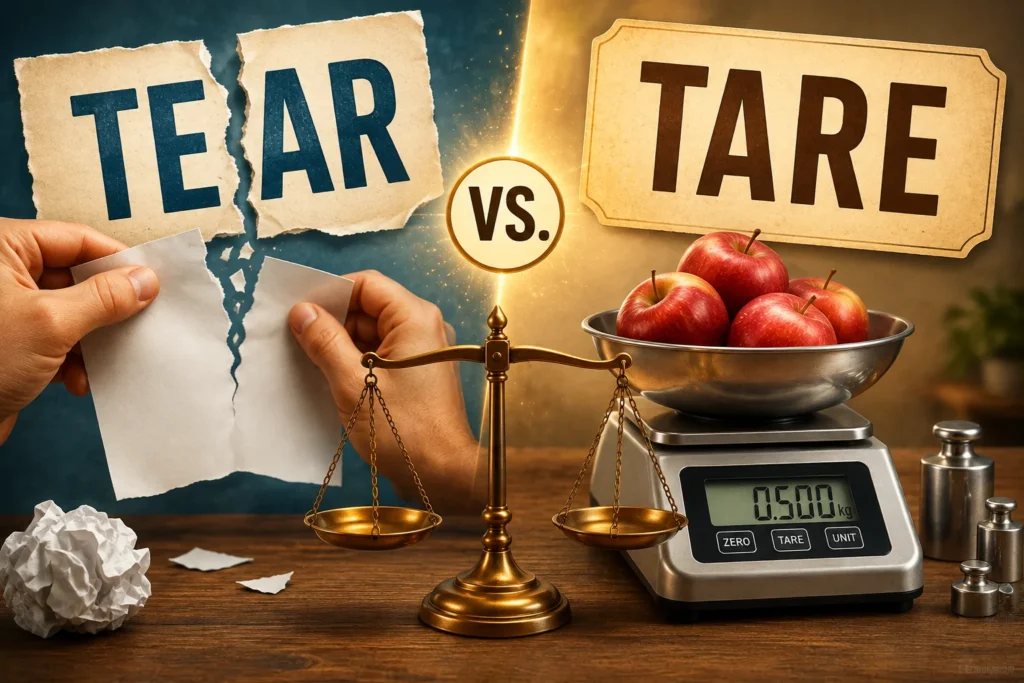
If you have ever wondered whether tear or tare belongs in a sentence, you’re dealing with a classic English spelling problem. The two words can sound exactly alike in one of their uses, yet their meanings have almost nothing in common. Tear can describe a drop from the eye, damage to fabric, the act of ripping something, or even moving quickly. Tare, meanwhile, usually belongs to the world of scales, containers, packaging, shipping, and measurement.
The confusion becomes even greater because tear has more than one pronunciation. In US English, the verb tear meaning “rip” is pronounced /ter/, while the noun tear meaning a drop from the eye is pronounced /tɪr/. The word tare is pronounced /ter/, so it rhymes with the “rip” meaning of tear rather than the “crying” meaning.
Understanding that distinction makes this pair much easier. You don’t need to memorize a complicated spelling rule. Instead, look at the meaning and the words surrounding it.
Tear vs. Tare at a Glance
At first glance, tear and tare look like simple spelling variants. They aren’t. Each word has its own meaning, grammatical uses, and typical contexts. The biggest difference is that tear appears in everyday English far more broadly, while tare tends to appear in specific situations involving weight and measurement.
Here is the quickest way to separate them:
| Word | Main meaning | Pronunciation in US English | Common context | Example |
| tear | A drop of liquid from the eye | /tɪr/ | Crying, emotion, pain | A tear rolled down her cheek. |
| tear | To rip or pull apart | /ter/ | Paper, clothing, materials | Don’t tear the page. |
| tear | A rip or hole | /ter/ | Fabric, paper, objects | There is a tear in my jacket. |
| tear | To move quickly | /ter/ | Informal speech | He tore down the street. |
| tare | Weight of an empty container or vehicle | /ter/ | Scales, packaging, shipping | The tare weight is two pounds. |
| tare | To adjust a scale to account for container weight | /ter/ | Weighing and measurement | Tare the bowl before adding flour. |
The table reveals the most important point: tear has several distinct meanings, whereas tare has a much narrower everyday range.
The two major meanings of tear
When tear relates to the eyes, it means the salty liquid produced by the eye. Cambridge defines it as a drop of salty liquid that flows from the eye because of strong emotion, pain, or similar causes.
For example:
A tear formed in her eye as she listened to the speech.
Here, tear has nothing to do with ripping. It describes an eye-related liquid.
But when tear means to pull something apart, it has a different pronunciation and meaning:
Be careful not to tear the paper.
This tear means to damage or separate something by pulling it apart. Its past forms are tore and torn, which makes the verb irregular.
The main meaning of tare
Tare generally refers to the weight of an empty container or the amount deducted from gross weight to account for the container. Merriam-Webster also defines the verb tare as weighing an empty container to determine its tare or adjusting a scale so the displayed weight returns to zero.
Consider a grocery scale. You put an empty bowl on it first and press the tare button. The scale resets the display to zero. When you add flour, the displayed number represents the flour rather than the bowl plus flour.
That simple action explains why tare often appears around words such as:
- tare weight
- gross weight
- net weight
- scale
- container
- packaging
- cargo
- shipment
- measurement
A simple memory shortcut
If the sentence involves crying, ripping, or damage, think tear.
If it involves weighing, containers, or packaging, think tare.
For example:
- She wiped away a tear.
- He accidentally tore the envelope.
- The shirt has a tear.
- The package has a tare weight of 1.5 pounds.
- Tare the scale before weighing the ingredients.
That distinction handles most everyday situations.
Why context matters more than sound
English contains many words that sound alike but differ in spelling and meaning. With tear and tare, sound can actually mislead you because tear itself changes pronunciation depending on its meaning.
Compare these:
- tear = eye liquid → /tɪr/
- tear = rip → /ter/
- tare = container weight or scale adjustment → /ter/
So if someone says “tear” aloud, you can’t always determine the spelling from pronunciation alone. You need the sentence.
For instance, imagine hearing:
“The shirt has a tear.”
The context points toward damage. The correct spelling is tear, not tare.
Now hear:
“The tare weight is five pounds.”
The reference to weight immediately signals tare.
This is why context acts like a built-in spelling guide.
Tear and tare are not interchangeable.
Replacing one with the other can completely change the meaning.
Incorrect:
The scale shows the tear weight.
Correct:
The scale shows the tare weight.
The first sentence uses the word associated with ripping or eye liquid. The second uses the measurement term.
Likewise:
Incorrect:
Don’t tare the paper.
Correct:
Don’t tear the paper.
A scale cannot help you choose tear in that sentence. The action of ripping does.
What Does “Tear” Mean?

The word tear deserves special attention because dictionaries treat it as several related but distinct words. Its meaning depends heavily on pronunciation and context.
In everyday writing, you will most often encounter tear as a noun connected with the eyes, a noun describing damage, or a verb meaning to pull something apart. It also has an informal meaning related to moving rapidly. Cambridge lists the “pull apart” verb with the forms tore and torn, while the eye-related noun has a different pronunciation.
Tear as a noun: a drop from the eye
The first meaning is probably the one most people learn first.
A tear is a drop of salty fluid that comes from the eye. Tears can appear because of sadness, pain, happiness, laughter, irritation, or other strong reactions. Cambridge specifically notes emotional and pain-related causes, while Merriam-Webster describes tears as fluid associated with the eye’s normal moisture and with crying or grieving.
Examples include:
- A tear rolled down his cheek.
- She had tears in her eyes.
- One tear fell onto the letter.
- The movie brought tears to my eyes.
- He was in tears after hearing the news.
The pronunciation is /tɪr/ in US English. That matters because this pronunciation does not match tare.
Several familiar expressions use this meaning:
In tears
If someone is in tears, they are crying or close to crying.
She was in tears after the argument.
Burst into tears
This means someone suddenly begins crying.
The child burst into tears when the toy broke.
Bring tears to someone’s eyes.
This means something causes someone to cry or become emotional.
The reunion brought tears to his eyes.
Shed tears
This means to cry or produce tears.
She refused to shed tears over the decision.
These expressions all use the eye-related meaning of tear.
Tear as a noun: a rip or hole
Now the spelling stays the same, but the pronunciation changes.
A tear can also mean a hole or damaged place created when something gets pulled apart. This meaning commonly applies to clothing, paper, fabric, bags, curtains, books, and similar materials. Cambridge defines this noun as a hole in paper, cloth, or another material where the material has been torn.
Examples:
- There is a tear in my jacket.
- I found a tear in the page.
- The bag has a small tear near the handle.
- She repaired the tear in her dress.
- The old curtain had several tears.
This tear is pronounced /ter/ in US English. That makes it a homophone of tare.
The difference becomes obvious when you compare meaning:
There was a tear in the package.
Here, the package has a rip.
The package had a tare weight of two pounds.
Here, tare refers to the weight of the packaging.
The surrounding noun tells you which word makes sense.
Tear as a verb: to rip or pull apart.
As a verb, tear means to pull something apart, damage it by force, or separate a piece from it. Cambridge gives examples involving paper, clothing, pages, and other materials.
Examples include:
- Tear the paper carefully.
- Don’t tear the envelope.
- She tore the page from the notebook.
- The dog tore the cushion.
- He tore the letter into pieces.
- The wind tore the sign from the wall.
The verb has an irregular form:
| Form | Word |
| Present | tear |
| Past | tore |
| Past participle | torn |
| -ing form | tearing |
This distinction matters because learners sometimes write teared when they mean the past tense of “rip.” In standard English, the normal past form is tore, not teared. Merriam-Webster lists tore as the past tense and torn as the past participle for this meaning.
For example:
I tore my sleeve on the fence.
Not:
I teared my sleeve on the fence.
And:
The page was torn from the book.
Not:
The page was teared from the book.
Common phrases with the verb tear
The verb appears in many useful combinations.
Tear apart means to pull something into separate pieces. It can also describe severe disagreement or destruction.
The children tore apart the old cardboard box.
Tear off means to remove something by pulling.
She tore off a piece of paper.
Tear up means to rip something into pieces.
He tore up the old receipt.
Tear down can mean to destroy a structure.
Workers tore down the damaged building.
Tear into can mean to attack physically or criticize someone aggressively, depending on context.
The coach tore into the team after the poor performance.
These expressions demonstrate how flexible tear can be.
Tear as a verb means “move quickly”
English also uses tear informally to describe rapid movement. Cambridge gives this meaning as moving very quickly or rushing.
For example:
She tore down the hallway when she heard the alarm.
Here, nobody is ripping anything. The person is simply moving very fast.
Merriam-Webster also records the verb’s sense of moving with violence, haste, or force.
That gives tear another meaning that tare does not have.
Tear has a surprisingly wide semantic range.
One reason tear creates confusion is its range of meanings. The same spelling can point to:
- eye fluid
- crying
- a rip
- physical damage
- pulling something apart
- removing something by force
- moving quickly
- emotional distress in certain expressions
The pronunciation helps separate these meanings when speaking, but spelling alone doesn’t.
That makes tear a good example of why English readers should pay attention to both meaning and pronunciation rather than treating spelling as a simple sound code.
What Does “Tare” Mean?
Unlike tear, tare usually appears in a much narrower range of situations. Its most familiar meaning involves weight.
If you have ever placed an empty bowl on a kitchen scale and pressed a button before adding ingredients, you’ve probably used the tare function. The scale accounts for the bowl’s weight so the displayed measurement represents what you actually want to weigh.
Merriam-Webster defines tare as a deduction from gross weight to account for the container. It also defines the verb as determining the tare or adjusting a scale with an empty container so the displayed weight falls to zero.
Tare as a noun
As a noun, tare can mean the weight of an empty container.
Suppose a box containing products weighs 18 pounds. The empty box weighs 3 pounds.
The calculation is:
18 pounds gross weight − 3 pounds tare weight = 15 pounds net weight
In that example:
- Gross weight: 18 pounds
- Tare weight: 3 pounds
- Net weight: 15 pounds
This relationship appears in shipping, packaging, manufacturing, retail, and other measurement settings.
Understanding tare weight
The three terms are easy to confuse at first, but their relationship is straightforward.
Gross weight is the total weight of the goods plus the container or packaging.
Tare weight is the weight of the empty container, packaging, or relevant vehicle.
Net weight is the weight of the actual contents after the tare amount is removed.
A useful formula is:
Net weight = Gross weight − Tare weight
You can also rearrange it:
Gross weight = Net weight + Tare weight
For example, imagine a shipping crate containing machinery:
| Measurement | Weight |
| Gross weight | 2,400 lb |
| Tare weight | 400 lb |
| Net weight | 2,000 lb |
The machinery weighs 2,000 pounds. The crate accounts for 400 pounds. Together, they produce the 2,400-pound gross weight.
Why tare weight matters
Tare weight isn’t just a technical number printed on a form. It can affect real-world decisions.
Consider a simple grocery example.
A customer wants to buy 2 pounds of prepared food. The food goes into a reusable container that weighs 0.5 pounds.
If the store simply weighs everything together, the scale reads 2.5 pounds. Without accounting for the container, the customer could be charged for an extra 0.5 pounds.
Using tare removes the container weight from the measurement.
The customer pays for the food, not the bowl.
Tare as a verb
Tare can also function as a verb.
When you tare a scale, you adjust it to account for the weight of an empty container. Merriam-Webster specifically describes this use as adjusting a scale after placing an empty container on it so the displayed weight becomes zero.
For example:
Tare the bowl before adding the flour.
Or:
She tared the container before measuring the ingredients.
The verb forms are:
- tare
- tared
- taring
This is completely different from the verb tear, whose past forms are tore and torn.
That contrast is useful:
| Present | Past | Meaning |
| tear | tore | rip or pull apart |
| tare | tared | adjust or determine tare weight |
This is one of the clearest grammatical ways to distinguish the two words.
The tare button on a scale
Modern digital scales often include a tare button or function.
The basic process looks like this:
- Place the empty container on the scale.
- Press the tare button.
- The displayed weight returns to zero.
- Add the product or ingredient.
- Read the net weight of the contents.
Suppose your empty mixing bowl weighs 1.2 pounds. You place it on the scale and press tare. The display becomes 0. Now you add 4 pounds of flour. The scale shows 4 pounds rather than 5.2 pounds.
The scale hasn’t made the bowl disappear. It has simply accounted for its weight.
Tare in shipping and logistics
Shipping provides one of the clearest real-world applications of tare.
A truck, trailer, railcar, or shipping container has its own weight before cargo gets added. That empty weight matters because the loaded weight includes both the transport equipment and its contents.
For example:
- Empty trailer: 8,000 pounds
- Cargo: 22,000 pounds
- Loaded weight: 30,000 pounds
Here, the empty trailer represents the relevant tare amount.
The same basic principle applies to containers used for transporting goods. The goal is to separate the weight of the cargo from the equipment carrying it.
Tare in manufacturing
Manufacturers often deal with products that sit inside boxes, drums, bottles, bags, bins, or other containers.
Suppose a factory fills containers with a chemical product. Each empty container has a known weight. The production team needs to measure the product itself rather than repeatedly counting the container.
A scale’s tare function makes that process practical.
The worker places the empty container on the scale, activates tare, and then fills the container. The displayed measurement focuses on the contents.
This becomes especially useful when workers repeat the same operation many times. Small errors can accumulate when thousands of units move through a production line.
Tare in retail
Retail weighing offers another familiar example.
Imagine buying coffee beans from a store where the clerk places a reusable container on a scale. The container weighs 0.4 pounds. The beans weigh 1.6 pounds.
Without tare:
0.4 + 1.6 = 2.0 pounds
With the container tared:
Displayed net weight = 1.6 pounds
The customer receives the correct product measurement.
This is why tare belongs naturally with words such as scale, weight, container, packaging, and net weight.
Another dictionary meaning of tare
There is one additional meaning worth knowing if you’re aiming for complete vocabulary coverage.
Tare can also refer to certain vetch plants or weeds. Merriam-Webster lists tare as a noun for a seed of a vetch and for several vetch species.
This meaning is much less common in everyday American English than the measurement sense.
So if you encounter tare in a technical, agricultural, historical, or literary passage, don’t automatically assume it refers to a scale. Context still controls the meaning.
Are Tear and Tare Homophones?
This is where the title of the article needs an important qualification.
Tear and tare can be homophones, but only for a particular meaning and pronunciation of tear.
A homophone is a word that has the same pronunciation as another word while differing in spelling or meaning. In this case:
tear meaning “rip” → /ter/
tare meaning “container weight” → /ter/
Those two forms sound the same in US English.
But:
tear meaning “a drop from the eye” → /tɪr/
That pronunciation does not sound like tare.
This distinction is important because simply saying “tear and tare are homophones” can leave readers with the wrong impression. The relationship applies to one major pronunciation of tear, not every use of the word.
The pronunciation comparison
| Word | Meaning | US pronunciation | Homophone relationship |
| tear | A drop from the eye | /tɪr/ | Not a homophone of tare |
| tear | To rip or pull apart | /ter/ | Homophone of tare |
| tear | A rip or hole | /ter/ | Homophone of tare |
| tare | Empty weight | /ter/ | Homophone of the /ter/ forms of tear |
Cambridge lists the US pronunciation of the eye-related noun as /tɪr/ and the “pull apart” verb as /ter/. Merriam-Webster likewise distinguishes the two pronunciation families and gives tare as /ter/.
Why the spelling doesn’t follow the sound
English spelling often preserves word history rather than giving you a perfect pronunciation guide.
The result is that two words can sound identical while looking different:
- tear
- tare
The letters don’t tell you enough by themselves.
That becomes even more complicated with tear, because the same spelling represents two different pronunciations:
- /tɪr/ → eye liquid
- /ter/ → rip or hole
This makes tear a particularly tricky word for English learners.
Context solves the problem.
When you hear a word without seeing it, you may not know which spelling belongs on the page.
If someone says:
“Please ___ the paper.”
The intended word is almost certainly tear because the sentence describes ripping.
If someone says:
“Please ___ the scale before weighing the flour.”
The correct word is tare because the sentence describes adjusting the scale.
If someone says:
“A ___ appeared in her eye.”
The correct word is tear because the sentence describes eye fluid.
The context supplies the missing information.
Tear vs. tare in real-world writing
Consider these three sentences:
The child began to tear the paper.
There was a tear in the paper.
The container has a tare weight of three ounces.
The first two sentences use tear because they involve ripping and damage. The third uses tare because it involves weight.
Now consider the pronunciation:
- tear the paper → /ter/
- a tear in the paper → /ter/
- tare weight → /ter/
All three sound alike in this context.
That is precisely why spelling becomes necessary in writing.
A useful editing strategy
When proofreading, don’t ask:
“Which word sounds right?”
Ask:
“What does this word mean here?”
Then apply the meaning:
Does it involve crying or eye fluid?
Use tear.
Does it involve ripping or a hole?
Use tear.
Does it involve weighing an empty container or adjusting a scale?
Use tare.
This strategy works better than trying to memorize isolated spellings.
Tear vs. Tare in Sentences and Common Mistakes
The fastest way to master these words is to see them in realistic sentences. Once you connect each spelling with its typical context, the distinction becomes much less intimidating.
Sentences using tear
Eye-related noun
A single tear rolled down her cheek.
The word refers to liquid from the eye.
Emotional response
The final scene brought tears to his eyes.
Again, this is the eye-related meaning.
Rip or hole
There is a small tear in the corner of the envelope.
Here, tear means damage.
Verb meaning rip
Be careful not to tear the document.
The word means to pull or damage the paper.
Past tense
I tore my jacket on the fence.
The past tense is tore, not “teared.”
Past participle
The old photograph was torn in half.
The correct participle is torn.
Moving quickly
The driver tore down the highway.
Here, tore means moved quickly.
Sentences using tare
Container weight
The tare weight of the box is two pounds.
The word refers to the empty box’s weight.
Scale adjustment
Tare the bowl before adding the ingredients.
Here, tare is a verb.
Retail weighing
The clerk entered the container’s tare before weighing the food.
The container’s weight gets excluded from the product measurement.
Shipping
The shipment’s gross weight includes the cargo and container, while the tare represents the container’s weight.
This sentence uses the measurement sense.
Manufacturing
The operator tared the vessel before filling it.
Here, tared is the past tense of the verb tare.
Side-by-side examples
| Sentence | Correct word | Why? |
| She wiped away a ___ from her cheek. | tear | It means eye fluid. |
| The paper has a small ___. | tear | It means a rip. |
| Don’t ___ the receipt. | tear | It means rip. |
| He ___ the envelope open. | tore | Past tense of tear. |
| The package’s empty weight is its ___. | tare | It refers to container weight. |
| ___ the bowl before adding flour. | tare | It means to adjust the scale. |
| The truck’s empty weight affects its ___. | tare | It refers to empty weight. |
| The fabric began to ___. | tear | It means separate or rip. |
Common spelling mistake: “tear weight”
One of the most important errors to avoid is writing tear weight when you mean tare weight.
The correct technical term is:
tare weight
It refers to the weight of the empty container, packaging, or relevant transport equipment.
Tear weight doesn’t express that measurement concept.
This mistake usually happens because the two words can sound identical. Spell-check may not flag it because tear is a perfectly valid English word.
That is a key lesson with homophones: a spelling checker can confirm that a word exists without confirming that it belongs in your sentence.
Common spelling mistake: “tare the paper”
Another error reverses the problem.
Don’t tare the paper.
This is incorrect if you mean “don’t rip the paper.”
The correct sentence is:
Don’t tear the paper.
Tare belongs to the world of weighing and measurement. Tear belongs to ripping, damage, eye fluid, and several related meanings.
Common mistake: assuming every tear sounds like tare
This mistake is subtle.
Some explanations say that tear and tare are homophones and stop there. That isn’t precise enough.
The tear meaning “rip” sounds like tare.
The tear meaning “a drop from the eye” does not.
So these are different:
tear /tɪr/ — eye liquid
tear /ter/ — rip
tare /ter/ — container weight
This distinction should stay in mind whenever you encounter the word in speech.
Common mistake: using “teared” as the past tense
For the verb meaning “rip,” the standard past tense is tore.
She tore the paper.
The past participle is torn:
She had torn the paper.
The forms don’t follow the regular -ed pattern.
By contrast, the measurement verb tare follows the regular pattern:
tare → tared
So the contrast is especially useful:
| Verb | Present | Past | Past participle |
| Rip | tear | tore | torn |
| Adjust a scale | tare | tared | tared |
Quick memory tricks
A good memory trick should reinforce meaning rather than create another rule to memorize.
Try these:
Tear = rip or tears
If something gets ripped, use tear. If liquid comes from someone’s eyes, use tear.
Tare = scale
Think of the letter a in tare as an anchor for amount or accounting. This isn’t a formal spelling rule, but it can help you remember that tare belongs with measurement.
Tare weight = empty container weight
Memorize this phrase as a unit. Once tare weight becomes familiar, the spelling becomes much easier.
A practical editing test
When you’re unsure, replace the word with a simple synonym.
If rip, damage, or cry makes sense, you probably need tear.
If container weight, deduction, or scale adjustment makes sense, you need tare.
For example:
Don’t ___ the page.
Replace the blank with rip:
Don’t rip the page.
That works, so tear is correct.
Now:
___ the scale before adding the ingredients.
Replace the blank with adjust:
Adjust the scale before adding the ingredients.
That points toward tare.
This quick substitution method can be especially useful when proofreading quickly.
A final comparison to keep handy
| If you mean… | Use… |
| Liquid from the eye | tear |
| A rip or hole | tear |
| Pull apart | tear |
| Past tense of rip | tore |
| Past participle of rip | torn |
| Move quickly | tear |
| Empty container weight | tare |
| Weight deducted from gross weight | tare |
| Adjust a scale for container weight | tare |
| Past tense of the weighing verb | tared |
The simplest rule is also the most reliable: meaning determines spelling. If the sentence involves ripping or crying, choose tear. If it involves weighing or removing container weight from a measurement, choose tare.
Once you notice that difference, these two homophones stop being a guessing game.
What Does “Tear” Mean?
The word tear carries several meanings, which is why it causes more confusion than tare. In everyday US English, one pronunciation refers to liquid from the eyes, while another refers to ripping or pulling something apart. The spelling stays the same even though the pronunciation and meaning change. Cambridge lists tear as a verb meaning to pull something apart, with the irregular forms tore and torn, and as a noun meaning either a hole in material or a drop of liquid from the eye.
Tear as a Noun: A Drop From the Eye
When tear refers to the eye, it means a drop of salty liquid produced by the eye. People may shed tears because of sadness, physical pain, happiness, laughter, or another strong emotional response. In US English, this meaning is pronounced /tɪr/, which is completely different from the /ter/ pronunciation used when tear means “rip.”
For example:
A tear rolled down her cheek.
The movie brought tears to his eyes.
He was in tears after hearing the news.
Several familiar expressions use this meaning:
- in tears — crying or visibly upset
- burst into tears — suddenly begin crying
- bring tears to someone’s eyes — cause someone to become emotional or cry
- shed tears — cry or produce tears
- reduce someone to tears — make someone cry
These expressions are useful because the context makes the meaning unmistakable. If a sentence mentions eyes, crying, sadness, or emotion, tear is the spelling you want. Cambridge specifically lists expressions such as “burst into tears,” “shed tears,” and “bring tears to someone’s eyes.”
Tear as a Noun: A Rip or Hole
Tear has another noun meaning: a rip, hole, or damaged opening in paper, cloth, clothing, or another material. This meaning uses the /ter/ pronunciation in US English. That pronunciation is the same as tare, which is why these words can function as homophones in this context.
Consider these examples:
There is a tear in my jacket.
The old book has a tear in one of its pages.
She noticed a small tear in the curtain.
Here, tear doesn’t describe emotion or eye fluid. It describes physical damage.
A useful way to recognize this meaning is to substitute rip or hole:
There is a rip in my jacket.
There is a hole in my jacket.
If either replacement makes sense, tear is probably the correct word.
Tear as a Verb: To Rip or Pull Apart
As a verb, tear means to pull something apart or away, often causing damage. You can tear paper, fabric, cardboard, clothing, photographs, letters, packaging, and many other materials. Cambridge gives the US pronunciation as /ter/ and lists tore as the past tense and torn as the past participle.
For example:
Don’t tear the page.
She tore the envelope open.
The dog tore my shirt.
Several pages were torn from the notebook.
The verb is irregular, so its forms are worth remembering:
| Verb form | Correct form |
| Present | tear |
| Past | tore |
| Past participle | torn |
| Present participle | tearing |
A common learner mistake is using teared as the past tense. In standard English, the normal forms are tore and torn.
So write:
He tore the paper.
Not:
He teared the paper.
And write:
The paper was torn.
Not:
The paper was teared.
Common Phrases With Tear
The verb tear appears in several common phrasal verbs and expressions. Their meanings can usually be understood from the context.
Tear apart means to pull something into separate pieces.
The children tore apart the cardboard box.
It can also describe severe emotional or social division:
The argument tore the family apart.
Tear off means to remove something by pulling it away.
She tore off a piece of paper.
Tear up means to rip something into pieces.
He tore up the old contract.
Tear down can mean to destroy a building or structure.
Workers tore down the damaged wall.
Tear into can describe attacking something physically or criticizing someone forcefully.
The puppy tore into the cardboard package.
These expressions show why learning tear as a single definition isn’t enough. Its meaning changes with the words around it.
Tear as a Verb: To Move Quickly
There is another informal meaning of tear that has nothing to do with ripping or crying. As a verb, tear can mean to move very quickly or rush. Cambridge identifies this as an informal use.
For example:
The ambulance came tearing down the road.
She was late and tore out of the house.
He went tearing around the room looking for his keys.
In this sense, tear often appears with words describing movement, such as down, along, around, or away.
This meaning can seem surprising because there is no physical tearing involved. English often develops multiple meanings around an established word, and context tells the reader which sense applies.
Tear in Expressions About Emotion
The eye-related meaning also appears in many everyday expressions.
She had tears in her eyes.
He was close to tears.
The story brought tears to her eyes.
She burst into tears when she heard the news.
The surrounding words provide a strong clue. If you see eyes, crying, emotion, sadness, or joy, the word almost certainly refers to the liquid produced by the eyes.
Cambridge also records tear as a verb meaning that the eyes produce tears, such as when cutting onions.
For example:
My eyes tear whenever I cut onions.
This use is pronounced differently from the verb meaning “rip.”
Tear Can Be a Noun or a Verb
One reason this word deserves careful attention is its grammatical flexibility.
As a noun, it can mean:
- a drop from the eye
- a rip or hole
As a verb, it can mean:
- to pull something apart
- to move quickly
- for the eyes to produce tears
The same spelling therefore appears in several grammatical and semantic roles.
| Use | Meaning | Example |
| Noun | Eye liquid | A tear fell from her eye. |
| Noun | Rip or hole | There is a tear in the shirt. |
| Verb | Pull apart | Don’t tear the paper. |
| Verb | Move quickly | The car tore down the road. |
| Verb | Produce tears | Her eyes tear in the wind. |
This variety explains why context matters so much.
Tear vs. Tare: The Most Important Distinction
When tear means rip, it sounds like tare.
When tear means a drop from the eye, it does not.
That gives you three useful forms to remember:
| Word | Meaning | US pronunciation |
| tear | drop from the eye | /tɪr/ |
| tear | rip or pull apart | /ter/ |
| tare | empty-container weight or scale adjustment | /ter/ |
Cambridge confirms the distinct US pronunciations for the eye-related and “pull apart” meanings of tear.
So if someone tells you that tear and tare are homophones, the statement needs a little qualification. They are homophones when tear has the /ter/ pronunciation. The eye-related tear uses /tɪr/ instead.
A Simple Context Test
When you’re unsure which meaning tear has, look at the words around it.
If the sentence contains:
- eyes
- cry
- sadness
- emotion
- tears
- cheek
then tear probably means eye liquid.
If it contains:
- paper
- shirt
- fabric
- page
- rip
- hole
- pieces
then tear probably means damage or pulling apart.
If it contains:
- road
- street
- running
- rushing
- quickly
then tear may mean moving rapidly.
And if the sentence contains:
- scale
- weight
- container
- packaging
- gross
- net
- measurement
you should start thinking about tare, not tear.
The key isn’t memorizing every definition separately. Read the context first, identify the meaning, and then choose the spelling.
What Does “Tare” Mean?
While tear appears across many areas of everyday English, tare has a more specialized role. You’ll most often see it when people discuss weight, scales, containers, packaging, shipping, and measurement. The noun tare refers to the weight of an empty container or the amount deducted from a gross weight to determine the actual weight of the contents. The verb tare means to determine that weight or adjust a scale so the container’s weight doesn’t count toward the final measurement.
Tare as a Noun
The easiest way to understand tare is to think about an empty container.
Imagine placing an empty box on a scale. The box has weight even though it contains nothing. That empty weight is the tare weight.
For example, suppose a package weighs 15 pounds when you place the entire package on a scale. The empty packaging weighs 3 pounds.
The calculation is:
Gross weight − tare weight = net weight
So:
15 lb − 3 lb = 12 lb
The actual contents weigh 12 pounds.
This distinction becomes especially important when products are sold, transported, or recorded according to weight. Without accounting for tare, the container could accidentally become part of the amount being charged or reported.
Understanding Tare Weight
Three terms work together when you’re dealing with packaged goods:
| Term | Meaning | Example |
| Gross weight | Total weight of contents plus container | 15 lb |
| Tare weight | Weight of the empty container | 3 lb |
| Net weight | Weight of the contents alone | 12 lb |
The relationship is simple:
Gross weight = Net weight + Tare weight
Therefore:
Net weight = Gross weight − Tare weight
Think about a jar filled with honey. The jar itself has weight, but the customer is interested in the honey’s weight. The tare measurement lets the scale separate those two quantities.
Why Tare Weight Matters
Tare weight may sound like a technical detail, but it has practical consequences.
Imagine a store selling food by weight. A customer brings a reusable container that weighs 0.75 pounds. The store needs to measure only the food inside that container.
If the filled container weighs 5.25 pounds, the net food weight is:
5.25 − 0.75 = 4.50 pounds
Without the tare deduction, the customer could be charged for the container as though it were food.
The same principle applies to larger operations. Warehouses, manufacturers, shipping companies, and retailers may all need accurate weight information for pricing, inventory, transportation, or recordkeeping.
Tare on a Digital Scale
You’ve probably encountered tare without realizing it.
Many kitchen and commercial scales include a Tare button. Its purpose is to remove the weight of a container from the displayed measurement.
The process usually works like this:
- Place the empty container on the scale.
- Press the Tare button.
- The display returns to zero.
- Add the product or ingredient.
- Read the weight of the contents.
Suppose an empty mixing bowl weighs 1.2 pounds. After you place it on the scale, the display reads 1.2 pounds. Press Tare, and the display changes to 0.
Now add flour.
If the flour weighs 4 pounds, the scale displays approximately 4 pounds rather than 5.2 pounds.
The bowl hasn’t become weightless. The scale has simply accounted for its weight.
Tare as a Verb
Tare doesn’t function only as a noun. It can also work as a verb.
When you tare a scale, you adjust it to account for the weight of an empty container. Merriam-Webster describes this verb as determining the tare, or adjusting a balance or scale with an empty container.
For example:
Tare the bowl before adding the ingredients.
The technician tared the container before weighing the material.
The verb follows a regular pattern:
| Form | Example |
| Present | tare |
| Past | tared |
| Past participle | tared |
| -ing form | taring |
This creates an especially useful contrast with tear.
Tear meaning “rip”:
tear → tore → torn
Tare meaning “adjust a scale”:
tare → tared → tared
So:
She tore the paper.
But:
She tared the scale.
The spellings and grammatical forms make the meanings unmistakable when written down.
Tare in Shipping and Logistics
The concept of tare becomes even more important when dealing with large shipments.
A truck, trailer, railcar, or shipping container has weight before cargo gets loaded. Transportation records may need to distinguish the empty equipment from the loaded total.
Consider this example:
| Measurement | Weight |
| Empty trailer | 8,000 lb |
| Cargo | 22,000 lb |
| Loaded total | 30,000 lb |
Here, the 8,000-pound empty trailer weight represents the tare amount in the basic calculation.
The cargo itself weighs 22,000 pounds. Once the trailer and cargo are combined, the total reaches 30,000 pounds.
This distinction matters because transportation systems need accurate information about what is being carried. Confusing the empty equipment weight with the cargo weight can distort records and calculations.
Tare in Manufacturing
Manufacturing environments frequently use containers to hold raw materials, components, liquids, powders, or finished products.
Suppose a factory fills drums with a material. Each empty drum weighs 20 pounds. A filled drum weighs 170 pounds.
The material weighs:
170 − 20 = 150 pounds
The drum represents the tare weight.
In repeated production, the tare value can become an important part of the weighing process. Workers may place an empty container on a scale, use the tare function, and then add material until the required net weight appears.
This approach is useful because it separates container weight from product weight without requiring the worker to perform the subtraction manually every time.
Tare in Retail Stores
Retail provides one of the easiest examples to understand.
Suppose you buy loose coffee, candy, produce, or another product sold by weight. The product may go into a bag, tray, box, or reusable container.
If that container weighs 0.2 pounds, the store can account for it before measuring the product.
Imagine the filled container weighs 2.7 pounds.
The net product weight is:
2.7 − 0.2 = 2.5 pounds
The 0.2 pounds is the tare.
This is why the word tare naturally appears around phrases such as tare weight, net weight, gross weight, container weight, and scale adjustment.
Tare in Food Preparation
The concept isn’t limited to stores and warehouses. Home cooks can use it too.
Suppose you’re following a recipe that requires 300 grams of flour. You place a mixing bowl on a digital kitchen scale. The bowl weighs 600 grams.
Instead of calculating the bowl’s weight yourself, press Tare.
The display goes back to zero.
Now add flour until the display reaches 300 grams.
You’ve measured the ingredient without needing to remove the bowl.
If you add another ingredient afterward, you can often press Tare again and continue measuring directly in the same bowl.
This makes the term easier to remember:
Tare = remove the container’s weight from the measurement.
Tare in Packaging
Packaging creates another important use for tare.
A product may be placed inside several layers of packaging:
- primary container
- inner packaging
- outer box
- protective material
- shipping container
The combined packaging contributes to the gross weight.
For example:
| Component | Weight |
| Product | 10 lb |
| Inner packaging | 0.5 lb |
| Outer box | 1.0 lb |
| Total packaging | 1.5 lb |
| Gross weight | 11.5 lb |
Here, the total packaging represents the tare amount when the measurement is being used to determine the product’s net weight.
The exact method can vary by industry and measurement system, but the central idea remains the same: tare separates the container or packaging from the contents.
Tare and Gross Weight
The relationship between tare and gross weight becomes much easier once you picture a physical package.
Think of a sealed box.
The box contains:
product + packaging
The weight of everything together is the gross weight.
The weight of the empty packaging is the tare weight.
The product left after removing the tare is the net weight.
So the three measurements form a simple chain:
Gross weight → subtract tare → net weight
For example:
50 kg gross − 7 kg tare = 43 kg net
That equation captures the central meaning of tare.
Tare vs. Net Weight
These terms are sometimes confused because they appear together on labels, shipping documents, and weighing records.
They aren’t interchangeable.
Tare weight describes the container or other relevant empty weight.
Net weight describes the actual contents after the tare has been removed.
For a box weighing 25 kilograms when full:
- Tare = 5 kg
- Net = 20 kg
- Gross = 25 kg
The easiest memory trick is:
Tare is what you subtract. Net is what remains.
That isn’t a universal rule for every technical measurement system, but it works well for the standard packaged-weight relationship.
Tare vs. Tear in Measurement Contexts
This is where the homophone confusion can cause genuine mistakes.
Consider:
The tear weight is 4 pounds.
If the writer means the weight of the empty container, tear is wrong.
The correct sentence is:
The tare weight is 4 pounds.
Now switch contexts:
The paper has a tare.
That is wrong if the writer means the paper has a rip.
The correct sentence is:
The paper has a tear.
The words sound alike in these contexts, but their meanings point in opposite directions.
A Quick Tare Memory Trick
If you see tare, connect it with scale.
If you see tear, ask whether you’re dealing with:
- an eye
- a rip
- damage
- pulling something apart
- rapid movement
A particularly strong phrase to memorize is:
tare weight
When you see that phrase, the spelling is always tare, not tear, because it describes a measurement concept.
Tare in Everyday Language
Unlike tear, tare doesn’t appear frequently in casual conversation. You may encounter it when cooking with a digital scale, reading shipping information, checking product measurements, or working with industrial equipment.
That’s why learners often know the word tear long before they encounter tare.
However, once you associate tare with weight and scales, its spelling becomes much easier to recall.
A simple mental picture can help:
Empty bowl → scale → zero → add food → net weight
That entire process represents tare.
An Important Additional Meaning of Tare
There is also an older or specialized noun meaning of tare connected with certain plants, particularly vetches. Merriam-Webster records tare as a noun referring to a vetch plant or its seed.
This meaning is much less likely to appear in ordinary American English than the measurement sense.
For most readers, the practical distinction remains:
Tare = a weight deduction or scale adjustment.
But if you’re reading older literature, agricultural writing, botanical material, or historical texts, context may reveal the plant-related meaning instead.
Real-World Tare Example
Consider a small bakery preparing packaged flour.
Each empty bag weighs 50 grams. The bakery needs to package exactly 1 kilogram of flour into each bag.
If a filled bag weighs 1,050 grams, the calculation is:
1,050 g gross − 50 g tare = 1,000 g net
The bakery can therefore verify that the bag contains the intended 1 kilogram of flour.
Now imagine the bakery uses a scale with a tare function. The worker places the empty bag on the scale, presses Tare, and adds flour until the display reaches 1,000 grams.
The same concept works whether the measurement happens manually or through a digital scale.
The Core Meaning to Remember
If you remember only one thing about tare, remember this:
Tare is about accounting for weight that doesn’t belong to the contents being measured.
It may refer to:
- the weight of an empty container
- the deduction made for that container
- the adjustment made to a scale
- the process of determining that empty weight
That makes tare fundamentally different from tear, even though the two words can sound identical in speech.
When the sentence involves ripping, crying, or damage, choose tear. When it involves scales, containers, packaging, or weight deductions, choose tare.
Are Tear and Tare Homophones?
Yes, tear and tare can be homophones, but there is an important detail that often gets overlooked. They sound the same only when tear has the pronunciation associated with “rip” or “pull apart.” The tear that comes from your eye has a different pronunciation. Understanding this small distinction makes the spelling, pronunciation, and meaning of both words much easier to remember.
When Tear and Tare Sound the Same
In US English, tear meaning “to rip or pull apart” is pronounced /ter/. Tare is also pronounced /ter/. Because they have the same pronunciation while having different spellings and meanings, these two words qualify as homophones. Cambridge lists the “pull apart” pronunciation of tear as /ter/ and gives tare the same US pronunciation.
Compare these sentences:
Please tear the paper in half.
The package has a tare weight of three pounds.
When spoken aloud, tear and tare sound alike in these sentences. Their meanings, however, are completely different.
The first sentence involves ripping. The second involves weight.
That is the heart of the confusion.
The Eye-Related Tear Sounds Different
The biggest pronunciation trap is that tear has another common pronunciation.
When tear means a drop of liquid from the eye, US English pronounces it /tɪr/. That sound is different from tare /ter/. Cambridge distinguishes these pronunciations clearly in its dictionary entries.
Compare:
A tear fell from her eye.
Don’t tear the paper.
The spelling is identical, but the pronunciation changes because the meaning changes.
The first tear sounds like “teer.”
The second tear sounds like “tair.”
Then there is:
The tare weight is listed on the package.
Tare sounds like the second tear, not the first.
Pronunciation Comparison
| Word | Meaning | US pronunciation | Sounds like |
| tear | A drop from the eye | /tɪr/ | “teer” |
| tear | To rip or pull apart | /ter/ | “tair” |
| tear | A rip or hole | /ter/ | “tair” |
| tare | Empty-container weight | /ter/ | “tair” |
This table gives you the key distinction at a glance.f you’re talking about eyes, crying, or emotional tears, use the /tɪr/ pronunciation.f you’re talking about ripping, damage, or a hole, use the /ter/ pronunciation.If you’re talking about weight, packaging, or a scale, use tare /ter/.
Why These Words Cause Spelling Problems
When two words sound alike, your ears can’t tell you which spelling to write. You need context.
Imagine someone says:
“The box has a tare.”
If you only hear the sound, you might wonder whether they mean tear or tare. The surrounding information resolves the uncertainty.
If the conversation is about damaged cardboard, the intended word could be tear.
If the conversation is about weighing the box, the intended word is tare.
This is one reason homophones create mistakes in writing. A speaker may know exactly what they mean, yet a writer still has to choose between two different spellings.
Context Is Your Best Clue
Instead of memorizing pronunciation alone, identify the subject of the sentence.
When the sentence concerns emotion or eyes, think:
tear
She wiped away a tear.
When it concerns ripping or damage, think:
tear
Don’t tear the envelope.
When it concerns weight or containers, think:
tare
Record the tare weight before loading the shipment.
The context almost acts like a signpost. It tells you which spelling belongs there.
Tear and Tare Have Different Meanings
Homophones share pronunciation, not meaning.
That’s especially clear here.
Tear can mean:
- a drop of liquid from the eye
- a rip or hole
- to pull something apart
- to damage something by pulling
- to move quickly in informal usage
Tare can mean:
- the weight of an empty container
- a deduction for container weight
- the adjustment of a scale
- the act of determining container weight
Merriam-Webster defines tare in relation to the weight of a container and also records its use as a verb for adjusting a weighing device. (Merriam-Webster)
So although the words can sound identical, they occupy very different semantic fields.
Spelling Makes the Difference Visible
The spelling difference is small:
- tear → T-E-A-R
- tare → T-A-R-E
Only two letters are arranged differently, but that small change separates two unrelated meanings.
Think about these examples:
The child began to tear the paper.
The package’s tare weight is printed on the label.
The words sound the same in these contexts, yet the spelling instantly tells the reader what the writer means.
This is why correct spelling matters even when pronunciation doesn’t change.
Tear Has Two Pronunciation Patterns
One useful way to remember the issue is to treat tear as two separate pronunciation patterns.
Tear = eye liquid
Pronounced approximately like “teer.”
A tear rolled down her cheek.
Tear = rip
Pronounced approximately like “tair.”
Don’t tear the page.
The second one matches tare.
This is also why English learners may initially find tear frustrating. The spelling stays constant while the pronunciation changes.
The Past Tense Makes the Difference Obvious
The verb tear, meaning “rip,” has the irregular past tense tore and past participle torn.
For example:
She tore the letter into pieces.
The letter was torn in half.
Notice that tare does not follow this pattern.
The verb tare is regular:
tare → tared
For example:
The technician tared the scale before weighing the material.
This creates a useful grammar shortcut:
Rip something → tear, tore, torn
Adjust a scale → tare, tared
Once you see the past forms, the difference becomes much easier to recognize.
A Real-Life Comparison
Imagine you’re working in a kitchen.
You place a bowl on a digital scale and press Tare.
Tare the bowl before adding the flour.
Then you accidentally grab the paper bag too roughly.
Be careful not to tear the bag.
The two words may sound almost indistinguishable when spoken quickly, but the situations are completely different.
One involves measurement.
The other involves damage.
Now imagine the kitchen gets smoky because something burns, and your eyes begin producing liquid:
My eyes tear when there’s too much smoke.
That’s the third pronunciation.
The same spelling tear now sounds different because the meaning has changed.
Are Tear and Tare True Homophones?
In practical English usage, tear and tare are commonly described as homophones because the relevant pronunciation of tear matches tare.
However, saying simply “they are always homophones” would be misleading.
A more precise explanation is:
Tear and tare are homophones when tear means “rip,” “pull apart,” or refers to a rip, and is pronounced /ter/.
The eye-related tear is pronounced /tɪr/, so it does not belong to that homophone pair.
This distinction is important for accurate language learning.
How to Choose the Correct Spelling
When you’re writing and aren’t sure which word belongs in the sentence, follow this quick process:
Look at the meaning first.
Ask yourself:
Does this involve the eye?
Use tear.
Does this involve ripping or damage?
Use tear.
Does this involve a scale or container weight?
Use tare.
Then check the grammar.
If the past tense means “ripped,” use tore.
If the past tense means “adjusted a scale,” use tared.
Finally, check the surrounding words.Words such as eyes, crying, and cheek point toward one meaning of tear.Words such as paper, fabric, and rip point toward another.Words such as weight, scale, container, gross, and net point toward tare.
Common Examples Compared
| Sentence | Correct word | Reason |
| A ___ fell from her eye. | tear | Eye liquid |
| Don’t ___ the receipt. | tear | Pull apart |
| There is a ___ in the shirt. | tear | Rip or hole |
| The ___ weight is five pounds. | tare | Empty-container weight |
| ___ the scale first. | tare | Adjust the scale |
| He ___ the paper yesterday. | tore | Past tense of tear |
| The paper was ___. | torn | Past participle of tear |
| The operator ___ the container. | tared | Past tense of tare |
The Easiest Rule to Remember
You don’t need a complicated mnemonic.
Just remember:
Tear is connected with tears, rips, and ripping.
Tare is connected with scales, containers, and weight.
And remember one extra detail:
Eye tear = /tɪr/
Rip tear = /ter/
Tare = /ter/
Once you connect pronunciation with meaning and context, tear vs. tare becomes much easier to handle. The spelling may look deceptively similar, but the situations in which each word belongs are usually very different.
Tear vs. Tare in Sentences and Common Mistakes
The easiest way to master tear vs. tare is to see the words working in real sentences. Because they can sound alike, especially when tear means “rip,” the surrounding context becomes your best guide. The spelling tells the reader what you mean, while the sentence itself provides the clue. If the situation involves eyes, crying, ripping, or damage, choose tear. If it involves scales, containers, packaging, or weight, choose tare.
Sentences Using “Tear”
Tear can appear as both a noun and a verb, so its meaning depends on the sentence.
A tear rolled down her cheek.
Here, tear means a drop of liquid from the eye.
The emotional speech brought tears to his eyes.
Again, the word refers to eye fluid.
Now consider a different meaning:
There is a tear in the sleeve of my jacket.
Here, tear means a rip or damaged opening.
As a verb:
Please don’t tear the paper.
In this sentence, tear means to rip or pull something apart.
The past tense changes to tore:
She tore the letter into several pieces.
The past participle is torn:
The photograph was torn during the move.
Tear can also describe rapid movement:
The children came tearing down the hallway.
So, when you see tear, don’t automatically assign one meaning to it. Look at the context.
Sentences Using “Tare”
Tare usually appears in sentences related to measurement.
The tare weight of the empty box is two pounds.
Here, tare means the weight of the empty container.
As a verb:
Tare the bowl before adding the flour.
The instruction tells you to adjust the scale so the bowl’s weight doesn’t count toward the ingredient measurement.
Past tense:
The worker tared the container before filling it.
You may also encounter the word in shipping:
The truck’s tare weight must be considered when calculating the loaded weight.
And in retail:
The cashier entered the container’s tare before weighing the food.
In each case, the surrounding words point toward weight or measurement, making tare the correct spelling.
Side-by-Side Comparison
| Meaning or situation | Correct word | Example |
| Liquid from the eye | tear | A tear fell from her eye. |
| Crying or emotion | tear | He was close to tears. |
| A rip or hole | tear | There is a tear in the shirt. |
| Pull apart | tear | Don’t tear the page. |
| Past tense of rip | tore | She tore the envelope. |
| Past participle of rip | torn | The paper was torn. |
| Move quickly | tear | The car tore down the road. |
| Empty container weight | tare | The tare weight is three pounds. |
| Scale adjustment | tare | Tare the scale first. |
| Past tense of scale adjustment | tared | He tared the bowl. |
Common Mistakes to Avoid
One of the most common errors is writing tear weight instead of tare weight.
If you’re discussing the weight of an empty container, the correct phrase is:
tare weight
Not:
tear weight
The word tear is valid English, so a spell-checker may not identify the mistake. That’s why understanding meaning is more reliable than depending entirely on automated correction.
Another common error is using tare when you mean “rip”:
Don’t tare the package.
The correct sentence is:
Don’t tear the package.
The package is being ripped, so tear is required.
Don’t Confuse Tear, Tore, and Torn
The verb tear has irregular forms.
| Tense or form | Correct word | Example |
| Present | tear | Don’t tear the paper. |
| Simple past | tore | She tore the paper. |
| Past participle | torn | The paper was torn. |
| Present participle | tearing | He is tearing the paper. |
By contrast, the verb tare follows the regular pattern:
| Tense or form | Correct word | Example |
| Present | tare | Tare the container. |
| Simple past | tared | She tared the scale. |
| Past participle | tared | The scale was tared first. |
| Present participle | taring | He is taring the container. |
This is one of the fastest ways to spot an error.
If you mean ripping, think:
tear → tore → torn
If you mean adjusting a scale, think:
tare → tared → tared
Quick Memory Tricks
You can keep the distinction simple.
Think “tear” when something breaks, rips, or comes from an eye.
A tear in your shirt = a rip.
A tear in your eye = liquid.
Think “tare” when something gets weighed.
Tare weight = empty-container weight.
Tare the scale = remove the container’s weight from the displayed measurement.
A useful phrase to memorize is:
Tare the container, measure the contents.
That short association can help you remember the spelling whenever you’re writing about scales or weight.
A Simple Substitution Test
If you’re still unsure, replace the questionable word with a simpler synonym.
For example:
Don’t ___ the paper.
Try rip:
Don’t rip the paper.
That makes tare the correct choice.
Now try:
___ the bowl before adding sugar.
Replace the blank with adjust:
Adjust the bowl’s scale measurement before adding sugar.
That points toward tare.
Another example:
The package’s ___ weight is 4 pounds.
Replace the blank with empty-container:
The package’s empty-container weight is 4 pounds.
The correct word is tare.
This substitution method works because it focuses on meaning rather than sound.
A Short Practice Test
Choose tear or tare for each sentence:
- The old shirt has a large ___ near the sleeve.
- Please ___ the scale before weighing the rice.
- A single ___ rolled down his cheek.
- The package has a ___ weight of 1.5 pounds.
- Don’t ___ the document.
- She ___ the envelope open.
- The worker ___ the container before filling it.
- The photograph was ___ in half.
Answers: tear — The shirt has a rip.
- tare — The scale needs to account for the container.
- tear — The word refers to eye liquid.
- tare — It refers to empty-container weight.
- tear — The action means rip.
- tore — This is the past tense of tear.
- tared — This is the past tense of the weighing verb tare.
- torn — This is the past participle of tear.
The One Rule Worth Remembering
If you’re writing quickly and only have time to remember one distinction, use this:
Tear = eye liquid, ripping, damage, or rapid movement.
Tare = container weight or a scale adjustment.
There’s one pronunciation detail worth keeping in mind too. The tear associated with the eye is pronounced differently from tear meaning “rip.” The “rip” pronunciation matches tare in US English.
So don’t let the sound trick you. When you write tear vs. tare, let meaning and context make the final decision.
Conclusion
Understanding tear vs. tare becomes much easier when you focus on meaning instead of sound alone. Tear can refer to liquid from the eye, a rip, or the action of pulling something apart. Tare, on the other hand, relates mainly to weight, containers, packaging, and scale measurements. The two words can sound alike when tear means “rip,” which explains why they often cause spelling mistakes. When you see words such as scale, weight, container, gross, or net, think tare. When the context involves eyes, crying, paper, clothing, ripping, or damage, tear is usually the right choice. Once you connect each spelling with its meaning and context, this homophone pair becomes far less confusing. Keep these distinctions in mind, and you’ll be able to use tear and tare confidently in everyday writing.
FAQs
Are tear and tare homophones?
Tear and tare are homophones when tear means “to rip” or “a rip” because both are pronounced /ter/ in US English. However, tear, meaning a drop from the eye, has a different pronunciation, /tɪr/. Their meanings and spellings also differ, so context helps you determine which word belongs in a sentence.
What does tear mean?
Tear has several meanings. It can mean a drop of liquid produced by the eye, a rip or hole in something, or the action of pulling something apart. In informal contexts, tear can also describe moving quickly. The intended meaning depends on the surrounding words and the pronunciation used.
What does tare mean?
Tare usually refers to the weight of an empty container or the deduction made for that container when measuring goods. As a verb, tare means to adjust a scale to account for the container’s weight. It commonly appears in cooking, retail, manufacturing, shipping, packaging, and other measurement contexts.
What is tare weight?
Tare weight is the weight of an empty container, package, vehicle, or other relevant equipment. It helps determine the actual weight of the contents. For example, if a filled container weighs twenty pounds and the empty container weighs five pounds, the net contents weigh fifteen pounds after subtracting the tare weight.
How do you remember the difference between tear and tare?
A simple memory trick is to associate tear with eyes or ripping and tare with scales or weight. If something is crying, torn, or being ripped, choose tear. If you’re measuring contents and removing the weight of a container, choose tare. This context-based approach works better than relying on sound alone.
Is tear pronounced the same in every context?
No. Tear has two common pronunciations in US English. When it means liquid from the eye, it sounds like “teer.” When it means to rip or pull apart, it sounds like “tair.” The second pronunciation matches tare, which is why tear and tare can function as homophones.
What is the past tense of tear?
The past tense of tear meaning “rip” is tore, not “teared.” Its past participle is torn” For example, you can say, “She tore the paper,” or “The paper was torn.” By comparison, the verb tare is regular, with tared serving as its past tense and past participle.
Should I write tear weight or tare weight?
The correct expression is tare weight when you’re referring to the weight of an empty container or packaging. Tear weight is incorrect in this context. Although the two words may sound alike, their meanings differ completely. Remembering the connection between tare and weight can prevent this common spelling mistake.
How can context help distinguish tear and tare?
Context provides the strongest clue. Words such as eyes, crying, cheek, paper, rip, and fabric usually point toward tear. Terms such as scale, container, packaging, gross weight, and net weight point toward tare. Looking at the surrounding sentence often makes the correct spelling obvious.
What is the easiest way to use tear and tare correctly?
Focus on the meaning before choosing the spelling. Use tear for eye liquid, ripping, or a rip in something. Use tare for container weight and scale adjustments. If you’re discussing a scale, think tare. If you’re discussing something being ripped or an eye producing liquid, think tear.
Meta description