
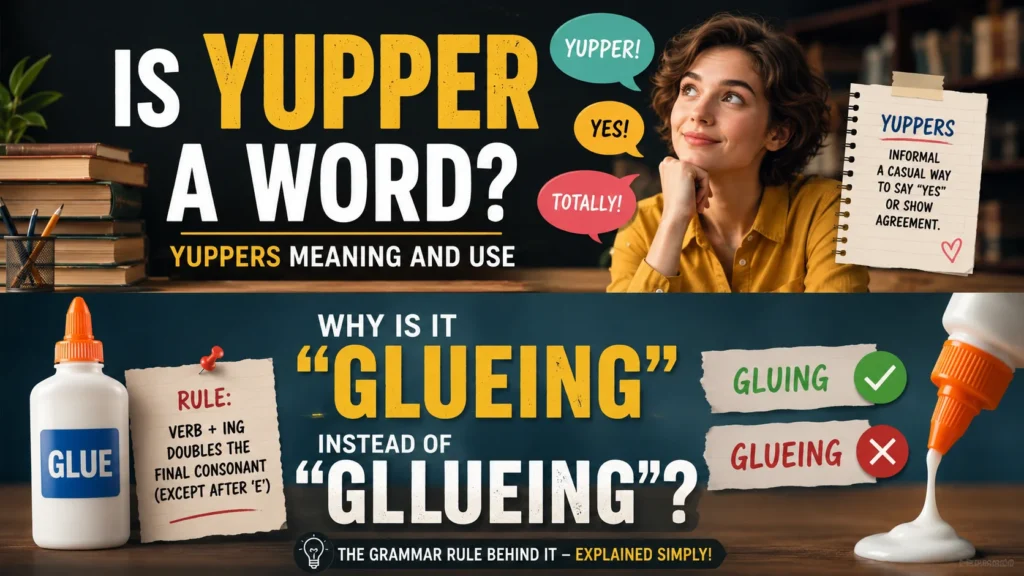
If you have seen “yupper” or “yuppers” in a text, comment, or casual conversation, you may have wondered whether it is actually a word. The answer needs a little nuance. Yuppers has a documented informal use meaning “yes,” while yupper appears mainly in informal and user-generated usage. Wiktionary lists yuppers as an alternative spelling of yeppers, an informal interjection meaning “yes.”
That distinction matters because English has a wide middle ground between formal dictionary vocabulary and completely meaningless strings of letters. People regularly create playful forms of familiar words, especially in speech, texting, memes, and online communities. Yupper and yuppers fit naturally into that informal side of English.
The safest way to understand these expressions is to look at meaning, context, tone, spelling, and register together. In casual communication, a person may use yupper or yuppers to give an upbeat “yes,” “yep,” “sure,” or “I agree.” In a formal essay, business report, academic paper, or professional letter, however, yes, certainly, or I agree will usually communicate the same idea more clearly.
There is another important issue. Yupper can easily be confused with Yooper, but the two terms have completely different meanings. Yooper is an established regional term for a person from Michigan’s Upper Peninsula. Merriam-Webster gives its first known use as 1975 and explains that it comes from the abbreviation U.P.
So, if your question is simply “Is yupper a word?”, the best answer is: yupper exists in informal usage, but it does not have the same standard status as common words such as yes, yep, or yup. Yuppers has clearer lexicographic documentation as an informal affirmative expression.
Is Yuppers a Real Word?
The phrase “real word” can confuse because dictionaries do not create language. They record language after speakers and writers use it consistently enough to merit attention. That means a word can appear in everyday communication long before every major dictionary recognizes it.
With yupper, the evidence points toward informal usage rather than established standard vocabulary. User-generated sources record yupper as an expression related to yup, including a noun-like use for someone who frequently says “yup.” At the same time, major dictionary searches do not provide the kind of established headword treatment that you would find for yes, yep, or yup.
That makes yupper a good example of a word-like expression that lives primarily in casual language.
What Does Yupper Mean?
In its most useful informal sense, yupper expresses agreement or confirmation. Depending on the conversation, it can mean:
- yes
- yep
- yup
- sure
- I agree
- that’s right
- definitely
The exact emotional shade comes from the situation.
Compare these replies:
“Yes.”
“Yep.”
“Yupper!”
All three can answer the same question. Yet they don’t sound identical. Yes sounds neutral. Yep sounds casual. Yupper! can sound more playful, cheerful, exaggerated, or deliberately cute.
For example:
“Are you coming with us tonight?”
“Yupper!”
The speaker isn’t necessarily communicating a different fact from someone who says “Yes.” The spelling simply adds personality.
That distinction is important. Yupper does not normally introduce a new concept or technical meaning. It changes the style of an affirmative response.
Is Yupper an Interjection?
When yupper functions as an affirmative reply, it behaves like an interjection. An interjection is a word or expression that can stand alone to communicate a reaction, feeling, response, or brief social signal.
Consider:
- “Yupper!”
- “Yep!”
- “Sure!”
- “Absolutely!”
- “Nope!”
These expressions can answer a question without forming a complete traditional sentence.
For instance:
“Did you finish the assignment?”
“Yupper.”
The response doesn’t contain a subject and verb, yet the meaning remains clear because the surrounding question supplies the context.
This is one reason informal expressions can feel perfectly natural in conversation while looking unusual in formal writing. Spoken English relies heavily on shared context, tone, timing, and social cues.
Can Yupper Be a Noun?
Some user-generated sources also record yupper as a playful noun for someone who frequently agrees with others or often responds with “yup.”
For example:
“He’s such a yupper. He agrees with everything.”
This use is much less established than the affirmative-response use. You should therefore treat it as playful word formation, not as a standard noun that belongs in formal English.
The same pattern appears throughout English. Speakers often turn a familiar expression into a label for a person associated with that expression. Such formations can be humorous and understandable without becoming standard vocabulary.
Is Yupper Slang?
Yupper is best treated as informal slang or playful colloquial language. The exact label can vary because “slang” covers a broad range of nonstandard expressions.
A practical classification looks like this:
| Expression | Basic meaning | Register | Best setting |
| Yes | Agreement | Standard | Almost anywhere |
| Yep | Yes | Informal | Casual conversation |
| Yup | Yes | Informal | Casual conversation and texting |
| Yupper | Playful yes | Very informal | Friends and casual chats |
| Yuppers | Playful yes | Very informal | Texts, chats, humorous replies |
| Yeppers | Informal yes | Very informal | Casual speech and online communication |
This table also shows why context matters more than a simple right-or-wrong label. An expression can work perfectly well in one setting and look out of place in another.
What Does Yuppers Mean?

Yuppers means “yes” informally and playfully. Wiktionary lists yuppers as an alternative spelling of yeppers and classifies the expression as an informal interjection. It also traces yeppers to yep + -ers.
That gives us a stronger linguistic basis for yuppers than we have for treating yupper as a standard dictionary word.
When someone writes:
“Yuppers!”
they usually mean something like:
“Yes!”
“Absolutely!”
“Sure!”
or
“Yep, I agree.”
The extra sound does more than stretch the spelling. It can make the response feel lighter and more expressive.
Yuppers vs. Yes
Imagine this exchange:
“Want to grab coffee after work?”
“Yes.”
That answer sounds neutral.
Now change it:
“Yuppers!”
The basic answer stays positive, but the tone becomes more playful.
That difference is especially noticeable in text because written communication removes much of the voice, facial expression, and body language that normally convey emotion. People often use unusual spellings, repeated letters, emojis, capitalization, and punctuation to replace some of those missing signals.
For example:
- Yes. — neutral
- Yep! — friendly
- Yup! — casual
- Yuppers! — playful
- YUPPERS! — highly enthusiastic or humorous
- Yuppers 😊 — warm and friendly
None of these forms guarantees a particular emotion. Context still does the heavy lifting.
Yuppers vs. Yeppers
The relationship between yuppers and yeppers is especially useful to understand.
Wiktionary lists yupper and yuppers among the alternative forms associated with yeppers. It gives yeppers the informal meaning “yes” and identifies the General American pronunciation as /ˈjɛpɚz/.
So you may encounter several spellings:
- yep
- yepper
- yeppers
- yupper
- yuppers
These forms don’t all have the same level of documentation or frequency. However, they belong to the same broad family of playful affirmative expressions.
The spelling yuppers is particularly important because it is directly documented as an alternative form of yeppers. That makes it more defensible to describe yuppers as an informal English expression than to claim that yupper has fully entered standard English vocabulary.
Why Does Yuppers Sound More Playful?
The ending -ers gives the expression a rhythmic, exaggerated quality. English speakers often modify familiar words for humor, affection, emphasis, or social bonding.
Think about expressions such as:
- sure thing
- yep
- yepper
- yeppers
- nope
- nopers
The purpose isn’t usually grammatical precision. It’s social expression.
When someone says “Yuppers!”, they may be signaling, “Yes, and I’m being cheerful about it.” The word can make a simple confirmation feel less dry.
Still, you shouldn’t assume every speaker uses it that way. One person may find it funny. Another may find it childish. Someone else may use it simply because it has become part of their texting style.
Yupper and Yuppers in Sentences
Here are natural examples showing different contexts:
| Situation | Example | Meaning |
| Agreement | “Yupper, I agree.” | Yes, I agree. |
| Confirmation | “Yuppers, that’s the plan.” | Yes, that’s the plan. |
| Invitation | “Want to come along?” — “Yuppers!” | Yes, I want to. |
| Texting | “Yuppers 😊” | Friendly yes |
| Enthusiasm | “YUPPERS!” | Very enthusiastic yes |
| Playful reply | “Did you eat the last cookie?” — “Yuppers.” | Yes, jokingly |
| Casual confirmation | “We’re meeting at six?” — “Yupper.” | Yes, at six |
These examples demonstrate why dictionaries alone cannot tell you everything about an expression. Meaning and tone emerge from actual use.
When Should You Use Yupper and Yuppers?
The easiest rule is simple: use yupper or yuppers when the conversation already welcomes casual, playful language.
That usually means texting friends, chatting with family, commenting on social media, or joking with people who know your communication style.
It becomes less suitable when the reader expects precision, professionalism, or formal language.
Good Situations to Use Yupper
Yupper can work naturally in a relaxed exchange:
Friend: “Want pizza?”
You: “Yupper!”
Here, the playful form fits because the conversation itself is casual.
It can also work in a group chat:
“Are we still meeting at 7?”
“Yuppers. I’ll be there.”
Again, the word acts as a quick confirmation.
Other suitable settings include:
- Friendly text messages
- Personal group chats
- Casual social-media comments
- Gaming chats
- Memes
- Lighthearted conversations
- Informal online communities
- Jokes between friends
- Playful family conversations
The key isn’t the platform alone. The relationship between the people matters. A group chat between close friends may welcome slang. A professional team channel may not.
When to Avoid Yupper
Avoid yupper and yuppers when your message needs a formal or neutral tone.
For example, don’t write:
“Yuppers, I approve the revised contract.”
A better professional version would be:
“Yes, I approve the revised contract.”
Or:
“I approve the revised contract.”
The same principle applies to academic work.
Instead of:
“Yupper, the evidence supports this argument.”
write:
“Yes, the evidence supports this argument.”
Better yet, in academic prose, you often don’t need the conversational confirmation at all. State the evidence directly.
Formal vs. Informal Communication
Register is one of the most important concepts behind your meaning and use.
Register refers to the style of language you choose for a particular situation. You don’t speak to your best friend exactly as you speak during a job interview. You also don’t write a research paper the same way you write a text message.
| Situation | Better choice | Why |
| Texting a friend | Yupper / Yuppers | Casual and playful |
| Family group chat | Yupper / Yuppers | Often fits an informal tone |
| Social-media comment | Yuppers | Can add personality |
| Gaming chat | Yupper / Yuppers | Fast, informal communication |
| Work chat with close colleagues | Maybe | Depends on workplace culture |
| Business email | Yes | Clear and professional |
| Job application | Yes | Standard language |
| Academic assignment | Yes | Formal register |
| Legal document | Yes | Precision matters |
| Research paper | Yes | Standard academic style |
The important point is that informal doesn’t mean wrong. A casual expression can serve its purpose extremely well in casual communication.
The mistake comes from assuming that every useful conversational expression belongs everywhere.
Why Do People Say Yupper Instead of Yes?
People rarely choose words based on dictionary definitions alone. They also choose them for tone, identity, humor, rhythm, and social connection.
A plain yes provides information.
A playful yuppers can provide information plus attitude.
That’s why people alter familiar words. They want the message to sound less stiff.
Consider these replies:
“Are you ready?”
“Yes.”
“Yep.”
“Yup.”
“Yuppers!”
The factual answer stays the same. The emotional color changes.
This process is common across informal English. Speakers shorten words, stretch sounds, add endings, repeat letters, and invent playful forms. Digital communication has accelerated that behavior because typing allows people to experiment with spelling without slowing down the conversation.
Common Situations Where Native Speakers May Use Yupper or Yuppers
There is no reliable basis for claiming that every native English speaker uses these expressions. They are informal and variable. Still, the forms appear in user-generated slang sources and online communication. User-submitted definitions record yupper and yuppers as affirmative or playful forms related to yup.
Friends and Family
This is probably the easiest environment for a playful affirmative.
“Did you save me some cake?”
“Yuppers.”
The response sounds intentionally casual.
Text Messages
Texting encourages short answers, and yupper can function as a one-word response:
“Can you pick me up?”
“Yupper.”
The surrounding relationship determines whether the word sounds natural.
Social Media
A person might comment:
“Yuppers! This is exactly what I needed.”
Here, the expression adds personality to a short comment.
Casual Workplace Chats
This category requires more caution.
If coworkers regularly use jokes, emojis, abbreviations, and informal language, yupper may not seem strange. But workplace culture varies widely. A casual Slack or Teams message between close colleagues differs from an email to a client or executive.
When you’re unsure, choose yes. It carries almost no risk.
A Simple Tone Test
Before using yupper, ask yourself three questions:
- Would I say this to the person out loud?
- Does this conversation already use playful language?
- Could a neutral “yes” communicate the message better?
If the first two answers are yes and the third answer is no, Yupper may fit.
If the message concerns money, contracts, grades, legal matters, employment, safety, or an important decision, plain language usually wins.
Yupper vs. Similar Words: Meaning, Tone, and Usage
Understanding yupper becomes much easier when you compare it with nearby expressions.
Yupper vs. Yup
Yup is a well-established informal form of yes. It appears in dictionaries as an informal affirmative response. The form is short, familiar, and widely understood.
Yupper feels more playful and less neutral.
Compare:
“Are you coming?”
“Yup.”
This sounds ordinary and casual.
“Are you coming?”
“Yupper!”
This sounds more expressive.
Yupper vs. Yep
Yep also means yes and works naturally in casual speech and writing.
Many speakers use yep without trying to sound humorous. By contrast, yupper often attracts more attention because its form is less conventional.
A useful rule:
- Use yep when you want casual simplicity.
- Use yupper when you intentionally want a playful tone.
Yupper vs. Yuppers
The distinction between these two is not rigid.
Yupper can function as a playful affirmative:
“Yupper, I’ll handle it.”
Yuppers can sound even more playful:
“Yuppers! Let’s go.”
However, speakers may use the two forms interchangeably. There is no standard grammatical rule that says one must express a particular degree of enthusiasm.
Yupper vs. Yeppers
This comparison has stronger dictionary evidence. Yeppers is documented as an informal interjection meaning yes, and Wiktionary lists yuppers as an alternative spelling.
So:
yeppers → yuppers
is a documented spelling relationship.
The broader family can be understood like this:
| Form | Meaning | Status |
| yes | Agreement | Standard |
| yep | Yes | Informal |
| yup | Yes | Informal |
| yeppers | Playful yes | Informal |
| yuppers | Alternative form of yeppers | Informal |
| yupper | Playful affirmative/informal usage | Nonstandard or slang |
This distinction helps prevent an important mistake: don’t claim that all these spellings have identical dictionary status.
They don’t.
Yupper vs. Yooper
This is the most important spelling confusion to avoid.
Yupper relates to an informal affirmative expression in the usage discussed here.
Yooper is a regional noun connected to Michigan’s Upper Peninsula.
Merriam-Webster defines Yooper as a native or resident of Michigan’s Upper Peninsula and gives its first known use as 1975. Dictionary.com similarly identifies it as a nickname for someone from the Upper Peninsula and dates its first recorded use to 1970–75.
Cambridge also classifies Yooper as informal and defines it as someone from Michigan’s Upper Peninsula. It recognizes both noun and adjective uses.
So the meanings are completely different:
| Word | Meaning |
| Yupper | Informal/playful affirmative expression |
| Yuppers | Informal “yes,” documented as an alternative spelling of yeppers |
| Yeppers | Informal “yes” |
| Yooper | Person from Michigan’s Upper Peninsula |
| Yuppie | A separate term associated with a young urban professional |
If someone writes “He is a Yooper,” they are talking about Michigan’s Upper Peninsula.
If someone writes “Yuppers!”, they are generally saying yes.
Is Yupper Grammatically Correct?
The answer depends on what you mean by grammatically correct.
If you mean, “Can a person use yupper as a conversational response and have other people understand it?” then yes, it can function naturally in informal communication.
If you mean, “Should I use yupper in formal standard English?” then generally no.
Grammar and register are not identical concepts.
A phrase can function successfully in conversation without being suitable for an academic essay. For example, people regularly use fragments such as:
- “Yep.”
- “Nope.”
- “Sure.”
- “Absolutely.”
- “Yuppers!”
These expressions work because conversation doesn’t require every response to look like a complete formal sentence.
Yupper therefore makes more sense as an informal interjection than as a formal vocabulary item.
Can You Use Yupper in Professional Communication?
Sometimes, but only when the communication style clearly supports it.
Suppose a close coworker asks:
“Can you send that file over?”
A casual:
“Yupper!”
might feel friendly.
Now imagine the same response in a formal email to a client:
“Yuppers, I’ll send the contract today.”
That sounds unnecessarily casual.
A professional version would be:
“Yes, I’ll send the contract today.”
Or, even better:
“I’ll send the contract today.”
The second version removes unnecessary conversational padding while keeping the message direct.
For professional communication, prefer:
- Yes
- Certainly
- Absolutely
- I agree
- I can do that
- That works for me
- I’ll take care of it
These alternatives give you control over tone without relying on a highly informal expression.
Is Yupper Common in American English?
It is difficult to give a trustworthy percentage for how many Americans use yupper, and no reliable current usage figure establishes it as a mainstream American expression.
What can be said more confidently is that related forms such as yup, yep, yeppers, and yuppers occur in informal English. Wiktionary explicitly records yeppers as an informal American English interjection and gives a General American pronunciation.
That puts yupper in a broader ecosystem of playful affirmative forms.
American English has long encouraged informal contractions and conversational shortcuts. Online communication adds another layer because people can deliberately reshape spelling to show humor or personality.
Still, don’t mistake online visibility for universal usage. A word can appear frequently in a particular community while sounding unfamiliar to another group of speakers.
Is Yupper Common in British English?
There is even less reason to treat yupper as a distinctly British expression.
Internet communication allows informal vocabulary to cross national boundaries quickly. A British speaker may understand yupper because the context makes the intended “yes” obvious, even if that speaker doesn’t normally use the word.
The better approach is to avoid assigning a strong American or British identity to yupper without solid usage evidence.
Instead, describe it as informal English.
That label tells readers what matters most: the expression belongs in relaxed communication, not formal prose.
Is Yupper Used Around the World?
English speakers around the world encounter informal vocabulary through social media, entertainment, gaming, messaging apps, and online communities. That exposure can spread playful expressions far beyond the place where they first appeared.
However, understanding an expression and regularly using it are two different things.
A reader in another English-speaking country may understand:
“Yuppers!”
from context while choosing “Yep!” or “Sure!” in their own messages.
This distinction matters for English learners too. Recognition doesn’t require active use.
You can understand yupper perfectly well without making it part of your everyday vocabulary.
Tips for English Learners
If you’re learning English, start with the standard forms first.
Learn this progression:
yes → yep → yup → yeppers/yuppers → yupper
The first three are much more useful for general communication. The later forms add personality but offer little practical advantage when you need clear, widely accepted English.
A learner can therefore follow these rules:
- Use yes in formal situations.
- Use yep or yup in ordinary casual conversation.
- Recognize yeppers and yuppers as playful informal forms.
- Treat yupper as a nonstandard, casual expression.
- Don’t use slang simply because native speakers use it online.
- Pay attention to the relationship between the speakers.
- Match your vocabulary to the setting.
- When uncertain, choose the simpler word.
For example, if your teacher asks:
“Did you complete the assignment?”
Say:
“Yes, I did.”
If your friend asks:
“Want to get pizza?”
You could say:
“Yup!”
If your close friend enjoys playful language, you might answer:
“Yuppers!”
The meaning stays positive throughout. The register changes.
That is the central lesson behind yupper’s meaning and use. Informal English isn’t a separate language with completely different rules. It is a flexible layer of communication where speakers adjust familiar words to express personality, humor, enthusiasm, and social closeness.
The strongest evidence also supports keeping the terminology precise. Yuppers has a documented dictionary-style entry through Wiktionary as an alternative spelling of yeppers, while Collins currently lists yuppers as a submitted word suggestion meaning “yes; sure” and says it is being monitored for evidence of usage.
That is a useful distinction from simply declaring that every informal expression is either “a word” or “not a word.”
Language doesn’t always fit into two neat boxes.
For practical writing, though, the decision is easy. If you want a playful yes in a relaxed conversation, yupper or yuppers can convey that tone. If you’re writing something formal, choose yes, certainly, or a direct statement instead. And if you mean someone from Michigan’s Upper Peninsula, write Yooper, not yupper.
Is Yupper a Real Word?
The question “Is Yupper a word?” has a surprisingly nuanced answer because informal English doesn’t always fit neatly into the categories of “real word” and “not a word.” In everyday communication, yupper can function as a playful affirmative expression, similar to yup, yep, or yes. However, its status is much less established than those familiar forms. Current dictionary evidence gives stronger support to yuppers, which Wiktionary lists as an alternative spelling of yeppers, an informal interjection meaning “yes.”
That distinction matters when you need to decide whether the expression belongs in a particular piece of writing. If you’re chatting with a friend, “Yupper!” can communicate a cheerful or humorous “yes” without confusion. If you’re writing an academic assignment, business email, formal report, or professional document, yes remains the better choice.
What Does Yupper Mean?
In its most common informal use, yupper means “yes.” It can also carry shades of agreement, confirmation, enthusiasm, or playful acceptance. The exact tone depends on the speaker and the surrounding conversation.
For example:
“Are you coming with us?”
“Yupper!”
The answer clearly means “yes,” but the unusual spelling makes the response sound more relaxed and expressive.
You can think of the forms as a rough progression:
| Expression | Basic meaning | Typical tone |
| Yes | Agreement | Neutral |
| Yep | Yes | Casual |
| Yup | Yes | Casual and relaxed |
| Yupper | Yes | Playful and informal |
| Yuppers | Yes | Playful, cheerful, or emphatic |
| Yeppers | Yes | Informal and expressive |
This isn’t a strict scale. Native speakers don’t follow a grammar rule that assigns one exact emotional level to each spelling. Instead, people choose the form that fits the mood.
Is Yupper Standard English?
No, not in the same sense as “yes.” It is better described as an informal or nonstandard expression.
That doesn’t mean the expression has no meaning. Quite the opposite. A word can have a clear function in conversation without becoming part of formal standard vocabulary.
Consider the difference between these replies:
“Yes, I’ll attend.”
and
“Yuppers, I’ll be there!”
Both communicate agreement. The first sounds neutral and professional. The second sounds personal and playful.
That distinction is known as register. Register describes the level and style of language appropriate for a particular situation.
Is Yupper Slang?
Yupper is best treated as very informal language or slang-like usage. The label “slang” can be broad, so it’s more useful to focus on how the expression behaves.
It appears most naturally in:
- Casual conversations
- Text messages
- Online chats
- Social-media comments
- Friendly group conversations
- Humorous exchanges
- Informal communities
It doesn’t belong naturally in every environment.
If your professor asks whether you completed an assignment, saying “Yupper!” aloud might sound overly casual. In a formal email, “Yes, I completed it” is clearer and more appropriate.
Why Does Yupper Sound Different From Yes?
The meaning stays almost the same, but the social signal changes.
When someone writes yes, the reader receives a straightforward confirmation. When someone writes yupper, the unusual form draws attention to the speaker’s personality.
That can make the response sound:
- Friendly
- Cheerful
- Playful
- Lighthearted
- Humorous
- Enthusiastic
- Occasionally sarcastic
For example:
“Did you really eat the whole pizza?”
“Yupper.”
The response may sound humorous because the spelling adds a playful edge to an otherwise ordinary “yes.”
The same word can therefore communicate different shades of attitude depending on punctuation and context. Yupper.” feels fairly relaxed.“Yupper!” sounds more enthusiastic.“YUPPER!” can sound exaggerated or intentionally funny.
The spelling itself doesn’t guarantee the emotion. The surrounding conversation determines how readers interpret it.
Is Yupper in the Dictionary?
Dictionary status deserves careful treatment because people often assume that a word either appears in every dictionary or doesn’t exist at all. Real language doesn’t work that cleanly.
Dictionaries are selective records of usage. Different publishers use different editorial standards, source collections, historical evidence, and thresholds for adding entries.
For yupper, the evidence is weaker than it is for yuppers or yeppers. Wiktionary currently has a dedicated entry for yuppers and defines it as an alternative spelling of yeppers. Wiktionary’s yeppers entry defines the expression as an informal way to say “yes” and gives its etymology as yep + -ers.
That gives us an important linguistic distinction.
| Form | Dictionary evidence | Meaning |
| Yes | Strong | Standard affirmative |
| Yep | Strong | Informal yes |
| Yup | Strong | Informal yes |
| Yeppers | Documented | Informal yes |
| Yuppers | Documented as an alternative spelling of yeppers | Informal yes |
| Yupper | Less established | Informal/playful affirmative |
So, if someone asks whether yupper is a standard dictionary word, the safest answer is no, not in the same established sense as yes, yep, or yup.
If they ask whether people use yupper as an understandable expression, the answer is yes.
Why Dictionary Status Doesn’t Tell the Whole Story
English contains thousands of expressions that began as informal speech, regional language, humor, or slang. Some eventually become standard vocabulary. Others remain tied to particular communities or situations.
This is why saying “It’s not in a major dictionary, therefore nobody uses it” can lead to an inaccurate conclusion.
Usage comes first. Dictionary recognition often follows.
The reverse is also important. Finding an entry in a user-generated dictionary doesn’t automatically make a word standard English. Sources differ greatly in editorial authority.
For that reason, the best approach is to consider several factors:
- Frequency: How often do people actually use it?
- Context: Where does it appear?
- Meaning: Do speakers consistently understand it?
- Register: Is it formal, informal, regional, or slang?
- Lexicographic evidence: Do reputable dictionaries document it?
- Historical evidence: Can earlier examples be found?
- Variation: Does the spelling compete with other forms?
This approach gives a much more accurate picture than a simple dictionary yes-or-no test.
What Does Yuppers Mean?
Yuppers means “yes” in an informal, playful way. Unlike yupper, it has clearer dictionary-style documentation. Wiktionary identifies yuppers as an alternative spelling of yeppers, while its entry for yeppers defines the word as an informal affirmative interjection.
In ordinary use, yuppers can mean:
- Yes
- Yep
- Yup
- Definitely
- Absolutely
- Sure
- I agree
The expression often adds a little personality to the response.
For example:
“Did you finish the project?”
“Yuppers!”
The speaker isn’t merely confirming completion. The spelling can make the response feel upbeat or playful.
Yuppers as an Interjection
Yuppers functions as an interjection when it stands alone as a response.
An interjection can express a reaction or response without forming a complete traditional sentence.
Examples include:
- “Yes!”
- “No!”
- “Wow!”
- “Oops!”
- “Yep!”
- “Yuppers!”
In a conversation, the surrounding question supplies the missing information.
“Are you ready?”
“Yuppers!”
The second speaker doesn’t need to say, “Yes, I am ready.” Everyone understands the intended meaning from context.
That makes yuppers particularly useful in casual dialogue and digital communication.
Why People Use Yuppers Instead of Yes
The simplest explanation is tone.
A plain yes communicates the answer efficiently. Yuppers communicate the answer while also giving the exchange a more relaxed personality.
Compare:
“Would you like to come?”
“Yes.”
with:
“Would you like to come?”
“Yuppers!”
The second response feels more animated.
This doesn’t mean yuppers always express excitement. Sometimes people use it simply because it has become part of their personal speaking style.
Online communication makes this especially noticeable. When you type instead of speaking, readers can’t hear your voice or see your facial expression. Informal spellings can help supply some of that missing social information.
Yuppers in Texting
Text messages create an ideal environment for expressions such as yuppers.
A short reply can carry a lot of tone:
“Can you pick me up?”
“Yuppers.”
“Are we still on for Friday?”
“Yuppers!”
“You really want to go there?”
“YUPPERS 😂”
The basic answer remains affirmative. The formatting adds emotional cues.
Punctuation matters too:
| Message | Possible impression |
| Yuppers. | Calm or matter-of-fact |
| Yuppers! | Cheerful |
| Yuppers!! | Excited |
| YUPPERS! | Exaggerated or humorous |
| yuppers 😊 | Warm and friendly |
| yuppers… | Potentially hesitant or sarcastic |
These aren’t fixed meanings. They illustrate how digital communication combines word choice, spelling, punctuation, and context.
Yupper vs. Yuppers
The two forms are closely related, but you shouldn’t assume they have an official grammatical distinction.
Yupper generally appears as a less common informal form.
Yuppers has stronger documentation as an alternative spelling of yeppers.
In casual conversation, people may use either form to agree. The choice often depends on personal preference rather than a grammar rule.
| Feature | Yupper | Yuppers |
| Core idea | Yes | Yes |
| Register | Very informal | Very informal |
| Tone | Casual/playful | Often more playful or emphatic |
| Dictionary documentation | Limited | Documented as an alternative spelling of yeppers |
| Formal writing | Avoid | Avoid |
| Texting | Possible | Commonly encountered |
| Main function | Affirmation | Affirmation |
The biggest practical difference is therefore not meaning but recognition and documentation.
If you’re writing for a broad audience, yuppers may be easier for readers familiar with informal English to recognize. If you need standard English, neither form is the best choice.
Use yes.
Yupper vs. Similar Words
Understanding nearby expressions helps explain why yupper feels informal.
Yupper vs. Yup
Yup is short, familiar, and widely recognized as an informal form of yes.
“Are you ready?”
“Yup.”
The response sounds casual but not especially unusual.
“Are you ready?”
“Yupper!”
The second answer attracts more attention because the form is less conventional.
Yupper vs. Yep
Yep works similarly.
Many speakers use yep as an ordinary casual response without intending humor.
Yupper tends to feel more marked. In linguistics, a marked form attracts more attention because it differs from what readers or listeners expect.
That makes yupper useful when the speaker wants a little extra personality.
Yupper vs. Yeppers
This is the most relevant comparison because yuppers is documented as an alternative spelling of yeppers.
The documented etymology of yeppers is straightforward: yep + -ers.
The ending helps transform a very short affirmative into something more rhythmic and expressive.
Yupper vs. Yeah
Yeah is far more common in everyday speech. It can mean yes, but it can also signal acknowledgment, agreement, or continuation.
For example:
“Yeah, I know what you mean.”
That sounds completely natural in casual conversation.
Yupper is much more playful and therefore has a narrower range of suitable contexts.
Yupper vs. Yes
This is the easiest distinction:
Yes = standard and neutral.
Yupper = informal and playful.
When you aren’t sure which one to use, yes is the safer option.
Is Yupper an Interjection?
When yupper means “yes,” it can function as an interjection because it can stand independently as a conversational response.
For example:
“Did you call Sarah?”
“Yupper.”
The word doesn’t need an object or a verb to perform its conversational job.
Its meaning comes from the question.
This is common with many English interjections and response forms:
- Yes
- No
- Yep
- Yup
- Sure
- Absolutely
- Yuppers
The grammatical label becomes less important than the practical function. In real conversation, yupper acts as a quick signal of agreement or confirmation.
Is Yupper Grammatically Correct?
Calling yupper “grammatically incorrect” would oversimplify the issue.
A better description is nonstandard and highly informal.
When you answer a casual question with a one-word interjection, you don’t necessarily need a complete sentence. Conversation regularly uses fragments because speakers share context.
For example:
“Coffee?”
“Yep.”
Nobody needs to say:
“Yes, I would like some coffee.”
The shorter response works perfectly well.
Yupper follows the same conversational pattern. Its issue isn’t that the sentence structure fails. Its issue is register.
In formal writing, readers expect standard vocabulary. In casual speech, people tolerate and even enjoy playful forms.
That is why the following distinction works:
Grammatically functional in casual conversation: Yes.
Appropriate for formal standard writing: Generally no.
When Should You Use Yupper or Yuppers?
Use these forms when playfulness is part of the point.
Good settings include:
- Conversations with close friends
- Family group chats
- Informal texting
- Social-media comments
- Gaming chats
- Humorous messages
- Casual online communities
Avoid them when your writing needs a professional or academic tone.
Good Example
“Want to grab lunch?”
“Yuppers! What are you thinking?”
The expression fits because the exchange is personal and casual.
Better Formal Example
“Are you available to discuss the proposal tomorrow?”
“Yes, I am available.”
Here, yes keeps the tone professional and clear.
What About Casual Work Chats?
This depends on the workplace.
A close team that regularly uses informal language may accept yupper without hesitation. Another organization may expect a much more restrained style.
A useful rule is:
Match the tone of the conversation rather than assuming the platform determines the correct language.
A Slack message isn’t automatically informal. An email isn’t automatically formal. The relationship, purpose, audience, and workplace culture all matter.
Is Yupper Common in American English?
The safest answer is that yupper is not established enough to call it a broadly common American English word.
Related forms have stronger evidence. Wiktionary identifies yeppers as an informal English interjection meaning “yes” and lists yuppers as an alternative spelling.
That distinction prevents an important SEO and language mistake: don’t turn scattered online examples into claims about millions of speakers.
A term can appear in social media, slang dictionaries, chats, or individual conversations without becoming a mainstream expression.
So, rather than saying “Americans commonly say yupper,” a more accurate description is:
Yupper occurs in informal usage, while related forms such as yup, yep, and yeppers have clearer recognition.
Is Yupper Common in British English?
There is no strong reason to classify yupper as a specifically British expression.
English-speaking communities share large amounts of vocabulary through television, music, social media, gaming, and online communication. An informal expression can therefore be understood outside the community where a particular speaker first encountered it.
Still, understanding a word doesn’t mean regularly using it.
A British English speaker might understand:
“Yuppers!”
as an obvious playful “yes” without using the expression personally.
The same principle applies to English speakers in Australia, Canada, Ireland, New Zealand, and elsewhere.
Is Yupper Used Around the World?
Informal English travels quickly.
A phrase can begin in one community, appear in online discussions, spread through memes, and eventually become familiar to people who never use it themselves.
For yupper, however, it’s better to describe this as possible cross-border recognition rather than universal global usage.
There is no good reason to claim that speakers across all English-speaking countries use the expression at the same rate.
For language learners, that distinction is valuable. You can understand a slang term without adopting it.
In fact, that’s often the best approach.
Learn the standard word first. Then learn the informal alternatives so you can recognize them when native speakers use them.
What Is the Safest Word to Use Instead?
If you’re uncertain about yupper, simply use yes.
It works almost everywhere.
| Situation | Recommended expression |
| Academic paper | Yes |
| Formal email | Yes |
| Job application | Yes |
| Professional report | Yes |
| Conversation with a friend | Yes / Yep / Yup |
| Casual texting | Yep / Yup / Yuppers |
| Playful conversation | Yupper / Yuppers |
This isn’t about declaring informal English “bad.” It’s about choosing the right tool for the job.
Think of yupper as a conversational accessory. You don’t need it to communicate agreement. You use it when its playful tone adds something useful.
The Bottom Line on Yupper and Yuppers
The evidence supports a careful distinction. Yuppers has direct lexicographic documentation as an alternative spelling of yeppers, and yeppers means “yes” as an informal interjection. Yupper appears in informal usage with a closely related affirmative sense, but it doesn’t have the same level of standard dictionary status.
So if someone asks “Is yupper a word?”, don’t give an overly rigid yes-or-no answer.
Yupper is a real expression in informal use, but it isn’t a standard formal substitute for “yes.”
And if someone writes “Yuppers!”, the intended meaning is usually much easier to establish: yes, definitely, or sure, delivered with a playful or cheerful tone.
For everyday communication, context is the key. Use yupper or yuppers when the conversation is relaxed, and the playful tone fits. Use yes when clarity, professionalism, or formality matters.
How to Use Yupper and Yuppers Naturally
Knowing the yupper meaning is only half the picture. The other half is knowing when the expression sounds natural and when it sounds forced. Because yupper and yuppers belong to very informal English, their success depends heavily on context, relationship, tone, and audience.
In a relaxed conversation, a playful response can make an exchange feel warmer. In a formal setting, the same expression may distract the reader. The word itself hasn’t suddenly become “wrong.” The register has simply changed.
For example:
“Are you still coming over tonight?”
“Yuppers!”
That sounds natural when two friends are chatting.
Now consider:
“Yuppers, I have reviewed the terms of the agreement.”
The sentence is understandable, but the opening feels out of place. A professional reader would expect “Yes” or a direct statement instead.
The most useful rule is straightforward:
Use yupper or yuppers when the tone of the conversation is already casual and playful.
Yupper as a Quick Affirmative
The simplest function of yupper is to provide a quick affirmative answer.
It can replace:
- Yes
- Yep
- Yup
- Sure
- Absolutely
- Definitely
- That’s right
The exact replacement depends on the question.
For example:
“Did you send the message?”
“Yupper.”
This means yes, I sent it.
“Are you coming with us?”
“Yupper!”
This means yes, I’m coming.
“Do you agree with that?”
“Yupper.”
This means yes, I agree.
Notice that the word itself doesn’t explain what the speaker agrees with. The question provides that information. That’s typical of conversational interjections.
Yuppers as a More Playful Yes
Yuppers often add more personality than a plain yes.
Compare:
“Can you help me?”
“Yes.”
with:
“Can you help me?”
“Yuppers!”
The factual information remains the same. The second answer simply feels more animated.
This is why unusual affirmative forms often appear in friendly conversations. People aren’t always trying to communicate information as efficiently as possible. They’re also communicating attitude.
A playful response can signal:
- Friendliness
- Enthusiasm
- Humor
- Agreement
- Confidence
- Familiarity
- Lightheartedness
However, don’t assume that yuppers always sound enthusiastic. Someone can use it sarcastically or simply as a habitual expression. Context determines the final interpretation.
Yupper in Spoken English
Spoken English gives informal expressions an advantage because voice and facial expression supply additional meaning.
Imagine someone saying:
“Yupper.”
with a smile.
It may sound warm and agreeable.
Now imagine someone saying:
“Yupper.”
with an exaggerated pause and an eye roll.
The same word could sound sarcastic.
Written English doesn’t provide those physical signals. Instead, writers rely on punctuation, capitalization, emojis, surrounding words, and context.
That’s why these versions can feel different:
- Yupper.
- Yupper!
- YUPPER!
- Yuppers 😂
- Yuppers…
The spelling isn’t a complete emotional code. It simply gives the reader clues.
Why Context Matters So Much
Informal words depend heavily on shared understanding.
If a close friend sends:
“Yuppers 😂”
you may immediately understand the playful intent.
A stranger sending the same message could leave you wondering whether they’re joking, being sarcastic, or simply using a word you’re unfamiliar with.
This is a broader feature of conversational English. Words don’t operate in isolation. Audience and context influence interpretation.
For that reason, a person should consider the reader before choosing an unusual informal expression.
Yupper in Text Messages
Texting is one of the most natural environments for yupper and yuppers because messages often prioritize speed and personality over formal structure.
A person may answer a question with a single word:
“Dinner at eight?”
“Yuppers.”
There’s no need to write a complete sentence because the context already supplies the missing information.
Text messages also encourage playful spelling. People regularly modify words to make them sound more expressive or personal.
Examples include:
- yup
- yep
- yuppers
- yeppers
- nope
- nah
- yesss
- sureee
These aren’t interchangeable in every situation. Each can create a slightly different impression.
Texting Examples With Yupper
Here are realistic examples:
Friend: “Are you ready to leave?”
Reply: “Yupper!”
Friend: “Can you bring snacks?”
Reply: “Yuppers 😄”
Friend: “We’re meeting at the same place, right?”
Reply: “Yupper.”
Friend: “Do you really want to watch that movie again?”
Reply: “YUPPERS 😂”
In each case, the expression works because the conversation is informal.
Yupper on Social Media
Social media also creates room for playful vocabulary because posts and comments often encourage personality rather than strict formal writing.
Someone might comment:
“Yuppers! This is exactly what I needed.”
or:
“Yupper, I’m definitely trying this.”
The expression can sound more conversational.
However, social media isn’t automatically informal. A business account, professional organization, government agency, or educational institution may have a different communication standard.
For example, a personal account might comfortably post:
“Yuppers, we’re going!”
A company announcing an important policy would normally write:
“Yes, the new policy takes effect Monday.”
The platform hasn’t changed. The audience and purpose have changed.
Yupper in Workplace Communication
Workplace communication requires more judgment.
Modern workplaces often use informal channels such as Slack, Microsoft Teams, group chats, and internal messaging platforms. Employees may communicate much more casually there than they would in a formal report.
That doesn’t automatically make yupper appropriate.
When It Might Work
Suppose two coworkers have an established friendly relationship:
“Can you join the call at 3?”
“Yupper!”
If their normal communication style is relaxed, nobody may find that unusual.
When It Doesn’t Work
Now imagine an email to a client:
“Yuppers, we’ve received your payment.”
That wording sounds unnecessarily casual.
A better version is:
“Yes, we’ve received your payment.”
Or:
“We’ve received your payment. Thank you.”
The second version is even more efficient because it removes the unnecessary affirmative opener.
Workplace Rule of Thumb
If the message involves money, contracts, deadlines, customers, legal matters, performance reviews, or formal decisions, choose standard language.
If it’s an informal exchange between colleagues who already communicate casually, a playful expression may be acceptable.
When uncertain, don’t gamble with tone.
Choose the neutral option.
Yupper in Academic Writing
Academic writing is another setting where yupper should generally stay out of the text.
A research paper needs precise language. Informal expressions can weaken the tone or make an argument appear less polished.
For example:
“Yuppers, the results support the hypothesis.”
Sounds conversational rather than academic.
A stronger version would be:
“The results support the hypothesis.”
Notice that the revised sentence doesn’t even need yes.
That’s an important writing principle: don’t add a conversational response when a direct statement communicates the idea more clearly.
Formal Alternatives to Yupper
Depending on your intended meaning, you can replace yupper with:
- Yes
- Certainly
- Indeed
- Correct
- That is correct
- Absolutely
- I agree
- The evidence supports this
- The results confirm this
- This is accurate
The best choice depends on what you’re trying to communicate.
For example:
“Is this interpretation correct?”
Instead of:
“Yupper.”
write:
“Yes, that interpretation is correct.”
In a formal essay, you could simply explain the interpretation and supporting evidence.
Yupper in Professional Emails
Email creates a particularly interesting middle ground.
An email to a friend can be highly informal. An email to a client may require professional language. An internal message to a close coworker may sit somewhere between the two.
Consider three situations.
Email to a Friend
“Yuppers! I’ll send it over tonight.”
Perfectly understandable.
Internal Email to a Familiar Coworker
“Yupper, I’ll have it ready by Friday.”
Potentially acceptable if the workplace culture is very casual.
Email to a Client
“Yuppers, we’ll have the report ready Friday.”
Too informal for many professional environments.
A safer version:
“Yes, we’ll have the report ready Friday.”
Or simply:
“We’ll have the report ready Friday.”
The final version is concise and professional without sounding stiff.
Common Mistakes With Yupper
The biggest mistakes don’t involve spelling. They involve using an informal expression in the wrong setting.
Mistake: Treating Yupper Like Standard Formal English
One common mistake is assuming that because people understand yupper, it can replace yes everywhere.
It can’t.
English has many expressions that work naturally in conversation but aren’t appropriate in formal writing.
For example:
- Gonna instead of going to
- Wanna instead of want to
- Yep instead of yes
- Nope instead of no
- Yuppers instead of yes
These forms can be useful. They simply belong to different registers.
Mistake: Assuming Yupper and Yooper Mean the Same Thing
This spelling confusion deserves special attention.
Yupper and Yooper are not interchangeable.
A Yooper is a person from Michigan’s Upper Peninsula. Merriam-Webster defines the term as a native or resident of Michigan’s Upper Peninsula and records its first known use as 1975.
So:
“Yuppers!”
means something like “Yes!”
while:
“She’s a Yooper.”
refers to someone’s connection to Michigan’s Upper Peninsula.
The difference is only a few letters, but the meanings have nothing to do with each other.
Mistake: Assuming Yuppers Has Only One Spelling
Informal English often creates spelling variation.
You may encounter:
- Yupper
- Yuppers
- Yeppers
- Yepper
These forms don’t all have equal dictionary status.
Yeppers has clearer lexicographic documentation, while yuppers is recorded as an alternative spelling of it.
That means you should avoid making an overly broad claim such as:
“Every spelling is an official English word.”
The evidence doesn’t support that statement.
Is Yupper Appropriate Everywhere?
No.
The most useful way to judge the word is through a context filter.
| Context | Yupper/Yuppers? | Better choice |
| Close friends | Yes | Yupper / Yuppers |
| Family chat | Usually | Yuppers |
| Casual texting | Yes | Yupper / Yep |
| Social-media comments | Sometimes | Depends on audience |
| Gaming chat | Often | Yupper / Yup |
| Personal blog | Sometimes | Depends on style |
| Casual coworker chat | Maybe | Yes / Yep |
| Client email | Usually no | Yes |
| Job application | No | Yes |
| Academic paper | No | Yes |
| Legal document | No | Standard wording |
| Formal report | No | Standard wording |
The table highlights a central principle: appropriateness depends on purpose, not simply grammar.
How Native Speakers May Interpret Yupper
There isn’t one universal reaction.
Some readers may see yupper as:
- Cheerful
- Cute
- Funny
- Friendly
- Playful
- Old-fashioned
- Childlike
- Exaggerated
- Unusual
Others may simply interpret it as a creative version of yup.
A few readers may not recognize it immediately.
That variation is normal for informal language. Standard words generally produce more predictable reactions. Slang and playful forms create more room for personal interpretation.
This is another reason formal writing favors conventional vocabulary.
Does Yupper Have a Negative Meaning?
Usually, no. The affirmative use is generally positive or neutral.
However, any word can become sarcastic when speakers manipulate tone.
For example:
“Yuppers, because that’s exactly what we needed.”
Depending on the situation, that could be genuine enthusiasm or sarcasm.
The sarcasm doesn’t come from the dictionary meaning of yuppers. It comes from the mismatch between the words and the situation.
That distinction is important when analyzing informal English. Literal meaning and pragmatic meaning aren’t always identical.
Yupper, Tone, and Punctuation
Punctuation can dramatically affect how an informal response feels.
Compare:Yupper.Yupper!YUPPER!Yupper…?
The first looks restrained.
The second sounds enthusiastic.
The third appears exaggerated.
The fourth could signal hesitation, disbelief, or playful uncertainty.
Again, these interpretations aren’t fixed grammatical rules. They’re conversational cues.
This is especially relevant to texting because writers have fewer tools for expressing voice. Capitalization and punctuation can partially compensate.
Can Yupper Sound Sarcastic?
Yes, depending on context.
Consider:
“You want me to clean the entire house by myself?”
“Yupper.”
That could be interpreted as a joking or sarcastic response.
But if someone says:
“Did you remember my birthday?”
“Yupper!”
the same word may sound cheerful and sincere.
The surrounding situation determines the interpretation.
Yupper and Personal Writing Style
Some people develop distinctive vocabulary habits. One person might say yep constantly. Another might prefer yup. Someone else might enjoy playful forms such as yuppers.
This is part of idiolect, the collection of language choices that characterizes an individual speaker.
Your idiolect can include:
- Favorite expressions
- Repeated phrases
- Pronunciation habits
- Slang
- Regional vocabulary
- Personal jokes
- Preferred spellings
So if someone regularly writes yuppers, that may simply be part of their personal communication style.
It doesn’t automatically mean they’re using English incorrectly.
The better question is whether the expression suits the audience and purpose.
How English Learners Should Handle Yupper
For English learners, the safest strategy is to recognize first, use later.
You don’t need to imitate every informal expression you encounter online.
Start with the high-value vocabulary:
yes → yep → yup
Once you understand these, you’ll have enough vocabulary to recognize related playful forms such as yeppers and yuppers.
If you decide to use yupper, save it for genuinely casual settings.
For example:
Friend: “Want to get coffee?”
You: “Yuppers!”
That’s fine.
But:
Professor: “Did you submit your research paper?”
You: “Yuppers.”
That may sound overly casual.
A learner who understands this distinction demonstrates something more valuable than memorizing slang: register awareness.
A Practical Decision Guide for Yupper
When you’re unsure whether yupper belongs in your sentence, run through this quick checklist:
Who am I talking to?
A close friend gives you more freedom than a client.
Why am I writing?
A joke allows more flexibility than a formal report.
How serious is the subject?
Important topics generally call for clearer language.
What tone does the conversation already have?
If everyone is joking, playful vocabulary may fit naturally.
Could “yes” work better?
If the answer is yes, standard wording is usually the safer choice.
This five-question test prevents most problems.
Quick Comparison: Yupper, Yuppers, Yep, and Yup
| Word | Meaning | Formal? | Tone |
| Yes | Affirmative | Yes | Neutral |
| Yep | Affirmative | No | Casual |
| Yup | Affirmative | No | Casual |
| Yupper | Playful affirmative | No | Playful |
| Yuppers | Playful affirmative | No | Playful/emphatic |
| Yeppers | Informal affirmative | No | Playful |
The safest takeaway is simple: the closer you move toward formal writing, the more useful standard “yes” becomes.
The farther you move toward relaxed conversation, the more room you have for playful forms.
Why Yupper Can Still Be Useful
It may seem unnecessary to have multiple ways to say yes, but natural language rarely works on efficiency alone.
If every affirmative response were simply yes, everyday conversation would lose some of its flexibility.
People use different forms to signal different relationships and moods:
Yes. — neutral
Yep. — casual
Yup. — relaxed
Yuppers! — playful
Absolutely! — enthusiastic
The factual content overlaps, but the social meaning changes.
That’s exactly why informal vocabulary survives. People don’t just exchange information. They also express personality, emotion, familiarity, humor, and attitude.
And that’s where yupper makes the most sense: not as a replacement for standard English, but as a small piece of informal conversational style.
Yupper, Yuppers, and the Way Informal English Changes
The story of yupper and yuppers makes more sense when you look at how informal English develops. Speakers constantly shorten, reshape, repeat, and modify familiar words. Most of these changes never become formal vocabulary. Some, however, become common enough to enter dictionaries and everyday standard usage.
An affirmative word such as yes has produced many informal alternatives over time. Yep and yup are familiar examples. Forms such as yeppers and yuppers push the same idea further by adding an expressive ending.
This kind of word formation isn’t unusual. English speakers often attach endings to existing words to create a particular tone or social effect. Sometimes the result becomes a recognized word. Other times, it remains a playful expression used by a relatively small group.
That’s why yupper’s meaning and use should be understood through actual context rather than through a simple dictionary test.
Where Did Yupper Come From?
There is no strong evidence establishing one precise person, place, or date as the origin of yupper. Claims that confidently assign the word to a particular source should therefore be treated with caution.
The better-documented related form is yeppers. Wiktionary analyzes it as yep + -ers and defines it as an informal way of saying “yes.” It also lists yuppers as an alternative spelling.
This gives us a reasonable linguistic pathway:
yes → yep → yeppers / yuppers
The exact history of yupper itself is less certain. It can be understood as part of this broader family of playful affirmative formations rather than as a word with a clearly documented single origin.
Why the Ending Matters
The ending -ers changes the feel of the base expression.
Compare:
Yep.
with:
Yeppers!
The second version has more rhythm and a more exaggerated quality.
English speakers often use this kind of modification to make a word sound:
- More playful
- More expressive
- More humorous
- More friendly
- More emphatic
The meaning doesn’t necessarily change. The pragmatic effect does.
This is why someone might choose yuppers instead of yes even when both provide the same basic answer.
How Informal Words Become Established
Not every expression follows the same path into the language.
A simplified model looks like this:
New expression → repeated informal use → wider recognition → broader usage → possible dictionary recognition
But the process isn’t automatic.
Some expressions remain inside a particular friend group. Others spread through regional communities. Social media can push them into much larger audiences. A few eventually become common enough for lexicographers to document them.
Dictionary editors look at evidence such as:
- Frequency of use
- Length of usage
- Geographic distribution
- Different types of sources
- Meaning stability
- Spelling consistency
- Use by independent speakers and writers
That means dictionary inclusion isn’t simply a vote on whether a word is “real.”
It is evidence that a word has achieved a particular level of established usage.
Why Yupper Is Different From a Standard Word
Yupper can communicate a recognizable meaning, but its usage is relatively informal and less established.
That’s why describing it as a standard English word would be too strong.
A more accurate description is:
Yupper is an informal, playful affirmative expression used in casual English.
That wording recognizes its real-world use without exaggerating its status.
What Does Yuppers Mean in Modern Communication?
In modern communication, yuppers generally works as a cheerful or playful yes.
It can appear as a standalone response:
“Are you joining us?”
“Yuppers!”
It can also appear at the beginning of a longer sentence:
“Yuppers, I’ll bring the snacks.”
Or it can be used humorously:
“YUPPERS, we’re doing this!”
The expression becomes particularly useful when the writer wants the response to feel less formal than yes.
Yuppers as Agreement
One common function is straightforward agreement.
“This is the best option, right?”
“Yuppers.”
Here, yuppers means something close to “Yes, that’s correct.”
It can also confirm a plan:
“We’re meeting at six?”
“Yuppers.”
The surrounding question supplies the specific information being confirmed.
Yuppers as Enthusiasm
In some contexts, yuppers carries more energy than a neutral yes.
“Want to go on a road trip?”
“Yuppers!”
The response suggests enthusiasm, although the exact emotional force depends on the speaker.
Adding an exclamation point can reinforce that reading:
“Yuppers!”
But punctuation doesn’t turn the word into a different grammatical category. It simply helps communicate tone in writing.
Is Yupper a Positive Word?
In its affirmative sense, yupper is generally positive or agreeable.
It normally communicates acceptance rather than rejection.
Compare:
- Yupper → yes
- Yuppers → yes, definitely or playfully
- Yep → yes
- Yup → yes
- Nope → no
However, the emotional meaning can shift through sarcasm.
For example:
“Yuppers, because that’s exactly what I wanted to deal with today.”
The first word is technically affirmative, but the entire sentence may communicate frustration.
This demonstrates an important linguistic principle: meaning comes from more than individual words.
Tone, context, punctuation, and surrounding language all influence interpretation.
Can Yupper Be Used as a Joke?
Absolutely. In fact, its unusual spelling makes it especially suitable for humorous communication.
A person might deliberately exaggerate the word:
“YUPPERRRR!”
That isn’t formal spelling. It’s a visual representation of exaggerated enthusiasm.
Similarly:
“Yuppers 😂”
can communicate a playful response without requiring a longer explanation.
This type of creative spelling is common online because digital writing allows people to imitate features of spoken language.
In face-to-face conversation, a speaker can stretch a sound.
“Yessssss!”
In text, the writer can represent that sound visually.
The same principle applies to playful forms such as yuppers.
Yupper and Digital Communication
Digital communication has changed how people interact with informal English.
Traditional writing usually follows established spelling conventions. Texting and social media give users much more freedom to represent speech patterns, humor, emotion, and personal style.
A person can write:
“Yup.”
or:
“Yuppers!!!”
Both are easy to understand. The second simply carries more stylistic information.
Why Texting Encourages Word Variation
Texting has several characteristics that encourage informal language:
- Messages are usually short.
- Conversations happen quickly.
- Writers often know the audience personally.
- Punctuation can carry emotional meaning.
- Humor is common.
- Spelling can imitate speech.
- Social identity matters.
Because of this, people regularly invent or adapt words.
That doesn’t mean every invented spelling becomes part of standard English. It simply means language users have enormous freedom in informal settings.
Yupper and Generational Language
It’s tempting to describe slang as belonging to one specific generation. That approach can be misleading.
Younger speakers may create new expressions quickly through social media and online communities. Older speakers also create and preserve informal expressions. Some words cross generations, while others disappear rapidly.
The popularity of an expression can depend more on:
- Online communities
- Regional background
- Family speech
- Friend groups
- Workplace culture
- Media exposure
- Personal preference
So you shouldn’t assume that yupper belongs exclusively to teenagers, millennials, Gen Z, or any other age group.
There isn’t enough reliable evidence to make such a broad claim.
Yupper in American Regional English
Another common mistake is assuming every unusual English word must come from a particular American region.
Yupper should not be confused with Yooper, which has a clear regional meaning.
What Is a Yooper?
A Yooper is someone from Michigan’s Upper Peninsula. Merriam-Webster identifies the word as a noun for a native or resident of that region and gives 1975 as its first known use.
Cambridge similarly defines Yooper as an informal term for someone from Michigan’s Upper Peninsula.
The name comes from the abbreviation U.P., referring to the Upper Peninsula.
That makes the two terms easy to distinguish:
Yupper = informal affirmative expression
Yooper = person associated with Michigan’s Upper Peninsula
If you are writing an article about yupper meaning, this distinction is worth mentioning because spelling mistakes can create an entirely different word.
Yupper vs. Yooper: A Quick Comparison
| Feature | Yupper | Yooper |
| Meaning | Informal “yes” | Person from Michigan’s Upper Peninsula |
| Word type | Informal interjection/use | Noun; also adjective |
| Region | Not reliably regional | Michigan’s Upper Peninsula |
| Formality | Very informal | Informal |
| Related concept | Yup, yep, yeppers | U.P., Upper Peninsula |
| Example | “Yupper, I’m coming.” | “He’s a Yooper.” |
The difference is only one vowel sound, but the concepts are unrelated.
Is Yupper a Good Choice for English Learners?
For English learners, yupper is more useful as a recognition word than as a priority vocabulary word.
If you’re building practical English skills, learn these first:
yes → yep → yup
These forms cover most situations where you need an affirmative response.
Once you understand them, recognizing yupper, yuppers, and yeppers becomes easier.
This approach prevents a common learning problem: memorizing slang before mastering standard vocabulary.
What English Learners Should Notice
When you encounter yupper online, don’t immediately assume the writer made a spelling mistake.
Ask:
Does the surrounding sentence suggest agreement?
If someone writes:
“Yupper, I’ll be there at eight.”
the intended meaning is probably clear.
But if you encounter:
“He is a yupper.”
the meaning could depend on the source because informal noun uses may differ from the affirmative use.
Context is your strongest clue.
How to Explain Yupper to Someone Learning English
A simple explanation works best:
Yupper is an informal, playful way of saying “yes.”
Then provide a comparison:
Yes = standard
Yep/Yup = casual
Yupper/Yuppers = very informal and playful
That explanation gives the learner something practical instead of overwhelming them with terminology.
You can also explain that yuppers has stronger dictionary documentation as an alternative spelling of yeppers.
Common Questions About Yupper and Yuppers
Does Yupper Mean Yes?
Yes. In its informal affirmative use, yupper means something like yes, yep, or sure.
The exact tone can range from casual to playful.
Does Yuppers Mean Yes?
Yes. Yuppers is an informal affirmative expression. Wiktionary documents it as an alternative spelling of yeppers, which means “yes.”
Is Yupper Formal English?
No. Treat yupper as informal and playful rather than formal standard English.
Can I Use Yupper in an Essay?
Generally, no. Unless you’re specifically discussing the word itself or quoting informal dialogue, use yes or another standard expression.
Can I Say Yupper to a Friend?
Yes. If your friend is comfortable with playful language, yupper can work naturally.
Is Yuppers More Correct Than Yupper?
It’s better not to describe one as simply “more correct.” Yuppers has stronger lexicographic documentation because it is listed as an alternative spelling of yeppers. Yupper has less established dictionary status.
Is Yupper the Same as Yooper?
No. Yooper refers to a person from Michigan’s Upper Peninsula.
Is Yupper a Slang Word?
It is best described as informal or slang-like language when used as an affirmative response.
Can Yupper Sound Sarcastic?
Yes. Like sure, yeah, or right, it can become sarcastic depending on context and delivery.
Should English Learners Use Yupper?
They can recognize and use it in relaxed settings, but yes, yep, and yup are more useful starting points.
A Better Way to Think About “Real Words”
The phrase “real word” often creates unnecessary confusion.
Suppose a friend invents a playful expression and everyone in the group understands it. Is it a word?
From a communication perspective, it is functioning as a meaningful linguistic expression.
But does that automatically make it standard English?
No.
These are different questions.
A useful framework is:
| Question | What it tells you |
| Do people use it? | Usage |
| Do people understand it? | Communicative function |
| Is the meaning stable? | Semantic development |
| Is it documented? | Lexicographic recognition |
| Is it formal? | Register |
| Is it widely used? | Frequency |
| Is it appropriate in professional writing? | Practical suitability |
Using this framework, yupper can be recognized as a meaningful informal expression without pretending it has the same status as yes.
That’s a much more accurate way to answer “Is yupper a word?”
Why “Not Standard” Doesn’t Mean “Wrong”
Language learners sometimes hear that slang is “wrong.” That’s too simplistic.
Slang serves real social purposes.
People use informal vocabulary to:
- Build familiarity
- Show humor
- Express identity
- Signal group membership
- Make conversations less formal
- Add emotional tone
- Create memorable expressions
The problem isn’t that informal language exists. The problem is using it where the audience expects another register.
Saying “Yuppers!” to a friend may be perfectly effective.
Writing “Yuppers!” in a legal filing would be inappropriate.
The expression hasn’t changed. The communication context has.
When Standard English Is the Better Choice
Choose yes instead of yuppers when clarity and formality matter more than personality.
This includes:
- Academic papers
- Formal business correspondence
- Job applications
- Legal documents
- Official reports
- Professional proposals
- Government documents
- Medical or safety instructions
- Formal presentations
In these settings, conventional language reduces ambiguity.
A reader shouldn’t have to wonder whether an unusual expression is intentional, humorous, or a typo.
When Informal English Adds Value
In personal communication, the opposite can be true.
Imagine a friend texts:
“Movie tonight?”
A response such as:
“Yuppers 🍿”
can feel more natural than:
“Yes, I would like to attend the movie tonight.”
The second sentence is grammatically clear but socially awkward for such a casual exchange.
This illustrates a fundamental truth about language:
Good writing isn’t always the most formal writing.
Good writing is writing that fits the audience, purpose, and situation.
The Role of Tone in Yupper Meaning
The meaning of yupper is closely tied to tone because the word doesn’t add much factual information beyond agreement.
Its main contribution is social.
It can make a response feel:
Casual: “Yupper.”
Cheerful: “Yupper!”
Playful: “Yuppers 😄”
Exaggerated: “YUPPERS!”
Potentially sarcastic: “Yuppers…”
This makes yupper a useful example of how language operates beyond literal definitions.
A dictionary can tell you that a word means yes. Context tells you how the yes feels.
Yupper and the Future of Informal English
Whether yupper eventually becomes more established is difficult to predict.
Some informal expressions disappear. Others become mainstream. A few survive for decades without ever becoming formal vocabulary.
Digital communication makes this process even harder to predict because millions of people can encounter an expression almost instantly.
Still, widespread online visibility doesn’t guarantee long-term linguistic success.
For yupper, the sensible position is to describe its current role rather than predict its future.
At present, it works best as an informal, playful affirmative expression, while yuppers has stronger documentation through its relationship with yeppers.
A Practical Usage Guide
If you want a quick reference, use this guide:
| If you want to sound… | Choose… |
| Formal | Yes |
| Neutral | Yes |
| Casual | Yep / Yup |
| Friendly | Yep / Yup |
| Playful | Yupper / Yuppers |
| Very enthusiastic | Absolutely / Definitely / Yuppers! |
| Professional | Yes / Certainly |
| Academic | Yes / direct statement |
| Humorous | Yuppers! |
The safest principle remains simple:
Match the expression to the relationship and situation.
That one rule will prevent most awkward uses of yupper.
What the Evidence Actually Supports
A careful answer should separate what can be established from what remains uncertain.
Well-supported:
- Yes is the standard affirmative.
- Yep and yup are informal affirmative forms.
- Yeppers is documented as an informal way to say “yes.”
- Yuppers is documented as an alternative spelling of yeppers.
- Yooper has a separate regional meaning connected to Michigan’s Upper Peninsula.
Less certain:
- A precise origin date for yupper
- A specific person who coined it
- A reliable percentage showing how many English speakers use it
- A claim that it is common across every English-speaking country
- A claim that all spellings have identical dictionary status
Keeping those distinctions clear is important for trustworthy language writing.
Yupper is best understood through usage rather than hype. It has a recognizable informal function, but that doesn’t make it a standard replacement for yes. Yuppers has stronger documentation as a playful affirmative form, while yupper remains more informal and less firmly established.
For everyday conversation, the choice comes down to tone.
Yupper vs. Similar Informal Words
One of the easiest ways to understand yupper is to compare it with other informal affirmative expressions. These words often overlap in meaning, yet they don’t always create the same tone.
Yupper vs. Yup
Yup is much more familiar and widely recognized than yupper. Both can mean yes, but yup usually sounds more natural in everyday casual conversation.
“Are you ready?”
“Yup.”
“Are you ready?”
“Yupper!”
The first response feels simple and relaxed. The second adds a more playful flavor.
Yupper vs. Yep
Yep also means yes and is common in casual American English. Compared with yupper, it generally feels less exaggerated.
| Expression | Basic meaning | Typical tone |
| Yes | Affirmative | Neutral/formal |
| Yep | Yes | Casual |
| Yup | Yes | Casual |
| Yupper | Yes | Playful |
| Yuppers | Yes | Playful/emphatic |
| Yeppers | Yes | Playful |
The distinction isn’t absolute. Speakers can use any of these forms differently depending on their personality and situation.
Yupper vs. Absolutely
Absolutely is different because it usually adds stronger emphasis.
“Can you help me?”
“Yupper.”
This confirms the request.
“Can you help me?”
“Absolutely!”
This sounds more enthusiastic and confident.
So if you want a playful yes, yupper can work. If you want strong agreement in a professional setting, absolutely is usually more suitable.
Is Yupper Grammatically Correct?
The answer depends on what you mean by grammatically correct.
If you’re asking whether yupper can function naturally as an informal response, yes. Speakers can use it as a standalone affirmative expression.
For example:
“Did you finish the assignment?”
“Yupper.”
The response works because the question establishes the context.
However, that doesn’t mean yupper belongs in every grammatical environment where yes can appear.
Formal English favors established vocabulary. Informal conversation allows much more flexibility.
This distinction is important because grammar and register aren’t the same thing. A phrase can function naturally in casual speech while remaining inappropriate for formal writing.
Is Yupper an Interjection?
When yupper appears by itself as a response, it can function similarly to an interjection because it expresses an immediate reaction or affirmation.
Consider:
“Want some coffee?”
“Yupper!”
The single word doesn’t describe an action, object, or person. It communicates the speaker’s immediate response.
Its conversational role is therefore more important than its sentence structure.
A longer response can also begin with the expression:
“Yupper, I’ll take one.”
Here, yupper works as an informal introductory affirmation before the main statement.
Pronunciation of Yupper
When someone uses yupper as a playful form of yup, or yes, the pronunciation generally follows the familiar yup sound at the beginning.
A simple approximation for English learners is:
YUP-er
The stress typically falls on the first syllable.
Because yupper is informal, pronunciation can vary slightly between speakers. Some may say it quickly and lightly. Others may exaggerate the word for comic effect.
The same flexibility applies to yuppers.
YUP-pers
The important point is that pronunciation supports the word’s conversational character rather than giving it a formal or technical quality.
Is Yupper Common in American English?
Yupper should not be treated as a highly common everyday word across American English.
Americans are much more likely to encounter and use familiar forms such as:
- Yes
- Yep
- Yup
- Yeah
- Sure
- Absolutely
That doesn’t make yupper meaningless. It simply places it further toward the playful end of the informal spectrum.
Someone may understand it immediately because its relationship to yup is obvious. Another person may rarely encounter it.
This difference matters when writing for a broad audience. If maximum clarity is your priority, yes, yep, or yup will usually be safer.
Is Yupper Common in British English?
There is no strong basis for describing yupper as a common feature of mainstream British English.
British speakers use plenty of informal affirmative expressions, including yeah, yep, and yup. Individual speakers can also use playful or creative forms.
However, an unusual expression shouldn’t automatically be labeled British, American, Australian, or Canadian simply because someone from that country uses it.
Informal vocabulary can travel quickly across borders.
A person may encounter yupper online without it having a meaningful regional connection at all.
Is Yupper Used Around the World?
English speakers around the world encounter informal American English through movies, television, music, gaming, social media, and online communities.
That exposure can spread casual expressions beyond their original communities.
Still, it’s important not to claim that yupper is universally used by English speakers worldwide. There isn’t enough evidence to support that broad conclusion.
A better description is:
Yupper can be understood as a playful English affirmative expression, but its use is informal and not universal.
That’s more accurate than presenting it as a standard international English word.
Common Situations Where Yupper Works
The strongest uses are situations where the conversation already feels relaxed.
Friends and Family
“Want pizza tonight?”
“Yuppers!”
The playful response fits naturally because the relationship is informal.
Group Chats
“Everyone ready for Saturday?”
“Yupper!”
Group chats often encourage short, expressive answers.
Casual Online Conversations
“Did that actually work?”
“Yuppers 😂”
The expression can reinforce a humorous tone.
Gaming Conversations
“Ready for another round?”
“Yupper.”
Gaming communities frequently use abbreviated and playful language, although preferences vary between groups.
Situations Where You Should Avoid Yupper
The easiest way to avoid misuse is to consider whether the reader expects professional authority.
Avoid it in:
- Formal academic writing
- Legal documents
- Official applications
- Professional reports
- Serious business correspondence
- Formal customer communication
- Government documents
- Technical documentation
- Important workplace announcements
For example, instead of:
“Yuppers, your application has been approved.”
write:
“Your application has been approved.”
The second version delivers the important information directly.
A Simple Test for Choosing Yupper
Before using Yuppers, ask three questions:
Is the conversation casual?
If yes, the expression may fit.
Does the reader already understand your communication style?
If yes, a playful expression is less likely to seem strange.
Would “yes” sound better because the situation is serious or formal?
If yes, choose yes.
This simple test works because the main issue isn’t comprehension. Most readers can figure out what yupper means from context. The bigger issue is tone.
Yupper in Customer Service
Customer service deserves special attention because companies increasingly use conversational language.
A brand might want to sound friendly:
“Yuppers! Your order is on the way.”
That can work for a deliberately playful brand voice.
But another company might prefer:
“Yes, your order is on the way.”
Neither is automatically wrong. The appropriate choice depends on the company’s established voice and audience.
For sensitive issues such as refunds, complaints, billing, or legal matters, neutral wording is usually safer.
A playful word can unintentionally make a serious message seem dismissive.
Yupper and Brand Voice
Businesses sometimes build entire communication strategies around conversational language.
A playful company might use:
- Casual contractions
- Humor
- Emojis
- Informal vocabulary
- Short sentences
- Friendly greetings
- Playful affirmations
In that environment, yupper might fit.
A financial institution, law firm, hospital, or government agency may need a more restrained voice.
This shows why professional communication isn’t simply about eliminating informal words. It’s about creating consistency between the language and the organization’s purpose.
What Should You Use Instead of Yupper?
If you aren’t sure about yupper, several alternatives are available.
For Neutral Communication
Use:
Yes
For Casual Communication
Use:
Yep
or
Yup
For Strong Agreement
Use:
Absolutely
or
Definitely
For Professional Communication
Use:
Certainly
or simply provide the answer directly.
For example:
“Can you send the document today?”
Instead of:
“Yupper.”
A professional response could be:
“Certainly. I’ll send it today.”
The wording is clear, polite, and appropriate.
The Most Important Difference: Meaning vs. Register
The central lesson from yupper is that two expressions can communicate essentially the same idea while belonging to very different registers.
Meaning answers:
What does the expression communicate?
Register answers:
Where and with whom does this expression sound appropriate?
For yupper, the basic meaning is affirmative.
Its register is informal and playful.
That combination explains nearly everything about its usage.
You don’t need to avoid the word completely. You simply need to recognize its limits.
A Realistic Example Across Different Settings
Consider the same question:
“Are you available tomorrow?”
With a close friend:
“Yuppers!”
With a coworker in a casual chat:
“Yep, I’m free.”
With a manager:
“Yes, I’m available tomorrow.”
With a client:
“Yes, I’m available tomorrow. Please let me know what time works best.”
The basic answer doesn’t change.
Only the register and level of detail change.
That’s how fluent communication works. Native speakers don’t simply choose words based on dictionary definitions. They constantly adjust their language to fit the situation.
Final Practical Takeaway About Yupper
If someone asks “Is yupper a word?”, the most accurate answer isn’t simply yes or no.
Yupper is a recognizable informal expression used as a playful affirmative response. It can function naturally in casual conversation, texting, social media, and friendly exchanges. However, it shouldn’t be treated as a standard formal substitute for yes.
Yuppers is closely related and has stronger documentation as an alternative spelling associated with yeppers, an informal affirmative expression.
The best approach is to think about audience, purpose, and tone before using either form. With friends, yupper can sound cheerful and playful. In academic, legal, or formal professional writing, standard alternatives such as yes, certainly, or absolutely are better choices.
And remember the spelling trap: yupper is not Yooper. A Yooper is someone associated with Michigan’s Upper Peninsula.
Ultimately, understanding informal English isn’t about memorizing every unusual expression. It’s about recognizing what people mean, understanding the tone they’re creating, and choosing language that fits the situation.
Conclusion
So, is yupper a word? Yes, yupper can be understood and used as an informal, playful way to say “yes,” especially in casual conversations, texting, and friendly online chats. Yuppers carries a similar meaning and can add extra enthusiasm or humor to an affirmative response. However, neither expression is a good choice for formal writing, academic work, or serious professional communication. In those situations, standard alternatives such as yes, certainly, or absolutely are clearer and more appropriate. The key is understanding yupper’s meaning and use rather than treating it as a universal replacement for “yes.” If you encounter yupper or yuppers, consider the context, audience, and tone before using them yourself. That simple approach helps you communicate naturally while knowing when informal English fits and when a more standard expression works better.
FAQs
Is yupper a real word?
Yes, yupper is a recognizable informal expression used to communicate agreement or affirmation. It generally means something similar to “yes,” “yup,” or “yep.” However, it is much more casual and playful than standard “yes.” Its use is most suitable for friendly conversations, texting, social media, and other relaxed settings rather than formal or academic writing.
What does yupper mean?
Yupper generally means “yes” or “yup.” People use it as a quick affirmative response, often with a playful or cheerful tone. For example, if someone asks, “Are you coming with us?” a response such as “Yupper!” means “Yes, I’m coming.” The exact tone can vary depending on the conversation, punctuation, and relationship between speakers.
What does yuppers mean?
Yuppers is an informal, playful affirmative expression that generally means “yes.” It can sound more enthusiastic or humorous than a simple “yes.” Someone might say “Yuppers!” when agreeing with a friend or confirming a plan. It works best in casual communication, while formal situations usually call for standard alternatives such as “yes,” “certainly,” or “absolutely.”
Is yupper formal or informal?
Yupper is informal. It has a playful, conversational quality and is most natural among friends, family members, and people who regularly communicate casually. It generally shouldn’t appear in academic papers, formal reports, legal documents, or professional correspondence unless you’re specifically discussing the expression itself. For formal communication, “yes” remains the safer and clearer choice.
Is yupper the same as yup?
Yupper and yup can both express agreement, but their tone differs slightly. “Yup” is a familiar casual form of “yes,” while “yupper” sounds more playful or exaggerated. Both can work in relaxed conversations. If you want the more widely recognized informal option, “yup” is generally safer. “Yupper” adds a stronger sense of personality.
Can you use yupper in a sentence?
Yes, you can use yupper in a sentence when the situation is informal. For example, “Yupper, I’ll meet you there” means “Yes, I’ll meet you there.” It can also stand alone as a complete conversational response, such as “Are you ready?” followed by “Yupper!” Its main purpose is to add a casual, playful tone.
Is yupper grammatically correct?
Yupper can function naturally as an informal affirmative expression, particularly as a standalone response or conversational opener. However, grammatical acceptability and formal language standards aren’t the same thing. Even when an expression works naturally in speech, it may not suit formal writing. Use “yes” or another standard expression when precision and professionalism matter most.
Can you use yuppers in formal writing?
Generally, yuppers should not be used in formal writing. It is a playful and informal expression, so it may sound out of place in academic essays, business reports, legal documents, or official correspondence. In those contexts, choose clearer alternatives such as “yes,” “certainly,” “indeed,” or “absolutely,” depending on the meaning and level of emphasis you need.
Is yupper the same as Yooper?
No. Yupper and Yooper have completely different meanings. Yupper is an informal affirmative expression related to “yes,” while a Yooper is a person from Michigan’s Upper Peninsula. The similar spelling can cause confusion, but the two terms aren’t interchangeable and don’t describe the same concept.
Should English learners use yupper?
English learners can recognize yupper and understand it in casual conversations, but it isn’t an essential vocabulary word. Beginners should learn standard “yes” first, followed by common informal forms such as “yep” and “yup.” Once those are familiar, recognizing playful expressions like “yupper” becomes easier. Use it mainly when the conversation is clearly relaxed.