

She has, or she have? If you’ve ever paused while writing a sentence such as “She ___ a car” or “She ___ enough time,” you’re not alone. The two forms look similar, but standard English uses them in different grammatical structures.
The quick answer is simple: “She has” is correct when have is the main verb in a normal present-tense statement. For example, “She has a new phone” is correct, while “She have a new phone” is not.
However, English has an important twist. You can still use have in a sentence containing she. Sentences such as “Does she have a car?”, “She doesn’t have a car,” and “She should have a car” are all grammatically correct.
So, the real question isn’t simply whether she can appear with have. It can. The key is understanding which part of the sentence controls the verb form.
This guide explains the difference between she has and she have, the subject-verb agreement rule behind it, the role of helping verbs, and the situations in which have correctly follows she.
The Quick Answer: “She Has” or “She Have”?
In a standard affirmative sentence, use “she has.”
She has a new laptop. ✅
She have a new laptop. ❌
The reason is subject-verb agreement. The pronoun she is third-person singular, and the present-tense form of have that agrees with a third-person singular subject is has.
Here are some straightforward examples:
- She has a beautiful house.
- She has two brothers.
- She has an important meeting.
- She has enough experience.
- She has a good idea.
- She has several responsibilities.
Now compare them with the incorrect form:
- She have a beautiful house. ❌
- She have two brothers. ❌
- She have an important meeting. ❌
- She have enough experience. ❌
- She have a good idea. ❌
- She has several responsibilities. ❌
The Basic Rule
The present-tense forms of have follow this pattern:
| Subject | Correct verb | Example |
| I | have | I have a question. |
| You | have | You have enough time. |
| He | has | He has a question. |
| She | has | She has a question. |
| It | has | It has a problem. |
| We | have | We have a question. |
| They | have | They have a question. |
The most useful shortcut is:
He + has
She + has
It + has
and:
I + have
You + have
We + have
They + have
This pattern applies to ordinary present-tense sentences in which have is the main verb.
Why “She Has” Is Correct in Standard English
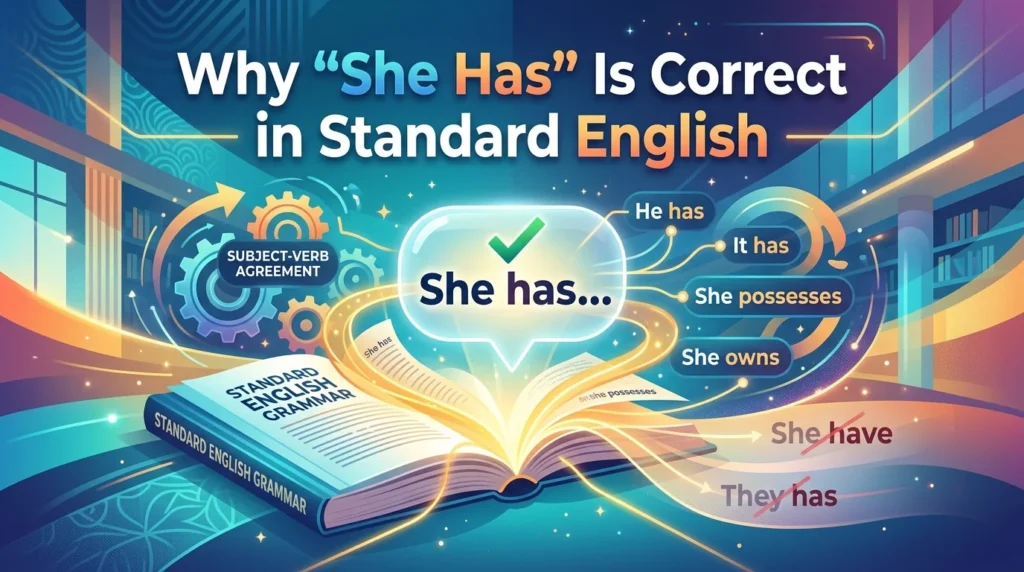
The reason “she has” is correct comes from one of the central principles of English grammar: subject-verb agreement.
A verb must generally agree with its subject in grammatical person and number.
The word she has ” has two important grammatical characteristics:
- It is third person.
- It is singular.
Therefore, when have functions as the main verb in the simple present, it changes to has.
For example:
She has a new job.
The sentence contains a singular third-person subject, she, so has is required.
If the subject changes, the verb changes too:
They have a new job.
Here, they is plural, so have is used.
The meaning of the verb hasn’t fundamentally changed. The form has changed because the subject has changed.
She is a Third-Person Singular Subject
Understanding the term third-person singular makes the entire rule easier.
English traditionally divides grammatical person into three categories:
| Person | Meaning | Common pronouns |
| First person | The speaker | I, we |
| Second person | The person being addressed | you |
| Third person | Someone or something being discussed | he, she, it, they |
The word she belongs to the third-person singular category.
That’s why these sentences are correct:
- She works here.
- She lives nearby.
- She likes music.
- She needs help.
- She has a car.
Notice that most regular verbs add -s in the third-person singular:
- work → works
- live → lives
- like → likes
- need → needs
But have is irregular.
Instead of saying:
She haves a car. ❌
English uses:
She has a car. ✅
This irregular form is one reason learners often need to memorize has separately from have.
Why “Has” Changes With He, She, and It
The words he, she, and it are especially important because they normally take has when have is the main verb in the simple present.
Consider these examples:
- He has a new car.
- She has a new car.
- It has four wheels.
Now compare them with:
- I have a new car.
- You have a new car.
- We have a new car.
- They have a new car.
This gives you a reliable grammatical pattern:
He, she, and it → has
I, you, we, and they → have
The same pattern applies when a noun replaces the pronoun:
- The teacher has a question.
- My sister has a new apartment.
- The company has several offices.
- The computer has a large screen.
- The students have several questions.
- The employees have new responsibilities.
In other words, the rule isn’t limited to pronouns. It applies to third-person singular subjects generally.
The Grammar Rule Behind “Has” and “Have”
The difference between has and have becomes clearer when you look at the full subject-verb pattern.
In the simple present, have has two basic forms:
- have
- has
The form has is used with third-person singular subjects.
The form have is used with first-person subjects, second-person subjects, and third-person plural subjects.
Present-Tense Subject Agreement
| Subject type | Form of “have” | Example |
| First-person singular | have | I have a plan. |
| Second-person singular | have | You have a plan. |
| Third-person singular | has | She has a plan. |
| First-person plural | have | We have a plan. |
| Second-person plural | have | You have a plan. |
| Third-person plural | have | They have a plan. |
A common mistake is to simplify the rule too much and think:
Singular = has.
That’s not completely accurate.
The better rule is:
Third-person singular = has.
Why does that matter?
Because I can refer to one person, yet we say:
I have a question.
We don’t say:
I has a question. ❌
Likewise, you can refer to one person, yet we say:
You have a question.
So grammatical person matters alongside number.
Why “She Have” Is Wrong in a Normal Statement
Consider:
She have a new car.
The subject is she, which is third-person singular. The verb have is being used as the main verb in a simple present statement.
Therefore, the correct form is:
She has a new car.
The error occurs because the base form have doesn’t agree with the third-person singular subject.
This same problem appears in other sentences:
| Incorrect | Correct |
| She have a dog. | She has a dog. |
| She have two sisters. | She has two sisters. |
| She have enough money. | She has enough money. |
| She has a good idea. | She has a good idea. |
| She has a meeting. | She has a meeting. |
| She have a new job. | She has a new job. |
The correction is straightforward: when she is the subject and have is the main verb in an ordinary affirmative present-tense sentence, use has.
Why “She Have” Sounds Wrong
Native and proficient English speakers generally expect a third-person singular subject to be followed by the appropriate present-tense verb form.For example:She works at a bank.She drives to work.She likes coffee.She has a car.
The form has the grammatical pattern created by she.
When someone says:
She have a car.
the sentence sounds incorrect because the subject and verb don’t match according to standard English subject-verb agreement.
This isn’t simply a matter of style. In formal writing, academic work, professional communication, edited content, and standard English, “she has” is the expected form.
Sentence Structure Matters
Take the sentence:
She has a new phone.
You can identify the basic structure as:
She → subject
has → main verb
a new phone → object
The verb directly follows a third-person singular subject. Therefore, has is required.
Now change the subject:
They have a new phone.
The object remains the same. Only the subject changes, so the verb form changes from has to have.
This demonstrates an important grammar principle:
The form of the verb depends on the grammatical subject, not the object that follows it.
For example:
She has three books.
The word books is plural, but that doesn’t make the verb have. The subject is she, so the correct verb is has.
This is a useful point because learners sometimes look at the nearest noun instead of identifying the actual subject.
Has vs. Have: What Is the Difference?
Has and have belong to the same verb family. Both come from the verb to have.
The basic difference is usually grammatical rather than semantic.
Compare:
She has a new computer.
They have a new computer.
Both sentences express possession. The only major difference is the subject, and that difference determines the verb form.
What Does “Have” Mean?
The verb have has many meanings in English. It isn’t limited to physical possession.
It can express ownership or possession:
I have a new laptop.
It can express relationships:
We have two children.
It can describe experiences:
They have a great time together.
It can describe conditions or states:
I have a headache.
It can describe events or activities:
We have dinner at seven.
It can also appear in expressions involving necessity or obligation:
You have to leave early.
The exact meaning depends on context.
What Does “Has” Mean?
Has is simply the third-person singular present form of have when it functions as the main verb.
For example:
- She has a new phone.
- He has a busy schedule.
- The house has three bedrooms.
- The company has several locations.
- The dog has a long tail.
The meaning of have remains connected to possession, experience, condition, relationship, or another context. Has tells the reader that the subject is third-person singular.
Has and Have as Helping Verbs
The word have can also function as an auxiliary verb, commonly called a helping verb.
This is particularly important when forming the perfect tenses.
Consider:
She has finished her homework.
Here, has isn’t expressing possession. It helps form the present perfect tense.
The main verb is finished.
Compare that with:
She has a lot of homework.
Here, has is the main verb. It expresses possession or a relationship with the object.
This distinction can be summarized like this:
| Sentence | Function of “has/have” |
| She has a car. | Main verb |
| She has two sisters. | Main verb |
| She has finished her work. | Helping verb |
| They have a car. | Main verb |
| They have finished their work. | Helping verb |
Understanding this difference is essential because have can appear with she in certain structures without being incorrect.
For example:
She has completed the project. ✅
Here, has is an auxiliary verb.
But:
She have completed the project. ❌
The auxiliary still needs to agree with the subject, so has is required.
When “Have” Can Appear With “She”
This is where many learners become confused.
If the basic rule is she + has, why do we sometimes see:
Does she have…?
The answer is that English uses auxiliary verbs to build questions, negatives, emphasis, and other structures.
When an auxiliary such as does carries the present-tense grammatical marking, the main verb normally returns to its base form.
That’s why:
Does she have a car? ✅
is correct.
But:
Does she has a car? ❌
is incorrect.
The auxiliary does already marks the third-person singular present form. The main verb therefore stays as have.
This gives us a critical distinction:
| Sentence | Correct? | Reason |
| She has a car. | ✅ | Has agrees directly with she. |
| She have a car. | ❌ | Have doesn’t agree with she in this structure. |
| Does she have a car? | ✅ | Does carries the present-tense agreement. |
| Does she has a car? | ❌ | Don’t use has after does. |
| She doesn’t have a car. | ✅ | Doesn’t carries the agreement. |
| She doesn’t has a car. | ❌ | Don’t use has after doesn’t. |
This is one of the most useful distinctions in the entire she has or she have topic.
“She Has” in a Simple Present Statement
When there is no auxiliary before the verb, she has is the standard choice for an affirmative present-tense sentence.
Examples include:
- She has a new apartment.
- She has three children.
- She has enough food.
- She has an excellent memory.
- She has a meeting tomorrow.
- She has several responsibilities.
- She has a strong opinion.
- She has plenty of experience.
- She has a beautiful garden.
- She has an appointment this afternoon.
These examples demonstrate how widely the verb have can be used.
The noun or phrase after has can represent many different things:
Possession:
She has a new car.
Relationship:
She has two brothers.
Characteristic:
She has excellent communication skills.
Condition:
She has a headache.
Experience:
She has a lot of experience.
Activity or event:
She has dinner at eight.
The grammatical pattern stays the same:
She + has + complement/object
A Practical Way to Check “She Has, or She Have”
If you’re uncertain, use a simple three-step check.
Identify the Subject
Ask:
Who or what is performing or experiencing the action?
If the answer is she, you’ve identified a third-person singular subject.
Check Whether “Have” Is the Main Verb
If the sentence is:
She ___ a car.
then have is the main verb.
Use:
She has a car.
Look for an Auxiliary or Modal
If the sentence already contains a word such as does, doesn’t, should, could, would, might, must, or another modal/auxiliary structure, the rule can change.
For example:
Does she have a car?
She doesn’t have a car.
She should have a car.
In these sentences, have is correct because another verb controls the grammatical structure.
Common Examples to Memorize
Certain sentence patterns appear frequently in everyday English. Learning them can make the distinction almost automatic.
| Pattern | Example |
| She has + noun | She has a car. |
| She has + adjective-related noun | She has great confidence. |
| She has + experience | She has five years of experience. |
| She has + relationship | She has two sisters. |
| She has + condition | She has a headache. |
| She has + activity | She has dinner at six. |
| She has + past participle | She has finished her work. |
| Does she have + noun? | Does she have a car? |
| She doesn’t have + noun | She doesn’t have a car. |
| She should have + noun | She should have enough time. |
The first group uses has directly after she. The later examples use have because another auxiliary or modal verb controls the construction.
The Most Important Distinction to Remember
The question “Is it she has, or she have?” doesn’t have one answer that works for every sentence.
The accurate rule is more precise:
Use “she has” when “have” is the main verb in a standard present-tense affirmative sentence.
But:
Use “have” after an auxiliary such as “does” or after a modal such as “should,” “could,” or “might.”
Compare these examples carefully:
- She has a car. ✅
- Does she have a car? ✅
- She doesn’t have a car. ✅
- She should have a car. ✅
- She could have a car. ✅
- She might have a car. ✅
- She has had a car for years. ✅
The forms may look inconsistent at first, but they follow a predictable grammatical system.
Quick Reference: She Has vs. She Have
Keep this compact reference nearby when you’re proofreading your writing.
| If you mean… | Use | Example |
| Normal present statement | she has | She has a new job. |
| Present perfect | she has | She has finished the report. |
| Present question with does | she have | Does she have a new job? |
| Present negative with doesn’t | she have | She doesn’t have a new job. |
| Modal construction | she have | She should have a new job. |
| Simple present with he | he has | He has a new job. |
| Simple present with they | they have | They have new jobs. |
| Simple present with I | I have | I have a new job. |
The One-Line Rule
If you remember only one thing from this section, remember this:
“She has” is correct in a normal present-tense statement, while “she have” becomes correct when another auxiliary or modal requires the base form “have.”
That distinction is the foundation for everything that follows. Once you understand why she has works and why does she have also works, the rest of the grammar becomes much easier to recognize and apply.
When to Use “She Has”
The phrase “she has” is the standard choice when have is the main verb in a simple present affirmative sentence. It can describe ownership, relationships, characteristics, experiences, conditions, activities, and many other situations.
The structure is usually:
She + has + object/complement
For example:has a new computer.She has two younger brothers.She has plenty of experience.She has an appointment today.The word has agrees with the subject she, which is third-person singular.
She Has for Possession
One of the most common uses of has is to show possession or ownership.
For example:
- She has a new car.
- She has a large house.
- She has an expensive laptop.
- She has several books.
- She has a beautiful necklace.
- She has enough money for the trip.
In these sentences, has tells us that something belongs to, is available to, or is associated with the person being discussed.
Consider this example:
She has a red bicycle.
The sentence doesn’t necessarily mean she legally owns the bicycle. It simply establishes that the bicycle is hers or under her possession or control in the context.You can also use has for things someone currently possesses:She has my keys.She has the documents.She has your phone.
Here, possession may be temporary.
Possession Doesn’t Always Mean Ownership
This distinction is useful because have has a broader meaning than own.
Compare:
She has my passport.
with:
She owns a passport.
The first sentence indicates that the passport is currently with her. It doesn’t necessarily say that she owns it.
Similarly:
She has the company files. Could mean that the files are currently in her possession.
This makes has extremely useful in everyday English because it can describe both permanent and temporary possession.
She Has for Relationships
Has can also describe family and social relationships.
For example:
- She has two sisters.
- She has three children.
- She has many close friends.
- She has a supportive family.
- She has several colleagues in the department.
- She has a business partner in Chicago.
In these sentences, has introduces people connected to the subject.
For example:
She has two brothers and one sister.
This doesn’t mean she owns those people. Instead, has expresses a relationship or connection.
The same pattern occurs with many relationship nouns:
- She has a husband.
- She has a daughter.
- She has a son.
- She has a cousin nearby.
- She has several friends at work.
- She has a good relationship with her manager.
She Has for Characteristics
Another common use of she has is to describe a person’s characteristics or features.
For example:
- She has blue eyes.
- She has long hair.
- She has a calm personality.
- She has a strong voice.
- She has excellent communication skills.
- She has a great sense of humor.
- She has a positive attitude.
These sentences don’t describe ownership in the ordinary sense. Instead, has connects the subject with a characteristic, feature, quality, or attribute.
Consider:
She has a confident personality.
The sentence tells the reader something about her character.
Likewise:
She has excellent leadership skills.
Here, has introduces a quality or ability associated with the person.
She Has for Physical Features
English frequently uses have/has to describe physical appearance.
Examples include:
- She has brown eyes.
- She has curly hair.
- She has a round face.
- She has a distinctive smile.
- She has long fingers.
- She has a small scar on her hand.
This structure is particularly common when describing people.
Instead of saying:
Her eyes are blue.
you can say:
She has blue eyes.
Both sentences are grammatically correct, but they organize the information differently.
The first focuses on the eyes.
The second focuses on her and describes what physical feature she has.
She Has for Feelings, Conditions, and States
The verb has also appears in many expressions involving feelings, conditions, and temporary states.
For example:
- She has a headache.
- She has a cold.
- She has a fever.
- She has a problem.
- She has a concern.
- She has doubts.
- She has an opportunity.
- She has a difficult decision to make.
The expression has a problem is especially common:
She has a problem with her computer.
Here, has indicates that the problem affects or concerns her.
Likewise:
She has a headache.
The sentence describes a physical condition.
Fixed Expressions With “Has”
English contains many common expressions built around have. When the subject is she, the form becomes has in a simple present statement.
Examples include:
- She has breakfast at 8 a.m.
- She has lunch at work.
- She has dinner with her family.
- She has a shower every morning.
- She has a rest after work.
- She has a conversation with her manager.
- She has a good time on vacation.
- She has a look at the report.
These expressions show why translating ” has “ directly as “own” can be confusing
For example:
She has breakfast at seven.
Obviously, has doesn’t mean she owns breakfast. It means she eats breakfast.
Similarly:
She has a shower.
means she takes a shower.
This is an important part of understanding the verb in natural English.
She Has for Responsibilities and Activities
The phrase she has can also describe responsibilities, appointments, schedules, duties, and activities.
Examples:
- She has a meeting at noon.
- She has an appointment tomorrow.
- She has three assignments to complete.
- She has a lot of work today.
- She has several responsibilities at home.
- She has an important presentation this afternoon.
- She has a class at nine.
- She has an interview next week.
Consider:
She has a meeting at three o’clock.
This means a meeting is scheduled for her or that she is expected to participate in it.
Similarly:
She has an important assignment to finish.
Here, has expresses something that is currently part of her responsibilities.
“Have” in Everyday Activities
Some activities naturally use have as part of a common English expression.For example:She has breakfast before work.She has lunch with her colleagues.
These aren’t unusual grammatical constructions. They’re ordinary English patterns that you’ll encounter frequently in speech and writing.
Everyday Examples Using “She Has”
Seeing the rule in different contexts makes it easier to use naturally.
At Home
At home, she has can describe possessions, family members, routines, and household responsibilities.
- She has a large kitchen.
- She has two cats.
- She has a garden behind the house.
- She has three children.
- She has dinner with her family every evening.
- She has a lot of housework to do.
- She has a guest staying with her this weekend.
Consider this short context:
Sarah recently moved into a new apartment. She has a spacious living room and has a small balcony. She also has two roommates.
Each occurrence of has follows a third-person singular subject.
At School
In an educational setting, she can describe classes, assignments, abilities, and academic responsibilities.
- She has a math class at ten.
- She has three assignments due this week.
- She has an excellent memory.
- She has a difficult exam tomorrow.
- She has a strong interest in history.
- She has several books for her research project.
For example:
She has an exam tomorrow, so she has a lot of studying to do tonight.
Both uses of has are correct because she is the subject in each simple present construction.
At Work
Professional communication frequently uses she has to discuss responsibilities, experience, skills, meetings, and projects.
Examples:
- She has five years of experience.
- She has excellent leadership skills.
- She has a meeting at two.
- She has several projects to manage.
- She has responsibility for the marketing team.
- She has an important presentation tomorrow.
- She has strong analytical abilities.
A professional example might read:
She has extensive experience in project management and has several successful projects on her record.
The first expresses possession of experience. The second introduces a record of completed or associated projects.
While Traveling
The phrase she has also appears naturally when talking about travel plans and possessions.
- She has a flight at six.
- She has a reservation at the hotel.
- She has a passport.
- She has two bags with her.
- She has enough money for the trip.
- She has a long journey ahead of her.
- She has a tour scheduled for tomorrow.
For example:
She has a flight early tomorrow morning, so she plans to leave for the airport tonight.
Again, has is correct because she is the third-person singular subject.
Talking About Health
English commonly uses has to describe health conditions and symptoms.
Examples include:
- She has a headache.
- She has a sore throat.
- She has a fever.
- She has a cold.
- She has back pain.
- She has an allergy.
- She has trouble sleeping.
For example:
She has a headache and needs to rest.
Here, has introduces a condition affecting her.
It’s important to understand that has does not necessarily mean ownership. In she has a headache, it means that the condition is present or affecting her.
When “She Have” Is Actually Correct
This is the point where the she has or she have question becomes more interesting.
Although “she have” is incorrect as a normal affirmative present-tense construction, have can correctly appear immediately after she in certain grammatical structures.
For example: Does she have a car? ✅She doesn’t have a car. ✅She should have a car. ✅She might have enough money. ✅In each case, another word controls the grammatical structure.The key concept is base-form preservation.When English uses do/does to form a present-tense question or negative, the main verb returns to its base form.When a modal verb such as should, could, would, might, or must appears, the following verb also remains in its base form.
Therefore:
She has a car. ✅
but:
Does she have a car? ✅
and:
She should have a car. ✅
These aren’t contradictions. They’re different grammatical structures.
Does She Have or Does She Has?
The correct question is:
Does she have a car? ✅
Not:
Does she has a car? ❌
Why?
The word does is the third-person singular form of the auxiliary do. Once does is used, the main verb stays in its base form.
The structure is:
Does + subject + base verb + …?
So:
Does she have a car?
not:
Does she has a car?
Compare the Statement and Question
Look at these two sentences:
She has a car.
Does she have a car?
In the statement, has directly carries the third-person singular form.
In the question, does carries that grammatical information. The main verb therefore becomes have.
This is a fundamental English pattern.
Compare:
- She works here.
- Does she work here?
- She likes coffee.
- Does she like coffee?
- She has a car.
- Does she have a car?
Notice what happens in every example: does takes the grammatical marking, while the main verb returns to its base form.
Common Questions With “Does She Have?”
Here are natural examples:
- Does she have a car?
- Does she have any siblings?
- Does she have enough money?
- Does she have a passport?
- Does she have an appointment?
- Does she have experience?
- Does she have any questions?
- Does she have a problem?
- Does she have a reservation?
- Does she have time today?
All of these use have, not has.
She Doesn’t Have, or She Doesn’t Has?
The correct form is:
She doesn’t have a car. ✅
Not:
She doesn’t has a car. ❌
The explanation is similar to the question structure.
Doesn’t is the contracted form of does not. The auxiliary does already carries the third-person singular present-tense marking.
Therefore, the main verb stays in its base form:
She doesn’t have a car.
not:
She doesn’t has a car.
Negative Sentence Pattern
The basic structure is:
Subject + does not/doesn’t + base verb
Examples:
- She doesn’t have a car.
- She doesn’t have enough time.
- She doesn’t have any money.
- She doesn’t have a passport.
- She doesn’t have a meeting today.
- She doesn’t have any questions.
The same principle applies to other verbs:
- She doesn’t work here.
- She doesn’t like coffee.
- She doesn’t need help.
- She doesn’t want dessert.
You would not say:
- She doesn’t work here. ❌
- She doesn’t like coffee. ❌
- She doesn’t needs help. ❌
The auxiliary doesn’t already handle the third-person singular agreement.
Does “She Have” Ever Stand Alone?
In standard modern English, “she have” generally does not stand alone as a normal affirmative present-tense sentence.
For example:
She have a new car. ❌
is incorrect.
However, you’ll sometimes encounter she have in highly specific dialectal, historical, poetic, or nonstandard varieties of English. Those uses shouldn’t be confused with standard English grammar.
If you’re writing:
- an academic assignment,
- a professional email,
- a business document,
- a website,
- an article,
- formal correspondence,
- or standard English generally,
use she has for the ordinary affirmative present construction.
The exceptions discussed above are grammatical structures such as does she have and she doesn’t have, where have is required by the sentence structure.
She Should Have, or She Should Has?
The correct sentence is:
She should have enough time. ✅
Not:
She should has enough time. ❌
The reason is different from the does rule but produces the same result: the verb following a modal verb stays in its base form.
Common modal verbs include:
- can
- could
- may
- might
- shall
- should
- will
- would
- must
After these verbs, English normally uses the base form of the following verb.
Therefore:
- She should have time.
- She could have time.
- She might have time.
- She would have time.
- She must have time.
- She will have time.
Not:
- She should has time. ❌
- She could has time. ❌
- She might has time. ❌
- She would has time. ❌
Why “She Should Have” Is Correct
Consider the structure:
She should have more time.
Here:
She = subject
should = modal auxiliary
have = base-form main verb
more time = complement/object
The modal should determines the form of the following verb.
This means you don’t apply the ordinary she + has rule directly to have when a modal is already present.
Compare:
She has more time. ✅
She should have more time. ✅
The first sentence contains only the main verb.
The second contains the modal should, so the main verb stays as have.
She Could Have, She Might Have, and She Would Have
The same principle works with several other modal constructions.
She Could Have
She could have a better opportunity elsewhere.
Here, could is the modal, and have remains in its base form.
She Might Have
She might have the answer.
Again, might controls the verb structure.
She Would Have
She would have more time if she worked from home.
The word would is followed by the base form have.
She Must Have
She must have a reason.
Here, must is followed by have.
These examples demonstrate why memorizing only “she = has” can lead to mistakes. The more useful rule is to examine the entire verb phrase.
“She Has” vs. “She Have”: The Complete Pattern
The following table brings the major structures together:
| Sentence type | Correct example | Why? |
| Affirmative statement | She has a car. | Has agrees with she. |
| Present question | Does she have a car? | Does carries the agreement. |
| Present negative | She doesn’t have a car. | Doesn’t carries the agreement. |
| Modal | She should have a car. | Modals take the base verb. |
| Modal | She could have a car. | Could takes the base verb. |
| Modal | She might have a car. | Might takes the base verb. |
| Present perfect | She has had a car. | Has is the perfect auxiliary. |
| Present perfect question | Has she had a car? | Has is the auxiliary. |
This table reveals the larger grammatical principle:
Don’t choose between “has” and “have” by looking at “she” alone. Examine the entire verb phrase.
A Common Source of Confusion: “She Does Have”
You may also encounter:
She does have a point.
This is correct.
At first glance, it may seem unusual because she appears with have rather than has.
But does is functioning as an auxiliary, and have is the base-form main verb.
The sentence can be used for emphasis:
She does have a point.
This is stronger than the neutral:
She has a point.
The auxiliary does emphasizes or confirms the statement.
Similarly:She does have enough experience.She does have a valid reason.She does have the necessary skills.In each case, does takes the third-person singular form, while have remains unchanged.
The Role of “Do” and “Does”
The broader pattern becomes easier if you compare do and does.
| Subject | Auxiliary | Example |
| I | do | I do have time. |
| You | do | You do have time. |
| He | does | He does have time. |
| She | does | She does have time. |
| It | does | It does have value. |
| We | do | We do have time. |
| They | do | They do have time. |
The auxiliary changes according to the subject.
The main verb remains have.
This is why the following is incorrect:
She does has a car. ❌
The correct form is:
She does have a car. ✅
Why “Does She Has” Is a Common Mistake
People often learn the rule:
She + has.
Then they apply it mechanically to every sentence.
That creates errors such as:
Does she has a car? ❌
The learner recognizes she and immediately chooses has, without noticing that does has already changed the grammatical structure.
The better approach is to recognize verb phrases, rather than isolated words.Think of these as complete patterns:She has…Does she have…?She doesn’t have…She should have…She has had…
Once you learn the patterns as structures, choosing the correct form becomes much easier.
Mini Case Study: Fixing a Common Grammar Error
Imagine a student writing this sentence:
She have three years of experience in marketing.
The student knows that have expresses possession of experience but has selected the wrong verb form.
Step One: Find the Subject
The subject is:
She
This is third-person singular.
Step Two: Identify the Verb
The main verb is:
have
Step Three: Check the Sentence Structure
There is no auxiliary verb before have. It’s a simple affirmative present-tense sentence.
Step Four: Change the Verb
The correct third-person singular form is:
has
Therefore:
She has three years of experience in marketing. ✅
Now change the sentence into a question:
Does she have three years of experience in marketing? ✅
Notice that have returns because does is now the auxiliary.
This small example captures the central rule behind the entire topic.
A Second Case Study: Why “She Have” Can Look Correct
Consider this pair:
She has enough money.
Does she have enough money?
Someone unfamiliar with English grammar might ask:
“Why does she use has in one sentence and have in the other?”
The answer is that the grammatical responsibility has shifted.
In the first sentence:
She has enough money.
has directly agrees with she.
In the second:
Does she have enough money?
Does carries the third-person singular present-tense marking.
The main verb remains in its base form.
This is a general feature of English, not an isolated rule for have.
Compare:
She likes coffee.
Does she like coffee?
and:
She works here.
Does she work here?
The same structural principle operates throughout the language.
Quick Comparison: Correct and Incorrect Forms
Use the following examples as a practical reference:
| Incorrect | Correct |
| She have a car. | She has a car. |
| She have two children. | She has two children. |
| She have enough time. | She has enough time. |
| Does she have a car? | Does she have a car? |
| Does she has experience? | Does she have experience? |
| She doesn’t has a car. | She doesn’t have a car. |
| She doesn’t has enough time. | She doesn’t have enough time. |
| She should has a plan. | She should have a plan. |
| She could has an opportunity. | She could have an opportunity. |
| She might has the answer. | She might have the answer. |
The incorrect examples usually come from applying has too broadly.
The correct approach is to ask:
What comes before the verb?
If nothing controls the verb, she has is normally correct.
If does, doesn’t, should, could, might, would, must, or another appropriate auxiliary/modal appears, have may be required.
A Useful Verb-Structure Formula
You can remember the most important structures this way:
Simple Affirmative
She + has + …
Example:
She has a new job.
Question With “Does”
Does + she + have + …?
Example:
Does she have a new job?
Negative With “Doesn’t”
She + doesn’t + have + …
Example:
She doesn’t have a new job.
Modal Construction
She + modal + have + …
Example:
She should have a new job.
Present Perfect
She + has + past participle + …
Example:
She has finished her work.
These patterns are much more reliable than memorizing isolated words.
What to Remember
The phrase “she has” is correct in ordinary present-tense affirmative statements when have functions as the main verb.
Use it to talk about:
- Possessions
- Relationships
- Physical features
- Characteristics
- Feelings
- Conditions
- Experiences
- Responsibilities
- Appointments
- Activities
- Schedules
- Opportunities
But don’t assume that have is always wrong after she.
The form have is correct in structures such as:
- Does she have…?
- She doesn’t have…
- She does have…
- She should have…
- She could have…
- She might have…
- She would have…
- She must have…
The crucial lesson is that subject-verb agreement operates within the complete verb structure.
She has a car.
Does she have a car?
She doesn’t have a car.
She should have a car.
All four sentences are correct.
The apparent difference between has and have isn’t random. Each form appears because of the grammatical structure surrounding it. Once you recognize the role of auxiliaries, modals, and the main verb, the “she has or she have” question becomes much easier to solve accurately.
Questions Using Has and Have
Questions are one of the biggest sources of confusion in the she has or she have debate. A learner may correctly remember that she takes has and then incorrectly write:
Does she has a car? ❌
The correct version is:
Does she have a car? ✅
The reason is that does is the auxiliary verb. It carries the third-person singular marking, so the main verb remains in its base form, which is have.
The basic pattern is:
Does + she + have + …?
Examples include:
- Does she have a car?
- Does she have enough money?
- Does she have any siblings?
- Does she have a passport?
- Does she have a reservation?
- Does she have enough experience?
- Does she have any questions?
- Does she have a meeting today?
Why “Does She Have” Is Correct
Compare the statement and question:
She has a new phone.
Does she have a new phone?
In the statement, has is the main verb and agrees with she.
In the question, does is the auxiliary. The main verb returns to its base form:
Does she have a new phone?
This isn’t unique to have. The same pattern appears with regular verbs:
She works here.
Does she work here?
She likes coffee.
Does she like coffee?
She needs help.
Does she need help?
The third-person singular -s disappears from the main verb because does carries it.
Questions With “Has” Are Also Possible
It’s important not to conclude that questions involving she must always use does she have.
The word has can itself function as an auxiliary in certain structures, especially the present perfect.
For example:Has she finished her work?Has she arrived yet?Has she called you?Here, has isn’t being used as the ordinary main verb of possession. It is helping form the present perfect.
Compare:
Does she have a car?
with:
Has she bought a car?
The first question uses does + have because have is the main verb.
The second uses has + past participle because has is the perfect auxiliary.
Question Patterns at a Glance
| Meaning | Correct structure | Example |
| Present possession | Does + she + have | Does she have a car? |
| Present condition | Does + she + have | Does she have a headache? |
| Present experience | Does + she + have | Does she have experience? |
| Present perfect | Has + she + past participle | Has she finished? |
| Present perfect | Has + she + past participle | Has she arrived? |
This distinction is essential because “has” and “have” don’t compete randomly. Their forms are determined by their grammatical roles.
Negative Sentences With Has and Have
Negative sentences create a similar pattern.
When you make a simple present negative sentence with she, use doesn’t have, not doesn’t has.
Correct:
She doesn’t have a car. ✅
Incorrect:
She doesn’t has a car. ❌
The reason is the same as in questions. Doesn’t contains the auxiliary does, which already carries the third-person singular present-tense form.
The main verb therefore stays in its base form:
She doesn’t have a car.
The Basic Negative Pattern
The structure is:
Subject + does not/doesn’t + base verb
Examples:
- She doesn’t have a car.
- She doesn’t have enough money.
- She doesn’t have any children.
- She doesn’t have a driver’s license.
- She doesn’t have enough time.
- She doesn’t have an appointment today.
The same rule applies to other verbs:
- She doesn’t work here.
- She doesn’t like coffee.
- She doesn’t need help.
- She doesn’t want dessert.
You wouldn’t write:
She doesn’t works here. ❌
or:
She doesn’t likes coffee. ❌
The auxiliary doesn’t already expresses the grammatical information associated with third-person singular present tense.
“She Has Not” vs. “She Doesn’t Have”
These two structures can look similar, but they aren’t always interchangeable.
Consider:
She doesn’t have a car.
This is a simple present negative construction. The verb have is the main verb.
Now consider:
She has not finished the report.
Here, has is the perfect auxiliary, and finished is the main verb’s past participle.The structures are different:She doesn’t have…She doesn’t have enough time.She has not + past participle…She has not finished the assignment.The contraction hasn’t is also common:She hasn’t finished the assignment.This distinction helps prevent errors such as:She hasn’t finish the assignment. ❌The correct form is:She hasn’t finished the assignment. ✅
Has and Have in Different Tenses
The word have appears in several English tense and aspect constructions. Understanding these forms gives you a much deeper understanding of she has or she have.
In the simple present, the distinction is straightforward:
She has a car.
In the present perfect:
She has finished the work.
In the past:
She had a car.
In the future:
She will have a car.
Notice how the verb changes depending on the tense and auxiliary structure.
Simple Present
For a normal affirmative statement:
She has a new job.
The verb has is the present-tense form that agrees with she.
Compare:
- I have a new job.
- You have a new job.
- She has a new job.
- We have a new job.
- They have a new job.
The third-person singular form is has.
Simple Past
The past tense uses had for all subjects.
Examples:
- I had a car.
- You had a car.
- He had a car.
- She had a car.
- We had a car.
- They had a car.
This is important because the present-tense distinction between has and have disappears in the simple past.
You don’t say:
She haved a car. ❌
The correct form is:
She had a car. ✅
Likewise:
They had a car. ✅
The past-tense form had works with singular and plural subjects.
Future With “Will”
Future constructions also use have, not has.
For example:
She will have more time tomorrow.
Not:
She will has more time tomorrow. ❌
The structure is:
Subject + will + base verb
Since have is the base form, we say:
She will have.
The same principle applies to other subjects:
- I will have.
- You will have.
- She will have.
- We will have.
- They will have.
This demonstrates a broader rule: modal and auxiliary verbs can prevent the main verb from taking its ordinary third-person singular form.
Present Perfect With “Has”
The present perfect is one of the most important structures involving she has.
The basic structure is:
She + has + past participle
Examples:
- She has finished her work.
- She has completed the project.
- She has visited New York.
- She has changed her mind.
- She has learned a lot.
- She has already eaten.
- She has arrived at the office.
In these sentences, has is an auxiliary verb.
The following verb appears as a past participle:
- finish → finished
- complete → completed
- visit → visited
- change → changed
- learn → learned
- eat → eaten
- arrive → arrived
For example:
She has finished her assignment.
The structure is:
She → subject
has → perfect auxiliary
finished → past participle
her assignment → object
Why “She Have Finished” Is Incorrect
Because she is third-person singular, the present perfect auxiliary must be has.
Incorrect:
She have finished her work. ❌
Correct:
She has finished her work. ✅
However, if the subject changes to they, the auxiliary becomes have:
They have finished their work. ✅
This produces a useful comparison:
| Subject | Present perfect | Example |
| I | have + past participle | I have finished. |
| You | have + past participle | You have finished. |
| He | has + past participle | He has finished. |
| She | has + past participle | She has finished. |
| It | has + past participle | It has finished. |
| We | have + past participle | We have finished. |
| They | have + past participle | They have finished. |
Present Perfect With “Have”
The form have is used with first-person, second-person, and third-person plural subjects in the present perfect.
Examples:
- I have finished my work.
- You have finished your work.
- We have finished our work.
- They have finished their work.
Compare these with:
- He has finished his work.
- She has finished her work.
- It has finished its cycle.
Again, has and have are determined by the subject.
The important point is that have can be an auxiliary, not just a main verb.
Has Been vs. Have Been
Another common area of confusion is the difference between has been and have been.
The correct form depends on the subject.
With she:
She has been working all morning. ✅
With they:
They have been working all morning. ✅
With I:
I have been working all morning. ✅
With he:
He has been working all morning. ✅
The pattern remains:
He/she/it → has been
I/you/we/they → have been
Examples of “She Has Been”
- She has been studying all day.
- She has been working here for five years.
- She has been waiting for an hour.
- She has been feeling better.
- She has been learning Spanish.
- She has been living in Boston since 2022.
The exact tense structure can vary depending on what follows has been, but the agreement between she and has remains consistent.
Why “She Have Been” Is Usually Incorrect
In a standard present-perfect construction, she have been is incorrect.
Incorrect:
She have been working all day. ❌
Correct:
She has been working all day. ✅
The auxiliary has agrees with the third-person singular subject.
Has Had vs. Have Had
Has had may look strange because it contains two forms of have, but it is completely grammatical.
For example:
She has had this car for five years.
Here, the first has is the auxiliary that forms the present perfect.
The second had is the past participle of have.
The structure is:
She + has + had + object
Examples:
- She has had this job for ten years.
- She has had the same phone since 2024.
- She has had several opportunities.
- She has had enough time to decide.
- She has had a difficult week.
Why “She Has Had” Is Correct
The first word has agrees with she.
The second word had doesn’t change according to the present subject because it is the past participle form.
Compare:
She has had a busy week.
They have had a busy week.
Only the auxiliary changes:
She has had
They have had
This is a useful example because it shows that has and have can both appear in the same broader verb system without being interchangeable.
Modal Verbs: Why “She Should Have” Is Correct
Modal verbs are another major reason have can correctly follow she.
Common English modal verbs include:
- can
- could
- may
- might
- shall
- should
- will
- would
- must
These verbs are followed by the base form of the main verb.
Therefore:
She should have more time. ✅
Not:
She should has more time. ❌
What Are Modal Verbs?
Modal verbs are auxiliary verbs that express meanings such as:
- possibility
- ability
- permission
- necessity
- obligation
- prediction
- intention
- advice
- hypothetical situations
For example:She can drive.She might arrive late.She should call him.She must leave.The verb following the modal remains in its base form.That’s why we say:She should have enough time.
not:
She should has enough time.
Why Modal Verbs Take “Have”
The standard structure is:
Subject + modal + base verb
So:
She + should + have
The same pattern applies to other subjects:
- I should have enough time.
- You should have enough time.
- She should have enough time.
- We should have enough time.
- They should have enough time.
The word should does not change according to the subject, and the following verb remains in its base form.
Why “She Should Have” Is Correct
Consider these two sentences:
She has enough time.
She should have enough time.
The first sentence uses has as the main verb.
The second sentence adds the modal should. Once should appears, the main verb must use its base form.
The grammatical structure changes from:
She + has
to:
She + should + have
This is why saying “she always takes has” is too simplistic.
The accurate rule is:
She takes “has” when it is the appropriate present-tense form of the main verb or auxiliary. A modal before the verb requires the base form “have.”
Other Modal Examples With “She Have”
Although “she have” by itself is incorrect in a standard affirmative sentence, she + modal + have can be completely correct.
She Could Have
She could have a better opportunity elsewhere.
This can express possibility or a hypothetical option.
She Might Have
She might have the answer.
This expresses possibility.
She Would Have
She would have more time if she worked from home.
This can describe a hypothetical situation.
She Must Have
She must have a reason for leaving early.
This can express a strong conclusion or logical inference.
She May Have
She may have enough money for the trip.
This expresses possibility.
She Will Have
She will have more responsibilities next year.
This refers to the future.
Notice the pattern:
She + modal/auxiliary + have
The word have remains in its base form.
“She Should Has” vs. “She Should Have”
This is a common error because learners remember the she + has rule but forget that should changes the structure.
Incorrect:
She should has more experience. ❌
Correct:
She should have more experience. ✅
Incorrect:
She could has a better chance. ❌
Correct:
She could have a better chance. ✅
Incorrect:
She might has the answer. ❌
Correct:
She might have the answer. ✅
The modal controls the following verb.
A Simple Formula
Remember:
Modal + base verb
Therefore:
- should + have
- could + have
- might + have
- would + have
- must + have
- may + have
- will + have
Never add -s to have after a modal.
Has and Have With Different Subjects
The she has or she have rule becomes much easier when you compare she with other subjects.
He Has or He Have?
The correct form is:
He has a car. ✅
Not:
He have a car. ❌
He is also third-person singular, so it follows the same pattern as she.
Examples:
- He has a new job.
- He has two children.
- He has enough money.
- He has an appointment.
- He has a good reason.
It Has or It Have?
The correct form is:
It has a problem. ✅
Not:
It have a problem. ❌
The pronoun it is third-person singular.
Examples:
- It has four wheels.
- It has a broken screen.
- It has several advantages.
- It has a strange smell.
- It has enough power.
I Have or I Has?
The correct form is:
I have a question. ✅
Not:
I has a question. ❌
This is an important reminder that singular does not automatically mean has.
Although I can refer to one person, it takes have.
You Have or You Has?
The correct form is:
You have enough time. ✅
Not:
You has enough time. ❌
This applies whether you refers to one person or several people.
For example:
You have a great opportunity.
can refer to one person.
You have several options.
can refer to one person or multiple people depending on context.
We Have or We Has?
The correct form is:
We have a meeting. ✅
Not:
We has a meeting. ❌
We is first-person plural, so it takes have.
Examples:
- We have enough time.
- We have several choices.
- We have a problem.
- We have an appointment.
- We have good news.
They Have or They Has?
The correct form is:
They have a house. ✅
Not:
They has a house. ❌
They is third-person plural, so it uses have.
Examples:
- They have two cars.
- They have enough experience.
- They have several questions.
- They have a meeting today.
- They have a new project.
Complete Subject Comparison
The following table is a useful reference for the entire has vs. have pattern:
| Subject | Correct form | Example |
| I | have | I have a plan. |
| You | have | You have a plan. |
| He | has | He has a plan. |
| She | has | She has a plan. |
| It | has | It has a purpose. |
| We | have | We have a plan. |
| They | have | They have a plan. |
The most important grouping is:
Subjects That Take “Has”
- He
- She
- It
- Singular third-person nouns
Examples:
- The boy has a bike.
- My mother has a new phone.
- The company has a website.
- She has a new phone.
Subjects That Take “Have”
- I
- You
- We
- They
- Plural nouns
Examples:
- I have a question.
- You have a choice.
- We have a meeting.
- They have a problem.
- The students have homework.
A Deeper Look at Subject-Verb Agreement
One reason the she has or she have issue causes so much confusion is that English subject-verb agreement is relatively limited compared with some other languages.
In English, many verb forms remain identical across subjects. For example:
I work.
You work.
We work.
They work.
Only the third-person singular changes:
She works.
The verb have is even more distinctive because its third-person singular form isn’t haves. It’s the irregular form has.
This means learners have to recognize both:
- The subject-verb agreement rule
- The irregular form of the verb
The combination produces:
She has
rather than:
She have
or:
She haves
Why “She Haves” Is Also Incorrect
Some learners understand that third-person singular verbs often take -s, then incorrectly apply the regular pattern to have.
They may write:
She haves a car. ❌
The correct form is:
She has a car. ✅
This happens because have is irregular.
You can compare it with another irregular verb:
I am → She is
and:
I have → She has
These forms have to be learned as part of standard English usage.
A Practical Error-Correction Strategy
When you see she have in a sentence, don’t automatically change it to she has.
First, examine what comes before it.
If Nothing Controls the Verb
Change:
She have a car.
to:
She has a car.
If “Does” Comes Before It
Keep have:
Does she have a car?
Don’t change it to has.
If “Doesn’t” Comes Before It
Keep have:
She doesn’t have a car.
If a Modal Comes Before It
Keep have:She should have a car.She might have a car.She could have a car.
If “Has” Is the Perfect Auxiliary
Keep has:
She has finished her work.
The important lesson is to look at the complete verb phrase before making a correction.
Common Patterns Worth Memorizing
These sentence frames cover many of the situations that cause mistakes:
| Pattern | Example |
| She has + noun | She has a car. |
| She has + experience | She has five years of experience. |
| She has + condition | She has a headache. |
| She has + past participle | She has finished the work. |
| Does she have + noun? | Does she have a car? |
| She doesn’t have + noun | She doesn’t have a car. |
| She should have + noun | She should have enough time. |
| She could have + noun | She could have a better option. |
| She might have + noun | She might have the answer. |
| She would have + noun | She would have more time. |
| She will have + noun | She will have more responsibilities. |
| She has had + noun | She has had this car for years. |
| Has she + past participle? | Has she finished the work? |
These patterns are more useful than memorizing a single isolated rule because they show how the verb behaves in real sentences.
Key Lessons From Questions, Negatives, and Tenses
The biggest takeaway is that “has” and “have” depend on grammatical structure.Use has directly with she in a standard present-tense affirmative sentence:She has a car.Use have after does:Does she have a car?Use have after doesn’t:She doesn’t have a car.Use have after a modal:She should have a car.She could have a car.She might have a car. Use has as the present-perfect auxiliary:She has finished her work.Use has had when has is the perfect auxiliary and had is the past participle:She has had this job for five years.
The most reliable strategy is to identify the first auxiliary in the verb phrase and then determine which form the following verb requires.
Once you understand this structure, the apparent conflict between she has and she have disappears. They belong to different grammatical patterns, and each has a specific job in standard English.
Common Mistakes With “She Has” and “She Have”
Even though the basic rule is simple, “she has” and “she have” can still cause confusion. The biggest problem usually happens when another verb appears in the sentence. A sentence may contain the subject she, but that doesn’t mean has must always appear immediately after it.
Understanding the role of each verb makes these mistakes much easier to avoid.
Mistake 1: Using “Have” After “She” in a Simple Statement
In a standard present-tense affirmative sentence, she takes has, not have.
Incorrect: She have a new phone.
Correct: She has a new phone.
Incorrect: She have two brothers.
Correct: She has two brothers.
Incorrect: She have enough time.
Correct: She has enough time.
The pattern is straightforward:
She + has + noun/complement
For example:
- She has a beautiful house.
- She has three children.
- She has an interesting idea.
- She has plenty of experience.
- She has a meeting today.
Mistake 2: Using “Has” After a Modal Verb
This is one of the most common errors because learners remember that she takes has and then apply that rule everywhere.
However, modal verbs such as should, could, would, might, may, and must are followed by the base form of a verb.
Incorrect: She should has more time.
Correct: She should have more time.
Incorrect: She might has a point.
Correct: She might have a point.
Incorrect: She could has forgotten.
Correct: She could have forgotten.
The formula is:
Subject + modal + base verb
So:
- She should have…
- She could have…
- She would have…
- She might have…
- She may have…
- She must have…
The word she doesn’t change this rule because the modal verb controls what comes next.
Mistake 3: Using “Has” After “Does”
Another frequent mistake appears in questions.
Incorrect: Does she has a car?
Correct: Does she have a car?
Once does becomes the auxiliary verb, the main verb returns to its base form.
Compare these sentences:
| Statement | Question |
| She has a car. | Does she have a car? |
| She has a dog. | Does she have a dog? |
| She has enough money. | Does she have enough money? |
| She has a sister. | Does she have a sister? |
Think of does as carrying the grammatical marking that would otherwise appear on the main verb.
That’s why we say:
She has a car.
but:
Does she have a car?
Not:
Does she has a car?
Mistake 4: Using “Has” After “Doesn’t”
The same principle applies to negative sentences.
Incorrect: She doesn’t has a ticket.
Correct: She doesn’t have a ticket.
Incorrect: She doesn’t has enough information.
Correct: She doesn’t have enough information.
The structure is:
She + does not/doesn’t + have
Examples:
- She doesn’t have a passport.
- She doesn’t have enough time.
- She doesn’t have any questions.
- She doesn’t have a driver’s license.
- She doesn’t have the answer.
Mistake 5: Letting Nearby Words Cause Confusion
Sometimes a sentence contains a plural noun close to she, and that can make the verb agreement seem confusing.
Consider:
She has two brothers.
The word brothers is plural, but the subject is she. Therefore, has is correct.
Now consider:
She has a group of friends.
Even though friends is plural, the subject is still she.
The verb agrees with the grammatical subject, not simply with the closest noun.
This principle is especially important in longer sentences:
She has several new responsibilities at work.
The subject is she, so the correct verb is has.
Mistake 6: Thinking “She Have” Is Always Wrong
There’s an important distinction here.
“She have” is incorrect in a simple present affirmative statement:
❌ She have a car.
But have can correctly appear with she when another auxiliary or modal controls the verb form:
✅ Does she have a car?
✅ She doesn’t have a car.
✅ She should have a car.
✅ She might have a car.
✅ She will have a car.
So the better rule isn’t simply “never use have with she.”
The more accurate rule is:
Use “has” after “she” in a simple present affirmative statement. Use “have” after auxiliaries and modal verbs that require the base form.
She Has vs. She Have: Side-by-Side Examples
A side-by-side comparison can make the difference much easier to remember.
| Situation | Correct | Incorrect |
| Simple statement | She has a car. | She have a car. |
| Possession | She has a laptop. | She have a laptop. |
| Relationship | She has two sisters. | She have two sisters. |
| Characteristic | She has blue eyes. | She have blue eyes. |
| Question | Does she have a car? | Does she has a car? |
| Negative | She doesn’t have a car. | She doesn’t has a car. |
| Modal | She should have a car. | She should has a car. |
| Future | She will have a car. | She will has a car. |
| Present perfect | She has bought a car. | She have bought a car. |
| Past | She had a car. | She haved a car. |
Notice something important: has and have aren’t interchangeable forms.
Their correct use depends on the structure of the sentence.
More Examples in Context
Simple present
She has an appointment tomorrow.
Question
Does she have an appointment tomorrow?
Negative
She doesn’t have an appointment tomorrow.
Modal
She may have an appointment tomorrow.
Future
She will have an appointment tomorrow.
These sentences describe related ideas, but the verb form changes because the grammatical structure changes.
How to Remember the “She Has” Rule
The easiest way to remember she has is to avoid memorizing isolated sentences. Instead, learn the pattern behind them.
The Three Special Pronouns: He, She, and It
In the simple present tense, he, she, and it are third-person singular subjects.
They commonly take verbs with an -s ending.
For the verb have, however, the form is irregular:
- He has
- She has
- It has
Compare that with:
- I have
- You have
- We have
- They have
A simple memory chart looks like this:
| Subject | Correct Form |
| I | have |
| You | have |
| He | has |
| She | has |
| It | has |
| We | have |
| They | have |
If your subject is she, and you’re making a normal present-tense statement, has should immediately come to mind.
The “S” Rule
For many regular verbs in the simple present, third-person singular subjects take an -s ending:
- She works.
- She walks.
- She reads.
- She drives.
- She plays.
The verb have follows the same grammatical pattern but uses an irregular form:
have → has
That’s why we say:
- She has.
- He has.
- It has.
rather than:
- She have.
- He have.
- It have.
The “S” idea isn’t a complete grammar rule for every verb, but it’s a useful memory shortcut.
Replace the Subject
Another helpful strategy is to replace she with another pronoun.
Suppose you’re unsure about this sentence:
She ___ a new job.
Replace she with they:
They have a new job.
Now replace it with he:
He has a new job.
The contrast helps reveal the correct form:
- She has
- He has
- They have
This technique works particularly well when you’re writing quickly.
Read the Sentence Aloud
Sometimes your ear can catch an error that your eyes miss.
Read these aloud:
She has a new car.
She have a new car.
The first sounds natural in standard English because you’ve heard that structure countless times.
However, don’t rely on sound alone. Grammar rules are more reliable when a sentence is unfamiliar, complicated, or formal.
A Simple Subject-Verb Agreement Chart
Here’s a quick reference you can use whenever you’re unsure about has or have.
| Subject | Present Form of “Have” | Example |
| I | have | I have a question. |
| You | have | You have a choice. |
| He | has | He has a question. |
| She | has | She has a choice. |
| It | has | It has a problem. |
| We | have | We have a plan. |
| They | have | They have a meeting. |
Now add auxiliary verbs:
| Structure | Correct Example |
| She + has | She has a new job. |
| Does + she + have | Does she have a new job? |
| She + doesn’t + have | She doesn’t have a new job. |
| She + will + have | She will have a new job. |
| She + should + have | She should have a new job. |
| She + might + have | She might have a new job. |
| She + has + past participle | She has started a new job. |
This chart highlights an important concept: the presence of she alone doesn’t determine every verb form in the sentence.
The surrounding grammatical structure matters.
Quick Grammar Check: Should You Use Has or Have?
When you’re stuck between she has and she have, follow these steps.
Step 1: Find the Subject
Ask:
Who or what is performing the action or being described?
If the subject is she, continue.
Step 2: Check Whether It’s a Simple Present Statement
If you’re making a straightforward affirmative statement, use has.
She has a new computer.
Step 3: Look for “Does” or “Doesn’t”
If does or doesn’t appears before the verb, use have.
Does she have a new computer?
She doesn’t have a new computer.
Step 4: Look for a Modal Verb
If you see should, could, would, might, may, must, or another modal, use have.
She should have more time.
She might have the answer.
Step 5: Check for a Future Auxiliary
After will, use have.
She will have more opportunities next year.
Step 6: Check for the Present Perfect
f has is acting as the helping verb, use has + past participle.She has finished her work.She has visited New York.She has written three emails.
The key is to identify the structure before choosing the verb.
Practice: She Has or She Have?
Practice is one of the fastest ways to turn a grammar rule into a habit.
Fill in the Blank
Choose has or have.
- She ___ a new apartment.
- Does she ___ enough money?
- She ___ three cousins.
- She doesn’t ___ a driver’s license.
- She should ___ more confidence.
- She ___ already finished the assignment.
- She will ___ another opportunity.
- She ___ a beautiful voice.
- Does she ___ any questions?
- She might ___ a better idea.
- She ___ a meeting at noon.
- She doesn’t ___ much free time.
Answers
- has
- have
- has
- have
- have
- has
- have
- has
- have
- have
- has
- have
Notice how the answer changes depending on what comes before have.
Correct or Incorrect?
Determine whether each sentence is correct.
- She has a new phone.
- She have a new phone.
- Does she have a new phone?
- Does she has a new phone?
- She doesn’t have a new phone.
- She doesn’t has a new phone.
- She should have a new phone.
- She should has a new phone.
- She will have a new phone.
- She will has a new phone.
- She has already called me.
- She have already called me.
Answers
| Sentence | Correct? | Explanation |
| She has a new phone. | ✅ | Simple present with she requires has. |
| She have a new phone. | ❌ | Have doesn’t agree with she in this structure. |
| Does she have a new phone? | ✅ | Have follows does. |
| Does she has a new phone? | ❌ | The main verb must return to base form after does. |
| She doesn’t have a new phone. | ✅ | Have follows doesn’t. |
| She doesn’t has a new phone. | ❌ | Has cannot follow doesn’t. |
| She should have a new phone. | ✅ | Have follows the modal should. |
| She should has a new phone. | ❌ | A modal requires the base form have. |
| She will have a new phone. | ✅ | Have follows will. |
| She will has a new phone. | ❌ | Has cannot follow will. |
| She has already called me. | ✅ | Has functions as the present-perfect auxiliary. |
| She have already called me. | ❌ | She requires has in this present-perfect structure. |
Rewrite the Sentences Correctly
Correct each sentence.
1. She have two dogs.
Correct version:
She has two dogs.
2. Does she has a reservation?
Correct version:
Does she have a reservation?
3. She doesn’t has enough information.
Correct version:
She doesn’t have enough information.
4. She should has a backup plan.
Correct version:
She should have a backup plan.
5. She will has more responsibilities.
Correct version:
She will have more responsibilities.
6. She have already completed the project.
Correct version:
She has already completed the project.
7. She might has the answer.
Correct version:
She might have the answer.
8. She have a lot of experience.
Correct version:
She has a lot of experience.
The corrections become easier once you identify whether has/have is the main verb or whether another auxiliary or modal is controlling the structure.
Real-World Importance of Using the Correct Form
Correct grammar isn’t only about passing a grammar test. It also helps your writing sound clear, polished, and trustworthy.
A small verb error can make a sentence sound noticeably unnatural:
❌ She have extensive experience in marketing.
Compared with:
✅ She has extensive experience in marketing.
The second sentence sounds professional and natural.
This matters in many everyday situations:
- Emails: She has attached the requested document.
- Resumes: She has five years of management experience.
- Academic writing: She has demonstrated strong research skills.
- Business communication: She has completed the required training.
- Customer service: Does she have an account with us?
- Casual conversation: She has a new job.
Grammar doesn’t need to be complicated to make a difference. Choosing the right form of a common verb can immediately improve the clarity of your writing.
Why Grammar Accuracy Matters
Using has and have correctly also makes longer sentences easier to understand.
Compare:
She have several years of experience, but she doesn’t have a degree in the field.
with:
She has several years of experience, but she doesn’t have a degree in the field.
The second sentence follows standard subject-verb agreement throughout.
More importantly, understanding the rule helps you avoid errors in more complicated constructions.
For example:
She has completed the project.
Does she have enough time to complete the project?
She doesn’t have enough information yet.
She should have enough information by tomorrow.
Each sentence uses has or have for a different grammatical reason.
Quick Reference: She Has vs. She Have
If you only remember one section from this article, remember this one.
Use “She Has” When:
You’re making a simple present-tense affirmative statement.
- She has a car.
- She has two children.
- She has a new job.
- She has enough time.
- She has an idea.
You also use has as the auxiliary in the present perfect:
- She has finished.
- She has arrived.
- She has studied.
- She has called.
- She has completed the work.
Use “She Have” When:
Have follows an auxiliary or modal that requires the base form.
- Does she have a car?
- She doesn’t have a car.
- She will have a car.
- She should have a car.
- She could have a car.
- She might have a car.
- She may have a car.
The Golden Rule
The simplest rule is:
She has in a normal present-tense statement.
But: Does she have?She doesn’t have.She should have.She will have.
Once you understand why these forms change, the difference between “she has” and “she have” becomes much easier to handle.
When in doubt, don’t look only at the word she. Look at the entire verb phrase. Ask whether you’re making a simple statement, asking a question, forming a negative, using a modal, or building a perfect tense.
That small habit can prevent most has vs. have mistakes and help your English sound more natural, accurate, and confident.
Here’s the conclusion, FAQs, and exact-length meta description, keeping the wording natural, SEO-friendly, and easy to scan.
Conclusion
Understanding “she has” or “she have” becomes much easier once you know the basic subject-verb agreement rule. In standard English, “she has” is correct when you use have as the main verb in a simple present-tense statement. For example, “She has a new car” and “She has two sisters” are both correct. However, “have” is correct after helping verbs and modal verbs, as in “Does she have a car?”, “She doesn’t have a car,” and “She should have a car.” The key is to look at the complete verb structure rather than focusing on she alone. With a little practice, choosing between has and have becomes almost automatic. Keep the basic pattern in mind, check for auxiliary or modal verbs, and your sentences will sound clearer, more natural, and grammatically correct.
FAQs
Is “She Has” Grammatically Correct?
Yes, “she has” is grammatically correct in standard English. Because she is a third-person singular subject, it takes has when have functions as the main verb in a simple present-tense affirmative sentence. For example, “She has a new laptop” and “She has enough time” are both correct. This follows standard subject-verb agreement rules.
Is “She Have” Ever Correct?
Yes, “she have” can be correct when another verb requires the base form have. For example, “Does she have a car?” and “She should have a car” are grammatically correct. However, “She have a car” is incorrect in standard English. The presence of an auxiliary or modal verb determines whether have should be used.
Why Does “She” Take “Has” Instead of “Have”?
She is a third-person singular pronoun, so it takes has in a simple present-tense statement. The verb have is irregular, meaning its third-person singular form isn’t haves but has. Therefore, we say “She has a book,” just as we say “He has a book” and “It has a problem.”
Should I Say “Does She Have” or “Does She Has”?
The correct form is “Does she have?” When does acts as the auxiliary verb in a present-tense question, the main verb returns to its base form. Therefore, “Does she have a car?” is correct, while “Does she has a car?” is incorrect. The same principle applies to other verbs after does.
Is “She Doesn’t Have” Correct?
Yes, “she doesn’t have” is correct. The auxiliary verb doesn’t already carries the third-person singular marking, so the main verb stays in its base form, have. For example, “She doesn’t have enough money” is correct. “She doesn’t has enough money” is incorrect because has cannot follow doesn’t.
Is “She Should Have” or “She Should Has” Correct?
“She should have” is correct. Should is a modal verb, and modal verbs are followed by the base form of the main verb. Therefore, you say “She should have more time,” not “She should has more time.” This rule also applies to could, would, might, may, and must.
Is “She Has Been” Grammatically Correct?
Yes, “she has been” is grammatically correct. Here, has functions as an auxiliary verb in the present perfect or present perfect progressive structure, depending on what follows. For example, “She has been busy” uses has been to describe a continuing state or situation. The form has been is standard English.
Is “She Has Had” Correct?
Yes, “she has had” is completely correct. The first has functions as the present perfect auxiliary, while had is the past participle of have. For example, “She has had a difficult week” means that the experience occurred within a period connected to the present. Although the words look repetitive, the structure is grammatically normal.
When Should I Use “Have” Instead of “Has”?
Use have with I, you, we, and they in simple present statements. You also use have after auxiliary verbs such as do and does, after modal verbs such as should and could, and after will. For example: “They have a car,” “Does she have one?” and “She will have one.”
What Is the Easiest Way to Remember “She Has”?
Remember this simple pattern: he, she, and it → has in simple present affirmative statements. For example, “She has a dog.” However, watch for words such as does, doesn’t, should, could, might, and will. These structures require the base form have, as in “Does she have a dog?” and “She should have a dog.”