
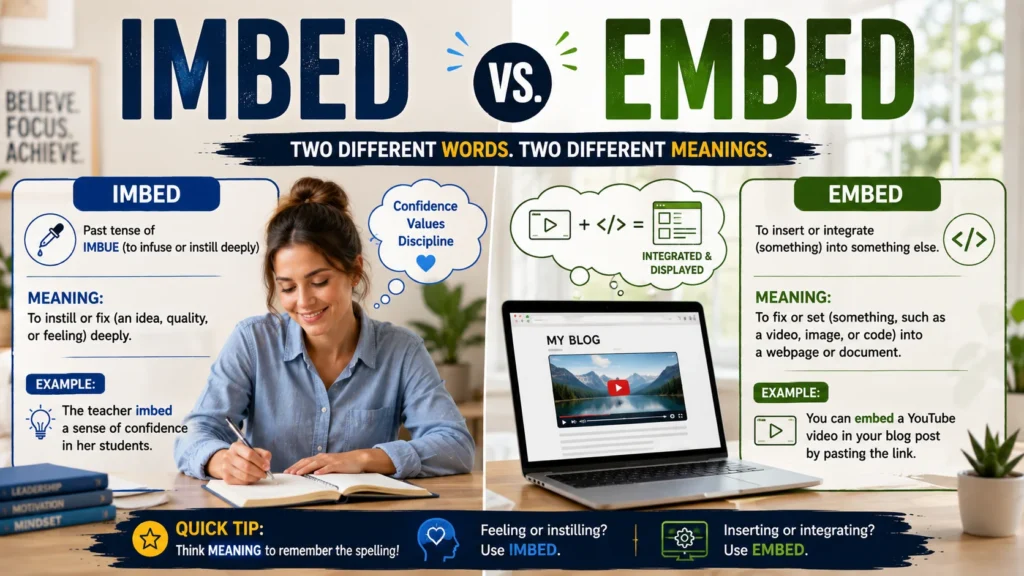
Imbed and embed look almost identical, and that small spelling difference raises a surprisingly common English-language question: Are they different words, or simply two spellings of the same word?
The short answer is straightforward: they have the same core meaning. Modern dictionaries treat imbed as a variant or less common spelling of embed. Merriam-Webster specifically labels imbed as a “less common spelling of embed,” while Oxford lists imbed as another form of embed.
For most modern writing, especially American English, embed is the better default. It is the form readers are more likely to expect in everyday writing, technical documentation, websites, software discussions, and professional communication.
That doesn’t make imbed an error, though. If you find imbed in an older book, a quotation, or a particular publication, the spelling itself isn’t automatically wrong. The important distinction is usage and preference, not a difference in basic meaning.
What Do Imbed and Embed Mean?
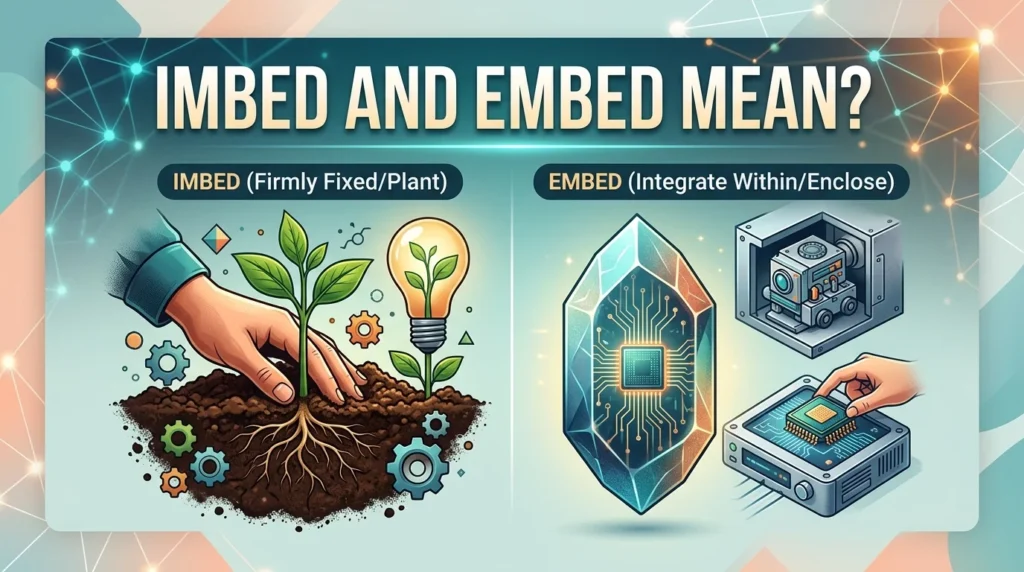
At its core, embed means to place something firmly inside something else. The thing being placed becomes surrounded by or incorporated into its new setting.
Think of a stone set into concrete. The stone doesn’t merely sit beside the concrete. It becomes fixed within it. That is a literal example of something being embedded.
The word also extends naturally into figurative situations. An idea can become embedded in a culture, a habit can become embedded in someone’s behavior, or a belief can become deeply embedded in a society. In those cases, nothing physical is being placed inside anything. Instead, the word describes something becoming firmly established.
Merriam-Webster gives several established senses of embed, including enclosing something in a surrounding material, making something an integral part of something else, preparing microscopy specimens, inserting media into a digital document, and attaching a journalist to a military unit.
Embed as a Verb
Embed is primarily a verb. Its meaning changes slightly according to context, but the central idea remains the same: put something firmly into, within, or as part of something larger.
Here are the main uses:
| Use | Meaning | Example |
| Physical | Put something firmly into a material | The stone was embedded in the wall. |
| Figurative | Make something a lasting part of something | The tradition became embedded in the culture. |
| Digital | Place media inside a document or webpage | You can embed the video on the page. |
| Technical | Build a component into a larger system | Engineers embedded the processor in the device. |
| Journalism | Attach a reporter to a military unit | The journalist was embedded with the troops. |
| Linguistics | Place one sentence or clause inside another | The smaller clause is embedded in the sentence. |
The Oxford Learner’s Dictionary also identifies physical, figurative, journalism, and linguistic meanings for embed.
This range explains why the word appears in so many fields. You don’t need a different verb simply because the context changes. The basic idea remains consistent.
Embed in a Physical Sense
The oldest and most concrete use involves physical placement.
For example:
- A bullet can become embedded in a wall.
- Glass can become embedded in a surface.
- A fossil can be embedded in rock.
- A cable can be embedded inside a structure.
- A decorative object can be embedded in concrete.
In each case, one thing becomes fixed within another.
The word often suggests more than simple contact. If you place a book on a table, the book isn’t embedded in the table. If you push an object into wet concrete and it becomes fixed there, embedded makes much more sense.
That distinction helps explain the word’s deeper meaning: embedding involves incorporation or firm placement, not merely proximity.
Embed in a Figurative Sense
English often takes physical ideas and applies them to abstract concepts. Embed is a good example.
A person might say:
Trust is embedded in the team’s culture.
Here, trust isn’t physically inside anything. The sentence means that trust has become a strong and established part of the culture.
Other common examples include:
- embedded beliefs
- embedded values
- embedded traditions
- embedded habits
- embedded assumptions
- embedded practices
- embedded attitudes
Oxford specifically gives figurative examples involving attitudes that become deeply established in society.
This figurative use matters because it appears frequently in academic writing, business writing, social science, education, and everyday conversation.
Embed in Digital Content
The digital meaning has become especially familiar.
When someone says, “Embed the video,” they usually mean placing the video directly into a webpage, document, email, or other digital environment rather than merely giving readers a separate link.
For example, a website might contain an embedded:
- YouTube video
- image
- audio player
- map
- social media post
- document
- interactive chart
- media player
Merriam-Webster explicitly includes inserting a media file such as a graphic, video, or audio clip into a computer document or website among the established meanings of embed.
This modern technology use is one major reason embed feels so familiar to contemporary readers.
Embed in Technology
Technology uses the word in another important way: embedded systems.
An embedded system is a computing system designed as part of a larger device or product. The computing component doesn’t necessarily operate like a general-purpose desktop computer. Instead, it performs particular functions within the larger system.
Examples include computing components found in:
- cars
- washing machines
- medical equipment
- industrial machinery
- appliances
- smart devices
- control systems
That gives us terms such as embedded software, embedded hardware, embedded processor, and embedded system.
Notice the spelling. Modern technical terminology overwhelmingly uses embedded, not imbedded. That’s one practical reason writers working in technology usually choose embed.
Embed in Journalism
Embed also has a specialized journalism meaning.
An embedded journalist is a journalist who travels with or operates alongside a military unit while covering a conflict. Oxford and Merriam-Webster both recognize this meaning.
This sense became particularly familiar through modern war reporting. The word doesn’t mean that the journalist is physically inserted into a vehicle or structure. Instead, it describes the journalist’s placement within an organized military group for reporting purposes.
Embed in Linguistics
The word also has a technical meaning in linguistics.
An embedded sentence or embedded clause occurs when one linguistic structure appears inside a larger one.
Consider:
I know that she left.
The words that she left form a clause within the larger sentence.
Oxford gives a similar linguistic explanation and identifies an embedded sentence as a sentence placed inside another sentence.
So, embed isn’t limited to physical objects or digital media. It can describe relationships between structures in language as well.
Imbed vs. Embed: What’s the Difference?
The biggest misconception about imbed vs. embed is that the two spellings have different definitions.
They don’t.
Imbed is a variant of embed. Merriam-Webster describes imbed as a less common spelling of embed, while Oxford’s American dictionary simply directs imbed to embed.
So if you write:
The stone was embedded in the wall.
and someone else writes:
The stone was imbedded in the wall.
the spelling changes, but the underlying meaning does not.
The Core Difference Is Usage
The practical difference comes down to frequency and convention.
| Point | Embed | Imbed |
| Basic meaning | Place firmly inside or make part of something | Same |
| Dictionary status | Standard form | Recognized variant |
| Modern frequency | More common | Less common |
| Technical writing | Preferred | Uncommon |
| Digital media | Standard | Rare |
| Figurative use | Common | Less common |
| Present form | embed | imbed |
| Past form | embedded | imbedded |
| -ing form | embedding | imbedding |
| Best default choice | Yes | Usually not |
Merriam-Webster lists embedded and imbedded as variants and likewise lists embedding and imbedding.
That distinction is important. Calling imbed “wrong” goes too far. Calling it equally common in every modern context also gives readers the wrong impression.
The more accurate statement is this:
Embed is the usual modern spelling, while imbed is an accepted but less common variant.
Why Most Writers Choose Embed
Writers generally want their readers to process the message without stopping over word choice.
Because embed is much more familiar, it usually creates less friction.
Imagine reading these two sentences:
Click the button to embed the video.
Click the button to embed the video.
Both can communicate the intended meaning. Yet the first looks immediately familiar to anyone who works with websites, content management systems, online publishing, or digital media.
The same applies to technical terminology:
- embedded system
- embedded software
- embedded content
- embedded media
- embedded device
The embed spelling has become firmly established in these expressions.
Correctness vs. Preference
This distinction deserves attention because English learners often assume that the less common spelling must be incorrect.
That’s not how vocabulary works.
A word can be:
- grammatically valid,
- recognized by dictionaries,
- understandable to readers,
- less common than another form.
Imbed falls into that category.
Oxford lists imbed as another form of embed, and Merriam-Webster calls it a less common spelling.
So don’t “correct” an older quotation from imbed to embed if the original spelling matters. Likewise, don’t assume that someone made a spelling error simply because they used imbed.
For your own modern writing, however, embed is usually the cleaner choice.
Do Imbed and Embed Sound Different?
No.
Oxford gives the pronunciation of both forms as /ɪmˈbed/.
That means the spelling difference doesn’t create a pronunciation difference.
The first syllable sounds like “im,” and the stressed second syllable sounds like “bed.”
So:
embed → /ɪmˈbed/
imbed → /ɪmˈbed/
If you hear someone say the word without seeing it written down, you can’t reliably determine which spelling they intend.
Why Is “Embed” More Common?
The dominance of embed isn’t simply a matter of grammar. English spelling often develops through long-term usage patterns, editorial conventions, professional terminology, and the forms that become familiar to large groups of speakers and writers.
The important point is that modern dictionaries recognize the relationship between the two forms rather than presenting them as separate words with separate meanings. Merriam-Webster dates the first known use of embed to around 1794.
Historical and Modern Usage
English has many pairs in which one spelling becomes more common while another remains possible.
That’s what happened here.
Imbed has not disappeared. Dictionaries still record it. But embed has become the dominant spelling in contemporary English.
You can see that preference especially clearly in specialized vocabulary.
For example:
- embedded systems
- embedded software
- embedded devices
- embedded content
- embedded video
- embedded media
- embedded clauses
- embedded journalism
These established expressions reinforce the embed spelling every time readers encounter them.
Technology Strengthened the Word “Embed”
Digital publishing has given embed a huge amount of everyday exposure.
Someone who has never studied grammar may still have seen phrases such as: Embed videoEmbed codeEmbed media
Embedded content
Embedded player
That repeated exposure matters.
When a word appears in website builders, video platforms, developer documentation, content management systems, and online publishing tools, its spelling becomes familiar through practical use.
This doesn’t mean technology “made” embed correct. It was already an established word. Instead, technology gave the existing spelling an enormous modern platform.
Editorial and Professional Consistency
Professional writers also value consistency.
Suppose a company uses embed throughout its technical documentation. Switching to imbed halfway through the document creates an unnecessary variation.
For example:
Embed the chart in the report.
The embedded chart updates automatically.
That looks natural.
But this looks less consistent:
Embed the chart in the report.
The embedded chart updates automatically.
The second sentence isn’t necessarily grammatically invalid. The issue is style consistency.
A publication, business, university, or technical team may establish a preferred spelling and expect writers to follow it.
The Technical Ecosystem Favors Embed
The strongest practical argument for choosing embed today comes from terminology.
A developer isn’t normally going to search for “how to imbed a YouTube video” when documentation, interfaces, and tutorials consistently use embed.
Likewise, engineers routinely encounter embedded systems, not imbedded systems.
This creates a useful rule:
When a technical field has standardized a term, follow the field’s established spelling.
That rule saves readers from unnecessary confusion.
When Should You Use Embed or Imbed?
If you’re deciding which spelling to put into your own sentence, embed is usually the easy answer.
Use embed when you want the form that modern readers are most likely to recognize immediately.
Use “Embed” in General Writing
Choose embed for physical, figurative, and professional uses.
Examples:
- The stone was embedded in the concrete.
- The idea became embedded in public culture.
- The habit was deeply embedded in his routine.
- The values are embedded in the organization’s policies.
- The tradition remains embedded in the community.
The same spelling works across all these contexts.
Use “Embed” for Digital Content
When talking about websites or online media, embed should be your first choice.
For example:
You can embed the video directly into the article.
The platform lets users embed images on their websites.
The developer added an embedded audio player.
The webpage contains embedded social media content.
This is one area where embed would look unusual to many readers.
Use “Embed” in Technical Writing
Technical writers should normally use the established terminology of their field.
That includes:
- embedded systems
- embedded software
- embedded hardware
- embedded devices
- embedded processors
- embedded applications
- embedded content
If you’re writing documentation, a user guide, a software tutorial, an engineering report, or a technology article, embed is the natural choice.
Use “Embed” in Academic Writing
Academic writing also uses the word in both literal and abstract ways.
For example:
Researchers examined how social beliefs become embedded in language.
The study explores how institutional practices become embedded over time.
In linguistics, embedded clause is an established technical expression. Oxford specifically recognizes the use of embed for placing a sentence inside another sentence.
So academic writers have plenty of reasons to prefer embed.
When Can “Imbed” Be Appropriate?
There are situations where imbed can be perfectly reasonable.
Consider an older quotation:
The original author wrote, “imbed.”
If you’re quoting that source accurately, preserving its spelling may be important.
Likewise, a historical document might consistently use imbed. Changing every occurrence simply to make the spelling modern could alter the character of the original material.
You might also encounter imbed because an author, organization, or publication prefers that variant.
The key is context.
Don’t Treat “Imbed” as an Error
This is perhaps the most important practical lesson.
If you see:
The researcher imbedded the specimen in wax.
you shouldn’t automatically mark it as wrong.
Oxford lists imbedded as the past form of imbed, while Merriam-Webster identifies imbedded as a variant of embedded.
For your own writing, embedded is usually the better modern choice. But that preference doesn’t turn imbedded into a grammatical mistake.
Embed vs. Imbed: A Quick Decision Guide
| If you’re writing… | Recommended form |
| A website article | embed |
| Technical documentation | embed |
| Software documentation | embed |
| Academic writing | embed |
| Business writing | embed |
| General American English | embed |
| A historical quotation | Preserve the original form |
| A publication with a house style | Follow its style |
| A source that consistently uses embed | Keep its established form when appropriate |
| A sentence where either form is technically possible | embed is usually safest |
This approach keeps your writing both accurate and reader-friendly.
Imbed vs. Embed: Examples and Common Mistakes
The easiest way to understand imbed vs. embed is to see the words working in real contexts.
Physical Examples
The literal meaning remains close to the original concept of putting something firmly inside another material.
| Sentence | Meaning |
| The stone was embedded in the concrete. | The stone became fixed inside the concrete. |
| A fragment of glass was embedded in the surface. | The glass became lodged in the surface. |
| The fossil was embedded in rock. | The fossil was enclosed within the rock. |
| The wire was embedded inside the wall. | The wire was placed within the wall. |
These examples show why embed often implies more than “put.”
If you put a cup on a desk, the cup isn’t embedded in the desk. If a component becomes fixed within the desk’s material, embedded becomes appropriate.
Figurative Examples
The word also works naturally with abstract concepts.
| Sentence | Meaning |
| The tradition is deeply embedded in the community. | The tradition has become firmly established. |
| Those beliefs are embedded in the culture. | The beliefs form an established part of the culture. |
| The habit became embedded in his daily routine. | The habit became difficult to separate from the routine. |
| The principle is embedded in the policy. | The principle forms an integral part of the policy. |
This is where learners sometimes confuse embed with words such as include.
The two aren’t always interchangeable.
Something can be included without being deeply established or integrated. Embedded often suggests a stronger relationship.
Digital Examples
Digital writing gives us some of the most familiar modern examples.
Embed the video below the introduction.
The article contains an embedded video.
The website allows visitors to embed the map.
The developer added an embedded media player.
You can embed the image rather than displaying it as a separate page.
Here, embed describes integrating digital content into another digital environment.
Journalism Examples
The journalism sense is different but still follows the basic idea of placing someone within a larger group.
The reporter was embedded with the military unit.
The journalist isn’t merely interviewing the unit from outside. The journalist travels with the group and reports from within that operational setting.
Oxford and Merriam-Webster both recognize this specialized meaning.
Linguistic Examples
In grammar and linguistics, embed describes a structure inside another structure.
For example:
I know that she left.
The clause that she left is embedded within the larger sentence.
This concept becomes more useful when studying complex sentences because it helps explain how clauses fit together.
Common Mistake: “Imbed Is Wrong”
This is the most common oversimplification.
Imbed isn’t simply a misspelling of embed. Major dictionaries recognize it as a variant. Merriam-Webster calls it a less common spelling, while Oxford lists it as another form of the same verb.
The better statement is:
Imbed is valid, but embed is more common.
That distinction gives readers accurate information without turning a usage preference into a grammar rule.
Common Mistake: Assuming the Meanings Differ
Another mistake is believing that embed refers to digital content while imbed refers to physical objects.
That’s incorrect.
Both spellings can describe physical placement and figurative incorporation. The difference lies primarily in spelling preference and frequency.
For instance, imbed can describe a physical object just as embed can. Oxford’s entry gives examples involving glass and bullets, along with figurative attitudes and journalism.
Common Mistake: Mixing Spellings
A writer may use:
embed, imbedded, embedding, and imbed
all within the same article.
Although dictionaries recognize these forms, unnecessary switching can make the writing look inconsistent.
Modern writing usually benefits from a consistent family:
- embed
- embeds
- embedded
- embedding
That set is familiar and easy for readers to follow.
Common Mistake: Confusing Embed With Similar Words
Several English words overlap with embed, but they aren’t perfect substitutes.
| Word | Main idea | Example |
| Embed | Make something firmly part of something else | Embed a video in a webpage. |
| Insert | Put something into something else | Insert the card into the slot. |
| Implant | Put something into a body or material | Doctors implanted the device. |
| Incorporate | Include as an integral part | The plan incorporates new evidence. |
| Integrate | Combine parts into a whole | The system integrates several tools. |
| Ingrain | Establish deeply, usually an idea or habit | The belief became ingrained. |
| Lodge | Become stuck in a particular place | The object lodged in the wall. |
These distinctions matter because good word choice depends on context.
For example, you might insert a key into a lock, but you wouldn’t normally say you embedded a key into the lock unless you specifically mean that it became fixed there.
Likewise, a company may integrate two software systems, while a developer may embed a video within a webpage.
Embedded vs. Imbedded
The past-tense forms deserve their own attention.
Embedded is the usual modern form.
Imbedded is a recognized variant.
Merriam-Webster lists both forms, and Oxford gives embedded as the standard form in its main embed entry while showing imbedded under imbed.
| Present | Past/participle | -ing form |
| embed | embedded | embedding |
| imbed | imbedded | imbedding |
If you’re writing for a modern American audience, the first row is generally the better choice.
A Simple Memory Rule
Here’s an easy way to remember the practical difference:
Use “embed” by default. Keep “imbed” when the source, style, or context calls for it.
You don’t need to memorize a complicated grammar rule.
When you’re writing a webpage, report, essay, technical document, business email, or general article, embed will almost always be the natural choice.
When you’re reading embed, don’t assume you’ve found a mistake. Check the context. The word is recognized, and its meaning is essentially the same.
The most useful takeaway is therefore not that one spelling is “right” and the other is “wrong.” It’s that embed is the standard modern choice, while imbed remains a legitimate but less common variant. That distinction matches the treatment given by major dictionaries and explains why both forms continue to appear in English.
Imbed vs. Embed: What’s the Actual Difference?
The simplest answer is that imbed and embed do not have different core meanings. They are variant spellings of the same verb. Oxford lists imbed as another form of embed, while Merriam-Webster describes imbed as a less common spelling of embed.
That distinction matters because many grammar questions treat the two words as if one must be correct and the other must be wrong. The evidence doesn’t support that rule. Both forms can describe fixing something inside a substance, making something an integral part of another thing, attaching a journalist to a military unit, or placing a sentence inside another sentence.
Embed and Imbed Have the Same Basic Meaning
At the center of both words is the idea of placing something within something else.
Consider these examples:
- The bullet embedded itself in the wall.
- The bullet embedded itself in the wall.
- The tradition is deeply embedded in the culture.
- The tradition is deeply embedded in the culture.
The spelling changes, but the basic meaning stays the same. Oxford gives both forms for physical, figurative, journalism, and linguistic uses.
The difference therefore isn’t semantic in the usual sense. It is mainly a matter of usage, spelling preference, and frequency.
Why “Embed” Is Usually the Better Choice
If both forms work, why choose one?
For modern American English, embed is generally the more useful default because it is the form readers most commonly encounter. It also dominates many established expressions, especially in technology and digital publishing.
You regularly see:
- embedded systems
- embedded software
- embedded content
- embedded media
- embedded video
- embedded devices
- embedded clauses
That familiarity gives embed a practical advantage. A reader doesn’t have to stop and wonder whether the writer intended something unusual.
Merriam-Webster’s entry makes the relationship especially clear: it presents embed as the main entry and identifies imbed as a less common spelling. It also recognizes embedded/imbedded and embedding/imbedding as variants.
So the useful writing rule is simple:
When you have no reason to choose the variant, use “embed.”
Is “Imbed” Wrong?
No. Calling imbed wrong oversimplifies the issue.
Oxford’s dictionary lists imbed as a verb and explicitly gives embed as another form. Its American English entry simply equates the two forms.
Merriam-Webster goes a step further by defining imbed as a “less common spelling” of embed.
That means you can encounter imbed in legitimate English without assuming the author made a spelling mistake.
However, valid doesn’t necessarily mean equally common.
English contains many words and spellings that remain acceptable even though another form has become much more common. That’s the better way to understand this pair.
The Difference Becomes Clear in Modern Contexts
The two forms can technically cover the same meanings, but real-world context affects which one sounds natural.
Take digital media:
You can embed the video directly into the article.
That sentence feels completely ordinary.
Now replace it:
You can embed the video directly into the article.
The meaning remains understandable. Yet the second version feels unusual because digital terminology has strongly established embed.
The same pattern appears in technical language:
The manufacturer uses an embedded processor.
The variant imbedded is possible as a dictionary-recognized form, but it isn’t the form most technical readers expect.
This distinction between meaning and usage is the key to understanding imbed vs. embed.
Literal and Figurative Uses Don’t Separate the Two Words
Another common misunderstanding suggests that embed has a figurative meaning while imbed has a literal meaning.
That isn’t accurate.
Both forms can describe something physically fixed within another material.
Literal:
The glass was embedded in the wall.
They can also describe something abstract becoming firmly established.
Figurative:
The belief became deeply embedded in the community.
Oxford documents both literal and figurative meanings for embed and imbed. Its imbed entry includes examples involving an object fixed in a substance and attitudes deeply established in society.
So don’t choose the spelling based on whether the sentence is literal or figurative. Choose based on the writing context and your preferred standard.
“Embed” Works Across Several Fields
One reason embed has such a strong presence in modern English is its flexibility.
Technology and Digital Media
In computing, embed can mean inserting media into a document, webpage, or email. Merriam-Webster specifically includes graphics, video, and audio among its examples of embedded media.
That’s why writers naturally use phrases such as:
- embed a video
- embed an image
- embed audio
- embed a map
- embed content
- embedded media
This technical meaning has become part of everyday digital vocabulary.
Journalism
Embed also has an established journalism meaning. It can mean assigning a journalist or photographer to travel with a military unit while covering a conflict. Both Oxford and Merriam-Webster recognize this sense.
For example:
The reporter was embedded with the military unit.
Again, embed can represent the same word, but embed is the familiar modern form.
Linguistics
In linguistics, embed means placing a sentence or clause inside another sentence.
For example:
I know that she left.
The clause that she left sits within the larger sentence.
Oxford explicitly identifies this as a linguistic sense of embed and provides the same type of structure for imbed.
This is another example of why the two spellings don’t represent separate concepts.
Embed vs. Imbed: Usage Comparison
| Feature | Embed | Imbed |
| Core meaning | Place or fix within something | Same |
| Dictionary status | Standard/main form | Recognized variant |
| Modern usage | More common | Less common |
| Digital content | Very common | Uncommon |
| Technical writing | Preferred | Less common |
| Figurative use | Common | Possible |
| Journalism | Common | Possible |
| Linguistics | Common | Possible |
| Pronunciation | /ɪmˈbed/ | /ɪmˈbed/ |
| Best default for modern writing | Yes | Usually no |
Oxford gives the same pronunciation, /ɪmˈbed/, for both forms and lists imbed as another form of embed.
What About “Embedded” and “Imbedded”?
The same pattern continues with their past-tense and past-participle forms.
Embedded is the familiar modern form.
Imbedded is also recognized.
Merriam-Webster lists embedded as the standard form and imbedded as a less common variant. It does the same for embedding and imbedding.
| Main form | Variant |
| embed | imbed |
| embeds | imbeds |
| embedded | imbedded |
| embedding | imbedding |
For most contemporary writing, sticking with the left-hand column will give you the most familiar result.
A Practical Example
Imagine you’re writing instructions for a website editor.
You could write:
Embed the video after the introduction. The embedded player will appear directly on the page.
That wording feels natural because it matches the terminology readers already see in digital publishing.
Using the variant isn’t necessarily incorrect:
Embed the video after the introduction. The embedded player will appear directly on the page.
But it creates a style choice that the first version avoids.
When clarity and familiarity matter, the standard form usually wins.
The Bottom Line on Imbed vs. Embed
The real difference between imbed vs. embed is not meaning. Both forms can describe the same action and the same figurative or specialized concepts.
The meaningful distinction is their modern usage:
- Embed is the standard and more familiar spelling.
- Imbed is a recognized but less common variant.
- Both forms can describe physical and figurative embedding.
- Both can appear in specialized contexts.
- Embedded is generally preferred over imbedded.
- Embedding is generally preferred over imbedding.
- Both words have the same pronunciation.
- For modern American English, embed is usually the safest choice.
So, if you’re writing a sentence today and you’re choosing between the two without any special reason to use the variant, embed is the straightforward choice. You won’t change the meaning by choosing it. You’ll simply use the spelling that modern readers are most accustomed to seeing.
Why Is “Embed” More Common Than “Imbed”?
If you compare imbed vs. embed in modern English, embed clearly has the stronger position. The important point isn’t that imbed suddenly became incorrect. Instead, English gradually settled on embed as the more familiar spelling, while imbed remained a recognized variant. Oxford currently lists imbed as another form of embed, and Merriam-Webster describes it as a less common spelling.
Embed Became the Familiar Modern Form
English often keeps more than one spelling for the same word. Over time, however, one form may become much more common because writers, publishers, dictionaries, and specialized fields repeatedly use it.
That’s what makes embed the practical choice today.
You can see this preference in familiar expressions such as:
- embed a video
- embed an image
- embed audio
- embedded content
- embedded software
- embedded systems
- embedded devices
- embedded clauses
These phrases appear across technology, education, journalism, linguistics, and general writing. The repetition reinforces the spelling every time a reader encounters it.
Technology Gave “Embed” Extra Visibility
Digital technology has made embed especially familiar.
When a website lets you embed a video, the word describes placing that media into another digital environment. Merriam-Webster specifically recognizes the use of embed for inserting media such as graphics, video, or audio into a computer document, website, or email.
That meaning now feels completely ordinary:
You can embed the video directly into the webpage.
The same word appears in technical terms such as embedded systems and embedded software. Once a particular spelling becomes part of established technical vocabulary, writers have little reason to switch to a less common variant.
Technical Language Strongly Favors “Embed”
Technical writing rewards consistency because readers often need to understand precise terminology quickly.
Consider these phrases:
| Common modern term | Less familiar variant |
| embedded system | imbedded system |
| embedded software | imbedded software |
| embedded device | imbedded device |
| embedded content | imbedded content |
| embedding media | imbedding media |
The right-hand forms aren’t necessarily meaningless or automatically ungrammatical. The problem is familiarity. A technical reader expects embedded, so changing the spelling can make an established term look unusual.
That’s why embed works particularly well in software documentation, engineering material, web publishing, and technology articles.
Dictionaries Reinforce the Relationship
Modern dictionary entries provide a useful reality check.
Oxford’s main entry gives embed and explicitly lists imbed as another form. Its separate imbed entry simply points readers to embed.
Merriam-Webster takes a similar approach. Its embed entry lists imbed as a variant or less common form and also recognizes embedded/imbedded and embedding/imbedding.
So dictionaries don’t support the claim that imbed has disappeared. They support a more precise conclusion:
Both forms exist, but “embed” is the main modern form.
“Imbed” Is Still a Valid Variant
It’s tempting to say that modern writers should never use imbed, but that’s too absolute.
Oxford’s entry gives imbed the same pronunciation and core senses as embed. It covers physical placement, figurative meaning, journalism, and linguistics.
For example, these two sentences express the same basic idea:
The bullet embedded itself in the wall.
The bullet imbedded itself in the wall.
The first version is more familiar today. The second still represents a recognized variant.
This distinction matters when editing older material. If a historical source uses imbed, an editor shouldn’t automatically assume the author made a spelling error.
Why Frequency Matters to Writers
When two forms carry the same meaning, the more familiar form usually makes communication easier.
Imagine a reader scanning a technical article and seeing:
The application supports embedded media.
The phrase requires almost no mental effort.
Now imagine:
The application supports embedded media.
The reader can still understand it, but the unusual spelling may cause a brief pause. That’s exactly the kind of friction good writing tries to avoid.
You don’t gain extra meaning by choosing imbed. In most modern contexts, you simply make the reader encounter a less familiar form.
Modern Usage and Style Are Different From Grammar
This distinction can save you from many unnecessary grammar arguments.
Grammar asks whether a construction follows the rules of the language.
Usage asks how speakers and writers actually use a word.
Style asks which acceptable form best fits a particular publication, audience, or purpose.
With imbed vs. embed, those three ideas don’t always point to the same question.
The issue isn’t:
“Is imbed grammatical?”
A better question is:
“Which spelling should I use for this audience and context?”
For most modern American English writing, the answer is embed.
Embedded or Imbedded?
The same preference appears in the past-tense and past-participle forms.
Embedded is the usual modern form.
Imbedded remains a recognized variant. Merriam-Webster lists both, while Oxford’s main embed entry gives embedded and its imbed entry gives imbedded.
The same pattern applies to the -ing form:
- embedding — usual modern form
- imbedding — recognized variant
For most writing, consistency makes the decision easy:
embed → embedded → embedding
That sequence looks familiar across modern English.
A Useful Rule for Everyday Writing
You don’t need to memorize the history of both spellings every time you write a sentence.
Use this practical rule:
Choose “embed” unless you have a specific reason to preserve or use “imbed.”
That rule works especially well for:
- websites
- blogs
- academic papers
- business documents
- software guides
- technical manuals
- digital media instructions
- American English
- general professional writing
If you’re reproducing a quotation, preserving historical wording, or following a publication’s established style, imbed may still have a place.
Why “Embed” Is the Safer Choice
Think of embed as the default setting.
You don’t need to defend it or explain why you chose it. Readers already recognize it, and specialized fields use it extensively.
By contrast, imbed can draw attention to itself because it appears less often.
That’s not a problem when the variant serves a purpose. It simply means that writers should avoid treating the two forms as equally common.
The Practical Difference in One Table
| Question | Embed | Imbed |
| Is it a real English word? | Yes | Yes |
| Does it have the same core meaning? | Yes | Yes |
| Is it used for physical placement? | Yes | Yes |
| Is it used figuratively? | Yes | Yes |
| Is it used for digital media? | Yes | Yes, but uncommon |
| Is it common in technology? | Yes | Much less common |
| Is it used in journalism? | Yes | Yes |
| Is it used in linguistics? | Yes | Yes |
| Is the spelling familiar to modern readers? | Very | Less |
| Best default for modern writing | Yes | Usually no |
Oxford’s current entries support the same basic conclusion: embed is the main form, while imbed functions as another form of the verb.
What This Means for Your Writing
If you’re writing a sentence from scratch, choose embed.
If you’re editing someone else’s work, don’t automatically change imbed simply because you prefer the other spelling. First consider the publication’s style, the author’s intent, the age of the material, and the surrounding vocabulary.
For example, an older text might consistently use imbedded. Changing one occurrence to embedded while leaving the others untouched could create an inconsistent document.
On the other hand, a modern technology article should normally use:
embedded system
rather than:
imbedded system
The first version matches established technical usage and will look immediately natural to most readers.
The Real Reason “Embed” Wins
The strongest explanation isn’t that English speakers decided one spelling was morally or grammatically superior. Language rarely works that neatly.
Instead, embed became the dominant form through usage, and modern fields reinforced that preference.
Today, readers encounter embed in dictionaries, technical vocabulary, digital publishing, journalism, linguistics, and everyday writing. Oxford and Merriam-Webster both preserve imbed while treating it as the variant rather than the main modern form.
So when someone asks “Why is embed more common than imbed?”, the most accurate answer is also the simplest:
Embed is the established modern spelling. Imbed remains valid, but it has a smaller footprint in contemporary usage.
For almost any new piece of American English writing, embed, embedded, and embedding are the forms that will sound most natural to readers.
When Should You Use “Embed” or “Imbed”?
When choosing between embed and imbed, context matters less than most people expect. Both forms can describe the same basic action, but embed is the better default for modern American English. Oxford lists imbed as another form of embed, with the same core meanings and pronunciation.
Use “Embed” for Modern Writing
If you’re writing a new sentence and don’t have a specific reason to choose the variant, use embed.
This choice works well in:
- Everyday English
- Academic writing
- Business writing
- Technical documentation
- Web content
- Software documentation
- Digital publishing
- Scientific writing
- Professional communication
For example:
Please embed the chart in the report.
The study examines how these beliefs become embedded in society.
The website allows users to embed videos.
These sentences use the spelling most readers expect.
Use “Embed” for Physical Objects
The physical meaning of embed describes something becoming firmly fixed inside another substance or object.
Examples include:
The bullet embedded itself in the wall.
Small pieces of glass were embedded in the material.
The stone became embedded in the concrete.
Oxford gives physical examples involving glass and bullets and also recognizes the figurative sense of something becoming firmly established.
You can think of embed as stronger than simply “put.” If you put a coin on a table, the coin isn’t embedded in the table. If the coin becomes fixed inside the material, embedded makes sense.
Use “Embed” for Figurative Ideas
You can also use embed when an abstract idea becomes a lasting part of something.
For example:
The tradition is deeply embedded in the community.
These values are embedded in the organization’s culture.
The assumption became embedded in public thinking.
Here, nothing physically enters anything. Instead, the word shows that an idea, attitude, value, or practice has become firmly established.
Oxford specifically recognizes this figurative use, including attitudes that become deeply established in society.
Use “Embed” for Websites and Digital Media
For digital content, embed is the natural choice.
You might:
- embed a video
- embed an image
- embed audio
- embed a map
- embed a social media post
- embed a document
- embed interactive content
For example:
You can embed the video directly into the article.
The past participle also appears frequently:
The article contains an embedded video.
This usage has become firmly established in modern digital language. The same spelling appears in technical documentation and publishing tools, which makes embed immediately recognizable to readers.
Use “Embed” in Technical Writing
Technical contexts strongly favor the embed family.
You’ll commonly see:
- embedded systems
- embedded software
- embedded hardware
- embedded devices
- embedded processors
- embedded applications
- embedded content
This terminology describes components that form part of a larger technological system.
For example:
The manufacturer uses an embedded processor in the device.
The application supports embedded content.
Engineers designed an embedded system for the equipment.
When technical terminology already uses embedded, switching to imbedded usually adds nothing useful. It can even make a familiar technical phrase look unusual.
Use “Embed” in Journalism
Embed also has a specialized journalism meaning.
An organization can embed a journalist or photographer with a military unit. The journalist then travels with the group and reports from the area where the unit operates. Oxford recognizes this meaning alongside the physical and figurative senses.
For example:
The newspaper embedded a reporter with the military unit.
Or:
Several embedded journalists covered the conflict.
The word doesn’t mean that the journalist physically sits inside the soldiers or equipment. Instead, it describes the journalist’s assignment and close placement within the group.
Use “Embed” in Linguistics
In linguistics, embed has a precise technical meaning.
A sentence or clause can appear inside another sentence:
I know that she left.
The clause that she left sits within the larger sentence.
Oxford recognizes this as a specific linguistic sense of embed.
This usage appears in grammar textbooks, linguistic research, and academic discussions about sentence structure.
When Is “Imbed” Acceptable?
Imbed remains acceptable because dictionaries recognize it as a variant of embed. Oxford gives imbed its own entry, and lists embed as another form.
So you don’t need to treat every occurrence of imbed as a spelling mistake.
You might encounter it in:
- older books
- historical documents
- quotations
- edited material that preserves original wording
- publications with a particular style preference
- writing from authors who prefer the variant
For example, if a historical source says:
The bullet embedded itself in the wall.
you may want to preserve that spelling when quoting the source exactly.
When Should You Prefer “Imbed”?
For new writing, there usually isn’t a strong reason to choose imbed over embed.
That’s especially true when you’re writing for a broad American audience.
| Writing situation | Better choice |
| Website article | embed |
| Blog post | embed |
| Technical guide | embed |
| Software documentation | embed |
| Academic paper | embed |
| Business document | embed |
| Digital media instructions | embed |
| General American English | embed |
| Historical quotation | Preserve the source’s spelling |
| House style requiring imbed | imbed |
The important distinction is preference rather than correctness. Oxford recognizes both forms, but its entries make clear that imbed functions as another form of embed.
What About “Imbedded” and “Imbedding”?
The same choice applies to the related forms.
The main modern forms are:
- embed
- embedded
- embedding
The corresponding variants are:
- imbed
- imbedded
- imbedding
Oxford lists these forms directly under its imbed entry.
For most modern writing, the first group will sound more natural:
The video is embedded in the page.
We are embedding the content.
Rather than:
The video is imbedded in the page.
We are imbedding the content.
The latter forms aren’t automatically wrong. They’re simply less familiar.
A Simple Rule for Choosing the Right Form
If you want a quick decision, use this rule:
Choose “embed” unless you have a specific reason to use “imbed.”
That rule works because embed fits both ordinary and specialized English.
You can use it for a physical object:
The wire was embedded in the wall.
You can use it for an idea:
The belief became embedded in the culture.
You can use it for digital content:
Embed the video below the heading.
You can use it for technology:
The device contains an embedded processor.
You can use it for journalism:
The reporter was embedded with the unit.
You can even use it in linguistics:
The clause is embedded within the larger sentence.
The spelling stays the same while the context changes.
Don’t Choose “Imbed” Because You Think It Has a Different Meaning
This is an important mistake to avoid.
You shouldn’t assume that imbed means something more physical while embed works for abstract or digital ideas. Both forms can cover those meanings. Oxford’s imbed entry includes physical, figurative, journalism, and linguistic uses.
So this isn’t a useful rule:
Imbed = physical
Embed = digital
Instead, think:
Imbed = variant spelling
Embed = usual modern spelling
That distinction will keep your word choice accurate.
A Practical Editing Test
When editing a sentence, ask three quick questions:
Is this new writing?
If yes, embed is usually the best choice.
Am I preserving someone else’s original wording?
If yes, keep the original spelling when accuracy matters.
Does my field already use a standard expression?
If yes, follow that established terminology. In technology, for example, embedded system is the familiar form.
This approach avoids unnecessary corrections while keeping modern writing consistent.
Embed vs. Imbed: Best Choice by Context
| Context | Recommended wording |
| Physical placement | embed |
| Figurative meaning | embed |
| Website content | embed |
| Video or audio | embed |
| Software | embed |
| Hardware | embed |
| Embedded systems | embedded |
| Journalism | embed / embedded |
| Linguistics | embed / embedded |
| Historical quotation | Follow the original |
| Modern American English | embed |
The safest choice for a writer is therefore clear: use embed in most situations. Save imbed for cases where the variant serves a genuine purpose, such as preserving a quotation or following an established style.
That approach gives you the best combination of correctness, clarity, consistency, and modern usage without incorrectly labeling imbed as a bad word.
Imbed vs. Embed: Common Mistakes, Examples, and a Quick Reference
Once you understand that imbed and embed share the same core meaning, the remaining challenge is choosing the form that fits modern writing. The safest default is embed. Merriam-Webster lists imbed as a less common variant and gives the same related forms, including embedded/imbedded and embedding/imbedding.
Common Mistakes to Avoid
The most common mistake is treating imbed as automatically incorrect. It isn’t. The more accurate description is that imbed is a recognized but less common spelling of embed.
A second mistake is assuming the two spellings have different meanings. They don’t. Both can describe something being placed firmly within another thing, becoming part of a larger whole, or being inserted into a digital document.
A third mistake is switching between the forms in the same document without a reason. If you choose embed, keep the related forms consistent:
embed → embedded → embedding
That sequence is especially natural in modern technical, academic, business, and digital writing.
Mistake: Assuming “Imbed” Is Wrong
You may see someone mark imbed as a spelling error. That correction isn’t necessarily justified.
Merriam-Webster explicitly identifies imbed as a less common spelling of embed, while Dictionary.com describes it as an alternate spelling with the same meanings and uses.
So compare:
The technician embedded the sensor in the device.
The technician imbedded the sensor in the device.
The first sentence uses the more familiar spelling. The second uses a recognized variant. The difference is primarily usage frequency, not meaning.
Mistake: Assuming “Imbed” Is More Correct for Physical Objects
Some writers mistakenly create a rule such as:
- imbed = physical
- embed = abstract or digital
English doesn’t support that distinction.
Both forms can describe physical placement:
The stone was embedded in concrete.
The stone was embedded in concrete.
They can also describe something becoming part of an abstract environment:
The idea became deeply embedded in the culture.
Merriam-Webster gives both physical and figurative senses for the main verb and identifies imbed as its less common variant.
Mistake: Using “Imbed” in Established Technical Terms
Technical vocabulary strongly favors embed.
You will commonly encounter:
- embedded system
- embedded software
- embedded device
- embedded processor
- embedded content
- embedded media
Changing these established expressions to imbedded system or imbedded software can make the terminology look unfamiliar.
The same principle applies to web content. Merriam-Webster specifically includes inserting a media file such as a graphic, video, or audio clip into a computer document as a meaning of embed.
Mistake: Confusing “Embedded” and “Imbedded”
Embedded and imbedded are not different grammatical forms.
They are variant spellings of the past-tense and past-participle form.
| Preferred modern form | Less common variant |
| embed | imbed |
| embedded | imbedded |
| embedding | imbedding |
| embeds | imbeds |
Merriam-Webster explicitly lists these variant relationships.
If you’re writing for a general American audience, the left-hand column will normally be the better choice.
Mistake: Switching Spellings Within One Article
Consistency matters even when both spellings are valid.
Imagine an article that says:
The application embeds video files.
Later, it says:
The platform embeds audio files.
Nothing about the second sentence requires the variant spelling. The sudden change simply looks inconsistent.
A cleaner approach is:
The application embeds video files.
The platform embeds audio files.
Consistency makes the writing easier to scan and prevents readers from wondering whether you’ve introduced a subtle difference in meaning.
Mistake: Thinking “Embed” Has Only a Digital Meaning
Modern technology has made embed extremely familiar, but digital content represents only one of its uses.
The word can describe physical placement:
The fossils were embedded in rock.
It can describe integration:
The principle became embedded in the organization’s culture.
It can describe digital content:
The developer embedded the video on the webpage.
It can also describe journalism:
The reporter was embedded with the military unit.
Merriam-Webster recognizes these physical, figurative, digital, and journalism-related senses.
Mistake: Choosing a Different Word When “Embed” Is More Precise
Not every sentence that involves putting something somewhere requires embed.
For example, insert, place, and integrate can sometimes be better choices.
| Word | Typical idea | Example |
| embed | Fix or incorporate firmly | Embed the image in the page. |
| insert | Put something into a location | Insert the key into the lock. |
| place | Put something somewhere | Place the book on the desk. |
| integrate | Make something part of a larger system | Integrate the new feature into the app. |
| implant | Put something inside a living body or material | The surgeon implanted the device. |
The distinction becomes useful when you want exact wording rather than simply choosing between imbed and embed.
Common Examples of “Embed”
Here are several contexts where embed sounds natural:
Physical object
The workers embedded steel rods in the concrete.
Digital content
The editor embedded a video in the article.
Figurative idea
The experience became embedded in her memory.
Technology
The device contains an embedded processor.
Journalism
The network sent an embedded reporter with the unit.
Linguistics
The sentence contains an embedded clause.
These uses share the same underlying concept: something becomes situated within a larger surrounding structure or context.
Imbed vs. Embed in Formal Writing
For formal writing, embed is usually the sensible choice because it is the form readers encounter most often.
This applies particularly to:
- academic papers
- professional reports
- technical documentation
- websites
- software guides
- business communication
- journalism
- educational material
That doesn’t make imbed grammatically invalid. It simply means that embed offers greater familiarity and aligns with established modern terminology. Dictionary.com likewise describes imbed as much less commonly used than embed.
Imbed vs. Embed in American English
In American English, embed is the practical default.
If you’re writing an article, report, email, school assignment, or technical document, there’s rarely a benefit to choosing imbed.
For example:
Please embed the chart in the report.
is preferable to:
Please embed the chart in the report.
The first sentence uses the spelling that modern readers are more accustomed to seeing.
A Quick Decision Guide
When you’re unsure, use this checklist:
| Question | Best choice |
| Are you writing something new? | Embed |
| Are you writing for a general audience? | Embed |
| Are you writing technical material? | Embed |
| Are you describing digital content? | Embed |
| Are you describing an established idea? | Embed |
| Are you preserving an old quotation? | Keep the original spelling |
| Does a publication require imbed? | Follow its style |
| Are you unsure? | Embed |
This isn’t a rule that makes imbed wrong. It’s a practical rule that helps you choose the more familiar form.
Side-by-Side Examples
| Less common | Preferred modern wording |
| The image was embedded in the page. | The image was embedded in the page. |
| We will embed the video. | We will embed the video. |
| The sensor was embedded in the device. | The sensor was embedded in the device. |
| The idea became embedded in the culture. | The idea became embedded in the culture. |
| The reporter was embedded with the unit. | The reporter was embedded with the unit. |
The left column isn’t automatically ungrammatical. The right column simply reflects the spelling most modern readers expect.
A Simple Memory Trick
If you’re trying to remember which spelling to use, think of embed as the standard modern form.
You can remember:
When in doubt, use “embed.”
That one rule covers most everyday situations without requiring you to memorize complicated exceptions.
Quick Reference: Imbed vs. Embed
| Point | Answer |
| Do they have different meanings? | No |
| Is imbed a real word? | Yes |
| Is imbed a variant of embed? | Yes |
| Which spelling is more common? | Embed |
| Which form should most modern writers choose? | Embed |
| Is imbedded recognized? | Yes |
| Is embedded more familiar? | Yes |
| Do both forms have the same pronunciation? | Yes |
| Can both describe physical placement? | Yes |
| Can both describe figurative integration? | Yes |
| Can embed describe digital content? | Yes |
| Is embed the safest default? | Yes |
Merriam-Webster’s current dictionary entry confirms the central point: embed is the main entry, imbed is a less common variant, and both forms share the same core meanings and related inflections.
Final Writing Rule
If you need one answer to remember from this entire comparison, make it this:
Use “embed” in modern writing unless you have a specific reason to use “imbed.”
You won’t change the meaning by choosing embed. You’ll simply choose the form that readers are most likely to recognize immediately. Imbed remains a legitimate variant, but its lower frequency makes it a less practical default for contemporary American English.
Conclusion
When comparing imbed vs. embed, the key point is simple: both words share the same basic meaning, but embed is the more common and practical spelling in modern American English. Imbed remains a valid variant, so it isn’t accurate to call it an outright mistake. You may still see it in older writing, quotations, or texts that follow a particular style. However, if you’re writing a website article, academic paper, business document, technical guide, or everyday message, embed is usually the clearest choice. The same preference applies to embedded rather than imbedded and embedding rather than imbedding. Once you remember that the difference is mainly one of usage and frequency rather than meaning, this spelling choice becomes much easier. When in doubt, choose embed for familiar, consistent, and reader-friendly modern English.
FAQs
Is “imbed” a correct word?
Yes. Imbed is a recognized English word and a variant spelling of embed. It has the same basic meanings, including placing something firmly within another thing and making something part of a larger whole. However, imbed is less common in modern English, so embed is generally the better choice for most contemporary writing.
What is the difference between imbed and embed?
There is no major difference in meaning between imbed and embed. Both words can describe physically fixing something inside another substance or figuratively making something an established part of a larger whole. The main difference is usage: embed is much more common today, while imbed survives as a less common variant spelling.
Should I use embed or imbed?
In most situations, use embed. It is the more familiar spelling in modern American English and appears widely in technology, journalism, academic writing, business communication, and everyday English. Imbed isn’t necessarily wrong, but it is less common. Unless you’re following a specific style or preserving original wording, embed is the safer choice.
Is imbed outdated?
Imbed isn’t completely outdated because dictionaries still recognize it as a valid variant of embed. However, it is much less common than embed in contemporary writing. Readers may encounter it in older works or particular publications, but modern writers generally prefer embed because it is more familiar and widely established.
Is embedded or imbedded correct?
Both embedded and imbedded are recognized forms. However, embedded is far more common in modern English. You’ll see it frequently in phrases such as embedded systems, embedded content, and embedded media. For general, professional, academic, and technical writing, embedded is normally the better choice.
Is embedding or imbedding correct?
Both embedding and imbedding can be used because they are variant forms of the same verb. However, embedding is the standard choice in most modern contexts. It is especially common in technology, digital publishing, linguistics, and general writing. If you’re unsure which form to use, embedding will usually sound more natural to contemporary readers.
Does embed only refer to technology?
No. Although embed is extremely common in technology, its meaning extends far beyond digital content. You can embed a physical object in another material, embed an idea in a culture, or describe a journalist as embedded with a military unit. The word can therefore have physical, figurative, technical, journalistic, and linguistic uses.
Can imbed be used in formal writing?
Yes, but embed is generally preferable in modern formal writing. Imbed is a recognized variant, so using it isn’t automatically incorrect. Still, academic papers, technical documents, professional reports, and business writing usually benefit from the more familiar embed spelling. Always follow a publication’s established style guide when one applies.
How do you pronounce imbed and embed?
Imbed and embed have the same pronunciation. Both are commonly pronounced approximately like “im-BED,” with the stress on the second syllable. The spelling changes, but the pronunciation does not. This is another reason the distinction between the two forms mainly concerns spelling and usage rather than meaning or pronunciation.
Which spelling is better for American English?
For modern American English, embed is generally the better choice. It is more common, more familiar, and firmly established across everyday, professional, academic, and technical contexts. Imbed remains acceptable as a variant, but it may look unusual to some readers. When no special context requires the variant, choosing embed keeps your writing clear and natural.