
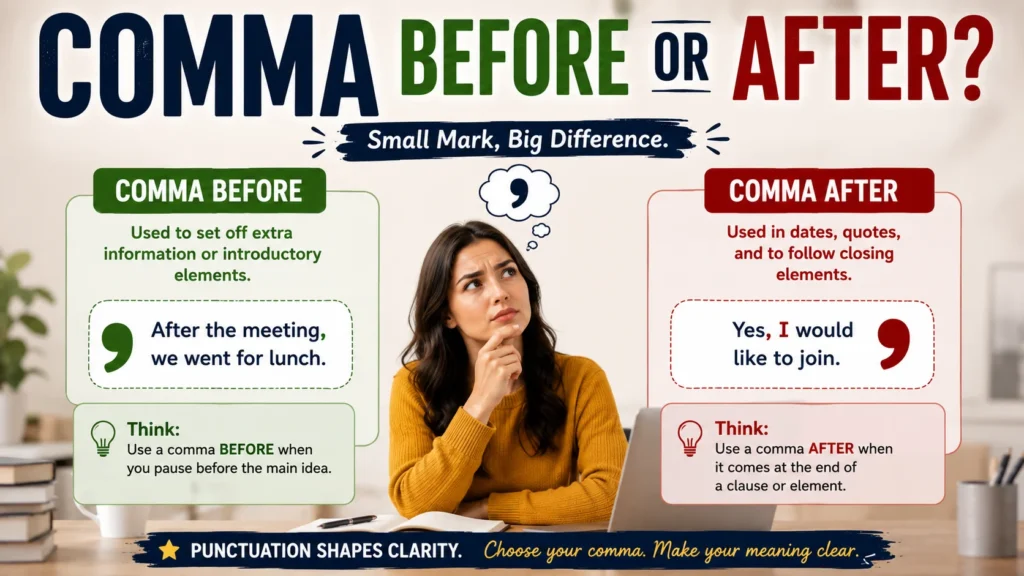
If you’ve ever stopped in the middle of a sentence and wondered whether “for example” needs a comma before it, after it, or on both sides, you’re not alone. The answer depends less on the phrase itself and more on how it functions in the sentence. That is the key idea to remember throughout this guide.
In American English, “for example” commonly introduces a specific illustration of a broader point. When it begins a sentence, it normally takes a comma after it: “For example, some fruits contain more natural sugar than others.” When it interrupts a sentence as a parenthetical expression, writers generally set it off with commas: “Some fruits, for example, contain more natural sugar than others.” However, punctuation before the phrase can change when it introduces a new independent clause or follows another punctuation mark. Official style guidance likewise emphasizes that sentence structure determines comma use.
The practical lesson is simple: don’t memorize “comma before” or “comma after” as a universal rule. Instead, identify what “for example” is doing and examine the sentence around it. Once you recognize whether the phrase is introductory, parenthetical, integrated, or introducing a separate thought, the punctuation becomes much easier to choose.
What “For Example” Means and How It Works
What Does “For Example” Mean?
“For example” is an expression that introduces a particular case that helps explain a broader statement. You make a general claim first, then use the phrase to point the reader toward something concrete.
Consider this sentence:
Many animals have strong survival adaptations.
That statement is broad. A reader understands the general idea, but the sentence doesn’t show what those adaptations look like. Add an example:
Many animals have strong survival adaptations. For example, polar bears have thick fur and a substantial layer of body fat that helps them survive in cold environments.
The second sentence gives the reader something specific to picture. The phrase “for example” acts as a signal: Here comes a particular illustration of the idea I just mentioned.
This function makes the expression especially useful in explanatory writing. You can use it in grammar lessons, academic papers, business documents, technical explanations, blog posts, and everyday communication.
Why Writers Use “For Example”
Writers use “for example” because examples reduce the distance between an abstract idea and something a reader can understand.
Suppose someone writes:
Good passwords should be difficult to guess.
That’s useful advice, but it remains general. A specific example makes the advice easier to apply:
Good passwords should be difficult to guess. For example, a long passphrase containing several unrelated words can be stronger than a short, predictable password.
The example doesn’t necessarily prove the entire statement. Instead, it illustrates what the writer means.
Examples can perform several jobs:
- Clarify a broad statement.
- Illustrate an unfamiliar concept.
- Demonstrate how something works.
- Make abstract information concrete.
- Help readers recognize a pattern.
- Give readers something they can compare with their own situation.
That last function matters in practical writing. If you explain a grammar rule without examples, a beginner may understand the definition but still struggle to apply it. A well-chosen example shows the rule in action.
“For Example” and “For Instance”
“For example” and “for instance” usually serve the same basic purpose. Both can introduce a particular case that illustrates a broader statement.
Compare:
Some animals communicate in unusual ways. For example, honeybees use movement to convey information about food sources.
And:
Some animals communicate in unusual ways. For instance, honeybees use movement to convey information about food sources.
The meaning remains essentially the same.
The difference is mainly one of word choice and style, not a completely different punctuation system. Both expressions can appear at the beginning or in the middle of a sentence.
“For Example” and “Such As”
“Such as” looks similar because it can also introduce examples, but its grammatical behavior differs.
Compare these sentences:
Several fruits contain vitamin C. For example, oranges and strawberries contain vitamin C.
Here, “for example” introduces an illustrative statement.
Now consider:
Several fruits, such as oranges and strawberries, contain vitamin C.
Here, “such as” is embedded directly within the noun phrase. It identifies examples of the broader category “fruits.”
This distinction becomes important when punctuation enters the picture.
You shouldn’t assume that because “for example” and “such as” both introduce examples, they should always receive identical commas.
A useful comparison is:
| Expression | Typical function | Example |
| for example | Introduces an illustration | Some fruits are high in vitamin C. For example, oranges contain it. |
| for instance | Introduces an illustration | Some fruits are high in vitamin C. For instance, oranges contain it. |
| such as | Introduces examples within a phrase | Fruits such as oranges contain vitamin C. |
| e.g. | Abbreviated form meaning “for example” | Fruits (e.g., oranges) can provide vitamin C. |
The exact punctuation surrounding these expressions depends on the sentence structure and the style being followed.
“For Example” and “e.g”
“E.g.” comes from the Latin exempli gratia, meaning roughly “for the sake of an example.” In English writing, it performs a function similar to “for example.”
However, the two forms differ in tone and presentation.
“For example” is usually easier for a broad audience because the reader doesn’t need to know what the abbreviation means. It also fits naturally into ordinary prose:
Several foods provide healthy fats. For example, avocados contain monounsaturated fat.
The abbreviated form is more compact:
Several foods provide healthy fats (e.g., avocados and nuts).
One important style detail: punctuation after “e.g.” varies among style systems. The Australian Government Style Manual, for instance, advises against adding a comma after the abbreviation in constructions such as “(e.g. lithium, europium).”
So if your goal is straightforward, beginner-friendly writing, spelling out “for example” often removes unnecessary ambiguity.
Why the Phrase’s Position Matters
The biggest source of confusion is that “for example” can appear in different positions.
It can begin a sentence:
For example, some birds migrate thousands of miles each year.
It can interrupt a sentence:
Some birds, for example, migrate thousands of miles each year.
It can appear later in a sentence:
Some birds migrate thousands of miles each year, for example.
The punctuation isn’t determined simply by counting words before or after the phrase. Instead, you need to ask what grammatical relationship the phrase has with the rest of the sentence.
That is why the question “Do I put the comma before or after ‘for example’?” doesn’t have one answer that works everywhere.
Do You Put a Comma Before or After “For Example”?
The Short Answer
Here’s the beginner-friendly rule:
When “for example” begins a sentence, normally put a comma after it. When it interrupts a sentence as a parenthetical expression, normally place commas on both sides. A comma before “for example” depends on the structure that comes before it.
Examples make this much clearer.
At the beginning:
For example, cats often sleep for many hours each day.
In the middle:
Some pets, for example, cats, can sleep for many hours each day.
After a complete thought:
Many pets sleep for long periods, for example.
That final construction is much less common and often sounds awkward. If you’re introducing a new example, starting a new sentence is usually clearer:
Many pets sleep for long periods. For example, cats can sleep for many hours each day.
The punctuation before “for example” therefore depends on whether you’re continuing the same sentence, inserting an aside, or introducing another complete thought.
When the Comma Comes After “For Example”
The clearest situation occurs when “for example” begins a sentence.
For example, apples contain fiber.
The comma follows the introductory expression because it separates that opening phrase from the main clause.
This follows the broader principle that introductory words and phrases can be separated from the main clause with a comma. The Australian Government Style Manual specifically identifies “for example” as a phrase that normally takes commas when used this way.
You can use the same structure with longer sentences:
For example, a writer may revise a sentence several times before finding the clearest wording.
For example, students often understand a difficult grammar rule faster when they see several sentences demonstrating it.
For example, a technical explanation becomes easier to follow when each unfamiliar term receives a short definition.
The comma isn’t there because the phrase is long. It marks the boundary between the introductory expression and the main statement.
When “For Example” Appears in the Middle
Now consider:
Some writers, for example, beginners, add commas whenever they see the phrase.
Here, “for example” interrupts the sentence.
Remove it:
Some writers, beginners, add commas whenever they see the phrase.
That version doesn’t work well because the sentence has another punctuation issue involving the word “beginners.” A cleaner version would be:
Some writers, for example, beginners, add commas whenever they see the phrase.
Or:
Some writers, beginners, for example, add commas whenever they see the phrase.
The exact construction matters.
A clearer parenthetical example is:
Many writers, for example, use commas to separate introductory phrases.
Remove the phrase:
Many writers use commas to separate introductory phrases.
The remaining sentence is complete and natural. That is a strong clue that “for example” functions parenthetically.
When Commas Appear on Both Sides
When “for example” acts as an interrupting or parenthetical expression, commas commonly appear on both sides:
Some punctuation marks, for example, commas and semicolons, help readers understand sentence structure.
The first comma opens the interruption. The second comma closes it.
You can think of the punctuation as a pair of brackets:
Some punctuation marks [for example,] commas and semicolons…
That mental model isn’t perfect for every sentence, but it helps beginners recognize why a second comma may be necessary.
The Style Manual guidance gives the pattern:
Some colors, for example, are difficult for people with color blindness to distinguish.
It also notes that “for example” takes a comma after it when the expression begins a sentence.
When No Comma Is Needed
Not every appearance of “for example” requires a comma immediately before it.
The important question is whether the phrase is functioning as a separate parenthetical expression or as part of the surrounding construction.
Consider:
Choose a familiar example for example purposes.
This sentence is awkward, but it demonstrates an important point: you shouldn’t mechanically insert commas around every occurrence of the words.
A better example is:
The writer used the phrase for example repeatedly throughout the article.
Here, the phrase is being discussed as a linguistic expression. It isn’t functioning as an introductory or parenthetical phrase within the sentence.
Another important case occurs when punctuation already separates the larger thought:
The rule has several applications. For example, it applies to introductory phrases.
The period handles the separation between the two complete sentences. You don’t need to force a comma before “for example.”
A Practical Comparison
| Sentence position | Example | Typical punctuation |
| Beginning | For example, the rule applies here. | Comma after |
| Middle, parenthetical | The rule, for example, applies here. | Commas around phrase |
| After a period | The rule applies here. For example, it also applies there. | Period before; comma after |
| After a semicolon | The rule applies here; for example, it applies to this sentence too. | Semicolon before; comma after |
| Before a list | Several colors are difficult to distinguish, for example: red, green, and brown. | Comma + colon in some style systems |
| Integrated wording | The phrase “for example” appears twice. | No special commas around phrase |
The table shows why the phrase itself doesn’t dictate every punctuation mark. Sentence structure does.
Don’t Confuse a Comma With a Pause
A common beginner strategy is to place a comma wherever the speaker would pause.
That approach can help occasionally, but it isn’t a reliable grammar rule.
For example:
For example, the sentence begins with an introductory phrase.
A speaker might pause after “example,” and the written comma reflects the structure.
But spoken pauses don’t always map neatly to commas. A reader may pause briefly in a sentence where no comma belongs.
Punctuation primarily helps readers understand grammatical relationships and meaning. Official style guidance describes commas as tools for separating parts of a sentence so that the meaning remains clear.
So instead of asking:
“Would I pause here?”
ask:
“What role does this phrase play in the sentence?”
That question produces a much more reliable answer.
How Sentence Structure Determines the Comma
Independent and Dependent Clauses
Understanding clauses makes the comma before or after “for example” question much easier.
An independent clause can stand alone as a complete sentence.
The students practiced.
A dependent clause cannot normally stand alone in the same way.
Because the students practiced…
Now combine that knowledge with “for example.”
The students practiced every day. For example, they reviewed their notes after class.
The first sentence is independent. The second sentence begins with an introductory expression followed by an independent clause.
You could also connect two complete thoughts differently:
The students practiced every day; for example, they reviewed their notes after class.
The semicolon separates the two independent clauses. The comma after “for example” still marks the introductory expression.
What you should avoid is treating the comma as if it can replace every stronger boundary:
The students practiced every day, for example, they reviewed their notes after class.
This construction can create a comma splice or an unclear connection, depending on the intended meaning.
The problem isn’t simply the position of “for example.” The larger issue is that two complete thoughts need an appropriate connection.
The Seven Coordinating Conjunctions
When two independent clauses are joined with one of the standard coordinating conjunctions — and, but, for, or, nor, so, yet — a comma may be appropriate before the conjunction.
For example:
The rule seems simple, but the sentence structure can change the punctuation.
However, don’t confuse the conjunction “for” with the expression “for example.”
In:
The sentence is clearer, for the punctuation separates the ideas.
“For” is functioning as a coordinating conjunction.
In:
For example, the sentence becomes easier to read.
“For example” is an introductory expression.
Those are grammatically different uses.
This distinction matters because a beginner might see the word “for” and assume that the same punctuation rule applies. It doesn’t.
Introductory Expressions
An introductory expression prepares the reader for the main statement that follows.
Examples include:
- For example,
- In contrast,
- However,
- In addition,
- Generally speaking,
- After the meeting,
- In many cases,
When “for example” introduces the sentence, the comma normally follows the phrase:
For example, the editor changed the sentence to make the meaning clearer.
The same principle applies to longer introductory constructions:
For example, after reviewing the original sentence carefully, the editor removed the unnecessary comma.
The comma after the introductory material helps the reader recognize where the main clause begins.
Parenthetical Expressions
A parenthetical expression adds information that the writer treats as an aside rather than as the core grammatical structure.
For example:
The editor, for example, rejected the unnecessary comma.
Remove the phrase:
The editor rejected the unnecessary comma.
The sentence still works.
That makes the parenthetical role easy to recognize.
Another example:
Several punctuation marks, for example, commas and semicolons, can change how readers interpret a sentence.
The phrase adds an illustration without becoming the main grammatical engine of the sentence.
A useful editing test is therefore:
Remove “for example.” Does the remaining sentence still work?
If yes, you may be looking at a parenthetical use that requires punctuation around the phrase.
However, don’t treat this test as an automatic rule. The entire construction still matters.
Interrupting Phrases
An interrupting phrase temporarily steps into the middle of a sentence.
Consider:
Some writers, for example, add too many commas.
The core sentence is:
Some writers add too many commas.
The inserted phrase provides an example-oriented aside.
This is why two commas make sense.
You can visualize the structure:
Main sentence: Some writers add too many commas.
Interruption: for example
Combined: Some writers, for example, add too many commas.
That pattern is one of the easiest ways to understand the second comma.
Lists and “For Example”
Lists create another area of confusion.
Suppose you write:
Several punctuation marks can separate ideas. For example, commas, semicolons, and periods serve different purposes.
Here, “for example” introduces the entire example sentence. The comma follows it.
Now consider a sentence that introduces a list directly:
Several colors are difficult for some people to distinguish, for example:
- red
- green
- orange
- brown
- blue
The exact punctuation used before a list can depend on the construction and style guide. The Australian Government Style Manual specifically recommends a colon when “for example” introduces a bullet list.
This is a good example of why punctuation should be considered as a system, not as an isolated comma question.
Colon Versus Comma
A colon can introduce material that explains, expands, or specifies what came before.
For example:
The writer needs three things: clarity, accuracy, and consistency.
A comma cannot perform exactly the same job.
When “for example” introduces a complete illustrative thought, a colon may sometimes appear before the phrase depending on the construction:
The rule has one important purpose: for example, it can prevent ambiguity in a long sentence.
However, you should not assume that a colon belongs before every occurrence of “for example.”
Some style guidance specifically warns against placing a colon directly after “for example” when the phrase itself introduces the material.
The safest approach is to determine what the colon is introducing.
Semicolon Versus Comma
A semicolon can connect closely related independent clauses:
The rule seems simple; for example, beginners can apply it after learning two basic patterns.
Here, the semicolon separates the first complete thought from the second.
The comma after “for example” serves a different purpose. It marks the introductory expression inside the second clause.
So the punctuation performs two jobs:
Semicolon: separates the independent clauses.
Comma: separates the introductory phrase from the main clause.
That distinction is worth remembering because it prevents you from thinking that every punctuation mark around “for example” performs the same function.
Common Mistakes and How to Fix Them
Mistake: Always Putting a Comma Before “For Example”
One of the most common errors is assuming that “for example” always needs a comma before it.
That isn’t a reliable rule.
Consider:
The writer discussed several examples such as commas and semicolons.
Now compare:
The writer discussed several punctuation marks, for example, commas and semicolons.
These sentences use different structures.
The first uses “such as” to embed examples directly into the noun phrase. The second uses “for example” as a parenthetical expression.
A writer who blindly inserts a comma before the phrase may produce sentences that feel chopped up or unnecessarily punctuated.
Mistake: Forgetting the Comma After Introductory “For Example”
This error is easier to spot:
For example the writer revised the sentence.
The standard introductory construction calls for a comma:
For example, the writer revised the sentence.
The comma gives the reader a clear boundary between the introductory phrase and the main clause.
Mistake: Automatically Adding Two Commas
The opposite problem is adding commas simply because “for example” appears in the sentence.
Consider:
The writer used “for example” several times.
Adding commas would make no sense:
The writer used, “for example,” several times.
Here, the words “for example” are the object being discussed. They aren’t functioning as an introductory or parenthetical expression.
The punctuation changes because the grammatical role changes.
Mistake: Treating “For Example” and “Such As” as Identical
These expressions overlap in meaning, but they don’t always fit into the same grammatical slot.
Compare:
Many vegetables contain nutrients. For example, spinach contains several important vitamins.
With:
Many vegetables, such as spinach, contain important nutrients.
The first phrase introduces a separate illustrative statement.
The second phrase sits inside the noun phrase and identifies spinach as an example of a vegetable.
That difference can affect comma placement.
Mistake: Adding a Comma Everywhere You Hear a Pause
Reading aloud can help with editing, but speech rhythm doesn’t provide a complete punctuation system.
Imagine saying:
Some writers for example use short sentences.
A speaker might pause before “for example.” But the written sentence needs to reflect the grammatical role of the phrase, not merely the speaker’s breathing pattern.
If the phrase is parenthetical:
Some writers, for example, use short sentences.
If it isn’t parenthetical, a different construction may be better.
The rule is therefore:
Use sentence structure first and reading rhythm second.
Mistake: Creating a Comma Splice
A comma splice occurs when a writer joins two independent clauses with only a comma.
For example:
The rule looks easy, for example, many beginners misunderstand it.
If the intended meaning is that the second portion forms a new independent thought, the comma alone may not provide a strong enough connection.
Better options include:
The rule looks easy. For example, many beginners misunderstand it.
Or:
The rule looks easy; for example, many beginners misunderstand it.
Or, when appropriate:
The rule looks easy, but many beginners misunderstand it.
The right choice depends on the relationship between the ideas.
Mistake: Over-Punctuating Long Sentences
More punctuation doesn’t automatically make a sentence clearer.
Consider:
The writer, for example, who had reviewed several style guides, changed the sentence, for example, after noticing the unnecessary comma.
The repeated interruptions make the sentence difficult to process.
A cleaner revision might be:
For example, the writer changed the sentence after noticing the unnecessary comma.
Or:
The writer changed the sentence after noticing the unnecessary comma.
Good punctuation supports meaning. It shouldn’t compete with it.
Mistake: Using “For Example” Too Often
This isn’t strictly a comma mistake, but it affects writing quality.
If every paragraph contains:
For example, …
the prose can become repetitive.
You can vary the structure:
One illustration is…
Consider…
A simple case is…
Take…
This appears in situations such as…
One common instance involves…
You don’t need to replace “for example” every time. The phrase is perfectly useful. The goal is simply to avoid repetitive sentence openings.
A Better Editing Method
When editing a sentence containing “for example,” use this sequence:
| Question | What to check |
| Where does the phrase appear? | Beginning, middle, or end |
| Is it introductory? | Usually comma after |
| Is it parenthetical? | Usually commas around it |
| Is it integrated? | Don’t add commas automatically |
| Are there two independent clauses? | Check the clause boundary |
| Is a list being introduced? | Consider whether a colon fits |
| Does removing the phrase leave a complete sentence? | Useful parenthetical test |
| Does the final sentence read naturally? | Check clarity and flow |
This process is more reliable than memorizing a single sentence such as “always put a comma before” or “always put a comma after.”
Practical Rules and Quick Reference
The Easiest Rule to Remember
If you’re a beginner, start with these three patterns.
Pattern one: “For example” begins the sentence.
For example, some writers prefer shorter sentences.
Pattern two: “For example” interrupts the sentence.
Some writers, for example, prefer shorter sentences.
Pattern three: “For example” introduces another complete thought.
Some writers prefer shorter sentences. For example, they may divide a long paragraph into smaller units.
These three structures cover many everyday uses.
Beginning-of-Sentence Pattern
When “for example” comes first, the standard pattern is:
For example, + main clause.
Examples:
For example, a comma can separate an introductory phrase from a main clause.
For example, a semicolon can connect closely related independent clauses.
For example, a parenthetical phrase can be removed without destroying the basic sentence.
The comma after the phrase is the easiest rule in this entire topic.
Middle-of-Sentence Parenthetical Pattern
When the phrase interrupts the main sentence, use a pair of commas when the construction is parenthetical:
The comma, for example, separates the introductory phrase from the main clause.
Remove the phrase:
The comma separates the introductory phrase from the main clause.
The sentence remains complete.
That makes the function clear.
Integrated Middle-Sentence Pattern
Not every phrase that conveys an example needs to sit between commas.
Compare:
The writer discussed for example purposes in the report.
This is an unusual construction, but it demonstrates that grammatical integration matters.
More naturally:
The article explains “for example” as an introductory expression.
Here, the phrase is the subject of discussion. It isn’t an aside.
The lesson is important:
Don’t punctuate words based only on their appearance. Punctuate the grammatical construction.
End-of-Sentence Pattern
Putting “for example” at the end can sound less natural when the phrase introduces a major illustration.
For example:
Some writers prefer concise sentences, for example.
A reader may reasonably wonder what example is coming.
A clearer structure is often:
Some writers prefer concise sentences. For example, they may remove unnecessary introductory phrases.
If you already have the example before the phrase, the construction can work differently:
Several punctuation marks can separate ideas, for example.
Even here, many editors would prefer a clearer sentence that names the examples or uses a more natural structure.
The important point is that grammatical correctness and effective writing aren’t always identical goals. A sentence can be technically possible yet still sound awkward.
Quick Comma Cheat Sheet
| Construction | Example |
| Introductory | For example, the rule applies here. |
| Parenthetical | The rule, for example, applies here. |
| Separate sentence | The rule applies here. For example, it also applies there. |
| Semicolon + introductory phrase | The rule applies here; for example, it applies to this case. |
| List introduction | The rule has several examples, for example: introductory phrases, clauses, and lists. |
| Phrase being mentioned | The words “for example” appear twice. |
A Three-Question Decision Test
When you’re unsure, ask yourself three questions.
Is “for example” at the beginning of the sentence?
If yes, a comma will normally follow it.
Is “for example” interrupting an otherwise complete sentence?
If yes, commas may surround it.
Does “for example” belong directly to the grammatical structure rather than acting as an aside?
If yes, don’t automatically add commas.
This decision process takes only a few seconds once you’ve practiced it.
The Remove-It Test
One of the most useful editing tricks is simple:
Remove “for example” and read the remaining sentence.
Consider:
Some writers, for example, prefer active voice.
Remove the phrase:
Some writers prefer active voice.
The sentence works perfectly.
That supports the parenthetical interpretation.
Now consider:
The article explains “for example” in detail.
Remove the phrase:
The article explains in detail.
The sentence changes substantially. The expression is an actual part of what the article discusses.
That difference helps explain why commas aren’t automatic.
The Replacement Test
Another useful method is replacing “for example” with “for instance.”
If the sentence still makes sense:
For instance, some writers prefer shorter sentences.
the phrase is probably functioning as an example-introducing expression.
Likewise:
Some writers, for instance, prefer shorter sentences.
This replacement can help you recognize the grammatical role without becoming distracted by the words themselves.
The Read-Aloud Test
Reading aloud can help with awkward punctuation, but use it as a secondary test, not the main rule.
Read:
Some writers, for example, prefer shorter sentences.
The pauses naturally highlight the parenthetical expression.
Now read:
For example, some writers prefer shorter sentences.
The comma marks the boundary after the introductory phrase.
If your sentence sounds overloaded with interruptions, try removing one of the parenthetical elements.
Why Context Matters More Than Memorization
The central lesson of comma before or after “for example” is that context controls punctuation.
The same two words can appear in different grammatical environments:
For example, the editor changed the sentence.
The editor, for example, changed the sentence.
The editor changed the sentence. For example, the original version contained an unnecessary comma.
The editor discussed “for example” as a transition.
The words haven’t changed. Their function and position have.
That’s why memorizing one rigid rule often creates more mistakes than it prevents.
A Final Working Checklist
Before you publish or submit a sentence containing “for example,” check these points:
- Is the phrase introducing the sentence?
- Did you place a comma after it?
- Is the phrase interrupting the sentence?
- If so, did you close the interruption with the appropriate punctuation?
- Is the phrase actually part of the sentence’s grammatical structure?
- Did you avoid unnecessary commas?
- Are two independent clauses being joined correctly?
- Would a period or semicolon make the relationship clearer?
- Are you introducing a list that needs different punctuation?
- Does the sentence remain clear when read naturally?
If you remember only one principle, remember this:
“For example” doesn’t have one permanent comma position. Its punctuation depends on what the phrase is doing in the sentence.
When it starts a sentence, the comma normally comes after it. When it acts as a parenthetical interruption, commas commonly appear before and after it. When it forms part of the sentence’s integrated structure, don’t add commas simply because the words happen to be “for example.”
That approach gives you something more useful than a memorized punctuation trick. It gives you a way to analyze unfamiliar sentences and make a sound punctuation decision even when the construction is longer, more complicated, or different from the examples you’ve seen before.
Do You Put a Comma Before or After “For Example”?
The simplest answer is that “for example” usually takes a comma after it when it begins a sentence, while a comma can appear before and after it when it works as a parenthetical expression inside a sentence. The punctuation before the phrase depends on the larger sentence structure. This is why treating the phrase as if it always requires a comma in one fixed position leads to mistakes.
The Short Answer
If “for example” starts a sentence, use a comma after the phrase:
For example, some writers prefer short sentences.
Here, “for example” introduces the complete sentence that follows. Academic writing guidance identifies this as the most common use: the phrase introduces a specific example of an idea mentioned previously and is followed by a comma.
When “for example” interrupts a sentence, commas generally surround it:
Some writers, for example, prefer short sentences.
Remove the phrase and the main sentence remains:
Some writers prefer short sentences.
That is a useful sign that “for example” functions as a parenthetical expression. The Australian Government Style Manual gives the same basic pattern, stating that the phrase generally takes a comma before and after it when used within a sentence.
However, don’t turn that into an absolute rule. The words surrounding “for example” matter. A phrase can sit inside another parenthetical construction, introduce a list, or follow a semicolon. In those situations, the punctuation has to account for the whole sentence rather than just the two words.
When the Comma Comes After “For Example”
The most straightforward construction looks like this:
For example, many students find punctuation easier to understand with practice.
The comma separates the introductory expression from the main clause. You can use the same structure in almost any kind of writing:
For example, a writer may use a semicolon to connect two closely related independent clauses.
For example, a long sentence may become clearer after you remove an unnecessary phrase.
For example, changing one comma can alter how readers understand a sentence.
The rule is especially useful for beginners because the pattern is predictable:
For example + comma + complete thought
The phrase doesn’t need special treatment simply because it contains the word “for.” Its role as an introductory expression determines the punctuation.
Why “For Example” Gets a Comma at the Start
Think about the phrase as a small signpost. It tells the reader that the next information will illustrate something already discussed.
For example:
Some punctuation rules depend on sentence structure. For example, introductory expressions often need commas.
The first sentence gives the general idea. The second sentence gives a specific illustration.
Academic writing resources describe this exact pattern: “for example” commonly appears at the beginning of a complete sentence that provides a specific example of an idea from the preceding sentence.
The comma helps separate that signpost from the statement that follows.
When a Comma Comes Before “For Example”
This is where the answer becomes more nuanced.
A comma may come before “for example” when the phrase functions as a parenthetical element:
Some punctuation marks, for example, commas, help organize sentences.
In this construction, the first comma opens the parenthetical phrase and the second comma closes it.
But you shouldn’t conclude that every sentence containing “for example” needs a comma immediately before the phrase.
Consider:
The article explains the phrase “for example” in detail.
The phrase itself is the object being discussed. It isn’t an interruption that needs to be enclosed by commas.
This distinction is important because punctuation follows function, not simply word choice.
When You Need Commas Before and After “For Example”
Use a pair of commas when “for example” interrupts the main sentence and provides additional, nonessential information.
For instance:
Some animals, for example, dolphins, communicate using complex sounds.
The core statement is:
Some animals communicate using complex sounds.
The inserted phrase gives the reader an example without changing the basic grammatical structure.
Another example is:
Several writing tools, for example, grammar checkers, can help identify obvious errors.
Without the parenthetical expression:
Several writing tools can help identify obvious errors.
The sentence still works.
This remove-it test is useful, but it isn’t a magic formula. Context can make punctuation more complicated. In particular, when an example itself contains commas, placing several comma pairs next to one another can make the boundaries difficult to see. In such cases, parentheses or em dashes can sometimes make the structure clearer.
“For Example” After a Complete Sentence
Often, the cleanest solution is simply to end the first thought and start another sentence.
Compare:
Many punctuation rules depend on context. For example, introductory phrases often take commas.
This construction is particularly clear because the first sentence states the general principle and the second gives the illustration.
It also avoids a common problem: trying to connect two complete thoughts with a comma alone.
For beginner writing, this is often the safest choice:
General statement. For example, specific illustration.
You don’t need to force the two ideas into one long sentence when two short sentences communicate the relationship more clearly.
“For Example” After a Semicolon
A semicolon can connect two closely related independent clauses:
The rule seems complicated; for example, beginners often confuse parenthetical and introductory uses.
Here, the semicolon performs one job and the comma performs another.
- Semicolon: separates the two independent clauses.
- Comma: separates “for example” from the clause that follows.
This distinction prevents a common punctuation mistake. The comma after “for example” doesn’t replace the semicolon.
Compare:
The rule seems complicated, for example, beginners often confuse the two uses.
If both sides form independent clauses, that construction may create a comma splice or an unclear connection. A period or semicolon can provide a clearer boundary.
What About a Colon?
A colon can introduce an explanation, list, or elaboration:
The sentence contains three punctuation marks: a comma, a colon, and a period.
But a colon shouldn’t automatically appear simply because “for example” follows it.
If you’re introducing an example as a new complete thought, a period or semicolon may be more natural:
The punctuation changes with sentence structure. For example, an introductory phrase usually takes a comma.
When “for example” introduces a bullet list, however, some style guidance recommends a colon:
Several colors may be difficult to distinguish, for example:
- red
- green
- orange
- brown
The Australian Government Style Manual specifically recommends a colon when “for example” introduces a bullet list.
When You Shouldn’t Add a Comma Automatically
A useful warning: don’t see “for example” and immediately type a comma before it.
Look at the sentence first.
The writer uses “for example” to introduce an illustration.
The phrase is being discussed as a linguistic expression. It isn’t functioning as an aside.
Now compare:
The writer, for example, uses introductory phrases.
Here, the expression interrupts the sentence and provides an example-oriented aside.
The difference is subtle but important:
Mentioning the phrase:
The writer uses “for example” frequently.
Using the phrase as an aside:
The writer, for example, uses introductory phrases.
The punctuation changes because the grammatical role changes.
A Quick Comparison
| Position or function | Example | Typical punctuation |
| Beginning of sentence | For example, writers revise sentences. | Comma after |
| Parenthetical middle | Writers, for example, revise sentences. | Commas around |
| Separate sentence | Writers revise sentences. For example, they remove repetition. | Period before, comma after |
| After semicolon | Writers revise sentences; for example, they remove repetition. | Semicolon before, comma after |
| Phrase being discussed | Writers use “for example” frequently. | No surrounding commas |
| Bullet-list introduction | Writers can use several techniques, for example: | Colon before list |
The Best Rule for Beginners
If you’re unsure, don’t ask:
“Does ‘for example’ always need a comma before or after it?”
Ask:
“What is ‘for example’ doing in this sentence?”
If it introduces a sentence, use a comma after it.
If it interrupts a sentence as a parenthetical expression, commas commonly surround it.
If it belongs directly to the grammatical structure, don’t add commas simply because the phrase happens to be present.
That approach is more dependable than memorizing a rigid rule, and it works even when the sentence becomes longer or more complex.
Comma Before or After “For Example”? Explained for Beginners
Using a Comma Before “For Example”
A comma before “for example” usually appears when the phrase works as a parenthetical expression inside a sentence. In this role, the phrase adds an illustration without becoming an essential part of the sentence’s basic grammar. Major style guidance specifically recommends a comma before and after “for example” when it appears in the middle of a sentence.
Consider this sentence:
Many fruits, for example, apples and oranges, contain natural sugars.
The words “for example” interrupt the sentence to signal that apples and oranges illustrate the broader category of fruits. If you remove the phrase, the sentence still works:
Many fruits contain natural sugars.
That is the key idea. The commas mark the phrase as an aside rather than treating it as an essential grammatical component.
When “For Example” Appears in the Middle
When “for example” appears in the middle of a sentence, the usual pattern is:
main idea + comma + for example + comma + continuation
For instance:
Some punctuation marks, for example, commas and semicolons, can change how readers interpret a sentence.
Another example:
Certain writing habits, for example, excessive repetition, can make an article harder to read.
In both cases, the phrase provides additional information. The surrounding commas show the reader where that interruption begins and ends.
This is not merely about creating a pause. The punctuation reflects the sentence structure. The Australian Government Style Manual explains that commas separate parts of a sentence according to their grammatical function and specifically recommends commas around “for example” when it appears within a sentence.
Why Two Commas May Be Necessary
A common beginner mistake is to write:
Writers, for example use short sentences.
The first comma opens the parenthetical expression, but nothing closes it.
The clearer version is:
Writers, for example, use short sentences.
Think of the two commas as a pair of brackets:
Writers, [for example,] use short sentences.
The phrase sits inside the main sentence rather than controlling the sentence itself.
Parenthetical expressions generally work this way. When the expression appears in the middle of a sentence, punctuation normally marks both sides of the interruption.
A Simple Removal Test
One of the easiest ways to check this construction is to temporarily remove “for example.”
Start with:
Some writers, for example, prefer shorter sentences.
Remove the phrase:
Some writers prefer shorter sentences.
The remaining sentence is complete and grammatical. That tells you that “for example” is functioning parenthetically.
Try another:
Several punctuation marks, for example, commas and semicolons, help organize written language.
Remove the phrase:
Several punctuation marks help organize written language.
Again, the main sentence survives.
This test isn’t a universal punctuation formula, but it is a useful editing tool when you’re learning how parenthetical expressions work.
Don’t Confuse “For Example” With the Word “For”
The word “for” inside “for example” doesn’t mean you should apply the punctuation rule for the coordinating conjunction for.
These are completely different grammatical situations.
In:
Some writers, for example, prefer shorter sentences.
“For example” functions as an introductory or parenthetical expression.
But in:
The writer revised the sentence, for the original wording was unclear.
Here, “for” acts as a coordinating conjunction meaning roughly “because.” The punctuation belongs to the relationship between the clauses, not to the expression “for example.”
This distinction matters because punctuation follows function, not merely the presence of a particular word.
When “For Example” Comes After a Comma
You may also see “for example” after a comma when it introduces an example at the end of a sentence:
Many fruits contain natural sugars, for example, apples and oranges.
However, this structure can become awkward when the example itself is long or already contains punctuation. In such cases, rewriting the sentence can improve clarity.
For example:
Many fruits contain natural sugars. For example, apples and oranges contain naturally occurring sugars.
The second version separates the general statement from the illustration. It may be easier to read, especially for beginners.
Google’s documentation style guidance also recommends considering commas, parentheses, or em dashes when introducing examples at the end of sentences and suggests rewriting longer examples in the middle for clarity.
When “For Example” Needs a Different Boundary
Sometimes the phrase occurs inside a larger parenthetical structure. That’s where blindly inserting two commas can create clutter.
Consider:
Other vegetarian animals, giraffes and rhinoceroses for example, can survive on plant-based diets.
Here, “giraffes and rhinoceroses for example” is already functioning as a parenthetical unit. Adding another comma immediately before “for example” can make the boundaries harder to understand.
A cleaner alternative might be:
Other vegetarian animals, such as giraffes and rhinoceroses, can survive on plant-based diets.
Or:
Other vegetarian animals — giraffes and rhinoceroses, for example — can survive on plant-based diets.
The broader lesson is simple: don’t add commas mechanically. Look at the entire construction and choose punctuation that makes the sentence’s structure obvious.
“For Example” at the Beginning vs. Middle
The position of the phrase changes the punctuation pattern.
| Position | Example | Typical punctuation |
| Beginning | For example, writers revise unclear sentences. | Comma after |
| Middle | Writers, for example, revise unclear sentences. | Commas around |
| End | Writers revise unclear sentences, for example. | Depends on the construction |
| Before a list | Writers use several techniques, for example: | Colon before a list |
The first two patterns are the most important for beginners.
When “for example” begins the sentence, it acts as an introductory phrase:
For example, writers can replace vague wording with specific language.
When it interrupts the sentence, commas normally surround it:
Writers, for example, can replace vague wording with specific language.
The Australian Government Style Manual explicitly distinguishes these two patterns and recommends a colon when “for example” introduces a bullet list.
When You Should Use a Colon Instead
A colon can be useful when “for example” introduces a list:
Several punctuation marks can separate ideas, for example:
- commas
- semicolons
- colons
- em dashes
Here, the colon announces that the list is coming.
But don’t add a colon simply because you see “for example.” The colon has its own grammatical job. It introduces what follows as an explanation, elaboration, or list.
Compare:
For example, commas can separate introductory phrases.
with:
Several punctuation marks can separate parts of a sentence, for example:
- commas
- semicolons
- parentheses
The punctuation differs because the sentence structures differ.
A Useful Editing Pattern
When checking a sentence containing “for example,” use this quick sequence:
- Find the phrase.
- Identify its position.
- Ask whether it interrupts the sentence.
- Remove it temporarily.
- Read the remaining sentence.
- Check whether the punctuation still marks the intended structure.
- Rewrite the sentence if several commas make it difficult to follow.
This approach is more reliable than memorizing a single rule such as “always put a comma before for example.”
Common Examples Compared
| Sentence | Assessment | Reason |
| For example, commas can clarify sentence structure. | Correct | Introductory phrase |
| Writers, for example, use commas to mark parenthetical information. | Correct | Parenthetical expression |
| Writers for example use commas to mark parenthetical information. | Usually unclear | The parenthetical boundaries aren’t marked |
| Writers use several punctuation marks, for example: commas and semicolons. | Context-dependent | A colon can introduce the example |
| Writers use “for example” when introducing illustrations. | Correct | The phrase is being discussed rather than used parenthetically |
The Main Rule to Remember
Don’t think of the rule as “comma before or after ‘for example’?”
Think of it as:
Where does “for example” sit, and what job does it perform?
At the beginning of a sentence, the usual form is:
For example, + main clause.
Inside a sentence as a parenthetical expression:
Main clause, for example, continuation.
When it introduces a list:
Main clause, for example: list.
That small shift in thinking makes the punctuation much easier to handle. Style guidance consistently emphasizes that sentence structure determines comma use, rather than treating commas as automatic decorations around particular words.
Comma Before or After “For Example”? Explained for Beginners
When Commas Go on Both Sides of “For Example”
The trickiest use of “for example” happens when it sits inside a sentence rather than at the beginning. In this position, the phrase often acts as a parenthetical expression, meaning you can remove it without breaking the basic grammar or changing the main point. In that case, place a comma before and after “for example.” The Style Manual gives the pattern directly: “Some colours, for example, are difficult for people with colour blindness to distinguish.”
Consider this sentence:
Many punctuation marks, for example, commas and semicolons, help organize written English.
The central sentence is:
Many punctuation marks help organize written English.
The words between the commas provide an illustration. They add useful detail, but the sentence remains complete without them.
This gives you a practical pattern:
Main idea + comma + for example + comma + remaining sentence
Correct Examples of the Two-Comma Pattern
Here are several examples:
Some fruits, for example, apples and oranges, contain natural sugar.
Many writers, for example, students and bloggers, struggle with comma placement.
Several punctuation marks, for example, commas and parentheses, can separate additional information.
Some sentence structures, for example, introductory clauses, require careful punctuation.
In each case, “for example” signals that the information immediately around it provides an illustration.
However, notice something important. The commas don’t appear simply because the phrase contains the word “for.” They appear because the phrase functions as supplementary information within the sentence.
The Second Comma Is Easy to Forget
One of the most common errors is adding the first comma but forgetting the second:
❌ Many writers, for example struggle with punctuation.
The corrected version is:
✅ Many writers, for example, struggle with punctuation.
The second comma closes the parenthetical expression.
A helpful way to visualize this is to treat the phrase like a small removable insert:
Many writers, [for example,] struggle with punctuation.
The punctuation marks the beginning and end of that inserted information.
The Style Manual specifically advises writers to check for the second comma when a pair is required.
Use the Removal Test
When you’re unsure whether both commas belong around “for example,” remove the phrase mentally.
Start with:
Some students, for example, find sentence structure difficult.
Now remove the phrase:
Some students find sentence structure difficult.
The remaining sentence is grammatically complete.
That strongly indicates that “for example” is supplementary information.
Try another:
Several writing problems, for example, unnecessary repetition, can reduce clarity.
Remove the phrase:
Several writing problems can reduce clarity.
Again, the main sentence remains intact.
This is a useful editing method because it makes you look at the function of the phrase instead of memorizing punctuation mechanically.
When the Commas Change the Meaning
Comma pairs can do more than make a sentence look polished. They can show whether information is essential or supplementary.
Compare:
The report that the editor revised was published yesterday.
with:
The report, which the editor revised, was published yesterday.
The second version treats the middle information as supplementary. The punctuation changes how the reader interprets the relationship between the pieces of information. Style guidance notes that comma pairs can significantly affect meaning and recommends checking whether the sentence still works when the enclosed material is removed.
The same principle helps explain “for example.”
If the phrase merely adds an illustration, commas can separate it from the main sentence.
“For Example” With a List Inside a Sentence
Things become more complicated when the example itself contains several items.
For instance:
Several tropical fruits, for example, mangoes, papayas, pineapples, and guavas, are rich in nutrients.
Grammatically, the phrase is parenthetical. Yet the sentence contains another series of commas.
That can make the boundaries difficult to see:
Several tropical fruits, for example, mangoes, papayas, pineapples, and guavas, are rich in nutrients.
A reader has to determine which commas belong to the list and which ones mark the parenthetical phrase.
When that happens, clarity should guide the revision.
You could write:
Several tropical fruits, such as mangoes, papayas, pineapples, and guavas, are rich in nutrients.
Or you could separate the example into a new sentence:
Several tropical fruits are rich in nutrients. For example, mangoes, papayas, pineapples, and guavas contain useful nutrients.
The second version is often easier to scan.
When “For Example” Introduces a Bullet List
A different punctuation pattern applies when “for example” introduces a list.
For example:
Several colors may be difficult for some people to distinguish, for example:
- red
- green
- orange
- brown
Here, the colon introduces the list.
The Style Manual specifically recommends a colon after “for example” when the phrase introduces a bullet list.
This creates an important distinction:
| Structure | Example | Punctuation |
| Beginning of sentence | For example, commas can separate introductory phrases. | Comma after |
| Parenthetical middle | Writers, for example, use commas in different ways. | Commas around |
| Before a bullet list | Writers use several techniques, for example: | Colon after |
| Phrase being discussed | Writers often use the phrase “for example.” | No parenthetical commas |
Don’t confuse the list construction with the ordinary introductory construction.
Why You Shouldn’t Add a Colon Everywhere
A common overcorrection looks like this:
❌ For example: commas can separate introductory phrases.
This isn’t necessarily the clearest choice when “for example” simply introduces a normal sentence.
The more natural beginner pattern is:
✅ For example, commas can separate introductory phrases.
The colon becomes useful when what follows functions as a list or a clearly introduced elaboration.
Style guidance recommends limiting colons to situations where they serve a clear structural purpose.
“For Example” in a Longer Sentence
Long sentences require more attention because punctuation has to show several relationships at once.
Consider:
Writers who want their sentences to sound natural can use several techniques, for example, varying sentence length, choosing precise verbs, and removing unnecessary words.
The phrase introduces examples within the larger sentence.
The sentence is grammatical, but the number of commas can make it visually busy.
A clearer revision might be:
Writers who want their sentences to sound natural can use several techniques. For example, they can vary sentence length, choose precise verbs, and remove unnecessary words.
This revision doesn’t change the idea. It simply gives the reader a cleaner path through it.
Shorter sentences can make complex information easier to process. The Style Manual likewise emphasizes that punctuation and sentence structure should support readability rather than create unnecessary visual clutter.
Parenthetical “For Example” vs. Essential Information
Not every example is automatically parenthetical.
Consider:
Some fruits, for example, apples, contain seeds.
Here, the phrase works as an interruption.
But compare:
Fruits for example are discussed in the next section.
That sentence doesn’t clearly establish the same parenthetical structure. The problem isn’t simply the missing comma. The sentence itself needs reconsideration.
A better version might be:
Fruits, for example, apples and oranges, are discussed in the next section.
Or:
The next section discusses fruits such as apples and oranges.
This illustrates an important writing principle: punctuation cannot always fix an unclear sentence. Sometimes the sentence needs restructuring.
A Useful Comparison With “Such As”
“For example” and “such as” can both introduce examples, but they don’t always fit the same sentence pattern.
Compare:
Some fruits, for example, apples and oranges, are rich in fiber.
and:
Some fruits, such as apples and oranges, are rich in fiber.
Both sentences communicate an example, but “such as” integrates the examples directly into the noun phrase. “For example” more clearly signals an illustrative aside.
This distinction can help you decide whether you need a comma pair.
A useful shortcut is:
- For example often behaves like an interruption or introductory expression.
- Such as commonly remains directly connected to the noun it explains.
- Neither phrase should receive commas automatically.
- Sentence structure determines the punctuation.
What Happens at the End of a Sentence?
The end position deserves special care because writers sometimes assume that “for example” always needs a comma before it.
Consider:
Some writers prefer shorter sentences, for example.
This construction is possible in certain contexts, but it doesn’t work like the standard parenthetical pattern.
Often, a rewrite will sound more natural:
Some writers prefer shorter sentences. For example, they may keep each sentence focused on one idea.
Or:
Some writers prefer shorter sentences, such as those containing one main idea.
The best punctuation isn’t always the result of inserting a comma. Sometimes the strongest solution is to rebuild the sentence.
“For Example” After a Semicolon
You may encounter a sentence such as:
Some punctuation rules seem complicated; for example, beginners often struggle with parenthetical phrases.
The semicolon separates two closely related independent clauses. The comma after “for example” then separates the introductory expression from the second clause.
The punctuation has two separate jobs:
- Semicolon: separates the independent clauses.
- Comma: separates the introductory expression.
Don’t treat the two marks as competing choices.
Avoiding a Comma Splice
A comma splice occurs when writers use only a comma to connect two independent clauses.
For example:
❌ The rule seems difficult, for example, beginners often misunderstand it.
The problem isn’t necessarily “for example.” The larger sentence contains two complete thoughts that need an appropriate boundary.
You could write:
The rule seems difficult. For example, beginners often misunderstand it.
Or:
The rule seems difficult; for example, beginners often misunderstand it.
The correct choice depends on how closely you want to connect the ideas.
The Style Manual describes a comma splice as using a comma to link two stand-alone sentences without an appropriate conjunction.
A Four-Pattern Cheat Sheet
Keep these four structures in mind:
Pattern 1 — Beginning
For example, the writer revised the sentence.
Pattern 2 — Middle
The writer, for example, revised the sentence.
Pattern 3 — After a semicolon
The sentence needed revision; for example, its opening was unclear.
Pattern 4 — Introducing a list
The writer changed several things, for example:
- the opening
- the wording
- the punctuation
These patterns cover many everyday uses.
Common Mistakes to Watch For
| Mistake | Incorrect | Better |
| Missing the second comma | Writers, for example revise sentences. | Writers, for example, revise sentences. |
| Missing the introductory comma | For example writers revise sentences. | For example, writers revise sentences. |
| Creating a comma splice | The rule is useful, for example, writers use it often. | The rule is useful. For example, writers use it often. |
| Overusing commas | Writers, for example, often, revise sentences. | Writers, for example, often revise sentences. |
| Using a colon without a list | For example: writers revise sentences. | For example, writers revise sentences. |
The goal isn’t to place more punctuation into the sentence. The goal is to make the structure immediately understandable.
A Practical Editing Method
When you encounter “for example” in your writing, work through these questions:
- Does it begin the sentence?
If yes, a comma normally follows it. - Does it interrupt the sentence?
If yes, check whether commas should surround it. - Can you remove it without breaking the sentence?
If yes, it may be functioning parenthetically. - Does it introduce a bullet list?
A colon may be appropriate. - Are two complete clauses being joined?
Check whether you need a period, semicolon, or coordinating conjunction. - Does the sentence contain too many commas?
Rewrite it rather than forcing additional punctuation into a crowded structure.
This method is more useful than memorizing a single sentence about comma placement.
A Final Before-and-After Example
Here’s a common kind of sentence that needs editing:
❌ Many writers, for example beginners often add commas wherever they hear a pause.
The missing second comma creates an incomplete parenthetical construction.
A corrected version is:
✅ Many writers, for example, beginners, often add commas wherever they hear a pause.
But there’s an even cleaner version:
✅ Many writers, especially beginners, add commas wherever they hear a pause.
And another:
✅ Beginners, for example, may add commas wherever they hear a pause.
The best revision isn’t always the one with the most punctuation. Clear writing uses punctuation to reveal structure, not to decorate the sentence. The broader principle behind comma use is that sentence structure determines where punctuation belongs
Comma Before or After “For Example”? Explained for Beginners
When No Comma Is Needed With “For Example”
Although “for example” commonly appears with commas, there are situations where adding a comma would be unnecessary or would make the sentence harder to read. The important point is that punctuation depends on sentence structure and function, not simply on the presence of the phrase. The Australian Government Style Manual notes that sentence structure determines comma use and specifically recommends commas around “for example” when it functions parenthetically.
When “For Example” Is Part of the Main Meaning
If the phrase is closely tied to the words around it rather than functioning as an interruption, don’t automatically insert a pair of commas.
For example:
The article explains how to use “for example” correctly.
Here, “for example” is the subject of discussion. The writer isn’t inserting an aside into the sentence. The phrase itself is the thing being discussed.
Compare that with:
Writers, for example, often struggle with comma placement.
In the second sentence, “for example” interrupts the main statement. Removing it leaves:
Writers often struggle with comma placement.
The two constructions have different grammatical jobs, so their punctuation differs.
When the Phrase Belongs Inside Another Structure
A particularly confusing situation occurs when “for example” appears inside an already parenthetical phrase.
Consider:
Other vegetarian animals, giraffes and rhinoceroses for example, help maintain the ecosystem.
Here, “giraffes and rhinoceroses for example” functions together as the parenthetical material. Adding another comma immediately before “for example” can create a confusing cluster of punctuation. A grammar discussion of this construction similarly notes that the phrase can remain closely attached to the examples when those examples already sit inside a larger parenthetical structure.
A cleaner alternative is:
Other vegetarian animals — giraffes and rhinoceroses, for example — help maintain the ecosystem.
The dashes make the outer boundary obvious while the comma belongs to the smaller expression.
You could also rewrite the sentence:
Other vegetarian animals, such as giraffes and rhinoceroses, help maintain the ecosystem.
Often, rewriting is better than adding more punctuation.
When “For Example” Appears in a Short, Direct Sentence
Short sentences don’t need extra punctuation simply because you want to emphasize an example.
Compare:
Some writers use “for example” frequently.
with:
Some writers, for example, use introductory expressions frequently.
The first sentence states a straightforward fact about the writers. The second uses “for example” as an interruption.
This distinction is easy to miss because the same two words appear in both sentences. Their syntactic role, however, isn’t identical.
Don’t Use a Comma Just Because You Hear a Pause
One of the weakest punctuation tests is:
“I hear a pause, so I need a comma.”
Speech can help you notice sentence rhythm, but pauses don’t provide a complete grammar rule.
Commas can mark introductory material, parenthetical information, list items, and relationships between clauses. They aren’t simply written versions of every pause a speaker might make. Microsoft and Google style guidance both describe commas in terms of specific grammatical structures rather than pauses alone.
For example:
For example, the writer revised the paragraph.
The comma works because “for example” is introductory.
But don’t create unnecessary punctuation in a sentence merely because you would naturally pause while speaking.
When a Sentence Is Better Without “For Example”
Sometimes the best way to solve a punctuation problem is to remove the phrase altogether.
Instead of:
Several fruits, for example, apples and oranges, contain fiber.
you might write:
Several fruits, such as apples and oranges, contain fiber.
Or:
Several fruits contain fiber. For example, apples and oranges contain fiber.
Each version has a slightly different structure, but all can communicate the intended relationship clearly.
This is especially useful when a sentence already contains several commas.
Cases Where a Comma Is Optional
Not every comma decision has a single universal answer. Some punctuation choices depend on length, emphasis, readability, and the relationship between parts of the sentence. Introductory phrases are one area where style guides acknowledge that context can influence the choice.
However, “for example” has a more established pattern than many ordinary introductory phrases.
When it appears parenthetically in the middle of a sentence, the standard recommendation is to use commas around it:
Some colors, for example, may be difficult to distinguish.
When it starts a sentence, use a comma after it:
For example, some colors may be difficult to distinguish.
The Australian Government Style Manual gives these patterns directly.
Optionality Usually Comes From the Larger Construction
Consider:
You can use several punctuation marks, for example, commas and parentheses.
The construction is understandable, but the sentence may become clearer if you change its structure:
You can use several punctuation marks, such as commas and parentheses.
Or:
You can use several punctuation marks. For example, you can use commas and parentheses.
The question isn’t simply whether a comma is technically possible. The better question is:
Which structure makes the relationship easiest for the reader to understand?
Good editing considers both grammatical correctness and readability.
Parentheses Can Replace Commas
If “for example” introduces information that feels genuinely secondary, parentheses may sometimes be cleaner:
Enter a six-digit code (for example, 228B22) to continue.
Google’s developer documentation uses this kind of construction when an example appears inside a sentence. It also recommends considering parentheses for short examples in the middle of sentences.
You don’t need to use parentheses every time. They simply provide another option when commas would create visual clutter.
Em Dashes Can Make Boundaries Clearer
Em dashes are another useful alternative:
Several animals — giraffes and rhinoceroses, for example — depend on plant-based diets.
Here, the dashes clearly identify the larger parenthetical section.
This can be especially helpful when the example contains internal commas:
Several animals — giraffes, rhinoceroses, elephants, and zebras, for example — depend heavily on vegetation.
A pair of ordinary commas would make this construction difficult to parse.
The goal isn’t to make punctuation more complicated. It’s to make the sentence boundaries easier to recognize.
Situations Where a Comma Is Incorrect
The most common mistake is applying the rule mechanically.
A writer sees “for example” and adds a comma before it:
❌ The phrase for example, introduces an illustration.
That comma doesn’t belong there simply because the phrase contains “for example.” Here, the phrase is part of the sentence’s grammatical structure.
A better sentence is:
The phrase “for example” introduces an illustration.
Quotation marks make it clear that the writer is discussing the expression itself.
Another example:
❌ The writer uses, for example, in the introduction.
This sentence is incomplete or poorly constructed because “for example” has been inserted without a clear grammatical relationship.
Rewrite it:
The writer uses “for example” in the introduction.
Or:
The writer, for example, uses an introductory phrase in the opening paragraph.
The second version works because the parenthetical expression now has a clear place in the sentence.
Don’t Create a Comma Splice
A comma doesn’t have enough power to join two independent clauses by itself.
For example:
❌ The rule seems difficult, for example, many beginners misunderstand it.
Both parts can function as complete thoughts:
The rule seems difficult.
Many beginners misunderstand it.
A comma alone shouldn’t join them.
Better choices include:
The rule seems difficult. For example, many beginners misunderstand it.
Or:
The rule seems difficult; for example, many beginners misunderstand it.
Google’s style guidance recommends a semicolon rather than a comma when independent clauses aren’t joined by an appropriate conjunction.
Don’t Add a Comma Between a Subject and Its Verb
Another common mistake occurs when writers mistake “for example” for a reason to separate a subject from its verb:
❌ Many punctuation rules, for example, help readers understand sentence structure.
This sentence may actually be grammatically defensible if “for example” is intended as parenthetical material, but it needs to be read as a complete construction:
Many punctuation rules, for example, help readers understand sentence structure.
If the intended meaning isn’t clear, rewrite it:
For example, commas can help readers understand sentence structure.
The second version is much easier to process.
This illustrates an important editing principle: correct punctuation should make grammatical relationships clearer rather than forcing readers to reconstruct them.
Avoiding Over-Punctuation
More commas don’t automatically produce better grammar.
In fact, excessive punctuation can hide the main idea.
Compare:
Writers, for example, who explain difficult grammar rules, should use clear examples.
The sentence contains multiple interruptions. A reader has to determine which information belongs to the main clause.
A cleaner version is:
Writers who explain difficult grammar rules should use clear examples.
Or:
Writers should use clear examples when explaining difficult grammar rules.
If the example matters:
Writers should use clear examples when explaining difficult grammar rules. For example, a short sentence can make an abstract rule easier to understand.
The revised structure gives each idea more room.
Over-Punctuated
❌ Some writers, for example, beginners, add commas, unnecessarily, when they hear a pause.
There are too many interruptions.
Better
✅ Some beginners add unnecessary commas when they hear a pause.
The second version is shorter and clearer.
Microsoft’s style guidance similarly recommends rewriting long or complicated constructions when punctuation starts making the sentence difficult to follow.
Understanding Parenthetical Expressions
A parenthetical expression provides information that can be removed without destroying the main grammatical structure.
For example:
The editor, for example, revised the introduction.
Remove the parenthetical phrase:
The editor revised the introduction.
The sentence remains complete.
That is why commas surround “for example” in this construction.
The same principle applies to many other expressions:
The editor, however, revised the introduction.
The editor, in fact, revised the introduction.
The editor, for example, revised the introduction.
The punctuation identifies the material as an interruption.
The Style Manual describes this broader comma function by explaining that the material between a comma pair should be removable while leaving a grammatically complete sentence.
Parenthetical Does Not Mean Unimportant
“Parenthetical” doesn’t necessarily mean the information has no value.
A parenthetical phrase can provide an important illustration:
Many punctuation rules, for example, depend on sentence structure.
The example marker is grammatically removable, but it still helps explain the writer’s point.
So think of parenthetical as a description of grammatical position, not a judgment about whether the information matters.
Introductory Expressions and Why They Matter
When “for example” appears at the beginning of a sentence, it works as an introductory expression.
The standard pattern is:
For example, + independent clause.
For instance:
For example, a comma can separate an introductory phrase from the main clause.
The comma creates a clear boundary between the introductory expression and the main statement. Style guides generally recommend a comma after introductory words and phrases.
This pattern is worth memorizing because you’ll encounter it constantly in essays, reports, emails, textbooks, and online writing.
Interrupting Phrases Inside Sentences
When “for example” appears inside a sentence, ask whether it interrupts the main thought.
If it does, commas usually mark both sides:
A clear example, for example, can make a grammar rule easier to understand.
Remove the phrase:
A clear example can make a grammar rule easier to understand.
The sentence still works.
But don’t assume that every middle-position occurrence needs exactly the same treatment. The surrounding construction matters.
For longer or complicated examples, rewriting can be more effective than stacking commas. Google’s style guidance recommends rewriting longer examples that occur in the middle of sentences when doing so improves clarity.
Lists and Series: Knowing the Difference
“For example” often introduces a category followed by one or more specific items.
Consider:
You can use several punctuation marks, for example, commas, semicolons, and parentheses.
Here, the comma after “for example” marks the parenthetical expression while the later commas separate items in the list.
That creates several punctuation layers:
- comma before “for example”
- comma after “for example”
- commas between list items
- possibly an Oxford comma before the final conjunction
When a sentence becomes visually crowded, separate the ideas:
You can use several punctuation marks. For example, you can use commas, semicolons, and parentheses.
This is often the better choice for educational writing.
A Complete List
A complete list identifies all relevant members:
The sentence contains three punctuation marks: a comma, a semicolon, and a period.
An Illustrative List
An illustrative list gives only some examples:
Several punctuation marks can affect sentence structure, for example, commas, semicolons, and parentheses.
The difference matters because “for example” tells the reader that the listed items are illustrations rather than necessarily an exhaustive set.
“For Example” in Longer Sentences
Long sentences require special care because every additional comma increases the number of boundaries a reader must interpret.
Consider:
Writers who want their explanations to remain clear can use several techniques, for example, shorter sentences, concrete examples, precise vocabulary, and carefully chosen transitions, especially when explaining complicated grammar rules to beginners.
Grammatically, the structure may work. From a readability standpoint, however, it’s busy.
A cleaner revision is:
Writers who want clear explanations can use several techniques. For example, they can use shorter sentences, concrete examples, and precise vocabulary.
The meaning remains intact while the structure becomes easier to follow.
Google’s style guidance specifically recommends rewriting longer examples in the middle of sentences when doing so improves clarity.
“For Example” After a Colon
A colon and “for example” can work together when the phrase introduces a list.
Several colors can be difficult to distinguish, for example:
- red
- green
- orange
- brown
The colon tells the reader that a list follows.
The Style Manual specifically recommends this construction for bullet lists introduced by “for example.”
However, a colon isn’t required merely because you’re giving an example.
Compare:
For example, red can be difficult to distinguish from green.
with:
Several colors can be difficult to distinguish, for example:
- red
- green
- orange
The structures are different, so the punctuation is different.
“For Example” After a Semicolon
A semicolon can separate two independent clauses:
The rule becomes easier with practice; for example, students often recognize the pattern after reviewing several sentences.
The semicolon separates the two complete thoughts. The comma after “for example” handles the introductory phrase within the second clause.
This is an important distinction:
Semicolon = clause boundary
Comma = introductory phrase boundary
Don’t use the comma after “for example” as if it were responsible for joining the two clauses.
Common Sentence Patterns
These patterns cover most situations beginners encounter.
Pattern One: Beginning of a Sentence
For example, writers can use commas to separate introductory phrases.
Rule: comma after the introductory expression.
Pattern Two: Middle of a Sentence
Writers, for example, can use commas to separate introductory phrases.
Rule: commas normally surround the parenthetical expression.
Pattern Three: Separate Example
Writers can use several punctuation techniques. For example, they can use commas to mark introductory material.
Rule: use a period to separate complete sentences and a comma after “for example.”
Pattern Four: List Introduction
Writers can use several punctuation marks, for example:
- commas
- semicolons
- parentheses
Rule: a colon can introduce the following list.
These four structures are more useful than trying to memorize dozens of isolated examples.
A Simple Way to Check Your Sentence
When you’re uncertain about comma before or after “for example,” run through this quick test:
| Question | What to do |
| Does “for example” begin the sentence? | Usually add a comma after it. |
| Does it interrupt the sentence? | Usually put commas around it. |
| Does it introduce a bullet list? | A colon may follow it. |
| Is the phrase itself being discussed? | Don’t automatically add parenthetical commas. |
| Are two independent clauses joined by only a comma? | Use a period, semicolon, or appropriate conjunction. |
| Are there too many commas? | Rewrite the sentence for clarity. |
The central principle remains simple: look at the job the phrase performs before choosing punctuation. The Style Manual summarizes the broader rule well: sentence structure determines correct comma use.
Conclusion
Understanding whether to put a comma before or after “for example” becomes much easier once you stop treating it as a fixed punctuation rule. Instead, look at how the phrase functions within the sentence. When “for example” begins a sentence, a comma usually follows it. When it interrupts a sentence as a parenthetical expression, commas generally appear on both sides. In other structures, such as lists or sentences with multiple punctuation marks, the surrounding grammar matters more than the phrase itself. The best approach is to read the entire sentence, identify the relationship between its parts, and then choose punctuation that makes the meaning clear. With regular practice, these patterns become natural. Whether you’re writing an email, school assignment, blog post, report, or professional document, using “for example” correctly can make your writing smoother, clearer, and easier to understand.
FAQs
Do you put a comma after “for example”?
Yes. When “for example” begins a sentence, a comma normally follows it: “For example, some writers prefer short sentences.”
Do you put a comma before “for example”?
Sometimes. When “for example” is used as a parenthetical expression in the middle of a sentence, a comma usually comes before it: “Some writers, for example, prefer short sentences.”
Do you put commas before and after “for example”?
Yes, when “for example” interrupts a sentence as a parenthetical expression. For example: “Many writers, for example, beginners, struggle with punctuation.” However, the sentence may be clearer if rewritten.
Is there always a comma before “for example”?
No. The comma depends on how “for example” functions in the sentence. It does not automatically require a comma before it.
Is there always a comma after “for example”?
No. A comma usually follows “for example” when it is introductory, but punctuation can change when the phrase is integrated into a different grammatical structure.
Can “for example” start a sentence?
Yes. This is one of its most common uses: “For example, commas can help clarify sentence structure.”