
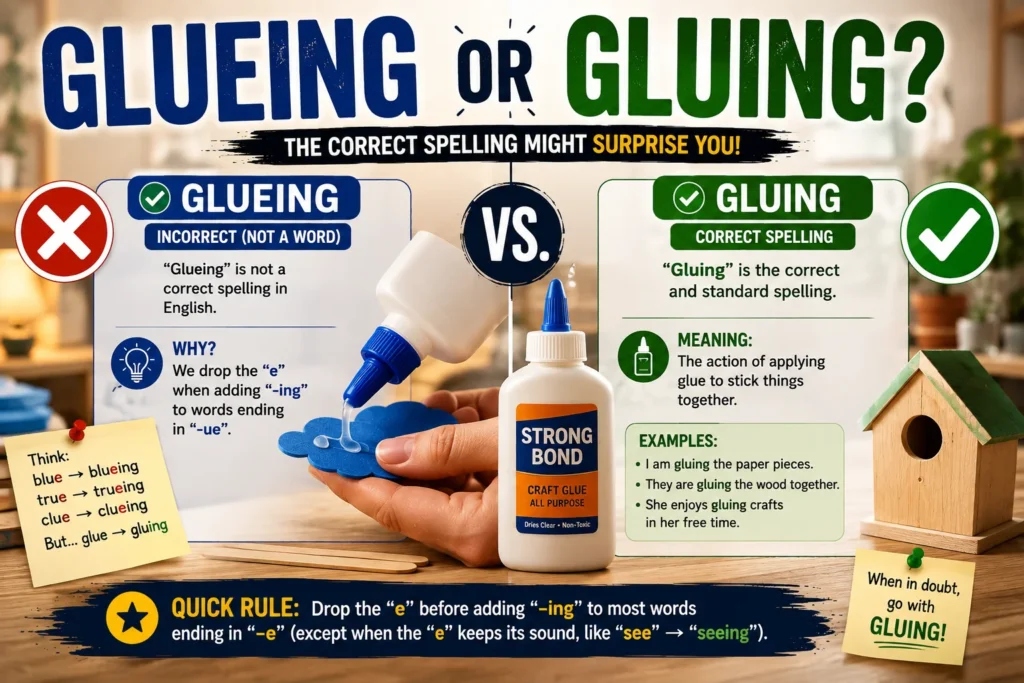
If you’ve ever paused over glueing and glueing, you’re not alone. The two spellings look almost identical, sound the same, and refer to the same basic action: joining something with glue. Yet modern dictionaries do not treat the two forms in the same way. Oxford lists gluing as an -ing form and also records glueing in its broader English entry, while its American English dictionary lists gluing. Merriam-Webster likewise gives glueing as the main form while recording glueing as a variant.
For most US English writing, gluing is the better choice. It follows the familiar pattern in which a final silent e disappears before -ing, as in make → making and write → writing. However, the story is more interesting than simply saying that glueing is “wrong.” Major dictionaries document both forms, so readers may legitimately encounter either spelling. Glueingg or Glueing: Which Spelling Is Correct?
The short answer is simple: use “gluing” in modern US English.
The spelling gluing is the form most natural for American readers. Oxford’s American English dictionary lists the verb glue with gluing as its -ing form. Merriam-Webster lists the verb forms as glued; gluing also glueing, which means the dictionary recognizes both spellings but places gluing first.
That distinction matters. A dictionary can recognize a spelling without suggesting that every available variant is equally common or equally suitable for every audience.
Consider these examples:
- She is gluing the photographs into her scrapbook.
- We are gluing the broken pieces back together.
- The students are gluing colored paper onto the poster.
- He spent the afternoon gluing the model together.
In each sentence, gluing is the present participle of glue.
The alternative glueing carries the same basic meaning. Oxford lists both gluing and glueing as -ing forms in its general English entry, and Cambridge’s Learner’s Dictionary also lists both forms.
So the issue isn’t meaning. It is primarily spelling preference and usage.
A quick comparison
| Form | Status | Meaning | Best choice for US English |
| gluing | Standard modern form | Joining something with glue | Yes |
| glueing | Documented variant | Joining something with glue | Usually avoid |
| glue | Base verb | Join with glue | Yes |
| glued | Past form / past participle | Joined with glue | Yes |
A useful way to think about the distinction is this: glueing and glueing describe the same action, but glueing is the cleaner default when you need one spelling for contemporary American writing.
That makes gluing the practical choice for school assignments, business documents, websites, instructions, reports, and most general-purpose content aimed at a US audience.
Why “glueing” can seem perfectly reasonable
The confusion comes from the word’s appearance.
The base word is glue, and adding -ing seems, at first glance, to produce glueing:
glue + ing = glueing
That visual calculation feels logical. After all, English often preserves letters when adding suffixes. But English spelling does not simply attach -ing to every verb without changing anything.
With many verbs ending in a silent e, English drops that final letter before -ing:
- make → making
- bake → baking
- take → taking
- write → writing
- drive → driving
- hope → hoping
- move → moving
The same pattern gives us:
- glue → gluing
There is one important wrinkle, though. English spelling rules are patterns, not mathematical laws. Historical usage, pronunciation, word origins, and established dictionary forms can all affect what becomes accepted. That is why glueing has not simply vanished from every dictionary.
Merriam-Webster explicitly records glueing as a variant, while its main entry gives gluing first.
What does “gluing” mean?
The verb glue means to join things with glue. Oxford defines it as joining two things together using glue, with examples involving labels, cardboard, and other objects.
The noun glue refers to a sticky substance used to join things together. Oxford describes it as a sticky substance used for joining things, while Merriam-Webster includes both adhesive substances and the broader idea of something that binds things together.
That gives us a straightforward word family:
glue → glued → gluing
For example:
- Glue the pieces together.
- She glued the pieces together yesterday.
- She is gluing the pieces together now.
The spelling changes because the grammatical form changes. The underlying action remains the same.
Is “glueing” a real word?
Yes. Calling glueing a completely nonexistent word would be inaccurate.
Merriam-Webster records glueing as a variant of gluing, and its Scrabble dictionary also lists glueing as a playable word. Oxford’s general English entry gives both glueing and glueing as -ing forms. Cambridge’s Learner’s Dictionary likewise lists both.
The important distinction is between “recognized” and “preferred.”
A spelling may appear in a dictionary because speakers and writers have used it over time. That does not mean you should automatically choose it in every context.
For contemporary US English, gluing is the safer default.
If an editor, teacher, employer, or publication follows a particular house style, that guidance should take priority. Otherwise, choosing gluing keeps the writing aligned with the American English dictionary form used by Oxford.
Why Is It “Glueing” Instead of “Glueing”?

The main reason is the familiar English spelling pattern involving a final silent e.
When a verb ends in silent e, English commonly removes that e before adding -ing. This prevents the spelling from carrying an unnecessary final letter into the new form.
So:
glue + -ing → gluing
not:
glue + -ing → glueing
The same basic pattern appears in many common verbs:
| Base verb | -ing form |
| make | making |
| bake | baking |
| take | taking |
| write | writing |
| drive | driving |
| hope | hoping |
| move | moving |
| use | using |
| save | saving |
| glue | gluing |
Once you recognize the pattern, gluing becomes much easier to remember.
The silent “e” rule
The final e in glue does not represent a separate sound at the end of the word. The word ends with the /uː/ sound, commonly represented by ue.
That spelling structure can make the word look different from familiar examples such as make or write. Still, the practical spelling pattern remains useful:
When a verb ending in silent e takes -ing, the final e is commonly dropped.
Examples:
- hope → hoping
- smile → smiling
- close → closing
- dance → dancing
- change → changing
- glue → gluing
This is why gluing looks unusual only until you compare it with other verbs.
Why “glueing” looks logical
The spelling glueing has an obvious visual appeal. A writer may see the base word glue, add -ing, and assume that every letter should remain.
That approach works with some words but not with many silent-e verbs.
For example, nobody normally writes:
- makeing
- writeing
- takeing
- hopeing
The expected forms are:
- making
- writing
- taking
- hoping
Following the same pattern leads to gluing.
The interesting part is that glueing has survived as a recognized variant. That tells us something important about English: spelling conventions develop through actual usage, and not every historical or variant form disappears just because another form becomes more common.
Merriam-Webster’s entry demonstrates this clearly by giving gluing first and glueing as an additional form.
Is the final “e” really silent?
In ordinary pronunciation, glue is pronounced /ɡluː/. The final written e does not create a separate spoken sound.
Oxford gives the pronunciation of glue as /ɡluː/ and lists gluing as /ˈɡluːɪŋ/.
That pronunciation also helps explain why the spelling can confuse learners. The letters ue work together to represent the vowel sound. When -ing is added, English does not need to retain the final e.
Compare:
- glue → /ɡluː/
- gluing → /ˈɡluːɪŋ/
The pronunciation does not require an extra vowel sound between glue and -ing.
A useful spelling test
When you’re unsure, remove the final e and see whether the resulting form matches a familiar English pattern.
For glue:
glue → gluing
For make:
make → making
For write:
write → writing
For drive:
drive → driving
This simple comparison makes the spelling much easier to recall.
Important exceptions to remember
English spelling rules have exceptions, so it would be misleading to tell readers that every word ending in e behaves the same way.
Some verbs keep the e for reasons connected with pronunciation or spelling conventions. For example:
- see → seeing
- agree → agreeing
- dye → dyeing
- singe → singeing
These examples show why spelling requires attention to the individual word.
The point isn’t that one rule solves every English spelling problem. The point is that gluing fits the common silent-e pattern and is the standard form to choose in contemporary American English.
What Does “Gluing” Mean and How Do You Use It?
Gluing has a straightforward literal meaning: it describes the act or process of joining something with glue.
Oxford defines glue as a verb meaning to join things together using glue. Merriam-Webster similarly defines the verb as causing something to stick tightly with or as if with glue.
That gives gluing several common grammatical uses.
It can function as the present participle in a continuous verb phrase:
The children are gluing paper shapes onto the poster.
It can also function as a gerund, where the -ing form behaves like a noun:
Gluing the pieces together took longer than expected.
The spelling stays the same in both cases. The surrounding sentence tells you the grammatical role.
“Gluing” as a present participle
When gluing appears with a form of be, it commonly forms a continuous tense:
- I am gluing the pieces.
- She is gluing the label onto the box.
- They are gluing the model together.
- We were gluing cardboard panels.
- The workers are gluing the panels in place.
The action is shown as ongoing rather than completed.
Compare:
She glued the pieces together.
This tells us the action happened in the past.
Now compare:
She is gluing the pieces together.
This presents the action as happening now or around the current time.
“Gluing” as a gerund
An -ing form can also function as a gerund when it acts like a noun.
For example:
Gluing requires patience.
Here, gluing names an activity. It isn’t simply describing what someone is doing at a particular moment.
More examples include:
- Gluing small pieces requires steady hands.
- Gluing the model took two hours.
- Careful gluing can make the finished project stronger.
- Gluing the edges first prevents gaps.
This distinction is useful because grammar questions often become easier when you stop looking only at the word itself and examine its role in the sentence.
Everyday examples of “gluing”
You might use gluing when talking about almost any activity that involves applying glue to join materials.
Crafts
Mia is gluing beads onto a greeting card.
Paper projects
The students are gluing colored shapes onto a poster.
Home repairs
He is gluing the loose trim back into place.
Model building
The hobbyist spent the evening gluing the model’s small parts together.
Woodworking
The carpenter is gluing two wooden panels along the edge.
Packaging
The machine is gluing the carton flaps closed.
The word does not change according to the material. Whether you are joining paper, wood, fabric, cardboard, or another suitable material, the verb remains gluing.
Gluing in instructions
Instructions often use the base verb rather than gluing:
Glue the two pieces together.
But a sentence describing the process might use gluing:
Gluing the two pieces together creates a stronger bond.
This distinction is grammatical rather than semantic.
The imperative glue tells someone what to do.
The -ing form gluing describes the activity or process.
Gluing, glued, and glue
These three forms belong to the same verb family, but they serve different grammatical purposes.
| Form | Typical function | Example |
| glue | Base/present form or imperative | Glue the pieces together. |
| glues | Third-person singular present | She glues the pieces together. |
| glued | Simple past / past participle | She glued the pieces together. |
| gluing | Present participle/gerund | She is gluing the pieces together. |
Knowing these forms helps prevent a common mistake: treating gluing as if it were simply another spelling of glue.
It isn’t. Gluing is a different grammatical form of the same verb.
The figurative meaning of “glue”
The word glue can also have a figurative meaning.
Merriam-Webster describes glue as something that binds people or things together, while Oxford gives examples involving social or community connections.
For example:
Trust can act as the glue that holds a team together.
However, gluing in a figurative context is less common than glue itself.
You might see a sentence such as:
The shared project is gluing the group together.
The intended idea is that the project is creating a stronger connection between the people involved.
Another related expression is glued to:
She was glued to her phone.
This does not mean literal adhesive was involved. It means she gave the phone her full attention or stayed very close to it. Oxford and Merriam-Webster both document this idiomatic use.
That distinction matters because gluing can describe literal physical attachment, while glued to can describe intense attention or an inability to move away.
Gluing vs. Glueing in American and British English
Regional English adds another layer to the question.
For American English, the practical recommendation is straightforward: use gluing.
Oxford’s American English dictionary lists gluing as the -ing form of glue.
That makes gluing the natural choice for:
- US schoolwork
- American business writing
- professional documents
- websites targeting US readers
- instructions
- general educational content
- most contemporary American publications
The alternative glueing is still documented in broader English dictionaries. Oxford’s general English entry lists both forms, while Cambridge’s Learner’s Dictionary also records glueing and glueing.
So it would be too strong to say that glueing is universally forbidden or that anyone who writes it has made a simple spelling error.
What the dictionaries actually tell us
Dictionary evidence is especially useful because this question often produces conflicting answers online.
Here is what several major references show:
| Dictionary/reference | Treatment of the forms |
| Oxford Advanced Learner’s Dictionary | Lists gluing and glueing as -ing forms in its general English entry |
| Oxford Advanced American Dictionary | Lists gluing |
| Merriam-Webster | Gives gluing and recognizes glueing as a variant |
| Cambridge Learner’s Dictionary | Lists glueing and gluing |
| Merriam-Webster Scrabble Dictionary | Recognizes glueing as a playable word |
This evidence changes the answer importantly.
Instead of saying:
“Glueing is wrong.”
A more accurate explanation is:
“Glueing is the preferred modern form for US English, while glueing is a documented variant.”
That wording respects both current standard usage and dictionary evidence.
Why regional consistency matters
Suppose you’re writing an article for an American audience. You use gluing throughout the article. Suddenly switching to glueing in one paragraph can make the writing look inconsistent.
The reader may wonder whether the change has a special meaning.
It doesn’t.
That is why consistency matters more than trying to use every accepted variant.
A useful editorial rule is:
Choose the form that fits your audience and style guide, then use it consistently.
For US English, that normally means gluing.
What about British English?
British English does not justify a simplistic rule saying “British writers use glueing and Americans use gluing.”
The dictionary evidence is more nuanced. Oxford’s general English entry records both forms, while its American English entry gives gluing. Cambridge also records both.
That means regional variation exists, but the spelling divide is not as clean as some grammar websites suggest.
If a British publication has a house style that prefers glueing, follow that style. If no special guidance exists, gluing remains a clear and widely recognized choice.
The key is to avoid inventing a rigid regional rule that the dictionaries do not support.
A practical style decision
If you’re unsure which spelling to use, consider these questions:
- Who will read this?
- Is the content written in US English?
- Does the publisher have a style guide?
- Does the publication consistently use one spelling?
- Are you writing for an educational or professional audience?
If the answer is that you’re writing standard US English with no special house style, choose gluing.
That decision is simple, defensible, and easy for readers to understand.
Why “Glueing” Looks Right but “Gluing” Is Usually Preferred
The human eye often processes spelling by recognizing familiar letter patterns. Glueing looks like the base word glue followed directly by -ing, so the form can feel natural even when the standard spelling drops the final e.
That visual familiarity creates the confusion.
Consider these pairs:
| Base word | Common -ing form | Tempting but incorrect form |
| make | making | makeing |
| write | writing | writeing |
| take | taking | takeing |
| hope | hoping | hopeing |
| glue | gluing | glueing |
The pattern becomes obvious when the words sit next to each other.
The key spelling principle
The useful principle is:
A final silent e is commonly dropped before -ing.
This is not a license to change every word mechanically. English contains exceptions and special cases. Still, it explains the standard spelling of gluing.
The word’s spelling can be understood as:
GLUE → GLU + ING → GLUING
The final e disappears, while the core pronunciation remains recognizable.
Why dictionaries still matter
Spelling rules explain why glueing is the standard form, but dictionary evidence explains why glueing continues to appear.
Merriam-Webster’s current entry explicitly says “glued; gluing also glueing.” That is strong evidence that glueing has established usage rather than being an invented mistake.
Oxford goes even further by listing both forms in its general English entry.
So there are two separate questions:
What form should a US English writer normally choose?
Gluing.
Does the alternative form exist in English usage?
Yes, glueing is documented.
Keeping those questions separate makes the explanation much more accurate.
Words that follow the same pattern
Several familiar verbs reinforce the spelling rule:
- love → loving
- save → saving
- move → moving
- use → using
- close → closing
- dance → dancing
- change → changing
- receive → receiving
The final e disappears, while the rest of the spelling adjusts naturally.
But don’t assume that every verb ending in e behaves identically.
For example:
- see → seeing
- agree → agreeing
- dye → dyeing
These forms demonstrate why good spelling instruction should teach patterns while also recognizing exceptions.
Why “glue” feels different
The spelling glue contains the letters u and e together. The final e isn’t simply acting like the final silent e in make from a visual perspective.
That unusual appearance makes glueing feel more plausible.
Yet the accepted modern form remains gluing in US English, and Oxford’s American English dictionary lists exactly that form.
A simple memory trick helps:
Glue loses its final e before -ing: glue → gluing.
Once that pattern becomes familiar, the spelling stops feeling strange.
Common Mistakes With Glueing and Glueing
The biggest mistake is straightforward: writing glueing when the intended style calls for glueing.
That mistake often happens because the writer follows the visible letters rather than the spelling pattern.
Adding an unnecessary “e”
A writer may think:
glue + ing = glueing
But the standard modern form is:
glue + ing = gluing
Compare:
❌ She is glueing the paper.
✅ She is gluing the paper.
The second version is the better choice for standard US English.
Confusing “gluing” with “glued”
These words are related but do different grammatical jobs.
❌ She gluing the pieces yesterday.
✅ She glued the pieces yesterday.
❌ She glued the pieces together right now.
✅ She is gluing the pieces together right now.
The first corrected sentence uses the simple past. The second uses the present continuous.
Assuming dictionary recognition means equal preference
This is a subtle mistake.
A dictionary can list multiple variants without implying that all variants have the same frequency, regional distribution, or editorial suitability.
Merriam-Webster’s treatment illustrates this perfectly: glueing appears first, while glueing appears as an additional variant.
That is why dictionary checking should involve more than searching for a green checkmark.
Ask:
- Which form is listed first?
- Does the dictionary mark one as a variant?
- Does an American English dictionary give a different form?
- Is the spelling regional or historical?
- Does your publication follow a style guide?
Relying completely on spell-check
Spell-check software is useful, but it isn’t a final authority on language.
A spell checker may recognize glueing because dictionaries or language databases recognize the form. That does not necessarily tell you whether it is the best choice for your audience.
This is particularly important for writers working across different varieties of English.
A better process is:
- Write the sentence.
- Check the spelling.
- Identify your target variety of English.
- Consult a reliable dictionary if the form remains uncertain.
- Apply the same choice consistently throughout the document.
Mixing regional or editorial styles
Imagine an article that uses gluing twenty times and then suddenly uses glueing once.
A careful reader may assume the difference has meaning.
It doesn’t.
Consistency makes writing easier to trust.
For an American audience, gluing provides a clean default. If a British publisher or another editorial system specifies glueing, follow that instruction throughout the relevant publication.
A quick proofreading checklist
Before publishing, check:
- Is the audience primarily American?
- Does the text use gluing consistently?
- Did an automatic correction change the spelling?
- Are glued, glue, and gluing being used according to their grammatical roles?
- Does the publication have a house style?
- Did the chosen dictionary support the spelling?
This takes seconds and prevents a surprisingly common source of confusion.
A real-world editorial example
Consider a craft tutorial written for American readers.
The first sentence says:
Start by gluing the cardboard pieces together.
Later, the instructions say:
After gluing the edges, let the project dry.
Nothing about the physical process has changed. The second spelling simply breaks the article’s consistency.
A cleaner version would use:
After gluing the edges, let the project dry.
That approach keeps the terminology stable and matches the preferred US English form.
GGlueingvs. glueing comparison table
| Question | Gluing | Glueing |
| Is it related to the verb glue? | Yes | Yes |
| Does it mean joining with glue? | Yes | Yes |
| Is it documented by major dictionaries? | Yes | Yes |
| Is it listed in Oxford’s American English entry? | Yes | No |
| Does Merriam-Webster recognize it? | Yes | Yes, as a variant |
| Is it the best default for US English? | Yes | Usually no |
| Can readers encounter it elsewhere? | Yes | Yes |
The table captures the central point: glueing is the practical default, while glueing is a documented alternative.
Easy ways to remember the correct spelling
The simplest memory trick is to connect glue with other silent-e verbs.
Think:
make → making
write → writing
glue → gluing
The final e steps aside when -ing arrives.
Another useful trick is to remember that gluing has only one e—the one already represented in the spelling pattern before the suffix changes the word.
More importantly, practice the word in complete sentences:
- I am gluing the label onto the box.
- She is gluing the model together.
- They are gluing paper onto the poster.
- Gluing the pieces requires patience.
- The machine is gluing the package closed.
Seeing the word repeatedly in natural sentences makes the spelling much easier to retain.
When “glueing” may still appear
There are situations where encountering glueing does not mean the text contains an obvious error.
You may see it in:
- older publications
- regional writing
- dictionaries that record variants
- word-game dictionaries
- texts following a particular editorial preference
- general English references that list alternative forms
Merriam-Webster’s Scrabble Dictionary, for example, explicitly recognizes glueing as playable.
That evidence doesn’t change the practical recommendation for US English. It simply prevents an inaccurate claim that glueing is not a real English form.
The safest choice for modern US English
If there is no special reason to use the variant, choose:
gluing
It is concise, familiar, and consistent with the American English dictionary entry from Oxford.
For most readers, that’s all the guidance they need.if a style guide tells you otherwise, follow the style guide. If you’re discussing historical or regional spelling, you can mention gluing as a documented variant. If you’re simply writing ordinary American English, gluing is the clear choice.
Final practical examples
Preferred US English:
The children are gluing shapes onto the paper.
She is gluing the broken handle back onto the cup.
Gluing the edges carefully will produce a cleaner finish.
The students spent an hour gluing their project together.
Variant encountered in English sources:
The children are glueing shapes onto the paper.
The second form is understandable and documented, but gluing is the better default for contemporary US English.
The distinction becomes especially easy once you separate meaning from spelling preference. Both forms point to the same action. The main difference is which spelling best fits the variety and style of English you’re writing.
For US English, the practical answer remains simple: choose gluing.
Why Is It “Glueing” Instead of “Glueing”?
The spelling gluing becomes much easier to understand once you look at how English handles verbs ending in a silent e. When you add -ing to many of these verbs, the final e drops: make → making, write → writing, take → taking, and hope → hoping. The same pattern gives us glue → gluing. Oxford’s American English dictionary lists glueing as the -ing form of glue, while its broader English dictionary records boglueinging and glueing. The confusion makes sense because glueing looks like a direct combination of glue and -ing. However, English spelling doesn’t always work by simply attaching a suffix to the unchanged base word. The final e in glue doesn’t represent a separate sound, and the pronunciation remains /ɡluː/ in the base word and /ˈɡluːɪŋ/ in gluing.
The Silent “e” Rule
The most useful rule here is simple: a final silent e often disappears before a suffix beginning with a vowel, including -ing. That’s why you write bake → baking, not bakeing, and drive → driving, not driveing. Applying the same pattern gives glue → gluing. This rule helps explain the standard spelling, but it isn’t an absolute law for every English verb. Words such as see → seeing, agree → agreeing, and dye → dyeing show that English has established exceptions and special patterns. So, rather than memorizing a rigid formula, treat the silent e pattern as a strong guide and confirm unusual forms with a reliable dictionary.
| Base Verb | Add -ing | Correct Form |
| make | make + ing | making |
| bake | bake + ing | baking |
| write | write + ing | writing |
| drive | drive + ing | driving |
| hope | hope + ing | hoping |
| glue | glue + ing | gluing |
The word glue can feel slightly different from make or write because its final letters work together to represent its vowel sound. Still, the spelling of the -ing form follows the established form gluing in American English. Oxford specifically lists gluing in its American English entry.
Why Some People Write “Glueing”
The form glueing isn’t simply an invented spelling. Major English dictionaries document it as a variant. Oxford’s general English entry gives both glueing and glueing, with the same pronunciation, while its American English entry lists glueing. That difference explains why you may see glueing in books, websites, or other English-language material even though gluing is the better default for US English.
The reason behind the variant is easy to understand. A writer may start with glue, add -ing, and preserve every letter:
glue + ing → glueing
That approach feels logical if you haven’t learned the silent e pattern. English spelling, however, has developed through centuries of usage rather than through one perfectly consistent system. Even Merriam-Webster’s treatment of glueing recognizes the alternative glueing, which shows that real-world usage can preserve forms alongside a more widely preferred spelling.
For practical writing, the distinction is straightforward. If you’re writing for a US English audience and don’t have a specific style guide telling you otherwise, choose gluing. It is the form Oxford gives in its American English dictionary.
A useful way to remember it is:
glue → gluing
Think of the final e as stepping aside when -ing arrives. The same idea works with make → making and hope → hoping. Once you connect these words, gluing stops looking unusual and starts looking like a familiar English spelling pattern.
What Does “Gluing” Mean and How Do You Use It?
Gluing means joining or attaching something with glue. As the present participle of glue, it describes an action in progress, as in “She is gluing the pieces together.” Merriam-Webster defines glue as causing something to stick tightly with or as if with glue, and it lists gluing as the standard form while also recognizing glueing as a variant. Cambridge likewise defines glue as joining things together with glue and lists botglueing and glueing as present-participle forms. In everyday writing, gluing can describe crafts, repairs, construction, school projects, packaging, or model building. For example, “The students are gluing colored paper onto the poster” shows an action happening now. You can also use gluing as a gerund when the activity itself becomes the focus: “Gluing the pieces together takes patience.” The word also appears in figurative contexts related to holding things together, although glue and glued to are much more common there. Merriam-Webster, for example, records the figurative sense of being glued to something, meaning remaining fixed or intensely focused on it.
“Gluing” as a Verb
When gluing appears with a helping verb such as is, are, was, or were, it forms part of a continuous verb phrase. The -ing form itself does not establish the tense; the helping verb does. Compare “She is gluing the label” with “She was gluing the label.” The first places the action in the present, while the second places it in the past. Cambridge identifies gluing as the present participle of glue, while Merriam-Webster lists the verb forms as glued; gluing also glueing.
- She is gluing the paper to the cardboard.
- They are gluing the model together.
- We were gluing the broken pieces back into place.
- The worker is gluing the edges before pressing them together.
- The children are gluing shapes onto their project.
The important point is that gluing describes the activity, while the helping verb shows when that activity occurs. This distinction becomes useful when you compare it with glued, the simple past and past participle form.
| Form | Example | Main idea |
| glue | Glue the pieces together. | Command or base verb |
| glues | She glues the pieces together. | Present action with a singular subject |
| glued | She glued the pieces together. | Completed past action |
| gluing | She is gluing the pieces together. | Ongoing action |
“Gluing” as a Gerund
Gluing can also function as a gerund when an -ing form acts as the activity being discussed. For example, in “Gluing small pieces requires patience,” the sentence focuses on the activity itself rather than simply describing what someone is doing at that moment. Another example is “I enjoy gluing paper models,” where gluing identifies the activity that the speaker enjoys.
This distinction can seem technical, but the practical test is simple: look at the job gluing performs in the sentence. In “She is gluing the pieces,” it forms part of the verb phrase. In “Gluing the pieces takes time,” it introduces the activity being discussed.
English grammar references sometimes use different terminology for -ing forms, so you may see terms such as present participle, gerund, or gerund-participle. The important thing for everyday writing is not the label. It is recognizing how the form works in the sentence.
Literal Meaning of “Gluing”
In its most common sense, gluing means physically attaching one thing to another with glue. You might glue paper to cardboard, attach wood pieces, repair a loose component, or assemble a model. Cambridge gives the core meaning as joining things together using glue.
For example:
The students are gluing photographs onto the display board.
Here, gluing describes a real physical process. The photographs are being attached to the board with an adhesive.
The same meaning works across many settings:
| Context | Example |
| Crafts | She is gluing beads onto the card. |
| School | The children are gluing shapes onto the poster. |
| Repairs | He is gluing the broken handle back together. |
| Woodworking | The carpenter is gluing two boards together. |
| Modeling | She is gluing the small parts onto the model. |
| Packaging | The machine is gluing the carton flaps closed. |
The material can change, but the basic meaning stays the same: joining something by using glue.
Figurative Uses Related to “Glue”
The noun glue has a figurative sense as well. Merriam-Webster defines it not only as an adhesive but also as something that binds together.
For example:
Trust is the glue that holds a strong team together.
Here, no physical adhesive exists. Glue describes something that creates unity or keeps separate parts connected.
The related expression glued to also has a figurative meaning:
The children were glued to the television.
That sentence does not mean the children literally had adhesive on their bodies. Instead, it means they remained fixed in place or intensely focused on the screen. Merriam-Webster records this figurative use as a meaning of the verb glue.
So, while gluing most often describes a physical action, the wider word family can also describe connection, attachment, focus, and unity in figurative language.
Gluing vs. Glueing in American and British English
The difference between glueing and glueing is sometimes described as an American-versus-British spelling issue, but the dictionary evidence is more nuanced. For US English, gluing is clearly the form to use: Oxford’s American English Dictionary lists gluing as the -ing form of glue, and Collins’ American English entry also gives gluing. However, British English does not create a simple rule that says British writers must use glueing. Cambridge’s Learner’s Dictionary actually lists both glueing and gluing as present participles, which shows that both forms have been recorded in English usage. This matters because glueing shouldn’t automatically be labeled a British spelling or a simple error. The better approach is to consider your audience, dictionary, and style guide. If you’re writing for American readers, choose gluing consistently. If you’re working with British or international material, you may encounter glueing, but glueing remains a well-established form. In practical editing, consistency matters more than forcing a regional distinction that dictionaries don’t fully support.
What Major Dictionaries Say About “Gluing” and “Glueing”
Dictionary evidence gives a clearer picture than blanket claims about regional English. Oxford’s American English entry lists gluing as the -ing form of glue and does not present glueing as the American form. Cambridge’s Learner’s Dictionary, however, lists glueing and gluing together as present participles. Collins’ American English entry also lists gluing among the verb forms. These entries show why the safest explanation is not “one spelling is real, and the other doesn’t exist.” Instead, glueing is the preferred choice for contemporary US English, while glueing is a documented alternative that readers may still encounter. For everyday American writing, therefore, gluing is the clearest choice. It works in sentences such as “She is gluing the pieces together” and “The students are gluing paper onto the poster.” When a publication has its own style guide, follow that guide and keep the chosen spelling consistent throughout the document.
Common Mistakes With Glueing and Glueing
The most common mistake is writing glueing simply because it looks like the base word glue plus -ing. In modern US English, glueing is the better choice, although glueing is a documented variant. Merriam-Webster lists the verb forms as “glued; glueing also glueing,” so calling glueing completely invalid would be inaccurate. The real issue is knowing which form fits your audience and writing style. If you’re preparing an American English article, assignment, report, or professional document, use gluing consistently. The same care applies to related forms such as glue, glues, and glued. For example, write “She is gluing the pieces together,” not “She is glueing the pieces together,” when following the preferred US English form. A quick dictionary check can settle the spelling, but understanding the grammar behind the word makes the choice easier to remember.
Adding an Unnecessary “e”
The easiest mistake to make is treating glueing as though English simply attaches -ing to the unchanged word glue. That gives the tempting pattern glue + ing = glueing. However, the standard form is gluing. The same spelling pattern appears in familiar verbs such as make → making, write → writing, and take → taking. The final e usually drops before -ing, so glue → gluing follows that established pattern. Still, glueing isn’t merely an imaginary spelling. Merriam-Webster recognizes it as a variant, and its Scrabble Dictionary lists glueing as a playable word. The practical distinction is therefore simple: glueing should be your default in US English, while glueing may appear in other sources. If you are proofreading your own work, search specifically for glueing and replace it with glueing when your chosen style calls for the standard American form.
Confusing Regional Variations
Another mistake occurs when writers assume that glueing and glueing represent a strict American-versus-British divide. The evidence doesn’t support such a simple rule. Dictionary sources document glueing as a variant rather than restricting it neatly to one national variety. Merriam-Webster, for example, lists both forms under the verb glue. That means seeing glueing in a British, international, historical, or other English-language text doesn’t automatically prove that the writer made a mistake. At the same time, American writers don’t need to use the variant simply because it exists. For contemporary US English, gluing remains the clearest and most practical choice. Think of it as an editing decision based on audience and consistency rather than a rigid language border. If a publication has a house style, follow it. Otherwise, choose gluing for American readers and stick with that form throughout the piece.
Mixing Writing Styles
Inconsistent spelling can make otherwise polished writing look careless. Imagine an article that uses gluing several times and suddenly switches to glueing in one paragraph. The meaning hasn’t changed, but the reader may wonder whether the two forms have different grammatical functions. They don’t. Both refer to the same basic action of fastening something with glue. Merriam-Webster’s entry confirms that glueing is a variant of glueing, rather than a separate meaning or separate verb. A consistent style therefore makes the article easier to read and edit. If the target audience uses US English, choose gluing from the beginning. Then apply the same choice in headings, examples, tables, image captions, and body text. This small editorial habit prevents unnecessary variation and keeps the terminology clean.
Ignoring Dictionary Recommendations
A common mistake is assuming that a spelling must be either completely correct or completely wrong. Dictionaries often provide a more detailed picture. Merriam-Webster currently gives gluing first and identifies glueing as an additional variant. Its thesaurus also lists gluing with glueing as a variant and connects the word with terms such as binding, bonding, fastening, adhering, uniting, and sticking. This evidence matters because it shows that glueing has a documented place in English usage. The best approach isn’t to erase the variant from existence. Instead, understand its status and choose the form that matches your audience. For ordinary US English, that choice is gluing.
Assuming Spell Check Catches Everything
Spell-check tools can flag obvious errors, but they don’t always tell you which accepted variant best suits your audience. A program may accept glueing because dictionaries and language databases recognize it. That doesn’t mean glueing is the preferred form for your particular document. In fact, the existence of dictionary-recognized variants is one reason automated checking can’t replace editorial judgment. Merriam-Webster’s current entry demonstrates the problem clearly by recognizing both glueing and glueing. When you’re unsure, check a reliable dictionary and consider the variety of English you’re using. For a US English article, gluing is the sensible default. A quick final search for “glueing” can also catch inconsistent usage before you publish.
| Common mistake | Better approach |
| Writing glueing because it looks like glue + ing | Use gluing in standard US English |
| Calling glueing completely invalid | Recognize it as a documented variant |
| Assuming it is strictly a British spelling | Check the actual dictionary evidence |
| Switching betweenglueingg and glueing | Pick one style and use it consistently |
| Trusting spell check alone | Check a reliable dictionary when uncertain |
| Confusing gluing with glued | Match the verb form to the sentence’s tense |
The safest rule is straightforward: if you’re writing in modern US English, use “gluing.” If you encounter “glueing,” don’t assume the writer invented the word. Major dictionary evidence shows that the variant exists, but that doesn’t make it the best choice for every context.
Conclusion
When choosing between gluing and glueing, the safest option for modern US English is gluing. It follows the common spelling pattern in which a final silent e disappears before -ing, just as in make → making and write → writing. While glueing does appear in dictionaries and real-world English as a variant, it isn’t usually the preferred form for American readers. Understanding this small spelling difference can make your writing cleaner and more consistent, especially in schoolwork, professional documents, articles, and everyday communication. If you’re ever unsure, think of the simple pattern glue → gluing. Once you remember that, the choice becomes much easier. Ultimately, both forms are connected to the same verb and meaning, but gluing is the best default when you’re writing for a US English audience.
FAQs
Is “gluing” or “glueing” correct?
Gluing is the preferred spelling in modern US English. It follows the common rule of dropping a final silent e before adding -ing. However, glueing is also a documented variant in some dictionaries. For American writing, especially formal or professional content, gluing is the clearer and more standard choice.
Why is “gluing” spelled without the e?
The final e in glue usually disappears when the -ing suffix is added. This creates gluing, similar to make → making and write → writing. The spelling follows a common English pattern rather than simply attaching -ing to every letter in the original word.
Is “glueing” a misspelling?
Not necessarily. Glueing is recognized as a variant form in some dictionaries, so it isn’t simply an invented or meaningless spelling. However, gluing is generally the better choice for standard American English. Writers should consider their audience, regional variety, and preferred style guide before choosing between the two forms.
Is “gluing” American English?
Yes. Gluing is the standard and preferred form in American English. It appears in major English dictionaries as the present participle of glue. Although glueing can also be found in English-language sources, American writers will usually want gluing for clear, conventional spelling.
Is “glueing” British English?
Glueing can occur in British and other varieties of English, but it isn’t accurate to say that British English exclusively uses this spelling. Dictionaries record both gluing and glueing. Therefore, the difference isn’t a simple American-versus-British rule. Gluing remains a well-established form across English usage.
What does “gluing” mean?
Gluing means joining or attaching something using glue. For example, if someone attaches paper to cardboard with adhesive, they are gluing the paper. The word can describe activities involving crafts, repairs, construction, packaging, woodworking, and other situations where glue helps connect separate materials.
What is the past tense of “glue”?
The past tense of glue is glued. For example, “She glued the broken pieces together yesterday.” The verb forms are glue, glues, glued, and gluing. Remembering these forms can help prevent confusion when you need to describe an action in different tenses.
Can “gluing” be used as a noun?
Yes. Gluing can function as a gerund when the -ing form acts like a noun. For example, “Gluing requires patience.” Here, the word refers to the activity itself. In another sentence, “She is gluing the pieces,” it functions as part of the verb phrase instead.
What are some examples of “gluing” in a sentence?
Common examples include “She is gluing the paper to the card,” “They are gluing the model together,” and “He spent the afternoon gluing the broken pieces.” In each example, gluing describes the action of attaching something with glue.
How can I remember the spelling of “gluing”?
A simple memory trick is to connect glue with familiar verbs such as make, write, and take. Their final e disappears before -ing, producing making, writing, and taking. Apply the same pattern to glue, giving you gluing. This makes the preferred spelling easier to remember.