

At first glance, a city, town, and village may seem easy to distinguish. A city feels large and busy. A town usually sits somewhere in the middle. A village often brings to mind a smaller, quieter community surrounded by open land. That picture works as a starting point, but the real difference is more nuanced.
There is no single worldwide population number that automatically turns a village into a town or a town into a city. Countries use different rules based on population, population density, administrative status, economic activity, infrastructure, and local law. The United Nations specifically notes that national definitions of urban areas vary substantially around the world.
That matters when you compare settlements across countries. A place called a “town” in one country might resemble a city in another. Likewise, a settlement can keep the historical name “village” even after surrounding development has made it much more urban.
The simplest way to understand the difference is to look beyond the label.
| Feature | Village | Town | City |
| Typical scale | Smaller settlement | Intermediate settlement | Larger urban settlement |
| Population density | Usually lower | Moderate | Usually higher |
| Built environment | More open space | Mixed development | Dense development in many areas |
| Services | Basic or limited | Wider range of local services | Broad and specialized services |
| Employment | Often local or agriculture-related | Retail, services, trades, public sector | Diverse professional, commercial, industrial, and service sectors |
| Transportation | Often car-dependent or limited | More local connections | Extensive transport networks are common |
| Community structure | Often close-knit | Mix of local and regional connections | Large and socially diverse |
| Legal definition | Varies by country | Varies by country | Varies by country |
These are general patterns, not universal rules. Modern urban classification increasingly looks at how many people live in an area, how closely they live together, and how settlements connect. The UN’s Degree of Urbanization framework, for example, uses population size, density, and geographic continuity to create comparable categories across countries.
What Is the Difference Between a City, Town, and Village?
The most useful distinction involves scale, density, function, and services rather than names alone.
A village is generally a small settlement with a relatively limited population and lower density. It may have homes, a small school, local shops, places of worship, farms, and other basic facilities. Residents often depend on nearby towns or cities for specialized healthcare, higher education, major shopping, and certain jobs.
A town generally occupies the middle ground. It can serve as a commercial or administrative center for surrounding communities. A town may have supermarkets, banks, schools, clinics, restaurants, government offices, transportation connections, and a broader employment base than a typical village.
A city generally has a much larger concentration of people, buildings, economic activity, and public services. Cities often contain universities, major hospitals, business districts, government institutions, cultural venues, transportation hubs, and specialized industries.
Yet size isn’t everything.
Consider two settlements with 50,000 residents. One might spread across a large rural area with relatively low density. The other might occupy a compact urban area filled with apartment buildings, offices, stores, and transit routes. Their populations match, but their physical character and functions differ dramatically.
This is one reason modern statistical systems increasingly consider density and spatial continuity alongside population totals. Under the UN’s 2025 Degree of Urbanization framework, cities are identified as densely populated areas with at least 50,000 people, while towns and semi-dense areas generally have at least 5,000 people and a density of at least 300 people per square kilometer. These are standardized statistical categories rather than universal legal definitions.
Why There Isn’t One Universal Definition
The word “city” doesn’t carry the same legal meaning everywhere.
Some countries classify settlements primarily through population thresholds. Others consider administrative status, density, economic activity, infrastructure, or a combination of factors. A national government might legally designate a settlement as a city even when another country would describe a similarly sized place as a town.
The same issue applies to villages.
A village may have a few hundred residents in one region and several thousand in another. Its official status can depend on local government rules rather than a globally recognized population limit.
The United Nations therefore distinguishes between national definitions and standardized methods designed for international comparison. National systems remain important because governments use their own classifications for administration, planning, and policy.
Key idea: A city, town, or village is not defined by population alone. Its legal status, density, function, infrastructure, and relationship with surrounding settlements can matter just as much.
What Is a Village?
A village is generally a small human settlement. Villages often have fewer residents, lower population density, and less extensive infrastructure than towns and cities.
Many villages have historical connections to farming, fishing, forestry, crafts, or other local industries. However, agriculture isn’t a requirement for every village. Some villages now function mainly as residential communities, tourist destinations, commuter settlements, or historic neighborhoods.
The image of a village as a cluster of houses surrounded by farmland can therefore be misleading.
Modern development can change the landscape without immediately changing the settlement’s name. A village might gain new housing, roads, businesses, or public services while retaining its traditional identity.
The UN’s standardized classification places villages within the broader rural category, alongside dispersed and very dispersed rural areas. This approach emphasizes settlement density and spatial patterns rather than relying only on traditional labels.
Common Characteristics of a Village
Villages often share several recognizable characteristics, although no single feature applies everywhere.
Smaller population is one of the most obvious. A village usually has fewer residents than a nearby town or city, which can create a more compact social environment.
Lower density is another common trait. Homes may sit farther apart, and open land can occupy a significant portion of the surrounding area.
Limited services can also distinguish villages from larger settlements. A village may have a small grocery store, primary school, local clinic, community center, or other basic facilities. Residents may travel to a town or city for specialized medical treatment, major purchases, government services, or higher education.
Local employment can shape village life as well. Farming remains important in many rural communities, while other villages rely on tourism, small businesses, construction, crafts, transportation, or nearby urban employment.
Strong local relationships often develop in smaller communities. People may know their neighbors, participate in shared events, and maintain social connections that extend across generations.
However, don’t confuse a small community with an isolated one.
A village can have excellent roads, high-speed internet, regular bus services, and easy access to a nearby city. Another village may face long travel times, limited public transportation, and fewer public services. Geography and infrastructure can make a huge difference.
Advantages of Living in a Village
Village life can appeal to people who value space, quiet surroundings, community connections, and access to nature.
Lower population density often means less traffic and fewer crowded public spaces. You may have easier access to fields, forests, rivers, hills, or other natural landscapes. For someone who finds a busy urban environment exhausting, that difference can be substantial.
Villages can also provide a stronger sense of familiarity.
In a smaller community, local relationships often play a visible role in everyday life. Neighbors may recognize one another, local businesses may know their customers personally, and community events can bring residents together.
That doesn’t mean every village has a perfect sense of community. Social life depends on culture, age, economic conditions, migration, and individual circumstances.
Common Advantages of Village Living
- Lower population density
- Quieter surroundings
- More open space
- Closer access to nature
- Potentially stronger local relationships
- Less traffic in many locations
- Smaller-scale community life
- Potential access to lower-cost housing or land in some regions
- A slower pace of daily life
Another advantage can be flexibility.
If you work remotely, for example, a village with reliable internet can offer a quieter home environment without completely disconnecting you from urban employment. Modern communication technology has made that option more realistic for some workers than it was in the past.
Still, the quality of village life depends heavily on infrastructure.
A peaceful location becomes less convenient when the nearest hospital sits an hour away. A large home may feel less attractive if public transportation is unreliable. Lower housing costs can also lose their advantage when residents must spend heavily on fuel and commuting.
Challenges of Village Life
The biggest drawback of village living is often limited access to specialized services.
A small settlement may not support a major hospital, university, large shopping center, specialized entertainment venue, or wide range of professional services. Residents may need to travel to a nearby town or city when they need something beyond the basics.
Employment can present another challenge.
A village may support local businesses and traditional occupations, but it usually cannot offer the same range of career paths as a major urban center. Someone seeking highly specialized work may need to commute or relocate.
Transportation can make that challenge more noticeable.
When buses or trains run infrequently, owning a car can become essential. That creates additional costs for fuel, maintenance, insurance, and travel time.
Village Life: A Practical Example
Imagine a family living in a village 20 miles from a regional town.
They may enjoy a larger home, quieter streets, nearby farmland, and a close community. Their children may attend a small local school. A grocery store and pharmacy may cover everyday needs.
Now imagine that one family member needs specialized medical treatment.
The family may have to travel to the regional town or a larger city. The same pattern can apply to university education, specialized employment, major shopping, or government services.
This illustrates an important principle: settlement size affects access to services because population supports demand.
A large hospital requires doctors, nurses, technicians, equipment, administrative staff, patients, and high operating costs. A small village usually cannot generate enough demand to support every specialized facility locally.
Village vs. Rural Area: Are They the Same?
Not exactly.
A village is a type of settlement. A rural area is a broader geographic category.
A rural region can contain villages, farms, isolated homes, small communities, forests, agricultural land, and other sparsely populated areas. The distinction becomes especially important in modern statistical classification.
The UN’s Degree of Urbanization framework describes rural areas as thinly populated areas that can include villages and dispersed settlements.
So, saying “village” and “rural area” mean precisely the same thing oversimplifies the relationship.
Can a Village Become a Town?
Yes, a settlement can grow and eventually function as a town, but the transition isn’t automatic.
Population growth can increase demand for stores, schools, healthcare, transportation, housing, and public administration. New roads or rail connections can attract businesses and residents. Industrial development can create jobs and encourage further growth.
Over time, the settlement may develop characteristics associated with a town.
But physical growth doesn’t automatically change legal status.
A government may need to officially reclassify the settlement. In some cases, the settlement’s traditional name may remain even after its surrounding area becomes substantially more urbanized.
The UN’s 2025 urbanization methodology recognizes several ways settlements change over time. Villages can grow into towns, towns can develop into cities, and cities can expand into larger urban agglomerations. Population growth, migration, and administrative changes can all contribute to that transformation.
How Population and Density Shape Villages
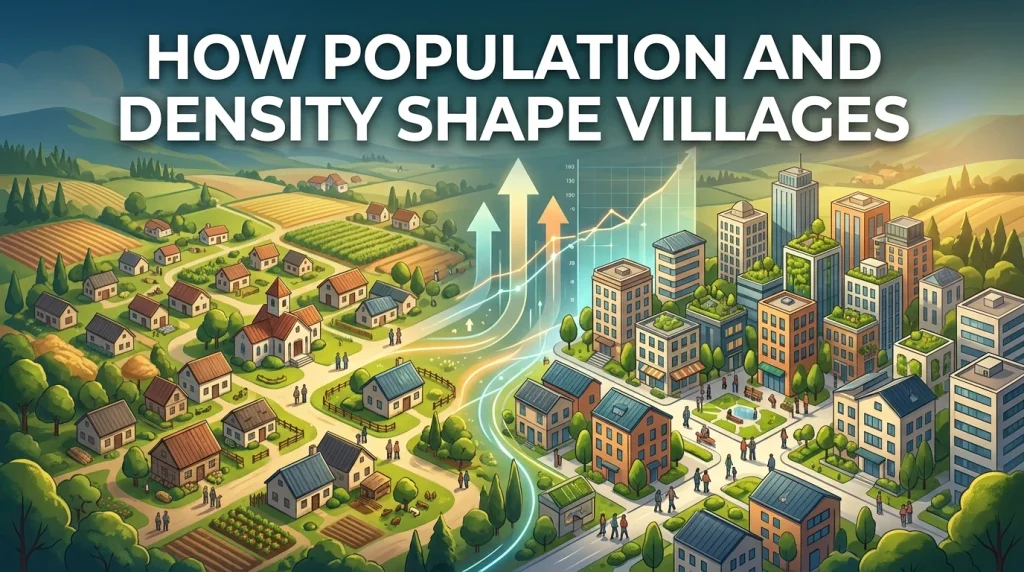
Population tells you how many people live somewhere. Density tells you how closely those people live together.
That distinction matters.
Suppose Village A has 2,000 residents spread across 20 square miles. Village B also has 2,000 residents but occupies only 2 square miles. Village B has a much higher population density even though both settlements have the same population.
Density affects daily life.
Higher density can support more stores, public transportation, schools, restaurants, and other services because more potential users live nearby. Lower density can make services harder to sustain because residents are spread across a larger area.
This relationship also explains why settlement classification increasingly uses both population and density.
Under the UN’s 2025 standardized approach, towns and semi-dense areas require at least 5,000 inhabitants and a density of at least 300 people per square kilometer. Cities require at least 50,000 inhabitants alongside a much higher density threshold.
These figures should not be mistaken for a universal legal definition of a town or city. They provide a consistent statistical framework for international comparison.
Villages in the Settlement Hierarchy
Villages don’t exist in isolation.
They often form part of a broader settlement hierarchy, in which smaller communities connect with larger centers.
A typical pattern might look like this:
Village → Town → City → Metropolitan Area
A village may supply agricultural products or local labor to a nearby town. The town may provide schools, shops, healthcare, markets, and government services to surrounding villages. The city may offer universities, major hospitals, specialized employment, financial services, and large transportation hubs.
This network creates interdependence.
A city depends on surrounding communities for workers, food, resources, and economic relationships. Villages depend on larger settlements for many specialized goods and services. Towns often sit between the two and connect rural communities with urban centers.
Modern urban geography therefore works better as a continuum than as three rigid boxes.
The UN describes human settlements as existing along an urban-rural continuum rather than as completely separate categories.
That idea makes the city, town, and village distinction much easier to understand.
A village doesn’t suddenly become a city because one new building appears. A town doesn’t become urban simply because its population rises by one person. Settlement change usually happens gradually through population growth, increased density, economic development, infrastructure expansion, migration, and administrative decisions.
The label matters, but the underlying pattern matters more.
What Is a Town?
A town generally sits between a village and a city in terms of population, services, economic activity, and urban intensity. That middle position makes towns especially important because they often connect smaller communities with larger urban centers.
A town can serve as a regional service center. People from surrounding villages may travel there to shop, attend school, visit a doctor, work, access government services, or use transportation connections.
However, “town” has no universal global definition.
The legal meaning can vary considerably from one country to another. In the United States, for example, the Census Bureau notes that incorporated places can be designated as cities, towns, villages, boroughs, or other legal forms, while the legal powers and functions of these places vary by state.
This explains why a town shouldn’t be defined simply as “a place with more people than a village and fewer people than a city.”
The reality is more interesting.
Common Characteristics of a Town
Most towns share several characteristics that distinguish them from smaller villages.
A broader service base is one of the clearest differences. A town may have several supermarkets, banks, restaurants, schools, clinics, pharmacies, government offices, repair businesses, and professional services.
A wider employment market is another. Towns can support retail workers, teachers, healthcare professionals, tradespeople, government employees, hospitality workers, business owners, manufacturers, and office workers.
Greater transportation connectivity often develops as well. A town may sit along a major road, railway, bus route, or other transportation corridor. Its location can help turn it into a commercial hub for nearby communities.
More developed infrastructure usually accompanies that activity. Roads, water systems, electricity networks, telecommunications, waste management, schools, and commercial areas tend to become more extensive as the population grows.
Towns Often Serve as Regional Hubs
Think of a town as a bridge between rural and urban life.
A farming community may produce crops, livestock, or other goods. Residents might then bring those products to a nearby town for processing, storage, sale, or transportation.
At the same time, villagers may travel into town for everyday needs.
This creates a two-way relationship:
- Villages supply workers, agricultural products, local resources, and consumers.
- Towns provide markets, services, education, healthcare, administration, and employment.
- Cities provide specialized services, higher education, major hospitals, corporate employment, and larger economic networks.
That relationship helps explain why towns remain important even as urbanization accelerates.
The United Nations’ 2025 urbanization data estimates that towns and semi-dense areas accounted for about 36% of the world’s population in 2025 under its harmonized Degree of Urbanization framework. Cities accounted for 45%, while rural communities accounted for 19%.
These figures use standardized statistical categories. They shouldn’t be confused with the legal definition of a “town” in any particular country.
Advantages of Living in a Town
Town living often offers a practical compromise.
You can have many conveniences associated with urban life without necessarily dealing with the scale and intensity of a major city.
Common advantages include:
- More services than a typical village
- Better access to healthcare
- More schools and educational options
- Greater employment variety
- More shops and restaurants
- Improved transportation connections
- Potentially shorter commutes than in major cities
- More housing choices than very small settlements
- Access to surrounding rural areas
- A stronger local community than some large urban environments
For many people, this balance is the biggest attraction.
A family might enjoy a quieter neighborhood while remaining close to schools, supermarkets, clinics, workplaces, and recreational facilities. A retiree might appreciate access to essential services without living in a crowded downtown district.
Challenges of Living in a Town
Town life isn’t automatically cheaper, quieter, or better.
Popular towns can become expensive when housing demand rises. A town located near a major city may attract commuters, increasing property prices and putting pressure on roads and public services.
Employment can also be narrower than in a large city.
A town may have several industries, but it usually cannot support the same number of highly specialized careers as a major metropolitan area. Someone working in a very specialized profession may eventually need to commute to a larger urban center.
Public transportation can also be inconsistent.
A town might have buses and a railway station, yet services may operate less frequently than they do in a major city. That difference becomes important for residents without private vehicles.
What Is a City?
A city is generally a large and relatively dense settlement with extensive infrastructure, diverse economic activity, and a wide range of public and private services.
But once again, population alone doesn’t tell the whole story.
For international statistical comparison, the UN’s 2025 Degree of Urbanization framework defines cities as population centers with at least 50,000 inhabitants and a density of at least 1,500 people per square kilometer. The framework is designed to make comparisons between countries more meaningful. It does not replace every country’s legal definition of a city.
Cities typically support complex systems that smaller settlements cannot sustain at the same scale.
You may find:
- Major hospitals
- Universities and colleges
- Corporate offices
- Government institutions
- Financial services
- Industrial districts
- Shopping centers
- Restaurants and entertainment venues
- Airports or major railway stations
- Large public transportation networks
- Specialized professional services
- Cultural institutions
- Sports facilities
- Large housing developments
The sheer variety of activity creates a different daily experience.
Common Characteristics of a City
High population concentration is one defining feature of many cities.
Thousands or millions of people may live within a relatively concentrated urban area. Apartment buildings, commercial districts, offices, factories, transportation infrastructure, and public facilities can occupy large portions of the built environment.
Economic diversity is another hallmark.
A city can support many industries simultaneously. Technology, finance, manufacturing, education, healthcare, tourism, media, construction, logistics, government, and professional services may all operate within the same urban economy.
Specialized services become possible because the population creates enough demand.
A small village cannot usually support several specialized medical centers. A major city can. A town may have a general hospital, while a city may have facilities specializing in cardiology, oncology, neurology, surgery, trauma care, and other fields.
Transportation networks also tend to become more complex.
Depending on the city, residents may use buses, railways, subways, trams, commuter trains, taxis, bicycles, cars, or pedestrian networks.
Cities Are More Than Large Towns
Calling a city “a big town” misses an important point.
A city often performs a different economic and regional function.
Large cities can operate as national or international centers for finance, government, education, culture, technology, trade, transportation, and innovation.
For example, a major city can attract workers from surrounding towns and villages every day. Universities bring students from distant regions. Hospitals receive patients from outside the city. Airports connect the urban economy to national and international markets.
This creates a network of relationships far beyond the city’s administrative boundary.
That distinction becomes especially important when discussing urban agglomerations and metropolitan areas.
A city’s built-up area can spread beyond its official boundary. Nearby towns may become physically connected to the city even though they retain separate governments and names.
As a result, the “city” you see on a map may not perfectly match the urban area experienced by residents.
Advantages of Living in a City
Cities offer choice.
You may have dozens of employers, hundreds of stores, multiple hospitals, universities, cultural venues, restaurants, and transportation options within the same metropolitan region.
Major advantages can include:
- Greater career variety
- More specialized healthcare
- Broader educational opportunities
- More entertainment and cultural activities
- Larger shopping markets
- Extensive professional services
- Greater transportation choices
- More diverse communities
- Access to major airports and transportation hubs
- More opportunities for networking and entrepreneurship
For ambitious professionals, the concentration of employers can be especially valuable.
If one company closes or changes its hiring plans, another employer may exist nearby. In a smaller settlement, losing one major employer can have a much larger effect on the local economy.
Challenges of City Life
The same concentration that makes cities convenient can create pressure.
Housing costs can rise sharply where demand exceeds supply. Large cities may also experience expensive transportation, higher rents, congestion, noise, air pollution, and competition for public resources.
Daily life can feel faster.
A 20-minute trip in a small town may take considerably longer during rush hour in a major metropolitan area. Crowded public spaces and busy schedules can also reduce the sense of privacy or calm some people prefer.
Other common challenges include:
- Traffic congestion
- Higher housing costs in many major cities
- Noise
- Air pollution in some urban areas
- Crowded public spaces
- Longer commuting times
- Greater competition for certain jobs and housing
- Less private outdoor space
- Higher everyday expenses in some locations
Still, city life isn’t uniformly stressful or expensive.
Urban neighborhoods vary enormously. A compact, walkable neighborhood near public transit can provide a very different experience from a car-dependent suburb on the metropolitan fringe.
City vs. Town vs. Village: Key Differences
The clearest way to compare a city, town, and village is to examine several dimensions at once.
Population provides one clue. Density, infrastructure, services, economic role, and governance provide the rest of the picture.
Population and Settlement Size
Population is usually the first measurement people consider.
A village generally has fewer residents than a town, while a town generally has fewer residents than a city. But this is a broad pattern rather than an international rule.
The UN’s standardized framework provides useful thresholds for statistical comparison:
| Settlement category | UN Degree of Urbanization threshold |
| City | At least 50,000 inhabitants and at least 1,500 people/km² |
| Town / semi-dense area | At least 5,000 inhabitants and at least 300 people/km² |
| Rural area | Lower-density areas outside those categories |
The UN uses these thresholds to create internationally comparable statistics. National governments may use different definitions.
This distinction is crucial.
A population threshold can help researchers compare places consistently. It doesn’t mean every government legally declares a settlement a city once it reaches 50,000 residents.
Population Density
Population density measures the number of people living within a particular area.
Imagine two communities with 20,000 residents.
One occupies 5 square miles. The other occupies 50 square miles.
They have the same population, but the first community is far denser.
That difference can influence everything from transportation to housing design.
High-density settlements can support:
- Frequent public transportation
- Apartment buildings
- Walkable commercial districts
- Dense retail markets
- Specialized services
- Smaller residential lots
Lower-density settlements generally require more land per resident and may depend more heavily on private vehicles.
This is why population density can sometimes tell you more about a settlement’s character than population alone.
Physical Size
Physical size creates another common misconception.
People often assume that a larger settlement must have a larger population. That’s not necessarily true.
A village can cover a surprisingly large geographic area if homes are spread apart. A city can occupy a relatively small administrative boundary while containing hundreds of thousands of residents.
The key distinction is between land area and built-up area.
An administrative boundary can include undeveloped land, forests, farmland, waterways, or other areas. The continuously built-up portion may cover only part of that territory.
Modern urban analysis therefore examines both population and built-up land. The UN’s 2025 World Urbanization Prospects includes data on city population, density, and built-up area to help researchers understand how urban settlements expand.
Infrastructure
Infrastructure tends to become more complex as settlements grow.
A village may have basic roads, electricity, water systems, telecommunications, and local facilities. A town often adds larger roads, commercial infrastructure, schools, healthcare facilities, and public services. A city may operate extensive transportation networks, utilities, drainage systems, major hospitals, universities, waste-management systems, and other large-scale infrastructure.
The relationship isn’t perfectly linear, though.
A wealthy village can have excellent infrastructure. A rapidly growing city can struggle with overloaded roads, insufficient housing, or inadequate public services.
Settlement size creates demand, but investment determines quality.
Healthcare
Healthcare illustrates the difference particularly well.
A village might have a small clinic or primary healthcare provider. Residents may travel elsewhere for specialized treatment.
A town may support a larger clinic, urgent-care facility, or general hospital.
A major city can support multiple hospitals and highly specialized medical facilities because its larger population creates enough demand to sustain them.
This doesn’t mean every city has better healthcare than every village. Service quality depends on government investment, private healthcare, regional wealth, staffing, and accessibility.
The key difference is usually breadth and specialization.
Education
Education follows a similar pattern.
A village may have a primary school. Older students might travel to a nearby town.
A town may offer multiple primary and secondary schools, vocational programs, libraries, and other educational facilities.
Cities can support universities, research institutions, specialized colleges, technical institutes, and extensive private education markets.
The concentration of students, teachers, researchers, and supporting institutions creates an educational ecosystem that is difficult to reproduce in very small settlements.
Employment and Economic Activity
Economic structure is another major difference.
Village economies may include agriculture, fishing, forestry, tourism, crafts, construction, local services, and commuting workers.
Town economies tend to diversify. Retail, education, healthcare, government, hospitality, manufacturing, logistics, construction, and professional services may all contribute.
Cities can support highly specialized economic sectors because large labor markets bring employers and workers together.
A city might simultaneously function as:
- A financial center
- A manufacturing center
- A technology hub
- A government center
- A university center
- A transportation hub
- A tourism destination
- A cultural center
That diversity creates economic opportunities but can also increase competition and living costs.
Transportation and Accessibility
Transportation is strongly influenced by density and regional importance.
Villages often have fewer transportation options. Residents may rely on private vehicles, local buses, bicycles, or walking.
Towns typically have better connections to surrounding communities. They may serve as stops along regional roads, railways, or bus routes.
Cities can support extensive transportation systems because thousands or millions of people need to move around every day.
Depending on the location, these systems may include:
- City buses
- Subways
- Light rail
- Trams
- Commuter trains
- Taxis
- Ride-hailing services
- Cycling networks
- Pedestrian infrastructure
- Major highways
- Airports
Transportation can also reshape settlement growth.
A new railway station or highway interchange can attract businesses and housing. Over time, that development can increase population density and transform a small settlement into a regional center.
City vs. Town vs. Village: Side-by-Side Comparison
| Category | Village | Town | City |
| Population | Generally smaller | Intermediate | Generally larger |
| Density | Usually low | Moderate | Often high |
| Housing | Detached homes and small clusters are common | Mixed housing types | Apartments and dense housing are more common |
| Services | Basic and limited | Broad local services | Extensive and specialized |
| Healthcare | Clinics or basic care | General medical services | Specialized hospitals and medical centers |
| Education | Often basic schools | Multiple schools and training options | Universities and specialized institutions may be available |
| Economy | Local, agricultural, tourism, or resource-based | Retail, services, trades, administration, industry | Diverse and highly specialized |
| Transportation | Limited | Regional connections | Extensive local and regional networks |
| Traffic | Usually lighter | Moderate | Often heavier |
| Community | Often highly familiar | Strong local identity with wider connections | More diverse and less uniformly personal |
| Open space | Usually abundant | Moderate | Often limited in dense areas |
| Specialized services | Often require travel | Available to a greater extent | Widely available |
| Administrative status | Depends on local law | Depends on local law | Depends on local law |
The table reveals an important pattern: there is no single feature that separates every city, town, and village.
Instead, several characteristics tend to change together.
Population grows. Density may increase. Businesses multiply. Infrastructure expands. Transportation becomes more complex. Public services become more specialized. The settlement begins serving a larger surrounding region.
Why a Town Can Sometimes Feel Like a City
A town can feel highly urban even when it doesn’t carry the legal title “city.”
Imagine a town with 100,000 residents, dense apartment buildings, shopping centers, hospitals, universities, offices, and heavy traffic.
Now imagine a legally designated city with only 20,000 residents spread across a large area.
Which one feels more urban?
Probably the first.
This is why legal classification and everyday urban character aren’t always identical.
In the United States, for example, the Census Bureau recognizes incorporated places using legal designations such as city, town, and village, but those labels and their governmental functions differ among states.
The same principle applies internationally.
A settlement’s official title can reflect history or legislation rather than its current population density or economic importance.
Why a City Can Sometimes Feel Like a Town
The reverse can happen, too.
A small city may have a population that would be considered modest by global urban standards. Its streets may be quiet, neighborhoods may be familiar, and local businesses may dominate daily life.
Residents may describe it as having a “small-town feel” even though its legal status is city.
This is another reason not to treat city, town, and village as rigid lifestyle categories.
A city can be peaceful.
A town can be crowded.
A village can be well connected.
A city can have rural-looking outskirts.
A town can contain high-rise buildings.
The physical and social reality matters more than the label alone.
The Most Important Difference: Function
If you remember only one principle from the city vs. town vs. village debate, make it this:
Settlement function often matters as much as settlement size.
A village primarily serves its residents.
A town often serves its own population plus surrounding communities.
A city can serve an entire region, country, or even an international network.
That difference affects employment, transportation, education, healthcare, commerce, and government.
The larger the service area, the more complex the infrastructure generally needs to become.
A Simple Way to Remember the Difference
Think of the three settlements as overlapping circles of influence:
Village → Local community
Town → Local community + surrounding settlements
City → Large region + national/international connections
These aren’t strict rules. They’re a useful mental model.
The boundaries between the categories can overlap, and urban growth can gradually erase the visible distinction between neighboring settlements.
City, Town, and Village Are Part of a Continuum
Human settlements rarely fit perfectly into three boxes.
A village can grow into a town. A town can expand into a city. A city can merge physically with neighboring towns and settlements to form a much larger urban agglomeration.
This process is part of global urbanization.
The latest UN World Urbanization Prospects report that cities housed 45% of the world’s 8.2 billion people in 2025, more than twice the share recorded in 1950.
That transformation doesn’t simply mean more people are moving into city centers.
Urban areas expand outward. New housing appears on former farmland. Roads connect previously separate communities. Businesses follow growing populations. Towns become commuter settlements. Eventually, neighboring built-up areas can become physically connected.
The result is a complex urban landscape where a village, town, and city may sit only a few miles apart while performing very different roles.
Understanding that continuum gives you a much clearer answer to the question “What is the difference between a city, town, and village?”
The answer isn’t simply big, medium, and small.
It’s about population, density, infrastructure, economic function, services, governance, geography, and connections with surrounding communities.
Population and Size Differences Between a City, Town, and Village
Population is one of the easiest ways to compare a city, town, and village, but it isn’t enough by itself.
A settlement’s population tells you how many people live there. It doesn’t necessarily tell you how closely those people live together, how much land the settlement occupies, what services it provides, or how important it is to surrounding communities.
That is why modern urban geography looks at several measurements at once.
The United Nations World Urbanization Prospects 2025 uses a harmonized Degree of Urbanization approach that considers population size, population density, and whether populated areas form contiguous clusters. Under this framework, a city has at least 50,000 inhabitants and a population density of at least 1,500 people per square kilometer. Towns and semi-dense areas generally have at least 5,000 inhabitants and a density of at least 300 people per square kilometer.
These thresholds are useful for international comparisons. They aren’t universal legal definitions.
How Population Shapes Each Settlement
Population affects nearly every part of settlement life.
When more people live in an area, demand rises for housing, transportation, schools, healthcare, shops, employment, utilities, recreation, and public administration.
A small village might need one elementary school.
A growing town may need several schools, a secondary school, clinics, supermarkets, banks, restaurants, and public offices.
A major city may support hundreds of schools, multiple universities, large hospitals, specialized shopping districts, mass-transit systems, stadiums, airports, and complex government agencies.
The difference isn’t simply that a city has “more” of everything.
It often has different levels of specialization.
For example:
| Need | Village | Town | City |
| Primary healthcare | Local clinic or basic provider | Clinics and general medical facilities | Hospitals and specialized medical centers |
| Education | Basic schools | Schools and vocational programs | Schools, colleges, universities, research institutions |
| Shopping | Small stores and local markets | Supermarkets and broader retail | Large commercial districts and specialized markets |
| Employment | Agriculture, trades, local services | Retail, services, industry, administration | Diverse industries and specialized professions |
| Transportation | Roads and limited public transit | Regional bus or rail connections | Extensive public and private transportation |
| Government services | Local offices | Broader administrative services | Multiple government departments and institutions |
| Entertainment | Local events and small venues | Restaurants, cinemas, community facilities | Museums, theaters, stadiums, major cultural venues |
Population therefore acts as a foundation for urban complexity.
It creates enough demand to support services that would not be financially or practically sustainable in a tiny settlement.
Why Physical Size Doesn’t Tell the Whole Story
Land area can be misleading.
Consider two hypothetical settlements:
- Settlement A: 30,000 residents across 10 square kilometers
- Settlement B: 30,000 residents across 100 square kilometers
Both have the same population.
Yet Settlement A has a density of 3,000 people per square kilometer, while Settlement B has only 300.
The first settlement will likely feel much more urban.
You may see apartment buildings, compact neighborhoods, busy commercial streets, sidewalks, and frequent transportation services.
The second could have widely separated homes, larger properties, farmland, forests, and longer travel distances.
This example shows why population density matters.
The UN’s current urban methodology specifically uses density alongside population because a settlement’s urban character depends partly on how concentrated its residents are.
Administrative Area vs. Built-Up Area
Another important distinction is the difference between an administrative boundary and a built-up area.
A city government may control a large territory that includes:
- Residential neighborhoods
- Commercial districts
- Industrial zones
- Parks
- Agricultural land
- Forests
- Rivers
- Empty land
- Roads and transportation corridors
Only part of that territory may be continuously developed.
Conversely, buildings may extend beyond the official city boundary into neighboring municipalities.
This creates a common problem.
The city on a legal map may not match the city people experience on the ground.
Modern urban statistics increasingly account for this issue by examining contiguous built-up areas rather than relying entirely on administrative boundaries. The UN describes an urban agglomeration as a continuous urban area formed by a city and surrounding developed areas, regardless of administrative boundaries.
Population Density and Urban Growth
Urban growth doesn’t always happen evenly.
A settlement can grow in several ways:
- Inward growth through denser development.
- Outward growth through new housing and commercial districts.
- Upward growth through taller buildings.
- Linear growth along highways, railways, or coastlines.
- Expansion into neighboring settlements.
- Administrative expansion through boundary changes.
A town near a rapidly expanding city may eventually become part of the city’s continuous built-up area.
At that point, the old labels can become less useful for describing the physical landscape.
A village may still have its original name and local identity while functioning economically as part of a metropolitan area.
Infrastructure and Public Services
Infrastructure is the physical and organizational foundation that allows a settlement to function.
Roads, water systems, electricity networks, telecommunications, schools, hospitals, drainage, waste collection, transportation, and public buildings all shape daily life.
The larger and denser a settlement becomes, the more complicated these systems usually become.
However, size doesn’t automatically guarantee better infrastructure.
A small community with strong investment can have reliable roads, high-speed internet, clean water, and excellent public services. Meanwhile, a rapidly growing city can struggle to keep infrastructure ahead of population growth.
The important issue is the relationship between population demand and infrastructure capacity.
Roads, Utilities, and Transportation
Villages generally have simpler transportation systems.
A local road may connect homes with a nearby highway or town. Residents may use private cars, motorcycles, bicycles, walking routes, or occasional buses.
Towns need more extensive road networks because they serve both residents and people traveling from surrounding communities.
A town may contain:
- Main commercial streets
- Residential roads
- Regional highways
- Bus stations
- Railway stations
- Parking areas
- Freight routes
- Pedestrian areas
Cities require still more complicated systems.
A major city may have multilane roads, bridges, tunnels, railways, subways, bus rapid transit, pedestrian networks, cycling infrastructure, airports, freight terminals, and complex traffic-management systems.
The challenge grows because infrastructure must handle large numbers of simultaneous trips.
A road that works perfectly for a village can become dangerously congested when thousands of commuters use it every morning.
Water, Electricity, and Waste Management
Utilities also change with settlement size.
A village may rely on a relatively simple water-distribution network or local wells. Waste collection might be limited or organized through small-scale services.
Towns generally need larger networks.
Cities require extensive systems for:
- Water treatment
- Water distribution
- Sewage collection
- Stormwater drainage
- Solid-waste collection
- Recycling
- Electricity distribution
- Natural gas distribution where available
- Telecommunications
- Public lighting
Dense development makes these systems particularly important.
When thousands of people live close together, a failure in water, electricity, sanitation, or drainage can affect an enormous number of residents.
This is one reason urban planning becomes increasingly important as settlements grow.
Schools, Colleges, and Universities
Education often reflects the settlement hierarchy.
A village may support one or more primary schools depending on its population and local education system.
A town can support a wider range of schools because it serves children from surrounding communities as well as its own residents.
Cities can sustain institutions with highly specialized programs.
These may include:
- Universities
- Medical schools
- Engineering colleges
- Business schools
- Technical institutes
- Research centers
- Art schools
- Libraries
- Specialized training institutions
A large student population can also create secondary economic activity.
Students need housing, transportation, food, entertainment, healthcare, and other services. Universities can therefore become major economic anchors within cities and towns.
Hospitals and Emergency Services
Healthcare provides another useful example of settlement specialization.
A village may have basic healthcare but require residents to travel for serious medical problems.
A town can provide general medical care, maternity services, emergency treatment, pharmacies, laboratories, and other services.
A major city can support highly specialized facilities because the surrounding population creates enough demand.
A city hospital may contain dedicated departments for:
- Cardiology
- Oncology
- Neurology
- Orthopedics
- Pediatrics
- Trauma care
- Surgery
- Intensive care
- Diagnostic imaging
- Rehabilitation
That specialization isn’t simply a matter of having a larger building.
It depends on trained personnel, equipment, laboratories, supply chains, medical schools, transportation, and enough patients to sustain specialized departments.
Shopping, Entertainment, and Public Facilities
Commercial life also expands with population.
A village may have a general store, local market, restaurant, workshop, or small group of businesses.
A town might offer supermarkets, clothing stores, banks, restaurants, pharmacies, hardware stores, repair services, hotels, cinemas, and other commercial facilities.
Cities create enough demand for highly specialized markets.
You might find entire districts devoted to:
- Electronics
- Fashion
- Restaurants
- Wholesale goods
- Furniture
- Automotive services
- Financial services
- Entertainment
- Tourism
The same principle applies to recreation.
Cities can support large museums, theaters, stadiums, convention centers, galleries, amusement facilities, and major cultural institutions because they draw audiences from a much wider region.
Infrastructure Comparison
| Infrastructure | Village | Town | City |
| Local roads | Basic network | More developed | Extensive and highly interconnected |
| Public transportation | Limited or occasional | Regional services | Multiple modes often available |
| Water systems | Small-scale or local | Municipal or regional | Large and complex networks |
| Waste collection | Basic | Regular municipal services | Large-scale collection and processing |
| Schools | Usually basic education | Multiple schools | Extensive education network |
| Healthcare | Basic or primary care | General medical services | Specialized hospitals and centers |
| Retail | Local shops and markets | Broad range of stores | Extensive and specialized retail |
| Recreation | Community facilities | More venues and public spaces | Major cultural and entertainment infrastructure |
| Telecommunications | Increasingly available | Broad coverage | Highly developed networks |
| Emergency services | Limited | More organized | Large, specialized systems |
The table describes common patterns, not absolute rules.
A well-funded village can have better internet than a struggling city. A small town can have an excellent hospital. Local investment, geography, wealth, and government capacity all matter.
Local Government and Administration
Government is one of the most confusing parts of the city, town, and village distinction because legal labels vary widely.
A settlement can be called a city because of a legal charter.
Another settlement with a larger population might legally remain a town.
A village may have its own elected council in one country while being administered as part of a larger municipality somewhere else.
This means administrative status is not the same thing as physical size.
The UN’s 2025 urbanization methodology deliberately complements national definitions rather than replacing them. Its purpose is to create a consistent framework for comparing settlements across countries.
How Villages Are Governed
Village government varies enormously.
Some villages have elected councils, local administrative offices, community leaders, or traditional authorities.
Others have little independent administrative authority and are governed through a larger municipality, district, county, or regional government.
The exact arrangement depends on national law.
Local responsibilities may include:
- Community roads
- Local sanitation
- Public spaces
- Community facilities
- Local permits
- Basic administrative records
- Small-scale development decisions
In some places, however, these responsibilities belong to a higher level of government.
How Town Governments Operate
Town governments usually have broader responsibilities because towns contain more people and infrastructure.
Depending on the country, a town administration may oversee:
- Local roads
- Zoning and land use
- Building permits
- Waste collection
- Water services
- Parks
- Markets
- Local business regulation
- Public facilities
- Fire or emergency services
- Local taxation
A town can therefore function as an important administrative center for nearby villages.
This regional role can be just as important as its population.
How City Governments Manage Large Populations
City governments often face a dramatically larger management challenge.
A major city may need to coordinate:
- Public transportation
- Traffic management
- Land-use planning
- Housing
- Water and sanitation
- Waste management
- Public health
- Emergency response
- Parks
- Schools or education-related services
- Economic development
- Environmental programs
- Major infrastructure projects
Some cities also have several layers of government.
A neighborhood might have local representation. The city government manages municipal functions. A metropolitan or regional authority handles transportation or infrastructure. A state, province, or national government controls other responsibilities.
This layered structure becomes increasingly important as urban areas spread across multiple jurisdictions.
Why Legal Status Differs Between Countries
There is no worldwide law that says:
“A settlement with X people must legally be called a city.”
Instead, governments have developed their own classification systems.
National definitions can consider:
- Population
- Density
- Administrative status
- Economic activity
- Infrastructure
- Historical status
- Land use
- Legal charters
- Government functions
The UN’s World Urbanization Prospects specifically notes that countries use diverse criteria to distinguish urban and rural areas. The 2025 framework was developed partly to make international comparisons more consistent despite these differences.
This explains why comparing two places by their labels alone can produce misleading results.
Economy and Employment
Economic activity is one of the strongest forces separating villages, towns, and cities.
Settlements don’t simply grow because people want larger homes.
They grow because jobs, markets, services, transportation, resources, and opportunities attract people and investment.
Economic geography helps explain why some settlements remain small while others become major urban centers.
Agriculture and Village Economies
Many villages have historically developed around agriculture and natural resources.
Common activities include:
- Crop farming
- Livestock production
- Fishing
- Forestry
- Food processing
- Handicrafts
- Small-scale trade
- Tourism
- Construction
- Local services
Not every village depends on agriculture.
A village near a tourist destination may rely heavily on hospitality. Another near a mining region may depend on resource extraction. A village near a large city may have many residents who commute to urban jobs.
The important point is that village economies can be diverse even when their settlement structure remains small.
Small Businesses and Town Markets
Towns often operate as commercial centers for larger surrounding areas.
Farmers may bring products into town.
Residents may purchase tools, clothing, food, medicine, construction materials, and household goods.
Businesses benefit from a customer base larger than the town’s permanent population because surrounding communities also contribute consumers.
This creates a multiplier effect.
A busy market supports transport workers. Transport workers purchase food. Restaurants employ staff. Shops rent commercial space. Local construction companies build new stores and homes.
The town becomes an economic bridge between rural production and larger urban markets.
Industry, Technology, and Business Centers in Cities
Cities can support more specialized economic sectors because they offer large labor pools and extensive infrastructure.
A technology company may need software engineers, designers, accountants, lawyers, marketing specialists, sales teams, data analysts, managers, and support staff.
A large city can provide this labor pool within a relatively concentrated area.
Cities also offer access to:
- Financial institutions
- Investors
- Universities
- Research organizations
- Major transportation networks
- International markets
- Specialized suppliers
- Government agencies
- Professional services
This concentration can produce economic clustering.
When businesses in related industries locate near one another, they can share talent, suppliers, knowledge, infrastructure, and customers.
That is one reason certain cities become known for particular industries.
Economic Comparison
| Economic feature | Village | Town | City |
| Agriculture | Often important in many rural settings | May support surrounding agriculture | Usually smaller share of the urban economy |
| Retail | Basic local commerce | Strong local and regional markets | Large and highly specialized markets |
| Manufacturing | Small-scale or resource-based in some areas | Moderate industrial activity | Large and diverse industrial sectors |
| Professional services | Limited | Moderate | Extensive |
| Technology sector | Usually limited | Growing in connected towns | Often highly developed |
| Finance | Basic services | Banks and financial providers | Major financial institutions and markets |
| Tourism | Possible major employer | Often significant | Can be a major metropolitan industry |
| Government employment | Local administration | Broader public services | Extensive government institutions |
| Employment diversity | Generally narrower | Moderate | Often very broad |
| Regional economic influence | Local | Regional | Regional, national, or international |
Case Study: How a Settlement Can Change Over Time
Imagine a small agricultural settlement called Riverbend.
At first, only a few hundred people live there.
Most households depend on farming. A small market operates once a week, and residents travel to a nearby town for medical care and secondary education.
Then a paved highway reaches Riverbend.
The change is gradual but powerful.
Trucks can transport agricultural products more efficiently. A permanent market opens. A fuel station follows. Several restaurants appear. A pharmacy opens. More workers arrive.
Riverbend now serves neighboring communities.
Its population reaches several thousand.
The settlement has effectively taken on town-like functions, even if its official legal classification has not changed.
A decade later, a railway station is built.
Factories begin operating nearby. New neighborhoods appear. A college opens. A larger hospital follows.
The population rises again.
Eventually, Riverbend may become a city under national law or fit the statistical definition of a city under an international classification.
This hypothetical example demonstrates a central principle of settlement geography:
Urbanization is a process, not a switch.
The UN’s 2025 methodology recognizes this broader continuum, using standardized spatial criteria to distinguish cities, towns, semi-dense areas, and rural areas.
The Global Shift Toward Cities
The difference between cities, towns, and villages matters even more because the world’s population is becoming increasingly urban.
According to the UN’s World Urbanization Prospects 2025, cities were home to about 45% of the world’s 8.2 billion people in 2025. Towns accounted for about 36%, while rural communities accounted for roughly 19%. In 1950, cities contained only about 20% of the global population.
That represents a profound transformation.
The number of people living in cities has more than doubled as a share of the global population since 1950.
The UN also projects that roughly two-thirds of global population growth through 2050 will occur in cities, with most of the remaining growth occurring in towns.
This doesn’t mean villages will disappear.
Far from it.
Rural communities will continue to produce food, manage natural resources, support local economies, preserve cultural traditions, and remain home to millions of people.
Instead, the settlement landscape is becoming more interconnected.
Villages connect to towns.
Towns connect to cities.
Cities connect to metropolitan regions.
Metropolitan regions connect to national and global economies.
Why Population Alone Cannot Define a City, Town, or Village
Population is useful, but it leaves several questions unanswered.
Suppose a settlement has 60,000 people.
Is it automatically a city?
Not necessarily.
You would still want to know:
- How densely do people live?
- Is the population concentrated in a contiguous built-up area?
- What services does the settlement provide?
- What is its legal status?
- What is its economic role?
- Does it function independently or as part of a metropolitan area?
- How does national law classify it?
The UN’s Degree of Urbanization framework addresses some of these issues by combining population size, density, and spatial contiguity. It was designed to improve comparisons between countries while recognizing that national definitions remain important.
That distinction is essential for anyone researching the difference between a city, town, and village.
A label tells you something.
The settlement’s population, density, infrastructure, economy, government, and regional role tell you much more.
Lifestyle and Living Experience
The difference between a city, town, and village isn’t only visible on a map. You can feel it in the rhythm of everyday life.
Where you live influences how far you travel, how easily you access services, how much space you have, what jobs are available, and how often you interact with your neighbors.
Of course, individual experiences vary.
A wealthy village can offer modern amenities and excellent internet access. A crowded city neighborhood can feel surprisingly close-knit. A growing town can combine quiet streets with a busy commercial center.
Still, each settlement type tends to create a different living environment.
Daily Life in a Village
Village life often revolves around a smaller and more familiar social environment.
People may know many of their neighbors. Local businesses can have long-standing relationships with customers. Community events may involve a large portion of the population.
Daily travel is often simpler when essential activities happen nearby.
A resident might walk to a local shop, visit a nearby farm, attend a community event, or travel to a neighboring town for larger purchases.
However, village life can require longer trips for specialized services.
You might need to travel to a town or city for:
- Specialized healthcare
- Higher education
- Certain government services
- Large shopping centers
- Specialized employment
- Entertainment
- Major transportation connections
This trade-off is central to village living.
You often gain space and proximity to nature while giving up some convenience and specialization.
Living in a Town
Town life offers a middle ground.
You may have enough shops, schools, clinics, restaurants, workplaces, and recreational facilities for most ordinary needs without traveling into a major city.
A town can also offer a strong sense of place.
Main streets, local markets, community centers, schools, religious buildings, parks, sports clubs, and neighborhood businesses can create recognizable social networks.
For many households, this combination is appealing.
You can enjoy a relatively manageable pace while remaining connected to larger economic and educational centers.
A town can also be a practical choice for people who want access to nature without sacrificing basic urban conveniences.
Fast-Paced City Life
City life usually offers the greatest range of choices.
You can often find multiple employers, schools, healthcare providers, restaurants, entertainment venues, transportation options, and cultural activities within a relatively short distance.
But greater choice can bring greater complexity.
Your neighborhood may be busy at all hours. Traffic can affect commuting. Housing can consume a large share of household income. Noise and crowds may become part of everyday life.
The city experience also depends heavily on neighborhood design.
A walkable neighborhood with parks, shops, schools, and public transportation can feel very different from a low-density area where residents must drive everywhere.
So, “city life” isn’t one universal experience.
It can range from a quiet residential district to a dense downtown filled with offices, apartments, restaurants, and transit stations.
Cost of Living Comparison
Cost of living is often presented as a simple village-versus-city equation.
The reality is more complicated.
Cities frequently have higher housing costs in high-demand areas. Yet they can also provide more employment opportunities and better access to public transportation.
A village may offer cheaper housing, but residents could spend more on transportation because workplaces, hospitals, schools, and shopping centers are farther away.
Towns can fall somewhere between the two.
A useful comparison looks beyond rent or mortgage payments.
| Cost factor | Village | Town | City |
| Housing | Often lower, but highly location-dependent | Moderate to high depending on demand | Often higher in major high-demand markets |
| Transportation | Private vehicles may be more important | Mixed | Public transit may reduce car dependence |
| Groceries | Fewer choices; prices vary | More competition | Broad selection and competition |
| Healthcare | May require travel | More local options | Broadest range of providers |
| Entertainment | Limited | Moderate | Extensive |
| Education | Fewer institutions | More choices | Broadest range |
| Employment | Narrower market | Moderate | Broadest market |
| Outdoor space | Often easier to access | Usually accessible | Can be limited in dense areas |
The most important lesson is simple:
The cheapest home doesn’t always create the lowest total cost of living.
Transportation, childcare, healthcare, taxes, utilities, commuting time, and access to employment can change the calculation dramatically.
Safety, Convenience, and Work-Life Balance
People often associate villages with safety and cities with danger.
That comparison is too simplistic.
Safety depends on many factors, including infrastructure, income, policing, road design, environmental hazards, housing conditions, and local social conditions.
A village can have dangerous roads.
A city can have exceptionally safe neighborhoods.
Convenience also works differently across settlement types.
A city may provide 24-hour services and multiple transportation options. A village may offer fewer services but make it easier to escape traffic and crowds.
Work-life balance therefore depends partly on what you value.If your ideal evening means walking through a busy cultural district, a city may suit you.If you prefer quiet evenings, open land, and fewer crowds, a village may feel more comfortable.If you want something between those extremes, a town can provide a useful compromise.
Community and Culture
Settlement size can influence social relationships, but it doesn’t determine them completely.
Culture develops through history, migration, geography, religion, language, economic activity, institutions, and local traditions.
A village and a city can both have strong communities.
They simply organize social life differently.
Social Relationships in Villages
Small populations can create close social networks.
Neighbors may know one another for years. Families may remain connected across generations. Community events can attract a significant portion of the local population.
This familiarity can create strong support networks.
Someone who needs help repairing a home, caring for a child, transporting an elderly relative, or organizing a local event may have several nearby contacts.
However, close communities can also feel less anonymous.
People may know more about one another’s personal lives. Newcomers may need time to establish relationships. Social expectations can sometimes feel stronger than they do in larger urban environments.
So village community life can provide belonging and familiarity, but it can also involve less privacy.
Community Events in Towns
Towns often have enough population to support larger organized events.
Examples include:
- Farmers’ markets
- Sports competitions
- Cultural festivals
- Parades
- Concerts
- Public fairs
- Seasonal celebrations
- Community theater
- Food festivals
- Local business events
These activities can bring together people from the town and nearby rural communities.
Because towns frequently function as regional hubs, their cultural identity may extend beyond their official boundaries.
A weekend market, for example, might attract farmers from surrounding villages and shoppers from several neighboring settlements.
Cultural Diversity in Cities
Cities often contain much greater demographic diversity.
Large urban areas can attract people from different regions and countries because of employment, education, migration, trade, and political or economic opportunities.
This can produce neighborhoods with distinctive cultural identities.
You may encounter:
- Multiple languages
- International restaurants
- Religious institutions from different traditions
- Cultural organizations
- Migrant communities
- International schools
- Art and music scenes
- Specialized markets
Cities can therefore become powerful centers of cultural exchange.
The same diversity can create challenges when rapid population growth puts pressure on housing, transportation, schools, healthcare, and other services.
Community Comparison
| Community feature | Village | Town | City |
| Social familiarity | Often high | Moderate to high | Varies widely |
| Privacy | Usually lower | Moderate | Often higher between households |
| Cultural diversity | Often smaller scale | Moderate | Often extensive |
| Community events | Smaller and local | Regional and local | Numerous and specialized |
| Newcomer integration | Personal networks matter strongly | Mixed | Many formal and informal networks |
| Neighborhood identity | Strong | Often strong | Can be extremely diverse |
| Social anonymity | Low | Moderate | Often higher |
These are broad patterns rather than universal rules.
A small village near an international border can be culturally diverse. A city neighborhood can function socially like a village.
Historical Development of Settlements
The modern city, town, and village hierarchy developed over thousands of years.
Human settlements did not appear in their present forms overnight.
They evolved as people changed how they produced food, traded goods, governed communities, traveled, and organized economies.
How Villages Formed
Permanent villages became possible when communities developed more stable food-production systems.
The transition to agriculture allowed people to remain in one location for longer periods rather than constantly moving in search of food.
Once people settled, they could build more permanent:
- Homes
- Storage facilities
- Wells
- Paths
- Places of worship
- Workshops
- Community spaces
Over time, settlements became increasingly organized.
Not every early settlement became a town.
Some remained small because the surrounding environment could support only a limited population.
Others grew because they had fertile land, water access, strategic locations, trade opportunities, or other advantages.
How Towns Expanded
Towns often emerged where economic activity required a larger concentration of people.
A trading route could create a marketplace.
A river crossing could attract merchants.
A port could become a center for shipping.
A mining area could create demand for workers and services.
A religious site could attract pilgrims and permanent residents.
A defensive location could encourage settlement around a fortress.
These forces created urban nodes.
Once a town developed a market, roads, workshops, government offices, and other services, its importance could reinforce further growth.
More people arrived because services existed.
More services appeared because more people arrived.
That cycle could transform a small settlement into a major regional center.
How Cities Became Urban Centers
Cities developed when settlements accumulated enough population, economic activity, political importance, and infrastructure to influence large surrounding regions.
Historically, cities often became centers of:
- Government
- Trade
- Religion
- Manufacturing
- Transportation
- Education
- Military power
- Finance
- Culture
Industrialization accelerated urban growth dramatically.
Factories needed large numbers of workers. Workers needed housing, transportation, food, schools, and services.
Railways and later highways expanded the geographic reach of cities.
Modern communications and digital technology have changed the process again.
A business no longer needs every employee or customer physically nearby. Yet physical concentration remains valuable for many industries because workers, institutions, infrastructure, and markets still benefit from proximity.
The Evolution of Human Settlements
A simplified settlement pathway looks like this:
Small settlement → village → growing town → city → metropolitan or urban agglomeration
But this isn’t a guaranteed sequence.Some villages remain villages for centuries.Some towns lose population.Some cities shrink.Some settlements merge physically with neighboring communities without changing their legal identity.
The UN’s 2025 urbanization framework reflects this idea of a settlement continuum rather than treating rural and urban areas as completely separate worlds. It classifies populations into cities, towns, semi-dense areas, and rural areas using consistent spatial criteria.
Common Misconceptions About Cities, Towns, and Villages
Many misunderstandings arise because people treat these labels as universal categories.
They aren’t.
Is Every Large Town a City?
No.
A large town may have a population comparable to or greater than some cities.
Its legal classification may depend on national or regional law rather than population alone.
A town can also have highly developed infrastructure and an urban appearance.
The word “town” doesn’t automatically mean small.
Can a Village Become a Town?
Yes.
A village can grow through natural population increase, migration, economic development, improved transportation, administrative reclassification, or a combination of these factors.
As its population and service base expand, it may begin functioning like a town.
The legal change, however, depends on the country or local government.
Does Population Automatically Create a City?
No.
Population is important, but it isn’t the only criterion.
National systems may also consider density, administrative status, infrastructure, economic activity, historical status, or other characteristics. The UN’s methodology specifically notes that national urban definitions use different combinations of these factors.
Under the UN’s harmonized statistical framework, population is combined with density and spatial contiguity rather than used alone.
Are Villages Always Rural?
Not necessarily.
The word “village” is often associated with rural areas, but the relationship between a named settlement and a statistical classification can be complicated.
A village can become surrounded by urban development.
It may retain its historical name while becoming physically connected to a nearby town or city.
The settlement can therefore remain culturally recognizable as a village while functioning economically as part of a metropolitan area.
Can a Town Be Larger Than a City?
Yes.
This sounds contradictory, but it becomes easy to understand once you separate legal labels from population.
A “city” may have a small population because city status is legally defined.
A “town” may have a much larger population because the local classification system uses different criteria.
So, the terms city and town are not universally ranked by population.
Is Every City More Developed Than Every Town?
No.
Development depends on infrastructure, investment, governance, geography, income, economic conditions, and historical circumstances.
A small town can have excellent roads, schools, internet access, healthcare, and public spaces.
A rapidly expanding city can have overloaded infrastructure and serious service gaps.
Settlement size and development are related, but they are not identical.
Does a City Always Have Skyscrapers?
No.
Skyscrapers are associated with some major cities, but they aren’t a requirement for being a city.
A city can consist primarily of low-rise buildings.
Building height depends on land prices, planning regulations, geography, construction technology, culture, and economic demand.
Are Cities Always More Crowded Than Towns?
Usually, but not always.
Population density is what matters.
A city with a low-density suburban layout may have fewer people per square kilometer than a compact town.
That’s another reason density is more informative than population alone when comparing settlement patterns.
Real-World Examples of Cities, Towns, and Villages
Real places demonstrate why simple definitions can fail.
Examples of Villages
Villages can be found across nearly every region of the world.
Examples include historic agricultural villages, fishing communities, mountain settlements, coastal villages, and settlements that have developed around tourism.
Their functions can vary enormously.
A village in a farming region may specialize in agriculture.
A coastal village may depend on fishing and tourism.
A mountain village may combine livestock farming, forestry, tourism, and seasonal employment.
A village near a major city may have residents who commute into the urban area.
The common thread is generally smaller settlement scale and a more limited service base, although the exact classification depends on local circumstances.
Examples of Towns
Towns often occupy the middle ground between rural settlements and major cities.
A town might serve as:
- A market center
- A manufacturing center
- A county or district administrative center
- A transportation hub
- A tourism center
- A university town
- A mining center
- A regional healthcare center
The town’s importance can therefore exceed what its population alone suggests.
A strategically located town may serve tens or hundreds of thousands of people across its surrounding region even if only a fraction of those people live inside the town itself.
Examples of Cities
Cities range from relatively small urban centers to enormous metropolitan areas.
Examples include:
- New York City
- London
- Tokyo
- Mumbai
- Cairo
- São Paulo
- Nairobi
- Toronto
- Paris
- Jakarta
These cities differ enormously in history, population, density, economic structure, architecture, governance, and culture.
There is no single “city experience.”
A global financial center and a regional administrative city may both qualify as cities while serving very different functions.
The UN’s 2025 urbanization data identifies more than 12,000 cities under its updated framework because the minimum city population threshold was lowered to 50,000 for this statistical system.
That expansion illustrates how broad the category can be.
When Classification Becomes Confusing
Classification becomes especially complicated around metropolitan boundaries.
Imagine a city surrounded by five neighboring municipalities.
Over time:
- New homes spread outward.
- Businesses follow the new residents.
- Roads connect the communities.
- Public transportation expands.
- Built-up areas become physically continuous.
- Residents cross municipal boundaries every day.
Eventually, the entire region may look like one city.
Yet it may still contain several legally separate cities, towns, villages, or municipalities.
This is why the concept of an urban agglomeration matters.
An urban agglomeration focuses on the continuous built-up urban area rather than relying only on political boundaries.
The UN’s current urbanization work explicitly distinguishes the city as a spatial settlement from the wider urban agglomeration surrounding it.
Which Is Better: City, Town, or Village?
There is no universal winner.
The best choice depends on what you need from your surroundings.Someone seeking career variety may benefit from a city.Someone who wants convenience without metropolitan intensity may prefer a town.Someone who values space, quiet, and access to nature may prefer a village.Your ideal settlement is really a question of trade-offs.
Best for Families
A town can be an attractive option for families who want access to schools, healthcare, shops, parks, and community facilities without living in the densest parts of a major city.
However, a city can offer more educational choices, specialized healthcare, activities, and employment opportunities.
A village can provide more space and quieter surroundings, but families may need to travel farther for specialized services.
Consider:
- School quality
- Childcare availability
- Healthcare access
- Housing space
- Transportation
- Safety
- Recreation
- Parents’ workplaces
Best for Career Opportunities
Cities generally offer the broadest employment markets.
Large labor pools allow businesses to specialize, and workers can move between employers without necessarily relocating.
Cities can be particularly valuable for careers in:
- Technology
- Finance
- Media
- Healthcare
- Higher education
- Consulting
- Government
- International business
- Specialized professional services
Towns can still offer strong career opportunities, especially when they have growing industries or sit near a major city.
Villages generally have narrower local employment markets, although remote work has changed the possibilities for some residents.
Best for Retirement
Retirement preferences vary widely.
A village may appeal to someone who wants peace, outdoor space, and a slower pace.
A town may provide a stronger balance between tranquility and access to healthcare, groceries, pharmacies, restaurants, and community activities.
A city can be especially useful for retirees who prioritize specialized medical care, cultural activities, walkability, and public transportation.
Healthcare access deserves particular attention.
A peaceful location isn’t necessarily convenient if reaching a hospital requires a long journey.
Best for Education
Cities generally provide the greatest range of educational institutions.
A large urban area may contain:
- Universities
- Colleges
- Technical institutes
- Libraries
- Research centers
- Specialized schools
- Language schools
- Professional training programs
Towns can also provide strong educational options, especially if they host colleges or vocational institutions.
Village residents may travel to larger settlements for secondary, technical, or higher education.
Best for Peace and Nature
Villages usually have the strongest advantage here.
Lower population density can mean:
- More open land
- Less traffic
- Fewer crowds
- Easier access to farmland or forests
- More outdoor space
- Quieter surroundings
But geography matters more than labels.
Some towns sit next to mountains, lakes, forests, beaches, or national parks.
Some cities have enormous parks and waterfronts.
So if nature matters to you, evaluate the actual location, not simply whether it is called a village.
Choosing the Right Place
Instead of asking, “Which is better: city, town, or village?” ask a more useful question:
Which settlement fits the way you want to live?
A simple decision guide can help.
| Your priority | Often a strong fit | Why |
| Maximum career variety | City | Large and diverse labor market |
| Specialized healthcare | City | More hospitals and specialist services |
| Quiet surroundings | Village | Lower density and fewer crowds |
| Balance of convenience and calm | Town | Moderate services and population |
| Large educational choices | City | Universities and specialized institutions |
| Community familiarity | Village or town | Smaller social networks are common |
| Nature and open space | Village | More access to low-density landscapes |
| Public transportation | City | Greater demand supports larger networks |
| Regional shopping | Town | Often serves surrounding communities |
| Diverse culture | City | Larger and more varied population |
| Lower housing costs | Village or town | Often lower, but location matters |
| Minimal commuting | Depends | Job and service locations matter most |
These are starting points, not rules.
A person can enjoy a city because it provides anonymity.
Another person can dislike a city because it feels overwhelming.
Someone may choose a village for peace but later find the commute exhausting.
A town may solve both problems by providing essential services close to home while remaining connected to larger urban centers.
A Practical City, Town, and Village Decision Checklist
Before choosing where to live, examine these factors together:
Housing
Look beyond the advertised price.
Consider property taxes, utilities, maintenance, insurance, commuting expenses, and available space.
Employment
Ask where your job is located and how easily you could find another job if circumstances change.
A cheaper home may not be a bargain if it creates an exhausting commute.
Healthcare
Check how far you would need to travel for routine care and emergency treatment.
For people with complex healthcare needs, proximity to specialized facilities may matter greatly.
Education
Consider both current needs and future needs.
A family with young children may eventually need secondary schools, vocational programs, colleges, or universities.
Transportation
Look at actual travel times rather than distances alone.
A 10-mile trip can take 15 minutes in one location and an hour in another.
Community
Think about whether you prefer strong familiarity or greater anonymity.
Neither is automatically better.
Nature and Recreation
Consider parks, trails, beaches, forests, sports facilities, cultural venues, and other activities you actually enjoy.
Future Growth
A place that seems quiet today may change rapidly.
New highways, industrial zones, housing developments, universities, or transportation projects can transform a town or village.
The UN’s latest urbanization projections show that this kind of transformation will remain important worldwide. Cities are projected to account for about two-thirds of global population growth through 2050, with most of the remaining growth occurring in towns.
City, Town, and Village as a Connected System
The biggest mistake is treating villages, towns, and cities as isolated categories.
They are usually connected.
A village may supply agricultural products to a town.
The town may process, sell, or transport those products.
The city may provide major markets, financial services, universities, specialized hospitals, technology, and international connections.
Workers may move between all three.
Students may live in towns while attending universities in cities.
Farmers may sell products in towns while purchasing machinery from businesses based in cities.
Patients from villages may visit town clinics before traveling to a city hospital for specialized treatment.
This creates a settlement network rather than three separate worlds.
The Settlement Continuum
A useful way to visualize the relationship is:
Village → Town → City → Metropolitan Area → Urban Agglomeration
Each stage can provide increasingly specialized services and connect to a wider geographic area.
But the transition isn’t always linear.Some villages remain small.Some towns become major regional centers.Some cities lose population.Some neighboring settlements merge physically while retaining separate governments.This flexibility is why modern demographic analysis increasingly treats settlement patterns as a continuum.
The UN’s Degree of Urbanization methodology was designed partly to capture this continuum and improve comparisons between countries with very different national definitions.
A Useful Mental Model for Remembering the Difference
If the terminology still feels confusing, think about three questions:
How many people live there?
How closely are they concentrated?
What role does the settlement play for surrounding communities?
A village is generally smaller and less specialized.
A town usually has a broader service and economic role.
A city typically has greater population concentration, more specialized infrastructure, and a much wider regional or national influence.
Yet none of those statements should be treated as an absolute legal rule.
The real difference between a city, town, and village emerges from the combination of population, density, infrastructure, economic function, government, geography, and social life.
That is why the same word can describe surprisingly different places around the world.
Conclusion
Understanding the difference between a city, town, and village is more than comparing population sizes. Each settlement has its own mix of density, infrastructure, services, economic activity, governance, culture, and lifestyle. A village generally offers a smaller, quieter environment, while a town often connects surrounding communities with broader markets and essential services. Cities typically provide the greatest concentration of jobs, education, healthcare, transportation, and cultural opportunities.
Still, these categories aren’t universal. Countries use different legal and administrative definitions, while modern international methods also consider population density and the physical continuity of built-up areas. The United Nations’ current framework reflects this complexity by viewing settlements along an urban-rural continuum.
Ultimately, a city, town, or village isn’t automatically better than the others. The right choice depends on your priorities, whether you value career opportunities, convenience, community, affordability, peace, or access to nature.
FAQs
What is the main difference between a city, town, and village?
The main differences involve population, density, services, infrastructure, economic activity, and administrative status. Villages are generally smaller and less densely developed, towns usually provide broader services to local and surrounding communities, and cities tend to have larger populations and more specialized infrastructure. However, there is no universal definition because countries classify settlements differently.
Is a city always bigger than a town?
No. A city isn’t always larger than a town. Legal definitions vary between countries and regions, so a town can sometimes have more residents than a legally designated city. Population is only one factor. Density, administrative status, infrastructure, economic function, and historical classification can also influence whether a settlement is called a city or town.
Can a village become a town?
Yes, a village can become a town as its population, services, infrastructure, and economic activity grow. New transportation links, businesses, housing, schools, and healthcare facilities can encourage further development. However, becoming a legally recognized town depends on local laws. Some settlements may become functionally urban without immediately changing their official classification.
What makes a place a city?
There is no single worldwide rule for becoming a city. Some governments use population thresholds, while others consider density, infrastructure, economic activity, administrative status, or historical importance. For international statistical comparisons, the UN’s Degree of Urbanization identifies cities using population size and density rather than relying solely on legal labels.
Are villages always rural?
Villages are commonly associated with rural areas, but the relationship isn’t always straightforward. A village can become surrounded by expanding urban development while retaining its historic name and identity. The UN’s detailed classification includes villages within its rural settlement categories, while also recognizing that settlements exist along a broader urban-rural continuum.
Which is usually more expensive, a city, town, or village?
Major cities often have higher housing costs, especially in areas with strong demand. Villages and towns can offer more affordable housing, but transportation and commuting costs may be higher. The actual cost of living depends on location, housing demand, wages, transportation, taxes, utilities, healthcare, and other expenses. Settlement size alone doesn’t determine affordability.
Which is better for families: a city, town, or village?
It depends on the family’s priorities. Towns can provide a useful balance of schools, healthcare, shopping, community life, and manageable travel distances. Cities offer more specialized education, healthcare, employment, and activities. Villages may provide more space, quieter surroundings, and closer access to nature. Local conditions matter more than the label itself.
Why are towns important to cities and villages?
Towns often act as a bridge between rural communities and larger cities. They provide markets, schools, healthcare, employment, transportation, government services, and other facilities for nearby populations. The UN identifies towns as an important part of the settlement system because they connect rural areas with cities and support local economies.
What is an urban agglomeration?
An urban agglomeration is a continuously developed urban area that can extend beyond the official boundaries of one city or municipality. Neighboring towns and settlements may become physically connected as housing, roads, businesses, and infrastructure expand. This means the built-up area people experience can be much larger than the legally defined city itself.
Why do definitions of cities and towns differ around the world?
Countries developed their own settlement classifications based on different legal, historical, geographic, and administrative systems. Some emphasize population, while others consider density, infrastructure, economic activity, or official government status. The UN created the Degree of Urbanization to provide a more consistent framework for international comparisons while recognizing national definitions.