
Have you ever seen the word smelt in a sentence and wondered what it means? You might encounter it while reading a novel, studying English grammar, looking at a seafood menu, or learning about metal production. The interesting thing is that smelt has several distinct meanings, and the correct interpretation depends on the context.
In everyday English, smelt is a past-tense form of the verb smell. For example, “I smelt smoke coming from the kitchen” describes something a person noticed through their sense of smell. The word can also refer to a small, silvery fish commonly found in coastal waters and freshwater environments. In metalworking, to smelt means to extract metal from ore through a process involving heat and chemical reactions.
These meanings can confuse readers because the same spelling refers to different things. Understanding the surrounding words makes it much easier to identify the intended meaning and use smelt correctly.
This guide explains the definition of smelt, its grammatical role, its differences from smelled and melting, its synonyms, and common mistakes to avoid. You’ll also find practical examples to help you recognize the word in everyday conversations, academic writing, and technical contexts.
Quick Answer: What Does Smelt Mean?
Smelt has three main meanings in English:
- Past tense of smell: It describes something someone detected through their sense of smell. Example: “She smelt fresh bread when she entered the bakery.”
- A type of fish: A smelt is a small, often silvery fish found in marine and freshwater environments. Example: “We ordered fried smelt at the seafood restaurant.”
- A metalworking verb: To smelt means to extract a metal from its ore, usually through heating and chemical processes. Example: “The factory smelts copper from copper-bearing ore.”
The grammatical role and surrounding words usually reveal which meaning applies.
| Meaning | Part of speech | Example |
| Past tense of smell | Verb | I smelt something burning. |
| A small fish | Noun | The fishermen caught several smelt. |
| Extract metal from ore | Verb | The plant smelts iron-bearing materials. |
When smelt describes a past experience involving an odor, it is a verb form of smell. When it names an aquatic animal, it is a noun. When it describes a metal-extraction process, it is a technical verb.
One additional detail matters: smelt is a standard past-tense form of smell, but smelled is also correct. The two forms often have similar meanings, although regional preferences can differ.
What Does Smelt Mean in English?
The meaning of smelt depends on how the word functions in a sentence. English uses the same word form in several unrelated contexts, so readers should pay attention to the subject, the surrounding verbs, and the topic being discussed.
Let’s examine the three meanings in more detail.
Smelt as a Verb Meaning Detected an Odor
The most familiar meaning of smelt for many English learners is the past tense of smell. The verb smell describes detecting an odor through the nose. It can also describe the odor something produces.
When used in the past tense, smelt indicates that the smelling or odor-related experience occurred earlier.
Consider these examples:
- “I smelt smoke coming from the garage.”
- “She smelt the flowers before placing them in a vase.”
- “We smelt something strange near the refrigerator.”
- “He smelt coffee brewing downstairs.”
In each sentence, smelt describes an experience involving the sense of smell.
The word can also appear in descriptions of odors. For example, “The room smelt damp after the rain.” Here, the sentence describes how the room smelled rather than an intentional action performed by someone.
Both uses are grammatically possible because smell can function as a verb describing perception or as a linking verb describing the quality of something.
Smelt as a Noun Meaning a Type of Fish
The second meaning refers to a group of small fish commonly known as smelts. Many species have slender bodies and silvery coloring, although their exact characteristics vary.
Smelts live in different marine and freshwater environments, depending on the species. Some are associated with coastal waters, while others spend parts of their lives in rivers, lakes, or connected waterways.
You may encounter the noun smelt in fishing reports, seafood recipes, restaurant menus, and discussions of aquatic ecosystems.
For example:
- “The fishermen brought fresh smelt to the market.”
- “Smelt are sometimes fried and served whole.”
- “The lake supports a population of smelt.”
- “The chef prepared smelt with lemon and herbs.”
In these examples, the word identifies a fish rather than describing an odor or a metalworking process.
The plural is often smelt, particularly when discussing the fish collectively, although smelts is also used in some contexts. The appropriate form can depend on the species, the intended meaning, and the style of writing.
Smelt as a Verb in Metalworking
The third meaning belongs to metallurgy, the science and technology of metals. In this context, to smelt means to extract metal from ore through heat and chemical reactions.
Ore is naturally occurring material containing minerals or compounds from which valuable metals can be recovered. During smelting, heat and suitable chemical conditions help separate the desired metal from unwanted components.
For example, a metalworking facility may smelt copper from copper-bearing ore. The precise process depends on the metal, the composition of the ore, and the technology being used.
Here are a few examples:
- “The facility smelts copper for industrial use.”
- “Workers smelted the ore in a high-temperature furnace.”
- “The company operates a plant that smelts metal-bearing materials.”
- “Traditional communities developed methods for smelting certain ores.”
Notice how the words ore, furnace, metal, and copper make the technical meaning clear.
Smelting is not simply another word for melting. Melting changes a solid material into a liquid through heat, whereas smelting involves extracting a metal from ore through a metallurgical process. The two processes may both involve high temperatures, but they serve different purposes.
How Context Helps You Identify the Correct Meaning
If you encounter smelt without knowing its meaning, examine the sentence before consulting a dictionary.
The following clues can help:
- Odors and sensory experiences: Words such as smoke, perfume, bread, or burning often indicate the past tense of smell.
- Water, fishing, and seafood: Words such as lake, fisherman, fish, or seafood suggest the noun referring to a fish.
- Metals and industrial processes: Words such as ore, copper, furnace, and extraction usually indicate the metalworking verb.
For instance, “The workers smelted the ore” clearly describes a metallurgical process. In contrast, “I smelt something burning” describes a sensory experience.
Context is particularly useful when reading technical material because the fish-related and metalworking meanings may be unfamiliar to someone who knows smelt only as a past-tense verb.
Smelt as the Past Tense of Smell

When smelt functions as the past tense of smell, it describes a smelling experience or an odor-related condition that existed in the past. This usage is standard English, although speakers differ in how often they choose smelt or smelled.
Understanding the verb’s forms helps you use it correctly in statements, questions, and negative sentences.
The Main Forms of the Verb Smell
Smell can describe detecting an odor, producing an odor, or having a particular smell. Its common forms include the following:
| Verb form | Example |
| Base form: smell | I smell fresh coffee. |
| Third-person singular: smells | She smells the flowers. |
| Past tense: smelt or smelled | I smelt smoke yesterday. |
| Past participle: smelt or smelled | I have smelt that perfume before. |
| Present participle: smelling | He is smelling the roses. |
Both smelt and smelled are accepted past-tense forms and past participles of smell. The correct choice often depends on regional usage and personal preference.
For example, you can write either “I smelt smoke” or “I smelled smoke.” Both sentences communicate that you detected the odor in the past.
Examples of Smelt in Everyday Sentences
The best way to understand the verb is to see how it works in ordinary situations.
Detecting a smell
“I smelt gas near the stove.”
This sentence describes detecting a possible gas odor in the past. Because a gas leak can be dangerous, a real situation like this requires prompt attention rather than relying on the sentence as a mere example.
Describing food
“She smelt the soup before serving it.”
Here, smelt describes the action of checking the soup’s odor.
Describing an environment
“The basement smelt musty after the storm.”
In this sentence, smelt links the subject the basement with the description musty. It tells the reader what odor the basement had.
Describing a memorable experience
“We smelt the ocean air as we walked along the beach.”
The sentence describes an experience that occurred in the past.
Describing a suspected problem
“He smelt something burning and checked the kitchen.”
The verb identifies the sensory clue that prompted the person to investigate.
These examples demonstrate that smelt doesn’t always describe a deliberate action. Sometimes, it describes an odor that someone detected or a condition associated with a place or object.
Using Smelt in Questions and Negative Sentences
The word smelt can also appear in questions and negative sentences, but the auxiliary verb did changes the form of the main verb.
In standard English, use the base form smell after did and didn’t.
Correct examples include:
- “Did you smell smoke?”
- “Did she smell the flowers?”
- “I didn’t smell anything unusual.”
- “They didn’t smell the food before serving it.”
Avoid constructions such as “Did you smelt it?” or “I didn’t smelt anything” in standard English. Because did already marks the past tense, the main verb should remain in its base form.
This rule applies to regular and irregular verbs alike. Compare “Did you go?” with “Did you went?” The first is standard because did carries the past-tense marking.
Using Smelt With Has, Have, and Had
Both smelt and smelled can serve as past participles in perfect tenses.
Examples include:
- “I have smelt that fragrance before.”
- “She has smelt smoke in this building previously.”
- “We had smelt the flowers before the rain began.”
The corresponding sentences can also use smelled: “I have smelled that fragrance before” and “She has smelled smoke in this building previously.”
Both forms are grammatically acceptable. The choice depends on the variety of English you use and the tone you want to maintain.
If you’re writing for an audience with a strong preference for one form, consistency is helpful. However, you generally don’t need to treat either form as incorrect simply because it differs from your own regional preference.
The essential rule is straightforward: use smelt or smelled for the past tense and past participle, but use smell after the auxiliary did.
Smelt vs. Smelled: What Is the Difference?
The difference between smelt and smelled is mainly a matter of regional preference and writing style. Both words are accepted past-tense forms and past participles of the verb smell. They generally communicate the same meaning when describing an odor someone detected or an odor associated with a place or object.
For example, both “I smelt smoke coming from the kitchen” and “I smelled smoke coming from the kitchen” are grammatically correct.
However, the two forms aren’t equally common in every variety of English. Smelled is especially common in American English, while smelt is often more familiar to speakers of British English and other varieties. These are general tendencies, not strict rules.
When to Use Smelt
Use smelt when it fits your preferred variety of English, your audience, and the tone of your writing. It is particularly familiar in British English and appears in both everyday speech and written descriptions.
Examples include:
- “I smelt fresh bread as soon as I entered the bakery.”
- “She smelt smoke and opened the windows.”
- “The room smelt damp after the heavy rain.”
- “We smelt the flowers in the garden.”
In each example, smelt refers to a past experience or a condition involving an odor.
You may also encounter smelt in literature and narrative writing, where it can fit naturally into the writer’s established style. If you’re writing for an audience that commonly uses this form, there’s no need to replace it simply because another form is also available.
When to Use Smelled
Use smelled when you want a widely familiar form, particularly in American English. It is standard in everyday conversation, school assignments, professional writing, and most general-purpose American English content.
Examples include:
- “I smelled smoke coming from the garage.”
- “She smelled the perfume before buying it.”
- “The kitchen smelled wonderful after dinner.”
- “They smelled something burning and called for help.”
These sentences follow standard English grammar and sound natural to American readers.
Smelled is also a practical choice when writing for an international audience because it is widely understood across English-speaking regions. However, smelt is also correct, so you should not automatically mark it as an error.
Comparison Table: Smelt vs. Smelled
| Feature | Smelt | Smelled |
| Meaning | Past tense of smell | Past tense of smell |
| Grammatical status | Correct | Correct |
| Common regional association | Often associated with British English | Especially common in American English |
| Formal writing | Acceptable | Acceptable |
| Past participle | Yes | Yes |
| Example | I smelt smoke. | I smelled smoke. |
The key point is that neither form is inherently more correct. Your choice should reflect your audience and your preferred English variety.
Can You Use Smelt and Smelled Interchangeably?
Yes, when both words are being used as forms of the verb smell, they are generally interchangeable without changing the basic meaning.
For example:
- “He smelt fresh coffee.”
- “He smelled fresh coffee.”
Both sentences describe the same general experience.
However, consistency matters in polished writing. If you’ve chosen American English and generally use smelled, switching repeatedly between smelt and smelled may distract readers. Similarly, a writer who consistently uses British English may prefer smelt.
Remember that this interchangeability applies to the verb forms. It does not mean that smelt can be substituted for smelled when the word refers to a fish or the process of extracting metal from ore.
Smelt Meaning as a Type of Fish
Beyond grammar, smelt is the name of a group of fish belonging to the smelt family, Osmeridae. These fish are generally small and often have slender, silvery bodies. Depending on the species, they inhabit marine waters, freshwater lakes, rivers, or environments connected to the sea.
You may encounter the word in seafood markets, fishing reports, cookbooks, and discussions of aquatic ecosystems. In these contexts, smelt has nothing to do with detecting an odor.
What Is a Smelt Fish?
A smelt is a small fish, although its exact size, appearance, and habitat vary by species. Many smelts are known for their silvery appearance and their association with coastal or freshwater environments.
Some species migrate between freshwater and saltwater during their life cycles, while others spend most or all of their lives in freshwater. Their feeding habits and ecological roles also differ depending on the species and habitat.
For example, smelts may serve as food for larger fish, birds, and other predators. Their presence can therefore form part of a wider aquatic food web.
The word can appear in sentences such as:
- “The lake contains several species of smelt.”
- “The fishermen caught smelt near the shore.”
- “Smelt are an important food source for some larger fish.”
- “The market sells fresh smelt during the fishing season.”
In these examples, the surrounding words make the fish-related meaning clear.
Is Smelt a Singular or Plural Noun?
Smelt can function as both a singular noun and a plural noun. The appropriate form depends on whether you’re referring to one fish or more than one.
Examples include:
- “A smelt swam near the rocks.”
- “We caught several smelt.”
- “The smelt were kept fresh on ice.”
- “One smelt was larger than the others.”
The plural form smelts is also used, especially when referring to individual fish or particular species in certain contexts. For example, a writer might discuss different smelts found in separate regions.
The important thing is to make the intended meaning clear. If you’re writing a general description of the fish as a group, smelt is often suitable. If your sentence requires a more explicit plural form, smelts may also be appropriate.
How Is Smelt Used in Food and Cooking?
Smelt appears in culinary writing because some species are eaten as seafood. Depending on local traditions and the type of fish, smelt may be fried, baked, grilled, or prepared in other ways.
For example:
- “The restaurant serves crispy fried smelt.”
- “She seasoned the smelt with salt, pepper, and lemon.”
- “Fresh smelt is available at the seafood market.”
- “The chef prepared smelt as an appetizer.”
Small smelts are sometimes cooked whole, although preparation methods vary according to the species, size, local food practices, and personal preference.
The word is particularly easy to recognize in a restaurant menu. If a dish is described as fried smelt and served with a dipping sauce, the word refers to the fish rather than the past tense of smell.
How to Recognize the Fish-Related Meaning
The easiest way to identify smelt as a noun is to look for references to food, water, fishing, or marine life.
Consider these sentences:
“The smelt were swimming near the riverbank.”
Here, smelt refers to fish because the sentence describes swimming animals.
“The fisherman smelt smoke near the dock.”
In this example, smelt is a verb because the fisherman detected an odor.
“The factory smelted metal from ore.”
This sentence uses the related-looking form smelted to describe metal extraction.
These examples show why context matters. Similar-looking words can have very different meanings, and a sentence’s subject and action usually reveal the intended interpretation.
Smelt Meaning in Metalworking
In metalworking, smelt means to extract a metal from ore through a process involving heat and chemical reactions. The process is an important part of producing certain metals used in construction, manufacturing, transportation, electronics, and other industries.
This meaning is more specialized than the everyday grammatical use of smelt, so it often appears in scientific, industrial, historical, or technical writing.
What Does Smelting Mean?
Smelting is a metallurgical process used to recover a metal from ore or other metal-bearing materials. Depending on the material, the process may involve high temperatures, chemical reducing agents, fluxes, and separation of unwanted substances.
The goal is to obtain the desired metal rather than simply turn an existing piece of metal into liquid.
For example, a facility may smelt copper from copper-bearing ore. The specific methods depend on the ore’s composition and the industrial process being used.
Common examples include:
- “The plant smelts copper for manufacturing.”
- “Workers smelted the ore in a furnace.”
- “The company uses industrial equipment to smelt metal-bearing materials.”
- “The region developed a history of smelting iron ore.”
In these sentences, smelt is a verb describing a metal-extraction process.
What Materials Can Be Smelted?
The materials involved in smelting depend on the metal being produced and the composition of the source material. Industrial operations use different methods for different ores, and not every metal is extracted using the same process.
Copper and iron are familiar examples associated with smelting. Other metals may also be recovered through specialized metallurgical processes, although the exact method can vary significantly.
For instance, an ironmaking process may use iron ore, a suitable reducing agent, and high temperatures to produce iron-bearing material. Copper production may involve a different combination of heating, chemical reactions, and subsequent refining steps.
The distinction is important because smelting is not one identical procedure used for every metal. It describes a category of extraction processes whose details depend on the material and the desired result.
How to Use Smelt in Technical Writing
When writing about metallurgy, use smelt when describing the extraction of metal from ore or another appropriate metal-bearing material.
Examples include:
- “The company plans to smelt copper-bearing ore at its facility.”
- “The workers smelted the material under controlled industrial conditions.”
- “The furnace is used to smelt certain metal-bearing feedstocks.”
- “The report examines the environmental effects of smelting operations.”
These sentences make the technical meaning clear by including words such as copper, ore, furnace, and industrial conditions.
If you’re writing for a general audience, briefly explain the process the first time you use the term. Readers may know smelt as the past tense of smell but be unfamiliar with its metallurgical meaning.
Why the Metalworking Meaning Matters
Smelting plays a significant role in the production of many materials used in modern life. Metals extracted through metallurgical processes may eventually become components in buildings, machinery, electrical systems, vehicles, and industrial equipment.
At the same time, smelting operations can have environmental consequences, including energy consumption, emissions, and waste generation. The exact effects depend on the materials, technology, energy sources, and pollution-control measures involved.
Understanding this meaning of smelt helps readers interpret technical reports and industrial discussions accurately. It also prevents confusion with smelled, which describes the past tense of the sensory verb smell.
The easiest way to remember the distinction is to examine the subject: a person may have smelt smoke, a fisherman may catch a smelt, and a metal producer may smelt ore. The spelling stays the same in the first two examples, but the meaning changes according to context.
Smelting vs. Melting: What Is the Difference?
Although smelting and melting look and sound similar, they describe different processes. Both can involve heat, but they serve different purposes. Understanding the distinction is especially important when reading about metallurgy, manufacturing, or metal production.
Melting means changing a substance from a solid into a liquid through heat. Smelting means extracting a metal from ore through a metallurgical process that typically involves heat and chemical reactions.
For example, melting an aluminum object turns solid aluminum into liquid aluminum. Smelting, by contrast, involves recovering a metal from ore or other suitable metal-bearing material.
What Does Melting Mean?
Melting is a physical change in which a solid becomes a liquid after reaching suitable temperature and pressure conditions. The substance generally retains its chemical identity during this phase change.
Ice melting into water is a familiar example. In metalworking, a solid metal may be heated until it becomes liquid so that workers can cast it into a mold or reshape it.
Consider these examples:
- “The ice melted in the afternoon sun.”
- “The workers melted aluminum before pouring it into a mold.”
- “The wax melted near the candle flame.”
- “The metal melted when it reached the required temperature.”
In each example, the focus is on a solid becoming liquid. The word melting does not automatically imply that a metal is being extracted from ore.
What Does Smelting Mean?
Smelting is a metallurgical extraction process. It involves recovering metal from ore or other metal-bearing material, often using high temperatures and chemical reactions to separate the desired metal from unwanted components.
For example, extracting copper from copper-bearing ore may involve smelting followed by additional refining steps. The exact process depends on the material and the metal being produced.
Examples include:
- “The facility smelts copper from ore.”
- “The workers smelted the material in an industrial furnace.”
- “The report explains how smelting contributes to metal production.”
Smelting may involve molten material, but simply melting an existing metal does not constitute smelting.
Smelting vs. Melting: Comparison Table
| Feature | Smelting | Melting |
| Main purpose | Extract metal from ore or metal-bearing material | Change a solid into a liquid |
| Process type | Metallurgical extraction process | Physical phase change |
| Role of heat | Commonly used to support extraction reactions | Supplies energy for the phase change |
| Chemical reactions | Often involved | Not required for melting itself |
| Example | Smelting copper-bearing ore | Melting copper for casting |
Common Mistakes When Using Smelting and Melting
One common mistake is using smelting whenever metal is heated in a furnace. The presence of heat alone doesn’t make a process smelting.
For example, “The workers melted the steel to cast new components” describes melting. Saying “The workers smelted the steel” would suggest an extraction process and might therefore misrepresent what happened.
Another mistake is assuming that smelting and melting are mutually exclusive. They are different processes, but smelting may produce molten metal or involve molten phases. The important distinction is the purpose of the operation.
To choose the correct word, ask yourself what is happening:
- Is a solid becoming liquid? Use melt.
- Is metal being extracted from ore through a metallurgical process? Use smelt.
This simple distinction will help you use both terms accurately in technical and everyday writing.
Smelt vs. Smell vs. Smelting
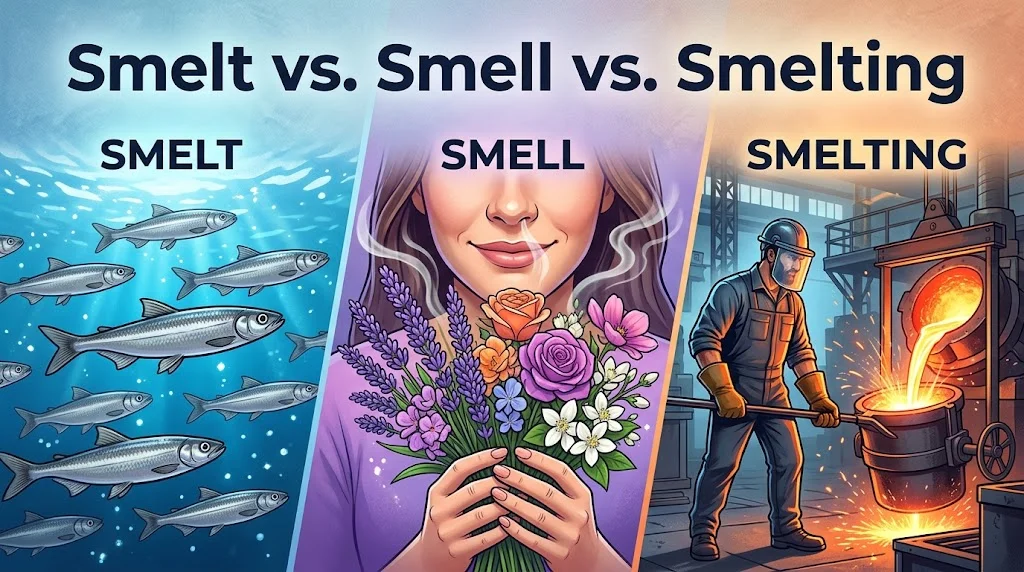
The words smelt, smell, and smelting are closely related in spelling, but their meanings and grammatical functions differ. Recognizing these differences helps prevent mistakes in conversation, essays, technical reports, and other forms of writing.
Smell is the base form of a verb associated with detecting or producing an odor. Smelt can be its past tense, but it also names a type of fish and serves as the base form of a verb meaning to extract metal from ore. Smelting is the -ing form of that metalworking verb.
Smell: The Base Form of the Verb
Use smell when describing an odor in the present, discussing a general experience, or forming a sentence with an auxiliary verb such as did.
Examples:
- “I smell fresh coffee.”
- “Flowers smell wonderful in the spring.”
- “Did you smell the smoke?”
- “I didn’t smell anything unusual.”
The word can also function as a noun, as in “The smell of fresh bread filled the kitchen.” In that sentence, smell names an odor rather than an action.
Smelt: A Past-Tense Verb, a Fish, or an Extraction Verb
The meaning of smelt depends on its grammatical role and context.
As the past tense of smell, it appears in sentences such as “I smelt smoke outside.” As a noun, it identifies a fish: “The fishermen caught smelt.” As the base form of the metallurgical verb, it describes extraction: “The factory can smelt copper-bearing ore.”
These meanings are unrelated in everyday use, so context is essential. Words such as smoke, fish, and ore usually make the intended meaning clear.
Smelting: The Process of Extracting Metal
Smelting is the present participle or gerund form of the verb smelt in its metallurgical sense.
Examples include:
- “The company is smelting copper-bearing material.”
- “Smelting requires suitable industrial equipment.”
- “The report examines the environmental effects of smelting.”
In the first example, smelting forms part of the progressive verb phrase “is smelting.” In the second and third, it functions as a noun-like term describing the process.
Notice that smelting does not ordinarily mean detecting an odor. For that meaning, use forms of smell, such as smelling: “She is smelling the flowers.”
Comparison Table: Smell, Smelt, and Smelting
| Word | Main grammatical role | Meaning | Example |
| Smell | Verb or noun | Detect an odor; an odor | I smell smoke. |
| Smelt | Past-tense verb or noun | Detected an odor; a fish | I smelt smoke. |
| Smelt | Verb | Extract metal from ore | They smelt copper. |
| Smelting | Gerund or present participle | The process of extracting metal | Smelting uses industrial equipment. |
| Smelling | Gerund or present participle | Detecting or producing an odor | She is smelling the flowers. |
How to Remember the Difference
A simple way to remember these words is to connect each one with a familiar example.
- Smell: “I smell fresh bread.”
- Smelt: “I smelt fresh bread yesterday.”
- Smelting: “The plant is smelting copper.”
- Smelt as a noun: “We ordered smelt for dinner.”
If the sentence concerns an odor, think about the verb smell. If it concerns extracting metal, look for words related to ore, furnaces, and metallurgy. If it concerns seafood or aquatic life, smelt may refer to the fish.
These distinctions are particularly useful for English learners because they show how one spelling can have several meanings. Instead of memorizing isolated definitions, learn the word in a complete sentence and pay attention to the surrounding vocabulary.
Smelt Meaning in American and British English
The word smelt appears in both American and British English, but its frequency and familiarity vary according to its meaning.
When used as the past tense of smell, smelt is commonly associated with British English, while smelled is especially common in American English. Both forms are correct. When smelt refers to a fish or a metallurgical process, the distinction is different because those are separate meanings rather than alternative past-tense forms.
Smelt and Smelled in American English
American English commonly uses smelled as the past tense and past participle of smell.
For example:
- “I smelled smoke in the hallway.”
- “She smelled the roses in the garden.”
- “The room smelled damp.”
- “Have you smelled this perfume before?”
These sentences are standard in American English and work well in school assignments, professional communication, and general writing.
American English also uses smelt in appropriate contexts. For example, the fish can be called smelt, and the verb smelt is used in metallurgy. Therefore, it would be incorrect to claim that the word itself is exclusively British.
Smelt and Smelled in British English
British English commonly uses both smelt and smelled as forms of the verb smell. The form smelt is particularly familiar in British usage.
Examples include:
- “I smelt smoke coming from the kitchen.”
- “She smelt the flowers before buying them.”
- “The room smelt damp after the rain.”
- “We smelt fresh bread from the bakery.”
These sentences are natural in British English. However, smelled is also correct and is not automatically an Americanism or a grammatical error.
The best choice depends on your writing style, audience, and preferred variety of English.
Which Form Should You Choose?
If you’re writing an article for an American audience, smelled is usually a practical default for the past tense of smell. If you’re writing in British English and prefer traditional British usage, smelt may feel more natural.
For example:
American English: “I smelled smoke outside.”
British English: “I smelt smoke outside.”
Both sentences are correct and communicate the same basic meaning.
For an international audience, either form is understandable. Consistency is generally more important than insisting on one form in every context.
Remember that the fish-related meaning and the metallurgical meaning of smelt are not simply regional alternatives to smelled. Their meanings remain distinct regardless of whether you’re writing in American or British English.
Synonyms and Related Words for Smelt
Choosing a synonym for smelt requires understanding which meaning you intend. Because the word can describe a past sensory experience, name a fish, or refer to metal extraction, no single synonym works in every context.
A suitable replacement should preserve the sentence’s meaning and grammatical structure.
Synonyms for Smelt as the Past Tense of Smell
When smelt means detected an odor, smelled is the closest direct alternative. Other words may work in particular situations, but they often introduce a slightly different meaning.
| Word or phrase | Meaning or use | Example |
| Smelled | Alternative past-tense form | I smelled smoke. |
| Detected an odor | Emphasizes noticing a smell | She detected an odor of gas. |
| Sensed a smell | Emphasizes perception | He sensed a strange smell. |
| Noticed an odor | Emphasizes awareness | We noticed an odor near the door. |
| Sniffed | Means inhaled through the nose, often deliberately | The dog sniffed the bag. |
These expressions are not perfectly interchangeable. For example, sniffed describes an action performed with the nose, while smelt can describe noticing an odor without deliberately sniffing.
Similarly, detected an odor sounds more formal and may be useful in technical or investigative writing. In everyday conversation, smelled or smelt is usually more natural.
Related Words for Smelt as a Fish
When smelt refers to a fish, the most accurate alternatives are usually the specific species name or a broader expression such as small fish, provided the description fits the context.
For example:
- “The fishermen caught smelt.”
- “The fishermen caught a small silvery fish.”
The second sentence describes the animal more generally, but it doesn’t necessarily identify it as a smelt. Not every small, silvery fish is a smelt.
If precision matters, use the correct species name rather than replacing smelt with a vague term. This is especially important in scientific writing, fishing regulations, seafood labeling, and ecological discussions.
Synonyms and Related Terms for Smelt in Metalworking
In metallurgy, the closest alternatives depend on the exact process being described.
| Word or phrase | How it differs |
| Extract | A broad term for obtaining a substance from a source |
| Recover | Emphasizes obtaining a material from an ore or another source |
| Refine | Means purifying a material after extraction or production |
| Melt | Means changing a solid into a liquid |
| Process ore | A broad phrase covering several operations used to recover valuable materials |
These words have related meanings, but they are not exact substitutes for smelt.
For example, a company may extract copper from ore through several stages, including smelting and refining. Replacing every occurrence of smelt with refine could therefore change the technical meaning.
Similarly, melt refers to a phase change and does not necessarily involve extracting metal from ore.
How to Choose the Right Synonym
Before replacing smelt, identify its meaning in the sentence.
If you’re describing a past sensory experience, smelled is usually the simplest alternative. If you’re naming a fish, use a precise species name only when you know it. If you’re discussing metal production, choose a technical term that accurately describes the operation.
For example, “I smelt smoke” can become “I smelled smoke” without changing the basic meaning. However, “The plant smelts copper from ore” should not automatically become “The plant melts copper from ore,” because melting and smelting describe different processes.
The best synonym is the one that preserves the intended meaning, not simply the one that looks or sounds similar.
Common Mistakes When Using Smelt
Although smelt has several legitimate meanings, writers sometimes use it incorrectly because they confuse its grammatical forms or assume that it always refers to the same thing. Understanding the context and sentence structure helps you avoid these errors.
Mistaking Smelt for an Incorrect Word
One common mistake is assuming that smelt is always incorrect American English. In reality, smelt is a valid word in American and British English. It can refer to the past tense of smell, a type of fish, or the process of extracting metal from ore.
For example, “I smelt something burning” is grammatically correct, although “I smelled something burning” is generally more common in American English.
Better approach: Consider the intended meaning and your audience before deciding whether smelt is appropriate.
Confusing Smelt and Smelled
Another frequent mistake is treating smelt and smelled as if one must be wrong. Both forms can function as the past tense and past participle of smell.
For example:
- Correct: “I smelled smoke yesterday.”
- Correct: “I smelt smoke yesterday.”
- Incorrect: “I did smelt smoke yesterday.”
The third sentence is incorrect because did takes the base form of the verb, not its past-tense form.
The correct version is “I did smell smoke yesterday.”
This rule also applies to negative sentences. Write “She didn’t smell anything unusual,” rather than “She didn’t smelt anything unusual.”
Using Smelt When You Mean Smelting
Some writers confuse smelt with smelting. Although both relate to metal extraction, they serve different grammatical purposes.
Consider these examples:
- “The factory smelts copper from ore.”
- “The factory is smelting copper from ore.”
- “The factory smelted copper from ore last year.”
The first sentence uses smelts for a present-tense action. The second uses smelting after the auxiliary verb is. The third uses smelted as the past tense of the metallurgical verb.
Remember that the metalworking verb generally follows the regular pattern smelt, smelted, smelted. Don’t assume that its past tense must be identical to the past tense of smell.
Confusing Smelting With Melting
Smelting and melting are related to heat, but they don’t mean the same thing. Melting changes a solid into a liquid, whereas smelting is a process used to extract metal from ore or other metal-bearing material.
For example:
- “The workers melted the aluminum to make new parts.”
- “The facility smelts copper-bearing ore.”
The first sentence describes a change in physical state. The second describes metal extraction.
Using smelt when you mean melt can make a technical explanation inaccurate. Choose the word that describes the actual process.
Ignoring Context When Smelt Refers to a Fish
The word smelt can also be a noun referring to a type of fish. Readers can usually identify this meaning from surrounding words such as fishing, catch, seafood, or cook.
For example, “We caught smelt during our fishing trip” refers to fish, not an odor or an industrial process.
If a sentence could have more than one interpretation, add enough detail to make the intended meaning clear.
How to Use Smelt Correctly in a Sentence
The easiest way to use smelt correctly is to identify its meaning before constructing the sentence. Once you know whether it refers to an odor, a fish, or metal extraction, choosing the right grammatical form becomes much easier.
Using Smelt in Past-Tense Sentences
When smelt means detected an odor, it describes an experience or observation that occurred in the past. This usage is particularly familiar in British English, although it is also correct in American English.
Examples:
- “I smelt fresh coffee when I entered the kitchen.”
- “She smelt smoke coming from the garage.”
- “We smelt flowers as we walked through the garden.”
- “He smelt something unusual in the room.”
In American English, you can generally use smelled in these sentences instead.
For example, “I smelled fresh coffee when I entered the kitchen” communicates the same basic idea.
Using Smelt in Questions and Negative Sentences
When you use did to form a question or negative sentence, the main verb returns to its base form, smell.
Examples:
- “Did you smell the smoke?”
- “I didn’t smell anything strange.”
- “Did she smell the flowers?”
- “They didn’t smell the food before serving it.”
Avoid constructions such as “Did you smelt it?” and “I didn’t smelt anything.” In standard English, the correct forms are “Did you smell it?” and “I didn’t smell anything.”
This grammatical rule applies regardless of whether you generally prefer smelt or smelled in affirmative past-tense sentences.
Using Smelt as a Noun
When smelt refers to a fish, it typically appears in sentences about fishing, food, aquatic life, or marine environments.
Examples:
- “The fishermen caught smelt near the shore.”
- “Smelt are often prepared as a seafood dish.”
- “We ordered fried smelt at the restaurant.”
- “Researchers studied the smelt population in the lake.”
The plural form depends on the species and context. Smelt is commonly used as both singular and plural, while smelts also occurs in some contexts.
Using Smelt in Metalworking Sentences
When smelt means extracting metal from ore, it functions as a verb. Its form changes according to the subject and tense.
Examples:
- “The company smelts copper from ore.”
- “The plant will smelt the material next month.”
- “The workers smelted the ore last year.”
- “The facility has smelted metal for several decades.”
Notice that the metallurgical verb commonly uses smelted for both its past tense and past participle. The appropriate form depends on the sentence’s grammatical structure.
For instance, “The facility has smelted copper” uses the present perfect, while “The facility smelts copper” uses the simple present.
A Quick Checklist for Correct Usage
Before using smelt, check these points:
- Meaning: Are you describing an odor, a fish, or metal extraction?
- Tense: Are you discussing the past, present, or an ongoing process?
- Grammar: Does an auxiliary verb require the base form smell?
- Audience: Would smelt or smelled be more natural for your readers?
- Precision: If you’re discussing metal production, do you mean smelting or simply melting?
Following these checks will help you write sentences that are clear, natural, and grammatically accurate.
Practical Examples: Understanding Smelt Through Context
Examples are particularly helpful because smelt has multiple meanings. The same spelling can describe an experience involving an odor, identify a fish, or refer to a technical process in metal production. The surrounding words usually reveal which meaning is intended.
Everyday Examples: Smelt as the Past Tense of Smell
Consider these sentences:
Example 1: “I smelt something burning in the kitchen.”
Here, smelt means detected an odor. The speaker noticed a burning smell in the past. In American English, “I smelled something burning in the kitchen” is also natural and often more common.
Example 2: “She smelt the perfume before buying it.”
The sentence describes a past action involving the sense of smell. The speaker deliberately smelled the perfume to assess its scent.
Example 3: “We smelt fresh bread as we passed the bakery.”
In this example, smelt describes noticing an odor while walking past a bakery. The sentence can also be written with smelled without changing its basic meaning.
Food and Wildlife Examples: Smelt as a Fish
Example 4: “The fishermen brought home a bucket of smelt.”
In this sentence, smelt is a noun referring to fish caught during a fishing trip. It has nothing to do with detecting an odor.
Example 5: “The restaurant served fried smelt with lemon.”
Here, the word identifies a seafood item on a menu. The cooking method and reference to lemon help make the meaning clear.
Example 6: “Scientists monitored the smelt population in the lake.”
This sentence uses smelt in an ecological context. The researchers are studying a fish population, not a smell or an industrial process.
Industrial Examples: Smelt as a Metallurgical Verb
Example 7: “The facility smelts copper from ore.”
The verb smelts describes the extraction of copper from ore. The subject is a facility, and the sentence uses the simple present tense to describe its operation.
Example 8: “The company smelted the ore before refining the metal.”
In this sentence, smelted is the past tense of the metallurgical verb. The sentence also distinguishes smelting from refining, which involves further processing or purification.
Example 9: “The report examines the environmental impact of smelting.”
Here, smelting is a noun-like form referring to the metal-extraction process. The sentence focuses on the process’s environmental consequences.
Comparing Similar Sentences
The following examples show how context changes the meaning of smelt.
| Sentence | Meaning |
| “I smelt smoke outside.” | I detected an odor in the past. |
| “We caught smelt in the river.” | We caught a type of fish. |
| “The plant smelts copper.” | The plant extracts copper from ore. |
| “The workers melted the copper.” | The workers changed solid copper into liquid copper. |
| “The factory is smelting ore.” | The factory is carrying out a metal-extraction process. |
These examples also show why smelt and melt should not be used interchangeably in technical writing. A factory that melts copper may be preparing existing metal for casting, while a facility that smelts ore is carrying out an extraction process.
Practice: Choose the Correct Form
Try choosing the correct word for each sentence before checking the answers.
- “I ___ smoke coming from the basement yesterday.” (smelt or smelting)
- “Did you ___ anything unusual?” (smelt or smell)
- “The factory ___ copper from ore.” (smelts or smelling)
- “We ordered fried ___ at the restaurant.” (smelt or smelled)
- “The workers ___ the aluminum to make new parts.” (melted or smelted, assuming they were only changing solid aluminum into liquid aluminum)
Answers:
- Smelt is correct, although smelled is also acceptable.
- Smell is correct because did takes the base form.
- Smelts is correct for the simple present tense.
- Smelt is correct because the sentence refers to fish.
- Melted is correct because the sentence describes a physical change rather than extracting metal from ore.
Final Tip for Remembering Smelt
When you encounter smelt, don’t judge its meaning from spelling alone. Look at the sentence and ask what the writer is describing. An odor points toward the verb smell, a seafood or wildlife context may indicate the fish, and references to ore or metal production usually signal the metallurgical verb.
Once you recognize these three meanings, you’ll be able to interpret smelt accurately and use it with greater confidence in everyday, academic, and technical writing.
Conclusion
Understanding the meaning of smelt becomes much easier when you consider the context in which it appears. The word has three main uses: it can be the past tense of smell, refer to a small type of fish, or describe the process of extracting metal from ore. Recognizing these meanings helps you avoid confusion and choose the right words when speaking or writing.
If you’re discussing an odor, remember that both smelt and smelled are correct past-tense forms, although smelled is more common in American English. When discussing metal production, distinguish smelting from melting, because these terms describe different processes. Meanwhile, references to fishing or seafood usually indicate the fish.
With practical examples, clear definitions, and the right context, you can use smelt confidently in everyday conversations, academic writing, and technical discussions. Understanding these distinctions will strengthen your vocabulary and help you communicate more precisely.
FAQs
What does smelt mean in English?
Smelt has three main meanings in English. It can be the past tense of smell, meaning detected an odor. It can also refer to a small fish or serve as a verb meaning to extract metal from ore through a metallurgical process. The surrounding words usually make the intended meaning clear.
Is smelt the past tense of smell?
Yes, smelt is a correct past-tense form of smell. For example, “I smelt smoke coming from the kitchen” describes noticing an odor in the past. The alternative form smelled is also correct. Which form sounds more natural often depends on regional preference, with smelled particularly common in American English.
Is smelt or smelled correct?
Both smelt and smelled are correct when used as the past tense or past participle of smell. British English commonly uses both forms, while American English generally favors smelled. Neither form is universally wrong. Choose the one that suits your audience, and maintain consistency throughout your writing.
What is the difference between smelt and smell?
Smell is the base form of a verb meaning to detect or produce an odor, and it can also be a noun referring to an odor. Smelt is a past-tense form of smell. It can also name a type of fish or describe extracting metal from ore, depending on the context.
What does smelt mean as a noun?
As a noun, smelt refers to a type of small fish found in various coastal and freshwater environments, depending on the species. Smelt are also used as food and may be fried or prepared in other ways. In sentences about fishing, seafood, or aquatic wildlife, this is often the intended meaning.
What does smelt mean in metalworking?
In metalworking, smelt means to extract metal from ore or other metal-bearing material through a metallurgical process. Smelting commonly involves high temperatures and chemical reactions that help separate the desired metal from unwanted components. It is an important process in producing certain metals, including copper and iron, from their source materials.
What is the difference between smelting and melting?
Melting changes a solid into a liquid through heat. Smelting, however, is a metallurgical process used to extract metal from ore or metal-bearing material. Although smelting may involve molten substances, the terms are not interchangeable. Melting existing metal for casting is different from extracting metal through smelting.
Is smelt used in American English?
Yes, smelt is used in American English, particularly when referring to the fish or the metal-extraction process. As the past tense of smell, it is also grammatically correct, although smelled is generally more common in the United States. The appropriate form depends on the intended meaning and context.
What are some synonyms for smelt?
The best synonym depends on the meaning. When smelt refers to detecting an odor, smelled is the closest alternative, while phrases such as “noticed an odor” may also work. In metalworking, “extract metal from ore” can explain the meaning. When smelt refers to a fish, a precise species name may be appropriate.
How do you use smelt correctly in a sentence?
First, identify the intended meaning. For example, “I smelt smoke yesterday” uses smelt as the past tense of smell. “We caught smelt” refers to fish, while “The plant smelts copper from ore” describes metal extraction. Context and grammar help you select the correct form and avoid confusing similar words.