
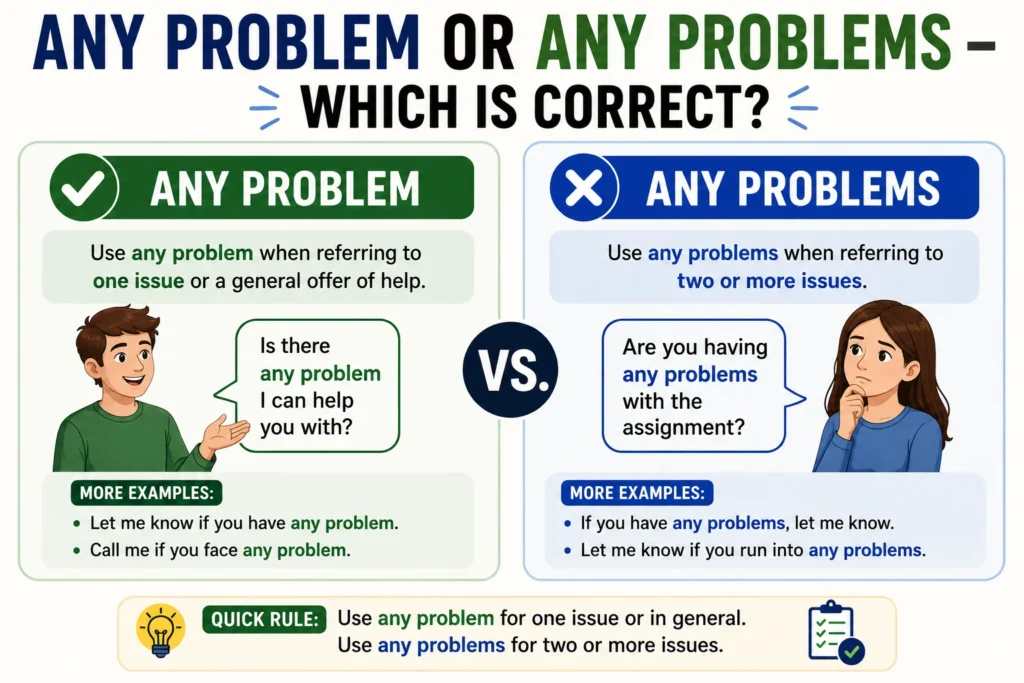
If you’re wondering whether to say “any problem” or “any problems,” you’re dealing with a small grammar choice that can change the meaning and naturalness of a sentence. The good news is that both forms can be correct. However, they don’t work in the same situations. In everyday American English, “any problems” is usually the better choice when you’re asking whether someone has encountered difficulties. “Any problem” can also be correct, but it normally appears in a different grammatical setting or carries a more specific meaning.
The key lies in understanding how any works with countable nouns. The word problem is a countable noun because you can talk about one problem, two problems, several problems, or many problems. English allows any to work with plural countable nouns in ordinary questions and negative statements. It can also work with singular countable nouns when it carries its stronger meaning of “it doesn’t matter which.”
Quick Answer: Is It “Any Problem” or “Any Problems”?
For a general question about difficulties, “any problems” is usually the natural choice.
For example:
“Are there any problems with the new software?”
Here, the speaker doesn’t know whether the person has experienced one problem, several problems, or none at all. The plural problems leaves the number open.
You’ll see the same pattern in everyday questions:
- “Did you have any problems?”
- “Are you having any problems?”
- “Did the installation cause any problems?”
- “Were there any problems during the meeting?”
- “Do you have any problems with your account?”
In each case, the speaker is asking about possible difficulties in general.
By contrast, “any problem” becomes natural when the sentence uses any in a different sense or construction. Consider:
“If any problem occurs, contact us immediately.”
This sentence refers to any individual problem that might occur. The idea isn’t simply “one problem instead of several.” Instead, any has the sense of any one possible problem, regardless of which one it is.
Cambridge Dictionary makes this distinction explicitly. Its grammar guidance describes a weak form of any for indefinite quantities in questions and negative sentences, while its strong form means roughly “it does not matter which or what.” The weak form normally goes with plural countable nouns or uncountable nouns, whereas the strong form can modify singular countable nouns as well.
So, rather than memorizing a rigid rule such as “always use any problems,” remember the meaning behind the sentence.
| Expression | Typical meaning | Example |
| any problems | One or more possible difficulties | “Are there any problems?” |
| any problem | Any individual problem or an unrestricted choice | “If any problem occurs, report it.” |
| any problems | Broad question about difficulties | “Did you have any problems?” |
| any problem | A singular possibility in a suitable construction | “Any problem with the equipment should be reported.” |
The safest everyday choice is simple: if you’re asking broadly whether something went wrong, “any problems” will usually sound natural.
The Short Rule You Need to Remember
Here’s the practical rule:
Use “any problems” when you’re asking about one or more possible difficulties.
“Are there any problems with the order?”
Use “any problem” when the sentence refers to any individual problem or uses any to mean that the particular choice doesn’t matter.
“If any problem occurs, call the technician.”
There’s another useful clue: look at the verb.
- Is there any problem?
- Are there any problems?
The singular noun problem takes the singular verb is. The plural noun problem takes the plural verb are.
Therefore:
- “Is there any problem?” → grammatically structured around singular problem
- “Are there any problems?” → grammatically structured around plural problems
- “Is there any problems?” → incorrect because is and problems do not agree
- “Are there any problem?” → incorrect because are and problem do not agree
That agreement rule is straightforward. The harder part is deciding whether the noun should be singular or plural in the first place.
In ordinary conversation, plural problems often win because people usually ask whether a person has encountered any difficulties at all. They aren’t trying to identify one specific problem before the conversation begins. They’re opening the door for the listener to mention whatever went wrong.
Think of it like opening a toolbox. If you ask, “Did you have any problems?”, you’re asking the other person to show you anything that needs fixing. You aren’t limiting the answer to one item.
Why Both Forms Can Be Correct

At first glance, any problem and any problems may look like interchangeable versions of the same phrase. They aren’t.
The difference comes from the grammar and meaning of any.
English uses any in questions and negative statements to talk about an indefinite amount or number. For example:
“Do you have any questions?”
The speaker doesn’t know whether the listener has zero questions, one question, or several questions. The plural questions makes that open-ended meaning natural.
Likewise:
“We didn’t find any problems.”
The sentence means that the people checking something found zero problems. The plural noun fits the idea of an unspecified number of possible problems.
Cambridge explains that this ordinary, or weak, form of any is used with plural countable nouns and uncountable nouns in questions and negative sentences. It specifically notes that this use does not normally take a singular countable noun.
That gives us an important distinction:
“Did you notice any problems?”
Natural ordinary question.
But:
“Did you notice any problem?”
Usually unnatural if the intended meaning is simply “Did you notice any problems?”
However, English also has another use of any. In its strong form, any can mean “it doesn’t matter which one.” This form can modify a singular countable noun.
For example:
“Choose any problem from the list.”
Here, the speaker isn’t asking whether problems exist. The speaker is telling you that you may choose whichever problem you want. The particular problem doesn’t matter.
The same pattern appears in familiar expressions:
- “Any student can apply.”
- “You can choose any book.”
- “Take any seat.”
- “Ask any question.”
- “Choose any problem.”
In these examples, any has a broader “whichever one you want” meaning.
That is why a simple statement such as “any always requires a plural noun” would be misleading. The grammar depends on which meaning of any the sentence expresses. Cambridge’s grammar reference confirms that strong any can be used with singular countable nouns, plural countable nouns, and uncountable nouns.
A Useful Comparison
Compare these two sentences:
“Are there any problems with the website?”
“Choose any problem on the website.”
The first sentence asks about an unknown number of possible difficulties. The second allows the reader to select whichever individual problem they prefer.
That’s the heart of the issue.
| Sentence | What any means |
| “Are there any problems?” | One or more possible problems |
| “I didn’t find any problems.” | Zero problems |
| “Choose any problem.” | Whichever problem you want |
| “If any problem occurs…” | Any individual problem that may occur |
| “Do you have any problems?” | Any difficulties you may be experiencing |
Once you understand that distinction, the choice becomes much easier.
What Does “Any” Mean in English Grammar?
Any is a versatile word. It can function as a determiner before a noun and as a pronoun when the noun is understood from context. It commonly appears when the speaker doesn’t know the amount, number, or identity of something.
Consider:
“Do you have any questions?”
The speaker doesn’t know how many questions exist. There could be none, one, or ten.
Now compare:
“You can ask any question.”
This time, the speaker doesn’t mean an unknown number. The listener may ask whichever question they choose.
Those two meanings look similar on the surface, but English treats them differently.
How “Any” Works With Countable Nouns
A countable noun names something that English treats as an individual item that can be counted. Such nouns normally have both singular and plural forms.
For example:
- one problem
- two problems
- one question
- three questions
- one issue
- several issues
Cambridge defines countable nouns as nouns that can have singular and plural forms and can refer to one or more countable items.
The word problem clearly belongs to this group.
You can say:
- a problem
- one problem
- two problems
- many problems
- several problems
- these problems
- any problems
Because problem is countable, number matters. You must decide whether the sentence treats the noun as singular or plural.
This becomes especially important with any because its ordinary weak form behaves differently from its strong form.
The Ordinary Use of “Any”
In questions and negative statements, any commonly refers to an indefinite quantity or number.
Examples:
“Are there any problems?”
“I don’t have any problems.”
“Did you notice any errors?”
“We didn’t find any errors.”
Here, the exact number isn’t known or isn’t important. The speaker simply wants to know whether one or more items exist.
That’s why plural countable nouns fit so naturally after any in these sentences.
The Strong Use of “Any”
Now consider:
“You can choose any problem.”
Here, any means that the particular problem doesn’t matter. The speaker isn’t asking whether there are problems. The speaker is giving unrestricted choice.
This distinction appears in many areas of English:
“Any employee can apply.”
“Any customer can request a refund.”
“Take any seat.”
“Choose any example.”
The singular noun works because any has the “whichever one” meaning.
Using “Any” in Singular Contexts
Singular any + countable noun deserves careful attention because it’s where many grammar explanations become too simplistic.
You may have heard a rule such as:
“Never use any with a singular countable noun.”
That rule is too broad.
The more accurate rule is that the weak form of any, used for indefinite quantities in ordinary questions and negatives, does not normally modify a singular countable noun. However, the strong form of any, meaning “it doesn’t matter which,” can modify one.
For example:
“Choose any problem you like.”
This is perfectly natural because the speaker means whichever problem you like.
Another example:
“Any student can participate.”
This doesn’t mean that several students participate. It means every individual student is eligible, with no particular student excluded.
The same logic applies to:
“If any problem occurs, contact the help desk.”
The writer isn’t asking whether several problems exist. The instruction applies whenever a problem of any kind occurs.
Why “Any Problem” Can Feel Unusual in Questions
Now compare that with:
“Did you have any problem?”
Many American English speakers will find this less natural than:
“Did you have any problems?”
Why?
Because the first sentence appears to use any as an indefinite quantity marker, but then pairs it with a singular countable noun. That combination doesn’t normally fit the ordinary weak use of any.
The plural version avoids that problem:
“Did you have any problems?”
It naturally asks whether the person experienced one or more difficulties.
This is one reason learners should avoid translating sentence patterns word for word from another language. English determiners follow their own patterns, and a direct translation may produce a sentence that is understandable but less natural.
Using “Any” in Plural Contexts
Plural any + countable noun is extremely common in ordinary questions and negative statements.
Consider these examples:
- “Are there any problems?”
- “Did you have any problems?”
- “Are you experiencing any problems?”
- “We didn’t encounter any problems.”
- “I haven’t noticed any problems.”
The plural tells the listener that the speaker is leaving the number open. Maybe there is one problem.Maybe there are five.Maybe there aren’t any.
The speaker doesn’t know yet.
That’s exactly the kind of uncertainty that ordinary any handles well.
Cambridge’s grammar guidance gives the same general pattern: weak any refers to indefinite quantities and occurs with plural countable nouns or uncountable nouns in questions and negative sentences.
Why “Any Problems?” Sounds So Natural
English conversation often shortens questions when the missing words are obvious.
For example:
“Any problems?”
This can stand for:
“Are there any problems?”
The shorter version feels quick and conversational. A manager might say it after assigning a task. A technician might ask it after installing software. A teacher might ask it after explaining a difficult concept.
The listener understands the intended meaning from the situation.
Compare:
“Any problems?”
with:
“Any problem?”
The plural sounds much more natural when the speaker is simply checking whether anything has gone wrong.
That’s not because plural problems is always “more correct.” It’s because the conversational meaning usually involves possible difficulties in general, which naturally calls for the plural construction.
Why Context Matters More Than a Memorized Rule
Grammar rules help you get started, but context often decides the final choice.
Imagine a technician has just installed a new printer.
The technician asks:
“Are you having any problems with it?”
That sounds natural because the technician wants to know whether the user has encountered any difficulties at all.
Now imagine a manual that says:
“If any problem occurs, restart the printer.”
That sentence has a different structure. The manual describes what to do if any individual problem occurs.
Neither sentence needs to be forced into the other pattern.
The Best Question to Ask Yourself
When you’re unsure, ask:
“Am I asking about possible difficulties in general, or am I referring to any individual example?”
If you’re asking about possible difficulties generally, any problems will often be the right choice.
If you’re referring to an unrestricted individual example, any problem can be appropriate.
This simple test is more useful than memorizing a rule that says one form is always right.
A Quick Mental Comparison
| If you mean… | Use… | Example |
| one or more possible difficulties | any problems | “Did you have any problems?” |
| whether difficulties exist generally | any problems | “Are there any problems?” |
| any individual problem that might occur | any problem | “If any problem occurs, call us.” |
| whichever problem you choose | any problem | “Choose any problem from the list.” |
| zero difficulties | any problems with a negative | “We didn’t have any problems.” |
The distinction may seem small, but it gives your writing much greater precision.
And once you stop treating any problem and any problems as simple interchangeable alternatives, the grammar becomes far less confusing.
When to Use “Any Problem” and “Any Problems”
The most useful way to choose between “any problem” and “any problems” is to stop treating them as simple singular and plural alternatives. Instead, look at what the sentence actually means. In ordinary questions about difficulties, “any problems” is usually the natural construction. English grammar references explain that the weak form of any normally combines with plural countable nouns in questions and negative sentences. The singular form becomes possible when any has its stronger meaning of “it doesn’t matter which” or when the sentence has a particular construction that supports singular reference.
That distinction becomes much easier once you see the forms working in real sentences. “Are there any problems?” asks whether difficulties exist. “Choose any problem from the list” gives you freedom to select whichever individual problem you want. Both sentences use any, but they use it differently.
When to Use “Any Problem”
Referring to Any Individual Possible Issue
“Any problem” can work when the sentence refers to an individual problem without specifying which problem it will be. The word any then carries the sense of “whichever one” or “any one that meets the condition.”
Consider this sentence:
“If any problem occurs, contact the support team.”
The instruction doesn’t necessarily predict several problems. It says that if one problem of any kind occurs, the reader should take action.
The same pattern appears in:
- “If any problem arises, let us know.”
- “Any problem with the equipment should be reported.”
- “If any problem develops, stop using the machine.”
- “Any problem affecting the service should be investigated.”
These sentences are particularly common in instructions, policies, technical documentation, warnings, procedures, and formal communication.
The meaning becomes clearer if you replace any with “whichever”:
“If whichever problem occurs, contact the support team.”
That replacement sounds awkward in normal English, but it helps reveal the underlying idea. The writer isn’t asking about an unknown number of problems. The writer is covering any individual problem that might occur.
“Any Problem” in Conditional Sentences
Conditional sentences are one of the most useful places to understand singular any.
Look at these examples: “If any problem occurs, restart the device.”“If any problem arises during installation, contact the technician.”“If any problem develops, stop the process immediately.”
The structure is:
if + any + singular noun + singular verb
Notice the agreement:
- any problem occurs
- any problem arises
- any problem develops
The singular noun problem takes a singular verb.
This construction works because the sentence considers an individual possible event. The exact problem isn’t known, but the instruction applies to any one that might arise.
Cambridge’s grammar guidance gives the broader rule behind this usage: strong any can modify singular countable nouns when it means that the particular choice isn’t limited or doesn’t matter.
“Any Problem” in Instructions and Policies
Technical and professional writing often needs to describe a rule that applies regardless of which particular issue appears.
For example:
“Any problem affecting customer data must be reported immediately.”
Here, any problem means that no particular type of problem has been excluded. The rule applies to an individual problem if one occurs.
Other examples include:
- “Any problem with the payment system must be reported.”
- “Any problem identified during testing should be documented.”
- “Any problem involving unauthorized access requires immediate review.”
- “Any problem that affects safety must be addressed.”
These sentences aren’t asking a question. They’re establishing a condition or requirement.
That difference matters.
Compare:
“Are there any problems with the payment system?”
with:
“Any problem with the payment system must be reported.”
The first asks whether one or more problems exist. The second establishes a rule that applies to any individual problem that meets the condition.
When “Any Problem” Is Not the Best Choice
Now consider:
“Did you have any problem during your trip?”
A reader can understand it, but in everyday American English, “Did you have any problems during your trip?” will usually sound more natural.
Why?
Because the speaker is asking about possible difficulties in general. The question leaves the number open. The traveler may have experienced one issue, several issues, or none.
The plural construction handles that meaning naturally:
“Did you have any problems during your trip?”
This follows the standard weak-any pattern used with plural countable nouns in questions.
So don’t use “any problem” simply because you believe any means “one.” That shortcut creates awkward sentences. The important question is what kind of meaning the sentence expresses.
When to Use “Any Problems”
Referring to One or More Possible Difficulties
Use “any problems” when you’re asking whether someone encountered difficulties without knowing how many there might be.
For example:
“Did you have any problems with the installation?”
The speaker doesn’t assume there was exactly one problem. The question allows for:
- no problems
- one problem
- two problems
- several problems
That’s why the plural works so well.
You can see the same pattern in:
“Are there any problems with the order?”
“Did you notice any problems?”
“Are you experiencing any problems with your account?”
“Were there any problems during the meeting?”
“We didn’t encounter any problems.”
In each example, the speaker treats the possible difficulties as an open set. The exact number remains unknown.
Why the Plural Is So Natural in Questions
English speakers frequently use plural countable nouns after any in questions because the speaker doesn’t know whether the answer involves one item, multiple items, or none.
Oxford Learner’s Dictionaries gives the same basic pattern for countable nouns: any commonly occurs with plural countable nouns in negative sentences and most questions.
Consider:
“Have you got any questions?”
The listener might have:
- zero questions
- one question
- five questions
The speaker doesn’t need to know beforehand.
The same logic applies to problems:
“Do you have any problems?”
The answer could be:
“No, everything works fine.”
Or:
“Yes, I have one problem.”
Or:
“Yes, there are a few problems with the system.”
The question works for all three answers.
That’s one reason “any problems” is such a useful construction.
“Any Problems?” as a Short Question
In everyday conversation, you may hear:
“Any problems?”
This is a shortened form of a longer question such as:
“Are there any problems?”
The shorter version is quick and natural because the surrounding context supplies the missing words.
Imagine a supervisor has just explained a new procedure. Afterward, they might ask:
“Any problems?”
The meaning is immediately clear.
A customer-service representative might say:
“Any problems with the new login?”
A teacher might ask:
“Any problems with that question?”
A technician might ask:
“Any problems after the update?”
These aren’t careless fragments. They’re normal examples of conversational English.
Why “Any Problems?” Is Often Better Than “Any Problem?”
Suppose your friend has just returned from a long trip.
You could ask:
“Any problems?”
That sounds natural and open-ended.
But:
“Any problem?”
sounds unusual unless the context has already established a specific problem or the speaker is using a special singular construction.
The difference comes down to what the question is trying to discover.
“Any problems?” means something like:
“Did anything go wrong?”
It doesn’t require the speaker to predict how many difficulties occurred.
That’s exactly what the plural form communicates.
“Is There Any Problem?” vs. “Are There Any Problems?”
This pair causes a huge amount of confusion because both sentences can appear grammatical, but they don’t always serve the same purpose.
Is “Is There Any Problem?” Correct?
Yes, “Is there any problem?” can be grammatically correct. However, it isn’t automatically the best choice for every situation.
The singular structure focuses on problem as a singular noun.
For example:
“Is there any problem with this proposal?”
This can work when the speaker is treating the proposal as having a possible specific issue.
However, if the speaker wants to ask broadly whether anything is wrong, many American English speakers would naturally say:
“Are there any problems with this proposal?”
The plural version makes the open-ended nature of the question clearer.
Is “Are There Any Problems?” Correct?
Absolutely.
“Are there any problems with the proposal?”
This is a straightforward plural construction. Problems is plural, so are is the matching verb.
The same pattern appears in:
- “Are there any problems with the software?”
- “Are there any problems with your order?”
- “Are there any problems with the schedule?”
- “Are there any problems we should discuss?”
- “Are there any problems with the instructions?”
The structure is easy to recognize:
Are there + any + plural noun?
The Agreement Rule
This is where grammar becomes very mechanical, which is useful.
| Singular | Plural |
| Is there any problem? | Are there any problems? |
| If any problem occurs | If any problems occur |
| Any problem is serious | Any problems are serious |
| Did any problem arise? | Did any problems arise? |
The noun controls the number of the verb in these constructions.
Therefore:
❌ “Is there any problems?”
is incorrect because is is singular while problems is plural.
And:
❌ “Are there any problem?”
is incorrect because are is plural while problem is singular.
Correct them as follows:
✅ “Is there any problem?”
✅ “Are there any problems?”
This is a basic subject-verb agreement issue, not a special exception involving any. Grammar references consistently teach that plural nouns take plural verb forms.
“Do You Have Any Problem?” vs. “Do You Have Any Problems?”
The same issue appears with do you have.
“Do You Have Any Problems?” Is the Natural Broad Question
If you want to ask someone whether they’re experiencing difficulties, use:
“Do you have any problems?”
This sounds natural because you’re asking about one or more possible difficulties.
For example: “Do you have any problems with your computer?”“Do you have any problems understanding the instructions?”“Do you have any problems accessing your account?” The person might have one problem or several. The plural form doesn’t require them to have multiple problems. It simply leaves the quantity open.
What About “Do You Have Any Problem?”
This sentence isn’t the best general-purpose choice for everyday American English.
If the intended meaning is:
“Are you experiencing any difficulties?”
then “Do you have any problems?” is the more natural wording.
If you want to focus on a single known issue, you can usually make that meaning clearer with another construction:
“Do you have a problem with the login?”
“Are you having a problem with the payment?”
“Is there a problem with your account?”
These forms make the singular reference explicit.
That distinction is useful because English doesn’t simply choose singular or plural based on how many problems the speaker expects. The construction itself helps communicate the intended meaning.
Any Problem vs. Any Problems in Negative Sentences
The distinction becomes especially clear in negative statements.
Consider:
“I didn’t have any problems.”
This means the person experienced zero problems.
The plural form is natural because the speaker is talking about an indefinite number of possible difficulties.
Other examples include:
- “We didn’t encounter any problems.”
- “She hasn’t reported any problems.”
- “They couldn’t find any problems with the system.”
- “The inspection revealed that there weren’t any problems.”
- “I haven’t noticed any problems so far.”
Cambridge specifically gives examples such as “There weren’t any technical problems” to illustrate how any works in negative clauses with plural countable nouns.
Why “Any” Doesn’t Simply Mean “None”
An important detail is that any itself isn’t inherently negative.
Compare:
“There aren’t any problems.”
and:
“There are no problems.”
Both can communicate that zero problems exist, but the negative force comes from aren’t in the first sentence and no in the second.
Cambridge notes this distinction directly: any needs a negative element such as not to produce the “none” meaning.
This matters because learners sometimes memorize:
any = none
That isn’t accurate.
A better way to think about it is:
not + any = zero quantity
For example:
- I don’t have any problems.
- We didn’t find any problems.
- There aren’t any problems.
But in a question:
- Do you have any problems?
Here, any does not mean “none.” The speaker is simply asking about an unknown quantity.
Any Problem vs. Any Problems in Affirmative Sentences
This is another area where the strong and weak forms of any become important.
A basic learner rule says that English commonly uses some in affirmative statements and any in questions and negatives. Oxford and Cambridge both describe this general pattern.
For example:
“I have some problems with the software.”
“I don’t have any problems with the software.”
“Do you have any problems with the software?”
But affirmative any can appear when it has the strong meaning of “it doesn’t matter which.”
For example:
“You can choose any problem from the worksheet.”
This doesn’t mean an unspecified quantity of problems. It means you can choose whichever problem you want.
Another example:
“Any student can participate.”
Here, any has an unrestricted meaning. It doesn’t mean “an unknown number of students.” It means that every individual student is eligible.
Cambridge makes this contrast especially clear when comparing any and every. Every refers to all individual members of a group, while strong any can indicate that one, several, or all choices are possible depending on context.
Any Problem vs. Any Problems in Formal Writing
Formal writing often uses singular any + noun in rules and conditions.
Consider:
“Any problem affecting the equipment must be reported.”
This is a broad rule. It applies whenever an individual problem meets the stated condition.
Now compare:
“Are there any problems affecting the equipment?”
That’s a question about whether difficulties exist.
The difference isn’t simply formal versus informal. Both singular and plural forms can appear in professional writing.
A better way to describe the difference is:
- any problem → often appears in rules, conditions, requirements, and unrestricted singular references
- any problems → often appears in questions or negative statements about possible difficulties
This is a much more reliable distinction than saying “any problem is formal and any problems is informal.”
Professional Examples
Policy:
“Any problem affecting customer safety must be reported.”
Technical instruction:
“If any problem occurs during installation, stop the procedure.”
Support question:
“Are you experiencing any problems with the installation?”
Workplace check-in:
“Did you encounter any problems during testing?”
All four examples are professional. Their noun forms differ because their grammatical structures and meanings differ.
A Practical Comparison: Which Form Should You Pick?
When you’re writing a sentence, use the following quick test.
Choose “Any Problems” When:
- you’re asking whether difficulties exist
- you’re asking whether something went wrong
- you don’t know how many issues might exist
- you’re asking about someone’s experience
- you’re making a negative statement about possible difficulties
Examples:
- “Did you have any problems?”
- “Are there any problems?”
- “We didn’t have any problems.”
- “Are you experiencing any problems?”
Choose “Any Problem” When:
- any means “whichever one”
- you’re referring to an individual possible problem
- you’re writing a conditional rule
- the sentence establishes a general requirement applying to each possible problem
Examples:
- “Choose any problem.”
- “If any problem occurs, contact us.”
- “Any problem affecting safety must be reported.”
The One-Sentence Memory Trick
If your intended meaning is “Did anything go wrong?”, reach for:
“Did you have any problems?”
If your intended meaning is “Whichever problem occurs or whichever one you choose,” singular any problem may be the right structure.
That distinction will solve most real-world cases without forcing you to memorize dozens of isolated grammar rules.
Any Problem vs. Any Problems in Real-Life English
The difference between “any problem” and “any problems” becomes much clearer when you see how people actually use these expressions. Grammar books can explain the rule, but real sentences show why the choice matters. In everyday American English, “any problems” commonly appears when someone asks about difficulties, errors, complications, or things that may have gone wrong. “Any problem” has a narrower range of natural uses, especially in conditional statements, rules, and sentences where any means “whichever one” or “any individual one.”
That makes context your best guide. Instead of asking only whether problem should be singular or plural, ask what the speaker wants the listener to understand.
Any Problem or Any Problems at Work?
Workplace communication provides some of the clearest examples.
Suppose a manager assigns a task and checks in later. A natural question would be:
“Did you have any problems with the new process?”
The manager doesn’t know whether the employee experienced zero, one, or several difficulties. The question therefore leaves the number open.
You could also ask:
“Are you having any problems with the software?”
Again, problems covers the entire range of possible difficulties.
This pattern works across many workplace situations:
| Situation | Natural sentence |
| Checking a new process | “Did you have any problems with the new process?” |
| Checking software | “Are you having any problems with the software?” |
| Reviewing a project | “Were there any problems during testing?” |
| Checking a deadline | “Did you run into any problems meeting the deadline?” |
| Asking about a task | “Are there any problems we need to address?” |
Now consider a workplace policy:
“Any problem affecting employee safety must be reported immediately.”
Here, any problem makes sense because the sentence establishes a rule that applies to each problem that meets the condition.
The distinction is subtle but important. A question usually asks about an unknown number of possible difficulties. A policy can establish what happens when any individual problem occurs.
Workplace Case Study
Imagine a software company launches a major update.
On launch day, a team leader asks:
“Are there any problems with the update?”
An engineer might respond:
“Yes. We found two problems with the login system.”
Later, the company’s internal procedure might state:
“Any problem affecting customer access must be escalated to the technical team.”
Notice how the two sentences work together.
The first sentence asks about possible problems in general.
The second sentence creates a rule for each problem that meets a particular condition.
This is a useful real-world example because it shows why context matters more than a simplistic singular-versus-plural rule.
Any Problem or Any Problems in Customer Support?
Customer service conversations strongly favor any problems when representatives ask customers whether something went wrong.
You might hear:
“Are you having any problems with your account?”
Or:
“Did you experience any problems placing your order?”
Or:
“Are there any problems with your payment?”
These questions invite the customer to describe whatever difficulties they experienced.
The customer could answer:
“No, everything worked perfectly.”
Or:
“Yes, I had one problem with the payment.”
Or:
“Yes, I had a couple of problems during checkout.”
The original question works with every one of those answers.
That’s one of the strongest reasons to use the plural problems in broad questions. The speaker doesn’t have to predict the number of difficulties before asking.
Why Customer-Service English Uses the Plural So Often
Customer support conversations are usually exploratory. The representative doesn’t know what happened yet.
The representative might need to discover:
- login problems
- payment problems
- shipping problems
- technical problems
- account problems
- communication problems
- installation problems
So the question:
“Did you have any problems?”
efficiently covers all of them.
It would be unnecessarily restrictive to frame the opening question around a single problem when the customer could have experienced several unrelated difficulties.
Any Problem or Any Problems During Travel?
Travel provides another natural setting for any problems.
After someone returns from a trip, you might ask:
“Did you have any problems at the airport?”
Or:
“Did you have any problems with your hotel?”
Or:
“Were there any problems with your flight?”
These questions don’t assume a particular number of difficulties.
A traveler might have experienced a delayed flight, a lost bag, a booking error, and a transportation problem. Alternatively, everything might have gone smoothly.
The plural handles all those possibilities.
Travel Example
Imagine a traveler arrives at a hotel after a long journey. The front-desk employee asks:
“Did you have any problems finding the hotel?”
The traveler says:
“No, the directions were easy to follow.”
Later, the hotel manager could write:
“Any problem reported by a guest should be handled promptly.”
Again, the two forms serve different grammatical purposes.
The question asks whether the traveler encountered any difficulties.
The policy addresses any individual problem that a guest may report.
Any Problem or Any Problems in School and Education?
Teachers and students also use these forms frequently.
A teacher might ask:
“Do you have any problems with this question?”
More naturally, in many situations:
“Are you having any problems with this question?”
A teacher could also ask:
“Are there any problems with the assignment?”
The plural is useful because students may struggle with different parts of the assignment.
For example, one student might have trouble understanding the instructions. Another might struggle with the research. Someone else might have difficulty submitting the work.
The teacher’s question needs to cover all those possibilities.
A Classroom Example
After explaining a difficult grammar concept, a teacher might ask:
“Any problems so far?”
Students immediately understand that the teacher is asking whether they have encountered any difficulties.
If the teacher instead says:
“Choose any problem from the worksheet.”
the meaning changes completely. The student may select whichever individual problem they prefer.
This is a perfect illustration of strong any.
Any Problem or Any Problems in Emails and Professional Communication?
Email wording deserves special attention because writers often want to sound professional without becoming unnatural.
For a general check-in, use:
“Please let me know if you have any problems.”
This sounds clear and natural.
You might also write:
“Please let us know if you experience any problems during installation.”
Or:
“Contact our support team if you encounter any problems.”
These sentences invite the reader to report one or more difficulties.
For a formal instruction, singular any problem can work:
“If any problem occurs during installation, contact technical support.”
The singular is appropriate because the instruction describes any individual problem that may occur.
Better Email Choices
| Intended meaning | Recommended wording |
| Ask whether the reader has difficulties | “Do you have any problems?” |
| Invite reports of difficulties | “Let us know if you have any problems.” |
| Give a conditional instruction | “If any problem occurs, contact support.” |
| Refer to a specific issue | “Is there a problem with the account?” |
| Ask about multiple possible issues | “Are there any problems with the account?” |
The important point is that professional writing doesn’t automatically require the singular. Choose the form that matches the meaning.
Formal vs. Informal Usage: What Really Changes?
A common explanation says:
“Any problem is formal; any problems is informal.”
That’s too simple.
Both forms can appear in formal writing, and both can appear in ordinary conversation.
Consider this formal sentence:
“Any problem affecting the safety of the equipment must be reported.”
Now consider this equally professional question:
“Are there any problems affecting the safety of the equipment?”
The difference isn’t primarily formality. It’s the grammatical function.
The first establishes a rule.
The second asks a question.
That’s why a good grammar explanation should focus on meaning, number, and construction instead of assigning a fixed formality label to each expression.
Which Form Sounds More Natural in Conversation?
If you’re simply checking whether something went wrong, “any problems” usually sounds more natural.
Imagine a friend has just finished assembling a piece of furniture.
You ask:
“Any problems?”
That sounds effortless.
You could expand it:
“Did you have any problems putting it together?”
Both forms use the plural because the question covers possible difficulties generally.
Now imagine saying:
“Any problem?”
That sounds less natural as a broad conversational check.
A listener might wonder whether you’re referring to a particular problem already mentioned.
If you mean one specific issue, English often uses a different structure:
“Is there a problem?”
That sentence is extremely natural when the speaker suspects something specific may be wrong.
So these three expressions aren’t simply interchangeable:
- “Any problems?” → broad check
- “Is there a problem?” → possible specific issue
- “Is there any problem?” → grammatically possible, but context-dependent and often less idiomatic for a broad everyday check
Common Mistakes With “Any Problem” and “Any Problems”
Understanding the correct forms also means knowing which mistakes to avoid.
Mistake: “Is There Any Problems?”
This is one of the easiest errors to identify.
❌ “Is there any problems?”
The problem is subject-verb agreement.
Problems is plural, so the sentence needs:
✅ “Are there any problems?”
If you want the singular:
✅ “Is there any problem?”
The pattern is:
is + singular noun
are + plural noun
Don’t let any distract you from this basic agreement rule.
Mistake: Assuming “Any” Always Requires a Plural
This rule sounds convenient, but it isn’t accurate.
Consider:
“Choose any problem you want.”
That sentence is grammatical.
Here, any means approximately “whichever one.”
Likewise:
“Any student can participate.”
“Any question is welcome.”
The singular form works because any has its strong, unrestricted meaning. Cambridge specifically identifies this use of any with singular countable nouns. (dictionary.cambridge.org)
Mistake: Assuming “Any Problem” Always Means One Problem
This is another misleading shortcut.
In:
“If any problem occurs, contact us.”
The writer isn’t necessarily saying that exactly one problem exists.
The sentence means that if an individual problem of any kind occurs, the instruction applies.
So don’t interpret singular grammar as a prediction that only one problem will ever happen.
Mistake: Assuming “Any Problems” Means Several Problems Must Exist
The plural doesn’t mean that several problems are actually present.
In:
“Are there any problems?”
the answer could simply be:
“No.”
The plural refers to the possible set of problems. It doesn’t assert that multiple problems exist.
This is an important distinction between grammatical number and actual quantity.
Why “Any Problems” Doesn’t Mean “Several Problems”
Suppose a technician asks:
“Are there any problems with the printer?”
You answer:
“Yes, one problem. The printer won’t connect.”
The question was still perfectly appropriate.
Why?
Because any problems asks whether there are problems in the relevant area. It doesn’t require the answer to contain two or more problems.
The plural construction leaves the number unspecified.
Compare:
“Are there any problems?”
with:
“Are there several problems?”
These questions aren’t equivalent.
The second explicitly asks whether multiple problems exist.
The first simply asks whether one or more problems exist.
That distinction helps explain why plural problems works so naturally after any.
Similar Grammar Patterns: Any Question or Any Questions?
The same pattern appears with many other countable nouns.
Any Question or Any Questions?
Consider:
“Do you have any questions?”
This is a normal question asking whether the listener has one or more questions.
Now compare:
“Ask any question you like.”
Here, any question means whichever question you choose.
That’s almost the same distinction we see with problem/problems.
| Broad question | Unrestricted singular |
| “Do you have any questions?” | “Ask any question you like.” |
| “Are there any problems?” | “Choose any problem.” |
| “Do you have any concerns?” | “Raise any concern you have.” |
| “Are there any issues?” | “Report any issue you notice.” |
| “Do you have any suggestions?” | “Make any suggestion you think is useful.” |
Once you recognize the pattern, any problem or any problems becomes much easier to understand.
Any Concern, Any Issue, and Any Suggestion
These related expressions reinforce the same grammar principle.
Any Concern or Any Concerns?
A manager might ask:
“Do you have any concerns?”
The question invites the employee to mention one or more concerns.
But a policy might say:
“Any concern regarding workplace safety should be reported.”
The singular works because the policy addresses an individual concern that meets the stated condition.
Any Issue or Any Issues?
A support agent might ask:
“Are there any issues with your account?”
A troubleshooting guide might say:
“If any issue occurs, restart the application.”
The structure mirrors any problems and any problem almost perfectly.
Any Suggestion or Any Suggestions?
You might ask:
“Do you have any suggestions?”
But you can also say:
“You can make any suggestion you think will help.”
Again, the plural works for an open-ended question. The singular works when any means an unrestricted individual choice.
Why Native Usage Matters
Grammar isn’t just a collection of rules detached from communication. Natural English depends on how speakers actually construct sentences.
A sentence can be technically interpretable yet still sound unusual.
For example:
“Did you have any problem?”
A learner may reason:
“Any means one or more, so this must be correct.”
But natural English doesn’t work through that kind of one-to-one substitution. The ordinary question pattern uses plural problems:
“Did you have any problems?”
That is why exposure to authentic English matters. Listening to conversations, reading reputable publications, and noticing recurring sentence patterns can help you develop a sense of what sounds natural.
The goal isn’t to ignore grammar rules. It’s to understand how those rules interact with meaning, context, and usage.
A Closer Look at “Any Problem” in Conditional Sentences
Conditional sentences deserve another look because they’re one of the most useful environments for singular any.
Consider:
“If any problem arises, contact the administrator.”
The structure can be broken down like this:
If → introduces the condition
any problem → identifies any individual problem that might arise
arises → singular verb agreeing with problem
contact the administrator → gives the required response
Now change the noun to plural:
“If any problems arise, contact the administrator.”
This sentence is also grammatical.
But the emphasis changes slightly.
Any problem arises focuses on an individual possible problem.
Any problems arise refers to possible problems more broadly as a plural set.
Both can work depending on the writer’s intended meaning.
This is a useful reminder: grammar sometimes gives speakers more than one valid way to frame the same general situation.
Any Problem vs. Any Problems: A Practical Decision Chart
When you’re editing your sentence, this chart can help:
| Your intended meaning | Best choice |
| Ask whether difficulties exist | any problems |
| Ask whether something went wrong | any problems |
| Ask about someone’s experience | any problems |
| Say you found zero difficulties | any problems |
| Give an unrestricted individual choice | any problem |
| Refer to an individual possible occurrence | any problem |
| Create a rule covering each possible problem | any problem |
| Use “are there” with the noun | any problems |
| Use “is there” with the noun | any problem |
Don’t treat this as an inflexible list. The meaning of the complete sentence still matters.
The Communication Perspective
At its core, this grammar question is really about what you want your reader or listener to picture.
If you’re asking someone to tell you about difficulties, plural problems gives them an open invitation:
“Tell me if anything went wrong.”
If you’re establishing a rule that applies whenever one possible issue appears, singular problem can be more precise:
“If any individual problem occurs, follow this procedure.”
The difference is small on paper but meaningful in communication.
Good English doesn’t merely follow a grammar pattern. It makes the intended meaning easy to recognize.
Real-World Examples at a Glance
Here are some natural examples grouped by purpose:
Everyday Conversation
- “Any problems?”
- “Did you have any problems?”
- “Are you having any problems?”
- “Did anything go wrong?”
Workplace Communication
- “Are there any problems with the schedule?”
- “Did the team encounter any problems?”
- “Please report any problem affecting safety.”
Customer Support
- “Are you having any problems with your account?”
- “Did you experience any problems during checkout?”
- “If any problem occurs, contact support.”
Technical Writing
- “Are there any problems with the installation?”
- “We didn’t identify any problems during testing.”
- “If any problem occurs, restart the device.”
Education
- “Do you have any problems with this exercise?”
- “Are there any problems with the assignment?”
- “Choose any problem from the worksheet.”
These examples demonstrate the pattern more clearly than a single rule ever could.
A Simple Way to Remember the Difference
When you hesitate between “any problem” and “any problems,” don’t immediately count the noun.
Instead, identify the sentence’s purpose.
Ask:
“Am I checking for possible difficulties, or am I referring to any individual choice or occurrence?”
If you’re checking for possible difficulties, any problems will usually fit.
If you’re referring to any individual problem regardless of which one, any problem can fit.
For example:
“Are there any problems?”
means:
“Do any difficulties exist?”
But:
“Choose any problem.”
means:
“Choose whichever problem you want.”
The word any creates the connection between these sentences, but its exact meaning changes with context.
That is the real key to mastering any problem or any problems.
Final Rule for “Any Problem” vs. “Any Problems”
The simplest reliable rule is this: use “any problems” when you’re asking whether one or more difficulties exist, especially in questions and negative statements. Use “any problem” when any refers to an individual possible problem, often with the meaning “whichever problem” or in a conditional rule.
So, if you’re asking a coworker whether something went wrong, say:
“Did you have any problems?”
If you’re writing an instruction, you might say:
“If any problem occurs, contact support.”
Both are correct because they perform different jobs.
A Five-Second Decision Formula
Before choosing between the two expressions, run this quick test:
Question about possible difficulties → “any problems”
Negative statement about possible difficulties → “any problems”
Individual unrestricted choice → “any problem”
Conditional rule about an individual possible issue → “any problem”
For example:
| Meaning | Correct example |
| Asking about difficulties | “Did you have any problems?” |
| Asking whether something is wrong | “Are there any problems?” |
| Saying nothing went wrong | “We didn’t have any problems.” |
| Asking about an individual issue | “Is there any problem with this file?” |
| Giving an unrestricted choice | “Choose any problem from the list.” |
| Creating a condition | “If any problem occurs, contact us.” |
This formula isn’t meant to replace context. Instead, it gives you a quick starting point when you’re unsure.
Why Context Matters More Than Memorized Rules
One of the biggest mistakes learners make is memorizing a rule such as:
“Any always takes a plural noun.”
That rule works for many common questions and negative statements, but it breaks down when any has its stronger meaning.
Consider:
“Do you have any questions?”
Here, the speaker asks about possible questions.
Now compare:
“Ask any question.”
Here, the listener has permission to choose whichever individual question they want.
The noun changes from plural to singular because the meaning of any changes.
Cambridge Grammar describes this distinction by separating common weak uses of any from its stronger use with singular countable nouns.
That is why understanding the function of any is more useful than memorizing a rigid noun-number rule.
Example A: Asking About Problems
Imagine a customer has just installed a new application.
A support representative asks:
“Are you having any problems with the installation?”
This is natural because the representative doesn’t know whether the customer has experienced zero, one, or several difficulties.
The customer might answer:
“No, everything worked perfectly.”
Or:
“Yes, I had one problem with the password.”
Or:
“Yes, I had a few problems during setup.”
The original question works in every case.
Example B: Giving a General Instruction
Now imagine the software company’s installation guide says:
“If any problem occurs during installation, restart the application and try again.”
Here, singular problem works naturally.
The sentence doesn’t ask the reader to report an unknown collection of difficulties. Instead, it establishes a condition:
If one individual problem of any kind occurs → follow the instruction.
You could also write:
“If any problems occur during installation, restart the application and try again.”
That version is grammatical too. The plural simply frames the possible difficulties as a broader group.
The key difference is therefore not that one version is “correct” and the other is “incorrect.” Context determines which version communicates the intended meaning most naturally.
The Strong and Weak Uses of “Any”
A deeper understanding of any makes the whole issue easier.
Weak “Any”
In questions and negative statements, any commonly refers to an indefinite amount or number.
Examples:
- “Do you have any problems?”
- “Are there any questions?”
- “I don’t have any concerns.”
- “We didn’t find any errors.”
Here, the exact quantity isn’t known.
Strong “Any”
In affirmative sentences, any can emphasize unrestricted choice.
Examples:
- “Choose any problem.”
- “Ask any question.”
- “Select any option.”
- “Any student can participate.”
The meaning is closer to:
“whichever one,” “it doesn’t matter which,” or “no matter which.”
Cambridge also notes that strong any can occur with singular countable nouns.
Once you recognize these two broad uses, any problem stops looking like an exception.
Any Problem or Any Problems in American English?
For everyday American English, “any problems” is generally the safer choice when you’re asking about difficulties.
Natural examples include:
“Any problems?”
“Did you have any problems?”
“Are there any problems?”
“Are you having any problems with the system?”
“Let me know if you have any problems.”
These patterns are common because they allow for an unknown number of possible difficulties.
However, don’t assume American English rejects singular any problem. It doesn’t.
These are perfectly useful constructions:
“If any problem occurs, contact us.”
“Any problem affecting customer safety must be reported.”
“Choose any problem from the list.”
The issue isn’t American versus British English. It’s primarily meaning and grammatical structure.
Is “Any Problem” Singular or Plural?
The noun problem is singular.
The noun problems is plural.
The word any doesn’t change the grammatical number of the noun that follows it.
Therefore:
- any problem = singular noun phrase
- any problems = plural noun phrase
That distinction becomes important when the phrase interacts with a verb.
Singular
“Any problem is serious.”
“If any problem occurs, report it.”
“Is there any problem?”
Plural
“Any problems are serious.”
“If any problems occur, report them.”
“Are there any problems?”
The verb must agree with the noun phrase.
Why “Is There Any Problem?” Can Sound Different
Although “Is there any problem?” can be grammatically correct, it doesn’t always sound like the most natural broad question in everyday American English.
If you want to ask:
“Is anything wrong?”
you’ll often hear:
“Are there any problems?”
or:
“Is there a problem?”
These alternatives have slightly different effects.
“Are there any problems?” asks broadly about possible difficulties.
“Is there a problem?” often sounds more focused on a particular possible issue.
“Is there any problem?” can work, especially in certain contexts, but it may sound less idiomatic as a general conversational question.
That’s why replacing it mechanically with either singular or plural isn’t enough. The intended meaning matters.
Common Expressions Native Speakers Use
Here are some patterns worth remembering:
Asking About Difficulties
- “Any problems?”
- “Did you have any problems?”
- “Are you having any problems?”
- “Were there any problems?”
- “Did you run into any problems?”
Offering Help
- “Let me know if you have any problems.”
- “Tell me if you run into any problems.”
- “Contact us if you experience any problems.”
Giving Instructions
- “If any problem occurs, contact support.”
- “Any problem affecting safety must be reported.”
- “Report any problem immediately.”
Talking About Choice
- “Choose any problem.”
- “You can select any problem from the list.”
- “Answer any problem you prefer.”
These recurring structures are more valuable to memorize than isolated grammar formulas.
Quick Reference Cheat Sheet
| Expression | Main use | Example |
| any problem | Individual possible issue | “If any problem occurs, call us.” |
| any problems | One or more possible difficulties | “Did you have any problems?” |
| a problem | One particular or unspecified problem | “I have a problem.” |
| problems | Multiple difficulties | “We found several problems.” |
| no problem | Zero difficulty, common expression | “No problem.” |
| no problems | Zero difficulties, broader plural | “There were no problems.” |
The phrase “no problem” deserves special attention because it is extremely common in conversational English. Someone may say:
“No problem!”
when they mean:
“That’s fine.”
or:
“You’re welcome.”
This doesn’t mean “any problem” and “no problem” follow the same grammatical pattern. They serve different functions.
“No Problem” vs. “Any Problems”
Consider this short exchange:
A: “Did you have any problems?”
B: “No problem.”
The response is understandable, but depending on context, a more direct answer would be:
“No, I didn’t have any problems.”
or simply:
“No problems.”
In casual conversation, however, English speakers frequently use “No problem” as a fixed expression meaning that something is acceptable or causes no concern.
This is a good example of why language can’t always be mastered by matching words mechanically.
The Best Answer to “Any Problem or Any Problems—Which Is Correct?”
If the question is simply:
“Any problem or any problems—which is correct?”
the answer is:
Both can be correct.
Use “any problems” when you’re generally asking about possible difficulties or referring to an indefinite number of problems.
Use “any problem” when you’re referring to an individual possible problem, an unrestricted choice, or a condition that applies to whichever problem occurs.
The most common everyday question is:
“Are there any problems?”
or:
“Did you have any problems?”
But a conditional instruction can naturally use:
“If any problem occurs, let us know.”
So there isn’t a universal rule saying that one expression is right and the other is wrong.
Final Rule to Remember
Here’s the rule worth keeping:
Use “any problems” for open-ended questions and negative statements about possible difficulties. Use “any problem” when “any” points to an individual possible issue or an unrestricted choice.
That one distinction covers most situations you’ll encounter.
If you’re asking someone whether something went wrong, “any problems” is usually your best choice:
“Did you have any problems?”
“Are there any problems?”
“Have you experienced any problems?”
If you’re giving a conditional instruction, singular “any problem” can be appropriate:
“If any problem occurs, contact us.”
And if you’re allowing someone to select whichever individual item they want:
“Choose any problem from the list.”
The noun number should follow the meaning rather than a memorized shortcut.
Conclusion
Choosing between “any problem” and “any problems” becomes much easier once you focus on meaning rather than memorizing a rigid rule. In everyday questions and negative statements about possible difficulties, “any problems” is usually the more natural choice: “Did you have any problems?” or “Are there any problems?” However, “any problem” is also correct when you mean an individual possible issue, an unrestricted choice, or a condition that applies to whichever problem occurs. Context ultimately determines the best form. If you’re asking whether something went wrong, “any problems” will usually sound natural and clear. If you’re describing a rule such as “If any problem occurs, contact us,” the singular form works well. Once you understand this distinction, you’ll be able to use both expressions confidently in conversations, emails, workplace writing, and everyday English.
FAQs
Is “any problem” grammatically correct?
Yes, “any problem” is grammatically correct in specific contexts. It commonly appears when any refers to an individual possible issue, such as “If any problem occurs, contact us.” It can also express an unrestricted choice, as in “Choose any problem from the list.” The sentence’s meaning and structure determine whether the singular form sounds natural.
Is “any problems” grammatically correct?
Yes, “any problems” is grammatically correct and very common in everyday English. It usually appears in questions and negative statements when someone refers to one or more possible difficulties. For example, “Did you have any problems?” asks whether the person experienced difficulties without specifying how many. The answer could involve zero, one, or several problems.
Should I say “any problem” or “any problems”?
For a general question about difficulties, “any problems” is usually the better choice. For example, “Are there any problems?” sounds natural when you’re checking whether anything is wrong. Use “any problem” when referring to an individual possible issue, an unrestricted choice, or a condition such as “If any problem occurs, contact support.”
Is “Are there any problems?” correct?
Yes, “Are there any problems?” is completely correct and natural. It asks whether one or more problems exist. Because problems is plural, the sentence uses are rather than is. This expression works well in everyday conversations, workplace communication, customer support, technical discussions, and many other situations where you want to ask about possible difficulties.
Is “Is there any problem?” correct?
Yes, “Is there any problem?” can be grammatically correct, although it isn’t always the most natural choice for a broad everyday question. When you’re generally asking whether difficulties exist, “Are there any problems?” often sounds more natural. When you’re concerned about one particular issue, “Is there a problem?” may be the clearer choice.
Is “Do you have any problems?” correct?
Yes, “Do you have any problems?” is a natural and widely used question. It asks whether someone is experiencing one or more difficulties. The speaker doesn’t know how many problems might exist, so the plural noun works naturally. You can use this expression when discussing work, technology, school, travel, health services, customer support, or everyday situations.
Why is “any problems” more common in questions?
“Any problems” is common because questions often ask about an unknown number of possible difficulties. For example, “Did you have any problems?” doesn’t assume that the person experienced multiple problems. They may have experienced none, one, or several. The plural construction leaves the quantity open while naturally asking whether difficulties occurred.
Can “any” be used with a singular noun?
Yes, “any” can modify a singular countable noun. This usually happens when it means something like “whichever one” or refers to an individual possible item. For example, “Choose any problem” means you can choose whichever problem you want. Similarly, “If any problem occurs” refers to an individual problem that might occur.
What is the difference between “any problem” and “any problems”?
“Any problem” usually refers to an individual possible problem or an unrestricted choice, while “any problems” commonly refers to possible difficulties generally. Compare “If any problem occurs, call us” with “Did you have any problems?” The first establishes a condition; the second asks whether one or more difficulties occurred.
Which is more natural: “Any problem?” or “Any problems?”
For a general conversational check, “Any problems?” is usually more natural. It’s a shortened way of asking whether anything went wrong. “Any problem?” can sound unusual without additional context, although singular any problem is perfectly grammatical in expressions such as “If any problem occurs” or “Choose any problem.”