
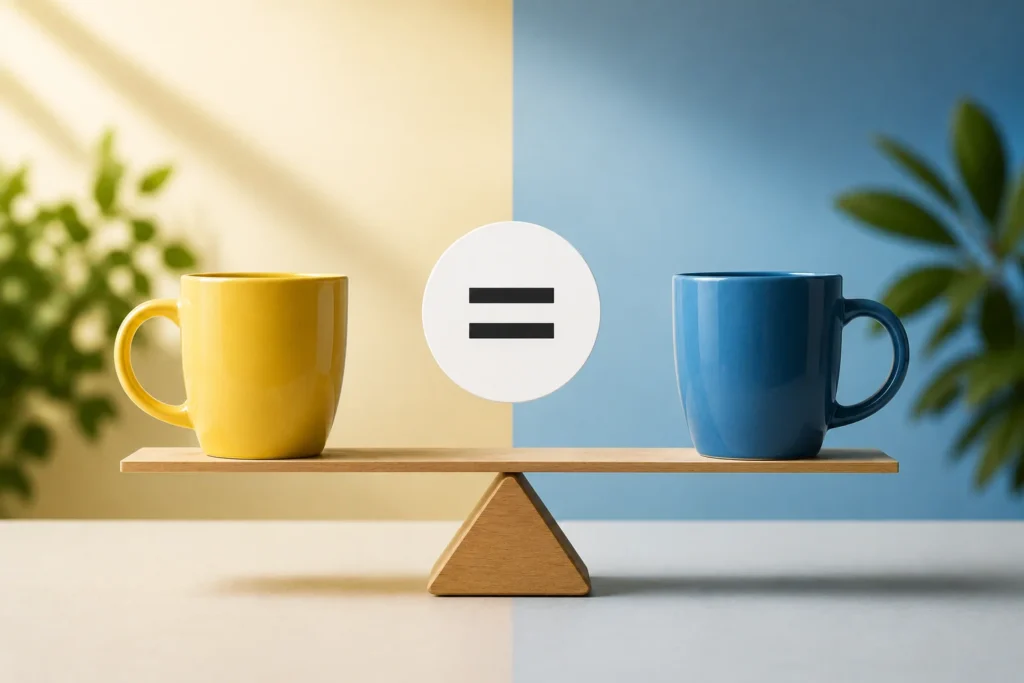
Have you ever heard someone say “same difference” after two people disagreed over a tiny detail? At first, the phrase sounds confusing because same and difference seem to contradict each other. Yet native English speakers use this idiom every day to point out that small differences don’t change the overall result. Whether you’re learning English, improving your vocabulary, or simply curious about common idioms, understanding same difference will help you sound more natural in conversations and recognize the expression whenever you hear it.
What Does “Same Difference” Mean?
Simple Definition of “Same Difference”
Same difference is an English idiom that means two things are different in small ways but are practically the same in the situation being discussed. The expression tells the listener that the differences are too minor to matter.
In everyday speech, people use the idiom to end unnecessary debates over details that have little impact on the outcome. Instead of focusing on what separates two options, the phrase shifts attention to what they have in common.
Simple meaning: The differences exist, but they aren’t important enough to change the result.
What Does the Idiom Really Mean?
Unlike a literal statement, same difference carries a figurative meaning. No one is claiming that two things are identical. Instead, the speaker believes the differences have little or no practical value.
For example, imagine two coffee shops located next to each other. One serves coffee for $4.95, while the other charges $5.00. Someone might simply shrug and say, “Same difference.” The five-cent gap is too small to influence the decision for most people.
The idiom often reflects a practical mindset. Rather than spending time discussing tiny distinctions, it encourages people to focus on the bigger picture.
Quick Examples
| Situation | Example | Meaning |
| Shopping | “This phone costs $499 and that one costs $501. Same difference.” | The price difference is insignificant. |
| Travel | “We’ll arrive at 8:00 or 8:03. Same difference.” | The arrival time is essentially the same. |
| School | “I scored 89, and you scored 90. Same difference.” | One point doesn’t make a meaningful distinction. |
| Work | “Let’s meet at 10:00 or 10:05. Same difference.” | The small time change doesn’t affect the meeting. |
The Key Idea Behind the Expression
The strength of same difference lies in perspective. It recognizes that while no two things are perfectly alike, some differences simply don’t deserve attention.
Native speakers commonly use the phrase when:
- Comparing similar products.
- Discussing small price changes.
- Talking about nearly identical schedules.
- Describing equivalent choices.
- Ending minor disagreements.
- Simplifying everyday conversations.
The expression doesn’t erase differences. Instead, it suggests that those differences have little practical importance.
Meaning of “Same Difference” in Everyday English
Literal Meaning vs. Intended Meaning
When viewed literally, same difference appears grammatically contradictory. After all, something cannot be both the same and different at the same time.
However, idioms rarely depend on literal interpretation. Their meanings develop through everyday usage rather than strict grammar rules.
The intended meaning is straightforward: the difference exists, but it doesn’t matter enough to affect the outcome.
This is why dictionaries classify same difference as an idiomatic expression rather than a factual description.
Why the Phrase Works
Many English idioms rely on irony, contrast, or exaggeration. Same difference combines two opposing words to create a memorable expression that immediately signals a relaxed attitude toward minor distinctions.
Instead of saying:
- “The differences are insignificant.”
- “These options produce essentially the same result.”
- “The distinction isn’t meaningful.”
Native speakers often choose the much shorter phrase:
“Same difference.”
Its brevity makes it easy to remember and natural to use in casual conversation.
Common Situations Where People Say “Same Difference”
You’ll hear this idiom in many everyday settings, including:
| Situation | Why People Use It |
| Shopping | Products have nearly identical value or features. |
| Family discussions | Small preferences don’t change the outcome. |
| School | Tiny grade differences aren’t important. |
| Workplace conversations | Minor scheduling or process changes have little impact. |
| Friends chatting | To avoid debating insignificant details. |
| Social media | To react humorously to trivial comparisons. |
Although the expression is common, it works best in informal English. Friends, coworkers, classmates, and family members use it naturally because everyone understands that the speaker is emphasizing the overall result instead of the minor differences.
Tone and Context Matter
The meaning of the same difference also depends on tone.
A relaxed smile usually makes the phrase sound friendly. A playful voice can make it humorous. A dismissive tone, however, may cause it to sound sarcastic or impatient.
For example:
- Friendly: “Either restaurant is fine. Same difference.”
- Humorous: “Blue socks or black socks? Same difference!”
- Sarcastic: “Sure, one mistake instead of ten. Same difference.”
Listening to the speaker’s voice and considering the situation helps you understand the intended meaning more accurately.
At a Glance
| Feature | Details |
| Expression Type | Idiom |
| Meaning | Minor differences don’t matter. |
| Tone | Usually informal, sometimes humorous or sarcastic. |
| Common Use | Everyday conversations. |
| Best For | Situations where the outcome stays the same despite small differences. |
| Avoid In | Formal reports, legal documents, contracts, and academic writing. |
Origin and History of “Same Difference”
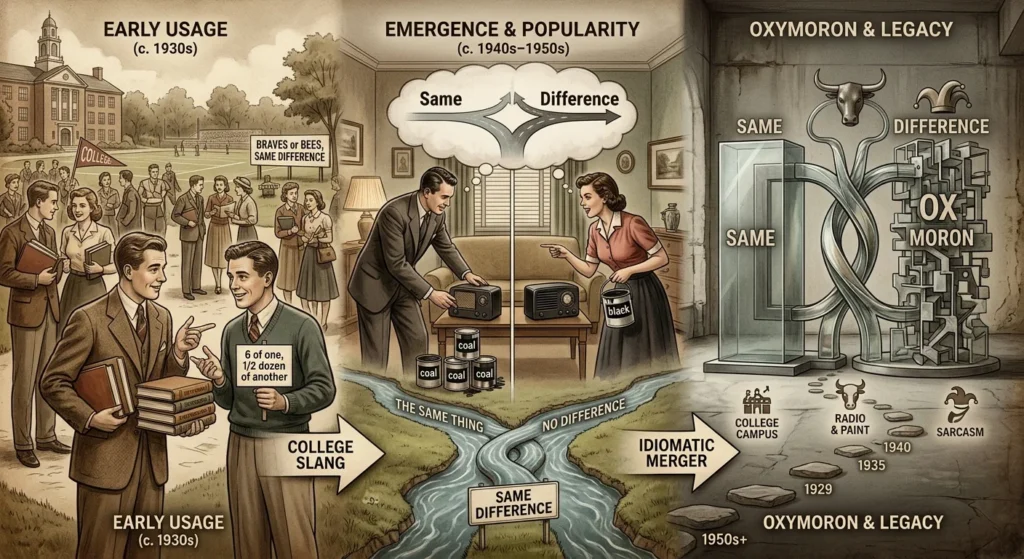
Every idiom has a story, and same difference is no exception. Although no one can point to a single person who created the phrase, it has been part of informal English for decades. Its unusual wording caught people’s attention because it combines two words that appear to contradict each other. That contradiction is exactly what helped the expression survive and become a familiar part of everyday conversation.
Where the Idiom Came From
The exact origin of the same difference remains uncertain, but language experts generally agree that it developed naturally in spoken English. Rather than following traditional grammar, the phrase uses irony to communicate its message.
Instead of saying that two things are identical, speakers acknowledge that differences exist while emphasizing that those differences have little practical value. Over time, people repeated the expression often enough that it became a recognized idiom.
Unlike many older idioms that trace back to literature or historical events, same difference appears to have grown from ordinary conversations. That makes it relatable because it reflects the way people naturally simplify everyday discussions.
Early Recorded Uses
Written evidence shows that the same difference appeared in American publications during the twentieth century, particularly in informal dialogue and popular culture. By the late 1900s, the phrase had become widely recognized in everyday American English.
Its popularity increased because it was short, memorable, and useful. Television shows, newspapers, magazines, and casual conversations exposed more people to the expression, helping it spread beyond regional speech.
Although dictionaries began including same difference as an idiom, its meaning stayed remarkably consistent:
Small differences do not significantly affect the final result.
That simple idea explains why the phrase has remained popular for generations.
How the Expression Became Popular in American English
Several factors helped the same difference become part of everyday American English.
| Factor | How It Helped |
| Everyday conversations | Easy to use when discussing minor differences. |
| Television and movies | Characters used the phrase naturally in dialogue. |
| Workplace conversations | Simplified discussions about similar options. |
| Schools and colleges | Students adopted it in casual speech. |
| Social media | Short, memorable expressions spread quickly online. |
American English often embraces expressions that are brief, conversational, and slightly humorous. Same difference fits all three qualities, making it easy for speakers of different ages to adopt.
Modern Usage and Cultural Influence
Today, same difference appears in conversations around the world wherever English is spoken. While it remains most common in North America, many English learners encounter it through movies, TV series, podcasts, YouTube videos, and social media.
The idiom has also become part of internet culture. People frequently use it in comments, memes, and online discussions when comparing two nearly identical choices.
For example:
- “Android or iPhone? Same difference for basic texting.”
- “Red folder or blue folder? Same difference.”
- “Leave at 8:00 or 8:05? Same difference.”
These examples show how the expression continues to evolve while keeping its original meaning.
Why the Meaning Has Stayed the Same
Many expressions change dramatically over time, but same difference has remained surprisingly stable. One reason is that the idiom describes a situation people experience every day. Whether discussing prices, schedules, products, or opinions, people regularly encounter differences that simply don’t matter very much.
Because the phrase solves a common communication need, speakers continue using it without changing its core meaning.
How to Use “Same Difference” Correctly
Knowing what same difference means is only the first step. Using it naturally requires understanding when it fits the conversation and when another expression works better.
Use It When Small Differences Don’t Matter
The idiom works best when two or more options produce nearly the same result.
For example:
- Two restaurants serve similar food at similar prices.
- Two routes take almost the same amount of time.
- Two products have nearly identical features.
- Two meeting times differ by only a few minutes.
In each situation, the speaker focuses on the outcome instead of the small distinctions.
Everyday Conversation Examples
Here are a few natural examples.
Friend: “Should we watch the movie at 7:00 or 7:15?”
Reply: “Same difference. Either time works.”
Customer: “This notebook costs $9.95 and that one costs $10.”
Friend: “Same difference. Buy the one you like.”
Student: “I got 91%, and you got 92%.”
Classmate: “Same difference. We both earned an A.”
These conversations sound natural because the small differences have little impact.
Workplace Examples
Although same difference is informal, people sometimes use it in relaxed workplace conversations.
For example:
- “Let’s meet on Tuesday instead of Wednesday.”
- “Same difference. The project timeline won’t change.”
Another example:
- “Should we use Arial or Calibri for internal notes?”
- “Same difference. Either font is easy to read.”
However, avoid using the idiom in formal reports, client presentations, contracts, or official business emails where precision matters.
Family and Social Situations
Family members often use the phrase because everyone understands the context.
Examples include:
- Choosing between two similar grocery brands.
- Deciding which route to take home.
- Picking a movie from two comparable options.
- Selecting matching decorations for an event.
The idiom keeps conversations relaxed and prevents unnecessary debates over trivial choices.
Informal vs. Formal Usage
The following table shows where the expression works best.
| Situation | Appropriate? | Reason |
| Chatting with friends | ✅ Yes | Natural and conversational. |
| Talking with family | ✅ Yes | Fits everyday speech. |
| Casual workplace discussions | ✅ Usually | Acceptable when the setting is informal. |
| Academic essays | ❌ No | Too informal. |
| Legal documents | ❌ No | Precision is required. |
| Business contracts | ❌ No | Ambiguity should be avoided. |
| Professional reports | ❌ No | Clear, formal language is better. |
When You Should Avoid Using “Same Difference”
Even though the idiom is useful, it isn’t appropriate in every situation.
Avoid it when:
- The differences affect safety.
- Financial decisions involve significant amounts of money.
- Medical advice requires precision.
- Legal or contractual details matter.
- Academic or technical writing demands exact language.
For example, saying “same difference” when comparing two medications with different dosages could create confusion. Likewise, treating major financial differences as insignificant may lead to poor decisions.
A simple rule is to ask yourself one question:
Does the difference actually change the outcome?
If the answer is yes, then the same difference probably isn’t the right expression. If the answer is no, the idiom usually fits naturally and communicates your point clearly.
Examples of “Same Difference” in Sentences
The best way to understand same difference is to see how native English speakers use it in real conversations. While the idiom always carries the same basic idea, the tone changes depending on the situation. Sometimes it sounds friendly. Other times it adds humor or mild sarcasm. In every case, the speaker suggests that the differences are too small to matter.
Simple Everyday Examples
You’ll hear the same difference most often during casual conversations. These examples show how naturally the idiom fits into daily life.
- “We can leave at 8:00 or 8:10. Same difference because traffic is light.”
- “That grocery store is one block farther away. Same difference.”
- “Both jackets cost about the same. Same difference. Pick the color you like.”
- “I’ll call you tonight or tomorrow morning. Same difference since we don’t need an answer right away.”
- “The blue mug and the green mug hold the same amount. Same difference.”
In each example, the outcome stays the same even though a small difference exists.
Student and Classroom Examples
Students often compare grades, assignments, or schedules. That’s where same difference naturally appears.
Example 1
We both did well.”
Example 2
Teacher: “Submit your homework before 9:00.”
Student: “Can I submit it at 8:55?”
Teacher: “That’s the same difference as long as it’s on time.”
Example 3
“We studied from different textbooks, but we learned the same material. Same difference.”
These examples highlight that the phrase works best when the small variation doesn’t affect the final result.
Workplace and Business Examples
Although same difference is informal, colleagues may use it during relaxed conversations.
| Situation | Example |
| Meeting time | “Let’s start at 2:00 instead of 2:05. Same difference.” |
| Office supplies | “Use the blue folder or the black folder. Same difference.” |
| Internal discussion | “Both templates look professional. Same difference.” |
| Planning | “We’ll finish today or early tomorrow. Same difference for this project.” |
However, avoid using the idiom in contracts, proposals, legal documents, financial reports, or official client communications where every detail matters.
Family and Social Examples
Families use same difference because conversations are usually relaxed.
For example:
- “Chicken or turkey sandwiches? Same difference.”
- “Let’s watch this movie or that one. Same difference.”
- “We’ll visit on Saturday or Sunday. Same difference if everyone is free.”
- “Use either plate. Same difference.”
The phrase helps keep discussions friendly without making small choices seem important.
Funny and Casual Examples
Humor makes this idiom even more memorable.
- “You’re five minutes late.”
“Five minutes? Same difference. I’m still fashionable.” - “You bought another pair of black shoes.”
“They’re dark gray.”
“Same difference.” - “It’s not coffee. It’s espresso.”
“Before my first cup? Same difference.”
These playful exchanges show why the expression is popular among friends.
Dialogue Examples
Here are a few longer conversations.
At a Restaurant
Friend 1: “Should we sit inside or outside?”
Friend 2: “Same difference. The weather is perfect.
Shopping Together
Customer: “This shirt costs $39. The other one costs $40.”
Friend: “Same difference. Buy the one that fits better.”
Planning a Trip
Traveler: “Should we take Highway A or Highway B?”
Driver: “They both take about two hours. Same difference.”
These conversations demonstrate that speakers use the idiom to move the discussion forward rather than focus on insignificant details.
Why People Say “Same Difference”
People don’t use same difference simply because it’s an idiom. They use it because it communicates a practical idea quickly and naturally.
To Show the Difference Doesn’t Matter
The most common reason is to point out that two choices produce nearly identical results.
Instead of explaining why every small detail is unimportant, speakers summarize the idea with two simple words.
For example:
- Two restaurants serve similar meals.
- Two routes reach the same destination.
- Two brands offer nearly identical quality.
Rather than debating tiny distinctions, someone says, “Same difference.”
To End Minor Arguments
Small disagreements can continue much longer than they should. The idiom helps end those conversations politely.
Imagine two coworkers discussing whether a meeting should begin at 9:00 or 9:05. If neither option affects the day’s schedule, one person may simply say:
“Same difference.”
The discussion ends because everyone understands the outcome remains unchanged.
To Add Humor
Many native speakers use the expression with a smile.
For example:
Friend: “These sneakers aren’t white. They’re off-white.”
Reply: “Same difference.”
The humor comes from treating a tiny distinction as unimportant.
To Express Practical Thinking
The idiom also reflects a practical attitude.
Instead of becoming distracted by details that don’t affect the outcome, the speaker focuses on the larger goal.
This approach is common in workplaces, schools, and everyday life where efficiency matters.
To Keep Conversations Moving
Conversations naturally slow down when people debate insignificant details.
Using same difference helps everyone move forward without sounding rude or dismissive.
That’s one reason the phrase has remained popular for decades.
Is “Same Difference” Rude, Polite, or Sarcastic?
One of the most common questions English learners ask is whether same difference sounds rude.
The answer depends almost entirely on tone, context, and relationship.
Neutral Usage
Most of the time, same difference is completely neutral.
Example:
“We can park on either side of the building. Same difference.”
The speaker isn’t criticizing anyone. They’re simply saying either choice works.
Friendly Conversations
Among friends and family, the idiom usually sounds relaxed.
Examples include:
- Choosing restaurants.
- Deciding meeting places.
- Comparing similar products.
- Planning weekend activities.
Because everyone understands the context, the expression feels natural.
Sarcastic Usage
Tone can completely change the meaning.
Suppose someone insists on correcting an unimportant detail.
Person A: “It’s 12.9 miles, not 13.”
Person B: “Same difference.”
Here, the response may sound sarcastic because the speaker dismisses the correction.
When the Phrase Can Sound Rude
Although the idiom isn’t inherently rude, it can offend someone if:
- They believe the difference is important.
- The conversation involves sensitive topics.
- The speaker uses an impatient tone.
- The listener feels ignored.
For example, saying the same difference during a discussion about health, legal matters, or finances could appear careless because those differences may have serious consequences.
Reading the Context Correctly
Before using the expression, consider these questions.
- Does the small difference affect the final result?
- Is the setting informal?
- Will the listener understand your intention?
- Could your tone sound dismissive?
If the answer to the last question is yes, another phrase may be a better choice.
Quick Guide
| Situation | Use “Same Difference”? | Why |
| Talking with friends | ✅ Yes | Sounds natural and relaxed. |
| Family conversations | ✅ Yes | Minor differences rarely matter. |
| Casual workplace discussions | ✅ Usually | Acceptable in informal settings. |
| Customer service complaints | ⚠️ Be careful | The customer may think the difference matters. |
| Legal or medical discussions | ❌ No | Precision is essential. |
| Financial decisions | ❌ No | Small differences may have significant consequences. |
Understanding the listener, the situation, and your tone will help you use the same difference confidently and naturally without creating confusion.
“Same Difference” vs. Similar Expressions
English has many idioms and expressions that compare similar ideas. While same difference shares a meaning with several of them, each phrase has its own purpose, tone, and best use. Knowing these differences will help you choose the most natural expression for any situation.
Same Difference vs. Six of One, Half a Dozen of the Other
These two idioms are closely related because both suggest that two choices are practically equal.
Same difference emphasizes that the differences are too small to matter.
Six of one, half a dozen of the other means that two options are essentially equal, making either choice acceptable.
| Same Difference | Six of One, Half a Dozen of the Other |
| Focuses on insignificant differences. | Focuses on two equal choices. |
| More common in everyday American English. | Slightly more traditional and less common in casual speech. |
| Often shorter and more conversational. | Often used to express balance between two options. |
Example
- “The laptops have almost the same features. Same difference.”
- “Choose whichever route you prefer. It’s six of one, half a dozen of the other.”
Same Difference vs. Tomato, Tomahto
Tomato, tomahto comes from the idea that people pronounce the same word differently. Today, it suggests that a disagreement is mostly about wording rather than meaning.
Same difference, however, focuses on the result instead of pronunciation or wording.
Example
- “You call it dinner, I call it supper. Tomato, tomahto.”
- “Either restaurant serves great food. Same difference.”
Same Difference vs. Potato, Potahto
Like tomato, tomahto, this phrase highlights different pronunciations or labels rather than meaningful differences. It is much less common in everyday conversation but still appears in humorous contexts.
Same Difference vs. Close Enough
These expressions are similar, but they are not identical.
Close enough means something isn’t perfect but is acceptable.
Same difference means the differences don’t significantly affect the outcome.
Example
- “The measurements are close enough to finish the project.”
- “Either measurement works here. Same difference.”
Same Difference vs. It’s All the Same
It’s all the same usually means every option leads to the same result or that the speaker has no preference.
Same difference specifically acknowledges small differences before dismissing their importance.
Example
Friend: “Italian or Mexican food?”
Reply: “It’s all the same to me.”
Friend: “The two Italian restaurants are almost identical.”
Reply: “Same difference.”
Same Difference vs. No Real Difference
No real difference is a straightforward statement often used in business, education, or technical writing.
Same difference is the informal version that sounds more conversational.
Which Expression Should You Choose?
The table below makes choosing easier.
| Expression | Best Used For | Formality |
| Same difference | Casual conversations | Informal |
| Six of one, half a dozen of the other | Equal choices | Informal |
| Tomato, tomahto | Minor wording or pronunciation differences | Informal |
| Close enough | Acceptable accuracy | Informal to neutral |
| It’s all the same | Showing no preference | Neutral |
| No real difference | Professional communication | Formal |
Synonyms and Alternative Expressions
Although same difference is common, English offers several alternatives. Choosing the right one depends on your audience, setting, and tone.
Informal Alternatives
These expressions work well in everyday conversations.
- It’s basically the same.
- Makes no difference.
- Doesn’t really matter.
- Pretty much the same.
- Either way.
- All the same.
- Much the same.
- More or less the same.
Neutral Alternatives
If you want a phrase that sounds less casual, consider these options.
- There is little difference.
- The outcome is the same.
- The result doesn’t change.
- Functionally identical.
- Nearly identical.
- Essentially the same.
These alternatives work well in presentations, reports, or educational writing.
Professional Alternatives
Business communication usually benefits from clear language.
Instead of saying the same difference, you could write:
- The difference is negligible.
- The options provide comparable results.
- Either option meets the requirements.
- Both approaches achieve the same objective.
- The distinction has minimal impact.
These phrases sound more precise while keeping the same general meaning.
Slang and Casual Expressions
Depending on your region, you may also hear:
- Same thing.
- No big deal.
- Whatever works.
- Works for me.
- Good enough.
These expressions share similar ideas but don’t always carry the exact meaning of same difference.
Context-Based Alternatives
The best expression depends on the situation.
| Situation | Better Alternative |
| Business meeting | The difference is minimal. |
| Academic writing | Essentially the same. |
| Technical discussion | Functionally equivalent. |
| Everyday conversation | Same difference. |
| Friendly debate | Makes no difference. |
Opposite Expressions
Sometimes the differences between two things are too important to ignore. In those situations, the opposite of same difference communicates the idea more accurately.
Big Difference
This phrase clearly states that the distinction matters.
Example
“A five-minute delay isn’t much, but a five-hour delay is a big difference.”
Worlds Apart
Worlds apart emphasizes that two people, ideas, or situations are completely different.
Example
“Those two job offers are worlds apart in salary and benefits.”
Not the Same Thing
This expression directly corrects someone who wrongly assumes two things are equal.
Example
“Saving money and investing money are not the same thing.”
That’s Another Matter
People use this expression when introducing a completely different issue.
Example
“Choosing a restaurant is easy, but paying for fifty people is another matter.”
Different Story
This phrase signals that the second situation changes everything.
Example
“Missing one class is manageable. Missing an entire semester is a different story.”
Night and Day
This idiom emphasizes an obvious contrast.
Example
“The old software and the updated version are like night and day.”
Choosing the Right Opposite
Use the comparison below as a quick guide.
| Expression | Meaning |
| Big difference | The distinction is significant. |
| Worlds apart | Completely different. |
| Not the same thing | Two ideas should not be treated as equal. |
| That’s another matter | A separate issue entirely. |
| Different story | The situation changes significantly. |
| Night and day | An extremely noticeable contrast. |
Common Mistakes When Using “Same Difference”
Although same difference is easy to understand, learners sometimes use it incorrectly. Avoiding these mistakes will help your English sound more natural.
Taking the Phrase Literally
The biggest mistake is interpreting the idiom word for word.
Remember that idioms often have figurative meanings. Same difference doesn’t claim two things are identical. It simply means the differences don’t matter in the current context.
Using It in Formal Writing
Avoid the expression in:
- Legal documents
- Academic papers
- Business contracts
- Scientific research
- Official reports
Formal writing should explain the exact relationship between ideas instead of relying on informal idioms.
Ignoring the Tone
Even the correct phrase can sound rude if spoken impatiently.
A friendly smile makes the same difference sound casual.
An annoyed voice may make it sound dismissive.
Using It When Differences Actually Matter
Never use the idiom when the distinction affects safety, health, finances, or legal obligations.
For example, these are not situations for same difference:
- Medication dosages
- Tax calculations
- Contract terms
- Emergency procedures
- Medical diagnoses
Here, precision is far more important than convenience.
Confusing It With Similar Idioms
Many learners mix same difference with close enough, or it’s all the same.
Although these expressions overlap, each has its own meaning and natural context.
Understanding those differences helps your conversations sound more fluent and authentic.
Quick Checklist
Before saying the same difference, ask yourself:
- Does the small difference change the outcome?
- Am I speaking in an informal setting?
- Will the listener understand my meaning?
- Could my tone sound dismissive?
- Would another expression fit better?
If you answer these questions first, you’ll use the idiom naturally and avoid the most common mistakes made by English learners.
Quick Reference Table for “Same Difference”
If you need a fast overview of same difference, the table below summarizes the most important points. It serves as a handy reference whether you’re learning English, teaching idioms, or simply refreshing your memory.
| Feature | Details |
| Idiom | Same Difference |
| Meaning | Small differences exist, but they don’t affect the overall result. |
| Expression Type | Informal English idiom |
| Tone | Usually neutral, friendly, humorous, or mildly sarcastic |
| Common Usage | Everyday conversations |
| Formal Writing | Not recommended |
| Common Audience | Friends, family, classmates, coworkers |
| Purpose | To show that minor differences are insignificant |
| Literal Meaning | Contradictory words that create a figurative meaning |
| Similar Expressions | Close enough, It’s all the same, Six of one, half a dozen of the other |
| Opposite Expressions | Big difference, Worlds apart, Not the same thing, Night and day |
When to Use “Same Difference”
Use the idiom when:
- Two choices lead to the same outcome.
- Small differences don’t affect your decision.
- You want to simplify a casual conversation.
- You want to avoid debating insignificant details.
- Everyone understands the discussion is informal.
When Not to Use “Same Difference”
Avoid using the idiom when:
- Accuracy is essential.
- Safety depends on precise information.
- Legal wording matters.
- Medical advice requires exact details.
- Financial calculations involve meaningful differences.
- Academic or technical writing demands formal language.
Real-Life Scenarios: Understanding the Idiom in Context
Learning an idiom becomes much easier when you see it in realistic situations. The following examples show how the same difference naturally appears in everyday life.
At Work
Imagine your team is deciding when to begin a meeting.
Manager: “Should we start at 9:00 or 9:05?”
Team Member: “Same difference. Everyone will already be here.”
The five-minute adjustment doesn’t affect productivity, so the idiom fits perfectly.
Another example involves office equipment.
Coworker: “Should we order the black notebooks or the blue ones?”
Supervisor: “Same difference. Buy whichever costs less.”
The discussion stays practical because the color doesn’t influence the work itself.
At School
Students often compare grades or assignments.
We both passed comfortably.”
Here, the one-point difference doesn’t change the overall achievement.
During a class project:
Teacher: “Use either presentation template.”
Student: “Which one is better?”
Teacher: “Same difference. Focus on the quality of your research.”
The teacher redirects attention to what truly matters.
With Friends
Friends regularly use the idiom because conversations are relaxed.
The emphasis stays on spending time together rather than debating locations.
Planning a movie night:
Friend: “Should we watch the 7:00 showing or the 7:15 showing?”
Reply: “Same difference. Either works.”
Family Conversations
Family discussions often involve everyday choices.
Parent: “Should we buy white bread or wheat bread today?”
Teenager: “Same difference. I’ll eat either one.”
Choosing vacation dates:
Parent: “We could leave on Friday evening instead of Saturday morning.”
Grandparent: “Same difference if the hotel reservation stays the same.”
The idiom keeps the conversation simple and avoids unnecessary debate.
Online Discussions
The internet has made same difference even more common.
People frequently use it when discussing:
- Similar smartphones.
- Streaming services.
- Video games.
- Fashion choices.
- Social media platforms.
- Everyday products.
For example:
“Both headphones sound great for casual listening. Same difference unless you’re an audio professional.”
The phrase helps readers understand that either choice will satisfy most users.
Related Idioms You May Also Like
Expanding your vocabulary with related idioms makes your English sound more natural. Although these expressions have different meanings, they often appear in similar conversations.
Six of One, Half a Dozen of the Other
This classic idiom means two choices are practically equal. It works well when neither option offers a clear advantage.
Example:
“Take the train or drive. It’s six of one, half a dozen of the other.”
Close Enough
This expression suggests something isn’t perfect but is acceptable for the situation.
Example:
“The measurements are close enough to finish the project.”
Unlike same difference, it focuses on acceptable accuracy rather than insignificant differences.
It’s All the Same
People use this phrase to show they have no preference between available options.
Example:
“Choose whichever restaurant you like. It’s all the same to me.”
Tomato, Tomahto
This well-known saying emphasizes that people are arguing over labels, pronunciation, or wording instead of meaningful differences.
Example:
“You call it soda. I call it pop. Tomato, tomahto.”
Potato, Potahto
Although less common today, this expression carries a similar idea to tomato, tomahto and is usually used humorously.
A Distinction Without a Difference
This formal expression means a supposed difference has no practical effect.
Example:
“Changing the title without changing the responsibilities is a distinction without a difference.”
You’ll often encounter this phrase in legal discussions, academic writing, and professional debates.
Common Situations Where Native Speakers Use “Same Difference”
Native English speakers rarely plan to use this idiom. Instead, it appears naturally when the conversation reaches a point where minor details simply don’t matter.
Some of the most common situations include:
- Comparing products with similar features.
- Choosing between nearly identical brands.
- Discussing meeting times a few minutes apart.
- Picking similar restaurants.
- Comparing travel routes with similar travel times.
- Talking about equivalent school grades.
- Debating insignificant wording differences.
- Making everyday purchasing decisions.
The more you listen to native speakers, the more you’ll notice how often they use the phrase to simplify conversations.
Tips for Using “Same Difference” Naturally
If you’re learning English, these practical tips will help you sound more confident.
| Tip | Why It Helps |
| Use the idiom in informal conversations. | That’s where native speakers expect it. |
| Think about the outcome instead of the details. | The expression focuses on results. |
| Pay attention to tone. | Tone changes the meaning. |
| Don’t use it when accuracy matters. | Precision is sometimes essential. |
| Listen to native speakers. | You’ll learn when the idiom sounds most natural. |
Key Takeaways
Here are the most important points to remember about same difference:
- Same difference is an informal English idiom.
- It means small differences don’t change the overall result.
- Native speakers commonly use it in everyday conversations.
- The phrase often sounds friendly, practical, or humorous.
- Tone and context determine whether it sounds neutral or sarcastic.
- It isn’t suitable for formal, legal, medical, or technical writing.
- Understanding similar and opposite expressions helps you choose the right words in different situations.
- Using the idiom correctly makes your spoken English sound more natural and fluent.
Whether you’re chatting with friends, studying English, or improving your communication skills, understanding same difference gives you another useful expression that native speakers use every day. Once you recognize the situations where small differences truly don’t matter, you’ll know exactly when this idiom fits the conversation.
Conclusion About Same Difference – Idiom, Meaning, Example & Usage
Understanding Same Difference is more than learning another English idiom—it’s about recognizing how native speakers simplify everyday conversations. Although the phrase may seem confusing at first, its meaning becomes clear once you realize it highlights differences that have little or no practical impact. Whether you’re chatting with friends, communicating at work, or improving your English vocabulary, knowing when and how to use this expression can make your speech sound more natural and confident. It’s equally important to recognize situations where the idiom isn’t appropriate, especially in formal, legal, or technical contexts that require precision. By exploring its meaning, origin, examples, synonyms, and common mistakes, you’ve gained a complete understanding of one of the most recognizable expressions in everyday English. The next time someone says “Same Difference,” you’ll know exactly what they mean and when it’s the perfect phrase to use yourself.
FAQs
What does “Same Difference” mean?
Same Difference means that two things have small differences, but those differences don’t change the overall result. People use this idiom in informal conversations to show that the distinction isn’t important enough to matter in the current situation.
Is “Same Difference” an idiom?
Yes. Same Difference is an English idiom because its meaning cannot be understood by interpreting each word literally. Instead, it expresses the idea that minor differences are insignificant and don’t affect the outcome.
Is “Same Difference” grammatically correct?
Although the phrase sounds contradictory, it is widely accepted as an idiomatic expression. Native English speakers understand its figurative meaning, even though the words “same” and “difference” appear to conflict with one another.
Is “Same Difference” commonly used in American English?
Yes. Same Difference is common in American English, especially in casual conversations. You’ll hear it among friends, coworkers, family members, and in movies, television shows, podcasts, and online discussions.
Can “Same Difference” sound sarcastic?
Yes. The meaning often depends on tone and context. Spoken with a smile, it usually sounds friendly or humorous. Spoken impatiently, it may sound sarcastic or dismissive, especially if someone believes the difference is important.
Can I use “Same Difference” in formal writing?
No. It’s best to avoid Same Difference in formal reports, academic papers, legal documents, contracts, or professional correspondence. In those situations, use clear and precise language instead of informal idioms.
What are some synonyms for “Same Difference”?
Common alternatives include it’s all the same, close enough, makes no difference, essentially the same, pretty much the same, and no real difference. The best choice depends on the context and the level of formality.
What is the opposite of “Same Difference”?
Opposite expressions include big difference, worlds apart, not the same thing, night and day, and that’s another matter. These phrases emphasize that the differences are meaningful and should not be ignored.
When should you avoid using “Same Difference”?
Avoid using the idiom whenever accuracy is important, such as in medical advice, legal matters, financial decisions, technical instructions, or scientific discussions. In these situations, even a small difference can have significant consequences.
How do native English speakers naturally use “Same Difference”?
Native speakers typically use Same Difference during informal conversations when comparing similar choices, prices, schedules, products, or opinions. The idiom helps keep discussions simple by showing that minor differences don’t affect the overall result.
Meta Description
Same Difference – Idiom, Meaning, Example & Usage explained with origin, examples, synonyms, and tips for everyday English use