
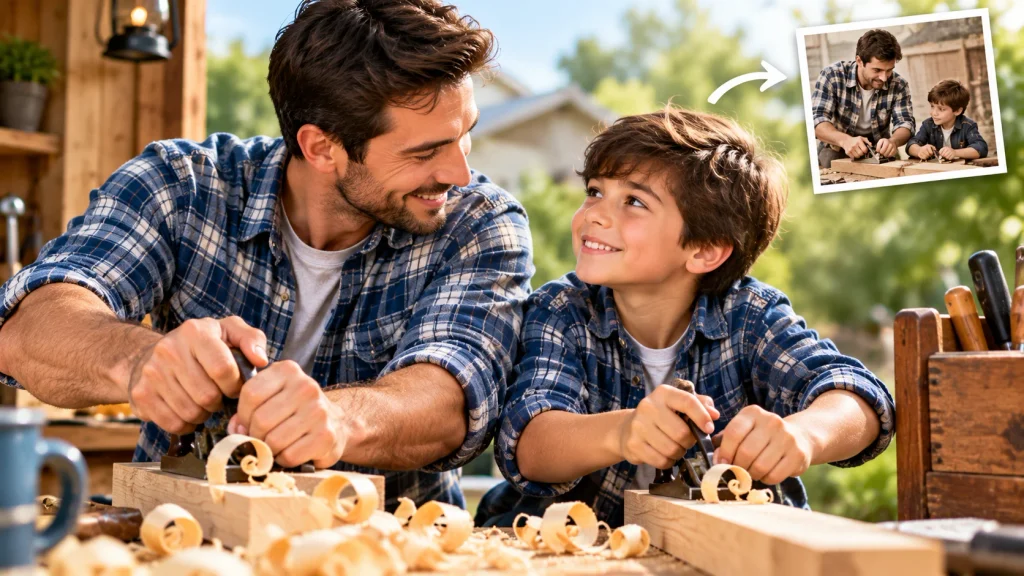
When someone calls a child a chip off the old block, they usually mean that the child strongly resembles a parent in some noticeable way. That similarity might appear in personality, behavior, appearance, skills, habits, or even a familiar way of handling everyday situations. The phrase is an informal English idiom, and it often carries a warm or approving tone. For example, if a father loves cooking and his daughter becomes an excellent chef, someone might smile and say she is a chip off the old block. The expression doesn’t necessarily mean that the child copies everything the parent does. Instead, it points to a recognizable family connection. In many cases, the resemblance is strong enough that other people notice it without being told.
What Does It Mean?
The simplest definition of “a chip off the old block” is this: a person resembles one of their parents in appearance, character, behavior, abilities, or other noticeable qualities. Cambridge defines the idiom as describing someone very similar in character to their father or mother. Collins also recognizes resemblance in appearance, character, or behavior. The expression therefore covers much more than having the same facial features. A child can be a chip off the old block because of a shared sense of humor, a natural talent, a stubborn streak, a love of sports, or a familiar way of solving problems.
Think about a large wooden block and a small piece cut from it. The smaller piece comes from the same material as the original. It may be smaller, but its basic qualities remain connected to the larger block. That physical image creates the central metaphor behind the idiom. The chip represents the child, while the old block represents the parent.
The expression can describe both obvious and subtle similarities. A son might have his father’s distinctive laugh, while a daughter might inherit her mother’s patience and love of teaching. Another child might show the same entrepreneurial instinct as a parent. None of these similarities requires an exact physical resemblance.
Literal Meaning vs. Figurative Meaning
Taken literally, a chip is a small piece broken or cut from something larger. A block can refer to a solid piece of wood or another material. The phrase itself, however, isn’t talking about construction materials when people use it in ordinary conversation.
Its figurative meaning focuses on family resemblance.
For example:
Maria has her mother’s confidence and her father’s love of music. She’s truly a chip off the old block.
The speaker isn’t saying that Maria is physically made from a piece of wood. Instead, the sentence highlights qualities that connect her with her parents.
This distinction matters because idioms often cannot be understood word for word. If you interpret every part literally, the expression sounds strange. Once you understand the metaphor, however, the meaning becomes straightforward.
What Can Make Someone a Chip off the Old Block?
A person may earn this description through many kinds of resemblance:
| Type of resemblance | Example |
| Appearance | A daughter has her mother’s smile and facial expressions. |
| Personality | A son has his father’s calm and patient nature. |
| Behavior | A child handles problems in the same way as a parent. |
| Talent | A parent and child both excel at music or sports. |
| Interests | Both enjoy gardening, cooking, reading, or painting. |
| Habits | A child develops routines similar to those of a parent. |
| Values | Both place strong importance on honesty or hard work. |
| Career interests | A child follows a parent into teaching, medicine, business, or another field. |
The resemblance doesn’t have to come from genetics alone. Children also learn through observation. A child who watches a parent practice an instrument every evening may develop the same passion through years of exposure. In that situation, the idiom still works because the visible similarity matters more than its exact cause.
What the Expression Really Suggests
The phrase carries more meaning than simply saying, “You look like your parent.” It often suggests a recognizable continuation of family traits. That is why people use it when a child displays something that reminds others of a parent.
Suppose a father spent decades repairing old cars and teaching his son how engines work. Years later, the son opens his own auto repair shop. Calling him a chip off the old block suggests a clear connection between the two generations.
The expression can also create a sense of pride. Parents may use it affectionately when their children develop admirable qualities. A mother might tell her daughter, “You’re a chip off the old block,” after watching her confidently lead a difficult project. The statement can mean, “I can see some of your parent in you.”
However, the phrase doesn’t guarantee that the shared quality is admirable. Context and tone matter.
If a parent has a habit of complaining and a child develops the same habit, someone might jokingly call the child a chip off the old block. The words remain the same, but the speaker’s tone changes the emotional effect.
Is “A Chip off the Old Block” About Looks?
Not necessarily. Physical resemblance is one possible meaning, but it isn’t the whole story.
Modern dictionaries describe the idiom broadly enough to include character, behavior, appearance, and characteristics. That broader meaning explains why the expression works in so many situations. A person can resemble a parent without looking anything like them.
For instance, imagine a father who is famous for remembering everyone’s birthday. His daughter develops the same habit and never forgets an important date. Even if they have completely different appearances, people could still call her a chip off the old block.
The same idea applies to talents. If a mother is an accomplished painter and her son develops an equally strong ability with a brush, the family resemblance is about talent rather than facial features.
When Do People Use It?

People usually use the expression when a noticeable similarity between generations becomes clear. It works especially well in family conversations, storytelling, casual observations, and friendly comments.
You might hear it when:
- A child develops the same talent as a parent.
- A son or daughter copies a parent’s mannerisms.
- Someone chooses the same career as a parent.
- A child develops similar interests or hobbies.
- A person’s personality strongly resembles a parent’s.
- A family member repeats a familiar habit.
- A child achieves something that reminds people of a parent’s accomplishments.
The phrase is particularly natural when the resemblance becomes visible through action.
For example, imagine a teenager helping organize a neighborhood event. She stays calm under pressure, gives everyone clear instructions, and solves problems quickly. Someone who knows her mother might say, “She’s a chip off the old block.” The speaker isn’t necessarily talking about appearance. The teenager’s behavior reminds them of her mother.
Family and Parenting Situations
Parents often hear the expression when their children display familiar traits. A father who loves fishing might grin when his daughter becomes fascinated by the sport. A mother who spends weekends baking might feel proud when her son becomes interested in pastry making.
These moments make the idiom feel personal because it connects present behavior with family history.
School and Education Situations
The phrase can also appear when a child follows a parent’s academic interests. If a parent is a scientist and the child develops a strong interest in biology, chemistry, or engineering, friends may describe the child as a chip off the old block.
The same idea works with teaching. A teacher’s child who naturally enjoys explaining difficult concepts might receive the expression from classmates or colleagues.
Sports, Arts, and Talent
Sports provide another natural setting. A parent who played professional or competitive sports may have a child who develops similar skills. The expression can highlight the shared talent without claiming that success is guaranteed.
The same principle applies to music, acting, painting, writing, cooking, and other creative pursuits. A child may inherit a natural ability, learn through family influence, or simply develop the same passion independently.
The Origin
The origin of “a chip off the old block” comes from an old metaphor involving a piece taken from a larger block of material. The image is especially associated with wood and craftsmanship. A small piece removed from a larger block remains recognizably related to the material from which it came.
The expression has a long history, but its wording changed over time. Earlier forms included “chip of the same block” and “chip of the old block.” Historical sources place the expression in English writing as far back as the 17th century. Robert Sanderson used the form “a chip of the same block” in a sermon from 1621, while John Milton used “a Chip of the old block” in a work published in 1642. The modern wording with “off” developed later, becoming established during the 19th century.
That evolution is useful because it explains why the phrase may appear in older texts with slightly different wording. The central metaphor stayed remarkably stable: a smaller piece comes from a larger original and therefore shares its essential qualities.
Why “Block” Represents the Parent
The old block represents the source from which the chip comes. In the family metaphor, that source is usually a parent.
The image works because a chip from a block shares the block’s material. In the same way, the idiom imagines a child as carrying recognizable qualities associated with a parent.
The metaphor doesn’t make a scientific claim about inheritance. Instead, it provides a memorable way to describe resemblance. That’s one reason the expression has remained useful for centuries.
Why the Idiom Has Lasted So Long
Many idioms disappear because the images behind them become unfamiliar. This one has survived because its central idea remains easy to understand. Families continue to notice similarities between generations, whether those similarities involve appearance, personality, talent, or behavior.
The expression is also compact. Saying someone is a chip off the old block communicates a complete idea without a long explanation. Instead of saying that a child has inherited several recognizable characteristics from a parent, a speaker can use one familiar phrase.
That economy gives the idiom lasting value in everyday English.
Is Positive or Negative?
The meaning of a chip off the old block depends heavily on the quality of the trait being described and the speaker’s tone. In many everyday conversations, the expression sounds warm, proud, or playful. Someone may use it to celebrate a child’s talent or point out a charming family resemblance. However, the same idiom can describe an undesirable habit when the context calls for it. The phrase itself doesn’t automatically label the shared quality as good or bad. Instead, the surrounding words, facial expression, and situation reveal the speaker’s attitude.
Positive Uses of “A Chip off the Old Block”
The idiom often works as a compliment when the parent has a respected quality. Imagine a father known for his patience and generosity. His son spends an afternoon helping an elderly neighbor repair a fence. A friend might say, “He’s a chip off the old block.” The remark praises the son while also recognizing the father’s influence.
People also use the expression when children display impressive abilities associated with their parents. A talented musician might have a child who develops an exceptional ear for music. A successful athlete might watch a child master the same sport. In these cases, the phrase creates a bridge between two generations.
Positive uses commonly involve:
- Talent: A child develops a parent’s artistic, athletic, musical, or practical ability.
- Character: A child shows the same kindness, patience, courage, or determination.
- Work ethic: A child approaches responsibilities with the same discipline as a parent.
- Interests: A child becomes passionate about the same hobbies.
- Values: A child demonstrates principles that strongly resemble a parent’s values.
- Achievement: A child succeeds in an area where a parent has also excelled.
The expression can therefore carry genuine affection. It gives the speaker a quick way to say that a family resemblance goes deeper than physical appearance.
Neutral and Negative Contexts
Not every inherited or learned quality deserves praise. People sometimes use the idiom neutrally when they simply notice a similarity. For example, if a mother is extremely organized and her daughter keeps every notebook perfectly arranged, someone may call her a chip off the old block. The comment doesn’t have to praise or criticize the habit.
The expression can also become humorous or mildly negative. Suppose a father has a reputation for arriving late to every family gathering. Years later, his son develops the same habit. A relative might joke, “He’s a chip off the old block.” The words point to the resemblance, while the situation provides the humor.
That usage demonstrates an important feature of English idioms: tone can reshape meaning.
A sentence such as “She’s a chip off the old block” might sound affectionate when said after a child helps someone. The same sentence might sound teasing after the child repeats an annoying parental habit.
How Tone Changes the Meaning
Context often matters more than the phrase itself. Consider these examples:
| Situation | Likely tone | Meaning |
| A daughter becomes an excellent baker like her mother | Positive | She shares her mother’s talent |
| A son develops his father’s strong work ethic | Positive | He has inherited or learned a valuable trait |
| A child has the same unusual sense of humor as a parent | Playful | Their personalities are remarkably similar |
| A teenager copies a parent’s stubbornness | Teasing | The child has picked up an undesirable trait |
| A child chooses the same profession as a parent | Neutral or positive | The child follows a similar path |
This flexibility makes the idiom useful in conversation. You don’t need to attach an adjective such as good or bad because the surrounding situation often communicates the judgment.
How to Use Correctly
Using a chip off the old block correctly is fairly simple once you understand its grammatical role. The expression normally functions as a noun phrase that describes a person. Most commonly, speakers place it after a linking verb such as is, was, or seems to be.
For example:
- Jake is a chip off the old block.
- She was a chip off the old block from an early age.
- Their daughter is definitely a chip off the old block.
You can also introduce the expression after noticing a specific similarity:
“He started repairing bicycles at twelve. He’s a chip off the old block.”
The second sentence works because the first sentence establishes the family connection.
Common Everyday Situations
You can use the idiom in many informal situations. Family gatherings are especially natural because relatives often notice similarities between generations.
Imagine a grandfather watching his grandson carefully repair an old radio. The grandfather spent his own childhood taking machines apart and putting them back together. He might laugh and say, “You’re a chip off the old block.”
The phrase also fits conversations about:
- Family businesses
- Hobbies and recreational activities
- Academic interests
- Career choices
- Cooking and baking
- Sports
- Music
- Artistic abilities
- Personality traits
- Family traditions
- Everyday habits
The strongest examples usually have a clear connection between the person and the parent. Without that connection, the idiom can sound confusing.
Formal vs. Informal Usage
A chip off the old block is generally conversational and informal. It works naturally in speech, personal writing, stories, interviews, and casual articles. You can use it in professional communication when the tone is relaxed, but a more direct expression may suit formal writing better.
For example, instead of writing:
“The new director is a chip off the old block.”
A formal report might say:
“The new director demonstrates many of the leadership qualities associated with her father.”
The idiom isn’t grammatically incorrect in the first example. It simply has a more conversational flavor.
For school assignments or formal reports, consider your audience before using it. In an essay about language or culture, however, the idiom may be exactly the right choice because the phrase itself is the subject.
Grammar and Sentence Structure
The phrase usually appears as “a chip off the old block.” The article a matters because the expression describes one person as a particular “chip” from the figurative block.
Common structures include:
Subject + linking verb + a chip off the old block
Daniel is a chip off the old block.
Subject + really + linking verb + a chip off the old block
Daniel really is a chip off the old block.
Subject + be + a true chip off the old block
Maya is a true chip off the old block.
Subject + look like + parent + chip off the old block
She looks just like her mother and is a chip off the old block.
The phrase itself doesn’t change for gender. You can describe a boy, girl, man, or woman as a chip off the old block.
You can also use it for plural subjects when the grammar calls for it:
“Those two brothers are chips off the same old block.”
Here, chips becomes plural because the sentence refers to more than one person.
Common Sentence Patterns
| Pattern | Example |
| He is a chip off the old block. | He has traits similar to his father. |
| She’s a real chip off the old block. | Her behavior strongly resembles her mother’s. |
| They’re chips off the same old block. | Several children resemble their parent. |
| He’s definitely a chip off the old block. | The resemblance is especially obvious. |
| She’s becoming a chip off the old block. | Her similarities are becoming noticeable. |
One useful point deserves attention: the expression doesn’t require a biological parent-child relationship in every casual use. Speakers sometimes apply it loosely when someone resembles an older family member or influential person. Still, the traditional and clearest use involves a child resembling a parent.
Examples in Sentences
Examples make this idiom easier to recognize because its meaning changes slightly with context. The following sentences show how speakers use it naturally rather than treating it as a fixed phrase with only one type of resemblance.
Family and Parenting Examples
“Lena loves gardening just like her mother. She’s a chip off the old block.”
Here, the resemblance concerns a shared interest.
“Mark has his father’s calm personality. He’s a chip off the old block.”
This example focuses on character rather than appearance.
“Everyone says Ava is a chip off the old block because she has her mother’s warm smile.”
Physical resemblance provides the reason for the expression.
“Tom started baking bread every weekend, just like his father did. He’s a chip off the old block.”
The similarity involves both behavior and a family tradition.
“When Sophie began fixing old furniture, her grandfather immediately recognized the family talent.”
If Sophie shares this interest with her father, the idiom could naturally follow in conversation.
These examples show why the expression has such a broad semantic range. Family resemblance can involve the face, personality, habits, skills, or choices.
School and Education Examples
A child doesn’t have to work in the same field as a parent for the idiom to fit. School activities can reveal similar interests and abilities.
“Nora won the school science competition, just as her mother did years ago. She’s a chip off the old block.”
The phrase connects two generations through academic achievement.
“Ethan loves explaining difficult math problems to his classmates. His father is a teacher, so he’s a chip off the old block.”
Here, the resemblance involves communication skills and an interest in teaching.
“Priya spends her free time drawing portraits, just like her artist mother. She’s certainly a chip off the old block.”
The family resemblance appears through creative ability.
Workplace and Career Examples
Career similarities provide another strong context. A child who enters a family profession may remind people of the parent who came before.
“Carlos followed his mother into architecture. He has the same eye for detail, too. He’s a chip off the old block.”
The expression emphasizes both career choice and ability.
“After watching his father run the family restaurant for years, Ben developed the same talent for managing a busy kitchen.”
In casual conversation, someone might describe Ben as a chip off the old block.
The phrase doesn’t mean that children must follow their parents’ careers. It simply works when a noticeable connection exists.
Sports and Athletic Talent Examples
Sports often make family resemblance easy to spot. A child’s technique, competitiveness, or love of a particular game may remind spectators of a parent.
“Ella has the same powerful tennis serve as her father. She’s a chip off the old block.”
“The young goalkeeper reads the game almost exactly like his dad did. He’s a chip off the old block.”
These statements don’t claim that genetics alone caused the talent. They simply identify a striking similarity between generations.
Music, Art, and Creative Talent Examples
Creative abilities also provide natural examples.
“Mia plays the piano beautifully, just like her mother. She’s a chip off the old block.”
“Jordan inherited his father’s passion for photography and spends every weekend exploring new locations.”
In the second example, the phrase could follow naturally because the shared interest creates the family connection.
Mini Case Study: A Family of Bakers
Consider a fictional family in which baking has passed from one generation to another.
Emma’s grandmother owned a small neighborhood bakery. She became known for carefully made sourdough bread and fruit pies. Emma’s mother learned the trade as a teenager and eventually managed the bakery herself. Emma grew up around flour, mixing bowls, ovens, and handwritten recipes.
At first, Emma showed little interest in the business. She planned to study something unrelated to food. Then, during high school, she began experimenting with bread at home. She studied fermentation, tested different hydration levels, and started keeping detailed notes about each loaf.
Her mother noticed something familiar.
Emma wasn’t simply learning a recipe. She approached baking with the same patience and curiosity that had defined her grandmother’s work. Eventually, Emma created her own bread recipes and began helping at the family bakery on weekends.
A customer who knew the family might say:
“Emma is a chip off the old block.”
The statement could refer to several similarities at once:
| Family connection | Emma’s example |
| Skill | She developed strong baking ability |
| Interest | She became fascinated by bread making |
| Work ethic | She carefully tested and refined recipes |
| Family tradition | She continued the bakery tradition |
| Personality | She showed patience and curiosity similar to her grandmother |
| Career influence | She eventually became involved in the family business |
This case also demonstrates an important point: the idiom doesn’t tell us exactly why the resemblance exists. Emma may have inherited certain tendencies, learned through observation, or developed them through years of practice. The phrase simply captures the noticeable result.
Why People Say
People use this idiom because family resemblance is often easier to describe through an image than through a long explanation. Saying that someone is a chip off the old block immediately creates a picture of something small coming from something larger.
That metaphor makes the relationship memorable.
Instead of saying:
“This person has several characteristics that resemble those of their parent.”
A speaker can say:
“He’s a chip off the old block.”
The shorter version sounds more natural in casual conversation. It also adds personality and warmth.
Family Resemblance in Looks and Personality
People naturally compare generations. A child may have the same eyes as a parent, but physical resemblance is only the most visible form. Personality often produces an even stronger connection.
A quiet parent may have a quiet child. A highly energetic parent may raise a child who shares that enthusiasm. A naturally curious parent may have a child who asks endless questions.
These similarities don’t prove that personality comes entirely from genetics. Nature and nurture interact in complicated ways. Children inherit biological tendencies, but they also learn by watching, listening, practicing, and responding to their surroundings.
The idiom doesn’t attempt to settle that debate. It simply gives everyday speakers a convenient label for an obvious family resemblance.
Shared Skills, Habits, and Values
Skills and habits can make the expression especially vivid.
A father who repairs household items might teach his daughter how to use tools. A mother who loves reading might create a home filled with books. A parent who values punctuality might teach a child to arrive early.
Years later, those learned behaviors may look remarkably natural.
The phrase can also describe shared values. A child who consistently volunteers, works hard, or treats others respectfully may remind people of a parent known for the same qualities.
In such cases, the “chip” metaphor represents continuity across generations.
Nature vs. Nurture Behind the Expression
The expression is figurative, so it shouldn’t be treated as a scientific explanation of human development. A child’s similarities with a parent can arise through multiple pathways.
Nature refers broadly to inherited biological influences. Nurture includes experiences, upbringing, education, family habits, culture, and environment. Both can shape how a person develops.
For example, a child may seem naturally musical, while years of hearing a parent play an instrument provide additional exposure. Another child may become interested in cooking because family meals turned the kitchen into a familiar creative space.
So when someone says, “She’s a chip off the old block,” they’re usually making an observation rather than explaining the scientific cause of the resemblance.
That distinction keeps the idiom useful without turning it into a claim about heredity.
“A Chip off the Old Block” vs. Similar Idioms
English has several expressions for people who resemble their parents or follow a family pattern. Although these idioms overlap, they aren’t always interchangeable. A chip off the old block usually emphasizes a person’s resemblance to a parent in character, behavior, appearance, talents, or habits. Other expressions may focus more narrowly on family behavior, career choices, or similarities between two people.
Understanding these differences helps you choose the expression that fits the situation instead of treating every family-related idiom as identical.
“The Apple Doesn’t Fall Far from the Tree”
“The apple doesn’t fall far from the tree” suggests that children often resemble their parents in personality, behavior, abilities, or values. The image is simple: an apple falling from a tree lands relatively close to its source.
This expression is closely related to a chip off the old block, but the emphasis can differ.
“A chip off the old block” presents the child as a piece of the parent. It often sounds like a direct observation about resemblance.
“The apple doesn’t fall far from the tree” emphasizes the idea that family influence remains visible in the child’s development.
Consider these examples:
“Leo has his father’s patience. He’s a chip off the old block.”
“Leo has his father’s patience. The apple doesn’t fall far from the tree.”
Both sentences communicate a similar idea. However, the second expression often feels more like a general observation about family influence.
“Like Father, Like Son”
“Like father, like son” specifically highlights similarities between a father and his son. The resemblance can involve personality, behavior, appearance, interests, or abilities.
For example:
“Both father and son love restoring classic cars. Like father, like son.”
The expression is narrower than a chip off the old block because its wording identifies the father and son relationship directly.
It also has a traditional, proverb-like quality. You may hear it after someone notices that a son has adopted a father’s familiar behavior.
“Like Mother, Like Daughter”
“Like mother, like daughter” follows the same pattern but focuses on a mother and daughter.
For example:
“Her mother is an excellent painter, and now she is winning art competitions too. Like mother, like daughter.”
The expression works well when the resemblance involves a recognizable shared quality.
Unlike a chip off the old block, it explicitly identifies the relationship between the two people. “A chip off the old block” remains gender-neutral.
“Following in Someone’s Footsteps”
“Following in someone’s footsteps” has a different focus. It usually means that someone chooses a similar path, career, profession, or pattern of achievement.
A person can follow a parent’s footsteps without resembling that parent in personality or appearance.
For example:
“Her father became a doctor, and she followed in his footsteps.”
This sentence says that the daughter chose a similar professional path. It doesn’t necessarily mean that she has her father’s personality or talents.
By contrast:
“She’s a chip off the old block.”
This statement can suggest a broader resemblance.
“Cut from the Same Cloth”
“Cut from the same cloth” describes two people who are very similar in personality, attitudes, behavior, or character. The expression doesn’t require a family relationship.
For example:
“The two sisters are cut from the same cloth.”
You could also use it for unrelated people:
“Those two managers are cut from the same cloth.”
That difference is important. A chip off the old block normally evokes a parent-child or family connection, while cut from the same cloth can describe almost any pair of similar people.
Comparison Table of Similar Expressions
| Expression | Main idea | Family connection required? | Common focus |
| A chip off the old block | A person resembles a parent | Usually | Character, behavior, talents, appearance |
| The apple doesn’t fall far from the tree | Children resemble their parents | Usually | Behavior, personality, characteristics |
| Like father, like son | Son resembles father | Yes | Father-son similarities |
| Like mother, like daughter | Daughter resembles mother | Yes | Mother-daughter similarities |
| Following in someone’s footsteps | A person follows a similar path | No | Career, achievements, choices |
| Cut from the same cloth | Two people are very alike | No | Personality, behavior, character |
The most useful distinction is simple: resemblance isn’t always the same as imitation. Someone can be a chip off the old block without deliberately copying a parent.
Opposite Ideas
Not every child follows a parent’s pattern. Some people deliberately choose different interests, values, careers, or lifestyles. These situations create a useful contrast with the idiom.
The opposite idea isn’t represented by one universally fixed idiom. Instead, English speakers often describe such situations directly with phrases such as “breaking the family pattern,” “going their own way,” or “taking a different path.”
Breaking the Family Pattern
A person may consciously avoid repeating a parent’s choices.
For example, imagine a family where several generations worked in the same business. One child decides to pursue environmental research instead. That child isn’t following the traditional family path.
You could say:
“Everyone expected her to join the family business, but she chose her own path.”
This idea contrasts with a chip off the old block because the focus shifts from similarity to individuality.
When Children Take a Different Path
Children often develop interests that differ dramatically from those of their parents.
None of these choices indicates a lack of family connection. They simply show that people develop individual identities.
This distinction matters because the idiom describes a noticeable similarity, not a requirement that children resemble their parents in every area.
Individuality vs. Family Resemblance
Family resemblance and individuality can exist together.
A daughter might share her mother’s compassion but choose a completely different career. A son might inherit his father’s sense of humor while rejecting his father’s hobbies.
People aren’t exact copies of their parents. That’s why the phrase works best when it identifies one or several recognizable similarities rather than suggesting total duplication.
Common Mistakes
The expression is easy to understand once its metaphor becomes familiar, but several mistakes can make a sentence sound unnatural. Most problems involve context, grammar, or confusion with related expressions.
Misunderstanding Its Figurative Meaning
The most basic mistake is interpreting the phrase literally.
A speaker isn’t normally describing a physical piece of wood. The phrase is an idiom about resemblance.
For example:
“Her daughter is a chip off the old block.”
The sentence means that the daughter resembles her parent in some noticeable way.
It doesn’t mean that someone physically cut a piece from a wooden block.
Using It Only for Physical Appearance
Another common misunderstanding is assuming that the idiom refers exclusively to looks.
That’s too narrow.
You can use it for:
- Personality
- Character
- Behavior
- Skills
- Talents
- Interests
- Habits
- Values
- Appearance
- Career tendencies
If a father is known for his extraordinary patience and his son displays the same quality, the idiom can fit perfectly even when the two look completely different.
Using It Outside an Appropriate Family Context
The expression traditionally points to family resemblance, especially between a parent and child. Using it for unrelated people can sound unusual.
For example:
“My coworker is a chip off the old block.”
This sentence raises an immediate question: Whose block?
If the coworker’s parent hasn’t been mentioned, the comparison lacks context.
You can use the expression for an unrelated person only when the figurative source is clearly established. Otherwise, expressions such as “cut from the same cloth” may be more appropriate.
Confusing It With “Following in Someone’s Footsteps”
These expressions can overlap, but they don’t mean the same thing.
If a woman becomes a doctor because her mother was a doctor, she may be following in her mother’s footsteps.
If she also shares her mother’s calm bedside manner, dedication, and interest in medicine, someone might call her a chip off the old block.
One expression emphasizes the path taken. The other emphasizes resemblance.
Grammar and Sentence Structure Errors
The standard singular expression includes the article a:
“He is a chip off the old block.”
Avoid dropping the article in ordinary singular usage:
“He is chip off the old block.” ❌
The natural version is:
“He is a chip off the old block.” ✅
For multiple people, the noun can become plural:
“The brothers are chips off the old block.”
However, plural usage is less common in everyday speech because speakers often describe each person separately.
Capitalization and Punctuation Issues
The idiom doesn’t normally require capitalization in the middle of a sentence.
Correct:
“She’s a chip off the old block.”
If the phrase appears in a title, headline, or heading, capitalization depends on the chosen title style.
Quotation marks are also optional. Use them when discussing the phrase as a phrase rather than using it normally.
For example:
The expression a chip off the old block describes family resemblance.
Here, quotation marks aren’t necessary if formatting already makes the expression clear.
Synonyms and Related Words
No single synonym reproduces every shade of meaning in a chip off the old block. Some alternatives describe physical resemblance, while others focus on behavior, family influence, or shared traits.
Useful related expressions include:
- Family resemblance
- Take after
- Like a parent
- Like father, like son
- Like mother, like daughter
- The apple doesn’t fall far from the tree
- Following in someone’s footsteps
- Cut from the same cloth
- Inherit traits
- Share characteristics
- Resemble
- Mirror
- Imitate
- Follow a family tradition
“Take After”
The phrasal verb “take after” is particularly useful because it directly describes resemblance to a family member.
For example:
“Maya takes after her mother.”
This could refer to appearance, personality, or behavior depending on context.
You can also combine the ideas:
“Maya takes after her mother. She’s definitely a chip off the old block.”
The first expression states the resemblance directly. The second adds an idiomatic, conversational touch.
Related Vocabulary for Family Resemblance
Understanding the vocabulary around the idiom makes it easier to describe exactly what the resemblance involves.
| Word or phrase | Meaning |
| Resemble | Look or seem similar to someone |
| Resemblance | A similarity between people or things |
| Trait | A distinguishing quality or characteristic |
| Character | A person’s moral or behavioral qualities |
| Personality | The combination of qualities shaping someone’s behavior |
| Inherit | Receive a characteristic, property, or tendency from a parent or predecessor |
| Influence | The power to affect someone’s development or behavior |
| Mannerism | A distinctive habitual gesture or behavior |
| Tradition | A custom or practice passed through generations |
| Heredity | The transmission of genetic characteristics between generations |
These terms can help you make your meaning more precise. For instance, resemblance may describe appearance, while trait can refer to a particular characteristic. Influence emphasizes the effect one person has on another.
Old Block” in Literature, Movies, and Everyday Speech
Idioms become powerful because people can recognize them quickly. Writers and speakers use a chip off the old block when they want to establish a family connection without explaining every detail.
The phrase can appear in dialogue, narration, interviews, family stories, and informal commentary. It works especially well when a younger character demonstrates an ability or behavior associated with an older family member.
Use in Books and Storytelling
In storytelling, the idiom can establish character relationships efficiently.
A novelist might introduce a young character who has inherited a parent’s stubborn determination. Rather than spending several sentences explaining the resemblance, a character could simply remark that the young person is a chip off the old block.
That doesn’t eliminate the need for detail. Instead, it gives the reader a familiar framework before the story develops the relationship further.
Writers can also use the expression humorously. A character might repeat a parent’s strange habit and receive the remark as gentle teasing.
Use in Films and TV Shows
Screen dialogue often favors idioms because characters need to communicate naturally without lengthy explanations. A chip off the old block fits family scenes particularly well.
A coach might recognize a famous player’s child and comment on the child’s skills. A restaurant owner might notice a son’s instinct for cooking. A detective might recognize a parent’s investigative habits in their child.
The idiom can therefore establish both family history and personality with very few words.
Use in Everyday Conversations
Everyday speech is where the expression feels most at home.
You might hear it at:
- Family celebrations
- Weddings
- School events
- Sporting events
- Birthday gatherings
- Family businesses
- Community events
- Casual conversations
The phrase often appears spontaneously after someone notices a familiar trait.
For example:
“He has his dad’s sense of humor. He’s a chip off the old block.”
The first sentence provides the evidence. The second delivers the idiomatic summary.
Why Writers and Speakers Prefer This Idiom
The phrase succeeds because it combines brevity, imagery, and emotional meaning.
It is brief enough for everyday conversation. Its wooden-block metaphor gives the listener an immediate mental picture. Most importantly, it can carry affection, humor, pride, or mild criticism depending on context.
That versatility makes it more expressive than simply saying, “They are similar.”
Compare:
“He resembles his father.”
with:
“He’s a chip off the old block.”
The first statement is direct and neutral. The second feels more vivid and conversational.
Quick Comparison
| Expression | Resemblance | Family-focused | Career/path-focused | Tone |
| A chip off the old block | Strong | Yes | Sometimes | Usually warm or playful |
| The apple doesn’t fall far from the tree | Strong | Yes | Sometimes | Neutral to warm |
| Like father, like son | Strong | Yes | Sometimes | Often approving or playful |
| Like mother, like daughter | Strong | Yes | Sometimes | Often approving or playful |
| Following in someone’s footsteps | Moderate | Not required | Yes | Usually neutral or positive |
| Cut from the same cloth | Strong | No | No | Neutral to positive |
The best choice depends on what you want to emphasize. If you’re highlighting broad family resemblance, a chip off the old block works well. If you’re highlighting a career or life choice, following in someone’s footsteps may be more exact.
Practice Zone
Practice helps turn an idiom from something you recognize into something you can use naturally. The activities below focus on meaning, context, grammar, and related expressions.
Fill in the Blanks
Complete each sentence with the appropriate form of the expression.
“Daniel loves woodworking just like his father. He’s a ______.”
“Both sisters inherited their mother’s love of painting. They’re ______.”
“Nina has her father’s calm personality. She’s a ______.”
The first sentence requires the singular form a chip off the old block. The second uses the plural chips off the old block because it refers to two people.
Multiple-Choice Questions
Which meaning best matches “a chip off the old block”?
Correct answer: B. The idiom describes someone who resembles a parent in one or more noticeable ways.
Which expression focuses most directly on following someone’s career or life path?
A. A chip off the old block
B. Cut from the same cloth
C. Following in someone’s footsteps
D. Like mother, like daughter
Correct answer: C.
Choose the Correct Context
Consider these situations:Situation A: A daughter has the same cheerful personality as her mother.Situation B: Two unrelated coworkers have completely different personalities.Situation C: A son enters the same profession as his father.Situation A strongly suits a chip off the old block.Situation B is better suited to cut from the same cloth if the coworkers are actually very similar. If they’re different, neither expression fits.
Situation C may suit following in his father’s footsteps, especially when the emphasis is on career choice.
Rewrite the Sentence
The sentence:
“Sam resembles his father because he has the same love of gardening.”
can become:
“Sam is a chip off the old block.”
The revised version is shorter and more idiomatic. However, the original sentence provides more specific information about the exact similarity.
That difference is worth remembering. Idioms add color and efficiency, but direct language can provide greater precision.
Answer Key
| Exercise | Answer |
| Daniel’s woodworking interest | A chip off the old block |
| Two sisters with their mother’s artistic interests | A chip off the old block |
| Nina’s similar personality | A chip off the old block |
| Meaning question | A person who resembles a parent |
| Career-path question | Following in someone’s footsteps |
| Gardening rewrite | Sam is a chip off the old block |
The strongest command of an idiom comes from recognizing both meaning and context. Once you understand what kind of resemblance the speaker has in mind, choosing the phrase becomes much easier.
Describe More Than Appearance?
The phrase “a chip off the old block” covers much more than physical appearance. English speakers often use it when a child resembles a parent in personality, abilities, habits, values, or interests.
That broader meaning makes the idiom useful in everyday conversations. A daughter might inherit her mother’s love of music. A son might share his father’s patience, humor, or business instincts. Neither example requires the two people to look alike.
Physical Resemblance
Physical resemblance is one of the most obvious uses of the expression. People may notice similar facial features, body language, gestures, or general appearance.
For example:
- “Mia has the same smile as her mother. She’s a chip off the old block.”
- “Look at those two brothers. They’re both chips off the old block.”
- “He has his dad’s eyes and his calm expression.”
The idiom doesn’t require an exact physical match. A general family resemblance can be enough.
Personality Resemblance
The expression can also describe personality. Someone may behave much like a parent without sharing the parent’s appearance.
A child might be:
- just as patient as a parent
- equally outgoing
- similarly stubborn
- naturally humorous
- highly organized
- calm under pressure
- adventurous and confident
- hardworking and determined
For instance, a father who loves meeting new people may have a daughter with the same outgoing personality. Someone might say, “She’s a chip off the old block.”
Here, the comparison focuses on character rather than appearance.
Learned Behaviors
Not every similarity comes from genetics. Children often learn behaviors by watching their parents.
A child who grows up watching a parent repair household items may develop similar practical skills. Another child might copy a parent’s habit of keeping detailed schedules.
These similarities can still inspire the idiom.
Consider this example:
“Her father always fixed things around the house, and now she does the same. She’s a chip off the old block.”
The phrase highlights the recognizable connection between parent and child. It doesn’t explain exactly why that similarity exists.
Inherited or Developed Talents
The idiom works particularly well when children demonstrate talents associated with their parents.
A family might have several generations of musicians. A young pianist could display the same musical ability as a parent. Similarly, a child may become an excellent athlete after growing up around sports.
Examples include:
- a parent and child who both excel at cooking
- a father and son who both play baseball
- a mother and daughter who both paint
- a parent and child who both enjoy public speaking
- several generations who work in the same profession
The expression doesn’t prove that the talent was inherited. It simply points out the striking similarity.
Understanding Nature and Nurture in the Expression
The phrase “a chip off the old block” sounds as though one person literally came from another. However, its everyday meaning doesn’t make a scientific claim about heredity.
Human characteristics develop through complicated interactions between genetics, environment, learning, experience, and personal choices.
A child may resemble a parent because of inherited traits. Another similarity may result from years of observation and imitation. Sometimes both factors contribute.
That’s why the idiom should be understood as a figurative comparison, not a biological explanation.
Genetics Can Influence Similarities
Some physical and behavioral characteristics have genetic components. Children can inherit features such as eye color, hair characteristics, and aspects of physical build.
Certain personality tendencies can also have heritable components. However, personality isn’t determined by one simple genetic switch.
Therefore, saying someone is a chip off the old block remains a casual observation rather than a scientific conclusion.
Environment Can Shape Similarity
Children also spend years around their families. Parents influence vocabulary, routines, manners, interests, expectations, and social behavior.
A child who regularly sees a parent reading may develop a strong reading habit. A child who grows up around musicians may become interested in music.
These similarities can emerge through exposure and practice.
Personal Choice Still Matters
Children aren’t copies of their parents. Even when they share many characteristics, they remain individuals.
Someone can admire a parent’s values while choosing a completely different career. Another person might inherit a parent’s artistic ability but prefer engineering.
This distinction matters because “a chip off the old block” describes resemblance, not complete identity.
Common Collocations
Learning common word combinations can make the idiom easier to use naturally.
You will often see phrases such as:
- a real chip off the old block
- a true chip off the old block
- clearly a chip off the old block
- definitely a chip off the old block
- quite a chip off the old block
- another chip off the old block
- just like his father
- just like her mother
Examples:
“He’s a real chip off the old block.”
“She’s definitely a chip off the old block.”
“That young player is clearly a chip off the old block.”
These combinations usually appear in informal conversation and storytelling.
Variations
You may encounter slightly different versions of this expression.
The modern and widely recognized form is:
a chip off the old block
An older variation is:
a chip of the old block
You may also encounter historical forms such as “a chip of the same block.”
The wording has changed over time, but the central image remains similar: a smaller piece comes from the same larger material.
For modern American English, “a chip off the old block” is the safest and most familiar version.
Is “Off” Required?
In contemporary usage, “off” belongs to the standard form.
Write:
She’s a chip off the old block.
Avoid inventing alternatives such as:
She’s a chip from the old block.
The second sentence may be understandable, but it isn’t the established idiom.
Can You Say “A Chip Off the Old Block” About an Adult?
Yes.
The expression doesn’t have to describe a young child. You can use it when an adult strongly resembles a parent.
For example:
“Daniel is forty, but he’s still a chip off the old block when it comes to business.”
The phrase focuses on the similarity rather than the person’s age.
Singular and Plural Forms
The most common singular structure is:
He is a chip off the old block.
or:
She is a chip off the old block.
When talking about several people, English can use the plural chips:
They are chips off the same old block.
However, the singular expression is much more common when describing one child.
Compare these examples:
| Situation | Natural sentence |
| One son | “He’s a chip off the old block.” |
| One daughter | “She’s a chip off the old block.” |
| Several siblings | “They’re chips off the old block.” |
| General observation | “He’s clearly a chip off the old block.” |
Capitalization and Punctuation
The idiom normally appears in lowercase within a sentence.
Correct:
“Jake is a chip off the old block.”
At the beginning of a sentence, only the first word needs capitalization:
“A chip off the old block can share many family traits.”
If you use the expression as part of a title, capitalize according to your chosen title style.
The phrase itself doesn’t require quotation marks in ordinary writing.
Correct:
Maria is a chip off the old block.
Quotation marks are useful when you’re discussing the expression itself:
The phrase “a chip off the old block” describes family resemblance.
Is the Idiom Appropriate in Formal Writing?
“A chip off the old block” is generally informal. It works naturally in conversations, interviews, personal essays, newspaper-style writing, storytelling, and casual commentary.
In highly formal academic or professional writing, a more precise expression may be better.
Instead of:
“The employee is a chip off the old block.”
you might write:
“The employee demonstrates several characteristics associated with her father.”
The formal alternative gives a more exact explanation.
However, idioms aren’t automatically wrong in professional writing. Context determines whether the expression fits.
A feature article about a family-owned business might use the idiom effectively because the conversational tone adds personality.
How Writers Use the Idiom Effectively
Writers often use “a chip off the old block” because it creates an immediate mental picture.
Rather than explaining a family resemblance through several sentences, the writer can use one familiar expression.
For example:
“After watching Emma negotiate the contract, everyone laughed. She was a chip off the old block.”
That sentence suggests that Emma has inherited or developed her parent’s negotiating style.
The idiom also creates a sense of continuity between generations.
Why It Works in Storytelling
Family stories often depend on recognizable similarities.
A character may laugh like a parent, work like a parent, speak like a parent, or make the same decisions. Calling that person a chip off the old block quickly establishes the relationship.
It can also add warmth and humor.
A parent might jokingly say:
“You organized the entire party before breakfast. You’re a chip off the old block.”
The statement celebrates similarity while keeping the tone light.
When the Idiom Can Sound Negative
Although the phrase often carries admiration, context can reverse its emotional effect.
Imagine a parent has a reputation for being extremely impatient. If someone says:
“Well, he’s certainly a chip off the old block.”
The statement might criticize the child’s impatience.
The words remain the same. The tone creates the difference.
Watch for clues such as:
- facial expressions
- surrounding comments
- adjectives
- situation
- speaker’s attitude
- whether the parent trait is admired or disliked
Positive Example
“She started her own business at twenty-two, just like her mother. She’s a chip off the old block.”
This sounds complimentary.
Negative Example
“He refuses to listen to anyone, just like his father. He’s a chip off the old block.”
This sounds critical.
Playful Example
“You stayed up all night building that model? You’re a chip off the old block!”
This may be affectionate rather than seriously positive or negative.
When Not to Use
The idiom isn’t suitable for every kind of similarity.
If two unrelated people share a personality trait, “a chip off the old block” usually doesn’t fit.
For example:
“Sarah and Lisa are both organized, so Sarah is a chip off the old block.”
This sentence doesn’t work unless Sarah is being compared with a parent.
For unrelated people, expressions such as “cut from the same cloth” may be more appropriate.
Likewise, if someone deliberately copies another person’s professional method, “following in someone’s footsteps” may communicate the idea more accurately.
“A Chip off the Old Block” vs. “Take After”
These expressions are closely related, but they aren’t identical.
Take after means to resemble a parent or relative, often in appearance or personality.
“Lena takes after her mother.”
A chip off the old block is more idiomatic and often sounds more colorful.
“Lena is a chip off the old block.”
The first expression is neutral and flexible. The second emphasizes the idea that the child strongly resembles the parent.
| Expression | Main idea | Typical tone |
| Take after | Resemble a relative | Neutral |
| A chip off the old block | Strongly resemble a parent | Informal, expressive |
| Like father, like son | Son resembles father | Familiar |
| Following in someone’s footsteps | Continue someone’s path | Neutral |
| Cut from the same cloth | Similar people | Informal |
“A Chip off the Old Block” vs. “The Apple Doesn’t Fall Far From the Tree”
These idioms often overlap.
The apple doesn’t fall far from the tree suggests that children tend to resemble their parents in behavior, character, interests, or habits.
A chip off the old block carries a similar idea.
However, the images differ:
- chip off the old block → a small piece comes from the same larger block
- apple doesn’t fall far from the tree → an apple lands near the tree that produced it
Both expressions can describe family resemblance, but “a chip off the old block” often sounds more direct when describing a particular person.
“A Chip off the Old Block” vs. “Following in Someone’s Footsteps”
These phrases should not be treated as exact synonyms.
Someone can follow a parent’s footsteps without having a similar personality.
For example:
“Mark followed his father’s footsteps and became a lawyer.”
This means Mark pursued a similar path.
But:
“Mark is a chip off the old block.”
means Mark resembles his father in some meaningful way.
The first emphasizes choice and direction. The second emphasizes resemblance.
A Practical Decision Guide
When you’re unsure which expression to choose, ask what kind of connection you want to emphasize.
| What you mean | Best expression |
| Similar appearance or personality | A chip off the old block |
| Resembles a parent | Take after |
| Son resembles father | Like father, like son |
| Daughter resembles mother | Like mother, like daughter |
| Similar career or life path | Following in someone’s footsteps |
| Two people have similar qualities | Cut from the same cloth |
| Child resembles parent generally | The apple doesn’t fall far from the tree |
This simple distinction can prevent many usage mistakes.
More Natural Examples
Here are additional examples across different situations.
Family Examples
“Nora loves gardening just as much as her mother. She’s a chip off the old block.”
“Ethan has his father’s dry sense of humor. He’s a real chip off the old block.”
“The twins both inherited their mother’s determination. They’re chips off the old block.”
Education Examples
“Her mother was a science teacher, and Maya now loves chemistry. She’s a chip off the old block.”
“David enjoys solving difficult puzzles just like his father did.”
Career Examples
“His father built a successful restaurant, and now he runs one too. He’s a chip off the old block.”
“Olivia has the same sharp business instincts as her mother.”
Sports Examples
“The young quarterback reads the field like his father. He’s a chip off the old block.”
“She has her mother’s competitive spirit and never gives up.”
Creative Examples
“Her father painted for decades, and now she spends every weekend in the studio. She’s a chip off the old block.”
“The young guitarist has the same passion for music as his mother.”
Personality Examples
“His father was known for helping neighbors, and he does the same. He’s a chip off the old block.”
“She inherited her mother’s patience and thoughtful nature.”
Mini Scenario: The Family Restaurant
Consider a fictional family restaurant run by three generations.
Grandmother Elena started the restaurant with a small menu. Her daughter Maria later expanded the business. Years afterward, Maria’s son Daniel joined the kitchen.
Daniel isn’t simply interested in cooking. He has many of the same habits as his mother and grandmother. He arrives early, remembers customers’ preferences, experiments with recipes, and stays calm during busy evenings.
A customer might say:
“Daniel is a chip off the old block.”
The statement doesn’t necessarily mean Daniel inherited his cooking ability genetically. It simply recognizes the strong family resemblance in his approach to the restaurant.
This is exactly where the idiom becomes powerful. It connects personality, behavior, skill, and family history in a few words.
The Idiom and Generational Identity
One reason this expression has remained recognizable is its connection to generations.
Families often pass down more than physical characteristics. They pass down stories, traditions, skills, routines, professions, and expectations.
The phrase captures that continuity.
A child who becomes a teacher after growing up with teachers may be described as a chip off the old block. A child who develops the same love of woodworking as a parent may receive the same description.
Yet the idiom doesn’t suggest that family members must remain identical.
Someone can be a chip off the old block while still creating a unique identity.
At-a-Glance Guide
| Feature | Explanation |
| Meaning | Someone who strongly resembles a parent |
| Main relationship | Usually parent and child |
| Resemblance | Appearance, personality, behavior, skills, habits, or values |
| Tone | Usually warm, playful, admiring, or affectionate |
| Can it be negative? | Yes, depending on context |
| Register | Informal |
| Common structure | “He/She is a chip off the old block.” |
| Plural | “They are chips off the old block.” |
| Common alternative | “Take after” |
| Related idiom | “The apple doesn’t fall far from the tree” |
| Usually literal? | No |
| Suitable for unrelated people? | Generally no |
| Can adults be described this way? | Yes |
Final Usage Checklist
Before using “a chip off the old block,” check these points:
- Is there a parent-child comparison?
- Does the person resemble the parent in some way?
- Are you describing appearance, personality, habits, skills, or values?
- Does the informal tone suit your sentence?
- Does the context make the meaning clear?
- Would “take after” or another expression be more precise?
- Are you using the standard form “a chip off the old block”?
If the answers fit, the idiom will usually sound natural.
The most important point is simple: “a chip off the old block” means more than looking like a parent. It can describe a recognizable family resemblance in character, behavior, talent, habits, or values. Its warm, memorable image explains why the expression remains useful in everyday American English.
Conclusion
Understanding “a chip off the old block” becomes easy once you recognize its central idea: a child strongly resembles a parent in some meaningful way. That resemblance can involve appearance, personality, habits, talents, values, or interests. The expression is usually warm and conversational, although context and tone can sometimes give it a critical meaning.
Whether someone shares a parent’s sense of humor, artistic ability, determination, or love of a particular career, this idiom highlights a noticeable family connection. It doesn’t mean the child is an exact copy. Instead, it suggests that familiar qualities have appeared in another generation. When you use “a chip off the old block” correctly, your writing and conversations can sound more natural, expressive, and engaging. It remains a memorable way to describe family resemblance while celebrating the unique connection between generations.
FAQs
What does “a chip off the old block” mean?
“A chip off the old block” means someone strongly resembles a parent in appearance, personality, behavior, skills, habits, or values. The expression usually describes a child who reminds people of their mother or father. It is an informal idiom and often carries a warm, affectionate, or complimentary tone.
Is “a chip off the old block” a compliment?
Yes, it is often used as a compliment. People commonly say it when a child displays admirable qualities associated with a parent. However, the meaning depends on context and tone. If the parent has an undesirable characteristic, the same expression can sound humorous, critical, or negative rather than complimentary.
Can “a chip off the old block” describe a daughter?
Yes. The idiom can describe any child who resembles a parent. For example, you could say, “She’s a chip off the old block” when a daughter shares her mother’s personality, talents, habits, or appearance. The expression isn’t limited to sons or to comparisons between fathers and sons.
Does “a chip off the old block” only describe physical appearance?
No. Although physical resemblance is a common use, the idiom has a much broader meaning. It can describe similar personalities, behaviors, talents, interests, habits, attitudes, or values. A child who acts like a parent can be called a chip off the old block even without looking similar.
Is “a chip off the old block” an idiom?
Yes. “A chip off the old block” is an English idiom used to describe a person who resembles a parent. Its figurative meaning comes from the image of a small piece coming from the same larger block. The expression has been used for centuries and remains common in informal English.
What is another way to say “a chip off the old block”?
Common alternatives include “take after,” “like father, like son,” “like mother, like daughter,” and “the apple doesn’t fall far from the tree.” The best choice depends on the situation. “Take after” is especially useful when you simply want to say that someone resembles a parent or relative.
Can “a chip off the old block” have a negative meaning?
Yes. The idiom can have a negative meaning when the quality being shared is undesirable. For example, if a parent is known for being stubborn, someone might say, “He’s a chip off the old block.” The words themselves aren’t necessarily negative. The surrounding context and speaker’s tone determine the attitude.
Is “a chip off the old block” formal or informal?
“A chip off the old block” is generally considered informal. It works well in everyday conversations, storytelling, personal writing, interviews, and friendly discussions. In highly formal or academic writing, phrases such as “resembles a parent” or “shares characteristics with a parent” may provide a more precise and professional alternative.
What is the difference between “a chip off the old block” and “following in someone’s footsteps”?
“A chip off the old block” focuses on resemblance, while “following in someone’s footsteps” focuses on pursuing a similar path. A child may follow a parent’s career without sharing the parent’s personality. Conversely, a child can be a chip off the old block without choosing the same career or lifestyle.
Can “a chip off the old block” describe an adult?
Yes. The expression can describe adults as well as children. Age doesn’t determine whether the idiom is appropriate. If an adult strongly resembles a parent in personality, appearance, habits, talents, or values, someone can naturally describe that person as “a chip off the old block.”