
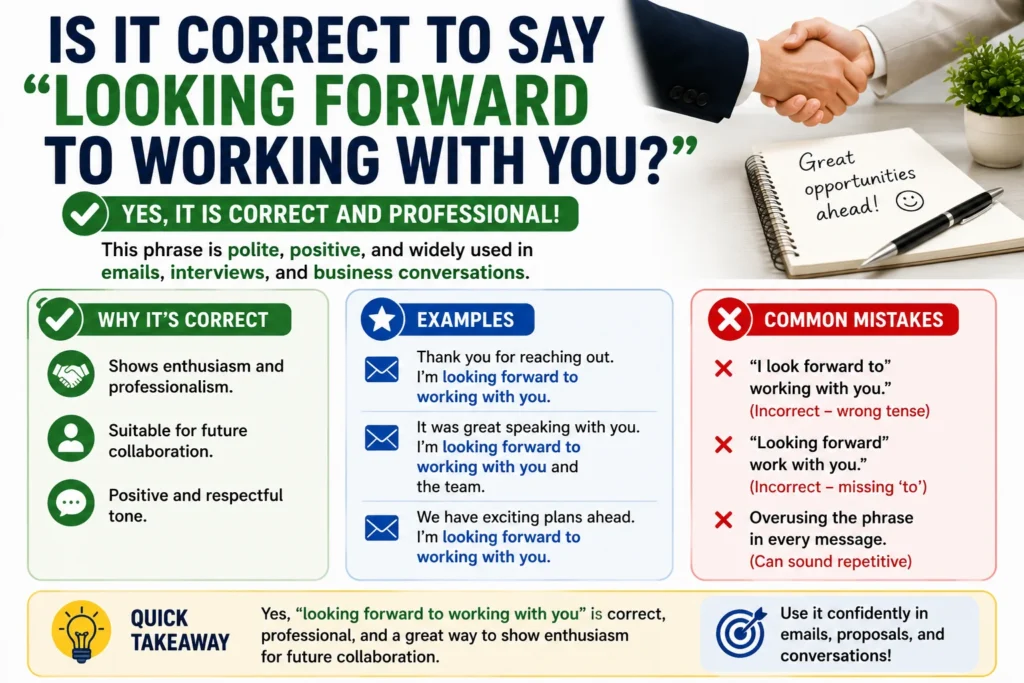
Quick Answer: Is “Looking Forward to Working With You” Grammatically Correct?
Yes, “looking forward to working with you” is grammatically correct and sounds natural in modern professional English. You’ll often see it in business emails, workplace messages, client communication, networking conversations, and introductions. The phrase expresses positive anticipation about working together in the future.
The key grammar point is the word to. In “look forward to,” to functions as a preposition. It does not introduce an infinitive. Therefore, the word that follows it should be a noun, pronoun, or -ing form. That’s why “working” is correct while “work” is not in this structure. Cambridge Dictionary gives the same rule and specifically explains that look forward to must be followed by a noun phrase or an -ing form.
Compare these examples:
| Expression | Correct? | Reason |
| I look forward to working with you. | ✅ Yes | Working is a gerund after the preposition to. |
| I’m looking forward to working with you. | ✅ Yes | The same grammar pattern applies. |
| Looking forward to working with you. | ✅ Yes in email context | The subject and auxiliary verb are understood. |
| I look forward to working with you. | ❌ No | Work is the base verb after a preposition. |
| Looking forward to work with you. | ❌ No | The phrase needs working, not work. |
| Looking forward to working with you. | ❌ No | The fixed expression uses to, not for. |
So, if you’re writing a professional email, you don’t need to worry that the phrase itself sounds wrong. It doesn’t. The real question is whether you want a formal, friendly, or more specific version.
The Short Explanation
The easiest way to remember the rule is:
look forward to + noun or -ing form
For example:
- I look forward to the meeting.
- I look forward to your response.
- I look forward to meeting you.
- I look forward to working with you.
- We look forward to collaborating with your team.
Notice what happens after to. The next element can be a noun such as meeting or response, or it can be a verb in its -ing form, such as meeting, working, or collaborating.
This pattern is confusing because English uses to in two different ways. Sometimes to introduces an infinitive:
- I want to work with you.
- We plan to meet tomorrow.
- She hopes to join the team.
Here, to work, to meet, and to join are infinitive structures.
However, it behaves differently in look forward to:
- I look forward to working with you.
- We look forward to meeting you.
- She looks forward to joining the team.
In these examples, to acts as a preposition. The following -ing form completes the prepositional structure.
That small distinction explains the entire grammar issue. Once you understand it, phrases such as look forward to hearing from you, look forward to meeting you, and look forward to learning more become much easier to form correctly. Cambridge specifically identifies to as a preposition in this construction and contrasts the correct “looking forward to going” with the incorrect “looking forward to go.”
Why Native English Speakers Use It Frequently
“Looking forward to working with you” has become a familiar part of professional communication because it combines warmth with restraint. It shows that you expect a future interaction to be positive without sounding overly enthusiastic.
Imagine two emails.
The first ends with:
“Regards.”
That closing is perfectly acceptable, but it tells the reader very little about your attitude toward the upcoming relationship.
The second ends with:
“Looking forward to working with you.”
The second version adds a clear signal of cooperation. It tells the recipient that you view the upcoming work positively.
That doesn’t mean the phrase always carries deep emotion. In many workplaces, people use it as a conventional professional courtesy. Context supplies much of its meaning.
For example, after accepting a new position, you might write:
“Thank you for the opportunity. I’m looking forward to working with you and the marketing team.”
Here, the expression communicates genuine anticipation.
After a client confirms a project, you might write:
“Thanks for confirming the timeline. We’re looking forward to working with you on the launch.”
This version sounds positive while remaining businesslike.
The phrase also works because it focuses on future cooperation rather than making an exaggerated claim about the relationship. You’re not saying the project will definitely succeed or that you already know the person well. You’re simply expressing a positive expectation.
That balance makes the phrase useful across many professional settings.
What Does “Looking Forward to Working With You” Mean?

At its core, “looking forward to working with you” means that you feel positive about a future opportunity to work together.
The expression look forward to means to anticipate something with pleasure or positive expectation. Cambridge Dictionary defines the expression in terms of being pleased or excited that something is going to happen.
The phrase therefore has two layers of meaning.
First, there’s the basic anticipation:
Something will happen in the future, and you’re happy about it.
Second, there’s the professional relationship:
You expect to cooperate with another person and feel positively about that cooperation.
That second layer matters in workplace communication. Saying “I look forward to working with you” doesn’t merely describe an upcoming task. It also establishes a courteous tone for the relationship.
The Literal Meaning of the Phrase
The words become clearer when you examine them separately.
Looking relates to directing attention toward something.
Forward indicates something ahead, particularly in time.
To connects the expression with what you anticipate.
Working identifies the future activity.
With you identifies the person who will participate in that activity.
Taken together, the expression points toward future cooperation.
However, you shouldn’t interpret it too literally. English contains many fixed expressions whose overall meaning goes beyond the individual words. Look forward to is one of them.
For instance:
“I’m looking forward to the conference.”
The speaker isn’t physically looking toward a conference. Instead, the speaker anticipates it positively.
Likewise:
“We look forward to working with your company.”
The speaker isn’t describing a physical act of looking. The sentence communicates positive anticipation about future cooperation.
This distinction becomes particularly useful for English learners. Translating each word separately can lead to awkward constructions. Learning the entire expression as a grammatical pattern produces much more natural English.
The Professional Meaning Behind the Expression
In professional settings, “looking forward to working with you” can communicate several ideas at once:
- Anticipation — You expect future interaction.
- Cooperation — You recognize that both sides will contribute.
- Professional goodwill — You establish a positive tone.
- Confidence — You treat the upcoming relationship as a constructive opportunity.
- Courtesy — You close the conversation on a respectful note.
- Openness — You signal willingness to collaborate.
The exact meaning depends on the situation.
Suppose a hiring manager offers you a position. You could write:
“I’m excited to accept the position and look forward to working with you.”
Here, the phrase supports a clear professional decision.
Now consider a vendor relationship:
“Thank you for confirming the agreement. We look forward to working with you on the upcoming project.”
The expression now signals the beginning of a business relationship.
The grammar remains identical. The context changes the shade of meaning.
That’s an important point because good professional writing isn’t simply about choosing grammatically correct words. It’s also about choosing language that fits the relationship, timing, and purpose.
What Message Does It Send to the Recipient?
When someone receives “looking forward to working with you,” they’ll usually understand it as a positive signal.
The message suggests:
“I expect that we’ll work together, and I’m positive about that opportunity.”
It can make an introduction feel warmer. It can also soften a formal business exchange without making the message casual.
For example:
“Thank you for sending the proposal. I look forward to working with you.”
This sounds professional and direct.
Compare it with:
“Thank you for sending the proposal. I can’t wait to work with you!!!”
The second version expresses stronger excitement, but it may not suit a formal client relationship. The first keeps enthusiasm under control.
That balance is one reason the phrase remains useful.
It also creates a subtle sense of shared purpose. The wording “working with you” emphasizes collaboration rather than simply completing a transaction. That distinction can matter when you’re beginning a long-term relationship with a client, colleague, supplier, manager, or business partner.
Still, context matters. If the collaboration hasn’t actually been confirmed, the phrase can sound premature. Saying “I look forward to working with you” assumes that working together is reasonably expected.
For example, after receiving a confirmed job offer, the phrase fits naturally:
“Thank you for the offer. I look forward to working with you and the team.”
After submitting an initial application, however, it may be better to avoid assuming the outcome:
“Thank you for considering my application. I look forward to hearing from you.”
The second version matches the situation more accurately because employment hasn’t been confirmed.
The Grammar Behind “Looking Forward to Working With You”
The grammar becomes straightforward once you identify the function of to.
The central structure is:
look forward to + noun/pronoun/gerund
Examples include:
- look forward to the meeting
- look forward to your reply
- look forward to it
- look forward to meeting you
- look forward to working with you
- look forward to hearing from you
The pattern stays stable even when the rest of the sentence changes.
Why “Looking Forward” Is Followed by a Gerund
A gerund is an -ing form that functions grammatically like a noun.
In:
“I look forward to working with you.”
Working names the activity that the speaker anticipates.
You can think of it as the thing being anticipated:
I look forward to [working with you].
The entire working with you phrase acts as the complement of the preposition to.
This explains why the base form work doesn’t fit.
You wouldn’t normally put an infinitive directly after this prepositional to. The correct structure requires the noun-like -ing form.
Cambridge’s grammar guidance makes this distinction explicit: look forward to takes a noun phrase or an -ing form because to functions as a preposition.
Why “Working” Is Correct Instead of “Work”
Consider these two sentences:
Correct:
I look forward to working with you.
Incorrect:
I look forward to work with you.
The difference comes down to grammatical form.
In the first sentence, working functions as a gerund after the preposition to.
In the second, work is the base form associated with an infinitive structure. That structure would make sense after verbs such as want, plan, or hope:
- I want to work with you.
- We plan to work with you.
- She hopes to work with you.
But look forward to follows another pattern:
- I look forward to working with you.
- We look forward to working with you.
- She looks forward to working with you.
Cambridge also notes that this same pattern applies to other verbs after look forward to, such as going, hearing, and meeting.
A useful memory trick is simple:
If “to” belongs to “look forward to,” use a noun or -ing form afterward.
So you get: look forward to meetinglook forward to hearinglook forward to workinglook forward to collaborating
Not: look forward to meetlook forward to hearlook forward to worklook forward to collaborate
The Role of “To” in “Look Forward to”
This is where many writers stumble.
English uses to in both infinitive constructions and prepositional constructions. The spelling stays the same, but the grammar changes.
Compare:
| To as an infinitive marker | To as preposition |
| want to work | look forward to working |
| plan to meet | look forward to meeting |
| hope to hear | look forward to hearing |
| need to discuss | look forward to discussing |
In the left column, to introduces an infinitive.
In the right column, to acts as a preposition.
That’s why memorizing the phrase “look forward to” as a complete grammatical unit can help. Trying to apply the general rule “to + verb” every time will produce errors.
English has many fixed patterns like this. The safest approach is to learn the pattern rather than relying only on the spelling of individual words.
How the Phrase Is Structured Grammatically
The complete sentence:
“I look forward to working with you.”
can be broken down like this:
| Word or phrase | Function |
| I | Subject pronoun |
| look | Main verb |
| forward | Part of the fixed expression |
| to | Preposition |
| working | Gerund |
| with | Preposition |
| you | Object pronoun |
The shorter email closing:
“Looking forward to working with you.”
works differently because it leaves the subject and auxiliary verb unstated.
The implied full version is usually:
“I am looking forward to working with you.”
In everyday email writing, readers can easily recover the missing subject from the communication. Similar shortened expressions appear frequently in modern correspondence, such as:
- Hope you’re doing well.
- Thanks for your help.
- Looking forward to hearing from you.
- Let me know if you have questions.
The shortened form can sound friendly and efficient. In highly formal documents, however, a complete sentence is generally the safer choice.
Common Grammar Mistakes Related to This Phrase
The most common mistake is replacing working with work.
❌ I look forward to work with you.
✅ I look forward to working with you.
Another common mistake involves replacing to with for.
❌ I look forward for working with you.
✅ I look forward to working with you.
Writers sometimes omit to entirely:
❌ I look forward working with you.
✅ I look forward to working with you.
These errors usually happen because learners recognize the meaning but haven’t learned the fixed grammatical pattern.
Here’s a quick reference:
| Incorrect | Correct |
| look forward to work | look forward to working |
| look forward for working | look forward to working |
| look forward working | look forward to working |
| look forward to meet | look forward to meeting |
| look forward to hear | look forward to hearing |
| look forward to collaborate | look forward to collaborating |
There’s another issue worth noticing: not every sentence containing look forward to has to use an -ing word. A noun or pronoun can follow the preposition too.
For example:
“I look forward to your response.”
Here, response is a noun.
Likewise:
“I look forward to it.”
Here, it is a pronoun.
So the deeper rule isn’t simply “look forward to + -ing.” The more accurate rule is:
look forward to + noun, pronoun, or gerund
That broader rule gives you much more control over the expression.
Is “Looking Forward to Working With You” Correct?
Yes. It is correct, natural, and useful in professional communication.bFor a formal business letter, “I look forward to working with you” offers a complete and polished sentence.For a friendly professional email, “I’m looking forward to working with you” sounds warm and conversational.For a concise email closing, “Looking forward to working with you” is common and easily understood. The important thing is to match the form with the situation.
| Version | Typical tone | Best use |
| I look forward to working with you. | Formal, polished | Business letters, formal correspondence |
| I’m looking forward to working with you. | Warm, conversational | Professional emails |
| Looking forward to working with you. | Concise, friendly | Email closings and ongoing correspondence |
| We look forward to working with you. | Corporate, collaborative | Company or team communication |
All four can communicate essentially the same positive expectation. The difference lies mainly in tone, completeness, and context.
So, when someone asks, “Is it correct to say looking forward to working with you?”, the answer is an uncomplicated yes. The phrase follows a standard English grammar pattern, and its professional meaning is clear. The bigger skill lies in knowing when to use the shortened form, when to choose the complete sentence, and how to make the expression fit the relationship rather than letting it become a lifeless email template.
When Should You Use “Looking Forward to Working With You”?
The phrase “looking forward to working with you” fits best when future cooperation is reasonably clear. It works especially well after a job offer, confirmed project, new partnership, team introduction, or successful business discussion. Cambridge Dictionary notes that look forward to expresses positive anticipation about something that will happen and that the expression commonly appears in formal letters and emails.
The important word is future. You’re talking about something you expect to happen, not simply describing a relationship that already exists. That distinction helps you choose the right expression without making your email sound like a recycled template.
After Accepting a Job Offer
A confirmed job offer creates one of the clearest situations for using “I look forward to working with you.” Once you’ve accepted the position, future collaboration is no longer hypothetical. You’ll soon join the organization and work with the hiring manager, team, or wider company.
For example:
Thank you for the offer. I’m pleased to accept the position and look forward to working with you and the marketing team.
This sentence works because it connects the expression to a specific event: accepting the position. It also sounds more genuine than dropping the phrase into an email without context.
You can adjust the wording depending on your relationship with the recipient:
- Formal: “I look forward to working with you and contributing to the team.”
- Professional and warm: “I’m looking forward to working with you and getting started.”
- Concise: “Looking forward to working with you.”
- Team-focused: “I look forward to working with you and everyone on the team.”
If you’re writing directly to a future manager, the complete sentence often feels polished:
“I look forward to working with you.”
If the conversation has already become friendly, the contraction “I’m looking forward to working with you” can sound more relaxed.
When Starting a New Business Partnership
A confirmed business partnership also provides a natural setting for this phrase. Once both parties have agreed to collaborate, “looking forward to working with you” communicates enthusiasm without becoming overly familiar.
Consider this example:
Thank you for confirming the partnership. We look forward to working with you on the upcoming campaign.
The phrase becomes stronger because the writer specifies the campaign. Specificity gives a routine expression some substance.
You can make the closing even more useful by mentioning the next stage:
We’re looking forward to working with you as we move into the first phase of the project.
This version does more than express enthusiasm. It connects the relationship to an actual business activity.
That approach matters because professional communication works best when courtesy and information support each other. A warm phrase alone can feel generic. A warm phrase attached to a concrete next step feels purposeful.
Before Joining a New Team
Starting a new team creates another obvious opportunity.
You might use the phrase when introducing yourself to colleagues:
Thank you for the warm welcome. I’m looking forward to working with you all and learning more about the team.
Here, working with you all makes the audience clear. The sentence also adds learning more about the team, which gives the message a more personal touch.
For a shorter introduction, you could write:
It’s great to meet everyone. I’m looking forward to working with you.
That sounds natural in an internal email or team message.
There’s a subtle difference between “working with you” and “working together.” The first directly addresses the recipient. The second emphasizes shared effort.
Compare:
- I’m looking forward to working with you.
- I’m looking forward to working together.
- We’re looking forward to working with you.
- We’re looking forward to working together on this project.
All four are grammatical. Your choice depends on whether you want to emphasize the person, the group, or the shared task.
After a Successful Meeting or Interview
This situation requires more care.
After a productive business meeting, “I look forward to working with you” can be appropriate if both sides have agreed to move forward. If the meeting was only exploratory, however, the phrase may assume too much.
For example, after confirming a project:
Thank you for meeting with us today. We look forward to working with you on the project.
That works because the collaboration is established.
After an initial sales conversation, a safer closing might be:
Thank you for taking the time to speak with us. I look forward to hearing your thoughts.
Why choose hearing your thoughts instead?
Because the next step remains uncertain. You’re waiting for the recipient’s response rather than assuming that the relationship has already moved into a working arrangement.
The same principle applies to job interviews.
After an interview, you could write:
Thank you for the opportunity to discuss the role. I look forward to hearing from you.
If the company has already offered you the position, you can confidently switch to:
Thank you again for the opportunity. I look forward to working with you.
The difference is small in wording but significant in meaning.
“I look forward to hearing from you” anticipates communication.
“I look forward to working with you” anticipates collaboration.
That distinction keeps your message accurate.
When Communicating With Clients or Customers
Client communication often benefits from this phrase because it combines professionalism with warmth. Once a client has approved a project, signed an agreement, or confirmed a service, you can use “looking forward to working with you” naturally.
For example:
Thank you for confirming the project details. We’re looking forward to working with you and getting started next week.
This version feels stronger because it identifies a clear next step.
Another option:
We appreciate the opportunity and look forward to working with you on the new website.
Notice how the project gives the closing a specific purpose.
For established clients, you can also make the phrase more relationship-focused:
We’re looking forward to working with you again on the next phase.
The word again changes the context. It tells the reader that previous collaboration already exists.
That makes the sentence different from a first-time introduction.
When You Should Avoid Using This Phrase
Although “looking forward to working with you” is correct, grammatical accuracy doesn’t automatically make every usage appropriate.
Sometimes the phrase arrives too early. Sometimes it sounds repetitive. In other cases, another expression communicates your actual intention more precisely.
Good professional writing isn’t about forcing a favorite phrase into every email. It’s about choosing language that matches what you genuinely know at that moment.
Situations Where It May Sound Premature
The biggest problem occurs when future cooperation hasn’t been confirmed.
Imagine that you’ve sent a proposal to a potential client. The client hasn’t accepted it yet.
Ending your message with:
“I look forward to working with you.”
could sound slightly presumptuous.
A better option might be:
“I look forward to hearing your thoughts on the proposal.”
Or:
“I’d be happy to discuss the proposal further.”
These alternatives respect the uncertainty.
The same principle applies during recruitment.
After submitting a resume, saying:
“I look forward to working with you.”
assumes you’ll receive the job.
Instead, you could say:
“I look forward to discussing my application with you.”
After an interview, “I look forward to hearing from you” usually fits better unless the employer has already confirmed the position.
A useful rule is:
Use “looking forward to working with you” when working together is expected, not merely hoped for.
That single distinction can prevent an otherwise polished email from sounding too confident.
Cases Where It Can Feel Overused or Generic
There’s another issue: repetition.
Because “looking forward to working with you” appears so often in professional correspondence, it can sometimes feel automatic. The phrase isn’t bad. The problem arises when the surrounding email contains no personal or situation-specific detail.
Compare these two endings:
Generic:
Thank you. Looking forward to working with you.
Specific:
Thank you for confirming the launch schedule. We’re looking forward to working with you on the first campaign phase next Monday.
The second version gives the reader something concrete.
You don’t always need a long sentence. Even one relevant detail can make a difference.
Try adding:
- the project
- the next meeting
- the upcoming phase
- the shared goal
- the recipient’s team
- the next action
- a confirmed date
For example:
“I’m looking forward to working with you on the product launch.”
That feels more purposeful than the standalone phrase.
Another option is to replace the expression entirely when it has already appeared several times in the conversation:
“I’m excited to get started.”
“It’ll be great to collaborate on this.”
“I’m glad we’ll be working together.”
Variation keeps your writing fresh without sacrificing professionalism.
When the Working Relationship Has Already Started
The phrase can also become slightly awkward when you’re already deep into the collaboration.
Suppose you’ve worked with a colleague for six months. Writing:
“I’m looking forward to working with you.”
isn’t necessarily grammatically wrong. However, the meaning suggests anticipation of future cooperation, which may not accurately describe the situation.
Consider these alternatives instead:
- I’m enjoying working with you.
- It’s been great working with you.
- I’m glad we’re working together.
- I look forward to continuing our work together.
- I’m excited about what we’ll accomplish together.
The last option shifts attention toward future results rather than the beginning of the relationship.
If you’re preparing for another phase of an existing project, “I look forward to continuing our work together” can be especially useful.
It preserves the idea of future anticipation while acknowledging that collaboration has already begun.
Alternatives for More Specific Communication
Sometimes the best alternative depends on what you actually want to communicate.
| What you mean | Better expression |
| You expect a reply | I look forward to hearing from you. |
| You expect a meeting | I look forward to meeting with you. |
| You’re excited about starting | I’m excited to get started. |
| You expect collaboration | I look forward to working with you. |
| You want to emphasize teamwork | I’m looking forward to working together. |
| You want to emphasize the project | I look forward to working with you on this project. |
| You already collaborate | I look forward to continuing our work together. |
| You want a warmer tone | I’m excited to work together. |
The goal isn’t to replace “looking forward to working with you” simply because you’ve used it before. It remains an excellent expression when it accurately reflects the situation.
Is “Looking Forward to Working With You” Formal or Informal?
“Looking forward to working with you” sits comfortably in the middle of the professional formality scale. It isn’t excessively formal, yet it doesn’t sound casual or slangy.
That flexibility explains why you can see it in many types of workplace communication.
The complete form “I look forward to working with you” generally sounds more formal and polished. The version “I’m looking forward to working with you” sounds warmer and more conversational. The shortened “Looking forward to working with you” feels concise and familiar in email communication.
Cambridge specifically identifies look forward to as a formal expression commonly used toward the end of letters and emails.
Professional Business Settings
In traditional business correspondence, “I look forward to working with you” is a safe choice.
For example:
Thank you for confirming the agreement. I look forward to working with you on the project.
The sentence sounds courteous without adding unnecessary enthusiasm.
For senior executives, external clients, legal professionals, consultants, and formal business relationships, the complete version often works better than the shortened form.
That doesn’t make “Looking forward to working with you” incorrect. It simply makes the complete sentence slightly more polished.
When the relationship is new and formal, clarity usually beats excessive friendliness.
Semi-Formal Workplace Communication
Internal workplace communication gives you more flexibility.
You might write:
Thanks for the introduction. I’m looking forward to working with you.
The contraction I’m creates a relaxed tone while keeping the sentence professional.
You could also write:
Great to meet you. Looking forward to working together.
That version feels more conversational and would fit a team chat or informal workplace email.
The important thing is consistency. If the rest of your message sounds friendly, the shorter form fits naturally. If the rest uses highly formal language, the complete sentence may create a smoother match.
Client and Customer Interactions
Client communication often requires a careful balance between warmth and professionalism.
“We look forward to working with you” is particularly useful when a company speaks on behalf of a team.
For example:
Thank you for choosing our team. We look forward to working with you throughout the project.
The plural we creates a sense of organizational support.
For a personal consultant-client relationship, you might choose:
I’m looking forward to working with you and learning more about your goals.
That version sounds more personal.
Avoid going too far in either direction. Extremely formal wording can create unnecessary distance, while excessive enthusiasm can feel unnatural in a business setting.
Academic and Corporate Environments
The phrase also works in academic and corporate communication when people expect to collaborate.
For example:
“I look forward to working with you on the research project.”
Or:
“We look forward to working with your department during the next phase.”
In these environments, the phrase works especially well when the collaboration has a defined purpose.
Adding the project, department, research topic, or next phase gives the sentence more informational value.
That’s a useful writing principle beyond this particular phrase: professional warmth becomes more convincing when you attach it to something concrete.
Casual Professional Communication
A casual workplace message allows even more flexibility.
You could write:
Looking forward to working with you!
Or:
I’m excited to work together.
Or simply:
Looking forward to getting started!
The exclamation mark can add warmth, but use it thoughtfully. One is enough in most professional contexts.
For a close colleague, a shorter message may feel completely natural:
Looking forward to working together.
For a new client, however, the complete “I look forward to working with you” may create a more polished first impression.
Formality Scale Comparison
Here’s a practical way to compare the main versions:
| Expression | Formality | Tone | Typical context |
| I look forward to working with you. | High | Polished, courteous | Formal business email |
| We look forward to working with you. | High | Corporate, professional | Client or company communication |
| I’m looking forward to working with you. | Medium | Warm, professional | Workplace email |
| Looking forward to working with you. | Medium | Friendly, concise | Email closing |
| I’m excited to work with you. | Medium | Enthusiastic | Friendly professional setting |
| Looking forward to working together. | Medium-low | Collaborative | Team communication |
| Can’t wait to get started! | Low | Highly enthusiastic | Casual workplace communication |
No single version wins every situation.
The best choice depends on the recipient, relationship, purpose, and level of certainty surrounding the collaboration.
When in doubt, “I look forward to working with you” remains one of the safest professional choices. It communicates positive anticipation clearly while maintaining a respectful tone.
The Tone Created by “Looking Forward to Working With You”
The wording “looking forward to working with you” does more than follow a grammar rule. It also shapes the emotional temperature of your message. A professional email can be technically correct yet still feel cold, abrupt, or overly enthusiastic. This phrase often lands in the middle. It communicates enthusiasm, confidence, and cooperation without demanding an emotional response from the reader.
That balance makes it useful when you’re beginning a new professional relationship. You can show genuine interest while keeping appropriate boundaries.
Expressing Enthusiasm Without Sounding Pushy
Professional enthusiasm works best when it feels measured.
Compare these sentences:
I look forward to working with you on the project.
and:
I’m absolutely thrilled beyond words that we’ll finally work together!
Both communicate excitement, but they create very different impressions. The first sounds confident and professional. The second may feel excessive unless the relationship is especially informal.
“Looking forward to working with you” avoids that problem. It shows positive anticipation without putting pressure on the recipient.
You can also make the phrase more natural by connecting it to something specific:
I’m looking forward to working with you on the upcoming launch.
We look forward to working with you and your team.
I’m looking forward to getting started next week.
Specific details make enthusiasm feel earned rather than automatic.
Building Trust and Professional Rapport
Good professional communication often begins with small signals of respect. A thoughtful closing can help establish that tone.
When you say “I look forward to working with you,” you acknowledge that the upcoming relationship involves cooperation. The phrase doesn’t position one person as superior to the other. Instead, working with you emphasizes partnership.
That wording can be particularly effective with:
- new clients
- future colleagues
- project partners
- vendors
- consultants
- managers
- department leaders
- business contacts
Suppose a client has just approved your proposal. A closing such as:
Thank you for approving the proposal. I look forward to working with you as we move into the next phase.
does two jobs at once. It expresses appreciation and establishes a positive expectation for the next stage.
That combination creates better professional rapport than a generic sign-off alone.
Showing Confidence and Cooperation
The phrase can also communicate confidence.
When you write “We look forward to working with you,” you’re treating the upcoming collaboration as a meaningful next step. You’re not begging for approval or making an exaggerated promise. You’re simply recognizing that both sides are moving forward.
That distinction matters in business communication.
For example:
We appreciate the opportunity and look forward to working with you on the implementation.
This sounds confident because the sentence acknowledges the opportunity while keeping attention on the actual work.
Likewise:
I look forward to working with you to achieve the project goals.
Here, the phrase points toward cooperation and a shared outcome.
Creating a Warm but Professional Impression
A strong professional message doesn’t have to sound stiff. In fact, excessive formality can sometimes create unnecessary distance.
Compare:
Your cooperation is hereby anticipated.
with:
I look forward to working with you.
The second sentence sounds far more natural. It communicates the same broad idea without hiding behind bureaucratic language.
The phrase works because it sounds like something a real person might say in conversation while still fitting professional correspondence.
That middle ground is valuable. You can sound approachable without becoming overly casual.
Expert Insight: Context Matters More Than the Phrase
A correct expression can still become weak when writers use it mechanically.
If every email ends with “Looking forward to working with you,” readers may eventually stop noticing it. The phrase becomes part of the background.
The solution isn’t to abandon it. Instead, make the surrounding language relevant.
For example:
Generic:
Thanks again. Looking forward to working with you.
More specific:
Thanks again for confirming the timeline. I’m looking forward to working with you on the first project phase.
The second version gives the reader a reason to believe the anticipation is genuine.
Specificity is especially useful when you’re communicating with clients or people outside your organization. A small reference to the actual task can transform a stock closing into meaningful communication.
Examples of “Looking Forward to Working With You” in Emails
The best way to understand this expression is to see how it behaves in realistic situations. The grammar stays consistent, but the surrounding words change according to the relationship.
New Employee Introduction Email
When you join a new organization, “I’m looking forward to working with you” can create a friendly first impression.
For example:
Thank you for the warm welcome. I’m looking forward to working with you and learning more about the team.
This version works particularly well because it doesn’t stop at the standard phrase. It adds learning more about the team, which makes the message feel personal.
A shorter version works for an internal message:
It’s great to meet everyone. I’m looking forward to working with you all.
The word all makes the intended audience clear.
Job Offer Acceptance Email
After accepting a job offer, the phrase becomes especially appropriate because the future working relationship is confirmed.
For example:
Thank you for the opportunity. I’m pleased to accept the position and look forward to working with you and the team.
You can make the sentence warmer without losing professionalism:
Thank you again for the opportunity. I’m excited to get started and look forward to working with everyone.
The phrase fits here because you aren’t merely hoping to join the company. You have accepted the role.
Client Onboarding Email
Client onboarding is another strong use case.
Thank you for choosing our team. We look forward to working with you throughout the project and getting started on the first phase.
This wording combines courtesy, anticipation, and a clear reference to the work.
A more personal version might say:
I’m looking forward to working with you and learning more about your goals for the project.
That approach works well when the relationship depends heavily on communication and collaboration.
Project Collaboration Email
When two professionals begin working on a defined project, specificity makes the phrase stronger.
Thanks for confirming the project details. I look forward to working with you on the research phase.
Or:
I’m looking forward to working with you as we prepare the launch materials.
Both examples connect the anticipated relationship to an actual responsibility.
That connection prevents the closing from sounding like empty courtesy.
Networking Follow-Up Email
Networking requires more caution because future collaboration may not yet exist.
After a genuinely productive conversation, you could write:
It was great speaking with you today. I look forward to staying in touch and exploring ways we can work together.
This wording is useful because it doesn’t automatically assume a formal working relationship.
If the person has already agreed to collaborate, you can be more direct:
Thanks for the conversation. I look forward to working with you on the upcoming initiative.
The key is certainty. Match the strength of the expression to what both parties have actually agreed to.
Vendor or Business Partnership Email
For a supplier, contractor, or business partner, the phrase can reinforce a cooperative relationship.
Thank you for confirming the agreement. We look forward to working with you and supporting a successful launch.
The plural we works particularly well when an organization speaks on behalf of its team.
You can also focus on the shared objective:
We look forward to working with you to deliver the project on schedule.
That version makes the relationship feel collaborative rather than transactional.
Meeting Follow-Up Email
After a meeting, your wording should depend on what happened.
If collaboration was confirmed:
Thank you for meeting with us today. We look forward to working with you on the next phase.
If the meeting was exploratory:
Thank you for taking the time to meet with us. We look forward to hearing your thoughts.
These examples illustrate an important distinction. Working with you anticipates collaboration. Hearing from you anticipates a response.
Choose the expression that accurately describes the next event.
Better Ways to Say “Looking Forward to Working With You”
There’s nothing wrong with the original phrase. Still, professional writing benefits from flexibility. Sometimes another expression better matches your relationship, purpose, or tone.
The goal isn’t to find a supposedly “better” phrase in every situation. Instead, choose the wording that communicates your actual intention most precisely.
Formal Alternatives
For formal correspondence, these options work well:
- I look forward to working with you.
- We look forward to working with you.
- I look forward to collaborating with you.
- I look forward to contributing to the project.
- I look forward to our continued collaboration.
- We look forward to a productive working relationship.
Among these, “I look forward to working with you” remains one of the most natural choices.
You don’t need an elaborate synonym simply to sound sophisticated. In professional writing, clarity usually beats ornament.
Friendly Alternatives
For a warmer workplace tone, consider:
- I’m excited to work with you.
- I’m looking forward to getting started.
- It’ll be great to work together.
- I’m glad we’ll be working together.
- I’m excited about what we can accomplish together.
- Looking forward to getting started with you.
These options feel less formal while remaining professional.
For example, a colleague might write:
Great meeting you today. I’m excited to work together on this.
That sounds natural in a team environment.
Client-Focused Alternatives
Client communication often benefits from language that emphasizes service and shared goals.
Useful alternatives include:
- We’re excited to get started on your project.
- We look forward to supporting your team.
- We’re pleased to begin working with you.
- We look forward to helping bring this project to life.
- We’re excited to partner with you on this initiative.
- We look forward to supporting your goals.
These alternatives can sound more purposeful because they focus on what the client actually needs.
For instance:
We’re excited to get started and support your team throughout the launch.
This feels more informative than a generic closing.
Team-Oriented Alternatives
When collaboration matters most, use language that emphasizes shared effort:
- I’m looking forward to working together.
- We’re looking forward to collaborating with your team.
- I’m excited to be part of the team.
- I’m glad we’ll be working together.
- I look forward to contributing to the team.
- I’m excited about what we can accomplish together.
The phrase working together can sometimes sound more collaborative than working with you, especially when several people are involved.
Executive-Level Alternatives
Executive communication usually benefits from brevity and precision.
Consider:
- I look forward to our collaboration.
- I look forward to working together.
- We look forward to a productive partnership.
- I look forward to advancing this initiative together.
- We look forward to building a strong partnership.
Avoid inflated wording such as “I eagerly anticipate our mutually beneficial synergistic collaboration.” It sounds more like corporate jargon than natural English.
A straightforward sentence often carries more authority.
Fifteen Professional Alternatives to “Looking Forward to Working With You”
Different situations call for slightly different shades of meaning. Here are useful alternatives organized by what you want to emphasize:
| Alternative | Tone | Best suited to |
| I look forward to collaborating with you. | Formal | Business partnerships |
| I’m looking forward to working together. | Warm | Team communication |
| I’m excited to work with you. | Friendly | Workplace relationships |
| I look forward to our collaboration. | Polished | Executive communication |
| We look forward to working with you. | Corporate | Client communication |
| I look forward to contributing to the project. | Professional | New assignments |
| I’m excited to get started. | Friendly | Project beginnings |
| We’re pleased to begin working with you. | Formal | Client onboarding |
| I look forward to supporting your team. | Service-focused | Client relationships |
| We’re excited to partner with you. | Positive | Business partnerships |
| I’m glad we’ll be working together. | Warm | New colleagues |
| I look forward to continuing our work together. | Professional | Existing relationships |
| We look forward to building a strong partnership. | Strategic | Long-term business |
| I’m excited about what we can accomplish together. | Optimistic | Collaborative projects |
| I look forward to getting started. | Concise | Confirmed projects |
Notice that these aren’t perfect substitutes in every context.
“I look forward to hearing from you” means something different. It anticipates a response rather than future collaboration.
Likewise, “I’m excited to get started” focuses on beginning an activity rather than specifically addressing the professional relationship.
That distinction matters when selecting an alternative. A synonym should preserve the intended meaning, not merely resemble the original phrase.
Looking Forward to Working With You vs. Excited to Work With You
These expressions overlap, but they aren’t identical.
“I look forward to working with you” sounds more measured. It emphasizes anticipation and remains highly adaptable across formal settings.
“I’m excited to work with you” sounds more energetic and personal. It directly communicates enthusiasm.
Consider the difference:
I look forward to working with you on the project.
This sounds polished and professional.
I’m excited to work with you on the project.
This sounds warmer and more enthusiastic.
Neither is inherently better.
Key Differences in Tone
| Phrase | Emotional intensity | Professional feel |
| I look forward to working with you. | Moderate | Very professional |
| I’m looking forward to working with you. | Moderate | Warm and professional |
| I’m excited to work with you. | Higher | Friendly and professional |
| I can’t wait to work with you. | High | Casual |
The more formal the setting, the more useful the measured look forward to construction becomes.
Which Sounds More Professional?
In most formal business contexts, “I look forward to working with you” sounds more polished than “I’m excited to work with you.”
That doesn’t mean excited is unprofessional. It simply carries a stronger emotional charge.
For a new corporate client, you might choose:
I look forward to working with you and your team.
For a close new colleague, you might naturally choose:
I’m excited to work with you.
Professionalism comes from matching the language to the relationship.
When to Use Each Expression
Use “I’m looking forward to working with you” when you want warmth without losing formality.Use “I’m excited to work with you” when the relationship allows stronger enthusiasm.Use “I can’t wait to work with you” only when the setting is genuinely casual.
A good writer doesn’t simply reach for the most enthusiastic option. The right phrase should feel proportionate to the situation.
How This Phrase Helps Build Professional Relationships
Words can establish expectations before the actual work begins. “Looking forward to working with you” can help create a cooperative frame for that relationship.
It doesn’t guarantee trust, of course. Trust comes from consistent actions. However, courteous language can provide a positive starting point.
Creating Positive First Impressions
First impressions often begin through email.
A message that ends with:
“I look forward to working with you.”
feels more welcoming than an abrupt sign-off.
This is particularly useful when introducing yourself to a new colleague or client. The phrase signals openness while maintaining professional boundaries.
Demonstrating Professional Courtesy
Professional courtesy doesn’t require complicated vocabulary.
A simple acknowledgment of future cooperation can show that you value the relationship.
For example:
Thank you for your time today. I look forward to working with you.
The sentence is short, but it recognizes both the person’s time and the future relationship.
Encouraging Long-Term Collaboration
When a relationship involves repeated projects, the phrase can support a broader sense of partnership.
For example:
We look forward to working with you on this phase and continuing our collaboration in the future.
This version moves beyond a single task. It communicates interest in an ongoing relationship while keeping the wording grounded.
Mini Case Study: Client Onboarding
Consider a fictional web design company onboarding a new client.
A generic closing might say:
Thanks. Looking forward to working with you.
A stronger version could say:
Thank you for approving the project plan. We’re looking forward to working with you on the website launch and beginning the discovery phase Monday.
The second message works better because it combines courtesy, specificity, anticipation, and a clear next step.
The lesson is simple: don’t make the phrase carry the entire message. Give it useful context.
Professional Email Examples at a Glance
Professional Email Examples at a Glance
After accepting a job offer:
Thank you for the opportunity. I look forward to working with you and the team.
After confirming a client project:
Thank you for confirming the project details. We look forward to working with you on the launch.
After joining a new team:
Thank you for the warm welcome. I’m looking forward to working with everyone.
After confirming a partnership:
We appreciate the opportunity and look forward to working with you on this initiative.
After an exploratory meeting:
Thank you for taking the time to meet. I look forward to hearing your thoughts.
For an existing collaboration:
I look forward to continuing our work together.
Common Mistakes to Avoid With “Looking Forward to Working With You”
“Looking forward to working with you” is simple, but small mistakes can change how your email sounds. Some errors involve grammar, while others involve timing, tone, punctuation, or repetition. Knowing these differences helps you write messages that feel natural instead of copied from a template.
Using the Phrase Too Early
One of the most common mistakes is using “looking forward to working with you” before both sides have agreed to collaborate.
For example, after sending a first proposal, you might not want to write:
I look forward to working with you on this project.
The recipient may still be deciding whether to accept the proposal. In that situation, the sentence sounds slightly presumptive.
A better option would be:
I look forward to hearing your thoughts on the proposal.
Once the recipient confirms the project, “I look forward to working with you” becomes much more appropriate.
Choosing the Wrong Level of Formality
The phrase itself works across many professional settings. However, the surrounding language should match your audience.
For a formal client email:
Thank you for confirming the agreement. I look forward to working with you.
For a friendly colleague:
Thanks for the warm welcome. I’m looking forward to working with you!
Neither version is more grammatically correct. They simply create different impressions.
Avoid combining very casual language with an extremely formal closing. A message should sound like one coherent voice from beginning to end.
Repeating It in Every Email
Because the expression works so well, it’s tempting to use it repeatedly.
That can make your writing feel mechanical.
If you’ve already used “looking forward to working with you” several times, vary the wording when the context allows it:
- I’m excited to get started.
- I look forward to collaborating with you.
- I’m glad we’ll be working together.
- We’re excited to begin the project.
- I look forward to continuing our work together.
Variation doesn’t mean replacing the phrase every time. Use it when it adds value, then choose a different expression when another wording fits better.
Confusing “Look Forward To” With “Look Forward To Work”
The most important grammar mistake involves the verb after to.
In “look forward to,” the word to functions as a preposition. A preposition can be followed by a noun, pronoun, or gerund.
Therefore:
I look forward to working with you. ✓
is correct.
But:
I look forward to work with you. ✗
is incorrect in standard English.
The same rule applies to other verbs:
- I look forward to meeting you.
- I look forward to hearing from you.
- I look forward to discussing the project.
- I look forward to seeing the results.
Think of to here as part of the established expression look forward to, rather than as the infinitive marker in to work.
Punctuation and Sign-Off Errors
The phrase itself doesn’t require special punctuation.
You can write:
I look forward to working with you.
If it appears as a closing sentence, follow it with your normal sign-off:
I look forward to working with you.
Best regards,
Jordan
You don’t need a comma after you unless the surrounding sentence structure requires one.
Likewise, avoid unnecessary punctuation such as:
I look forward to working with you!!!
One exclamation mark can work in an informal workplace setting. Formal correspondence usually benefits from a period.
Best Practices for Professional Email Closings
A strong email closing should feel like a natural landing rather than a sentence that suddenly appears at the bottom.
“Looking forward to working with you” works best when it connects logically to the message before it.
Choosing the Right Closing Based on Context
Different situations call for different closing expressions.
| Situation | Recommended closing |
| Confirmed new job | I look forward to working with you. |
| Confirmed client project | We look forward to working with you. |
| Waiting for a reply | I look forward to hearing from you. |
| Upcoming meeting | I look forward to meeting with you. |
| Existing collaboration | I look forward to continuing our work together. |
| Friendly colleague | I’m looking forward to working with you. |
| Casual team message | Looking forward to getting started! |
| Exploratory proposal | I look forward to discussing this further. |
This distinction prevents you from using working with you when the actual next step involves something else.
Matching Your Tone to the Recipient
Consider who will read your email.
A senior executive, potential client, new colleague, and close teammate may all receive different versions of the same basic message.
For a senior business contact:
I look forward to working with you.
For a new teammate:
I’m looking forward to working with you.
For a close colleague:
Looking forward to working together!
The underlying meaning remains similar, but the social distance changes.
Combining Warmth With Professionalism
You don’t need excessive enthusiasm to sound friendly.
A useful formula is:
appreciation + specific context + future cooperation
For example:
Thank you for confirming the project timeline. I’m looking forward to working with you and getting started next week.
The first sentence acknowledges the recipient. The second establishes anticipation and provides a concrete detail.
This approach feels more authentic than simply adding several enthusiastic adjectives.
“Looking Forward to Working With You” vs. “Looking Forward to Working with You”
One issue that often confuses writers isn’t grammar at all. It’s capitalization.
In ordinary sentence text, “working with you” normally uses lowercase with and you.
For example:
I look forward to working with you.
When the phrase appears in a title or heading, capitalization depends on the style guide you’re following.
A title may appear as:
Looking Forward to Working With You
or:
Looking Forward to Working with You
Both can be acceptable depending on the chosen title-case rules.
The important point is that capitalization doesn’t create a different grammatical phrase.
Which Version Is Correct?
In normal prose, use:
I look forward to working with you.
The lowercase form follows ordinary sentence capitalization.
In a heading, capitalization can vary according to editorial style. If you’re writing website headings, consistency matters more than choosing one universal capitalization pattern.
Why Many Writers Get Confused
The confusion usually comes from title case.
Some style systems capitalize major words while leaving shorter function words lowercase. Other systems use different capitalization rules.
As a result, you may encounter:
- Looking Forward to Working With You
- Looking Forward to Working with You
- looking forward to working with you
These versions can look different while referring to the same expression.
The grammar doesn’t change because the capitalization changes.
Grammar Rule Explained Simply
The structure can be broken down like this:
look forward to + noun/gerund
Examples:
- look forward to meeting
- look forward to speaking
- look forward to hearing
- look forward to working
- look forward to collaborating
The verb after to takes the -ing form because to functions as a preposition in this construction.
That rule is the key to understanding why “looking forward to working with you” is correct.
Why “Looking Forward to Working With You” Is Grammatically Correct
The phrase contains a useful grammar lesson that extends beyond this single expression.
Consider:
I look forward to working with you.
The structure contains:
- I — subject
- look forward to — verb phrase
- working — gerund
- with you — prepositional phrase
The word working acts as a gerund. Although it looks like a present participle because of its -ing ending, its role here is noun-like because it follows the preposition to.
Compare this with:
I want to work with you.
Here, to work is an infinitive.
The two constructions look similar but follow different grammar patterns:
| Construction | Correct form |
| want to + verb | want to work |
| plan to + verb | plan to work |
| hope to + verb | hope to work |
| look forward to + gerund | look forward to working |
| object to + gerund | object to working |
| be committed to + gerund | be committed to working |
This distinction helps explain why learners sometimes make mistakes. The word to doesn’t always introduce an infinitive.
How to Make the Phrase Sound More Natural
Correct grammar is only the first step. Good writing also depends on context and rhythm.
A bare closing such as:
Looking forward to working with you.
can work in a short email. However, a complete sentence often sounds more polished in formal correspondence:
I look forward to working with you.
Adding context can make it even stronger:
I look forward to working with you on the upcoming product launch.
Or:
I’m looking forward to working with you and your team.
The best version depends on what you want to emphasize.
Add a Specific Project
Instead of:
I look forward to working with you.
try:
I look forward to working with you on the website redesign.
The added detail immediately makes the sentence more relevant.
Mention the Next Step
For example:
I’m looking forward to working with you and getting started next Monday.
This gives the recipient useful information while maintaining a friendly tone.
Mention the Shared Goal
You could write:
We look forward to working with you to deliver the project successfully.
This emphasizes cooperation and outcome rather than simply the relationship.
A Practical Decision Guide
When you’re unsure whether to use the phrase, ask yourself a few quick questions.
| Question | If the answer is yes |
| Has the collaboration been confirmed? | I look forward to working with you. |
| Am I waiting for a response? | I look forward to hearing from you. |
| Is this a new colleague? | I’m looking forward to working with you. |
| Is this an existing relationship? | I look forward to continuing our work together. |
| Is the setting casual? | Looking forward to working together! |
| Is the project still uncertain? | Avoid assuming future collaboration. |
| Have I used the phrase repeatedly? | Consider a specific alternative. |
This simple check can help you choose language that matches the actual situation.
Final Takeaway for Professional Writers
“Looking forward to working with you” is grammatically correct, natural, and widely suitable for professional communication. Its strongest use comes when future collaboration has already been established or reasonably confirmed.
The grammar becomes straightforward once you remember one central rule: look forward to takes a noun or -ing form because to functions as a preposition.
So write:
I look forward to working with you.
Not:
I look forward to work with you.
Beyond grammar, context matters. Use the phrase after a confirmed job offer, project agreement, team introduction, or business partnership. When collaboration remains uncertain, choose “I look forward to hearing from you” or another expression that accurately reflects the next step.
A little specificity also goes a long way. Mention the project, team, goal, or upcoming stage when appropriate. That small addition can turn a familiar professional phrase into a warmer and more purposeful closing.
Conclusion
“Looking forward to working with you” is correct, natural, and widely used in professional English. It works especially well when you want to express positive anticipation about a future working relationship without sounding overly formal. The key grammar rule is simple: in “look forward to,” the word to acts as a preposition, so it should be followed by the -ing form, such as working, rather than work. Whether you’re writing to a colleague, client, manager, business partner, or new team, the phrase offers a friendly and polished way to close your message. You can also adjust the wording to match your relationship and situation. When collaboration isn’t confirmed yet, “I look forward to hearing from you” may be more appropriate. Ultimately, clear context makes this familiar expression sound more genuine, professional, and purposeful.
FAQs
Is “Looking Forward to Working With You” grammatically correct?
Yes, “looking forward to working with you” is grammatically correct. The phrase uses to as a preposition, so it should be followed by the -ing form, working. You can use it naturally in professional emails, workplace messages, client communication, and business correspondence when you expect to collaborate with someone in the future.
Should I say “Looking Forward to Work With You” or “Working With You”?
You should say “Looking forward to working with you.” The phrase “look forward to” requires a noun, pronoun, or gerund after to. Since working functions as a gerund here, it fits correctly. “Looking forward to work with you” is not standard English and should be avoided in professional writing.
Why does “looking forward to” use “working” instead of “work”?
The word to in “look forward to” is a preposition rather than an infinitive marker. Prepositions can be followed by gerunds, which use the -ing form. Therefore, “I look forward to working with you” is correct. This same pattern appears in expressions such as “look forward to meeting you” and “look forward to hearing from you.”
Is “I look forward to working with you” formal?
Yes, “I look forward to working with you” has a professional and moderately formal tone. It works well in business emails, client correspondence, job-related communication, and formal workplace situations. The version “I’m looking forward to working with you” sounds slightly warmer and more conversational while remaining appropriate for most professional settings.
Can I use “Looking Forward to Working With You” in an email?
Absolutely. “Looking forward to working with you” is a common professional email closing. You can use it after confirming a project, accepting a job, joining a team, or establishing a business relationship. For more formal correspondence, “I look forward to working with you” may sound slightly more polished and complete.
Is “Looking Forward to Working With You” appropriate after a job interview?
It can be appropriate, but context matters. If the employer hasn’t offered you the position, “I look forward to hearing from you” is usually safer because it doesn’t assume you’ll get the job. Once employment is confirmed, “I look forward to working with you” becomes a natural and confident choice.
What is the difference between “I look forward to working with you” and “I’m looking forward to working with you”?
Both expressions are correct and communicate future anticipation. “I look forward to working with you” generally sounds more formal and polished. “I’m looking forward to working with you” feels warmer and more conversational. Choose the first for formal business communication and the second when your relationship allows a friendlier tone.
Can I say “We look forward to working with you”?
Yes. “We look forward to working with you” is completely correct and works especially well when a company or team communicates with a client, partner, or customer. The plural we shows that the recipient will work with multiple people or an organization. It’s a particularly common choice in business correspondence.
What can I say instead of “Looking Forward to Working With You”?
You have several natural alternatives depending on your tone and purpose. You could say “I look forward to collaborating with you,” “I’m excited to work with you,” “I’m looking forward to working together,” or “I’m excited to get started.” For an existing relationship, “I look forward to continuing our work together” works particularly well.
Is “Looking Forward to Working With You” too formal?
No, it isn’t necessarily too formal. The expression sits comfortably within professional English and works across many workplace situations. However, the surrounding message determines the overall tone. For casual communication, “I’m excited to work with you” or “Looking forward to working together!” may feel more relaxed and natural.