
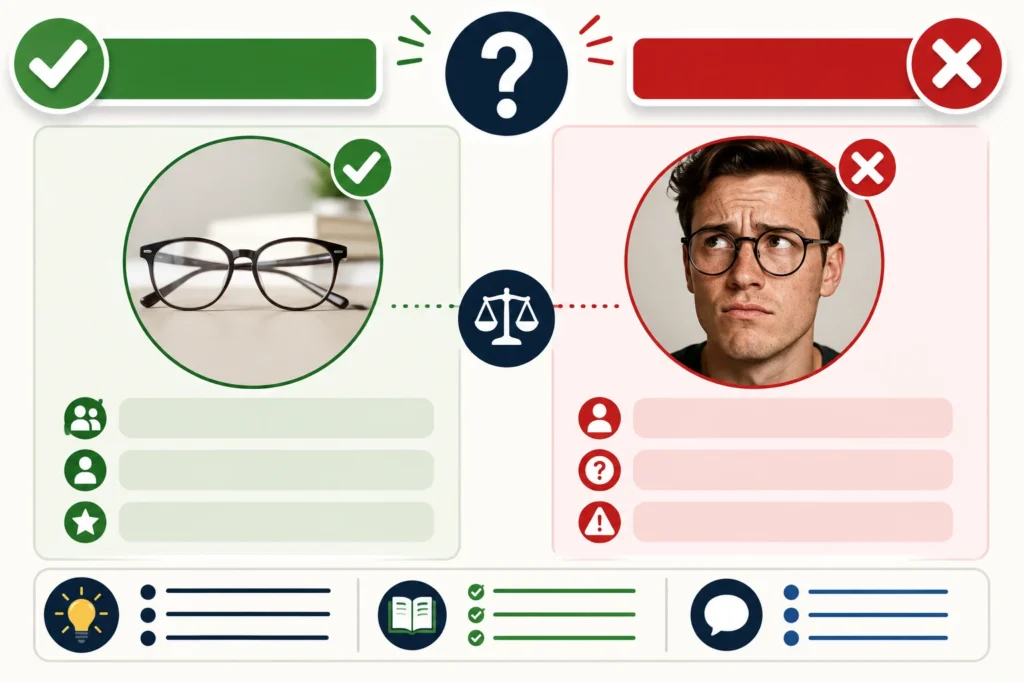
Quick Answer: Bespeckled vs. Bespectacled
If you’ve ever hesitated between bespeckled and bespectacled, you’re not alone. The two words share a similar beginning and a similar sound, but they point to completely different ideas. Bespeckled describes something marked or covered with specks, spots, or flecks. Bespectacled, meanwhile, describes someone who is wearing glasses or spectacles. Merriam-Webster defines bespectacled as “wearing spectacles,” while its related entry for speckle describes a small mark and the act of marking something with speckles.
That distinction gives you a quick rule: specks → bespeckled; spectacles → bespectacled. Once you connect each word with its root, the spelling becomes much easier to remember.
| Word | Meaning | Typical use | Example |
| Bespeckled | Covered or marked with small spots | Objects, surfaces, clothing, skin | A bespeckled window |
| Bespectacled | Wearing glasses | People | A bespectacled teacher |
Both words are legitimate English adjectives. The problem isn’t correctness. It’s meaning.
Which Word Refers to Someone Wearing Glasses?
Bespectacled is the word you want when you’re describing someone who wears glasses. Dictionaries consistently give this meaning. Cambridge labels the word as formal and defines it as “wearing glasses,” while Merriam-Webster gives “wearing spectacles.”
For example:
The bespectacled professor adjusted his glasses before beginning the lecture.
Here, bespectacled tells you something about the professor’s appearance. It doesn’t describe spots on his face, clothing, or surroundings.
You can replace bespectacled with the more conversational phrase wearing glasses:
- The bespectacled teacher entered the room.
- The teacher wearing glasses entered the room.
The second version usually sounds more natural in everyday American English. The first is more compact and descriptive, which makes it useful in narrative, journalistic, and formal writing.
Which Word Refers to Spots or Speckles?
Choose bespeckled when you mean covered or marked with small spots or specks.
Think about a shirt dotted with paint, a window covered with tiny raindrops, or a surface marked with flecks of dust. These things can be described as bespeckled.
The related verb bespeckle means “speckle” or “besprinkle,” according to Merriam-Webster. Its word history identifies the formation as be- + speckle.
For example:
The old canvas was bespeckled with tiny drops of blue paint.
Here, the word has nothing to do with glasses. The focus is entirely on the small marks covering the canvas.
Why These Words Are Commonly Confused
The confusion comes mainly from their appearance. Both begin with be- and contain the sequence spec- or speck-. They also have a similar rhythm when spoken.
However, their important roots point in different directions:
- bespeckled → speck → small spot or mark
- bespectacled → spectacles → glasses
That one-letter difference can change the entire meaning of a sentence.
Imagine writing, “The bespeckled man entered the office.” A reader may picture a man covered in spots or marks. If you actually mean that he wears glasses, bespectacled is the better choice.
What Does Bespeckled Mean?
Bespeckled is an adjective that describes something marked with small spots, specks, or flecks. It can refer to a surface, object, piece of clothing, natural feature, or even a person’s skin.
The related word speckle means a small mark, especially one of color. Merriam-Webster lists fleck, speck, and dot among related words. It also defines speckle as marking something with speckles or distributing something like speckles.
So, when you see a pattern made up of many tiny marks, bespeckled can be a useful descriptive choice.
Definition of Bespeckled
In plain English, bespeckled means covered or marked with small spots or specks.
The spots don’t have to be perfectly round. They might be irregular flecks, tiny marks, droplets, stains, or bits of color.
Consider these examples:
- a bespeckled stone
- a bespeckled wall
- a bespeckled shirt
- a bespeckled page
- a bespeckled leaf
- a bespeckled window
The adjective often creates a visual image. Instead of simply saying that a shirt has paint on it, you can say it is bespeckled with paint. The latter gives the reader a stronger sense of many small marks scattered across the fabric.
Origin and Etymology of Bespeckled
The word bespeckled comes from the verb bespeckle, which Merriam-Webster traces to be- + speckle. The related noun speckle has roots in Middle English and is connected with Old English specca.
That history helps explain why the word carries the idea of something being covered with small marks.
The base word speckle is especially important. A speckle is a small mark, often one of color. When you add the be- prefix to speckle, you get bespeckle, a verb meaning to speckle or sprinkle with small marks.
From that verb comes the adjective bespeckled.
You can therefore think of the word as belonging to this family:
speck → speckle → bespeckle → bespeckled
That family connection makes the meaning easier to recognize.
Common Contexts Where Bespeckled Is Used
You can use bespeckled whenever small marks are an important part of what you’re describing.
Clothing:
His white shirt was bespeckled with drops of coffee.
Surfaces:
The kitchen counter was bespeckled with flour after baking.
Nature:
The bird had a brown, bespeckled breast.
Artwork:
The painting had a bespeckled background filled with tiny flecks of gold.
Glass or windows:
Rain left the windshield bespeckled with droplets.
Skin or appearance:
Her face was bespeckled with freckles.
Notice the common thread. Each example involves small marks distributed across something.
That is the semantic core of bespeckled.
Example Sentences Using Bespeckled
Here are several natural examples:
- The painter wore a bespeckled apron after a long afternoon in the studio.
- Sunlight fell across the bespeckled surface of the old table.
- The ripe fruit had a bespeckled yellow skin.
- Rain left the car windshield bespeckled with droplets.
- The ceramic bowl had a beautiful bespeckled glaze.
- A bespeckled pattern covered the handmade paper.
- The bird’s feathers were brown and bespeckled with white.
- The dusty mirror looked bespeckled under the bright bathroom light.
These sentences show an important feature of the word: bespeckled usually works best when the reader can visualize the scattered marks.
Common Mistakes With Bespeckled
The biggest mistake is using bespeckled to mean “wearing glasses.”
For example:
❌ The bespeckled professor adjusted his glasses.
This sentence isn’t necessarily impossible to interpret because a professor could have both spots and glasses. However, if your intended meaning is simply that the professor wears glasses, bespectacled is the precise adjective.
✅ The bespectacled professor adjusted his glasses.
Another common error involves confusing bespeckled with speckled. These words are closely related. Speckled is often the simpler and more common everyday choice, while bespeckled can add a more descriptive or literary flavor.
What Does Bespectacled Mean?
Bespectacled means wearing glasses or spectacles. It normally describes a person and focuses on their appearance.
Merriam-Webster gives the definition “wearing spectacles” and records the word’s first known use as 1742. Cambridge likewise classifies bespectacled as a formal adjective meaning “wearing glasses.”
That makes the word considerably older than many modern readers might expect.
Definition of Bespectacled
In simple terms, bespectacled means wearing glasses.
For example:
The bespectacled librarian smiled and pointed toward the history section.
The adjective doesn’t tell us anything about the librarian’s personality, intelligence, age, or profession. It simply identifies the person as someone wearing glasses.
You could rewrite the sentence as:
The librarian wearing glasses smiled and pointed toward the history section.
Both versions communicate essentially the same basic idea. The difference lies mostly in style and compactness.
Origin and Etymology of Bespectacled
The word bespectacled connects directly with spectacles, an older term for eyeglasses.
Collins gives the word origin as be- + spectacled and dates its first recorded use to 1735–45. Merriam-Webster records its first known use as 1742.
That slight difference in dictionary dating isn’t unusual. Lexicographers may use different evidence and criteria when determining the earliest documented use.
The important point for modern writers is much simpler: spectacles means glasses, so bespectacled describes someone wearing them.
The Connection Between Spectacles and Bespectacled
This is probably the easiest way to remember the spelling.
Look at the word:
be + spectacles → bespectacled
You can visually spot spectac inside bespectacled. That sequence should immediately remind you of spectacles.
Compare:
speck → bespeckled
spectacles → bespectacled
The words may look like cousins, but they belong to different meaning families.
| Root | Related word | Meaning |
| speck | bespeckled | Marked with small spots |
| spectacles | bespectacled | Wearing glasses |
Once you see those roots, the spelling becomes much less mysterious.
Common Contexts Where Bespectacled Is Used
Writers often use bespectacled when describing a person’s appearance.
It commonly appears before nouns:
- a bespectacled teacher
- a bespectacled scientist
- a bespectacled writer
- a bespectacled student
- a bespectacled professor
- a bespectacled man
- a bespectacled woman
Merriam-Webster’s current examples show the adjective appearing in descriptions of people from journalism, science, sports, entertainment, and public life.
That usage pattern matters. Bespectacled isn’t merely a dictionary word that exists in theory. Contemporary published English continues to use it as a compact descriptive adjective.
Example Sentences Using Bespectacled
Consider these examples:
- The bespectacled teacher wrote the answer on the board.
- A bespectacled student sat quietly near the window.
- The bespectacled researcher reviewed the results.
- We spoke with a bespectacled man in a gray jacket.
- The bespectacled author signed copies of her new book.
- A bespectacled doctor entered the examination room.
- The article featured a bespectacled scientist discussing the discovery.
You can replace the adjective with wearing glasses in each case.
For instance:
The scientist wearing glasses discussed the discovery.
That sounds more conversational. The bespectacled scientist sounds tighter and more descriptive.
Common Mistakes With Bespectacled
The most common mistake is confusing bespectacled with bespeckled.
❌ The bespeckled student wore glasses.
If the intended meaning is “the student who wears glasses,” the better choice is:
✅ The bespectacled student wore glasses.
Another mistake is assuming that bespectacled means someone has a face covered with spots. It doesn’t.
If you want to describe freckles, paint marks, dust, or other small spots, choose bespeckled or another suitable word.
Bespeckled vs. Bespectacled: Side-by-Side Comparison
The difference becomes especially clear when you put the words next to each other.
| Feature | Bespeckled | Bespectacled |
| Basic meaning | Covered with small spots or specks | Wearing glasses |
| Root association | Speck/speckle | Spectacles |
| Typical subject | Object, surface, clothing, skin | Person |
| Main idea | Small marks | Eyeglasses |
| Example | A bespeckled wall | A bespectacled teacher |
| Everyday alternative | Speckled, spotted | Wearing glasses |
| Main source of confusion | Similar spelling | Similar spelling |
This comparison exposes the central rule: the words aren’t interchangeable.
Meaning
Bespeckled focuses on marks.
Bespectacled focuses on glasses.
That’s the difference you should check first. Don’t start by asking which spelling “looks right.” Start by asking what you want the adjective to mean.
If the answer is small spots, choose bespeckled.
If the answer is wearing glasses, choose bespectacled.
Pronunciation
The words also differ in their pronunciation.
Bespectacled is commonly pronounced approximately bi-SPEK-tuh-kuld in American English. Cambridge gives the US pronunciation as /bɪˈspek.tə.kəld/.
Bespeckled follows the pronunciation of bespeckle, with the central sound built around speck.
The pronunciation difference isn’t always enough to prevent confusion. In fast speech, both can sound similar enough that context does much of the work.
Usage
Bespeckled works as a descriptive adjective for something showing numerous small marks.
Bespectacled works primarily as an adjective describing someone who wears glasses.
Both can fit naturally into descriptive writing. However, bespectacled has a more formal or literary feel. Cambridge explicitly labels it formal, and Collins describes it as a written adjective.
Context
Context often solves the problem instantly.
Compare:
The bespeckled window needed cleaning.
The reader expects spots or marks on the window.
Now compare:
The bespectacled teacher needed a new pair of glasses.
The reader understands that the teacher wears glasses.
If you’re unsure, look at the noun following the adjective. A bespeckled wall makes sense because walls can have spots. A bespectacled professor makes sense because professors can wear glasses.
Example Comparison Table
| Sentence | Correct word | Why |
| The shirt was ___ with paint. | Bespeckled | Paint created small marks |
| The ___ teacher entered the room. | Bespectacled | The teacher wore glasses |
| The window was ___ with raindrops. | Bespeckled | Raindrops appeared as small marks |
| The ___ scientist explained the result. | Bespectacled | The scientist wore glasses |
| We admired the ___ ceramic bowl. | Bespeckled | The bowl had a spotted pattern |
| The ___ writer adjusted his frames. | Bespectacled | The writer wore eyeglasses |
When Should You Use Bespeckled?
Use bespeckled when you want to emphasize small marks scattered across something.
The word can create a vivid visual effect. Instead of saying “covered with little spots,” you can use one compact adjective.
Describing Specks, Spots, or Markings
The adjective works particularly well with surfaces and patterns.
The ceramic mug was bespeckled with brown dots.
The old map was bespeckled with ink stains.
The bird had bespeckled feathers.
The painter’s apron was bespeckled with white paint.
In each sentence, the reader can imagine a collection of small marks.
That visual quality makes bespeckled useful in descriptive prose. It can also suggest that the marks are numerous or scattered rather than appearing as one large stain.
Common Writing Examples
When writing about physical appearance, objects, or natural patterns, consider these constructions:
- bespeckled with dust
- bespeckled with paint
- bespeckled with rain
- bespeckled with color
- bespeckled surface
- bespeckled feathers
- bespeckled fabric
- bespeckled skin
The preposition with is especially useful when you want to explain what caused or forms the specks.
For example:
The artist’s hands were bespeckled with blue and green paint.
That sentence gives you both the adjective and the source of the marks.
Mistakes to Avoid
Don’t use bespeckled merely because it resembles bespectacled.
A sentence such as:
❌ The bespeckled professor adjusted his glasses.
could suggest that the professor has spots or marks rather than simply wearing glasses.
If glasses are the intended detail:
✅ The bespectacled professor adjusted his glasses.
Also avoid forcing bespeckled into contexts where a simpler word would communicate the idea more naturally.
For example, if you’re casually describing a shirt with a few dots, spotted or speckled may sound less formal than bespeckled.
Real-World Usage Example
Imagine a baker finishing a chocolate cake. A little powdered sugar lands across the dark countertop.
You could write:
The countertop was bespeckled with powdered sugar.
The word works because the sugar creates numerous small white marks.
Now imagine a teacher standing nearby wearing reading glasses.
The bespectacled teacher watched the baker decorate the cake.
The two words could appear in the same paragraph because they describe entirely different details.
That’s a useful practical test: What physical feature are you describing?
If it’s a pattern of tiny marks, choose bespeckled. If it’s eyewear, choose bespectacled.
When Should You Use Bespectacled?
Use bespectacled when you want a concise adjective for a person who wears glasses.
It’s especially useful when appearance matters to the description.
Describing a Person Wearing Glasses
The word commonly appears directly before a noun: a bespectacled studenta bespectacled professora bespectacled journalista bespectacled scientist
It can also appear after a linking verb:
The professor was bespectacled and quietly confident.
However, everyday American English often favors wearing glasses.
Compare:
The bespectacled man waited outside.
with:
The man wearing glasses waited outside.
Neither is grammatically wrong. The first is more compact. The second sounds more conversational.
Common Writing Examples
Narrative writing:
A bespectacled librarian emerged from behind the shelves.
News-style description:
The bespectacled researcher answered questions from reporters.
Academic description:
The bespectacled professor presented the findings.
Casual alternative:
The professor wearing glasses presented the findings.
The choice depends on your audience and tone.
Why Writers Use Bespectacled
Writers often choose bespectacled because it compresses a longer description into one adjective.
Instead of:
The scientist who was wearing glasses entered the laboratory.
You can write:
The bespectacled scientist entered the laboratory.
The second sentence moves faster. It also makes the person’s appearance part of the noun phrase.
That compactness can be valuable in journalism, fiction, profiles, and descriptive nonfiction.
Still, don’t treat the word as automatically better. Clear writing beats fancy writing. If wearing glasses sounds more natural for your audience, use it.
Mistakes to Avoid
Avoid using bespectacled for objects covered with spots.
❌ The bespectacled wall looked colorful.
That sentence doesn’t convey the intended meaning if the wall has many small marks.
Use:
✅ The bespeckled wall looked colorful.
Likewise, don’t assume spectacled and bespectacled always function identically. Spectacled has additional uses. Merriam-Webster notes that spectacled can describe something having markings that resemble a pair of spectacles, as in a spectacled alligator.
That is a different construction from the ordinary human-description use of bespectacled.
Real-World Usage Example
Picture a university lecture hall.
A professor walks toward the podium wearing round glasses.
The bespectacled professor adjusted his notes before beginning the lecture.
The word efficiently tells readers about his appearance.
If the same professor has chalk dust scattered across his jacket, you could write:
His jacket was bespeckled with chalk dust.
Now both words appear naturally in the same scene:
bespectacled professor → glasses
bespeckled jacket → small marks
The distinction becomes almost impossible to miss when the two examples sit side by side.
Why People Mix Up Bespeckled and Bespectacled
The confusion isn’t surprising. English contains many pairs that look similar while carrying unrelated meanings.
Similar Sound and Spelling
Both words begin with besp- and contain a strong spek sound.
That creates visual and phonetic interference. If you encounter either word only occasionally, your memory may store the general shape without preserving the exact meaning.
The result is a classic vocabulary mix-up.
Shared Prefix Structure
Both words contain be-, but their roots differ.
Bespeckled connects with speckle.
Bespectacled connects with spectacles.
The shared prefix doesn’t make them semantic twins. It simply contributes to their similar appearance.
Contextual Misunderstandings
Context can also cause mistakes because readers may understand what you meant even when the word isn’t technically the best choice.
Suppose someone writes:
The bespeckled scientist entered the room.
If the scientist wears glasses, readers might infer the intended meaning from the broader context.
That doesn’t make bespeckled correct for “wearing glasses.” It simply shows how readers use context to repair meaning.
Good writing shouldn’t force readers to perform that repair.
Rare Exposure in Everyday Speech
Bespectacled is less common in casual conversation than wearing glasses.
Cambridge marks the word as formal, while Collins describes its use as written.
That matters because many people encounter bespectacled primarily in books, articles, profiles, or other descriptive writing.
When a word appears infrequently in everyday speech, spelling and meaning can become easier to confuse.
Memory Tricks to Tell the Difference
You don’t need a complicated grammar rule to remember these words.
Remembering “Spectacles” in Bespectacled
Look directly inside bespectacled:
be + spectacled
The word contains spectac, which should remind you of spectacles.
And spectacles are glasses.
So:
spectacles → glasses → bespectacled
That’s the fastest reliable association.
Associating “Speckles” With Bespeckled
Now look at bespeckled.
You can see speck right inside the word.
A speck is a tiny mark or spot.
So:
speck → speckles → bespeckled
If you picture tiny dots scattered across a surface, the connection becomes even stronger.
Fast Recall Techniques
When you hesitate, ask yourself one question:
“Am I talking about glasses or spots?”
If the answer is glasses, choose bespectacled.
If the answer is spots, choose bespeckled.
You can also use the first distinctive root:
| Think of | Choose |
| Speck | Bespeckled |
| Speckles | Bespeckled |
| Spot | Bespeckled |
| Spectacles | Bespectacled |
| Glasses | Bespectacled |
| Eyeglasses | Bespectacled |
This method works because it connects spelling to meaning rather than asking you to memorize two isolated definitions.
A Simple Phrase to Remember
Use this short phrase:
Specks are bespeckled; spectacles are bespectacled.
It’s compact, and the matching sounds make the distinction easier to recall.
Common Incorrect Examples and Corrections
Seeing incorrect examples can make the difference clearer.
Incorrect Uses of Bespeckled
Incorrect for glasses:
❌ The bespeckled woman sat in the front row.
If the only intended detail is that she wears glasses, use:
✅ The bespectacled woman sat in the front row.
Correct for spots:
✅ The white wall was bespeckled with tiny gray marks.
Here, bespeckled correctly describes the markings.
Incorrect Uses of Bespectacled
Incorrect for spots:
❌ The bespectacled fabric had tiny blue dots.
If the fabric contains dots, choose:
✅ The bespeckled fabric had tiny blue dots.
Correct for glasses:
✅ The bespectacled editor reviewed the manuscript.
Here, bespectacled describes the editor’s appearance.
Corrected Sentences Explained
| Incorrect or unclear | Better version | Reason |
| The bespeckled teacher wore glasses. | The bespectacled teacher wore glasses. | The intended feature is eyewear |
| The bespectacled wall had dark spots. | The bespeckled wall had dark spots. | The wall has small marks |
| A bespeckled researcher entered. | A bespectacled researcher entered. | The researcher wears glasses |
| The bespectacled page had ink dots. | The bespeckled page had ink dots. | The page contains small marks |
One caution is important: a sentence can contain both meanings at once. A person can be bespectacled and have a bespeckled shirt. The words aren’t mutually exclusive. They simply describe different characteristics.
Are Bespeckled and Bespectacled Interchangeable?
No. Bespeckled and bespectacled are not interchangeable.
They may look similar, but substituting one for the other changes the meaning.
Situations Where They Cannot Be Swapped
Use bespeckled for:
- small spots
- specks
- flecks
- scattered marks
- dotted surfaces
- spotted clothing
- marked objects
Use bespectacled for:
- people wearing glasses
- people wearing spectacles
- people wearing eyeglasses
The difference is straightforward once you connect each word to its root.
How Meaning Changes When the Wrong Word Is Used
Consider:
The bespeckled doctor entered the room.
This suggests the doctor has some kind of spots or marks.
Now change one word:
The bespectacled doctor entered the room.
Now the reader understands that the doctor wears glasses.
The spelling difference is tiny. The semantic difference is substantial.
That is why word choice matters. A single adjective can change the image your sentence creates.
Bespeckled or Bespectacled: Choosing the Right Word
The easiest way to settle the bespeckled or bespectacled question is to ignore their similar appearance and focus on the meaning you need.
Choose bespeckled when something has many small spots, specks, or marks. Choose bespectacled when you’re describing someone who wears glasses. The dictionary evidence supports this distinction clearly: Merriam-Webster defines bespectacled as wearing spectacles, while its entries for bespeckle and speckle connect the other word with small marks or specks.
If you’re writing casually, speckled, spotted, or wearing glasses may often sound more natural. If you’re writing descriptive prose, bespeckled and bespectacled can add precision without requiring a long explanation.
The final check is simple:
Specks? Use bespeckled.
Spectacles? Use bespectacled.
Once that distinction sticks, this easily confused pair becomes a piece of cake.
What Does Bespectacled Mean?
Bespectacled is the correct adjective when you want to describe a person who is wearing glasses or spectacles. Cambridge Dictionary defines it as “wearing glasses” and marks the word as formal, while Merriam-Webster gives the closely matching definition “wearing spectacles.”
The easiest way to understand the word is to look at its connection with spectacles. Spectacles is an established term for eyeglasses, so bespectacled naturally describes someone whose appearance includes glasses. For example, you could write, “The bespectacled teacher walked into the classroom,” meaning that the teacher was wearing glasses. In everyday US English, wearing glasses often sounds more natural and conversational, while bespectacled can sound more descriptive, formal, or literary. That doesn’t make it incorrect or outdated. It simply gives the sentence a different tone. When you need a compact adjective before a noun, bespectacled can be especially useful: bespectacled student, bespectacled professor, bespectacled writer, or bespectacled scientist. The key point is simple: if the visual detail involves eyewear, bespectacled is the word to choose.
Definition of Bespectacled
In simple terms, bespectacled means wearing glasses. It normally describes a person rather than an object. The adjective tells readers about someone’s appearance without requiring a longer phrase such as “the person who was wearing glasses.”
For example:
The bespectacled student raised her hand.
The sentence gives the reader one specific visual detail: the student wears glasses. It doesn’t tell us anything else about her personality, intelligence, age, or profession.
You can also use the word after a linking verb:
The professor was bespectacled and carrying a stack of books.
Here, bespectacled still describes the professor’s appearance.
The word becomes particularly useful when you want to keep a sentence compact. Compare these two versions:
The bespectacled researcher reviewed the report.
The researcher wearing glasses reviewed the report.
Both communicate the same basic idea. The first uses a single adjective, while the second uses a descriptive phrase.
There’s also an important style point. Bespectacled can sound more formal than wearing glasses. Cambridge labels it formal, so it may fit better in descriptive prose than in a casual conversation. If you’re writing for a general US audience, though, don’t use the longer-sounding word simply to make the sentence seem sophisticated. Clear wording should come first.
Origin and Etymology of Bespectacled
The meaning becomes easier to remember once you connect bespectacled with spectacles.
The word contains the same recognizable spectac- sequence found in spectacles. That gives you a useful spelling clue:
spectacles → bespectacled
Because spectacles means glasses, bespectacled describes someone wearing them.
This connection is much more useful than trying to memorize the spelling letter by letter. If you remember only that bespectacled contains the idea of spectacles, you can usually reconstruct the meaning when you need it.
It’s also worth separating bespectacled from visually similar words. Bespeckled contains speck, which refers to a tiny mark. Bespectacled contains the recognizable beginning of spectacles. The similarity is mostly a spelling trap.
Think of the two word families like this:
| Word | Key part to remember | Meaning |
| Bespeckled | speck | Marked with small spots |
| Bespectacled | spectacles | Wearing glasses |
| Speckled | speckle | Covered with small spots |
| Spectacles | spectac- | Glasses |
This simple comparison can prevent the most common mistake.
The Connection Between Spectacles and Bespectacled
If you struggle to remember bespectacled, focus on the middle of the word rather than its beginning.
Be-SPECTAC-led
That spectac sequence points toward spectacles.
Now compare it with:
Be-SPECK-led
That speck sequence points toward a small spot.
The spelling itself gives you a memory shortcut.
Spectacles = glasses = bespectacled.
Speck = tiny mark = bespeckled.
Once you notice that distinction, the two words stop looking interchangeable.
This is especially helpful because the meanings aren’t related. A person can be bespectacled, while a shirt can be bespeckled. A person could even be both: someone might wear glasses while their shirt has tiny paint spots. The adjectives simply describe different features.
Common Contexts Where Bespectacled Is Used
Bespectacled works best when a person’s glasses form part of the description. You may see it in fiction, profiles, journalism, biographies, essays, and other forms of descriptive writing.
Common combinations include:
- bespectacled teacher
- bespectacled student
- bespectacled professor
- bespectacled scientist
- bespectacled writer
- bespectacled journalist
- bespectacled man
- bespectacled woman
- bespectacled researcher
For example:
A bespectacled scientist explained the experiment to the audience.
The adjective works because the scientist is wearing glasses.
You can also place the description after the noun:
The scientist was bespectacled.
That’s grammatically sound, although the construction may feel more formal than simply saying:
The scientist was wearing glasses.
The choice depends on the tone you’re aiming for.
Example Sentences Using Bespectacled
Here are several examples that show how bespectacled works in real sentences:
- The bespectacled professor adjusted his frames before speaking.
- A bespectacled student sat near the front of the classroom.
- The bespectacled researcher examined the results carefully.
- We spoke with a bespectacled man outside the library.
- The bespectacled writer signed copies of her latest book.
- A bespectacled doctor entered the examination room.
- The article featured a bespectacled scientist discussing the discovery.
- The bespectacled editor leaned closer to read the small print.
Notice that the adjective doesn’t mean “intelligent,” “academic,” or “serious.” Those associations may sometimes appear because writers use glasses as part of a character’s visual description, but they aren’t part of the dictionary meaning.
That distinction matters. Bespectacled describes eyewear, not personality.
Common Mistakes With Bespectacled
The biggest mistake is using bespectacled when you actually mean covered with spots.
For example:
❌ The bespectacled wall was covered with tiny blue marks.
If you’re describing the wall’s spotted appearance, bespeckled is the better choice:
✅ The bespeckled wall was covered with tiny blue marks.
The reverse mistake is just as common:
❌ The bespeckled professor adjusted his glasses.
If the intended description is simply that the professor wears glasses, use:
✅ The bespectacled professor adjusted his glasses.
There’s another useful point here. Bespectacled doesn’t mean that someone has spectacles physically attached to them. It simply describes someone wearing glasses. That’s why it can function as a normal adjective in descriptions of people.
Bespeckled vs. Bespectacled: Side-by-Side Comparison
The difference becomes much clearer when the two words appear together. Bespeckled relates to small marks, while bespectacled relates to glasses. The similar spelling is what confuses, not any meaningful overlap between their definitions. Related words such as speckle refer to very small marks that differ in color from the surrounding area, which reinforces the meaning of bespeckled.
| Feature | Bespeckled | Bespectacled |
| Core meaning | Covered with small spots or specks | Wearing glasses |
| Key root | Speck | Spectacles |
| Usually describes | Objects, surfaces, clothing, skin, patterns | People |
| Main idea | Small marks | Eyewear |
| Related word | Speckle | Spectacles |
| Common alternative | Speckled, spotted | Wearing glasses |
| Example | A bespeckled shirt | A bespectacled teacher |
| Main confusion | Looks similar to bespectacled | Looks similar to bespeckled |
Meaning
The first thing to check is meaning.
If you mean small spots, use bespeckled.
If you mean wearing glasses, use bespectacled.
This distinction is more important than pronunciation or spelling. Even if the words look confusing, their meanings are quite separate.
For instance:
The bird had a bespeckled breast.
The word describes a pattern of small marks.
Now consider:
The bespectacled researcher studied the bird.
Here, the word describes the researcher wearing glasses.
Both sentences could appear in the same paragraph without any conflict. One adjective describes the bird’s markings. The other describes the researcher’s appearance.
Pronunciation
Pronunciation can add to the confusion because both words contain a similar spek sound.
For bespectacled, Cambridge gives the US pronunciation as /bɪˈspek.tə.kəld/. The word has several syllables, with the main stress falling on spek.
Bespeckled is built around the shorter sound of speck, making its pronunciation more directly connected to speckle.
If you’re unsure which word you’ve heard, don’t rely entirely on sound. Ask what the speaker is describing. Context usually makes the intended meaning clear.
Usage
Bespeckled and bespectacled serve different descriptive purposes.
You might describe:
- a bespeckled egg
- a bespeckled jacket
- a bespeckled surface
- a bespectacled student
- a bespectacled professor
- a bespectacled journalist
The distinction follows the noun naturally.
A surface can have specks. A person can wear glasses.
There are exceptions in the broader vocabulary, of course. English uses spectacled in some contexts where it refers to markings resembling spectacles rather than a person wearing eyeglasses. That is one reason you shouldn’t assume that every word containing spectac- has the same grammatical use.
For the specific choice between bespeckled and bespectacled, however, the basic rule remains dependable.
Context
Context often tells you which word belongs in a sentence.
Consider:
The bespeckled ceramic bowl sat on the table.
The bowl has a pattern of small marks.
Now:
The bespectacled chef placed the bowl on the table.
The chef wears glasses.
The nouns themselves provide a useful clue. If you’re describing a surface, object, pattern, or material, bespeckled may fit. If you’re describing a person and mentioning glasses, bespectacled is the likely choice.
When a word feels uncertain, identify the visual feature you’re trying to communicate. That small pause can prevent an incorrect substitution.
Example Comparison Table
| Sentence | Correct choice | Explanation |
| The shirt was ___ with paint. | Bespeckled | The paint created small marks |
| The ___ teacher entered the room. | Bespectacled | The teacher wore glasses |
| The window was ___ with raindrops. | Bespeckled | Raindrops appeared as scattered spots |
| The ___ scientist explained the results. | Bespectacled | The scientist wore glasses |
| The ceramic bowl had a ___ glaze. | Bespeckled | The glaze contained small spots |
| The ___ writer adjusted her frames. | Bespectacled | The writer wore eyeglasses |
| His jacket was ___ with flour. | Bespeckled | Flour left small marks |
| The ___ librarian helped us find the book. | Bespectacled | The librarian wore glasses |
A useful pattern emerges: the object or person usually gives you the answer.
When Should You Use Bespeckled?
Use bespeckled when small marks, dots, or flecks form an important part of what you’re describing. The related word speckle refers to a very small mark that differs in color from the surrounding area. Cambridge also gives fleck and spot as related words.
Describing Specks, Spots, or Markings
Bespeckled works well for surfaces and patterns that contain many small marks.
You might describe:
- a bespeckled bird
- a bespeckled egg
- a bespeckled fabric
- a bespeckled wall
- a bespeckled table
- a bespeckled page
- a bespeckled window
- a bespeckled ceramic bowl
Cambridge’s examples of speckled include birds, eggs, fruit, surfaces, and other things with visible small marks.
For example:
The white eggs were bespeckled with brown marks.
Or:
The artist created a bespeckled background with tiny drops of paint.
The adjective creates a stronger visual impression than simply saying something has “some spots.”
Common Writing Examples
You can use bespeckled with when you want to identify the material or substance forming the marks:
The apron was bespeckled with flour.
The pavement was bespeckled with rainwater.
The canvas was bespeckled with blue paint.
You can also use it directly before a noun:
The artist admired the bespeckled canvas.
The word doesn’t require a literal perfect pattern. The marks can be irregular or scattered. What matters is the idea of small visible spots or specks.
Mistakes to Avoid
Don’t use bespeckled as a substitute for bespectacled.
❌ The bespeckled librarian adjusted her glasses.
If the glasses are the feature you’re trying to highlight, say:
✅ The bespectacled librarian adjusted her glasses.
Also, don’t assume that bespeckled always sounds better than speckled. In many everyday sentences, speckled is simpler and more familiar.
Compare:
The egg was speckled with brown.
The egg was bespeckled with brown.
Both can communicate a spotted appearance. The second can sound more literary or descriptive. Choose based on the tone of your writing rather than trying to make a simple sentence sound elaborate.
Real-World Usage Example
Imagine a ceramic artist working in a studio. She finishes a pale blue bowl with tiny dark marks scattered across its surface.
A natural description would be:
The finished bowl had a bespeckled glaze that gave it a handmade appearance.
Now imagine a customer wearing round glasses examining the bowl:
A bespectacled customer picked it up and examined the glaze.
The two words work side by side because they describe two different visual details.
That is the core lesson: bespectacled describes markings; bespectacled describes eyewear.
When Should You Use Bespectacled?
Use bespectacled when you’re describing a person who wears glasses. It can replace the longer phrase wearing glasses, especially when you want a compact descriptive adjective.
Describing a Person Wearing Glasses
Here are natural combinations:
- bespectacled student
- bespectacled professor
- bespectacled doctor
- bespectacled scientist
- bespectacled writer
- bespectacled teacher
- bespectacled editor
- bespectacled researcher
For example:
The bespectacled professor paused before answering the question.
The adjective adds one quick visual detail without slowing down the sentence.
You can also write:
The professor wearing glasses paused before answering the question.
That’s often more natural in everyday US English. Bespectacled becomes especially useful when the description needs to stay compact.
Common Writing Examples
Consider how the word functions in different styles.
Narrative:
A bespectacled librarian emerged from behind the shelves.
Descriptive:
The bespectacled man studied the painting in silence.
Academic:
The bespectacled researcher presented the findings.
Journalistic:
The bespectacled scientist answered questions after the announcement.
Each example uses the adjective to identify a person by appearance.
Why Writers Use Bespectacled
The main advantage is compression.
Instead of writing:
The scientist who was wearing glasses explained the process.
You can write:
The bespectacled scientist explained the process.
That’s shorter and places the visual detail neatly inside the noun phrase.
Still, shorter doesn’t always mean better. If your readers expect casual, straightforward US English, wearing glasses may feel more familiar. If you’re writing a character description or a formal profile, bespectacled can work smoothly.
The best word is the one that fits both the meaning and the tone.
Mistakes to Avoid
Avoid using bespectacled when you’re talking about spots or marks.
❌ The bespectacled page was covered with ink dots.
If the page has scattered marks, write:
✅ The bespeckled page was covered with ink dots.
Likewise, don’t use bespeckled just because you remember that it starts with besp-.
The roots are your safeguard:
speck → bespeckled
spectacles → bespectacled
Real-World Usage Example
Picture a quiet library. A librarian wearing rectangular glasses helps a visitor locate an old dictionary.
The bespectacled librarian pointed toward the reference section.
Now imagine that the same library has an old wooden desk covered with tiny marks.
The bespeckled desk showed years of use.
Both adjectives are accurate because they describe different things.
If you remember that simple contrast, the bespeckled or bespectacled question becomes much easier to answer.
Why People Mix Up Bespeckled and Bespectacled
At first glance, bespeckled and bespectacled look like variations of the same word. They aren’t. The confusion comes from their similar spelling, shared be- structure, and overlapping spek sound. Once you separate their roots, the distinction becomes much easier: bespeckled connects with speck and describes small spots, while bespectacled connects with spectacles and describes someone wearing glasses.
Similar Sound and Spelling
The words can confuse readers because they look remarkably alike:
bespeckled
bespectacled
Both begin with besp-, and both contain a sound that resembles “spek.” When you encounter either word only occasionally, that visual similarity can make the meanings blur together.
However, the words divide neatly once you focus on the middle:
- bespeckled contains speck
- bespectacled contains spectac, as in spectacles
A useful comparison is speck versus spectacles. A speck is a tiny mark. Spectacles are glasses. The roots point in completely different directions.
Shared Prefix Structure
Both words contain the prefix be-, which contributes to their similar appearance. That shared beginning doesn’t mean they have the same meaning.
Bespeckled comes from bespeckle, which relates to marking something with specks or small spots.
Bespectacled relates to spectacles, an established word for eyeglasses.
You can visualize their structure this way:
| Word | Key word inside it | What it describes |
| Bespeckled | Speck | Small spots or marks |
| Bespectacled | Spectacles | A person wearing glasses |
This is more than a spelling trick. It gives you a reliable way to understand and remember the vocabulary.
Contextual Misunderstandings
Sometimes the surrounding sentence can hide an incorrect word choice.
Consider:
The bespeckled professor entered the classroom.
If the writer means that the professor wears glasses, the adjective is wrong. A reader might instead imagine a professor whose clothing, skin, or another visible feature has tiny spots.
Now compare:
The bespectacled professor entered the classroom.
This clearly identifies the professor as someone wearing glasses.
The same problem occurs in reverse:
The bespectacled wall had tiny black marks.
If the wall has small spots, bespeckled makes sense. Bespectacled doesn’t.
Context may allow readers to guess the intended meaning, but precise writing shouldn’t make readers guess. The adjective should communicate the intended image immediately.
Rare Exposure in Everyday Speech
Another reason for the confusion is that bespectacled isn’t an especially common word in casual American conversation. Most people would naturally say wearing glasses.
For example:
The man wearing glasses waited outside.
sounds more conversational than:
The bespectacled man waited outside.
Dictionaries reflect this difference in tone. Cambridge labels bespectacled as formal, while Collins describes it as a written adjective.
That doesn’t make the word incorrect. It simply means that readers may encounter it more often in descriptive writing, journalism, literature, or formal prose than in everyday conversation.
Bespeckled can also sound somewhat descriptive or literary compared with speckled, although it has a straightforward meaning.
The practical lesson is simple: don’t choose a word merely because it sounds sophisticated. Choose the word that communicates your meaning naturally.
Memory Tricks to Tell the Difference
A good memory trick should make the spelling and meaning reinforce each other. Fortunately, these two words provide their own clues.
Remembering “Spectacles” in Bespectacled
Start with spectacles.
Spectacles are glasses.
Now look at bespectacled. The word visibly contains the beginning of spectacles:
spectacles → glasses → bespectacled
So, whenever you’re describing someone who wears glasses, bespectacled is the word to reach for.
For example:
The bespectacled editor reviewed the manuscript.
The editor wears glasses.
If you forget the spelling, remember the word spectacles first. That connection can lead you back to bespectacled.
Associating “Speckles” With Bespeckled
Now switch to speck.
A speck is a tiny mark. A collection of such marks can form a speckled pattern.
That gives you:
speck → speckles → bespeckled
For example:
The blue bowl was bespeckled with white dots.
The bowl contains small marks.
The association is especially useful because the letters speck appear clearly inside bespeckled. You don’t need to memorize an abstract definition. The spelling itself gives you a clue.
Fast Recall Techniques
When you’re writing and suddenly pause over the two spellings, ask:
Am I describing spots or glasses?
If you’re describing spots, specks, flecks, or small marks, choose bespeckled.
If you’re describing someone wearing glasses, choose bespectacled.
You can also use this quick reference:
| If you mean… | Use… |
| Specks | Bespeckled |
| Small spots | Bespeckled |
| Flecks | Bespeckled |
| Dots or markings | Bespeckled |
| Spectacles | Bespectacled |
| Glasses | Bespectacled |
| Eyeglasses | Bespectacled |
| A person wearing glasses | Bespectacled |
Another useful technique is to create two mental pictures. Picture a speckled egg for bespeckled. Then picture a bespectacled student wearing glasses for bespectacled. Visual memory can make the distinction stick faster than memorizing definitions alone.
A Simple Phrase to Remember
One short sentence captures the entire distinction:
Specks are bespeckled; spectacles are bespectacled.
It’s simple because the key words nearly explain themselves.
If you prefer an even shorter version, remember:
Speck = spot. Spectacle = glasses.
That gives you the correct adjective almost instantly.
Common Incorrect Examples and Corrections
The quickest way to understand a confusing word pair is often to see the mistake beside the correction. These examples show how a single spelling choice can alter the picture in the reader’s mind.
Incorrect Uses of Bespeckled
Suppose you want to describe a woman who wears glasses:
❌ The bespeckled woman entered the office.
This doesn’t correctly communicate “wearing glasses.” Bespeckled refers to small spots or marks.
Write:
✅ The bespectacled woman entered the office.
Now the intended visual detail is clear.
Here’s another example:
❌ The bespeckled professor adjusted his frames.
If the adjective refers to the professor’s glasses, use bespectacled.
✅ The bespectacled professor adjusted his frames.
By contrast, bespeckled works perfectly when the marks themselves matter:
✅ The professor’s jacket was bespeckled with chalk dust.
Here, the jacket has tiny marks, so bespeckled fits naturally.
Incorrect Uses of Bespectacled
Now reverse the mistake.
❌ The bespectacled table was covered with tiny black spots.
If the table has scattered spots, use bespeckled:
✅ The bespeckled table was covered with tiny black spots.
Likewise:
❌ The bespectacled bird had brown markings across its feathers.
If you’re describing the bird’s spotted pattern, bespeckled is the appropriate choice:
✅ The bird had bespeckled feathers with brown markings.
But if the bird itself were somehow wearing spectacles, bespectacled could describe it. That’s unusual in ordinary factual writing, of course, but the grammatical principle remains the same: the word describes glasses, not spots.
Corrected Sentences Explained
| Incorrect sentence | Corrected sentence | Why the correction works |
| The bespeckled teacher adjusted her glasses. | The bespectacled teacher adjusted her glasses. | The teacher wears glasses |
| The bespectacled wall had tiny spots. | The bespeckled wall had tiny spots. | The wall has small marks |
| The bespeckled researcher wore glasses. | The bespectacled researcher wore glasses. | Eyewear is the intended description |
| The bespectacled fabric had blue dots. | The bespeckled fabric had blue dots. | The fabric has small marks |
| A bespectacled shirt hung by the door. | A bespeckled shirt hung by the door. | The shirt has spots or marks |
| The bespeckled librarian helped the student. | The bespectacled librarian helped the student. | The librarian wears glasses |
One subtle point deserves attention: a person can be both bespectacled and associated with something bespeckled.
For example:
The bespectacled artist wore a bespeckled apron.
This sentence uses both adjectives correctly. The artist wears glasses, while the apron has small paint marks.
That example is useful because it proves the words aren’t opposites. They simply describe different characteristics.
Are Bespeckled and Bespectacled Interchangeable?
No. Bespeckled and bespectacled are not interchangeable.
Although their spelling looks similar, their meanings remain distinct. Merriam-Webster defines bespectacled in terms of wearing spectacles, while bespeckled relates to marking something with specks.
Situations Where They Cannot Be Swapped
Use bespeckled when the subject has small visible marks:
- a bespeckled shirt
- a bespeckled wall
- a bespeckled egg
- a bespeckled bird
- a bespeckled surface
- a bespeckled page
- a bespeckled window
Use bespectacled when the subject wears glasses:
- a bespectacled student
- a bespectacled teacher
- a bespectacled professor
- a bespectacled scientist
- a bespectacled writer
- a bespectacled researcher
The easiest way to test a sentence is to replace the adjective with a plain phrase.
If covered with small spots makes sense, bespeckled probably fits.
If wearing glasses makes sense, bespectacled probably fits.
For example:
The ___ jacket was covered with tiny paint marks.
“Covered with small spots” works, so bespeckled fits.
Now:
The ___ journalist interviewed the mayor.
If you intend to identify the journalist as wearing glasses, bespectacled works.
How Meaning Changes When the Wrong Word Is Used
The difference may seem tiny on the page, but it can create a very different mental image.
Compare:
The bespeckled scientist entered the laboratory.
A reader may picture a scientist whose clothing, face, or other visible feature contains small spots.
Now:
The bespectacled scientist entered the laboratory.
The reader pictures a scientist wearing glasses.
Neither adjective tells the reader everything about the scientist. They simply highlight different physical details.
This is why precise vocabulary matters. The goal isn’t to use the fanciest word available. The goal is to give the reader the right picture without making them stop and decode your meaning.
A particularly clear pair makes the distinction memorable:
The bespeckled notebook sat beside the bespectacled writer.
The notebook has small marks. The writer wears glasses.
That’s the entire rule in one sentence.
Bespeckled or Bespectacled: Choosing the Right Word
The easiest way to settle the bespeckled or bespectacled question is to focus on meaning rather than appearance. These words look similar enough to be confusing, but their definitions take them in different directions. Bespeckled describes something marked with specks, spots, or flecks, while bespectacled describes someone who is wearing glasses or spectacles. Once you connect each word to its root, the distinction becomes straightforward.
If you’re talking about a spotted surface, bespeckled is the right choice. You might describe a bespeckled shirt covered with paint, a bespeckled bird with patterned feathers, or a bespeckled window dotted with raindrops. On the other hand, if you’re describing a person who wears eyeglasses, choose bespectacled. For example, “The bespectacled professor entered the classroom” clearly identifies the professor as someone wearing glasses.
A Quick Rule for Everyday Writing
Use this simple rule whenever you’re unsure:
Specks = bespeckled. Spectacles = bespectacled.
The connection is almost built into the spelling.
Bespeckled contains speck, which means a small spot or mark.
Bespectacled contains spectac, which points toward spectacles, an established word for glasses.
| If you mean… | Use this word | Example |
| Small spots | Bespeckled | A bespeckled wall |
| Tiny marks | Bespeckled | A bespeckled page |
| Flecks | Bespeckled | Bespeckled feathers |
| A spotted surface | Bespeckled | A bespeckled table |
| Glasses | Bespectacled | A bespectacled teacher |
| Eyeglasses | Bespectacled | A bespectacled student |
| Spectacles | Bespectacled | A bespectacled writer |
| Someone wearing glasses | Bespectacled | A bespectacled researcher |
This rule works because it links spelling, meaning, and context instead of forcing you to memorize two unrelated definitions.
When a Simpler Alternative Works Better
Although bespeckled and bespectacled are correct words, you don’t always need to use them.
For everyday US English, speckled, spotted, or wearing glasses may sound more natural.
Compare:
The bespectacled man waited outside.
with:
The man wearing glasses waited outside.
The second sentence sounds more conversational. The first is shorter and more descriptive.
Similarly:
The bowl was bespeckled with dark marks.
could become:
The bowl was speckled with dark marks.
Both versions communicate a spotted appearance. Your choice should depend on the tone of the writing.
Bespectacled can sound formal or literary. Cambridge Dictionary labels it formal, while Collins describes it as a written adjective.
That doesn’t mean you should avoid it. It simply means you should use it deliberately.
If you’re writing a casual email, “wearing glasses” may be the smoother option. If you’re describing a character, writing a profile, or creating polished prose, bespectacled can fit neatly.
Final Usage Check Before You Write
Before using either word, pause for a second and ask:
What am I describing?
If you’re describing spots or small marks, choose bespeckled.
If you’re describing a person wearing glasses, choose bespectacled.
You can also test the word by replacing it with a simpler phrase:
- bespeckled → covered with small spots
- bespectacled → wearing glasses
If the replacement makes sense, you’ve probably chosen correctly.
Conclusion
Bespeckled or bespectacled are both correct English words, but they have completely different meanings. Bespeckled describes something covered or marked with small spots, dots, or specks. Bespectacled, on the other hand, describes someone who wears glasses. The difference becomes much easier to remember when you connect spectacles with bespectacled. If you’re talking about freckles, stains, stars, or tiny marks, bespeckled is the better choice. If you’re describing a person wearing eyeglasses, use bespectacled. Although these words look and sound similar, they aren’t interchangeable. Choosing the right term keeps your writing precise and prevents an amusing misunderstanding. Whether you’re polishing an article, writing creatively, or improving your everyday English, knowing this distinction will help you use both words confidently and naturally.
FAQs
Is bespeckled a correct word?
Yes, bespeckled is a correct English word. It describes something covered with small spots, marks, or specks. For example, you might describe a bespeckled sky filled with stars or a bespeckled surface covered in paint. It doesn’t refer to wearing glasses. The word comes from speck, meaning a small spot or mark.
Is bespectacled a correct word?
Yes, bespectacled is a correct English word. It describes a person who wears glasses or spectacles. For example, “The bespectacled teacher entered the classroom” means the teacher was wearing eyeglasses. The word comes from spectacles, an older term for eyeglasses. Therefore, bespectacled relates specifically to glasses, not spots or marks.
What is the difference between bespeckled and bespectacled?
Bespeckled means covered with small spots, dots, or specks, while bespectacled means wearing glasses. For example, “The wall was bespeckled with paint” describes a spotted wall. In contrast, “The bespectacled man smiled” describes a man wearing eyeglasses. Their similar spelling can confuse, but their meanings are entirely different.
Does bespectacled mean wearing glasses?
Yes, bespectacled means wearing glasses or spectacles. It commonly works as an adjective before a noun, as in “a bespectacled student.” The word can describe anyone wearing eyeglasses, regardless of age or gender. If you want to describe someone with glasses in a concise and slightly literary way, bespectacled is an appropriate choice.
What does bespeckled mean?
Bespeckled means covered or dotted with small spots, specks, or marks. It can describe people, objects, surfaces, or natural scenes. For instance, you could write, “Her face was bespeckled with freckles.” You might also describe a night sky as bespeckled with stars. The word emphasizes the presence of many small visible marks.
Can bespeckled describe a person?
Yes, bespeckled can describe a person when their appearance includes noticeable spots or specks. For example, someone might have a bespeckled face because of freckles. However, it doesn’t mean that the person wears glasses. If glasses are the feature you’re describing, bespectacled is the correct adjective.
Can bespectacled describe something other than a person?
Bespectacled usually describes a person or animal wearing glasses, rather than an ordinary object. It focuses on the presence of spectacles or eyeglasses. For example, “a bespectacled librarian” naturally describes a librarian wearing glasses. In contrast, an object covered with tiny marks would normally be described as bespeckled, not bespectacled.
Is bespeckled related to the word speck?
Yes, bespeckled is directly connected to speck, which means a small spot, dot, or particle. The word describes something marked with many such specks. This connection provides an easy memory trick: bespeckled contains “speck,” so think of spots or tiny marks. That association can help you distinguish it from bespectacled.
Is bespectacled formal English?
Bespectacled is standard English, but it can sound somewhat formal, literary, or descriptive. In everyday conversation, people usually say wearing glasses instead. However, bespectacled works naturally in articles, storytelling, journalism, and descriptive writing. It can add a concise visual detail without requiring a longer phrase such as “a person who wears glasses.”
How can I remember bespeckled vs bespectacled?
Use the key words inside each adjective. Bespeckled contains speck, so associate it with spots, dots, or marks. Bespectacled relates to spectacles, meaning glasses. Think speck = spot and spectacles = glasses. This simple distinction makes it much easier to choose the correct word when you’re writing or proofreading.