
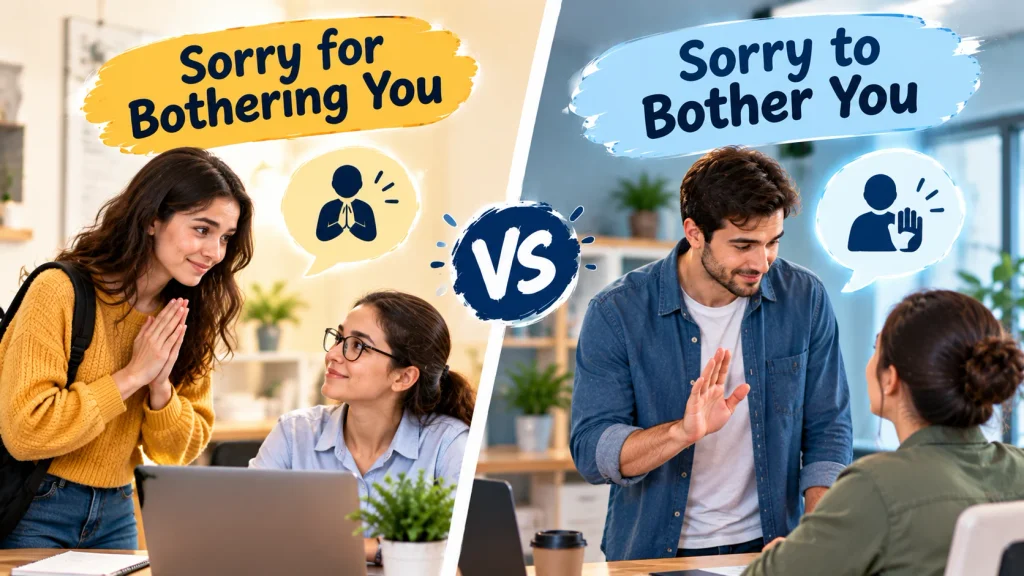
Have you ever started a message with “Sorry to bother you” and then wondered whether “Sorry for bothering you” would sound better?
You’re not alone. These two expressions are extremely common in everyday English, workplace conversations, emails, texts, and polite requests. They also look almost identical, which makes the choice feel more complicated than it really is.
The good news is that both phrases are grammatically correct. The main difference comes from the verb form after sorry and the way you frame the action.
“Sorry to bother you” usually introduces an interruption, question, or request. You’re apologizing before or as you begin to bother someone.
“Sorry for bothering you” focuses more on the act of bothering someone. It often sounds natural when you’re acknowledging an inconvenience that has already happened or is currently happening.
For example:
- Sorry to bother you, but could I ask a quick question?
- Sorry for bothering you again about this issue.
The first phrase prepares the listener for an interruption. The second acknowledges the inconvenience more directly.
Once you understand that difference, choosing between them becomes much easier.
“Sorry for Bothering You” vs. “Sorry to Bother You” at a Glance
Both expressions communicate politeness and consideration. However, they approach the situation from slightly different grammatical angles.
| Phrase | Grammar | Typical Use | Example |
| Sorry to bother you | to + base verb | Before or as you interrupt someone | Sorry to bother you, but may I ask something? |
| Sorry for bothering you | for + gerund | When acknowledging the act or inconvenience | Sorry for bothering you again. |
| Sorry to bother you | Infinitive | Often introduces a request | Sorry to bother you, but I need your help. |
| Sorry for bothering you | Gerund | Often refers to an action being acknowledged | Sorry for bothering you while you were working. |
The distinction isn’t a rigid rule about time. English speakers can use either expression in several situations depending on context.
That’s important because you may see simplified explanations claiming that “to bother” always means something has not happened yet, while “for bothering” always means it has already happened.
That explanation can help beginners, but it isn’t the whole story.
Natural English depends on context, intention, and what you want to emphasize.
Quick Difference Between the Two Phrases
Think of the difference this way:
“Sorry to bother you” often means:
I’m about to interrupt you or ask something, and I want to acknowledge that.
“Sorry for bothering you” often means:
I recognize that my action has bothered or inconvenienced you.
Consider these examples:
Before a question:
Sorry to bother you, but do you know when the meeting starts?
After repeated contact:
Sorry for bothering you again, but I still haven’t received the document.
In the first sentence, the speaker is introducing a request. In the second, the speaker recognizes that they have contacted the person repeatedly.
This is why “Sorry to bother you” is especially common at the beginning of conversations, emails, and requests.
An Easy Memory Rule
If you need a quick way to remember the difference, use this simple guideline:
“Sorry to bother you” → think “I’m about to interrupt.”
“Sorry for bothering you” → think “I’ve caused an inconvenience.”
This isn’t an absolute grammatical rule, but it’s a useful starting point.
Imagine walking up to a coworker who is deeply focused on a task.
You might say:
Sorry to bother you, but could I ask you something?
You haven’t necessarily bothered the person yet. You’re politely recognizing that your interruption might take their attention away from what they’re doing.
Now imagine you’ve already sent three messages asking about the same issue.
You could write:
Sorry for bothering you again, but could you please check on this?
Here, you’re acknowledging the repeated contact.
The memory trick works because it focuses on what the speaker is doing with the apology, rather than simply memorizing a grammar formula.
Are Both Phrases Grammatically Correct?
Yes. “Sorry to bother you” and “Sorry for bothering you” are both standard and grammatically acceptable expressions.
The important thing is to use the correct structure after sorry.
These patterns are natural:
- Sorry to bother you.
- Sorry for bothering you.
- Sorry to interrupt you.
- Sorry for interrupting you.
- Sorry to disturb you.
- Sorry for disturbing you.
The incorrect forms are usually created by mixing the two structures.
For example:
❌ Sorry for bother you.
❌ Sorry to bothering you.
The first incorrectly uses the base verb after for. The second incorrectly uses the -ing form after to in this construction.
The correct patterns are:
sorry + to + base verb
and
sorry + for + -ing form
So:
Sorry to bother you.
Sorry for bothering you.
This distinction is useful far beyond these two particular phrases. Understanding the grammar behind them can help you form similar expressions naturally.
What Does “Sorry for Bothering You” Mean?
“Sorry for bothering you” is a polite expression used when you acknowledge that your actions may have interrupted, inconvenienced, or annoyed someone.
The word for is followed by bothering, which is the gerund form of the verb bother.
Here, bothering functions grammatically like a noun within the phrase “for bothering you.”
The speaker is essentially apologizing for the action itself.
For example:
Sorry for bothering you while you’re working.
The speaker recognizes that their interruption may have caused an inconvenience.
Another example is:
Sorry for bothering you again about the same issue.
This sentence makes sense when the speaker has already contacted the person and is now acknowledging the repeated interruption.
The phrase can sound particularly natural when the speaker believes they have imposed on someone’s time, attention, patience, or personal space.
Meaning and Grammar
The structure is:
sorry + for + gerund
In:
Sorry for bothering you.
the word sorry expresses an apology or regret.
For introduces the action that the speaker is apologizing for.
Bothering is the gerund form of bother.
And you is the person affected by that action.
You can use the same structure with other verbs:
- Sorry for interrupting you.
- Sorry for disturbing you.
- Sorry for keeping you waiting.
- Sorry for calling so late.
- Sorry for asking again.
- Sorry for taking up your time.
Notice the pattern. After for, the verb takes the -ing form.
That’s why “Sorry for bother you” is incorrect.
Why “Sorry for Bothering You” Sounds Polite
An apology can soften an interaction because it shows that you recognize another person’s time and attention have value.
When you say:
Sorry for bothering you.
you aren’t necessarily admitting that you did something seriously wrong. In many everyday situations, sorry simply signals consideration.
For instance, you might need to ask a coworker for help while they are busy.
You could say:
Sorry for bothering you while you’re working. Could you take a quick look at this?
The apology acknowledges the interruption without suggesting that your request is unreasonable.
However, there’s an important point here: politeness doesn’t always require an apology.
If you frequently apologize for normal requests, your communication can start to sound overly hesitant.
Compare:
Sorry for bothering you. Could you send me the report?
with:
Could you send me the report when you have a moment? Thanks.
The second version can sound more confident while remaining polite.
So, learning when to use “sorry” is just as important as learning which grammatical form to choose.
When “Sorry for Bothering You” Refers to an Ongoing or Completed Action
The phrase often works well when the speaker is focusing on an action that has already begun or has already happened.
For example:
Sorry for bothering you during your lunch break.
The interruption is already taking place.
Or:
Sorry for bothering you again with this request.
The speaker has contacted the person before.
You can also use the phrase when the action is still happening:
Sorry for bothering you while you’re trying to concentrate.
The important idea is not simply whether the action happened in the past. Instead, the -ing form allows the speaker to refer to the action itself.
That’s why it can work in a variety of contexts.
Examples of “Sorry for Bothering You”
Here are some natural examples:
At work:
Sorry for bothering you during a busy afternoon.
After repeated contact:
Sorry for bothering you again, but I wanted to follow up.
During a study session:
Sorry for bothering you while you’re studying.
After interrupting a conversation:
Sorry for bothering you while you were talking.
In a message:
Sorry for bothering you this late in the evening.
When asking for additional help:
Sorry for bothering you with another question.
Each example focuses on the act of bothering and acknowledges that the other person’s time or attention may have been affected.
What Does “Sorry to Bother You” Mean?
“Sorry to bother you” is a common polite expression used when you are about to interrupt someone, ask a question, make a request, or otherwise take some of their attention.
Its structure is:
sorry + to + base verb
So:
Sorry to bother you.
The word to is followed by the base form bother.
You can use the same structure with other verbs:
- Sorry to interrupt you.
- Sorry to disturb you.
- Sorry to ask.
- Sorry to call so late.
- Sorry to trouble you.
In many situations, “Sorry to bother you” sounds natural because it prepares the listener for what comes next.
For example:
Sorry to bother you, but could you help me with this file?
The speaker politely signals that they are about to make a request.
Meaning and Grammar
The basic pattern is:
sorry + to + base verb
Here, to bother is an infinitive.
The phrase can be understood as an abbreviated form of a longer thought such as:
I’m sorry that I’m going to bother you.
However, English speakers usually don’t think about the phrase in such a literal way. “Sorry to bother you” is an established polite expression.
It often appears immediately before a request:
Sorry to bother you, but could you check this for me?
It can also appear before a question:
Sorry to bother you, but do you know where the library is?
Or before an interruption:
Sorry to bother you. Could I have a quick word?
The expression gives the listener a small warning that the speaker is about to take their attention.
Why English Speakers Say “Sorry to Bother You”
People often use “Sorry to bother you” because it softens an interruption.
Imagine someone is working with headphones on. You need their attention, but you don’t want to sound demanding.
You might say:
Sorry to bother you, but could I ask you something?
The phrase communicates two things at once.
First, you want the person’s attention.
Second, you recognize that they may already be occupied.
This makes the expression particularly useful in situations where you don’t know whether the other person is available.
It’s common in offices, schools, stores, customer-service interactions, phone calls, and everyday conversations.
You might even hear it from a stranger asking for directions:
Sorry to bother you, but could you tell me how to get to the station?
The speaker doesn’t necessarily believe they have done anything wrong. The apology simply makes the request sound considerate.
When “Sorry to Bother You” Refers to an Upcoming Action
The infinitive construction often works naturally when the speaker is introducing an action.
For example:
Sorry to bother you, but I have a quick question.
The speaker is beginning an interaction.
Similarly:
Sorry to interrupt, but may I add something?
The interruption is happening at that moment.
Or:
Sorry to disturb you, but your appointment is ready.
The speaker is acknowledging that their action may interrupt what the listener is doing.
This is why “Sorry to bother you” is such a useful phrase before questions and requests.
It gives the listener context before the main message arrives.
Examples of “Sorry to Bother You”
Here are several natural examples:
Before asking a question:
Sorry to bother you, but where can I find the admissions office?
Before requesting help:
Sorry to bother you, but could you help me carry this?
Before interrupting:
Sorry to bother you, but may I say something?
At work:
Sorry to bother you, but do you have a minute?
On the phone:
Sorry to bother you so late, but I need to confirm something.
In a professional setting:
Sorry to bother you, but could you clarify the deadline?
These examples show why “Sorry to bother you” is one of the most useful polite expressions in everyday English.
“Sorry for Bothering You” vs. “Sorry to Bother You”: The Grammar
The difference becomes much clearer when you look at the grammatical structures rather than trying to memorize the phrases separately.
The two patterns are:
sorry + to + base verb
and
sorry + for + gerund
That gives us:
Sorry to bother you.
Sorry for bothering you.
Both are correct, but the construction changes the way the action is presented.
With to bother, the speaker uses an infinitive.
With for bothering, the speaker uses a gerund after the preposition for.
This is a small grammatical difference, but it creates a meaningful difference in how the sentence is framed.
“Sorry for Bothering You”
The phrase “sorry for bothering you” uses a preposition followed by a gerund.
The structure is:
sorry + for + verb-ing
Examples include:
Sorry for bothering you.
Sorry for interrupting you.
Sorry for calling so late.
Sorry for asking so many questions.
The -ing form identifies the action that the speaker is apologizing for.
You can think of it as pointing directly toward the activity or behavior.
That makes this construction particularly natural when you want to acknowledge an inconvenience.
For example:
Sorry for bothering you again.
The word again strongly suggests previous contact.
Another example:
Sorry for bothering you while you were busy.
Here, the speaker identifies the specific situation that caused the inconvenience.
“Sorry to Bother You”
The phrase “sorry to bother you” uses an infinitive.
The structure is:
sorry + to + base verb
Examples include:
Sorry to bother you.
Sorry to interrupt you.
Sorry to disturb you.
Sorry to ask.
This structure often introduces an action that is happening immediately or is about to happen.
For example:
Sorry to bother you, but could I ask a quick question?
The speaker is about to ask the question.
Similarly:
Sorry to interrupt you, but I need to clarify something.
The speaker is interrupting at that moment.
This makes the infinitive construction especially common at the beginning of requests and interruptions.
Gerund vs. Infinitive: The Practical Difference
The easiest way to understand the grammar is to focus on what follows for and to.
After for, use the -ing form:
Sorry for bothering you.
After to, use the base form:
Sorry to bother you.
This is why the following forms are incorrect:
❌ Sorry for bother you.
❌ Sorry to bothering you.
They mix the two grammatical patterns.
The correct forms are:
✅ Sorry for bothering you.
✅ Sorry to bother you.
You can apply the same principle to related expressions:
Sorry for interrupting you.
Sorry to interrupt you.
Sorry for disturbing you.
Sorry to disturb you.
The choice between the two structures depends on how you want to frame the action and the context in which you are speaking.
Is the Difference Really Just “Before” vs. “After”?
Not completely.
It’s tempting to memorize this:
Before the action → “Sorry to bother you.”
After the action → “Sorry for bothering you.”
That rule is useful, but it’s too strict if you treat it as an absolute rule.
Native speakers can use “Sorry to bother you” even when an interaction has technically already started.
For example:
Sorry to bother you again, but I have one more question.
Likewise, “Sorry for bothering you” can refer to an action that is currently happening:
Sorry for bothering you while you’re working.
So, the distinction is better understood as a difference in focus.
“Sorry to bother you” often focuses on the interruption or request being introduced.
“Sorry for bothering you” often focuses on the act of bothering itself and the inconvenience it may have caused.
That explanation is more flexible and more useful in real English.
Why Timing Still Matters
Although timing isn’t an absolute rule, it can still influence which phrase sounds more natural.
If you are approaching someone who is busy, “Sorry to bother you” is often the natural choice:
Sorry to bother you, but do you have a moment?
You’re beginning the interaction.
If you have already contacted someone several times, “Sorry for bothering you” may fit better:
Sorry for bothering you again about this.
You’re acknowledging previous contact.
Think of timing as a clue, not a grammar law.
Context, intention, and the speaker’s emphasis can all influence the choice.
And that’s the key to using these phrases naturally: don’t try to force every situation into a single formula.
When to Use “Sorry to Bother You”
“Sorry to bother you” is especially useful when you are about to interrupt someone, ask for help, request information, or take some of their attention.
It works as a polite introduction to what you want to say next.
For example:
Sorry to bother you, but could you help me with this form?
The phrase does not necessarily mean you believe you are doing something wrong. It simply shows awareness that the other person may be busy.
That makes it useful in both casual and professional conversations.
Before Asking a Question
One of the most common uses of “sorry to bother you” is before a question.
Imagine you’re in an unfamiliar building and need directions. You might approach someone and say:
Sorry to bother you, but do you know where the conference room is?
The apology makes the question feel less abrupt.
You could also say:
Sorry to bother you, but could you tell me when the office closes?
Or:
Sorry to bother you, but do you know who handles these applications?
In each case, the phrase works as a soft introduction.
It tells the listener that you want their attention while recognizing that they may already be occupied.
Before Making a Request
You can also use the phrase before asking someone to do something.
For example:
Sorry to bother you, but could you send me the updated file?
Or:
Sorry to bother you, but would you mind checking this number?
This construction is particularly common at work.
However, the request that follows should still be clear. The apology should not replace the actual information the listener needs.
Compare:
Sorry to bother you, but could you send me the report when you have a moment?
with:
Sorry to bother you. I’m sorry. I know you’re busy. I just wanted to ask if maybe you could possibly send the report.
The second version contains too much hesitation.
Politeness is useful. Excessive apologizing can make a simple request unnecessarily complicated.
Before Interrupting Someone
“Sorry to bother you” can also introduce an interruption.
For example:
Sorry to bother you, but may I add something?
Or:
Sorry to bother you, but I need to clarify one point.
You might say this when someone is speaking, working, reading, or otherwise focused on something else.
Another natural expression is:
Sorry to interrupt.
In some situations, this is even more precise because you are directly acknowledging the interruption.
For example:
Sorry to interrupt, but could we go back to the previous point?
The choice depends on what you want to emphasize. Bother is broader, while interrupt specifically refers to breaking into someone’s activity, conversation, or concentration.
When Approaching Someone You Do Not Know
The phrase is also useful when you need help from a stranger.
For example:
Sorry to bother you, but could you tell me where the nearest pharmacy is?
Or:
Sorry to bother you, but is this seat taken?
This sounds considerate because you are not assuming that the person is available to help.
Still, “Excuse me” is often just as natural in these situations:
Excuse me, could you tell me where the nearest pharmacy is?
In fact, “excuse me” can sound more neutral because it doesn’t automatically frame your request as an inconvenience.
That distinction becomes important when you want to sound polite without sounding overly apologetic.
When to Use “Sorry for Bothering You”
“Sorry for bothering you” is useful when you want to acknowledge the fact that your actions have caused, or may have caused, an inconvenience.
It often appears after an interaction has already started or when you’re referring to repeated contact.
For example:
Sorry for bothering you again.
This sounds natural when you have already asked about something before.
You could also say:
Sorry for bothering you during your lunch break.
Here, the speaker is acknowledging that the interruption occurred during a time when the listener was probably unavailable.
The phrase can also refer to an ongoing situation:
Sorry for bothering you while you’re trying to work.
The emphasis is on the act of bothering rather than simply announcing an upcoming request.
After Interrupting Someone
Suppose you interrupt a coworker who is concentrating on an important task.
Afterward, you might say:
Sorry for bothering you while you were working.
The phrase acknowledges what happened.
You could also say:
Sorry for interrupting you earlier.
This version is particularly clear because interrupting directly describes the action.
The choice between bothering and interrupting depends on the situation.
Bothering is broader and can mean causing inconvenience, annoyance, or disruption.
Interrupting specifically means breaking into someone’s activity or conversation.
After Asking for Help
Imagine a friend has already helped you several times with a project. You need their assistance again.
You might say:
Sorry for bothering you again, but could you look at this last section?
The word again changes the feel of the sentence. It signals that you recognize the repeated request.
However, you don’t always need an apology.
If the person has willingly offered to help, you could simply say:
Could you take another look at this when you have a chance? Thanks.
That can sound warmer and more confident.
After Repeated Contact
Repeated emails, calls, or messages are another common situation.
For example:
Sorry for bothering you again about this. I wanted to check whether there has been any update.
Or:
Sorry for bothering you with another follow-up.
These expressions acknowledge that you have already contacted the person.
Still, professional communication often benefits from being direct.
Instead of:
Sorry for bothering you again and again.
you could write:
I’m following up on my previous message regarding the application.
The second version is more neutral and businesslike.
When You Think You Have Caused an Inconvenience
You can use “sorry for bothering you” when you believe your action may have disrupted someone’s time or attention.
For example:
Sorry for bothering you during your meeting.
Or:
Sorry for bothering you while you were having lunch.
The phrase works because it acknowledges the person’s situation.
However, the seriousness of the inconvenience matters.
If you genuinely caused a significant problem, “Sorry for bothering you” may sound too mild. A more specific apology can be better:
I’m sorry for interrupting the meeting.
Or:
I apologize for the confusion.
Specific apologies usually communicate more effectively than vague ones.
“Sorry to Bother You” in Emails
Email creates an interesting situation because the recipient may read your message long after you send it.
You can’t always know whether they are busy when they open it.
Still, “Sorry to bother you” is common in emails when you want to make a request or follow up politely.
For example:
Sorry to bother you, but I wanted to ask about the status of my application.
This is grammatically correct and understandable.
However, in professional writing, you should consider whether an apology is actually necessary.
A more confident version might be:
I’m following up to ask about the status of my application.
Or:
I wanted to check whether there has been an update on my application.
These versions communicate the same purpose without apologizing for contacting someone.
Before a Request
Suppose you need a manager to approve a document.
You could write:
Sorry to bother you, but could you please review the attached document when you have a moment?
This is polite.
A slightly more confident professional version would be:
Could you please review the attached document when you have a moment? I’d appreciate your feedback.
The second version avoids implying that the request itself is a problem.
That can be useful in workplace communication, especially when making a normal part of your job someone’s responsibility.
After Previous Contact
If you’ve already emailed someone and are following up, you might write:
Sorry for bothering you again. I wanted to follow up on my previous email.
This is understandable and polite.
But you can make the message more professional by focusing on the purpose:
I’m following up on my previous email regarding the project timeline. Please let me know when you have a chance to review it.
This approach is direct without being rude.
Following Up on an Unanswered Message
When someone hasn’t responded, many writers immediately begin with:
Sorry to bother you again.
But you don’t necessarily need to apologize.
A better professional approach may be:
I’m following up on the message below regarding the requested information.
Or:
I wanted to follow up in case my previous message was missed.
These alternatives acknowledge the reason for contacting the person without assuming that your message was an inconvenience.
A More Confident Professional Email
Consider these two approaches.
More apologetic:
Sorry to bother you again, but I wanted to ask whether you had a chance to review the proposal.
More confident:
I’m following up to see whether you’ve had a chance to review the proposal. Please let me know if you have any questions.
Both are polite.
The second simply sounds more direct.
That distinction matters in professional English. Being polite does not mean you need to apologize every time you ask someone for something.
Email Examples
Example: Before a Request
Subject: Quick Question About the Schedule
Sorry to bother you, but could you confirm whether tomorrow’s meeting is still scheduled for the morning? I want to make sure I have the correct time.
Thank you.
This version works because the writer is introducing a small request.
A more confident alternative could be:
Could you please confirm whether tomorrow’s meeting is still scheduled for the morning? I want to make sure I have the correct time. Thank you.
The second version removes the apology while keeping the tone respectful.
Example: After Previous Contact
Subject: Follow-Up on My Previous Email
Sorry for bothering you again. I’m following up on my previous message regarding the application. Please let me know if you need any additional information from me.
Thank you for your time.
This use of “sorry for bothering you again” makes sense because the writer is acknowledging previous contact.
Still, a more neutral professional version would be:
I’m following up on my previous message regarding the application. Please let me know if you need any additional information from me. Thank you for your time.
This sounds confident and avoids unnecessary self-blame.
Common Mistakes to Avoid
The phrases are simple, but learners often mix their grammatical patterns.
Mistake 1: “Sorry for Bother You”
This is incorrect in standard English.
❌ Sorry for bother you.
The problem is the verb form after for.
When for introduces the action being apologized for, use the -ing form:
✅ Sorry for bothering you.
The same rule applies to similar expressions:
❌ Sorry for interrupt you.
✅ Sorry for interrupting you.
❌ Sorry for disturb you.
✅ Sorry for disturbing you.
Remember:
for + gerund
Mistake 2: “Sorry to Bothering You”
This is another common error.
❌ Sorry to bothering you.
After to in this infinitive construction, use the base form:
✅ Sorry to bother you.
You can apply the same pattern to other verbs:
Sorry to interrupt you.
Sorry to disturb you.
Sorry to ask.
The key pattern is:
to + base verb
Mistake 3: Treating “Before” and “After” as an Absolute Rule
This is probably the most important conceptual mistake.
Some learners memorize:
Before = sorry to bother you.
After = sorry for bothering you.
That shortcut is helpful, but it is not a complete description of natural English.
For example:
Sorry to bother you again, but I have one more question.
The speaker has already contacted the listener, yet “sorry to bother you” still sounds perfectly natural.
Likewise:
Sorry for bothering you while you’re working.
The action may still be happening.
So don’t treat timing as an unbreakable grammar rule.
Instead, consider the focus of the sentence.
Use “sorry to bother you” when you are introducing an interruption, question, or request.
Use “sorry for bothering you” when you want to acknowledge the act of bothering someone or the inconvenience it may have caused.
Mistake 4: Assuming One Phrase Is Always More Polite
Neither phrase is automatically more polite in every situation.
Both can express consideration.
The more natural choice depends on the context.
For example:
Sorry to bother you, but could I ask a question?
sounds perfectly polite when approaching someone.
But:
Sorry for bothering you again.
may sound more appropriate after several previous contacts.
The situation determines which expression fits better.
Mistake 5: Using an Apology When Appreciation Is Better
Sometimes sorry isn’t the best way to sound polite.
Suppose your coworker agrees to help you.
You might say:
Sorry to bother you.
But if they have willingly offered their time, you could say:
Thanks for your help.
Or:
I appreciate your time.
This shifts the focus from guilt to gratitude.
That can create a warmer and more confident tone.
For example:
Could you take a look at this when you have a moment? I appreciate your help.
This sentence makes the request clear without suggesting that asking for assistance is inherently wrong.
Mistake 6: Over-Apologizing in Professional Communication
Over-apologizing can weaken otherwise straightforward communication.
Compare:
Sorry to bother you, but I’m sorry to ask again. I know you’re busy, but I was wondering if maybe you could send the report.
with:
Could you please send the report when you have a moment? Thank you.
The second version is shorter, clearer, and still polite.
Professional communication often works best when you respect the other person’s time without unnecessarily apologizing for making a reasonable request.
“Sorry to Bother You” vs. “Sorry for Bothering You”: Quick Comparison
The following comparison can help you choose quickly:
| Situation | Natural Choice | Why |
| Approaching someone who is busy | Sorry to bother you | Introduces the interruption |
| Asking a stranger for directions | Sorry to bother you | Softens the request |
| Asking a coworker a quick question | Sorry to bother you | Signals an upcoming request |
| Contacting someone repeatedly | Sorry for bothering you again | Acknowledges repeated contact |
| Referring to an earlier interruption | Sorry for bothering you | Focuses on the action |
| Acknowledging an inconvenience | Sorry for bothering you | Recognizes the effect of the action |
| Professional follow-up | Either, depending on context | Both are grammatical |
| Normal workplace request | Often no apology needed | Direct wording can sound more confident |
The most important point is that neither expression is universally better.
The surrounding sentence determines the most natural choice.
Which Phrase Is More Polite?
This question comes up often, but there isn’t a single answer.
“Sorry to bother you” can sound especially polite when you are approaching someone unexpectedly.
For example:
Sorry to bother you, but could you help me find this address?
It acknowledges the interruption before making the request.
“Sorry for bothering you” can sound more appropriate when you’re recognizing that your actions have already caused an inconvenience.
For example:
Sorry for bothering you again about this.
The difference is subtle, but it matters.
Are They Equally Polite?
Yes, both can be polite.
The more important issue is whether the phrase matches the situation.
A polite expression can become unnatural if you use it mechanically.
For example, saying “Sorry to bother you” every time you ask a colleague a routine question may sound unnecessarily apologetic.
Likewise, saying “Sorry for bothering you” after every ordinary email can make your communication sound hesitant.
Good communication balances courtesy with confidence.
When “Sorry” Sounds Natural
An apology is particularly natural when you are genuinely interrupting someone or making an unexpected request.
For example:
Sorry to bother you while you’re busy. Could I ask a quick question?
It can also be appropriate when you have contacted someone repeatedly:
Sorry for bothering you again. I just wanted to confirm one detail.
In both cases, the apology has a clear purpose.
When “Sorry” May Sound Too Apologetic
You don’t need to apologize simply because you are communicating.
Consider a normal workplace request:
Sorry to bother you, but could you send me the invoice?
There’s nothing inherently wrong with this sentence.
But if sending the invoice is part of the person’s normal responsibilities, a direct request may be more appropriate:
Could you please send me the invoice when you have a moment?
The second sentence remains polite but removes unnecessary self-blame.
Don’t Over-Apologize
One of the most useful communication habits is knowing when not to apologize.
If you have a reasonable question, a legitimate request, or a normal follow-up, you don’t automatically need to say sorry.
Instead, you can use courteous language such as:
Could you please…
Would you mind…
When you have a moment, could you…
I’d appreciate your help with…
Thank you for your time.
These expressions can make your communication polite without making you sound uncertain.
The goal isn’t to eliminate “sorry” from your vocabulary. It’s to use it when it genuinely adds meaning.
Formal vs. Informal Usage
Both “sorry to bother you” and “sorry for bothering you” can appear in formal, semi-formal, and informal English.
The surrounding language determines how formal the complete message sounds.
Formal Situations
In formal settings, you can use the expressions when you need to acknowledge an interruption.
For example:
Sorry to bother you, but may I ask for clarification regarding the policy?
Or:
I’m sorry for bothering you outside your normal working hours.
These sentences are grammatically sound and respectful.
However, very formal correspondence may use alternatives such as:
I apologize for the interruption.
or:
I apologize for the inconvenience.
These expressions can sound more formal than “sorry to bother you.”
Business Communication
In business English, context matters more than the choice between to bother and for bothering.
For a quick request, you might write:
Sorry to bother you, but could you review this document?
For repeated contact:
Sorry for bothering you again. I’m following up on my previous email.
But if the request is routine, direct wording may be preferable:
Could you please review this document when you have a chance?
This is especially useful when communicating with colleagues, clients, managers, or business partners.
Academic Settings
Students may use “sorry to bother you” when approaching a professor or instructor.
For example:
Sorry to bother you, but could you clarify the assignment instructions?
This is polite and natural.
A more formal version might be:
Excuse me, could you clarify the assignment instructions?
Or in an email:
I’m writing to ask for clarification regarding the assignment instructions.
The best choice depends on the relationship and communication channel.
Customer Service
Customer-service interactions can also use these expressions.
For example:
Sorry to bother you, but could you check the status of my order?
However, a customer doesn’t necessarily need to apologize for requesting assistance.
A straightforward version could be:
Could you please check the status of my order?
In professional service communication, clarity is often more valuable than excessive politeness.
Casual Conversations
In casual conversations, both expressions are common.
You might tell a friend:
Sorry to bother you, but can you help me with something?
Or:
Sorry for bothering you while you’re watching the game.
Because casual conversations are flexible, speakers often choose based on instinct and context rather than consciously applying a grammar rule.
Text Messages
Text messages frequently use shortened and informal versions.
For example:
Sorry to bother you, are you free for a minute?
Or:
Sorry for bothering you again. Did you get my last message?
In texting, tone can be difficult to judge because the listener cannot hear your voice. A brief apology can therefore help signal friendliness.
Still, if you’re making a normal request, you can often skip the apology:
Hey, are you free for a minute?
That can sound perfectly natural between people who already know each other.
Natural Alternatives to “Sorry to Bother You”
Although “sorry to bother you” is perfectly natural, you don’t have to use it every time you want to be polite.
In fact, choosing a different expression can sometimes make your communication sound more confident, professional, or appropriate for the situation.
For example, if you are asking a stranger for directions, “Excuse me” may sound more natural. If you’re contacting a coworker, “Do you have a moment?” may be more direct. If you’re writing a professional email, “I’d appreciate your help with…” can sound more confident than starting with an apology.
The best alternative depends on what you’re trying to accomplish.
“Excuse Me”
“Excuse me” is one of the most versatile alternatives.
You can use it to get someone’s attention, interrupt politely, ask a question, or move past someone.
For example:
Excuse me, could you tell me where the station is?
Or:
Excuse me, may I ask you something?
It works particularly well when approaching someone you don’t know.
There is also an important difference in tone.
“Sorry to bother you” suggests that you recognize your interaction may be an inconvenience.
“Excuse me” is more neutral. It simply signals that you want the person’s attention.
That makes “excuse me” a useful choice when you don’t want to imply that your request is burdensome.
“Do You Have a Moment?”
This expression is especially useful at work.
Instead of:
Sorry to bother you, but could I ask you something?
you could say:
Do you have a moment?
This sounds polite while respecting the other person’s availability.
It also gives the listener an easy opportunity to say that they’re busy.
For example:
Do you have a moment? I’d like to discuss the project timeline.
Or:
Do you have a moment to look over this document?
This approach can sound more confident than apologizing for needing someone’s attention.
“Could I Ask You a Quick Question?”
This is another natural alternative when you need information.
For example:
Could I ask you a quick question about the schedule?
The word quick helps signal that you don’t intend to take much of the person’s time.
You can also say:
Could I ask you something?
Or:
May I ask you a quick question?
The choice between could and may depends partly on tone. Could I is extremely common and natural in everyday English, while may I can sound slightly more formal.
“Would You Mind…?”
“Would you mind…?” is useful when you’re asking someone to do something.
For example:
Would you mind checking this document?
Or:
Would you mind sending me the updated version?
The phrase is polite because it recognizes that the other person has a choice.
One important grammar point is worth remembering:
Would you mind checking this?
is correct.
After would you mind, use the -ing form.
So:
❌ Would you mind to check this?
✅ Would you mind checking this?
This expression can replace “Sorry to bother you” when your main goal is to make a request politely.
“I Hope I’m Not Interrupting”
This phrase directly acknowledges a possible interruption.
For example:
I hope I’m not interrupting. Could I ask you something?
Or:
I hope I’m not interrupting, but I wanted to check something with you.
It can sound considerate without being as apologetic as “Sorry to bother you.”
The phrase is especially useful when you are unsure whether someone is available.
However, it should be used naturally. If you already know that the person has invited you to speak, there’s no need to emphasize the possibility of an interruption.
“I Appreciate Your Time”
This expression shifts the focus from apology to appreciation.
Instead of:
Sorry to bother you with this request.
you could say:
I appreciate your time. Could you please take a look at this?
This can sound particularly professional.
It also creates a more positive tone because you’re recognizing the value of the person’s time rather than suggesting that your request is a problem.
For example:
I appreciate your time and would be grateful if you could review the document.
This works well in business emails, academic communication, and formal requests.
“When You Have a Moment…”
Another confident alternative is:
When you have a moment, could you please review this?
This phrase acknowledges that the person may be busy without requiring an apology.
You could also write:
When you have a chance, please let me know what you think.
Or:
When you have a moment, could you send me the updated file?
These expressions are useful because they respect the recipient’s schedule while keeping the request straightforward.
Choosing the Best Alternative
There is no single replacement for “sorry to bother you.”
Different expressions fit different situations.
If you’re approaching a stranger, “Excuse me” is often a natural choice.
If you’re speaking to a busy coworker, “Do you have a moment?” can be useful.
If you’re making a request, “Would you mind…?” works well.
If you’re writing a professional message, “I appreciate your time” or “When you have a moment…” can sound polished.
The goal is to match the expression to the situation rather than searching for the most polite phrase possible.
“Sorry to Bother You” vs. “Excuse Me”
These expressions overlap, but they’re not identical.
“Excuse me” is often used to get someone’s attention or politely interrupt.
Excuse me, could you tell me where the bank is?
“Sorry to bother you” more clearly acknowledges that your interaction might inconvenience the person.
Sorry to bother you, but could you tell me where the bank is?
Both are polite.
However, “excuse me” can sound more neutral, while “sorry to bother you” can sound more apologetic.
For ordinary requests, either can work.
“Sorry to Bother You” vs. “Sorry to Trouble You”
“Sorry to trouble you” is grammatically correct, but it can sound more formal or old-fashioned than “sorry to bother you” in everyday American English.
For example:
Sorry to trouble you, but could you sign this form?
This is understandable and polite.
However:
Sorry to bother you, but could you sign this form?
is generally more conversational.
The word trouble suggests that the request may require effort or cause inconvenience.
The word bother is broader and is very common in everyday speech.
In formal correspondence, you may still encounter “sorry to trouble you” or “I’m sorry to trouble you with this request.”
Bother, Disturb, or Trouble?
These three verbs overlap, but their meanings aren’t exactly the same.
Bother can mean to inconvenience, annoy, interrupt, or cause someone difficulty.
Sorry to bother you, but could I ask a question?
Disturb often emphasizes interrupting someone’s peace, concentration, rest, or activity.
Sorry to disturb you while you’re working.
Trouble can emphasize causing someone effort or inconvenience.
Sorry to trouble you, but could you help me with this form?
The difference can be subtle.
If you’re asking someone a quick question, bother is very natural.
If someone is sleeping or concentrating, disturb may be more precise.
If you’re asking someone to make an effort on your behalf, trouble can fit, especially in formal language.
Alternatives That Sound More Confident
Politeness doesn’t have to mean apologizing.
If you’re making a reasonable request, you can often sound more confident by changing the structure.
Instead of:
Sorry to bother you, but could you send me the report?
try:
Could you please send me the report when you have a moment?
Instead of:
Sorry for bothering you again about this.
try:
I’m following up on my previous message regarding this.
Instead of:
Sorry to bother you with another question.
try:
I have one more question about this.
Instead of:
Sorry for bothering you while you’re busy.
try:
When you have a moment, could you please take a look at this?
These alternatives aren’t necessarily more polite. They’re simply less apologetic.
That distinction is important.
A confident speaker can still be courteous.
Alternatives for Professional Emails
Professional emails often benefit from direct language.
Here are some useful replacements:
I’m writing to ask about…
I’m following up regarding…
Could you please confirm…
When you have a moment, could you…
I’d appreciate your help with…
Please let me know when you have a chance.
Thank you for your time.
For example, instead of:
Sorry to bother you, but could you confirm whether the meeting has been moved?
you could write:
Could you please confirm whether the meeting has been moved? Thank you for your time.
The second version is direct, professional, and respectful.
“Bother,” “Disturb,” and “Trouble”: What’s the Difference?
Because these words frequently appear in polite expressions, it’s worth examining their meanings more closely.
Bother
Bother has a broad meaning.
It can describe annoying someone, inconveniencing them, interrupting them, or causing them difficulty.
For example:
Sorry to bother you while you’re working.
It can also be used casually:
The noise is bothering me.
Or:
Don’t bother calling him.
Because bother has several uses, it is a highly flexible word.
Disturb
Disturb is often associated with interruption or disruption.
For example:
Please don’t disturb the students while they’re taking the exam.
You might also see:
Sorry to disturb you.
This sounds natural when someone is resting, concentrating, speaking, or otherwise engaged.
The word can also appear in signs:
Do Not Disturb
That expression is particularly common in hotels and other places where privacy or uninterrupted time matters.
Trouble
Trouble can mean to cause someone difficulty or require effort from them.
For example:
Sorry to trouble you, but could you sign this document?
It can sound more formal than bother.
You might also see:
I’m sorry to trouble you with this matter.
This style is more likely in formal correspondence than casual conversation.
Real-Life Examples in Context
Understanding these expressions becomes much easier when you see how they work in realistic situations.
Office Conversation
Imagine you need to ask your coworker about a report while they are working.
You could say:
Sorry to bother you, but do you have a minute?
Your coworker might answer:
Sure. What do you need?
If you have already interrupted them and want to acknowledge it afterward, you could say:
Sorry for bothering you while you were working.
The first expression introduces the interruption. The second reflects on it.
School Conversation
Suppose you’re a student and need clarification from a teacher.
You might say:
Sorry to bother you, but could you explain this part again?
That sounds natural because you’re approaching the teacher with a question.
In an email, you could write:
I’m writing to ask for clarification about the final assignment.
This is more direct and works well in a formal academic setting.
Business Email
Imagine you’re contacting a client about missing information.
An apologetic version might say:
Sorry to bother you, but could you please send the missing information when you have a chance?
A more professional alternative could be:
Could you please send the missing information when you have a chance? We need it to complete the next stage of the project.
The second version explains why the request matters instead of apologizing for making it.
Customer Service
Suppose you need to contact customer service about an order.
You might say:
Sorry to bother you, but could you check the status of my order?
This is polite and natural.
However, you could simply say:
Could you please check the status of my order?
There is no need to apologize for requesting customer service.
Phone Call
Imagine you are calling someone outside normal business hours.
You might say:
Sorry to bother you so late, but I need to confirm something.
Here, the apology makes sense because the timing itself may be inconvenient.
You could also say:
I’m sorry to call so late. I just need to confirm one detail.
This version is more specific because it identifies the reason for the apology.
Text Message
Texting often allows for shorter expressions.
You might send:
Sorry to bother you, but are you free for a minute?
Or:
Sorry for bothering you again. Did you get my message?
But between close friends, a simple:
Hey, are you free for a minute?
may sound more natural.
The relationship between the speakers affects how much politeness or apology is necessary.
Asking a Stranger for Help
Imagine you’re walking through a city and need directions.
You could say:
Sorry to bother you, but could you tell me how to get to the station?
Or:
Excuse me, could you tell me how to get to the station?
Both are natural.
The second is slightly more neutral because it doesn’t frame the question as an inconvenience.
When Should You Use an Apology at All?
This is the bigger communication question behind the difference between these two phrases.
You don’t need to apologize every time you speak to someone.
An apology is useful when you’ve actually interrupted someone, caused an inconvenience, contacted them repeatedly, or approached them at a potentially inconvenient time.
For example:
Sorry to bother you while you’re eating.
The context provides a reason for the apology.
But if you’re simply asking a coworker for information that they normally provide as part of their job, an apology may be unnecessary.
Instead:
Could you please send me the latest schedule?
This is perfectly polite.
When You Are Actually Interrupting
If someone is speaking, working, reading, or concentrating, an apology can make sense.
For example:
Sorry to interrupt, but could I clarify one thing?
Or:
Sorry to bother you while you’re working.
In these cases, you’re recognizing a real interruption.
When You May Be Causing an Inconvenience
An apology can also be appropriate when your request requires extra effort.
For example:
Sorry to trouble you, but could you help me move this table?
The request involves an actual effort from the other person.
When Someone Has Already Helped You
If someone has already spent time helping you, you might feel tempted to apologize for asking again.
For example:
Sorry for bothering you again.
This is grammatically correct.
But appreciation can sometimes work better:
Thanks for helping me with this. Could I ask one more question?
That sounds appreciative rather than apologetic.
When Appreciation Is Better Than Apology
Consider these two sentences:
Sorry to bother you with another question.
Thanks for taking the time to answer another question.
The second sentence can create a warmer tone.
It recognizes the other person’s effort without suggesting that your question is an unreasonable burden.
This is particularly useful in professional and academic communication.
How to Sound Polite Without Sounding Insecure
A useful formula is:
Acknowledge + request + appreciation
For example:
I know you’re busy. Could you please review this when you have a moment? I appreciate your help.
This sounds respectful without over-apologizing.
Another option is:
When you have a chance, could you take a look at this? Thanks for your time.
The message remains courteous, but the speaker doesn’t treat the request as something they should feel guilty about.
A Simple Three-Step Choice
When you’re unsure which expression to use, ask yourself three quick questions.
Are You About to Interrupt Someone?
If yes, “Sorry to bother you” is often a natural choice.
For example:
Sorry to bother you, but could I ask a quick question?
If you’re specifically interrupting a conversation or activity, “Sorry to interrupt” may be even more precise.
Have You Already Interrupted or Inconvenienced Them?
If yes, “Sorry for bothering you” may fit naturally.
For example:
Sorry for bothering you earlier.
Or:
Sorry for bothering you again.
The focus is on the action or inconvenience.
Would “Excuse Me” or “Thank You” Sound More Natural?
This final question can prevent unnecessary apologizing.
If you’re simply trying to get someone’s attention:
Excuse me.
may be enough.
If someone has willingly helped you:
Thank you for your time.
may be better than another apology.
The goal is not to choose the phrase that sounds most apologetic. The goal is to choose the phrase that communicates your intention naturally.
Final Takeaway
“Sorry to bother you” and “Sorry for bothering you” are both correct expressions, but they frame the situation differently.
“Sorry to bother you” commonly introduces an interruption, question, or request.
“Sorry for bothering you” commonly acknowledges the act of bothering someone or the inconvenience it may have caused.
The grammar is straightforward:
to + base verb
Sorry to bother you.
for + gerund
Sorry for bothering you.
But don’t turn the difference into an inflexible before-and-after rule. Real English is more flexible. Context, timing, intention, and emphasis all influence which expression sounds most natural.
And remember that politeness doesn’t always require an apology. “Excuse me,” “Do you have a moment?” “Could I ask a quick question?” and “I appreciate your time” can often communicate respect without making you sound overly apologetic.
The best expression is the one that fits the situation, respects the other person’s time, and lets you communicate clearly and confidently.
Real-Life Examples in Context
The difference between “sorry to bother you” and “sorry for bothering you” becomes much easier when you see how people might actually use them.
The grammar matters, but context matters just as much. A phrase that sounds natural in a casual conversation may not be the best choice in a professional email.
Let’s look at several everyday situations.
Office Conversation
Imagine that your coworker is concentrating on a spreadsheet. You need to ask a quick question.
You could say:
Sorry to bother you, but do you have a minute?
This works because you’re about to interrupt the person’s concentration.
If you have already interrupted them and want to acknowledge it afterward, you could say:
Sorry for bothering you while you were working.
The first expression introduces the interruption. The second acknowledges it.
Now consider another situation. You’ve already asked the same coworker about the project several times.
You might say:
Sorry for bothering you again, but I have one more question.
Here, again makes the reason for the apology particularly clear.
However, if the coworker has already told you to ask whenever you need help, you may not need an apology at all:
Do you have a minute? I have one quick question about the project.
That version sounds friendly and confident.
School Conversation
Students often need to interrupt a teacher or approach an instructor with a question.
For example:
Sorry to bother you, but could you explain this part of the assignment?
This is polite because the student recognizes that the teacher may be occupied.
In an email, however, a more direct approach may be appropriate:
Could you please clarify the instructions for the final section of the assignment?
There is no need to apologize simply for asking an academic question.
If the student has already contacted the teacher several times, “Sorry for bothering you again” may make sense:
Sorry for bothering you again. I wanted to confirm the submission deadline.
Still, a professional email could simply say:
I’m following up to confirm the submission deadline.
Business Email
Business communication often requires a careful balance between politeness and confidence.
Suppose you need information from a client.
You could write:
Sorry to bother you, but could you please confirm the delivery address?
This is polite and understandable.
A more direct professional version would be:
Could you please confirm the delivery address when you have a moment?
Both are respectful.
The second version simply removes an unnecessary apology.
Now imagine that you’ve already sent an email and haven’t received a response.
You might be tempted to write:
Sorry for bothering you again.
A more neutral follow-up could be:
I’m following up on my previous email regarding the delivery schedule.
This approach keeps the focus on the purpose of your message.
Customer Service
Suppose you contact customer service because an order hasn’t arrived.
You might say:
Sorry to bother you, but could you check the status of my order?
This sounds polite.
However, you are contacting customer service specifically to receive assistance. You don’t need to feel guilty about making a reasonable request.
A direct alternative is:
Could you please check the status of my order?
That sentence is polite without apologizing.
If you’ve already contacted the company several times, you might say:
Sorry for bothering you again. I’m following up because I haven’t received an update.
The repeated contact provides a clear reason for the apology.
Phone Call
Phone calls make timing particularly important.
If you’re calling someone late at night, you might say:
Sorry to bother you so late, but I need to confirm something.
Here, sorry acknowledges that the timing may be inconvenient.
If you’ve already had a long conversation and realize you’ve taken too much of the person’s time, you might say:
Sorry for bothering you for so long.
The for + -ing construction focuses on the activity that has already taken place.
You could also say:
Sorry for keeping you so long.
That is more specific because it identifies exactly what you’re apologizing for.
Text Message
Texting gives you more flexibility.
For example:
Sorry to bother you, but are you free for a minute?
Or:
Sorry for bothering you again. Did you get my last message?
Both are natural.
With a close friend, though, neither may be necessary:
Hey, are you free for a minute?
The relationship between the speakers affects how much apologizing sounds appropriate.
Asking a Stranger for Help
Suppose you are visiting a new city and need directions.
You could say:
Sorry to bother you, but could you tell me how to get to the train station?
Or:
Excuse me, could you tell me how to get to the train station?
Both expressions are polite.
Excuse me is often more neutral, while sorry to bother you emphasizes your awareness that you’re interrupting the person’s activity.
If the person is clearly busy, the second expression may make your consideration more explicit.
When Should You Use an Apology at All?
Choosing between “sorry to bother you” and “sorry for bothering you” is only part of the larger question.
Sometimes the best choice is not to apologize at all.
English speakers don’t normally apologize every time they ask a reasonable question. In many situations, a direct but courteous request sounds more natural.
For example:
Could you please send me the updated schedule?
There is no apology here, but the sentence is still polite.
Similarly:
When you have a moment, could you review this document?
This respects the other person’s time without suggesting that the request itself is a problem.
When You Are Actually Interrupting
An apology makes sense when you’re genuinely interrupting someone.
For example:
Sorry to interrupt, but may I add something?
Or:
Sorry to bother you while you’re working.
The apology acknowledges the interruption.
You can also use “excuse me”:
Excuse me, could I ask you something?
The choice depends on how you want to frame the interaction.
When You May Be Causing an Inconvenience
If your request requires extra effort, an apology can be appropriate.
For example:
Sorry to trouble you, but could you help me move this?
Or:
Sorry for bothering you with another request.
The important point is that the apology has a reason.
When Someone Has Already Helped You
If someone has already spent time helping you, you may feel tempted to say:
Sorry to bother you again.
That is perfectly understandable.
But gratitude may sometimes communicate your intention better:
Thanks for helping me with this. Could I ask one more question?
This approach acknowledges the person’s effort without making you sound uncomfortable about asking for reasonable assistance.
When Appreciation Is Better Than Apology
Compare:
Sorry to bother you with another question.
with:
Thanks for taking the time to answer another question.
The second sentence focuses on appreciation rather than inconvenience.
This can be especially useful in academic and professional communication.
If a professor has already spent time explaining something, for example, you might write:
Thank you for your explanation. Could I ask one more question about the assignment?
That sounds respectful and confident.
How to Sound Polite Without Sounding Insecure
A simple communication formula can help:
Acknowledge + request + appreciation
For example:
I know you’re busy. Could you please review this when you have a moment? I appreciate your help.
Or:
When you have a chance, could you take a look at this? Thanks for your time.
These sentences recognize the other person’s schedule without making the speaker sound guilty for communicating.
A Simple Three-Step Choice
When you’re unsure which phrase to choose, use this quick decision process.
Are You About to Interrupt Someone?
If yes, “Sorry to bother you” is often a natural option.
For example:
Sorry to bother you, but could I ask a quick question?
If you are specifically interrupting a conversation, you could use:
Sorry to interrupt, but may I add something?
Have You Already Interrupted or Inconvenienced Them?
If the action has already happened, “Sorry for bothering you” may fit naturally.
For example:
Sorry for bothering you earlier.
Or:
Sorry for bothering you again.
The focus is on the action itself or the inconvenience it may have created.
Remember that this isn’t an absolute tense rule. Context can make either construction appropriate.
Would “Excuse Me” or “Thank You” Sound More Natural?
This final question is often overlooked.
If you simply need someone’s attention, “Excuse me” may be enough:
Excuse me, could you tell me where the library is?
If someone has already helped you, “Thank you” may be more appropriate:
Thanks for your help. Could I ask one more question?
If the request is routine, you may not need either an apology or an elaborate softener:
Could you send me the updated document when you have a moment?
The best choice is the one that matches the actual situation.
A Practical Context Guide
Here’s a simple reference you can use when you’re speaking or writing.
| Situation | Natural Expression | Reason |
| Approaching someone who is busy | Sorry to bother you | Introduces an interruption |
| Asking a stranger for help | Sorry to bother you / Excuse me | Gets attention politely |
| Asking a quick question | Sorry to bother you | Softens the request |
| Interrupting a conversation | Sorry to interrupt | Directly identifies the interruption |
| Following up repeatedly | Sorry for bothering you again | Acknowledges repeated contact |
| Referring to an earlier interruption | Sorry for bothering you | Focuses on the previous action |
| Asking for routine workplace help | Could you please…? | Polite without unnecessary apology |
| Showing gratitude after help | Thanks for your help | Appreciation may be more suitable |
| Formal apology for inconvenience | I apologize for the inconvenience | More formal and specific |
| Getting a stranger’s attention | Excuse me | Neutral and versatile |
This table highlights an important point: the most natural expression isn’t always an apology.
English gives you several ways to be respectful.
Common Situations Where “Sorry to Bother You” Is Useful
The phrase is particularly common when you don’t know whether the listener is available.
When Someone Looks Busy
If a coworker is typing, reading, or working on a deadline, you might say:
Sorry to bother you, but do you have a minute?
The phrase shows that you’ve noticed their situation.
When You Need a Small Favor
For a quick request:
Sorry to bother you, but could you hold this for a second?
The request is small, so the apology functions mainly as a politeness marker.
When You Need Information
For example:
Sorry to bother you, but do you know what time the store closes?
This is especially common when speaking to someone you don’t know.
When You Are Calling at an Inconvenient Time
For example:
Sorry to bother you this late, but could you confirm the appointment time?
Here, the timing provides a clear reason for the apology.
Common Situations Where “Sorry for Bothering You” Is Useful
The for + -ing version often sounds natural when you’re reflecting on an action.
After Repeated Questions
Sorry for bothering you again. I just wanted to clarify one thing.
The word again makes the connection especially clear.
After Interrupting Someone
Sorry for bothering you while you were talking.
The action has already occurred.
After Taking Someone’s Time
Sorry for bothering you for so long.
This construction directly identifies the activity.
When Following Up
Sorry for bothering you again about this matter.
This acknowledges previous contact without necessarily suggesting that the follow-up itself is inappropriate.
How Context Changes the Meaning
One reason learners struggle with these phrases is that the grammatical difference is small while the contextual difference can be subtle.
Compare:
Sorry to bother you.
Sorry for bothering you.
The first phrase often functions as an introduction.
The second often functions as an acknowledgment.
But the distinction is not absolute.
For example:
Sorry to bother you again.
The word again tells us that previous contact has already occurred.
Likewise:
Sorry for bothering you while you’re working.
The action is happening at the moment of speaking.
This demonstrates why you should use timing as a helpful clue rather than a strict grammar formula.
Why “Sorry to Bother You” Can Sound More Natural in Requests
English speakers often use the infinitive after expressions that introduce an action.
For example:
Sorry to interrupt.
Sorry to ask.
Sorry to bother you.
These phrases naturally lead into what the speaker wants to say next.
You can think of them as small conversational signals.
They prepare the listener:
Sorry to bother you, but…
Sorry to interrupt, but…
Sorry to ask, but…
The listener immediately understands that a question, request, or interruption is coming.
That’s one reason the expression appears so frequently at the beginning of conversations and messages.
Why “Sorry for Bothering You” Can Sound More Reflective
The gerund construction focuses on the action as something being acknowledged.
For example:
Sorry for bothering you again.
The speaker is looking at the interaction and recognizing that their behavior may have been inconvenient.
This can make the phrase sound particularly suitable after an interruption or repeated contact.
Compare:
Sorry to bother you again.
and:
Sorry for bothering you again.
Both are possible.
The first can introduce another request.
The second can emphasize the fact that the speaker recognizes the repeated interruption.
The difference is subtle, but this is exactly the kind of subtlety that makes English usage interesting.
Professional Communication: Polite Without Being Overly Apologetic
In professional settings, your goal should usually be clear, respectful, and appropriately confident.
You don’t need to remove all apologies from your emails.
Instead, consider whether the apology contributes anything.
Apology Is Useful
Sorry to bother you outside your normal working hours.
This makes sense because the timing may genuinely be inconvenient.
Direct Request Is Better
Could you please review the attached document when you have a moment?
If reviewing the document is part of the recipient’s role, there’s no need to apologize for asking.
Appreciation Is Better
Thank you for taking the time to review this.
If someone has already agreed to help, appreciation may be more appropriate than another apology.
Specific Apology Is Better
Instead of:
Sorry for bothering you.
you might say:
I’m sorry for interrupting the meeting.
The second version tells the reader exactly what you’re apologizing for.
Specific language usually communicates more effectively.
“Sorry to Bother You” and “Sorry for Bothering You” in Everyday English
Both phrases are common enough that English speakers may choose between them naturally without consciously thinking about grammar.
You’ll hear:
Sorry to bother you, but…
when someone begins a question or request.
You’ll also hear:
Sorry for bothering you.
when someone acknowledges an interruption, repeated contact, or inconvenience.
The expressions are not limited to formal English.
They can appear in:
- workplace conversations
- classrooms
- phone calls
- text messages
- customer-service interactions
- conversations with strangers
- family conversations
- professional emails
The level of formality comes mainly from the rest of the sentence and the relationship between the speakers.
Final Takeaway
Choosing between “sorry to bother you” and “sorry for bothering you” doesn’t have to be difficult.
Use “sorry to bother you” when you are introducing a question, request, or interruption. It commonly works as a polite opening.
Use “sorry for bothering you” when you want to acknowledge the act of bothering someone or the inconvenience it may have caused.
The grammar gives you a useful foundation:
sorry + to + base verb
Sorry to bother you.
sorry + for + gerund
Sorry for bothering you.
But don’t rely on a rigid before-and-after rule. Natural English is more flexible than that. Context, timing, intention, and emphasis all influence the best choice.
And remember that you don’t always need an apology. “Excuse me,” “Do you have a moment?” “Could I ask a quick question?” “When you have a moment…” and “I appreciate your time” can all be polite alternatives.
The real goal is simple: be considerate without apologizing for every normal interaction. When your wording matches the situation, you can sound polite, natural, and confident at the same time.
Conclusion
Understanding the difference between “Sorry for bothering you” and “Sorry to bother you” becomes much easier when you focus on grammar, timing, and context. Both expressions are correct, polite, and common in everyday and professional English. “Sorry to bother you” usually introduces an interruption, question, request, or other action, while “Sorry for bothering you” often acknowledges an inconvenience that has already happened or is being recognized. However, the before-and-after rule is only a helpful guide, not an absolute grammar rule.
You can also choose alternatives such as “Excuse me,” “Do you have a moment?” or “I appreciate your time” when an apology feels unnecessary. The best expression depends on the situation and the tone you want to create. Once you understand these subtle differences, you can sound polite, natural, confident, and considerate without over-apologizing.
FAQs
Is “Sorry for bothering you” grammatically correct?
Yes, “Sorry for bothering you” is grammatically correct. The preposition “for” is followed by the gerund “bothering.” The phrase commonly acknowledges that you have interrupted, inconvenienced, or disturbed someone. It can be used in casual conversations, professional communication, emails, and other situations where you want to recognize the inconvenience you may have caused.
Is “Sorry to bother you” grammatically correct?
Yes, “Sorry to bother you” is completely grammatical and very common in English. It uses “to bother”, an infinitive structure. Speakers often use this expression before asking a question, making a request, interrupting someone, or approaching someone who may be busy. It is polite without necessarily suggesting that the person has already been inconvenienced.
What is the difference between “Sorry for bothering you” and “Sorry to bother you”?
The main grammatical difference is “for + gerund” versus “to + base verb.” “Sorry to bother you” commonly introduces an action or interruption, while “Sorry for bothering you” often acknowledges an action that has already caused inconvenience. However, context matters, so the phrases should not be treated as a strict before-and-after rule.
Should I say “sorry to bother you” before asking a question?
Yes. “Sorry to bother you” is natural before asking someone a question, especially if you think they may be busy or your request could interrupt them. For example, you might say it before asking a coworker for information. In casual situations, however, “Excuse me” or “Could I ask you a quick question?” may sound more direct.
Should I say “sorry for bothering you” after asking for help?
You can. “Sorry for bothering you” can work naturally after you have asked someone for help, particularly when you believe your request created an inconvenience. However, an apology is not always necessary. If the person willingly helped you, “Thank you for your help” or “I appreciate your time” may sound warmer and more confident.
Is “sorry for bother you” correct?
No. “Sorry for bother you” is grammatically incorrect because “for” should normally be followed by a noun, pronoun, or gerund in this structure. The correct form is “Sorry for bothering you.” Remember the pattern: sorry for + -ing form. This small grammar distinction is important when you want your English to sound natural and polished.
Is “sorry to bothering you” correct?
No. “Sorry to bothering you” is incorrect. After “to” in the infinitive structure, you need the base form of the verb. Therefore, the correct expression is “Sorry to bother you.” The two correct patterns are “sorry to bother” and “sorry for bothering.” Mixing these structures creates the common mistake.
Which is more polite: “sorry to bother you” or “sorry for bothering you”?
Neither phrase is automatically more polite. Both can express consideration and respect. “Sorry to bother you” often sounds natural when you are about to interrupt or make a request, while “Sorry for bothering you” can acknowledge an inconvenience. The surrounding situation, tone, relationship, and wording usually matter more than the choice between these two expressions.
Can I use “sorry to bother you” in a professional email?
Yes. “Sorry to bother you” is commonly used in professional emails when you need to ask for information, request assistance, or follow up on something. However, frequent apologies can sometimes make a message sound unnecessarily hesitant. Depending on the situation, alternatives such as “When you have a moment” or “Could you please…” can sound polite and confident.
What are some alternatives to “sorry to bother you”?
Useful alternatives include “Excuse me,” “Do you have a moment?” “Could I ask you a quick question?” “Would you mind…?” and “I hope I’m not interrupting.” In professional communication, “When you have a moment” and “I appreciate your time” can also work well. Choose the expression that matches the level of formality and the situation.