
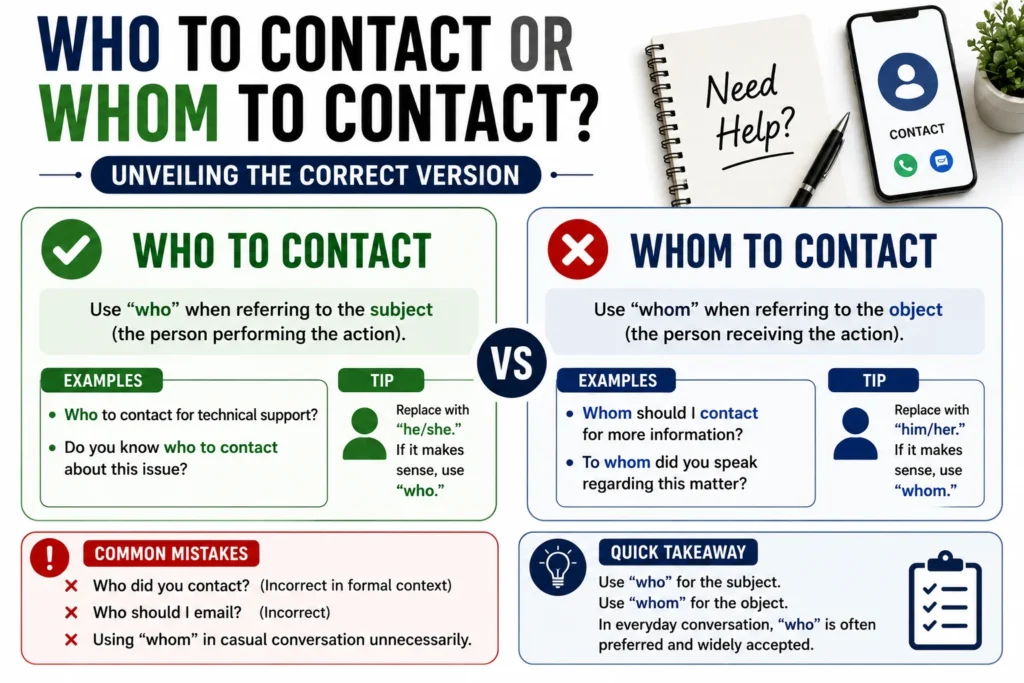
If you’re unsure whether to write “who to contact” or “whom to contact,” you’re dealing with a real grammar distinction that modern English has made less obvious. Both forms appear in standard English, but they carry different grammatical and stylistic signals. “Whom” is traditionally the object form of “who,” while modern English often uses “who” even where older grammar rules would expect “whom.”
Quick Answer: “Who to Contact” or “Whom to Contact”?
For most everyday and professional American English, “who to contact” is the more natural choice. For example, you can write, “Please let me know who to contact about the billing issue.” That wording is clear, familiar, and unlikely to distract the reader.
“Whom to contact” is also grammatically valid. It follows the traditional rule because the person being contacted functions as the object of the verb contact. You might see it in highly formal writing, official correspondence, or prose that deliberately maintains traditional pronoun distinctions. Merriam-Webster describes whom as the objective form of who, while Cambridge notes that it is mainly used in formal styles or writing.
The practical choice is therefore less complicated than it first appears:
| Phrase | Grammar | Tone | Best fit |
| Who to contact | Modern standard usage | Natural and conversational | Everyday, workplace, websites |
| Whom to contact | Traditional object form | Formal and sometimes stiff | Formal or traditional writing |
If your priority is straightforward communication, who to contact will usually serve you well. If your sentence has a strongly formal tone and you want to preserve the traditional subject-object distinction, whom to contact can work perfectly well.
Is “Who to Contact” Correct?
Yes. “Who to contact” is correct in modern English, especially in ordinary speech and writing.
Consider these examples:
- “I don’t know who to contact.”
- “Can you tell me who to contact?”
- “Please ask your manager who to contact.”
- “The website explains who to contact for technical support.”
These sentences sound natural because modern English commonly uses who in positions where traditional grammar might prescribe whom. Merriam-Webster specifically notes that speakers at all educational levels and reputable writers use who as the object of a verb or following a preposition, even though some traditional grammarians still disapprove of that usage.
That point matters because grammar isn’t frozen in time. English speakers don’t communicate by mentally checking every pronoun against an old grammar chart. Instead, usage changes through everyday speech, writing, and repeated patterns. Who has become the normal choice in many constructions that once strongly favored whom.
Is “Whom to Contact” Correct?
Yes. “Whom to contact” is grammatically correct under the traditional subject-object system.
Look at the simple sentence:
You should contact him.
Here, you act, while he receives it. Because him is an object pronoun, its corresponding interrogative form is traditionally whom.
That gives you:
You should contact him.
and:
You should know whom to contact.
The grammar becomes easier to see if you expand the shortened phrase. The underlying idea is roughly:
You should know which person you should contact.
The person being contacted doesn’t act contacting. That person receives the action. Traditional grammar therefore selects whom.
Merriam-Webster defines whom as the objective case of who and explains that it traditionally refers to someone receiving the action of a verb or completing the meaning of a preceding preposition.
The catch is tone. Whom can sound noticeably formal in ordinary American English. Cambridge likewise explains that whom occurs more often in writing and formal styles than in speech.
So the phrase isn’t wrong. It may simply sound more formal than the situation requires.
Who vs. Whom: Understanding the Grammar

The easiest way to understand this issue is to stop thinking about which word “sounds smarter.” Instead, look at the job the pronoun performs.
What Does “Who” Mean?
Who is an interrogative pronoun when it asks about a person. It can also introduce a relative clause.
For example:
- “Who called the office?”
- “Who made the decision?”
- “Who sent the email?”
- “The employee who called left a message.”
In the first three examples, who identifies the person acting. The same principle appears in the relative clause in the fourth example.
You can test the first sentence by replacing who with a known person:
Sarah called the office.
Sarah acts. Therefore:
Who called the office?
That is the traditional subject role.
Cambridge gives the same general distinction: who can function as the subject of a question or relative clause, while whom is the object form used in formal contexts.
What Does “Whom” Mean?
Whom traditionally identifies the person receiving an action or serving as the object of a preposition.
Compare:
Who contacted the manager?
The unknown person performed the contacting.
Now reverse the relationship:
Whom did the manager contact?
The manager acted. The unknown person received it.
That distinction is the heart of the rule.
You don’t need to memorize dozens of grammar terms. You mainly need to ask one question:
Is the unknown person doing the action or receiving it?
If the person does the action, traditional grammar points toward who.
If the person receives the action, traditional grammar points toward whom.
Subject vs. Object Explained Simply
A subject acts or serves as the main participant in a clause.
An object receives the action.
Look at this simple example:
Maria contacted David.
Maria is the subject because she acted.
David is the object because she contacted him.
Turn those names into question words:
Who contacted David?
and:
Maria contacted whom?
The same relationship appears in the phrase that causes so much confusion:
whom to contact
The person you need to contact represents the object of contact.
Here’s another useful comparison:
| Sentence | Subject | Object |
| Sarah contacted John. | Sarah | John |
| Who contacted John? | Who | John |
| Sarah contacted whom? | Sarah | Whom |
| I need to contact John. | I | John |
| I need to know whom to contact. | I | Whom |
Once you see the pattern, the difference becomes much less mysterious.
Why “Whom to Contact” Is Traditionally Correct
The traditional grammar behind “whom to contact” is straightforward. The verb contact describes an action directed toward another person. That person occupies the object position.
Start with:
I will contact him.
Now turn the identity of that person into a question:
Whom will I contact?
The same substitution works with the infinitive:
I need to contact him.
I need to know whom to contact.
The phrase whom to contact therefore follows the traditional object-form rule.
How the Verb “Contact” Affects the Pronoun Choice
The verb itself doesn’t automatically demand whom in every sentence. What matters is the role of the person connected to the verb.
Compare these two sentences:
Who contacted the customer?
Here, the unknown person acted.
Now:
Whom did the customer contact?
Here, the unknown person received the action.
The verb remains contact in both sentences. The grammatical role changes.
That’s why simply memorizing “contact takes whom” isn’t enough. The better approach is to identify who performs the action and who receives it.
This distinction becomes especially useful when the sentence gets longer:
I don’t know whom to contact about the missing payment.
The subject of know is I. The phrase “whom to contact” indicates that I don’t know. Inside that phrase, the person represented by whom is still the object of contact.
Identifying the Object of the Sentence
A quick way to find the object is to ask what or whom the action affects.
Consider:
The supervisor contacted the supplier.
Ask:
Who performed the contacting?
The supervisor.
Whom did the supervisor contact?
The supplier.
Now replace the supplier with the traditional object pronoun:
The supervisor contacted whom.
That gives you the grammatical foundation for:
I need to know whom to contact.
This method works particularly well when you feel tempted to choose whom simply because the sentence looks formal. Grammar should drive the choice first. Tone should come afterward.
The Him/Her Test for Choosing “Whom”
The him/her test is one of the most useful shortcuts for deciding between who and whom.
Replace the unknown person with he/she or him/her.
- He/she → who
- Him/her → whom
For example:
Who called the office?
Try:
He called the office.
That works, so who is the traditional choice.
Now:
Whom should I contact?
Try:
I should contact him.
That works, so whom fits the traditional rule.
Another example:
Who should handle the request?
Try:
She should handle the request.
Therefore, who.
Now:
Whom should we invite?
Try:
We should invite her.
Therefore, whom.
The test isn’t magic, but it is remarkably useful when a sentence makes the grammatical relationship hard to see.
Why Many People Say “Who to Contact”
The traditional rule explains why whom to contact works grammatically. It doesn’t explain why so many people naturally say who to contact.
For that, you have to look at modern English usage.
English has gradually weakened the distinction between subject and object forms of who in many everyday constructions. Whom still exists, but speakers use it much less frequently than who, particularly in ordinary conversation. Cambridge explicitly describes whom as more common in writing and formal styles, while Merriam-Webster notes that it can sound awkward or unnatural in ordinary speech and writing.
That creates a useful distinction:
Traditional grammar asks:
“What is the pronoun’s grammatical role?”
Modern usage often asks:
“What wording sounds natural to the reader?”
In many everyday situations, both questions point toward different answers.
Changes in Modern English Usage
Modern English favors fewer visible case distinctions than older stages of the language. Pronouns still preserve some distinctions—compare I/me, he/him, and she/her—but who/whom has become less sharply divided in everyday usage.
That’s why these sentences can coexist:
Whom did you contact?
Who did you contact?
The first preserves the traditional object form. The second follows common modern usage.
Merriam-Webster notes that who is used by speakers across educational levels and by reputable writers as the object of a verb or following a preposition.
This isn’t simply a matter of people “forgetting grammar.” Languages change because speakers repeatedly choose forms that communicate efficiently. Over time, those patterns become normal.
Common Speech Patterns
Say these aloud:
“Do you know who I should contact?”
“Do you know whom I should contact?”
The second sentence is grammatically traditional, but many American English speakers find the first more relaxed and natural.
Cambridge specifically gives “Can you tell me who I should talk to?” as a normal indirect-question construction.
That pattern matters because the same structure appears in workplace communication, customer service, online help pages, and ordinary conversation.
For example:
“Could you tell me who to contact about my account?”
sounds natural and professional.
By contrast:
“Could you tell me whom to contact about my account?”
is perfectly defensible, but it creates a more formal impression.
Acceptance in Everyday Communication
Modern usage doesn’t mean you should throw grammar rules away. It means you should understand the difference between traditional correctness and accepted contemporary usage.
For everyday American English, who to contact is usually the smoother option.
For a highly formal document, whom to contact may better match the surrounding language.
The strongest writing doesn’t use formal words merely to look intelligent. It chooses language that fits the audience.
That principle becomes especially important in professional communication. A customer trying to solve a problem usually wants a clear instruction, not a grammar puzzle:
Who to contact for billing questions
is direct and easy to scan.
A highly formal administrative document might instead use:
Whom to contact regarding billing inquiries
The second isn’t necessarily better. It simply signals a different register.
That distinction—grammar, usage, tone, and audience—is the key to making the right choice without overthinking it.
Why “Whom to Contact” Is Traditionally Correct
The traditional grammar behind “whom to contact” is straightforward once you identify the person receiving the action. In the phrase, contact is a transitive verb, so it normally takes an object: you contact someone. Traditional grammar therefore uses whom because whom serves as the object form of who. Merriam-Webster and the MLA Style Center both describe this subject-object distinction.
Consider the basic sentence:
You should contact him.
Here, you act, and he receives it. Replace him with an interrogative pronoun, and you get:
Whom should you contact?
The same logic applies when the question becomes an infinitive phrase:
You should know whom to contact.
The grammar hasn’t changed simply because the sentence has become longer. The person still receives the action of contact.
How the Verb “Contact” Affects the Pronoun Choice
The verb contact doesn’t automatically force you to use whom. Instead, look at the grammatical role of the person associated with the verb.
Compare these sentences:
| Sentence | Person’s role | Traditional choice |
| Who contacted the manager? | Performs the action | Who |
| The manager contacted whom? | Receives the action | Whom |
| I need to know whom to contact. | Receives the action | Whom |
| Who should contact the manager? | Performs the action | Who |
That distinction prevents a common mistake: assuming that the word contact itself determines the pronoun.
For example:
Who contacted the customer?
The unknown person did the contacting. Therefore, who has the subject role.
Now change the sentence:
Whom did the customer contact?
The customer acted. The unknown person received it. Traditional grammar therefore selects whom.
The same principle works in:
I don’t know whom to contact about the application.
The person you need to contact remains the object of contact, even though the phrase appears inside a larger sentence.
Identifying the Object of the Sentence
A reliable way to understand “whom to contact” is to temporarily replace the unknown person with a normal personal pronoun.
Start with:
I need to contact Sarah.
Sarah receives the action.
Now replace Sarah with her:
I need to contact her.
Because her is an object pronoun, the traditional interrogative equivalent is whom:
I need to know whom to contact.
This approach often works better than memorizing a rule in isolation. It lets you see what the sentence is actually doing.
The MLA Style Center recommends a similar strategy: when the choice feels difficult, rearrange the relevant part of the sentence to reveal whether the pronoun acts as the subject or object.
For instance:
The person _____ we should contact can help.
Instead of staring at the blank, rearrange the clause:
We should contact _____.
The unknown person receives the action, so traditional grammar gives:
The person whom we should contact can help.
This kind of rearrangement becomes particularly useful when several clauses appear in the same sentence.
The Him/Her Test for Choosing “Whom”
The classic him/her test gives you a fast shortcut.
Replace the unknown person with he/she or him/her:
- He/she → who
- Him/her → whom
For example:
Who called the office?
Try:
He called the office.
That works, so who fits.
Now:
Whom should I contact?
Try:
I should contact him.
Again, the replacement works, so traditional grammar supports whom.
Try another pair:
Who submitted the report?
→ She submitted the report.
Therefore: who.
Whom did the director hire?
→ The director hired her.
Therefore: whom.
This test also helps with who to contact:
I don’t know who to contact.
Replace the unknown person:
I don’t know whether to contact him.
That replacement reveals why traditional grammar would select whom. Yet this is exactly where modern English complicates the picture: many speakers naturally use who even though the traditional object-form analysis points to whom.
Why Many People Say “Who to Contact”
If whom to contact follows the traditional grammatical rule, why does who to contact sound so normal?
The answer lies in modern English usage.
English speakers increasingly use who in object positions, especially in ordinary conversation and informal or neutral writing. Merriam-Webster explicitly recognizes this widespread usage and notes that reputable writers and speakers use who as the object of a verb or after a preposition.
That means you can encounter both:
I don’t know whom to contact.
and:
I don’t know who to contact.
The first preserves the traditional case distinction. The second reflects the way many people naturally speak and write today.
This isn’t simply a contest between “correct” and “incorrect.” It is a case where grammar, usage, register, and audience overlap.
Changes in Modern English Usage
The distinction between who and whom has weakened over time.
English still has clear subject and object forms for several personal pronouns:
- I/me
- he/him
- she/her
- they/them
- we/us
The distinction between who and whom, however, has become much less prominent in everyday language.
Merriam-Webster describes whom as the objective form of who, but also points out that it now has a distinctly formal quality and often feels awkward in ordinary speech and writing.
Cambridge takes a similar position. It identifies whom as the object form but notes that it appears mainly in formal styles and writing and occurs less often in speech.
That explains why this sounds completely ordinary:
Can you tell me who to contact?
Yet this can sound noticeably more formal:
Can you tell me whom to contact?
Neither sentence creates a communication problem. The difference lies largely in register.
Common Speech Patterns
Natural speech strongly favors familiar constructions.
Imagine asking a coworker for help:
“Do you know who I should contact about this?”
That sentence sounds effortless.
Now imagine saying:
“Do you know whom I should contact about this?”
It’s grammatical, but the speaker may sound more formal than necessary.
The same pattern appears in direct questions:
Who should I contact?
versus:
Whom should I contact?
Traditional grammar favors the second because whom functions as the object of contact. Modern English commonly uses the first. Cambridge specifically notes that whom is formal and that who is the normal choice in less formal speech.
This distinction matters for practical writing. If you’re creating a help page, sending an ordinary workplace email, or asking a colleague for assistance, who usually keeps the sentence smooth.
Acceptance in Everyday Communication
Modern usage has made who a practical default in many situations.
That doesn’t mean writers should ignore grammar. It means that grammar includes more than a traditional rulebook. Actual standard usage matters too.
Merriam-Webster’s usage guidance is especially useful here: it acknowledges the traditional distinction but explains that who is standard in many constructions where whom would be technically traditional.
So consider these two sentences:
Please let me know who to contact about the account.
Please let me know whom to contact about the account.
The first sounds natural to most readers.
The second sounds more formal. It might suit a legal notice, highly formal letter, or traditional institutional style.
The key isn’t to assume that one form wins in every situation. Instead, match the wording to the audience and purpose.
Who to Contact vs. Whom to Contact in Formal Writing
Formal writing is where the distinction becomes especially useful.
You may encounter whom more often in academic, legal, administrative, and highly polished professional prose. Cambridge specifically notes that whom occurs more commonly in writing than speech and is used when the person functions as the object of a verb.
Still, formal writing doesn’t require you to use whom every time an object appears.
Clarity remains important.
Consider:
Please contact the department to determine whom to contact regarding your application.
This is grammatically traditional, but it has a formal, institutional tone.
A simpler alternative is:
Please contact the department to determine who to contact regarding your application.
The second version is easier for many readers to process. It doesn’t sacrifice the meaning.
Formal Letters and Emails
In a formal letter, whom can work naturally when the rest of the language has the same level of formality.
For example:
Please advise whom to contact regarding the outstanding documentation.
The phrase fits because advise, regarding, and outstanding documentation already create a formal register.
But if the email is otherwise conversational, whom can feel out of place:
Hi Sarah, could you let me know whom to contact about the schedule?
That isn’t wrong. It simply sounds more formal than the opening.
A more natural workplace version would be:
Hi Sarah, could you let me know who to contact about the schedule?
The lesson is simple: don’t judge the pronoun separately from the sentence around it.
Professional Documents
Professional documents often need consistency more than formality for its own sake.
A policy might say:
Employees should ask their supervisor who to contact if they experience a system problem.
That’s clear and professional.
A more formal policy could say:
Employees should ask their supervisor whom to contact if they experience a system problem.
Both versions communicate the same instruction. The second simply preserves the traditional object form.
If a document uses whom throughout its formal constructions, switching suddenly to casual wording may create an inconsistent tone. Conversely, a plain-language document can sound unnecessarily stiff if it inserts whom merely to appear authoritative.
Legal and Academic Contexts
Legal and academic writing can preserve grammatical distinctions more deliberately than everyday communication.
For example:
The committee shall determine whom to contact for additional documentation.
The formal construction may fit the document’s overall style.
However, legal or academic writing does not magically make whom mandatory. Writers still need to consider readability.
A university webpage aimed at thousands of students might reasonably say:
If you have questions, contact the office to find out who to contact.
A formal regulation might use:
Applicants shall identify whom to contact for further information.
The difference isn’t about one being “educated” and the other being “uneducated.” It is about register, audience, and communicative purpose.
When to Use “Whom to Contact”
Whom to contact makes the most sense when you intentionally want the traditional object form and the surrounding context supports a formal tone.
Good situations include:
- Formal correspondence
- Traditional business writing
- Legal or administrative documents
- Academic prose
- Formal institutional notices
- Writing that consistently maintains traditional pronoun distinctions
For example:
Please confirm whom to contact before submitting the final application.
That sentence is grammatically traditional and appropriately formal.
Another example:
The department will provide instructions regarding whom to contact for technical assistance.
Again, whom fits the formal register.
The important point is that you don’t need to use whom simply because you think it makes your writing sound more intelligent. If the sentence becomes stiff, the extra formality may work against you.
When to Use “Who to Contact”
For most everyday communication, who to contact is the easier choice.
It works naturally in:
- Workplace emails
- Customer-service messages
- Help-center pages
- Website copy
- Internal communications
- Conversations
- General informational writing
Consider a customer-support page:
Not sure who to contact about your order? Start with our support team.
That sounds direct and welcoming.
Now compare:
Not sure whom to contact about your order?
The second version is grammatically traditional, but it may sound unusually formal for customer-facing copy.
The same principle applies to workplace communication:
Can you tell me who to contact about the payroll issue?
This sounds natural without becoming casual.
Website and Marketing Copy
Web writing benefits from immediate clarity. Readers usually scan headings and instructions rather than studying each sentence.
That’s one reason why ” who to contact often works better on a webpage.
For example:
Who to Contact About Your Account
is a natural heading.
A company could technically write:
Whom to Contact About Your Account
but the second heading may feel more formal than necessary.
When users visit a contact page, the priority is usually simple navigation:
Who to contact → what they handle → how to reach them.
That structure reduces friction.
Customer Service Messages
Customer-service communication should generally sound helpful rather than ceremonial.
Compare:
If you’re having trouble with your order, here’s who to contact.
with:
If you’re having trouble with your order, here’s whom to contact.
The first feels more conversational and accessible.
That’s particularly useful when your audience includes people with different levels of English proficiency. Plain language can communicate the same information without adding a grammatical hurdle.
“Who Should I Contact?” or “Whom Should I Contact?”
This question deserves separate attention because it is one of the most common variations.
Traditional grammar favors:
Whom should I contact?
Why? Rearrange the sentence:
I should contact whom.
The unknown person functions as the object of contact.
Yet modern English commonly uses:
Who should I contact?
Merriam-Webster explicitly recognizes this kind of object use of who as standard contemporary usage outside highly formal contexts.
Which Is More Common?
In ordinary American English, who should I contact? is generally the more natural construction. You might use it when:You need help from another department.You don’t know which employee handles a request.You want someone to direct you to the correct person.
Examples include:
- “Who should I contact about my invoice?”
- “Who should I contact if the password doesn’t work?”
- “Who should I contact about admissions?”
- “Who should I contact for technical support?”
These sentences sound normal in conversation and professional writing.
Which Should You Use?
Use ” Who should I contact? when you want a natural, direct question.
Choose ” Whom should I contact? when the context is deliberately formal or when maintaining traditional grammatical distinctions matters to your style.
Neither choice needs to become a test of intelligence or education. The strongest option is the one that communicates your meaning naturally to the intended reader.
“Who Can I Contact?” vs. “Whom Can I Contact?”
The same principle applies when can appears before contact.
Traditional grammar gives:
Whom can I contact?
Modern usage commonly gives:
Who can I contact?
The underlying structure is:
I can contact him.
Therefore, traditional grammar identifies the unknown person as an object.
But everyday English frequently uses who in this position. Merriam-Webster notes that who is used as an object by speakers at all educational levels and by many reputable writers.
Understanding the Sentence Structure
Look at the roles:
I can contact Sarah.
- I = subject
- can = modal verb
- contact = main verb
- Sarah = object
Replace Sarah with the traditional interrogative:
Whom can I contact?
That is the formal grammatical analysis.
Now use the modern everyday form:
Who can I contact?
This is the version most people will find more conversational.
Formal and Informal Alternatives
| More conversational | More formal/traditional |
| Who can I contact? | Whom can I contact? |
| Who should I contact? | Whom should I contact? |
| Who did you contact? | Whom did you contact? |
| Who are you speaking to? | Whom are you speaking to? |
| Who should I send this to? | To whom should I send this? |
The left column generally sounds more natural in contemporary American English. The right column preserves traditional grammatical distinctions and can sound more formal.
Who to Contact or Whom to Contact: The Practical Rule
If you’re writing for a general American audience, who to contact is usually the safest natural choice.
If you’re writing in a deliberately formal register, whom to contact remains grammatically sound.
A useful decision framework looks like this:
| Ask yourself | If the answer is yes |
| Is this ordinary conversation? | Prefer who |
| Is this a normal workplace email? | Usually prefer who |
| Is this customer-facing copy? | Usually prefer who |
| Is the document highly formal? | Consider whom |
| Is the pronoun clearly an object? | Traditional grammar favors whom |
| Does a preposition directly precede it? | Whom is the traditional formal choice |
| Would him/her fit the sentence? | Traditional grammar points to whom |
| Would he/she fit? | Traditional grammar points to whom |
The most useful takeaway is that “who to contact” and “whom to contact” aren’t simply a correct-versus-incorrect pair. Traditional grammar favors whom because the person receives the action of contact, while modern English widely accepts who in that position. Merriam-Webster and Cambridge both recognize this gap between traditional grammar and contemporary usage.
That distinction becomes even more important when who or whom appears after a preposition, inside a relative clause, or within a longer sentence. In those cases, looking only at the word immediately before the pronoun can lead you to the wrong answer.
Who vs. Whom: Common Sentence Patterns in Real Life
The who vs. whom question becomes much easier when you stop treating it as an isolated grammar exercise. In real writing, the choice depends on the sentence structure, the level of formality, and what sounds natural to your reader. Who to contact is especially common in modern American English, while whom to contact keeps the traditional object form.
“Who Do I Contact?” or “Whom Do I Contact?”
Both versions appear in English.
Who do I contact about my account?
Whom do I contact about my account?
Traditional grammar favors whom because the person receives the action of contact. However, modern English commonly uses who in this position. Merriam-Webster notes that who is widely used as an object in contemporary English, including by reputable writers.
For most everyday communication, “Who do I contact?” sounds more natural.
“Contact Who?” or “Contact Whom?”
This construction is less common as a standalone question, but the same grammatical principle applies.
You should contact whom?
Traditional grammar identifies whom as the object.
In ordinary speech, however, a speaker would usually restructure the sentence:
Who should I contact?
That version flows more naturally and avoids the awkwardness of putting whom at the end of an informal question.
This illustrates an important writing technique: you don’t always need to choose between two pronouns. Sometimes you can restructure the sentence to make the wording clearer.
“To Who?” or “To Whom?”
Here, traditional grammar strongly favors to whom because whom follows the preposition to.
To whom should I send the document?
This is formal and grammatically traditional.
A common modern alternative is:
Who should I send the document to?
The second sentence uses a stranded preposition, meaning to appears at the end rather than directly before its object.
Both constructions communicate the same idea. The first sounds more formal. The second sounds more conversational.
“For Who?” or “For Whom?”
The traditional form is:
For whom is this application intended?
In ordinary conversation, many speakers would instead say:
Who is this application for?
Again, the difference is largely one of grammatical tradition and register.
The practical lesson is straightforward: whom remains especially useful after explicit prepositions in formal writing, while who frequently appears in natural conversational alternatives.
When Prepositions Change the Picture
Prepositions make who vs. whom slightly more complicated because traditional grammar treats the object of a preposition as whom.
Consider:
With whom did you speak?
Traditional grammar considers whom the object of with.
But everyday English usually prefers:
Who did you speak with?
The meaning remains unchanged.
Cambridge explains that whom is used as the object of a verb or preposition, particularly in formal styles, while who is much more common in ordinary speech.
Formal Prepositional Constructions
You are more likely to encounter whom when a preposition comes immediately before it:
- to whom
- for whom
- with whom
- by whom
- from whom
- about whom
Examples:
To whom should I address the letter?
With whom did you discuss the proposal?
For whom was the report prepared?
By whom was the decision made?
These forms aren’t mistakes or outdated curiosities. They remain part of standard formal English.
Conversational Alternatives
Everyday English often moves the preposition to the end: Who should I address the letter to?Who did you discuss the proposal with?Who was the report prepared for?Who did you receive the information from?
These sentences sound natural to many American English speakers.
For most general communication, there’s little reason to force a formal prepositional construction when a simpler version communicates the same information.
When to Use “Whom to Contact”
Whom to contact works best when traditional grammar and a formal register fit the situation.
Formal Business Writing
A formal business letter might say:
Please advise us whom to contact regarding the outstanding documentation.
This wording is grammatically traditional and fits the formal tone of the sentence.
However, a modern business email could simply say:
Please let us know who to contact about the missing documents.
The second version isn’t careless. It is direct, readable, and appropriate for most workplace communication.
Professional Documents
Official documents often use more formal constructions because they need a consistent institutional tone.
For example:
Applicants should contact the department to determine whom to contact for additional assistance.
This works when the document consistently uses formal language.
Yet a plain-language version may be easier:
Applicants should contact the department to find out who to contact for additional help.
The choice should serve the reader rather than the writer’s desire to sound formal.
Legal and Academic Contexts
Whom can appear naturally in legal and academic writing because these fields often preserve traditional grammatical forms.
For example:
The researcher identified the participant whom the committee had selected.
Here, whom clearly functions as the object of selected.
Similarly:
The policy identifies whom to contact when a dispute arises.
The formal construction fits the institutional setting.
Still, neither lawyers nor academics must use whom whenever possible. A document can remain professional while using who where modern usage makes the sentence more natural.
When to Use “Who to Contact”
For most general audiences, who to contact is a strong practical choice.
It works especially well in:
- Workplace emails
- Help-center articles
- Customer-service pages
- Website headings
- Internal company messages
- General instructions
- Everyday conversations
- Informal correspondence
A website might say:
Who to Contact for Technical Support
That heading immediately tells the reader what information they will find.
A customer-service message could say:
If your order hasn’t arrived, here’s who to contact.
An employee handbook could say:
Ask your supervisor who to contact if you need assistance.
All three examples sound professional without relying on formal pronoun forms.
Casual Conversations
In conversation, who is overwhelmingly the more comfortable choice for many speakers.
You might naturally ask:
“Who should I contact?”
“Who can I contact about this?”
“Do you know who to contact?”
“Who do I contact if there’s a problem?”
Using whom in each situation could make the conversation sound unusually formal.
That doesn’t make whom wrong. It simply means that spoken English often favors the shorter, more familiar form.
Informal Emails and Messages
Informal digital communication generally benefits from natural wording.
For example:
Hi Mike, do you know who to contact about the schedule?
This sounds normal in a workplace chat or email.
Compare:
Hi Mike, do you know whom to contact about the schedule?
The second version is grammatical, but it may sound more formal than the relationship requires.
When the purpose of a message is simply to get information, who usually keeps the exchange moving?
Website and Marketing Copy
Website copy should prioritize clarity because visitors often scan rather than read every word.
A heading such as:
Who to Contact About Billing
is instantly understandable.
A heading such as:
Whom to Contact About Billing
isn’t wrong, but it may feel formal and less conversational.
For customer-facing content, the simpler option usually works better because readers don’t need to decode the grammar before understanding the instruction.
Which Version Sounds More Natural Today?
For modern American English, who to contact generally sounds more natural than whom to contact in ordinary communication.
That doesn’t mean every speaker makes the same choice. Some writers consciously maintain the traditional distinction. Others use whom in formal contexts but switch to who in conversation.
The important point is that language has more than one register.
Native Speaker Preferences
Native speakers often make these choices intuitively.
A person might write:
I don’t know who to contact.
Then use:
To whom should the letter be addressed?
The apparent inconsistency isn’t necessarily a problem. The first sentence belongs to an ordinary conversational register. The second deliberately uses a formal construction.
In other words, speakers can understand the traditional rule while choosing not to apply it everywhere.
Modern Style Guide Recommendations
Modern editorial guidance generally recognizes both the traditional rule and contemporary usage.
The MLA Style Center explains that who traditionally functions as a subject and whom as an object, but it also recognizes that contemporary English frequently uses who where traditional grammar would call for whom.
Merriam-Webster similarly distinguishes the traditional objective role of whom from the widespread modern use of who as an object.
This gives writers a more realistic framework than the simple rule:
“Always use whom for objects.”
That rule describes traditional grammar, but it doesn’t fully describe modern American English.
Traditional vs. Modern Preference
| Traditional preference | Modern common preference |
| Whom should I contact? | Who should I contact? |
| Whom did you contact? | Who did you contact? |
| Whom to contact | Who to contact |
| To whom should I write? | Who should I write to? |
| With whom did you speak? | Who did you speak with? |
| For whom is this intended? | Who is this intended for? |
The traditional column isn’t obsolete. The modern column isn’t grammatically careless.
Both reflect real patterns in English.
Balancing Correctness and Readability
Good writing balances grammatical accuracy, natural usage, and reader expectations.
Suppose you’re writing a public support article. You could write:
Customers should determine whom to contact for account assistance.
That’s grammatically traditional, but:
Customers should find out who to contact for account help.
is easier and more conversational.
Now imagine a formal legal document. The first version may fit the surrounding register better.
The right question isn’t:
“Which word sounds more sophisticated?”
Ask instead:
“Which version communicates the intended meaning naturally for this audience?”
Common Mistakes People Make With Who and Whom
The biggest mistakes often happen when writers learn one rule and apply it everywhere.
Using “Whom” as a Subject
One common error occurs when writers assume whom is simply a more formal version of who.
It isn’t.
For example:
Whom called you yesterday?
Traditional grammar considers this incorrect because the unknown person acts calling.
The correct traditional form is:
Who called you yesterday?
Use the he/him test:
He called me.
You wouldn’t say:
Him called me.
Therefore, who is the traditional choice.
Avoiding Overcorrection
Overcorrection happens when a writer becomes so concerned about using whom that they insert it where it doesn’t belong.
For example:
Whom is responsible for the report?
That sounds formal, but it doesn’t make the grammar correct.
The correct form is:
Who is responsible for the report?
The unknown person performs the role of the subject.
This is why learning the actual structure is more valuable than memorizing “whom sounds formal.”
Misunderstanding Complex Sentences
Long sentences can hide the pronoun’s grammatical role.
Consider:
The manager asked the employee to explain who had approved the request.
The presence of manager, employee, explain, and approved can make the sentence look complicated. But isolate the relevant clause:
Who had approved the request?
The unknown person performed approved, so who works.
Now compare:
The manager asked the employee to identify whom the committee had approved.
Inside the relevant clause:
The committee had approved whom.
The unknown person receives the action, so traditional grammar uses whom.
When a sentence feels confusing, isolate the smallest clause containing the pronoun and its verb.
Common Errors Table
| Incorrect or awkward approach | Better approach | Why |
| Using whom because it sounds formal | Check the pronoun’s role | Formality doesn’t determine grammar |
| Using who in every formal construction | Consider whom when appropriate | Traditional object forms still have a place |
| Treating whom as a universal replacement for who | Identify subject vs. object | The two forms have different traditional roles |
| Ignoring the audience | Match the register | Natural wording improves readability |
| Assuming modern who usage is automatically incorrect | Recognize contemporary standard usage | English usage has changed |
Easy Tricks to Remember the Difference
The fastest way to make a decision is to use a substitution test.
The He/Him Rule
Use he to test for who.
Use him to test for whom.
For example:
Who is at the door?
→ He is at the door.
Therefore: who.
Whom did you invite?
→ I invited him.
Therefore: whom.
The She/Her Rule
The same method works with she and her.
Who submitted the form?
→ She submitted the form.
Therefore: who.
Whom did the committee select?
→ The committee selected her.
Therefore: whom.
This works because English personal pronouns make the subject-object distinction obvious.
A Simple Three-Step Check
When you’re unsure, use this quick process: Step 1: Find the relevant verb or preposition.Step 2: Determine whether the unknown person performs or receives the action.Step 3: Replace the person with he/she or him/her.
If he/she works, traditional grammar points toward who.
If him/her works, traditional grammar points toward whom.
Then make one final check: Does the sentence need a formal register?
If not, modern who may be the more natural choice.
Memory Chart
| Test word | Pronoun |
| He | Who |
| She | Who |
| Him | Whom |
| Her | Whom |
You can remember it as:
Who = he/she
Whom = him/her
The rhyme “who/he, whom/him” also helps many learners remember the distinction.
Practical Case Studies: Choosing Between Who and Whom
Case Study: Corporate Website
Imagine a company creating a contact page.
Option A:
Who to Contact for Sales Questions
Option B:
Whom to Contact for Sales Questions
Both are grammatically understandable. But Option A is usually more approachable for a broad audience.
A website visitor wants to locate the right department quickly. The phrase who to contact doesn’t interrupt that task with an unusually formal construction.
Case Study: Academic Handbook
Now consider an academic handbook:
Students should consult the department office to determine whom to contact regarding formal appeals.
Here, whom can fit because the document uses an institutional and formal register.
But this would also work:
Students should consult the department office to find out who to contact regarding formal appeals.
The second version is easier to read. The first preserves traditional grammar more strictly.
Case Study: Internal Team Communication
A manager sends this message:
Does anyone know who to contact about the software outage?
That is the natural workplace choice.
Using:
Does anyone know whom to contact about the software outage?
is grammatically traditional but sounds more formal than a quick internal message usually needs.
Case Study: Customer Support
A support page might state:
Not sure who to contact? Choose the department that matches your question.
This wording is direct, friendly, and easy to scan.
Replacing it with:
Not sure whom to contact?
would preserve the traditional object form but create a noticeably more formal voice.
For customer-facing writing, natural language usually wins.
Quick Reference Guide for Everyday Use
When you need an answer quickly, remember these patterns:
| Situation | Recommended wording |
| Everyday conversation | Who to contact |
| Workplace email | Who to contact |
| Customer-service page | Who to contact |
| Website heading | Who to contact |
| Informal message | Who to contact |
| Highly formal document | Whom to contact may fit |
| Formal phrase after a preposition | To whom, for whom, with whom |
| Traditional grammar exercise | Follow the subject/object rule |
The distinction becomes much easier once you separate grammar from style.
Traditional grammar says the person being contacted is the object, so whom to contact is the traditional form.
Modern American usage frequently uses who in that same construction, making who to contact natural and widely accepted.
Neither fact cancels out the other. They describe different parts of how English works today.
What Modern Grammar Experts Say About Who and Whom
The debate over who and whom often looks like a simple grammar rule, but modern usage tells a more nuanced story. Traditional grammar clearly distinguishes the two forms. Who serves as the subject form, while whom serves as the object form. At the same time, contemporary English increasingly uses who in object positions, particularly when speakers want a natural and conversational tone. Merriam-Webster recognizes this widespread modern usage, while the MLA Style Center explains the traditional distinction and the role of contemporary usage.
Traditional Grammar View
Traditional grammar treats who and whom as different cases of the same interrogative pronoun.
The basic pattern looks like this:
- Who = subject
- Whom = object
- Who = equivalent to he/she
- Whom = equivalent to him/her
Consider:
Who contacted the office?
The unknown person acts.
Now compare:
Whom did the office contact?
The unknown person receives the action.
This traditional distinction is still useful because it explains why whom to contact is grammatically sound.
Take the phrase apart:
to contact him
becomes:
whom to contact
The person remains the object of contact.
Traditional grammar also favors whom after a preposition:
To whom should I send the application?
With whom did you speak?
For whom was the report prepared?
This framework hasn’t disappeared. It remains especially visible in formal writing and careful editing.
Contemporary Usage View
Contemporary English has weakened the distinction between who and whom.
Merriam-Webster explains that who is now widely used as an object, including in constructions where traditional grammar would call for whom. It also notes that whom is increasingly associated with formal or sometimes stilted language. (merriam-webster.com)
That is why these two sentences can both appear in edited English:
I don’t know who to contact.
I don’t know whom to contact.
The first follows common modern usage.
The second follows the traditional object-form rule.
Neither sentence creates ambiguity. The reader understands the intended meaning immediately.
This is an important point for writers: modern usage doesn’t erase traditional grammar. Instead, it gives writers more than one acceptable option depending on context.
Current Writing Standards
Modern professional writing increasingly values clarity, accessibility, and natural expression alongside grammatical correctness.
That doesn’t mean formal grammar has become irrelevant. It means writers need to consider the entire sentence rather than applying a single rule mechanically.
For example:
Please let me know who to contact regarding your application.
This sounds professional, direct, and natural.
You could also write:
Please let me know whom to contact regarding your application.
The second version is traditionally grammatical, but it has a more formal tone.
The choice becomes even clearer when you compare surrounding language:
Hey, could you tell me who to contact about this?
Using whom here would create a noticeable mismatch:
Hey, could you tell me whom to contact about this?
Nothing is grammatically broken. The register simply feels uneven.
By contrast:
Please advise whom to contact regarding the matter described above.
Sounds consistent because the entire sentence already uses formal language.
Expert Insight
The most useful way to approach this issue is to separate three questions:
Is it grammatically traditional?
Is it accepted in modern English?
Does it suit the audience?
For whom to contact, the answer to the first question is clearly yes.
For whom to contact, the answer to the second question is also yes.
The third question determines which version will usually produce better writing.
This approach prevents two opposite mistakes. One mistake is declaring who to contact wrong simply because traditional grammar prefers whom. The other is claiming that whom has become completely incorrect. Neither position accurately reflects contemporary English usage.
Frequently Confused Variations of Who and Whom
The same grammatical issue appears in several related phrases. Learning these patterns helps you make consistent choices instead of memorizing one expression.
Who Do I Contact or Whom Do I Contact?
Traditional grammar favors:
Whom do I contact?
Modern English commonly uses:
Who do I contact?
A more polished modern version is:
Who should I contact?
The last option is especially useful because it sounds natural while avoiding the abrupt structure of ” Who do I contact.
For formal writing, however:
Whom should I contact?
remains perfectly valid.
Contact Who or Contact Whom?
The traditional object form is:
Contact whom?
But most writers wouldn’t choose that structure in ordinary communication.
Instead, they would normally write:
Who should I contact?
or:
Who do I need to contact?
This illustrates a broader point: sometimes the best solution isn’t choosing between who and whom. You can simply rebuild the sentence.
That technique often makes writing more natural without changing its meaning.
To Who or To Whom?
Traditional formal English uses:
To whom should I send the letter?
Modern conversational English often uses:
Who should I send the letter to?
The first construction keeps the preposition before the object. The second leaves the preposition at the end.
Neither creates a different meaning. For a formal letter, to whom may fit the register.For an everyday email, who … to is usually more relaxed.For Who or For Whom?
The traditional form is:
For whom is this document intended?
A natural conversational alternative is:
Who is this document for?
The second sentence is usually easier to process because it follows ordinary spoken English.
Again, whom hasn’t become meaningless. It simply appears less often in everyday constructions.
Why Some Variations Survive Better Than Others
Not every use of whom has declined at the same rate.
Certain expressions remain strongly associated with formal English:
- to whom
- for whom
- with whom
- by whom
- from whom
These phrases often appear in official, academic, legal, and institutional writing.
Other constructions have shifted more strongly toward who:
- who did you contact
- who should I contact
- who can I contact
- who to contact
The reason is partly structural and partly stylistic. English speakers often avoid forms that feel marked or unusually formal in conversation.
Practical Case Studies: Choosing Between Who and Whom
Looking at realistic situations makes the distinction easier than studying isolated rules.
Case Study: Corporate Website
Imagine a company’s support page with a section directing visitors to different departments.
One heading could say:
Who to Contact for Sales Questions
Another could say:
Whom to Contact for Sales Questions
Both communicate the intended meaning.
For a general corporate website, who to contact will usually sound more approachable. Website visitors don’t need a formal grammatical construction to understand where they should go.
A clear page might organize the information like this:
| Need | Who to contact |
| New sales inquiry | Sales team |
| Existing order | Customer support |
| Billing question | Accounts department |
| Technical problem | Technical support |
| Partnership request | Business development |
Here, the heading’s job is navigation. Who to contact performs that job immediately.
Case Study: Academic Handbook
Now consider a university handbook containing formal administrative instructions:
Students should determine whom to contact regarding academic appeals.
This wording fits a formal institutional document.
However, a student-facing webpage might say:
Students can find out who to contact about an academic appeal.
The second version is more conversational and may be easier for a broad student audience.
The underlying meaning remains identical.
Case Study: Internal Team Communication
Imagine a manager posting a message in an internal team channel:
Does anyone know who to contact about the software issue?
That’s natural workplace English.
A manager could write:
Does anyone know whom to contact about the software issue?
The grammar is traditionally sound, but the wording feels more formal than a quick team message normally requires.
This is a good example of why tone matters alongside grammar.
Case Study: Customer Support Message
Suppose a company sends an automated message:
Not sure who to contact about your order? Our support team can help.
The wording feels friendly and direct.
A more formal alternative would be:
Unsure whom to contact regarding your order? Please consult our support department.
The second version sounds institutional. The first sounds customer-focused.
For public-facing communication, the natural version will often be the stronger choice.
Common Sentence Patterns You Can Use
Knowing the most common patterns makes future decisions much faster.
| Meaning | Natural modern version | Traditional/formal version |
| Ask about the right person | Who should I contact? | Whom should I contact? |
| Ask who handles an issue | Who can I contact? | Whom can I contact? |
| Ask indirectly | Do you know who to contact? | Do you know whom to contact? |
| Ask about a department | Who do I contact? | Whom do I contact? |
| Ask after a preposition | Who should I send it to? | To whom should I send it? |
| Ask who received an action | Who did you contact? | Whom did you contact? |
| Ask who performed an action | Who contacted you? | Who contacted you? |
The final row is important because traditional and modern usage agree there. Who contacted you? uses who because the unknown person acts.
That’s a useful reminder that modern English hasn’t eliminated the subject-object distinction everywhere. It has mainly weakened the need to mark the object with whom.
How to Avoid Overcorrecting Your Writing
One of the easiest ways to make writing sound unnatural is to insert whom wherever possible.
Suppose you’re writing:
Please let me know whom to contact if you have questions.
That’s fine.
But if you then write:
Whom can answer your questions?
you’ve created a grammatical problem.
The correct traditional form is:
Who can answer your questions?
Why?
Because who performs the action represented by can answer.
The he/him test makes this obvious:
He can answer your questions.
You wouldn’t say:
Him can answer your questions.
Therefore, who is the correct traditional choice?
This is why “whom sounds formal” is a poor rule. Formality can’t turn an object pronoun into a subject pronoun.
A Better Three-Step Decision Method
When you’re unsure, don’t stare at the sentence and guess. Use a repeatable process.
Find the Relevant Verb
Look for the verb connected to the unknown person.
In:
Who contacted the client?
The relevant verb is contacted.
In:
Whom did the client contact?
The same verb appears, but the grammatical relationship changes.
Identify the Action’s Doer
Ask:
Who acted?
If the unknown person performs it, traditional grammar calls for who.
Who contacted the client?
Identify the Action’s Receiver
Ask:
Who received the action?
If the unknown person receives it, traditional grammar calls for whom.
The client contacted whom?
Then apply the modern usage check:
Would “who” sound more natural for this audience?
If yes, who may be the better modern choice.
A Quick Reference Guide for Everyday Use
If you need a fast answer while writing, keep these patterns in mind.
Use “Who” When the Person Is the Subject
Examples: Who called?Who sent the message?Who approved the request?Who should handle this?
The person acts.
Use “Whom” in Traditional Object Positions
Examples: Whom did you call?Whom did they invite?Whom should I contact?Whom are you asking?
The person receives the action.
Prefer “Who” in Most Everyday Communication
Examples:
Who should I contact?
Who can I contact?
Do you know who to contact?
Can you tell me who to ask?
These forms generally sound natural in contemporary American English.
Consider “Whom” for Formal Register
Examples:
To whom should I address the correspondence?
Please advise whom to contact.
With whom did you discuss the matter?
For whom was the report prepared?
These forms fit a formal or traditional register more comfortably.
A Compact Who vs. Whom Decision Chart
| If you can replace it with… | Traditional choice |
| he | who |
| she | who |
| him | whom |
| her | whom |
For example:
Who should I contact?
Think:
I should contact him.
Traditional grammar therefore gives whom.
But modern usage permits:
Who should I contact?
That distinction is the entire issue in miniature.
Who to Contact or Whom to Contact in Different Writing Situations
Your audience can change which version works best.
| Situation | Better natural choice | Formal alternative |
| Text message | Who to contact | — |
| Everyday conversation | Who to contact | — |
| Workplace email | Who to contact | Whom to contact |
| Customer-service page | Who to contact | Whom to contact |
| Website heading | Who to contact | Whom to contact |
| Academic handbook | Who to contact | Whom to contact |
| Formal letter | Who to contact | Whom to contact |
| Legal document | Depends on style | Whom to contact may fit |
| Highly traditional prose | — | Whom to contact |
This isn’t a rigid ranking. A formal business letter can absolutely use who, and a formal document can use whom. The surrounding language and editorial style should guide the final decision.
What to Choose in Professional Writing
Professional writing often sits between casual conversation and highly formal prose.
That’s why who to contact is such a useful default.
Consider:
Please let me know who to contact regarding the invoice.
It sounds professional without sounding ceremonial.
Now compare:
Please let me know whom to contact regarding the invoice.
This version is also professional. It simply has a more traditional tone.
If your company’s communication style uses plain, approachable language, this will probably fit better.
If the document uses formal institutional language throughout, whom may blend more naturally with it.
The strongest choice is usually the one that doesn’t call attention to itself.
What to Choose for Website Headings
Website headings need to communicate quickly.
Compare:
Who to Contact About Your Order
with:
Whom to Contact About Your Order
The first is generally easier for a broad audience to scan.
That’s particularly relevant for:
- Contact pages
- Help centers
- Support portals
- FAQ navigation
- Department directories
- Employee resources
- Customer-service pages
A reader visiting a website usually wants an answer, not a demonstration of grammatical formality.
For that reason, who to contact is often the better heading even when the traditional grammatical analysis would support whom to contact.
How the Choice Changes With Sentence Structure
A subtle point often gets overlooked: the best answer can change when you rearrange the sentence.
Compare:
Who should I contact?
and:
To whom should I send the request?
The first uses modern who in an object position.
The second uses traditional whom after to.
Now restructure the second:
Who should I send the request to?
The preposition moves to the end, and who becomes the natural modern choice.
The meaning doesn’t change.
This is one reason English grammar can’t always be reduced to a single substitution rule. Sentence structure, preposition placement, register, and modern usage all interact.
A Practical Editing Checklist
Before publishing a sentence containing who or whom, check the following:
- Identify the pronoun’s role.
- Find the verb or preposition connected to it.
- Try the he/him or she/her substitution.
- Check whether the sentence is formal or conversational.
- Consider how your audience normally speaks and reads.
- Avoid using whom merely to sound sophisticated.
- Avoid assuming every use of who is grammatically careless.
- Keep the surrounding sentence consistent in tone.
- Rewrite the sentence if both options sound awkward.
This approach gives you more control than memorizing a single “correct” phrase.
Choosing the Right Form With Confidence
For a straightforward modern American English sentence, who to contact is usually the best choice:
Please let me know who to contact about the issue.
It is clear, natural, and widely accepted.
For a deliberately formal sentence, whom to contact remains available:
Please advise whom to contact regarding the matter.
It follows the traditional object-form rule and works well when the rest of the writing has a similar register.
The important distinction is therefore practical:
Who to contact — the natural modern choice for most everyday and professional communication.
Whom to contact — the traditional object form and a suitable choice when formal or traditional style calls for it.
When in doubt, use the he/him test, check the sentence’s grammatical structure, and then consider your audience. That combination gives you a far more reliable answer than treating who as casual and whom as automatically superior.
Conclusion
Choosing between who to contact and whom to contact doesn’t have to feel like a grammar puzzle. Whom to contact is the traditional form because the person receiving the action of contact functions as an object. However, who to contact is widely used in modern American English and often sounds more natural, especially in everyday conversations, emails, websites, and customer-facing writing. The best choice depends on both grammar and context. If you’re writing formally or following traditional grammar rules, whom can be appropriate. For clear, friendly, modern communication, who is usually the smoother option. When you’re unsure, use the he/him or she/her test, then consider your audience and tone. Good grammar isn’t about making every sentence sound formal; it’s about making your meaning clear while using language that fits the situation.
FAQs
Is “who to contact” grammatically correct?
Yes, who to contact is grammatically acceptable in modern English. Traditional grammar favors whom to contact because the pronoun functions as the object of contact. However, modern American English commonly uses who in object positions. For most everyday, workplace, and website writing, who to contact sounds natural, clear, and professional.
Is “whom to contact” grammatically correct?
Yes. Whom to contact is the traditional grammatical form because the person being contacted functions as the object of the verb contact. It remains appropriate in formal, academic, legal, or highly traditional writing. Although it can sound more formal than who to contact, it is not outdated or incorrect.
Which is more common, “who to contact” or “whom to contact”?
Who to contact is generally more common in contemporary everyday English, particularly in American English. Speakers and writers frequently use who where traditional grammar would use whom. Whom to contact still appears in formal writing, but it is less common in casual conversation, emails, websites, and ordinary workplace communication.
Should I use “who to contact” in a professional email?
Yes, in most professional emails, who to contact is a perfectly suitable choice. It sounds clear and natural without making the message unnecessarily formal. For example, “Please let me know who to contact about this issue” works well in business communication. Use whom if your organization or document follows a deliberately traditional formal style.
Should I use “whom to contact” in formal writing?
You can use whom to contact in formal writing when you want to follow traditional grammar or maintain a formal register. It is especially suitable for legal, academic, institutional, and highly formal documents. However, formal writing doesn’t require whom in every situation. Clarity, consistency, and the expectations of your audience should guide your choice.
What is the easiest way to know whether to use who or whom?
Use the he/him or she/her test. If he or she fits, traditional grammar calls for who. If him or her fits, traditional grammar calls for whom. For example, “Who called?” becomes “He called,” while “Whom did you call?” becomes “I called him.”
Is “who should I contact” correct?
Yes. Who should I contact? is extremely common in modern English and is widely accepted. Traditional grammar would prefer ” Whom should I contact? because the pronoun functions as the object. Nevertheless, who should I contact? is usually the more natural choice for everyday and professional communication.
Is “whom should I contact” wrong?
No. Whom should I contact? is grammatically correct under the traditional subject-object distinction. It may sound more formal than who should I contact?, but that doesn’t make it wrong. The choice depends largely on your desired tone. Whom can work particularly well in formal or traditionally edited writing.
Is “to whom should I contact” correct?
No. The phrase to whom should I contact is generally incorrect because contact takes a direct object and doesn’t normally require to before the person being contacted. Say whom should I contact? or, more naturally, who should I contact? You can use to whom with verbs that require the preposition, such as “To whom should I write?”
Which should I use: “who” or “whom”?
For most modern communication, who is the practical choice when you’re asking about someone you need to contact. Use whom when traditional grammar or a formal tone calls for the object form. The key isn’t choosing the word that sounds more sophisticated. Choose the form that is grammatically appropriate and natural for your audience.