
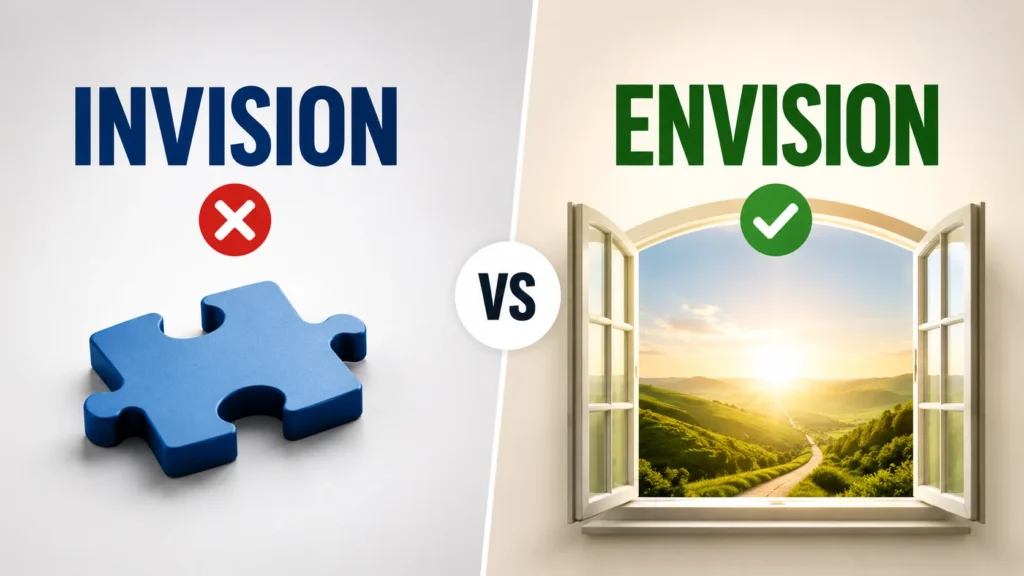
When you’re unsure whether to write invision or envision, the correct choice depends on what you mean. If you want to say “to imagine,” “to picture,” or “to see something in your mind,” envision is the standard English word. Invision is generally a misspelling when used with that meaning. However, InVision can appear as a proper name, so the two forms aren’t always interchangeable. This small spelling difference can confuse because both words look and sound similar at first glance. The easiest rule is simple: when you’re talking about imagining a future idea, goal, situation, or result, use envision.
Quick Answer: Is It Invision or Envision?
Envision is the correct spelling when you mean “to imagine or picture something.” For example, you can say, “I envision a future where everyone has access to better education.” You shouldn’t write, “I invision a future…” if you’re using the word as an ordinary English verb.
The confusion usually comes from the word vision. Since envision relates closely to forming a mental picture, it’s easy to assume that adding the prefix “in-” creates invision. English doesn’t work that way here. The accepted verb is envision, and that’s the spelling you should use in essays, emails, articles, business documents, and everyday writing.
Quick Reference Table
| Word | Correct standard English? | Meaning | Example |
| Envision | Yes | To imagine or picture something | She envisions a successful career. |
| Invision | Generally no | Usually a misspelling of envision | ❌ She invisions a successful career. |
| InVision | Yes, as a proper name | A specific brand or product name | The document mentions InVision. |
The key distinction is context. Envision functions as an English verb, while InVision may function as a proper name. Capitalization can therefore change what the word refers to, but it doesn’t make InVision the standard spelling of the verb.
The Correct Spelling: Envision
Envision is spelled with en- at the beginning: e-n-v-i-s-i-o-n. It means to imagine or mentally picture something, especially something that could happen in the future.
For example:
- “She envisions herself running her own business.”
- “They envisioned a larger home for their growing family.”
- “We envision several changes to the project.”
- “He is envisioning a different approach.”
Notice how the spelling stays consistent as the verb changes form. You get envision, envisions, envisioned, and envisioning.
A useful way to remember it is to connect envision with vision. When you envision something, you create a kind of mental vision of it. That connection won’t explain the word’s full history, but it gives you a practical spelling cue.
Why Most Dictionaries Recognize Envision
Standard dictionaries list envision as the English verb for imagining or picturing something. Its meaning centers on forming a mental image or thinking about a possible future situation.
This matters when you’re checking a spelling question because dictionary recognition helps separate established vocabulary from a common typing or spelling mistake. If your sentence means “imagine,” envision is the form to choose.
For instance, compare these two sentences:
“I envision a peaceful future.”
“I invision a peaceful future.”
The first sentence uses the standard English verb. The second uses a spelling that readers will generally recognize as an error.
You’ll often see envision in discussions about plans, ambitions, strategies, careers, products, and future possibilities. The word can suggest more than simply having a passing thought. It often carries the sense of mentally seeing an outcome or imagining how something might develop.
What Does Envision Mean?
Envision means to imagine, picture, or mentally see something that isn’t necessarily present or happening right now. People commonly use it when they think about a future possibility, desired outcome, plan, or situation.
Imagine you’re planning your career five years from now. You might envision yourself leading a team, working remotely, or running your own company. You’re not saying that situation already exists. You’re describing a future picture in your mind.
That’s why envision works especially well with goals and possibilities:
- Envision a better future.
- Envision a successful career.
- Envision a new approach.
- Envision what your life could look like.
- Envision a solution to the problem.
The word can also describe an idea that someone develops mentally before putting it into practice. A designer might envision a new product before creating it. A business leader might envision how a company should grow. A student might envision the career they want after graduation.
Definition of Envision
In simple terms, envision means to imagine something clearly in your mind. It usually acts as a verb and often points toward something possible, planned, expected, or desired.
Here are the main ideas behind the word:
Imagine: You form an idea in your mind.
Picture: You mentally represent how something might look or happen.
Anticipate: You think about a possible future situation.
Plan: You mentally consider what a future result could be.
However, these related words aren’t perfect substitutes in every sentence. Envision has its own shade of meaning. It often suggests that you’re mentally forming a picture of a particular situation rather than simply thinking about it.
For example, “I envision a small house near the ocean” creates a clearer sense of a mental picture than “I think about a small house near the ocean.” The first expression gives the reader a stronger feeling of imagined detail.
How Envision Is Used in Everyday English
You’ll find envision in both casual and formal English, although it often sounds slightly more deliberate than imagine. People use it when discussing plans, dreams, expectations, and possible outcomes.
Consider a conversation about career goals. Someone might say, “I envision myself working for an international company.” The speaker isn’t merely thinking about employment. They’re describing a future they can mentally picture.
In professional writing, the word appears frequently when people discuss goals and direction. A company might envision expanding into new markets. A project team might envision a simpler way to solve a problem. A school might envision new opportunities for its students.
You can also use it in personal situations:
- “I envision spending more time with my family.”
- “She envisions a quieter life after retirement.”
- “They envisioned building their dream home.”
- “He envisioning a fresh start” would be incorrect; the natural form is “He is envisioning a fresh start.”
That last example highlights an important grammar point. Envision behaves like a normal verb, so its form must match the sentence.
Common Situations Where People Use Envision
The word envision fits naturally whenever someone mentally considers a future state or possible result. Common situations include:
Future goals: “She envisions becoming a doctor.”
Career plans: “He envisions himself leading the department.”
Business strategy: “The company envisions expanding its services.”
Creative work: “The author envisioned a world unlike our own.”
Personal development: “I envision becoming more confident over time.”
Problem-solving: “The team envisioned a simpler solution.”
One pattern stands out: the word often connects an idea in the present with something imagined or expected in the future. That’s what gives envision its particular usefulness. When you want readers to understand that someone can mentally see a possibility before it becomes reality, envision is often the right choice.
Why Do People Write “Invision” Instead of “Envision”?
The confusion between invision and envision usually starts with their similar appearance and sound. When people hear envision, they may naturally connect the word with vision and assume the beginning should be “in-.” That assumption feels reasonable, but standard English uses envision when the intended meaning is “to imagine” or “to picture.” A quick spelling check can prevent the mistake before it reaches an email, essay, website, or professional document.
Pronunciation and Sound Similarities
When spoken quickly, invision and envision can sound close enough to cause uncertainty. The middle and ending sounds are especially similar, so someone who has learned the word mainly through conversation may not remember its exact spelling.
This problem becomes more noticeable when you don’t encounter envision frequently in writing. You may know exactly what the word means yet still hesitate when typing it. That’s a common spelling issue with words whose pronunciation doesn’t make their written form immediately obvious.
For example, you might hear:
“She envisions a better future.”
If you’ve never seen envisions written before, it’s easy to type invisions. The meaning remains clear, but the spelling doesn’t follow standard English usage.
Autocorrect and Typing Errors
Fast typing can make the problem worse. When you’re writing quickly, your fingers may produce invisions simply because the spelling feels familiar. Autocorrect may also fail to flag every unusual word, especially when a typed form resembles a name, username, or other recognized term.
Still, frequent appearance online doesn’t automatically make a spelling standard. If you’re preparing formal writing, don’t rely only on whether a spell-checker accepts a word. Check the intended meaning and standard dictionary usage instead.
A simple correction makes the difference:
- ❌ “I invision a better future.”
- ✅ “I envision a better future.”
The second version is the appropriate choice when envision means to imagine or mentally picture something.
Brand Name Influence
Another source of confusion comes from InVision, which has been used as a proper name in the digital product and design field. Because proper names can use unusual spellings, readers may assume that invision is also a legitimate alternative spelling of the ordinary verb.
That’s an important distinction. A company, product, organization, or other brand can choose almost any name that suits its identity. That name doesn’t change the standard spelling of an unrelated English word.
So, if you’re talking about imagining a future outcome, write envision. If you’re referring to a specific product or brand called InVision, preserve the name as it is officially written in the relevant context.
Why the Mistake Is So Common
The mistake feels natural because several clues point in the same direction. Envision contains vision, which makes the word visually familiar. Its pronunciation can also make the first vowel difficult to identify. Add fast typing or exposure to the proper name InVision, and the confusion becomes easier to understand.
The good news is that you only need one reliable rule: use envision when you mean imagine or picture.
Is “Invision” a Real Word?
If you’re asking whether invision can replace envision in a normal English sentence, the answer is generally no. Standard English uses envision for the meaning “to imagine,” “to picture,” or “to mentally see.” Writing invision in that context will usually be treated as a spelling error.
That doesn’t mean you’ll never encounter the sequence of letters InVision or invision. Names, brands, specialized terms, and unusual historical usages can appear outside ordinary modern vocabulary. Context matters.
For everyday writing, however, the practical choice is straightforward: envision is the word you want.
Invision as a Brand and Company Name
InVision has been used as the name of a digital product design and collaboration platform. In that setting, InVision isn’t functioning as the ordinary English verb envision. It’s a proper name.
This distinction is similar to the difference between an ordinary dictionary word and a company with a deliberately chosen name. A brand can use capitalization, spacing, or spelling that differs from conventional vocabulary.
Therefore, seeing InVision in a technology article doesn’t mean you can use invision in a sentence such as “I invision my future.” The first refers to a proper name, while the second attempts to use a nonstandard spelling of the English verb.
Why It Is Not Considered Standard English
When invision appears in a sentence where the writer means “imagine,” it doesn’t match the standard spelling of the verb. The established form is envision.
Compare:
- “They envision a larger home.”
- “They invision a larger home.”
The first sentence uses the standard verb. The second would normally need correction.
This distinction matters more in formal contexts. A spelling mistake in a casual message may cause little trouble, but the same error can weaken an article, application, report, or business proposal. Choosing envision keeps the wording clear and conventional.
Dictionary Treatment of Invision
When you check standard English dictionaries for the verb meaning “imagine,” envision is the form to look for. It carries the established definition and grammatical usage associated with mentally picturing something.
That dictionary distinction gives you a dependable way to settle the spelling question. Don’t choose between invision and envision based only on which one looks familiar. Look at the word’s meaning and standard usage.
For most ordinary sentences, the answer remains envision.
Envision vs. Invision: Side-by-Side Comparison
The easiest way to remember the difference is to compare their roles directly. Envision is the standard English verb. Invision is generally a misspelling when someone intends that verb, while InVision may refer to a specific proper name.
| Term | Standard English usage | Meaning | Example |
| Envision | Yes | Imagine or picture something | “I envision a better future.” |
| Invision | Generally no as the ordinary verb | Usually a misspelling of envision | “I invision a better future.” ❌ |
| InVision | Yes, as a proper name | A specific brand/product name | “The designer used InVision.” |
The capitalization in InVision is important when you’re referring to the name itself. Lowercase invision doesn’t become the correct English verb simply because the letters appear in a brand name.
The Bottom Line
If your sentence means imagine, picture, or mentally see a future possibility, choose envision. That’s the standard spelling readers expect.
For example:
- “We envision a more efficient system.”
- “She envisions herself running a business.”
- “They envisioned a different outcome.”
- “He is envisioning a new career path.”
Use InVision only when the context specifically calls for that proper name. This small distinction can save you from a surprisingly common spelling error, especially in professional or published writing.
How to Use Envision Correctly
Once you know that envision is the standard spelling, the next step is learning how to use it naturally. The verb usually describes a mental picture of something that could happen, something you want to achieve, or something you’re planning. You can use it for personal goals, business plans, creative ideas, and future possibilities. In most cases, envision takes an object, such as a better future, a new approach, or yourself in a particular role. You can also follow it with an -ing form when describing an imagined action.
A Simple Formula for Using Envision
A useful sentence pattern is:
Subject + envision + object
For example:
- “I envision a better future.”
- “She envisions a successful career.”
- “They envisioned a larger project.”
Another common pattern is:
Subject + envision + yourself + -ing
For example:
- “I envision myself working abroad.”
- “He envisions himself leading the team.”
- “She envisioned herself starting a business.”
You can also use envision with a clause when you’re describing a particular future situation:
- “Can you envision what the city will look like in ten years?”
- “We envision how the new system could improve the process.”
The important point is meaning. Use envision when you’re mentally picturing a possibility, outcome, plan, or future state. Don’t choose it simply because another sentence contains the word vision.
Envision in Professional Writing
In professional writing, envision often appears when people discuss strategy, goals, growth, or long-term direction. A business leader might write, “We envision expanding our services over the next five years.” Here, the word communicates a future possibility or intended direction.
You might also see it in project plans:
- “The team envisions a faster approval process.”
- “The company envisioned a more flexible workplace.”
- “Our organization envisions improving customer support.”
- “The designers are envisioning a simpler user experience.”
The word works particularly well when you’re describing an outcome before it becomes reality. That’s why it often appears in business proposals, strategic plans, presentations, and organizational statements.
Envision in Academic Writing
Academic writers can use envision when discussing possible developments, future research, theoretical outcomes, or broader implications. For example, a researcher might write, “Future studies may envision new approaches to this problem.”
However, academic writing benefits from precision. If the writer means “predict,” foresee may fit better. If the writer means “expect,” anticipate could be more accurate. Envision works best when the idea involves mentally forming a picture of a possible situation.
For example:
- “Researchers envision new applications for the technology.”
- “The study envisions a different approach to education.”
- “Scientists envisioned several possible outcomes.”
Envision in Business Communication
Business communication frequently uses envision to express direction without presenting an imagined outcome as an existing fact. A company can envision entering a new market, developing a new product, or changing its customer experience.
For instance, a manager might say, “We envision a workplace where employees can collaborate more easily.” The statement presents a desired future rather than claiming that the workplace already operates that way.
That distinction makes envision useful in strategic communication. It allows you to describe a goal clearly while leaving room for the steps needed to reach it.
Envision in Everyday Conversation
Although envision can sound more formal than imagine, people use it naturally in everyday conversations about goals and the future.
You might say:
- “I can envision living somewhere quieter.”
- “Can you envision yourself doing that job?”
- “She envisions a simple life near the coast.”
- “I never envisioned moving this far away.”
In casual conversation, imagine may sound more relaxed in many situations. Still, envision works when you want to emphasize a clear mental picture of a future possibility.
Example Sentences Using Envision
Seeing envision in different contexts makes its meaning easier to understand. The following examples show how the verb changes naturally depending on the subject and situation.
Future Planning Examples
When you talk about plans, envision can describe the outcome you hope to create or expect to see.
- “I envision a future where remote work becomes even more common.”
- “She envisions buying a home within the next few years.”
- “They envision a community built around shared spaces.”
- “We envision several improvements to the current system.”
These examples all involve something that isn’t necessarily happening now. The speaker mentally pictures a possible future.
Business and Career Examples
Career and business discussions provide another natural setting for envision.
- “He envisions himself managing an international team.”
- “The company envisions expanding into new markets.”
- “She envisioned a career that allowed more creative freedom.”
- “The founders envision the product becoming a major part of the industry.”
Here, envision connects present circumstances with a possible future result. It helps readers understand the goal or direction behind a decision.
Creative and Personal Goal Examples
Writers, artists, designers, and people pursuing personal goals can also use envision.
- “The author envisioned an entirely different ending.”
- “The architect envisioned a building filled with natural light.”
- “I envision myself becoming more confident.”
- “She envisions creating a healthier daily routine.”
In these examples, the imagined result can involve something practical, creative, or deeply personal.
Educational Examples
Students and teachers can use envision when discussing future possibilities or learning goals.
- “The student envisions studying medicine after graduation.”
- “The teacher envisioned a classroom built around collaborative learning.”
- “Researchers envision new ways to improve online education.”
- “The program envisions better opportunities for students.”
These examples demonstrate why context matters. Envision isn’t limited to one field. Its central idea remains the same: mentally picture something that could exist, happen, or develop.
Envision vs. Imagine: What’s the Difference?
Envision and imagine overlap, but they aren’t always interchangeable. Imagine has a broader meaning. You can use it for hypothetical situations, creative ideas, memories, possibilities, and simple thoughts. Envision tends to emphasize a mental picture of something, particularly a future situation, goal, or outcome.
Compare these sentences:
- “Imagine being able to travel anywhere.”
- “I envision myself traveling the world after retirement.”
The first sentence creates a hypothetical scenario. The second focuses on a specific future possibility.
That doesn’t mean envision always refers to a distant future. You can use it for something you’re planning or mentally picturing right now. The key difference is emphasis. Imagine is broader, while envision often suggests a clearer mental picture or intended outcome.
When Imagine Works Better
Choose imagine when you want a broad, flexible verb for forming an idea in your mind.
For example:
- “Can you imagine how surprised she was?”
- “Imagine living on another planet.”
- “I can’t imagine doing that every day.”
- “Try to imagine the scene.”
These sentences don’t necessarily describe a planned future. They simply ask the reader or listener to form a mental idea.
Envision vs. Visualize: What’s the Difference?
Visualize is closely related to envision, but it places stronger emphasis on creating a mental image. If you’re mentally seeing the details of an object, scene, or action, visualize may be the more precise choice.
For example:
- “Visualize the finish line before you begin.”
- “She visualized herself standing on the stage.”
- “I envision a career that gives me more freedom.”
The first two examples focus strongly on a mental picture. The third focuses more on a desired future state.
Still, the meanings can overlap. In many sentences, either word can work. Your choice depends on whether you want to emphasize the mental image or the future possibility.
Envision vs. Foresee: What’s the Difference?
The difference between envision and foresee becomes clearer when you consider prediction. Foresee means to anticipate or recognize something likely to happen. Envision means to form a mental picture of something that may happen or that you want to happen.
Compare:
- “We foresee several challenges ahead.”
- “We envision a smoother process in the future.”
The first sentence focuses on anticipated events. The second describes a possible or desired outcome.
When Foresee Is the Better Choice
Use foresee when you’re talking about something you expect or predict.
For example:
- “I foresee problems with the current plan.”
- “The company foresees strong demand next year.”
- “She couldn’t foresee the consequences.”
- “Experts foresee major changes in the industry.”
Use envision instead when you’re describing a mental picture of what something could become. Knowing this distinction helps you choose the right verb rather than treating every synonym as interchangeable.
Common Mistakes Related to Envision
Even after learning the correct spelling, a few mistakes can still trip you up. The most common one is writing invision when you mean envision. Another is confusing envision with related verbs such as imagine, visualize, or foresee. These words share some meaning, but each one has a slightly different focus. You may also see capitalization mistakes when a writer uses InVision as though it were an ordinary English verb. Keeping the meaning and context in mind makes these errors much easier to avoid.
Using Invision in Formal Documents
Writing invision in an email, report, essay, application, or other formal document can make a spelling error stand out immediately. If you mean “to imagine,” use envision.
For example:
- ❌ “The company invisions future growth.”
- ✅ “The company envisions future growth.”
- ❌ “I invision myself working in this field.”
- ✅ “I envision myself working in this field.”
A useful editing habit is to search your document for invision before submitting it. If you intended the ordinary English verb, replace it with envision.
Confusing Envision With Similar-Sounding Words
Several English verbs overlap with envision, but their meanings aren’t identical. Imagine works well for general mental ideas. Visualize emphasizes forming a mental image. Foresee focuses on anticipating something that may happen. Anticipate often means expecting or preparing for an event.
For example, “I envision a successful career” describes a future you can mentally picture. “I foresee challenges in this career” focuses on what you expect to happen. Choosing the verb that matches your intended meaning makes the sentence sharper.
Capitalization Mistakes With Brand Names
Don’t confuse the ordinary verb envision with InVision, a proper name used in the digital design space. A proper name keeps its required capitalization because it identifies a specific brand or product.
Compare:
- “I envision a new design.”
- “The designer worked with InVision.”
The first sentence uses an English verb. The second refers to a specific name. Context tells you which form belongs in your sentence.
Envision in Different Types of Writing
Envision works across many forms of English because people constantly discuss possibilities, goals, and future outcomes. The level of formality may change, but the basic meaning stays consistent.
Envision in Professional Writing
Professional writers often use envision when describing strategy, growth, goals, or plans. A business proposal might say, “We envision expanding our services across the region.” The sentence presents a planned or desired direction without claiming that the expansion has already happened.
You can also use it in workplace discussions:
- “We envision a more efficient workflow.”
- “The team envisions better customer support.”
- “The company envisioned a broader product range.”
Envision in Academic Writing
In academic writing, envision can describe possible developments, future applications, or proposed approaches. For example, “Researchers envision new applications for this technology.”
Use the word carefully, though. If you’re making a prediction, foresee may be more precise. If you’re describing an expectation, anticipate might fit better. Good academic writing depends on choosing the word that expresses the exact idea.
Envision in Business Communication
Business communication frequently uses envision when discussing long-term goals and organizational direction. Leaders may envision a new market position, a different customer experience, or a more efficient operation.
For example, “The company envisions becoming a leading provider of affordable technology.” This sentence describes an intended future position rather than a fact.
Envision in Everyday Conversation
Although envision can sound slightly more deliberate than imagine, it still works in everyday speech.
You might say:
- “I envision living somewhere quieter.”
- “Can you envision yourself doing that job?”
- “She envisions a different kind of life.”
- “I never envisioned moving so far away.”
In relaxed conversation, imagine may sometimes sound more natural. However, envision is perfectly appropriate when you’re talking about a future picture, goal, or possibility.
American vs. British English: Does the Spelling Change?
Here’s where another spelling can enter the discussion: envisage. Unlike invision, envisage is a genuine English word. It carries a meaning closely related to envision and appears especially often in British English.
US English Usage
In American English, envision is the standard form. If you’re writing for a US audience, use envision when you mean to imagine or picture something.
For example:
“We envision a future with cleaner transportation.”
UK English Usage
British English commonly uses envisage for the same broad idea.
For example:
“We envisage a future with cleaner transportation.”
This is a regional spelling and usage difference. It shouldn’t be confused with invision, which isn’t the standard replacement for envision.
What Major Dictionaries Say
When you’re unsure about a disputed spelling, reputable dictionaries provide a reliable reference. Standard dictionary entries recognize envision as the verb meaning to imagine or picture something. Envisage is also established English usage, particularly in British contexts.
The practical rule remains simple: use envision in standard US English when you mean “imagine” or “picture.”
Memory Trick to Remember the Correct Spelling
A simple memory trick can help you stop making the invision mistake. Think of envision as creating a mental vision. The word contains vision, which connects directly with the idea of seeing something in your mind.
Connecting “En” With Entering an Idea Into Your Mind
Think of an idea as something you bring into your mental view. You envision it before it becomes real. This isn’t a formal spelling rule, but it’s an easy memory aid.
Whenever you’re about to type invision, pause and ask yourself: “Do I mean imagine?” If the answer is yes, choose envision.
Easy Spelling Rule You Can Use Every Time
Remember this:
Imagine = envision
Not = invision
If you’re referring to the specific proper name InVision, keep its capitalization and use it only when that name is actually what you mean.
Envision Grammar Forms
Understanding the main forms of envision makes the word easier to use correctly in real sentences.
| Form | Usage | Example |
| Envision | Base form | “I envision a better future.” |
| Envisions | Third-person singular | “She envisions a new career.” |
| Envisioned | Past tense | “They envisioned a larger project.” |
| Envisioning | Present participle/gerund | “He is envisioning a different future.” |
These forms follow normal English verb patterns. The spelling of the base word remains envision, not invision.
Is “Envisioned” Correct?
Yes. Envisioned is the standard past-tense and past-participle form of envision.
For example:
- “She envisioned a successful career.”
- “The founders envisioned a global company.”
- “We had envisioned a much smaller project.”
Is “Envisioning” Correct?
Yes. Envisioning is the present participle or gerund form.
For example:
- “They are envisioning a new approach.”
- “She is envisioning her next career move.”
- “Envisioning the final result helped the team plan.”
Is “Envisions” Correct?
Yes. Envisions is the third-person singular form used with he, she, it, or a singular noun.
For example:
- “She envisions a better future.”
- “The company envisions continued growth.”
- “He envisions himself leading the team.”
Invision or Envision: Which One Should You Use?
When the meaning is to imagine, picture, or mentally see something, choose envision. That’s the standard English spelling, especially in US English. Invision is generally a spelling mistake in that context.
The one important exception is InVision as a proper name. If you’re referring to that specific brand or product, use the name as required by its context. Otherwise, don’t let the similar-looking spelling pull you off course.
The simplest rule to remember is this: envision is the verb for imagining a possibility or future outcome. If you mean “I can picture it in my mind,” envision is almost certainly the word you’re looking for.
Conclusion
When choosing between invision and envision, the answer is simple: envision is the correct standard English verb when you mean to imagine, picture, or mentally see something. You might envision a better future, a new career, a creative idea, or a different outcome. Invision is generally a misspelling when used with this meaning. However, InVision can appear as a proper name, so context still matters. If you’re writing an email, article, essay, report, or business document, choosing envision will keep your writing accurate and polished. When in doubt, connect the word with vision: to envision something is to form a mental picture of it. Once you remember that simple connection, the spelling becomes much easier to recognize. Whether you’re describing personal goals or future possibilities, envision is the word to use.
FAQs
Is “envision” or “invision” correct?
Envision is correct when you mean “to imagine,” “to picture,” or “to mentally see something.” Invision is generally considered a misspelling in standard English when used with that meaning. For example, “I envision a better future” is correct. However, InVision may be correct when referring to a specific proper name, brand, or product.
What does envision mean?
Envision means to imagine or picture something in your mind, especially a possible future situation, goal, or outcome. For example, “She envisions herself running a successful business” means she can mentally picture that future. The word commonly appears when people discuss plans, ambitions, possibilities, strategies, and desired results.
Is invision a real English word?
Invision is not generally used as the standard English verb meaning “to imagine.” When that is the intended meaning, envision is the correct choice. You may encounter InVision as a proper name, but that doesn’t make lowercase invision an alternative spelling of the ordinary English verb.
Why do people spell envision as invision?
People often write invision because the pronunciation and appearance of envision can confuse. The word also contains vision, which may encourage people to assume an “in-” beginning. Fast typing, unfamiliarity, and exposure to the proper name InVision can add to the confusion.
Can I say “I invision my future”?
No. If you mean that you can imagine or picture your future, write “I envision my future.” The spelling invision isn’t the standard form of this verb. For example, “I envision myself working abroad” correctly describes a future situation that you can mentally picture.
What is the difference between envision and imagine?
Imagine has a broader meaning and can describe forming almost any idea or hypothetical situation in your mind. Envision often emphasizes mentally picturing a particular possibility, goal, or future outcome. The two words can overlap, but “I envision a successful career” focuses more strongly on a future picture.
What is the difference between envision and visualize?
Envision and visualize can both describe creating a mental picture. Visualize usually places greater emphasis on seeing something mentally, including its visual details. Envision often focuses more on a possible future, plan, or outcome. For example, you can visualize a scene but envision a successful career.
Is envisage the same as envision?
Envisage and envision have closely related meanings. Both can mean to imagine or picture something, especially a possible situation or future outcome. Envision is the standard form commonly used in American English, while envisage is especially common in British English. Neither should be confused with invision.
What are the forms of the verb envision?
The main forms are envision, envisions, envisioned, and envisioning. For example, “I envision,” “she envisions,” “they envisioned,” and “we are envisioning” all use the verb correctly. The spelling remains based on envision, not invision, regardless of the grammatical form you need.
Is InVision different from envision?
Yes. Envision is an English verb meaning to imagine or picture something. InVision can refer to a specific proper name associated with digital design and collaboration. Although the two forms look similar, they serve different purposes. Use envision for ordinary English sentences and InVision only when the specific name is intended.