
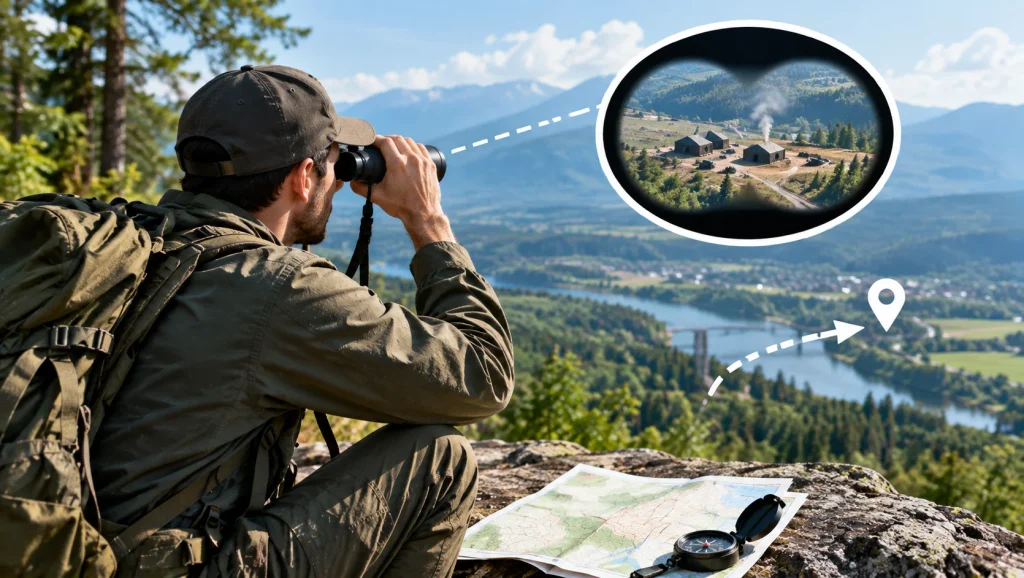
Have you ever gone somewhere new before making an important decision? Maybe you checked the area, looked for potential problems, or gathered information before acting. That basic idea is at the heart of “reconnoiter.”
So, what does reconnoiter mean? Reconnoiter means to examine or explore a place carefully to gather information, usually before deciding what to do next. The word often appears in military situations, where soldiers inspect an area to learn about its terrain, roads, defenses, or other conditions. However, its meaning isn’t limited to warfare.
You can also use reconnoiter in business, travel, outdoor activities, construction, and other situations where someone needs to investigate an unfamiliar place before proceeding.
For example:
The team sent two hikers ahead to reconnoiter the trail.
Here, the hikers aren’t simply walking around for fun. They’re checking the trail and gathering useful information before the rest of the group continues.
What Does It Mean?
Reconnoiter is a verb meaning to inspect, explore, or survey an area to gather information, especially before taking further action.
The word suggests purposeful investigation. When you reconnoiter a place, you usually have a reason for looking around. You may want to understand the terrain, identify obstacles, find a suitable route, assess conditions, or determine what lies ahead.
That purpose separates reconnoiter from a general word such as look or explore.
For instance:
- The soldiers reconnoitered the valley before advancing.
- The hikers reconnoitered the trail before starting the climb.
- The engineers reconnoitered the site before planning the project.
- The expedition leader went ahead to reconnoiter the route.
In each example, someone examines an area with a particular goal in mind.
A Simple Definition
If you want an easy way to remember the meaning, think:
Reconnoiter = carefully check an area before deciding what to do next.
It often involves observation, investigation, and preparation.
The word can describe a quick preliminary inspection or a more deliberate examination. The exact meaning depends on the context.
For example, a group planning a camping trip might reconnoiter a campsite to check the terrain and locate a safe place to set up tents. A military unit might reconnoiter an area to understand its geography and possible threats.
The action is similar in both cases: look first, gather information, then act.
What Does Reconnoiter Imply?
The word often carries three ideas:
- Observation: You carefully look at an area.
- Purpose: You have a specific reason for investigating it.
- Preparation: The information helps you make a later decision.
This is why reconnoiter can sound more deliberate than look around.
Compare these sentences:
We looked around the park.
We reconnoitered the park before choosing a location for the event.
The first sentence simply describes looking around. The second suggests a planned inspection intended to support a decision.
Pronunciation
Reconnoiter can be challenging to pronounce because its spelling doesn’t immediately reveal how the word sounds.
In American English, the word is commonly pronounced with the main stress toward the end. The pronunciation is closely related to the French source of the word.
The word has several syllables, so saying it slowly at first can make it easier to remember. Pay attention to the stressed portion near the end.
You may also encounter reconnoitre, the spelling traditionally used in British English. The two forms have the same basic meaning and are pronounced essentially the same way.
That spelling difference is important because it can cause confusion for English learners.
Part of Speech
Reconnoiter is primarily a verb.
It describes the action of examining or exploring an area for a specific purpose.
Here are a few examples:
The scouts reconnoitered the forest before sunset.
We need to reconnoiter the area before choosing a campsite.
The guide is reconnoitering the route ahead.
The verb can appear in several forms depending on tense and grammatical context.
| Form | Example |
| Base form | reconnoiter |
| Third-person singular | reconnoiters |
| Present participle | reconnoitering |
| Past tense | reconnoitered |
| Past participle | reconnoitered |
Because reconnoiter is a regular verb, its past tense is formed with -ed.
For example:
The team reconnoitered the area yesterday.
The scouts have reconnoitered the route.
Can Reconnoiter Be a Noun?
In standard modern English, reconnoiter is normally used as a verb rather than a noun.
The related noun reconnaissance is much more common when you want to name the activity or process of gathering information.
For example:
The soldiers conducted reconnaissance before moving forward.
Instead of:
The soldiers conducted a reconnoiter.
The first version uses the standard noun reconnaissance.
This distinction is useful because the two words are closely related but serve different grammatical roles.
Origin and Etymology of Reconnoiter

The history of reconnoiter helps explain both its spelling and its meaning.
The word ultimately comes from French reconnoître, an older spelling related to modern French reconnaître, meaning “to recognize” or “to know again.” English adopted the word in a specialized sense connected with examining or surveying a place.
Over time, the English verb developed its modern meaning of examining an area to gather information, particularly before a military operation or other planned action.
The word has strong historical connections with military terminology. Armies have long needed to understand unfamiliar terrain before moving troops, planning an attack, establishing a position, or selecting a route.
That practical need helped make reconnoiter an established military term.
However, the word eventually expanded beyond strictly military use.
Today, you can find it in contexts involving exploration, outdoor activities, business planning, construction, engineering, and other forms of preliminary investigation.
Why Does the Word Look Unusual?
The spelling can seem strange because reconnoiter contains several vowels together, and the word has a French background.
English has many words with French origins whose spelling reflects older forms of French or historical pronunciation.
The related British spelling, reconnoitre, makes the connection even more noticeable.
American English generally uses:
reconnoiter
British English generally uses:
reconnoitre
Neither spelling changes the basic meaning.
When Should You Use?
Use reconnoiter when someone deliberately examines an area to gather information before taking another action.
The word works especially well when the inspection is:
- purposeful
- preliminary
- strategic
- focused on a particular location
- intended to support a later decision or action
For example:
The hikers reconnoitered the mountain trail before beginning the climb.
This sounds natural because the hikers are checking the trail before committing to the route.
Another example:
The construction team reconnoitered the site before beginning excavation.
Again, the inspection happens before a significant action.
Reconnoiter Is More Than Simply Looking
One of the easiest mistakes is treating reconnoiter as a fancy replacement for look.
It isn’t quite that simple.
If you say:
She looked at the building.
You’re only stating that she viewed it.
If you say:
She reconnoitered the building site before the renovation.
You’re suggesting a deliberate inspection intended to gather information.
The second sentence tells the reader more about the purpose behind the action.
That’s why reconnoiter works particularly well when preparation matters.
Military Context
The military is probably the context most closely associated with reconnoiter.
In military use, to reconnoiter means to examine an area and gather information that can help with planning or operations.
A military unit might reconnoiter:
- enemy positions
- roads
- bridges
- hills
- valleys
- buildings
- possible routes
- defensive positions
- terrain
- potential obstacles
For example:
The patrol was ordered to reconnoiter the valley before the main unit advanced.
The patrol’s job is not simply to visit the valley. It needs to gather useful information about the area.
Another example:
The scouts reconnoitered the route and reported their findings to the commander.
Here, reconnoitered describes a deliberate information-gathering mission.
Why Is Reconnoiter Useful in Military Language?
Military decisions often depend on information about physical surroundings.
A map may show roads and elevation, but conditions on the ground can be different. A route may be blocked. A bridge may be damaged. A hill may provide an important vantage point. Weather may make an otherwise suitable path difficult to use.
Reconnoitering gives people an opportunity to inspect those conditions directly.
This is why the word is closely associated with reconnaissance, the broader process of gathering information about an area or situation.
The relationship is easy to remember:
Reconnoiter is the verb.
Reconnaissance is the related noun.
For example:
The unit reconnoitered the area.
The unit conducted reconnaissance of the area.
Both sentences describe information-gathering, but they use different grammatical forms.
Everyday and Non-Military Contexts
Although reconnoiter has a military history, you don’t have to be a soldier to use it.
The word can describe ordinary situations where someone checks a location before doing something.
For example, imagine a group planning a long hike. One person walks ahead to inspect the trail.
You could say:
Maya went ahead to reconnoiter the trail.
The sentence suggests that Maya is checking the route so the group knows what to expect.
Similarly:
We reconnoitered the neighborhood before choosing a hotel.
This means the travelers examined the area before making their decision.
Outdoor Activities
Outdoor activities provide some of the most natural non-military uses of the word.
Hikers, campers, climbers, explorers, and expedition teams may reconnoiter an area before committing to a route.
For example:
The climbers reconnoitered the base of the mountain before selecting an approach.
The campers reconnoitered the area for a safe place to set up their tents.
The hikers sent someone ahead to reconnoiter the trail.
In each sentence, the person is gathering information before proceeding.
Travel
You can also use reconnoiter when discussing travel, especially when the planning involves unfamiliar locations.
For example:
We spent the morning reconnoitering the town before deciding where to stay.
This sounds more deliberate than:
We walked around town.
The first sentence suggests that the travelers were assessing the town for a purpose.
Still, keep the context in mind. Reconnoiter is somewhat formal and can sound dramatic in casual conversation.
If someone casually says:
Let’s reconnoiter the mall.
That could be humorous or intentionally formal because everyday speakers would usually say:
Let’s check out the mall.
Knowing the register helps you decide when the word feels natural.
Professional and Business Contexts
Reconnoiter can also appear in professional settings when someone needs to investigate a location before making plans.
For example, a construction company might inspect a site before starting work.
The engineers reconnoitered the property before designing the new access road.
A real estate professional could use the word when describing a preliminary visit to a property.
The team reconnoitered the site before preparing its proposal.
An event planner might also use it in a more formal or playful context:
We need to reconnoiter the venue before finalizing the event layout.
In these examples, the word emphasizes preliminary assessment.
Is Reconnoiter Common in Business English?
It is understandable in professional English, but it is not an everyday business word.
In many workplaces, people would more naturally say:
- inspect the site
- survey the area
- assess the location
- evaluate the property
- examine the site
- check the area
For instance:
The engineers inspected the site before construction.
This is more straightforward than:
The engineers reconnoitered the site before construction.
The second sentence isn’t necessarily wrong. It simply has a more specialized or formal flavor.
As a result, reconnoiter works best when the context genuinely involves deliberate preliminary investigation.
Reconnoiter vs. Reconnoitre
Reconnoiter and reconnoitre are two spelling variants of the same word.
The main difference is regional spelling.
| Spelling | Common usage |
| reconnoiter | American English |
| reconnoitre | British English |
The meanings are essentially the same.
For example:
The team reconnoitered the area before proceeding.
And:
The team reconnoitred the area before proceeding.
Both sentences describe examining an area beforehand.
Which Spelling Should You Use?
If you’re writing for an American audience, reconnoiter is generally the preferred spelling.
If you’re following British English conventions, reconnoitre is the traditional spelling.
The choice is similar to other American and British spelling differences, such as:
- color/colour
- center/centre
- organize/organise
- analyze/analyse
The important thing is consistency.
If your article, essay, report, or other writing follows American English, use reconnoiter consistently.
If you’re writing in British English, reconnoitre may be the better choice.
Neither form is a misspelling when used according to the appropriate regional convention.
A Quick Look at the Meaning
Before moving into the finer distinctions between reconnoiter and similar words, keep this basic idea in mind:
Reconnoiter means to carefully examine an area to gather information before taking action.
The key elements are purpose, investigation, and preparation.
If you remember those three ideas, you’ll have a much easier time recognizing when the word fits.
For example:
The hikers reconnoitered the trail before starting the difficult climb.
The hikers investigate the trail.
They have a reason for doing it.
They use what they learn to prepare for the next step.
That’s the central meaning of reconnoiter.
Reconnoiter vs. Similar Words
Reconnoiter overlaps with several familiar English verbs, including scout, survey, inspect, explore, and observe. However, these words aren’t always interchangeable.
The main difference is purpose.
When you reconnoiter, you examine an area to gather useful information, usually before making a decision or taking action. The word often suggests a preliminary investigation.
Other verbs can describe similar actions without emphasizing that preparation.
Understanding these differences will help you choose the most natural word for your sentence.
Reconnoiter vs. Scout
Scout means to search or look around for something, often by going ahead of a larger group. It can also mean to examine a place or situation for a particular purpose.
For example:
The hikers sent James ahead to scout the trail.
You could also say:
The hikers sent James ahead to reconnoiter the trail.
Both sentences work. However, scout is much more common in everyday English.
The word scout can also describe searching for people, opportunities, locations, or talent.
For example:
The coach traveled to several schools to scout new players.
You wouldn’t normally replace scout with reconnoiter here because the meaning and context are different.
Reconnoiter is more strongly associated with systematic preliminary examination, particularly of a physical area.
Compare:
We scouted the neighborhood for a restaurant.
We reconnoitered the area before selecting a location for the event.
The first sentence sounds casual. The second sounds more deliberate and formal.
Reconnoiter vs. Survey
Survey means to examine or measure something carefully, often to collect detailed information.
It can refer to a physical area, a group of people, or a particular subject.
For example:
Engineers surveyed the land before construction began.
Here, survey may involve measurements, maps, boundaries, elevations, or other technical information.
Reconnoiter is broader in one sense. It emphasizes checking an area to understand its conditions before proceeding.
Compare:
The engineers surveyed the property.
The engineers reconnoitered the property before deciding where to build.
The first sentence may suggest a technical examination. The second focuses more on preliminary investigation and preparation.
There is some overlap, especially when people are assessing a physical location.
Reconnoiter vs. Inspect
Inspect means to examine something closely, usually to check its condition, quality, safety, or compliance with a standard.
For example:
The mechanic inspected the car before returning it to the customer.
The building inspector inspected the electrical system.
The purpose is usually to identify problems or verify that something meets requirements.
Reconnoiter, by contrast, often involves examining an unfamiliar area before a planned action.
Compare:
The technician inspected the machine for damage.
The team reconnoitered the area before setting up the equipment.
The technician is checking an existing object for a particular condition. The team is gathering information about a location before doing something there.
That distinction makes inspect the better choice for quality checks and reconnoiter the better choice for preliminary area assessment.
Reconnoiter vs. Explore
Explore means to travel through or investigate a place or subject to learn more about it.
It is one of the closest everyday words to reconnoiter, but the purpose can differ.
When you explore, you may simply want to discover something new.
For example:
We explored the old town for several hours.
This doesn’t necessarily mean that we were preparing for a specific action.
By contrast:
We reconnoitered the old town before choosing a location for the festival.
Here, the investigation has a clear practical purpose.
Explore can also be used for abstract subjects:
She explored several career options.
You generally wouldn’t say:
She reconnoitered several career options.
So, explore has a much wider range of uses.
A useful distinction is:
Explore = investigate or discover.
Reconnoiter = investigate an area to prepare for what comes next.
Reconnoiter vs. Observe
Observe means to watch, notice, or examine something carefully.
It doesn’t necessarily involve movement or exploration.
For example:
The scientist observed the birds from a distance.
The teacher observed the students during the activity.
In these examples, the person watches something happening.
Reconnoiter normally involves actively checking an area or route.
Compare:
The soldier observed the road from the hill.
The soldier reconnoitered the road before the unit advanced.
The first sentence focuses on watching the road. The second emphasizes gathering information about the area before a future operation.
The two words can overlap, but observe is broader and more neutral.
A Simple Comparison Table
The following table makes the distinctions easier to remember:
| Word | Main idea | Typical purpose |
| Reconnoiter | Examine an area beforehand | Preparation and planning |
| Scout | Search or check an area | Finding information or opportunities |
| Survey | Examine or measure systematically | Collecting detailed information |
| Inspect | Examine something closely | Checking condition or compliance |
| Explore | Investigate or discover | Learning about something new |
| Observe | Watch or notice carefully | Monitoring or understanding |
These meanings can overlap. The right word depends on what you want to emphasize.
If your sentence involves checking a place before taking action, reconnoiter may be a strong choice.
If you’re simply talking about discovering a new place, explore will usually sound more natural.
Reconnoiter Synonyms
Several words can serve as synonyms for reconnoiter, depending on the context.
Common alternatives include:
- scout
- survey
- inspect
- examine
- investigate
- explore
- assess
- survey
- check out
- look over
- evaluate
- study
However, these aren’t perfect replacements in every sentence.
For example, investigate is useful when the focus is on finding information or determining facts.
The researchers investigated the area.
Assess emphasizes judging conditions or suitability.
The team assessed the site before beginning construction.
Examine is a broad term for looking at something carefully.
The experts examined the terrain.
Scout often emphasizes searching or going ahead to check a location.
The guide scouted the route before the group arrived.
Reconnoiter brings these ideas together with a strong sense of preliminary, purposeful inspection.
More Formal Alternatives
In professional or technical writing, these alternatives may sometimes be clearer:
- conduct a preliminary assessment
- survey the area
- inspect the site
- assess the terrain
- evaluate the location
- examine the route
- investigate the surroundings
The best choice depends on what actually happened.
For example, if engineers took measurements, the survey may be more precise than reconnoiter.
If workers checked a building for safety problems, inspection may be more accurate.
If hikers walked ahead to understand a route, reconnoiter may capture the situation well.
Reconnoiter Antonyms
There isn’t one perfect opposite of reconnoiter because the word describes a specific type of action.
However, several words and phrases can express the opposite idea depending on the context.
Possible contrasts include:
- ignore
- neglect
- overlook
- disregard
- proceed blindly
- act without investigating
- move ahead without checking
For example:
The team reconnoitered the route before beginning the journey.
A contrasting situation would be:
The team began the journey without checking the route.
The second sentence doesn’t contain a direct dictionary antonym. Instead, it describes the absence of the preparation implied by reconnoiter.
This is an important distinction. Not every word has a single clean opposite.
Reconnoiter vs. Ignore
If someone deliberately examines an area, they are gathering information.
If someone ignores the area, they make no effort to consider what is there.
For example:
The hikers reconnoitered the trail before climbing.
versus:
The hikers ignored the trail conditions and started climbing.
The contrast is between deliberate preparation and failure to investigate.
Reconnoiter vs. Proceed Blindly
The phrase proceed blindly is particularly useful when explaining the practical opposite of reconnoiter.
For example:
Good planning requires the team to reconnoiter the site rather than proceed blindly.
This doesn’t mean the team literally cannot see. It means they act without enough information.
In a Sentence: Examples
Seeing reconnoiter in different sentences is one of the easiest ways to understand how the word works.
Because it has a formal and somewhat specialized tone, examples are especially helpful.
Everyday Examples
You can use reconnoiter outside military situations when someone checks a place before making plans.
We reconnoitered the park before choosing a spot for the picnic.
Sarah went ahead to reconnoiter the trail.
The family reconnoitered the campground before deciding where to stay.
We spent an hour reconnoitering the neighborhood before renting an apartment.
The group reconnoitered the beach to find a safe place to launch the boat.
Notice that each sentence involves a location and a purpose.
The person isn’t simply wandering around. They’re checking the area to support a later decision.
Military Examples
Military contexts are especially natural for reconnoiter.
The patrol reconnoitered the valley before the unit moved forward.
Scouts were sent to reconnoiter the surrounding terrain.
The commander ordered the team to reconnoiter the road.
The soldiers reconnoitered the area before establishing a temporary position.
The patrol returned after reconnoitering the route.
These examples demonstrate why the word has such a strong connection with military language.
In these situations, information about terrain, routes, obstacles, and surroundings can affect planning.
Professional Examples
The word can also appear in professional contexts.
The engineers reconnoitered the construction site before preparing the design.
The environmental team reconnoitered the property before beginning its assessment.
The production crew reconnoitered the venue before setting up the equipment.
The project manager reconnoitered the location before meeting with the contractor.
The survey team reconnoitered the area before starting the fieldwork.
These sentences are grammatically correct, but remember that reconnoiter is less common than simpler alternatives in ordinary business communication.
A professional writer might choose inspect, assess, or survey when those words describe the exact activity more precisely.
Student-Friendly Examples
English learners often understand a word faster when the examples involve familiar situations.
Here are some simple examples:
We reconnoitered the classroom before setting up the science project.
The students reconnoitered the museum before planning their field trip.
Jake went ahead to reconnoiter the hiking route.
Our group reconnoitered the campsite before unpacking.
The teacher asked the students to examine the area before beginning the activity.
The final example uses examine instead of reconnoiter. That’s useful because it shows how a simpler synonym can sometimes sound more natural.
Reconnoiter in Different Tenses
The verb can be used naturally in several tenses.
Present:
The team reconnoiters the area before each expedition.
Past:
The team reconnoitered the area yesterday.
Future:
The team will reconnoiter the route tomorrow.
Present progressive:
The scouts are reconnoitering the area now.
Present perfect:
The scouts have reconnoitered the route.
These forms follow normal English verb patterns.
The past and past participle forms use -ed:
reconnoitered
The present participle uses -ing:
reconnoitering
Common Collocations With Reconnoiter
A collocation is a combination of words that naturally appear together.
Knowing common collocations can help you use unfamiliar vocabulary more naturally.
With reconnoiter, location-related nouns are especially common.
Reconnoiter the Area
This is one of the most straightforward combinations.
The patrol reconnoitered the area before moving ahead.
It means the patrol examined the surrounding location to gather information.
Reconnoiter the Terrain
Terrain refers to the physical features of an area, especially when those features affect movement.
The scouts reconnoitered the terrain before selecting a route.
This collocation fits military and outdoor contexts particularly well.
Reconnoiter the Route
This means examining a route before using it.
The hikers reconnoitered the route before beginning the expedition.
It can refer to roads, trails, mountain paths, waterways, or other possible routes.
Reconnoiter the Site
This is useful in professional and construction-related contexts.
The engineers reconnoitered the site before preparing their plans.
It emphasizes a preliminary examination of a particular location.
Reconnoiter the Surrounding Area
This phrase emphasizes the broader environment around a particular location.
The team reconnoitered the surrounding area before establishing camp.
Reconnoiter Ahead
The phrase reconnoiter ahead emphasizes checking what lies in front of a group.
Two scouts moved ahead to reconnoiter.
This construction is especially natural when someone is sent forward to gather information.
Conduct Reconnaissance
Although this phrase doesn’t use reconnoiter directly, it is closely related.
The unit conducted reconnaissance before the operation.
Remember that reconnaissance is the noun, while reconnoiter is the verb.
Compare:
The scouts reconnoitered the area.
The scouts conducted reconnaissance of the area.
Both express closely related ideas.
Associated With the Military?
The military connection comes from the practical need to gather information about unfamiliar territory.
Before moving people or equipment through an area, military planners may need to understand the terrain and possible routes. Historically, this made scouting and reconnaissance important parts of military planning.
A group might need information about:
- roads and paths
- bridges and crossings
- hills and valleys
- natural obstacles
- buildings
- visibility
- terrain
- possible positions
- routes of movement
The verb reconnoiter developed a strong association with this kind of preliminary examination.
That doesn’t mean the word is exclusively military.
It has a broader meaning today. Any situation involving purposeful examination of an area before taking action can potentially use the word.
Still, if you encounter reconnoiter in a novel, historical account, military report, or discussion of warfare, the military sense is often the first one to consider.
Historical Example
The military use of reconnoiter became particularly important as armies developed more organized methods of gathering information about unfamiliar territory.
Military commanders have long needed to know what lies beyond their immediate position. Scouts and advance parties could travel ahead of larger groups to observe roads, terrain, settlements, crossings, and other features.
This activity is generally described as reconnaissance.
A historical military narrative might therefore say:
The cavalry was sent ahead to reconnoiter the enemy’s position.
The sentence means that the cavalry was sent forward to investigate and gather information.
The important point is that reconnoitering was not the final objective. The information collected could then be used for planning.
This relationship between observation and later action explains why the word has retained its strategic flavor.
How Is Reconnoiter Used in Modern English?
Modern English still uses reconnoiter, although it is not one of the most common verbs in casual conversation.
You are more likely to encounter it in:
- military writing
- historical writing
- adventure stories
- outdoor and expedition contexts
- journalism
- formal descriptions
- professional reports
- technical discussions
- literary prose
For example:
Before attempting the climb, the team reconnoitered the mountain route.
This sounds natural because the activity involves a difficult location and careful preparation.
You may also see the word used figuratively or humorously.
For example:
We spent Saturday reconnoitering the new shopping district.
The speaker may intentionally choose a formal word for an ordinary activity. The effect can be playful.
In everyday conversation, however, most people would probably say:
We checked out the new shopping district.
That doesn’t make reconnoiter outdated. It simply means the word has a more specialized or formal tone than many common alternatives.
Does this sound natural?
A useful test is to ask yourself:
Am I examining a place because I need information before doing something else?
If the answer is yes, reconnoiter may fit.
For example:
The crew reconnoitered the site before filming.
The crew needs information about the location before setting up.
Another example:
The hikers reconnoitered the route before attempting the crossing.
Again, the inspection comes before the main activity.
But consider:
I reconnoitered the kitchen before making breakfast.
This is grammatically possible, but it sounds unnecessarily grand for such a routine situation.
A natural speaker would probably say:
I checked the kitchen before making breakfast.
This illustrates an important vocabulary lesson: a word can be correct without being the best stylistic choice.
Use reconnoiter when its deliberate, strategic tone adds something meaningful to the sentence.
The Idea of Preparation
The strongest concept behind reconnoiter is preparation.
You don’t usually reconnoiter after everything is finished. The activity normally happens beforehand.
Think of the sequence like this:
Check → Gather information → Evaluate → Act
For example:
The hikers reconnoitered the trail → learned about the conditions → chose the safest route → began the hike.
This sequence captures the practical meaning of the word.
That’s also why reconnoiter often appears with words such as:
- before
- ahead
- first
- route
- area
- site
- terrain
- position
- surroundings
- advance
- prepare
These words reinforce the idea that the inspection is connected to a later decision or action.
A Practical Rule for Choosing Reconnoiter
When you’re unsure whether to use reconnoiter, ask three questions:
- Is there a place or area being examined?
- Is the examination purposeful rather than casual?
- Will the information help with a later action or decision?
If all three answers are yes, reconnoiter is likely to make sense.
If you’re simply watching something, observe may be better.
If you’re checking for defects, inspect may be better.
If you’re discovering a new place without a specific practical objective, explore may be better.
If you’re taking measurements or collecting systematic data, survey may be better.
If you’re searching ahead or looking for something, scout may be better.
Choosing the precise word makes your writing clearer and more natural.
Common Mistakes
Reconnoiter is a useful word, but it can be tricky for English learners. Its unusual spelling, formal tone, and military association can make it easy to misuse.
Most mistakes happen because writers treat it as a direct replacement for words such as explore or inspect. However, reconnoiter has a more specific sense.
It usually describes a purposeful examination of an area to gather information before a later action or decision.
Here are some of the most common mistakes to avoid.
Confusing Reconnoiter With Explore
This is probably one of the most common problems.
Explore means to investigate or travel through something to learn more about it. You might explore a city, cave, forest, subject, idea, or career option.
Reconnoiter usually involves a more specific purpose. You examine an area because the information will help you decide what to do next.
Compare:
We explored the forest during our vacation.
The group is discovering the forest and enjoying the experience.
Now compare:
We reconnoitered the forest before choosing a route.
The group is examining the forest for a practical reason.
Both words involve investigation, but the purpose is different.
Incorrect or Awkward Usage
I reconnoitered several books to decide which one to read.
This sounds unnatural because books aren’t normally treated as physical areas to be reconnoitered.
A better choice would be:
I explored several books before deciding which one to read.
Or:
I reviewed several books before deciding which one to read.
The lesson is simple: don’t use reconnoiter just because you want a sophisticated synonym for explore.
Better Usage
The hikers reconnoitered the trail before attempting the difficult climb.
Here, the word works naturally because the hikers are examining a physical route before taking action.
Using Reconnoiter Without a Purpose
Another mistake is using reconnoiter when the sentence gives no reason for the investigation.
The word strongly suggests that the examination has a practical purpose.
For example:
The tourists reconnoitered the museum.
This isn’t necessarily grammatically wrong, but the meaning feels incomplete. Why were they examining the museum? Were they looking for an entrance? Planning an event? Checking the layout?
A clearer sentence would be:
The event planners reconnoitered the museum before choosing a location for the reception.
Now the purpose is obvious.
Another example:
The hikers reconnoitered the trail before beginning the climb.
The reader immediately understands why the trail was examined.
How to Fix This Mistake
You don’t always need to state the purpose explicitly. Context can make it clear.
For example:
The scouts went ahead to reconnoiter.
The phrase went ahead already suggests that they are checking what lies in front of the group.
However, when the context isn’t obvious, adding a purpose makes the sentence stronger.
Useful structures include:
- reconnoiter before + action
- reconnoiter to + purpose
- reconnoiter ahead of + event
- reconnoiter the area + before-clause
For example:
The team reconnoitered the site before construction began.
The guide reconnoitered the route to identify possible obstacles.
The scouts reconnoitered ahead of the main group.
These structures make the meaning easy to understand.
Spelling the Word Incorrectly
The spelling of reconnoiter can be surprisingly difficult.
Common misspellings may happen because the word contains several vowels and repeated letters.
Writers may accidentally produce forms such as:
- reconiter
- reconnoitering with incorrect letter patterns
- reconnoitre when American spelling is expected
- reconnoitter
- reconoit
The correct American English spelling is:
reconnoiter
The British spelling is:
reconnoitre
The important thing is to recognize that these are legitimate regional variants rather than treating one as an error in every context.
A Spelling Tip
Break the word mentally into parts rather than trying to memorize every letter at once:
re-con-noi-ter
The middle portion is especially important.
If you’re writing for an American audience, remember the ending:
-oiter
For British English:
-oitre
When proofreading, pay particular attention to the repeated n and the unusual vowel. Mispronouncing Reconnoiter
Spelling and pronunciation don’t line up perfectly in reconnoiter, which can cause another common problem.
Some learners try to pronounce every written letter exactly as it appears.
English doesn’t always work that way.
The word has several syllables, with the primary stress toward the end. The spelling comes from a historical French form, which helps explain why its pronunciation may not feel obvious from the letters alone.
When learning the word, it’s better to learn the pronunciation together with the spelling.
Don’t assume that every vowel should receive a strong, separate sound.
A Useful Learning Strategy
Say the word slowly first.
Then repeat it at a natural conversational pace.
Finally, use it in a complete sentence:
The scouts reconnoitered the area before the group arrived.
Learning the word inside a sentence helps connect its sound, spelling, and meaning.
It also makes the formal tone easier to recognize.
Overusing the Word
Because reconnoiter sounds sophisticated, some writers may use it too often.
That’s usually a mistake.
A strong vocabulary isn’t about choosing the most unusual word available. It’s about choosing the word that communicates your meaning most clearly.
Consider this paragraph:
We reconnoitered the hotel before checking in. Then we scouted the restaurant before ordering. After dinner, we reconnoitered the neighborhood before returning to the hotel.
The repeated word makes the writing sound forced.
A more natural version would vary the vocabulary:
We checked out of the hotel before checking in. Then we inspected the restaurant before ordering. After dinner, we explored the neighborhood before returning to the hotel.
Different verbs communicate the different actions more precisely.
Use Reconnoiter When It Adds Meaning
A good rule is:
Don’t use reconnoiter simply to sound formal. Use it when the idea of purposeful preliminary investigation matters.
For example:
The expedition team reconnoitered the mountain route before beginning the ascent.
The word adds useful meaning.
But:
I reconnoitered my desk before starting my homework.
The sentence sounds unnecessarily dramatic.
In that situation, checked my desk or looked over my desk would be much more natural.
How to Remember the Meaning
Because reconnoiter isn’t an everyday word, remembering its meaning can take some practice.
The easiest method is to connect it with the idea of checking first.
Think:
Look first. Act later.
That’s the central idea behind the word.
Think: “Look Before You Leap”
The familiar expression “look before you leap” provides an excellent memory connection.
To reconnoiter means to examine the situation before moving forward.
Imagine someone standing at the edge of a difficult trail. Instead of immediately walking ahead, they stop and check the route.
They are effectively saying:
“Let me reconnoiter this area first.”
This mental image connects the word with preparation.
Picture a Scout Going Ahead
Another useful memory trick is to imagine a scout walking ahead of a larger group.
The scout checks:
- What is ahead?
- Is the route safe?
- Are there obstacles?
- Which direction should the group take?
- What conditions should everyone expect?
That person is reconnoitering.
The image is especially helpful because scout and reconnoiter are closely related in many contexts.
You can remember:
A scout goes ahead to reconnoiter.
This isn’t a strict definition of every use, but it captures the central idea effectively.
Connect It With Preparation
Try connecting the word to a simple sequence:
Reconnoiter → gather information → prepare → act
For example:
The team reconnoitered the site → learned about the terrain → adjusted the plan → began the work.
The word becomes easier to remember when you see it as part of a process rather than as an isolated vocabulary item.
Use a Memory Sentence
Create a sentence that you can easily recall.
For example:
We reconnoitered the trail before we started the hike.
This sentence contains all the essential elements:
- a physical area
- deliberate examination
- a reason
- a later action
Another useful sentence is:
The scouts reconnoitered ahead of the group.
Repeat one or two memory sentences until the word begins to feel familiar.
Practice With Real Situations
You don’t need a military situation to practice reconnoiter.
Imagine everyday scenarios where someone checks a place before acting.
For example:
Scenario 1: Hiking
A friend walks ahead to check whether the trail is open.
She went ahead to reconnoiter the trail.
Scenario 2: Construction
Engineers visit a property before planning the project.
The engineers reconnoitered the site before designing the structure.
Scenario 3: Event planning
Organizers visit a venue before arranging the event.
The organizers reconnoitered the venue before finalizing the layout.
Scenario 4: Travel
Travelers examine an unfamiliar neighborhood before choosing where to stay.
We reconnoitered the neighborhood before booking a hotel.
These examples reinforce the same basic pattern: investigate first, act afterward.
Related Words and Word Forms
Learning the related forms of reconnoiter can make the vocabulary easier to understand.
The most important related terms are reconnaissance, reconnoitering, reconnoitered, and reconnoiters.
Each one serves a different grammatical purpose.
Reconnaissance
Reconnaissance is the related noun.
It refers to the process or activity of gathering information about an area or situation.
For example:
The unit conducted reconnaissance before moving forward.
The word is especially common in military contexts.
It can also appear in non-military situations:
The expedition team conducted reconnaissance of the mountain route.
The relationship can be remembered this way:
Reconnoiter = verb
Reconnaissance = noun
Compare:
The scouts reconnoitered the valley.
The scouts conducted reconnaissance of the valley.
The two sentences express closely related ideas.
Reconnoitering
Reconnoitering is the present participle and gerund form of the verb.
It describes the ongoing activity of examining an area.
For example:
The scouts are reconnoitering the surrounding terrain.
Here, the action is happening now.
It can also function as a noun-like gerund:
Reconnoitering the route took several hours.
In that sentence, reconnoitering refers to the activity itself.
Reconnoitered
Reconnoitered is the simple past and past participle form.
For example:
The team reconnoitered the area yesterday.
And:
The team has reconnoitered the route already.
Because the verb is regular, the past form ends in -ed.
This is useful to remember when writing about an investigation that has already happened.
Reconnoiters
Reconnoiters is the third-person singular present form.
It is used with subjects such as he, she, or it.
For example:
The scout reconnoiters the route before each expedition.
The guide reconnoiters the area before bringing the group forward.
With a plural subject, use the base form:
The scouts reconnoiter the area before each expedition.
This follows the normal English rule for third-person singular present-tense verbs.
As a Verb in Sentence Structure
Understanding how the verb behaves grammatically can help you use it correctly.
Reconnoiter is generally an intransitive or transitive verb depending on how it is used.
It can stand without a direct object when the location is understood:
The scouts went ahead to reconnoiter.
It can also take a direct object:
The scouts reconnoitered the valley.
You can add more information about purpose or timing:
The scouts reconnoitered the valley before the main group arrived.
Or:
The scouts reconnoitered the valley to identify a safe route.
These structures are particularly useful because they make the purpose of the action clear.
Common Sentence Patterns
A few patterns are worth remembering.
Reconnoiter + place
The team reconnoitered the area.
Reconnoiter + place + before + action
The team reconnoitered the area before beginning the operation.
Reconnoiter + place + to + purpose
The team reconnoitered the area to identify possible obstacles.
Go ahead to reconnoiter
Two scouts went ahead to reconnoiter.
Reconnoiter ahead
The guide moved forward to reconnoiter ahead.
These patterns give you a practical framework for using the word naturally.
Is Formal or Informal?
Reconnoiter is generally more formal or specialized than everyday verbs such as check, look around, or explore.
Its tone can vary depending on context.
In military writing, it sounds completely normal:
The patrol reconnoitered the area before advancing.
In an outdoor or adventure context, it can sound natural:
The climbers reconnoitered the route before beginning the ascent.
In casual conversation, however, it may sound overly formal:
Let’s reconnoiter the kitchen before making sandwiches.
A friend would probably say:
Let’s check the kitchen.
The unusual choice could still be intentional. A speaker might use reconnoiter humorously to make an ordinary activity sound like a serious mission.
This stylistic flexibility is worth remembering. Correct vocabulary isn’t only about dictionary meaning. Register and context matter too.
In Formal Writing
The word can be useful in formal writing when you want to describe deliberate preliminary investigation.
For example:
Before beginning the field study, researchers reconnoitered the area to identify suitable observation points.
This sentence uses the word effectively because the investigation is purposeful and connected to later work.
Another example:
The project team reconnoitered the proposed construction site before developing the final design.
Here, reconnoitered emphasizes the preliminary nature of the visit.
However, don’t choose the word simply because it sounds academic.
If inspect, assess, or survey describes the activity more precisely, use that word instead.
Clarity should come before vocabulary complexity.
In Literature and Storytelling
Writers sometimes use reconnoiter because it creates a sense of strategy, preparation, or adventure.
For example:
Before entering the abandoned fortress, the travelers spent an hour reconnoitering the surrounding hills.
The word gives the scene a deliberate, tactical feeling.
Compare:
The travelers looked around the hills.
This version is much simpler and less dramatic.
In fiction, the choice of reconnoiter can therefore contribute to the atmosphere. It may make characters seem cautious, strategic, or prepared.
That’s one reason the word appears frequently in adventure, historical, military, and expedition narratives.
Reconnoiter vs. Reconnaissance in Practice
Because the two words are closely related, English learners sometimes confuse them.
The easiest way to separate them is grammatically.
Reconnoiter describes an action:
The scouts reconnoitered the area.
Reconnaissance names the activity:
The scouts conducted reconnaissance of the area.
Avoid forcing the noun into a verb position.
For example:
The scouts reconnaissance the area.
This is incorrect.
Use:
The scouts reconnoitered the area.
Or:
The scouts conducted reconnaissance of the area.
Similarly, avoid treating reconnoiter as the normal noun for the activity.
The distinction becomes easier once you associate the two forms with their grammatical roles.
A Quick Memory Review
At this point, the core meaning can be reduced to a simple idea:
Reconnoiter = investigate an area before taking action.
Think of a person moving ahead of a group.
They stop.
They look around.
They gather information.
They return or report what they found.
Then the larger group can make a better-informed decision.
That’s the mental picture behind the word.
When you remember purposeful checking before action, you’ll be much less likely to confuse reconnoiter with ordinary words such as look or explore.
How to Use Naturally
Knowing the dictionary definition of reconnoiter is only the first step. The next step is understanding when the word sounds natural in real English.
The word works best when the situation involves deliberate investigation before a later action.
Imagine a hiking group approaching an unfamiliar trail. Instead of immediately sending everyone forward, one person walks ahead and checks the path.
That person might:
- examine the terrain
- look for obstacles
- check the route
- assess conditions
- identify possible problems
- report useful information to the group
That is a natural situation for reconnoitering.
For example:
The guide went ahead to reconnoiter the trail before leading the group across the mountain pass.
The sentence works because the guide is gathering information before the group proceeds.
Use Reconnoiter for Preliminary Investigation
The word often works particularly well with before.
The crew reconnoitered the location before setting up the equipment.
The hikers reconnoitered the trail before starting the climb.
The engineers reconnoitered the property before preparing their plans.
This structure makes the relationship between investigation and later action very clear.
You can also use to when explaining the purpose:
The team reconnoitered the area to identify potential obstacles.
Here, the phrase to identify potential obstacles tells the reader why the team investigated the area.
Use Reconnoiter for Physical Locations
The word most naturally describes examination of a place or physical area.
Common objects include:
- area
- site
- terrain
- route
- trail
- valley
- neighborhood
- surroundings
- location
- coastline
- campsite
- mountain pass
For example:
The expedition team reconnoitered the coastline before choosing a landing point.
The researchers reconnoitered the site before beginning their fieldwork.
This doesn’t mean the word can never be used more broadly. However, its physical-location sense is especially well established.
Can You Reconnoiter a Person?
Usually, reconnoiter is associated with places rather than directly examining individual people.
For example:
The team reconnoitered the area.
Sounds natural.
But:
The team reconnoitered the manager.
sounds unusual if the intended meaning is simply that they investigated the manager.
Depending on the intended meaning, better choices might include:
- investigated
- observed
- interviewed
- assessed
- studied
- researched
You might, however, encounter contexts where people are part of the broader situation being reconnoitered.
For example:
The patrol reconnoitered the area and observed several people near the road.
Here, the area is what gets reconnoitered. The people are observed as part of the investigation.
This distinction helps keep your usage precise.
Can You Reconnoiter an Idea?
In ordinary modern English, reconnoiter is primarily associated with examining a physical location.
For abstract subjects, other verbs are usually more natural.
For example:
She explored several possible career paths.
The committee investigated several alternatives.
The researchers examined the theory.
These sentences sound more natural than:
She reconnoitered several career paths.
Although English can be flexible, there’s no benefit in forcing a specialized verb into a context where a simpler word communicates the idea better.
A good vocabulary choice should fit both meaning and context.
Reconnoiter vs. Check Out
In casual American English, check out is a common alternative when someone wants to look at or investigate a place.
For example:
Let’s check out the new restaurant.
This simply means let’s go see what it’s like.
By contrast:
Let’s reconnoiter the new restaurant.
sounds much more formal, strategic, or humorous.
You might use the second version intentionally if you’re joking with friends.
For example:
Before we choose our table, gentlemen, we must reconnoiter the restaurant.
The exaggerated formality can create humor.
In ordinary conversation, however, check out is usually the natural choice.
Reconnoiter vs. Look Around
Look around is another common everyday alternative.
We looked around the campsite before setting up the tent.
This is simple and natural.
You could also say:
We reconnoitered the campsite before setting up the tent.
The second sentence gives the activity a more deliberate or strategic feeling.
Neither sentence is inherently better. They simply create different tones.
Look around is casual.
Reconnoiter is more formal, specialized, or strategic.
That distinction matters when choosing vocabulary for different audiences.
Reconnoiter vs. Assess
Assess means to evaluate something carefully, especially to understand its condition, quality, value, or suitability.
For example:
The engineers assessed the site before construction began.
This is very natural professional English.
You could also write:
The engineers reconnoitered the site before construction began.
The difference is subtle.
Assess emphasizes evaluation.
Reconnoiter emphasizes preliminary examination or information gathering.
If the engineers are trying to determine whether the site is suitable, assess may be more precise.
If they’re gathering initial information about the location before deciding how to proceed, reconnoiter may fit well.
Reconnoiter vs. Investigate
Investigate is a much broader verb.
It can refer to examining places, events, people, problems, claims, accidents, crimes, and ideas.
For example:
Police investigated the incident.
Scientists investigated the unusual result.
The company investigated the complaint.
You normally wouldn’t replace investigated with reconnoitered in these sentences.
However, if the investigation specifically involves checking an area beforehand, reconnoiter may be appropriate.
Compare:
The police investigated the robbery.
This focuses on finding out what happened.
Officers reconnoitered the building before entering.
This focuses on examining the physical location beforehand.
The two actions could occur during the same broader situation, but they have different purposes.
How the Word Changes the Tone
One interesting feature of reconnoiter is that it can change the tone of a sentence.
Compare:
We checked the venue.
We inspected the venue.
We surveyed the venue.
We reconnoitered the venue.
Each sentence suggests a slightly different perspective.
Checked is simple and casual.
Inspected suggests careful examination, often for condition or problems.
Surveyed can suggest systematic examination or measurement.
Reconnoitered suggests preliminary investigation, preparation, and strategic awareness.
This is why writers sometimes choose the word even when simpler alternatives are available.
The word itself can make an activity sound more deliberate.
Common Situations Where It Fits
Here are several situations where reconnoiter can work naturally.
Before a Hike
The group reconnoitered the trail before attempting the steep section.
The hikers want information about the route before proceeding.
Before Construction
The engineers reconnoitered the site before finalizing the design.
The site visit helps inform later planning.
Before an Expedition
The expedition leaders reconnoitered the valley before choosing a campsite.
The leaders need to understand the terrain before deciding where to establish camp.
Before an Event
The organizers reconnoitered the venue before arranging the seating.
The venue inspection supports a later decision.
Before a Military Operation
The patrol reconnoitered the area before the unit moved forward.
This is one of the most traditional uses of the word.
During Exploration
The climbers reconnoitered the mountain route before beginning their ascent.
The activity combines exploration with preparation.
When Not to Use
Sometimes a simpler verb is clearly better.
Avoid reconnoiter when you are only talking about:
- casually looking at something
- watching someone
- reading about a topic
- checking a spelling
- inspecting an object for damage
- exploring an abstract idea
- reviewing a document
- investigating a complaint
For example:
She observed the birds.
Use observe, not reconnoiter, when watching is the main activity.
The technician inspected the machine.
Use inspect when checking an object’s condition.
He explored different career options.
Use explore for broad investigation of possibilities.
The manager investigated the complaint.
Use investigate for determining facts about a problem.
Choosing a more specific verb makes your writing easier to understand.
Common Sentence Pattern
Learning a few sentence patterns can make the word much easier to use.
Pattern 1: Reconnoiter + the Area
The scouts reconnoitered the area.
This is the most basic structure.
2: Reconnoiter + the Area + Before
The scouts reconnoitered the area before the group arrived.
This highlights the preliminary nature of the action.
Pattern 3: Reconnoiter + the Area + to + Verb
The scouts reconnoitered the area to find a safe route.
This directly states the purpose.
4: Go Ahead to Reconnoiter
Two hikers went ahead to reconnoiter.
This pattern emphasizes someone moving forward to check what lies ahead.
Pattern 5: Reconnoiter + Specific Location
The team reconnoitered the mountain pass.
The engineers reconnoitered the construction site.
The patrol reconnoitered the valley.
This pattern works when the location itself is important.
More Examples in Context
The following examples show how the word can appear in different styles.
Adventure Writing
Before entering the canyon, the guide reconnoitered the surrounding cliffs.
The word fits because the guide is assessing the location before proceeding.
Historical Writing
The scouts were sent ahead to reconnoiter the road.
This has a natural historical or military tone.
Business Writing
The project team reconnoitered the proposed site before developing the final plan.
This is possible in formal business writing, although assessed or inspected may be more common.
Outdoor Writing
The climbers reconnoitered the route before attempting the summit.
The word fits naturally with route planning and difficult terrain.
Casual or Humorous Writing
We reconnoitered the food court before deciding where to eat.
Here, the word can be intentionally playful because the situation is ordinary.
The humorous effect comes from treating a simple activity as if it were a strategic mission.
How to Make this Sound Natural
A few habits can improve your usage.
Give the word a clear purpose.
Instead of:
We reconnoitered the area.
Try:
We reconnoitered the area before choosing a campsite.
Use it with a physical location when possible.
Instead of:
She reconnoitered several ideas.
Try:
She reconnoitered the proposed location before making a recommendation.
Don’t repeat it unnecessarily.
Use related verbs when they describe different actions.
For example:
The team reconnoitered the site, inspected the equipment, and assessed the conditions.
This is more precise than using reconnoitered for every action.
Match the register.
Use simpler language when you’re having a casual conversation.
Use reconnoiter when its formal or strategic tone is appropriate.
A Quick Answer
Reconnoiter means to examine or explore an area carefully to gather information, usually before taking action or making a decision.
It is commonly associated with military reconnaissance, where people investigate terrain, routes, positions, and surroundings.
However, the word can also be used in non-military contexts.
For example:
The hikers reconnoitered the trail before starting the climb.
The word suggests more than simply looking around. It implies purposeful investigation and preparation.
The American spelling is reconnoiter, while reconnoitre is the traditional British spelling.
At a Glance
| Feature | Details |
| Word | reconnoiter |
| Part of speech | Verb |
| Basic meaning | Examine an area to gather information |
| Main idea | Investigate before taking action |
| Common context | Military and strategic situations |
| Other contexts | Hiking, exploration, construction, travel, professional work |
| American spelling | reconnoiter |
| British spelling | reconnoitre |
| Related noun | reconnaissance |
| Past tense | reconnoitered |
| Present participle | reconnoitering |
| Third-person singular | reconnoiters |
| Common related idea | preliminary investigation |
| Common objects | area, site, route, terrain, valley, trail |
This quick reference captures the most important points about the word.
The Key Difference
If you’re still unsure about the difference between reconnoiter and explore, remember this simple contrast:
Explore focuses on discovering or learning about something.
Reconnoiter focuses on checking an area to prepare for what comes next.
For example:
We explored the forest during our vacation.
The purpose may simply be discovery.
But:
We reconnoitered the forest before choosing a route.
The purpose is preparation.
This distinction isn’t absolute in every possible context. The two words can overlap. However, it provides a useful guideline for choosing between them.
Reconnoiter vs. Scout: The Key Difference
The distinction between reconnoiter and scout is also useful.
Scout often emphasizes searching, going ahead, or looking for something.
Reconnoiter emphasizes examining an area to gather information before action.
For example:
The hikers sent Alex ahead to scout the trail.
This is very natural everyday English.
The hikers sent Alex ahead to reconnoiter the trail.
This is more formal and strategic.
Both can describe the same basic action, but their tone differs.
Reconnoiter vs. Inspect: The Key Difference
Think of inspect when the main goal is checking condition.
The technician inspected the bridge for damage.
Think of reconnoiter when the main goal is understanding an area before proceeding.
The team reconnoitered the bridge area before planning the crossing.
The first focuses on the bridge’s condition.
The second focuses on the surrounding location and preparation.
Reconnoiter vs. Observe: The Key Difference
Observe is about watching or noticing.
The researchers observed the animals.
Reconnoiter is about investigating a location for useful information.
The researchers reconnoitered the area before establishing their observation station.
You can observe while reconnoitering, but the two verbs aren’t identical.
Observation can be one part of reconnaissance.
Reconnoiter vs. Survey: The Key Difference
Survey often suggests systematic examination, measurement, or data collection.
The surveyors surveyed the land.
Reconnoiter is broader and often more preliminary.
The team reconnoitered the land before deciding where to conduct the detailed survey.
In some situations, both words could describe related stages of the same project.
First, a team might reconnoiter an area to understand its general conditions. Later, specialists might survey the land in detail.
A Useful Vocabulary Ladder
You can think of these words as emphasizing different aspects of investigation:
Look around → casual observation
Explore → discovery and investigation
Scout → searching or checking ahead
Inspect → close examination
Survey → systematic examination or measurement
Assess → evaluation
Reconnoiter → purposeful preliminary investigation before action
This isn’t a strict hierarchy. Each word has its own uses.
Still, the comparison can help you choose vocabulary more deliberately.
Why Reconnoiter Is a Valuable Word to Know
You may not use reconnoiter every day, but understanding it can make unfamiliar texts much easier to follow.
You might encounter it in:
- novels
- historical accounts
- military writing
- adventure stories
- travel writing
- journalism
- professional reports
- outdoor literature
When you see the word, look for clues around it.
If the sentence mentions a route, area, terrain, patrol, scouts, advance, site, or before, the meaning is often connected to preliminary investigation.
For example:
The scouts moved ahead to reconnoiter the terrain before the expedition continued.
Even if you’ve never seen the word before, the surrounding context gives you useful clues.
Final Takeaway
Reconnoiter means to carefully examine an area to gather information before taking action or making a decision. It is especially common in military contexts, but its use isn’t limited to the armed forces.
You can use it for hiking trails, expedition routes, construction sites, venues, neighborhoods, and other physical locations when the investigation is purposeful.
The word is a verb, while reconnaissance is its related noun. In American English, the standard spelling is reconnoiter. British English traditionally uses reconnoitre.
The easiest way to remember the meaning is to think “look before you leap.” Someone who reconnoiters checks what lies ahead before committing to the next step.
Use the word when you want to emphasize preparation, purposeful investigation, and informed action. When a simpler word such as check, explore, inspect, or survey is more precise, choose that instead. Good vocabulary isn’t about using the most complicated word. It’s about using the right word for the situation.
Conclusion
Understanding what reconnoiter means becomes much easier when you connect the word with one simple idea: careful investigation before taking action. To reconnoiter means to examine an area, route, site, or situation to gather useful information, often before making a decision or moving forward.
Although the word has strong military associations, it can also appear in outdoor activities, business, construction, travel, and other professional settings. Its American spelling is reconnoiter, while reconnoitre is the common British spelling. Related words such as reconnaissance, scout, survey, and inspect can help you understand its meaning, but each has its own nuance.
Once you understand the purpose behind the word, using it naturally becomes much easier. Think of reconnoitering as looking before you leap. When careful preparation and information gathering matter, this precise and useful verb can be a great choice.
FAQs
What does reconnoiter mean?
Reconnoiter means to examine or explore a place carefully to gather information before deciding what to do. The word often suggests purposeful investigation rather than casual looking around. For example, a team might reconnoiter a route before beginning a journey. It is especially common in military contexts, but it can also describe careful preparation in everyday and professional situations.
How do you pronounce reconnoiter?
In American English, reconnoiter is commonly pronounced approximately “rek-uh-NOY-ter,” with the main stress on the middle syllable. The exact pronunciation can vary slightly by speaker or dictionary system. Hearing the word spoken can help you recognize its rhythm. Remembering the connection with “reconnaissance” can also make the pronunciation and meaning easier to recall.
Is reconnoiter a verb or a noun?
Reconnoiter is primarily a verb. You can say that someone “reconnoitered the area” or “will reconnoiter the route.” The related noun is reconnaissance, which refers to the process of gathering information through careful observation or investigation. Recognizing this difference helps you choose the correct word when constructing a sentence.
What is the difference between reconnoiter and explore?
Reconnoiter usually involves purposeful investigation to gather information before taking action. Explore is broader and can involve discovering or learning about a place, subject, or idea without the same preliminary purpose. For example, you might explore a new city for enjoyment, while you might reconnoiter a route to assess conditions before traveling it.
Is reconnoiter only used in military contexts?
No. Reconnoiter has strong military associations because military forces have historically used reconnaissance to gather information about terrain, routes, and positions. However, the verb can also be used outside military settings. Hikers, construction teams, business professionals, researchers, and travelers may reconnoiter a location when careful observation is needed before making plans.
What is the difference between reconnoiter and scout?
Scout and reconnoiter overlap, but they are not identical. To scout often means to search or inspect an area, sometimes casually or as part of a broader task. To reconnoiter emphasizes gathering information for a specific purpose, often before deciding what action to take. In many contexts, scout sounds more familiar and conversational than reconnoiter.
What is the British spelling of reconnoiter?
The common British spelling is reconnoitre, while reconnoiter is the standard American spelling. Both forms have the same basic meaning and are pronounced similarly. If you are writing for a US audience, reconnoiter is generally the spelling to use. For British English, reconnoitre is more appropriate.
What are some synonyms for reconnoiter?
Depending on the context, synonyms for reconnoiter include scout, survey, inspect, examine, investigate, assess, and explore. These words are not always interchangeable because each carries a slightly different meaning. Reconnoiter is particularly useful when you want to emphasize careful information gathering before a decision, movement, or action.
Can you use reconnoiter in everyday conversation?
Yes, but reconnoiter can sound formal or specialized in casual conversation. In everyday speech, people often say “look around,” “check out,” “scout,” or “inspect.” You might use reconnoiter when discussing a hike, route, property, event location, or project where careful preliminary investigation matters. Its formal tone makes it especially useful in professional or descriptive writing.
What is the noun form of reconnoiter?
The related noun is reconnaissance. It describes the process of gathering information by observing or examining an area, situation, or environment. For example, “The team conducted reconnaissance before choosing a route.” Reconnoiter is the action, while reconnaissance names the broader activity or process of information gathering.