

When a writer wants every sentence to land with a sharp beat, staccato sentences can do the job. Short. Direct. Deliberate. This style breaks ideas into compact units that create noticeable pauses and a quick, sometimes tense rhythm. However, staccato writing isn’t simply a matter of making every sentence shorter. The real skill lies in controlling sentence length, syntax, punctuation, emphasis, and pacing so the prose sounds intentional rather than choppy. The term comes from music, where staccato describes notes played separately and with short duration. Dictionaries also extend the word to speech and other sounds that come in short, distinct bursts.
That musical connection gives writers a useful mental picture. Imagine a smooth melody suddenly turning into a series of crisp notes. The same shift can happen on the page. A long sentence may carry several connected ideas in one flowing movement. A staccato sequence separates those ideas. Each statement gets its own beat. The effect can feel urgent, dramatic, blunt, confident, tense, or energetic depending on the context.
The technique works best when you use it with purpose. A paragraph made entirely of tiny sentences can become predictable. A single short sentence placed after a longer, more complex one can have far greater impact. Purdue’s writing guidance makes a similar point about sentence variety: a sequence of short sentences can become repetitive, while a strategically placed simple sentence can gain emphasis through contrast.
What Is a Staccato Sentence?
A staccato sentence is a short, sharply separated sentence used to create a clipped rhythm, strong emphasis, quick pacing, or a particular emotional effect. It often contains a single clear idea and uses straightforward syntax. Writers may place several such sentences together to make a passage feel faster or more forceful.
Consider this example:
The door opened. Nobody moved. Then the lights went out.
Each sentence stands apart. The periods create distinct stops. Instead of allowing the reader to glide through one long sentence, the writer creates three separate beats.
Now compare it with a more flowing version:
When the door opened, nobody moved, and everyone froze as the lights suddenly went out.
The second version isn’t wrong. It simply produces a different reading experience. Its clauses connect more smoothly. The staccato version creates more space between events.
That difference matters because staccato describes an effect, not merely a sentence length. There is no universal rule saying a sentence must contain five words, eight words, or another fixed number to qualify. A sentence can be relatively short yet sound perfectly smooth in context. Conversely, a somewhat longer sentence can contribute to a staccato passage when its structure and rhythm create abrupt movement.
Definition of Staccato Sentences
The simplest way to understand the term is to think about separation.
A staccato sentence usually has several recognizable qualities:
- It communicates a focused idea.
- It tends to use concise wording.
- It creates a noticeable stopping point.
- It can emphasize a particular detail.
- It may accelerate the perceived pace.
- It often works through contrast with surrounding sentences.
- It can sound abrupt, clipped, urgent, or forceful.
For example:
The phone rang.
She stared at it.
She didn’t answer.
The sentences are grammatically complete. None needs to be a fragment. Yet the sequence has a clipped rhythm because every action receives its own sentence.
This distinction helps prevent a common mistake. Short sentence and staccato sentence aren’t perfect synonyms. A short sentence can simply be concise. Staccato writing intentionally draws attention to separation and rhythm.
Why Is It Called “Staccato”?
The word staccato comes from Italian and literally relates to the idea of being detached. In music, it describes notes played separately rather than smoothly connected. Oxford lists legato as the opposite musical concept, where notes flow together more smoothly.
That musical idea transfers neatly to writing.
Think of two musical performances. In the first, notes flow into one another. The result feels continuous and smooth. In the second, each note has a distinct attack and separation. Your ear notices the individual beats.
Writing can create a similar contrast.
Compare:
Rain hammered the roof while the wind pushed against the windows and branches scraped across the glass.
with:
Rain hammered the roof. The wind pushed hard. Branches scraped the glass.
The second version creates stronger separation. Each action becomes a distinct event.
The effect doesn’t depend on shouting, exclamation marks, or dramatic vocabulary. The sentence boundaries do much of the work.
How Does Staccato Writing Sound to a Reader?
Although readers see words rather than hear an actual performance, sentence structure influences the rhythm they experience internally.
A sequence such as this:
He stopped. He listened. Nothing. He moved again.
feels different from:
He stopped and listened carefully before moving again when he heard nothing.
The first version creates hesitation and uncertainty. The second explains the sequence more smoothly.
This is why sentence rhythm matters. Writing has a visual structure, but readers also process its cadence. Short sentences can create the impression of quick mental or physical movement.
A staccato style can therefore suggest:
| Effect | Typical impression |
| Urgency | Events happen quickly |
| Tension | Something feels uncertain or dangerous |
| Emphasis | A key point receives extra weight |
| Drama | Each statement feels significant |
| Confidence | The prose sounds firm and decisive |
| Shock | Ideas arrive in abrupt bursts |
| Anger | Speech feels clipped or forceful |
| Excitement | The pace feels energetic |
The effect depends heavily on context. A sequence of short sentences doesn’t automatically sound dramatic. Meaning, vocabulary, punctuation, and surrounding prose all contribute.
What Makes a Sentence Staccato?
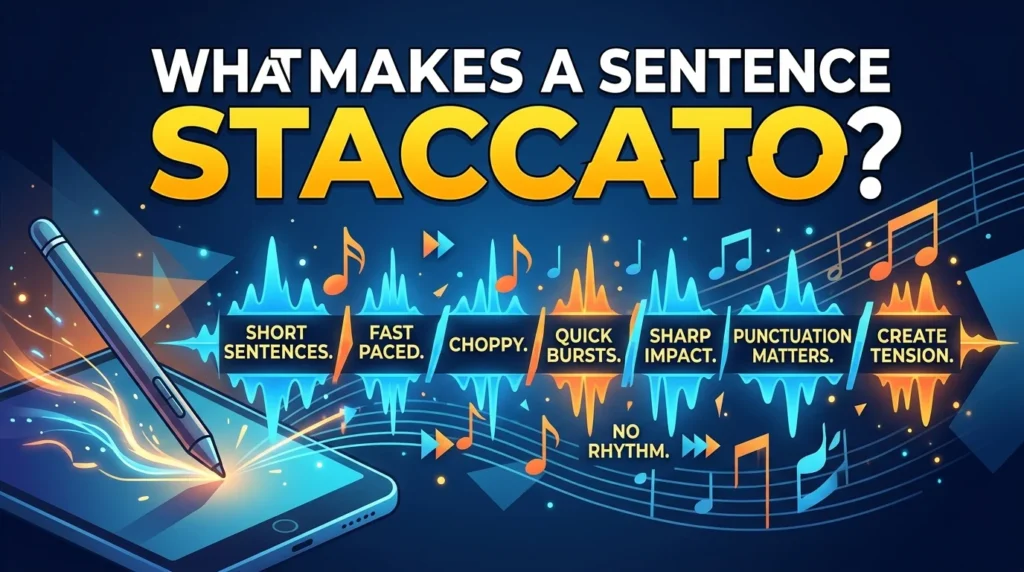
A sentence becomes staccato through a combination of brevity, separation, focus, and rhythm. Writers can strengthen the effect by using direct syntax and precise words.
However, no single feature defines every example. Treating sentence length as the only factor oversimplifies the technique.
Short, Direct Sentence Structure
Short syntax gives staccato writing its most recognizable quality.
Consider:
The alarm sounded. Everyone froze.
These sentences contain little structural complexity. Each statement moves directly from subject to action.
Now compare:
When the alarm suddenly sounded throughout the building, everyone stopped what they were doing and looked toward the nearest exit.
The second sentence carries more information within one grammatical structure. It may suit an explanatory paragraph, but the first version produces stronger beats.
Short structure works especially well when the writer wants readers to process events one at a time.
Strong Sentence Boundaries
Periods matter because they establish firm boundaries between thoughts.
Compare:
He opened the box and found a note, so he read it immediately.
with:
He opened the box. A note waited inside. He read it immediately.
The second version creates three stages.
Open. See. Read.
That sequence feels more deliberate because the writer controls where the reader stops.
Still, punctuation shouldn’t become a blunt instrument. Splitting every clause into a separate sentence can make prose sound mechanical. The strongest staccato passages usually contain variation.
Focused Ideas and Precise Wording
Staccato writing becomes more effective when each sentence has a clear job.
Weak:
She was very nervous and extremely worried about what might happen next.
Sharper:
She was nervous. She expected trouble.
The second version doesn’t simply shorten the original. It gives each idea more definition.
Precise wording also helps. Strong verbs can carry more meaning with fewer words.
| Wordy phrasing | More direct phrasing |
| began to run quickly | ran |
| made a sudden decision | decided |
| gave a loud warning | warned |
| moved very quickly | rushed |
| was very angry | snapped |
The goal isn’t to make every sentence as short as possible. The goal is to make every word earn its place.
Repetition and Parallel Structure
Repeated sentence structures can create a deliberate beat.
The repeated pattern produces rhythm. The three sentences feel connected even though each stands alone.
Parallel structures can also reinforce a message:
This type of writing appears frequently in persuasive and promotional contexts because the repetition makes the statements memorable.
Yet repetition has a limit. Once the pattern becomes predictable, it can lose its force. Strategic repetition works because the writer controls when to begin and when to stop the pattern.
Staccato Sentences vs. Short Sentences
A short sentence describes length. A staccato sentence describes style and effect.
That’s the distinction worth remembering.
A sentence such as:
The store closes at six.
is short. It isn’t necessarily staccato. It simply communicates information efficiently.
Now consider:
The store closes at six. Hurry.
The second sentence introduces a sharper rhythm. The short final statement changes the urgency.
The difference becomes even clearer across a paragraph.
Is Every Short Sentence Staccato?
No.
A short sentence can have a calm, neutral, or conversational rhythm.
My brother lives nearby.
It’s concise. But nothing about the sentence necessarily creates an abrupt effect.
Now look at:
The door slammed. Silence. Nobody spoke.
The passage feels much more staccato because the writer has deliberately separated events and used a fragment for emphasis.
The surrounding rhythm matters as much as the individual sentence.
Staccato Sentence vs. Concise Sentence
Concise writing removes unnecessary words. Staccato writing uses sentence separation to create a particular rhythm.
A concise sentence might be:
The meeting starts at nine.
A staccato sequence might be:
Nine o’clock. No excuses. Be there.
The second example isn’t merely concise. It has a deliberate cadence.
Staccato Sentence vs. Choppy Writing
This distinction is essential.
Staccato writing is controlled. Choppy writing often results from uncontrolled repetition of short structures.
Consider: The man entered. He looked around.He saw the desk.He walked toward it.He opened the drawer.He found the key.
Every sentence follows nearly the same pattern. The paragraph may feel mechanical.
A stronger revision could be:
The man entered and scanned the room. The desk stood near the window. He crossed to it. Opened the drawer. Found the key.
Now the rhythm varies. Longer sentences establish context. Shorter structures highlight the important actions.
Purdue’s guidance similarly warns that repeated short sentences can create a repetitive “drumbeat,” while deliberate sentence variation can place stronger emphasis on selected information.
Staccato Sentences vs. Sentence Fragments
A sentence fragment lacks the grammatical structure normally expected of a complete sentence. A staccato sentence doesn’t have to be a fragment.
For example: She ran.She fell.She got up.
All three are complete sentences.
Now:
She ran. Faster. Much faster.
“Faster” doesn’t function as a complete independent sentence in the usual grammatical sense. Yet the fragment can work stylistically because the surrounding context supplies the meaning.
This distinction matters in both grammar and editing. Intentional fragments can contribute to voice and emphasis, but accidental fragments can make formal writing unclear.
Can a Staccato Sentence Be a Fragment?
Yes, but it doesn’t have to be.
Writers sometimes use fragments to create an especially sharp beat:
The hallway was empty. Empty.
The second statement emphasizes the first.
Another example:
He heard something behind him. Footsteps.
The fragment creates suspense because it isolates the important detail.
The technique works because readers can easily recover the missing grammatical relationship from context.
Complete Staccato Sentences
Complete sentences can create just as much impact:
The lights flickered. The engine stopped. The room went dark.
Nothing is grammatically incomplete. The rhythm comes from the short independent clauses and firm sentence boundaries.
This is useful for writers who want a staccato effect without relying heavily on fragments.
Intentional Fragment vs. Grammar Error
Ask three questions when reviewing a fragment:
- Does the surrounding context make the meaning obvious?
- Does the fragment create a deliberate stylistic effect?
- Would a complete sentence communicate the idea more effectively for this audience?
If the answer to the first two questions is yes, the fragment may be intentional.
Formal academic or professional writing generally requires more caution. Creative writing, advertising, dialogue, and other expressive forms often allow more stylistic freedom.
Why and When Do Writers Use Staccato Sentences?
Staccato sentences aren’t useful simply because they’re short. Their value comes from what they make the reader feel, notice, or process differently.
A writer might use them to accelerate a scene, isolate an important fact, increase tension, or create a firm tone. The technique becomes especially powerful when it contrasts with smoother sentences nearby.
What Effect Do Staccato Sentences Have?
The strongest effects usually involve pace, emphasis, tension, tone, and attention.
How Staccato Sentences Control Pacing
Sentence length influences how quickly information appears.
Compare:
She heard the noise coming from the hallway and slowly turned toward the door because she wasn’t sure what she would find there.
with:
She heard a noise. From the hallway. She turned. Slowly.
The second passage creates hesitation and suspense. Each sentence or fragment creates another beat.
A writer can also use staccato sentences during action:
The door burst open. He ducked. Glass shattered. Someone shouted.
The events feel immediate.
That doesn’t mean readers literally process every short sentence faster in every situation. Rather, the sentence structure creates a perception of rapid movement because the prose presents events in discrete bursts.
How Staccato Sentences Create Emphasis
A short sentence can act like a spotlight.
Imagine several sentences explaining a difficult situation. Then the writer ends with:
The deadline was tomorrow.
That final short sentence may carry more weight than a longer explanation would.
Purdue’s sentence-variety guidance explains this principle clearly: a simple sentence can receive extra emphasis when it follows more complex structures.
The technique works through contrast.
Longer setup → short statement → stronger impact.
How Staccato Sentences Build Tension and Suspense
Suspense depends partly on controlling what readers know and when they receive it.
Staccato writing can help by slowing information into separate beats:
The handle moved. Once. Then again. She stepped back.
The reader gets each event separately.
Compare that with:
When the handle moved twice, she stepped back from the door.
The second sentence communicates the same basic action more efficiently. The first version creates more dramatic space.
How Staccato Sentences Change Tone
Sentence rhythm can influence the personality of prose.
A sequence such as:
Enough. Stop. Listen.
sounds commanding.
Meanwhile: He waited. He listened. He wasn’t sure.
feels uncertain.
And:
We won. We actually won.
Feels excited.
The vocabulary matters, but the sentence boundaries reinforce the tone.
Why Do Writers Use Staccato Sentences?
To Grab Attention
A sudden short sentence can interrupt a predictable rhythm.
Suppose a paragraph contains several medium-length explanatory sentences. Ending with:
Everything changed.
creates a noticeable shift.
The sentence isn’t powerful because it contains sophisticated vocabulary. Its impact comes from placement and contrast.
To Highlight Important Information
Short statements can isolate facts that deserve special attention.
For example:
The contract looked perfect. One problem remained. It wasn’t signed.
The final sentence carries significance because the writer gives it a separate position.
To Create Drama
Drama often depends on timing.
He opened the envelope. Read the letter. Stopped.
The final fragment creates a visual and emotional pause.
A longer version might explain the same sequence more smoothly. The staccato version makes each action feel like a separate beat.
To Increase Urgency
Short sentences work well when a scene requires speed.
The alarm rang. Grab the bag. Run.
The commands arrive rapidly.
The writer doesn’t need to explain every movement. The structure itself suggests urgency.
To Make Writing More Punchy
Punchy writing often uses compact sentences, strong verbs, and clear emphasis.
For example:
The company ignored the warning. Then the system failed.
The second sentence lands more sharply than it might inside a long compound structure.
Still, “punchy” doesn’t mean simplistic. Sophisticated ideas can appear in short sentences when the writer chooses precise language.
Where Do Staccato Sentences Work Best?
Fiction and Narrative Writing
Fiction writers can use staccato rhythm during:
- action scenes
- confrontations
- discoveries
- moments of fear
- sudden changes
- emotional reactions
- suspense sequences
For example:
The window cracked. Then shattered. He ducked behind the table.
The short structures reproduce the speed of the event.
Dialogue
People sometimes speak in short bursts when they’re angry, frightened, shocked, uncertain, or in a hurry.
“Did you see him?”
“Yes.”
“Where?”
“Outside.”
This dialogue feels tense because the responses are clipped.
However, natural dialogue also contains interruptions, pauses, longer explanations, and incomplete thoughts. Not every spoken exchange should sound staccato.
Speeches and Public Speaking
Speakers can use short statements to emphasize important ideas.
For example:
We need action. Not excuses.
The second sentence reinforces the contrast.
In spoken communication, pauses also become part of delivery. A speaker can make a short sentence more noticeable by allowing a moment of silence afterward.
Business and Professional Writing
Professional writing benefits from clarity. Selective staccato sentences can help highlight decisions, warnings, instructions, or key findings.
For example:
The results are clear. The process needs revision.
This style can work in reports, presentations, internal communications, and executive summaries.
However, professional writing still needs logical connections. A report made entirely of clipped sentences may feel abrupt or unsophisticated.
Advertising and Marketing Copy
Marketing often uses short statements because readers scan.
Examples:
Less clutter. More space.
Think bigger. Move faster.
Simple. Fast. Reliable.
These structures create a memorable rhythm. They also make individual words easy to isolate visually.
The technique isn’t a guarantee of persuasion. The message, audience, product, evidence, and offer still determine whether the copy works.
Social Media Writing
Short sentence patterns can suit platforms where readers move quickly through large amounts of content.
For example:
Big change. Small steps. Start today.
The structure creates rhythm without requiring lengthy explanation.
Still, social media writing shouldn’t become a string of disconnected fragments. Useful information must remain clear.
How to Write and Edit Staccato Sentences Effectively
Writing good staccato prose requires more control than simply cutting long sentences into pieces. The writer needs to decide where the beat belongs and why it matters.
The strongest approach is selective. Build context with normal sentences. Then shorten the structure when the moment deserves emphasis.
Start With the Purpose
Before shortening a sentence, identify the intended effect.
Ask:
- Do you want urgency?
- Do you need emphasis?
- Are you creating suspense?
- Should the character sound angry?
- Do you want the final idea to land harder?
- Does the paragraph need faster pacing?
If you can’t identify a reason, shortening the sentence may not improve it.
Find the Key Moment
Every paragraph has information of different importance.
Consider:
The storm had continued throughout the afternoon, and by evening the roads were flooded, several trees had fallen, and the power company had reported widespread outages.
This sentence provides useful context.
A writer might then introduce the crucial point:
Then the bridge collapsed.
The short sentence works because the preceding sentence establishes a larger situation. The brief statement becomes the dramatic beat.
Cut Unnecessary Words
Staccato writing benefits from economy.
Look for phrases such as:
- “because”
- “at this point”
- “to”
- “a large number of”
- “began to”
- “made a decision to”
Replace them with direct alternatives when appropriate.
For example:
She began to walk quickly toward the exit.
becomes:
She hurried toward the exit.
The second version says more with less.
Strengthen the Verbs
Strong verbs give short sentences energy.
Compare:
He made a quick movement toward the door.
with:
He lunged toward the door.
The stronger verb carries the action without extra explanation.
Staccato writing doesn’t require dramatic verbs in every sentence. Precision matters more than intensity.
Separate Ideas Deliberately
A long sentence may contain several ideas that deserve different levels of emphasis.
Original:
The alarm sounded while everyone was working, and the manager told the staff to leave the building because smoke had begun filling the hallway.
Possible staccato revision:
The alarm sounded. Everyone stopped. Smoke filled the hallway. The manager ordered everyone outside.
The revision changes more than sentence length. It changes information hierarchy. Each event now receives its own beat.
Read the Passage Aloud
Reading aloud can reveal rhythm problems that aren’t obvious on the screen.
Listen for:
- repetitive sentence openings
- too many periods
- awkward fragments
- monotonous pacing
- sudden rhythm changes
- unnecessary repetition
- places where a longer sentence would connect ideas better
If every sentence sounds like the same beat, the passage probably needs variation.
How to Balance Staccato Sentences With Longer Sentences
Sentence variation is one of the most important skills in effective prose.
Imagine listening to music where every note has the same duration. Even a pleasant rhythm would eventually become tiring.
Writing works similarly.
A paragraph containing only short sentences may feel mechanical:
The dog barked. The man stopped. He looked back. The dog barked again. He walked faster. The dog followed.
A more varied version might read:
The dog barked behind him, and the man stopped to look back. The animal stood at the end of the driveway. It barked again. He walked faster. The dog followed.
The short sentences now stand out because longer sentences surround them.
Why Sentence-Length Variation Matters
Variation gives readers a changing rhythm.
Purdue describes sentence variety as purposeful control over sentence structures and notes that mixing structures can increase interest while placing emphasis where it belongs.
A useful pattern is:
Long → medium → short → short
For example:
After hours of searching through the abandoned building, they finally reached the locked office at the end of the hallway. The door wouldn’t move. They tried again. Nothing.
The final sentences feel stronger because the first sentence creates buildup.
When to Follow a Long Sentence With a Short One
A short sentence can work as a rhetorical landing point.
For example:
The company had spent months reviewing the proposal, comparing costs, testing the system, and discussing possible risks with its legal and technical teams. The plan was ready.
The final sentence feels decisive.
When Longer Sentences Work Better
Some ideas need relationships.
Conditions, explanations, comparisons, qualifications, and cause-and-effect relationships often benefit from connected syntax.
Forcing everything into separate sentences can hide those relationships.
Instead of:
The product launched in May. Sales increased. The company expanded production. Demand remained strong.
You might write:
After the product launched in May, sales increased enough for the company to expand production because demand remained strong.
The longer sentence connects the facts. Short sentences can then emphasize the result:
Demand remained strong. Very strong.
The best writing doesn’t choose one sentence length. It chooses the right structure for each idea.
Common Mistakes With Staccato Sentences
Making Every Sentence Short
This is the most obvious problem.
A passage like this quickly becomes tiring:
The room was dark. The door was closed. The floor was cold. The walls were bare. The window was broken. The wind came inside.
Nothing is grammatically wrong. The rhythm is the problem.
A longer sentence could establish the setting more naturally before the writer returns to short beats.
Confusing Staccato With Choppy Writing
Choppy writing often happens when writers split sentences without considering the relationship between ideas.
For example:
The meeting ended. Everyone left. They were tired. The discussion had lasted three hours. It was difficult.
These ideas feel disconnected.
A stronger version might be:
The meeting ended after three exhausting hours of discussion. Everyone left. Nobody wanted to stay longer.
The short sentence now has a purpose.
Using Too Many Sentence Fragments
Fragments can create impact. Too many can make prose feel unfinished.
Compare:
The room was silent. Completely silent. Nothing. Nobody. No movement.
This might work in a suspense scene. In an ordinary explanation, it could feel artificial.
Use fragments when the context supports them.
Removing Necessary Context
Concise writing isn’t the same as incomplete writing.
A writer shouldn’t remove information simply to make sentences shorter.
Bad revision:
The test failed. Therefore, stop.
Better:
The test failed because the sensor wasn’t calibrated. Fix that first.
The second version gives the reader the necessary relationship between cause and action.
Overusing Dramatic Sentence Breaks
If every statement receives maximum emphasis, nothing feels especially important.
Staccato works through contrast.
A short sentence has more force when the surrounding prose gives it room to stand out.
Before-and-After: Turning Flowing Prose Into Staccato Writing
Example: Action
Flowing version:
As soon as the alarm began ringing throughout the building, everyone stood up and started moving toward the nearest exit while the security team tried to determine what had happened.
Staccato version:
The alarm rang. Everyone stood. People rushed for the exits. Security moved fast.
The revised version creates a faster sequence. Each action receives its own beat.
Example: Suspense
Flowing version:
She slowly approached the front door because she could hear a strange sound coming from outside, although she couldn’t tell exactly what was making it.
Staccato version:
She approached the door. Slowly. Something moved outside. She couldn’t see it.
The shorter structure creates uncertainty. The fragment “Slowly” also stretches the moment.
Example: Emotional Impact
Flowing version:
He had spent years preparing for the opportunity, but when the moment finally arrived, he realized that everything he had worked toward was about to disappear.
Staccato version:
He had prepared for years. Now it was happening. And it was all disappearing.
The shorter statements isolate the emotional shift.
Example: Professional Writing
Flowing version:
The current system has several weaknesses that increase processing time and create unnecessary maintenance costs, so the team recommends replacing it before the next quarter.
Staccato version:
The current system is inefficient. It slows processing. It raises maintenance costs. Replace it before next quarter.
The revised version is more forceful. However, whether that tone suits a professional document depends on the audience and purpose.
How to Know When Staccato Writing Works
The easiest test is to ask whether the sentence breaks accomplish something.
Does the Short Sentence Have a Purpose?
If a short sentence adds emphasis, pace, tension, clarity, or tone, it may earn its place.
If it merely makes the paragraph look shorter, reconsider it.
Does the Rhythm Match the Scene?
A frantic action scene can support rapid beats.
A detailed technical explanation usually needs more connected sentences.
A reflective passage may need longer structures that allow ideas to unfold.
Match the rhythm to the subject.
Does the Passage Still Flow?
Read the entire paragraph rather than judging individual sentences.
Look for:
- repetitive openings
- excessive periods
- disconnected ideas
- unnecessary fragments
- abrupt transitions
- monotonous sentence length
A good staccato passage should feel controlled, not broken.
Would a Longer Sentence Communicate the Idea Better?
Sometimes the answer is yes.
If two ideas have a close logical relationship, keeping them together may improve clarity.
If one idea deserves special emphasis, separating it may improve impact.
That decision is the heart of effective sentence design.
Quick Comparison of Staccato and Regular Sentence Styles
| Feature | Staccato Style | More Flowing Style |
| Typical rhythm | Short, separated beats | Connected, varied movement |
| Main purpose | Emphasis, urgency, tension, impact | Explanation, connection, detail |
| Sentence length | Often short | Short, medium, or long |
| Pacing | Can feel quick or abrupt | Often smoother |
| Syntax | Usually direct | May be compound or complex |
| Fragments | May appear intentionally | Less common in formal prose |
| Best use | Action, suspense, emphasis, dialogue | Explanation, analysis, background |
| Main risk | Choppy or repetitive writing | Dense or slow prose |
The strongest writers move between these styles rather than choosing one permanently.
A staccato sentence should feel like a deliberate beat. It should not feel like a sentence that was cut apart simply because someone wanted shorter paragraphs.
That distinction separates effective staccato writing from choppy writing. The technique works because the writer controls rhythm, emphasis, and information flow. Short sentences provide the raw material. Purpose gives them power.
Why Writers Use Staccato Sentences
A staccato sentence does more than shorten a thought. It changes the reader’s experience of that thought. Writers use short, separated sentences to control pace, emphasis, tension, clarity, tone, and emotional intensity. The technique works because sentence boundaries create pauses. When several brief sentences appear together, each statement receives its own beat. Grammar Monster describes staccato sentences as short sentences placed back to back for effects such as emphasis, clarity, speed, drama, or excitement.
The important word is control. A writer doesn’t need to turn an entire article into clipped prose. In fact, doing so can make the writing feel repetitive. Purdue’s guidance on sentence variety notes that repeated short sentences can create a monotonous “drumbeat,” while placing a simple sentence after more complex structures can give that sentence much greater emphasis.
To Grab the Reader’s Attention
Attention can disappear when every sentence follows the same rhythm. A short sentence can interrupt that pattern.
Consider this sequence:
The meeting had continued for nearly two hours, with everyone discussing the proposal, reviewing the numbers, and debating whether the company could afford the change. Nobody agreed.
That final sentence stands apart. Nobody agreed.
The writer could have attached it to the previous sentence, but separating it gives the statement more weight. The reader reaches a firm stopping point.
This technique works especially well in digital writing because readers often scan rather than read every sentence with equal attention. A concise sentence can act as a visual and rhetorical anchor.
For example:
The results looked promising. Until Friday.
The fragment isn’t a conventional complete sentence. Yet it immediately raises a question. What happened Friday? Why did the results change?
That curiosity is one reason short structures can become powerful attention tools.
To Create Tension and Suspense
Few writing techniques create suspense as efficiently as controlled sentence separation.
Imagine a character walking through an empty building:
She walked down the hallway and listened carefully as the old floorboards creaked beneath her feet while a faint sound came from somewhere behind the closed doors.
The sentence contains useful detail, but the movement feels continuous.
Now consider:
She walked down the hallway.
The floor creaked.
She stopped.
Something moved behind the door.
The second version creates distinct beats.
Walk. Listen. Stop. Discover.
The reader receives information in smaller portions. Each sentence creates another moment of uncertainty.
Cambridge defines staccato as a series of short, separate sounds and also uses the word to describe short, separate ways of speaking. That underlying idea transfers naturally to prose, where sentence boundaries can create a similarly detached rhythm.
A suspense writer can make this even sharper:
The handle moved.
Once.
Then again.
The fragment Once slows the moment rather than speeding it up. That’s an important point: staccato writing doesn’t always accelerate a scene. It can also stretch a moment by separating individual details.
To Add Drama and Emotional Impact
Emotion often becomes stronger when a writer gives an important thought room to stand alone.
Compare:
She had spent years preparing for the competition, but when the final result appeared on the screen, she realized that she had finally achieved what she wanted.
with:
She had prepared for years.
The result appeared.
She won.
The final sentence feels significant because the writer isolates it.
That doesn’t mean the three-word sentence contains more factual information. It carries more emotional weight because of its position and brevity.
Staccato structures can also represent emotional states. A frightened character may speak in fragments:
No.
Not here.
Not now.
An angry character might use commands:
Stop.
Listen.
Leave.
An excited character could speak in rapid bursts:
We did it. We actually did it.
The sentence rhythm supports the emotion without requiring the writer to explain every feeling directly.
To Highlight Important Information
A short sentence can function like a highlighter.
Suppose a paragraph explains a complicated business problem:
The company had reviewed its operating costs, compared supplier contracts, examined production delays, and identified several areas where inefficient processes were affecting overall performance.
The writer could end with:
The biggest problem was waste.
That sentence summarizes the central issue and gives it prominence.
The same principle works in educational writing:
Several factors affect reading comprehension, including vocabulary, background knowledge, sentence complexity, attention, and working memory. Context matters.
The short statement doesn’t replace the explanation. It reinforces the main lesson.
This is one reason sentence variety matters. If every sentence receives identical treatment, readers have less guidance about which ideas deserve special attention.
To Speed Up the Pace of a Scene
Staccato writing is particularly useful in action scenes because it can make events feel immediate.
For example:
The door opened. He jumped. Glass broke. Someone shouted. He ran.
Each sentence presents another action.
The reader doesn’t receive a long explanation between events. The sequence moves quickly.
Grammar Monster gives similar examples in which short sentences and fragments create a rapid sense of movement during dramatic scenes.
However, speed isn’t created by short sentences alone. Verb choice matters too.
Compare:
He moved quickly toward the door.
with:
He lunged for the door.
The second sentence contains fewer words and a more forceful verb. Combine that with short sentence structure:
He heard the crash. He lunged for the door.
The pace becomes sharper.
How Staccato Sentences Change Tone
Sentence rhythm can change the personality of a passage without changing its basic subject.
A smooth sentence can sound thoughtful, calm, explanatory, or reflective. A staccato sequence can sound decisive, nervous, urgent, angry, shocked, or energetic.
Consider these examples:
Please wait while I explain what happened.
This sounds calm.
Now:
Wait. Listen. Something happened.
The second version sounds urgent.
Neither structure is automatically better. The right choice depends on what the writer wants the reader to experience.
Staccato Sentences and Confidence
Short declarative sentences can make a statement sound firm.
The evidence is clear. The system failed.
The writer doesn’t hedge unnecessarily.
A longer alternative might sound more cautious:
Based on the available evidence, it appears that the system may have failed.
That version has its place in technical or analytical contexts where qualifications matter. Yet when the evidence genuinely supports a direct claim, the shorter construction can sound more decisive.
Staccato Sentences and Anger
Anger often appears through clipped speech.
“You knew.”
“You lied.”
“Enough.”
The short statements suggest that the speaker doesn’t want to waste words.
The effect becomes stronger when the writer avoids unnecessary explanation:
“I don’t want to hear another excuse. You knew what you were doing, and you chose to do it anyway.”
This version provides more detail and reasoning.
Both approaches can work. The first emphasizes emotional intensity. The second emphasizes argument.
Staccato Sentences and Shock
Shock can interrupt normal sentence flow.
The door opened.
Nobody was there.
Nobody.
The final repetition changes the rhythm.
Or:
She read the message. Stopped. Read it again.
The fragment Stopped isolates the character’s reaction.
This technique allows writers to show an emotional response rather than simply naming it.
Instead of:
She was extremely shocked by what she saw.
a narrative might use:
She looked at the screen. Once. Then again. Her hands shook.
The reader experiences the reaction through action and rhythm.
Staccato Sentences in Different Types of Writing
The technique isn’t limited to fiction. Writers can use it in many forms of communication, although the appropriate level of intensity changes with the audience.
Staccato Sentences in Fiction
Fiction offers perhaps the widest range of uses.
Writers can use staccato structures during:
- action scenes
- arguments
- moments of fear
- discoveries
- sudden reversals
- internal thoughts
- dramatic reveals
- emotional confrontations
- rapid movement
For example:
The floor shook.
Dust fell from the ceiling.
The lights flickered.
Then everything stopped.
The structure mirrors the experience of a sudden event.
Merriam-Webster’s examples of staccato in contemporary usage include references to prose, dialogue, movement, and rapidly changing action, showing that the term can describe more than music or literal sound.
Staccato Sentences in Dialogue
Dialogue naturally contains short responses.
“Ready?”
“Yes.”
“Sure?”
“Absolutely.”
The brevity can make the exchange feel quick and natural.
Staccato dialogue can also show personality. A character who constantly responds with short statements may seem guarded, impatient, confident, frightened, or emotionally distant.
For example:
“Where were you?”
“Outside.”
“Doing what?”
“Walking.”
The reader learns something about the character without a long description.
Still, realistic dialogue needs variation. People don’t normally speak entirely in one-word responses. Writers should use short exchanges selectively and allow characters to explain, interrupt, hesitate, and elaborate when appropriate.
Staccato Sentences in Business Writing
Professional writing requires more restraint.
A report shouldn’t sound like this:
Sales fell. Costs rose. Problems increased. Fix it.
The sentences are clear, but the tone may sound overly blunt.
A more controlled version might be:
Sales declined during the quarter, while operating costs increased. The current process needs revision.
The second sentence provides emphasis without making the writing sound careless.
Staccato sentences can work particularly well for:
- executive summaries
- presentation slides
- internal announcements
- action items
- recommendations
- warnings
- marketing messages
- strategic statements
The key is to preserve professionalism.
Staccato Sentences in Advertising
Advertising often relies on short statements because the reader has limited attention.
Examples include structures such as:
Less waste. More value.
Built to last.
Simple. Fast. Reliable.
These phrases create rhythm and make individual benefits easy to remember.
The same principle appears in slogans and campaign copy. Short statements can make a product benefit feel immediate.
However, good advertising still needs substance. Short sentences cannot rescue a weak claim, unclear offer, or poorly defined audience.
Staccato Sentences in Journalism
Journalistic writing often balances speed with information density.
A reporter might write:
The fire started shortly after midnight. Within minutes, flames reached the roof. Firefighters arrived soon after.
The short sentences create a fast-moving sequence while preserving factual information.
Longer sentences may be necessary when the writer needs to explain cause, evidence, attribution, or background.
That balance matters. Journalism shouldn’t use dramatic rhythm at the expense of accuracy.
Staccato Sentences in Speeches
Speakers can use short sentences to create memorable moments.
For example: We faced the problem. We studied it. We solved it.The repetition creates a rhythmic progression.
A speaker can also pause after a short statement:
The choice is simple.
Pause.
We move forward.
The written sentence and the spoken pause work together.
When Staccato Sentences Become Too Much
The technique becomes ineffective when every sentence tries to create maximum impact.
Consider:
The sun rose. Birds sang. People woke. Cars moved. Shops opened. Traffic increased. The city changed.
The passage is easy to read. Yet it feels mechanical because every sentence has nearly identical weight and structure.
Purdue specifically warns that repeated short sentence patterns can sound like a repetitive drumbeat.
The solution isn’t to eliminate short sentences. It’s to vary the rhythm.
A stronger paragraph might read:
By sunrise, the city was already beginning to stir. Birds called from the rooftops as commuters filled the streets. Cars moved slowly through the intersections. Then the shops opened. The day began.
Now the short sentences stand out because longer structures surround them.
The Rule of Contrast
Think of staccato sentences as punctuation in the rhythm of a paragraph.If everything is loud, nothing sounds loud.If every sentence is short, none receives special emphasis.If every statement is dramatic, the reader eventually becomes numb to the drama.
Use short sentences where they matter most.
A Practical Method for Using Staccato Sentences
When revising a paragraph, try this process.
First, identify the key idea. What should the reader remember?
Next, find the emotional or informational peak. Where does the paragraph become most important?
Then, shorten that point. Remove unnecessary words and use direct syntax.
After that, read the surrounding sentences. Make sure the short sentence contrasts with them.
Finally, check the rhythm aloud. If every sentence sounds equally clipped, restore some variation.
For example:
The team spent several weeks reviewing the proposal, testing the numbers, consulting specialists, and considering the risks before reaching a final decision. The proposal failed.
The short final sentence has force.
But if the paragraph continued:
The proposal failed. The budget failed. The schedule failed. The strategy failed.
The repeated pattern might become excessive.
A better revision could be:
The team spent several weeks reviewing the proposal, testing the numbers, consulting specialists, and considering the risks before reaching a final decision. The proposal failed. Several smaller problems contributed to the outcome, but one issue mattered most: the budget.
Here, the staccato sentence provides emphasis without dominating the paragraph.
A Quick Staccato Sentence Checklist
Before keeping a short sentence, check its function.
| Question | What to look for |
| Is it clear? | The reader understands it immediately |
| Is it necessary? | Removing it would weaken the passage |
| Does it add emphasis? | The idea deserves separate attention |
| Does it affect pacing? | It speeds up or slows down a meaningful moment |
| Does it match the tone? | The rhythm suits the subject and audience |
| Does it vary the prose? | It doesn’t repeat an established pattern excessively |
| Is the grammar intentional? | Any fragment serves a clear stylistic purpose |
| Does it sound natural? | The sentence doesn’t feel artificially shortened |
A useful editing question is simple:
Why is this sentence standing alone?
If the answer is clear, the sentence probably has a purpose.
If there is no good answer, reconnect it to the surrounding idea.
The real strength of staccato sentences comes from selective use. A short sentence can create a pause, sharpen a point, accelerate action, or expose emotion. Yet its impact depends on the sentences around it. Strong prose therefore treats sentence length as a form of rhythmic control rather than a fixed rule.
When you combine short sentences with longer structures, precise verbs, intentional fragments, and meaningful pauses, you gain far more control over the reader’s experience. The result isn’t merely shorter writing. It’s writing with pace, pressure, emphasis, and voice.
Staccato Sentences vs. Regular Sentences
The difference between staccato sentences and regular sentences comes down to rhythm, structure, and purpose. Regular prose often connects related ideas within the same sentence. Staccato prose separates those ideas into shorter, distinct units. This creates a sharper cadence that can make a statement feel immediate. For example, compare “The storm grew stronger as the wind pushed against the windows and rain flooded the streets” with “The storm grew stronger. The wind pushed harder. Rain flooded the streets.” Both versions communicate similar information. The second creates individual beats. That separation changes the reader’s experience without changing the basic facts.
Key Differences in Sentence Structure
A regular sentence can combine several clauses and relationships. A staccato sentence usually limits each unit to one main thought or action. That doesn’t mean staccato sentences must always contain only a few words. Instead, writers create the effect by controlling where thoughts end.
| Feature | Staccato Sentences | Regular Flowing Sentences |
| Structure | Short, direct units | Connected clauses and phrases |
| Rhythm | Sharp and separated | Smooth and continuous |
| Pacing | Often quick or deliberate | Usually more even |
| Emphasis | Strong on individual statements | Distributed across the sentence |
| Best effect | Urgency, tension, impact | Explanation, detail, connection |
| Main risk | Choppy repetition | Excessive length or density |
Consider this example:
The alarm sounded. Everyone stopped. Nobody knew what to do.
Each sentence carries one clear idea. The periods create firm boundaries, so the reader processes the events as separate moments.
Now compare:
When the alarm sounded, everyone stopped because nobody knew what was happening.
The second version connects the events logically. It works well for explanation, while the first emphasizes the sequence itself.
Neither approach is automatically better. Effective writing depends on matching sentence structure to purpose.
Differences in Tone and Effect
Sentence structure influences tone because readers interpret rhythm alongside meaning. Short, separated statements can sound confident, urgent, tense, blunt, or emotional.
Compare:
We need to reconsider the plan before making a final decision.
with:
The plan failed. We need a new one.
The first version sounds measured. The second sounds decisive.
A writer can use this difference strategically. A business report may need measured language when discussing uncertain evidence. A thriller may benefit from abrupt sentences during a dangerous scene.
This principle applies to speech as well. When speakers deliver short statements with pauses, the audience often notices each statement individually. Writing can recreate that effect through sentence boundaries.
When Each Style Works Best
Use flowing sentences when ideas depend heavily on one another. Explanations, background information, comparisons, and detailed analysis often need connected syntax.
Use staccato sentences when you want to:
- emphasize a key point
- accelerate an action sequence
- create suspense
- isolate an emotional reaction
- make instructions easier to scan
- create a firm tone
- break a repetitive rhythm
- make a statement memorable
The best passages often combine both styles.
A longer sentence can establish context. A short sentence can deliver the punch.
After months of planning, testing, and negotiation, the team finally launched the product. It failed.
The final sentence gains power because the first sentence creates expectation.
Examples of Staccato Sentences
Understanding the concept becomes easier when you see it working in different settings. The same sentence pattern can produce different effects depending on the context.
Simple Everyday Examples
Staccato sentences appear naturally in everyday communication.
I’m tired. I’m hungry. Let’s go home.
The speaker could combine these thoughts into one longer sentence. Separating them makes each feeling clear.
Another example:
The package arrived. It’s damaged. Call the seller.
Here, short sentences support quick communication.
Staccato writing can also make ordinary statements more memorable:
Small steps. Big results.
Less clutter. More room.
Stop. Think. Decide.
These examples rely on brevity and rhythm. Their effectiveness comes from the relationship between the statements rather than sentence length alone.
Examples in Fiction Writing
Fiction writers often use staccato structures during moments that require urgency or emotional pressure.
The door opened. He froze. Footsteps approached.
The sequence creates suspense because each event arrives separately.
Another example:
She grabbed the phone. Dialed the number. Waited.
The second sentence is technically a fragment because its subject is omitted. Yet the meaning remains clear from context. Creative writing frequently uses this type of intentional fragment to control rhythm.
A more intense sequence could read:
Run. Hide. Don’t look back.
The short commands create immediate pressure.
However, fictional prose shouldn’t remain this compressed throughout an entire chapter. Readers need descriptive passages, dialogue, reflection, and longer sentences too. Contrast makes staccato writing effective.
Examples in Business and Marketing Writing
Business writing can use staccato sentences to communicate benefits or decisions clearly.
The data is clear. Costs are rising. Action is needed.
Marketing copy often pushes the technique further:
Faster. Simpler. Smarter.
More control. Less effort.
Built for work. Designed for life.
These structures are visually easy to scan. Each word or phrase receives separate emphasis.
Still, marketing claims require accuracy. Short sentences shouldn’t become an excuse for vague promises or unsupported statements.
Examples in Speeches and Public Communication
Speakers often use short statements before or after a longer explanation. We faced a challenge.We studied the problem. We found an answer.
The repetition creates a predictable rhythm that audiences can follow.
A speaker might also isolate an important statement:
We have a choice.
Then comes the explanation.
We can continue the same way, or we can change the system now.
The short opening creates a rhetorical pause. The longer sentence then develops the idea.
This technique works because spoken communication includes timing. The written version can suggest that timing through sentence boundaries.
Staccato Sentences in Literature
Literary writers have long used sentence length and syntax to control narrative pace. Ernest Hemingway, for example, became strongly associated with direct prose and economical sentence structures, although reducing his style to “short sentences” would overlook his broader approach to rhythm, repetition, dialogue, and syntax.
Famous Literary Examples
One widely discussed example comes from Hemingway’s The Old Man and the Sea:
“He was an old man who fished alone in a skiff in the Gulf Stream…”
The opening itself isn’t staccato. That’s important. Hemingway doesn’t rely exclusively on short sentences. He alternates sentence lengths and structures to create a controlled rhythm.
In For Whom the Bell Tolls, short sentences and direct syntax can become especially noticeable during action and emotional moments.
The broader lesson is more useful than copying a particular author: effective literary rhythm depends on variation.
Other writers use sharply different approaches. Cormac McCarthy, Raymond Carver, James M. Cain, and many contemporary writers have employed short, direct structures for different stylistic purposes. Their prose demonstrates that sentence rhythm can contribute to narrative voice.
How Authors Use Staccato for Effect
Authors may use staccato structures to represent:
- panic
- violence
- urgency
- shock
- confusion
- determination
- emotional restraint
- rapid physical movement
- internal pressure
For example:
He heard the footsteps. Closer now. Much closer.
The writer isn’t merely reporting sound. The sentence pattern creates psychological pressure.
An author can also use a single short sentence after a long paragraph:
She remembered the house, the narrow hallway, the cracked window, the kitchen where they had eaten together every Sunday, and the old chair where her father always sat. He was gone.
The short final sentence becomes emotionally heavy because the previous sentence creates a long buildup.
Analysis of a Staccato Passage
Consider this original passage:
The engine coughed. Once. Twice. Then it stopped.
The structure produces three stages.
First, the engine makes a sound.
Second, the sound repeats.
Third, the engine stops.
The fragments “Once” and “Twice” isolate the repetitions. The final sentence provides resolution.
Now imagine the same information written as one sentence:
The engine coughed once, then twice, before finally stopping.
This version is grammatically smooth and efficient. The staccato version creates more suspense.
That’s the key distinction. Sentence rhythm changes presentation, not necessarily information.
Staccato Sentences vs. Sentence Fragments
One of the most common misconceptions about staccato writing is that every staccato sentence must be a fragment. That’s incorrect.
A complete sentence can produce a strong staccato effect:
The lights went out. The room became silent.
Both sentences contain complete grammatical structures.
Fragments can intensify the effect:
The lights went out. Suddenly. Completely.
The fragments add emphasis.
Are Staccato Sentences Always Fragments?
No.
A writer can create staccato rhythm entirely with complete sentences: He opened the door. He stepped inside. He looked around.
The sentences are grammatically complete. Their short length and repetition create the clipped effect.
This distinction matters in formal writing. If you want concise prose without deliberately breaking grammatical conventions, complete staccato sentences provide a useful option.
How to Tell the Difference
A sentence fragment lacks an independent grammatical structure. A staccato sentence describes a rhythmic or stylistic effect.
Think of these as two different categories:
Grammar: Is the sentence complete?
Style: How does the sentence sound and function within the passage?
A sentence can therefore be:
- complete and staccato
- complete and flowing
- fragmentary and staccato
- fragmentary and intentionally dramatic
For example:
The room was empty.
Complete sentence. Not strongly staccato by itself.
The room was empty. Empty.
Complete sentence followed by a fragment. Stronger staccato effect.
Empty. Empty.
Two fragments. Highly compressed and stylistic.
Common Mistakes Writers Make
Writers often overuse fragments because fragments appear dramatic. The problem is that repetition quickly reduces their impact.
Weak:
He entered. Quiet. Dark. Empty. Cold. Alone.
This may suit an experimental literary style, but it can also feel forced.
A more balanced version might be:
He entered the quiet, dark room. It was empty. Cold. He was alone.
Now the fragments have greater contrast.
Another mistake involves splitting sentences that should remain connected:
The company changed its policy. Because customers complained.
The second sentence is a fragment. If the intended meaning requires a clear cause-and-effect relationship, the writer could combine them:
The company changed its policy because customers complained.
The goal isn’t to avoid fragments at all costs. It’s to understand why you’re using them.
Benefits of Using Staccato Sentences
Used strategically, staccato sentences can improve both readability and rhetorical impact.
Improved Readability
Short sentences can make complicated information easier to process.
Compare:
The software tracks user activity, identifies recurring errors, generates performance reports, and sends alerts when the system detects unusual behavior.
with: The software tracks user activity.It identifies recurring errors.It generates performance reports.It sends alerts when unusual behavior appears.
The second version creates smaller information units.
However, shorter doesn’t always mean clearer. If the relationships between ideas matter, splitting them too aggressively can make the writing harder to follow.
Greater Emphasis and Clarity
A separate sentence gives an idea more visual and grammatical space.
The report contains several useful findings. One matters most.
That structure signals importance before revealing the key point.
Staccato sentences can also simplify instructions:
Open the file. Check the settings. Save the changes.
Each action is easy to identify.
Stronger Emotional Impact
Short sentences can make emotions feel immediate.
She opened the letter. Read it. Cried.
The compressed sequence focuses attention on the reaction.
The same principle can work with positive emotion:
The doors opened. The crowd cheered. They had won.
The short sentences create momentum.
Better Reader Engagement
Staccato writing can encourage readers to move from one sentence to the next because each sentence provides a discrete piece of information.
This is especially useful when building suspense:
The phone rang. She ignored it. It rang again.
The final sentence creates a natural question: Who is calling?
The writer can then delay the answer.
That information gap encourages continued reading.
Quick Comparison of Benefits
| Benefit | How the technique helps |
| Readability | Breaks information into smaller units |
| Emphasis | Gives important ideas their own sentence |
| Pacing | Creates quick, distinct beats |
| Suspense | Delays information through separation |
| Emotion | Isolates reactions and key moments |
| Clarity | Makes individual actions easier to identify |
| Engagement | Creates forward movement and curiosity |
The technique becomes especially valuable when several of these effects work together.
Potential Drawbacks of Staccato Sentences
No writing technique works everywhere. Staccato sentences can create problems when writers apply them without considering context.
Writing Can Feel Choppy
Too many short sentences can make prose sound mechanical. The boy walked outside. He looked around. He saw the car.He walked toward it.He opened the door.
The repetition becomes noticeable.
A better version might combine some actions:
The boy walked outside and looked around. Then he noticed the car. He opened the door.
Now the important moments remain separate without making every action a new sentence.
Risk of Overuse
If every paragraph contains numerous short sentences, readers may stop noticing the intended emphasis.
Staccato works partly because it contrasts with other rhythms.
One short sentence can stand out.
Ten consecutive short sentences may simply become the normal rhythm.
Loss of Natural Flow
Some ideas belong together.
For example:
She stayed home. Because she was sick.
The fragment interrupts the logical relationship.
Better:
She stayed home because she was sick.
The writer should preserve natural connections when those connections help meaning.
Balancing Short and Long Sentences
Good prose often resembles conversation or music. It changes pace.
A useful pattern might look like this:
Long sentence for context.
Medium sentence for movement.
Short sentence for emphasis.
For example:
After several hours of searching through the abandoned warehouse, the investigators finally reached a locked office near the rear entrance. The room was empty. Almost.
That final fragment creates uncertainty because the writer deliberately breaks the expected rhythm.
How to Use Staccato Sentences Effectively
The technique becomes much easier when you treat sentence length as a rhetorical tool rather than a rule.
Use Staccato Sentences for Important Moments
Don’t shorten every sentence. Save the strongest beats for moments that deserve attention.
These may include:
- a major revelation
- a sudden action
- an emotional reaction
- an important conclusion
- a warning
- a dramatic reversal
- a decisive statement
For example:
The investigation had uncovered several inconsistencies in the records. Then they found the missing file.
The short second sentence changes the direction of the paragraph.
Mix Staccato Sentences With Longer Sentences
This is perhaps the most important practical rule.
Long sentences provide space for relationships and detail. Short sentences provide impact.
Consider:
The rain had continued for hours, flooding the streets and forcing residents to leave their homes as emergency crews moved through the neighborhood. Then the river rose.
The final sentence feels significant because the first sentence builds context.
Without that contrast:
The rain continued. The streets flooded. People left. Crews arrived. The river rose.
The passage feels faster, but it also feels more mechanical.
Use Sentence Length as a Pacing Dial
Think of sentence length as a dial rather than a switch.
Longer: reflection, explanation, context.
Medium: normal movement and development.
Short: emphasis, speed, tension.
Very short: shock, commands, dramatic impact.
This gives you control over the reader’s experience.
Match the Tone and Purpose
A staccato style should fit the communication goal.
A suspense novel can tolerate highly dramatic sentence patterns.
A scientific paper usually needs clearer logical connections and fewer stylistic fragments.
A marketing headline may benefit from extreme brevity.
A personal essay might use short sentences to emphasize an emotional realization.
For example:
The evidence doesn’t support the claim.
works well in analytical writing because it’s direct.
In a dramatic narrative, you might write:
The evidence was there. All of it.
The second version is more expressive.
Consider Your Audience
Readers bring expectations to different types of writing.
A professional audience may appreciate concise sentences but dislike excessive fragments.
A fiction audience may expect experimentation with rhythm.
A social media audience may respond well to compact visual structures.
A student writing an academic paper should generally prioritize grammatical completeness and logical connections over dramatic effect.
Always ask what your reader needs from the sentence.
Edit Staccato Writing With Rhythm in Mind
Editing should happen at the paragraph level.
Don’t judge every sentence independently. Read several sentences together.
Look for patterns such as
If the pattern continues too long, combine some sentences.
Then check for the opposite problem:
Extremely long sentence containing several clauses, multiple qualifications, several actions, and too many ideas.
A short sentence may provide the needed break.
Effective writing usually lives between those extremes.
A Practical Editing Exercise
Take a paragraph containing several long sentences.
Mark each major idea.
Then ask:
Which idea deserves emphasis?
Separate that idea into its own sentence.
Next, ask:
Which ideas naturally belong together?
Keep those connected.
Finally, read the paragraph aloud.
For example:
The company had struggled with delayed shipments throughout the previous quarter. After reviewing its supplier contracts, delivery records, staffing levels, and inventory data, managers discovered that the primary bottleneck occurred during order processing.
Possible revision:
The company had struggled with delayed shipments throughout the previous quarter. Managers reviewed supplier contracts, delivery records, staffing levels, and inventory data. They found the bottleneck. It occurred during order processing.
The revised version increases emphasis and reduces syntactic density.
However, another revision might be better for a formal report:
The company had struggled with delayed shipments throughout the previous quarter. After reviewing supplier contracts, delivery records, staffing levels, and inventory data, managers identified order processing as the primary bottleneck.
This version keeps the important relationship intact while still improving readability.
That comparison demonstrates an important lesson: staccato writing isn’t automatically the best revision. The correct choice depends on purpose.
Advanced Techniques for Staccato Sentences
Once you understand the basics, you can use sentence rhythm more deliberately. Advanced staccato writing depends on contrast, repetition, isolation, and carefully timed breaks.
Create Contrast
Contrast gives short sentences their power.
A long sentence establishes momentum. A short sentence interrupts it.
The team had spent months researching the market, evaluating competitors, testing prototypes, interviewing customers, and refining the product before finally presenting the finished design to investors. They rejected it.
The short sentence changes the emotional direction immediately.
That reversal works because the longer sentence creates expectation.
Build Momentum
Staccato sentences can also increase intensity gradually.
He walked toward the door. Faster. Faster still. He ran.
The sentences become increasingly compressed.
Another pattern:
The crowd murmured. Voices rose. People shouted. The room erupted.
Each statement increases the perceived intensity.
This technique resembles a rising musical passage. The individual beats become closer and more forceful.
Use Strategic Repetition
Repetition can reinforce rhythm.
The repeated structure creates escalation.
But strategic repetition requires restraint. Repeating the same structure too often can sound artificial.
A stronger passage might break the pattern:
She wanted answers. She needed them badly. So she opened the file.
Now the rhythm changes before the reader becomes accustomed to it.
Isolate Important Ideas
Isolation is one of the strongest staccato techniques.
Consider:
The researchers expected minor variations in the results because the testing conditions weren’t perfectly identical. Instead, they discovered a completely different pattern.
Now isolate the key revelation:
The researchers expected minor variations. The testing conditions weren’t identical. But they discovered something else.
A completely different pattern.
The final fragment receives maximum attention.
This technique works particularly well in narrative reveals, persuasive writing, speeches, and explanatory articles.
Real-World Examples of Staccato Writing
Staccato structures appear across modern communication because they offer a simple way to create emphasis and improve scanning.
Example From Marketing
Marketing often uses compact phrases:
Better performance. Lower effort. Faster results.
The structure allows each benefit to receive individual attention.
A longer version might say:
The product delivers better performance while requiring less effort and helping users achieve faster results.
The second version communicates the same general idea. The first makes each benefit visually distinct.
Example From Journalism
News writing may use short sentences when describing rapidly developing events:
The storm reached the coast overnight. Power lines fell. Thousands lost electricity.
The structure creates a chronological sequence.
Longer sentences can then provide context:
Officials warned residents to remain indoors as emergency crews worked to restore power across several affected communities.
This combination keeps the report readable without sacrificing information.
Example From Public Speaking
A speaker might say:
We have the technology. We have the resources. Now we need action.
The repeated sentence structure creates momentum.
The final sentence receives emphasis because it completes the sequence.
Public speakers can strengthen the effect with pauses, changes in volume, and deliberate timing.
Example From Fiction
A fiction writer might create a tense moment like this:
The footsteps stopped. He held his breath. Nothing.
The final fragment creates uncertainty.
The reader knows something has changed, but doesn’t know what happens next.
That gap becomes the source of tension.
Mini Case Study: How Sentence Length Changes Reader Experience
Consider a simple scenario: a driver discovers that a vehicle won’t start.
Version One: Longer Sentences
When Daniel turned the key that morning, the engine failed to start, so he tried several times again while listening for any indication of what might be wrong before finally realizing that the battery had probably died.
The sentence contains the entire sequence in one continuous movement.
It’s efficient. It’s also relatively calm.
Version Two: Staccato Style
Daniel turned the key. Nothing. He tried again. Still nothing. The battery was dead.
The second version changes the experience.
Each event receives separate attention. The repeated failure creates frustration.
What Changed?
The factual sequence remains almost identical.
The major difference lies in presentation.
| Element | Longer Version | Staccato Version |
| Information flow | Continuous | Segmented |
| Emotional intensity | Lower | Higher |
| Pacing | Smooth | More abrupt |
| Emphasis | Distributed | Concentrated |
| Reader focus | Whole event | Individual moments |
This demonstrates why staccato writing can be useful even when it doesn’t add new information. Rhythm itself communicates meaning.
Common Myths About Staccato Sentences
Myth: Staccato Sentences Are Always Better
They’re not.
Short sentences work when their rhythm serves the purpose. A complex idea may require a longer structure.
Good writing isn’t a contest to see who can use the fewest words.
The goal is precision with purpose.
Myth: Short Sentences Are Easier to Write
Short sentences can actually require more editing.
A long sentence can sometimes hide weak structure behind additional words. A short sentence exposes every choice.
Compare:
The thing was very important to the overall situation.
with:
It mattered.
The second sentence is shorter, but finding the right short wording may require more thought.
Myth: Staccato Writing Is Only for Fiction
Staccato structures appear in advertising, journalism, speeches, professional communication, social media, and everyday conversation.
The intensity simply changes by context.
A marketing line may say:
Simple. Fast. Secure.
A business report might use:
Costs increased. Revenue declined.
A novelist might write:
He heard footsteps. Closer now.
The underlying technique remains similar.
Myth: Short Sentences Lack Sophistication
Sophistication comes from precision, control, meaning, and context, not sentence length.
A short sentence can express a complex idea:
Context matters.
Only two words, yet the statement can support an entire discussion about interpretation, communication, literature, law, or language.
Likewise:
Silence changes everything.
The sentence is short. Its meaning can be substantial.
Best Practices for Writing Staccato Sentences
A useful checklist can prevent the technique from becoming repetitive.
Do
- Use short sentences strategically.
- Give important ideas room to stand alone.
- Mix short and long sentences.
- Choose precise verbs.
- Remove unnecessary words.
- Use fragments intentionally.
- Match rhythm to tone.
- Read paragraphs aloud.
- Consider the audience.
- Use sentence boundaries to control emphasis.
Don’t
- Don’t make every sentence short.
- Don’t split naturally connected ideas without reason.
- Don’t use fragments simply because they look dramatic.
- Don’t confuse brevity with clarity.
- Don’t sacrifice necessary context.
- Don’t repeat identical sentence patterns for too long.
- Don’t use staccato rhythm in situations that require careful qualification.
- Don’t assume short writing automatically sounds professional.
Quick Reference Table
| Question | Answer |
| What is a staccato sentence? | A sentence or sentence sequence that creates a short, separated rhythm |
| Does it have to be very short? | No. Effect matters more than a fixed word count |
| Must it be a fragment? | No. Complete sentences can create staccato rhythm |
| Why use it? | To create emphasis, pace, tension, clarity, or emotional impact |
| Where does it work? | Fiction, dialogue, speeches, marketing, journalism, and selected professional writing |
| What is the biggest risk? | Overuse can make writing feel choppy or mechanical |
| What’s the best technique? | Combine staccato sentences with varied sentence lengths |
| How can you test them? | Read the paragraph aloud and listen for rhythm |
| What creates the effect? | Sentence length, boundaries, syntax, repetition, punctuation, and context |
| Is staccato always better? | No. Use it when the intended effect supports the message |
The central principle is simple: staccato sentences give individual thoughts a stronger beat. Their real power comes from contrast. A short sentence surrounded by longer sentences can stop the reader in a way that another long sentence cannot. Used carefully, this rhythm can make action feel faster, suspense feel tighter, emotions feel sharper, and important ideas easier to remember.
Common Writing Situations Where Staccato Sentences Work Best
Staccato sentences can transform ordinary prose when the moment calls for speed, pressure, emphasis, or emotional force. Their clipped rhythm gives each thought more space, almost like a series of footsteps moving across a quiet floor. However, the technique works best when the sentence pattern matches the purpose. A tense action scene may need rapid beats, while an academic explanation usually benefits from smoother connections. The key isn’t simply making sentences short. It’s controlling pace, emphasis, rhythm, and reader attention.
Action Scenes
Action writing often benefits from short sentences because events happen quickly. Instead of describing every movement inside one long sentence, writers can separate important actions into distinct beats.
The door slammed.
He turned.
The window shattered.
Someone screamed.
He ran.
Each sentence represents a separate moment. The reader moves through the scene quickly because the prose doesn’t linger between actions.
Longer sentences can slow the action:
As he turned toward the door, he heard the window shatter behind him and immediately realized that someone had entered the room.
That sentence provides more explanation. The staccato version provides more urgency.
Dialogue
People naturally use short sentences during arguments, emergencies, and tense conversations.
“Did you call him?”
“No.”
“Why not?”
“I forgot.”
The short responses create tension without lengthy narration.
Staccato dialogue can also reveal personality. A confident character may answer directly, while a nervous character might speak in fragments.
“Are you coming?”
“Maybe.”
“That’s not an answer.”
“I know.”
The rhythm tells readers something about the relationship between the speakers.
Persuasive Writing
Persuasive writing can use short sentences to make claims sound firm and memorable.
The problem is real. The cost is rising. Change is necessary.
Each statement receives separate attention.
However, persuasion still needs evidence. Short sentences can strengthen a supported argument, but they can’t replace facts, reasoning, or credible sources.
Advertising Copy
Advertising frequently uses compressed language because readers often encounter promotional messages quickly.
Examples include:
More power. Less effort.
Simple. Reliable. Effective.
Think bigger.
These structures make individual benefits easy to notice.
Advertising also uses fragments heavily. A phrase such as Built for speed isn’t a complete sentence in the traditional grammatical sense, yet it can function effectively as a headline or slogan.
Social Media Content
Social platforms favor content that readers can scan. Short sentences can create visual breaks and make key statements stand out.
For example:
You don’t need a perfect plan.
You need a starting point.
Start today.
The final sentence becomes the strongest call to action because the preceding statements build toward it.
Still, excessive clipping can make a post feel artificial. A natural mixture of sentence lengths usually feels more conversational.
Examples: Revising Long Sentences Into Staccato Sentences
One of the easiest ways to understand staccato writing is to revise existing prose. The goal isn’t to shorten everything. Instead, separate the ideas that deserve individual emphasis.
Example One
Long version:
Maria opened the email and immediately noticed that the subject line suggested something important had happened, so she clicked the message and read the first paragraph before realizing that her application had been accepted.
Staccato version:
Maria opened the email. The subject line caught her attention. She clicked the message. She read the first paragraph. Her application had been accepted.
The revised version creates a sequence of events.
Why It Works
The final statement receives more emphasis because the writer isolates the result.
The original sentence treats acceptance as one part of a continuous chain. The revised version makes it the destination of that chain.
This technique works particularly well when the final detail changes the reader’s understanding.
Example Two
Long version:
The storm continued throughout the night, and by morning the streets were flooded, several trees had fallen, and residents were beginning to leave their homes because emergency officials had issued evacuation warnings.
Staccato version:
The storm continued all night. By morning, the streets were flooded. Trees had fallen. Residents began leaving. Officials issued evacuation warnings.
The shorter sentences create a stronger sense of escalation.
Example Three
Long version:
Although James had spent months preparing for the interview and felt confident about his qualifications, he became nervous when the interviewer asked about a project that had failed several years earlier.
Staccato version:
James had prepared for months. He knew his qualifications. Then came the difficult question. The project had failed.
The last two sentences introduce tension much more effectively.
Lessons You Can Apply
When revising a long sentence, don’t mechanically split it at every comma. First identify the ideas.
Ask:
- Which idea deserves emphasis?
- Which events happen separately?
- Which details create tension?
- Which information belongs together?
- Where should the reader pause?
- Does the shorter version improve the rhythm?
- Does each resulting sentence remain clear?
A good revision preserves meaning while improving rhythm and emphasis.
Tips for Writing Better Staccato Sentences
Strong staccato writing depends on precision. Because short sentences contain fewer words, each word carries more weight.
Choose Precise Words
A weak short sentence can feel vague:
He went there quickly.
A stronger version uses a specific verb:
He sprinted inside.
The second sentence contains fewer words but provides clearer imagery.
Good verbs can make staccato writing feel energetic without adding unnecessary description.
Remove Unnecessary Details
Short writing loses its effect when writers fill it with needless qualifiers.
Instead of:
She was extremely tired after everything that had happened.
Try:
She was exhausted.
The shorter sentence provides stronger impact.
However, don’t remove details that establish necessary context. Concision should improve meaning, not erase it.
Focus on One Idea at a Time
A useful approach is to give each sentence one primary job.
For example:
The lights went out. The room became silent. Nobody moved.
Each sentence advances the scene.
Trying to pack all three ideas into one sentence would produce a different rhythm:
When the lights went out, and the room became silent, nobody moved.
That’s grammatically sound. The staccato version simply creates greater dramatic separation.
Read the Passage Aloud
Reading aloud exposes awkward rhythm quickly.
Listen for repeated patterns,
If the sequence feels intentional, keep it.
If it sounds mechanical, combine some sentences:
He walked to the door and stopped. After looking around, he waited. Then he turned.
The ear often catches problems that the eye overlooks.
Advanced Techniques for Using Staccato Sentences
Once the basic technique feels natural, sentence length can become a more deliberate storytelling tool.
Create Contrast
Contrast makes a short sentence noticeable.
Consider:
The negotiations had lasted for six exhausting hours, with both sides presenting evidence, challenging assumptions, revising proposals, and attempting to find a compromise that everyone could accept. No agreement.
The fragment stands out because the preceding sentence is long.
That contrast creates disappointment.
Build Momentum
Staccato sentences can create a rising sequence.
The crowd murmured. Voices grew louder. People stood. Someone shouted. Chaos followed.
Each sentence adds another stage.
The writer can increase intensity through verbs as well as sentence length.
The rhythm and vocabulary work together.
Use Strategic Repetition
Repetition can create rhythm when each repeated structure adds something new.
The repeated phrase establishes progression.
However, repetition should remain purposeful. If every sentence uses the same grammatical pattern, the prose can quickly become predictable.
Isolate Important Ideas
Sometimes the strongest technique is simply giving one idea its own line.
Everything changed after the meeting.
Or:
Everything changed.
The second version feels more dramatic because the sentence doesn’t share attention with surrounding information.
In narrative writing, this can signal a turning point.
Real-World Examples of Staccato Writing
Staccato structures aren’t restricted to novels. They appear in many forms of everyday communication.
Example From Marketing
Imagine a fitness brand describing a new training program:
Train smarter. Recover better. Move stronger.
Each phrase presents one benefit.
The structure works because the message needs to be understood quickly.
Example From Journalism
A journalist covering a developing event might write:
The bridge closed before dawn. Traffic backed up for miles. Crews arrived shortly afterward.
The short sentences help readers follow the sequence.
Journalists still need to preserve accuracy, attribution, context, and relevant evidence. Rhythm should support reporting rather than exaggerate it.
Example From Public Speaking
A speaker might say:
The repeated structure makes the message easier to remember.
Short sentences also create natural places for a speaker to pause.
Example From Fiction
A suspense writer might use:
The phone rang. Once. Then silence.
The fragment Once slows the scene while emphasizing the sound.
That illustrates an important point: staccato writing can sometimes make a moment feel slower. The writer controls the reader’s attention by isolating individual details.
Mini Case Study: How Sentence Length Changes Reader Experience
Sentence length can change how readers perceive the same basic event.
Version One: Longer Sentences
After waiting outside the theater for nearly an hour, Maya finally saw her friend approaching through the crowd, and she immediately waved before moving toward the entrance so they could get inside before the show began.
This version presents the entire event as one continuous movement.
Version Two: Staccato Style
Maya waited nearly an hour. Then she saw her friend. She waved. They hurried inside. The show was about to begin.
The second version feels faster.
The reader notices each action separately.
What Changed?
| Element | Longer Style | Staccato Style |
| Rhythm | Smooth | Clipped |
| Pacing | Continuous | Quick |
| Emphasis | Shared | Concentrated |
| Action | Connected | Segmented |
| Emotional effect | Calm | More immediate |
| Reading experience | Flowing | Beat-driven |
The facts haven’t changed dramatically. The presentation has.
That’s why sentence structure matters so much in effective writing.
Common Myths About Staccato Sentences
Myth: Staccato Sentences Are Always Better
Short sentences aren’t automatically stronger.
A complex idea may need a longer sentence because its relationships matter.
For example:
The policy changed because the original process created unnecessary delays.
Splitting this unnecessarily could weaken the cause-and-effect relationship.
Myth: Short Sentences Are Easier to Write
Short sentences can demand greater precision.
When you have fewer words, vague wording becomes easier to notice.
Compare:
The thing was really important.
with:
The decision mattered.
The second sentence requires a clearer choice of language.
Myth: Staccato Writing Is Only for Fiction
Staccato writing appears in advertising, journalism, speeches, business communication, social media, and everyday conversation.
Its intensity changes according to the context.
A novel may use fragments to create suspense. A business report may use short complete sentences for clarity.
Myth: Short Sentences Lack Sophistication
Sophisticated writing isn’t defined by sentence length.
A short sentence can communicate a complicated idea with remarkable efficiency.
Context matters.
That’s only two words. Yet the statement can shape an entire discussion about interpretation and meaning.
Best Practices Checklist
Do
- Use short sentences for emphasis.
- Mix sentence lengths.
- Choose precise verbs.
- Keep important ideas clear.
- Use fragments deliberately.
- Match rhythm to purpose.
- Read the passage aloud.
- Consider the audience.
- Create contrast between sentence lengths.
- Remove unnecessary words.
Don’t
- Don’t make every sentence short.
- Don’t split connected ideas without a reason.
- Don’t use fragments simply because they look dramatic.
- Don’t confuse brevity with clarity.
- Don’t sacrifice important context.
- Don’t repeat identical structures endlessly.
- Don’t force staccato writing into formal situations where smooth logic matters more.
- Don’t assume shorter always means better.
Quick Reference Table
| Question | Answer |
| What are staccato sentences? | Short, separated sentences that create a distinct rhythmic effect |
| Must they contain few words? | No. The overall rhythm matters more than a strict word count |
| Are they always fragments? | No. Complete sentences can create staccato rhythm |
| Why use them? | To add emphasis, tension, speed, clarity, or emotional impact |
| Where do they work well? | Fiction, dialogue, speeches, marketing, journalism, and selected business writing |
| Can they improve readability? | Yes, especially when they break dense information into clear units |
| Can they hurt readability? | Yes. Excessive use can make prose choppy |
| What’s the biggest mistake? | Using the same short sentence pattern repeatedly |
| How should they be balanced? | Combine short sentences with medium and longer structures |
| Do they always make writing faster? | No. Isolated sentences can also slow attention and build suspense |
| Can fragments be used? | Yes, when the context makes their purpose clear |
| What’s the main principle? | Use sentence length intentionally to control rhythm and emphasis |
Understanding the Real Purpose of Staccato Sentences
The real strength of staccato sentences isn’t their shortness alone. It’s the control they give a writer over rhythm, pacing, emphasis, and tone. A brief sentence can hit like a drumbeat after a long explanation. Several short sentences can make an action sequence feel immediate. One isolated statement can make an emotional realization impossible to overlook.
Good writing rarely depends on one sentence length. Instead, it moves between rhythms. Longer sentences explain and connect. Medium sentences develop ideas. Short sentences create impact.
That’s why the most effective use of staccato prose feels intentional rather than mechanical. When you know why a sentence needs to stand alone, its separation becomes meaningful. When every sentence stands alone without purpose, the writing can quickly become choppy.
The best approach is simple: use staccato sentences when the rhythm serves the meaning. Let them sharpen important moments, control the reader’s pace, and give powerful ideas room to breathe.
Conclusion
Staccato sentences are short, deliberate statements that give writing a sharper rhythm, stronger emphasis, and greater emotional impact. They can make action feel faster, dialogue sound more natural, and important ideas stand out. However, effective staccato writing isn’t about making every sentence brief. The real skill lies in balancing short sentences with longer ones. That contrast keeps your prose lively and prevents it from sounding choppy or repetitive. Whether you’re writing fiction, essays, speeches, marketing copy, or everyday communication, sentence rhythm can shape how readers experience your message. Use staccato sentences when you want a thought to land with force. Let longer sentences provide context and flow around those moments. Once you understand this balance, you can use sentence length as a practical writing tool rather than a rigid rule. Staccato sentences are simple in structure, yet powerful when used with purpose.
FAQs
What are staccato sentences?
Staccato sentences are short, separate sentences that create a clipped or rhythmic effect. Writers use them to emphasize ideas, increase tension, speed up action, or create emotional impact. They can contain complete thoughts or, in creative writing, intentional fragments. Their defining feature isn’t a specific word count. Instead, the overall passage creates a noticeable sequence of brief, distinct beats.
What is an example of a staccato sentence?
A simple example is: “The door opened. He froze. Nobody moved.” Each sentence communicates a separate moment, creating a quick and tense rhythm. Another example is “Stop. Listen. Wait.” These short commands create urgency. The effect comes from separating ideas rather than connecting them into one longer sentence.
Are staccato sentences always short?
Staccato sentences are generally brief, but there’s no strict word limit that determines whether a sentence qualifies as staccato. The important factor is rhythm. Several relatively short sentences placed together can create the effect. Writers also use sentence fragments, pauses, repetition, and sharp transitions to strengthen the clipped rhythm without relying solely on word count.
Are staccato sentences grammatically correct?
Yes. A staccato sentence can be completely grammatical. For example, “The lights went out. Everyone stopped.” Both sentences contain complete thoughts. Writers may also use intentional fragments such as “Too late.” in creative or informal writing. The important distinction is between a stylistic choice and an accidental fragment that makes the meaning unclear.
Why do writers use staccato sentences?
Writers use staccato sentences to control pacing, emphasis, tension, and tone. Short sentences can make action feel faster and important statements feel stronger. They can also represent fear, anger, excitement, shock, or urgency. In persuasive writing, they can make key claims easier to remember. Their effectiveness comes from purposeful placement and contrast with longer sentences.
Can staccato sentences improve readability?
Yes, when used carefully. Short sentences can break dense information into smaller pieces and make important ideas easier to process. They can also improve scanning in digital content. However, excessive short sentences may create a choppy reading experience. The strongest writing usually combines staccato sentences with longer structures to maintain both clarity and natural flow.
What is the difference between staccato sentences and sentence fragments?
A staccato sentence describes a writing style or rhythm, while a sentence fragment describes a grammatical structure. A staccato sentence can be grammatically complete, such as “The car stopped.” A fragment lacks a complete independent structure, such as “After the storm.” Writers sometimes use intentional fragments to make staccato prose more dramatic or conversational.
Where are staccato sentences commonly used?
Staccato sentences appear in fiction, dialogue, advertising, journalism, speeches, social media, and selected forms of business writing. They’re particularly useful during action scenes, dramatic moments, persuasive statements, and urgent communication. The appropriate amount depends on the audience and purpose. Formal or technical writing generally requires more logical connections and fewer stylistic fragments.
Do staccato sentences make writing sound more dramatic?
They can. Separating short statements gives each idea more attention and can create suspense, urgency, or emotional weight. For example, “She opened the letter. She read the message. She cried.” feels more dramatic than combining everything into one sentence. However, dramatic effect depends on context. Overusing short sentences can weaken the impact by making every moment sound equally intense.
How can you use staccato sentences effectively?
Start by identifying the ideas that deserve emphasis. Give those ideas their own sentences while keeping naturally connected information together. Mix short sentences with medium and longer ones to create contrast. Choose precise verbs, remove unnecessary words, and read the passage aloud. If the rhythm feels repetitive or mechanical, combine some sentences and restore variation.