
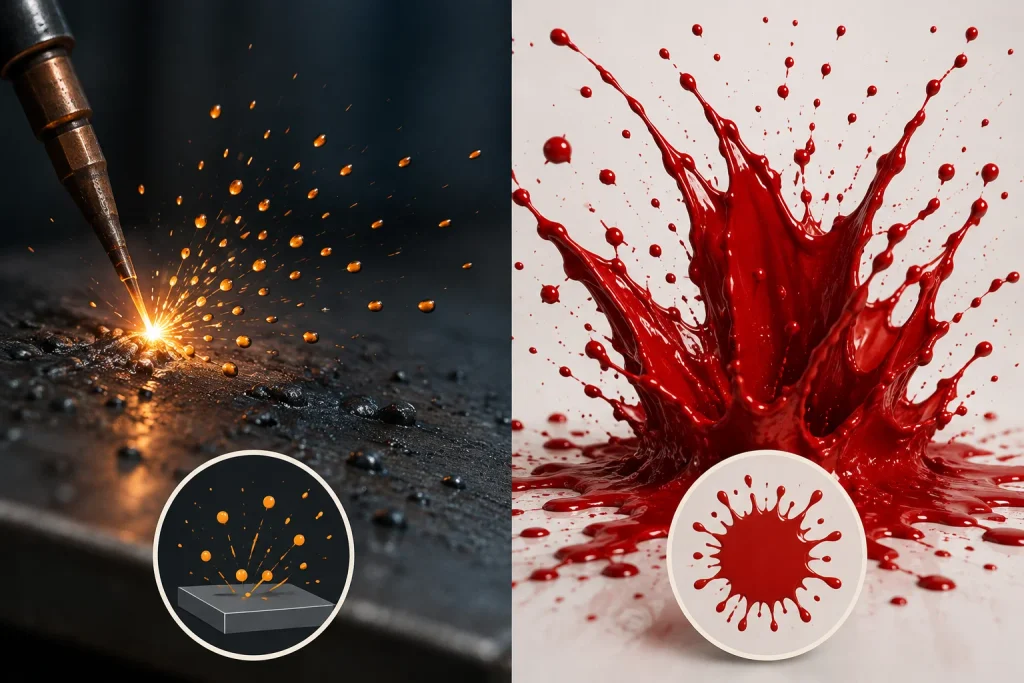
When liquid lands somewhere in scattered drops, should you call it spatter or splatter? The two words look almost identical, sound remarkably similar, and often appear in the same kinds of sentences. That overlap makes the choice surprisingly tricky.
You might describe paint on a wall as paint spatter or paint splatter. Mud can spatter your clothes or splatter across your car. Even phrases involving blood can use either word in everyday English. Yet the words aren’t completely interchangeable in every context.
The most useful distinction comes from what the liquid is doing and how the writer wants to portray the result. Spatter commonly emphasizes small drops scattered or falling onto a surface. Splatter often suggests a more noticeable, messy covering, especially when a thick or wet substance hits a surface. Cambridge Dictionary makes this distinction explicit in its definitions while also showing considerable overlap between the two words.
There is another important distinction in forensic science. In bloodstain pattern analysis, spatter is an established technical term, while everyday speakers may still say blood splatter. Understanding that difference can help you choose the right word for casual conversation, creative writing, academic work, or technical writing.
This guide explains spatter or splatter, including their meanings, grammatical functions, common uses, subtle differences, and practical examples.
Quick Answer
The simplest answer is this:
Spatter usually describes small drops of liquid scattered or falling onto a surface. Splatter often describes liquid, particularly a thicker or wetter substance, hitting and spreading across a surface in scattered drops.
| Feature | Spatter | Splatter |
| Basic idea | Small drops scattered or falling | Liquid hits and scatters across a surface |
| Typical emphasis | Scattered droplets | Messy impact or covering |
| Liquid | Often thin liquids | Often thicker or wetter liquids |
| Common examples | Rain, water, paint, grease, mud | Mud, paint, grease, sauces |
| Tone | Neutral and descriptive | More vivid and messy |
| Technical use | Established in bloodstain terminology | Common in everyday language |
| Verb | The rain spattered the window. | Mud splattered the car. |
| Noun | There was paint spatter on the floor. | There was paint splatter on the floor. |
However, this table should not be treated as an absolute grammatical rule.
English doesn’t provide a rigid scientific boundary between the two words in ordinary usage. A substance doesn’t suddenly become splatter instead of spatter because its droplets reach a particular size.
The distinction is primarily about meaning, emphasis, context, and established usage.
Cambridge defines spatter as dropping or scattering small drops of liquid onto a surface or liquid falling in small drops. It defines splatter as liquid, especially thick liquid, hitting and covering a surface with small drops.
The easiest way to think about it
Imagine two scenes.
Scene one: Light rain hits your car window in dozens of tiny drops.
The rain spattered against the window.
Scene two: A muddy tire races through a puddle and throws wet mud across your car.
The tire splattered the car with mud.
Both words describe scattered liquid. The second sentence simply creates a stronger sense of impact, mess, and coverage.
Is one word correct and the other wrong?
Usually, no.
In many ordinary sentences, both words can work.
For example:
- Paint spattered the floor.
- Paint splattered the floor.
Both are understandable and grammatical.
The choice depends on the picture you want the reader to imagine.
Spatter can sound more neutral, technical, or focused on individual droplets.
Splatter often sounds more vivid, dramatic, messy, or forceful.
That distinction becomes particularly important in professional writing.
What Does “Spatter” Mean?
Spatter means to scatter or cause small drops of liquid to land on a surface. It can also describe liquid falling or striking a surface in small drops.
The word works as both a verb and a noun, which makes it useful in everyday descriptions as well as technical contexts.
Spatter Definition
As a verb, spatter means to scatter small drops or bits of liquid over a surface. As a noun, it can refer to the scattered drops themselves or the act of liquid falling in small drops.
For example:
The passing truck spattered mud onto the sidewalk.
Here, spattered tells you what the mud did.
The mud didn’t necessarily form one large splash. Instead, scattered drops landed across another surface.
As a noun:
There was a spatter of paint on the floor.
Here, spatter refers to the scattered paint drops.
What Does Spatter Mean in Simple English?
In simple terms:
Spatter means small drops of liquid scattering onto something.
You can associate the word with many little drops rather than one large pool or splash.
Think about:
- raindrops hitting a window
- oil jumping from a hot pan
- mud thrown from a bicycle tire
- paint landing around a brush
- water bouncing off a wet surface
These situations can all involve spatter.
How “Spatter” Works as a Verb
The verb spatter can be transitive or intransitive.
A transitive use means something causes drops to land on another object.
The motorcycle spattered mud on my shoes.
The motorcycle is responsible for the mud reaching the shoes.
You can also use a passive construction:
My shoes were spattered with mud.
The shoes receive the action.
An intransitive use focuses on the liquid itself:
Rain spattered against the windshield.
Here, the rain acts without a direct object.
Other examples include:
- Oil spattered across the stovetop.
- Water spattered onto the tiles.
- Paint spattered onto the canvas.
- Mud spattered the cyclist’s jacket.
- Rain spattered against the roof.
- Grease spattered from the pan.
The verb can therefore describe both movement and result.
Common grammatical patterns with “spatter”
Several constructions are especially natural:
Spatter + object
The puddle spattered my clothes.
Spatter + something + with + liquid
The puddle spattered my clothes with muddy water.
Be + spattered + with + liquid
The walls were spattered with paint.
Liquid + spatter + against/onto/across + surface
Rain spattered against the glass.
These patterns make spatter flexible enough for both ordinary and formal writing.
How “Spatter” Works as a Noun
As a noun, spatter refers to scattered drops or the act of liquid landing in small drops.
For example:
A fine spatter of water covered the steps.
Here, the noun identifies the scattered water.
Another example:
There was grease spatter around the stove.
The word describes the small deposits produced by the grease.
You can also use the plural form:
The mechanic noticed oil spatters around the engine.
The plural spatters refers to individual scattered marks or droplets.
Spatter as a descriptive noun
The noun often works well when you want to emphasize a pattern of scattered droplets.
Compare:
There was water on the floor.
with:
There was a spatter of water on the floor.
The second sentence gives the reader more visual information. It suggests scattered marks rather than an unspecified amount of water.
Common Uses of Spatter
Spatter appears in many everyday situations.Rain and waterRain is a natural example:Rain spattered against the bedroom window.
The word creates an image of individual droplets repeatedly striking the glass.
You could also write:
A spatter of rain dotted the windshield.
This emphasizes the scattered droplets.
Mud
Mud frequently appears with spatter because moving vehicles, bicycles, and shoes can throw small drops outward.
The truck spattered mud across the road.
Or:
His jeans were covered in mud spatters.
The word works especially well when the marks are scattered rather than forming one continuous coating.
Paint
Painters may encounter spatter when using brushes, rollers, spray equipment, or other techniques.
The brush produced a fine spatter of blue paint.
This sentence emphasizes the scattered drops.
Cooking
Hot oil can spatter when it encounters moisture.
Be careful because the oil may spatter when you add the vegetables.
This is an especially useful everyday application of the word. Cambridge specifically gives cooking as an example of spatter because oil can scatter in small drops when heated.GreaseGrease can also spatter during cooking or mechanical work.Grease spattered across the inside of the machine.
The word highlights the scattered deposits.
Figurative writing
Spatter can sometimes be used figuratively.
A writer might describe a page as being spattered with notes, spattered with criticism, or spattered with references.
In such cases, the word borrows the visual idea of scattered spots and applies it to something abstract.
That makes spatter more versatile than a word used only for physical liquids.
Spatter Example Sentences
Here are practical examples showing how spatter works in different contexts:
- The rain spattered against the windows all night.
- The car spattered mud onto the pedestrians.
- Hot oil spattered across the stovetop.
- A fine spatter of paint covered the drop cloth.
- His boots left mud spatters on the hallway floor.
- Water spattered onto the counter when the pipe burst.
- The artist intentionally created a spatter effect on the canvas.
- Grease spattered the wall behind the stove.
- The windshield was marked with rain spatters.
- The machine left small oil spatters on the surrounding surface.
Notice the common thread: the language often focuses on small scattered drops or marks.
What Does “Splatter” Mean?
Splatter is closely related to spatter, but it often gives a stronger impression of impact, mess, thickness, or widespread coverage.
Cambridge Dictionary defines splatter as liquid, especially thick liquid, hitting and covering a surface with small drops. As a noun, splatter refers to drops of thick liquid that have splashed or fallen somewhere.
That distinction explains why splatter frequently appears with substances such as:
- mud
- paint
- sauce
- grease
- wet food
- other thick liquids
What Does Splatter Mean in Simple English?
A simple definition is:
Splatter means liquid hitting or spreading onto something in scattered drops, often creating a messy effect.
The important idea isn’t simply that the liquid forms drops.
It’s that the event often feels more noticeable or messy.
Imagine a spoon dropping thick tomato sauce onto a white shirt.
You might naturally say:
Tomato sauce splattered my shirt.
The word immediately communicates more than the mere presence of liquid. It suggests an uncontrolled, scattered mess.
How “Splatter” Works as a Verb
Like spatter, splatter can function as both a transitive and intransitive verb.
Transitive:
The muddy tires splattered the side of the car.
Passive:
The side of the car was splattered with mud.
Intransitive:
Mud splattered onto the pavement.
Each construction emphasizes liquid being scattered after some form of movement or impact.
Examples of the verb “splatter”
- The truck splattered mud across the windshield.
- Sauce splattered onto my shirt.
- Paint splattered across the floor.
- The wet clay splattered against the wall.
- The puddle splattered pedestrians as the bus passed.
- Grease splattered around the frying pan.
The verb often produces a vivid mental image.
How “Splatter” Works as a Noun
As a noun, splatter refers to scattered drops, particularly drops of a thicker liquid.
For example:
There was splatter on the kitchen wall.
Or:
The floor was covered with paint splatter.
The plural form splatters is also common:
Mud splatters covered the lower half of the car.
Cambridge gives examples involving paint and mud to illustrate this noun usage.
Splatter and visual description
One reason splatter feels more vivid is that the word naturally evokes a messy pattern.
Compare:
There was paint on the floor.
with:
There was paint splatter across the floor.
The second sentence suggests irregular marks, scattered drops, and a less controlled distribution.
That visual quality makes splatter especially useful in descriptive and creative writing.
Common Uses of Splatter
Mud and dirty water
Mud is one of the strongest everyday examples of splatter.
The truck splattered mud across the side of the house.
The sentence suggests more than isolated droplets. It creates an image of mud being thrown around through force or movement.
Paint
Artists can deliberately create splatter effects.
The artist splattered red paint across the canvas.
Here, splatter emphasizes an energetic, uncontrolled-looking technique.
A similar sentence could use spatter:
The artist spattered red paint across the canvas.
Both are possible. Splattered simply gives the scene a more forceful or messy feel.
Food and sauces
Thick foods naturally pair with splatter:
Tomato sauce splattered onto the counter.
Or:
The frying pan was surrounded by grease splatter.
This works because the substance is wet and can spread irregularly when it strikes a surface.
Accidents and messes
Splatter is especially useful when an accident produces an obvious mess.
The burst pipe splattered water across the bathroom.
Wet cement splattered the worker’s boots.
The word gives the event energy and visual immediacy.
Creative writing
Writers often choose splatter when they want a scene to feel dramatic, chaotic, or visually intense.
For example:
Waves crashed against the rocks, sending salty spray and foam across the pier.
Although splatter isn’t the only possible verb, it would create a more aggressive image in a sufficiently messy context.
Splatter Example Sentences
- Mud splattered across the car doors.
- Paint splattered onto the artist’s shoes.
- Tomato sauce splattered the white tablecloth.
- The tires splattered pedestrians with dirty water.
- Grease splattered around the frying pan.
- A splatter of paint appeared on the floor.
- The wall was covered with paint splatters.
- His jacket was splattered with mud.
- Wet clay splattered across the workshop floor.
- The accident left splatter across the nearby surface.
These examples show why splatter often feels more energetic than spatter. It brings attention to the event’s messy visual result.
The Core Meaning Difference
The difference between spatter and splatter becomes easier when you stop looking for a rigid rule and instead consider the mental image behind each word.
Spatter tends to emphasize scattered drops.
When you use spatter, the reader may picture numerous small drops distributed across a surface.
Rain spattered the window.
The important detail is the scattered droplets.
Splatter tends to emphasize impact and mess.
When you use splatter, the reader may picture liquid striking a surface and spreading in an irregular way.
Mud splattered the windshield.
The important detail is the messy result.
A useful comparison
| Sentence | What it emphasizes |
| Rain spattered the glass. | Repeated small drops |
| Mud splattered the glass. | Messy impact and coverage |
| Paint spattered the floor. | Scattered paint droplets |
| Paint splattered the floor. | More noticeable mess |
| Oil spattered from the pan. | Small drops of hot oil |
| Sauce splattered across the counter. | Thick liquid spreading messily |
Neither column represents an unbreakable rule.
The context decides what sounds most natural.
Does Spatter Mean Smaller Drops Than Splatter?
This is one of the most common questions about these words.
The answer is not as strict as many explanations suggest.
It’s tempting to memorize this:
Spatter = small drops
Splatter = big drops
But that formula is too simplistic.
Both words can describe small drops. Cambridge’s definition of splatter itself refers to small drops, especially when a thick liquid hits and covers a surface.
So droplet size alone cannot reliably determine which word you should use.
A better approach is to consider several factors:
- the substance involved
- how it moves
- whether impact is prominent
- whether the result appears messy
- whether the writing is technical or conversational
- which expression is established in that field
This approach produces more accurate English.
Does Splatter Always Mean More Force?
Not necessarily.
Splatter often suggests a forceful or messy event, but the word itself doesn’t establish a precise physical amount of force.
For example:
Sauce splattered onto the table.
The sentence doesn’t tell you exactly how much force caused the sauce to move.
It simply presents the result as scattered, wet, and messy.
Likewise:
Paint splattered across the canvas.
The artist may have thrown the paint deliberately, flicked it with a brush, or produced the effect through another technique.
Therefore, avoid treating force as a dictionary-level requirement.
It is better described as a common implication or stylistic tendency.
Why “Spatter” Often Sounds More Neutral
One reason spatter appears frequently in descriptive and technical language is that it can describe scattered drops without necessarily adding a strong emotional reaction.
Consider:
Small droplets spattered the surface.
That sounds relatively neutral.
Now compare:
Thick mud splattered the surface.
The second sentence feels more vivid.
It draws attention to the mess and the substance’s physical behavior.
This difference can matter in:
- scientific writing
- journalism
- technical documentation
- academic writing
- fiction
- everyday conversation
The best word isn’t determined only by dictionary definition. Register and context matter too.
Why “Splatter” Often Sounds More Vivid
The extra l in splatter isn’t just visually noticeable. The word itself has a punchier sound and often appears in descriptions involving sudden, messy movement.
Compare:
Water spattered onto the floor.
with:
Water splattered onto the floor.
The second version can feel more dramatic even when the underlying physical event is similar.
This is partly because English vocabulary often carries sound symbolism. Words such as splash, smash, crash, and splatter can evoke the physical character of the action they describe.
That doesn’t create a strict definition, but it helps explain why writers may instinctively choose splatter for vivid scenes.
Can Spatter and Splatter Be Interchanged?
Often, yes. Not always.
In ordinary English, the two words overlap considerably.
For example:
Paint spattered the wall.
and
Paint splattered the wall.
Both are natural.
However, replacing one word with the other can subtly change the tone.
When the substitution works well
You can often switch between them when describing:
- paint
- mud
- water
- grease
- rain
- food
- other liquids
For example:
The rain spattered the window.
could become:
The rain splattered the window.
The second version may sound slightly more dramatic or forceful.
When the substitution becomes less appropriate
Some contexts have established terminology.
Forensic science is the clearest example.
The technical field uses terms such as bloodstain pattern, forward spatter, and backspatter. NIST’s forensic terminology includes formal definitions for these concepts.
Therefore, casual interchangeability doesn’t mean professional terminology is interchangeable.
Which Word Should You Choose?
Use this practical decision guide.
Choose “spatter” when:
- You want to emphasize small scattered drops.
- The description is relatively neutral.
- You’re discussing rain or fine droplets.
- You’re writing technical or scientific material where spatter is established terminology.
- You want to describe scattered marks without emphasizing dramatic mess.
Choose “splatter” when:
- You want to emphasize a messy result.
- The liquid is thick or wet.
- The substance hits and spreads across a surface.
- The scene is vivid or dramatic.
- You’re writing conversational or creative prose.
- The context naturally involves paint, mud, food, grease, or similar substances.
A quick decision test
Ask:
Am I focusing on scattered droplets or the messy impact?If the focus is scattered droplets, spatter may fit better.If the focus is messy impact or coverage, splatter may fit better.If both descriptions seem accurate, either word may work. Choose the one that best matches the tone.
When Should You Use “Spatter”?
Spatter is particularly useful when you want precise, neutral descriptions of scattered drops.
Spatter in painting
Paint can spatter accidentally or intentionally.
The brush created a fine spatter of black paint.
The word works especially well when the emphasis is on individual scattered drops.
Spatter in cooking
Hot oil can spatter as it heats.
The bacon caused grease to spatter across the stovetop.
This is a common practical use.
If you’re giving safety instructions, spatter can sound particularly natural:
Lower the heat to reduce oil spatter.
Spatter with rain
Rain is another classic environment for spatter.
Rain spattered against the windows.
The word captures the repeated contact of droplets against glass, metal, pavement, or another surface.
Spatter with mud
Mud can also spatter.
The bicycle tires spattered mud across the sidewalk.
This sentence emphasizes the scattered marks produced by movement.
Spatter in descriptive writing
Spatter can add detail without making a scene unnecessarily dramatic.
A fine spatter of water covered the stone steps.
The phrase gives the reader a clear visual pattern.
Spatter in technical writing
This is where the word becomes particularly important.
Professional fields sometimes establish specialized terminology that shouldn’t be replaced simply because another word sounds familiar.
Bloodstain pattern analysis is one such field. The American Academy of Forensic Sciences’ Academy Standards Board has published a technical report containing recommended terms and definitions for bloodstain pattern analysis.
That makes spatter more than just an ordinary synonym in certain professional contexts.
What Is Forensic Science?
The phrase blood spatter is widely recognized, but modern forensic terminology is more precise than popular media often suggests.
Forensic professionals generally discuss bloodstain patterns and specific pattern classifications rather than treating every blood mark as simply “blood spatter.”
NIST defines a bloodstain pattern as a grouping or distribution of bloodstains whose arrangement can indicate how the pattern was deposited.
This distinction matters because forensic analysis isn’t merely about noticing red marks.
It involves interpreting characteristics such as:
- location
- size
- shape
- distribution
- direction
- relationships between stains
- possible mechanisms that produced the pattern
Forward spatter
Forward spatter pattern is an established forensic term. NIST defines it as a bloodstain pattern resulting from blood drops that can be produced when a projectile creates an exit wound.
Backspatter
Backspatter pattern is also an established term. NIST defines it as a bloodstain pattern resulting from blood drops that can be produced when a projectile creates an entrance wound.
These terms demonstrate why spatter matters in professional vocabulary.
Blood spatter vs. blood splatter
In everyday English, people commonly say:
blood splatter
The phrase is understandable and widely encountered.
But in technical forensic writing, blood spatter and more specific terms such as forward spatter or backspatter are more appropriate because they belong to established terminology.
That doesn’t make splatter an incorrect English word.
It means that technical fields develop preferred vocabulary.
Important distinction: bloodstain and spatter
A bloodstain is a deposit of blood on a surface. NIST uses that definition in its forensic glossary.
A bloodstain doesn’t automatically tell you how it got there.
A forensic analyst may examine a broader bloodstain pattern to determine how the stains relate to one another and how the pattern may have formed.
That is why technical terminology tends to be more specific than ordinary conversation.
A Practical Forensic Language Example
Consider these two sentences:
The movie showed blood splatter across the wall.
This is ordinary descriptive language.
Now consider:
The analyst documented a bloodstain pattern containing forward spatter.
This is technical language.
The second sentence uses terminology associated with forensic analysis rather than simply describing a messy visual scene.
The context changes the correct vocabulary.
That’s one of the most important lessons when deciding between spatter and splatter.
Why “Blood Splatter” Still Appears So Often
If spatter is the established technical term, why does blood splatter appear everywhere?
Because everyday English doesn’t always follow specialized professional terminology.
Movies, television shows, news reports, fiction, online discussions, and casual conversations often use familiar words rather than technical vocabulary.
The word splatter also naturally evokes a vivid, messy visual image. That makes it attractive in popular descriptions.
Cambridge itself provides an example of splatter being used with blood in general English examples.
So there is no need to assume that every occurrence of blood splatter is a grammatical mistake.
The better distinction is:
Everyday description: “blood splatter” can be natural.
Forensic terminology: “blood spatter” and specific bloodstain-pattern terms are preferred.
That difference between general English and domain-specific English is crucial.
Etymology and Word History
The close relationship between spatter and splatter isn’t surprising. Their forms are extremely similar, and their meanings overlap.
Where “spatter” comes from
The historical record places spatter in English by the 1570s. Etymological sources connect it with forms associated with scattering or splashing liquid, including Dutch or Low German influences. The noun use developed later.
The historical development helps explain why the word has long been associated with drops and scattered liquid.
Where “splatter” comes from
Splatter appeared later in English. Etymological sources date its verb use to the late 18th century and suggest that its formation may have been influenced by words such as spatter and splash.
That possible relationship is revealing.
Both words belong to a broader family of expressive English terms describing the movement and impact of liquids.
Why the words remain so similar
English often develops words by modifying existing forms.
A word may gain an extra sound or syllable while retaining part of the original meaning. Over time, the newer word can develop its own shades of meaning.
That appears to be part of the story behind splatter.
Instead of thinking:
“These words must have completely separate meanings.”
It’s more accurate to think:
“These words have closely related meanings that have developed slightly different tendencies.”
That explains their modern overlap.
What Is the Difference
If you need a one-sentence explanation, use this:
Spatter generally emphasizes small drops scattered or falling onto a surface, while splatter often emphasizes liquid hitting, spreading, or covering a surface in a messy way, especially with thicker substances.
This definition captures the central distinction without pretending that English has a rigid boundary between the two words.
A Simple Memory Trick
Here’s an easy way to remember the difference.
Think “spatter = scattered spots”
The word spatter can remind you of small scattered spots.
Rain spattered the glass.
Picture tiny drops spread across a surface.
Think “splatter = splashy mess”
The extra l in splatter can remind you of a larger-feeling, livelier mess.
Mud splattered the car.
Picture thick material striking and spreading.
Again, this is a memory aid, not a scientific definition.
It helps you choose naturally without forcing every example into an artificial rule.
Common Spatter and Splatter Mistakes
Understanding the words is easier when you know which assumptions to avoid.
Mistake: Treating them as completely different words
They aren’t.
Their meanings overlap substantially.
Paint spattered the wall.
and
Paint splattered the wall.
Both can work.
The difference is usually one of emphasis and context rather than basic grammatical correctness.
Mistake: Assuming droplet size creates an absolute rule
This is perhaps the most common oversimplification.
You shouldn’t assume:
tiny drops = spatter
large drops = splatter
The dictionary definitions don’t support such a rigid distinction. Splatter can itself describe small drops, particularly from thick liquid.
Instead, consider the whole event.
Mistake: Thinking “splatter” is incorrect English
Splatter is absolutely a real English word.
It functions as both a verb and a noun and appears in standard dictionaries.
For example:
Mud splattered the car.
Paint splatter covered the floor.
Cambridge lists both grammatical functions and provides numerous usage examples.
So there’s no reason to avoid splatter merely because spatter sometimes sounds more formal.
Mistake: Assuming “spatter” only belongs to forensic science
It doesn’t.
You can use spatter for:
- rain
- water
- paint
- mud
- oil
- grease
- food
- industrial materials
For example:
The pan began to spatter hot oil.
That’s ordinary English, not forensic terminology.
Mistake: Assuming “splatter” is always informal
Splatter is common in casual and descriptive language, but that doesn’t make it grammatically inferior.
It can appear in:
- journalism
- technical contexts
- art descriptions
- cooking instructions
- scientific discussions
- general nonfiction
The important question is whether it fits the meaning and register of the sentence.
Which Is More Formal?
Neither word is automatically formal or informal.
However, spatter can sound more neutral or technical, especially in contexts involving patterns of droplets.
Splatter often sounds more vivid and conversational because it strongly evokes mess and impact.
Compare:
The surface showed a pattern of paint spatter.
This sounds analytical.
The surface was covered in paint splatter.
This sounds more visual and descriptive.
Both sentences can be perfectly appropriate.
The choice depends on what you want the reader to notice.
Examples in Sentences
Everyday examples
The passing car spattered mud onto the sidewalk.
The bus splattered dirty water across my shoes.
Rain spattered against the windows.
Tomato sauce splattered the counter.
Hot oil spattered when the vegetables hit the pan.
Painting examples
The brush created a fine spatter of paint.
The artist deliberately splattered paint across the canvas.
Paint spattered onto the protective sheet.
Blue paint splattered across the white wall.
Formal descriptive examples
The surface contained a fine spatter of liquid droplets.
The examination revealed scattered spatter on the surrounding surface.
The fabric showed several small paint spatters.
Creative examples
Rain spattered against the old window as the storm approached.
Mud splattered across the windshield as the truck accelerated.
Thick paint splattered across the unfinished canvas.
The creative examples show how the two words can create different levels of visual intensity.
Splash
Another common source of confusion is splash.
Although these words overlap, they aren’t identical.
| Word | Typical idea |
| Spatter | Small drops scattered across a surface |
| Splatter | Liquid scattered through impact, often messily |
| Splash | A more noticeable amount of liquid moving or striking a surface |
Consider a puddle.If a tiny stone lands in it, water may spatter outward.If a heavy object drops into it, water may splash dramatically.If muddy water hits your clothes and leaves scattered wet marks, it may splatter your clothes.
These are tendencies rather than rigid physical classifications.
Spray
Spray usually involves a fine stream or mist of liquid particles being projected through the air.
For example:
The hose sprayed water across the garden.
Spatter emphasizes scattered drops reaching a surface.
The hose caused water to spatter across the pavement.
Splatter adds a stronger sense of messy impact or coverage.
The muddy hose water splattered across the wall.
The same liquid can therefore be described using different verbs depending on how it moves and what aspect of the movement matters.
Spill
A spill is different again.
When you spill something, the liquid escapes from its container or intended location.
She spilled coffee on the desk.
That doesn’t necessarily mean the coffee formed scattered droplets.
But if the coffee hits the floor and breaks into scattered drops, you might describe the resulting marks as spatter or splatter, depending on the context.
This gives you a useful conceptual distinction:
Spill = loss of containment.
Spatter = scattered drops.
Splatter = scattered liquid with an often messy impact or covering effect.
The Practical Rule
When you’re unsure, don’t ask only:
“Which word means small drops?”
Ask three better questions:
What is the substance?
Is it:
- thin water?
- rain?
- oil?
- thick mud?
- paint?
- sauce?
- grease?
What happened to it?
Did it:
- fall?
- scatter?
- strike?
- splash?
- spread?
- cover a surface?
What tone do you need?
Do you want:
- neutral description?
- technical precision?
- vivid imagery?
- informal conversation?
- dramatic storytelling?
These three questions usually lead you toward the most natural choice.
Final Comparison
| Question | Better tendency |
| Small scattered drops? | Spatter |
| Thick liquid hitting a surface? | Splatter |
| Neutral description? | Spatter |
| Vivid messy description? | Splatter |
| Rain hitting glass? | Spatter |
| Mud covering a car? | Splatter |
| Hot oil scattering? | Spatter |
| Paint thrown across canvas? | Splatter |
| Technical bloodstain terminology? | Spatter |
| Everyday phrase about a messy blood scene? | Splatter can occur |
| Strict droplet-size distinction? | No |
| Can the words overlap? | Yes |
The key is to treat these as closely related words with different tendencies, not as two completely separate categories.
Key Takeaways
- Spatter generally refers to small drops scattered or falling onto a surface.
- Splatter often describes liquid hitting and spreading across a surface in a messy pattern.
- Both words can function as verbs and nouns.
- Both can describe paint, mud, water, grease, and other liquids.
- Spatter often sounds more neutral or technical.
- Splatter often sounds more vivid, messy, or forceful.
- Droplet size does not create a strict rule separating the two.
- In forensic science, spatter is part of established bloodstain-pattern terminology.
- Blood splatter remains understandable and common in general English.
- Context, register, and intended emphasis should guide your choice.
When deciding between spatter or splatter, focus less on memorizing an artificial rule and more on the image your sentence needs to create. If you want to emphasize scattered droplets, spatter is often the natural choice. If you want to emphasize a thick, messy substance striking and covering something, splatter often fits better. And when you’re working in a specialized field such as forensic science, follow that field’s established terminology rather than relying solely on everyday usage.
The Real Difference
The difference between spatter and splatter is subtle because the two words overlap heavily in everyday English. In fact, major dictionaries treat them as closely related terms. Merriam-Webster lists splatter as a synonym of spatter, while Cambridge distinguishes them mainly by the type of liquid and the way it hits or covers a surface.
That means there isn’t a universal rule saying that one word must describe a particular droplet size, amount of liquid, or level of force. Instead, the words carry slightly different associations and emphases.
Spatter tends to focus on scattered drops
Spatter commonly draws attention to liquid being scattered in small drops.
Rain spattered against the window.
The sentence focuses on the individual droplets repeatedly striking the glass.
Another example:
Hot oil spattered across the stovetop.
Here, the important idea is the scattering of small drops.
Cambridge specifically defines spatter in terms of small drops falling or being scattered onto a surface. Merriam-Webster similarly describes it as liquid being propelled or scattered in drops.
Splatter tends to focus on impact and mess.
Splatter often creates a stronger image of liquid hitting, spreading, and leaving a messy pattern.
Mud splattered across the windshield.
The sentence doesn’t merely tell you that individual drops appeared. It creates an image of mud being thrown onto the glass.
Cambridge especially associates splatter with thick liquid hitting and covering a surface with small drops.
That makes splatter particularly natural with things such as:
- mud
- thick paint
- tomato sauce
- grease
- wet clay
- dirty water
- other messy substances
Still, thickness isn’t a requirement. It’s a common tendency rather than an absolute rule.
Spatter vs. splatter at a glance
| Feature | Spatter | Splatter |
| Central idea | Scattering in drops | Hitting and scattering |
| Common emphasis | Droplets and distribution | Impact, mess, and coverage |
| Typical tone | Neutral or descriptive | Vivid or messy |
| Often used with | Rain, water, oil, paint, mud | Mud, paint, sauce, grease, wet substances |
| Technical use | Important in some specialized terminology | Less likely in formal forensic terminology |
| Can describe paint? | Yes | Yes |
| Can describe mud? | Yes | Yes |
| Can describe rain? | Yes | Yes |
| Strict droplet-size rule? | No | No |
| Strict force requirement? | No | No |
The table shows tendencies, not grammatical laws.
Meaning and Emphasis
One of the easiest ways to understand spatter vs. splatter is to ask what the sentence emphasizes.Spatter often emphasizes the scattered pattern.Splatter often emphasizes the event and resulting mess.Consider these sentences:Tiny drops of rain spattered the glass.
Mud splattered the glass when the truck hit the puddle.
Both describe liquid reaching a surface. Yet the mental pictures differ.
The first sentence feels relatively controlled and observational. The second feels more energetic and messy.
Spatter creates a fine-scattered image.
When you read:
A fine spatter of paint covered the table.
you may picture numerous individual marks distributed over the surface.
The word works particularly well when the writer wants to describe a pattern rather than dramatize the event.
Splatter creates a more dynamic ima. g.e
Now consider:
Paint splattered across the table.
The action feels more energetic.
You can almost imagine the paint leaving the brush, traveling through the air, and landing irregularly.
That doesn’t mean the paint droplets were necessarily larger. It means splatter gives the action a more vivid character.
Is There a Difference?
Force is often discussed when people compare spatter or splatter, but it shouldn’t be treated as a strict dividing line.
A common explanation says:
Spatter involves less force, while splatter involves more force.
That’s useful as a rough mental shortcut, but it’s not a dependable definition.
A person can deliberately spatter paint with a brush. A small amount of liquid can splatter if it strikes a surface. The words don’t provide a precise measurement of physical force.
Merriam-Webster’s definitions demonstrate this overlap particularly well. It defines splatter as essentially spatter and gives examples involving rain, mud, eggs, and paint.
So instead of asking:
“How much force was involved?”
ask:
“What aspect of the event does the writer want to emphasize?”
That question is much more useful.
Droplet Size and Amount of Liquid
Droplet size is another area where simplified explanations can become misleading.
You may encounter the claim that:
- spatter means tiny droplets
- splatter means larger droplets
There is some intuitive appeal to this explanation, but it isn’t an absolute distinction.
Cambridge defines splatter as liquid hitting and covering a surface with small drops, especially when the liquid is thick.
That directly shows why droplet size can’t be the entire explanation.
Likewise, spatter can describe a noticeable amount of scattered material.
Merriam-Webster gives spatter meanings involving splashes, spots, stains, and scattered material.
Better rule
Think of droplet size as a possible characteristic, not a fixed definition.
The following description is more accurate:
Spatter often suggests scattered drops, while splatter often suggests scattered liquid produced by an impact or messy covering action.
This distinction works across far more examples.
Degree of Messiness
Messiness is one of the biggest practical differences between the words.
Compare:
A spatter of rain covered the window.
with:
Mud splattered all over the window.
The second sentence immediately feels messier.
This is partly because splatter is strongly associated with substances that leave visible, irregular marks.
You can see this association in common expressions such as:
- paint splatter
- mud splatters
- grease splatter
- sauce splatter
Merriam-Webster’s current examples include paint, mud, blood, grease, and other situations in which splatter describes scattered material or resulting marks.
Why “splatter” feels more dramatic
The sound of the word contributes to its expressive quality.
English contains many words whose sounds seem suited to the physical actions they describe:
- splash
- slap
- smack
- crack
- crash
- splatter
These words can make prose feel more immediate.
So if a writer wants the reader to see and almost hear the mess, splatter can be a stronger stylistic choice.
Formal vs. Informal Writing
Neither spatter nor splatter is inherently incorrect or grammatically inferior.
However, spatter can sometimes sound more neutral or technical, while splatter can sound more vivid and conversational.
Consider:
The surface contained a pattern of fine paint spatter.
This sounds analytical.
Now compare:
Paint splatter covered the floor.
This sounds more visual and everyday.
Both are acceptable. The difference is largely one of register and emphasis.
In formal writing
When writing academically or professionally, choose the term that matches the established terminology of your field.
For example, a technical document might discuss a spatter pattern rather than replacing the established term with splatter simply because both words exist.
In creative writing
You have more freedom.
Red paint spattered the canvas.
Sounds observational.
Red paint splattered across the canvas.
Sounds energetic.
A novelist can deliberately select either word to shape the scene.
Context Matters More Than a Formula
The same substance can take either word depending on the situation.
Paint
The brush spattered paint onto the paper.
The artist splattered paint across the canvas.
Both sentences are natural.
The first emphasizes scattered droplets. The second creates a stronger impression of deliberate, energetic application.
Mud
The tires spattered mud onto the road.
The tires splattered mud across the car.
Again, both work.
The second version may sound more natural when the focus is on the messy result.
Rain
Rain spattered against the roof.
Rain splattered against the roof.
Both are possible. Spattered often sounds more delicate or observational, while splattered can make the rain feel more vigorous.
Grease
Hot grease spattered across the stove.
Hot grease splattered across the stove.
Both work. The second can emphasize the mess created by cooking.
Are “Spatter” and “Splatter” Interchangeable?
They are often interchangeable, but not universally interchangeable.
This is the most important practical answer.
In ordinary descriptions, replacing one with the other may leave the sentence grammatically sound.
For example:
The dog spattered water everywhere.
The dog splattered water everywhere.
Both can be understood.
Merriam-Webster explicitly lists spatter among the synonyms of splatter and splatter among the synonyms of spatter.
That dictionary relationship confirms the substantial overlap.
However, synonyms rarely have perfectly identical meanings in every context.
Where they overlap strongly
The words commonly overlap when discussing:
- paint
- mud
- water
- rain
- grease
- food
- wet surfaces
- scattered drops
Where the choice matters
The distinction becomes more important when:
- you need a particular tone
- you’re describing a highly visual scene
- you’re writing technical material
- your field has established terminology
- you want to emphasize droplets rather than mess
- you’re choosing between neutral and dramatic language
In other words, interchangeable doesn’t mean identical.
When Should You Use “Spatter”?
Use spatter when scattered drops are the main idea or when the context calls for a neutral, precise description.
Use “spatter” for rain.
Rain is a natural match for spatter because individual droplets strike a surface repeatedly.
Raindrops spattered against the window.
Rain spattered across the windshield.
The word gives the sentence a sense of repeated droplets without necessarily implying a dramatic mess.
Use “spatter” for cooking
Cooking provides another common example.
Hot oil spattered my hands.
Grease spattered the stovetop.
This usage is especially useful when talking about small drops produced during frying.
Merriam-Webster includes cooking grease among its examples of spatter.
Use “spatter” for paint
You can describe paint that lands in scattered droplets:
The brush left paint spatters around the edge of the canvas.
The plural noun spatters works naturally when referring to individual marks.
Use “spatter” for mud.
Although splatter may sound more vivid with mud, spatter remains completely natural:
The passing truck spattered mud on my coat.
Cambridge uses a similar construction in its dictionary examples.
Use “spatter” when describing a pattern.n
If the visual arrangement matters, spatter can be especially useful:
The wall showed a fine pattern of paint spatter.
This makes the word valuable in descriptive, technical, and analytical writing.
When Should You Use “Splatter”?
Use splatter when you want to emphasize a messy, noticeable, or energetic scattering of liquid.
Use “splatter” for mud
Mud splattered across the side of the truck.
The word immediately suggests an unpleasant or messy result.
Use “splatter” for thick liquid.s
Cambridge specifically associates splatter with thick liquids that hit and cover a surface.
For example:
Tomato sauce splattered across the counter.
Wet clay splattered the floor.
Thick paint splattered onto the wall.
These examples naturally fit the word’s common associations.
Use “splatter” for dramatic descriptions.
If a scene needs strong visual energy, splatter can make the prose more vivid.
The artist splattered bright paint across the enormous canvas.
The verb moves feel active.
Use “splatter” when the result is visibly messy
The kitchen wall was covered in grease splatter.
This sounds natural because the noun focuses on the unwanted marks left behind.
Which Word Should You Choose?
When both words seem possible, use this decision guide:
| If your sentence emphasizes… | Consider |
| Small scattered drops | Spatter |
| A pattern of droplets | Spatter |
| Neutral description | Spatter |
| Technical terminology | Spatter, when established |
| A messy surface | Splatter |
| Thick liquid | Splatter |
| Strong impact imagery | Splatter |
| Dramatic or energetic movement | Splatter |
| Paint | Either |
| Mud | Either |
| Rain | Either, with different stylistic effects |
| Grease | Either |
| Forensic bloodstain terminology | Spatter |
The last row deserves special attention.
Specialized Contexts
Everyday English gives you considerable freedom. Specialized language can be much less flexible.
Forensic science is a particularly useful example.
In bloodstain pattern analysis, established terminology includes spatter.
NIST’s forensic lexicon includes terms such as Forward Spatter Pattern and defines it as a bloodstain pattern resulting from blood drops that can be produced when a projectile creates an exit wound.
Professional terminology therefore matters more than a simple dictionary synonym test.
Everyday English vs. technical English
Consider:
The movie showed blood splatter across the wall.
This is normal descriptive English.
Now consider:
The analyst documented a bloodstain pattern containing forward spatter.
This is specialized forensic language.
The second sentence isn’t simply a more formal way to say the first. It communicates a specific technical concept.
That’s why replacing spatter with splatter in every context can create an inaccurate or less precise result.
A Key Rule for Technical Writers
When a profession has an established term, use the established term even if a common synonym exists.
This principle applies far beyond spatter and splatter.
Technical vocabulary exists because professionals need consistent meanings.
Forensic terminology, for example, includes defined concepts involving:
- bloodstains
- bloodstain patterns
- forward spatter
- backspatter
- directionality
- areas of convergence
- areas of origin
The Academy Standards Board’s terminology work is specifically intended for forensic reports, scientific manuscripts, courtroom testimony, and education in bloodstain pattern analysis.
So the question isn’t always:
“Which word is grammatically correct?”
Sometimes the better question is:
“Which term does this professional field actually use?”
That’s a much more reliable approach.
Three Situations Compared
Situation: A rainy evening
Rain spattered against the window.
This sounds calm and descriptive.
Rain splattered against the window.
This sounds more energetic.
Best choice: Either can work. Spatter often produces the more neutral image.
Situation: A muddy road
The tires spattered mud onto the car.
Correct and natural.
The tires splattered mud onto the car.
Also correct and perhaps more vivid.
Best choice: Either works. Splattered emphasizes the mess more strongly.
Situation: Forensic analysis
The analyst examined the blood spatter pattern.
This uses established terminology.
The analyst examined the blood splatter pattern.
This may be understood by general readers, but it is less appropriate when precise forensic terminology is required.
Best choice: Use spatter and the field’s established terminology.
Why Context Controls the Choice
English vocabulary rarely operates as a collection of perfectly isolated boxes.
Words have:
- overlapping meanings
- common collocations
- stylistic associations
- specialized meanings
- historical relationships
- domain-specific preferences
Spatter and splatter are excellent examples.
Their dictionary meanings overlap. Merriam-Webster’s entry for splatter actually defines the verb as spatter and lists the noun as spatter, splash.
At the same time, Cambridge gives splatter a particular association with thick liquids hitting and covering surfaces, while spatter emphasizes small drops falling or scattering.
The result is a pair of words that are semantically close but stylistically distinct.
The Bottom Line
If you remember only one principle, remember this:
Spatter usually highlights scattered droplets, while splatter often highlights a messy or noticeable impact.
But don’t turn that principle into a rigid rule.
Paint can spatter. Paint can splatter.
Mud can spatter. Mud can splatter.
Rain can spatter. Rain can splatter.
The right choice depends on the image, tone, context, and terminology involved.
For everyday writing, choose the word that creates the clearest mental picture. For technical writing, choose the term established by the relevant field.
That approach is far more accurate than trying to separate spatter and splatter by an imaginary cutoff for droplet size or physical force.
When Should You Use “Splatter”?
Splatter works best when the sentence needs a stronger sense of movement, impact, mess, or visible coverage. It commonly describes liquids that strike a surface and scatter into irregular drops.
The word is especially natural when the substance itself feels wet, thick, dirty, or difficult to control.
Use “splatter” for messy accidents.
When something suddenly lands across an unwanted surface, splatter often gives the sentence more visual energy.
The passing truck splattered mud across the windshield.
The broken pipe splattered water onto the bathroom floor.
The child dropped the bowl, and soup splattered across the table.
These sentences don’t simply report that liquid appeared. They suggest an active event with a noticeable result.
Use “splatter” for thick liquids.
Cambridge Dictionary particularly associates splatter with thick liquids that hit and cover a surface with small drops.
Common examples include:
- mud
- tomato sauce
- thick paint
- wet clay
- grease
- gravy
- other viscous liquids
For example:
Tomato sauce splattered across the counter.
Wet clay splattered the workshop floor.
Thick blue paint splattered the artist’s shoes.
The thickness of the substance isn’t an absolute requirement. It’s simply a strong usage tendency.
Use “splatter” when the mess matters.
Sometimes the physical process isn’t important. The visible mess is.
The kitchen wall was covered in grease splatter.
Here, the noun splatter focuses on the marks left behind.
Compare:
There was grease on the wall.
with:
There was grease splatter on the wall.
The second sentence gives the reader a much clearer visual impression.
Use “splatter” in creative descriptions
Writers often choose splatter because it creates a lively, almost cinematic image.
Bright yellow paint splattered across the unfinished canvas.
Mud splattered the boots as the hikers crossed the trail.
Water splattered against the pavement beneath the leaking pipe.
The word adds movement without requiring a long explanation.
Use “splatter” for intentional artistic techniques
Splattering isn’t always accidental.
Artists can deliberately throw, flick, drip, or scatter paint across a surface.
The artist splattered black paint across the canvas.
The verb describes the technique while also suggesting its energetic appearance.
In this context, spatter would also be possible:
The artist spattered black paint across the canvas.
The difference is mainly stylistic. Splattered gives the action a more forceful and visually dramatic quality.
Forensic Science
The distinction between spatter and splatter becomes especially important in forensic science because professional terminology isn’t always the same as everyday vocabulary.
People often hear the phrase blood splatter in movies, television shows, news reports, and casual conversations. However, forensic professionals use more specific terminology centered on bloodstain patterns and spatter.
The National Institute of Standards and Technology (NIST) defines a bloodstain pattern as a grouping or distribution of bloodstains whose arrangement can provide information about how the pattern was deposited.
That wording matters.
Forensic analysis isn’t simply about noticing drops on a wall or floor. It involves examining the location, size, shape, distribution, and other characteristics of bloodstains to interpret how a pattern may have formed.
Why “blood spatter” is the established term
In bloodstain pattern analysis, spatter is an established technical term.
The American Academy of Forensic Sciences’ Academy Standards Board has published terminology and definitions specifically for bloodstain pattern analysis. Such standardized terminology helps forensic professionals communicate consistently in reports, scientific publications, education, and courtroom settings.
This is why technical expressions such as:
- blood spatter
- forward spatter
- backspatter
- bloodstain pattern
appear in forensic literature.
What is forward spatter?
Forward spatter is a specific forensic term.
NIST defines a forward spatter pattern as a bloodstain pattern resulting from blood drops that can be produced when a projectile creates an exit wound.
The important point for this article is not the forensic mechanism itself. It’s the terminology.
Professionals call this forward spatter, not forward splatter.
That distinction demonstrates how specialized fields can give particular words a more precise role.
What is backspatter?
Backspatter is another established forensic expression.
NIST defines a backspatter pattern as a bloodstain pattern resulting from blood drops that can be produced when a projectile creates an entrance wound.
Again, the preferred technical word is spatter.
This doesn’t mean splatter is an incorrect English word. It simply means that forensic science has developed standardized terminology that should be followed in technical contexts.
Blood Spatter vs. Blood Splatter
The difference between blood spatter and blood splatter is largely a difference between technical terminology and everyday language.
“Blood spatter”
Blood spatter is the more appropriate choice when discussing bloodstain pattern analysis in a technical or professional context.
For example:
The forensic analyst examined the blood spatter pattern.
Or:
The report documented several areas of forward spatter.
These sentences use terminology associated with forensic practice.
“Blood splatter”
Blood splatter is common in general English.
For example:
The movie showed blood spatter across the wall.
This sentence is completely understandable because the writer is describing a visual scene rather than presenting a technical forensic analysis.
The distinction can therefore be summarized as:
| Context | Preferred wording |
| Casual conversation | Blood splatter can be natural |
| Fiction | Blood spatter can be natural |
| Movie description | Blood spatter is common |
| General journalism | Either may appear depending on context |
| Forensic report | Blood spatter/bloodstain terminology |
| Scientific BPA discussion | Spatter terminology |
| Technical forensic testimony | Established BPA terminology |
Why technical terminology matters
Technical vocabulary reduces ambiguity.
Imagine a field where several words appear to mean roughly the same thing. If professionals constantly switched between them, communication could become less consistent.
Standardized terminology provides a shared vocabulary.
The forensic field therefore distinguishes among specific concepts rather than treating every blood mark as interchangeable with every other description.
The UK Forensic Science Regulator’s current guidance on bloodstain pattern analysis describes examination of characteristics such as the location, size, shape, and distribution of bloodstains. It also recognizes physical factors including surface tension, viscosity, impact, movement, gravity, and air resistance when considering bloodstain patterns.
This level of analysis is much more precise than simply asking whether something looks like “blood splatter.”
Blood Spatter Doesn’t Mean Every Bloodstain
Another useful distinction is between bloodstain and spatter.
A bloodstain is essentially a deposit of blood on a surface.
A bloodstain pattern, however, refers to a grouping or distribution of stains whose arrangement can provide information about how the pattern was deposited. NIST’s terminology reflects this distinction.
That means a forensic analyst isn’t necessarily looking at one isolated drop and calling it “blood spatter.”
The analyst may examine:
- individual stains
- groups of stains
- stain shapes
- stain distribution
- directionality
- relationships among stains
- possible mechanisms that produced the pattern
This is one reason bloodstain pattern analysis is a more precise expression than the broad phrase “blood splatter analysis.”
Why Movies Often Say “Blood Splatter”
Popular media tends to favor language that ordinary audiences immediately understand.
Splatter is a vivid word. It creates an immediate mental picture of liquid scattered across a surface.
That’s useful for:
- horror movies
- crime dramas
- novels
- video games
- comic books
- casual storytelling
A screenwriter might write:
Blood splattered across the wall.
The goal is visual impact rather than technical classification.
A forensic report has a different goal:
The examination identified a bloodstain pattern containing forward spatter.
The second sentence sounds less dramatic because precision matters more than visual effect.
Neither sentence is inherently wrong. They’re performing different communicative jobs.
Technical Language vs. Everyday Language
This distinction provides one of the most useful lessons in the entire topic.
| Everyday English | Specialized English |
| Flexible | More standardized |
| Synonyms can often overlap | Established terminology matters |
| Style influences word choice | Precision influences word choice |
| “Blood splatter” may be understandable | “Blood spatter” is preferred in BPA terminology |
| Visual effect often matters | Technical meaning matters |
The same principle appears across many professions.
A word can have one broad meaning in everyday speech and a more specialized role in a particular discipline.
Spatter is a strong example of that phenomenon.
Etymology and Word History
The close relationship between spatter and splatter becomes easier to understand when you look at their history.
These words don’t merely happen to resemble one another. Their forms and meanings have developed within a larger family of English words associated with splashing, scattering, and liquid movement.
The history of “spatter”
The word spatter has been recorded in English since the 1570s, according to etymological sources.
Its origins are uncertain, although historical forms have been connected with Dutch and Low German words associated with scattering or splashing. Etymonline dates the noun sense to the late 18th century.
That long history helps explain why spatter has such a broad range of uses today.
It can describe:
- rain
- water
- paint
- mud
- oil
- grease
- stains
- scattered marks
The underlying image is consistently related to material being scattered in drops or spots.
The history of “splatter”
Splatter appeared later.
Etymonline dates the verb to 1784 and suggests that its formation may have been influenced by spatter and splash.
That possible connection is especially interesting because splatter combines ideas already associated with other expressive words.
Consider the relationship:
spatter → scattered drops
splash → liquid movement
splatter → vivid scattering or messy impact
This isn’t a formal equation. It’s a useful way to understand why the words feel related.
Why the extra “l” matters stylistically
English contains many expressive words whose sounds seem to reinforce their meanings.
Words such as:
- splash
- splatter
- slap
- slam
- smash
- crash
often feel energetic because of their sound patterns.
This doesn’t mean sound determines dictionary meaning. It does help explain why splatter often feels more vivid than spatter.
When a writer chooses splatter, the word itself can contribute to the sensory quality of the sentence.
How the Meanings Developed
Both words have retained their central association with scattered liquid, but splatter developed a stronger association with messy or impactful action.
That distinction is useful because it explains modern usage without pretending that the two words evolved into completely separate categories.
Think of them as linguistic relatives.
They share a common semantic neighborhood, but each has developed its own preferred territory.
Spatter’s modern territory
Spatter often fits descriptions involving:
- droplets
- scattered marks
- rain
- water
- oil
- paint
- neutral descriptions
- technical terminology
Splatter’s modern territory
Splatter often fits descriptions involving:
- messy surfaces
- thick liquids
- dramatic movement
- paint
- mud
- sauces
- grease
- vivid descriptions
The territories overlap.
That’s why native speakers can sometimes choose either word without creating a grammatical error.
Why Etymology Helps Explain the Similarity
If two words seem almost identical, learners sometimes assume one must be a mistake or a newer spelling of the other.
That’s not the case here.
The historical relationship helps explain why spatter and splatter have overlapping meanings.
At the same time, language changes through repeated usage. Speakers gradually develop preferences for certain combinations.
For example:
rain spatter
sounds natural.
mud splatter
also sounds natural.
But:
forward splatter pattern
doesn’t fit established forensic terminology nearly as well as:
forward spatter pattern
These preferences are part of how vocabulary develops.
Collocations Matter
A collocation is a word combination that speakers commonly use together.
Collocations can be extremely useful when deciding between similar words.
Common “spatter” combinations
You may encounter:
- rain spatter
- paint spatter
- oil spatter
- grease spatter
- mud spatter
- blood spatter
- spatter pattern
- spattered surface
- spattered with paint
- spattered with mud
Common “splatter” combinations
You may encounter:
- paint splatter
- mud splatter
- grease splatter
- sauce splatter
- blood splatter
- splatter pattern
- splattered across
- splattered onto
- splattered with mud
- splattered with paint
Notice something important: both lists contain many of the same substances.
That’s another reason why an overly rigid distinction doesn’t work.
The surrounding words and context often tell you which option sounds most natural.
A Useful Case Study: Paint on a Canvas
Imagine an artist working on a large white canvas.
A brush flicks several tiny drops of blue paint onto the surface.
You could write:
The brush created a fine spatter of blue paint.
This sounds observational and emphasizes the scattered droplets.
Now imagine the artist deliberately swings the brush and sends paint across the canvas.
You could write:
The artist splattered blue paint across the canvas.
This version feels more energetic.
What changed?
Not necessarily the chemistry of the paint.
Not necessarily the exact size of every drop.
The major difference is the writer’s emphasis.
The first sentence highlights the resulting pattern.
The second highlights the energetic action and messy visual effect.
That’s the practical heart of the distinction.
Another Case Study: Mud on a Car
Imagine driving through a muddy puddle.
You might say:
The tires spattered mud onto the car.
This is perfectly natural.
You could also say:
The tires splattered mud onto the car.
That version feels messier and more forceful.
Now change the purpose of the sentence.
Neutral report
The vehicle showed several areas of mud spatter.
Vivid description
Mud splattered across the vehicle as it sped through the puddle.
The first sounds observational.
The second sounds cinematic.
Neither requires a completely different physical event.
Another Case Study: Cooking Oil
Imagine frying vegetables in a hot pan.
You might warn someone:
Be careful. The oil may spatter.
This is a straightforward warning about small droplets.
You could also say:
The oil may splatter onto the counter.
The second version draws more attention to the messy result.
Again, the words overlap.
The choice depends on what you want to communicate.
The Best Rule for Writers
When you’re writing and hesitate between spatter or splatter, avoid trying to calculate the exact size of each droplet.
Instead, ask:
What picture should the reader see? If the image is a field of scattered drops, spatter may be ideal.If the image is a sudden, messy burst of liquid covering something, splatter may be more effective.If you’re writing for a technical audience, ask another question:
Does this field have an established term?
If the answer is yes, use that terminology.
This approach works better than memorizing a simplistic “small versus large” rule.
Quick Decision Guide
Use spatter when you want to emphasize:
- scattered droplets
- small drops
- a pattern of spots
- neutral description
- rain or water
- oil or grease
- established forensic terminology
Use splatter when you want to emphasize:
- messiness
- impact
- visible coverage
- thick liquids
- mud
- paint
- sauce
- dramatic action
When both seem appropriate, choose based on tone and context.
The words are close enough that either may be grammatically correct in many ordinary sentences.
The important difference is often what the reader is encouraged to notice.
What to Remember
The relationship between these words becomes much simpler once you stop treating them as exact opposites.
Spatter is the more neutral word for scattered drops and appears in established technical expressions such as blood spatter, forward spatter, and backspatter.
Splatter often creates a stronger image of messy impact, especially when thick liquid hits and covers a surface.
Their meanings overlap enough that you can use either word for substances such as paint, mud, rain, water, and grease in many ordinary situations.
The safest practical rule is:
Use “spatter” when scattered droplets or technical precision are central. Use “splatter” when messy impact, vivid movement, or thick liquid is the focus.
Most importantly, don’t force every sentence into a rigid distinction based only on droplet size or force. Context determines the most natural choice.
Common Mistakes, Memory Tricks, and Examples
Understanding spatter or splatter becomes much easier once the major distinction is clear. However, many writers still make mistakes because the two words overlap in everyday English. The biggest problem isn’t usually grammar. It’s assuming that the words have a perfectly fixed boundary.
A better approach is to look at context, emphasis, tone, and established terminology. The following sections cover the mistakes to avoid, practical ways to remember the difference, sentence examples, and several related words that can confuse.
Common Mistakes With Spatter and Splatter
Assuming “spatter” and “splatter” have completely separate meanings
One of the most common mistakes is treating spatter and splatter as if they describe two completely different physical events.
They don’t.
The words overlap substantially. Both can describe liquid being scattered in drops across a surface.
For example:
Paint spattered across the canvas.
and:
Paint splattered across the canvas.
Both sentences are grammatical and understandable.
The difference comes from the impression created by the wording.
Spattered can sound more neutral and focused on scattered drops. Splattered often sounds more energetic, messy, or visually dramatic.
Assuming “spatter” always means tiny droplets.
This explanation appears frequently in discussions of spatter vs. splatter, but it shouldn’t be treated as an absolute rule.
It’s reasonable to associate spatter with small scattered drops. That’s part of its normal meaning.
However, English doesn’t define a precise maximum droplet size for spatter.
Consider:
The wet road spattered mud onto the car.
The sentence doesn’t tell you that every drop had a particular diameter.
It simply describes mud being scattered.
Therefore, don’t try to determine the correct word by measuring imaginary droplets.
Assuming “splatter” always means large droplets.
The opposite mistake is equally misleading.
Splatter often creates a stronger impression of a messy event, but it doesn’t require large drops.
Cambridge Dictionary describes splatter in terms of liquid, particularly thick liquid, hitting and covering a surface with small drops.
That means small droplets can still be splatter.
A better distinction is:
Spatter emphasizes scattered drops. Splatter often emphasizes the messy action or resulting coverage.
This explanation works across more situations.
Assuming force determines the word
Another common rule says:
Low force = spatter
High force = splatter
That isn’t reliable.
Force can influence the resulting pattern of liquid, but the words themselves don’t establish a precise force threshold.
For example:
The artist spattered paint across the canvas.
The artist could use a deliberate flicking motion.
Meanwhile:
Sauce splattered onto the table.
The amount of force could be quite small.
The choice depends on how the event is described, not on a measurable force level.
Thinking “splatter” is incorrect English.
Splatter is a standard English word.
It works as both a verb and a noun.
As a verb:
Mud splattered the windshield.
As a noun:
There was mud splatter on the windshield.
It appears in standard dictionaries and has been part of English usage for centuries.
So replacing splatter with spatter simply because spatter sounds more formal isn’t necessary.
Thinking “spatter” only relates to blood.d
Because people frequently encounter phrases such as blood spatter, they sometimes assume spatter belongs mainly to forensic science.
That’s incorrect.
Everyday English uses spatter for many substances:
- rain
- water
- mud
- paint
- oil
- grease
- food
- other liquids
For example:
Hot oil spattered the stovetop.
No forensic context exists here.
Thinking “blood splatter” is always grammatically wrong
This is another important misconception.
Blood splatter is understandable and commonly used in general English, particularly in fiction, movies, television, and casual descriptions.
However, forensic science uses established terminology centered on bloodstain patterns and spatter.
So the distinction is contextual:
General description: blood splatter can be natural.
Technical forensic writing: blood spatter and specific bloodstain-pattern terminology are preferable.
Calling blood splatter “ungrammatical” would therefore be inaccurate.
Ignoring established technical terminology
A synonym can be perfectly acceptable in everyday English while being inappropriate in a specialized discipline.
Forensic science is a strong example.
If a professional report discusses forward spatter, replacing that term with forward splatter would sacrifice established terminology.
The same principle applies throughout technical writing.
Before replacing a word with a synonym, ask:
Does this field use a standardized term?
If it does, use the established terminology.
Assuming one word is always more formal
It’s tempting to think:
Spatter = formal
Splatter = informal
That’s too simple.
Spatter can sound more neutral or technical in some contexts.
Splatter can sound more vivid and conversational.
But both are legitimate words that appear in many types of writing.
The real question is whether the word fits the purpose and context.
How to Remember the Difference Between Spatter and Splatter
A good memory trick should make the distinction easier without turning a tendency into a false rule.
Remember “spatter” as scattered spots
Think:
SPATTER → scattered spots
The idea is a collection of droplets or marks spread over a surface.
For example:
A fine spatter of paint covered the paper.
The mental image is a surface containing many scattered spots.
Remember “splatter” as a splashy mess.
Think:
SPLATTER → splashy mess
The extra l can remind you of a lively, messy action.
For example:
Mud splattered across the side of the truck.
The mental image is energetic and messy.
Again, this is a memory device, not a dictionary definition.
Use the “What do I want to show?” test
When you’re uncertain, ask yourself:
Do I want the reader to notice the scattered drops or the messy impact?
If the scattered pattern is the main idea, spatter may be the better choice.
If the messy impact is the main idea, splatter may be more effective.
Use the “technical or vivid?” test.
Ask one more question:
Is this technical language or vivid description?
For technical forensic terminology, spatter is the established choice in expressions such as forward spatter and backspatter.
For vivid descriptions of paint, mud, sauce, or similar substances, splatter may sound more natural.
This two-question test is easy to apply:
Scattered pattern → spatter
Messy impact → splatter
Technical forensic term → spatter
Vivid messy description → splatter
Examples in Sentences
Examples are one of the fastest ways to understand subtle vocabulary differences. The following sentences show how both words behave in real contexts.
Everyday examples with “spatter”
Rain spattered against the bedroom window.
The passing car spattered mud onto my shoes.
Hot oil spattered across the stovetop.
Water spattered onto the bathroom tiles.
Grease spattered the wall behind the pan.
The bicycle tires spattered mud onto the pavement.
Each example emphasizes scattered droplets or marks.
Everyday examples with “splatter”
Mud splattered across the side of the car.
Tomato sauce splattered onto the counter.
Paint splattered across the artist’s shoes.
Wet clay splattered the workshop floor.
Grease splattered around the frying pan.
Dirty water splattered onto the sidewalk.
These sentences tend to create a stronger impression of mess and impact.
Spatter or Splatter With Paint
Paint is an excellent example because both words work naturally.
With “spatter”
The brush created a fine spatter of blue paint.
This sounds like a description of the resulting pattern.
With “splatter”
The artist splattered blue paint across the canvas.
This sounds more energetic and action-oriented.
What changes?
The paint hasn’t necessarily changed.
The writer’s focus has changed.
Spatter draws attention toward the scattered droplets.
Splatter draws attention toward the energetic action and resulting mess.
This is exactly why rigid rules don’t work well for these words.
Spatter or Splatter With Mud
Mud provides another strong example.
The tires spattered mud onto the road.
This is neutral and descriptive.
The tires splattered mud across the car.
This feels more vivid and messy.
Both sentences work because mud can reasonably be described using either word.
The second sentence simply creates a stronger sense of unwanted coverage.
Spatter or Splatter With Rain
Rain can also work with either word.
Rain spattered against the glass.
This creates an image of scattered droplets.
Rain splattered against the glass.
This can make the rain seem more energetic.
For calm descriptive prose, spatter may be the more natural choice.
For dramatic prose, splatter may create more movement.
Spatter or Splatter With Oil
Hot oil often produces scattered drops.
Hot oil spattered from the frying pan.
This is a very natural construction.
You can also say:
Hot oil splattered around the stove.
The first sentence focuses more directly on the droplets. The second gives greater attention to the resulting mess.
Both are useful.
Spatter or Splatter With Food
Thick sauces and liquids frequently work well with splatter.
The pasta sauce splattered onto the white shirt.
The sentence immediately creates an image of an annoying stain.
You could say:
The pasta sauce spattered onto the white shirt.
That’s also possible, but splattered often feels more vivid in this situation.
Formal Writing
Formal writing requires more attention to precision.
Consider:
The surface contained a fine pattern of paint spatter.
This sounds analytical.
Now compare:
The surface was covered with paint splatter.
This is still grammatical, but it has a more general and visual quality.
Neither sentence is automatically better.
The first is useful when discussing patterns and observations.
The second works when describing visible mess or coverage.
A useful formal-writing principle
Don’t choose a word merely because it sounds more sophisticated.
Choose the word that communicates the intended meaning most accurately.
A simple word used precisely is better than an impressive-looking word used incorrectly.
Creative Writing
Creative writers have greater freedom because sound and imagery matter.
Compare:
Rain spattered against the window.
This creates a relatively restrained image.
Rain splattered against the window.
This feels more forceful.
Or:
Red paint spattered across the canvas.
versus:
Red paint splattered across the canvas.
The second sentence has more energy.
Writers can therefore use the distinction intentionally.
Creative writing tip
If the scene needs subtle realism, spatter may work well.
If the scene needs energy, chaos, or mess, splatter may be the stronger choice.
News and Media
News writing often favors clarity over dramatic wording.
A general report might say:
Mud splattered the road after the vehicle overturned.
That’s natural because the writer is describing a visible event.
A technical report may instead use more specialized vocabulary.
The choice should depend on the subject and intended audience.
For sensitive subjects, particularly crime reporting, writers should also avoid assuming that a visible pattern proves a particular event or mechanism. Description and interpretation aren’t the same thing.
That distinction matters in responsible reporting.
Commonly Confused Related Words
The words spatter and splatter belong to a broader group of words describing liquid movement.
The most commonly confused relatives include:
- splash
- spray
- spill
- sprinkle
- splosh
- smear
- splatter
Understanding their differences helps you choose a more precise verb.
Spatter vs. Splash
Splash usually suggests a more substantial movement of liquid.
For example:
The child splashed water into the pool.
This doesn’t primarily focus on tiny scattered drops.
Now compare:
Water spattered across the floor.
The second sentence focuses more on scattered droplets.
Simple distinction
Splash → a noticeable movement or disturbance of liquid.
Spatter → scattered drops.
Splatter → scattered liquid with a stronger messy or impactful impression.
These meanings can overlap, but the mental images differ.
Splatter vs. Splash
Consider a muddy puddle.
The truck splashed through the puddle.
The emphasis is on the vehicle entering and disturbing the water.
The truck splattered mud across the sidewalk.
Now the emphasis is on the muddy material landing elsewhere.
The first word describes the movement through liquid.
The second describes the scattered result.
Spatter vs. Spray
Spray generally describes liquid projected as a stream, mist, or collection of fine particles.
For example:
The sprinkler sprayed water over the lawn.
The water is deliberately projected outward.
Compare:
The sprinkler caused water to spatter onto the sidewalk.
Here, the emphasis is on the droplets reaching a surface.
Quick comparison
| Word | Main idea |
| Spray | Project liquid outward, often as mist or fine droplets |
| Spatter | Scatter drops onto or against a surface |
| Splatter | Scatter liquid in a messy or impactful way |
| Splash | Move or strike liquid with a noticeable disturbance |
Splatter vs. Spill
A spill usually means that a liquid escapes from a container or its intended location.
She spilled coffee on the desk.
The key event is the loss of containment.
Now consider what happens afterward:
The spilled coffee splattered across the desk.
Here, the focus shifts to how the liquid spreads into scattered marks or drops.
Therefore:
Spill = liquid escapes.
Spatter = liquid scatters in drops.
Splatter = liquid scatters with an often messy visual effect.
Spatter vs. Sprinkle
Sprinkle usually suggests small amounts of something being distributed lightly or deliberately.
She sprinkled sugar over the dessert.
The action is controlled.
Compare:
The hot oil spattered across the stove.
The oil’s movement is uncontrolled.
This gives you a useful contrast:
Sprinkle often implies deliberate distribution.
Spatter often implies scattered droplets produced by movement, impact, or another physical process.
Spatter vs. Smear
A smear is different because it usually involves material being spread across a surface rather than scattered into separate droplets.
He smeared paint across the wall.
The paint forms a continuous or elongated mark.
Compare:
He spattered paint across the wall.
Now the paint appears in scattered drops or spots.
Visual difference
Spatter: ● · ● · · ●
Smear: ─────────
The first suggests separate deposits.
The second suggests continuous spreading.
A Comparison Table
| Word | Core image | Typical movement | Example |
| Spatter | Scattered drops | Scattering or falling | Rain spattered the glass. |
| Splatter | Messy scattered liquid | Impacting and spreading | Mud splattered the car. |
| Splash | Disturbed liquid | Moving or striking | Water splashed onto the floor. |
| Spray | Projected droplets or mist | Being propelled outward | The hose sprayed water. |
| Spill | Escaping liquid | Leaving a container | Coffee spilled on the desk. |
| Sprinkle | Light distribution | Deliberately scattering | She sprinkled sugar over the cake. |
| Smear | Spread-out material | Rubbing or spreading | He smeared paint across the wall. |
These distinctions are useful because they show that liquid movement vocabulary is highly contextual.
Choosing the Right Word in Real Situations
When you’re editing a sentence, use the following checklist.
If the sentence describes scattered droplets
Choose spatter when it sounds natural.
Fine rain spattered the window.
If the sentence describes a messy coating
Consider splatter.
Mud splattered the side of the truck.
If the substance is thick
Splatter may create a stronger image.
Sauce splattered across the counter.
If the sentence is technical
Check the terminology used by the relevant field.
For forensic bloodstain analysis, spatter is established terminology.
If both words work
Choose according to tone.
Neutral: spatter
Vivid: splatter
That isn’t an absolute rule, but it is a useful writing strategy.
A Quick Test
Before publishing a sentence, ask these questions:
Is the focus on scattered drops?
→ Spatter may fit.
Is the focus on a messy impact?
→ Splatter may fit.
Is the liquid thick?
→ Splatter may sound especially natural.
Is the context technical or forensic?
→ Check for established spatter terminology.
Could both words describe the event?
→ Choose according to tone and emphasis.
Are you trying to distinguish the words solely by droplet size?
→ Don’t. That rule is too rigid.
The Most Important Lessons
The distinction between spatter and splatter isn’t a simple matter of right versus wrong.Both are legitimate English words.
Both function as nouns and verbs.
Both can describe substances such as paint, mud, rain, water, grease, and food.
The main difference is often emphasis.
Spatter commonly emphasizes scattered drops, droplets, or a pattern of small marks.
Splatter commonly emphasizes messy impact, movement, or coverage, especially with thicker liquids.
However, the two words overlap. A sentence can often accept either one without becoming grammatically incorrect.
The most important exception is specialized terminology. In forensic science, spatter is established in terms such as forward spatter and backspatter, while blood splatter remains common in everyday language and popular media.
So when choosing between them, don’t rely on an oversimplified rule about droplet size or force. Look at the context, the intended image, the tone, and the vocabulary of the field.
That approach will help you use spatter or splatter naturally, accurately, and confidently.
Conclusion
Choosing between spatter or splatter doesn’t have to be confusing. Both words describe liquid or other material being scattered in drops, and their meanings often overlap in everyday English. The main difference lies in emphasis and context. Spatter often sounds more neutral, precise, or technical, while splatter can suggest a messier, more vivid, or more forceful effect. However, droplet size or force alone doesn’t create a strict rule.
When you’re writing about bloodstain patterns, paint, oil, rain, mud, or everyday accidents, consider what you want the sentence to communicate. In technical and forensic contexts, spatter is generally the established term. In casual or descriptive writing, splatter can create a stronger sense of messy action.
Ultimately, understanding spatter vs. splatter comes down to context, tone, and intended meaning. Once you recognize that subtle distinction, choosing the right word becomes much easier.
FAQs
What is the difference between spatter and splatter?
Spatter and splatter both describe drops of liquid or material being scattered. Spatter often sounds more neutral or technical, while splatter can emphasize a messy, vivid, or dramatic result. The distinction isn’t absolute, and the two words can overlap in everyday English. Context, tone, and established terminology usually matter more than droplet size alone.
Is spatter or splatter more correct?
Neither word is universally more correct. Spatter and splatter are both standard English words with overlapping meanings. Spatter is often preferred in technical contexts, especially forensic terminology involving bloodstain patterns. Splatter is common in informal and descriptive writing when the emphasis is on a messy or visually dramatic effect. The best choice depends on context.
Does spatter mean small drops?
Spatter commonly refers to small drops or scattered spots of liquid, but “small drops” shouldn’t be treated as an absolute rule. The word focuses more broadly on liquid being scattered or deposited in drops. For example, paint can spatter onto a wall, while muddy water can spatter across clothing after a vehicle passes through a puddle.
Does splatter mean bigger drops?
Not necessarily. Splatter often describes liquid or material being scattered in a messy or splashy way, and some dictionary definitions associate it with thicker liquids. However, droplet size doesn’t provide a strict dividing line between spatter and splatter. In real-world usage, the words overlap, so context and the intended sense are more reliable guides.
Is “blood spatter” or “blood splatter” correct?
Both expressions can occur in general English, but blood spatter is the preferred technical terminology in forensic science and bloodstain pattern analysis. Professionals use terms such as backspatter and forward spatter to describe specific bloodstain patterns. Blood splatter remains understandable in everyday speech, journalism, and popular media, but it is less precise in technical contexts.
Can spatter and splatter be used as nouns?
Yes. Both spatter and splatter can function as nouns as well as verbs. As nouns, they can refer to scattered drops, spots, or the resulting material. For example, “There was paint spatter on the floor” and “The wall was covered with paint splatter” are both understandable. The preferred choice depends on context and tone.
Is spatter more formal than splatter?
Spatter can sound more formal or technical in certain contexts, especially scientific, forensic, and professional writing. Splatter often feels more informal, vivid, or expressive. However, formality isn’t a fixed grammatical difference between the words. A writer should choose based on the subject, audience, established terminology, and the particular effect they want to communicate.
Can you use splatter for paint?
Yes. Splatter is commonly used when describing paint scattered in an irregular, messy, or artistic way. For example, an artist may use a splatter technique to create scattered paint marks on a canvas. Spatter also works when the focus is simply on paint being scattered in drops. Both words can be natural depending on the intended emphasis.
Are spatter and splatter interchangeable?
They are often interchangeable in casual English, but not always. Some contexts strongly favor one word because of established usage. Spatter has an important role in technical terminology, particularly bloodstain pattern analysis. Splatter tends to work well when describing a messy or visually dramatic effect. When precision matters, follow the terminology associated with your field.
How can I remember the difference between spatter and splatter?
A simple memory aid is to associate spatter with scattered spots and splatter with a splashy mess. This isn’t a strict dictionary rule, but it can help you remember the usual difference in emphasis. When writing, ask whether you want a neutral or technical description or a more vivid, messy image. That question often makes the choice easier.