Imagine you’re writing a report that compares two companies. Both have improved customer service, introduced new technology, and expanded their online presence. You write, “Similarly, the second company invested in digital tools.” The sentence is correct, but if you use “similarly” several times on the same page, your writing may start to sound repetitive.
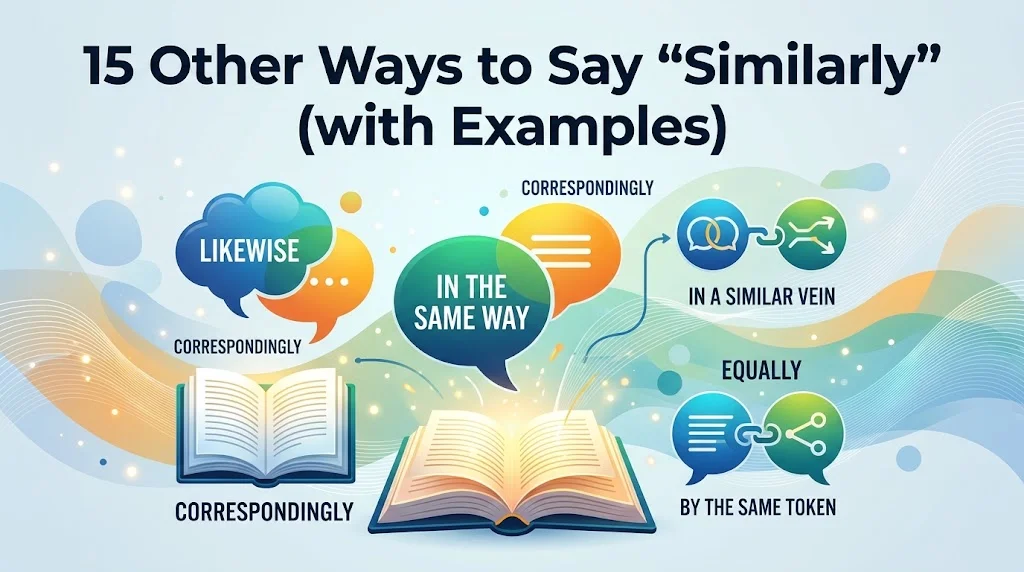
That’s where alternatives become useful. Expressions such as “likewise,” “in the same way,” “along similar lines,” and “by the same token” can help you connect related ideas without repeating the same transition. However, these phrases aren’t always interchangeable. Some work best in formal reports, while others sound more natural in everyday conversations.
Learning different ways to say “similarly” helps you make your writing clearer, more varied, and better suited to your audience. In this guide, you’ll learn what “similarly” means, when to use it, how its alternatives differ, and which expression fits different situations.
What Does “Similarly” Mean?
“Similarly” is an adverb used to show that something is like, comparable to, or follows a pattern similar to something mentioned earlier. It helps connect two ideas, actions, situations, or results that share a meaningful feature. For example, “The first team completed the project early. Similarly, the second team finished ahead of schedule.” The word highlights the connection between the teams’ results.
The key is that similarly signals a relationship between ideas. It doesn’t necessarily mean the two things are identical. They may share one characteristic while differing in other ways.
Consider these examples:
- Work: The first department reduced its expenses. Similarly, the second department found ways to cut costs.
- Education: Maya studies vocabulary every morning. Similarly, her brother practices new words before school.
- Business: The company improved its website. Similarly, it updated its mobile app to make navigation easier.
- Everyday conversation: I prefer to plan my trips in advance. Similarly, my sister likes to organize everything before leaving.
In each example, “similarly” connects two related ideas. It tells readers that the second point follows a comparable pattern.
How Is “Similarly” Used in a Sentence?
“Similarly” often appears at the beginning of a sentence when you want to connect it with a previous statement. In this position, it is usually followed by a comma.
Example: The new policy helped employees manage their schedules. Similarly, it gave managers a clearer view of team availability.
You can also use “similarly” within a sentence when the comparison fits naturally.
Example: The two schools similarly emphasize practical learning alongside classroom instruction.
This second structure is grammatical, but it may sound less natural in some contexts. If you want to compare two complete ideas, placing “similarly” at the beginning of a sentence is often clearer.
Use “Similarly” to Compare Related Actions
Use the word when two people, groups, or organizations do something in a comparable way.
Example: The marketing team uses customer surveys to improve its campaigns. Similarly, the product team collects feedback before releasing new features.
Use “Similarly” to Connect Findings or Results
In academic and professional writing, “similarly” can introduce a result that supports or resembles a previous finding.
Example: The first study found that regular practice improved test performance. Similarly, the second study reported better results among students who followed a consistent routine.
Make sure the comparison is supported by the information you have. Two findings may point in the same direction without being identical in method or significance.
Use “Similarly” to Improve the Flow of an Argument
The word can also help you move from one supporting point to another.
Example: Clear instructions reduce confusion during onboarding. Similarly, regular feedback helps new employees understand what their managers expect.
Here, “similarly” makes the relationship between the two points easy to follow. It works best when the connection is clear enough that readers don’t have to guess why the second sentence follows the first.
Where Does the Word “Similarly” Come From?
“Similarly” is formed from the adjective “similar” and the adverb-forming suffix “-ly.” The word “similar” entered English through French and ultimately comes from Latin similis, meaning “like” or “resembling.” This history reflects the word’s central purpose: showing likeness or a comparable relationship.
You don’t need to know the word’s history to use it correctly, but its structure offers a useful clue. “Similar” describes a relationship between things, while “similarly” describes how an action, situation, or idea relates to another.
For example:
- Similar: The two proposals have similar goals.
- Similarly: The two teams similarly approached the planning stage.
The first sentence describes the proposals. The second explains how the teams approached their work.
Why Look for Other Ways to Say “Similarly”?
“Similarly” is useful, but repeating it in every paragraph can make an article, report, or presentation sound mechanical. Choosing a suitable alternative adds variety and can make the relationship between your ideas more precise.
The best replacement depends on what you want to communicate. If you’re simply adding a related point, “likewise” may work. If you want to emphasize a shared method, “in the same way” may be clearer. If you’re drawing a comparison between two measurable outcomes, “comparably” might fit better.
Here are four reasons to use alternatives:
- To avoid repetition: Vary transitions when several related points appear close together.
- To clarify the relationship: Choose a phrase that highlights a shared method, result, principle, or degree.
- To match your audience: Formal reports may call for different wording than emails, conversations, or social posts.
- To improve readability: A well-chosen transition helps readers understand how each sentence connects to the previous one.
Variety alone shouldn’t be your goal, though. A less familiar phrase can make a sentence harder to understand. Choose the expression that communicates your meaning most clearly.
Is “Similarly” Professional, Polite, or Casual?
“Similarly” is generally neutral in tone. It works in professional emails, academic writing, reports, presentations, and everyday explanations. It doesn’t sound especially warm or informal, but it usually doesn’t feel stiff either.
Its alternatives can shift the tone slightly.
In Professional Writing
“Similarly” and “likewise” are both useful for connecting related points in reports, proposals, and workplace messages.
Example: The operations team has streamlined its approval process. Similarly, the finance team has reduced delays in expense reviews.
For a more direct or method-focused comparison, you could write:
“The finance team followed the same approach when reviewing expense requests.”
This version spells out the relationship rather than relying on a transition alone.
In Polite Workplace Communication
“Similarly” can help you acknowledge a related action or concern without sounding overly personal.
Example: Thank you for sharing the revised schedule. Similarly, I’ll update the project timeline so everyone has the same information.
The sentence is understandable, but “I’ll also update the project timeline” sounds more natural if you simply mean that you will take an additional action. This illustrates an important point: not every use of “also” needs to be replaced with “similarly.” Use “similarly” when you intend to highlight a comparison, not just add another item.
In Casual Conversation
People often choose simpler expressions when speaking informally.
Example: I usually listen to podcasts while cooking. My brother does the same thing when he’s driving.
This sounds more conversational than “Similarly, my brother listens to podcasts while driving.” Both are understandable, but the best choice depends on the setting and the speaker’s style.
Advantages and Disadvantages of Using “Similarly”
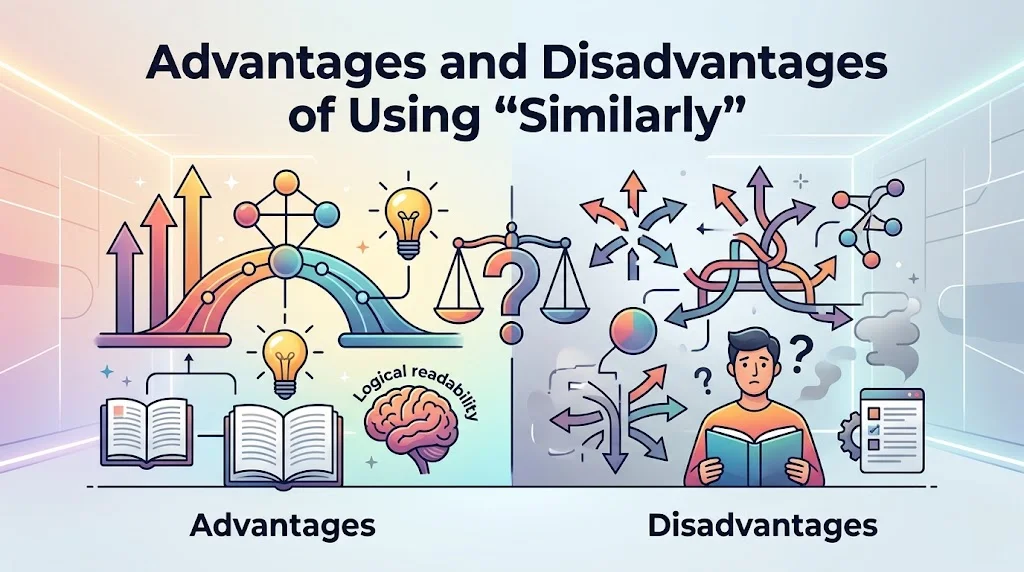
Like other transition words, “similarly” can improve a sentence when it expresses the right relationship. Problems arise when writers use it automatically or assume it means exactly the same thing as “also,” “therefore,” or “in contrast.”
Advantages
- Creates a clear connection: It signals that the next point resembles the previous one in a relevant way.
- Supports organized writing: It helps readers follow comparisons across paragraphs, reports, and explanations.
- Works across different settings: It fits academic, professional, and general informational writing.
- Keeps the tone neutral: It usually communicates a comparison without adding strong emotion or judgment.
Disadvantages
- Overuse can become repetitive: Repeating the word in every paragraph makes transitions predictable.
- The comparison may be unclear: Readers may not understand what the two ideas have in common if the relationship isn’t explained.
- It can be too formal for casual speech: In a friendly message, “the same goes for me” or “I do that too” may sound more natural.
- It may imply a comparison you haven’t established: Two statements appearing next to each other aren’t necessarily similar. The connection should be meaningful.
How to Use It More Effectively
Before using “similarly,” ask yourself one simple question: What exactly do these two ideas have in common?
If the answer is a shared method, explain the method. If it’s a comparable result, make that result clear. If you’re merely adding information, “also” or “in addition” may be more accurate.
For example:
Less precise: The company launched a new website. Similarly, it hired three customer service representatives.
Clearer addition: The company launched a new website. It also hired three customer service representatives.
The second sentence adds another fact, but it doesn’t establish a meaningful similarity between the two actions. Choosing the right transition helps readers understand your intended connection.
Five Alternatives to “Similarly” to Know First
Before exploring all 15 alternatives in detail, it helps to understand a few common options. Each one expresses a slightly different relationship, so the choice should depend on the sentence rather than a desire to avoid repetition.
Likewise
“Likewise” is a concise alternative that means “in the same way” or “also in a comparable manner.” It works well in professional writing and general explanations.
Example: The first branch extended its opening hours. Likewise, the second branch began serving customers earlier.
Use it when the second action or situation closely resembles the first.
In the Same Way
“In the same way” emphasizes a shared method or manner. It’s especially useful when you want to explain how two people or groups approach a task.
Example: The teacher uses short quizzes to check understanding. In the same way, the tutor reviews key concepts at the end of each session.
Choose this phrase when the process matters more than the final result.
In a Similar Way
“In a similar way” also highlights resemblance, but it doesn’t necessarily suggest that the two actions are identical. It can be useful when the comparison is close but not exact.
Example: The first app helps users track daily spending. In a similar way, the new tool lets them monitor monthly savings.
This phrase works when two things serve comparable purposes through related methods.
Comparably
“Comparably” is useful when discussing things that can be evaluated against a common standard. It often appears in analytical or formal contexts, especially when comparing levels, performance, size, or outcomes.
Example: The second model performed comparably during the same set of tests.
Use it when the comparison involves a meaningful point of reference. If you’re simply adding a related idea, “comparably” may sound unnecessarily technical.
Correspondingly
“Correspondingly” highlights a relationship in which one change, result, or development is linked to another. It is particularly useful when the second point follows a related pattern.
Example: Customer demand increased during the holiday season. Correspondingly, the store expanded its delivery capacity.
Be careful not to use “correspondingly” when you haven’t established a real relationship between the two developments. If you only mean that another thing happened, a simpler transition may be clearer.
These five alternatives provide a useful starting point. The remaining expressions offer additional choices for emphasizing equal treatment, shared principles, comparable degrees, or familiar patterns. The next step is to examine how their meanings and tones differ so you can choose the most natural phrase for each situation.
More Ways to Say “Similarly”: Meaning, Tone, and Examples
The right alternative to “similarly” depends on the connection you want to make. Some expressions highlight a shared approach, while others emphasize a common principle, comparable result, or matching situation. Choosing carefully helps your writing sound natural rather than repetitive.
In a Similar Way
Meaning: “In a similar way” means that something happens or works in a manner that resembles another action or situation. The two things don’t have to be exactly alike; they simply share a relevant feature.
Why This Phrase Works: It makes the comparison explicit and gives readers a moment to understand how the second idea relates to the first. It’s particularly useful when the relationship involves a method, process, or purpose.
Real-World Usage Insight: In workplace writing, this phrase can connect two approaches without suggesting that the teams or individuals followed identical procedures.
Best Use: Use it when comparing methods, learning strategies, business processes, or practical solutions.
Avoid When: The second statement merely adds information without a meaningful comparison. In that case, “also” or “in addition” may be more accurate.
Tone: Neutral, explanatory, and suitable for professional or academic writing.
US vs. UK Usage: The phrase is natural in both American and British English. The choice usually depends on sentence flow rather than regional preference.
Example (Email / Message / Meeting): “Our support team now answers common questions through an online help center. In a similar way, the sales team is creating resources that help customers understand our products before contacting a representative.”
Comparably
Meaning: “Comparably” means in a way that can be compared with something else, often because the items have similar levels, qualities, or results.
Why This Phrase Works: It can communicate a measured comparison without claiming that two things are identical. This makes it useful when discussing performance, costs, results, or standards.
Real-World Usage Insight: In a report, “comparably” often works best when readers already know what is being compared. Without a clear reference point, the sentence can sound vague or overly technical.
Best Use: Use it for analytical writing, evaluations, product comparisons, performance reviews, or discussions involving measurable qualities.
Avoid When: You’re writing a friendly message or explaining a simple relationship. “Similarly” or “to a similar degree” may sound more natural, depending on the intended meaning.
Tone: Formal, analytical, and somewhat technical.
US vs. UK Usage: “Comparably” is used in both varieties of English. There is no general rule requiring one region to prefer it over the other.
Example (Email / Message / Meeting): “The two software packages performed comparably during our initial tests, although the second option was easier for new employees to learn.”
Correspondingly
Meaning: “Correspondingly” describes something that matches or relates to another thing, often because a change or development in one area is accompanied by a related change elsewhere.
Why This Phrase Works: Unlike a general comparison, this word can emphasize a relationship between developments. It helps readers understand that two changes follow a related pattern.
Real-World Usage Insight: In business reports, the word can connect changes in demand, costs, staffing, or production. However, the sentence should make the relationship clear instead of relying on the transition alone.
Best Use: Use it when discussing related changes, trends, quantities, or outcomes.
Avoid When: You haven’t established a meaningful relationship between the two points. If you simply want to introduce another fact, “also” is clearer.
Tone: Formal, precise, and analytical.
US vs. UK Usage: The word is accepted in both American and British English. Its formal tone is more important than regional differences.
Example (Email / Message / Meeting): “Online orders rose sharply during the campaign. Correspondingly, we increased the number of employees assigned to packing and dispatch.”
Equally
Meaning: “Equally” means to the same degree or extent, or with the same importance or consideration. It can also introduce another point that deserves comparable attention.
Why This Phrase Works: It helps emphasize balance, equal importance, or a comparable level. However, its meaning depends on the sentence: it may describe degree, treatment, or significance rather than a general similarity.
Real-World Usage Insight: In presentations and professional discussions, “equally important” is a common way to introduce a second priority. It signals that the next point deserves attention alongside the first.
Best Use: Use it to discuss equal importance, comparable levels, fair treatment, or two priorities that deserve similar consideration.
Avoid When: The two things are merely related but not equal in degree or importance. “Likewise” may be a better fit if you want to show a similar action.
Tone: Neutral to formal, with an emphasis on balance or importance.
US vs. UK Usage: “Equally” is common in both American and British English, with no major difference in its core meaning.
Example (Email / Message / Meeting): “Reducing delivery delays is a priority for our team. Equally important is keeping customers informed when an order is running late.”
To the Same Extent
Meaning: “To the same extent” means to the same degree or level. It emphasizes how much two things share a quality, rather than simply stating that they are alike.
Why This Phrase Works: It makes the degree of similarity explicit. This is useful when comparing effects, influence, involvement, or the strength of a response.
Real-World Usage Insight: The phrase is often helpful in analytical, academic, and workplace discussions where the amount or intensity of a relationship matters.
Best Use: Use it when comparing levels of impact, participation, effectiveness, or influence.
Avoid When: You don’t know whether the degree is actually equal. If the comparison is approximate rather than exact, “to a similar extent” may be more accurate.
Tone: Formal, measured, and precise.
US vs. UK Usage: This expression is natural in both varieties of English. Its suitability depends on the type of comparison, not on a regional preference.
Example (Email / Message / Meeting): “Both departments contributed to the project, but they didn’t contribute to the same extent because the launch required more technical support than customer outreach.”
Along Similar Lines
Meaning: “Along similar lines” means following a comparable idea, approach, direction, or pattern. It often connects suggestions or plans that share a general principle.
Why This Phrase Works: It sounds less rigid than some formal transitions. It allows you to draw a comparison without implying that every detail matches.
Real-World Usage Insight: This phrase is especially useful during brainstorming, planning, and collaborative discussions. It helps introduce an idea that builds on something already proposed.
Best Use: Use it when discussing related plans, recommendations, strategies, or opinions.
Avoid When: You need to demonstrate an exact or measurable relationship. A more precise phrase may be necessary for technical or data-heavy writing.
Tone: Neutral and conversational, while still appropriate for many workplace settings.
US vs. UK Usage: “Along similar lines” is understood in both American and British English. It works particularly well in informal professional discussion.
Example (Email / Message / Meeting): “Your proposal focuses on giving new customers a simpler onboarding experience. Along similar lines, I’d suggest creating a short checklist that helps them complete the first steps without assistance.”
By the Same Token
Meaning: “By the same token” introduces a related point that follows from the same reasoning or principle. It can mean that if one idea is accepted, another related idea should also be considered.
Why This Phrase Works: It connects ideas through logic rather than resemblance alone. This makes it different from “in the same way,” which more directly emphasizes a shared manner or process.
Real-World Usage Insight: The expression often appears in arguments, explanations, and discussions where a speaker applies the same standard to another situation. It can sound persuasive, so the connection should be reasonable.
Best Use: Use it when applying the same principle to a second case or drawing a related conclusion.
Avoid When: The next point is only loosely connected or doesn’t follow from the same reasoning. “Similarly” may be safer if you intend to make a straightforward comparison.
Tone: Thoughtful, moderately formal, and sometimes argumentative.
US vs. UK Usage: The expression is used in both varieties of English. Its rhetorical tone is more significant than any regional difference.
Example (Email / Message / Meeting): “We ask every department to document major decisions so the team can review them later. By the same token, project leads should record changes to deadlines and responsibilities.”
In Like Manner
Meaning: “In like manner” means in a similar or comparable way. It communicates a relationship much like “in the same way,” but it generally sounds more formal or traditional.
Why This Phrase Works: It can suit formal explanations where a writer wants to maintain a consistent, measured tone. However, its extra formality doesn’t necessarily make the sentence clearer.
Real-World Usage Insight: The phrase is more likely to fit formal prose than a quick workplace message. In most everyday situations, “in the same way” is simpler and more natural.
Best Use: Use it sparingly in formal or carefully structured writing when its tone fits the surrounding text.
Avoid When: You’re writing for a general audience and a simpler phrase would communicate the same idea. Avoid choosing it merely to sound sophisticated.
Tone: Formal and somewhat traditional.
US vs. UK Usage: The phrase is understandable in both American and British English, but it can sound stiff in ordinary conversation in either variety.
Example (Email / Message / Meeting): “The first application must include proof of identity and a completed form. In like manner, applicants requesting a renewal must provide the required supporting documents.”
Analogously
Meaning: “Analogously” means in a way that is comparable by analogy. It introduces a comparison between situations, systems, or ideas that share a useful structural relationship.
Why This Phrase Works: It is especially valuable when explaining a complex concept through a related example. Rather than claiming that two situations are identical, it points to a similarity that helps readers understand the subject.
Real-World Usage Insight: The word often appears in academic, technical, and analytical writing. Because it can feel specialized, readers should be able to identify the relationship being drawn.
Best Use: Use it when explaining systems, theories, models, processes, or abstract ideas through comparison.
Avoid When: You’re making a simple everyday comparison. “Similarly” or “in the same way” is usually easier to understand.
Tone: Formal, analytical, and technical.
US vs. UK Usage: “Analogously” is used in both American and British English. The main consideration is whether the audience is comfortable with formal analytical vocabulary.
Example (Email / Message / Meeting): “A project team needs clear responsibilities to avoid duplicated work. Analogously, a well-designed software system assigns each component a defined role so different parts don’t perform conflicting tasks.”
Just As
Meaning: “Just as” connects two actions, situations, or qualities that correspond closely. It is often used to show that a point applying to one person or situation also applies to another.
Why This Phrase Works: It can make a comparison feel direct and natural, particularly when the two ideas are presented in a balanced sentence. It also works well when introducing an example that reinforces a broader point.
Real-World Usage Insight: Unlike a transition placed between two sentences, “just as” often forms part of the sentence structure itself. It may introduce a dependent clause, so the full sentence needs to be arranged carefully.
Best Use: Use it to compare actions, responsibilities, needs, or situations with a clear relationship.
Avoid When: The two ideas don’t actually correspond, or when you need a formal transition between separate paragraphs. “Likewise” may be more convenient in that position.
Tone: Neutral, natural, and suitable for both everyday and professional writing.
US vs. UK Usage: “Just as” is common in both American and British English, with no major difference in its ordinary use.
Example (Email / Message / Meeting): “Just as the design team needs clear feedback before revising a layout, the development team needs specific requirements before building the feature.”
Much the Same
Meaning: “Much the same” means nearly the same or very similar. It emphasizes that two things share most of their important characteristics, even if minor differences remain.
Why This Phrase Works: It is concise and natural when describing situations, experiences, conditions, or results that are broadly alike. It doesn’t require the two things to match in every detail.
Real-World Usage Insight: This phrase often sounds more conversational than “comparably” or “correspondingly.” It works well in general explanations, informal updates, and descriptions of similar experiences.
Best Use: Use it when two situations, experiences, or outcomes are broadly alike.
Avoid When: The comparison requires exact measurement or strict technical precision. “Much the same” can be too general for a detailed statistical or scientific claim.
Tone: Neutral and conversational.
US vs. UK Usage: The expression is understood in both varieties of English. Its general meaning stays the same, although individual sentence choices may vary.
Example (Email / Message / Meeting): “The revised schedule is much the same as the original one, except that the client review has moved from Tuesday to Thursday.”
In Much the Same Way
Meaning: “In much the same way” means in a way that closely resembles another method, action, or process. The word “much” emphasizes a strong similarity without necessarily claiming exact identity.
Why This Phrase Works: It makes the relationship between two approaches explicit. It can be especially useful when explaining a process, describing a pattern, or connecting a practical example to a broader idea.
Real-World Usage Insight: The phrase is longer than “likewise,” so it works best when the comparison deserves a little explanation. If you use it repeatedly, shorter alternatives can keep the writing moving.
Best Use: Use it to compare processes, learning methods, problem-solving strategies, or patterns of behavior.
Avoid When: You need a brief transition or the comparison is only slight. A shorter expression may be clearer.
Tone: Neutral to formal, depending on the surrounding sentence.
US vs. UK Usage: The phrase is natural in both American and British English.
Example (Email / Message / Meeting): “The training guide uses short demonstrations to explain each task. In much the same way, the follow-up videos show employees how to handle common problems step by step.”
Similarly To
Meaning: “Similarly to” introduces a person, group, or thing that resembles another in a particular respect. It is grammatical in suitable constructions, but it can sound less natural than alternatives such as “like,” “as with,” or a sentence beginning with “similarly.”
Why This Phrase Works: It can make the point of comparison explicit by placing the two subjects close together. However, it should be used only when the sentence remains clear and idiomatic.
Real-World Usage Insight: Writers sometimes choose “similarly to” because they assume every synonym of “similarly” can replace it directly. That isn’t always true. The structure of the original sentence matters, and a small rewrite may be more fluent than a word-for-word substitution.
Best Use: Use it when the construction reads naturally and the comparison is clear. For example, “Similarly to the first model, the updated version includes a battery-saving feature” is understandable, although “Like the first model, the updated version includes a battery-saving feature” is often more direct.
Avoid When: The phrase makes the sentence awkward or unnecessarily formal. In many cases, “like,” “as with,” or “in the same way as” is a better choice.
Tone: Neutral to formal, though it may sound less idiomatic than simpler alternatives.
US vs. UK Usage: The construction is understandable in both varieties, but naturalness depends on the sentence. A simpler alternative often works well in either region.
Example (Email / Message / Meeting): “Like the previous version, the updated dashboard includes a weekly performance summary that managers can review before their team meetings.”
Choosing the Right Alternative for Your Situation

These expressions overlap in meaning, but they don’t all serve the same purpose. Before choosing one, consider the relationship you want readers to notice.
- For a straightforward comparison: Choose “likewise” or “in the same way.”
- For a related method or strategy: Choose “along similar lines” or “in much the same way.”
- For measurable similarity: Choose “comparably” or “to the same extent,” depending on whether you mean a general comparison or an equal degree.
- For related changes or outcomes: Choose “correspondingly” when the relationship between developments is clear.
- For a shared principle: Choose “by the same token.”
- For an analytical analogy: Choose “analogously.”
- For a natural, conversational comparison: Choose “much the same.”
- For equal importance: Choose “equally,” especially in phrases such as “equally important.”
- For a sentence that compares two actions directly: Choose “just as” when the grammar supports that structure.
One final check can prevent many awkward substitutions: read the sentence with the alternative in place. If it changes your intended meaning, suggests a relationship that isn’t supported, or sounds unnecessarily complicated, choose a simpler expression.
The goal isn’t to use the most unusual synonym. It’s to make the connection between your ideas easy for the reader to understand.
Comparison Table of the Best Alternatives to “Similarly”
Choosing the right alternative becomes easier when you compare its meaning, tone, and typical use. The following table highlights ten useful expressions and explains when each one works best.
| Phrase | Meaning | Best Use | Worst Use | Tone | US vs. UK Usage |
| Likewise | In a comparable way; also | Professional writing and general comparisons | When the second point is unrelated | Neutral | Common in both |
| In the same way | Using a similar method | Explaining processes or actions | When the methods differ significantly | Neutral | Common in both |
| In a similar way | Following a comparable approach | General explanations | When you need to emphasize exact equality | Neutral | Common in both |
| Comparably | In a way that can be compared | Evaluations and performance reports | Casual messages that need simple wording | Formal | Common in both |
| Correspondingly | In a related or matching way | Connected changes or outcomes | When no meaningful relationship exists | Formal | Common in both |
| Equally | To the same degree or with equal importance | Balanced arguments and priorities | When the two things aren’t equal in the relevant respect | Neutral to formal | Common in both |
| To the same extent | To an equal degree | Measuring impact or involvement | When the degree of similarity is unknown | Formal | Common in both |
| Along similar lines | Following a comparable idea | Brainstorming and planning | Exact technical comparisons | Conversational | Common in both |
| By the same token | Applying the same principle or reasoning | Arguments and explanations | Unrelated points or unsupported conclusions | Moderately formal | Common in both |
| Analogously | By comparison with a related situation | Academic and technical explanations | Simple everyday statements | Formal | Common in both |
The expressions are broadly understood in both American and British English. The main differences here involve tone, sentence structure, and context rather than strict regional rules.
Common Mistakes When Using Alternatives to “Similarly”
Synonyms can make your writing more interesting, but replacing one word with another without checking its meaning can create confusion. These are some common mistakes to avoid.
Using “Similarly” When You Only Mean “Also”
“Similarly” emphasizes a relationship between two ideas. “Also” simply adds information. They sometimes overlap, but they don’t always communicate the same thing.
Less effective: The company launched a new website. Similarly, it hired two customer service representatives.
Better: The company launched a new website. It also hired two customer service representatives.
The second sentence presents another fact without implying that hiring employees resembles launching a website.
Treating Every Alternative as an Exact Synonym
“Equally” often emphasizes equal importance or degree. “Correspondingly” can suggest a relationship between changes. “Analogously” introduces a comparison based on a shared pattern.
These words may all connect related ideas, but they highlight different relationships.
Example: “Both departments improved their response times. Likewise, both introduced clearer procedures.”
Here, “likewise” connects comparable actions. Replacing it with “equally” could change the meaning by suggesting equal importance or degree.
Using Formal Expressions in Casual Messages
Long or technical alternatives can make ordinary communication sound unnatural.
Overly formal: “Analogously, I prepare my lunch before leaving for work.”
More natural: “I do the same thing when I leave for work.”
The formal version isn’t automatically grammatically wrong, but the simpler wording better suits an everyday conversation.
Using “Correspondingly” Without Showing a Connection
“Correspondingly” works best when one development relates meaningfully to another.
Unclear: The company changed its logo. Correspondingly, the office moved to a different building.
The two actions may have occurred around the same time, but the sentence doesn’t explain how they correspond.
Clearer: Customer orders increased during the promotion. Correspondingly, the warehouse scheduled additional packing shifts.
The relationship is now easier to understand because increased demand provides a reason for additional staffing.
Repeating the Same Transition Too Often
Even a suitable transition becomes distracting when it appears in every paragraph.
Repetitive: The first group reviewed the report. Similarly, the second group checked the figures. Similarly, the managers examined the recommendations.
Improved: The first group reviewed the report. Likewise, the second group checked the figures. The managers also examined the recommendations.
Use variety where it improves readability, but don’t replace every occurrence mechanically. Sometimes the clearest option is to remove the transition altogether.
Why Do Writers Keep Using “Similarly”?
Writers often repeat familiar expressions because those phrases are easy to remember and help organize thoughts quickly. Once a word becomes part of your writing routine, you may use it without considering whether another expression would be more precise.
There are several practical reasons this happens.
Familiar Words Are Easier to Retrieve
When you need to connect two points quickly, a familiar word such as “similarly” may come to mind before a more specific expression. This is common during drafting, especially when you’re concentrating on ideas rather than sentence-level style.
Practical tip: During editing, highlight repeated transitions and check whether each one expresses the intended relationship.
Writers Want Their Arguments to Flow
Transitions help readers follow an explanation. However, adding a transition to every sentence can make writing feel overorganized.
For example, “The first option is affordable. The second option offers more flexibility” may be clear without any linking phrase. You could use “Similarly” only if you genuinely intend to highlight a resemblance between the options.
Synonyms Can Create a False Sense of Variety
Changing “similarly” to “correspondingly” doesn’t automatically improve a sentence. If the new word is less precise or harder to understand, the result may be worse.
A useful rule: Choose the word that best describes the relationship, not the one that sounds most sophisticated.
Using Alternatives to “Similarly” in Digital Communication
The best transition also depends on the format of your message. A research paper, a workplace email, and a short chat message have different needs.
Emails
In professional emails, clarity matters more than variety. “Likewise” can connect comparable actions, while “also” is usually better when you’re simply adding another task or update.
Example:
“Thanks for confirming the revised deadline. I’ll update the project calendar as well so the whole team can see the change.”
This wording is direct and natural. It avoids using “similarly” when the intended meaning is simply that another action will take place.
Workplace Chat
Short messages usually benefit from straightforward language.
Example:
“I’ll review the first proposal today. Can you check the second one in the same way?”
The phrase “in the same way” is useful here because it tells the recipient to follow the same method.
Social Media Posts
For short posts, captions, and comments, a natural tone is usually more important than formal transitions.
Example:
“Small habits can make a big difference. The same goes for taking a few minutes to plan your day.”
This expression sounds conversational while preserving the connection between the two ideas.
Reports and Presentations
Formal documents may require more precise wording, especially when comparing findings or outcomes.
Example: “The first survey showed a preference for flexible working hours. Similarly, the second survey identified flexibility as a major concern.”
This is suitable when the two surveys support a comparable finding. If the results differ in strength or context, explain those differences rather than implying that they are identical.
How to Choose the Best Alternative: A Quick Decision Guide
When you’re unsure which expression to use, identify what you want the second statement to do.
- Are you adding another fact? Use “also” or “in addition.”
- Are you comparing two actions? Use “likewise” or “in the same way.”
- Are you describing a similar approach? Use “along similar lines” or “in a similar way.”
- Are you comparing measurable results? Use “comparably” when appropriate, or describe the actual figures.
- Are you emphasizing equal importance? Use “equally” or “equally important.”
- Are you comparing the degree of an effect? Use “to the same extent” only when the degree is genuinely equal.
- Are you connecting related changes? Use “correspondingly” when the relationship is clear.
- Are you applying the same reasoning to another case? Use “by the same token.”
- Are you explaining an abstract idea through a comparison? Use “analogously.”
- Are you writing an informal message? Consider “the same goes for,” “I do that too,” or “the same thing applies.”
Remember that the most suitable alternative depends on the entire sentence. A phrase that works well in a report may sound stiff in a conversation, while an informal expression may not fit an academic argument.
Practice: Choose the Right Alternative to “Similarly”
Try these short examples to test your understanding. Choose the expression that best fits each sentence before checking the answers.
Question 1
The first branch reduced its delivery times. ______, the second branch introduced a faster dispatch process.
A. Likewise
B. In contrast
C. Nevertheless
Answer: A. Likewise. Both branches made changes aimed at improving delivery speed. “Likewise” connects their comparable actions.
Question 2
The company’s sales increased during the campaign. ______, it hired additional staff to handle the extra orders.
A. Analogously
B. Correspondingly
C. In like manner
Answer: B. Correspondingly. The additional staffing relates to the increase in orders. The word works because the two developments have a clear connection.
Question 3
Clear instructions help new employees understand their responsibilities. ______ important is providing feedback during their first few weeks.
A. Equally
B. Comparably
C. Analogously
Answer: A. Equally. “Equally important” emphasizes that feedback deserves comparable attention alongside clear instructions.
Question 4
The first team uses a checklist to review each application. The second team should review its applications ______.
A. by the same token
B. in the same way
C. correspondingly
Answer: B. In the same way. The sentence refers to following a similar method or procedure.
Question 5
The first product performed well in the tests. The updated product achieved ______ results under the same conditions.
A. comparably
B. by the same token
C. along similar lines
Answer: A. Comparably. The sentence compares performance under the same conditions. In a technical report, the actual results should still be provided when precision matters.
Final Checklist for Using “Similarly” and Its Alternatives
Before publishing an article, sending an email, or submitting a report, review your transitions with these questions:
- Meaning: Does the phrase express a real similarity, shared method, related change, or equal degree?
- Accuracy: Does the sentence support the relationship you’re suggesting?
- Tone: Does the expression fit your audience and the formality of the situation?
- Clarity: Would a simpler phrase communicate the idea more directly?
- Repetition: Have you repeated the same transition unnecessarily?
- Sentence structure: Does the alternative fit grammatically, or does the sentence need to be rewritten?
- Evidence: If you’re comparing data or research findings, have you represented the results accurately?
A quick review can catch awkward substitutions and help you make your writing more natural. The aim isn’t to eliminate “similarly”; it’s to use it when it communicates the relationship clearly and choose another expression when that expression does a better job.
Conclusion
“Similarly” is a useful transition when you want to show that two ideas, actions, or results share a meaningful feature. However, repeating it throughout an article, report, or email can make your writing feel predictable. Alternatives such as “likewise,” “in the same way,” “equally,” “along similar lines,” and “correspondingly” give you more flexibility, but each carries a slightly different emphasis.
The easiest way to choose the right phrase is to identify the connection you want readers to notice. Are you comparing methods, adding information, emphasizing equal importance, or explaining related changes? Once you know the purpose, the right wording becomes easier to find.
FAQs
What is another word for “similarly”?
“Likewise” is one of the closest alternatives to “similarly.” Other options include “in the same way,” “in a similar way,” and “along similar lines.” The best choice depends on the relationship between the ideas. For example, “likewise” works for comparable actions, while “in the same way” is especially useful when you want to emphasize a shared method or process.
Is “likewise” the same as “similarly”?
“Likewise” and “similarly” often have similar meanings, and both can connect related ideas. However, their use depends on context. “Likewise” can also mean that someone returns a sentiment or responds in kind, as in “Nice to meet you.” “Similarly” more directly highlights a resemblance between situations, actions, or results.
Can I use “also” instead of “similarly”?
Sometimes, but the meanings aren’t identical. “Also” adds another piece of information, while “similarly” signals a comparison or resemblance. For example, “The team also updated the website” simply adds an action. “Similarly, the team improved its mobile app” suggests that the app improvement relates to the website update in some meaningful way.
What is a formal alternative to “similarly”?
“Correspondingly,” “comparably,” and “analogously” can work in formal writing when their meanings fit the context. “Correspondingly” is useful for related changes, “comparably” for comparable qualities or results, and “analogously” for comparisons between related systems or ideas. Don’t choose a formal word merely to sound sophisticated; a precise, familiar expression is often clearer.
Is “in the same way” professional?
Yes. “In the same way” is suitable for professional emails, reports, presentations, and explanations. It’s particularly effective when comparing methods or procedures. For example, “The first department reviews applications using a checklist. The second department follows the same process.” This wording is clear, direct, and professional without sounding unnecessarily formal.
When should I use “correspondingly”?
Use “correspondingly” when one change or development relates to another. For example, if customer orders increase and a business expands its packing shifts in response, the two developments correspond. Avoid using the word merely to introduce an unrelated fact. The sentence should make the relationship between the changes clear enough for readers to understand.
What does “by the same token” mean?
“By the same token” introduces a related point that follows from the same principle or reasoning. It is useful in arguments, explanations, and discussions where the same standard applies to another situation. For example, if employees must document major decisions, project leaders should also document significant changes to deadlines. The phrase links the points through a shared principle.
Is “similarly” too formal for everyday conversation?
No. “Similarly” is a neutral word, but it can sound a little formal in some casual conversations. People may naturally say “I do that too,” “the same goes for me,” or “we do the same thing.” In writing, “similarly” works well when the comparison is clear. The best choice depends on your audience and the tone you want.
How can I avoid repeating “similarly” in an essay?
First, identify what each transition is doing. Use “likewise” for comparable actions, “equally” for equal importance, or “in the same way” for shared methods. If you’re simply adding information, “also” may be more accurate. You can also remove unnecessary transitions when the connection between sentences is already obvious.
Can “similarly” begin a sentence?
Yes. “Similarly” commonly begins a sentence that connects with a previous idea, and it is usually followed by a comma. For example, “The first study found better results after regular practice. Similarly, the second study reported improved performance.” Make sure the second statement genuinely resembles or supports the first; otherwise, a different transition may be more accurate.