
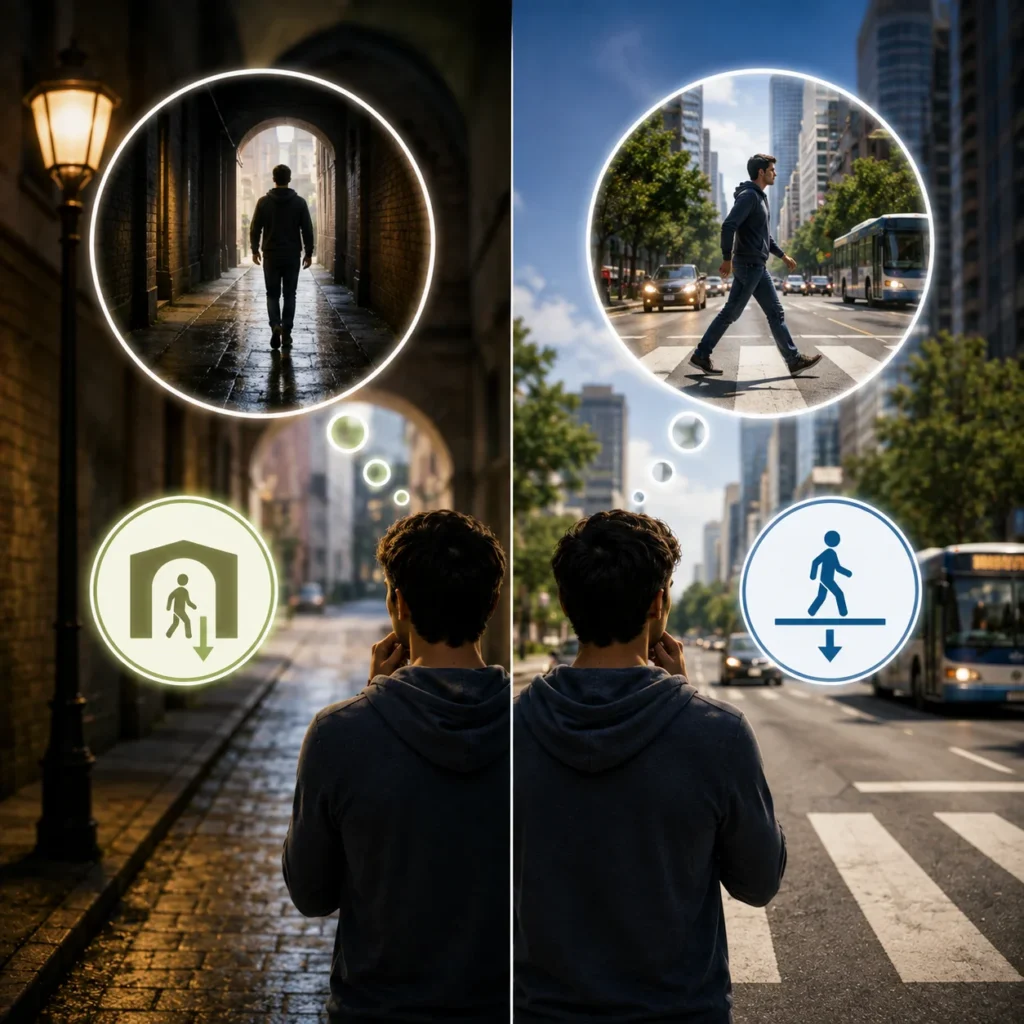
Why “In the Street” vs. “On the Street” Changes Meaning
English prepositions often look small, but they can completely change the meaning of a sentence. The difference between “in the street” and “on the street” is a good example. Both phrases mention a street, yet they create different pictures in the listener’s mind. Choosing the correct phrase helps your English sound more natural and prevents confusion.
When native speakers hear “on the street,” they usually imagine a person, activity, building, or event connected with a street location. The street acts like a surface or a public area where something exists or happens. For example, when someone says, “I saw a musician on the street,” the meaning is that the musician was performing somewhere along the street, perhaps on a sidewalk or a public corner.
However, when someone says “in the street,” the meaning often becomes more specific. It usually suggests that a person, object, or activity is physically inside the roadway itself. The listener may imagine someone standing between cars, walking on the road, or blocking traffic. The phrase focuses more on being surrounded by the physical space of the street rather than simply being located near it.
Compare these two sentences:
| Sentence | Meaning | Image Created |
| I met my neighbor on the street. | I met my neighbor while outside in a public street area. | Two people meeting casually outdoors. |
| A dog was sitting in the street. | The dog was physically on the road where vehicles move. | A dog in the middle of the roadway. |
This small difference matters because English speakers use prepositions to show relationships between people, objects, and places. The words in, on, and at are not interchangeable. Each one gives information about position, space, and context.
Why English Learners Commonly Confuse “In the Street” and “On the Street”
Many learners struggle with these expressions because their first language may use one general word for different location meanings. A direct translation can make both phrases appear correct. However, English often depends on how speakers mentally organize space.
A useful comparison is this:
- One often connects with surfaces. Itn often connects with enclosed or surrounding spaces.
- At usually points to a specific location or point.
For example:
- On the street → located along a street or connected with street life.
- In the street → physically inside the roadway.
- At the street → usually unnatural when referring to a street location.
Imagine a street as a large stage. If someone is standing on that stage performing, you might describe them as being on the street. But if someone walks into the area where cars drive, they are literally in the street.
This difference becomes even more important in professional communication. A small preposition mistake can change the seriousness of a message. For example:
- “There is a person on the street” may simply describe someone outdoors.
- “There is a person in the street” may suggest a possible traffic danger.
The second sentence creates urgency because the person is located in the vehicle’s path.
How Context Determines the Correct Preposition
The meaning of these phrases depends heavily on context. The same location can require different prepositions depending on what the speaker wants to emphasize.
Consider a city market:
“There are many shops on the street.”
Here, the focus is on businesses located along that street.
Now consider a road accident:
“A car stopped in the street after the crash.”
Here, the focus is the car’s position inside the roadway.
The physical place has not changed. The perspective has changed.
English speakers naturally adjust prepositions based on the relationship between the subject and the location. This is why memorizing a single rule is not enough. Understanding the image behind the phrase makes the choice easier.
Everyday Situations Where the Difference Matters
The distinction between “in the street” and “on the street” appears frequently in everyday conversations.
Meeting Someone
Most people say:
“I ran into an old friend on the street.”
This means the meeting happened casually while outside.
Saying:
“I ran into an old friend in the street.”
is possible, but it sounds more like both people were physically standing in the roadway.
Talking About Businesses
Businesses are usually described as “on the street.”
Examples:
- A café on the street
- A store on the street
- A restaurant on the street
The phrase connects the business with its public location.
Describing Safety Situations
Safety-related situations often use “in the street.”
Examples:
- Children playing in the street
- Debris lying in the street
- A vehicle stopped in the street
These examples emphasize that something is occupying the road space.
The Role of Mental Images in Learning Prepositions
One of the easiest ways to master these expressions is to stop thinking about grammar rules alone and start creating mental images.
When you hear “on the street,” picture:
- Sidewalk conversations
- Street markets
- Restaurants and shops
- People walking through neighborhoods
- Public activities
When you hear “in the street,” picture:
- Cars driving
- Road lanes
- Traffic situations
- Objects blocking movement
- People standing directly on the road
This visualization method works because language is connected to how humans understand space. Instead of memorizing hundreds of examples, you learn the relationship behind them.
Why Choosing the Right Phrase Improves Natural English
Using the correct preposition makes your English clearer and more fluent. Native speakers may understand a wrong choice, but they immediately notice when a phrase sounds unusual.
For example:
“There is a new bakery on the street.”
This sounds strange in most situations because a bakery is not usually on the road. A more natural sentence would be:
“There is a new bakery on the street.”
The second version matches how English speakers normally describe locations.
Similarly:
“The workers are repairing something on the street.”
This sounds natural because road workers usually operate along a public street.
But:
“The workers are standing in the street.”
Creates a different image. They are likely standing directly on the road surface.
Understanding this difference helps learners communicate more accurately in conversations, writing, travel situations, and workplace settings.
The key idea is simple: “On the street” usually describes a connection to street life or location, while “in the street” usually describes being physically inside the roadway. Once you understand that difference, choosing the right expression becomes much easier.
The Core Rule: Surface vs. Enclosed Space
Understanding the difference between “in the street” and “on the street” becomes much easier when you understand one basic English idea: “on” often describes a surface, while “in” often describes being inside or surrounded by a space. This rule does not explain every English preposition, but it gives you a strong starting point for understanding why native speakers choose one phrase over another.
When English speakers use “on the street,” they usually imagine the street as a surface or an area where people, businesses, and activities exist. The street becomes similar to other surfaces where things happen.
For example:
- A person stands on the street.
- A restaurant is on the street.
- A festival happens on the street.
- A person sells products on the street.
In these examples, the focus is not that the person or object is inside the road. The focus is that something is located along a public street area.
On the other hand, “in the street” focuses on physical position within the street space. The street is viewed as a three-dimensional area with boundaries. Something is not just connected to the street; it occupies the space of the roadway.
Examples:
- A ball is in the street.
- A car stopped in the street.
- Workers are standing in the street.
- Children are playing in the street.
Here, the listener imagines something placed within the area where vehicles normally move.
Understanding “On” as a Surface
The word “on” is commonly used when something touches or exists on the top of a surface. This is why English speakers say:
- A book is on the table.
- A picture is on the wall.
- A person is on the floor.
- A shop is on the street.
A street is not flat like a table, but English often treats streets as surfaces because people move across them. The street functions as a public platform where activities take place.
Think about a busy city street. You might see:
- Street performers playing music.
- Vendors selling food.
- People walking between shops.
- Customers entering restaurants.
- Neighbors are talking outside.
All of these activities happen around the street environment, so “on the street” feels natural.
A useful comparison is a football field. We say players are on the field, not in the field, because the field is viewed as the surface where activity happens. In the same way, streets are often viewed as surfaces where movement and social activity occur.
Understanding “In” as Physical Space
The word “in” usually creates the idea of being surrounded by something or located within defined boundaries.
Examples:
- A person is in a room.
- A car is in a garage.
- Water is in a bottle.
- A person is in the street.
Although a street does not have walls, it still has a recognizable physical area. It includes lanes, traffic spaces, and boundaries between sidewalks and buildings.
When someone says:
“A man was standing in the street.”
The listener does not usually imagine someone standing near a shop entrance. Instead, they imagine a person standing directly on the road surface where vehicles pass.
This is why “in the street” often appears in situations involving danger, movement, or interruption.
Examples:
| Phrase | Meaning | Common Situation |
| A child is in the street | The child is on the roadway | Safety warning |
| A truck is in the street | The truck occupies road space | Traffic problem |
| People are in the street | People are gathered on the road | Protest or celebration |
The phrase draws attention to the physical location.
The Street as a Location vs. The Street as a Space
One of the biggest differences between these expressions is perspective.
When you say “on the street,” you usually think about the street as a location. You are identifying where something exists.
Examples:
“She works on the street near my office.”
The meaning is that her workplace is located along that street.
“I saw a musician on the street.”
The musician was performing somewhere in a public street.
When you say “in the street,” you think about the street as a space that contains something.
Examples:
“There is water in the street after the storm.”
The water has spread across the roadway.
“A group of people gathered in the street.”
The people are occupying the road.
The difference is subtle, but the mental picture changes.
A Simple Memory Trick for Choosing Between “In” and “On”
A practical trick is to ask yourself:
Is the person or thing connected with the street, or is it physically occupying the road?
If it is connected with the street:
Use “on the street.”
Examples:
- My office is on the street.
- There is a coffee shop on the street.
- I met him on the street.
If it is physically inside the road:
Use “in the street.”
Examples:
- A bicycle is lying in the street.
- There is a hole in the street.
- The workers are repairing pipes in the street.
This simple question helps avoid many common mistakes.
How Native Speakers Process These Expressions
Native speakers usually do not stop and analyze grammar rules before choosing a preposition. Instead, they rely on years of exposure and mental patterns. They immediately understand the relationship between the object and the location.
For example, imagine someone saying:
“There is a new bookstore on the street.”
A native speaker can understand the meaning, but the sentence feels unusual. The brain expects a bookstore to be on the street because stores are connected to a street location.
Now compare:
“There is construction equipment in the street.”
This sounds natural because construction equipment can physically occupy the roadway.
The difference comes from how people mentally organize space. English not only describes where something is located. It describes how that thing relates to its surroundings.
Surface Thinking and Space Thinking in Real Communication
The surface-versus-space idea appears in many other English expressions.
Compare:
| Surface Idea (“On”) | Space Idea (“In”) |
| on the street | in the street |
| on the road | on the road |
| on the sidewalk | in the area |
| on the field | in the stadium |
These examples show a broader pattern. English speakers often use “on” for activities and locations connected with a surface, while they use “in” when something exists inside a larger area.
However, language is not a perfect mathematical system. Some expressions become fixed through history and common usage. That is why learning the general idea helps, but paying attention to real examples matters too.
Why This Rule Helps English Learners
Many learners try to memorize phrases individually:
- “on the street”
- “in the street”
- “on the road”
- “in the road”
This method can become confusing because there are many exceptions. Understanding the concept behind the prepositions gives you a flexible system.
When you picture the street as a surface, “on” usually works.
When you picture the street as a physical space being occupied, “in” usually works.
This approach makes your English more natural because you are not just remembering words. You are understanding how English speakers view locations.
The core rule is simple: use “on the street” when the street acts like a surface or public location, and use “in the street” when something is physically inside the roadway space. This small distinction creates clearer communication and helps you choose the right expression with confidence.
When to Use “On the Street”
The phrase “on the street” is the more common expression in everyday English. Native speakers use it when they talk about locations, activities, businesses, people, and events connected with a street. In most situations, the street works like a public area or a surface where life happens rather than a container that holds something inside.
When you choose “on the street,” you usually focus on the relationship between a person, place, or activity and the street environment. You are not necessarily saying that someone is standing in the road. Instead, you are saying that something exists along the street, near the street, or as part of street life.
For example:
“I met Sarah on the street yesterday.”
This sentence suggests a casual meeting while walking outside. Sarah may have been on the sidewalk, near a store, or simply in the general street area. The speaker is describing the location where the meeting happened, not the exact physical position of Sarah’s feet.
Using “On the Street” for General Locations
One of the most common uses of “on the street” is to describe where something is located.
Examples:
- There is a bakery on the street near my house.
- My office is on the street behind the shopping center.
- They opened a new bookstore on the street.
- She lives on the street next to the park.
In these examples, the street functions like an address or location marker. The speaker is identifying a place by its connection to a particular street.
This usage appears frequently in:
- Real estate descriptions
- Travel guides
- City directions
- Business listings
- Neighborhood conversations
A person might say:
“There are many restaurants on this street.”
The meaning is not that restaurants are physically sitting on the road. It means the restaurants are located along that street.
Surface Positioning: Seeing the Street as a Public Area
The idea of surface positioning explains why English often uses “on” with streets. A street is treated as a surface where movement and activities occur.
Think about a city street during the day. You might see:
- People walking
- Street musicians performing
- Vendors selling goods
- Artists creating drawings
- Workers repairing buildings
- Tourists exploring neighborhoods
All these activities are connected to the street environment.
For example:
“A musician was playing guitar on the street.”
The listener imagines a performer somewhere outside, perhaps on a sidewalk or a public corner. The focus is on the street performance rather than the exact physical position.
Compare this with:
“A musician was sitting in the street.”
Now the image changes. The musician appears to be sitting directly on the roadway, which sounds unusual unless there is a specific reason, such as a street festival or road closure.
Public Visibility and Street Presence
The phrase “on the street” also connects with the idea of public visibility. Something that happens on the street is usually open, noticeable, or accessible to the public.
Examples:
- Police officers were speaking on the street.
- Reporters interviewed people on the street.
- Protesters gathered on the street.
- Local artists sell paintings on the street.
The phrase highlights that the activity happens in a public environment where other people can see it.
This meaning appears often in journalism and documentaries. News organizations may describe:
“People gathered on the street to celebrate the victory.”
The focus is not the road itself. The focus is the public gathering and the visible social activity.
Commercial Context: Businesses “On the Street”
One of the strongest uses of “on the street” appears in commercial language. Shops, restaurants, markets, and offices are commonly described as being on a street.
Examples:
| Sentence | Meaning |
| There is a café on the street. | The café is located along the street. |
| A new clothing store opened on Main Street. | The store has a location on that street. |
| Many small businesses operate on the street. | Businesses exist in that street area. |
Businesses often depend on street visibility. A store on the street usually has public access, signs, customers walking by, and a physical connection to the neighborhood.
For example:
“The restaurant on the street corner is always busy.”
The phrase helps people identify the restaurant’s location.
However, saying:
“The restaurant is in the street”
Would create a strange image. It sounds like the restaurant is physically placed on the roadway, which is not the intended meaning.
Idiomatic Meaning of “On the Street”
English also uses “on the street” in several expressions where the meaning goes beyond physical location. These phrases are common in conversations, media, and professional communication.
Word on the Street
The expression “word on the street” means a rumor, public opinion, or information that people are sharing.
Example:
“The word on the street is that the company will launch a new product soon.”
This does not mean someone literally heard words while standing outside. It refers to information circulating among people.
Living on the Street
The phrase “living on the street” refers to homelessness or having no permanent home.
Example:
“Many organizations help people living on the street.”
This expression focuses on a person’s social situation rather than their exact physical location.
Street Interviews
News reporters often conduct interviews on the street because they want public opinions from ordinary people.
Example:
“The journalist asked people on the street about the election.”
This type of interview is sometimes called a “man-on-the-street interview.”
Street-Level Business
Businesses often use street visibility to attract customers.
Examples:
- A street-level café
- A shop on the street
- A restaurant on a busy street
These phrases describe businesses that interact directly with the public movement.
Common Situations Where “On the Street” Sounds Natural
Here are some everyday examples:
| Situation | Natural Sentence |
| Meeting someone | I saw him on the street this morning. |
| Shopping | There are several stores on the street. |
| Directions | The bank is on the street next to the library. |
| Public events | People gathered on the street for the parade. |
| Interviews | The reporter spoke with people on the street. |
| Neighborhood talk | There is a new café on the street. |
These examples show how flexible “on the street” can be.
“On the Street” in American English
In American English, “on the street” is especially common when describing locations and public activities. People often use it naturally in everyday speech.
Examples:
- I parked my car on the street.
- There is a house for sale on this street.
- I saw a famous actor on the street.
- The festival takes place on the street every summer.
Notice that “on” does not always mean direct contact with a surface. It often expresses a relationship with a location.
For example:
“My apartment is on Oak Street.”
The apartment is not on the road. It is located along Oak Street.
A Quick Test for Choosing “On the Street”
Ask yourself:
Am I talking about something connected with the street, located along the street, or visible in public?
If yes, “on the street” is usually the correct choice.
Use it for:
- Locations
- Businesses
- Public activities
- Street culture
- Social events
- General presence
The phrase “on the street” represents the street as a place where people live, work, move, and interact. It describes the connection between everyday life and the public spaces that surround us. Understanding this usage will help your English sound more natural because it matches how native speakers view streets—not just as roads, but as active parts of communities.
When to Use “In the Street”
While “on the street” is the more common phrase in everyday English, “in the street” has a specific purpose. It usually describes a person, object, or activity that is physically located inside the roadway area where vehicles normally travel. The phrase creates a stronger image of something occupying the street space itself.
The key idea is simple: “in the street” focuses on physical position, not just location. When someone or something is in the street, the listener often imagines the road surface, traffic lanes, or an area where movement could be affected.
For example:
“There is a bicycle in the street.”
This sentence suggests that the bicycle is lying or standing on the road. It may be blocking traffic or creating a possible danger.
Compare it with:
“There is a bicycle shop on the street.”
Now the bicycle is not on the road. The shop is simply located along that street.
The difference comes from the image created by each phrase.
Physical Immersion: Being Inside the Roadway
The strongest use of “in the street” appears when something is physically surrounded by the street area. The street becomes a space that contains an object or activity.
Common examples include:
- A car stopped in the street
- A person standing in the street
- A package left in the street
- A tree branch lying in the street
- Water is collecting in the street
In each example, the subject is not simply connected to the street. It occupies the actual road space.
Imagine a busy city road. Cars move through lanes, pedestrians walk along sidewalks, and buildings stand beside the road. If someone walks into the vehicle area, they are no longer just near the street. They are in the street.
This distinction matters because the phrase can communicate urgency.
For example:
“There is a man on the street.”
This sounds neutral. The man may be walking, shopping, or waiting outside.
“There is a man in the street.”
This may sound like a warning. The man could be standing where cars pass.
The second sentence creates a stronger safety image.
Roadway and Traffic Situations
Traffic-related situations frequently use “in the street” because the focus is on the road itself.
Examples:
- A vehicle broke down in the street.
- A fallen tree blocked the street.
- Workers are repairing a pipe in the street.
- Construction materials were left in the street.
- A traffic accident happened in the street.
In these situations, the exact position matters. Emergency workers, drivers, and pedestrians need to know that something is occupying the roadway.
Consider a traffic report:
“A truck is stuck in the street near the bridge.”
The important information is not just that the truck is nearby. The truck is affecting the road.
However:
“A truck company is located on the street near the bridge.”
This describes a business location, not a traffic problem.
The preposition changes the entire meaning.
Emergency and Safety Language
Emergency communication often depends on precise location words. Using “in the street” helps describe situations where immediate attention may be needed.
Examples:
| Sentence | Meaning |
| A child is in the street. | The child may be in danger because of traffic. |
| A dog is in the street. | The dog may be blocking vehicles. |
| Glass is in the street. | The road may be unsafe. |
| A person is lying in the street. | There may be an accident or emergency. |
News reports often use this phrase because it gives readers a clear mental picture.
Example:
“Police found debris in the street after the accident.”
The phrase tells the audience that the debris was located on the road surface, not simply near the area.
“In the Street” During Public Events
Although “in the street” often suggests danger or obstruction, it can also describe planned activities where people intentionally use the roadway.
For example:
- A parade moved through the street.
- People danced in the street during the festival.
- Residents gathered in the street for a celebration.
In these cases, the street has temporarily become a shared space rather than a normal traffic route.
A city festival might close a road and allow people to walk, eat, and perform there. During that event, saying:
“People were dancing in the street”
Sounds completely natural.
The context changes the meaning. The phrase does not always indicate a problem. It simply highlights that people are occupying the roadway.
Physical Activity Context
Many activities naturally use “in the street” because participants are physically using the road space.
Examples:
- Children playing in the street
- Neighbors talking in the street
- Artists painting in the street
- Musicians performing in the street
However, some activities can use either phrase depending on the intended meaning.
Compare:
“The musicians performed on the street.”
This focuses on the public performance and street entertainment.
“The musicians performed in the street.”
This emphasizes that they were physically located in the roadway.
Both can be correct, but they create different images.
British and American English Differences
The use of “in the street” and “on the street” can vary slightly between British and American English.
In American English, “on the street” is extremely common for a general location.
Examples:
- I live on Green Street.
- There is a restaurant on the street.
- I saw him on the street.
British English also uses “on the street” for many of these situations, but speakers may use “in the street” more frequently in some contexts, especially when referring to people physically using the roadway.
For example:
British English:
“The children are playing in the street.”
American English:
“The children are playing in the street.”
This expression is common in both varieties because children are actually occupying the road.
However:
American English:
“I left my keys on the street.”
This often means the keys were dropped somewhere outside.
British English speakers may also use this, but depending on context, they may choose slightly different wording.
When “In the Street” Sounds More Natural
Use “in the street” when the sentence answers the question:
“Where exactly is this person or object physically located?”
Examples:
Objects on the Road
- There is a box in the street.
- Leaves are scattered in the street.
- A bottle was lying in the street.
People on the Road
- The protesters stood in the street.
- The workers were standing in the street.
- The children were playing in the street.
Road Problems
- There is a hole in the street.
- Water is flowing in the street.
- A vehicle is blocking traffic in the street.
The phrase works because the street is being treated as a physical area.
Common Mistakes With “In the Street”
Many learners overuse “in the street” because they translate directly from their first language. They may think that because people are located within a street area, “in” should always work.
For example:
Incorrect or unnatural:
“There is a coffee shop on the street.”
The listener may imagine a coffee shop sitting in the middle of the road.
Better:
“There is a coffee shop on the street.”
Another example:
Unnatural:
“I met my friend in the street yesterday.”
Possible meaning: You met your friend while standing on the road.
More natural in most situations:
“I met my friend on the street yesterday.”
The correct choice depends on the picture you want to create.
A Simple Rule for Remembering “In the Street”
Use “in the street” when something is:
- Inside the roadway
- Occupying street space
- Blocking movement
- Happening directly on the road
- Connected with traffic or safety
Use “on the street” when something is:
- Located along the street
- Part of public street life
- Connected with businesses or buildings
- Happening in a general outdoor area
The phrase “in the street” is not more correct or less correct than “on the street.” They simply describe different relationships with the same place. Once you understand whether the street is acting as a location or a physical space, choosing the right expression becomes much easier.
Can “In the Street” and “On the Street” Ever Be Interchangeable?
The phrases “in the street” and “on the street” can sometimes describe the same general location, but they are rarely identical in meaning. In some situations, both expressions may sound acceptable because the context allows different interpretations. However, each phrase still creates a slightly different mental image.
The difference comes down to focus.
“On the street” usually focuses on the street as a location, environment, or public space. It tells you where something happens.
“In the street” usually focuses on physical placement. It tells you that someone or something is inside the actual street area, often the roadway.
Think of the street like a park. If you say someone is “in the park,” you imagine the person inside the park area. If you say someone is “at the park,” you focus more on the location. Streets work in a similar way, although English uses “on” more often because streets are viewed as surfaces where people move.
Situations Where Both Expressions Can Work
There are cases where both phrases are grammatically possible, but the meaning changes slightly.
Consider this example:
“People were dancing on the street.”
This suggests a public performance or celebration. The focus is on the event happening in a street environment.
Now:
“People were dancing in the street.”
This creates a stronger image of people physically occupying the roadway.
Both sentences can describe the same event, especially during a festival when roads are closed. The difference is the speaker’s viewpoint.
| Sentence | Main Focus | Image Created |
| People were dancing on the street. | Public activity and street culture | A street performance or celebration |
| People were dancing in the street. | Physical location | People using the road space |
Neither sentence is automatically wrong. The context decides which one sounds more natural.
When “On the Street” and “In the Street” Change the Meaning Completely
Sometimes replacing one preposition with another creates a completely different message.
Example: Meeting Someone
On the street:
“I saw John on the street.”
Meaning:
You unexpectedly saw John while you were outside.
Possible situations:
- Walking past a store
- Standing near a sidewalk
- Leaving a building
In the street:
“I saw John in the street.”
Meaning:
John was physically standing or walking on the road.
Possible situations:
- John was crossing the traffic lanes
- John was involved in an activity on the roadway
The second sentence may make people wonder why John was there.
Example: A Child Playing
A child is playing on the street.
This can suggest the child is enjoying outdoor activity in a neighborhood street area.
A child is playing in the street.
This often creates a stronger safety concern because the child may be playing where cars drive.
The words are similar, but the emotional effect changes.
Context Determines the Correct Choice
English depends heavily on context. The same street can be described differently depending on what the speaker wants to highlight.
Imagine a neighborhood block party.
Someone says:
“There is music on the street.”
The focus is the public event. The street has become a place for entertainment.
Someone else says:
“People are sitting in the street.”
The focus is the physical use of the road. People are occupying an area normally used by vehicles.
Both sentences may describe the same party, but they provide different information.
This is why native speakers choose prepositions based on meaning rather than only location.
Regional Differences Between American and British English
The difference between “in the street” and “on the street” also changes slightly depending on the variety of English.
In American English, “on the street” is very common for a general location.
Examples:
- I live on Pine Street.
- There is a grocery store on the street.
- I met her on the street.
American speakers also commonly use “in the street” for physical situations.
Examples:
- The car stopped in the street.
- The children are playing in the street.
- There is trash in the street.
British English often uses “in the street” more naturally for activities happening on the roadway.
Examples:
- The children are playing in the street.
- People were dancing in the street.
However, British speakers also use “on the street” when describing locations and addresses.
The difference is not about one version being correct and the other being wrong. It is about common usage patterns.
Why Native Speakers May Choose Differently
Native speakers often make these choices automatically because they are thinking about the situation rather than the grammar rule.
For example, imagine a reporter describing a protest.
They might write:
“Thousands gathered on the street.”
The focus is the public movement and visibility of the protest.
Another reporter might write:
“Thousands gathered in the street.”
The focus is that the protesters occupied the roadway.
Both describe a protest, but the second one emphasizes physical occupation.
This distinction matters in news writing because a single preposition can influence how readers imagine an event.
Examples From Real-Life Communication
Example: Traffic
Natural:
“There is a car in the street blocking traffic.”
Why?
The car is physically occupying the road.
Less natural:
“There is a car on the street blocking traffic.”
This is possible, but it sounds less focused on the road obstruction.
Example: Shopping
Natural:
“There is a clothing store on the street.”
Why?
The store is located along the street.
Incorrect meaning:
“There is a clothing store on the street.”
This sounds like the store is physically placed in the roadway.
Example: Public Events
Natural:
“People celebrated on the street after the game.”
Focus:
Public celebration.
Natural:
“People celebrated in the street after the game.”
Focus:
People occupied the road.
Both can work depending on the image you want.
A Practical Test: Ask What You Want the Listener to Notice
When deciding between “in the street” and “on the street,” ask:
Do I want to describe the street as a place or as a physical area?
If the street is simply the location:
Use “on the street.”
Examples:
- A restaurant is on the street.
- I met someone on the street.
- There are shops on the street.
If the street itself is part of the action:
Use “in the street.”
Examples:
- Someone is standing in the street.
- A vehicle is parked in the street.
- Children are playing in the street.
This question works because it focuses on meaning rather than memorization.
Why Understanding the Difference Improves Fluency
Many English learners try to find one fixed rule that solves every preposition problem. Unfortunately, English does not work that way. Prepositions reflect how speakers view situations.
Learning “in the street” and “on the street” is not just about grammar. It is about perspective.
When you understand the image behind each phrase, your English becomes more precise:
- The street connects with location, visibility, and public life.
- The street connects with physical presence, movement, and roadway space.
The two expressions may overlap in certain situations, but they are not perfect substitutes. Choosing the right one helps your listener see exactly what you mean.
Common Mistakes and How to Avoid Them
Many English learners understand the basic meanings of “in the street” and “on the street” but still make mistakes when using them in real conversations. The reason is simple: prepositions are not always translated directly from one language to another. English speakers choose these words based on how they imagine a situation, not just where something exists.
A small mistake with a preposition usually does not stop communication, but it can change the image your sentence creates. Learning the common mistakes below will help you sound more natural and communicate your meaning clearly.
Direct Translation Errors
One of the biggest problems learners face is translating phrases word-for-word from their native language. A phrase that feels logical in one language may sound unusual in English.
For example, some languages use one general word for being located near or inside a street area. When translated directly, learners may choose “in the street” for almost every situation.
Example:
“There is a new restaurant in the street.”
A learner may think this means the restaurant is located within that street area. However, most English speakers imagine something different. The sentence creates a picture of a restaurant sitting in the middle of the road.
A more natural sentence would be:
“There is a new restaurant on the street.”
Now the meaning is clear. The restaurant is located along that street.
The same problem appears with homes and businesses.
Less natural:
“I live in Green Street.”
Natural:
“I live on Green Street.”
In American English, addresses with street names usually use “on.”
Examples:
- She lives on Oak Avenue.
- The office is on Market Street.
- They opened a store on Fifth Street.
The important lesson is that English does not always describe location in the same way other languages do.
Overgeneralizing “In”
Another common mistake is assuming that “in” means “inside” every time. While “in” often describes enclosed spaces, learners sometimes extend that idea too far.
They may think:
- A city has boundaries, so I am in the city.
- A street is a place, so I am in the street.
The problem is that English views streets differently from enclosed locations.
We say:
- I am in a building.
- I am in a room.
- I am in a car.
These places surround or contain a person.
A street usually does not surround someone. Instead, it acts as a surface or route where people move. That is why English commonly uses:
- I am on the street.
- She works on the street.
- They opened a business on the street.
However, when someone enters the roadway itself, “in the street“ becomes natural.
Examples:
- The workers are in the street repairing a pipe.
- A ball rolled in the street.
- A car stopped in the street.
The difference depends on whether the street is a general location or a physical space being occupied.
Ignoring Idioms and Fixed Expressions
English contains many expressions where prepositions are fixed through common usage. Even if a different preposition seems logical, native speakers usually follow the established phrase.
For example:
Word on the Street
The expression:
“The word on the street is that the company will expand.”
means people are saying or discussing something publicly.
You cannot replace it with:
“The word in the street…”
Although the meaning might be understood, it does not sound natural in standard English.
Other common expressions include:
Living on the Street
Example:
“The organization supports people living on the street.”
This refers to homelessness.
Street on the Map vs. On the Street
Example:
“The store is on the street.”
This means the store is located along the street.
Understanding these expressions helps you avoid creating sentences that sound translated.
Confusing “On the Street” With “At the Street”
Another mistake involves using “at” incorrectly.
Some learners say:
“Meet me on the street.”
This sounds incomplete or unnatural in most situations.
English usually uses:
- Meet me on the street.
- Meet me at the corner.
- Meet me at the intersection.
- Meet me outside the store.
The word “at” usually points to a specific point or destination.
Compare:
“I am on Main Street.”
Meaning:
Your location is somewhere along Main Street.
“I am at the corner of Main Street and First Avenue.”
Meaning:
You are at one exact point.
The choice depends on whether you mean a general area or a precise meeting point.
Using “In the Street” When Talking About Businesses
A frequent mistake happens when learners describe shops, restaurants, or offices.
Incorrect or unnatural:
“There is a bakery in the street.”
The sentence sounds like the bakery is located in the roadway.
Better:
“There is a bakery on the street.”
Businesses usually connect with streets through addresses, entrances, and public access.
Examples:
- A bookstore on the street
- A restaurant on the street
- A hotel on the street
- A pharmacy on the street
However, a business may use “in the street” if the business activity physically takes place on the road.
Example:
“Food vendors were selling meals in the street during the festival.”
Here, vendors are not inside shops. They are using the roadway space.
Forgetting That Context Changes Meaning
Another mistake is believing one phrase always has one meaning. In reality, context controls interpretation.
Consider:
“People are dancing on the street.”
This sounds like a public performance.
Now:
“People are dancing in the street.”
This suggests that people are physically occupying the roadway.
Both sentences can describe the same event. The difference is the speaker’s focus.
The first emphasizes the activity and public atmosphere.
The second emphasizes the physical location.
Common Mistake Examples and Corrections
| Incorrect or Less Natural Sentence | Better Sentence | Reason |
| There is a café in the street. | There is a café on the street. | The café is located along the street. |
| I met him in the street yesterday. | I met him on the street yesterday. | A casual meeting usually happens in a street area. |
| My house is in Baker Street. | My house is on Baker Street. | Street addresses usually use “on.” |
| Meet me on the street. | Meet me on the street. | “At” needs a specific point. |
| There was a shop in the street. | There was a shop on the street. | Shops are connected with street locations. |
How to Practice and Remember the Difference
The best way to improve is not by memorizing long grammar lists. Instead, practice by creating mental images.
When you hear “on the street,” imagine:
- Shops
- Houses
- Restaurants
- People walking
- Public activities
When you hear “in the street,” imagine:
- Cars
- Traffic lanes
- Road repairs
- Objects blocking movement
- People using the roadway
You can also practice by describing your surroundings.
For example:
- “There is a café on the street near my office.”
- “A delivery truck is parked in the street.”
- “I saw a musician on the street.”
- “Workers are repairing something in the street.”
These examples train your brain to connect meaning with context.
A Simple Rule to Avoid Most Mistakes
Remember this:
Use “on the street” for connection and location. Use “in the street” for physical occupation of the roadway.
If you are describing where a business, home, or person is generally located, choose “on the street.”
If you are describing something that is directly inside the road space, choose “in the street.”
Once this difference becomes natural, many other English location expressions become easier to understand. Prepositions stop feeling like random rules and start becoming tools for showing exactly how people, objects, and places relate to each other.
Real-World Examples and Comparison Table: Choosing Between “In the Street” and “On the Street”
Understanding grammar rules is useful, but real-life examples make the difference between “in the street” and “on the street” much easier to remember. In everyday English, the correct choice depends on what you want the listener to picture. Are you describing something connected with street life, or are you describing something physically occupying the road?
The best way to build confidence is to see how native speakers use these phrases in different situations.
Side-by-Side Comparison of “In the Street” vs. “On the Street”
| Situation | Correct Expression | Example Sentence | Meaning |
| Meeting someone casually | On the street | I saw my old teacher on the street yesterday. | You met the person while outside in a public area. |
| A person standing in the traffic space | In the street | A man was standing in the street. | The person was physically on the roadway. |
| A business location | On the street | There is a bakery on the street near my home. | The bakery is located along that street. |
| A vehicle blocking traffic | In the street | A broken car was left in the street. | The car was occupying the road. |
| A public performance | On the street | The singer performed on the street. | The performance happened in a public street environment. |
| People using the road during an event | In the street | People danced in the street during the festival. | People occupied the roadway. |
| Street information or rumors | On the street | The word on the street is that prices will rise. | Public opinion or unofficial information. |
| Road damage | In the street | There is a large hole in the street. | The problem exists within the road surface. |
This comparison shows that the difference is not about grammar alone. It is about the relationship between the subject and the street.
Real-Life Examples From Everyday Conversations
Talking About Your Neighborhood
Imagine someone asking where you live.
Natural:
“I live on Maple Street.”
This means your home is located along Maple Street.
You would not normally say:
“I live on Maple Street.”
That sounds unnatural in American English because a street is treated as a location line rather than an enclosed area.
Other examples:
- My apartment is on this street.
- There are many houses on the street.
- A new playground was built on the street.
The street identifies the location.
Talking About People Outside
When describing people being outdoors, “on the street” is usually the safer choice.
Examples:
“I met a friend on the street after work.”
The meaning is simple. You unexpectedly saw someone while outside.
“There were many people on the street during the evening.”
This describes a lively public environment.
The phrase often connects with normal city activity:
- Walking
- Shopping
- Talking
- Performing
- Traveling
However, if the people are directly using the road, “in the street” may be better.
Example:
“The protesters were sitting in the street.”
The sentence tells us they occupied the roadway.
News and Media Examples
Journalists carefully choose prepositions because location affects how readers understand an event.
Compare these headlines:
“Crowds gather on the street after a championship win.”
This sounds like a public celebration.
People are outside, visible, and sharing an event.
“Crowds gather in the street after a championship win.”
This emphasizes that people have moved onto the roadway and possibly blocked traffic.
Both headlines may describe the same celebration, but the second one creates a stronger image of physical occupation.
This difference appears often in:
- News reports
- Emergency updates
- Weather coverage
- Community announcements
Professional Writing and Communication
Choosing the correct phrase matters in professional writing because clarity is important.
Imagine writing a workplace safety notice.
Less clear:
“Equipment was left on the street.”
This could mean the equipment is somewhere outside.
More precise:
“Equipment was left in the street and may create a traffic hazard.”
The second sentence clearly communicates a safety concern.
Similarly:
“The company opened a new office on the street.”
This gives location information.
“The company placed equipment in the street.”
This describes a physical action.
Professional communication often depends on these small differences.
A Quick Decision Guide
When choosing between “in the street” and “on the street,” use this quick guide:
| Ask Yourself | Choose |
| Is this about a business, home, or general location? | On the street |
| Is this about public activity or visibility? | On the street |
| Is something physically blocking or using the road? | In the street |
| Is there a safety issue involving traffic? | In the street |
| Is someone simply outside in a public area? | On the street |
This simple decision process works in most everyday situations.
Practice Examples
Choose the correct phrase:
- There is a new coffee shop ___ the street.
- A bicycle was lying ___ the street.
- I saw my neighbor ___ the street.
- Workers are repairing pipes ___ the street.
- Many people gathered ___ the street for the parade.
Answers:
- There is a new coffee shop on the street.
- A bicycle was lying in the street.
- I saw my neighbor on the street.
- Workers are repairing pipes in the street.
- Many people gathered in the street for the parade.
Notice how the answer changes depending on the image.
Final Comparison: The Difference in One Sentence
The easiest way to remember the difference is:
“On the street” describes a connection with street life, while “in the street” describes physical presence inside the roadway.
A restaurant is on the street because it belongs to that location.
A car accident happens in the street because vehicles and people occupy the road.
A musician performs on the street because the street is a public setting.
A group of people stands in the street because they are using the road space.
Once you understand this difference, you can use both expressions naturally in conversations, writing, and professional communication. The choice becomes less about memorizing rules and more about seeing the situation from the listener’s point of view.
Conclusion About “In the Street” or “On the Street” – Understanding the Difference
Understanding the difference between “In the Street” and “On the Street” becomes much easier when you focus on the picture each phrase creates. “On the Street” usually connects with locations, public activities, businesses, and everyday street life. “In the Street” highlights physical presence inside the roadway or a space where traffic normally moves. These small preposition choices can completely change meaning and help your English sound more natural. Whether you are writing, speaking, traveling, or communicating at work, choosing the right phrase improves clarity. With practice and attention to context, these expressions become simple tools for expressing ideas accurately. Good English is not only about rules; it is about helping others clearly understand the scene you want to describe.
FAQs
Is “in the street” grammatically correct?
Yes, “in the street” is grammatically correct. It is commonly used when someone or something is physically located on the roadway itself. For example, a car stopped in the street, or children playing in the street,t shows that the subject is occupying the road space rather than simply being near it.
Is “on the street” more common than “in the street”?
Yes, “on the street” is more common in many everyday situations, especially in American English. People use it for locations, businesses, meetings, and public activities. For example, someone can live on a street, work on a street, or meet a friend on the street while walking outside.
What is the main difference between “in the street” and “on the street”?
The main difference is perspective. “On the street” treats the street as a location or surface connected with daily life. “In the street” focuses on being physically inside the roadway. The correct choice depends on whether you describe a connection to the street or the actual occupation of the road.
Can “in the street” and “on the street” be used interchangeably?
Sometimes both phrases can describe the same event, but they usually create different meanings. For example, people dancing on the street focus on the public activity, while people dancing in the street emphasize that they are using the roadway. Context determines which phrase sounds more natural.
Why do we say “on the street” for addresses?
English treats streets as location lines or surfaces, which is why people say they live on a street. For example, “I live on Oak Street” means a home is located along that street. The phrase does not suggest that the house is physically sitting on the road.
Why does “in the street” often sound connected to danger?
“In the street” often refers to the area where vehicles travel, so it can suggest a possible safety issue. A person standing in the street, a broken vehicle in the street, or objects left in the street may affect traffic or create risks for others.
Should I say “I met him in the street” or “I met him on the street”?
In most everyday conversations, “I met him on the street” sounds more natural. It usually means you saw someone while outside. “I met him in the street” is possible, but it suggests that both people were physically standing on the roadway.
Do British and American speakers use these phrases differently?
Both British and American speakers use “in the street” and “on the street”, but there can be small differences in preference. British English may use “in the street” more often for activities happening on the roadway, while American English commonly uses “on the street” for general locations.
What is a common mistake with “in the street”?
A common mistake is using “in the street” for businesses or places. Saying “There is a restaurant in the street” may sound like the restaurant is located on the road. The natural expression is usually “There is a restaurant on the street” because the restaurant is located along that street.
How can I remember when to use “in the street” or “on the street”?
Think about the image you want to create. If something is connected with a street location, public life, or a business, choose “on the street.” If something is physically occupying the roadway, choose “in the street.” This simple idea helps you make the right choice quickly.
Meta description: Learn the difference between In the Street and On the Street with easy examples, basic rules, andtipsp to improve your English naturally