

If you’ve ever paused while writing “summer” and wondered whether it needs a capital letter, you’re not alone. Seasonal words often create small but surprisingly common grammar questions. The same confusion appears with phrases such as “summer break,” “summer vacation,” “summer semester,” and “summer camp.”
So, is summer capitalized? In most cases, no. The word summer is usually written with a lowercase s because it names a season, not a proper noun. However, capitalization can change when the word appears as part of a proper name, official title, or other expression that follows a specific capitalization style.
The phrase “summer break” normally follows the same rule. Both words are generally lowercase when you use them as ordinary nouns.
Understanding this rule can help you write school assignments, emails, articles, calendars, and everyday messages with confidence. The key is to look at how the word is being used, not simply where it appears in a sentence.
Is Summer Capitalized?
In standard American English, summer is usually not capitalized when you use it as the name of a season.
For example:
- We usually travel during summer.
- Summer begins in June in the Northern Hemisphere.
- I love spending time outside in summer.
- Our family has several plans for summer.
- The weather becomes hotter during summer.
Although summer names a specific season, it isn’t normally treated as a proper noun. That makes it different from names such as Monday, January, or California, which are proper nouns and require capitalization.
The same lowercase rule generally applies to all four seasons:
- spring
- summer
- fall
- winter
Therefore, these sentences follow standard capitalization:
We planted flowers in spring.
The kids are excited about summer.
Leaves begin changing in fall.
Snow usually arrives in winter.
The important point is simple: season names are normally lowercase in American English.
Why Is “Summer” Usually Lowercase?
Capitalization often signals that a word has a special grammatical status. Proper nouns identify specific people, places, organizations, holidays, or other named entities.
For example:
- Sarah is a person.
- Texas is a state.
- Monday is a day.
- January is a month.
- Christmas is a holiday.
By contrast, summer describes a general season. It doesn’t identify one unique object, person, or official entity.
That’s why you normally write:
I enjoy summer.
Not:
I enjoy Summer.
The lowercase form isn’t less important. It simply reflects the word’s grammatical function.
Is “Summer” a Proper Noun?
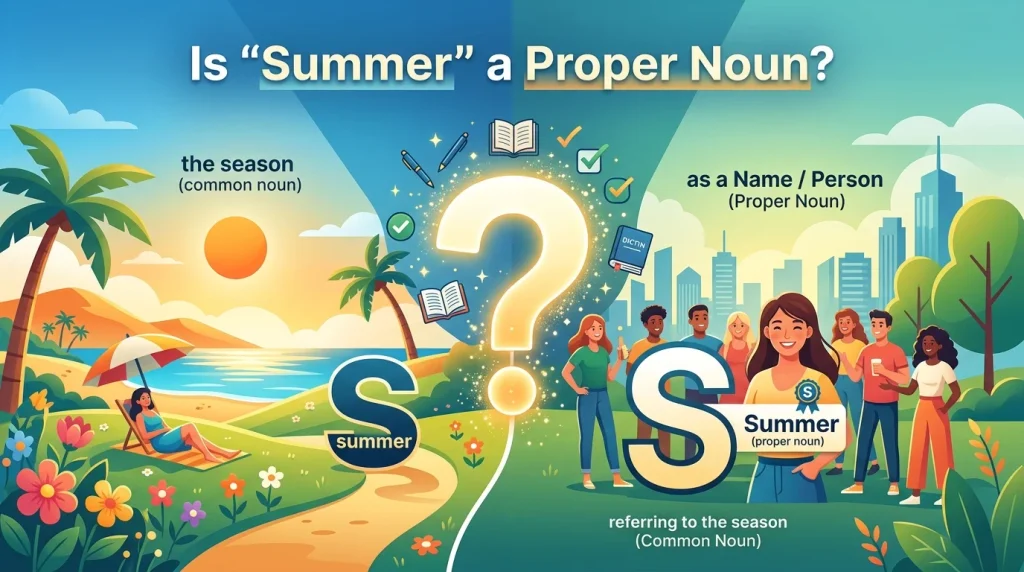
No, summer is generally a common noun, not a proper noun.
A common noun refers to a general person, place, thing, or concept. A proper noun identifies a particular named entity.
Compare these examples:
| Common noun | Proper noun |
| season | summer |
| month | January |
| day | Monday |
| city | Chicago |
| country | Canada |
| holiday | Thanksgiving |
This distinction explains why summer normally remains lowercase while January and Monday require capital letters.
Consider this sentence:
My summer vacation begins on Monday, June 15.
Here, summer stays lowercase, while Monday and June are capitalized.
Why?
Because Monday is the name of a particular day of the week, and June is the name of a particular month. Summer is the general name of a season.
That difference is one of the easiest ways to remember the rule.
Do You Capitalize the Seasons?
Generally, no. The four seasons are lowercase in ordinary writing.
Spring
- Flowers bloom in spring.
- We usually clean the house in spring.
- The semester begins in spring.
Summer
- We visit our relatives every summer.
- The children enjoy summer vacation.
- Temperatures rise during summer.
Fall
- The leaves turn orange in fall.
- School starts again in fall.
- We enjoy hiking during fall.
Winter
- The roads become icy in winter.
- Many people enjoy skiing in winter.
- Our heating bills increase during winter.
This lowercase treatment is standard when the words simply refer to the seasons.
However, capitalization can become appropriate when a season appears in a proper name, official title, or title-style context. The surrounding wording matters.
What About “Summer Break”?
The phrase “summer break” is normally lowercase.
When you use it as an ordinary phrase, write:
- summer break
- summer vacation
- summer holiday
- summer semester
- summer classes
- summer school
- summer camp
For example:
We are looking forward to summer break.
The students have three months of summer break.
What are you doing during summer break?
I plan to work during my summer break.
In these examples, summer isn’t a proper noun. It simply describes the type of break.
Therefore, summer break does not normally need capitalization.
Is “Summer Break” Ever Capitalized?
Yes, but context matters.
If Summer Break appears as an official name, heading, title, or branded program, capitalization may be appropriate because of the style being used.
For example, a school might officially name a program Summer Break Academy. In that case, capitalization comes from the proper name.
Likewise, if Summer Break appears in the title of a book, movie, article, event, or course, title capitalization may require both words to begin with capital letters.
The important distinction is this:
Ordinary phrase: summer break
Official name or title: Summer Break
You shouldn’t capitalize the phrase simply because it refers to a school vacation.
“Summer Break” vs. “Summer Vacation”
Both phrases are commonly used, but they can carry slightly different meanings depending on context.
Summer break often refers to the period when students aren’t attending school during the summer.
For example:
School ends in June, and summer break lasts until August.
Summer vacation can refer to the same period. It can also emphasize the idea of taking time away from work, school, or normal routines.
For example:
We’re planning a family trip during our summer vacation.
Neither phrase normally requires a capital S in ordinary sentences.
So these forms are generally correct:
- summer break
- summer vacation
- summer holidays
- summer recess
Not:
- Summer Break
- Summer Vacation
- Summer Holidays
unless capitalization is required by a title, proper name, or particular style.
Is “Summer” Capitalized at the Beginning of a Sentence?
Yes.
Like any other word, summer must be capitalized when it begins a sentence.
For example:
Summer is my favorite season.
Summer can be extremely hot in some regions.
Summer break starts next week.
This doesn’t mean that the season itself has become a proper noun. The capital letter appears because summer is the first word of the sentence.
Compare:
I love summer.
Summer is my favorite season.
The first sentence uses lowercase summer because the word appears in the middle of the sentence. The second uses uppercase Summer because it begins the sentence.
This is a basic capitalization rule that applies to almost every common noun.
For example:
Winter can be cold.
I don’t like winter.
School starts tomorrow.
I walk to school every morning.
The position of the word can affect capitalization even when its grammatical role stays the same.
Is “Summer” Capitalized After a Comma?
Usually, no.
A comma doesn’t automatically make the next word uppercase. If summer follows a comma and remains part of the same sentence, it normally stays lowercase.
For example:
I love every season, but summer is my favorite.
We traveled throughout the country last summer, enjoying the warm weather.
During the year, summer is the season I look forward to most.
The word summer remains lowercase because it isn’t a proper noun.
A common mistake is to assume that punctuation always requires capitalization. That’s not true.
A comma usually separates parts of a sentence. It doesn’t automatically turn the next word into a new sentence.
Compare:
Correct:
I love summer, especially when the evenings are warm.
Incorrect:
I love summer, especially when the evenings are warm.
The capital E isn’t justified because especially doesn’t begin a new sentence.
The same principle applies to summer.
Is “Summer” Capitalized in the Middle of a Sentence?
Normally, no.
When summer appears in the middle of an ordinary sentence, use lowercase:
We usually travel in summer.
My favorite memories come from summer.
The children are excited for summer break.
She found a job for the summer.
They spend most weekends at the beach during summer.
These sentences use the standard form.
The same rule applies when summer modifies another noun.
For example:
- summer clothes
- summer weather
- summer activities
- summer months
- summer vacation
- summer break
- summer school
- summer camp
- summer reading
- summer schedule
In each case, summer functions as a common noun modifier.
What About “Summer Months”?
The phrase “summer months” should normally use lowercase letters.
For example:
We receive the most visitors during the summer months.
Many businesses become busier during the summer months.
The summer months can bring extreme heat.
There is no special capitalization rule for the phrase. Summer remains lowercase because it is simply describing the months associated with that season.
You might also see:
The summer months of June, July, and August are especially busy.
Here, summer is lowercase, while June, July, and August are capitalized because month names are proper nouns.
This provides another useful comparison:
summer months → lowercase
June, July, and August → uppercase
Is “Summer” Capitalized in “Summer School”?
Normally, no.
When summer school refers generally to classes or an educational program held during the summer, both words are lowercase.
For example:
She plans to attend summer school.
I took two classes during summer school.
Summer school begins next week.
Notice that Summer is capitalized in the third sentence only because it starts the sentence.
If a particular institution officially calls its program Summer School, capitalization may change because the phrase is being used as a formal name.
For example, a school could establish a program called Lincoln High Summer School Program. The capitalization then depends on the official name and the style guide being followed.
The general rule remains straightforward:
Generic phrase: summer school
Official name: capitalization may apply
Is “Summer Camp” Capitalized?
Usually, summer camp is lowercase when you mean the activity or type of program in general.
Examples:
My children attend summer camp every year.
She worked at a summer camp last year.
We’re searching for a good summer camp.
He made many friends at summer camp.
However, if the camp has a specific official name, capitalize that name.
For example:
My daughter attends Pine Valley Summer Camp.
Here, Pine Valley Summer Camp functions as a specific name.
But if you simply write:
My daughter attends summer camp.
the phrase remains lowercase.
This distinction between generic description and official name is one of the most useful capitalization concepts to remember.
Is this Capitalized?
Generally, summer semester is lowercase.
For example:
I’m taking three classes during the summer semester.
The summer semester begins in May.
Registration for the summer semester opens next week.
Some schools may officially label academic terms with capitalized names in their schedules or catalogs. If you’re reproducing an institution’s official terminology, follow that institution’s style.
In ordinary prose, however, lowercase is the safer standard:
summer semester
rather than:
Summer Semester
The same principle applies to expressions such as:
- summer session
- summer term
- summer classes
- summer courses
- summer program
- summer enrollment
These phrases are normally lowercase unless they’re part of a proper name or title.
Is “Summer Vacation” Capitalized?
No, not in ordinary writing.
Write:
We are planning our summer vacation.
Our summer vacation starts next week.
She spent her summer vacation with her grandparents.
Where are you going for summer vacation?
The phrase doesn’t become a proper noun simply because it refers to a significant period of the year.
This is an important point because people sometimes capitalize words that feel important. Grammar doesn’t work that way. Capitalization depends primarily on function and naming, not emotional importance.
Your summer vacation might be the highlight of the entire year. That still doesn’t require a capital S.
Common Capitalization Mistakes With “Summer”
Several errors appear repeatedly in informal writing.
Mistake: Capitalizing Every Season
Some writers assume that all season names need capital letters.
They may write:
I love Summer and Fall.
In ordinary American English, this should be:
I love summer and fall.
Both season names are common nouns.
Mistake: Capitalizing “Summer Break”
Another common error is:
We’re excited for Summer Break.
In ordinary prose, use:
We’re excited for summer break.
The capitalized version can be correct if Summer Break is part of an official title or heading, but not simply because it’s a school vacation.
Mistake: Capitalizing Seasons Like Months
Writers sometimes remember that January is capitalized and assume summer should be too.
Compare:
We travel in June.
We travel in summer.
June is capitalized because it is a month name. Summer remains lowercase because it is a season name.
This simple contrast can help prevent many capitalization mistakes.
Mistake: Assuming Importance Requires Capitalization
A word doesn’t become a proper noun because it represents something important.
For example:
Summer is my favorite season.
The word can be meaningful or culturally important without becoming a proper noun.
Capitalization isn’t a way to show enthusiasm or importance in standard English.
Quick Rule to Remember
When you’re unsure whether summer needs a capital letter, ask one question:
Is “summer” simply naming the season, or is it part of a proper name or title?
If you’re simply talking about the season, use lowercase:
- summer
- summer break
- summer vacation
- summer camp
- summer school
- summer weather
If the word begins a sentence, capitalize it:
- Summer is finally here.
If it’s part of a specific official name or title, capitalization may be required:
- [Official Program Name] Summer Program
This rule keeps your writing clean without forcing you to memorize dozens of individual examples.
Summer Capitalization at a Glance
| Expression | Usual form | Example |
| Season | summer | I love summer. |
| Beginning of sentence | Summer | Summer is hot here. |
| Summer break | summer break | School ends for summer break. |
| Summer vacation | summer vacation | We planned a summer vacation. |
| Summer camp | summer camp | She works at summer camp. |
| Summer school | summer school | He attends summer school. |
| Summer semester | summer semester | Classes begin in the summer semester. |
| Summer months | summer months | The summer months are busy. |
| Official name | Depends on name | Follow the official capitalization. |
| Title | Depends on style | Follow the title’s capitalization style. |
The safest everyday rule is simple: capitalize “summer” only when a capitalization rule requires it. In ordinary sentences, the lowercase form is correct.
When Should “Summer” Be Capitalized?
Although summer is usually lowercase, there are situations where a capital letter is correct. The trick is to identify the reason for capitalization.
A season name can appear in a proper name, a title, a heading, or at the beginning of a sentence. Each situation follows a slightly different rule.
Understanding these exceptions prevents you from treating every use of summer the same way.
When “Summer” Starts a Sentence
The most obvious exception occurs when summer begins a sentence.
Every standard sentence begins with a capital letter, regardless of the word involved.
For example:
Summer is the perfect time for outdoor activities.
Summer break begins next Friday.
Summer usually brings warmer temperatures.
Summer vacation gives students time to relax.
Here, the capital letter doesn’t come from the season itself. It comes from the word’s position at the beginning of the sentence.
Move the same word into the middle of a sentence, and it usually becomes lowercase:
Students look forward to summer break.
This distinction is easy to overlook because the word looks different even though its meaning hasn’t changed.
When “Summer” Appears in a Proper Name
A proper name identifies a particular person, place, organization, program, event, publication, or other named entity.
If Summer forms part of such a name, capitalization can be appropriate.
For example:
The school introduced the Summer Scholars Program.
Here, Summer Scholars Program may function as the official name of a particular program.
Compare it with:
The school offers a summer scholars program every year.
The second sentence describes a type of program rather than necessarily naming one specific program.
This distinction matters.
Generic description:
The university offers a summer program.
Official name:
The university launched the Summer Scholars Program.
The first uses summer as a common noun modifier. The second uses it within a proper name.
What About “Summer Break” in a Title?
Titles require special attention because capitalization depends on the title style being used.
If summer break appears in ordinary sentence text, lowercase is normally appropriate:
Students are excited about summer break.
However, if the phrase appears as the title of an article, book, story, presentation, or other work, title capitalization may capitalize important words.
For example:
Summer Break: Tips for Making the Most of Your Vacation
In this title, Summer and Break are capitalized because they are important words in the title.
That doesn’t mean the ordinary phrase has suddenly become a proper noun.
Compare:
Sentence:
The students are ready for summer break.
Title:
Summer Break: A Guide for Students
The difference comes from the format and capitalization style, not from a change in the basic meaning of the phrase.
Why Titles Change the Rule
English titles often use title case. Under common title-case conventions, major words receive capital letters.
Words that may be capitalized include:
- nouns
- verbs
- adjectives
- adverbs
- pronouns
- important words in headings
Short articles, conjunctions, and prepositions may remain lowercase depending on the style.
Therefore, a title such as:
Summer Break Activities for Students
can use capital letters even though the ordinary phrase remains:
summer break
When you’re writing a title, don’t apply ordinary sentence capitalization mechanically. Follow the capitalization style required for that title.
Sentence Case vs. Title Case
Knowing the difference between sentence case and title case can make summer capitalization much easier.
Sentence Case
Sentence case generally capitalizes the first word and proper nouns.
For example:
Summer break starts next week.
Summer vacation is almost here.
Summer classes begin in June.
The word summer is capitalized here only because it starts the sentence.
Title Case
Title case usually capitalizes the important words in a title.
For example:
Summer Break Activities for Kids
How to Plan the Perfect Summer Vacation
Best Summer Activities for Families
Here, Summer is capitalized because it appears as an important word in a title.
This distinction explains why the same phrase may look different in different contexts.
Is “Summer” Capitalized in Headings?
It depends on the capitalization style used for headings.
If your document uses sentence case for headings, you might write:
Summer break activities
If your document uses title case, you might write:
Summer Break Activities
Neither necessarily changes the underlying grammar of summer.
The capitalization comes from the heading style.
This is especially important for websites, blogs, school projects, business documents, and academic papers. A document may establish one heading style and expect every heading to follow it consistently.
The biggest mistake is mixing styles randomly.
For example, a document might contain:
Summer Break Activities
summer Vacation Ideas
Summer school options
That inconsistent treatment looks unprofessional.
Choose one heading style and use it throughout the document.
Is “Summer” Capitalized in a School Schedule?
School schedules can be confusing because institutions sometimes capitalize terms according to their internal style.
In ordinary prose, write:
The summer semester begins in May.
Registration for summer classes opens tomorrow.
Students can enroll in the summer session online.
However, an official school document might display something like:
Summer Session
or
Summer Term
This may reflect the institution’s preferred labeling system rather than a universal grammar rule.
If you’re writing about the term in normal prose, lowercase is generally appropriate.
If you’re reproducing an official program name, schedule heading, or institutional label, preserve the official capitalization when necessary.
Is “Summer” Capitalized in Academic Writing?
Academic writing generally follows a consistent style guide. The exact details can vary depending on the publication, institution, or discipline.
In ordinary academic prose, season names are usually lowercase.
For example:
The study was conducted during summer.
Participants were recruited during the summer months.
The university offers additional courses during the summer semester.
Enrollment increased during summer break.
The fact that a paper is formal doesn’t automatically require capitalizing season names.
Formal writing still follows the same basic distinction between common and proper nouns.
However, an academic paper may contain the title of a specific program, course, conference, or publication. Those official names can require capitalization.
For example:
Participants enrolled in the Summer Research Fellowship.
Here, the capitalization comes from the proper name.
Is “Summer” Capitalized in Business Writing?
Business writing follows the same basic rule.
When referring generally to the season, use lowercase:
We expect sales to increase during summer.
The company will launch the campaign in summer.
Our summer schedule begins in June.
Employees can request summer vacation days through the portal.
But a formal campaign, event, or program name may use capitalization:
The company launched its Summer Savings Campaign.
If that is the official name of the campaign, capitalization makes sense.
Again, the key question isn’t whether the document is professional. The key question is whether summer is functioning as an ordinary season name or part of a specific name.
Is “Summer” Capitalized in Emails?
In everyday emails, summer normally stays lowercase.
For example:
Hi James,
I’m looking forward to summer break.
Are you planning a trip this summer?
We can discuss the summer schedule next week.
There is no reason to capitalize summer simply because the email is professional.
The same applies to phrases such as:
- summer vacation
- summer schedule
- summer meeting
- summer internship
- summer project
- summer hours
However, an email subject line may use a different capitalization style.
For example:
Summer Internship Opportunities
could be a subject line using title-style capitalization.
The same phrase inside the email could appear as:
We have several summer internship opportunities available.
Context determines the appropriate capitalization.
What About “Summer Hours”?
The phrase summer hours is generally lowercase.
For example:
Our office will operate on summer hours beginning next month.
Please check the website for updated summer hours.
The library has different summer hours.
However, if an organization uses Summer Hours as the formal name of a specific initiative or schedule, capitalization may be used according to its official style.
This distinction appears frequently in business communication.
A phrase can be grammatically generic while an organization chooses to capitalize it as a branded label.
For ordinary writing, though, lowercase is the normal choice.
What About “Summer Session”?
Use lowercase summer session when you’re referring generally to an academic session.
Examples:
I’m taking one course during the summer session.
The summer session begins in May.
Registration for the summer session closes Friday.
If the institution gives the session a formal title, follow its official capitalization.
For example, an institution could name a particular program:
2026 Summer Session
Here, the capitalization may reflect a formal label or heading.
The important point is that summer doesn’t become a proper noun simply because it relates to education.
What About “Summer Term”?
The same principle applies to summer term.
Use lowercase in ordinary prose:
Students can register for the summer term.
The summer term is shorter than the fall term.
She plans to take two courses during the summer term.
But a university’s official catalog or schedule may use capitalization as part of its naming convention.
When you’re writing independently, lowercase is generally appropriate unless a specific style or official name requires otherwise.
What About “Summer Olympics”?
This phrase introduces an important capitalization issue because Olympics is part of a proper name.
When referring to the official event, capitalization is required:
The Summer Olympics attract athletes from around the world.
Here, Summer Olympics is a specific name for an international sporting event.
This is different from a generic phrase such as:
I enjoy watching sports during the summer.
The first expression identifies a specific event. The second simply refers to the season.
The word summer may therefore be capitalized as part of a proper name even though ordinary season names are lowercase.
“Summer Olympics” vs. “Summer Sports”
Compare these:
The Summer Olympics begin in July.
I enjoy watching summer sports.
The first contains the official name of a major event. The second describes sports associated with the season.
That difference explains the capitalization.
What About “Summer Solstice”?
The phrase summer solstice is generally lowercase when used as a common astronomical term.
For example:
The summer solstice occurs around June 20 or 21 in the Northern Hemisphere.
Many cultures celebrate the summer solstice.
Days are longest around the summer solstice.
Although the event has scientific and cultural significance, its name doesn’t automatically become a proper noun.
This is another useful reminder: importance doesn’t determine capitalization.
The grammatical role and established naming convention matter more.
What About “Summer Olympics” and Other Official Events?
Official events may capitalize Summer when the full expression functions as a recognized name.
Similar examples can occur with:
- Summer Olympics
- Summer Paralympics
- Summer Games
- Summer Festival, when used as an official event name
- Summer Conference, when used as an official conference title
But don’t assume every event containing summer requires capitalization.
Compare:
We attended a summer festival downtown.
with:
We attended the Summer Festival hosted by the city.
The second could be capitalized if Summer Festival is the event’s official name.
The first describes a generic type of event.
Is “Summer” Capitalized in Names of Programs?
A program’s official name may capitalize Summer.
For example:
She was accepted into the Summer Leadership Program.
He applied for the Summer Internship Program.
The university launched the Summer Scholars Initiative.
These examples use capitalization because the phrases can function as formal names.
But if you aren’t referring to a particular named program, lowercase is better:
She applied for a summer internship program.
The university offers a summer leadership program.
Students can join a summer scholars program.
When in doubt, ask whether the phrase identifies one specific program or merely describes a type of program.
What About “Summer Reading”?
The phrase summer reading is usually lowercase.
For example:
The teacher assigned summer reading.
I finished my summer reading early.
The library has a summer reading program.
But an official program title may be capitalized:
Students joined the Summer Reading Challenge.
If Summer Reading Challenge is the official name of a particular program, the capital letters are justified by its status as a proper name.
This pattern repeats across many expressions:
Generic: summer reading program
Official name: Summer Reading Challenge
The capitalization isn’t caused by the word summer itself.
What About “Summer Internship”?
Usually, write summer internship in lowercase.
Examples:
I’m applying for a summer internship.
She completed a summer internship at a local company.
The company offers several summer internships.
If a particular internship has an official name, capitalize that name.
For example:
She was selected for the Summer Leadership Internship.
Again, context controls capitalization.
What About “Summer Job”?
The phrase summer job is normally lowercase.
For example:
He found a summer job at a restaurant.
Many students look for a summer job after school ends.
I had my first summer job when I was sixteen.
There is no special capitalization rule that makes summer uppercase here.
The same applies to:
- summer work
- summer employment
- summer position
- summer internship
- summer schedule
- summer hours
All remain lowercase when they’re ordinary descriptive phrases.
What About “Summer School” and “Summer Camp” Together?
When several summer expressions appear in one sentence, keep the same lowercase treatment unless a proper name or title changes the rule.
For example:
During summer break, some students attend summer school or summer camp.
This sentence contains three ordinary phrases:
- summer break
- summer school
- summer camp
None requires capitalization in ordinary prose.
A writer might incorrectly capitalize them because they’re all associated with a specific period of the year. That isn’t enough.
Their relationship to the season doesn’t make them proper nouns.
Does “Summer” Need Capitalization After a Colon?
Usually, no.
A colon doesn’t automatically require the next word to begin with a capital letter in American English.
For example:
There is one season I always look forward to: summer.
We have one major plan for the school vacation: summer break.
In these examples, lowercase is appropriate because summer and summer break aren’t proper nouns.
However, if the material following the colon is a complete sentence, capitalization may be appropriate depending on the style and context.
For example:
We have one goal: Summer should be a time for students to rest.
Here, Summer is capitalized because it begins a complete sentence.
The colon itself doesn’t create the capitalization rule. The grammatical structure does.
Does “Summer” Need Capitalization After a Semicolon?
No.
A semicolon connects closely related independent clauses. It doesn’t automatically capitalize the next word.
For example:
School ends in June; summer break begins soon afterward.
However, this particular sentence has another issue: summer break is normally lowercase because it isn’t a proper noun.
So the preferred version is:
School ends in June; summer break begins soon afterward.
The word summer is lowercase even though it follows a semicolon.
This illustrates an important rule: punctuation doesn’t automatically turn a common noun into a proper noun.
Is “Summer” Capitalized in Quotation Marks?
Quotation marks don’t automatically require capitalization.
For example:
She said she couldn’t wait for “summer break.”
The word remains lowercase because the phrase isn’t a proper name.
But if the quoted material begins a sentence or reproduces a title, capitalization may change.
For example:
The article was titled “Summer Break Activities.”
Here, the capital letters come from title capitalization.
Similarly:
She said, “Summer is my favorite season.”
The capital S appears because Summer begins the quoted sentence.
So quotation marks don’t determine capitalization by themselves.
The Big Rule Behind All These Examples
Most capitalization questions about summer become easier once you separate three situations:
Ordinary season name
I love summer.
Beginning of a sentence
Summer is here.
Proper name or title
Summer Scholars Program
These three categories cover most everyday cases.
If summer simply means the season, keep it lowercase. If it begins a sentence, capitalize it. If it forms part of a proper name or follows a title-style capitalization system, capitalize it when that convention requires it.
That approach is much more reliable than memorizing isolated phrases.
Does the Style Guide Affect Summer Capitalization?
The basic rule is consistent across standard English: season names are generally lowercase. However, style guides can differ in how they handle titles, headings, official names, and specialized terms.
This matters when you’re writing for a school, business, publication, website, or academic institution with its own editorial rules.
For ordinary sentences, you can confidently write:
We usually travel during summer.
Students return after summer break.
She took a course during the summer semester.
The situation becomes more complicated when the phrase appears in a heading, title, official program name, or branded expression.
General American English Usage
In standard American English, spring, summer, fall, and winter are normally lowercase.
Examples include:
The weather is pleasant in spring.
We spend more time outdoors in summer.
School resumes in fall.
The roads can become dangerous in winter.
This applies whether the season appears alone or modifies another noun.
For example:
- summer weather
- summer vacation
- summer break
- summer school
- summer camp
- summer activities
- summer months
All of these are normally lowercase in ordinary prose.
What About British English?
British English also generally uses lowercase for season names in ordinary writing.
For example:
We usually go away in summer.
The children are looking forward to summer holidays.
The weather was warm throughout summer.
So the basic capitalization rule doesn’t change simply because the variety of English changes.
However, British English often uses summer holidays, while American English commonly uses summer vacation or summer break.
These are vocabulary differences rather than capitalization differences.
American English
Common expressions include:
- summer break
- summer vacation
- summer school
- summer camp
British English
You may commonly encounter:
- summer holidays
- summer term
- summer school
- summer camp
Regardless of the expression, summer generally remains lowercase when it refers to the season.
Is “Summer” Capitalized in “Summer Holidays”?
No, not in ordinary prose.
British English frequently uses summer holidays to describe the extended school vacation.
For example:
The children are looking forward to the summer holidays.
Schools close for the summer holidays.
We traveled abroad during the summer holidays.
The phrase doesn’t require a capital S simply because it refers to an important school period.
The same principle applies to American English expressions such as summer break and summer vacation.
Is “Summer” Capitalized in “Summer Vacation”?
Normally, no.
Write:
We planned a summer vacation.
Our summer vacation begins next week.
She spent her summer vacation at home.
The phrase remains lowercase unless it appears in a title, official name, or another context where capitalization is required.
A common mistake is to write:
Summer Vacation
inside a normal sentence.
That style can look like a title even when it isn’t one.
Is “Summer Break” One Word or Two?
Summer break is written as two words.
The word summer modifies the noun break, creating a noun phrase.
Examples:
I need a relaxing summer break.
Our summer break starts tomorrow.
What are your plans for summer break?
Do not normally write:
summerbreak
The compound form isn’t standard in ordinary American English.
You may see variations in informal branding or creative writing, but the standard phrase is summer break.
Is “Summer Break” Hyphenated?
Usually, summer break does not need a hyphen.
For example:
The students are enjoying their summer break.
There is no reason to hyphenate the phrase simply because summer describes break.
A hyphen becomes relevant when multiple words work together as a compound modifier before another noun, and the construction could become unclear.
For example:
a two-week summer break
Here, two-week is hyphenated because it functions as a compound adjective modifying summer break.
But:
a summer break
does not need a hyphen.
This distinction helps prevent unnecessary hyphenation.
What About “Summer Break Schedule”?
The phrase summer break schedule is normally written without a hyphen.
For example:
Check the summer break schedule before making travel plans.
Here, summer break describes the type of schedule.
If the entire phrase appears as a heading, capitalization depends on your heading style.
For example, in sentence case:
Summer break schedule
In title case:
Summer Break Schedule
Neither style changes the underlying spelling of summer break.
What About “Summer-Break Activities”?
This construction can create a more complicated punctuation question.
When summer break functions directly as a modifier before another noun, writers may consider whether a hyphen improves clarity.
For example:
We planned several summer break activities.
This is perfectly natural without a hyphen.
You generally don’t need to write:
summer-break activities
The phrase is familiar enough that the meaning is clear.
However, different editorial styles may handle unusual compound modifiers differently. In ordinary writing, summer break activities is the straightforward choice.
Is “Summer” Capitalized in “Late Summer” and “Early Summer”?
No, normally.
Write:
- early summer
- late summer
- mid-summer or midsummer, depending on the intended meaning and style
- summer evening
- summer morning
- summer afternoon
Examples:
We usually travel in early summer.
Temperatures remain high in late summer.
The flowers bloom in early summer.
The adjective early or late doesn’t make the season a proper noun.
What About “Midsummer”?
Midsummer is a special case because it can function as a recognized noun referring to the middle of summer or, in some contexts, a traditional seasonal celebration.
Examples include:
The festival takes place at midsummer.
We visited the region in midsummer.
The capitalization of Midsummer can vary when it refers to a specific cultural celebration, holiday, or title.
As with other capitalization questions, context matters more than the word’s connection to the season.
What About “Summer Solstice”?
The ordinary astronomical term is generally lowercase:
The summer solstice occurs around June.
Many cultures celebrate the summer solstice.
The phrase describes a particular astronomical event, but that doesn’t automatically make every word a proper noun.
This is similar to terms such as:
- spring equinox
- winter solstice
- autumn equinox
In ordinary prose, these terms are generally lowercase.
If an official organization, event, or publication uses a capitalized form as part of its formal name, follow that name’s established style.
What About “Summer Olympics”?
Summer Olympics is different from ordinary summer because it appears within the recognized name of a specific international sporting event.
For example:
She hopes to compete in the Summer Olympics someday.
Here, Summer Olympics is treated as a proper name.
Compare:
She trains throughout the summer.
The first identifies a specific event. The second identifies a season.
This is one of the clearest examples of why context matters.
What About “Summer Games”?
The phrase summer games can be either lowercase or capitalized depending on what you mean.
If you’re talking generally about games played during the summer, use lowercase:
The children played several summer games outside.
But if Summer Games forms part of an official event name, capitalization may be appropriate:
The city hosted the Summer Games.
The exact capitalization depends on whether the phrase is being used as an established proper name.
What About “Summer Festival”?
The same distinction applies to summer festival.
Generic use:
We attended a summer festival near the lake.
Official name:
We attended the Summer Festival organized by the city.
The second version assumes Summer Festival is the event’s formal name.
If you’re unsure, check how the organization officially styles the event. Don’t capitalize every descriptive event phrase automatically.
Is “Summer” Capitalized in “Summer Reading Program”?
Usually, summer reading program is lowercase when it refers to a general type of program.
For example:
The library offers a summer reading program for children.
But if the library gives its program a formal name, capitalization may apply:
The library launched the Summer Reading Adventure.
The first phrase describes what the library offers. The second identifies a specific named program.
This generic-versus-proper distinction is one of the most important concepts in capitalization.
Is “Summer” Capitalized in “Summer Internship Program”?
The answer depends on whether the phrase is generic or official.
Generic:
The company offers a summer internship program.
Official name:
Applications are open for the Summer Internship Program.
If the second phrase is the organization’s formal program name, title-style capitalization is appropriate.
However, don’t capitalize it merely because the internship is important.
A common noun phrase doesn’t become a proper name just because it appears in a professional document.
Is “Summer” Capitalized in “Summer Session”?
The ordinary phrase remains lowercase:
Registration for the summer session begins tomorrow.
I’m taking two courses during the summer session.
The summer session is shorter than the fall semester.
A university might use Summer Session as an official administrative label. In that situation, its internal style may capitalize the words.
When writing independently, use lowercase unless you have a reason to preserve an official capitalization.
Is “Summer” Capitalized in Dates?
Season names can appear alongside months and dates, which sometimes creates confusion.
Consider:
Our summer program begins on June 10.
Here, summer is lowercase, while June is capitalized.
Another example:
The event will take place in summer 2027.
The season remains lowercase, while the year uses its normal numerical form.
You could also write:
We expect warmer weather in summer 2027.
Again, the presence of a year doesn’t require capitalization.
Why “June” Is Different
Month names are proper nouns:
- January
- February
- March
- April
- May
- June
- July
- August
- September
- October
- November
- December
Season names are normally common nouns:
- spring
- summer
- fall
- winter
Therefore:
June is hot in this region.
but:
summer is hot in this region.
The capitalization difference is grammatical rather than seasonal.
Can “Summer” Be Capitalized in a Date Range?
Not usually.
For example:
The course runs from spring through summer.
The program lasts from June through August.
The project continues throughout summer 2027.
The season remains lowercase.
If a date range appears in a heading or title, title capitalization can produce a different visual form:
Summer 2027 Program Dates
Here, Summer is capitalized because it appears in a title-style heading.
Is “Summer” Capitalized in a Calendar?
Calendars can use different capitalization systems.
A calendar might display:
Summer
as a seasonal label.
That doesn’t necessarily mean that the word is grammatically a proper noun. Designers and publishers often use capitalization for visual consistency.
For example, a calendar might display all seasons as:
Spring
Summer
Fall
Winter
This is a design or labeling choice.
In ordinary sentence text, however, the standard form remains:
We travel during summer.
This difference between display formatting and ordinary grammar is easy to miss.
Is “Summer” Capitalized in a List?
A list doesn’t automatically require capitalization.
For example:
- spring activities
- summer activities
- fall activities
- winter activities
The season names remain lowercase.
But if each item is written as a title or heading, capitalization may change:
- Spring Activities
- Summer Activities
- Fall Activities
- Winter Activities
The difference comes from the formatting convention, not from a special rule for season names.
Is “Summer” Capitalized in a Bullet Point?
A bullet point follows the capitalization style of the text inside it.
For example:
- Plan your summer vacation.
- Register for summer classes.
- Prepare for summer break.
Here, lowercase is appropriate because the season is part of an ordinary phrase.
If the bullets are title-style labels, you might instead see:
- Summer Vacation Plans
- Summer Class Registration
- Summer Break Activities
Again, title capitalization changes the appearance.
Is “Summer” Capitalized in a Book Title?
If summer appears in a book title, capitalize it according to the title’s capitalization style.
For example:
A Summer to Remember
Summer Adventures
The Secret of Summer
The exact capitalization depends on the title and style being used.
This doesn’t mean that summer should be capitalized whenever it appears in regular writing.
Compare:
I spent the summer reading.
with:
Summer Adventures is a popular title.
The first is ordinary prose. The second is a title.
Is “Summer” Capitalized in a Movie or Song Title?
Yes, it may be capitalized when title-style conventions require it.
For example:
The movie is titled Summer Nights.
She listened to the song Summer Dreams.
The capitalization belongs to the title.
When discussing the season outside the title, keep it lowercase:
We watched the movie during summer.
This is another example of how a word can appear with different capitalization depending on its role.
What About “Summer” in a Course Name?
Course names can be either generic descriptions or official titles.
Generic:
I’m taking a summer writing course.
Official course title:
I’m enrolled in Summer Writing Workshop.
If Summer Writing Workshop is the official name listed by the institution, capitalization may be required.
However, if you’re simply describing the course, lowercase is appropriate.
For example:
The university offers a summer writing workshop every year.
This distinction is especially useful for students filling out applications, writing academic emails, or describing their coursework.
What About “Summer” in a Workplace Program?
The same principle applies to workplace programs.
Generic:
The company offers a summer training program.
Official name:
Employees can register for the Summer Leadership Initiative.
The second expression is presented as a specific named initiative.
When an organization has established an official name, preserve its capitalization. Otherwise, don’t capitalize summer simply because the phrase appears in a corporate document.
Common Questions
Many capitalization mistakes happen because writers rely on appearance instead of grammatical function.
Here are several quick comparisons.
“Summer” vs. “Summer”
I love summer.
Summer is finally here.
The first is lowercase because it appears in the middle of the sentence. The second is capitalized because it begins the sentence.
“Summer Break” vs. “summer break”
We need a long summer break.
Summer Break: Ideas for Students
The first is ordinary sentence text. The second is a title.
“Summer School” vs. “summer school”
She attends summer school.
Summer School is the title of the program.
The capitalization depends on whether the phrase is generic or functions as a title or official name.
“Summer Olympics” vs. “summer activities”
He dreams of competing in the Summer Olympics.
She enjoys summer activities.
The first identifies a specific event. The second describes activities associated with the season.
A Simple Three-Step Capitalization Test
When you’re uncertain about summer, use this quick test.
Step One: Is It the Season?
Ask whether summer simply refers to the season.
If yes, use lowercase:
We traveled during summer.
I love summer weather.
School ends before summer break.
Step Two: Does It Start the Sentence?
If summer begins a sentence, capitalize it:
Summer is my favorite season.
This capitalization comes from sentence position.
Step Three: Is It Part of a Proper Name or Title?
If summer belongs to an official name or title, capitalize it when the naming convention requires it:
Summer Scholars Program
Summer Olympics
Summer Reading Challenge
This three-step test solves most everyday capitalization questions.
A Quick Comparison Table
| Context | Correct Form | Reason |
| Ordinary season | summer | Common noun |
| Start of sentence | Summer | First word |
| Summer break | summer break | Generic phrase |
| Summer vacation | summer vacation | Generic phrase |
| Summer school | summer school | Generic phrase |
| Summer camp | summer camp | Generic phrase |
| Summer semester | summer semester | Generic academic term |
| Summer Olympics | Summer Olympics | Specific event name |
| Official program | Summer Program | Possible proper name |
| Article title | Summer Break Tips | Title capitalization |
| Heading | Depends | Style determines capitalization |
| Calendar label | Depends | Display style may vary |
The central principle remains unchanged: ordinary season names stay lowercase unless another capitalization rule takes priority.
Real-Life Examples of Summer Capitalization
The easiest way to master summer capitalization is to see the rule working in everyday sentences. Most uses are straightforward once you identify whether you’re talking about the season, using a proper name, or writing a title.
Consider these examples:
I love summer because the days are longer.
The season appears in ordinary sentence text, so it stays lowercase.
Summer is usually hot in this region.
Here, the word is capitalized because it begins the sentence.
We’re planning a trip during summer break.
Both words remain lowercase because this is a generic phrase.
Our school offers a summer program for younger students.
Again, summer program is a general description.
She enrolled in the Summer Scholars Program.
Here, Summer Scholars Program is presented as a formal program name, so capitalization may be appropriate.
These examples demonstrate why looking only at the word itself can confuse. You need to consider its role in the sentence.
Correct and Incorrect Examples
A side-by-side comparison can make the rule easier to remember.
| Incorrect or unnecessary form | Preferred form | Explanation |
| I love Summer. | I love summer. | Season names are normally lowercase. |
| We have Summer Break next month. | We have summer break next month. | Generic phrase stays lowercase. |
| She attends Summer School. | She attends summer school. | Generic educational term stays lowercase. |
| We travel during Summer. | We travel during summer. | Ordinary season reference. |
| Summer is finally here. | Summer is finally here. | First word of sentence needs capitalization. |
| We visited during Summer 2027. | We visited during summer 2027. | A year doesn’t change season capitalization. |
| The summer months are busy. | The summer months are busy. | Generic phrase uses lowercase. |
| She joined the Summer Reading Challenge. | Summer Reading Challenge | Capitalization can apply to an official program name. |
Remember that the first column isn’t always universally “wrong” in every imaginable context. A capitalized phrase could be correct when it functions as a title, proper name, or official label.
Tricky Cases You Should Know
Some expressions look like proper names even when they aren’t. These cases often lead writers to capitalize summer unnecessarily.
“This Summer”
The phrase this summer is lowercase in ordinary writing.
Examples:
What are you doing this summer?
We’re staying home this summer.
I hope to travel this summer.
You don’t need to write:
What are you doing this Summer?
The word simply identifies the current or upcoming season.
“Next Summer”
Use lowercase:
We’re moving next summer.
I’ll start college next summer.
They plan to visit us next summer.
The word next doesn’t affect capitalization.
“Last Summer”
The standard form is:
We visited them last summer.
I started that job last summer.
Last summer was unusually hot.
In the third example, Last is capitalized because it begins the sentence. summer remains lowercase.
“Every Summer”
Use lowercase when the phrase appears within a sentence:
We go camping every summer.
Every summer, the town holds a festival.
In the second example, Every is capitalized because it begins the sentence. summer remains lowercase.
What About “Summer of 2026”?
When you mention a particular summer with a year, summer is still normally lowercase.
For example:
During the summer of 2026, we renovated the house.
The project will continue through the summer of 2026.
We expect strong demand in summer 2026.
The year doesn’t turn the season into a proper noun.
This is similar to saying:
in January 2026
Here, January remains capitalized because month names are proper nouns. The distinction between months and seasons still applies.
What About “Summer 2026”?
The normal sentence form is:
The project begins in summer 2026.
We expect construction to finish by summer 2026.
Enrollment opens for summer 2026.
However, you may see:
Summer 2026
in calendars, schedules, brochures, headings, or official labels.
That capitalization can reflect formatting or title style rather than a universal rule that requires Summer to be capitalized whenever a year follows it.
This distinction is particularly useful when you’re creating content for websites, school materials, or business documents.
What About “Summer Season”?
The phrase summer season is generally lowercase.
For example:
The summer season brings warmer temperatures.
Many businesses become busier during the summer season.
We prepare for the summer season every year.
The word season doesn’t make summer a proper noun.
In fact, summer season can sometimes sound repetitive because summer already identifies a season. In many contexts, simply saying summer is more natural.
For example:
Tourism increases during summer.
This is often cleaner than:
Tourism increases during the summer season.
Both can be grammatical, but concise wording usually sounds more natural.
What About “Summer Time” and “Summertime”?
Both summer time and summertime can appear in English, but they don’t always function in the same way.
Summertime is commonly used as a noun referring to the period of summer.
For example:
I enjoy summertime.
Summertime is perfect for outdoor activities.
When it begins a sentence, it receives a capital letter like any other word.
Summer time can also occur in contexts where the two words are being used separately, but summertime is often the natural form when referring generally to the season or period.
Don’t confuse summertime with daylight saving time, which is a separate concept.
What About “Summer’s”?
The apostrophe in summer’s can represent different grammatical meanings.
For example:
Summer’s arrival brought warmer weather.
Here, summer’s is a possessive form.
It can also represent a contraction:
Summer’s almost over.
Here, summer’s means summer is.
In both cases, capitalization follows the normal rule.
For example:
I love summer’s warm evenings.
Summer’s almost here.
The apostrophe itself doesn’t create a capitalization rule.
What About “Summers”?
The plural form summers is also normally lowercase.
For example:
I remember those long summers from childhood.
We spent many summers at the beach.
Several summers in a row were unusually hot.
The plural doesn’t make the word a proper noun.
If it begins a sentence:
Summers in this region can be extremely hot.
The initial capital comes from sentence position.
Can “Summer” Be Used as a Person’s Name?
Yes. Summer can be used as a personal name.
When Summer is someone’s name, it is capitalized because personal names are proper nouns.
For example:
Summer is joining our team next week.
I spoke with Summer yesterday.
This is completely different from:
I enjoy summer.
The spelling is identical, but the grammatical function is different.
In the first example Summer identifies a specific person. In the second, summer identifies a season.
This is an excellent example of why context matters in capitalization.
“Summer” as a Name vs. “Summer” as a Season
Compare these sentences:
Summer is my favorite season.
Summer is my new coworker.
The first Summer refers to the season and happens to be capitalized because it begins the sentence.
The second Summer refers to a person and requires capitalization because it is a proper name.
Move the season into the middle:
My favorite season is summer.
Now the difference becomes obvious.
This kind of context-based capitalization appears with many English words that can function as both common and proper nouns.
What About “Summer” in Poetry and Creative Writing?
Creative writing can use capitalization for artistic effect. A poem, story, or advertisement may deliberately capitalize words that standard prose would normally leave lowercase.
For example, a poet might write:
I waited for Summer to return.
That stylistic choice doesn’t establish a universal grammar rule.
In standard informational writing, summer should generally remain lowercase when it refers to the season.
Creative capitalization can be intentional, but it shouldn’t be mistaken for standard capitalization.
What About “Summer” in Advertising?
Advertisements often use capitalization for visual emphasis.
You might see:
Summer Sale
Summer Savings
Summer Collection
These forms can be perfectly appropriate as promotional headings.
However, if the same phrase appears in ordinary sentence text, standard capitalization may be different:
Our summer sale starts Friday.
The company launched its summer collection.
Advertising frequently prioritizes visual impact, while formal writing prioritizes grammatical consistency.
This is why a website banner isn’t always a reliable guide to standard capitalization.
What About “Summer Sale”?
The phrase summer sale is normally lowercase in ordinary prose.
For example:
The store is holding a summer sale.
We found several items during the summer sale.
If the business names its promotion Summer Sale, capitalization can be used as part of that official branding.
For example:
The Summer Sale begins Friday.
The important distinction is whether you’re referring to a generic seasonal sale or a specific branded promotion.
What About “Summer Collection”?
Fashion and retail businesses frequently use expressions such as summer collection.
In ordinary prose:
The brand released its new summer collection.
If Summer Collection is being used as an official campaign or collection name, capitalization may be appropriate:
The Summer Collection launches Friday.
Branding conventions can differ from ordinary grammar. When writing for a particular organization, its established brand style may take priority.
What About “Summer Festival”?
Again, consider whether the expression is generic or official.
Generic:
The town hosts a summer festival every year.
Official name:
We attended the Riverdale Summer Festival.
The first phrase describes an event. The second identifies a specific named event.
The capital letter isn’t required because summer is a season. It’s required because the word appears inside a proper name.
What About “Summer School Starts Monday”?
This sentence is a useful capitalization test.
Correct:
Summer school starts Monday.
Why?
Because summer school is a generic phrase, and summer begins the sentence only because it is the first word.
Now move it into the middle:
Students return to summer school on Monday.
Here, both words are lowercase.
The phrase itself hasn’t changed. Only its position in the sentence has changed.
What About “Summer Break Starts in June”?
The standard form is:
Summer break starts in June.
Here, Summer is capitalized because it begins the sentence.
Compare:
Students return after summer break in June.
Now summer is lowercase.
This is one of the easiest examples to use when explaining the rule to a student.
What About “Have a Great Summer”?
This phrase often appears in messages, cards, emails, and social posts.
At the end of a message, you might write:
Have a great summer!
The season remains lowercase.
If it appears as a heading:
Have a Great Summer!
tTitle-stylecapitalization may capitalize the important words.
Both forms can therefore be correct in different contexts.
The key is not to confuse a greeting or heading with ordinary sentence prose.
What About “Enjoy Your Summer”?
In ordinary sentence text:
Enjoy your summer!
The season is lowercase.
But a card, poster, or promotional graphic might display:
Enjoy Your Summer!
That version uses display or title-style capitalization.
Again, the visual format can influence capitalization without changing the basic grammatical rule.
Common Mistakes to Avoid
Don’t Capitalize Seasons Just Because They’re Time Periods
A season is a period of the year, but that doesn’t make its name a proper noun.
Write:
We travel in summer.
Not:
We travel in Summer.
Don’t Capitalize “Summer Break” Automatically
Write:
I can’t wait for summer break.
Not:
I can’t wait for Summer Break.
Unless Summer Break is an official title or named program.
Don’t Capitalize “Summer Vacation” in Normal Sentences
Write:
Our summer vacation starts tomorrow.
Not:
Our Summer Vacation starts tomorrow.
Don’t Treat Summer Like a Month
Write:
June is warm.
Summer is warm.
The second sentence capitalizes Summer only because it begins the sentence.
In the middle of a sentence:
I prefer summer to winter.
A Practical Proofreading Method
If you’re proofreading an article, essay, email, or school assignment, use this quick method.
Search for Every “Summer”
Use your document’s search function to find each occurrence of summer.
Then examine each instance individually.
Don’t replace every lowercase or uppercase form automatically.
Ask What the Word Means
Does it mean the season?
We traveled during summer.
If yes, lowercase is normally correct.
Does it identify a person?
Summer called earlier.
If yes, capitalize it because it’s a personal name.
Does it form part of an official name?
Summer Scholars Program
If yes, preserve the proper-name capitalization.
Does it appear in a title?
Summer Break Activities
If yes, follow the title style.
Check Sentence Position
If summer begins a sentence, capitalize it.
For example:
Summer break starts tomorrow.
If it appears later:
Our summer break starts tomorrow.
This simple check catches many errors.
Check Your Document’s Style
If you’re writing for a school, company, publication, or website, check whether it uses a particular capitalization style.
A style guide may determine how headings, titles, program names, and labels should appear.
Consistency matters just as much as correctness.
Practice: Choose the Correct Form
Try choosing the correct capitalization before checking the answers.
Example One
I love (summer/Summer) because school is out.
Answer: summer
The word appears in the middle of the sentence and refers to the season.
Example Two
(summer/Summer) is my favorite season.
Answer: Summer
It begins the sentence.
Example Three
We are excited for (summer break/Summer Break).
Answer: summer break
It’s an ordinary phrase.
Example Four
The school launched the (summer scholars program/Summer Scholars Program).
Answer: Summer Scholars Program, if that is the official program name.
Example Five
We visited the city during (summer 2026/Summer 2026).
Answer: summer 2026 in ordinary sentence text.
Example Six
She hopes to attend the (summer Olympics/Summer Olympics).
Answer: Summer Olympics
The phrase identifies a specific international sporting event.
Example Seven
Our (summer vacation/Summer Vacation) begins next week.
Answer: summer vacation
It’s a generic phrase.
Example Eight
(summer break/Summer Break) starts on Friday.
Answer: Summer break
The word begins the sentence, so only the first word is capitalized in ordinary sentence-style writing.
Practice: Fix the Mistakes
Here are several sentences with unnecessary capitalization.
Incorrect
I always look forward to Summer.
Correct
I always look forward to summer.
Incorrect
We’re planning a trip during Summer Break.
Correct
We’re planning a trip during summer break.
Incorrect
She attends Summer School every year.
Correct
She attends summer school every year.
Incorrect
The Summer Months are usually busy.
Correct
The summer months are usually busy.
Incorrect
We usually travel in Summer.
Correct
We usually travel in summer.
These examples cover some of the most common mistakes.
When Capitalization Is Clearly Correct
It’s also useful to recognize cases where a capital letter really is necessary.
At the Beginning of a Sentence
Summer is almost here.
As a Person’s Name
Summer works in the admissions office.
In a Proper Name
She joined the Summer Scholars Program.
In an Official Event Name
The Summer Olympics attract international athletes.
In a Title
Summer Break Activities for Students
The reason changes from case to case. That’s why memorizing a single rule such as “never capitalize summer” would be inaccurate.
The better rule is:
Usually lowercase, but capitalize when another standard capitalization rule applies.
Summer Capitalization Cheat Sheet
| If you’re writing… | Use |
| the season | summer |
| the beginning of a sentence | Summer |
| summer break | summer break |
| summer vacation | summer vacation |
| summer holidays | summer holidays |
| summer school | summer school |
| summer camp | summer camp |
| summer classes | summer classes |
| summer semester | summer semester |
| summer session | summer session |
| summer months | summer months |
| summer weather | summer weather |
| summer job | summer job |
| summer internship | summer internship |
| summer program | summer program |
| official program name | Capitalize according to official name |
| official event name | Capitalize according to official name |
| title or heading | Follow title/heading style |
| person’s name | Summer |
| calendar label | Follow the calendar’s style |
The Easiest Way to Remember the Rule
Think of summer as an ordinary season name.
If you’re simply talking about the season, keep it lowercase:
I love summer.
If it starts a sentence, capitalize it:
Summer is here.
If it’s part of a proper name, use the capitalization required by that name:
Summer Scholars Program
If it’s in a title, follow the title’s capitalization style:
Summer Break Ideas for Families
This approach works for most situations without requiring you to memorize every possible phrase.
Summer vs. Other Seasons
The rule isn’t unique to summer.
All four common season names normally follow the same capitalization pattern.
| Season | Ordinary form | Beginning a sentence |
| Spring | spring | Spring |
| Summer | summer | Summer |
| Fall | fall | Fall |
| Winter | winter | Winter |
For example:
We enjoy hiking in spring.
Spring arrives early here.
I prefer summer.
Summer is usually hot.
We travel in fall.
Fall brings cooler temperatures.
Snow arrives in winter.
Winter can be harsh.
If you remember the rule for one season, you can generally apply it to the others.
Final Usage Check Before You Publish
Before submitting or publishing your writing, scan for these expressions:
- summer
- summer break
- summer vacation
- summer holidays
- summer school
- summer camp
- summer semester
- summer session
- summer program
- summer internship
- summer months
- summer weather
- summer activities
For ordinary sentence text, these should generally remain lowercase.
Then look for exceptions:
- Is Summer at the beginning of a sentence?
- Is Summer someone’s name?
- Is it part of an official program name?
- Is it part of a recognized event name?
- Is it included in a title?
- Is the document using a special heading or branding style?
If the answer is yes, capitalization may be appropriate.
Key Takeaways
The capitalization rule for summer is simpler than it first appears.
Summer is usually lowercase when it refers to the season in ordinary writing. The same applies to summer break, summer vacation, summer school, summer camp, and most other generic phrases containing the word.
Capitalize summer when it begins a sentence, functions as a person’s name, appears in a proper name, or receives capitalization because of a title or heading style.
The most important distinction is between generic language and specific names.
I can’t wait for summer break.
is ordinary sentence text.
Summer Break Adventures
could be a title.
Likewise:
She joined a summer program.
describes a general type of program.
She joined the Summer Scholars Program.
can identify a specific official program.
Once you look at the word’s function rather than its appearance, the rule becomes much easier to apply. When in doubt, start with lowercase summer and then check whether sentence position, a proper name, or a title convention requires capitalization.
Conclusion
Understanding whether ” summer ” is capitalized becomes much easier once you focus on how the word functions in a sentence. In ordinary writing, summer is lowercase because season names are generally common nouns. The same rule applies to phrases such as summer break, summer vacation, summer school, and summer camp. However, capitalization can change when Summer begins a sentence, appears as someone’s name, forms part of a proper name, or appears in a title or heading that uses title case.
The key is to look at the context rather than memorize every phrase separately. When you’re writing about the season, lowercase summer is usually the right choice. When you’re referring to an official name or title, follow its established capitalization. With these simple rules in mind, you can confidently use summer and summer break in emails, essays, articles, schoolwork, and everyday writing.
FAQs
Is summer capitalized in a sentence?
Usually, summer is lowercase when it refers to the season in ordinary writing. For example, you can write, “I love summer.” However, capitalize it when it begins a sentence: “Summer is my favorite season.” The capitalization in that example comes from sentence position, not because season names normally require capital letters.
Is summer break capitalized?
No, summer break is normally lowercase when used as a general phrase. For example, “Students are excited about summer break” is correct. You may see Summer Break capitalized when the phrase appears in a title, heading, official program name, or branded expression. In ordinary sentence text, lowercase is the standard choice.
Do you capitalize summer vacation?
Generally, no. Summer vacation is lowercase when it refers to the seasonal school or work break in ordinary writing. For example, “We’re planning our summer vacation” is correct. If the phrase appears in a title, heading, or official name, capitalization may change according to the relevant style or naming convention.
Are the names of seasons capitalized?
No. In standard American English, spring, summer, fall, and winter are normally lowercase when they refer to the seasons. For example, “We travel during summer” and “Winter can be cold” are correct. A season name receives a capital letter when it begins a sentence or appears in a proper name or title requiring capitalization.
Is summer capitalized at the beginning of a sentence?
Yes. Any word that begins a sentence should normally be capitalized, including summer. For example, “Summer is finally here” is correct. The capital letter doesn’t mean that summer is a proper noun. It simply follows the standard rule that the first word of a sentence begins with a capital letter.
Should you capitalize summer school?
Usually, summer school is lowercase when it refers generally to classes offered during the summer. For example, “She attends summer school” is correct. If Summer School is part of an institution’s official program name or appears in a title, capitalization may be appropriate. Always consider whether you’re describing a program or naming one specifically.
Is summer camp capitalized?
The general phrase summer camp is lowercase. For example, “My children attend summer camp every year” is correct. However, a specific camp’s official name may capitalize the words included in that name. The important distinction is between a generic description and a proper name. Ordinary references to the activity don’t require a capital letter.
Is summer capitalized when followed by a year?
Usually, summer remains lowercase when followed by a year in ordinary sentences. For example, “The project will begin in summer twenty twenty-seven” follows the general season rule. You may see Summer capitalized in calendars, headings, schedules, or official labels because those formats can use title-style capitalization.
Is summer capitalized in a title?
It can be. Titles often use title case, which may capitalize important words such as Summer. For example, “Summer Break Activities for Students” can be a correctly capitalized title. However, this doesn’t change the ordinary sentence form. In regular prose, you would normally write “Students enjoy summer break.”
Why is summer usually lowercase?
Summer is usually lowercase because it is a common noun naming a general season rather than a proper noun. Unlike January or Monday, season names aren’t normally treated as unique proper names. Therefore, standard writing uses summer, spring, fall, and winter in lowercase unless another capitalization rule applies.