

Understanding Cartels and Mafias: What Separates These Powerful Criminal Organizations?
Organized crime has existed for centuries, but two terms often dominate discussions about criminal networks: cartel and mafia. People frequently use these words interchangeably, especially in movies, news reports, and popular culture. However, they describe different types of organizations with distinct histories, structures, goals, and methods of operation.
A cartel usually refers to a network of criminals who cooperate to control a specific illegal market, most commonly drug production and trafficking. A mafia, on the other hand, traditionally describes a structured criminal organization built around loyalty, hierarchy, family ties, and long-term influence over communities, businesses, and institutions.
Understanding the difference between a cartel and a mafia helps explain how organized crime groups develop, how they generate wealth, and why law enforcement agencies around the world approach them differently.
| Feature | Cartel | Mafia |
| Main purpose | Control illegal markets and maximize profits | Build long-term criminal influence and power |
| Traditional origin | Modern drug trafficking networks | Historical Sicilian organized crime groups |
| Structure | Often flexible alliances between groups | Strict hierarchy with ranks and family systems |
| Main income sources | Drug trafficking, smuggling, illegal trade | Extortion, protection rackets, gambling, fraud, infiltration |
| Leadership style | Often based on operational control and territory | Usually based on rank, loyalty, and family connections |
| Geographic focus | Often international trafficking routes | Strong local roots with global connections |
Although both groups use secrecy, violence, and corruption, their foundations are different. A cartel often behaves like a criminal business focused on controlling supply chains. A mafia organization usually works like a hidden institution that attempts to influence the society around it.
What Is a Cartel?
A cartel is an organized criminal group that works together to control the production, distribution, or sale of illegal goods and services. The term originally described legal business agreements between companies that wanted to control markets, but today it is widely associated with criminal networks, especially drug trafficking organizations.
Criminal cartels are most commonly linked with the global drug trade. These groups may control everything from raw material production to transportation routes and international distribution networks.
For example, a large drug cartel may manage:
- Production facilities
- Supply chains
- Smuggling routes
- Financial networks
- Weapons acquisition
- Corruption systems
- Local enforcement operations
Unlike traditional mafia groups, cartels are often less focused on maintaining a formal family structure. They may form alliances between different criminal groups that cooperate when it benefits their business interests.
Definition of a Cartel
A criminal cartel can be defined as:
An organized network of individuals or groups that cooperate to control illegal markets, reduce competition, and increase profits through criminal activity.
The main objective of many cartels is economic control. They attempt to dominate markets by controlling supply, eliminating rivals, and protecting their operations.
A cartel may operate across multiple countries because illegal markets often depend on international movement. Drugs, money, weapons, and people can move through complex networks that involve several regions.
Common Characteristics of Cartels
While every cartel operates differently, many share several common characteristics.
Market Control
Cartels attempt to control specific criminal markets. This may involve controlling:
- Production areas
- Transportation routes
- Distribution networks
- Local sales territories
Controlling these areas allows criminal groups to increase profits and reduce competition.
Flexible Organization
Many cartels do not follow a traditional corporate structure. Instead, they may operate through smaller groups connected by agreements.
A cartel may include:
- Regional leaders
- Transport coordinators
- Financial managers
- Armed groups
- Local partners
This flexible structure can make them difficult for authorities to dismantle because removing one leader may not destroy the entire network.
Use of Violence and Intimidation
Violence often becomes a tool for protecting territory and maintaining control. Criminal cartels may use threats, attacks, and intimidation against rivals, witnesses, or officials who interfere with their operations.
However, violence is usually a strategy rather than the central identity of a cartel. The primary goal remains controlling profitable criminal markets.
Corruption Networks
Many powerful cartels attempt to influence officials, businesses, and institutions through bribery or threats.
Corruption can help criminal organizations:
- Avoid investigation
- Move illegal goods
- Protect members
- Gain access to information
Main Goals and Sources of Income of Cartels
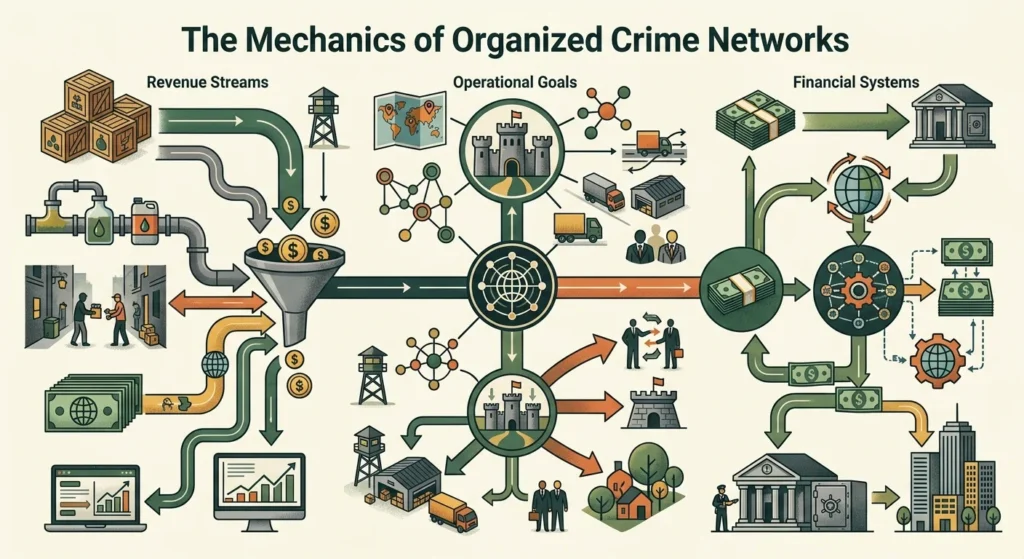
The primary goal of a cartel is financial gain. These organizations seek to create powerful criminal enterprises that generate significant revenue.
Major sources of cartel income include:
| Income Source | Description |
| Drug trafficking | Production and international distribution of illegal drugs |
| Human trafficking | Exploitation and illegal movement of people |
| Weapons trafficking | Illegal sale and transportation of firearms |
| Extortion | Forcing individuals or businesses to pay money |
| Illegal mining | Control of valuable natural resources |
| Fuel theft | Stealing and selling petroleum products |
Some modern criminal cartels have expanded beyond traditional drug trafficking. They may diversify their activities to reduce dependence on a single source of income.
Famous Cartel Examples
Several criminal cartels have gained international attention because of their size, influence, and impact.
Sinaloa Cartel
The Sinaloa Cartel is one of the most recognized criminal organizations in modern history. It developed strong international trafficking networks and became known for its influence in the global drug trade.
The organization has operated through partnerships, regional cells, and international connections rather than relying only on one centralized command.
Medellín Cartel
The Medellín Cartel became one of the most powerful drug organizations during the 1980s. Under the leadership of Pablo Escobar, the organization gained enormous wealth and influence before being dismantled by Colombian and international authorities.
Jalisco New Generation Cartel
The Jalisco New Generation Cartel emerged as a major criminal group in Mexico. It expanded through territorial control, trafficking operations, and violent conflicts with rival organizations.
What Is a Mafia?
A mafia is a type of organized crime group that traditionally relies on hierarchy, loyalty, secrecy, and long-term influence. Unlike many cartels that focus primarily on controlling illegal markets, mafias often aim to build lasting power within communities and legitimate industries.
The word “mafia” is historically connected to Sicily, Italy, where organized criminal groups developed during the 19th century. Over time, the term expanded to describe similar criminal organizations worldwide.
A mafia organization may operate quietly for years by blending criminal activity with legitimate businesses and social connections.
Definition of a Mafia
A mafia can be described as:
A structured criminal organization that uses loyalty, hierarchy, intimidation, and corruption to maintain power and generate income.
Traditional mafia groups often have clearly defined ranks, including:
- Boss
- Underboss
- Caporegime (captain)
- Soldiers
- Associates
This structure creates a chain of command where members understand their roles and responsibilities.
Key Characteristics of Mafia Organizations
Family-Based Hierarchy
One of the most recognizable features of traditional mafia groups is their family-style organization.
Members often develop strong loyalty relationships. New members may need approval from senior leaders before joining.
This structure creates:
- Trust between members
- Internal discipline
- Secrecy
- Long-term relationships
Code of Silence
Many mafia organizations follow strict rules about cooperation with authorities. In Italian-American organized crime, this tradition is often associated with omertà, a cultural code that discourages members from revealing information.
Breaking these rules can lead to severe consequences.
Influence Over Legitimate Businesses
Mafia groups often attempt to gain control or influence over legal industries.
Examples include:
- Construction companies
- Waste management businesses
- Restaurants
- Gambling operations
- Labor organizations
By combining legal and illegal activities, mafias can hide criminal profits and expand their influence.
Traditional Structure and Family-Based Hierarchy
A traditional mafia structure resembles a pyramid.
| Rank | Role |
| Boss | Controls major decisions and overall strategy |
| Underboss | Assists the boss and manages operations |
| Consigliere | Provides advice and resolves internal disputes |
| Caporegime | Leads smaller groups of members |
| Soldier | Carries out criminal activities |
| Associate | Works with the organization without full membership |
This hierarchy creates stability and allows mafia organizations to survive leadership changes.
Well-Known Mafia Organizations
Sicilian Mafia (Cosa Nostra)
The Sicilian Mafia is one of the oldest and most influential mafia organizations. It developed in Sicily and became known for its hierarchical structure, secrecy, and involvement in various criminal enterprises.
‘Ndrangheta
The ‘Ndrangheta, based in Calabria, Italy, has become one of the most powerful mafia organizations in the world. It built international networks through drug trafficking, financial operations, and business infiltration.
American Mafia
The American Mafia developed in the United States during the 20th century. It became associated with activities such as gambling, extortion, labor racketeering, and illegal business operations.
Why People Often Confuse Cartels and Mafias
The confusion between cartels and mafias exists because both belong to the broader category of organized crime.
They share several similarities:
- Both seek financial profit.
- Both operate secretly.
- Both may use violence.
- Both may corrupt officials.
- Both create loyalty systems.
- Both operate across borders.
Popular culture also contributes to confusion. Movies and television often portray every powerful criminal organization as a “mafia” or “cartel” even when the real structure is different.
The key difference is their foundation:
- A cartel primarily focuses on controlling illegal markets.
- A mafia focuses on building organized influence through hierarchy, loyalty, and long-term power.
Quick Cartel vs. Mafia Comparison
| Question | Cartel | Mafia |
| What drives it? | Market control and profit | Power, influence, and profit |
| Typical structure? | Flexible criminal network | Formal hierarchy |
| Common activities? | Drug trafficking and smuggling | Extortion, racketeering, infiltration |
| Main strength? | Supply chains and territory | Loyalty networks and social influence |
| Historical roots? | Modern illegal markets | Traditional organized crime families |
Understanding the difference between a cartel and the mafia creates a clearer picture of how organized crime groups function. Although both can be dangerous and powerful, their histories, structures, and methods reveal two very different approaches to criminal organization.
History and Evolution of Cartels and Mafias: How Organized Crime Expanded Globally
The Origins of the Sicilian Mafia
The history of the mafia begins long before modern crime movies and television created its famous image. The roots of organized mafia groups trace back to 19th-century Sicily, an island in southern Italy where weak government control created opportunities for private groups to gain power.
During this period, Sicily faced political instability, poverty, and limited protection from authorities. Landowners and businesses often needed protection, and groups known as “mafiosi” offered security services in exchange for money. Over time, these protection networks transformed into organized criminal organizations that controlled communities through intimidation, loyalty, and influence.
The early Sicilian Mafia was not built like a modern drug cartel. Its power came from controlling relationships, information, and local authority. Mafia members created networks with farmers, business owners, politicians, and public officials, allowing them to influence daily life without always appearing openly criminal.
How the Sicilian Mafia Developed Power
The growth of the Sicilian Mafia was connected to several social and political conditions:
| Factor | Impact on Mafia Growth |
| Weak government institutions | Criminal groups filled gaps in law enforcement |
| Economic inequality | Poor communities became easier to control |
| Local influence | Mafia groups gained support through connections |
| Fear and intimidation | Violence helped maintain obedience |
| Political relationships | Connections increased protection and power |
The mafia’s traditional strength came from its ability to operate quietly. Instead of only relying on open violence, these organizations often focused on building influence behind the scenes.
The Rise of Modern Drug Cartels
Unlike traditional mafias, modern drug cartels developed mainly during the 20th century as international demand for illegal drugs increased.
The growth of global transportation networks, international trade routes, and consumer markets created new opportunities for criminal groups. Organizations began building large-scale systems to produce, transport, and distribute illegal substances across borders.
During the 1970s and 1980s, Latin American drug organizations became especially powerful because they controlled important production and trafficking routes.
The rise of major cartels was influenced by several factors:
- Growing demand for illegal drugs in wealthy markets
- Weak government control in certain regions
- Corruption within institutions
- Access to international transportation routes
- Competition between criminal organizations
Unlike the traditional mafia model, many cartels developed around business efficiency. Their goal was often to dominate supply chains, control territory, and maximize profits.
The Evolution of Early Drug Trafficking Networks
Before large cartels existed, drug trafficking often involved smaller criminal groups and independent smugglers. Over time, these groups became more organized.
In countries such as Colombia and Mexico, criminal networks expanded by controlling different parts of the supply chain:
- Cultivation of drug-producing plants
- Processing and manufacturing
- Transportation
- International distribution
- Money management
This created powerful organizations capable of operating across multiple countries.
The Medellín Cartel became one of the earliest examples of a highly structured drug cartel. During the 1980s, it controlled a significant portion of the cocaine trade and demonstrated how profitable international drug trafficking could become.
The Cocaine Era and Global Expansion
The 1970s and 1980s marked a major turning point in organized crime history. Cocaine demand increased dramatically in North America and Europe, creating enormous profits for trafficking organizations.
The Medellín Cartel and Cali Cartel became major players during this period.
These organizations developed sophisticated systems involving:
- International smuggling routes
- Financial networks
- Corruption strategies
- Armed security groups
- Distribution partnerships
At their peak, some major cartels generated billions of dollars through illegal trade.
However, law enforcement pressure eventually weakened many of these organizations. The collapse of major Colombian cartels did not eliminate drug trafficking. Instead, smaller and more flexible criminal groups replaced them.
How Both Expanded Internationally
Both mafias and cartels expanded beyond their original regions, but they followed different paths.
Mafias typically expanded through migration, business connections, and community networks. Cartels expanded through trafficking routes, partnerships, and control of illegal markets.
Mafia Expansion Model
Traditional mafia groups expanded by:
- Establishing criminal families in new locations
- Building relationships with local businesses
- Influencing industries
- Creating international financial networks
For example, Italian organized crime groups expanded into parts of Europe, North America, and Australia through migration and business activities.
Cartel Expansion Model
Cartels expanded by:
- Creating international supply chains
- Partnering with local criminal groups
- Controlling transportation routes
- Establishing distribution networks
A cartel’s influence often depends on geography. A group controlling a major smuggling route can gain significant power because territory directly affects profits.
How Organized Crime Changed Over Time
Organized crime has never remained static. Both mafias and cartels have adapted to changes in technology, law enforcement strategies, and global markets.
Modern criminal organizations now use:
- Encrypted communication
- International financial systems
- Digital technology
- Complex business structures
- Global partnerships
Traditional ideas of organized crime have changed. A mafia group today may participate in international financial crimes, while a cartel may operate legitimate businesses to hide profits.
The boundary between different criminal organizations has become less clear because many groups have adopted similar strategies.
Major Differences in Historical Development
| Category | Mafia Development | Cartel Development |
| Origin | Local protection groups in Sicily | Modern illegal market networks |
| Main growth period | 19th and early 20th century | Mainly 20th century |
| Main power source | Loyalty, influence, and hierarchy | Supply control and trafficking |
| Expansion method | Communities and businesses | International trade routes |
| Main goal | Long-term influence | Market domination and profit |
Case Study: The Transformation of the Sicilian Mafia
The Sicilian Mafia changed significantly throughout history. Initially, it focused on local control and protection rackets. Later, some factions became involved in international criminal activities, including drug trafficking and financial crimes.
During the late 20th century, Italian authorities launched major investigations and prosecutions against mafia leaders. These efforts reduced the public power of some groups, although organized crime networks continued adapting.
The mafia’s survival shows an important characteristic of organized crime: these groups often change their methods when pressure increases.
Case Study: The Evolution of Drug Cartels
Drug cartels have also transformed over time. Early large organizations often depended on powerful leaders who controlled entire operations. After authorities captured or killed major leaders, many cartels fragmented into smaller groups.
This fragmentation created new challenges because smaller organizations could become harder to track.
Modern cartels may operate through:
- Regional criminal cells
- Temporary alliances
- Independent trafficking groups
- Financial networks
Instead of one powerful organization controlling everything, modern criminal markets often involve many connected groups competing and cooperating at the same time.
How Technology Changed Organized Crime
Technology has reshaped both mafia and cartel operations.
Criminal organizations now use technology for:
- Communication
- Financial transfers
- Market coordination
- Recruitment
- Information gathering
At the same time, governments use advanced technology to investigate criminal networks.
This creates an ongoing battle between criminal adaptation and law enforcement innovation.
The Global Impact of Organized Crime Evolution
The evolution of cartels and mafias has affected countries around the world. These organizations influence public safety, economies, political systems, and communities.
Their history shows that organized crime is not a single fixed model. It changes according to economic opportunities, government responses, and social conditions.
While a mafia traditionally grows through loyalty, hierarchy, and influence, a cartel often expands through markets, logistics, and territorial control. Understanding this historical difference helps explain why these organizations operate differently today.
How Cartels and Mafias Operate: Inside the Structure, Strategies, and Criminal Networks
Cartel Structure and Leadership
The way cartels operate differs from traditional criminal organizations because they often function like complex illegal businesses. Their main focus is controlling profitable markets, managing supply chains, and protecting their operations from competitors and law enforcement.
A cartel does not always have a strict pyramid structure. Instead, many modern cartels operate through connected groups that cooperate when their interests align. Some members may handle production, others may manage transportation, while separate groups may control local distribution.
This flexible approach allows cartels to survive even when authorities capture important leaders. Removing one person does not always destroy the entire network because smaller units can continue operating independently.
A typical cartel structure may include:
| Role | Main Function |
| Top leaders | Make strategic decisions and control major operations |
| Regional commanders | Manage specific territories or business areas |
| Financial operators | Handle money movement and investments |
| Logistics coordinators | Organize transportation and supply chains |
| Local groups | Manage street-level operations and territory |
| Associates | Provide services without direct membership |
Unlike traditional companies, criminal cartels cannot rely on legal contracts. Instead, they use loyalty, financial rewards, fear, and personal relationships to maintain control.
How Cartels Control Illegal Markets
The primary goal of a cartel is market domination. To achieve this, criminal organizations attempt to control every important stage of their business model.
A cartel may seek influence over:
- Production locations
- Transportation routes
- Distribution networks
- Local territories
- Financial systems
For example, a drug trafficking organization may attempt to control the entire journey of a product from production to final sale. This creates greater profits because fewer outside groups take a share of the income.
Market control also creates conflicts between rival organizations. When multiple groups compete for the same territory or routes, violence may increase as each side attempts to gain an advantage.
Drug Production and Distribution Networks
One of the most recognized activities connected with cartels is drug trafficking. However, this process involves much more than simply selling illegal substances.
Large trafficking networks often depend on multiple stages:
| Stage | Purpose |
| Production | Creating or preparing illegal substances |
| Processing | Transforming raw materials into finished products |
| Transportation | Moving goods across regions or borders |
| Distribution | Connecting suppliers with local sellers |
| Financial management | Moving and hiding profits |
These networks can involve people across several countries. A single organization may have suppliers in one region, transportation partners in another, and financial connections somewhere else.
The international nature of these operations makes them difficult for authorities to investigate.
Territorial Control and Criminal Influence
Territory plays a major role in how many cartels operate. Control over specific areas can provide access to transportation routes, customers, and resources.
Territorial influence may involve:
- Monitoring movement through certain areas
- Controlling local criminal activity
- Preventing competitors from entering markets
- Establishing connections with local communities
Territory does not always mean official ownership. Instead, criminal groups attempt to create influence through fear, corruption, and control of important resources.
Smuggling Networks and Logistics
Modern cartels depend heavily on logistics. Moving illegal goods requires planning, communication, and connections.
Smuggling networks may involve:
- Border routes
- Transportation companies
- Hidden storage locations
- International contacts
- Financial systems
The ability to move products efficiently often determines how successful a cartel becomes.
A criminal organization with strong logistics can expand its reach beyond its original location and compete internationally.
Money Laundering and Financial Operations
Criminal organizations cannot openly use illegal profits without attracting attention. Because of this, many groups attempt to hide money through complex financial systems.
Money laundering involves disguising illegally obtained funds so they appear legitimate.
Common methods historically associated with organized crime include:
- Front businesses
- Fake transactions
- Property investments
- International financial networks
- Cash-based businesses
The financial side of organized crime is often as important as the criminal activity itself. Without money management, even powerful organizations struggle to survive.
Case Study: The Evolution of the Sinaloa Cartel
The Sinaloa Cartel represents one example of how modern cartels adapt over time.
The organization developed extensive international connections and became known for its ability to create trafficking networks across multiple regions.
Its survival has been linked to several factors:
- Flexible organizational structure
- Regional partnerships
- International connections
- Adaptation after leadership changes
Rather than depending only on one leader, the organization developed systems that allowed different groups to continue operating.
This demonstrates a key feature of modern cartels: adaptability.
How Mafia Organizations Operate
Mafia Hierarchy and Family-Based Systems
Traditional mafia organizations operate differently from many cartels because they usually depend on formal hierarchy, personal loyalty, and long-term relationships.
The classic mafia structure resembles a family system where members move through different ranks. Authority comes from experience, reputation, and trust.
A traditional hierarchy often includes:
| Position | Responsibility |
| Boss | Controls major decisions and organizational direction |
| Underboss | Manages operations and assists leadership |
| Consigliere | Provides advice and handles disputes |
| Caporegime | Leads smaller groups within the organization |
| Soldiers | Carry out criminal activities |
| Associates | Work with members without full membership |
This structure allows mafia groups to maintain discipline and secrecy.
Protection Rackets and Extortion
One of the oldest activities associated with mafia groups is the protection racket.
In this system, criminals demand payments from businesses or individuals while claiming they provide protection.
The reality is often different. The organization may create fear and then offer “security” against threats that it created itself.
Protection rackets allow criminal groups to generate income while building influence within communities.
Racketeering and Illegal Business Activities
Mafia groups often focus on controlling or influencing legitimate businesses.
Racketeering involves using repeated criminal activities to generate income or maintain power.
Examples may include:
- Fraud
- Illegal gambling
- Labor manipulation
- Business intimidation
- Financial crimes
Unlike some cartels that focus heavily on illegal markets, mafias often blend criminal operations with legal industries.
Loan Sharking and Financial Control
Loan sharking involves providing illegal loans with extremely high interest rates while using intimidation to collect payments.
Historically, some mafia organizations used loan sharking to control individuals and businesses.
This activity allowed criminal groups to:
- Generate income
- Build influence
- Create dependency
- Expand their networks
Legitimate Business Infiltration
A major feature of many mafia organizations is their ability to enter legitimate industries.
Criminal groups may attempt to influence businesses through:
- Ownership
- Partnerships
- Corruption
- Threats
- Hidden financial control
Industries historically targeted by organized crime have included:
- Construction
- Waste management
- Transportation
- Entertainment
- Gambling
This strategy allows criminal organizations to appear legitimate while continuing illegal activities behind the scenes.
Recruitment, Loyalty, and Internal Rules
Mafia organizations often place strong importance on loyalty. Membership is usually based on personal connections and trust.
Traditional recruitment may involve:
- Recommendations from existing members
- Long-term relationships
- Demonstrated loyalty
- Criminal experience
Many mafia groups use internal rules to maintain discipline. Breaking these rules can damage the organization because secrecy is essential for survival.
Case Study: Italy’s ‘Ndrangheta
The ‘Ndrangheta is considered one of the most powerful mafia organizations in the world.
Unlike some traditional groups that weakened due to government pressure, the organization expanded internationally through:
- Global business connections
- Drug trafficking networks
- Financial operations
- Family-based relationships
Its structure demonstrates how traditional mafia models can adapt to modern criminal markets.
Cartels vs. Mafias: Different Operating Models
Although cartels and mafias share some methods, their operating systems are different.
| Area | Cartels | Mafias |
| Main focus | Control illegal markets | Build long-term influence |
| Structure | Flexible networks | Formal hierarchy |
| Leadership | Often operational and territorial | Rank-based and family-oriented |
| Main income | Trafficking and illegal trade | Extortion, businesses, racketeering |
| Expansion | Routes and markets | Relationships and influence |
The biggest difference is the foundation of power. Cartels usually gain strength through control of supply chains and markets, while mafias gain strength through loyalty, hierarchy, and social influence.
Understanding how cartels and mafias operate reveals why both types of organized crime remain difficult to eliminate. Their ability to adapt, create networks, and replace damaged structures allows them to survive despite constant pressure from governments and law enforcement agencies.
Cartel vs. Mafia: The Key Differences in Structure, Goals, Power, and Influence
Understanding the difference between a cartel and a mafia requires looking beyond their criminal reputation. Although both belong to the world of organized crime, they developed through different historical conditions and operate using different strategies.
A cartel usually works as a market-driven criminal network focused on controlling illegal industries, while a mafia traditionally operates as a hierarchical organization built around loyalty, family connections, influence, and long-term power.
The two may overlap in some activities, such as trafficking, corruption, and violence, but their core structures and objectives remain distinct.
Purpose and Objectives
The biggest difference between a cartel and a mafia is their primary purpose.
A cartel is generally focused on controlling a profitable criminal market. Its success depends on supply, demand, territory, and distribution networks. Many cartels operate with a business mindset where increasing revenue and expanding market control are major priorities.
A mafia organization usually has broader goals. Instead of only controlling one market, it often aims to establish influence over communities, businesses, and institutions.
| Category | Cartel | Mafia |
| Main objective | Control illegal markets and maximize profits | Build long-term power and influence |
| Core strategy | Market expansion and supply control | Loyalty networks and social influence |
| Primary motivation | Financial dominance | Financial gain, reputation, and authority |
A cartel may ask, “How can we control this market?” A mafia organization may ask, “How can we control this environment?”
Organizational Structure
The organizational design of these groups is one of their clearest differences.
Cartel Structure
Many cartels operate through flexible networks rather than strict chains of command. They may consist of multiple groups that cooperate for mutual benefit.
A cartel can include:
- Regional leaders
- Independent criminal cells
- Transportation networks
- Financial operators
- Local partners
This structure provides flexibility. If authorities remove one leader, other parts of the network may continue operating.
Mafia Structure
Traditional mafia groups usually follow a more formal hierarchy. Authority moves through clearly defined ranks, and members often follow established rules.
The classic structure includes:
- Boss
- Underboss
- Adviser or consigliere
- Captains
- Soldiers
- Associates
This system creates order and allows leaders to maintain control over members.
Leadership Style
Leadership styles in cartels and mafias also differ significantly.
Cartel Leadership
Cartel leaders often gain power through:
- Financial success
- Territory control
- Military strength
- Operational ability
Leadership can change quickly because power often depends on maintaining control over valuable criminal markets.
A successful cartel leader needs to manage logistics, alliances, competition, and security.
Mafia Leadership
Mafia leadership traditionally depends on:
- Family connections
- Loyalty
- Reputation
- Experience
- Internal respect
A mafia boss often gains authority through years of building relationships within the organization.
Unlike some cartel structures, traditional mafia leadership emphasizes stability and continuity.
Revenue Models
Money drives both organizations, but they often generate income differently.
Cartel Revenue Sources
Cartels commonly rely on large-scale illegal markets.
Major sources may include:
| Revenue Activity | Description |
| Drug trafficking | Production and distribution of illegal substances |
| Smuggling | Movement of illegal goods across borders |
| Extortion | Forced payments from businesses or individuals |
| Illegal trade | Control of underground markets |
Cartels often depend on volume. Greater control over production and distribution can lead to larger profits.
Mafia Revenue Sources
Mafia organizations traditionally use a wider mixture of criminal and legitimate activities.
Common sources include:
| Revenue Activity | Description |
| Protection rackets | Forced payments for “security” |
| Extortion | Threat-based financial demands |
| Gambling operations | Illegal betting and gaming activities |
| Racketeering | Repeated criminal schemes for profit |
| Business infiltration | Control or influence over legal industries |
Mafias often focus on creating steady income streams rather than controlling one specific market.
Geographic Reach
Both cartels and mafias can operate internationally, but their expansion methods differ.
Cartel Expansion
Cartels usually expand through:
- Transportation routes
- Supply chains
- Distribution networks
- Market opportunities
Geography is important because controlling specific locations can provide access to valuable routes.
For example, a cartel positioned near important transportation corridors may gain an advantage over competitors.
Mafia Expansion
Mafias often expand through:
- Migration patterns
- Family connections
- Business relationships
- Community influence
Traditional mafia groups may establish operations in new countries by creating networks among existing communities.
Recruitment Methods
Recruitment reflects the different cultures within these organizations.
Cartel Recruitment
Cartels may recruit people based on:
- Skills
- Local influence
- Access to resources
- Military experience
Because cartels often operate in competitive environments, they may prioritize people who can help protect territory or expand operations.
Mafia Recruitment
Mafia organizations traditionally place more importance on trust and loyalty.
Recruitment often involves:
- Personal recommendations
- Long-term relationships
- Family connections
- Demonstrated commitment
A person may spend significant time proving loyalty before gaining full membership.
Use of Violence
Violence exists in both cartels and mafias, but the way they use it can differ.
Cartel Violence
Cartels may use violence to:
- Defend territory
- Compete with rivals
- Control transportation routes
- Intimidate opponents
Violence can become highly visible when organizations compete for market dominance.
Mafia Violence
Mafia groups traditionally use violence more selectively.
It may be used to:
- Enforce internal discipline
- Remove threats
- Protect reputation
- Maintain control
Historically, many mafia groups preferred secrecy because public attention could increase pressure from authorities.
Relationship With Governments and Communities
Both cartels and mafias may attempt to influence governments and communities, but their approaches often differ.
Cartel Influence
Cartels may use:
- Bribery
- Threats
- Corruption
- Control of local areas
Their influence often focuses on protecting criminal operations.
Mafia Influence
Mafia groups may attempt deeper social and economic influence.
They may seek control through:
- Business ownership
- Political connections
- Community relationships
- Institutional corruption
This allows some mafia organizations to operate quietly for long periods.
Global Operations
Modern organized crime is increasingly international. Both cartels and mafias have developed global connections.
International Cartel Networks
Cartels often rely on:
- International suppliers
- Cross-border transportation
- Foreign distributors
- Global financial networks
Their operations are usually connected to illegal markets that cross national boundaries.
International Mafia Networks
Mafias often expand through:
- Family networks
- International businesses
- Financial activities
- Community connections
Groups such as the ‘Ndrangheta have built international influence while maintaining traditional organizational methods.
Cartel vs. Mafia Comparison Table
| Feature | Cartel | Mafia |
| Origin | Modern criminal markets | Historical organized crime families |
| Main goal | Control illegal industries | Build influence and power |
| Structure | Flexible network | Formal hierarchy |
| Leadership | Often based on territory and resources | Based on rank and loyalty |
| Membership | Can include temporary alliances | Usually requires trusted relationships |
| Main income | Trafficking and illegal markets | Extortion, businesses, racketeering |
| Expansion | Supply routes and markets | Social and business networks |
| Violence | Often linked to territorial competition | Often used for control and enforcement |
| Public presence | Sometimes highly visible | Traditionally secretive |
| Long-term strategy | Market dominance | Institutional influence |
Why the Difference Between Cartels and Mafias Matters
Understanding the difference between cartels and mafias helps explain why authorities approach them differently.
A cartel built around illegal markets may be disrupted by targeting supply chains, transportation networks, and financial systems.
A mafia organization may require a different approach because its strength often comes from relationships, corruption, and social influence.
Both groups create serious harm, but they represent different forms of organized crime. A cartel is often driven by market control, while a mafia is traditionally driven by power, loyalty, and influence. Recognizing these differences provides a clearer view of how organized crime develops and survives.
Similarities, Misconceptions, and the Real Impact of Cartels and Mafias
Shared Characteristics Between Cartels and Mafias
Although cartels and mafias developed from different historical backgrounds, they share several characteristics that place them under the broader category of organized crime. Both types of criminal organizations depend on secrecy, loyalty, financial motivation, and networks of influence to survive.
The biggest similarity is that both groups create systems designed to protect their operations. They cannot function like normal businesses because their activities are illegal. Instead, they rely on relationships, intimidation, corruption, and hidden structures.
Some common characteristics include:
| Shared Feature | How It Works |
| Organized leadership | Both groups require decision-makers who coordinate operations |
| Financial motivation | Profit remains the primary reason behind criminal activities |
| Secrecy | Members hide information to avoid law enforcement detection |
| Loyalty systems | Trust between members helps maintain stability |
| Violence and intimidation | Used to protect interests and control rivals |
| Corruption | Criminal groups may attempt to influence officials and institutions |
| International connections | Many organizations operate beyond their original regions |
While their methods differ, both cartels and mafias depend on one important factor: control. A criminal organization must control people, resources, information, or markets to maintain power.
Organized Leadership and Internal Control
Neither cartels nor mafias operate randomly. They require leadership systems that allow members to coordinate activities.
A cartel may organize around:
- Territory
- Supply chains
- Transportation routes
- Financial networks
- Criminal partnerships
A mafia organization may organize around:
- Family relationships
- Loyalty
- Rank
- Traditional rules
- Long-term influence
Leadership allows these groups to make decisions, solve internal conflicts, and respond to outside threats.
However, the way authority develops is different. Cartel leaders often gain influence through resources and operational control, while mafia leaders traditionally gain authority through reputation and established relationships.
Financial Motivation Behind Organized Crime
Money is a central motivation for both cartels and mafias. Criminal organizations exist because illegal activities can generate significant profits.
Their financial goals may include:
- Expanding operations
- Protecting assets
- Increasing influence
- Maintaining member loyalty
- Competing with rivals
The difference lies in how they create income.
Cartels often depend on controlling illegal markets and supply networks. Mafias often combine criminal activities with legitimate businesses to create long-term financial influence.
For example, a cartel may focus on moving illegal products through international routes, while a mafia group may attempt to gain influence in industries such as construction, gambling, or business services.
Secrecy and Loyalty Systems
Secrecy is one of the strongest survival tools used by organized crime groups.
Both cartels and mafias understand that information can threaten their existence. If members reveal operations, leadership structures, or financial systems, law enforcement can use that information to dismantle networks.
To maintain secrecy, organizations often rely on:
- Internal trust
- Threats against informants
- Limited information sharing
- Personal relationships
- Strict communication practices
Mafia groups have historically placed strong importance on loyalty through traditions such as omertà, a code associated with silence and refusal to cooperate with authorities.
Cartels may rely more heavily on operational security because their activities often involve large-scale trafficking networks.
Common Misconceptions About Cartels and Mafias
Many people misunderstand organized crime because movies, television, and news coverage often simplify complex organizations.
These misunderstandings can create inaccurate views of how criminal groups actually work.
Are All Cartels Drug Cartels?
One common misconception is that every cartel is involved in drugs.
While many famous criminal cartels are connected to drug trafficking, the word cartel simply refers to a group working together to control a market.
Criminal cartels may also become involved in:
- Human trafficking
- Illegal mining
- Fuel theft
- Weapons trafficking
- Smuggling operations
- Extortion
Drug trafficking remains one of the most recognized activities, but it is not the only source of income.
Is Every Organized Crime Group a Mafia?
Another common mistake is calling every criminal organization a mafia.
The word mafia has a specific historical meaning connected to traditional organized crime groups, especially those originating in Italy.
Not every criminal network follows the mafia model.
A group may be considered organized crime without having:
- Family-based membership
- Traditional hierarchy
- Mafia-style rules
- Long-term community influence
The term “organized crime” covers a much wider range of criminal networks.
Can a Mafia Become a Cartel?
The relationship between mafias and cartels is complicated because criminal organizations can change over time.
Some mafia groups have entered markets traditionally associated with cartels, including international drug trafficking.
For example, some Italian organized crime groups have developed global trafficking networks while maintaining traditional mafia structures.
This shows that criminal organizations are adaptable. They may adopt methods from other groups when those strategies increase profits.
However, adopting a certain activity does not automatically change the identity or structure of the organization.
Which Is More Powerful: Cartels or Mafias?
There is no simple answer because power depends on different factors.
A cartel may have greater influence when it controls:
- Valuable trafficking routes
- Large illegal markets
- Production networks
- International distribution systems
A mafia organization may have greater influence when it controls:
- Businesses
- Political relationships
- Community connections
- Financial systems
Power is not only about money or violence. Influence, stability, intelligence, and adaptability also determine strength.
Cartels and Mafias in Popular Culture
Movies and television have played a major role in shaping how people understand organized crime.
Films and series often portray criminal organizations as dramatic groups led by powerful individuals. While these stories may contain realistic elements, they frequently exaggerate certain aspects.
Popular culture often focuses on:
- Violence
- Wealth
- Personal rivalries
- Powerful leaders
However, real organized crime is usually more complex. Many criminal operations depend less on dramatic actions and more on planning, financial management, corruption, and hidden networks.
How Media Shapes Public Perception
Media can influence how people view criminal organizations by creating simplified images.
For example:
- A mafia is often shown as a family-controlled organization.
- A cartel is often shown as a violent trafficking group.
- Individual leaders are sometimes presented as the entire organization.
In reality, both types of groups usually involve many people performing different roles.
A powerful leader may receive attention, but criminal organizations often survive because of systems, relationships, and structures rather than one individual.
Fiction vs. Reality
| Popular Belief | Reality |
| Criminal groups are controlled by one person | Many depend on networks and multiple leaders |
| Violence is their only tool | Money, corruption, and influence are also important |
| All members are highly visible | Many participants remain hidden |
| Organizations disappear after one leader is removed | Many groups adapt and continue |
Understanding these differences helps separate entertainment from reality.
Why Understanding the Difference Matters
Learning about the difference between cartels and mafias is important for several reasons. It improves public understanding of organized crime and helps explain why governments use different strategies to fight these groups.
Law Enforcement Perspectives
Authorities cannot treat every criminal organization the same way.
A cartel investigation may focus on:
- Financial networks
- Transportation routes
- Supply chains
- International partnerships
A mafia investigation may focus on:
- Corruption networks
- Business connections
- Leadership structures
- Long-term relationships
Understanding the organization’s structure helps law enforcement develop more effective responses.
Public Awareness and Safety
Public knowledge about organized crime can reduce misinformation.
When people understand how criminal groups operate, they can better recognize:
- Corruption risks
- Economic impacts
- Social consequences
- The dangers of criminal influence
Organized crime does not only affect law enforcement. It can impact businesses, communities, governments, and economies.
Academic and Historical Importance
Studying cartels vs. mafias also helps researchers understand how criminal organizations evolve.
Historians and social scientists examine these groups to study:
- Political instability
- Economic inequality
- International crime
- Government responses
- Social influence
The history of organized crime shows that criminal organizations change with society. They adapt to new technology, global markets, and law enforcement strategies.
Final Comparison: Cartel vs. Mafia
| Category | Cartel | Mafia |
| Foundation | Illegal market control | Organized influence and hierarchy |
| Historical roots | Modern trafficking networks | Traditional criminal families |
| Main strength | Logistics and market access | Loyalty and social connections |
| Typical operations | Trafficking and smuggling | Extortion, racketeering, infiltration |
| Expansion method | Supply routes | Relationships and businesses |
| Identity | Criminal enterprise | Criminal organization with social structure |
The difference between a cartel and a mafia comes down to how they build power. Cartels usually focus on controlling markets, while mafias traditionally focus on creating influence through loyalty, hierarchy, and connections. Both represent complex forms of organized crime, but their histories and operating methods reveal two very different paths to criminal power.
Conclusion About Cartel vs. Mafia: Understanding the World of Organized Crime
Understanding the difference between a cartel and a mafia helps reveal how organized crime groups develop, operate, and influence societies. While cartels often focus on controlling illegal markets and supply networks, mafias traditionally build power through hierarchy, loyalty, and long-term connections. Both use complex systems, but their histories and methods make them distinct. Learning about these differences allows you to see beyond movie stereotypes and understand the real challenges faced by communities and law enforcement agencies worldwide. The world of organized crime continues to evolve, making awareness and accurate information more important than ever. A clear view of cartel vs. mafia provides valuable insight into how criminal organizations gain power, adapt, and impact the modern world.
FAQs About Cartel vs. Mafia
What is the main difference between a cartel and a mafia?
A cartel mainly focuses on controlling illegal markets, such as trafficking networks, while a mafia traditionally focuses on building influence through hierarchy, loyalty, and connections. Both are organized crime groups, but their structures and goals are different.
Are cartels and mafias the same thing?
No, cartels and mafias are not the same. They share some characteristics, including secrecy, violence, and financial motives, but they developed from different histories and operate using different organizational models.
Why are cartels often associated with drugs?
Many famous cartels became known because of their involvement in international drug trafficking. However, criminal cartels can also operate in other illegal markets, including smuggling, extortion, and resource theft.
Why are mafias associated with families?
Traditional mafia organizations often developed around family-like structures built on trust and loyalty. This system helped members maintain secrecy, control internal relationships, and preserve long-term influence.
Can a mafia operate like a cartel?
Some mafia organizations can participate in activities commonly linked with cartels, such as international trafficking. However, taking part in a specific activity does not necessarily change the organization’s traditional structure or identity.
Which is more powerful, a cartel or a mafia?
Power depends on many factors, including money, territory, influence, and adaptability. Cartels may have strength through market control, while mafias may gain power through relationships, businesses, and social influence.
Do cartels and mafias still exist today?
Yes, both types of organized crime groups continue to exist in different regions. Many have adapted by using modern technology, international networks, and financial systems to continue their operations.
How do governments fight organized crime groups?
Governments use investigations, financial tracking, international cooperation, and law enforcement operations to disrupt criminal organizations. Targeting leadership, money networks, and supply systems are common strategies.
Are all organized crime groups called mafias?
No, organized crime is a broad category that includes many different types of groups. A mafia usually refers to organizations with specific historical and structural characteristics, especially traditional criminal networks.
Why is it important to understand cartel vs. mafia differences?
Understanding the difference helps people recognize how organized crime works, avoid misinformation, and better understand the social, economic, and legal challenges created by criminal organizations.
Meta Description:
Explore cartel vs mafia differences, their structures, histories, and operations to understand how organized crime groups shape the world today.