
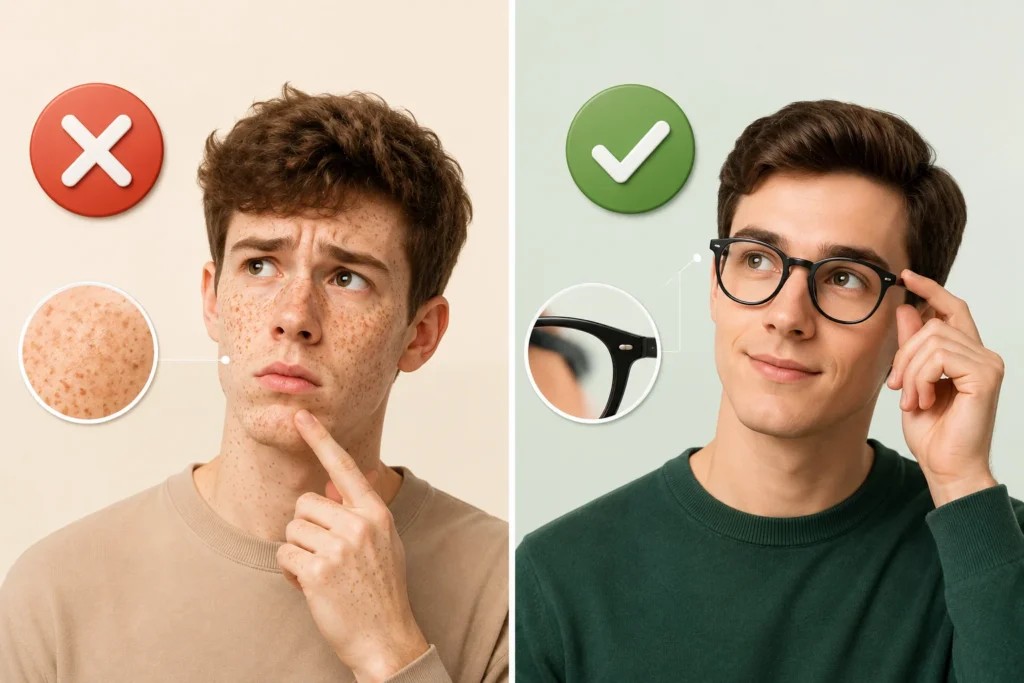
The difference between bespeckled and bespectacled comes down to what you are describing. Bespeckled means something has specks, spots, or scattered marks on its surface. Bespectacled describes a person who is wearing spectacles or glasses. These two words look almost identical, but they point to completely different ideas.
A simple way to remember them is:
| Word | Meaning | Connected Word | Example |
| Bespeckled | Covered with tiny spots or marks | Speck | A bespeckled butterfly had colourful dots on its wings. |
| Bespectacled | Wearing glasses | Spectacles | The bespectacled teacher entered the classroom. |
If you are describing someone’s appearance and mentioning their eyewear, bespectacled is the right choice. If you are describing a surface, pattern, or appearance with tiny marks, bespeckled fits better.
Which Word Refers to Someone Wearing Glasses?
The word bespectacled specifically refers to a person who wears glasses. It comes from the noun spectacles, an older English word for eyeglasses. When someone is called bespectacled, the focus is on the glasses they wear rather than on their eyesight or personality.
Writers often use bespectacled when creating a visual description of a person. It appears frequently in literature, journalism, and character descriptions because it provides a quick image in the reader’s mind.
For example:
- “The bespectacled scientist examined the results carefully.”
- “A bespectacled writer sat near the window with a notebook.”
- “The bespectacled student raised her hand during the lecture.”
In each example, the word ” bespectacled ” indicates the person wears glasses. It does not mean the person has spots, marks, or a decorated appearance.
The word is especially useful when a writer wants to create a clear visual image without spending several words explaining someone’s appearance. Instead of saying “a person wearing glasses,” bespectacled gives the same meaning in a single descriptive word.
Which Word Refers to Spots or Speckles?
The word bespeckled describes something covered with small marks, dots, or tiny patches. It comes from the word speck, which means a small spot or particle.
Unlike bespectacled, this word has nothing to do with glasses. It is usually used for physical appearances, textures, colours, and patterns.
Common things that can be described as bespeckled include:
- Bespeckled leaves with tiny spots
- Bespeckled clothing with small patterns
- Bespeckled skin with freckles
- Bespeckled surfaces covered with dust or marks
- Bespeckled animals with spotted fur or feathers
Examples:
- “The old wooden table was bespeckled with paint marks.”
- “The bird had bespeckled feathers that blended into the forest.”
- “The sky became bespeckled with stars after sunset.”
The word often creates a more artistic or descriptive image. Writers may choose bespeckled when they want readers to notice small details and visual patterns.
Why People Confuse Bespeckled and Bespectacled
Many people mix up bespeckled and bespectacled because they share similar spelling patterns and the same beginning structure. Both words start with “be-“ and contain several similar letters, which makes them easy to confuse when reading quickly.
The main difference appears in the middle of each word:
| Word Part | Meaning |
| Speck in bespeckled | A tiny spot or mark |
| Spectacle in bespectacled | Glasses or eyewear |
A useful memory trick is:
Specks = Spots
Spectacles = Glasses
When you see bespeckled, think about tiny dots scattered across something. When you see bespectacled, think about spectacles sitting on someone’s face.
The pronunciation can also create confusion because both words have a similar rhythm. However, their meanings are separated by their roots. Understanding the origin of each word makes the difference much easier to remember.
The Fastest Way to Choose the Correct Word
Before using either word, ask yourself one question:
“Am I describing glasses or marks?”
- If the answer is glasses, use bespectacled.
- If the answer is spots or small marks, use bespeckled.
A quick comparison:
| If you mean… | Use… |
| Someone wearing eyeglasses | Bespectacled |
| Something covered in dots | Bespeckled |
| A person with spectacles | Bespectacled |
| A surface with tiny marks | Bespeckled |
Knowing this small difference prevents one of the most common mistakes between these two similar-looking English words. While they may appear like close relatives, their meanings travel in completely different directions: one points to vision and eyewear, while the other points to patterns and tiny marks.
What Does Bespeckled Mean? Definition, Origin, Usage, and Common Mistakes

Definition of Bespeckled
Bespeckled means covered with specks, spots, dots, or tiny marks. It describes the appearance of something that has scattered patterns across its surface. The word usually creates a visual image of small details spread over an object, person, animal, or natural scene.
The word is an adjective, which means it is used to describe a noun. For example, you can describe a bespeckled bird, a bespeckled page, or a bespeckled wall. The focus is always on the presence of small marks rather than the colour, size, or shape of the entire object.
Some common meanings of bespeckled include:
| Description | Example |
| Covered with tiny spots | A bespeckled butterfly had colourful wings. |
| Marked with scattered stains | The old book had bespeckled pages. |
| Decorated with small patterns | She wore a bespeckled dress with tiny dots. |
| Filled with small visible details | The night sky looked bespeckled with stars. |
The word often appears in descriptive writing because it adds more detail than simply saying something is “spotted” or “marked.” It helps readers imagine a surface filled with small, noticeable features.
For example, compare these two sentences:
- “The wall was spotted with paint.”
- “The wall was bespeckled with paint.”
The second sentence gives a stronger visual impression. It suggests many small drops or marks scattered across the wall rather than a few large spots.
Origin and Etymology of Bespeckled
The word bespeckled comes from the older English word speck, which means a small mark, particle, or spot. The root of the word has been used in English for centuries to describe tiny visible details.
The structure of the word follows a common English pattern:
Be- + speck + -led = Bespeckled
Here is what each part means:
| Word Part | Meaning |
| Be- | A prefix that helps create a verb or describe a condition |
| Speck | A tiny spot, mark, or particle |
| -led | Shows the result of being affected by something |
The original idea behind bespeckled is that something has become covered or marked with specks. Over time, English speakers began using the word for many types of spotted appearances, from physical objects to poetic descriptions.
The connection with speck is the most important detail to remember. A speck is small and visible, so bespeckled always relates to small marks.
Common Contexts Where Bespeckled Is Used
Although bespeckled is not one of the most common words in everyday conversation, it remains useful in descriptive writing. Authors, journalists, and speakers often choose it when they want to create a more vivid picture.
Nature and Animals
One of the most common uses of bespeckled appears in descriptions of nature. Animals, plants, and landscapes often have patterns that can be described with this word.
Examples:
- A bespeckled frog resting near a pond.
- A bespeckled bird with unusual feather patterns.
- A bespeckled leaf covered with tiny brown marks.
In nature writing, the word helps highlight small details that readers might otherwise overlook.
Objects and Surfaces
Writers also use bespeckled to describe objects that have scattered marks or decorations.
Examples:
- A bespeckled ceramic cup.
- A bespeckled stone found near the river.
- A bespeckled notebook filled with ink drops.
These descriptions make ordinary objects feel more unique because they draw attention to their texture and appearance.
People and Physical Appearance
The word can also describe a person’s appearance, but it usually refers to spots or marks rather than glasses.
For example:
- “The child had a bespeckled face covered with freckles.”
This means the person’s face had small spots or freckles. It does not mean the person wore glasses.
This is where some confusion happens with bespectacled. The two words look similar, but their meanings are completely different.
Example Sentences Using Bespeckled
Seeing the word in different situations makes its meaning easier to understand.
| Sentence | Meaning |
| The artist painted a bespeckled pattern across the canvas. | The canvas had many small marks. |
| The butterfly’s bespeckled wings attracted attention. | The wings had tiny spots. |
| The explorer discovered a bespeckled rock near the mountain trail. | The rock had scattered markings. |
| The old mirror was bespeckled with dust. | The mirror had many small particles on it. |
| The garden looked magical under the bespeckled evening sky. | The sky appeared filled with small visible points, such as stars. |
In creative writing, bespeckled often adds a sense of beauty or uniqueness. It encourages the reader to notice small features rather than only the larger picture.
Common Mistakes With Bespeckled
The biggest mistake people make with bespeckled is confusing it with bespectacled. Because both words contain similar letters, writers sometimes use the wrong term when describing a person.
Incorrect:
“The bespeckled professor entered the room wearing glasses.”
This sentence suggests that the professor was covered with small spots, not that the professor wore glasses.
Correct:
“The bespectacled professor entered the room wearing glasses.”
Another mistake is using bespeckled for large patterns. The word specifically suggests small marks or tiny spots. It does not usually describe large shapes, bold designs, or major colour changes.
Incorrect:
“The wall was bespeckled with huge painted circles.”
Better:
“The wall was decorated with large painted circles.”
Correct:
“The wall was bespeckled with tiny drops of blue paint.”
A helpful rule is simple:
Small marks = bespeckled
Glasses = bespectacled
Once you connect bespeckled with specks, the correct usage becomes much easier to recognize.
What Does Bespectacled Mean? Definition, Origin, Usage, and Common Mistakes
Definition of Bespectacled
Bespectacled describes someone who wears glasses or spectacles. It is an adjective used to highlight a person’s appearance by mentioning their eyewear. The word does not describe eyesight, vision problems, or the quality of someone’s glasses. It simply tells the reader that a person has glasses on their face.
For example:
- “The bespectacled professor explained the theory clearly.”
- “A bespectacled child sat quietly in the library.”
- “The detective was a bespectacled man with a sharp eye for details.”
In each sentence, bespectacled creates a quick visual image. The reader immediately imagines someone wearing glasses.
Unlike bespeckled, which relates to tiny spots or marks, bespectacled connects directly to the word spectacles, an older term for eyeglasses.
| Word | Meaning | Related Word | Main Idea |
| Bespectacled | Wearing glasses | Spectacles | Eyewear on a person |
| Bespeckled | Covered with small spots | Speck | Marks or dots on something |
Understanding this difference prevents one of the most common spelling and vocabulary mistakes in English.
Origin and Etymology of Bespectacled
The word bespectacled comes from the noun spectacles, which has been used in English to refer to eyeglasses for hundreds of years. The term spectacles originated from the Latin word spectare, meaning “to look at” or “to observe.”
The word developed through the idea that glasses help people see and observe the world more clearly.
The structure of bespectacled can be understood like this:
| Word Part | Meaning |
| Be- | Creates a condition or state |
| Spectacle | A pair of glasses used for vision |
| -ed | Shows a person has that feature |
So, someone who is bespectacled is literally someone who is in the state of wearing spectacles.
The word became popular in descriptive writing because it provides a simple way to describe a person’s appearance. Instead of writing “a person wearing glasses,” authors can use one precise adjective: bespectacled.
The Connection Between Spectacles and Bespectacled
The easiest way to remember bespectacled is to focus on the word hidden inside it: spectacles.
A spectacle traditionally means a pair of eyeglasses. Although many people today simply say glasses, the word spectacles still appears in formal writing, literature, and historical descriptions.
The connection works like this:
Spectacles → Spectacled → Bespectacled
When someone wears spectacles, they become bespectacled.
For example:
- A person wearing sunglasses is not usually described as bespectacled because the word normally refers to vision glasses.
- A person wearing reading glasses may be described as bespectacled.
- A character in a novel with round glasses may be introduced as bespectacled.
The word often adds personality to a description. A writer may use it to create a memorable image of a scientist, teacher, researcher, writer, or intellectual character.
For example:
“The bespectacled researcher carefully reviewed the experiment results.”
The word does more than mention glasses. It helps readers picture the person in a specific setting.
Common Contexts Where Bespectacled Is Used
Although people commonly say “wearing glasses” in everyday conversation, bespectacled appears frequently in descriptive and formal writing.
Character Descriptions
Writers often use bespectacled when introducing fictional or real people.
Examples:
- “The bespectacled detective noticed a small clue.”
- “The bespectacled author signed copies of her new book.”
- “The bespectacled scientist worked late in the laboratory.”
The word quickly gives readers a visual detail without interrupting the flow of the sentence.
Academic and Professional Writing
The term often appears when describing professionals, especially in articles, biographies, and profiles.
Examples:
- A bespectacled researcher presenting new findings.
- A bespectacled professor discussing history.
- A bespectacled engineer reviewing technical plans.
It can create an image of someone who appears thoughtful, focused, or scholarly. However, the word itself does not mean intelligent or educated. It only describes appearance.
Journalism and Media
News writers sometimes use bespectacled as a descriptive word when introducing a person.
For example:
“The bespectacled speaker addressed the audience during the conference.”
This style gives readers a quick identifying feature, especially when several people appear in a story.
Creative Writing
In fiction, bespectacled can help establish a character’s appearance.
A writer might describe:
- A quiet bespectacled librarian.
- A young bespectacled inventor.
- A serious bespectacled detective.
The word works as a small visual detail that supports the overall character image.
Example Sentences Using Bespectacled
The following examples show how bespectacled works in different situations.
| Sentence | Explanation |
| The bespectacled teacher explained the lesson with patience. | The teacher wore glasses. |
| A bespectacled journalist asked the final question. | The journalist had glasses. |
| The bespectacled scientist examined the sample carefully. | The scientist was wearing spectacles. |
| The novel introduced a bespectacled detective with a clever mind. | The detective’s appearance included glasses. |
| The bespectacled student searched through old books. | The student wore glasses while studying. |
These examples show that bespectacled describes a person’s physical appearance. It does not describe their personality, profession, or abilities.
Common Mistakes With Bespectacled
The most common mistake is confusing bespectacled with bespeckled.
Incorrect:
“The bespectacled butterfly had colourful dots on its wings.”
This sentence suggests that the butterfly wears glasses, which does not make sense.
Correct:
“The bespeckled butterfly had colourful dots on its wings.”
Another mistake is assuming bespectacled means someone has poor eyesight. The word only describes the presence of glasses.
Incorrect:
“The man was bespectacled because his vision was weak.”
Better:
“The man was bespectacled and wore glasses while reading.”
The reason someone wears glasses is separate from the meaning of the word.
Another point to remember is that bespectacled sounds more formal than everyday phrases like “wearing glasses.” In casual conversations, most people simply say:
- “She wears glasses.”
- “He has glasses.”
However, bespectacled remains useful when writing descriptions that need a more polished or literary style.
A simple memory rule helps avoid mistakes:
Spectacles = glasses = bespectacled
If the sentence is about eyewear, the correct word is bespectacled. If it is about dots, marks, or spots, the correct word is bespeckled.
Although bespeckled and bespectacled appear almost identical, they describe completely different things. One word focuses on small marks or spots, while the other focuses on a person wearing glasses. The difference comes from their root words: speck and spectacles.
Many English learners confuse these words because they share the same beginning, similar spelling, and a similar sound. However, understanding their meanings makes the choice simple.
- Bespeckled = covered with specks, spots, or marks.
- Bespectacled = wearing spectacles or glasses.
The easiest way to separate them is to look inside the word:
| Word | Hidden Meaning | Remember It As |
| Bespeckled | Contains “speck” | Small spots |
| Bespectacled | Contains “spectacles” | Glasses |
A writer describing a spotted animal, a dusty surface, or a star-filled sky should choose bespeckled. A writer describing a person with eyeglasses should choose bespectacled.
Meaning Difference Between Bespeckled and Bespectacled
The main difference between these two words is the thing they describe.
Bespeckled describes an object, surface, or appearance that contains many small marks. These marks can be natural, accidental, or decorative.
Examples:
- A bespeckled stone covered with tiny patterns.
- A bespeckled bird with spotted feathers.
- A bespeckled painting with small dots of colour.
The focus is always on visible spots or scattered details.
On the other hand, bespectacled describes a person who wears glasses.
Examples:
- A bespectacled professor giving a lecture.
- A bespectacled writer working at a desk.
- A bespectacled student reading a book.
The focus is not on the person’s eyesight. It only describes their appearance.
A simple comparison:
| Question | Correct Word |
| Does it have small dots or marks? | Bespeckled |
| Does someone wear glasses? | Bespectacled |
Pronunciation Difference Between Bespeckled and Bespectacled
Pronunciation can also be confusing because both words have similar sounds. However, the middle section of each word changes the pronunciation slightly.
Bespeckled
Pronunciation: bih-SPEK-uhld
The stress falls on the “speck” sound, which connects to the meaning of small spots.
Example:
“The old paper was bespeckled with ink marks.”
Bespectacled
Pronunciation: bih-SPEK-tuh-kuld
The word includes the sound of spectacles, making it slightly longer.
Example:
“The bespectacled researcher studied the documents.”
A useful pronunciation trick:
- Hear speck → think about spots.
- Hear spectacle → think about glasses.
Even though they sound close, the extra syllable in bespectacled reflects its connection to spectacles.
Visual Difference Between Bespeckled and Bespectacled
These words create two completely different mental pictures.
When you hear bespeckled, imagine:
- A frog with spotted skin.
- A page covered with ink drops.
- A night sky filled with stars.
- A stone with natural markings.
When you hear bespectacled, imagine:
- A person wearing reading glasses.
- A scientist looking through lenses.
- A student studying with eyeglasses.
The visual difference can be remembered like this:
Bespeckled shows marks on something.
Bespectacled shows glasses on someone.
This visual association is especially helpful for writers because both words are mainly used to create descriptions.
Grammar and Part of Speech
Both bespeckled and bespectacled function as adjectives. They describe nouns by adding information about appearance.
Examples:
- The bespeckled butterfly rested on the flower.
- The bespectacled scientist recorded observations.
In both sentences, the adjective comes before the noun.
They can also appear after linking verbs:
- The butterfly was bespeckled with colourful patterns.
- The scientist was bespectacled during the interview.
However, their grammatical roles do not make them interchangeable. The adjective form is similar, but the meaning changes completely.
Usage Context Difference
The context usually reveals which word fits best.
Situations for Bespeckled
Use bespeckled when describing:
- Animals with spots
- Objects with marks
- Surfaces with stains
- Natural patterns
- Decorative designs
Examples:
“The artist created a bespeckled design using small dots.”
“The forest floor was bespeckled with colourful leaves.”
Situations for Bespectacled
Use bespectacled when describing:
- People wearing glasses
- Characters in books
- Professionals in profiles
- Historical figures
- Visual descriptions
Examples:
“The bespectacled doctor reviewed the patient’s notes.”
“The story follows a young bespectacled inventor.”
Choosing the correct word depends on whether the description involves spots or spectacles.
Tone and Writing Style Difference
Both words have a descriptive and slightly formal tone. People do not often use them in everyday conversation, but they appear frequently in written English.
Bespeckled Tone
Bespeckled often creates a creative, artistic, or poetic feeling.
Examples:
- A bespeckled sky.
- A bespeckled garden.
- A bespeckled old manuscript.
It draws attention to small visual details.
Bespectacled Tone
Bespectacled often sounds literary, professional, or descriptive.
Examples:
- A bespectacled scholar.
- A bespectacled journalist.
- A bespectacled character.
It gives readers an immediate image of someone’s appearance.
Common Collocations With Bespeckled and Bespectacled
Collocations are words that naturally appear together. Learning them helps you use vocabulary more accurately.
Common Bespeckled Combinations
| Phrase | Meaning |
| Bespeckled feathers | Feathers with small spots |
| Bespeckled surface | A surface with tiny marks |
| Bespeckled sky | A sky filled with visible points like stars |
| Bespeckled page | A page with spots or stains |
| Bespeckled pattern | A design made of small marks |
Common Bespectacled Combinations
| Phrase | Meaning |
| Bespectacled man | A man wearing glasses |
| Bespectacled woman | A woman wearing glasses |
| Bespectacled professor | A professor with glasses |
| Bespectacled scientist | A scientist wearing glasses |
| Bespectacled writer | A writer with glasses |
These common pairings show that the words belong to different contexts.
Are Bespeckled and Bespectacled Interchangeable?
No, bespeckled and bespectacled are not interchangeable. Replacing one with the other changes the meaning of a sentence.
Incorrect:
“The bespeckled teacher entered the classroom.”
This suggests the teacher had small spots or marks on their appearance.
Correct:
“The bespectacled teacher entered the classroom.”
This tells the reader the teacher wore glasses.
Another example:
Incorrect:
“The bespectacled butterfly had colourful wings.”
This suggests the butterfly wore glasses.
Correct:
“The bespeckled butterfly had colourful wings.”
This describes the butterfly’s spotted wings.
The words may look similar, but swapping them creates an incorrect image.
How Meaning Changes When the Wrong Word Is Used
Using the wrong word can confuse readers because it creates a completely different picture.
Consider these examples:
| Incorrect Sentence | Problem | Correct Sentence |
| The bespeckled scientist explained the experiment. | It suggests the scientist had spots. | The bespectacled scientist explained the experiment. |
| The bespectacled rock had unusual patterns. | It suggests the rock wore glasses. | The bespeckled rock had unusual patterns. |
| The bespeckled student adjusted her glasses. | The word does not describe eyewear. | The bespectacled student adjusted her glasses. |
A good writer chooses words based on meaning, not just spelling. When you understand the roots, these two words become easy to separate:
- Speck = spot = bespeckled
- Spectacles = glasses = bespectacled
That small memory link is enough to prevent confusion in most writing situations.
When to Use Bespeckled and Bespectacled: Examples, Memory Tricks, and Common Errors
When Should You Use Bespeckled?
Use bespeckled when you want to describe something that has specks, spots, dots, or scattered marks. The word works best when the focus is on appearance, texture, or patterns. It helps readers picture tiny details that cover part of a surface.
Unlike simple words such as “spotted” or “marked,” bespeckled often adds a more descriptive or literary feeling. Writers use it when they want to highlight the small features that make something visually interesting.
Common situations where you can use bespeckled include:
| Situation | Example |
| Describing animals | A bespeckled bird rested on the tree branch. |
| Describing nature | The forest floor was bespeckled with colourful leaves. |
| Describing objects | The old vase had a bespeckled surface. |
| Describing clothing | She wore a bespeckled scarf with tiny patterns. |
| Describing the sky | The night looked bespeckled with stars. |
The key idea is that something has many small visible marks. These marks can be natural, decorative, or accidental.
Describing Specks, Spots, or Markings
The word bespeckled is especially useful when the marks are small and scattered rather than large or uniform. It creates the feeling that tiny details appear across a surface.
For example:
“The artist created a bespeckled painting using tiny drops of colour.”
This sentence does not describe large shapes or bold designs. Instead, it suggests many small spots that combine to create an overall pattern.
Other examples include:
- A bespeckled egg with tiny coloured marks.
- A bespeckled stone covered with natural patterns.
- A bespeckled butterfly with detailed wings.
- A bespeckled notebook marked with ink spots.
In creative writing, this word can make ordinary things feel more vivid. A writer may use bespeckled instead of “covered with spots” because it creates a stronger visual impression.
Common Writing Examples Using Bespeckled
Here are examples showing how bespeckled works naturally:
“The farmer noticed a bespeckled mushroom growing beside the old tree.”
The word shows that the mushroom has small markings.
“A bespeckled moon appeared between the clouds.”
This creates a poetic image of a moon surrounded by small visible points or details.
“The child’s face was bespeckled with freckles after a summer outdoors.”
Here, the word describes tiny marks on the skin.
“The ancient map was bespeckled with faded ink stains.”
The word shows that the map contains many small marks from age.
These examples demonstrate that bespeckled can describe natural objects, human features, and manufactured items.
Mistakes to Avoid With Bespeckled
The biggest mistake is using bespeckled when you mean someone is wearing glasses. This confusion happens because the spelling looks similar to bespectacled.
Incorrect:
“The bespeckled professor adjusted his glasses.”
This sentence suggests that the professor had spots or marks.
Correct:
“The bespectacled professor adjusted his glasses.”
Another mistake is using bespeckled for large designs or obvious patterns.
Incorrect:
“The wall had a bespeckled mural with huge painted shapes.”
Better:
“The wall had a colourful mural with huge painted shapes.”
Correct:
“The wall was bespeckled with tiny drops of paint.”
Remember:
Small marks = bespeckled
If the description involves tiny dots, stains, freckles, or scattered particles, bespeckled is usually the right choice.
When Should You Use Bespectacled?
Use bespectacled when describing a person who wears glasses or spectacles. The word focuses on someone’s appearance by mentioning their eyewear.
It is often used in biographies, articles, stories, and formal descriptions because it gives readers an immediate picture of a person.
Examples:
- A bespectacled teacher explained the lesson.
- The bespectacled scientist reviewed the research.
- A bespectacled writer worked at the desk.
The word does not describe intelligence, personality, age, or profession. It only tells the reader that the person wears glasses.
Describing a Person Wearing Glasses
The main purpose of bespectacled is visual description. It replaces the longer phrase “wearing glasses” with one precise adjective.
Compare:
- “The man wearing glasses entered the room.”
- “The bespectacled man entered the room.”
Both sentences have the same meaning, but the second sounds more polished and descriptive.
Writers often use bespectacled when introducing characters:
“A bespectacled researcher entered the laboratory carrying a folder of documents.”
The reader immediately imagines someone with glasses without needing additional explanation.
Common people or characters described as bespectacled include:
- Scientists
- Teachers
- Writers
- Researchers
- Students
- Professionals
- Fictional characters
However, the word can describe anyone who wears glasses.
Common Writing Examples Using Bespectacled
Examples:
“The bespectacled journalist asked detailed questions during the interview.”
The word highlights the journalist’s appearance.
“The bespectacled student searched through old textbooks.”
The reader can picture the student studying with glasses.
“The bespectacled doctor reviewed the patient’s records.”
The word provides a quick visual detail.
“The novel introduced a quiet bespectacled character who loved reading.”
The description helps create a memorable image.
These examples show why writers choose bespectacled. It adds detail without making sentences longer.
Why Writers Use Bespectacled
Writers use bespectacled because it is a compact and descriptive word. Instead of explaining someone’s appearance with several words, one adjective creates a clear picture.
It can also add style to writing. A phrase like “a bespectacled professor” feels more descriptive than simply saying “a professor who wore glasses.”
However, writers should avoid assuming that glasses represent a person’s personality. The word only describes appearance.
For example:
Correct:
“The bespectacled engineer designed a new machine.”
The sentence only describes the engineer wearing glasses.
Incorrect assumption:
“The bespectacled engineer was naturally smarter.”
Glasses do not determine intelligence.
Memory Tricks to Tell the Difference
The easiest way to remember these words is to connect each one with its root.
Remember “Spectacles” in Bespectacled
The word bespectacled contains spectacles.
Spectacles = glasses
Therefore:
Bespectacled = wearing glasses
Example:
“The bespectacled author looked through his glasses while writing.”
Associate “Speckles” With Bespeckled
The word bespeckled connects with speck or speckles.
Speckles = tiny spots
Therefore:
Bespeckled = covered with small marks
Example:
“The bespeckled bird had dots across its feathers.”
Fast Recall Technique
When you see either word, ask:
Does the sentence talk about eyes or spots?
- Eyes, glasses, vision → Bespectacled
- Spots, dots, marks → Bespeckled
A five-second check can prevent a major meaning mistake.
Another easy phrase:
Spectacles sit on faces. Specks sit on surfaces.
This simple connection helps separate the two words permanently.
Common Incorrect Examples and Corrections
Incorrect Uses of Bespeckled
Incorrect:
“The bespeckled woman removed her glasses.”
Correction:
“The bespectacled woman removed her glasses.”
Reason: The sentence describes someone wearing glasses.
Incorrect:
“The bespeckled teacher gave a lecture.”
Correction:
“The bespectacled teacher gave a lecture.”
Reason: The teacher has glasses, not spots.
Incorrect Uses of Bespectacled
Incorrect:
“The bespectacled butterfly had colourful wings.”
Correction:
“The bespeckled butterfly had colourful wings.”
Reason: The butterfly has spots, not spectacles.
Incorrect:
“The bespectacled wall was covered with paint marks.”
Correction:
“The bespeckled wall was covered with paint marks.”
Reason: The wall has tiny marks.
Corrected Sentences Explained
| Incorrect Word | Correct Word | Reason |
| Bespeckled professor | Bespectacled professor | Professor wears glasses |
| Bespectacled bird | Bespeckled bird | Bird has spots |
| Bespeckled student with glasses | Bespectacled student with glasses | Student wears glasses |
| Bespectacled painting | Bespeckled painting | Painting has marks |
The difference is always connected to the root word:
- Speck → spots
- Spectacles → glasses
Once this connection becomes familiar, choosing between bespeckled and bespectacled becomes quick and natural.
Conclusion About Bespeckled or Bespectacled – Which Is Correct?
Choosing between bespeckled and bespectacled becomes much easier once you understand their roots. Bespeckled describes something covered with specks, spots, or marks, while bespectacled describes someone wearing spectacles or glasses. Although these words look and sound similar, they create completely different images in a reader’s mind. Remembering the connection between specks and spots and spectacles and glasses helps you use the correct word every time. Whether you are writing a story, an article, or a simple description, using the right term makes your meaning clearer. A small vocabulary difference can have a big impact on how your writing feels, so understanding is a useful step toward stronger and more accurate English.
FAQs
Is bespeckled a real word?
Yes, bespeckled is a real English word. It is an adjective that describes something covered with small spots, specks, or marks. Writers often use it to describe objects, animals, nature, or surfaces with scattered patterns.
Is bespectacled a real word?
Yes, bespectacled is a correct English word. It describes a person who wears glasses or spectacles. The word comes from “spectacles,” an older term for eyeglasses, and it is often used in formal or descriptive writing.
What is the difference between bespeckled and bespectacled?
The difference is their meaning. Bespeckled relates to tiny spots or marks on something, while bespectacled relates to someone wearing glasses. They sound similar but describe completely different things.
Can bespeckled describe a person?
Yes, bespeckled can describe a person if you mean they have small marks, freckles, or spots on their appearance. It does not mean the person wears glasses. For glasses, the correct word is bespectacled.
Can bespectacled describe an object?
Usually, no. Bespectacled is used for people because it refers to wearing spectacles or glasses. Objects, animals, and surfaces with spots should be described as bespeckled instead.
Why are bespeckled and bespectacled confused?
These words are often confused because they share similar spelling, pronunciation, and the same beginning prefix. Their middle parts provide the clue: “speck” means a small spot, while “spectacles” means glasses.
Is bespectacled a formal word?
Yes, bespectacled has a slightly formal or literary tone. In everyday conversation, people usually say “wearing glasses.” However, writers use it when they want a concise and descriptive way to portray someone.
Is bespeckled the same as spotted?
They have similar meanings, but they are not always identical. Bespeckled usually suggests many small scattered marks, while “spotted” can describe larger or more noticeable patterns. The word choice depends on the type of appearance being described.
How can I remember the difference between bespeckled and bespectacled?
Use a simple memory trick: specks are spots, so bespeckled means covered with spots. Spectacles are glasses, so bespectacled means wearing glasses. Connecting each word to its root makes it easier to remember.
Which word should I use for someone with glasses?
Use bespectacled when describing someone who wears glasses. For example, “The bespectacled teacher entered the classroom.” Use bespeckled only when describing small spots, marks, or patterns.
Meta Description:
Discover the difference between bespeckled and bespectacled, learn their meanings, uses, and easy tips to choose the correct word every time.