
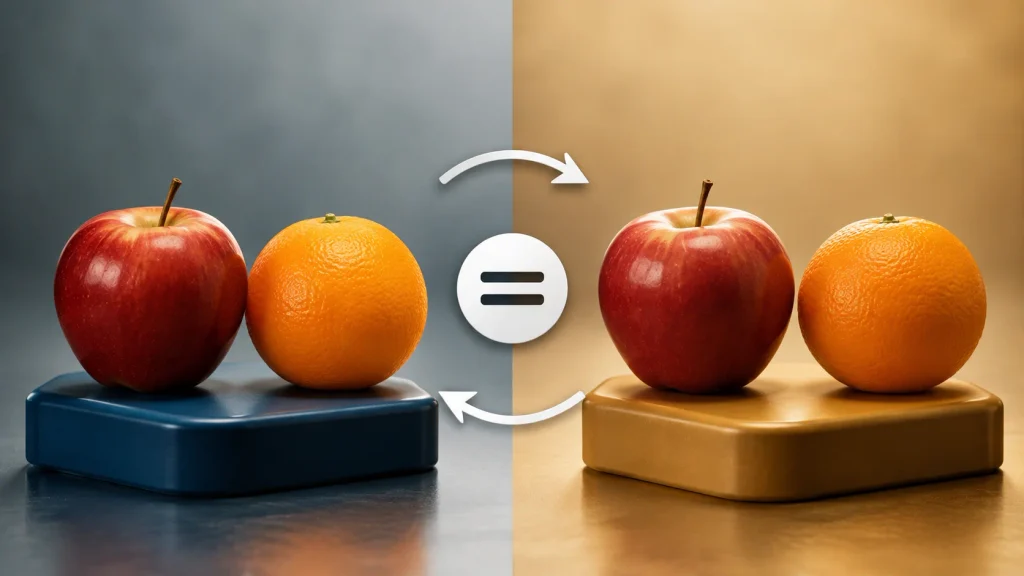
The phrase “same difference” sounds strange at first. After all, how can something be both the same and different? That apparent contradiction is exactly what makes the expression memorable. In everyday American English, same difference usually means that two things are technically different, but the distinction doesn’t matter in the situation. Merriam-Webster describes it as an informal expression used mainly in the United States when two things aren’t meaningfully different. Cambridge similarly treats it as an informal idiom used when a correction may be technically valid but doesn’t change the main point.
What Does “Same Difference” Mean?
“Same difference” is an informal idiom that tells someone that a particular distinction isn’t important enough to change the outcome, argument, or practical meaning.
Imagine someone says, “The meeting starts at 2:00,” and another person corrects them: “Actually, it starts at 2:05.” If the exact five-minute difference doesn’t matter, the first person might respond, “Same difference.”
The speaker isn’t claiming that 2:00 and 2:05 are literally identical. The point is that, for the discussion at hand, the distinction has little practical importance.
A useful way to understand the expression is:
There is a difference, but it doesn’t make a meaningful difference.
That idea sits at the heart of the idiom.
Merriam-Webster gives the phrase a particularly clear sense: two things aren’t really different in any important way. Cambridge adds another useful angle by explaining that a speaker can use it after acknowledging that their original statement wasn’t exactly correct while still considering the correction unimportant.
Simple Definition of “Same Difference”
In simple English, same difference means:
- the distinction doesn’t matter
- the two choices are effectively equivalent
- the result is essentially the same
- either option will do
- the correction doesn’t change the main point
- the difference is too small to be important
For example:
“You said Tuesday, but it’s actually Wednesday.”
“Same difference. I’ll be free either day.”
Here, Tuesday and Wednesday aren’t the same day. The speaker simply doesn’t care about the distinction because the practical result remains unchanged.
Another example makes the idea even clearer:
“It’s a blue shirt.”
“Actually, it’s navy blue.”
“Same difference.”
The colors aren’t technically identical. However, the speaker considers the distinction irrelevant to the conversation.
What “Same Difference” Really Communicates
The expression often communicates more than simple agreement. It can acknowledge a correction while refusing to let that correction derail the conversation.
Consider this exchange:
“You said he lived in Boston.”
“Right, but he actually lives just outside Boston.”
“Same difference.”
The final response doesn’t necessarily mean that Boston and its suburbs are geographically identical. Instead, the speaker may mean, “That distinction doesn’t affect what we’re talking about.”
This makes same difference a useful conversational shortcut. Rather than explaining why a minor distinction doesn’t matter, the speaker uses three quick words to move the discussion forward.
Still, context matters. If the difference is genuinely important, saying “same difference” can sound careless or dismissive.
Why Does “Same Difference” Sound Contradictory?
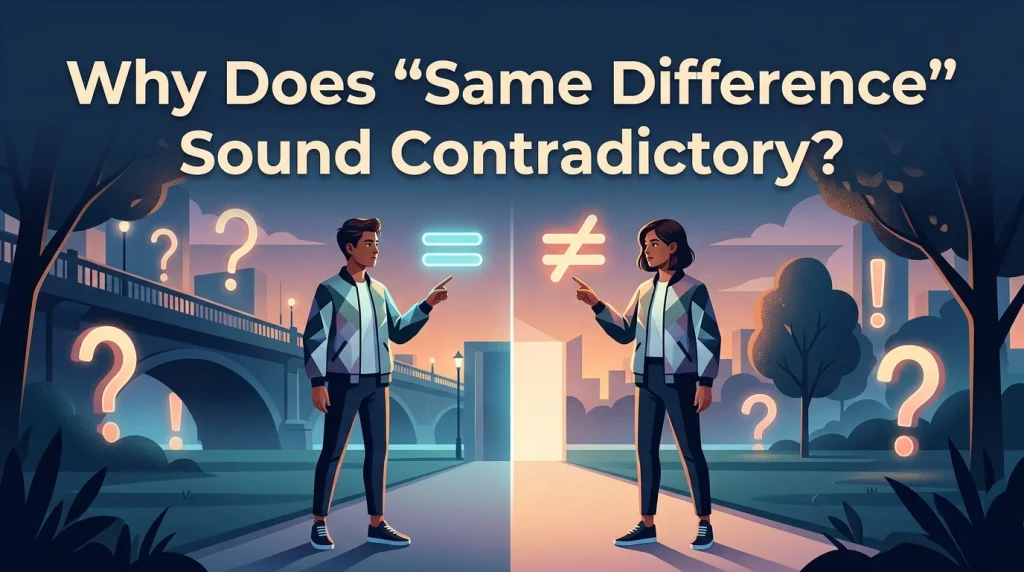
The phrase catches attention because same and difference normally point in opposite directions.
Same suggests similarity, identity, or equivalence. Difference suggests a distinction between two things. Merriam-Webster defines same in terms such as being identical, closely corresponding, or equal in value or importance. It defines difference as a distinction, dissimilarity, disagreement, or a measurable amount by which things differ.
Put those ideas together, and you get an expression that appears logically awkward:
same + difference
Yet ordinary language doesn’t always follow strict literal logic. Speakers regularly use irony, exaggeration, understatement, and contradiction to communicate ideas efficiently.
That’s what happens here.
The phrase effectively compresses the thought:
“Yes, there is a difference, but that difference is not important enough to matter.”
The contradiction gives the expression its punch. It makes the phrase playful while also making its meaning easy to remember.
Is “Same Difference” an Oxymoron?
“Same difference” can be described as oxymoronic because the two words appear to contradict each other. An oxymoron generally places apparently conflicting terms together to create a particular effect.
However, calling the phrase an oxymoron doesn’t fully explain how people use it. In everyday speech, same difference functions as an established idiomatic expression with a recognizable meaning.
That distinction matters.
The phrase isn’t normally used because speakers have forgotten the meaning of same or difference. They use it deliberately. The apparent contradiction is part of the expression’s character.
For example:
“The two proposals aren’t identical, but they produce the same result. Same difference.”
The speaker recognizes the distinction. The phrase simply says that the distinction has no meaningful consequence.
“Same Difference” in Everyday English
The expression works especially well in casual conversation because people often don’t need to spell out every minor distinction.
Suppose two friends are deciding where to eat:
“The restaurant is technically in the next neighborhood.”
“Same difference. Let’s go.”
The speaker isn’t making a geographical claim. They’re saying that the location difference isn’t important enough to affect the decision.
You can also hear the phrase after a small factual correction:
“The movie came out in 1998.”
“Actually, it was 1999.”
“Same difference.”
Again, the years are different. The speaker simply doesn’t consider the one-year distinction relevant to the larger point.
Common Situations for “Same Difference”
The idiom can appear in several everyday situations:
| Situation | Example | Intended Meaning |
| Minor correction | “It was Thursday, not Friday.” “Same difference.” | The exact day isn’t important |
| Similar choices | “We can take Route A or Route B.” “Same difference.” | Either option works |
| Small measurement | “It’s about five miles, not four.” “Same difference.” | The exact figure isn’t important |
| Similar descriptions | “It’s dark green, not black.” “Same difference.” | The distinction doesn’t matter here |
| Equivalent outcomes | “We can call or text them.” “Same difference.” | Either method produces the desired result |
| Casual disagreement | “It’s a mistake.” “It’s really an error.” “Same difference.” | The terminology doesn’t change the point |
These examples reveal an important feature of the expression: the speaker decides that the difference lacks practical significance.
That judgment can be reasonable, humorous, impatient, or even wrong.
Literal Meaning vs. Idiomatic Meaning
There are actually two ways to understand the words same difference, and keeping them separate prevents confusion.
The Idiomatic Meaning
The idiomatic meaning is the one most people encounter in casual conversation:
“The distinction doesn’t matter.”
For example:
“He called it a mistake. She called it an error.”
“Same difference.”
Here, the expression focuses on the practical result rather than the exact wording.
The Literal Meaning
The words can also appear in a literal mathematical context. In mathematics, a difference can mean the result obtained by subtracting one number from another. Merriam-Webster specifically recognizes this sense of difference as the amount by which quantities differ.
For example:
- 12 − 9 = 3
- 10 − 7 = 3
The pairs contain different numbers, yet both calculations produce the same difference: 3.
That is a completely literal statement. It doesn’t rely on humor, irony, or conversational shorthand.
This distinction is useful because the phrase isn’t inherently illogical. “Same difference” can make literal sense when referring to equal numerical differences. The informal idiom simply developed a different conversational use.
Why Context Matters
Context usually makes the intended meaning obvious.
If someone says:
“The difference between 12 and 9 is the same as the difference between 10 and 7.”
The phrase has a literal mathematical meaning.
If someone says:
“You called it a mistake, and I called it an error. Same difference.”
The phrase has its informal idiomatic meaning.
The words remain the same. The surrounding context changes the interpretation.
The Practical Meaning Behind the Idiom
At its core, same difference isn’t really about whether two things are identical. It’s about whether their distinction has consequences.
That idea becomes clearer if you think about a decision-making situation.
Suppose two stores sell the same brand of notebook. One costs $4.99 and the other costs $5.00. If someone says, “Same difference,” they aren’t claiming that the prices are mathematically equal. They’re saying that a one-cent difference isn’t worth worrying about.
Now change the numbers:
- Store A: $4.99
- Store B: $49.99
Calling that “same difference” would make little sense because the price difference now matters.
This is the key test:
Does the distinction change the practical outcome?
If it doesn’t, same difference may fit naturally.
If it does, another expression would be clearer.
When “Same Difference” Works Well
The idiom works best when the difference is genuinely minor or irrelevant to the point being discussed.
Minor Corrections
Someone corrects a small detail that doesn’t affect the larger discussion.
“The event starts at 6:30.”
“Actually, it’s 6:35.”
“Same difference.”
Equivalent Choices
Two options lead to essentially the same outcome.
“Should we email her or send her a message?”
“Same difference. She’ll see it either way.”
Different Labels for the Same Practical Idea
Two people use slightly different words to describe something.
“You call it a problem. I call it a challenge.”
“Same difference.”
Small Numerical Variations
A small measurement or estimate doesn’t affect the decision.
“The drive is 20 minutes.”
“More like 22.”
“Same difference.”
In each example, the speaker isn’t denying reality. The speaker is ranking the difference as unimportant.
When “Same Difference” Can Cause Problems
The phrase becomes risky when another person considers the distinction important.
Imagine a workplace conversation about a deadline:
“The contract is due Monday.”
“No, it’s due Sunday.”
“Same difference.”
That response could be a serious mistake. One day may have legal, financial, or operational consequences.
Likewise, imagine a medical, safety, financial, or technical discussion. A small-looking difference may carry major consequences that aren’t immediately obvious.
In those situations, precision matters more than conversational convenience.
A better rule is simple:
Use “same difference” for low-stakes distinctions. Use precise language when the distinction affects the outcome.
“Same Difference” as a Conversational Shortcut
One reason the idiom survives is efficiency.
Instead of saying:
“I acknowledge that your description differs slightly from mine, but I don’t believe that distinction changes the point we’re discussing.”
a speaker can simply say:
“Same difference.”
Three words replace a much longer explanation.
That doesn’t make the phrase appropriate everywhere. It makes it particularly useful in relaxed speech.
It also explains why tone matters so much. A friendly speaker can make “same difference” sound lighthearted. A frustrated speaker can make the same words sound like “I don’t care about your correction.”
The wording stays fixed. The social meaning shifts.
Key Takeaways
- Same difference is an informal idiom.
- It generally means that two things differ in some respect, but the distinction isn’t important.
- The phrase is especially common in casual American English. Merriam-Webster labels it “chiefly US, informal.”
- Cambridge describes it as an informal expression used when a correction is technically valid but doesn’t matter to the point being made.
- Its wording sounds contradictory because same and difference have opposing meanings.
- The expression can sound neutral, humorous, sarcastic, or dismissive depending on context and delivery.
- It works best when the distinction genuinely has little practical effect.
- It isn’t the best choice for formal, technical, legal, academic, or high-stakes communication.
- The phrase can also have a literal mathematical meaning when two pairs of numbers have equal differences.
- Context determines whether the same difference is being used literally or idiomatically.
How to Use “Same Difference” Correctly
Using “same difference” correctly comes down to one basic idea: the two things being discussed may differ in some detail, but that detail doesn’t materially change the situation. Major dictionaries consistently describe the expression as informal. Merriam-Webster calls it “chiefly US, informal” and defines it as a way to say that two things aren’t really different in any important way. Cambridge gives a similar explanation, noting that speakers use it when they accept that a statement wasn’t exactly correct but don’t think the correction matters.
The easiest way to test the expression is to ask whether the distinction changes the practical outcome. If it doesn’t, same difference may fit. For example, if someone says, “The store closes at 8:00,” and another person replies, “Actually, it closes at 8:05,” the first speaker might say, “Same difference.” Five minutes may not matter to the plan. However, if the store closes at 7:00 rather than 8:00, the difference suddenly matters. In that case, dismissing it as the same difference would be misleading.
Common Conversation Examples
The expression often appears after a small correction. Someone points out a minor detail, and the other person acknowledges it without changing their main point.
Example:
“You said the movie came out in 2004.”
“It was actually 2005.”
“Same difference.”
Here, the speaker isn’t claiming that 2004 and 2005 are identical. The speaker simply doesn’t consider the one-year distinction important to the discussion.
You can use the phrase in several everyday situations:
- Dates: “It happened Tuesday.” “Actually, it was Wednesday.” “Same difference.”
- Descriptions: “It’s dark blue.” “More like navy.” “Same difference.”
- Locations: “The café is downtown.” “It’s technically just outside downtown.” “Same difference.”
- Choices: “We can call them or email them.” “Same difference.”
- Terminology: “It’s an error.” “I’d call it a mistake.” “Same difference.”
- Measurements: “It’s about ten miles away.” “Closer to eleven.” “Same difference.”
Notice the common thread. Each example contains a distinction, yet the speaker considers that distinction irrelevant to the immediate purpose.
When the Idiom Fits Naturally
“Same difference” works especially well when people are making casual decisions. Imagine two friends choosing between two coffee shops that sit on opposite sides of the same street. One friend says, “This one is actually two minutes farther away.” The other responds, “Same difference.”
That response makes sense because the extra two minutes probably won’t affect the decision.
It can also work when two words describe essentially the same practical situation:
“You call it a delay. I call it a scheduling issue.”
“Same difference.”
The speaker isn’t making a dictionary claim that delay and scheduling issue are perfect synonyms. Instead, the speaker is saying that the distinction doesn’t change the point being discussed.
Oxford’s American English dictionary gives a similar treatment, defining same difference as an informal expression used when someone thinks the differences between two things aren’t important.
When You Should Avoid “Same Difference”
The expression becomes a poor choice when the difference has real consequences.
Consider a workplace contract:
“The payment is due June 1.”
“Actually, the contract says June 10.”
Responding with “same difference” would be inappropriate because nine days could affect billing, compliance, cash flow, or contractual obligations.
The same principle applies to:
- legal documents
- financial decisions
- medical information
- safety instructions
- technical specifications
- academic research
- official records
- deadlines
- measurements that affect performance
In these settings, precision matters. A distinction that looks small may carry a surprisingly large consequence.
Rule of thumb: If changing the detail could change someone’s decision, don’t casually dismiss it as the same difference.
Workplace and Professional Examples
You may hear “same difference” in informal workplace conversation, particularly between colleagues who already have a relaxed relationship. However, that doesn’t mean the expression belongs in every professional setting.
Consider this exchange:
Manager: “The presentation is scheduled for Thursday.”
Employee: “Actually, it’s Friday.”
Manager: “Same difference. The client won’t review it until next week.”
Here, the expression works because the manager has explained why the distinction doesn’t affect the outcome.
Now consider a different situation:
Accountant: “The invoice total is $18,450.”
Colleague: “It’s actually $18,950.”
Accountant: “Same difference.”
That response is inappropriate. A $500 difference in an invoice isn’t merely a conversational detail. It affects the actual amount of money involved.
The distinction between these examples shows why context matters more than the phrase itself.
A Better Professional Alternative
When you’re unsure whether same difference sounds too casual, use a more precise phrase:
- “The distinction doesn’t affect the outcome.”
- “Either option will produce the same result.”
- “The difference isn’t significant in this context.”
- “For our purposes, the distinction doesn’t matter.”
- “Both options are effectively equivalent here.”
These alternatives communicate the same general idea without the playful or dismissive flavor of the idiom.
Family and Social Situations
Casual social conversations provide one of the most natural settings for the same difference.
Imagine two siblings arguing over what time they left home:
“We left at 7:10.”
“No, it was 7:12.”
“Same difference.”
The speaker doesn’t need to settle the exact minute because the disagreement has no practical consequence.
Friends might use it when discussing food:
“You ordered the chicken sandwich.”
“No, I ordered the grilled chicken wrap.”
“Same difference.”
That could sound humorous if both meals are similar. It could also sound mildly dismissive if the person who ordered the meal cares about the distinction.
That’s an important feature of the idiom: the speaker gets to decide whether the difference matters, but the listener may disagree.
If someone has a strong reason for correcting, responding with same difference can come across as brushing them off.
Is “Same Difference” Sarcastic?
Sometimes, yes. “Same difference” isn’t inherently sarcastic, but speakers can use it sarcastically.
Cambridge’s examples show the expression being used after a correction. The American English entry also gives a broader informal meaning equivalent to “the same thing.”
Sarcasm usually comes from tone, context, and intention, rather than from the three words alone.
Compare these two situations.
Friendly Use
“You said the restaurant was on Fifth Street.”
“Actually, it’s on Sixth.”
“Same difference. We’re here now.”
The tone can be light and friendly.
Sarcastic Use
“You spent $500 instead of $50.”
“Same difference.”
Here, the phrase could sound deliberately dismissive because the financial difference is obviously significant.
The words haven’t changed. The situation has.
How Tone Changes the Meaning
A speaker may make same difference sound:
Neutral: “Either way, the result is the same.”
Playful: “Close enough. Same difference.”
Sarcastic: “Yeah, sure. Same difference.”
Dismissive: “Whatever. Same difference.”
That’s why text messages can sometimes create confusion. Without facial expression or vocal tone, the reader has fewer clues about the speaker’s intention.
Is this rude?
It can be, but it isn’t automatically rude.
The phrase becomes rude when it dismisses a distinction that another person considers important.
Imagine someone carefully explains that two medical terms have different meanings. Responding with “same difference” could minimize a distinction that actually matters.
By contrast, saying it while choosing between two nearly identical restaurants is unlikely to offend anyone.
A useful way to judge the tone is to ask:
“Am I dismissing a detail that matters to the other person?”
If the answer is yes, choose a more respectful response.
For example, instead of:
“Same difference.”
you could say:
“You’re right about the technical distinction. It doesn’t affect what we’re deciding here, though.”
That response acknowledges the correction while still making the practical point.
“Same Difference” vs. “It Makes No Difference”
These expressions overlap heavily, but their tone isn’t identical.
“It makes no difference” is direct and neutral.
“Same difference” is shorter, more informal, and often more playful or ironic.
Compare:
“Should we leave at 6:00 or 6:05?”
“It makes no difference to me.”
This sounds straightforward.
Now:
“Should we leave at 6:00 or 6:05?”
“Same difference.”
This sounds more casual.
Oxford lists both constructions in its discussion of difference, including same difference as an informal expression, and makes no difference for situations in which something has no effect.
Which One Should You Choose?
| Expression | Tone | Best Setting |
| Same difference | Informal, sometimes humorous | Casual conversation |
| It makes no difference | Neutral | Everyday and professional speech |
| The distinction isn’t important | Neutral/formal | Professional or academic contexts |
| Either option works | Clear and practical | Decisions and workplace discussions |
| The outcome is essentially the same | Formal | Reports and professional writing |
The safest option depends on your audience.
If you’re talking with friends, same difference can sound natural. If you’re writing a report, the distinction isn’t important will usually communicate your meaning more clearly.
“Same Difference” vs. “It’s All the Same”
These expressions are close, but they don’t always carry the same emphasis.
“It’s all the same” can mean that several options are effectively equivalent. “Same difference” more often responds to a specific distinction or correction.
For example:
“Do you want tea or coffee?”
“It’s all the same to me.”
This expresses indifference between choices.
Now consider:
“You said coffee, but you actually ordered a latte.”
“Same difference.”
Here, the phrase responds directly to a distinction.
The first expression emphasizes choice or indifference. The second often emphasizes the unimportance of a correction or distinction.
“Same Difference” vs. “Six of One, Half a Dozen of the Other”
“Six of one, half a dozen of the other” also communicates equivalence. Both expressions can tell someone that two alternatives amount to essentially the same thing.
However, the focus differs.
“Same difference” can dismiss a minor distinction.
“Six of one, half a dozen of the other” usually compares two choices or alternatives that are effectively equal.
For example:
“Should we take the highway or the back road?”
“Six of one, half a dozen of the other.”
The speaker means that neither choice offers a meaningful advantage.
By contrast:
“You called it the back road, but it’s technically County Road 12.”
“Same difference.”
Here, the speaker isn’t comparing two choices. They’re dismissing a distinction.
“Same Difference” vs. “Potato, Potahto”
These expressions can overlap when someone wants to make light of a minor distinction. However, “potato, potahto” specifically plays with pronunciation to suggest that two versions of a word or idea amount to the same thing.
For example:
“You say tomato. I say tomahto.”
The humor comes from the different pronunciations.
“Same difference” is broader. It can refer to differences in names, dates, descriptions, choices, measurements, or outcomes.
So while both expressions can communicate “this distinction isn’t worth arguing about,” they don’t function in the same way.
“Same Difference” vs. “Close Enough”
“Close enough” usually means that something is sufficiently accurate, similar, or acceptable for the purpose.
“Same difference” usually says that the distinction itself doesn’t matter.
Consider:
“The estimate was $1,000, but the actual cost was $1,020.”
“Close enough.”
The speaker focuses on acceptable accuracy.
Now:
“You said the estimate was $1,000. It was actually $1,020.”
“Same difference.”
The speaker focuses on the insignificance of the distinction.
The difference may seem tiny, but the underlying attitude isn’t identical.
“Same Difference” vs. “Tomato, Tomahto”
“Tomato, tomahto” often suggests that two ways of saying or describing something don’t deserve an argument. It has a playful, deliberately exaggerated pronunciation contrast.
“Same difference” doesn’t depend on pronunciation. It works across a much wider range of situations.
For example:
“You call it a mistake. I call it an oversight.”
“Same difference.”
You wouldn’t normally replace that with “tomato, tomahto” unless you wanted to make the exchange especially playful.
“Same Difference” vs. “No Difference”
“No difference” is more direct and literal.
If two options have no meaningful effect on the result, you can say:
“There’s no difference between the two options for this project.”
That sounds neutral.
“Same difference.”
That sounds conversational and may imply a slightly humorous attitude toward the distinction.
The choice therefore depends less on meaning and more on register and tone.
Common Mistakes When Using “Same Difference”
Treating the Two Things as Literally Identical
The biggest misunderstanding is assuming that same difference means “these things are the same.”
Usually, it doesn’t.
The phrase often acknowledges that a difference exists. The speaker simply doesn’t think that difference matters.
Incorrect interpretation:
“Same difference means the two things are identical.”
Better interpretation:
“Same difference means the distinction isn’t important in this situation.”
That subtle distinction is essential.
Using It When Differences Actually Matter
This is the most serious practical mistake.
If someone says:
“The dosage is 5 milligrams, not 50 milligrams.”
Responding “same difference” would be dangerously inappropriate.
Likewise:
“The contract expires on March 1, not March 10.”
That’s not a harmless correction.
The expression works only when the speaker can reasonably treat the difference as nonessential.
Using It in Formal Writing
Because major dictionaries label the idiom as informal, it generally isn’t the strongest choice for formal prose.
Instead of:
“The two approaches are different. Same difference.”
a formal document could say:
“The two approaches differ slightly, but the distinction does not affect the outcome.”
That version is longer, but it removes ambiguity and preserves a professional tone.
Assuming It Always Sounds Friendly
A speaker might intend the same difference as a joke, while the listener hears it as “I don’t care what you think.”
This happens especially when the correction concerns something the listener values.
For that reason, don’t judge the phrase only by its dictionary definition. Conversation is social. Tone changes meaning.
A Quick Decision Guide
Before using same difference, run through this short checklist:
- Is the situation informal?
- Is there a genuine difference between the two things?
- Does that difference have little practical impact?
- Are you comfortable sounding casual?
- Could the other person interpret the phrase as dismissive?
- Would a more precise expression communicate the idea better?
If the answers line up, the idiom will probably sound natural.
If the distinction carries real consequences, skip it.
Real-Life Scenario
Consider a team planning a weekend event.
One person says:
“Let’s meet at 9:00.”
Another checks the schedule and says:
“The reservation actually starts at 9:15.”
The first person replies:
“Same difference. We should arrive early anyway.”
That use makes sense because the correction doesn’t disrupt the plan. In fact, arriving early makes the fifteen-minute distinction even less important.
Now change the scenario.
“The reservation starts at 9:00.”
“Actually, it’s 9:15, and late arrivals lose their booking.”
“Same difference.”
Now the response is poor. The fifteen-minute distinction directly affects the outcome.
This illustrates the most useful principle for learning the expression:
The phrase isn’t about whether two things differ. It’s about whether the difference matters.
That is the central idea behind the natural use of same difference.
Why Do People Say?
“Same difference” has a practical purpose in everyday conversation. People use it when they recognize that two statements, choices, or descriptions aren’t exactly alike, yet the distinction doesn’t change the point. The expression can save time, soften a minor correction, or add a touch of humor to an otherwise pointless disagreement.
Imagine two people discussing a trip. One says, “The hotel is in downtown.” Another replies, “Technically, it’s just outside downtown.” The first person might answer, “Same difference.” The location may differ on a map, but that distinction doesn’t affect where they’re staying or how they plan to get there.
The phrase therefore focuses on practical significance rather than absolute identity. That’s why it can be useful in relaxed conversations.
Using to Dismiss a Minor Distinction
One of the most common purposes of same difference is to show that a small distinction isn’t worth further attention.
For example:
“You said the meeting was at 3:00.”
“It’s actually at 3:05.”
“Same difference.”
The speaker accepts that the original statement wasn’t perfectly accurate. However, five minutes doesn’t change the larger plan.
This use appears frequently when people discuss:
- small differences in time
- approximate measurements
- similar descriptions
- minor factual corrections
- alternative names
- nearly identical choices
- insignificant changes in wording
The important factor isn’t the size of the difference alone. Relevance matters more than measurement. A five-minute difference could be trivial for one situation and crucial for another.
Using to End an Unnecessary Debate
Arguments often continue long after the important point has been settled. “Same difference” can act as a conversational brake.
Suppose two coworkers disagree about whether a customer request qualifies as a complaint or a concern. If both terms lead to the same response from the company, one might say:
“Call it a complaint or a concern. Same difference. We still need to respond.”
That sentence doesn’t establish that complaint and concern have identical dictionary meanings. Instead, it says that the terminology doesn’t alter the required action.
This distinction is important because the same difference isn’t necessarily an expression of agreement. Sometimes it’s an expression of practical indifference.
The speaker may be saying:
“You may be technically right, but your correction doesn’t change what happens next.”
That’s a more precise way to understand its conversational role.
Adding Humor or Sarcasm With “Same Difference”
The contradictory wording gives same difference a built-in humorous quality. Putting same next to difference sounds deliberately illogical, which can make a minor disagreement feel less serious.
For example:
“You said the restaurant was Italian.”
“It’s actually Italian-American.”
“Same difference.”
The humor comes partly from treating a potentially debatable distinction as though it were insignificant.
However, the same expression can become sarcastic. If someone makes an obviously important correction and the speaker responds with “same difference,” the phrase may communicate irritation or deliberate dismissal.
Compare these situations:
Lighthearted:
“You said it was six miles away.”
“It’s five and a half.”
“Same difference.”
Dismissive:
“You entered the wrong account number.”
“Same difference.”
The second response sounds unreasonable because the distinction clearly matters.
Why Sarcasm Matters
Sarcasm often relies on an obvious mismatch between the words and reality. Saying “same difference” about two things that are clearly different can create that effect.
The listener has to infer the speaker’s attitude from:
- tone of voice
- facial expression
- relationship between speakers
- seriousness of the subject
- size of the actual difference
- surrounding conversation
As a result, the same difference shouldn’t automatically be labeled sarcastic. The phrase can be perfectly neutral in one conversation and sharply dismissive in another.
Showing Practical Thinking
Another useful function of same difference is expressing a practical, outcome-focused attitude.
Some conversations revolve around distinctions that don’t affect the final result. A practical speaker may decide that debating those distinctions wastes time.
For example:
“We can send the document as a PDF or print it and scan it.”
“Same difference. The client just needs a readable copy.”
The speaker isn’t claiming that the two processes are identical. They simply care about the result.
This makes the phrase particularly interesting from a communication perspective. It shifts attention away from classification and toward consequences.
Instead of asking:
“Are these two things the same?”
the speaker asks:
“Does the difference actually matter here?”
That mental shift explains much of the idiom’s usefulness.
Origin and History of “Same Difference”
The history of “same difference” is less straightforward than its modern meaning might suggest. Unlike expressions with a clearly documented inventor or a famous historical event behind them, this idiom does not have a universally accepted single point of origin.
Historical evidence places the informal expression in American usage during the early 20th century, with documented examples appearing by the late 1920s. Linguistic discussions of its history point to early American examples in newspapers and student publications, although the exact moment when someone first coined the phrase remains uncertain.
That uncertainty is worth emphasizing. It would be misleading to claim that one particular person definitely invented the same difference unless reliable historical evidence establishes it.
Early Recorded Uses
The phrase began appearing in American sources in the early decades of the 20th century. Historical references commonly identify examples from the 1920s and 1930s, a period when American slang and conversational expressions were increasingly represented in newspapers, magazines, and other popular publications.
Early uses are valuable because they show that the expression wasn’t simply a recent internet invention. Its structure may sound modern because it remains conversational and punchy, but the idiom has been part of informal American usage for many decades.
The historical record also supports an important distinction: the modern idiomatic sense developed as a conversational expression rather than as a formal grammatical construction.
That helps explain why dictionaries continue to mark it as informal.
How Became Popular in American English
American English has a long tradition of compact expressions that use humor, irony, or exaggeration to communicate an attitude quickly. Same difference fits neatly into that pattern.
Its appeal is easy to understand. The phrase is:
- short
- memorable
- slightly contradictory
- easy to say
- useful after corrections
- effective in casual disagreements
- flexible across many everyday situations
The expression also works particularly well in spoken language because listeners can rely on tone and context to understand what the speaker intends.
Merriam-Webster currently identifies the same difference as chiefly U.S. and informal. Cambridge also records the expression in its English dictionaries and describes its conversational function.
Modern Usage and Cultural Influence
Today, same difference remains recognizable in casual American English. You may encounter it in conversation, dialogue, informal writing, social interactions, and humorous exchanges.
Its continued use also reflects a broader feature of modern communication: people often want to acknowledge a technical distinction without spending time debating it.
For example:
“Technically, those are two different versions.”
“Same difference.”
That exchange works because the speaker understands the distinction but considers it unimportant.
The phrase can also appear in fictional dialogue because it quickly reveals a character’s attitude. A character who says “same difference” may come across as relaxed, impatient, witty, practical, or sarcastic depending on the surrounding scene.
However, modern digital communication has an important limitation. Written messages remove many vocal cues. A phrase that sounds playful aloud can appear dismissive in a text message.
For example:
“You’re wrong.”
“Same difference.”
Without tone or context, the second sentence can feel colder than the speaker intended.
Is “Same Difference” Common in American English?
Yes. Same difference is a recognized informal American English expression. Merriam-Webster specifically marks it as chiefly U.S. and informal, while Cambridge includes it as an informal phrase.
That doesn’t mean every American speaker uses it frequently. Language varies by age, region, social group, and personal speaking style.
Still, most fluent English speakers who recognize the expression can understand its basic conversational meaning from context.
It belongs more naturally to informal speech than to formal prose.
Where You’re Most Likely to Hear It
You’ll most naturally encounter the same difference in:
- casual conversations
- conversations among friends
- family discussions
- humorous exchanges
- informal workplace conversations
- movies and television dialogue
- informal online conversations
- situations involving minor corrections
You are less likely to see it in:
- academic papers
- legal documents
- scientific reports
- formal business reports
- technical instructions
- official correspondence
The reason isn’t that the phrase is grammatically impossible in those settings. The problem is register. Formal writing usually benefits from explicit, precise language.
Grammar and Sentence Structure of “Same Difference”
A common question is whether same difference is grammatically correct.
The answer depends on what “correct” means.
As an established informal expression, same difference has a recognized idiomatic use. It doesn’t need to behave like an ordinary literal sentence to function naturally in conversation.
It often appears as a standalone conversational response:
“It’s technically a sedan.”
“Same difference.”
That structure is perfectly understandable because the listener supplies the unstated meaning from context.
The full underlying idea might be:
“It’s technically a sedan, but that distinction makes no practical difference here.”
English conversation frequently leaves information unstated when context makes it obvious. Same difference works in exactly that way.
Is “Same Difference” Grammatically Correct?
For informal conversation, the established idiomatic expression is acceptable and widely understood.
For formal writing, the issue is less about grammar and more about style and clarity. A formal writer would usually choose a complete statement such as:
“The distinction does not affect the outcome.”
That version removes the irony and makes the intended relationship explicit.
So rather than asking only whether same difference is grammatically correct, ask whether it is appropriate for the context.
That’s the more useful question.
“Same Difference” and the Literal Mathematical Meaning
The expression has another fascinating interpretation when the words are used literally.
In mathematics, a difference is the result of subtraction. Two different pairs of numbers can therefore have the same difference.
For example:
- 15 − 10 = 5
- 12 − 7 = 5
The numbers are different, yet both differences equal 5.
Another example:
- 20 − 13 = 7
- 11 − 4 = 7
Again, the original numbers differ, but the resulting difference is identical.
This literal construction has nothing to do with sarcasm or conversational dismissal.
Literal vs. Idiomatic Use
| Use | Example | Meaning |
| Literal | 15 − 10 and 12 − 7 have the same difference | Both subtraction results equal 5 |
| Idiomatic | “Tuesday or Wednesday? Same difference.” | The distinction doesn’t matter |
| Humorous | “It’s technically teal, not blue. Same difference.” | The distinction is being treated playfully |
| Sarcastic | “It’s only $5,000 more. Same difference.” | The speaker may deliberately dismiss an obvious difference |
This distinction is especially useful for language learners. The literal construction follows ordinary mathematical logic, while the idiomatic expression relies on pragmatic meaning.
Common Mistakes With “Same Difference”
Misunderstanding the Irony
Some people interpret the phrase as nonsensical because same and difference appear contradictory.
That reaction makes sense if you read the expression literally. Idioms, however, often create meanings that can’t be predicted simply by combining dictionary definitions.
The phrase doesn’t mean:
“There is no difference whatsoever.”
It means:
“There is a difference, but it isn’t important enough to matter here.”
That is the crucial distinction.
Taking the Phrase Literally
A listener who interprets the same difference literally in every context may misunderstand the speaker.
If someone says:
“The appointment is at 2:00, not 2:05. Same difference.”
The speaker isn’t saying the two times are identical. They’re saying the five-minute distinction doesn’t affect the situation.
Using It When Differences Actually Matter
This mistake can create confusion or even serious consequences.
Avoid dismissing distinctions involving:
- money
- deadlines
- dosage
- measurements
- legal requirements
- technical specifications
- safety procedures
- contractual terms
The more consequential the difference, the less suitable same difference becomes.
Using It in Formal Writing
Because dictionaries identify the expression as informal, formal writers should usually choose a more precise alternative.
For example:
Informal:
“Same difference.”
Professional:
“The distinction does not affect the outcome.”
Academic:
“The two approaches produce essentially equivalent results.”
Business:
“Either option will achieve the required result.”
The underlying idea remains similar. The register changes.
Same Difference and Formal vs. Informal English
Understanding register is essential if you want your English to sound natural.
Same difference belongs primarily to informal language. That makes it perfectly suitable for a conversation with friends, but less suitable for a research paper.
Consider these examples:
Casual conversation:
“You said it was Friday.”
“Actually, Saturday.”
“Same difference.”
Formal report:
“Although the dates differ by one day, the distinction does not affect the project’s timeline.”
Both sentences communicate roughly the same practical idea. The second one fits a formal audience because it states the relationship directly.
Choosing Better Alternatives
When you need a more neutral or professional tone, several alternatives work well.
| Intended meaning | Better alternative |
| The difference doesn’t matter | It makes no difference |
| Either option works | Either option is fine |
| The result won’t change | The outcome is the same |
| A distinction isn’t important | The distinction isn’t significant |
| Two choices are effectively equal | Both options are equivalent for this purpose |
| A minor correction doesn’t affect the point | That distinction doesn’t affect the main point |
The best replacement depends on what you’re actually trying to communicate.
If you’re talking casually, same difference may sound more natural. If you’re writing professionally, a direct alternative will usually serve you better.
A Practical Test for Using “Same Difference”
Before saying same difference, ask one question:
“Would the distinction change what happens next?”
If the answer is no, the idiom may work.
If the answer is yes, don’t use it.
For example:
“The blue folder is on the left, and the navy folder is on the right.”
If either folder contains the same documents, saying “same difference” may be reasonable.
But if one folder contains confidential documents and the other contains public documents, the difference clearly matters.
This simple test prevents most misuse.
Key Takeaways
Same difference is a compact expression with a surprisingly precise conversational purpose. It doesn’t erase a difference. Instead, it tells the listener that the difference has little or no practical significance in the current situation.
Its most natural uses involve minor corrections, equivalent choices, insignificant distinctions, and casual disagreements. The expression can also add humor because its wording deliberately combines apparently contradictory ideas.
At the same time, context controls its tone. A friendly speaker may use it playfully, while another speaker may use exactly the same phrase to sound sarcastic or dismissive.
For formal communication, clearer alternatives usually work better. When accuracy, safety, money, deadlines, or legal meaning are involved, never assume that a distinction is insignificant.
The most useful principle remains simple:
A difference can exist without making a difference.
Synonyms and Alternative Expressions for “Same Difference”
When “same difference” feels too casual, the English language offers several alternatives that express the same basic idea with different shades of meaning. The best choice depends on whether you want to sound relaxed, neutral, humorous, or professional.
Informal Alternatives
In everyday conversation, these phrases can replace same difference when two options have little practical distinction:
- It makes no difference
- Either way
- It’s all the same
- No real difference
- Same thing
- Either one works
- Doesn’t matter
- Close enough
For example:
“Should we take the train or drive?”
“Either way is fine.”
This sounds natural and casual without carrying the slightly ironic flavor of same difference.
Neutral Alternatives
For general communication, “it makes no difference” is one of the clearest choices. It directly tells the listener that the distinction has no effect.
Other useful options include:
- The difference isn’t important.
- The distinction doesn’t matter.
- Either option works.
- The outcome is essentially the same.
- There’s no meaningful difference.
- Both options are effectively equivalent.
These alternatives are especially useful when you want to avoid sounding sarcastic or dismissive.
Professional Alternatives
In workplace, academic, technical, or formal communication, precision usually beats cleverness.
Instead of:
“Same difference.”
You could write:
“The distinction does not affect the outcome.”
Other professional alternatives include:
- The distinction isn’t significant in this context.
- Either option will produce the same result.
- The difference has no material effect on the outcome.
- For this purpose, the two options are equivalent.
- The variation does not affect the final result.
These versions make the reasoning explicit. They also reduce the chance that a reader will misunderstand your tone.
Opposite Expressions to “Same Difference”
Sometimes the exact opposite message is needed. Instead of saying that a distinction doesn’t matter, you may need to emphasize that two things are meaningfully different.
“That’s a Different Story”
“That’s a different story” signals that a new fact or situation changes the discussion.
For example:
“Driving is fine if the weather stays clear. If there’s a snowstorm, that’s a different story.”
Here, the speaker says that the new circumstance creates a meaningful difference.
“Worlds Apart”
“Worlds apart” describes things that differ dramatically.
For example:
“The two candidates have completely different approaches. They’re worlds apart.”
This expression is much stronger than simply saying that two things aren’t the same.
“Not the Same Thing”
This straightforward expression directly rejects equivalence.
“A mistake and intentional misconduct aren’t the same thing.”
Unlike same difference, this wording emphasizes that the distinction matters.
“There’s a Big Difference”
This phrase highlights a substantial distinction.
“The two plans look similar at first, but there’s a big difference in their total cost.”
It works particularly well when someone has incorrectly treated two things as equivalent.
“That’s Another Matter”
“That’s another matter” signals that a separate issue requires different consideration.
For example:
“The project can handle a small delay. A missed regulatory deadline is another matter.”
This phrase is useful when circumstances change the practical consequences.
Same Difference vs. Similar Expressions
Several English expressions overlap with same difference, but they aren’t interchangeable in every situation.
| Expression | Main idea | Typical tone |
| Same difference | The distinction doesn’t matter | Informal, sometimes humorous |
| It makes no difference | The distinction has no effect | Neutral |
| It’s all the same | The alternatives don’t matter to the speaker | Informal |
| Either way | Both paths are acceptable | Neutral/casual |
| Six of one, half a dozen of the other | Two alternatives are essentially equivalent | Informal, often humorous |
| Potato, potahto | A naming or pronunciation difference isn’t important | Playful |
| Close enough | Something is sufficiently similar or accurate | Casual |
| There’s no meaningful difference | The distinction has little practical significance | Neutral/formal |
The important point is that the same difference often responds to a specific distinction or correction. Other expressions may focus more strongly on choosing between alternatives.
Same Difference vs. “Six of One, Half a Dozen of the Other”
These two expressions often appear in similar conversations because both can communicate practical equivalence.
“Six of one, half a dozen of the other” compares two alternatives that ultimately amount to the same thing.
For example:
“Should we use the first contractor or the second?”
“Six of one, half a dozen of the other.”
The speaker sees little meaningful advantage in either choice.
“Same difference” can do something slightly different:
“You called it the first contractor, but it’s actually the second company.”
“Same difference.”
Here, the speaker dismisses a correction rather than weighing two alternatives.
So the expressions overlap, but their conversational jobs aren’t identical.
Same Difference vs. “Close Enough”
“Close enough” focuses on acceptable similarity or accuracy.
Suppose someone estimates that a package weighs 10 pounds:
“It weighs 10 pounds.”
“Actually, 10.2.”
“Close enough.”
The speaker means the estimate is sufficiently accurate for the purpose.
With the same difference, the emphasis shifts:
“You said 10 pounds, but it’s 10.2.”
“Same difference.”
The speaker isn’t necessarily saying the measurement is accurate. They’re saying the distinction isn’t important to the current discussion.
That difference becomes significant in technical situations. A 0.2-pound variation may be irrelevant when estimating luggage weight, yet crucial in a laboratory or manufacturing setting.
Same Difference vs. “Potato, Potahto”
“Potato, potahto” is a playful expression used to suggest that two versions of a word, pronunciation, label, or description don’t deserve an argument.
It comes from the familiar pronunciation contrast between potato and potahto.
For example:
“You call it a sofa. I call it a couch.”
“Potato, potahto.”
The expression highlights a trivial difference in terminology.
Same difference is broader. It can apply to terminology, dates, measurements, locations, choices, and outcomes.
That makes same difference more flexible, while potato, potahto often carries a more deliberately humorous tone.
Same Difference vs. “It Makes No Difference”
These expressions are close in meaning, but their register differs.
“It makes no difference” is neutral and can work in both casual and professional settings.
“Same difference” is more conversational and carries a stronger possibility of humor or sarcasm.
Compare:
“Should we meet at 2:00 or 2:05?”
“It makes no difference to me.”
This sounds calm and neutral.
Now:
“Should we meet at 2:00 or 2:05?”
“Same difference.”
This sounds more relaxed and possibly playful.
When clarity matters more than personality, it makes no difference is usually the safer option.
Same Difference in American English
“Same difference” is an established informal expression in American English. Merriam-Webster labels it “chiefly US, informal,” while Cambridge also records the expression as informal.
That label tells you something important about usage. The expression belongs naturally to relaxed communication rather than highly formal prose.
You might hear it from friends, family members, coworkers, or characters in casual dialogue. You can also encounter it in informal online conversations.
However, frequency varies from speaker to speaker. Not every American uses the phrase regularly, and recognizing an idiom doesn’t mean someone considers it their preferred expression.
Why Register Matters
English speakers constantly adjust vocabulary according to audience.
A person might say:
“Same difference.”
to a close friend.
The same person might say:
“The distinction doesn’t affect the outcome.”
during a formal presentation.
The underlying idea remains similar. The register changes.
That flexibility is an important part of fluent English. Knowing a phrase isn’t enough. You also need to know when it sounds natural.
Grammar of “Same Difference”
One interesting feature of same difference is that speakers often use it as a standalone response.
For example:
“You said the store is on Main Street.”
“It’s actually on Oak Street.”
“Same difference.”
The final phrase doesn’t contain a conventional subject and verb. Yet the meaning remains clear because the conversation supplies the missing information.
The implied message could be:
“That difference doesn’t make a meaningful difference to what we’re discussing.”
This is common in spoken English. Conversation often relies on context instead of complete grammatical sentences.
Is “Same Difference” Grammatically Correct?
As an established informal idiom, same difference has a recognized conversational use. Its unusual structure doesn’t prevent native speakers from understanding it.
Still, formal writing requires a different standard. A complete sentence such as “The distinction does not affect the outcome” is usually clearer.
So the practical issue isn’t simply whether the phrase is grammatically possible. It’s whether the phrase fits the audience, purpose, and level of formality.
Literal “Same Difference” in Mathematics
The phrase also has a straightforward literal interpretation in mathematics.
A difference can refer to the result of subtraction. Two different pairs of numbers can produce the same result.
For example:
| Calculation | Difference |
| 15 − 10 | 5 |
| 12 − 7 | 5 |
| 18 − 13 | 5 |
| 21 − 16 | 5 |
Every pair contains different numbers, yet every subtraction produces the same difference: 5.
That usage has nothing to do with the idiom’s conversational meaning.
This is worth knowing because it shows that the combination of same and difference isn’t always logically contradictory. In mathematics, it can describe a perfectly ordinary relationship between numerical quantities.
Idiomatic vs. Literal Meaning
The easiest way to distinguish the two meanings is to look at what surrounds the phrase.
Literal:
“The difference between 15 and 10 is the same as the difference between 12 and 7.”
The speaker discusses numerical results.
Idiomatic:
“You said the meeting was Thursday, but it was Friday.”
“Same difference.”
The speaker dismisses the importance of the distinction.
A Simple Context Test
Ask:
Is the phrase describing equal differences, or is it dismissing an unimportant difference?
If it’s describing subtraction or measurable differences, the meaning may be literal.
If someone uses it as a response to a correction or disagreement, it’s probably the idiom.
Common Mistakes to Avoid
Using “Same Difference” When Accuracy Matters
Don’t use the expression to dismiss information that affects a decision.
A difference in price, dosage, deadline, measurement, or legal wording may have serious consequences.
Poor choice:
“The payment is due May 1, not May 15.”
“Same difference.”
Better:
“You’re right. The date is May 15, and that changes the payment schedule.”
Using It in Formal Documents
The informal nature of the phrase makes it less suitable for formal reports, academic writing, contracts, or official correspondence.
Instead of:
“Same difference for the two methods.”
write:
“The distinction between the two methods does not affect the outcome.”
That version gives the reader a precise explanation.
Assuming It Always Means “Exactly the Same”
This is another common misunderstanding.
Same difference generally doesn’t mean identical.
It means the difference is not important in the relevant context.
That’s a subtle but essential point.
Using It Without Considering the Listener
A person may care deeply about a distinction that seems minor to you.
If someone has spent time correcting an important detail, immediately saying “same difference” may sound dismissive.
Sometimes a better response is:
“That’s technically different, but it doesn’t change what we’re trying to accomplish.”
That acknowledges the person’s point before explaining why the distinction doesn’t affect the decision.
How Native English Speakers Use “Same Difference”
Native speakers generally use the expression naturally when the conversational context already establishes the comparison.
It doesn’t usually appear as a formal definition or an elaborate explanation. Instead, it pops up as a short reaction.
For example:
“It’s technically a suburb.”
“Same difference.”
Or:
“We need to leave at 6:10.”
“It’s 6:15.”
“Same difference. We’re already running early.”
The expression works because everyone understands the practical context.
A fluent speaker also knows when not to use it. That is just as important as knowing the phrase itself.
Quick Reference Table for “Same Difference”
| Feature | Details |
| Expression | Same difference |
| Type | Informal idiomatic expression |
| Core meaning | A difference exists, but it isn’t important in context |
| Typical use | Casual conversation and informal dialogue |
| American English | Recognized informal expression |
| Tone | Neutral, playful, humorous, sarcastic, or dismissive |
| Formal writing | Usually better replaced with a clearer phrase |
| Literal meaning | Two numerical differences can be equal |
| Common alternative | It makes no difference |
| Another alternative | It’s all the same |
| Related expression | Six of one, half a dozen of the other |
| Key caution | Don’t use it when the distinction has meaningful consequences |
Conclusion
“Same difference” is a memorable English idiom because its wording sounds contradictory at first. In everyday conversation, however, its meaning is simple: a difference exists, but it doesn’t matter enough to change the situation. You might use it after a minor correction, during a casual debate, or when two choices produce essentially the same result. The phrase is especially common in informal American English and can sound neutral, playful, humorous, or slightly dismissive depending on your tone and context. For formal writing, clearer alternatives such as “it makes no difference” or “the distinction is not significant” are usually better. Understanding this subtle difference between literal wording and intended meaning will help you recognize and use same difference naturally. When the distinction truly matters, though, skip the idiom and choose precise language.
FAQs
What does “same difference” mean?
“Same difference” means that two things are different in some way, but the distinction isn’t important in the current situation. People often use it to dismiss a minor correction or show that two choices have essentially the same practical result. The phrase is informal and can sound humorous, casual, or mildly sarcastic depending on the speaker’s tone.
Is “same difference” an idiom?
Yes, “same difference” is an established informal idiom. It doesn’t usually mean that two things are literally identical. Instead, it communicates that their differences aren’t important for the situation being discussed. The expression appears frequently in casual conversation, particularly in American English, where speakers may use it as a short response.
Is “same difference” grammatically correct?
“Same difference” is an accepted informal expression even though it doesn’t form a complete conventional sentence. Its meaning depends heavily on conversational context. In formal writing, it’s usually better to use a complete phrase such as “the distinction does not matter” or “the difference does not affect the outcome.” This approach provides greater clarity.
Is “same difference” an oxymoron?
“Same difference” can be described as oxymoronic because the words “same” and “difference” appear to contradict each other. That apparent contradiction gives the expression its memorable quality. However, the phrase has developed an established idiomatic meaning, so listeners generally understand that it refers to differences that are practically unimportant rather than nonexistent.
Is “same difference” sarcastic?
“Same difference” isn’t automatically sarcastic. Its tone depends on context, delivery, and the relationship between speakers. Someone might say it playfully when correcting a friend about a minor detail. In another situation, the same phrase could sound impatient or dismissive. Pay attention to the surrounding conversation before deciding what tone the speaker intends.
Is “same difference” rude?
It can be, although it isn’t inherently rude. The phrase may sound dismissive if someone is emphasizing a distinction that genuinely matters to them. In a relaxed conversation about an insignificant detail, however, it can sound completely harmless. If you want to avoid misunderstanding, use a neutral alternative such as “either way” or “it makes no difference.”
Can you use “same difference” in formal writing?
You generally should avoid “same difference” in formal writing because it has a strongly conversational feel. In professional, academic, or official communication, clearer alternatives work better. Try phrases such as “the distinction is not significant,” “the difference does not affect the outcome,” or “both options are effectively equivalent,” depending on the context.
What are some synonyms for “same difference”?
Useful alternatives include “it makes no difference,” “either way,” “it’s all the same,” “no meaningful difference,” “the distinction doesn’t matter,” and “both are essentially equivalent.” The best synonym depends on your intended tone. “Either way” sounds casual and neutral, while “the distinction is not significant” sounds more professional and precise.
What is the opposite of “same difference”?
The opposite idea is that a distinction actually matters. Depending on the situation, you could say “there’s a big difference,” “that’s not the same thing,” “they’re worlds apart,” or “that’s a different story.” These expressions emphasize that the differences between two things are meaningful rather than insignificant.
When should you avoid saying “same difference”?
Avoid “same difference” when accuracy, precision, or consequences matter. A small distinction involving a deadline, price, measurement, legal term, safety issue, or important instruction may not be insignificant at all. In those situations, clearly acknowledge the difference and explain its effect. Saving the idiom for genuinely minor distinctions makes your communication more respectful and effective.