
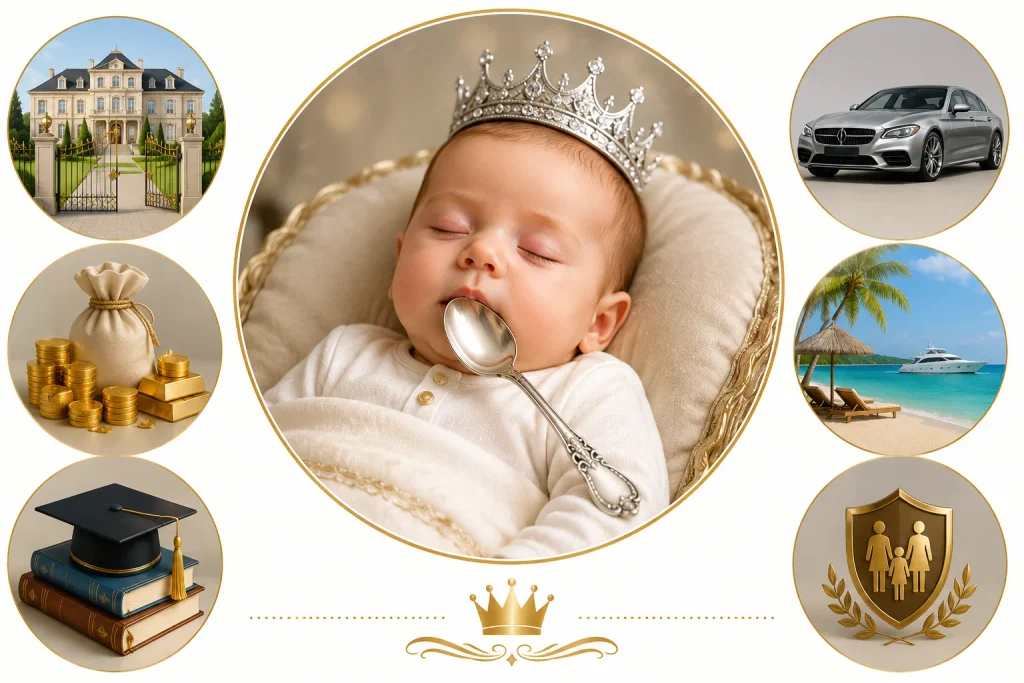
The expression “born with a silver spoon in their mouth” is one of those English idioms that sounds strange when you picture it literally. A baby obviously isn’t born holding a spoon between their teeth. The silver spoon is a metaphor for wealth, privilege, comfort, and advantages that exist from birth.
In modern English, saying that someone was born with a silver spoon in their mouth generally means that the person was born into a very wealthy or privileged family. Merriam-Webster defines the idiom as being born into a very wealthy family, while its related noun, silver spoon, means wealth, especially inherited wealth.
The expression is especially useful when discussing family wealth, inherited advantages, social class, education, career opportunities, business connections, and financial security. However, it does not automatically mean that the person is lazy, unsuccessful, spoiled, or incapable. Those assumptions depend on the context and tone.
This guide explores ” born with a silver spoon in their mouth, its history, symbolism, everyday usage, examples, related idioms, common mistakes, and the subtle difference between having money and being born into an environment where money and opportunity are already available.
What Does “Born With a Silver Spoon in Their Mouth” Mean?
The simplest definition is:
To be born with a silver spoon in your mouth means to be born into a wealthy, financially secure, or highly privileged family.
The expression focuses on a person’s starting point in life rather than only their current financial situation.
Someone may become wealthy at age 40 because of a successful company, an investment, or a career. That person became wealthy through circumstances that happened later in life. Someone who inherited a substantial family fortune, grew up in an affluent household, attended expensive schools, and had family connections from childhood could be described as having been born with a silver spoon in their mouth.
That distinction matters.
The idiom is fundamentally about advantage from birth.
Simple Definition of the Silver Spoon Idiom
Here are the key ideas behind the expression:
- Born into wealth
- Inherited financial advantages
- Privileged upbringing
- Family resources
- Greater access to opportunities
- Financial security from an early age
- Social or professional connections
- Comfort that may be unavailable to others
- A favorable starting position in life
Merriam-Webster specifically connects the idiom with being born into a very wealthy family. Its dictionary entry for silver spoon also identifies the modern meaning as wealth, particularly inherited wealth, with a first known use of the noun in this sense in 1801.
Literal Meaning vs. Figurative Meaning
The literal image is simple: a baby is supposedly born with a silver spoon in their mouth.
The figurative meaning is much more important.
The spoon represents the material and social advantages surrounding the child from the beginning. Instead of having to build financial security from nothing, the person may grow up with a home, savings, private education, family businesses, investments, professional contacts, or other resources already available.
| Literal idea | Figurative meaning |
| A spoon made of silver | Wealth and financial privilege |
| A baby holding a spoon | Advantages present from birth |
| Expensive tableware | Affluence and social status |
| Food available on the spoon | Comfort and security |
| A valuable object | Inherited resources and opportunity |
This is why the expression works so well as a metaphor. Silver is valuable, and the spoon is available from the very beginning. The person doesn’t have to acquire that particular advantage later.
Why a Silver Spoon?
Silver historically had value, so owning silver objects could signal financial standing. The connection between silver and social status helped make the image of a silver spoon an effective symbol of prosperity.
Historical sources also point to the tradition of giving children silver spoons at christenings or similar ceremonies. Wealthy godparents could present a silver spoon as a valuable gift, although this tradition should be treated as a possible influence on the idiom rather than a proven single origin.
The important cultural association is clear: silver was not the ordinary material for everyone. A silver object could represent resources that went beyond basic necessity.
Over time, that symbolism became attached to birth and family circumstances.
The phrase therefore turns an expensive object into a picture of inherited advantage.
What Does the Silver Spoon Symbolize?

The silver spoon symbolizes much more than money sitting in a bank account.
It can represent an entire environment of opportunity.
Imagine two children with equally strong intelligence and ambition. One grows up in a family that can pay for tutoring, private schooling, extracurricular activities, college expenses, international travel, and professional introductions. The other grows up in a household where every educational expense requires careful planning.
Their abilities may be similar, but their starting conditions aren’t.
That’s the deeper idea behind the idiom.
Financial Security
The most obvious meaning is money.
A person born into substantial family wealth may have access to:
- A financially secure home
- Inherited property
- Family investments
- Trust funds
- Business ownership
- Financial assistance for education
- Help with major purchases
- Emergency financial support
- Inheritance later in life
The phrase doesn’t require every one of these advantages. Even one substantial inherited advantage can contribute to the broader idea of a privileged upbringing.
Educational Opportunities
Wealth can also influence education.
A child from a wealthy family may have access to expensive schools, tutors, extracurricular programs, specialized training, language instruction, or universities that require significant financial resources.
That doesn’t mean wealthy students automatically perform better. It means they may have more resources available to support their development.
This distinction is important because the idiom describes an advantage, not a guaranteed outcome.
Professional Connections
Money isn’t the only form of inherited advantage.
Family networks can also matter.
A person whose parents own a company may have an easier path into business. Someone raised around lawyers may understand the profession earlier. Someone whose family has relationships with influential people may receive introductions that another candidate has to spend years developing.
In this sense, the silver spoon can represent social capital as well as financial capital.
Freedom to Take Risks
Financial security can also change how people respond to risk.
Someone with family wealth may be able to:
- Start a business without worrying immediately about rent
- Accept an unpaid internship
- Spend time studying instead of working multiple jobs
- Move to another city for an opportunity
- Recover more easily from a failed business
- Invest money at a younger age
- Take career risks without facing immediate financial crisis
This doesn’t make success effortless. It does mean failure can carry a different level of financial risk.
That’s one reason the phrase remains relevant in conversations about economic inequality and opportunity.
What the Idiom Really Suggests About Privilege
The phrase often points to privilege, but privilege should not automatically be confused with personal wrongdoing.
Being born into wealth is a circumstance of birth.
A person doesn’t choose their parents, family income, inheritance, or childhood environment.
Therefore, saying someone was born with a silver spoon in their mouth can be a neutral observation:
“She was born with a silver spoon in her mouth, but she has built her own career.”
It can also be critical:
“He was born with a silver spoon in his mouth and never understood how difficult life can be for other people.”
The difference comes from context, word choice, and tone.
Wealth Is Not the Same as Success
One of the biggest mistakes people make with this idiom is assuming that being born wealthy means someone hasn’t achieved anything.
That’s too simplistic.
A wealthy person may work extremely hard. They may build a successful company, become an excellent doctor, write influential books, create valuable technology, or contribute meaningfully to society.
The phrase simply acknowledges that their starting conditions were unusually favorable.
Likewise, being born wealthy doesn’t guarantee a successful life.
A person can inherit money and still make poor decisions.
A useful way to understand the idiom is:
Starting advantage ≠ guaranteed success.
The expression describes the starting line. It doesn’t predict where the person will finish.
Does “Born With a Silver Spoon” Always Mean Someone Is Rich?
Not necessarily in the narrow sense of being extremely rich.
In everyday speech, the phrase usually suggests substantial wealth or privilege, but people sometimes use it more loosely for someone who grew up considerably more comfortable than average.
For example:
“He wasn’t a billionaire, but he was born with a silver spoon in his mouth.”
Here, the speaker may mean that the person grew up in a wealthy professional family, attended an elite school, had extensive family support, or enjoyed opportunities that most people didn’t have.
The phrase is therefore relative to context.
Still, calling someone “born with a silver spoon” generally implies more than simply saying that their parents were financially comfortable.
Silver Spoon vs. Being Comfortable
| Description | What it usually suggests |
| Financially comfortable | Stable household with adequate resources |
| Well-off | Above-average financial position |
| Affluent | Considerable wealth and comfort |
| Wealthy | Significant financial resources |
| Born with a silver spoon | Wealth or privilege available from birth |
| Extremely wealthy | Very substantial financial resources |
| Billionaire family | Exceptional level of wealth |
The key feature is not merely the amount of money. It’s the fact that the advantage existed from birth.
How the Expression Works in Everyday English
The phrase is generally used as an adjective-like description after a form of be or in the longer construction “born with a silver spoon in their mouth.”
Common forms include:
- “He was born with a silver spoon in his mouth.”
- “She was born with a silver spoon in her mouth.”
- “They were born with a silver spoon in their mouth.”
- “I wasn’t born with a silver spoon in my mouth.”
- “He didn’t grow up with a silver spoon in his mouth.”
- “She certainly wasn’t born with a silver spoon in her mouth.”
The wording can change according to the person being discussed.
Why “Their” Works Naturally
Modern English commonly uses singular they/their when the person’s gender is unknown, irrelevant, or intentionally unspecified.
For example:
“Anyone born with a silver spoon in their mouth may have different opportunities.”
This is grammatically natural in contemporary English.
You can also use gendered pronouns when the person is known:
“She was born with a silver spoon in her mouth.”
“He was born with a silver spoon in his mouth.”
Examples of “Born With a Silver Spoon in Their Mouth”
Context makes the meaning much clearer, so consider these examples.
Example 1: Family Wealth
“Daniel was born with a silver spoon in his mouth. His parents owned several successful businesses.”
The sentence suggests that Daniel grew up with significant family wealth.
Example 2: Education
“She was born with a silver spoon in her mouth and attended private schools throughout her childhood.”
Here, the speaker emphasizes the educational opportunities connected to family resources.
Example 3: Career Opportunities
“He didn’t have to worry about finding an entry-level job because his family already had connections in the industry.”
A speaker might describe this person as someone who was born with a silver spoon in his mouth because his family background gave him an unusually strong professional starting point.
Example 4: Contrast With Hardship
“Unlike his classmates who worked after school to support their families, Marcus was born with a silver spoon in his mouth.”
This example creates a clear contrast between different economic circumstances.
Example 5: Neutral Usage
“She was born with a silver spoon in her mouth, but she has worked hard to build a career outside her family’s business.”
This is important because the idiom doesn’t have to be an insult.
Example 6: Critical Usage
“He complains about minor inconveniences despite being born with a silver spoon in his mouth.”
Here, the expression carries a distinctly critical tone.
Example 7: Self-Awareness
“I’ve been fortunate. I was born with a silver spoon in my mouth, and I know that gave me opportunities other people didn’t have.”
This usage is reflective rather than hostile.
What “Born With a Silver Spoon” Does Not Mean
Understanding the boundaries of an idiom is just as important as knowing its definition.
The expression does not automatically mean:
- The person is lazy.
- The person never worked.
- The person is unintelligent.
- The person is spoiled.
- The person inherited a billion dollars.
- The person has never experienced difficulty.
- The person is morally bad.
- The person cannot achieve anything independently.
Those meanings may be implied by a speaker’s tone, but they aren’t part of the basic dictionary definition.
The core idea remains wealth or privilege from birth.
Is “Born With a Silver Spoon” Always Negative?
No.
The expression can be neutral, positive, critical, humorous, or sarcastic, depending on the situation.
Neutral Tone
“She was born with a silver spoon in her mouth and had access to excellent educational opportunities.”
The speaker is describing a background.
Critical Tone
“He was born with a silver spoon in his mouth and has no idea what it means to struggle financially.”
Here, the speaker is criticizing a perceived lack of awareness.
Humorous Tone
“I wasn’t exactly born with a silver spoon in my mouth. My childhood spoon was definitely plastic.”
The speaker is using the idiom playfully to describe an ordinary upbringing.
Balanced Tone
“He was born with a silver spoon in his mouth, but that doesn’t mean he hasn’t worked hard.”
This is perhaps the most useful modern interpretation because it recognizes both inherited advantage and personal effort.
Why Context Matters So Much
Idioms don’t exist independently of the sentences around them.
Compare these two statements:
“She was born with a silver spoon in her mouth and used her advantages to fund scholarships.”
and:
“She was born with a silver spoon in her mouth and thinks everyone should have the same life she had.”
The first is relatively positive. The second is critical.
The words following the idiom tell readers how they should interpret the speaker’s attitude.
That makes tone one of the most important aspects of using this expression correctly.
The Deeper Idea: Starting Life With an Advantage
At its heart, born with a silver spoon in their mouth is a metaphor about the starting point of life.
Think about a race.
If every runner starts at the same line, their performance can be compared more directly. But if one runner begins several yards ahead, that person has an advantage before the race even starts.
The idiom uses the same basic idea.
The “silver spoon” is the head start.
That head start can come from:
- Family money
- Property
- Education
- Social connections
- Business ownership
- Inheritance
- Family reputation
- Financial safety
- Access to professional networks
This is why the expression frequently appears in discussions about class, inequality, inheritance, opportunity, and privilege.
Historical Background of “Born With a Silver Spoon”
The expression has a surprisingly long history.
Modern dictionaries connect silver spoon with wealth and especially inherited wealth. Merriam-Webster gives 1801 as the first known use of silver spoon in the relevant sense.
However, evidence for the longer expression “born with a silver spoon in one’s mouth” appears earlier.
Historical references point to early-18th-century printed examples. One well-known early appearance occurs in an English translation of Don Quixote, while a Scottish proverb collection from 1721 contains a closely related form.
That means the exact history deserves some caution. It is safer to say that the expression has early-18th-century printed evidence rather than claiming that one particular person definitively invented it.
Early Evidence and “Don Quixote”
An early English appearance is associated with Peter Anthony Motteux’s translation of Don Quixote. The wording appears in a proverb-like statement involving a silver spoon and birth.
The important point isn’t that the novel necessarily invented the phrase.
Instead, its appearance in an early printed translation suggests that the expression was already recognizable enough to work as a proverb or familiar saying.
That distinction matters when discussing idiom origins.
The 1721 Scottish Proverb
A related version appeared in a collection of Scottish proverbs in 1721:
“Every Man is not born with a Silver Spoon in his Mouth.”
This wording demonstrates that the central metaphor was already circulating in English by the early 1700s.
The proverb also reveals an important feature of the expression: not everyone begins life with the same advantages.
That idea is essentially the same one modern speakers communicate today.
The Silver Spoon and Social Class
Why did silver work so effectively as a symbol of privilege?
Part of the answer lies in material culture.
Silver was valuable. Possessing silver objects could communicate wealth, status, and access to resources. A family that could afford silver tableware occupied a different economic position from a family that relied on inexpensive everyday utensils.
A silver spoon therefore became a compact visual symbol.
You don’t need a long explanation to communicate wealth when you can simply say:
“He was born with a silver spoon in his mouth.”
The listener immediately understands the image.
Silver Spoon as a Symbol of Inherited Wealth
The metaphor became especially powerful because a spoon is associated with feeding and early life.A newborn cannot earn money.A newborn cannot build a company.A newborn cannot invest in stocks.A newborn can only receive the conditions created by the family into which they are born.
That makes the phrase particularly effective for describing inherited advantage.
The silver spoon isn’t something the person earned.
It’s something the metaphor says was already waiting for them.
The Tradition of Giving Silver Spoons to Children
One commonly suggested explanation for the expression involves the tradition of giving silver spoons to children, particularly as christening or baptism gifts.
Historical sources note that wealthy godparents in various traditions gave silver spoons to their godchildren. This connection may have influenced the imagery behind the expression, although historians and etymologists do not establish it as the sole, definitive origin.
The symbolism makes intuitive sense:
A valuable silver object + a newborn child + family prosperity = an image of inherited privilege.
Over generations, that image could become figurative language.
Did Shakespeare Create the Silver Spoon Idiom?
There is no solid basis for saying Shakespeare created the expression.
This is an important correction because famous literary figures are often incorrectly credited with popular English phrases.
The available historical evidence points to printed examples of the silver-spoon expression from the early 18th century, including the Motteux translation of Don Quixote and the 1721 Scottish proverb collection.
Therefore, it is more accurate to describe the phrase as an older proverb-like expression that entered recorded English usage well before modern times, rather than attributing its invention to Shakespeare.
How the Meaning Developed
The expression has retained its central idea for centuries.
The wording is old, but the underlying social concept remains familiar:
Some people begin life with substantially greater resources than others.
In earlier societies, wealth could determine:
- Where someone lived
- What education they received
- What profession they entered
- Whom they married
- Which social circles they entered
- Whether they inherited land
- Whether they could participate in political life
- Whether they could survive financial setbacks
Today, wealth operates differently in many respects, but inherited resources can still influence education, housing, investment, entrepreneurship, professional networks, and financial security.
That’s why the idiom hasn’t disappeared.
Its imagery is centuries old, but its basic idea remains recognizable.
A Quick Knowledge Check
Before moving into related expressions and more advanced usage, keep these core facts in mind:
| Question | Answer |
| What does the idiom mean? | Being born into wealth or privilege |
| Is it literal? | No, it is figurative |
| What does the spoon symbolize? | Wealth, advantage, and inherited privilege |
| Does it always mean billionaire-level wealth? | No |
| Does it automatically mean someone is lazy? | No |
| Can it be neutral? | Yes |
| Can it be critical? | Yes |
| Is it about wealth from birth? | Primarily |
| Did Shakespeare definitely create it? | No |
| Is the origin completely certain? | No; several historical influences are discussed |
| When is silver spoon first known in its wealth sense? | Merriam-Webster gives 1801 |
| Is the longer phrase older than that? | Yes, early-18th-century evidence exists |
Key Takeaway
“Born with a silver spoon in their mouth” describes someone who enters life with substantial financial or social advantages because of their family background. The expression is about starting conditions, not a guaranteed outcome.
The silver spoon represents more than money. It can symbolize education, security, inheritance, connections, opportunity, social status, and the freedom to take risks. At the same time, the idiom doesn’t prove that a wealthy person is lazy or undeserving. Tone and context determine whether the expression sounds neutral, admiring, critical, or sarcastic.
Historically, the phrase has early-18th-century printed evidence, while silver spoon in the specific sense of inherited wealth is dated to 1801 by Merriam-Webster.
The central idea has remained remarkably stable: some people are given a head start before they ever have the chance to choose their path.
Origin and History of “Born With a Silver Spoon in Their Mouth”
The history of “born with a silver spoon in their mouth” is more interesting than the modern definition might suggest. Today, the phrase immediately brings to mind inherited wealth, privilege, and a comfortable upbringing. Its historical development, however, involves silver objects, social status, religious gift-giving traditions, proverbs, and changing ideas about class and inherited advantage.
The exact origin isn’t completely settled. What can be established with greater confidence is that the expression was already appearing in English in the early 18th century, while silver spoon developed its specific dictionary sense of wealth, especially inherited wealth, later. Merriam-Webster gives 1801 as the first known use of silver spoon in that meaning.
That distinction is useful because idioms often exist in spoken or proverbial language before dictionaries record them as independent expressions.
Where Did “Born With a Silver Spoon” Come From?
The phrase appears to have developed from the association between silver and prosperity.
For centuries, silver objects could represent financial resources and social position. A family that owned silver tableware had something valuable that wasn’t simply a basic household necessity. Silver could also be passed down through generations, which made it a natural symbol of family wealth and inherited status.
The expression then takes that symbolism one step further.
Instead of saying that a wealthy family owned a silver spoon, the proverb imagines a child as being born with one already in their mouth.
That exaggeration creates the central meaning:
The person’s advantages were present from the very beginning of life.
This is why the phrase is stronger than simply saying someone is wealthy.
“Wealthy” describes financial condition.
“Born with a silver spoon” describes financial advantage from birth.
That difference remains important in modern English.
Early Printed Evidence of the Idiom
Historical evidence places the expression much earlier than many people might expect.
An early English appearance is found in Peter Anthony Motteux’s translation of Don Quixote. The wording appears in a proverb-like statement about not everyone being born with a silver spoon in their mouth. A closely related version then appeared in a 1721 collection of Scottish proverbs.
The historical record is especially interesting because the expression was used as a translation of a Spanish proverb whose literal imagery was different. That suggests the English silver-spoon wording was already understandable as a proverb rather than being invented from scratch by the translator.
An even earlier English proverb from 1639 reportedly used a penny in the mouth rather than a silver spoon. This provides useful context because it shows that the broader idea of being born with a valuable object in one’s mouth existed before the familiar silver-spoon version.
So, rather than assigning the phrase to one inventor, it’s more accurate to view it as part of a long evolution of proverbial language about birth, wealth, and fortune.
A Brief Historical Timeline
| Period | Development |
| 16th century | Silver possessions could signal relative prosperity and social position |
| 1639 | An earlier related proverb used a penny rather than a silver spoon |
| Early 1700s | The silver-spoon expression appears in English print |
| 1721 | A related form appears in a Scottish proverb collection |
| 1801 | Merriam-Webster dates silver spoon in the sense of wealth to this year |
| Modern English | The expression commonly means being born into wealth or privilege |
The dates help show that the longer idiom predates the dictionary’s first recorded use of silver spoon as a standalone term for inherited wealth.
Why Silver Was Associated With Wealth
To understand the metaphor, you have to understand what silver represented historically.
Silver wasn’t simply another material for making everyday utensils. In many historical settings, owning silver objects represented a level of prosperity. Silverware could be valuable, decorative, durable, and capable of being preserved as an heirloom.
That made silver particularly useful as a symbol of economic security and social standing.
A wooden or inexpensive spoon represented ordinary utility.
A silver spoon suggested something different:
- Money
- Status
- Luxury
- Family resources
- Refinement
- Social position
- Inherited possessions
Historical accounts describe silver spoons as possessions associated with prosperity, and traditions developed around giving silver spoons to children at baptism or christening.
The metaphor didn’t need to claim that every wealthy child literally possessed a silver spoon.
The object worked as a visual shorthand for privilege.
Silver Spoons and Social Class
For much of European history, material possessions could make social differences visible.
Clothing, houses, jewelry, furniture, tableware, and other objects could communicate a family’s economic position. Silver was especially useful as a status symbol because it was valuable enough to distinguish its owner from people who could afford only basic household goods.
This created a natural connection between:
silver → wealth → family status → privileged upbringing
Once that association became culturally familiar, the silver spoon could represent an entire family background rather than one physical object.
That’s what makes the idiom so efficient.
When someone says:
“She was born with a silver spoon in her mouth.”
the listener doesn’t think only about cutlery.
They think about the advantages surrounding that person’s childhood.
The Tradition of Giving Silver Spoons to Babies
One of the most commonly discussed explanations for the phrase involves the tradition of giving silver spoons to babies, particularly around baptism or christening.
A silver spoon could serve as a valuable gift and a lasting keepsake. In families that could afford it, such objects might be engraved with the child’s initials, name, or date.
The tradition is important because it connects three ideas:
- A newborn child
- A valuable silver object
- A family’s ability to provide it
That combination closely resembles the imagery of the idiom.
However, it’s important not to turn this explanation into an absolute historical fact. The christening-spoon tradition is widely cited as a possible influence, but the surviving evidence doesn’t establish that one specific custom definitively created the entire expression.
In other words:
The tradition helps explain the imagery, but it isn’t proof of a single, certain origin.
Why a Spoon Instead of Another Silver Object?
The choice of a spoon is especially effective because a spoon is associated with food and nourishment.
A baby being born with a silver spoon creates an exaggerated image of having one’s needs provided immediately.
The metaphor therefore combines wealth with effortless access to necessities.
A silver necklace might symbolize wealth.
A silver cup might symbolize wealth.
But a silver spoon has an additional association: someone else is feeding you with it.
That makes the spoon particularly powerful as a metaphor for inherited advantage.
The person isn’t simply born into a family that has money. The image suggests that the person has been provided for from the moment they enter the world.
Why Not a Gold Spoon?
Gold would seem like an obvious symbol of wealth, yet the traditional English expression uses silver.
That choice reflects historical material culture.
Silver was valuable but practical enough to be used for household objects and tableware. Gold, by contrast, was much more closely associated with extreme luxury and wasn’t the ordinary material for a functional spoon in the way silver could be.
Silver therefore made the metaphor feel both wealthy and believable.
The phrase wasn’t trying to describe royalty.
It was describing someone whose family had enough wealth to provide something valuable from birth.
Interestingly, other languages sometimes use golden cradle or similar imagery to express the idea of being born into wealth. The English tradition settled on the silver spoon.
The Role of Social Class in the Idiom
The expression has always carried a connection to social class.
Being born into wealth can affect more than how much money someone has. Family resources can shape education, housing, social networks, career options, and the ability to recover from financial setbacks.
That is why “born with a silver spoon” can be more meaningful than simply saying “rich.”
Consider these two statements:
“He is rich.”
and:
“He was born with a silver spoon in his mouth.”
The first tells you about his financial situation.
The second tells you something about where his advantages came from and when they began.
That distinction is central to the idiom.
Inherited Wealth vs. Earned Wealth
One of the most important ideas connected to the phrase is the difference between inherited wealth and wealth acquired later.
Imagine two people who are both worth several million dollars.
Person A grew up in an ordinary household and accumulated wealth through a business over 30 years.
Person B inherited a large family fortune and grew up with access to expensive education, property, and family connections.
Both are wealthy.
But Person B is much more naturally described as having been born with a silver spoon in their mouth.
The expression focuses on the source and timing of advantage, not simply the person’s current bank balance.
The “Starting Line” Meaning
A useful modern interpretation is to think of the silver spoon as a head start.
Someone born into significant wealth may begin life with resources that another person has to spend decades trying to obtain.
Those resources can include:
- A stable home
- Quality education
- Financial assistance
- Inherited property
- Investment capital
- Business connections
- Professional introductions
- Family reputation
- Access to specialized opportunities
- Protection from certain financial risks
The person may still need talent and effort to succeed.
The difference is that their starting conditions can be substantially more favorable.
How the Idiom Became Associated With Privilege
Over time, the expression moved beyond literal wealth and began to capture a broader idea of privilege.
Modern speakers may use it when discussing someone who received advantages through family circumstances even if those advantages weren’t simply cash.
For example, a person could have access to an elite professional network because their parents are influential in a particular field.
Another person might inherit a family business.
Someone else might have parents who can pay for years of specialized education without requiring the student to take on debt.
These circumstances are different, but they can all fit the broader concept of starting life with unusual advantages.
Financial Privilege
This is the most direct form.
Examples include:
- Inheritance
- Trust funds
- Family businesses
- Property
- Investment portfolios
- Paid education
- Financial assistance
Educational Privilege
A wealthy upbringing may provide access to:
- Private schools
- Tutors
- Specialized programs
- Test preparation
- International education
- Expensive extracurricular activities
Education doesn’t guarantee success, but access to resources can affect the opportunities available to a person.
Social Privilege
Family networks can also provide an advantage.
A child who grows up around successful professionals may learn how certain industries work long before entering the workforce. They may know whom to contact, what qualifications matter, and how professional environments operate.
This type of advantage is sometimes less visible than money.
Yet it can be extremely valuable.
Entrepreneurial Privilege
Starting a business often requires capital.
Someone without financial support may need to save for years, borrow money, attract investors, or work another job while building the company.
Someone from a wealthy family may be able to obtain startup capital much more easily.
That doesn’t guarantee that the business will succeed.
It simply means the cost of failure may be easier to absorb.
This is another reason the silver-spoon metaphor remains relevant when people discuss entrepreneurship.
Did Shakespeare Create the Phrase?
A common claim about the idiom is that William Shakespeare created it.
There isn’t strong evidence supporting that claim.
The expression is documented in early-18th-century sources, including the Motteux translation of Don Quixote and the 1721 Scottish proverb collection.
That evidence makes it inappropriate to confidently credit Shakespeare with inventing the phrase.
This is a useful lesson in idiom research generally: a phrase may sound old enough to belong to Shakespeare without actually appearing in Shakespeare’s works.
Many popular websites repeat attractive origin stories without distinguishing between:
- documented first appearance,
- possible influence,
- later interpretation,
- and unsupported attribution.
For an accurate explanation, those categories should remain separate.
The Connection With Don Quixote
The Don Quixote connection deserves special attention because it provides one of the earliest known printed English forms of the expression.
Peter Anthony Motteux translated Miguel de Cervantes’ famous novel into English. In the translation, Sancho Panza uses the silver-spoon wording in a proverb-like statement.
What makes the example fascinating is that the Spanish original used different imagery.
That means the English translator wasn’t necessarily translating the exact metaphor word for word. Instead, the English wording appears to have used an expression that conveyed a related idea to an English-speaking audience.
This suggests something important about the idiom’s history:
The silver-spoon expression may already have been recognizable as proverbial language when it appeared in the English translation.
Why This Matters
If an expression appears naturally inside a translation as a proverb, it may indicate that the translator expected readers to understand it.
That doesn’t prove precisely when ordinary speakers first used the phrase.
Spoken language generally exists before it appears in books.
But it gives researchers a valuable historical checkpoint.
The phrase was clearly established enough by the early 1700s to appear in printed English.
The 1721 Scottish Proverb Connection
The expression also appears in a collection of Scottish proverbs published in 1721.
The recorded form is essentially:
“Every Man is not born with a Silver Spoon in his Mouth.”
The wording is significant because it makes the underlying social message explicit.
Not everyone receives the same advantages at birth.
That idea remains at the center of the idiom today.
The proverb isn’t merely describing silverware. It’s commenting on fortune, social position, and unequal starting circumstances.
From Proverb to Modern Idiom
Language changes slowly, then suddenly.
An old proverb can become a shorter phrase. A metaphor can become a noun. A literary expression can move into ordinary conversation.
That’s essentially what happened with silver spoon.
Merriam-Webster now defines silver spoon as wealth, especially inherited wealth, and traces the term in that meaning to 1801.
Modern English speakers can therefore use the shorter expression without saying the complete idiom.
For example:
“He inherited everything. He was born with a silver spoon.”
Or:
“She grew up with a silver spoon.”
Or even:
“He’s a silver-spoon kid.”
The shorter forms depend on context, but they all preserve the basic association between birth, wealth, and inherited advantage.
How the Meaning Changed Over Time
The phrase’s central meaning has remained remarkably consistent, but its social implications have expanded.
Earlier usage emphasized fortune and material circumstances.
Modern usage can additionally involve:
- Economic inequality
- Social mobility
- Inherited privilege
- Meritocracy
- Family connections
- Access to education
- Career opportunities
- Generational wealth
- Social class
This broader use reflects changes in how people talk about wealth.
Today, being privileged isn’t necessarily about owning silver tableware.
It can mean having resources, networks, security, or opportunities that others must work much harder to obtain.
The Modern Idea of Generational Wealth
One reason the silver-spoon idiom remains relevant is the growing attention given to generational wealth.
Generational wealth refers broadly to assets and financial resources that can be transferred between family generations.
These resources can include:
- Homes
- Land
- Investments
- Businesses
- Savings
- Trusts
- Inherited assets
The concept closely matches the deeper meaning of the silver-spoon metaphor because the advantage doesn’t begin with the individual’s own earnings.
It begins with what the family already possesses.
A Simple Generational Example
Imagine a family that owns a profitable company.
The grandparents establish it.
The parents expand it.
The child grows up around the business, learns how it operates, receives a first job there, and eventually inherits ownership.
The child may work extremely hard.
But the child also receives something most people never receive:
a family-created economic platform from which to begin.
That is exactly the kind of situation where the silver-spoon idiom can be appropriate.
Silver Spoon Does Not Mean “No Hard Work”
This distinction deserves emphasis because the expression can easily become unfair when used carelessly.
A person can be:
born privileged + hardworking
at the same time.
A person can also be:
born wealthy + talented
or:
born wealthy + generous
or:
born wealthy + highly accomplished
The idiom doesn’t cancel those qualities.
It simply identifies an advantage that existed before the person’s own achievements.
A fair statement might be:
“She was born with a silver spoon in her mouth, but she used her opportunities responsibly and built an impressive career.”
That sentence recognizes both privilege and personal effort.
When the Silver Spoon Expression Becomes Critical
The phrase often becomes negative when the speaker believes someone fails to recognize their privilege.
For example:
“He was born with a silver spoon in his mouth, so he doesn’t understand why people struggle to pay their bills.”
The criticism isn’t necessarily that he has money.
The criticism is that his experience may have given him a limited understanding of financial hardship.
This is one reason the phrase sometimes carries an undertone of resentment, envy, or social criticism.
The Difference Between Description and Insult
Compare:
“She was born with a silver spoon in her mouth.”
with:
“She’s just another spoiled rich kid who was born with a silver spoon in her mouth.”
The first can be descriptive.
The second is clearly judgmental.
The added words “spoiled rich kid” turn the sentence into a criticism.
This shows why tone matters so much when using idioms about class and wealth.
Historical Facts at a Glance
| Fact | What it tells us |
| Silver was associated with prosperity | Explains the metaphor |
| Silver spoons were used as valuable gifts | Helps explain the birth imagery |
| The phrase appears in early-18th-century English print | Shows the expression is centuries old |
| A related proverb appears in 1721 | Confirms its proverbial character |
| Silver spoon means wealth, especially inherited wealth | Confirms the modern semantic development |
| Merriam-Webster dates that noun sense to 1801 | Provides a dictionary-based milestone |
| Shakespeare is not a reliable creator attribution | Prevents a common origin myth |
| The phrase emphasizes birth circumstances | Separates it from simply being wealthy |
What the History Tells Us About the Idiom
The historical development of “born with a silver spoon in their mouth” reveals why the expression has remained so effective.
It combines a simple physical object with a complicated social idea.
The spoon represents wealth.
The mouth represents nourishment and provision.
Birth represents circumstances a person did not choose.
Put those three elements together, and the meaning becomes powerful:
Someone received substantial advantages before they had done anything to earn them.
That doesn’t necessarily make the person bad.It doesn’t mean they never worked.It doesn’t mean their achievements are worthless.It simply means they started from a position of unusual advantage.
That is the central historical and modern meaning of the silver-spoon idiom.
Takeaway
The history of “born with a silver spoon in their mouth” stretches back at least to the early 18th century in documented English print, with related imagery appearing even earlier. Silver’s association with prosperity, the tradition of silver gifts for children, and the long history of class distinctions all helped make the spoon a powerful symbol of inherited advantage.
The expression eventually developed into the modern concept of being born into wealth or privilege, while the silver spoon itself came to mean wealth, especially inherited wealth. Merriam-Webster dates that specific noun sense to 1801.
Most importantly, the phrase isn’t really about a piece of silverware. It’s about where someone starts in life, what their family can provide, and how much opportunity is available before they have earned anything themselves.
part 3
Is “Born With a Silver Spoon in Their Mouth” Always Negative?
The expression “born with a silver spoon in their mouth” can sound negative, but it isn’t automatically an insult. Its basic meaning is simply that someone was born into wealth, privilege, or unusually favorable circumstances. The speaker’s attitude comes from the surrounding context.
If someone says, “She was born with a silver spoon in her mouth,” the statement may be completely neutral. If they say, “He was born with a silver spoon in his mouth and has no idea how ordinary people live,” the same idiom becomes critical.
Understanding this difference is essential when using the phrase naturally. The idiom describes an advantage, while the context determines the judgment attached to that advantage.
Neutral Use of “Born With a Silver Spoon”
A neutral use simply describes someone’s background without attacking their character.
“James was born with a silver spoon in his mouth, but he chose to pursue a career far removed from his family’s business.”
Here, the speaker acknowledges James’s privileged upbringing without claiming that he is lazy or undeserving.
Another example:
“She was born with a silver spoon in her mouth and had access to excellent schools from an early age.”
The sentence presents family wealth as a background fact.
Neutral usage often appears in biographies, interviews, discussions about family businesses, and conversations about social class.
Positive or Balanced Use
The phrase can also appear in a balanced statement that recognizes privilege while acknowledging personal effort.
“He was born with a silver spoon in his mouth, but he has worked hard to build something of his own.”
This construction is especially useful because it avoids two extremes.
It doesn’t pretend that inherited advantages don’t matter. At the same time, it doesn’t assume that wealth automatically makes someone’s accomplishments meaningless.
A person’s circumstances and their actions can both be true.
Someone can receive significant advantages from family wealth and still:
- Work long hours
- Develop valuable skills
- Build a successful company
- Earn professional qualifications
- Help other people
- Make difficult decisions
- Experience failure
- Achieve meaningful goals
The idiom describes where someone started, not everything they do afterward.
Critical Use of the Silver Spoon Idiom
The phrase becomes more negative when the speaker uses it to criticize someone’s attitude toward money or hardship.
For example:
“He was born with a silver spoon in his mouth, so he doesn’t understand why his employees worry about living expenses.”
The criticism isn’t necessarily directed at wealth itself. Instead, it targets the person’s lack of awareness about financial hardship.
Another example:
“She was born with a silver spoon in her mouth and expects every opportunity to come easily.”
Here, the speaker suggests that privilege has influenced the person’s expectations.
Common words that can make the expression sound more critical include:
- Spoiled
- Privileged
- Entitled
- Sheltered
- Out of touch
- Unaware
- Fortunate
- Pampered
However, these words should not automatically be treated as synonyms for the idiom. “Born with a silver spoon” does not itself mean spoiled or entitled.
Does Being Born With a Silver Spoon Mean Someone Is Spoiled?
No.
This is one of the most common misunderstandings.
A person can grow up wealthy and still have:
- Strong discipline
- Empathy
- Humility
- Independence
- Ambition
- A strong work ethic
- Awareness of social inequality
Likewise, someone from a wealthy family can become spoiled or entitled, but that behavior isn’t part of the literal definition of the idiom.
Consider the difference:
“She was born with a silver spoon in her mouth.”
This tells us about her background.
“She was born with a silver spoon in her mouth and became spoiled.”
This adds a judgment about her personality.
The second statement contains more information than the first.
Does the Idiom Mean Someone Didn’t Work for Their Success?
Again, not necessarily.
This is an important distinction in conversations about wealth.
Imagine someone whose parents paid for their university education and provided startup capital for a business. That person might still spend ten years developing the company, managing employees, learning from failures, and building the organization into something successful.
Calling that person born with a silver spoon can be accurate because their initial circumstances were privileged.
But saying they “didn’t work for anything” would be a separate claim that requires evidence.
The two ideas should not be confused.
| Statement | What it means |
| Born with a silver spoon | Started life with wealth or privilege |
| Worked hard | Invested effort into achieving something |
| Self-made | Built wealth or success largely through personal effort and resources |
| Spoiled | Developed an entitled or poorly disciplined attitude |
| Privileged | Had advantages unavailable to many others |
A person can fit more than one category.
How Tone Changes the Meaning
The tone of the speaker can dramatically change how the idiom is understood.
Admiring Tone
“She was born with a silver spoon in her mouth and used her family’s resources to create scholarships for disadvantaged students.”
The phrase acknowledges wealth, while the rest of the sentence highlights generosity.
Critical Tone
“He was born with a silver spoon in his mouth and complains whenever anything goes wrong.”
The speaker is clearly criticizing his attitude.
Sarcastic Tone
“Oh, poor thing. He was born with a silver spoon in his mouth and only has three vacation homes.”
The exaggerated wording signals sarcasm.
Matter-of-Fact Tone
“The founder was born with a silver spoon in his mouth. His family had owned the company for three generations.”
This is primarily descriptive.
Context is the key.
When Should You Use “Born With a Silver Spoon”?
The expression works best when you’re discussing someone’s background or starting advantages.
It is appropriate in conversations about:
- Family wealth
- Inheritance
- Generational wealth
- Business families
- Social class
- Education
- Career opportunities
- Financial privilege
- Economic inequality
- Family connections
- Luxury lifestyles linked to inherited wealth
Appropriate Example: Family Business
“He was born with a silver spoon in his mouth because his parents owned a successful manufacturing company.”
The phrase works because the person’s financial advantage existed through their family from childhood.
Appropriate Example: Inheritance
“She was born with a silver spoon in her mouth and eventually inherited several family properties.”
The connection between family wealth and inheritance makes the idiom particularly natural.
Appropriate Example: Elite Education
“Growing up, he was born with a silver spoon in his mouth and attended some of the country’s most expensive schools.”
The sentence emphasizes access to educational opportunities.
Appropriate Example: Career Connections
“She was born with a silver spoon in her mouth, and her family’s connections helped her enter the industry.”
Again, the phrase focuses on the advantage available through family circumstances.
When Should You Avoid the Idiom?
Although the expression is common, there are situations where it can sound judgmental, presumptuous, or insensitive.
Be cautious when discussing someone’s finances if you don’t actually know their family background.
For example, someone may drive an expensive car because they:
- Saved for years
- Built a successful company
- Received a loan
- Leased the vehicle
- Inherited it
- Earned it through work
You can’t automatically conclude that they were born with a silver spoon simply because they appear wealthy today.
Don’t Use It Based Only on Appearance
Avoid assumptions such as:
“She wears designer clothes, so she must have been born with a silver spoon.”
That conclusion isn’t justified.
Visible wealth doesn’t tell you when or how someone acquired it.
Don’t Use It for Every Successful Person
Someone who becomes wealthy after building a business from scratch isn’t necessarily someone who was born with a silver spoon.
The phrase is about family circumstances at birth, not simply about the person’s present-day success.
Don’t Use It as a Substitute for Evidence
If you’re writing formally about someone’s financial background, precise wording is often better.
Instead of:
“He was born with a silver spoon.”
you might write:
“He grew up in a wealthy family that owned several businesses.”
The second statement gives specific information.
The idiom is more colorful and conversational, while the factual description is more precise.
How to Use the Idiom Naturally in Conversation
The phrase is fairly long, so native speakers often use it when the context gives them a reason to discuss someone’s upbringing.
Natural conversation might look like this:
A: “How did she manage to start her company so young?”
B: “Her family provided the initial investment. She was born with a silver spoon in her mouth.”
Or:
A: “His parents own several hotels, right?”
B: “Yes. He definitely wasn’t born without advantages.”
The full expression can also be shortened when the context is obvious:
“He grew up with a silver spoon.”
“She came from a silver-spoon background.”
“They had a silver-spoon upbringing.”
The exact wording varies depending on the speaker and context.
Examples of “Born With a Silver Spoon” in Sentences
Here are practical examples across different situations.
Everyday Conversation Examples
- “She was born with a silver spoon in her mouth and never had to worry about paying for college.”
- “I wasn’t born with a silver spoon in my mouth, so I had to work throughout college.”
- “He grew up with a silver spoon, but he doesn’t act entitled.”
- “People assume she’s spoiled because she was born with a silver spoon in her mouth.”
- “His family was wealthy, so you could say he was born with a silver spoon in his mouth.”
Workplace Examples
- “He was born with a silver spoon in his mouth, so his family helped him launch his first company.”
- “Being born with a silver spoon can give someone access to professional networks that take years for others to develop.”
- “She had a privileged upbringing, but she has earned respect from her colleagues through her performance.”
- “The new executive was born with a silver spoon in his mouth and inherited part of the family business.”
- “Don’t assume every wealthy executive was born with a silver spoon.”
Education Examples
- “She was born with a silver spoon in her mouth and attended private schools from kindergarten onward.”
- “Unlike his classmates, he never had to worry about tuition because his parents could afford every educational expense.”
- “The novel’s protagonist was born with a silver spoon in her mouth but eventually chose a very modest lifestyle.”
- “Students born with a silver spoon may have access to educational resources that others cannot afford.”
Family and Inheritance Examples
- “He was born with a silver spoon in his mouth because his family had owned the estate for generations.”
- “She inherited the company from her parents, so people often say she was born with a silver spoon.”
- “Being born into a wealthy family doesn’t guarantee that someone will manage inherited assets wisely.”
- “His family fortune gave him a significant financial cushion from childhood.”
Critical Examples
- “He was born with a silver spoon in his mouth and has never had to live paycheck to paycheck.”
- “She was born with a silver spoon in her mouth, yet she complains about every small inconvenience.”
- “Critics argue that the politician was born with a silver spoon and doesn’t understand ordinary financial pressures.”
Positive or Balanced Examples
- “She was born with a silver spoon in her mouth, but she uses her wealth to support charitable causes.”
- “He was born with a silver spoon, yet he built his own career instead of joining the family business.”
- “Although he was born with a silver spoon in his mouth, he openly acknowledges the advantages his family gave him.”
- “She had every financial advantage growing up, but she also developed an impressive work ethic.”
Case Study: Two People, Two Starting Points
Consider two fictional graduates, Maya and Daniel.
Maya grows up in a middle-income household. Her parents can cover basic expenses, but she takes a part-time job during college. She graduates with student debt and spends several years saving enough money to start a business.
Daniel grows up in a wealthy family. His parents pay for his education, introduce him to experienced business owners, and provide the capital he needs to launch a company immediately after graduation.
Suppose both eventually become successful entrepreneurs.
Their achievements can both be real.
But Daniel is the person more naturally described as having been born with a silver spoon in his mouth.
Why?
Because his family gave him financial and social advantages before he had established his own career.
This example shows why the idiom doesn’t necessarily answer the question, “Who worked harder?”
Instead, it answers a different question:
“Who began life with greater inherited advantages?”
Similar Idioms to “Born With a Silver Spoon”
English contains several expressions that overlap with the idea of wealth, privilege, or advantage. However, they aren’t interchangeable.
“Born on Third Base”
“Born on third base” is a particularly close American expression.
It describes someone who starts life in an advantageous position and then may act as though they achieved everything independently.
The baseball metaphor is straightforward: if you’re already standing on third base, you’re extremely close to scoring before you’ve done the work of hitting the ball and running around the bases.
Compare:
“He was born with a silver spoon in his mouth.”
This emphasizes wealth or privilege from birth.
“He was born on third base.”
This emphasizes starting with a major advantage, often with an implication that the person may fail to recognize that advantage.
The second expression can therefore be more pointed.
“Well-Heeled”
“Well-heeled” means wealthy or financially comfortable.
For example:
“They live in a well-heeled neighborhood.”
But it doesn’t necessarily tell us anything about when the person acquired their money.
Someone can become well-heeled through decades of work.
Someone else may inherit wealth.
Therefore:
Well-heeled = wealthy
Born with a silver spoon = born into wealth or privilege
That distinction is important.
“Living the High Life”
“Living the high life” describes a luxurious or extravagant lifestyle.
For example:
“After selling his company, he started living the high life.”
This person may have become wealthy recently.
The phrase says nothing about their childhood.
By contrast:
“He was born with a silver spoon in his mouth.”
Specifically points toward wealth or privilege from birth.
“To the Manor Born”
“To the manor born” is an older British expression associated with someone born into an upper-class or privileged environment.
It can overlap strongly with the idea of a silver spoon, but it has a stronger historical and social-class flavor.
For example:
“She was born to the manor and grew up among the country’s old aristocratic families.”
The phrase can emphasize social class, breeding, and traditional status, whereas born with a silver spoon more directly emphasizes wealth and material privilege.
Opposite and Contrasting Expressions
The opposite of a silver-spoon upbringing isn’t necessarily one single idiom. English uses several expressions to describe people who start with fewer advantages.
“From Rags to Riches”
“From rags to riches” describes someone who rises from poverty or severe financial hardship to wealth or success.
It is almost the reverse journey of the silver-spoon idea.
| Expression | Starting point | Direction |
| Born with a silver spoon | Wealth or privilege | Advantage exists from birth |
| From rags to riches | Poverty or hardship | Person rises toward wealth |
| Self-made | Limited inherited advantage implied | Success built through personal effort |
| Born on third base | Strong starting advantage | Focus on head start |
| Well-heeled | Wealthy | Doesn’t specify origin of wealth |
Example:
“She wasn’t born with a silver spoon. Her story is more of a rags-to-riches journey.”
“Self-Made”
Self-made describes someone who has built their wealth or success largely through their own efforts rather than inheriting it.
For example:
“He became a self-made millionaire after building a technology company.”
The word doesn’t mean the person received absolutely no help.
It simply contrasts with the idea that their wealth was primarily handed to them through family inheritance.
“Born on the Wrong Side of the Tracks”
This expression traditionally describes someone from a poorer or socially disadvantaged neighborhood or background.
For example:
“The novel follows a character born on the wrong side of the tracks who eventually becomes a respected business leader.”
The expression is often used figuratively, but it can carry class-based or judgmental undertones, so context matters.
It creates a strong contrast with:
“Born with a silver spoon in their mouth.”
One expression emphasizes an advantaged beginning.
The other emphasizes a disadvantaged beginning.
Comparing “Born With a Silver Spoon” and “Born on Third Base”
These expressions are similar enough that people sometimes use them interchangeably, but there is an important difference.
Meaning Comparison
Born with a silver spoon in their mouth:
- Emphasizes wealth
- Focuses on family background
- Highlights inherited privilege
- Suggests advantages from birth
- Can be neutral or critical
Born on third base:
- Emphasizes a head start
- Uses a baseball metaphor
- Can apply beyond financial wealth
- Often criticizes someone for claiming full credit for success
- Is especially common in American English
Which Idiom Should You Choose?
Use “born with a silver spoon” when wealth or privileged family circumstances are central.
Use “born on third base” when the main point is that someone began with a major advantage and perhaps doesn’t acknowledge it.
For example:
“She was born with a silver spoon because her family was extremely wealthy.”
This is about money.
“He was born on third base but acts like he hit a triple.”
This focuses on the difference between starting advantage and perceived self-made success.
Quick Comparison Table
| Expression | Main meaning | Focus on birth? | Focus on wealth? | Typical tone |
| Born with a silver spoon | Born into wealth or privilege | Yes | Strong | Neutral to critical |
| Born on third base | Started with a major advantage | Yes | Sometimes | Often critical |
| Well-heeled | Wealthy | No | Strong | Usually neutral |
| Living the high life | Enjoying luxury | No | Moderate | Neutral to playful |
| To the manor born | Born into an upper-class setting | Yes | Moderate | Traditional/formal |
| From rags to riches | Rose from poverty to wealth | Yes | Strong | Usually positive |
| Self-made | Built success through personal effort | Not necessarily | Often | Usually positive |
| Wrong side of the tracks | Poor or disadvantaged background | Often | Moderate | Can be negative |
A Useful Rule for Remembering the Idiom
If you’re unsure whether “born with a silver spoon in their mouth” fits a situation, ask yourself three questions:
Was the person advantaged from birth?
If yes, the phrase may fit.
Were those advantages connected to family wealth, status, resources, or connections?
If yes, the phrase becomes even more appropriate.
Am I describing their background rather than assuming something about their personality?
If yes, you’re probably using the idiom responsibly.
The easiest memory trick is:
Silver spoon = advantage from birth.
It doesn’t mean:
Silver spoon = lazy person.
That distinction prevents most misuse.
Takeaway
“Born with a silver spoon in their mouth” isn’t automatically negative. It can describe someone’s wealthy upbringing neutrally, recognize inherited advantages, or criticize a person who seems unaware of their privilege. The surrounding words and the speaker’s tone determine the emotional meaning.
The expression is most appropriate when you’re discussing wealth, family resources, inheritance, social connections, education, or other advantages that existed from birth. It shouldn’t be applied simply because someone is wealthy today.
The idiom also becomes easier to understand when compared with related expressions. “Born on third base” focuses on having a major head start, “well-heeled” describes wealth without necessarily referring to childhood, and “from rags to riches” describes the opposite journey from hardship toward wealth.
Most importantly, remember that privilege and hard work can coexist. Someone can be born with substantial advantages and still accomplish difficult things through talent, discipline, and persistence.
Common Mistakes With “Born With a Silver Spoon in Their Mouth”
Knowing the born with a silver spoon in their mouth meaning is only half the job. Using the expression accurately requires understanding what it does—and doesn’t—communicate. Many mistakes happen when people treat the idiom as a synonym for every form of wealth.
The expression specifically points toward advantages present from birth, usually through family wealth, status, inheritance, or access to resources. A person who becomes rich later in life isn’t automatically someone who was born with a silver spoon.
Confusing Wealth With Inherited Privilege
Being wealthy and being born with a silver spoon aren’t the same thing.
Someone can become wealthy through years of work, a successful business, investing, entertainment, professional success, or other circumstances. If that person grew up without substantial financial advantages, the silver-spoon idiom may not accurately describe their childhood.
Compare these examples:
“She became wealthy after building a successful company.”
This tells us how she acquired wealth.
“She was born with a silver spoon in her mouth.”
This tells us that she started life with wealth or privilege.
The distinction is small in wording but significant in meaning.
| Situation | “Born with a silver spoon” appropriate? |
| Born into a wealthy family | Yes |
| Inherited a family fortune | Usually yes |
| Parents owned a major business | Yes |
| Grew up with extensive family resources | Usually yes |
| Became wealthy through a career | Not necessarily |
| Won money later in life | No |
| Built a company from an ordinary upbringing | No, based on wealth alone |
| Currently lives a luxurious lifestyle | Not necessarily |
Assuming Every Wealthy Person Had an Easy Life
Another mistake is assuming that wealth eliminates hardship.
A wealthy person can experience personal loss, illness, family conflict, professional failure, relationship problems, or other difficult circumstances. Financial privilege can provide certain forms of security, but it doesn’t guarantee an easy emotional or personal life.
The idiom refers primarily to economic and social advantage, not to every aspect of someone’s existence.
That’s why this sentence can be unfair:
“He was born with a silver spoon, so his life must have been perfect.”
The first part may describe his financial background. The second part makes a much broader claim that the idiom doesn’t establish.
Using the Idiom Literally
The expression is figurative.
Nobody expects the phrase to mean that a baby physically entered the world holding a silver spoon.
If someone says:
“She was born with a silver spoon in her mouth,”
the intended meaning concerns wealth and privilege, not an actual utensil.
This is a straightforward example of an English idiom where the individual words create an image that differs from the phrase’s established meaning.
Applying It to Temporary Wealth
The idiom describes a starting condition, so temporary or recently acquired wealth doesn’t automatically qualify.
Suppose someone wins a major prize at age 30.
They may suddenly become wealthy, but they weren’t born into that wealth.
Similarly, someone might become a successful entrepreneur at age 45. Their current lifestyle may be luxurious, but that doesn’t mean they were born with a silver spoon.
A better distinction is:
Born wealthy → silver spoon may fit.
Became wealthy later → silver spoon may not fit.
Using the Expression Without Knowing the Facts
Calling someone “silver-spooned” based solely on appearance can be misleading.
An expensive house doesn’t prove that someone inherited money.
A luxury car doesn’t prove that their parents were wealthy.
A prestigious job doesn’t prove that someone had family connections.
Even a successful business doesn’t reveal whether its owner grew up privileged.
If the person’s background isn’t known, use more neutral language such as:
- wealthy
- affluent
- financially successful
- financially comfortable
- successful
- high-income
Use “born with a silver spoon” when the person’s privileged upbringing is actually relevant.
Quick Guide: Correct vs. Incorrect Usage
| Usage | Better or worse? | Why |
| “He was born into a wealthy family.” | Accurate | Direct factual description |
| “He was born with a silver spoon in his mouth.” | Accurate | Natural idiomatic description |
| “She became wealthy at 40, so she was born with a silver spoon.” | Incorrect | Her wealth came later |
| “He drives an expensive car, so he was born with a silver spoon.” | Weak assumption | Current wealth doesn’t prove childhood privilege |
| “Her parents funded her education and business.” | Specific | Identifies the actual advantage |
| “He was born with a silver spoon, but he worked hard.” | Natural | Recognizes both privilege and effort |
Grammar, Form, and Pronunciation
The standard expression is:
born with a silver spoon in one’s mouth
The pronoun changes according to the subject.
Standard Forms
“He was born with a silver spoon in his mouth.”
“She was born with a silver spoon in her mouth.”
“They were born with a silver spoon in their mouth.”
“I wasn’t born with a silver spoon in my mouth.”
The expression can also be used with a person’s name:
“Michael was born with a silver spoon in his mouth.”
Why Is “Spoon” Singular?
The standard idiom uses “a silver spoon”, not “silver spoons.”
The indefinite article a refers to one spoon:
a silver spoon
The phrase has become fixed through long-standing usage, so changing the number can make it sound unnatural.
For example:
“He was born with silver spoons in his mouth.”
This isn’t the standard idiomatic form.
The conventional expression is:
“He was born with a silver spoon in his mouth.”
Why Is “Mouth” Singular?
The same principle applies to mouth.
The standard expression describes one person and therefore uses the singular:in his mouthin her mouthin their mouth
The plural form isn’t part of the established idiom when referring to one person.
Common Variations of the Expression
English speakers may shorten the full phrase when the meaning is already clear.
You might encounter:
- born with a silver spoon
- grew up with a silver spoon
- silver-spoon upbringing
- silver-spoon background
- silver-spoon kid
- silver-spoon family
- silver-spoon privilege
The full expression remains the clearest form when you’re introducing the idea to a reader who may not know it.
“Silver-Spooned” as an Adjective
Silver-spooned is another form used to describe someone from a wealthy or privileged family.
For example:
“He grew up in a silver-spooned household.”
or:
“She had a silver-spooned upbringing.”
This form is more compact, but the traditional idiom “born with a silver spoon in their mouth” is often more recognizable.
Dictionary sources describe silver-spooned as an informal adjective connected with being born into a wealthy or upper-class family.
Pronunciation Tip
In natural speech, the phrase can sound smoother than it looks on the page.
A useful pronunciation breakdown is:
born — /bɔrn/
with — /wɪð/ or /wɪθ/
a — /ə/
silver — /ˈsɪlvər/
spoon — /spuːn/
in — /ɪn/
their — /ðer/
mouth — /maʊθ/
In connected speech, native speakers often reduce unstressed words. For example, “with a” may sound closer to “with-uh” than two strongly separated words.
The important point isn’t to pronounce every word dramatically. Focus on the natural rhythm of the complete phrase.
Silver Spoon vs. Related Wealth Terms
Several English expressions describe money, luxury, privilege, or social class. They may overlap with born with a silver spoon in their mouth, but each has its own emphasis.
| Term or expression | Meaning | Refers specifically to birth? | Wealth-focused? |
| Born with a silver spoon | Born into wealth or privilege | Yes | Yes |
| Silver-spooned | From a wealthy or privileged family | Usually | Yes |
| Well-heeled | Wealthy or financially comfortable | No | Yes |
| Affluent | Having substantial financial resources | No | Yes |
| Living the high life | Enjoying a luxurious lifestyle | No | Often |
| Born on third base | Starting with a major advantage | Yes | Sometimes |
| To the manor born | Born into an upper-class environment | Yes | Sometimes |
| Self-made | Built success largely through one’s own efforts | No | Often |
| From rags to riches | Rose from poverty to wealth | Yes | Yes |
The differences become much easier to understand when you focus on the central idea of each expression.
Silver Spoon vs. Well-Heeled
Well-heeled means wealthy.
It doesn’t necessarily indicate how the wealth was obtained.
“The neighborhood is known for its well-heeled residents.”
The residents might have inherited money, earned it through careers, built companies, or accumulated wealth over time.
By contrast:
“He was born with a silver spoon in his mouth.”
The phrase specifically highlights family circumstances at birth.
Silver Spoon vs. Living the High Life
Living the high life describes a luxurious lifestyle.
“After selling his company, he started living the high life.”
This person might have grown up poor, middle-class, or wealthy. The expression doesn’t tell us.
The silver-spoon idiom does.
“She was born with a silver spoon in her mouth.”
The emphasis is on how she started life.
Silver Spoon vs. Self-Made
Self-made often describes someone who accumulated wealth or achieved success largely through personal effort.
“He is a self-made entrepreneur.”
The phrase doesn’t necessarily mean the person had zero assistance. It usually contrasts their success with the idea that wealth was simply inherited.
That’s why these expressions can create an interesting contrast:
“He was born with a silver spoon, while his business partner is largely self-made.”
The first describes the starting point.
The second describes the development of success.
Comparing “Born With a Silver Spoon” With “To the Manor Born”
These expressions both connect birth with privilege, but they aren’t identical.
Born with a silver spoon primarily emphasizes wealth and material advantage.
To the manor born has stronger associations with traditional upper-class status, social position, and aristocratic culture.
For example:
“She was born with a silver spoon in her mouth because her parents were extremely wealthy.”
This focuses on money.
“He was born to the manor and grew up in an old aristocratic family.”
This focuses more strongly on social class and heritage.
The choice depends on what you want to emphasize.
Comparing “Born With a Silver Spoon” With “Born on Third Base”
These two expressions are particularly close.
Born with a silver spoon:
- Focuses strongly on wealth
- Highlights privileged family circumstances
- Uses a feeding-related metaphor
- Can be neutral or critical
Born on third base:
- Focuses on a head start
- Comes from baseball
- Can describe social or financial advantage
- Often carries criticism when someone claims to be entirely self-made
Consider this sentence:
“He was born on third base and thinks he hit a triple.”
The meaning goes beyond simply being wealthy. The speaker is criticizing someone for taking personal credit for an outcome that was partly enabled by an advantageous starting position.
That nuance makes “born on third base” especially useful in discussions about merit and privilege.
Practice: Test Your Understanding
Try choosing the most suitable expression for each situation.
Question One
Maria’s parents owned several successful companies, paid for her education, and provided her with substantial financial support.
Which expression fits best?
Answer: Born with a silver spoon in her mouth.
Question Two
James grew up in an ordinary household and became wealthy after creating a successful software company.
Would “born with a silver spoon in his mouth” automatically fit?
Answer: No.
He became wealthy later. The phrase describes wealth or privilege from birth.
Question Three
Someone lives in an expensive neighborhood, but you know nothing about their childhood.
Should you automatically call them silver-spooned?
Answer: No.
Their current financial situation doesn’t prove that they were born into wealth.
Question Four
A person inherited a large family fortune and grew up surrounded by financial security.
Does the idiom fit?
Answer: Yes.
This is a strong example of inherited privilege.
Question Five
Someone grew up poor but later became a millionaire.
Which expression could describe their journey?
Answer: From rags to riches, depending on the details of their story.
Question Six
Someone inherited a family business but worked hard to expand it.
Can both statements be true?
Answer: Yes.
The person can have been born with a silver spoon and still have worked hard to grow the business.
Question Seven
Someone has an expensive lifestyle but earned all their money independently.
Which expression is more appropriate?
Answer: Living the high life or well-heeled, depending on the context.
The silver-spoon idiom would require evidence of a privileged upbringing.
Question Eight
Someone had wealthy parents, but their parents refused to support them financially.
Can the idiom still apply?
Answer: Potentially, yes.
The phrase concerns family background and privilege, but the specific facts matter. If the person genuinely grew up without the advantages normally associated with the family’s wealth, calling them silver-spooned may be misleading.
Question Nine
Someone received a large inheritance at age 50.
Were they necessarily born with a silver spoon?
Answer: No.
They received wealth later in life. Inheritance itself doesn’t prove a privileged childhood.
Question Ten
A wealthy person openly acknowledges that their family gave them opportunities others didn’t have.
Can the silver-spoon idiom describe them?
Answer: Yes.
The phrase describes their background, not whether they recognize or misuse their privilege.
Practice Tip: Focus on the Starting Point
When deciding whether to use “born with a silver spoon in their mouth,” don’t focus only on the person’s current bank account.
Instead, ask:
What advantages did this person have from birth or childhood?
That question gets directly to the heart of the idiom.
If the answer involves substantial family wealth, inherited assets, elite opportunities, family businesses, financial security, or influential connections, the expression may be appropriate.
If the answer is simply “They are rich now,” choose a different term.
A Practical Usage Formula
You can remember the expression with this simple formula:
Born with a silver spoon = privileged starting point + family resources + advantage from birth
The formula helps distinguish the phrase from related expressions.
Well-heeled = wealthy now
Living the high life = enjoying luxury
Self-made = built success largely through personal effort
From rags to riches = rose from poverty to wealth
Born on third base = started with a major advantage
These expressions overlap, but their semantic focus differs.
Why the Idiom Remains Relevant
The phrase has survived for centuries because the underlying idea remains easy to understand.
People continue to discuss:
- Inherited wealth
- Generational wealth
- Economic mobility
- Educational access
- Family businesses
- Professional networks
- Social class
- Financial inequality
- Privilege
- Merit and opportunity
The modern world has changed dramatically since the expression entered recorded English, but the question behind it remains familiar:
How much of a person’s starting position comes from circumstances they inherited?
That question explains why the silver spoon remains such an effective metaphor.
Final Takeaway
The expression “born with a silver spoon in their mouth” is best understood as a description of wealth or privilege received through family circumstances from birth. It doesn’t automatically mean a person is spoiled, lazy, dishonest, or unsuccessful.
Use it when the person’s upbringing and starting advantages are relevant. Avoid using it merely because someone is wealthy today, dresses expensively, or has a successful career.
The phrase also works differently from related expressions. “Well-heeled” describes wealth, “living the high life” describes luxury, “self-made” emphasizes personal achievement, “from rags to riches” describes upward economic movement, and “born on third base” emphasizes an advantageous starting position.
Most importantly, the idiom allows for nuance. A person can be born with a silver spoon and still work hard. Acknowledging inherited privilege doesn’t require dismissing personal achievement. Likewise, recognizing someone’s accomplishments doesn’t require pretending their starting conditions were equal to everyone else’s.
That balance is what makes the expression useful—and what helps you use it accurately in everyday English.
Conclusion
The phrase “born with a silver spoon in their mouth” describes someone who grows up with wealth, privilege, or significant advantages from birth. It usually points to inherited financial security, valuable opportunities, strong social connections, or a comfortable family background. However, being born into privilege doesn’t automatically make someone spoiled, lazy, or unsuccessful. Context and tone determine whether the expression sounds neutral, complimentary, or critical.
Understanding this idiom also means recognizing the difference between wealth, privilege, and personal achievement. Someone can have a silver-spoon upbringing and still work hard to build an independent life. Likewise, a wealthy person isn’t necessarily “born with a silver spoon” if they earned their fortune later. Once you understand these distinctions, you can use the expression naturally and accurately in conversations, writing, and everyday English.
FAQs
What does “born with a silver spoon in their mouth” mean?
“Born with a silver spoon in their mouth” means someone was born into a wealthy or privileged family. The expression suggests that the person had financial security, valuable opportunities, or social advantages from an early age. It focuses mainly on their circumstances at birth rather than on wealth they earned through their own career or business success.
Is “born with a silver spoon in their mouth” an idiom?
Yes, “born with a silver spoon in their mouth” is a common English idiom. Its meaning isn’t literal. Instead, the silver spoon symbolizes wealth, privilege, and advantages received through family circumstances. The expression often describes someone whose comfortable upbringing gave them opportunities that may not have been equally available to people from less privileged backgrounds.
Is being born with a silver spoon always a negative thing?
No. The phrase can be neutral, positive, or negative depending on context and tone. It may simply describe someone who grew up wealthy. However, speakers sometimes use it critically to suggest that a person received advantages without earning them. The surrounding sentence usually makes the intended attitude clear.
Does a silver spoon mean someone is spoiled?
Not necessarily. Being born with a silver spoon means growing up with wealth or privilege, but it doesn’t prove anything about a person’s personality. A wealthy upbringing may provide greater opportunities without making someone entitled or spoiled. The idiom describes a person’s starting circumstances, not their character, behavior, work ethic, or values.
What is an example of “born with a silver spoon in their mouth”?
An example is: “She was born with a silver spoon in her mouth, so she never had to worry about paying for college.” Here, the expression indicates that her family had enough wealth to provide significant financial support. The sentence focuses on an advantage she received because of her family background rather than something she earned independently.
What does the silver spoon symbolize?
The silver spoon symbolizes wealth, comfort, status, and inherited privilege. Silver was historically associated with prosperity and could appear in valuable household objects or ceremonial gifts. Over time, the spoon became a figurative symbol of being born into favorable circumstances. In the idiom, it represents advantages that exist before a person has earned them.
What is the difference between “silver spoon” and “self-made”?
A silver-spoon person is generally understood to have been born into wealth or privilege, while a self-made person is associated with building substantial success through personal effort and achievement. The two ideas contrast starting advantages with independently developed success. However, “self-made” doesn’t necessarily mean someone received absolutely no help from family or others.
Is “born with a silver spoon” the same as “well-heeled”?
They’re related but not identical. Well-heeled means wealthy or financially comfortable, while born with a silver spoon specifically emphasizes being born into wealth or privilege. Someone can become well-heeled later in life without having had a privileged childhood. The silver-spoon expression focuses on family background and early advantages.
What is the opposite of “born with a silver spoon in their mouth”?
There isn’t one perfect opposite, but expressions such as “from rags to riches” and “born on the wrong side of the tracks” can provide contrasting ideas. “From rags to riches” describes someone who rises from poverty to wealth. “Born on the wrong side of the tracks” emphasizes disadvantaged socioeconomic origins.
Can you use “born with a silver spoon” in formal writing?
Yes, but use it thoughtfully. The expression is familiar and works well in articles, essays, journalism, and other contexts when the tone allows idiomatic language. In highly formal writing, you may prefer “born into wealth,” “born into privilege,” or “raised in an affluent family.” Choose the wording that best matches your audience and purpose.