
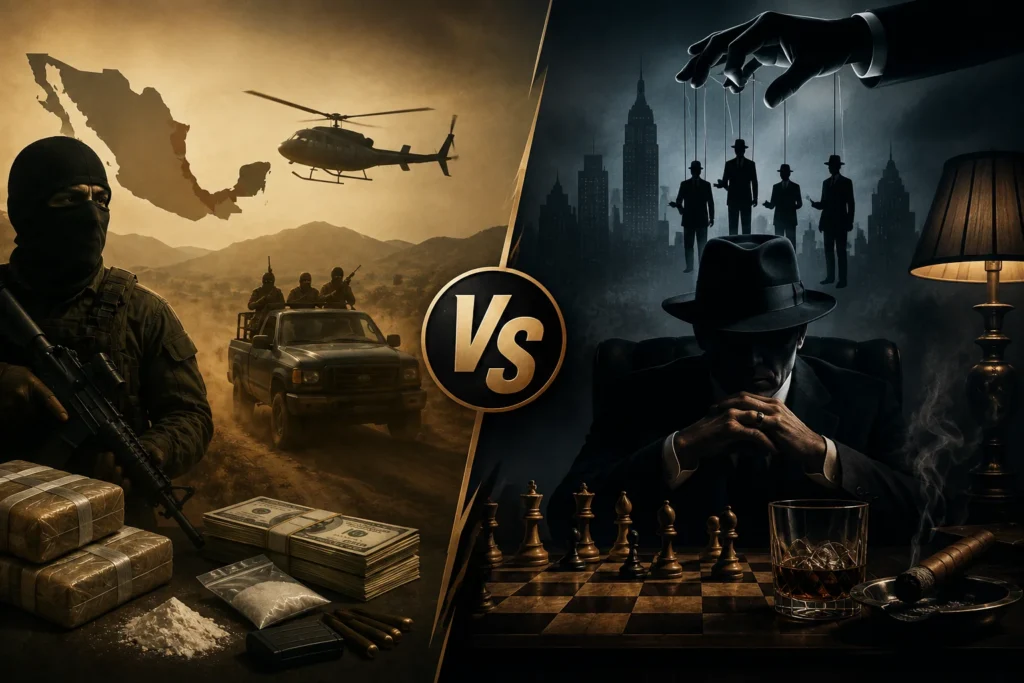
People often use cartel and mafia as if they mean the same thing. They don’t. Both can describe powerful organized-crime networks, yet the terms point toward different traditions, structures, and criminal business models. A cartel is commonly associated with controlling illicit markets, especially drug production and trafficking. A mafia, by contrast, usually describes a durable criminal organization that relies on hierarchy, loyalty, territorial influence, corruption, and several sources of income.
That distinction matters because real organized crime rarely fits the neat stereotypes seen in movies. A criminal group may combine several models at once. For example, a mafia organization can become heavily involved in international drug trafficking, while a cartel can develop sophisticated financial, political, and territorial influence. The better question isn’t simply which group is “more powerful.” It’s how the organization is built, what it controls, how it makes money, and how it maintains power.
What Is the Difference Between a Cartel and a Mafia?
The simplest answer is that a cartel usually emphasizes an organized network controlling an illicit market or trafficking operation, while mafia generally describes a more enduring criminal organization with a recognizable internal structure and broader social or territorial influence.
However, the distinction isn’t absolute. Organized-crime researchers and law-enforcement agencies don’t always use these labels in the same way. The United Nations Office on Drugs and Crime notes that organized crime is better understood through characteristics such as planning, group organization, and the activities a criminal network performs rather than through popular labels alone.
A useful way to picture the difference is to compare two businesses.
A cartel can resemble a flexible criminal enterprise built around a valuable market. Different groups may handle production, transportation, distribution, finance, or security while cooperating under a broader umbrella. The arrangement can change when leaders disappear, routes become risky, or market conditions shift.
A traditional mafia organization is more likely to resemble a long-running institution. It may have formal ranks, established families or clans, rules of conduct, initiation practices, trusted associates, and a strong emphasis on loyalty. Its income may come from drugs, extortion, illegal gambling, loansharking, fraud, labor racketeering, or infiltration of legitimate businesses.
The FBI’s history of La Cosa Nostra illustrates this broader model. It describes Mafia families organized geographically and involved in drug trafficking, money laundering, illegal gambling, political corruption, labor racketeering, extortion, kidnapping, fraud, weapons trafficking, and the infiltration of legitimate businesses.
Quick Comparison at a Glance
| Feature | Cartel | Mafia |
| Common meaning | Criminal network focused on controlling illicit markets | Enduring organized-crime group with hierarchy and influence |
| Strong association | Drug trafficking and supply chains | Extortion, racketeering, corruption, gambling, and diversified crime |
| Structure | Often flexible, networked, or decentralized | Often hierarchical, clan-based, or family-based |
| Primary focus | Market access, trafficking, production, and distribution | Long-term criminal power and influence |
| Territorial role | May control production zones, routes, or markets | Often seeks sustained territorial and community influence |
| Revenue | Frequently dominated by drug trafficking and related crime | Often diversified across several criminal markets |
| Loyalty | Can depend on alliances, business relationships, and local networks | Often reinforced by family ties, initiation, reputation, and secrecy |
| Corruption | Can protect trafficking and financial operations | Can support long-term political, economic, and territorial influence |
| Violence | Often connected to market competition, intimidation, and territorial disputes | Can enforce internal rules, protect territory, and settle disputes |
| Terminology | Frequently used for major drug-trafficking organizations | Often used for mafia-style or historically Mafia-linked organizations |
This table offers a useful starting point, but it shouldn’t become a rigid rulebook. Criminal organizations evolve. The Sinaloa Cartel, for instance, illustrates how a drug-trafficking organization can operate through decentralized networks while maintaining a broader organizational identity. The U.S. Drug Enforcement Administration says its investigations have identified tens of thousands of Sinaloa members operating worldwide through decentralized networks and has linked its activities to operations in at least 40 countries.
The Italian ’Ndrangheta provides the opposite reminder. Although it is clearly a mafia-style organization, Europol has documented its involvement in large-scale cocaine trafficking, money laundering, bribery, and violence across multiple countries. In a 2023 coordinated operation involving 10 countries, authorities took 132 alleged members into custody, with more than 2,770 officers involved.
So, labels help, but evidence matters more.
Why People Often Confuse the Two
The confusion comes partly from the fact that both cartels and mafias can perform similar criminal functions. Both may use violence, corruption, intimidation, money laundering, trafficking networks, and legitimate businesses to protect or expand their operations.
Popular culture adds another layer of confusion. Movies and television often portray every large criminal organization as a “mafia.” In everyday speech, the word can even become a loose synonym for any powerful criminal group. Europol has noted that the term Mafia has become widely understood around the world as a reference to the organized criminal underworld.
The word cartel creates a similar problem. In economics, a cartel can mean a group of otherwise independent businesses that coordinate prices, production, or markets. In criminal-justice reporting, however, the word often refers to a major illicit trafficking organization, particularly a drug-trafficking group.
Context therefore matters.
Consider two statements:
- “Several companies formed a cartel to coordinate prices.”
- “Investigators dismantled a drug cartel.”
The first describes an economic arrangement. The second describes organized criminal activity. The shared word doesn’t make the underlying organizations equivalent.
There is another reason for the confusion: criminal groups can overlap. A mafia organization may participate in drug trafficking at an international scale. A cartel may rely on local gangs, corrupt officials, financial intermediaries, and independent trafficking partners. The resulting network can look like a mixture of several organizational models.
The FBI’s Pizza Connection investigation offers a striking historical example. Prosecutors described a Sicilian Mafia-linked drug conspiracy that stretched across four continents. The operation involved obtaining morphine base from Turkey, processing it into heroin in Sicily, moving it into the United States, and distributing it through Mafia-connected businesses. Investigators estimated that roughly $1.6 billion worth of heroin was shipped to the United States between January 1975 and April 1984.
That case makes an important point: a Mafia organization can behave like a sophisticated international trafficking network without becoming identical to every organization called a cartel.
What Is a Cartel?
A cartel is an organized group or network that coordinates control over an illicit market. In modern criminal reporting, the term most often appears in connection with drug cartels, which coordinate parts of the production, movement, wholesale distribution, and sale of illegal drugs.
The word itself doesn’t automatically mean “drug organization.” Its meaning depends on context. Yet drug trafficking has become so strongly associated with the term that many readers immediately picture a powerful transnational criminal network when they hear “cartel.”
Drug cartels can differ dramatically in size and organization. Some may rely on centralized leadership. Others can operate as loose networks of cells, partners, suppliers, brokers, distributors, and allied groups. Some control production and trafficking directly. Others depend heavily on relationships with outside criminal organizations.
This flexibility can make cartels difficult to define with one organizational chart.
Definition of a Cartel
In organized crime, a cartel generally refers to a criminal organization or alliance that seeks to control a profitable illicit market or coordinate criminal commerce. Drug cartels commonly pursue control over production, supply, transportation, distribution, territory, trafficking routes, and market access.
The goal isn’t necessarily to control every stage personally. Criminal networks often divide responsibilities.
One group may produce or acquire drugs. Another may arrange transportation. A third may move shipments across a border. Local distributors may handle regional markets. Financial intermediaries may help conceal criminal proceeds. Corrupt contacts may provide protection or warnings.
This creates a network rather than a simple chain.
The Sinaloa Cartel demonstrates this complexity. The DEA describes it as one of the world’s oldest and most powerful drug cartels and says it has been a major producer and trafficker of fentanyl and other illicit drugs. The agency also describes its worldwide structure as decentralized rather than as one simple top-down organization.
That distinction is important. The popular image of a cartel often resembles a pyramid with one boss at the top. Real criminal networks can look much messier.
Common Characteristics of Cartels
Although no two cartels operate exactly alike, several characteristics appear frequently.
Market control sits near the center. A cartel seeks access to a profitable criminal market and may attempt to control supply, transportation corridors, wholesale distribution, or local sales.
Networked organization is another common feature. Instead of putting every participant into one formal hierarchy, a cartel may connect specialized groups that perform different functions.
Territorial competition can also become important. Control over production areas, border crossings, transportation corridors, ports, or distribution markets can generate enormous strategic value.
Violence and intimidation may appear when groups compete over territory, punish perceived betrayal, threaten rivals, or attempt to deter law enforcement. Violence isn’t universal, however, and it doesn’t by itself define a cartel.
Corruption can help criminal networks operate. Bribery may target public officials, law-enforcement personnel, customs personnel, or other people who can obstruct investigations or facilitate criminal activity.
Money laundering allows criminal proceeds to move through financial or commercial systems while disguising their origin.
Adaptability may be one of the most important characteristics. When authorities disrupt a route, arrest a leader, seize assets, or change enforcement priorities, criminal networks can reorganize.
The result is an organization that may survive even when individual leaders do not.
How Cartels Are Organized
Cartel structures often work through layers and networks rather than one perfectly centralized hierarchy.
At one level, senior figures may make strategic decisions. Beneath them, regional operators can coordinate trafficking or production. Separate cells may manage transportation, security, finance, communications, or local distribution.
The exact arrangement varies.
A simplified model might look like this:
Leadership or coordinating figures → regional networks → specialized criminal cells → local distributors and associates
Yet the arrows don’t always run in one direction. A local operator may work with several partners. Independent suppliers may sell to multiple organizations. Rival groups may cooperate temporarily when their interests overlap.
This flexibility can make the network resilient.
It also explains why removing a high-ranking figure doesn’t necessarily eliminate an entire cartel. Other members may already control money, routes, suppliers, personnel, and local relationships.
The DEA’s description of Sinaloa is particularly relevant here. Its investigators identify tens of thousands of members worldwide working through decentralized networks under the wider Sinaloa umbrella.
In other words, organizational identity can outlast individual leadership.
Main Goals and Sources of Income
The central financial objective of a drug cartel is straightforward: profit from illicit markets while protecting the network that generates those profits.
Drug trafficking often provides the primary revenue stream, but criminal organizations can diversify when opportunities arise.
Common sources can include:
- Drug production
- Wholesale drug trafficking
- Local and international distribution
- Extortion
- Kidnapping
- Human smuggling or trafficking
- Illegal mining or resource exploitation
- Money laundering
- Fraud and other financial crimes
- Control of local illicit markets
The exact mix varies by organization and region. It would be misleading to assume that every cartel engages in all of these activities.
Drug trafficking itself involves several economic stages. A criminal network can profit from acquiring raw materials, producing drugs, moving finished products, supplying wholesalers, and connecting distributors with consumer markets.
That makes trafficking less like a single transaction and more like an illicit supply chain.
The Sinaloa example again shows the scale involved. The DEA states that the organization has trafficked fentanyl, methamphetamine, cocaine, heroin, and marijuana and has operated through international networks.
Drug Trafficking and Market Control
Cartels don’t simply move drugs from one place to another. At their largest scale, they can attempt to influence an entire illicit market ecosystem.
That ecosystem can include production, suppliers, transportation, storage, wholesale buyers, local distributors, financial channels, and protection networks.
Control over a trafficking route can therefore be extremely valuable. A route connects supply with demand. Whoever can reliably move a product through that corridor gains an advantage over competitors.
Market control can take several forms:
- Controlling access to a production area
- Controlling transportation corridors
- Establishing relationships with suppliers
- Coordinating wholesale distribution
- Using intimidation against competitors
- Building alliances with other criminal networks
- Corrupting officials or intermediaries
- Laundering proceeds through legitimate economic channels
However, control doesn’t always mean monopoly. Criminal markets can contain several competing groups at once. Alliances may change quickly, and local actors may retain significant independence.
This is why the word network often explains modern cartels better than the image of a single criminal corporation.
Famous Cartel Examples
Several organizations have become prominent examples of drug-cartel activity.
The Sinaloa Cartel is one of the most significant contemporary examples. Based in Mexico’s Sinaloa region, it has developed international trafficking networks and has been associated by U.S. authorities with the movement of fentanyl and several other illicit drugs. The DEA describes it as one of the world’s oldest and most powerful drug cartels and says investigations have connected its operations to at least 40 countries.
The Jalisco New Generation Cartel (CJNG) is another major Mexican criminal organization frequently identified as a drug cartel. Its significance illustrates how modern criminal networks can combine trafficking with territorial competition, violence, corruption, and diversified criminal activity.
Historically, the Medellín Cartel and the Cali Cartel became internationally notorious for their roles in Colombia’s cocaine trade. Their histories also demonstrate how criminal organizations can evolve, fragment, and lose power rather than remaining permanent institutions.
These examples shouldn’t be treated as interchangeable. Each developed under different political, economic, geographic, and law-enforcement conditions.
That point is crucial when studying organized crime. A cartel isn’t a single template. It’s a label applied to different criminal organizations that may share important traits while operating in very different ways.
The clearest distinction from a mafia comes into focus when the organization’s core identity is considered. Cartels are commonly recognized for their role in controlling illicit markets and trafficking systems. Mafia organizations are more often recognized for their durable internal structures, territorial influence, loyalty systems, corruption, and diversified criminal enterprises.
Yet the boundary can blur. History has repeatedly shown criminal organizations crossing it.
That is exactly why the next question matters: what makes a mafia a mafia?
What Is a Mafia?
A mafia is more than a synonym for organized crime. The term traditionally refers to criminal organizations built around durable relationships, internal rules, secrecy, and control over territory or economic activity. The word is most strongly associated with Sicily, where the Mafia developed during the 19th century and later evolved into a major organized-crime phenomenon. Treccani describes the traditional Sicilian Mafia as territorially based, hierarchical, and governed by omertà, a code of silence.
The important point is that mafia describes an organizational tradition as much as a collection of crimes. A mafia group may traffic drugs, but drug trafficking alone doesn’t make an organization a mafia. Its defining features can include durable membership, hierarchy, relationships based on loyalty, territorial influence, and the ability to exert power through both criminal and legitimate channels.
The FBI’s history of La Cosa Nostra provides a useful example. The agency describes American Mafia families as geographically organized groups involved in drug trafficking, money laundering, illegal gambling, political corruption, labor racketeering, extortion, kidnapping, fraud, weapons trafficking, and infiltration of legitimate businesses.
That breadth separates the classic mafia model from the narrower image of a criminal group built primarily around one illicit commodity.
Definition of a Mafia
In everyday language, people often use mafia to mean any large or secretive criminal organization. In criminology, however, the concept is more specific.
A mafia-type organization generally maintains a continuing criminal enterprise rather than forming solely for one temporary crime. Members may build relationships that last for years or generations. The organization can also develop rules for resolving disputes, protecting members, collecting illicit revenue, and managing relationships with outsiders.
This long-term orientation matters.
A criminal network might emerge because several people want to move an illegal product. A mafia-style organization can go further by establishing a durable system of power. It may collect payments from businesses, influence local officials, control particular markets, and use reputation or intimidation to discourage challenges.
The FBI’s historical account of La Cosa Nostra shows how this model developed in the United States. The organization eventually consisted of geographically arranged families, with major groups operating in New York, New England, Philadelphia, Chicago, and Detroit.
The word family can also confuse readers. In this context, it doesn’t necessarily mean that every member has a biological relationship with every other member. It refers to an organized criminal group whose members operate within an established hierarchy and system of allegiance.
Key Characteristics of Mafia Organizations
Mafia organizations can differ considerably, but several characteristics repeatedly appear in historical and criminological descriptions.
Hierarchy gives members defined positions and responsibilities. Traditional Mafia structures may distinguish senior leadership from lower-ranking members and associates.
Secrecy protects the organization from law enforcement and rival groups. The concept of omertà, particularly associated with Sicilian Mafia culture, represents a strong expectation of silence and non-cooperation with authorities.
Loyalty helps maintain internal cohesion. Mafia organizations have historically used initiation practices, personal relationships, family connections, reputation, and threats to reinforce allegiance.
Territorial influence is another important feature. A mafia group may seek control over a neighborhood, town, industry, market, or local economic sector.
Diversified criminal activity allows the organization to generate revenue from several sources. The FBI lists activities ranging from gambling and extortion to drug trafficking, fraud, corruption, and legitimate-business infiltration among the activities associated with La Cosa Nostra.
Corruption can extend the organization’s influence beyond traditional criminal activity. A mafia group may attempt to influence officials, businesses, unions, or public institutions.
Reputation can function as an informal enforcement mechanism. If people believe an organization can retaliate against those who resist it, the perceived threat itself can discourage opposition.
These traits explain why calling every criminal organization a mafia can create analytical problems. Organized crime exists on a spectrum. UNODC notes that criminal groups can range from highly structured mafia-type organizations to more loosely organized networks.
Traditional Structure and Family-Based Hierarchy
The classic Mafia structure is often represented as a pyramid.
At the top sits the boss, who exercises overall authority. An underboss may help manage the organization. Consiglieri traditionally advise senior leadership. Below them, capos or captains can oversee smaller groups of members. Soldiers perform criminal activities, while associates may work with the organization without holding formal membership.
The exact titles and arrangements vary among organizations and periods. They shouldn’t be treated as a universal organizational chart.
Still, the model helps explain the traditional distinction between a Mafia organization and a loose criminal network.
The FBI describes La Cosa Nostra as consisting of different families that are generally arranged geographically. Historical restructuring under Salvatore Maranzano established family divisions and procedures for resolving disputes. Charles “Lucky” Luciano later created the Commission, which coordinated activities among Mafia families.
This history demonstrates another important feature: Mafia organizations don’t necessarily operate as completely isolated groups. They can cooperate.They can compete.They can negotiate.
And they can establish mechanisms for managing disputes without constantly fighting one another.
The American Mafia’s history also shows how organizational structures can evolve. The FBI reports that Luciano organized La Cosa Nostra in a manner resembling a corporation and established the Commission to coordinate activities among families.
That doesn’t mean the Mafia literally functions like a legitimate corporation. It means its leadership developed systems for managing a large criminal enterprise.
Criminal Activities and Revenue Streams
Mafia organizations traditionally rely on multiple revenue streams rather than depending on one commodity.
Common activities associated with mafia-type organizations include:
- Extortion
- Protection rackets
- Illegal gambling
- Loansharking
- Drug trafficking
- Fraud
- Labor racketeering
- Counterfeiting
- Money laundering
- Weapons trafficking
- Corruption
- Infiltration of legitimate businesses
The FBI identifies many of these activities in its description of La Cosa Nostra.
This diversification creates resilience. If one source of income becomes difficult to maintain, another can continue generating revenue.
For example, an organization involved in illegal gambling may also use extortion and legitimate businesses to produce income. Another organization may become deeply involved in international drug trafficking while maintaining older relationships in construction, transportation, or other sectors.
UNODC makes a broader point that helps explain this flexibility: organized criminal groups can change what they do over time while the group itself remains relatively stable.
That is one of the clearest conceptual differences between crime as an activity and organized crime as a continuing enterprise.
Territorial Influence and Social Control
A mafia organization’s power doesn’t necessarily come only from the money it earns.
It can also come from influence.
Historically, mafia groups have sought to establish authority over particular territories or economic sectors. Businesses may pay for protection. Individuals may avoid reporting crimes because they fear retaliation. Officials may face pressure or corruption. Competitors may find themselves excluded from certain markets.
This creates an informal system of control.
The Sicilian Mafia’s history illustrates the connection between criminal power and territorial influence. Treccani describes the historical development of relationships between Mafia organizations and local politics, including exchanges of votes and favors and systems of domination and protection over territory.
Modern mafia organizations can also operate internationally.
The ’Ndrangheta, based in Calabria, offers a powerful example. Europol describes it as one of the world’s most powerful criminal networks and says it plays a major role in Europe’s cocaine trade while also engaging in money laundering, bribery, and violence.
That combination challenges another common misconception: a mafia doesn’t have to remain a purely local organization.
It can have local roots and international reach at the same time.
Well-Known Mafia Organizations
The word “Mafia” often brings to mind the Sicilian Mafia, but organized crime in Italy includes several distinct organizations.
The major Italian groups commonly identified by authorities include:
| Organization | Historical base | Notable characteristics |
| Cosa Nostra | Sicily | Traditional Sicilian Mafia organization with territorial and hierarchical structures |
| ’Ndrangheta | Calabria | Strong family-based networks and major involvement in international cocaine trafficking |
| Camorra | Campania, especially Naples | Historically fragmented into clans with diverse criminal activities |
| Sacra Corona Unita | Apulia | Italian organized-crime organization with regional and international activity |
The FBI identifies Cosa Nostra, Camorra, ’Ndrangheta, and Sacra Corona Unita as four active Italian organized-crime groups.
The ’Ndrangheta deserves particular attention because its international reach shows how a mafia organization can operate across borders without losing its traditional organizational identity.
In May 2023, authorities from 10 countries conducted a coordinated operation against the ’Ndrangheta. Europol reported that 132 suspected members were taken into custody and more than 2,770 officers participated. Investigators linked the organization to cocaine trafficking, systematic money laundering, bribery, and violence.
That case also demonstrates why the terms cartel and mafia shouldn’t be separated by geography alone.
A mafia organization can become deeply involved in international drug trafficking.
A drug-trafficking organization can develop relationships, territorial power, and political influence.
The structure and purpose still matter.
Cartel vs. Mafia: Side-by-Side Comparison
The clearest way to understand the difference between a cartel and mafia is to compare their organizational logic rather than simply listing their crimes.
A cartel is commonly associated with market control, particularly the control of illicit commodities and trafficking networks. A mafia is more commonly associated with durable organizational power, territorial influence, diversified criminal activity, and systems of loyalty.
The distinction remains useful even though real-world groups can overlap.
| Category | Cartel | Mafia |
| Core concept | Criminal network focused heavily on illicit markets | Durable criminal organization built around continuing power and influence |
| Typical market | Often drugs and related trafficking | Multiple criminal markets |
| Structure | Can be decentralized or network-based | Traditionally hierarchical or clan-based |
| Leadership | May shift between competing factions or networks | Often organized through established ranks and leadership |
| Membership | Can include partners, cells, suppliers, and associates | Often distinguishes formal members from associates |
| Territorial role | May focus on routes, production zones, and markets | Often seeks sustained control or influence over territory |
| Revenue model | Frequently centered on high-value illicit commodities | Usually more diversified |
| Violence | Often linked to competition, enforcement, and territorial disputes | Can enforce internal rules, protect territory, and intimidate rivals |
| Corruption | Can facilitate trafficking operations | Can become part of long-term institutional influence |
| Longevity | May survive through flexible networks and alliances | Often emphasizes continuity and organizational identity |
| Examples | Sinaloa Cartel, CJNG, historical Medellín and Cali cartels | Cosa Nostra, ’Ndrangheta, Camorra |
Purpose and Objectives
The most useful distinction begins with what the organization is trying to control.
A cartel commonly seeks control over an illicit market. In drug trafficking, that can involve production, supply, transportation, wholesale distribution, or access to valuable trafficking routes.
A mafia organization may seek something broader: lasting criminal power.
That power can generate income, but it can also create influence over businesses, communities, officials, and markets.
This distinction isn’t merely theoretical. A 2024 study in the British Journal of Criminology examined whether the Sinaloa Cartel fits a mafia framework. The researchers concluded that it did not fully meet the seven characteristics they used to typify mafias and described it more appropriately as a large drug-selling enterprise.
That finding is valuable because it demonstrates why “cartel” and “mafia” shouldn’t automatically be treated as interchangeable labels.
Organizational Structure
A cartel can operate through a flexible network.
Different cells or partners may handle different functions. Relationships can change as circumstances change. Some participants may cooperate without becoming formal members of a single organization.
Mafia organizations traditionally place greater emphasis on formal internal relationships.
The classic Mafia model includes ranks, families or clans, initiation, rules, and mechanisms for settling disputes. The structure can provide continuity even when individual members leave.
Still, neither model is completely fixed.
UNODC emphasizes that organized crime includes both hierarchical groups and more loosely structured criminal networks.
Therefore, structure should be treated as a spectrum rather than a binary choice.
Leadership Style
Cartel leadership can be highly influential, but it doesn’t always mean one person controls every criminal operation.
Decentralized networks may allow regional operators to retain significant independence. This can make a cartel harder to dismantle because removing a leader doesn’t necessarily remove every connection that supports trafficking.
Traditional Mafia structures place stronger emphasis on established leadership roles.
The history of La Cosa Nostra illustrates this clearly. Maranzano created family divisions and procedures for resolving disputes, while Luciano later established the Commission to coordinate activities among Mafia families.
Leadership therefore becomes part of the organization’s institutional structure rather than simply the personality of one powerful criminal.
Criminal Activities
This is where the difference becomes particularly visible.
Cartels are strongly associated with drug trafficking, although their activities can extend beyond drugs.
Mafia organizations typically have a broader criminal portfolio.
A Mafia group can combine extortion, gambling, loansharking, fraud, corruption, labor racketeering, drug trafficking, money laundering, and business infiltration.
The FBI’s description of La Cosa Nostra confirms this wide range.
That doesn’t mean every Mafia group performs every activity. It means diversification is a recurring feature of the model.
Revenue Sources
A cartel may derive a large share of its revenue from controlling an illicit commodity.
For drug cartels, the economic chain can include:
Production → transportation → wholesale trafficking → distribution → market access
Mafia organizations can use a wider mix of revenue sources.
For example:
Extortion + illegal gambling + loansharking + fraud + trafficking + business infiltration
This diversification can make the organization financially resilient.
It can also create a deeper relationship with the legitimate economy. When criminal groups infiltrate businesses or public contracts, their influence can extend beyond traditional underground markets.
Geographic Reach
Neither term automatically tells you how far an organization operates.
A cartel can operate across national borders through trafficking networks. A mafia organization can also become highly internationalized.
The ’Ndrangheta demonstrates the point. Europol’s 2023 investigation involved authorities in Belgium, Germany, Italy, France, Portugal, Slovenia, Spain, Romania, Brazil, and Panama, showing the multinational nature of the criminal network and the law-enforcement response.
The important distinction is therefore not simply local vs. international.
Instead, ask what the organization is trying to control and how it maintains that control.
Recruitment Methods
Recruitment can also differ.
Traditional Mafia organizations have historically relied heavily on personal relationships, family connections, local ties, and established criminal networks. Formal membership can carry a strong sense of identity and loyalty.
Cartels may use a broader mixture of recruits, associates, specialists, regional partners, and pre-existing criminal groups.
The boundary between “member” and “associate” can therefore be especially important when examining modern criminal networks.
It’s also one reason headline estimates of membership should be treated carefully. A person who works within a wider trafficking network isn’t necessarily equivalent to a formally initiated member of a Mafia family.
Use of Violence
Violence appears in both models, but it doesn’t provide a reliable definition of either one.
Cartels may use violence to compete over trafficking routes, punish rivals, intimidate communities, or enforce organizational decisions.
Mafia organizations may use violence to enforce internal discipline, intimidate competitors, protect territory, or retaliate against perceived threats.
Yet organized crime can also rely heavily on corruption, secrecy, financial influence, and fear without constant physical violence.
This matters because Hollywood often treats visible violence as proof of power. Real criminal organizations can be more subtle. A bribe, fraudulent contract, threatened business owner, or compromised official may sometimes accomplish what a violent confrontation cannot.
Relationship With Governments and Communities
Both cartels and mafias can attempt to influence public institutions, but their methods and objectives can vary.
Cartels may seek corruption that protects trafficking operations, provides warnings, facilitates movement, or weakens enforcement.
Mafia organizations can pursue a more sustained relationship with local political and economic structures.
The ’Ndrangheta provides a documented example. In a June 2023 operation, Eurojust reported allegations involving corruption of local politicians, manipulation of elections, placement of associates in administrative positions, interference with public procurement, money laundering, extortion, fraud, and violence.
This illustrates why organized crime shouldn’t be viewed solely as an underground economy.
At its most sophisticated, it can interact with the legitimate economy and public institutions.
The History of Cartels and Mafias
The histories of cartels and mafias developed through different paths.
The Sicilian Mafia emerged in a particular historical setting involving territorial power, social relationships, protection, and local politics. Modern drug cartels developed much later within international illicit markets shaped by drug demand, prohibition, trafficking routes, and globalization.
Their histories eventually intersected.
Mafia organizations became involved in drug trafficking. Drug-trafficking organizations developed sophisticated financial and territorial systems. International criminal markets connected groups from different countries.
Understanding that history prevents an easy mistake: assuming that the modern cartel model and the historical Mafia model originated as the same phenomenon.
The Origins of the Sicilian Mafia
The Sicilian Mafia developed during the 19th century and became associated with territorial control, secrecy, hierarchical organization, and relationships of protection and influence. Treccani identifies the Mafia as a collection of criminal organizations that arose in Sicily during the 19th century and were territorially based and hierarchically structured.
The FBI offers a broader historical account, describing how Sicilian communities developed strong reliance on family ties during periods of invasion and exploitation before secret societies evolved into organized criminal groups.
Over time, criminal organizations became intertwined with local economic and political relationships.
This historical background helps explain why territory and social influence became such important parts of the Mafia concept.
The Rise of Mafia-Type Organizations
Mafia-type organizations didn’t remain confined to Sicily.
Italian organized-crime groups developed different regional identities. Cosa Nostra became associated with Sicily, the Camorra with Campania, and the ’Ndrangheta with Calabria.
Italian migration also helped create organized-crime networks abroad. In the United States, Italian-American criminal organizations eventually developed into what became known as La Cosa Nostra.
The FBI says the American Mafia evolved through several criminal groups and became recognized nationally as La Cosa Nostra during the 20th century.
Its history demonstrates how organized crime can adapt to a new country while preserving certain organizational traditions.
How Modern Drug Cartels Emerged
Modern drug cartels emerged within a different environment.
The growth of international drug markets created enormous financial incentives for organizations capable of producing, transporting, and distributing illegal drugs. Geographic location also mattered because some regions could provide access to production areas or important trafficking corridors.
Over time, organizations involved in these markets developed increasingly sophisticated networks.
Modern cartels can coordinate activities across borders while using independent partners, local criminal groups, corrupt intermediaries, and financial networks.
UNODC describes contemporary transnational organized crime as a fluid criminal economy in which networks profit from illegal goods and services across borders. It identifies activities including drug trafficking, migrant smuggling, human trafficking, money laundering, firearms trafficking, counterfeit goods, wildlife trafficking, and other serious crimes.
That fluidity helps explain why modern cartels don’t always resemble the rigid Mafia hierarchy shown in older crime stories.
How Both Expanded Internationally
Globalization changed organized crime.
Faster transportation, international finance, digital communications, global trade, and cross-border markets created new opportunities for criminal networks.
A criminal group no longer needs to maintain every operation inside one city or country.
One part of a network can operate near a production area. Another can coordinate international transportation. Financial intermediaries can move or disguise proceeds elsewhere. Local criminal partners can handle distribution in another market.
Mafia organizations also adapted to this environment.
The ’Ndrangheta is a particularly clear example. Europol describes the organization as deeply involved in Europe’s cocaine trade and documents its connections to money laundering, bribery, and violence.
The result is a modern organized-crime landscape where cartels and mafias can cross borders, cooperate with other criminal networks, and diversify their activities.
The labels still matter, but the underlying networks matter more.
That distinction becomes even clearer when examining exactly how cartels conduct their operations and how their structures respond to competition, law enforcement, and changing markets.
How Cartels Operate
A cartel is more than a group that sells illegal drugs. At its most sophisticated, a cartel can function like a sprawling illicit enterprise with suppliers, transporters, distributors, financial facilitators, corrupt contacts, and regional operators. The exact structure varies considerably, but modern cartels often rely on flexible networks rather than one rigid chain of command. UNODC research similarly describes organized criminal groups across a spectrum that includes hierarchical, business-oriented, cultural, and networked models.
This flexibility helps explain why the word cartel can describe organizations that look very different from one another. Some control production and trafficking directly. Others outsource portions of the supply chain to independent groups, contractors, or allied criminal networks.
Drug Production and Distribution
Drug trafficking remains strongly associated with major cartels, particularly those operating across Mexico and international markets. However, the business usually involves far more than moving a finished product from one country to another.
A large trafficking organization may connect multiple stages of an illicit supply chain:
- Sourcing raw materials or precursor chemicals
- Arranging production
- Moving products between regions
- Recruiting distributors and transporters
- Managing wholesale transactions
- Protecting shipments and facilities
- Collecting proceeds
- Laundering or transferring criminal profits
- Maintaining relationships with other criminal groups
The modern synthetic-drug trade illustrates how complicated these networks can become. The DEA has reported that major Mexican cartels maintain international supply chains involving precursor chemicals, production facilities, transportation networks, distribution hubs, financial facilitators, and other participants.
That means the organization may not personally perform every task. Instead, it can coordinate a network in which different participants specialize in different functions.
Think of it as an illegal supply chain. One group may provide materials, another may manufacture the product, another may transport it, and another may handle wholesale distribution. The central organization can profit from the entire system without directly employing every participant.
Supply Chains and Trafficking Networks
Cartels depend on connections. Those connections can cross borders, jurisdictions, and even criminal organizations.
For example, a trafficking network may involve producers in one country, transporters in another, wholesalers in a third, and distributors operating much farther away. Communication technology and international commerce can make these connections easier to maintain.
Modern cartels can therefore resemble networks of networks.
This model creates an important advantage: resilience. If one person is arrested or one shipment is intercepted, other parts of the network may continue operating.
UNODC notes that contemporary organized crime increasingly includes fluid, less formal networks. Such arrangements can reduce the need for every participant to know everyone else or maintain constant face-to-face contact.
That doesn’t mean every cartel operates loosely. Some maintain powerful leadership structures and strict internal discipline. The key point is that cartel organization can be adaptable rather than uniformly hierarchical.
Territorial Control
Territory matters because control over strategic locations can affect production, transportation, distribution, and competition.
A cartel may seek influence over an area because that location provides access to:
- Production facilities
- Transportation corridors
- Border crossings
- Ports
- Local distribution markets
- Smuggling routes
- Financial or commercial infrastructure
Territorial competition can produce severe violence when rival organizations fight over valuable criminal markets.
Yet territorial control isn’t always equivalent to conventional political control. A criminal organization doesn’t necessarily need to govern an entire city or region formally. Influence over specific routes, businesses, officials, or criminal markets can be enough to produce substantial power.
This distinction matters when comparing cartels with traditional Mafia organizations. Both can seek territorial influence, but they may use it for somewhat different purposes.
Smuggling Networks
Smuggling requires logistics, connections, money, and risk management.
Criminal organizations can use combinations of land, maritime, and air transportation. Investigations into major trafficking organizations have identified extensive networks involving commercial transportation, private vehicles, maritime routes, aircraft, couriers, and other methods.
The exact techniques change over time because criminal organizations respond to law-enforcement pressure.
When one route becomes difficult to use, traffickers may look for alternatives. When a particular method attracts too much attention, they can modify it. This constant adaptation is one reason organized crime can be difficult to dismantle permanently.
Money Laundering and Financial Operations
Selling illegal products creates another problem for cartels: what happens to the money?
Large amounts of criminal revenue cannot simply be spent openly without attracting attention. Organized criminal groups therefore rely on financial arrangements designed to disguise, transfer, store, or reinvest illicit proceeds.
Money laundering can involve:
- Cash movement
- Businesses
- Financial intermediaries
- Trade-based transactions
- Assets
- Front or shell companies
- Informal value-transfer systems
- Cryptocurrency in some cases
UNODC identifies money laundering as a central component of transnational organized crime because criminal proceeds must eventually be integrated into the legitimate or semi-legitimate economy.
Recent DEA cases also demonstrate how sophisticated financial networks can connect drug trafficking with international money laundering arrangements. Investigators have alleged the use of trade-based schemes, bulk cash movement, cryptocurrency, and other financial mechanisms in cartel-related cases.
This is why financial investigations can be just as important as drug seizures. Removing a shipment hurts the organization. Disrupting its ability to turn criminal revenue into usable wealth can threaten the business model itself.
Corruption and Institutional Influence
Cartels may also attempt to weaken law enforcement by corrupting or intimidating officials.
Corruption can provide access to information, protection from investigation, assistance with transportation, or reduced enforcement pressure. UNODC describes corruption as a mechanism that can protect organized criminal groups from law-enforcement disruption and help them expand their influence.
This creates a dangerous cycle.
Criminal money can buy influence, and influence can protect criminal money.
The relationship isn’t always limited to police or government officials. Criminal organizations may seek relationships with people involved in transportation, finance, business, local administration, or other institutions.
The result can be an organization that survives not simply because it has weapons or money, but because it has embedded relationships that make enforcement more difficult.
Case Study: The Evolution of the Sinaloa Cartel
The Sinaloa Cartel offers a useful example of why the word cartel shouldn’t automatically be interpreted as a single rigid organization.
The DEA describes Sinaloa as one of the world’s oldest and most powerful drug cartels. Its operations have extended across international markets and involved large-scale trafficking of illicit drugs.
Yet the organization has also demonstrated characteristics associated with decentralized criminal networks. Different factions, associates, suppliers, transporters, and distribution networks can operate within a broader criminal ecosystem.
This creates an important distinction between organizational identity and operational structure.
A criminal organization may have a recognizable name and leadership while relying on numerous semi-independent participants. That flexibility can make the organization difficult to eliminate through the arrest of a single leader.
It also explains why the terms cartel, drug trafficking organization, criminal network, and criminal enterprise can overlap without meaning the same thing.
How Mafia Organizations Operate
Mafia organizations generally operate through a broader and more diversified criminal model than the stereotype of a drug-trafficking gang suggests.
Traditional Mafia-type groups have historically combined illegal markets with territorial influence, protection, extortion, corruption, legitimate businesses, and social relationships. Some also participate heavily in drug trafficking.
The FBI’s history of La Cosa Nostra, for example, describes activities ranging from drug trafficking and illegal gambling to extortion, political corruption, labor racketeering, fraud, money laundering, and infiltration of legitimate businesses.
The defining feature, therefore, isn’t simply what the Mafia sells. It is often the way criminal power becomes embedded in a community, territory, business environment, or social network.
Protection Rackets
One classic Mafia activity is the protection racket.
At first glance, protection sounds legitimate. In a criminal racket, however, the organization may demand payment from businesses or individuals in exchange for supposed protection from harm.
The threat can come from the organization itself.
A business owner might understand that refusing to pay could result in intimidation, property damage, violence, or other consequences. The organization therefore creates the problem and then offers itself as the solution.
This is one reason Mafia-style crime can be especially damaging to local communities. The organization isn’t merely selling an illegal product. It can interfere with ordinary economic life.
Extortion and Racketeering
Extortion involves obtaining money, property, services, or other benefits through threats or coercion.
Mafia organizations have historically used extortion to generate revenue and establish authority. Racketeering can go further by creating an ongoing system in which criminal influence affects businesses, labor organizations, contracts, markets, or other economic activities.
The broader objective is often control rather than a single transaction.
A one-time theft produces one payoff. A sustained extortion system can produce recurring revenue while strengthening the organization’s influence over a particular area.
UNODC identifies extortion, racketeering, corruption, and money laundering among the mechanisms organized criminal groups can use to maintain markets and protect their enterprises.
Loan Sharking
Loan sharking provides another example of how Mafia-style organizations can exploit economic vulnerability.
An illegal lender may provide money under extremely unfavorable conditions. Borrowers who struggle to repay can face threats, intimidation, or additional demands.
Historically, loansharking has appeared alongside other Mafia revenue streams because it allows criminal groups to turn financial relationships into sources of recurring income and influence.
It also illustrates the broader Mafia model: the organization can make money from financial control, not merely from physical goods.
Illegal Gambling and Other Revenue Sources
Illegal gambling has long been associated with Mafia organizations.
Depending on the group and historical period, other revenue sources may include:
- Extortion
- Illegal gambling
- Loansharking
- Fraud
- Counterfeiting
- Smuggling
- Labor racketeering
- Drug trafficking
- Construction-related corruption
- Theft
- Money laundering
- Infiltration of legitimate businesses
The diversity is important because it gives Mafia-type organizations multiple sources of income.
If one criminal market becomes less profitable, another can help sustain the organization.
This diversified model differs from the common image of a cartel that is overwhelmingly dependent on a particular illicit commodity or trafficking market.
However, the distinction isn’t absolute. Some cartels diversify, while some Mafia organizations become deeply involved in specific drug markets.
Legitimate Business Infiltration
One of the most important characteristics of Mafia-style organized crime is its ability to interact with legitimate commerce.
Criminal groups may seek ownership, influence, partnerships, contracts, or hidden financial interests in businesses. The goal can be to launder money, gain market access, obtain contracts, control suppliers, or create a respectable public appearance.
This creates a difficult boundary between the legal and illegal economies.
A company may appear ordinary from the outside while criminal interests influence some aspect of its operation. UNODC specifically identifies infiltration of legitimate businesses and government as an important dimension of organized crime.
The result can be especially destructive because legitimate businesses may face unfair competition from organizations willing to use threats, corruption, or illegally obtained capital.
Political and Institutional Influence
Mafia organizations can also seek political influence.
Historically, Mafia-type groups have sometimes exchanged favors, money, votes, protection, or information with political actors and public officials. The exact relationship varies by country, era, and organization.
The objective isn’t necessarily to control a government outright.
Often, limited influence is enough.
An organization may want an investigation delayed, a contract secured, a zoning decision influenced, or a rival excluded from an economic opportunity. Small interventions can produce significant advantages when repeated over many years.
Modern investigations involving Italian organized crime have continued to identify allegations involving corruption, public procurement, political influence, money laundering, and violence.
Case Study: Italy’s ’Ndrangheta
The ’Ndrangheta demonstrates why modern Mafia organizations cannot be understood solely through old stereotypes.
Originating in Calabria, the organization has developed an international presence and has been strongly associated with large-scale cocaine trafficking, money laundering, corruption, and infiltration of legitimate economic activity.
European investigations have repeatedly targeted networks connected to the organization. In 2023, Europol reported a major operation involving more than 100 arrests across several countries and described alleged links to cocaine trafficking, systematic money laundering, bribery, and violence.
Another Eurojust-supported operation in 2023 involved allegations including political corruption, election manipulation, public procurement, murder, extortion, fraud, and money laundering.
The lesson is important: a Mafia organization can be simultaneously traditional and highly internationalized.
Family connections and internal loyalty can coexist with sophisticated financial networks and international criminal partnerships.
Similarities Between Cartels and Mafias
Although cartel and Mafia describe different organizational traditions, the two categories share many characteristics.
In real-world organized crime, the boundaries can become blurred. A group may borrow organizational methods from another criminal model, diversify its activities, or cooperate with outside networks.
UNODC emphasizes that organized criminal groups do not all follow one structure. Hierarchical, cultural, business-oriented, and networked models can overlap.
Shared Criminal Characteristics
Both cartels and Mafia organizations can participate in serious criminal activities such as:
- Drug trafficking
- Extortion
- Smuggling
- Fraud
- Corruption
- Money laundering
- Illegal gambling
- Violence
- Kidnapping
- Weapons trafficking
- Infiltration of legitimate businesses
The exact combination depends on the organization.
Therefore, activity alone usually isn’t enough to determine whether a group is better described as a cartel or Mafia.
Organized Leadership
Both types can develop leadership structures that coordinate lower-level participants.
A Mafia family may have formal ranks. A cartel may have centralized leaders, regional commanders, factional leaders, or network coordinators.
The difference is often one of organizational tradition and emphasis, not the simple presence or absence of hierarchy.
UNODC describes hierarchical organized crime as involving clear rankings between leaders and lower-level participants. It also recognizes other models where criminal relationships are considerably more flexible.
Financial Motivation
Money is a central driver for both.
Even when violence, territorial influence, or political relationships become important, criminal organizations generally seek material benefit from their activities.
That benefit can come directly from illegal markets or indirectly through control over legitimate economic activity.
This is why organized crime is often best understood as an economic system built around illegal opportunities.
Secrecy and Loyalty
Both cartels and Mafia organizations depend on secrecy.
Members have strong incentives to prevent information from reaching law enforcement or rival organizations. Loyalty, intimidation, financial dependence, personal relationships, and fear can all contribute to internal cohesion.
Mafia traditions have historically placed particular emphasis on secrecy and loyalty. Cartels can achieve similar results through different mechanisms, including family ties, financial incentives, factional alliances, and coercion.
The methods differ, but the underlying need is similar:
Criminal organizations survive when their members can cooperate without exposing the entire network.
Violence and Intimidation
Violence can serve several purposes.
It may:
- Eliminate rivals
- Enforce internal discipline
- Intimidate witnesses
- Protect territory
- Punish noncompliance
- Influence communities
- Defend trafficking operations
However, violence isn’t always constant.
Some criminal organizations deliberately minimize visible violence because excessive publicity can trigger stronger government intervention. Others use extreme violence because intimidation itself becomes part of their strategy.
UNODC notes that organized criminal groups can use intimidation, violence, corruption, and coercion to establish markets and protect their operations.
Corruption and Money Laundering
Both cartels and Mafias can need two things beyond criminal revenue: protection and financial access.
Corruption can reduce enforcement pressure. Money laundering can make criminal proceeds easier to store, transfer, invest, or spend.
Together, these mechanisms help transform illegal activity into sustainable criminal enterprise.
The combination can also create a feedback loop. Profits finance corruption and expansion, while corruption makes continued profit easier.
Adaptation to Law Enforcement Pressure
Neither cartels nor Mafias remain static.
When governments change laws, increase surveillance, seize assets, arrest leaders, or disrupt routes, criminal organizations can adapt.
They may:
- Replace leaders
- Split into factions
- Create new alliances
- Change trafficking routes
- Diversify revenue
- Use new technologies
- Recruit new intermediaries
- Shift financial methods
- Reduce direct contact between members
UNODC describes organized crime as entrepreneurial and adaptive, responding to criminal opportunities, demand, competition, and enforcement conditions.
This adaptability is one reason organized crime can survive major enforcement operations.
Key Differences Between Cartels and Mafias
The most useful way to distinguish a cartel from a Mafia is to look at the overall criminal business model, rather than focusing on one activity.
Neither label has a universal definition that perfectly fits every organization. Some groups overlap heavily. Still, several broad differences help explain the traditional distinction.
Business Model
A cartel is often strongly associated with controlling an illicit market, especially the production, wholesale movement, or distribution of drugs.
A Mafia organization typically operates with a broader portfolio.
It may earn money through extortion, protection, gambling, loansharking, fraud, corruption, legitimate-business infiltration, and drug trafficking.
In simple terms:
Cartel: often centered on controlling a lucrative illicit commodity or market.
Mafia: often centered on sustained criminal influence over territory, businesses, relationships, and multiple revenue streams.
These are tendencies, not absolute rules.
Organizational Hierarchy
Traditional Mafia organizations are famous for formal internal structures.
A classic Mafia family may include:
Boss → Underboss → Consigliere → Capos → Soldiers → Associates
Not every organization follows this exact arrangement, and modern groups can operate differently.
Cartels can also have clear leaders and ranks. However, many contemporary trafficking organizations rely heavily on decentralized networks and alliances.
That can make a cartel appear less like a single corporation and more like a collection of interconnected criminal enterprises.
Scope of Criminal Activities
Mafia organizations frequently diversify.
A single organization may combine:
- Extortion
- Gambling
- Loansharking
- Fraud
- Corruption
- Construction or labor racketeering
- Drug trafficking
- Money laundering
- Business infiltration
Cartels can also diversify, particularly when they gain substantial territorial or financial power. Yet the classic cartel model remains closely tied to control of specific illicit markets.
This difference is one of the clearest conceptual distinctions between the two.
Market and Territory Control
Cartels often seek to control markets and trafficking corridors.
Mafia organizations often seek to control territories, businesses, and social relationships.
Again, there is considerable overlap.
A cartel may exercise territorial control because territory protects its markets. A Mafia organization may control businesses because economic influence generates revenue.
The difference lies mainly in the organization’s central objective.
Public Influence
Traditional Mafia groups may cultivate long-term relationships with communities, business owners, politicians, and institutions.
This can produce a complicated form of social power.
A Mafia organization may attempt to appear useful, protective, or legitimate while simultaneously relying on coercion and criminal authority.
Cartels can also cultivate community relationships, provide money, employ residents, or build networks of influence. Yet their public identity is often more closely associated with trafficking, armed power, and territorial competition.
Recruitment and Membership
Mafia membership traditionally emphasizes loyalty, personal relationships, family ties, initiation rituals, and long-term affiliation.
Cartel recruitment can be more flexible.
Participants may join through family connections, local criminal networks, economic incentives, coercion, or specialized skills.
A cartel may therefore depend on a mixture of full-time members, temporary collaborators, independent traffickers, suppliers, transporters, and allied organizations.
Use of Violence
Both can use violence, but their patterns may differ.
Mafia violence has historically served purposes such as enforcing internal discipline, protecting territory, eliminating rivals, and intimidating businesses or officials.
Cartel violence can become closely connected to territorial competition, trafficking routes, market control, and struggles between rival factions.
Neither model is inherently or universally more violent.
The level of violence depends on the organization, market, location, competition, state response, and leadership strategy.
Global Operations
Both models can operate internationally.
Mafia-type organizations such as the Italian groups have developed transnational financial, trafficking, and business networks. Europol has described Italian organized crime groups as operating internationally while often attempting to maintain a low public profile.
Cartels can likewise operate across borders through supply chains, trafficking networks, distributors, financial facilitators, and international criminal partnerships.
The major difference isn’t simply local versus global.
Instead, it is often how international activity is organized.
A cartel may build an international supply chain around a particular illicit market. A Mafia organization may use international networks to expand a broader criminal portfolio involving drugs, finance, businesses, corruption, and other activities.
Long-Term Organizational Goals
A cartel may prioritize maintaining control over profitable illicit markets.
A Mafia organization may pursue something broader: durable criminal influence.
That influence can extend beyond direct criminal transactions into business, politics, labor, local communities, and financial systems.
This distinction explains why a Mafia can remain powerful even when one particular criminal market becomes less profitable.
The organization isn’t necessarily dependent on one product.
Instead, its strength can come from the combination of money, relationships, territory, reputation, secrecy, and institutional influence.
Ultimately, the cartel-versus-Mafia distinction works best as a framework rather than a rigid classification system. Organized crime evolves constantly, and real groups rarely respect the neat categories created to describe them. A cartel can diversify. A Mafia can enter international drug markets. A criminal network can combine elements of both.
That overlap is precisely why understanding the underlying structure, business model, relationships, and objectives matters more than relying on the label alone.
Cartel vs. Mafia Comparison Table
Understanding the distinction between a cartel and a Mafia becomes easier when you compare their typical characteristics side by side. The table below focuses on broad organizational tendencies rather than absolute rules because real criminal organizations can combine multiple models.
Cartel vs. Mafia: Structure, Activities, Revenue, and Influence
| Characteristic | Cartel | Mafia |
| Primary focus | Often centered on controlling lucrative illicit markets | Often centered on sustained criminal influence and diversified revenue |
| Common association | Drug production, trafficking, and distribution | Extortion, protection, gambling, corruption, business infiltration, and trafficking |
| Structure | Can be hierarchical, factional, or networked | Traditionally hierarchical and relationship-based |
| Leadership | Leaders may oversee factions, territories, or trafficking networks | Often organized around bosses, families, crews, and subordinate ranks |
| Revenue model | Frequently tied to high-value illicit commodities | Often diversified across multiple criminal and legitimate-looking activities |
| Territorial influence | Often connected to trafficking routes, production areas, and markets | Often connected to territory, businesses, communities, and institutions |
| Violence | May be used heavily in territorial and market competition | May be used for intimidation, enforcement, retaliation, and territorial control |
| Corruption | Can protect trafficking and logistics | Can protect criminal businesses, contracts, officials, and broader influence |
| Business infiltration | Can occur, particularly for laundering or logistics | Historically a major feature of many Mafia-type organizations |
| International reach | Often follows global trafficking and distribution networks | Can extend through migration, business, financial, and criminal connections |
| Membership | May include factions, associates, contractors, and allied networks | Traditionally emphasizes loyalty, initiation, family, crews, and long-term affiliation |
| Organizational goal | Maintaining profitable control of illicit markets | Maintaining wealth, power, territory, relationships, and long-term criminal influence |
The table highlights a useful distinction: a cartel is often described by the market it controls, while a Mafia is often described by the broader system of influence it maintains.
That distinction isn’t perfect. A cartel can diversify into extortion and corruption. A Mafia organization can become deeply involved in international drug trafficking. Modern organized crime increasingly mixes these characteristics rather than keeping them separate.
Which Characteristics Overlap?
The overlap is substantial.
Both cartels and Mafia organizations can:
- Generate enormous illicit profits
- Use violence or threats
- Corrupt officials
- Launder criminal proceeds
- Control territory or markets
- Build international connections
- Recruit through personal relationships
- Exploit legitimate businesses
- Form alliances with other criminal groups
- Adapt when law enforcement applies pressure
This overlap explains why simply asking, “Is this group a cartel or a Mafia?” can sometimes produce an oversimplified answer.
A better approach examines the organization’s structure, activities, relationships, objectives, and sources of power.
UNODC specifically cautions against treating organized crime as a single organizational model. Criminal groups can be hierarchical, culturally connected, business-oriented, or networked, with substantial overlap between models.
Where the Two Models Diverge
The biggest difference usually appears in the organization’s center of gravity.
A cartel traditionally revolves around criminal markets and commodities. Its power may depend heavily on production, transportation, wholesale distribution, and control of valuable trafficking routes.
A Mafia-style organization traditionally revolves around relationships and influence. Its power may depend on territory, loyalty, extortion, corruption, legitimate businesses, political connections, and multiple sources of income.
But modern organized crime complicates this distinction.
A major drug-trafficking organization can behave like a Mafia. A Mafia group can function like an international trafficking enterprise. A network can borrow characteristics from both.
In other words, the labels describe patterns, not airtight boxes.
Common Misconceptions About Cartels and Mafias
Popular culture has created strong images of both cartels and Mafias. Some contain elements of truth. Others make organized crime appear much simpler than it really is.
Understanding these misconceptions helps you interpret the terminology more accurately.
Are All Cartels Drug Cartels?
No.
The word cartel has a broader meaning outside organized crime.
In legitimate economics, a cartel can refer to businesses that coordinate to influence prices, production, or competition. In criminal contexts, the term commonly refers to organizations involved in illicit markets, especially drug trafficking.
Even among criminal organizations, however, drug trafficking isn’t the only possible activity.
A criminal group could coordinate around other illicit markets or operate as a cartel-like network without fitting the classic drug-cartel image.
The association with narcotics became particularly strong because several powerful Latin American trafficking organizations have been widely described as drug cartels.
Is Every Organized Crime Group a Mafia?
No.
“Mafia” is not a universal synonym for organized crime.
Organized crime is a much broader category. It can include criminal networks involved in drug trafficking, human trafficking, fraud, smuggling, cybercrime, illegal gambling, corruption, money laundering, and other serious offenses.
UNODC’s definition of an organized criminal group is deliberately broad. It focuses on factors such as structure, continuity, coordinated serious crime, and the pursuit of financial or material benefit rather than requiring a group to resemble a traditional Mafia.
So the relationship looks like this:
Organized crime → broad category
Mafia → one type or tradition within organized crime
Cartel → another commonly used label for certain criminal organizations or market arrangements
The categories can overlap.
Can a Mafia Become a Cartel?
Not literally in every case, but an organization can develop cartel-like characteristics.
Suppose a Mafia-style organization becomes heavily involved in controlling a particular drug market. It might develop supply chains, distribution networks, trafficking partnerships, and territorial competition.
At that point, observers may describe part of its activity as cartel-like.
The reverse can also happen.
A cartel can diversify into extortion, corruption, gambling, legitimate businesses, and local political influence. Over time, those activities can give it characteristics commonly associated with Mafia organizations.
This is why labels sometimes change as criminal organizations evolve.
Are Cartels Always More Violent?
No.
Violence levels vary dramatically among criminal organizations.
Some cartels have developed reputations for extreme violence, particularly during territorial conflicts. That doesn’t mean every cartel uses violence at the same level.
Likewise, Mafia organizations can commit serious violence, but some may deliberately avoid highly visible violence because publicity can attract law-enforcement attention.
Violence is better understood as a tool of organized crime than as a defining characteristic of one particular category.
Does a Mafia Always Have a Family-Based Structure?
No.
The term “family” can refer to organizational membership rather than biological family.
Traditional Italian and Italian-American Mafia structures have emphasized loyalty, initiation, hierarchy, and enduring relationships. But modern organized crime groups can operate through business partnerships, friendship networks, criminal alliances, ethnic or community connections, or flexible networks.
UNODC recognizes that organized criminal groups don’t require a formal hierarchy or permanent membership to qualify as structured criminal groups.
Therefore, assuming that every Mafia-style organization consists entirely of blood relatives is misleading.
Are Gangs, Cartels, and Mafias the Same?
No, although the categories can overlap.
A gang is a broad and inconsistently defined term. Some gangs are highly organized. Others have limited structure and may not meet the criteria used to identify organized criminal groups.
A cartel usually refers to a criminal organization or arrangement associated with controlling an illicit market, especially drug trafficking.
A Mafia generally refers to a particular tradition of organized crime associated historically with Sicily and related Mafia-type organizations, although the word is also used more broadly.
The important point is that no single label captures every criminal group.
UNODC notes that there is no internationally agreed definition of “gang,” while its organized-crime framework deliberately accommodates both hierarchical organizations and looser networks.
Cartels, Mafias, and Organized Crime: Understanding the Terminology
The terminology surrounding organized crime can become confusing because journalists, researchers, police agencies, and the public don’t always use the same labels.
A careful analysis starts with the broadest concept and then moves toward more specific organizational models.
What Does “Organized Crime” Mean?
Organized crime isn’t simply a collection of serious crimes.
It describes criminal activity that involves continuing cooperation, planning, organization, and the pursuit of material benefit.
Under the UN Convention against Transnational Organized Crime, an “organized criminal group” involves at least three people, exists for some period of time, acts together to commit serious crimes, and seeks financial or material benefit. Importantly, the group doesn’t need a formal hierarchy.
That definition is intentionally flexible.
Why?
Because organized crime changes.
A criminal group operating decades ago may have looked like a tightly controlled hierarchy. A modern network may rely on encrypted communications, online platforms, specialized service providers, cryptocurrency, and temporary partnerships.
Europol’s 2026 assessment highlights this changing environment, including the increasing use of digital platforms, encrypted communication, artificial intelligence, cryptocurrencies, money laundering methods, and legitimate business structures by criminal networks.
Cartel vs. Criminal Organization
A criminal organization is the broader concept.
A cartel can be a type of criminal organization when the term describes a coordinated group controlling illicit markets.
The distinction is similar to the difference between category and subtype.
For example:
Criminal organization = broad category
Cartel = commonly used label for certain market-focused criminal organizations
But not every criminal organization is a cartel.
A group specializing in extortion, fraud, or cybercrime may have no reason to be called a cartel.
Mafia vs. Mafia-Type Organization
The word “Mafia” has both historical and modern uses.
Historically, it is strongly connected with organized crime originating in Sicily and later associated with related organizations in Italy and elsewhere.
In modern discussion, “Mafia-type organization” can describe groups that share characteristics such as hierarchy, territorial influence, secrecy, corruption, intimidation, and diversified criminal activity.
That doesn’t mean every organized criminal group with a hierarchy is automatically a Mafia.
The term carries historical and cultural meaning that goes beyond simple organizational structure.
Gang vs. Cartel vs. Mafia
These terms are easiest to distinguish by asking what they emphasize.
| Term | What it generally emphasizes |
| Gang | Group identity, local association, or recurring criminal activity |
| Cartel | Coordination and control within illicit markets |
| Mafia | Durable criminal organization, hierarchy, loyalty, territory, and influence |
| Organized crime | The broader phenomenon of continuing, coordinated criminal enterprise |
These aren’t legal categories that work identically in every country.
A gang can become highly organized. A cartel can contain multiple gangs. A Mafia can cooperate with cartels. A criminal network can operate without looking like any of them.
Why Criminal Organizations Don’t Always Fit One Label
Real criminal organizations evolve in response to opportunity.This produces hybrid organizations.
The FBI has described modern transnational criminal enterprises as increasingly flat and fluid networks with global reach, while still engaging in traditional activities such as extortion and loan sharking alongside drug trafficking, fraud, cyber-enabled crime, money laundering, and corruption.
Therefore, the most accurate description may sometimes be an organized criminal network rather than a cartel or Mafia.
Cartels and Mafias in Popular Culture
Movies, television shows, books, and video games have made the words cartel and Mafia instantly recognizable.
They’ve also created some persistent misconceptions.
Movies and TV Shows
Popular entertainment often portrays organized crime through dramatic characters:
- The powerful Mafia boss
- The loyal soldier
- The ruthless cartel leader
- The corrupt politician
- The undercover investigator
- The criminal family
- The dangerous rival
These characters make compelling stories because organized crime naturally combines money, secrecy, loyalty, betrayal, and violence.
But entertainment needs a clear narrative.
Real organized crime usually doesn’t provide one.
Criminal networks can contain competing factions, temporary partnerships, financial intermediaries, legitimate businesses, corrupt facilitators, independent contractors, and people who barely know one another.
Famous Criminal Stereotypes
The classic Mafia stereotype often includes an imposing boss sitting at the center of a perfectly organized hierarchy.
The classic cartel stereotype often features a heavily armed leader controlling an enormous territory.
Both images contain fragments of reality, but neither represents every organization.
Modern criminal networks can be much more decentralized.
Europol’s recent assessments emphasize the agility and interconnectedness of contemporary criminal networks. These groups can adapt rapidly, cooperate across borders, and exploit digital and financial systems.
How Media Shapes Public Perception
Media can influence which characteristics people associate with organized crime.
If a movie repeatedly shows Mafias as family businesses, viewers may assume biological family ties are essential.
If television repeatedly shows cartels as military-style organizations, viewers may assume every cartel has the same hierarchy.
Reality is more complicated.
Organized crime exists on a spectrum. Some groups are rigid. Others are decentralized. Some rely heavily on family ties. Others rely on commercial relationships.
Fiction vs. Reality
Fiction often compresses years of organizational development into a few scenes.
Real criminal organizations need to manage:
- Money
- Logistics
- Recruitment
- Communication
- Corruption
- Risk
- Competition
- Law-enforcement pressure
- Internal disputes
- Financial concealment
These mundane processes may be less entertaining than a dramatic confrontation, but they’re often central to how organized crime actually survives.
Why Real Organized Crime Looks Different From Hollywood
The most significant difference is often less drama and more adaptation.
Criminal networks don’t need to behave exactly like fictional organizations. They change their methods when conditions change.Europol’s 2026 assessment emphasizes that criminal networks can regenerate and adapt despite sustained law-enforcement pressure.
That adaptability is one of the most important realities that popular culture often underplays.
How Law Enforcement Targets Cartels and Mafias
Law enforcement agencies don’t simply arrest the most visible criminal.
Sophisticated investigations attempt to understand the entire organization.
That can involve identifying leadership, financial facilitators, communication patterns, assets, transportation networks, corrupt relationships, and connections between seemingly separate suspects.
Intelligence Gathering
Intelligence is the foundation of many organized-crime investigations.
Investigators may combine:
- Human intelligence
- Informants
- Cooperating witnesses
- Surveillance
- Financial records
- Communications evidence
- Digital evidence
- International intelligence
- Data analysis
The FBI states that organized-crime investigations can use undercover operations, court-authorized electronic surveillance, informants, cooperating witnesses, and partnerships with domestic and international agencies.
The goal isn’t simply to identify one offender.
It is to understand how the network works.
Financial Investigations
Following money can reveal relationships that ordinary surveillance misses.
Financial investigations can identify:
- Hidden assets
- Money laundering
- Business connections
- Unexplained wealth
- Payment networks
- Criminal investments
- Financial intermediaries
This approach is particularly important because both cartels and Mafias depend on converting criminal revenue into usable wealth.
Financial disruption can therefore attack the organization without relying exclusively on arrests.
Asset Seizures and Money Laundering Cases
Criminal organizations need resources to operate.
Seizing assets can reduce their ability to finance trafficking, bribery, recruitment, logistics, and expansion.
The FBI describes asset forfeiture as a tool used to deprive criminal organizations of illicit gains and disrupt their operations.
Money-laundering investigations can be equally significant because they expose the mechanisms used to move criminal proceeds into legitimate-looking financial and commercial systems.
International Cooperation
Modern organized crime rarely respects national borders.
A trafficking network can involve participants in several countries. Financial proceeds may move through multiple jurisdictions. Criminal communications may involve people scattered across continents.
Law enforcement therefore relies heavily on international cooperation.
Europol’s recent threat assessments illustrate the multinational nature of contemporary criminal networks and the importance of cooperation between countries and agencies.
International cooperation can include intelligence sharing, coordinated arrests, financial investigations, extradition procedures, evidence exchange, and joint operations.
Targeting Leadership and Criminal Networks
Historically, investigators often focused heavily on organizational leaders.
Removing leadership can disrupt operations, but it doesn’t always destroy the organization.
A decentralized group may replace one leader quickly. Rival factions may compete for control. Another network may inherit the market.
This is why modern law enforcement increasingly emphasizes network disruption rather than simply removing one prominent figure.
Why Arresting One Leader May Not End an Organization
Imagine a criminal organization as a tree.
The leader may be the visible trunk, but the organization can also have extensive roots.
Those roots may include:
- Financial relationships
- Suppliers
- Corrupt officials
- Transporters
- Distributors
- Associates
- Businesses
- International contacts
- Local networks
Remove one individual, and the remaining network may survive.
Modern law-enforcement strategies therefore seek to identify and disrupt multiple components simultaneously.
The FBI has specifically described its organized-crime investigations as targeting major networks and using legal, financial, intelligence, undercover, and international tools rather than relying on a single tactic.
Social and Economic Impact of Organized Crime
The damage caused by cartels and Mafia organizations extends far beyond direct victims.
Organized crime can distort markets, weaken institutions, intimidate communities, and undermine trust in government.
Its effects can persist long after individual criminals leave the scene.
Violence and Public Safety
Violence is one of the most visible consequences.
Criminal competition can produce killings, kidnappings, intimidation, threats, and attacks on rivals or public officials.
Even people who have no connection to organized crime can become victims when violence spreads into public spaces.
The threat of violence can also change behavior. Businesses may close, witnesses may remain silent, and residents may avoid reporting crimes.
Corruption and Institutional Damage
Corruption creates damage that goes beyond individual bribes.
When criminal organizations influence officials, they can weaken the institutions designed to protect the public.
A compromised official may provide information, delay an investigation, influence a contract, or obstruct enforcement.
Over time, repeated corruption can make people question whether laws are applied fairly.
That loss of confidence can become one of organized crime’s most damaging long-term effects.
Effects on Local Businesses
Legitimate businesses can face unfair competition from criminal organizations.
A business connected to illicit money may have advantages that honest competitors cannot match.
Criminal groups may also use intimidation, extortion, corruption, or market manipulation to pressure business owners.
The result can be an economic environment where legal businesses struggle to compete on equal terms.
Drug Markets and Community Harm
Drug trafficking creates consequences beyond the trafficking organization itself.
Communities can experience addiction, overdose, violence, exploitation, corruption, and strain on public services.
The criminal profits generated by drug markets can also finance further criminal activity.
This creates a self-reinforcing cycle:
Demand → illicit market → criminal profit → organizational growth → corruption and violence → greater community harm
Breaking that cycle requires more than arresting individual traffickers.
Money Laundering and Economic Distortion
Money laundering can make criminal proceeds appear legitimate.
When illicit money enters real estate, businesses, financial systems, luxury markets, or other economic sectors, it can distort competition and asset prices.
The problem isn’t merely that criminals possess money.
It is that criminal capital can influence legitimate economic decisions.
UNODC identifies the infiltration of legitimate businesses and government as an important dimension of organized crime.
Long-Term Effects on Public Trust
Perhaps the hardest damage to reverse is the loss of trust.
When people believe criminal groups can buy protection, influence officials, intimidate witnesses, or operate above the law, confidence in institutions can decline.
That makes organized crime a governance problem as well as a criminal-justice problem.
Strong institutions, transparent financial systems, effective investigations, international cooperation, and public trust all play roles in limiting the ability of criminal organizations to embed themselves in society.
Why Understanding the Difference Matters
The distinction between a cartel and a Mafia isn’t just a vocabulary exercise.
The terminology helps you understand how different criminal organizations generate money, exercise influence, recruit participants, and respond to pressure.
Law Enforcement Perspectives
Law enforcement needs to understand organizational structure before deciding how to disrupt it.
A rigid hierarchy may require a different investigative strategy from a decentralized network.
A trafficking-focused organization may require extensive supply-chain and financial investigations. A Mafia-style group deeply embedded in legitimate businesses may require long-term corruption, racketeering, and asset investigations.
Understanding the structure can therefore make enforcement more targeted.
Public Awareness
Accurate terminology also helps the public avoid stereotypes.UNODC’s framework reinforces this point by recognizing multiple organizational models and emphasizing that criminal groups can change according to opportunities, markets, technology, and enforcement conditions.
Academic and Historical Importance
The distinction also matters for researchers and historians.
Mafia organizations emerged within particular historical, social, political, and economic environments. Cartels developed within different market and trafficking contexts.
Treating every form of organized crime as “the Mafia” erases those differences.
Likewise, treating every trafficking organization as a cartel can hide important distinctions in structure and purpose.
Careful terminology makes historical and criminological analysis more precise.
Understanding Organized Crime Without Hollywood Myths
The clearest way to understand cartel vs. Mafia is to move beyond the stereotypes.
A cartel is commonly associated with control of an illicit market, particularly drug trafficking. The Mafia is more strongly associated with durable criminal relationships, territorial influence, diversified revenue, corruption, and infiltration of legitimate economic or political systems.
Yet neither definition is absolute.
Modern organized crime is fluid.
Groups can merge, split, cooperate, diversify, decentralize, and adopt new technologies. Some operate like traditional hierarchies. Others resemble international business networks. Many contain characteristics of several models at once.
That is why the most reliable question isn’t simply “Is this a cartel or a Mafia?”
A better question is:
How is this criminal organization structured, what does it control, how does it make money, and how does it maintain power?
Those questions reveal the underlying system more clearly than a label ever could.
Conclusion
Understanding ‘cartel’ vs. ‘Mafia’ becomes much easier when you look beyond movies, stereotypes, and simplified labels. A cartel is commonly associated with controlling illicit markets, especially drug trafficking, while the Mafia is traditionally linked to territorial influence, loyalty, extortion, corruption, and diversified criminal enterprises. Still, these categories can overlap. Modern organized crime groups often adapt their structures, form alliances, diversify their activities, and operate across borders. The most useful distinction comes from examining how an organization makes money, exercises power, recruits members, and responds to law enforcement. Whether you’re studying criminology, researching organized crime, or simply trying to understand the terminology, recognizing these differences gives you a clearer picture of the criminal world. Ultimately, cartels and Mafias represent different organized-crime models, but neither label perfectly describes every criminal organization.
FAQs
What is the main difference between a cartel and a Mafia?
A cartel is generally associated with controlling an illicit market, particularly drug production, trafficking, or distribution. A Mafia traditionally operates through broader criminal influence involving territory, extortion, corruption, illegal gambling, business infiltration, and multiple revenue sources. However, modern organizations can combine characteristics of both, so the distinction isn’t always absolute.
Is a cartel the same as a Mafia?
No, a cartel and a Mafia aren’t automatically the same. The term cartel usually emphasizes control over an illicit market, while Mafia traditionally describes a durable criminal organization built around loyalty, hierarchy, territory, and influence. Some cartels develop Mafia-like characteristics, and some Mafia organizations become heavily involved in drug trafficking and other cartel-associated activities.
Are all cartels involved in drug trafficking?
No. Although drug cartels are the most familiar type in popular discussion, the word cartel has a broader meaning. In criminal contexts, it can describe groups or arrangements that coordinate control over illicit markets. Drug trafficking became strongly associated with the term because several major international criminal organizations have built extensive operations around illegal narcotics.
What does the word Mafia mean?
Mafia historically refers to organized crime associated with Sicily and, more broadly, related Mafia-type organizations. The term is commonly connected with hierarchy, secrecy, loyalty, territorial influence, intimidation, corruption, and diversified criminal activity. In everyday language, people sometimes use “Mafia” as a general synonym for organized crime, but that broader usage isn’t always technically precise.
Are cartels and gangs the same thing?
No. A gang is a broad term that can describe a group involved in recurring criminal activity, while a cartel typically refers to an organization or network associated with controlling an illicit market. Some gangs can become highly organized and participate in cartel operations. Likewise, cartels may work with local gangs for distribution, protection, or other criminal activities.
Do Mafia organizations traffic drugs?
Yes. Drug trafficking can be an important source of revenue for Mafia organizations. Although traditional Mafia groups are also associated with extortion, gambling, corruption, loansharking, and business infiltration, some have developed major international drug-trafficking operations. This overlap demonstrates why criminal organizations can’t always be classified solely by the illegal activity they perform.
Which is more organized, a cartel or a Mafia?
Neither is automatically more organized. Traditional Mafia groups can have formal hierarchies with clearly defined roles, while some cartels operate through decentralized factions and networks. Other cartels may have strong centralized leadership. Organization depends on the individual group, its history, criminal markets, leadership structure, and relationships with other criminal networks.
Why are cartels associated with drug trafficking?
Cartels became strongly associated with drug trafficking because several powerful criminal organizations built extensive operations around producing, transporting, and distributing illegal drugs. Their involvement in international trafficking markets made the term widely recognized in this context. However, the broader concept of organized crime includes many other activities, including fraud, extortion, corruption, and money laundering.
Why is Mafia used for organized crime groups outside Italy?
The word Mafia originated in connection with Sicilian organized crime, but its meaning expanded through journalism, law enforcement, popular culture, and criminology. Today, “Mafia” can describe groups outside Italy that share certain characteristics with traditional Mafia organizations. However, not every organized criminal group outside Italy should automatically be called a Mafia.
Can a criminal organization have both cartel and Mafia characteristics?
Yes. Real-world criminal organizations don’t always fit neatly into one category. A trafficking organization can diversify into extortion, corruption, money laundering, and legitimate-business infiltration. Likewise, a Mafia organization can become deeply involved in international drug markets. For that reason, examining structure, revenue, territory, relationships, and objectives often provides a more accurate picture than relying on a single label.