
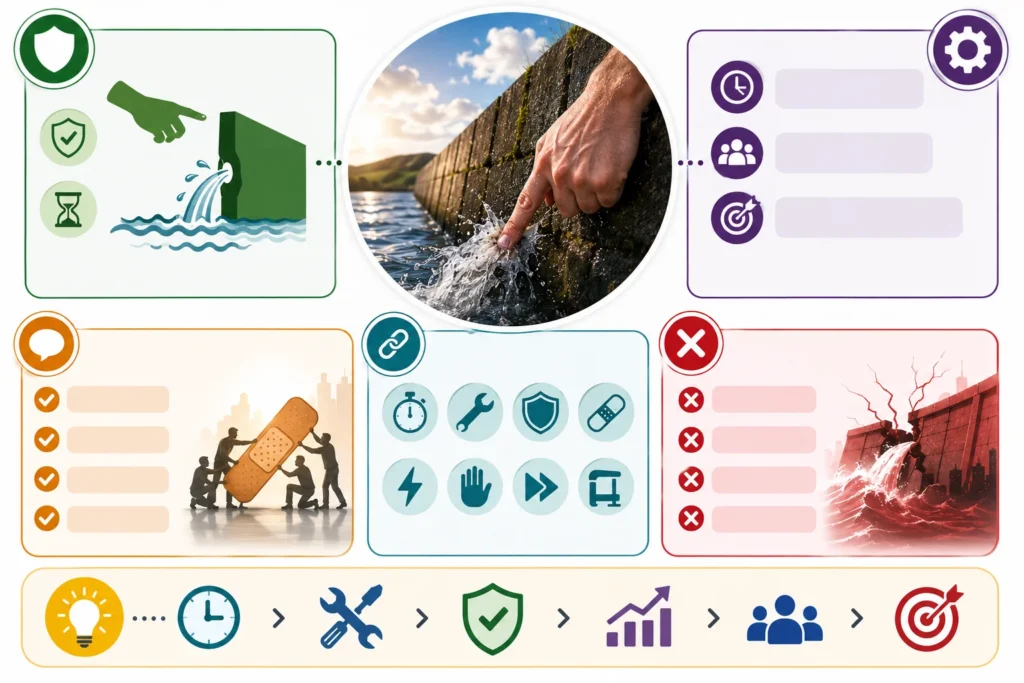
The idiom “finger in the dike” describes a small, urgent action that holds back a much bigger problem. Imagine discovering a tiny hole in a dike while water is already pushing through. Blocking that opening might prevent immediate flooding, but it doesn’t repair the damaged structure. That contrast explains why English speakers use the phrase for temporary solutions, crisis management, and efforts that buy time without fixing the root cause.
The expression has an interesting literary history, too. Despite its strong association with the Netherlands, the familiar little-boy-and-dike story is connected to American writer Mary Mapes Dodge’s 1865 novel Hans Brinker; or, The Silver Skates. The boy in the dike story isn’t actually Hans Brinker, a detail that many modern retellings get wrong.
Today, you might hear the phrase in a business meeting, a technology discussion, political commentary, or an ordinary conversation about a recurring problem. Its core message remains simple: you can stop a problem from getting worse without actually solving it.
What Does “Finger in the Dike” Mean?
“Finger in the dike” means using a small or temporary action to prevent a much larger problem from developing or becoming worse. The expression usually carries an image of urgency. Something is already going wrong, and someone must act immediately.
The phrase comes from the idea of plugging a hole in a dike with a finger. A finger can block the immediate flow of water. It can’t rebuild the dike, reinforce its foundation, or protect the surrounding land forever.
That distinction gives the idiom its figurative power.
When someone calls an action a finger in the dike, they often mean:
- The action deals with an immediate threat.
- The measure provides temporary relief.
- The larger problem still exists.
- A permanent solution requires more work.
- Ignoring the underlying issue could make things worse.
- The temporary action may still be valuable because it buys time.
For example:
“Hiring another employee to handle the backlog is just a finger in the dike. The company needs to fix its outdated ordering system.”
The sentence doesn’t say that hiring another employee is useless. That person may genuinely reduce the pressure. The criticism is that the company hasn’t addressed why the backlog keeps returning.
Finger in the Dike: Meaning at a Glance
| Element | Meaning |
| Phrase | Finger in the dike |
| Type | Idiom |
| Basic idea | Temporary action against a larger problem |
| Typical situation | An urgent problem needs immediate control |
| Possible tone | Helpful, critical, cautionary, or urgent |
| Underlying message | The root problem still needs attention |
| Alternative spelling | Finger in the dyke |
The spelling “finger in the dyke” also appears as an alternative form. The meaning remains the same.
How to Use “Finger in the Dike” in a Sentence
The phrase works best when your sentence contains two ideas: an immediate problem and a larger threat behind it.
You can use it as a noun phrase:
“The emergency funding was a finger in the dike.”
You can also use related constructions:
“The team is putting a finger in the dike by fixing each error manually.”
Or:
“We keep putting our fingers in the dike instead of repairing the system.”
The plural form works naturally when several people or actions attempt to contain a growing problem.
Natural Sentence Patterns
| Pattern | Example |
| a finger in the dike | “This loan is only a finger in the dike.” |
| put a finger in the dike | “The emergency team put a finger in the dike by restoring the service.” |
| putting a finger in the dike | “We’re putting a finger in the dike every time another server fails.” |
| fingers in the dike | “Everyone has their fingers in the dike, but nobody is fixing the pipeline.” |
| just a finger in the dike | “The temporary subsidy is just a finger in the dike.” |
One useful test can help you decide whether the idiom fits.
Ask yourself: “Does this small action prevent a larger problem from getting worse?”
If the answer is yes, the expression may work naturally.
If you’re simply describing an ordinary solution, another phrase will probably be clearer.
“Finger in the Dike” Example Sentences
Here are examples that show how the meaning changes with context.
Business:
“The new sales campaign is a finger in the dike because the company still has serious cash-flow problems.”
Technology:
“Restarting the server every morning is a finger in the dike, not a real fix.”
Workplace:
“Hiring temporary staff helped, but it was only a finger in the dike.”
Government:
“The emergency grant acted as a finger in the dike while officials searched for a long-term solution.”
Personal finances:
“Selling a few possessions paid the bill, but it was only a finger in the dike.”
Education:
“Adding another tutoring session may be a finger in the dike if the curriculum remains too difficult.”
Cybersecurity:
“Blocking individual malicious accounts is a finger in the dike if the company hasn’t secured the underlying system.”
Household repairs:
“Putting tape over the leaking pipe was a finger in the dike until the plumber arrived.”
Notice the recurring structure. The immediate response matters, but something deeper remains unresolved.
Is “Finger in the Dike” Positive or Negative?
The expression can be positive, negative, or neutral depending on context.
That’s important because some explanations treat the idiom as though it always criticizes temporary solutions. Real usage allows more nuance.
A person who puts a finger in the dike may show courage, responsibility, and quick thinking. If a flood threatens a community, stopping the first leak can be exactly the right thing to do.
However, the same phrase can criticize an organization that repeatedly uses emergency measures instead of fixing the cause.
Positive Use
“The nurse’s quick intervention was a finger in the dike that prevented the situation from becoming dangerous.”
Here, the temporary action deserves praise. It prevented immediate harm.
Negative Use
“Another temporary patch won’t solve the network problem. It’s just another finger in the dike.”
Here, the speaker believes the organization has relied on quick fixes for too long.
The key question is:
Is the temporary action buying time for a real solution, or has it become a substitute for one?
That distinction determines the tone.
What Is the Origin of “Finger in the Dike”?
The origin of “finger in the dike” is more interesting than the popular version suggests.
Many people assume the phrase comes from ancient Dutch folklore. The famous story certainly has a Dutch setting and revolves around a very real feature of Dutch life: dikes and flood protection. Yet the familiar literary story appeared in American writing.
The story is associated with Mary Mapes Dodge, whose Hans Brinker; or, The Silver Skates was published in 1865. The book is set in the Netherlands and includes a separate story about a boy who notices a leak in a dike and blocks it with his finger.
That literary connection matters because it corrects one of the most persistent misconceptions surrounding the idiom.
A Quick Historical Timeline
| Year | Event |
| 1865 | Mary Mapes Dodge publishes Hans Brinker; or, The Silver Skates |
| 19th century | The little-boy-and-dike story spreads among English-speaking readers |
| Late 19th century onward | The story develops into a metaphor for a stopgap measure |
| 20th century | The expression becomes established in figurative English |
| Today | The idiom describes temporary crisis control in many fields |
The important point isn’t that Dodge invented every idea about Dutch dikes. Rather, the specific famous story that shaped the English expression is documented in American literature.
Is the Little Dutch Boy Really Hans Brinker?
No.
This is one of the biggest mistakes people make when explaining the phrase.
Hans Brinker is the central character of Mary Mapes Dodge’s novel. He is a poor Dutch boy whose story centers on his family, his father, and a skating race.
The boy who plugs the dike is a separate, unnamed character in a story within the novel.
So this familiar statement is incorrect:
“Hans Brinker put his finger in the dike.”
A more accurate explanation is:
“A story within Mary Mapes Dodge’s 1865 novel features an unnamed Dutch boy who blocks a dike leak with his finger.”
That distinction may seem small. It isn’t. Accurate historical details strengthen an article’s credibility, especially when a popular myth has been repeated for generations.
Hans Brinker vs. the Little Dutch Boy
| Character | Role |
| Hans Brinker | Main character of Dodge’s novel |
| Little Dutch Boy | Unnamed boy in the dike story |
| The dike story | A separate moral tale within the novel |
| Common misconception | The two boys are the same person |
Later retellings helped merge these characters in popular culture. That’s why many people still remember the dike hero as Hans Brinker.
The Little Dutch Boy Story: What Actually Happens?
The basic story is remarkably simple.
A boy discovers water coming through a small opening in a dike. He understands that the opening could become a much larger breach. Instead of walking away, he blocks the hole with his finger.
He remains there while the water presses against the barrier.
The story turns a tiny physical action into an act of enormous responsibility. The boy cannot rebuild the dike himself. He can only stop the immediate danger until help arrives.
That is exactly why the story became such a useful metaphor.
The Story’s Central Ideas
- Vigilance: Notice a small warning before it becomes a crisis.
- Responsibility: Act when others may not yet see the danger.
- Courage: Take action despite personal discomfort or risk.
- Urgency: Deal with the immediate threat first.
- Temporary control: Buy time for a stronger response.
- Collective responsibility: One person’s action can protect many others.
The story therefore carries a lesson that extends beyond flood control:
A small intervention can matter enormously when the alternative is uncontrolled failure.
At the same time, the modern idiom adds another layer. It asks whether someone is merely holding the problem back or actually solving it.
Why the “Finger in the Dike” Story Became So Memorable
The image is almost impossible to forget.
A tiny finger stands between a small opening and a potentially devastating flood. The contrast is dramatic. That’s excellent material for an idiom because the reader doesn’t need a long explanation.
The metaphor works because it compresses a complicated idea into one visual scene.
Think about these two statements:
“We are using a temporary intervention to prevent a larger systemic failure.”
That’s accurate, but dry.
Now compare it with:
“We’re just putting a finger in the dike.”
The second sentence immediately creates an image.
That’s one reason idioms survive. They turn abstract ideas into pictures.
What Is a Dike?
A dike is a raised structure designed to help control or hold back water. In places vulnerable to flooding, dikes can form part of a broader system of flood defenses.
The word matters because the idiom depends on the difference between a small breach and the large consequences that breach can create.
A dike isn’t simply a wall in isolation. Modern flood protection can involve multiple structures, monitoring systems, barriers, drainage systems, and other measures.
The Netherlands provides an especially relevant real-world context because its geography has made flood protection a long-term national priority. Rijkswaterstaat explains that much of the country lies below sea level and that its flood-defense system protects people and the economy from high water.
That real engineering context makes the metaphor even more striking.
Dike vs. Dyke: Which Spelling Is Correct?
Both dike and dyke can appear in English.
For American readers, dike is the most familiar spelling in this idiom. British and other varieties of English may use dyke more often in certain contexts.
You may therefore encounter:
- finger in the dike
- finger in the dyke
They refer to the same figurative idea.
If you’re writing for a US audience, finger in the dike is the safer primary form because it matches common American spelling.
Literal Meaning vs. Figurative Meaning
The literal image and figurative meaning are closely connected.
| Literal idea | Figurative idea |
| A dike has a leak | A system has a problem |
| Water threatens to break through | A crisis threatens to grow |
| A finger blocks the opening | A person takes emergency action |
| The finger cannot repair the dike | The action doesn’t solve the root cause |
| Help must eventually arrive | A permanent solution is still needed |
This relationship explains why the idiom remains easy to understand even for people who have never heard the original story.
You don’t need to know the entire history to grasp the metaphor.
Small opening. Big threat. Immediate response. Bigger repair still needed.
That’s the entire logic.
When Does “Finger in the Dike” Become a Bad Strategy?
Temporary action isn’t automatically bad.
In a genuine emergency, temporary action can be essential. It can prevent injuries, protect assets, preserve a service, or create enough time for experts to respond.
The trouble begins when an organization keeps using temporary measures while ignoring the underlying problem.
Imagine a company whose database crashes every Friday.
The technical team restarts the server every Friday afternoon. The restart works. Customers regain access. Everyone feels relieved.
Next Friday, the server crashes again.
Then again.
Then again.
At some point, restarting the server stops being a solution. It’s a finger in the dike.
The company needs to investigate the underlying failure.
Warning Signs of a Stopgap Trap
- The same problem returns repeatedly.
- Temporary fixes become routine.
- Nobody investigates the root cause.
- Emergency work consumes more resources each month.
- Staff spend more time reacting than planning.
- Customers experience repeated disruptions.
- The organization celebrates recovery without preventing recurrence.
- Leaders confuse “nothing got worse” with “the problem was solved.”
A good emergency response should therefore lead to a stronger next step.
Contain first. Diagnose next. Repair properly.
“Finger in the Dike” vs. “Band-Aid Solution”
These expressions overlap, but they aren’t identical.
A band-aid solution usually emphasizes the weakness of a temporary fix. It suggests that someone has covered a problem without properly repairing it.
Finger in the dike adds a stronger sense of urgency and potential escalation.
| Expression | Main emphasis |
| Finger in the dike | Holding back a larger or growing threat |
| Band-aid solution | Covering a problem without fixing it properly |
| Stopgap measure | Temporary action until something better is available |
| Damage control | Limiting the consequences of a problem |
| Put out fires | Handling urgent problems as they appear |
Consider these examples:
“The emergency patch was a finger in the dike.”
This suggests the patch is holding back a larger problem.
“The patch was a band-aid solution.”
This focuses more directly on its inadequacy.
Both can be correct. The better choice depends on what you want to emphasize.
“Finger in the Dike” vs. “Nip It in the Bud”
These expressions deal with problems at different stages.
Nip it in the bud means stopping something early, before it grows into a bigger issue.
Finger in the dike suggests that the bigger threat has already emerged and someone is trying to hold it back.
For example:
“We should nip the communication problem in the bud before it affects the whole team.”
The issue is still relatively small.
Compare:
“We’re putting a finger in the dike by adding another manager to handle the complaints.”
Now the problem has already grown and requires emergency control.
The Simple Difference
Nip it in the bud: Stop the problem early.
Finger in the dike: Hold back the problem after it becomes threatening.
“Finger in the Dike” vs. “Put Out Fires”
The phrase put out fires often describes a workplace where people constantly respond to urgent problems.
A manager might say:
“I spend every afternoon putting out fires.”
That means the manager deals with one urgent issue after another.
A finger in the dike suggests a somewhat different picture. One action is holding back a larger threat.
For example:
“Every manual correction is another finger in the dike.”
The company isn’t merely dealing with random problems. The repeated corrections are preventing a larger system failure from becoming obvious.
The two expressions can overlap, but their imagery differs.
Put out fires emphasizes repeated emergencies.
Finger in the dike emphasizes containment of a larger threat.
Other Expressions Related to “Finger in the Dike”
Depending on the situation, you can use several alternatives.
Temporary Fix
A general phrase for something that solves a problem only for a limited period.
Stopgap Measure
A temporary measure used until a better solution becomes available.
Damage Control
Actions intended to reduce the harm caused by an existing problem.
Short-Term Solution
A solution designed to address immediate needs rather than long-term conditions.
Putting Out Fires
Handling urgent problems as they appear.
Band-Aid Solution
A temporary fix that often implies the real problem remains.
Plugging a Leak
A vivid expression for stopping one immediate problem, especially when more serious issues remain.
None of these expressions matches finger in the dike perfectly. That’s useful because word choice should reflect the exact idea you want to communicate.
Modern Uses of “Finger in the Dike”
The idiom works surprisingly well in modern settings because today’s systems often have complex problems that require immediate containment.
Business and Finance
Businesses frequently face situations where immediate action matters more than perfect solutions.
A company might freeze spending after a sudden revenue decline. That can stabilize cash flow. Yet if the business model remains unprofitable, the spending freeze is only a temporary measure.
That is where the idiom fits.
“The spending freeze is a finger in the dike until management can restructure the business.”
The phrase can also describe emergency financing, temporary staffing, debt extensions, or repeated cost reductions.
Technology
Technology provides some of the clearest modern examples.
A software company might fix individual bugs every day while its underlying architecture becomes harder to maintain.
Each patch helps.
Each patch may even be necessary.
But if the system continues producing the same class of failures, developers eventually need to address the architecture itself.
“The constant patches are fingers in the dike against a deeper reliability problem.”
The phrase works particularly well here because software teams often distinguish between incident response and root-cause remediation.
Cybersecurity
Cybersecurity teams frequently need to contain threats immediately.
They might block an account, disable a compromised machine, revoke credentials, or isolate a server.
Those actions can prevent additional damage.
However, if attackers keep exploiting the same vulnerability, containment alone isn’t enough.
The organization needs to patch the vulnerability, improve access controls, strengthen monitoring, and address the root cause.
That’s a classic finger-in-the-dike situation.
Government and Public Policy
Governments sometimes introduce emergency measures to prevent immediate harm.
For instance, temporary financial support may help households during a crisis. Emergency infrastructure repairs may restore a critical service. Short-term regulations may reduce immediate risks.
Such measures can be necessary.
But policymakers still need to determine whether the underlying structural problem remains.
The idiom becomes useful when someone argues that emergency action cannot substitute for structural reform.
Everyday Life
You don’t need a government crisis or failing corporation to use this expression.
Suppose your monthly expenses exceed your income.
You sell an unused device to cover the next bill.
That solves the immediate problem.
But if your income and expenses remain unchanged, another bill will create the same pressure next month.
The sale was a finger in the dike.
It bought time. It didn’t solve the financial imbalance.
That same logic can apply to:
- household repairs
- overloaded schedules
- recurring family problems
- missed deadlines
- schoolwork
- personal budgeting
- home maintenance
- repeated customer complaints
A Real-World Lesson: Temporary Action Can Still Matter
There’s a subtle lesson hidden inside this idiom.
Temporary doesn’t mean useless.
A temporary measure can be incredibly valuable when the alternative is immediate failure.
Suppose a hospital loses power.
Emergency generators aren’t the permanent power system. Yet nobody would call them pointless. Their purpose is to keep critical equipment running while the main problem is resolved.
Likewise, a cybersecurity team might isolate an infected machine before investigating the breach.
The isolation isn’t the final solution.
It’s still essential.
The real question isn’t whether the action is temporary. The question is what happens next.
A healthy response looks something like this:
Contain the immediate threat → understand the cause → implement the permanent fix → monitor the result.
An unhealthy response looks like this:
Contain → forget → repeat → contain → repeat.
The second pattern is where the finger in the dike metaphor becomes especially critical.
The 1953 North Sea Flood: A Real-World Warning
The Netherlands provides an especially powerful real-world context for understanding why flood protection cannot depend on improvised fixes.
On the night of January 31 to February 1, 1953, a severe northwesterly storm combined with spring tide to produce catastrophic flooding in the Netherlands.
According to Rijkswaterstaat, the country’s national water-management authority, 1,836 people died. More than 150,000 hectares of land flooded, and dikes were breached at more than 150 locations across Zeeland, South Holland, and North Brabant. About 72,000 people were evacuated.
The figures show the scale of the problem.
This wasn’t a situation where one person could permanently solve a structural weakness with a quick intervention.
Emergency responses mattered. People worked to limit damage. But the disaster also demonstrated the need for a much larger approach.
Key Facts From the 1953 Flood
| Fact | Figure |
| People who died | 1,836 |
| Evacuated | 72,000 |
| Land flooded | More than 150,000 hectares |
| Dike breach locations | More than 150 |
| Houses and buildings destroyed | 4,300 |
| Buildings damaged | 43,000 |
| Livestock lost | 47,000 |
| Poultry lost | 140,000 |
Rijkswaterstaat identifies the flood as the largest natural disaster in the Netherlands during the 20th century.
The historical event isn’t the origin of the little-boy story. That’s an important distinction.
Instead, it offers a real-world illustration of the underlying metaphor: serious water threats require robust systems rather than reliance on last-minute improvisation.
What Changed After the 1953 Flood?
The Netherlands responded with stronger flood-defense standards and a large national program of water-management projects.
Rijkswaterstaat states that construction of the Delta Works began after the disaster. The first Delta Works project started in 1954, and the final project, the Maeslant Barrier, was completed in 1997.
That response illustrates the difference between holding back one emergency and redesigning the system that produced the risk.
Instead of asking people to keep plugging leaks, engineers built large-scale defenses designed to reduce exposure to storm surges.
That’s precisely the kind of distinction the idiom helps us express.
The Delta Works: Moving Beyond the “Finger in the Dike”
The Delta Works represent the long-term side of the metaphor.
Rijkswaterstaat describes them as the Netherlands’ largest defense system against high water from the sea. Its listed structures include storm-surge barriers, locks, and dams.
The program contains 13 major works, according to Rijkswaterstaat’s historical overview.
One particularly important project is the Hollandsche IJssel Barrier.
Construction began after the 1953 flood, and the barrier was completed in 1958. It protects one of the country’s lowest-lying areas. The structure uses two steel gates, each more than 80 meters wide and 12 meters high.
Another major structure is the Eastern Scheldt Barrier. Construction began in 1976 and took ten years. Rijkswaterstaat describes it as one of the Netherlands’ most important flood-defense structures and a major achievement in hydraulic engineering.
These projects reveal an important practical lesson:
A temporary fix can save the day. A resilient system reduces the need for emergency fixes in the first place.
Why Temporary Fixes Fail
Temporary fixes fail for several predictable reasons.
They Treat Symptoms
A symptom is visible.
The root cause may not be.
If a pipe keeps leaking because excessive pressure damages it, replacing the same small section repeatedly won’t solve the larger issue.
They Create False Confidence
A quick repair can make everyone feel the crisis has ended.
That feeling can be dangerous.
The problem may simply be waiting for another opportunity to appear.
They Consume Resources
Repeated emergency work costs time and money.
Eventually, an organization can spend more maintaining temporary fixes than it would have spent solving the underlying problem.
They Increase Complexity
Every workaround can introduce another dependency.
Over time, a system becomes harder to understand because nobody remembers why certain patches exist.
They Delay Better Decisions
A temporary fix can reduce pressure enough that decision-makers stop treating the underlying issue as urgent.
That’s when a useful stopgap becomes a trap.
Common Mistakes With “Finger in the Dike”
Mistaking Hans Brinker for the Little Dutch Boy
This is the most famous historical error.
Hans Brinker and the unnamed dike boy are not the same character.
Calling the Story Ancient Dutch Folklore
The popular tale is strongly associated with Dutch culture, but its documented literary appearance is connected to Mary Mapes Dodge’s 1865 work.
Using the Phrase for Any Small Solution
Not every small solution is a finger in the dike.
The phrase needs an element of threat, escalation, containment, or a larger unresolved problem.
Assuming Temporary Means Bad
A temporary measure can be exactly what a crisis requires.
The criticism arises when people stop at the temporary measure.
Confusing the Idiom With a Permanent Solution
The entire metaphor depends on the fact that a finger cannot replace a properly repaired dike.
That’s the heart of the expression.
Is “Finger in the Dike” Still Used Today?
Yes.
The phrase remains useful because modern organizations constantly face situations where immediate containment and long-term repair are different tasks.
You can apply the metaphor to a failing computer system, a budget deficit, an overloaded workplace, an aging bridge, a cybersecurity breach, or a household problem.
The technology changes.
The underlying logic doesn’t.
A useful modern translation would be:
“We’re stopping the immediate damage, but we haven’t solved the real problem yet.”
That’s essentially what finger in the dike communicates with more imagery.
The idiom also works particularly well in commentary because it lets a writer criticize a policy without saying that every emergency measure was worthless.
For example:
“The subsidy may help families this year, but critics argue that it is only a finger in the dike.”
That sentence leaves room for nuance.
The subsidy may help.
The deeper problem may remain.
Can You Use “Finger in the Dike” in Formal Writing?
Yes, although context matters.
The phrase can work in:
- opinion articles
- business analysis
- journalism
- policy commentary
- essays
- workplace communication
- presentations
- general nonfiction
In highly technical writing, a more precise phrase may sometimes work better.
Instead of:
“The intervention was a finger in the dike.”
A technical report might say:
“The intervention provided short-term risk reduction but did not address the underlying failure mechanism.”
That’s less colorful but more precise.
In general writing, however, the idiom can make an abstract argument much easier to understand.
Casual vs. Professional Use
Casual:
“We’re just putting a finger in the dike again.”
Professional:
“The current measure provides short-term containment but does not resolve the underlying issue.”
Both express similar ideas.
The first is vivid.
The second is more technical.
Quick “Finger in the Dike” Examples
Here are concise examples across different contexts:
| Context | Example |
| Business | “The emergency loan is only a finger in the dike.” |
| Technology | “Another patch would be a finger in the dike.” |
| Cybersecurity | “Blocking one account is a finger in the dike against a broader attack.” |
| Workplace | “Hiring another temporary worker is a finger in the dike.” |
| Finance | “Selling assets provided a finger in the dike against the cash shortage.” |
| Government | “The relief program may be a finger in the dike rather than a lasting reform.” |
| Education | “Adding another exam review session is a finger in the dike if students still lack the basics.” |
| Home repair | “The bucket under the leak is a finger in the dike until the roof gets fixed.” |
| Healthcare | “Treating the immediate symptom without investigating the cause can become a finger in the dike.” |
| Personal life | “Borrowing money for this month’s bill is only a finger in the dike.” |
Each sentence contains the essential relationship: an immediate response holds back a larger issue.
A Simple Way to Remember the Meaning
Think of the phrase as a four-part sequence:
Small leak → immediate action → larger threat → permanent repair needed
That’s the easiest mental model.
If a colleague says:
“We’re just putting a finger in the dike.”
They’re probably telling you that the team is containing a problem rather than eliminating it.
If someone says:
“That was a finger in the dike, but it bought us enough time.”
The meaning becomes more positive. The temporary intervention succeeded at its immediate purpose.
This flexibility is one reason the idiom remains useful.
The Deeper Lesson Behind “Finger in the Dike”
The expression isn’t really about fingers or dikes.
It’s about how people respond to problems under pressure.
When something goes wrong, the first instinct is often to make the problem disappear as quickly as possible. That’s understandable. A customer is angry, a server is down, a bill is due, or a deadline is approaching.
Immediate action matters.
Yet immediate action can create a psychological trap. Once the visible crisis disappears, people may feel that the job is finished.
It isn’t always finished.
The strongest problem-solving approach separates containment from correction.
Containment prevents further damage.
Correction removes the cause.
Prevention reduces the chance of recurrence.
That three-stage approach gives the idiom a surprisingly practical lesson:
| Stage | Question |
| Contain | How do we stop the damage now? |
| Correct | What caused the problem? |
| Prevent | How do we stop it happening again? |
A finger may be enough for the first stage.
It was never meant to replace the other two.
Final Practical Takeaway
When you see or hear “finger in the dike,” think of a person holding back a growing problem with a small, urgent measure.
The expression can describe something admirable. Someone may step in during a crisis and prevent serious damage.
It can also describe something frustrating. An organization may keep applying temporary fixes while refusing to address the real cause.
The context tells you which meaning the speaker intends.
Its history adds another layer. The famous dike-boy story is connected to Mary Mapes Dodge’s 1865 literary work, not to an ancient Dutch folk tradition, and Hans Brinker isn’t the boy who plugs the dike.
The real-world history of Dutch flood protection provides an equally useful lesson. After the devastating 1953 North Sea flood, the Netherlands pursued large-scale defenses such as the Delta Works rather than relying solely on emergency responses.
So, in modern English, the simplest interpretation is this:
A “finger in the dike” is a temporary action that holds back a larger problem. It may save the situation today, but someone still needs to repair the dike.
The Story Behind “Finger in the Dike”: Myth vs. Reality
The history behind “finger in the dike” is more complicated than the familiar Little Dutch Boy story suggests. Many people assume the tale comes from ancient Dutch folklore, but the best-documented path into English points to 19th-century literature. The story became widely known through American writer Mary Mapes Dodge and her novel Hans Brinker, or The Silver Skates, first published in 1865.
That detail matters because the story and the character often get blended. The boy who discovers the leak and blocks it with his finger is not Hans Brinker. Dodge’s novel contains a story within the larger narrative about an unnamed boy who notices water escaping through a small hole in a dike. He understands that the tiny leak could grow into a devastating flood, so he puts his finger into the opening and stays there until morning.
The story is therefore fictional rather than a documented account of an actual Dutch child. Dutch historical sources also make this distinction clear. The Dutch water authorities note that Hans Brinker himself never existed and that the boy in the dike episode was a separate unnamed character in Dodge’s book.
The Dutch Connection
The connection with the Netherlands isn’t completely random.
Dikes are genuinely important to Dutch history and water management. The Netherlands has long dealt with the challenge of protecting low-lying areas from water. That real geographical and engineering context made the fictional story feel believable to generations of English-speaking readers.
However, there’s an important distinction between a fictional story set in the Netherlands and a traditional Dutch legend.
The famous finger-in-the-dike story wasn’t widely known in the Netherlands before it appeared in American literature. A study published through the Royal Netherlands Academy of Arts and Sciences notes that the legend became known in the Netherlands largely through American visitors who asked about the famous boy and his supposed rescue of the country.
That reversal is fascinating. Many Americans grew up thinking the story was an old Dutch tale. Yet Dutch audiences later encountered the legend partly because Americans had already made it famous.
The “Little Dutch Boy” Story
The story itself is straightforward.
A young boy is returning home when he hears water trickling through a small opening in a dike. He immediately understands the danger. If the opening grows, the water could break through and flood the surrounding area.
Instead of ignoring the problem, he climbs to the opening and puts his finger into it.
The action stops the immediate flow.
But there’s a catch.
The boy can’t leave.
He calls for help, but nobody responds. As darkness arrives, the cold becomes increasingly painful. Still, he refuses to remove his finger because he believes that doing so could allow the water to break through.
In Dodge’s original text, the boy eventually remains at the dike through the night until a clergyman discovers him in the morning.
That detail explains why the story became such a powerful moral lesson. The boy doesn’t possess special strength or sophisticated equipment. He simply recognizes a danger and accepts responsibility for doing something about it.
The metaphor behind the modern idiom grows from that exact situation.
A tiny intervention can hold back an enormous threat.
Why the Story Became So Powerful
The story combines several ideas that naturally attract readers:
- Responsibility — the boy doesn’t walk past the danger.
- Courage — he acts despite the personal discomfort involved.
- Urgency — he understands that waiting could make the situation worse.
- Persistence — he continues holding the opening closed.
- Sacrifice — he gives up his comfort to protect others.
- Prevention — he stops a disaster before it happens.
These qualities also explain why the expression works so well in modern English.
When someone says a policy is a “finger in the dike,” they’re usually drawing on the same basic image. A person or organization is trying to prevent a larger failure with whatever limited action is immediately available.
The modern meaning adds an important criticism, though. The boy’s action is temporary. It protects the town until someone can provide a lasting solution.
That distinction is crucial.
A finger in the dike can be heroic in an emergency. It becomes problematic when people keep using emergency measures instead of repairing the underlying weakness.
The Little Dutch Boy Wasn’t Hans Brinker
One of the most persistent misconceptions about this story is that Hans Brinker was the boy who plugged the dike.
He wasn’t.
Hans Brinker is the protagonist of Mary Mapes Dodge’s novel. His story revolves around his family, his father’s illness, his desire to help his family, and a famous skating competition.
The dike story is separate.
Within Dodge’s novel, children hear a story about an unnamed boy who saves Haarlem by stopping a leak. The boy isn’t identified as Hans Brinker. The original text makes this distinction clear.
This confusion probably became stronger as the novel’s popularity grew. Readers associated the book’s title character with its memorable dike episode, and later retellings often simplified the story.
The result was a cultural shortcut:
Hans Brinker = Little Dutch Boy = Finger in the Dike
But that equation isn’t historically accurate.
Hans Brinker vs. the Little Dutch Boy
| Detail | Hans Brinker | Little Dutch Boy |
| Literary connection | Hans Brinker; or, The Silver Skates | Story within the same novel |
| Author | Mary Mapes Dodge | Mary Mapes Dodge’s retelling |
| Character status | Main character | Unnamed boy |
| Dike rescue | No | Yes |
| Historical person | No | No |
| Main association | Silver skating race and family story | Saving Haarlem from a possible flood |
Dutch water-management organizations specifically state that Hans Brinker wasn’t the boy who put his finger in the dike. They also explain that the boy’s name isn’t given in Dodge’s version.
So if you’re writing about the finger in the dike meaning and origin, it’s better to say “the unnamed Dutch boy” rather than calling him Hans Brinker.
Was the Story Completely Invented by Mary Mapes Dodge?
There’s another layer to the story.
It would be too simplistic to say that Dodge created the entire idea from nothing. Research into the tale has identified earlier versions of the basic story.
A Dutch historical study traces similar versions to earlier publications and discusses an older French story associated with Eugénie Foa. The Dutch water authorities likewise note that versions of the story existed before Dodge’s famous novel.
What Dodge did was particularly important, however.
Her 1865 novel brought the story to a huge English-speaking audience. Because Hans Brinker, or The Silver Skates, became widely read, the dike story gained a reach that earlier versions apparently did not achieve.
This distinction gives us a more accurate historical picture:
The story predates Dodge in related forms, but Dodge’s novel played a major role in making the famous version widely known.
That is a better explanation than either extreme.
It wasn’t necessarily an ancient Dutch legend.
Nor did Mary Mapes Dodge necessarily invent every earlier version of the motif.
The Story’s Connection to Haarlem
The famous tale is usually connected with Haarlem, a real city in the Netherlands.
In Dodge’s story, the boy realizes that water coming through the dike could eventually flood Haarlem. The danger isn’t presented as a minor inconvenience. It’s a threat to the entire community.
The original passage emphasizes the boy’s understanding that a small hole could become much larger and cause a serious inundation.
That detail is particularly important for understanding the meaning of ” finger in the dike.
The phrase isn’t simply about putting your finger into a hole.
It’s about recognizing that small failures can become large failures.
Consider a modern example.
A company’s customer-support inbox contains 200 unanswered messages. One employee stays late and clears the backlog.
That’s useful.
But if the company receives another 200 messages tomorrow, the backlog returns.
The employee’s effort was a finger in the dike.
The immediate pressure decreased. The system that created the pressure remained unchanged.
That is the exact metaphorical relationship between the original story and modern English usage.
Why the Myth Became So Popular
The story has almost everything a memorable children’s tale needs. There’s danger.There’s a young hero.There’s suspense.There’s personal sacrifice.There’s a community at risk.
And there’s a simple action that anyone can visualize.
The image requires no technical explanation. You don’t need to understand hydrology to imagine a child pressing a finger against a hole while water pushes from the other side.
That visual simplicity makes the story exceptionally easy to remember.
It also makes the expression useful.
Compare:
“The company is implementing temporary interventions to mitigate the consequences of an unresolved systemic problem.”
Now compare:
“They’re putting a finger in the dike.”
The second version is shorter and much more vivid.
The listener immediately understands the basic relationship between small action and large danger.
A Metaphor That Works Across Fields
The phrase has survived because its logic applies to many areas of life.
| Original image | Modern comparison |
| Hole in dike | Emerging problem |
| Water pushing through | Growing pressure |
| Finger | Immediate intervention |
| Holding the opening | Containing the problem |
| Help arriving | Permanent solution |
| Flood | Major failure |
This makes the idiom particularly effective in business writing, political commentary, technology discussions, and everyday speech.
The Engineering Reality Behind the Metaphor
Although the story is fictional, the underlying concern is real.
A breach in a flood-defense structure can become more serious as water moves through it. Modern flood protection therefore relies on engineered systems, monitoring, maintenance, and carefully designed barriers rather than heroic last-minute actions.
That reality makes the metaphor more powerful, not less.
A person might be able to stop a tiny leak temporarily.
But a community cannot safely depend on one person standing at a dike indefinitely.
The same principle applies to organizations.
A manager can work late to solve a staffing crisis.
A developer can patch a broken application.
An accountant can find money to cover an unexpected shortfall.
A teacher can give extra help to struggling students.
Those interventions can all matter.
Yet if the conditions causing the problem remain unchanged, the same crisis will eventually return.
Why “Finger in the Dike” Means More Than “Temporary Fix”
It’s tempting to treat finger in the dike as simply another way to say temporary fix.
That’s not quite enough.
A temporary fix can be completely ordinary.
For example:
“I used a spare charger until I bought a new one.”
That’s a temporary solution, but it isn’t really a finger-in-the-dike situation.
The idiom needs something more.
There should usually be:
- An existing or emerging threat
- A sense of urgency
- A limited intervention
- A larger problem behind the immediate issue
- A need for a stronger or permanent solution
That’s why the phrase sounds dramatic.
It carries the emotional weight of trying to hold back something that could become much worse.
When the Idiom Suggests Heroism
Not every use of finger in the dike is criticism.
Sometimes the phrase recognizes that someone has done exactly what was necessary under difficult circumstances.
Imagine a hospital suddenly loses access to a critical computer system.
An IT administrator immediately switches staff to backup procedures.
The backup process is slower. It isn’t the permanent solution.
But it keeps essential services functioning while technicians investigate the outage.
Calling that action a finger in the dike can emphasize the administrator’s ability to contain the immediate threat.
The phrase can therefore carry admiration:
“The temporary measure prevented disaster.”
The implied next step is still important:
“Now fix the underlying problem.”
When the Idiom Becomes Critical
The tone changes when an organization repeatedly uses temporary measures.
Imagine a factory where one machine keeps breaking.
Workers repair it every few days.
Production resumes.
Everyone moves on.
Then it breaks again.
After months of repeated repairs, someone might say:
“We’re just putting a finger in the dike.”
Here, the phrase criticizes the organization’s approach.
The repairs aren’t necessarily wrong.
They’re simply incomplete.
The organization is managing the symptoms rather than addressing the cause.
Signs You’re Dealing With a “Finger in the Dike” Situation
Look for these patterns:
- The same failure keeps returning.
- Emergency measures become normal procedures.
- Staff constantly respond to crises.
- Nobody owns the underlying problem.
- Temporary fixes consume increasing amounts of money.
- One solution creates another workaround.
- Leaders keep postponing structural improvements.
- The organization measures success by recovery rather than prevention.
When several of these conditions appear together, the idiom becomes especially appropriate.
A Useful Distinction: Containment vs. Resolution
One of the clearest ways to understand the phrase is to separate containment from resolution.
Containment limits immediate damage.
Resolution removes or repairs the cause.
For example, a cybersecurity team may detect a compromised account and immediately disable it.
That’s containment.
Investigating how the account was compromised and closing the vulnerability is resolution.
Similarly, putting a bucket beneath a leaking roof contains the immediate problem.
Repairing the damaged roof resolves it.
The idiom usually describes the first action.
It reminds you that the second action still matters.
A Simple Problem-Solving Model
| Step | Purpose | Example |
| Detect | Identify the threat | Notice the leak |
| Contain | Stop immediate damage | Block the opening |
| Diagnose | Find the cause | Inspect the dike |
| Repair | Fix the underlying problem | Reinforce the structure |
| Prevent | Reduce future risk | Improve monitoring and maintenance |
This model captures why the original story remains such a useful metaphor more than a century later.
Why the Idiom Fits Business So Well
Modern businesses often operate under constant pressure.
A customer complaint needs an immediate response.
A shipment gets delayed.
A website crashes.
Revenue drops.
A key employee resigns.
A supplier fails.
Each event creates a problem that someone must handle.
The danger comes when leaders spend all their time responding to those events.
A company can become very good at recovering from problems while remaining very bad at preventing them.
That’s a classic finger-in-the-dike pattern.
For example, imagine an online retailer that receives thousands of customer complaints because orders arrive late.
Management adds temporary staff to process complaints faster.
Complaint response times improve.
The dashboard looks better.
But warehouse capacity remains unchanged.
Two months later, complaints rise again.
The extra staff was useful.
Yet they didn’t solve the underlying logistics problem.
The organization put a finger in the dike.
Why the Idiom Fits Technology Even Better
Technology systems often accumulate temporary fixes.
A developer discovers an error and adds a patch.
Another issue appears.
Another patch follows.
Over time, the code becomes difficult to maintain because each fix interacts with previous workarounds.
The system still operates.
But nobody is confident about what will happen after the next update.
That’s a software version of the dike metaphor.
A patch isn’t automatically bad. Software engineers use patches to resolve urgent security and reliability problems all the time.
The issue arises when an organization continually postpones architectural improvements.
The phrase therefore works especially well when discussing technical debt.
“The latest patch keeps the service running, but it’s another finger in the dike against a deeper architectural problem.”
That’s more precise than simply calling the patch “bad.”
The patch may be necessary.
It just isn’t sufficient.
The Psychology Behind “Finger in the Dike” Thinking
There is also a human reason organizations fall into this pattern.
Immediate problems demand attention.
Long-term problems demand patience.
When a crisis appears, people naturally focus on the thing that is screaming loudest.
A broken server gets attention.
A future reliability risk doesn’t.
An angry customer gets a response.
A process that may cause thousands of complaints next year gets postponed.
A leaking roof gets a bucket.
Replacing the roof gets scheduled for “later.”
This creates a cycle:
Problem → quick response → relief → reduced urgency → recurrence → another quick response.
The relief is real.
That’s what makes the cycle difficult to break.
The temporary fix works well enough to postpone the permanent fix.
Why a Stopgap Measure Can Still Be Smart
It’s important not to turn the idiom into an argument against temporary solutions.
That would miss the point.
Emergency measures are often essential. If a server is under attack, isolate it first.If a pipe bursts, shut off the water first.If a patient needs immediate treatment, stabilize the situation first.If a business faces a sudden cash shortage, preserve liquidity first.
First aid isn’t a failure simply because it isn’t surgery.
The problem comes when the emergency response becomes the entire strategy.
A strong organization knows when to stop managing symptoms and start solving causes.
The Historical Lesson Behind the Modern Metaphor
The famous dike story became powerful because it contains a universal human experience. You notice something going wrong.You realize the consequences could be much larger.You have limited resources.You act anyway.You hold the problem back.
Then you wait for a solution that is bigger than anything you can do alone.
That’s why the phrase works outside flood protection.
It describes the moment when a small intervention stands between order and escalation.
And it also reminds us that the intervention has limits.
A finger can block a hole.
It cannot rebuild a dike.
How the Story Connects to Modern English Usage
The original fictional story gives the expression its imagery. Modern speakers supply the broader metaphor.
Today, “finger in the dike” can describe:
- temporary financial support
- emergency government action
- repeated software patches
- crisis management
- short-term staffing
- temporary repairs
- cybersecurity containment
- repeated customer-service interventions
- political compromises
- short-term environmental measures
- personal financial decisions
In each case, the phrase points toward the same underlying relationship:
A limited action is preventing a larger problem from breaking through.
That is the heart of the finger-in-the-dike meaning.
A More Accurate Way to Explain the Origin
If you need to explain the idiom in an article, classroom, presentation, or conversation, avoid the oversimplified version:
“It’s an old Dutch story about Hans Brinker.”
A stronger explanation would be:
“The expression is associated with a famous story about an unnamed Dutch boy who blocks a leak in a dike. The story became widely known through Mary Mapes Dodge’s 1865 novel Hans Brinker; or, The Silver Skates, although related versions existed earlier.”
That wording is more historically responsible.
It also avoids two common errors at once:
- claiming Hans Brinker was the dike boy
- claiming Dodge necessarily invented the entire story
Historical research has identified earlier versions and possible French sources, while Dodge’s novel clearly played a major role in popularizing the story.
What the Origin Tells Us About the Idiom Today
The story’s survival isn’t really surprising.
People have always needed language for problems that are too large to solve immediately but too dangerous to ignore.
That’s exactly where finger in the dike sits.
It describes the uncomfortable middle ground between disaster and resolution.You’re not helpless.You’re not finished.You’re holding things together.
That can be admirable.
It can also be exhausting.
And if the temporary solution continues forever, it can become a warning sign that the real problem has been left unattended.
The phrase therefore carries two ideas at once:
“This action matters.”
and
“This action isn’t enough.”
That tension is what gives “finger in the dike” its lasting usefulness in modern English.
Modern Usage of “Finger in the Dike”
The phrase “finger in the dike” fits modern life because people and organizations constantly face problems that demand immediate attention. A quick response can prevent serious damage. However, that response may still leave the underlying issue untouched.
You can use the idiom whenever a person takes a limited action to contain a larger or growing problem. The situation doesn’t have to involve water, construction, or physical danger. In modern English, the dike is usually a metaphor for a system under pressure.
For example, a company might keep hiring temporary workers because its permanent staffing levels are too low. The extra employees reduce the workload for a while. Yet if management never fixes the staffing structure, the same problem returns.
That makes the temporary hiring a finger in the dike.
The expression also works because it doesn’t automatically condemn the immediate response. Sometimes you need to stop the bleeding before you can perform a proper repair.
Common Modern Contexts
| Context | Finger in the dike situation |
| Business | Temporary measures covering structural business problems |
| Technology | Repeated patches instead of fixing system weaknesses |
| Cybersecurity | Blocking individual threats while vulnerabilities remain |
| Finance | Emergency funding covering a continuing deficit |
| Government | Short-term relief addressing an ongoing policy problem |
| Workplace | Temporary staffing covering chronic understaffing |
| Education | Extra support covering weaknesses in the learning system |
| Personal life | Quick fixes delaying a larger personal problem |
| Infrastructure | Repeated repairs instead of replacing failing equipment |
The phrase becomes particularly effective when you want to highlight the difference between managing symptoms and solving causes.
Business and Workplace Examples of “Finger in the Dike”
Businesses provide some of the clearest examples of the idiom.
Imagine a customer-service department that’s receiving far more complaints than usual. Management asks employees to work overtime. The backlog disappears within a few days.
That sounds like success.
But then another wave of complaints arrives.
The company orders another round of overtime.
After several months, employees are exhausted, costs are rising, and the complaint volume hasn’t changed.
The overtime may have been necessary. It may even have protected the company’s reputation during a difficult period. Yet it didn’t address the reason customers kept complaining.
That’s a finger-in-the-dike approach.
The real solution might involve improving the product, fixing shipping problems, changing the billing process, or increasing permanent staffing.
Example Situations in the Workplace
Repeated Employee Overtime
A company regularly asks employees to work late because it lacks enough staff.
Overtime can keep projects moving. It can also become a temporary patch for a deeper workforce problem.
“The extra hours are a finger in the dike against chronic understaffing.”
Temporary Hiring
A business brings in contractors whenever its workload increases.
That approach can make sense during seasonal demand. It becomes questionable when the same staffing shortage occurs throughout the entire year.
“Hiring contractors every month is becoming a finger in the dike.”
Customer Complaints
A company gives refunds whenever customers complain about a defective product.
Refunds protect individual customers from immediate harm. They don’t fix the defective product.
“The refunds are a finger in the dike while the company investigates the manufacturing problem.”
Missed Deadlines
A manager repeatedly moves deadlines whenever a team falls behind.
The extension may reduce immediate pressure. It doesn’t necessarily improve the workflow.
“Moving every deadline is a finger in the dike rather than a solution to the planning problem.”
Technology: When Every Patch Becomes Another Finger in the Dike
Technology gives this idiom a particularly modern meaning.
Software systems rarely fail in only one way. A problem can emerge from outdated architecture, poor testing, inadequate capacity, configuration errors, or incompatible components.
Developers often need to fix urgent issues quickly.
That’s normal.
A security patch may need to go live immediately. A production outage may require an emergency workaround. A database problem may demand a temporary configuration change.
Those actions can protect users while engineers investigate the cause.
The problem appears when emergency fixes become the normal development strategy.
Imagine an application that crashes whenever traffic increases.
The team restarts the application whenever it fails.
Then they increase the restart frequency.
Later, they add scripts that automatically restart it.
The service appears more stable.
But the underlying capacity problem remains.
At that point, the automation is another finger in the dike.
Temporary Patch vs. Permanent Fix
| Temporary response | Deeper solution |
| Restart the application | Identify why it crashes |
| Increase server capacity temporarily | Redesign the bottleneck |
| Patch individual errors | Address the underlying architecture |
| Manually correct database records | Fix the data-validation process |
| Disable a problematic feature | Repair the feature or its dependencies |
| Respond to each outage | Improve reliability and monitoring |
This distinction doesn’t mean patches are bad.
In fact, a temporary patch can be excellent incident management.
The problem is failing to schedule the permanent work afterward.
Cybersecurity and the “Finger in the Dike” Problem
Cybersecurity makes the distinction between containment and resolution especially important.
Suppose a company discovers that attackers are repeatedly attempting to access employee accounts.
The security team blocks the suspicious IP addresses.
That may immediately reduce malicious traffic.
But attackers can change addresses.
If the underlying weakness involves stolen passwords, weak authentication, or inadequate access controls, blocking individual addresses won’t solve the main problem.
The organization needs stronger defenses.
These may include:
- multifactor authentication
- stronger identity controls
- credential protection
- network segmentation
- vulnerability management
- security monitoring
- employee security training
- incident-response procedures
- timely software updates
Blocking one threat can therefore be a finger in the dike.
It’s useful because it reduces immediate danger.
It’s insufficient because the vulnerability remains.
Finance: When Emergency Money Only Buys Time
Financial problems often create the same pattern.
A person might borrow money to cover an unexpected bill. A business might obtain emergency financing to meet payroll. A government might provide temporary assistance during an economic shock.
None of those measures is automatically a bad idea.
Sometimes they prevent immediate financial damage.
But borrowed money doesn’t necessarily repair an unbalanced budget.
Consider a small business that consistently spends more than it earns.
The owner obtains a short-term loan.
The loan keeps suppliers paid.
A few months later, the company needs another loan.
Then another.
Eventually, someone might describe the repeated borrowing as a finger in the dike.
The financing is holding back an immediate crisis. The business still needs to address its underlying revenue, pricing, cost, or operating problems.
A Useful Financial Distinction
Liquidity problem: You may need money immediately even though the underlying business remains viable.
Structural problem: The business model itself may not generate enough sustainable income.
A short-term loan can help with the first.
It can’t automatically solve the second.
That’s exactly the kind of distinction the idiom captures.
Government and Policy Usage
Political and policy discussions frequently use the idea behind finger in the dike.
Governments often need to act quickly when a crisis develops. Emergency funding, temporary regulations, subsidies, relief programs, or short-term restrictions can reduce immediate harm.
However, public policy problems can be deeply structural.
A temporary measure may stabilize conditions without changing the system that created the problem.
For example, suppose a city experiences a severe shortage of affordable housing. Officials provide short-term rental assistance to help struggling residents.
That assistance may prevent displacement.
It can be valuable.
But if housing supply remains inadequate, the underlying shortage continues.
A critic might describe the program as a finger in the dike.
That doesn’t necessarily mean the program has no value. It means the program may be containing the consequences rather than resolving the structural cause.
Why Context Matters in Political Writing
The idiom can carry a critical tone in political commentary.
For example:
“The emergency funding may be necessary, but critics argue that it is only a finger in the dike.”
Notice the nuance.
The writer isn’t saying the funding is useless.
The writer is saying that something larger still needs to change.
That’s a more sophisticated use of the expression than simply calling every temporary policy a failure.
Everyday Life Examples You Can Relate To
You don’t need to work for a major company or government agency to experience a finger-in-the-dike situation.
Everyday problems often follow the same pattern.
Household Repairs
A pipe starts leaking.
You place a container underneath it.
The container prevents water from spreading across the floor.
That’s useful.
But the pipe still needs repair.
“The bucket is just a finger in the dike until the plumber arrives.”
The temporary response has a clear purpose. It protects the property while you arrange a permanent repair.
Personal Budgeting
Your monthly expenses exceed your available income.
You sell something valuable to cover this month’s bills.
That solves the immediate cash shortage.
If your income and expenses remain unchanged, however, the same problem will appear again.
The sale was a finger in the dike.
Schoolwork
A student falls behind in several subjects.
A parent helps the student finish an assignment late at night.
The immediate deadline is saved.
But if the student continues struggling because the material isn’t understood, completing one assignment doesn’t solve the larger issue.
The late-night help may be a temporary finger in the dike.
The stronger solution might involve regular tutoring, better study habits, or identifying the specific learning gaps.
Time Management
Someone repeatedly misses deadlines because they accept too many commitments.
Each time, they work late to finish the task.
The deadline gets met.
Then another deadline approaches.
Working late becomes the standard response.
At that point, the extra hours are holding back a larger scheduling problem.
Related Ideas and Similar Expressions
Understanding similar expressions helps you use finger in the dike more accurately.
Some expressions overlap with it. Others describe a slightly different situation.
“Band-Aid Solution”
A band-aid solution is a temporary fix that covers a problem without addressing its deeper cause.
It often carries a negative tone.
“Replacing the broken component without fixing the overheating problem is just a band-aid solution.”
The focus is on the inadequacy of the fix.
“Stopgap Measure”
A stopgap measure is something used temporarily until a more permanent arrangement becomes available.
It doesn’t necessarily criticize the action.
“The temporary bridge is a stopgap measure until the main bridge is repaired.”
This is often more neutral than finger in the dike.
“Damage Control”
Damage control means taking action to limit the harmful effects of a problem.
It focuses on consequences rather than necessarily implying that the action is temporary.
“The company launched a public-relations campaign as part of its damage control.”
“Putting Out Fires”
Putting out fires describes constantly handling urgent problems.
It’s particularly common in workplace conversations.
“The manager spends most of the week putting out fires.”
The phrase emphasizes repeated emergencies.
“Nip It in the Bud”
To nip something in the bud means to stop a problem while it’s still small.
That’s different from finger in the dike, which generally suggests that a significant threat has already developed.
Comparison Table
| Expression | Main idea | Typical tone |
| Finger in the dike | Hold back a larger threat with limited action | Mixed |
| Band-aid solution | Cover rather than solve the problem | Usually critical |
| Stopgap measure | Temporary solution until something better arrives | Neutral |
| Damage control | Limit the effects of a problem | Neutral |
| Put out fires | Handle repeated urgent problems | Often critical |
| Nip it in the bud | Stop a problem before it grows | Usually positive |
When “Finger in the Dike” Becomes Dangerous
The most important warning isn’t about the idiom itself.
It’s about the behavior the idiom describes.
Temporary fixes become dangerous when they create the illusion that a serious problem is under control.
Imagine an aging electrical system in a large building.
A fuse trips repeatedly.
Someone resets it.
The lights come back.
The same thing happens again.
Another reset solves it.
Eventually, the repeated resets may hide an electrical problem that requires professional inspection.
The temporary response doesn’t remove the danger.
It simply restores normal operation for a while.
That’s the deeper concern behind finger-in-the-dike thinking.
Warning Signs
Watch for these patterns:
- The same problem keeps returning.
- Temporary solutions become routine.
- Nobody investigates the root cause.
- The cost of quick fixes keeps rising.
- People spend more time reacting than preventing.
- Workarounds become permanent.
- Management keeps postponing structural improvements.
- Success means restoring normal operation rather than eliminating the cause.
When those signs appear together, an organization may need to step back and ask a different question:
“Why do we keep needing this emergency response?”
That’s often more useful than asking how to make the next emergency response faster.
The Difference Between a Useful Stopgap and a Bad One
Not every temporary measure deserves criticism.
The best way to judge one is to consider purpose, duration, and follow-up.
| Question | Healthy temporary measure | Risky temporary measure |
| Why was it introduced? | To prevent immediate harm | To avoid difficult decisions |
| How long will it last? | Clearly limited | Indefinite |
| Is there a permanent plan? | Yes | No |
| Is the root cause understood? | Being investigated | Ignored |
| Does it reduce risk? | Yes | Sometimes only hides it |
| What happens next? | Repair and prevention | Another temporary fix |
This distinction makes the idiom more useful.
A finger in the dike isn’t automatically a mistake.
Sometimes you genuinely need a finger.
The mistake is pretending that the finger is the finished repair.
A Workplace Case Study: The Endless Quick Fix
Consider a fictional but realistic example.
A growing online retailer begins receiving complaints about late deliveries. Management initially believes the problem comes from an unusually busy month.
They hire temporary workers.
The backlog decreases.
The next month, deliveries slow again.
Management adds another temporary team.
The backlog falls again.
Three months later, the same issue continues.
An operations review finally reveals that the warehouse’s order-processing software sends batches to workers inefficiently. Employees spend much of their time waiting for information or correcting duplicate tasks.
The temporary workers weren’t the problem.
They were the finger in the dike.
The real problem was the process.
What the Company Should Do
Instead of endlessly increasing temporary staffing, the company could:
- map the order process
- identify bottlenecks
- improve software workflows
- remove duplicate data entry
- measure processing times
- train permanent staff
- monitor delivery performance
- review capacity before demand peaks
The case demonstrates a practical principle:
If the same emergency requires the same fix repeatedly, investigate the system creating the emergency.
Another Case Study: The Technology Patch Cycle
Consider a fictional software company operating a popular customer platform.
Users occasionally report that the platform becomes unavailable during traffic spikes.
Engineers initially restart the application whenever the problem occurs.
That works.
Then traffic grows.
The outages become more frequent.
Engineers automate the restart.
The service now recovers faster.
From the user’s perspective, the system appears improved.
But the underlying capacity problem remains.
Eventually, engineers examine performance data and discover that one database operation creates a bottleneck under heavy demand.
They optimize the query and redesign the affected process.
The outages decline sharply.
The automated restart was useful.
It kept customers online while engineers investigated.
But it was still a finger in the dike.
The permanent improvement came from addressing the bottleneck.
The Psychology Behind Repeated Quick Fixes
Why do people keep using temporary solutions when they know the larger problem exists?
The answer often comes down to pressure.
Immediate problems are visible.
Long-term risks are easier to postpone.
A broken website generates complaints today.
A fragile architecture may create serious problems six months from now.
A customer waiting on hold demands attention immediately.
A poorly designed process doesn’t complain.
That difference encourages reactive behavior.
The Quick-Fix Cycle
Problem appears → emergency response → immediate relief → pressure decreases → permanent work gets postponed → problem returns.
The cycle can become surprisingly comfortable.
Everyone knows how to respond to the emergency. Nobody wants to take responsibility for redesigning the system.
That’s when a finger in the dike stops being an emergency response and becomes an operating model.
Why the Idiom Works So Well in Leadership
Leaders often have to make decisions with incomplete information.
Waiting for a perfect solution isn’t always possible.
Sometimes you have minutes, not weeks.
A strong leader can therefore authorize a temporary measure while simultaneously starting work on the permanent solution.
For example:
“Shut down the affected service now. Restore critical operations through the backup system. Then investigate the failure before bringing the full system online.”
That is not poor leadership.
It’s structured crisis management.
Poor leadership would look more like:
“Just keep restarting it whenever it fails.”
The difference is follow-through.
The first approach contains the problem and then investigates it.
The second accepts recurrence.
“Finger in the Dike” in Professional Communication
When you use this idiom at work, make sure your audience understands the underlying problem.
The expression works best when context explains what the finger and dike represent.
For example:
“Adding temporary staff is another finger in the dike. Our real problem is that the current workflow can’t handle demand.”
That’s stronger than simply saying:
“Temporary staff are a finger in the dike.”
The first sentence explains the metaphor.
It tells readers exactly what needs attention.
More Professional Alternatives
If you’re writing a formal report, you may prefer:
- short-term containment measure
- temporary intervention
- stopgap response
- interim solution
- short-term risk mitigation
- symptom-level intervention
If you’re writing an article, speech, or opinion piece, finger in the dike may be more engaging because it creates a memorable picture.
How to Choose the Right Expression
- someone handles one urgent issue after another
- the workplace has become highly reactive
This makes the distinctions much easier to remember.
How the Idiom Applies to Infrastructure
Infrastructure provides another strong metaphorical connection.
Roads, bridges, water systems, electrical grids, and buildings require maintenance. A small repair may keep a system functioning while a larger replacement project is planned.
Suppose a city repeatedly repairs potholes on the same road.
Each repair improves the road temporarily.
But if the underlying pavement has reached the end of its useful life, repeated patching eventually becomes expensive and inefficient.
Someone might describe those repairs as a finger in the dike.
The phrase is especially useful when the immediate repair is necessary but clearly cannot continue forever.
A well-managed infrastructure program therefore balances:
- emergency repairs
- preventive maintenance
- condition monitoring
- capital investment
- replacement planning
- long-term risk management
The same principle applies to organizations.
Maintenance keeps today’s system working. Investment prepares tomorrow’s system.
“Finger in the Dike” and Root-Cause Thinking
One of the strongest connections between the idiom and modern problem-solving is root-cause analysis.
Root-cause thinking asks why the problem happened instead of merely asking how to make the symptoms disappear.
Suppose employees repeatedly enter incorrect customer information.
A manager might tell them to double-check every entry.
That could reduce errors.
But perhaps the form itself is confusing.bMaybe required fields are unclear.Maybe the software allows invalid informationMaybe employees have inadequate training.
The instruction to “double-check” may be a finger in the dike.
The deeper solution involves finding out why errors occur.
Symptom vs. Cause
| Symptom | Possible root cause |
| Frequent software crashes | Capacity or architectural weakness |
| Late shipments | Workflow bottleneck |
| Employee overtime | Chronic understaffing or poor planning |
| Repeated customer complaints | Product or service defect |
| Recurring budget shortages | Structural financial imbalance |
| Repeated security alerts | Unresolved vulnerability |
The idiom encourages you to notice that distinction.
Why “Finger in the Dike” Remains Relevant
The expression has survived because its metaphor describes a problem that isn’t limited to any particular century.
Technology changes.
Organizations change.
Industries change.
But people still face the same basic dilemma:
Do we handle the immediate problem, or do we take time to fix what’s causing it?
Often, the correct answer is both.
You contain the immediate threat first.
Then you make sure the same threat doesn’t return.
That’s why the phrase can be useful in everything from a casual conversation to a serious business analysis.
Its imagery also gives writers a compact way to describe a complicated situation.
Instead of explaining several sentences about temporary interventions, you can say:
“The measure is a finger in the dike.”
If the audience understands the idiom, they immediately grasp the central idea.
A Practical Checklist for Recognizing a “Finger in the Dike” Situation
When you’re unsure whether the phrase fits, ask:
- Is there a larger problem behind the immediate issue?
- Is someone taking a small or limited action?
- Does the action prevent the situation from becoming worse?
- Will the problem probably return without further action?
- Does the situation require a more permanent solution?
- Is there pressure to act immediately?
- Does the temporary measure buy useful time?
If most answers are yes, finger in the dike is probably an appropriate expression.
If there’s no larger threat, the phrase may sound exaggerated.
For instance:
“I used a bookmark because I needed to save my place.”
Calling that a finger in the dike would be unnecessarily dramatic.
The metaphor works when the stakes are meaningfully larger than the immediate action.
Key Modern Examples at a Glance
| Situation | Immediate “finger” | Larger “dike” problem |
| Website outage | Restart server | Fragile system architecture |
| Staff shortage | Hire contractors | Poor workforce planning |
| Cash shortage | Take short-term loan | Unsustainable finances |
| Cyberattack | Block one account | Security vulnerability |
| Product complaints | Issue refunds | Defective product |
| Road damage | Patch potholes | Failing road surface |
| Student struggles | Help with one assignment | Learning gaps |
| Household leak | Place bucket underneath | Damaged roof |
| Missed deadlines | Work overtime | Poor planning process |
| Housing pressure | Temporary assistance | Long-term supply shortage |
The common thread is always the same: the immediate action has value, but it isn’t the complete answer.
Quick Examples in Sentences
The easiest way to understand “finger in the dike” is to see how naturally it fits different situations. The expression usually describes an urgent response that holds back a larger problem without actually eliminating its cause.
Here are practical examples across everyday, professional, financial, and public situations:
- “Hiring temporary workers is only a finger in the dike while the company fixes its staffing shortage.”
- “The emergency funding helped, but critics called it a finger in the dike.”
- “Restarting the server every morning has become a finger in the dike against a deeper technical problem.”
- “The bucket under the leaking roof was a finger in the dike until the repair crew arrived.”
- “Giving students extra time may be a finger in the dike if the curriculum remains too difficult.”
- “Blocking individual attacks won’t solve the security problem. It’s merely another finger in the dike.”
- “The refund program offers immediate relief, but it could become a finger in the dike if the product defect continues.”
- “Working overtime every weekend is a finger in the dike, not a sustainable staffing strategy.”
- “The temporary housing program is helping families, but it doesn’t address the larger shortage.”
- “Replacing the damaged part bought us time. It was a necessary finger in the dike.”
Notice that most examples contain two layers: the immediate response and the larger problem.
That two-part structure is what makes the idiom different from ordinary phrases such as “temporary fix” or “quick solution.”
How to Use “Finger in the Dike” Correctly
When you use this expression, think about the image behind it.
A person presses a finger against a small opening. The action prevents water from escaping. However, the person’s finger doesn’t repair the entire structure.
Modern usage follows the same logic.
You can use “finger in the dike” when someone:
- responds to an urgent problem
- prevents a situation from becoming worse
- uses limited resources
- buys time for a better solution
- manages symptoms rather than causes
- repeatedly relies on temporary interventions
The expression works particularly well when you want to show that something is helping while still being inadequate as a final answer.
Example in a Workplace Conversation
“The team is working overtime to clear the backlog, but that’s just a finger in the dike. We need to fix the process creating the delays.”
This sentence works because the first action has a clear purpose. The second sentence identifies the deeper issue.
Example in an Article
“Emergency repairs can keep the system operating, but repeated repairs may become little more than a finger in the dike.”
This style is useful in business writing because it communicates both urgency and limitation.
When Not to Use the Idiom
The phrase shouldn’t describe every temporary action.
If the temporary solution completely addresses a minor issue, “finger in the dike” may sound overly dramatic.
For example:
“I used a spare battery until I bought a replacement.”
That’s simply a temporary solution.
There’s no larger threat that the battery is holding back.
Now consider:
“The company keeps borrowing money to cover operating losses.”
That situation fits much better because the borrowing may prevent an immediate crisis while the underlying financial problem remains.
The difference comes down to scale and pressure.
The idiom suggests that something larger could break through if the immediate response fails.
Case Study: A Startup That Relied on Too Many Quick Fixes
Consider a fictional technology startup experiencing rapid growth.
During its first year, the company has a small customer base and a simple software platform. As more customers join, the system begins experiencing occasional slowdowns.
The development team responds quickly.
They optimize individual database queries.
Then they increase server capacity.
Later, they add caching.
Each change improves performance for a while.
The company keeps growing.
The same problem returns.
Instead of stepping back to examine the entire system, the team continues applying targeted fixes.
Eventually, the application becomes difficult to maintain. Different workarounds interact with one another. Engineers spend more time investigating unexpected behavior.
The company hasn’t failed because its engineers lacked skill.
The problem is strategic.
Each quick fix solved an immediate symptom without fully addressing the architecture.
What the Startup Did Right
The team shouldn’t be criticized simply for using temporary fixes.
Those interventions provided real value.
They:
- prevented extended outages
- protected customer access
- bought development time
- supported continued growth
- reduced immediate performance problems
During a fast-moving incident, those outcomes matter.
Where the Strategy Failed
The company failed to create a transition from containment to permanent improvement.
Eventually, it needed to:
- analyze system architecture
- identify recurring bottlenecks
- measure performance under realistic loads
- remove unnecessary workarounds
- redesign weak components
- establish capacity-planning practices
- monitor system health continuously
The lesson is straightforward:
A quick fix becomes dangerous when success encourages you to stop looking for the real cause.
That’s the deeper lesson contained within the finger in the dike metaphor.
The Psychology Behind “Finger in the Dike” Thinking
There’s a strong psychological reason people prefer immediate solutions.
Quick fixes produce visible results.
You repair the leak, and the water stops.You answer the complaints, and customers become quieter.You restart the server, and the application comes back online.You pay the bill, and the immediate financial pressure disappears.
That relief feels like progress.
Sometimes it is progress.
But relief can also reduce the motivation to investigate what caused the problem.
The Relief Trap
The cycle often looks like this:
Problem → quick action → immediate relief → lower urgency → postponed permanent solution → recurring problem.
This cycle becomes especially powerful when teams operate under constant pressure.
People naturally prioritize what is urgent over what is important.
A crisis demands attention now.
Preventive work promises benefits later.
Without deliberate planning, “later” can become “never.”
The Difference Between Crisis Management and Chronic Firefighting
Crisis management involves responding to an unusual or unexpected event.
Firefighting happens when urgent problems become routine.
That distinction matters.
If a server unexpectedly fails once, an emergency restart may be sensible.
If employees restart the same server every week, the organization should investigate why the failure keeps happening.
The first situation may require crisis management.
The second suggests chronic firefighting.
A workplace stuck in firefighting mode often shows recognizable patterns:
- employees constantly change priorities
- long-term projects get delayed
- urgent tasks dominate meetings
- preventive work receives little attention
- staff experience repeated disruptions
- leaders celebrate recovery without examining recurrence
This is where the finger in the dike metaphor becomes particularly useful.
How Leaders Can Move Beyond the Finger in the Dike
The goal isn’t to eliminate temporary fixes.
The goal is to use them intelligently.
A practical approach has several stages.
Contain the Immediate Risk
First, stop the problem from causing additional damage. If a website is under attack, protect the system.If a pipe bursts, stop the water.If a product is defective, prevent further sales.
Immediate safety and stability come first.
Identify the Root Cause
Once the immediate threat is controlled, ask why it happened.
Don’t settle for the first explanation.
A recurring problem may have several contributing factors.
Assign Ownership
Someone should own the permanent fix.
Without clear ownership, temporary solutions tend to become permanent by default.
Set a Deadline
A permanent solution needs a realistic timeline.
Otherwise, the organization may continue saying that the temporary measure is “working for now.”
Monitor Recurrence
Track how often the problem returns.
Repeated incidents provide evidence that the current solution isn’t sufficient.
This approach turns the idiom into a practical management lesson rather than merely a colorful expression.
“Finger in the Dike” vs. “Band-Aid Solution”
These expressions overlap, but they aren’t identical.
A band-aid solution usually emphasizes that a fix only covers the symptoms.
A finger in the dike emphasizes the pressure of a larger threat that the temporary action is holding back.
Consider these examples:
“Changing the font is a band-aid solution for a confusing website.”
The issue isn’t necessarily dangerous or urgent.
Now consider:
“Adding emergency staff is a finger in the dike while the hospital addresses a severe staffing shortage.”
Here, the temporary action is holding back a much larger operational problem.
The emotional force is different.
Band-aid suggests superficial treatment.
Finger in the dike suggests containment under pressure.
“Finger in the Dike” vs. “Putting Out Fires”
These phrases are also related.
Putting out fires usually describes a series of urgent problems.
Someone might say:
“I spend my entire day putting out fires.”
The emphasis falls on constant reactive work.
By contrast:
“We’re using temporary patches as a finger in the dike.”
The emphasis falls on one or more interventions holding back a larger problem.
You can use both expressions in the same discussion.
For example:
“The support team spends every day putting out fires, while management keeps adding fingers in the dike instead of fixing the workflow.”
That sentence captures both the repetitive nature of the emergencies and the weakness of the long-term strategy.
The Phrase in Education
Education provides many situations where temporary interventions help without solving the underlying issue.
Suppose students repeatedly perform poorly on a particular type of assignment.
The teacher gives extra review sessions before every test.
Scores improve slightly.
However, students continue struggling with the same concepts.
The review sessions are valuable.
Yet they may function as a finger in the dike if the curriculum, teaching method, or foundational knowledge needs attention.
A stronger response might include:
- identifying specific learning gaps
- changing instructional methods
- providing earlier intervention
- improving foundational skills
- adjusting the pace of instruction
- offering targeted practice
The important point is balance.
Immediate support can protect students while greater improvements take place.
The Phrase in Personal Finance
Personal finances can create another recognizable pattern.
Suppose someone regularly spends more than they earn.
At the end of each month, they use savings to cover the difference.
The money prevents missed payments.
That’s useful.
But if the monthly deficit continues, savings will eventually run out.
The savings withdrawals therefore act as a finger in the dike.
A lasting solution requires changing the financial equation.
That could mean:
- reducing recurring expenses
- increasing income
- renegotiating debt
- changing spending patterns
- creating a realistic budget
- building an emergency reserve
The idiom highlights an uncomfortable truth:
Money used to cover a recurring deficit can buy time without creating sustainability.
The Phrase in Public Policy
Public policy frequently involves decisions where immediate relief and structural reform must coexist.
Consider a city facing severe traffic congestion.
Officials introduce temporary traffic restrictions during peak hours.
Congestion decreases during those periods.
But population growth and transportation demand continue.
The restrictions may provide immediate relief.
They don’t necessarily solve the broader transportation problem.
Long-term measures could involve:
- public transportation capacity
- road design
- land-use planning
- traffic management
- infrastructure investment
- demand management
Calling the initial restriction a finger in the dike would emphasize that it contains pressure while broader changes remain necessary.
Environmental and Climate Contexts
The metaphor can also describe environmental management.
For example, a community might temporarily restrict water use during a drought.
That action can conserve water immediately.
But if the region faces persistent water shortages, temporary restrictions alone won’t create long-term security.
Authorities may also need better infrastructure, conservation programs, groundwater management, storage capacity, and sustainable planning.
Again, the temporary measure isn’t necessarily wrong.
It simply has a limited job.
It buys time.
That is one of the most important ideas behind the phrase.
How “Finger in the Dike” Changes Tone
The expression can sound positive, neutral, or critical depending on context.
Positive Tone
“The emergency team became a finger in the dike that prevented the outage from spreading.”
Here, the phrase recognizes valuable work.
Neutral Tone
“The temporary funding serves as a finger in the dike until the new budget takes effect.”
Here, the phrase simply describes an interim measure.
Critical Tone
“Another round of temporary funding is just a finger in the dike against a growing structural deficit.”
Here, the speaker argues that the response doesn’t go far enough.
Context determines the emotional meaning.
Can “Finger in the Dike” Be Used Literally?
In modern English, the phrase is overwhelmingly figurative when used as an idiom.
You might discuss an actual dike in a historical or engineering context. However, saying that someone is “putting a finger in the dike” usually invokes the famous story.
The figurative meaning has become much more common than any literal interpretation.
You should therefore use the phrase when you want readers to think about containment, urgency, and insufficient long-term repair.
Common Mistakes With the Idiom
Mistake: Treating It as a Synonym for Any Temporary Fix
Not every temporary measure is a finger in the dike.
The phrase needs a larger threat or continuing pressure.
Mistake: Assuming the Phrase Means Failure
A temporary response can be extremely effective.
The idiom doesn’t necessarily mean the action failed.
It means the action isn’t the complete solution.
Mistake: Confusing Hans Brinker With the Dike Boy
The famous boy was unnamed in Mary Mapes Dodge’s story.
Hans Brinker was the novel’s main character.
Keeping those characters separate prevents a common historical error.
Mistake: Using It Without Explaining the Bigger Problem
If you write:
“The new policy is a finger in the dike.”
Readers may wonder what you mean.
A stronger sentence explains what the policy is holding back.
Frequently Useful Sentence Patterns
You can adapt these structures when writing or speaking.
“X is a finger in the dike against Y.”
“Temporary staffing is a finger in the dike against rising demand.”
“X may be necessary, but it remains a finger in the dike.”
“The emergency repair may be necessary, but it remains a finger in the dike.”
“Rather than solving X, Y acts as a finger in the dike.”
“Rather than solving the staffing shortage, overtime acts as a finger in the dike.”
“The measure buys time but doesn’t solve the underlying problem.”
This final pattern doesn’t use the idiom directly, but it expresses its central meaning clearly.
A Simple Test for Correct Usage
Before using “finger in the dike,” ask yourself three questions:
What is the immediate problem?
Identify the issue that requires action now.
What larger problem is being held back?
Identify the bigger threat behind it.
Why isn’t the current action enough?
Explain what still needs to change.
If you can answer all three, the idiom will usually fit naturally.
What the Idiom Teaches About Problem Solving
The deeper value of finger in the dike isn’t linguistic.
It’s practical.
The metaphor teaches you to distinguish between response and resolution.
A response prevents immediate damage.
A resolution changes the conditions that created the problem.
Strong problem-solving often requires both.
You may need to stop the leak today.
You still need to repair the dike tomorrow.
That principle applies to organizations, families, technology, public policy, finance, education, and countless everyday situations.
Final Understanding of “Finger in the Dike” in Modern Life
The enduring meaning of “finger in the dike” comes from a simple but powerful image: a small action holding back something much larger. In modern English, the phrase describes an urgent intervention that prevents a problem from escalating while a deeper solution remains necessary.
Its history also deserves careful treatment. The famous story centers on an unnamed boy rather than Hans Brinker, and Mary Mapes Dodge’s 1865 novel helped popularize the tale in English-speaking culture. Related versions of the story existed earlier, so the origin is more complicated than the common legend suggests.
Today, you can use the idiom in business, technology, finance, government, education, infrastructure, and everyday life. It can praise an effective emergency response or criticize an organization that relies on temporary measures for too long.
The key is context.
A finger in the dike can be exactly what you need during an emergency. But if you’re still using the same finger months later, it’s probably time to repair the dike.
Conclusion
The finger in the dike is more than a memorable image from a famous story. It gives you a simple way to describe an urgent action that holds back a much larger problem. Whether you’re talking about business, technology, finances, government, or everyday life, the idiom highlights the difference between managing an immediate threat and solving its underlying cause. Its history also shows why accuracy matters: the famous boy was not Hans Brinker, and the story became widely known through Mary Mapes Dodge’s Hans Brinker, or The Silver Skates. Today, you can use this expression when a temporary measure buys valuable time but doesn’t provide a lasting answer. In other words, putting a finger in the dike can be necessary when trouble starts pushing through. Just remember that the real goal is eventually to repair the dike, not keep holding the hole forever.
FAQs
What does “finger in the dike” mean?
“Finger in the dike” describes a small or temporary action that prevents a much larger problem from getting worse. The expression comes from the image of someone blocking a hole in a dike with a finger to stop water from breaking through. It often suggests that the immediate response helps but doesn’t solve the underlying problem.
Is “finger in the dike” an idiom?
Yes, “finger in the dike” is an English idiom. It is normally used figuratively rather than literally. The phrase describes someone trying to contain a serious or growing problem with a limited intervention. Depending on the context, it can express admiration for an emergency response or criticism of relying on temporary fixes instead of addressing the root cause.
What is the origin of “finger in the dike”?
The expression is associated with a story about a Dutch boy who discovers a leak in a dike and blocks it with his finger. Mary Mapes Dodge helped popularize the story through her 1865 novel Hans Brinker; or, The Silver Skates. Related versions existed earlier, so the complete origin is more complicated than the commonly repeated legend.
Was Hans Brinker the boy who put his finger in the dike?
No. Hans Brinker was not the boy who blocked the dike. He is the main character of Mary Mapes Dodge’s novel Hans Brinker; or, The Silver Skates. The boy in the dike story is an unnamed character who appears within the novel’s storytelling. Later retellings often combined the two characters, creating a persistent misconception.
Is “finger in the dike” the same as “band-aid solution”?
The expressions are similar but not identical. A band-aid solution usually emphasizes that a fix treats symptoms instead of the underlying cause. Finger in the dike adds the idea of holding back a larger or potentially dangerous problem. It often suggests urgency and pressure, while a band-aid solution can describe a much broader range of inadequate temporary fixes.
Can “finger in the dike” have a positive meaning?
Yes. The phrase can praise someone for taking effective action during an emergency. A temporary measure may prevent serious damage while a permanent solution is being prepared. However, the expression can also sound critical when people repeatedly rely on quick fixes. Its tone depends on whether the temporary action is viewed as necessary or as a substitute for lasting improvement.
How do you use “finger in the dike” in a sentence?
You can use the phrase to describe an action that contains a larger problem without solving its cause. For example: “Hiring temporary workers is a finger in the dike while the company addresses its staffing shortage.” The sentence works because the temporary workers reduce immediate pressure while the larger staffing problem remains unresolved.
What is the difference between “finger in the dike” and “stopgap measure”?
A stopgap measure is a temporary action used until a more permanent solution becomes available. Finger in the dike has a stronger image of pressure and potential escalation. It suggests that the temporary action is actively holding back a larger threat. Therefore, “stopgap measure” is usually more neutral, while “finger in the dike” can carry urgency or criticism.
Can “finger in the dike” describe business problems?
Absolutely. Businesses often use temporary measures to manage staffing shortages, technical failures, financial pressure, customer complaints, or operational problems. For example, repeatedly asking employees to work overtime may act as a finger in the dike when a company has chronic understaffing. The overtime helps immediately, but hiring enough permanent employees may provide the lasting solution.
Why is “finger in the dike” still relevant today?
The idiom remains relevant because modern people constantly face problems that require immediate action before a permanent solution is possible. A software patch, emergency funding, temporary staffing, or short-term repair can all act as a finger in the dike. The phrase captures a universal situation: a small intervention holds back a larger problem while people work toward a lasting fix.