
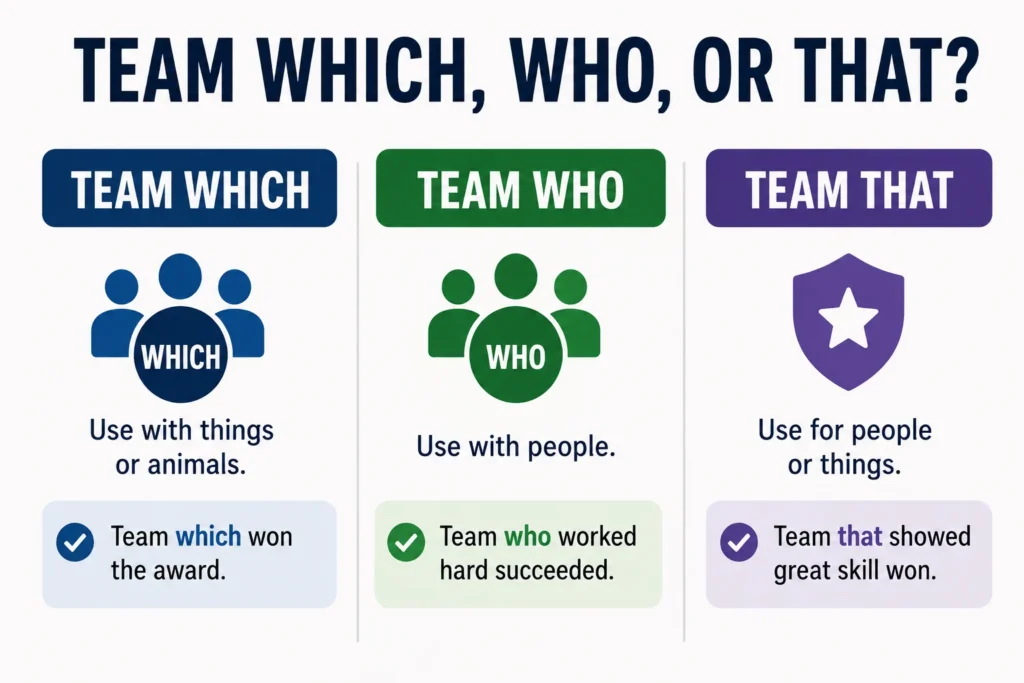
When you write a sentence such as “The team who won the match celebrated,” you may wonder whether who is correct. Perhaps “the team that won” sounds better. Then again, you may have seen “the team which won” in formal writing and wondered whether that version works too. The confusion makes sense because team names a group of people, yet grammatically it is a collective noun.
The good news is that the choice becomes much easier once you separate two ideas: what the relative pronoun refers to and what kind of relative clause follows it. Who normally points to people, which normally points to things or animals, and that can introduce a defining relative clause referring to people, animals, or things. English also allows who with collective human nouns such as team, committee, group, and panel.
That means there isn’t a single rule saying that team must always take who, or that team must always take that. Context decides. The punctuation and meaning of the relative clause matter, too.
What Makes “Team” a Special Word in English Grammar
The word team belongs to a group called collective nouns. A collective noun names a collection of individuals as one unit. Other familiar examples include family, committee, audience, company, government, class, staff, group, and jury.
This creates an interesting grammatical tension. A team contains several people, but the noun itself refers to one organized group.
Consider these two sentences:
The team is ready for the final.
The players are ready for the final.
The first sentence treats the team as one unit. The second focuses on the individual people within it. In standard American English, writers commonly use a singular verb when a team functions as a collective noun: the team is, the team has, the team wins.
That distinction becomes especially important when you choose a relative pronoun.
Why “Team” Can Work With “Who”
At first glance, who may seem wrong after team because team isn’t grammatically a person. However, English commonly allows who after collective nouns that represent groups of people. Cambridge Grammar specifically notes that who can be used with collective human nouns, including team, committee, government, group, panel, and police.
For example:
The team who worked late finished the project on time.
Here, who draws attention to the people who make up the team. The sentence isn’t merely describing an abstract organization. It highlights the human members and what they did.
Another example makes the distinction clearer:
The team that won the championship received a trophy.
This sentence treats the team as the group that achieved the result.
Now compare:
The team who trained together for months finally won.
This version puts more attention on the people involved in the training.
Neither sentence automatically becomes ungrammatical simply because the noun team appears before the relative pronoun. The intended reference matters.
Why “Team” Can Work With “That”
That has a broader grammatical range. In a defining relative clause, it can refer to people, animals, or things. Cambridge describes that as an alternative to who, whom, or which in defining relative clauses.
That makes the team that won a very natural construction.
For example:
The team that finished first qualified for the national tournament.
The phrase that finished first identifies which team the writer means. Without that information, the reader may not know which team is being discussed.
This is a defining relative clause because the information helps identify the noun.
Why “Team Which” Is More Limited
Which normally refers to things or animals rather than people.
So you should be careful with sentences such as:
The team which won the game celebrated afterward.
This construction can appear in English, particularly when the writer treats the team as an organization or entity. However, it doesn’t carry the same emphasis as the players who won the game.
The key distinction is simple:
- the players who won → focuses directly on people
- the team that won → treats the team as a unit
- the team, which won → can add information about an already identified team
That final comma matters. More on that distinction later.
Why This Matters in Real Writing

This isn’t just a grammar exercise. Choosing who, which, or that can affect how clearly your sentence communicates its meaning.
Imagine a sports report:
The team who scored three goals advanced to the final.
The writer may want to emphasize the people who achieved the result.
Now consider:
The team that scored three goals advanced to the final.
The second sentence identifies the team by its performance. It sounds especially natural when the writer needs to distinguish it from another team.
A business writer might use a similar structure:
The team that handles customer complaints meets every Monday.
Here, that handles customer complaints tells the reader which team the sentence means.
If the writer instead says:
The employees who handle customer complaints meet every Monday.
The focus shifts from the organizational unit to the individual employees.
That small change can make a sentence more precise.
The Core Rule: Choosing Between “Who,” “Which,” and “That”
The easiest way to understand these words is to stop treating them as interchangeable.
Each one has a typical job.
| Relative pronoun | Typical reference | Defining clause | Non-defining clause |
| who | People and sometimes collective human groups | Yes | Yes |
| which | Things and animals | Yes | Yes |
| that | People, animals, and things | Yes | No |
| whom | People as objects, especially in formal writing | Yes | Yes |
Cambridge Grammar gives the same broad distinction: who refers to people, which refers to animals and things, and that can replace who, whom, or which in defining clauses.
The important phrase here is defining clause.
A defining relative clause supplies information needed to identify the noun. A non-defining relative clause adds information that the reader doesn’t need to identify it. Cambridge notes that defining clauses provide essential identifying information, while non-defining clauses provide extra information and are set off with commas.
The Simple Breakdown
Think of the three main choices this way:
Who = people
The players who trained hardest improved the most.
That = defining information
The team that trained hardest improved the most.
Which = things or a group treated as an entity, especially in a non-defining clause
The team, which had trained all summer, looked confident.
There’s an important nuance here. This can also appear in defining clauses when it refers to a thing or entity. However, when the antecedent is a human collective such as team, who and that often provide a clearer choice depending on what the writer wants to emphasize.
The Most Useful Question to Ask
When you’re stuck, ask:
“Am I talking about the people, or am I identifying the team as a unit?”
If you mean the individual people:
The players who volunteered stayed late.
If you mean the team as a unit:
The team that volunteered stayed late.
If you’ve already identified the team and want to add extra information:
The team, which volunteered last week, received an award.
That question often solves the problem faster than trying to memorize a long grammar rule.
“Team Who” vs. “Team That”
The difference between team who and team that deserves special attention because both constructions can appear in real English.
When “Team Who” Makes Sense
Use who when the relative clause naturally highlights the people represented by the collective noun.
For example:
The team who worked through the night deserves recognition.
The relative clause who worked through the night describes the people who worked through the night.
Cambridge specifically recognizes who with collective groups of people.
This usage can feel particularly natural when the following verb describes a human action:
- the team who volunteered
- the team who helped
- the team who organized the event
- the team who worked together
- the team who responded quickly
Still, many writers prefer to remove any possible ambiguity by naming the people directly:
The players who worked through the night deserve recognition.
That version makes the human reference unmistakable.
When “Team That” Makes Sense
Use that when the clause identifies or defines the team.
For example:
The team that won the regional competition will represent the school.
The phrase that won the regional competition tells us which team the writer means.
You can use the same pattern in professional writing:
The team that manages our website will update the homepage.
Or in education:
The team that won the debate will represent the school at nationals.
Or in technology:
The team that developed the software released a security update.
In each case, the clause helps identify the particular team.
“Team Which” vs. “Team That”
The distinction between which and that becomes much clearer once you understand restrictive and nonrestrictive clauses.
Consider:
The team that won the final received a bonus.
The clause that won the final identifies the team.
Now consider:
The team, which won the final, received a bonus.
The commas tell the reader that which won the final is additional information. The sentence assumes that the reader already knows which team is being discussed.
This is not merely a punctuation preference. The meaning changes.
Restrictive Meaning
The team that won the final received a bonus.
There may be several teams, and the writer needs the relative clause to identify the relevant one.
Nonrestrictive Meaning
The team, which won the final, received a bonus.
The team has already been identified. The writer simply adds the fact that it won.
Cambridge explains that non-defining relative clauses use commas and cannot use that as their relative pronoun.
So this is standard:
The team, which won the final, celebrated afterward.
But this is not standard:
The team, that won the final, celebrated afterward.
The comma-and-that combination is one of the common errors worth avoiding.
A Quick Memory Trick
You don’t need to memorize dozens of grammar formulas.
Use this compact mental model:
Who → people
Which → things or entities
That → defining information
Then add one important qualification:
Who can also follow collective human nouns such as team.
That gives you a practical starting point without pretending that English grammar works through rigid one-word rules.
For example:
| Sentence | Main focus |
| The players who trained daily improved quickly. | Individual people |
| The team that trained daily improved quickly. | Team as a unit |
| The team, which trained daily, improved quickly. | Extra information about an identified team |
This framework works well because it connects grammar to meaning rather than forcing you to choose a pronoun mechanically.
What Writers Often Miss
One of the biggest mistakes is assuming that team automatically determines the relative pronoun.
It doesn’t.
The relative pronoun depends on the relationship between the noun and the clause that follows it.
Consider:
The team that won the game celebrated.
Here, that refers to team as the antecedent.
Now change the sentence:
The players who won the game celebrated.
The antecedent has changed from team to players, so who becomes the obvious choice?
This is why replacing team with players can be a useful editing test.
If your intended meaning is really about the members, write players, members, employees, students, or another precise human noun. If you mean the organized group, team may be the better noun.
Who, Which, and That in Relative Clauses
A relative clause gives more information about a noun or noun phrase. The relative pronoun connects that clause to the noun it describes. Cambridge defines a relative pronoun as a pronoun such as which, who, or that used to begin a relative clause.
Look at this sentence:
The team that won the tournament celebrated all night.
The basic sentence is:
The team celebrated all night.
The added clause is:
that won the tournament
That clause tells us which team the writer means.
The same structure works with who:
The players who won the tournament celebrated all night.
Again, the basic sentence is:
The players celebrated all night.
The relative clause supplies additional information about those players.
Subject vs. Object in the Relative Clause
Another useful detail is the grammatical role of the relative pronoun.
In:
The team that won the game celebrated.
That acts as the subject of won.
You can see the underlying structure:
The team won the game.
But in:
The team that the coach praised celebrated afterward.
That functions as the object of praised.
The underlying relationship is:
The coach praised the team.
English allows the relative pronoun to occupy different roles within the relative clause. Cambridge notes that who, which, and that can function as subjects or objects in relative clauses.
This distinction becomes useful when you decide whether a relative pronoun can be omitted.
For example:
The team that the coach praised celebrated.
In informal English, you can often say:
The team the coach praised celebrated.
The relative pronoun disappears because it functions as the object of praised.
But you cannot normally remove that from:
The team that won celebrated.
You cannot naturally write:
The team won celebrated.
Here, that functions as the subject of won, so it performs an essential grammatical job.
Why “Who” Isn’t Automatically Wrong After “Team”
Some grammar explanations oversimplify the issue by saying that who is for people and which is for things. That basic rule is useful, but collective nouns require a little more care.
A team consists of people. English can therefore use who with the collective noun when the clause refers to the human group. Cambridge explicitly includes team among collective human nouns that can take who.
For example:
The committee who approved the proposal met again.
The panel who reviewed the entries reached a decision.
The team who organized the fundraiser deserves praise.
The choice is understandable because the collective noun represents people.
However, if your goal is the clearest possible American English, you should consider whether players, members, or another specific noun would express the intended meaning more directly.
Compare:
The team who organized the event deserves praise.
with:
The team that organized the event deserves praise.
and:
The team members who organized the event deserve praise.
The third sentence removes the ambiguity completely. It tells the reader that the individual members, rather than the team considered as an organization, acted.
That’s often the strongest editorial choice.
A Practical Comparison Table
| If you mean… | Best natural choice | Example |
| Individual people | who | The players who trained improved quickly. |
| A team as an identified unit | that | The team that trained improved quickly. |
| Extra information about an already identified team | which | The team, which trained all summer, improved quickly. |
| A collective group of people performing an action | who can work | The team who volunteered stayed late. |
| A restrictive clause about the team | that is often natural | The team that won advanced. |
| A nonrestrictive clause | which, not that | The team, which won, advanced. |
The table isn’t a substitute for context, but it gives you a reliable starting point.
The Role of Punctuation
Punctuation provides one of the strongest clues in this topic.
Compare:
The team that won the championship received a trophy.
No comma appears before that.
Now:
The team, which won the championship, received a trophy.
The commas signal that the information is nonessential to identifying the team.
This difference follows the broader rule for defining and non-defining relative clauses. A defining clause identifies the person or thing being discussed. A non-defining clause adds information that isn’t necessary for identification.
A useful editing trick is to remove the relative clause.
Defining
The team that won the championship received a trophy.
Remove the clause:
The team received a trophy.
The reader may now wonder which team.
Non-defining
The team, which won the championship, received a trophy.
Remove the clause:
The team received a trophy.
The core meaning remains intact. The reader already knows which team the writer means.
That’s the real purpose of the comma.
Why “That” Cannot Replace “Which” Everywhere
A common misconception is that that can always replace which.
It can’t.
That works in defining relative clauses, but standard grammar does not use that to introduce a non-defining relative clause. Cambridge explicitly warns against this construction.
Correct:
The team that won the match advanced.
Correct:
The team, which won the match, advanced.
Incorrect in standard usage:
The team, that won the match, advanced.
The third sentence combines the punctuation and function of a non-defining clause with a relative pronoun normally used for defining clauses.
Think of the comma as a warning sign. When you place commas around the relative clause, that should immediately look suspicious.
What About “Which” Without a Comma?
This is where many explanations become too rigid.
Which can introduce a defining relative clause when it refers to a thing or entity. Cambridge gives examples such as “the box which says yes” and explains that which can function in both defining and non-defining clauses.
So the broader rule isn’t simply:
which = always comma
That’s inaccurate.
Instead:
- which can occur in defining clauses.
- which can occur in non-defining clauses.
- that can occur in defining clauses.
- that does not introduce standard non-defining clauses.
When the antecedent is team, however, the choice becomes a question of both grammar and meaning.
The Fastest Way to Choose
When editing a sentence, run through these questions:
Does the relative clause refer directly to people?
If yes, who is usually the clearest choice?
Does the clause identify which team you mean?
If yes, that is often the most natural option.
Has the team already been clearly identified, and are you adding extra information?
If yes, which with commas may be appropriate.
Would “players” or “team members” make the meaning clearer?
If yes, consider replacing team with a more precise noun.
For example:
The team who arrived early entered the stadium first.
Ask what you really mean.
If you mean the people:
The team members who arrived early entered the stadium first.
If you mean the team as a unit:
The team that arrived early entered the stadium first.
If the team has already been identified:
The team, which arrived early, entered the stadium first.
The grammar becomes much easier once the intended meaning comes first.
A Note on American English
Because this article focuses on US English, singular treatment of collective nouns deserves special attention.
American English generally treats a collective noun such as team as singular when the group acts as a unit
This doesn’t mean American English ignores the individuals within the group. Writers can shift to a plural noun when they want to focus on those individuals:
The players are ready.
The team members have different responsibilities.
That distinction gives you a clean way to control meaning without forcing the reader to infer what team represents.
In practical writing, clarity usually beats cleverness. If a sentence makes readers stop and ask whether who refers to the team or its members, a small rewrite can solve the problem.
Real-World Examples
Sports Writing
The team that won the semifinal advanced to the championship game.
This is a clear restrictive construction. The clause identifies the team.
The players who scored in the semifinal received special recognition.
Here, who clearly refers to people.
The team, which had struggled earlier in the season, finally found its rhythm.
The team is already identified. The writer adds background information.
Workplace Writing
The team that manages payroll will answer your question.
The clause identifies the relevant team.
The employees who manage payroll will answer your question.
The sentence focuses on the people.
The payroll team, which handles all employee records, meets every Friday.
The relative clause supplies additional information about an identified team.
School Writing
The debate team that won the regional competition will travel to the state tournament.
The defining clause identifies the team.
The students who prepared the final presentation stayed late.
The writer focuses on individual students.
The debate team, which has competed nationally for several years, has added new members.
The team is already known, and the writer adds background information.
A Small Case Study: Three Sentences, Three Meanings
Consider this short scenario: a school has several competition teams. One team won a regional event.
Sentence A
The team that won the regional event will travel to the state tournament.
This sentence identifies which team will travel. The clause is essential to the identification.
Sentence B
The students who won the regional event will travel to the state tournament.
Now the focus shifts to the students. The writer isn’t emphasizing the organization as a unit.
Sentence C
The team, which won the regional event, will travel to the state tournament.
This sentence assumes the reader already knows which team the writer means. Winning the regional event becomes additional information.
The underlying event remains the same. The grammatical framing changes the reader’s focus.
That’s why team who, team which, or team that isn’t really a matter of picking a winner from three interchangeable words. The right choice depends on the relationship between the noun, the relative clause, and the information the writer wants the reader to notice.
Expert Rule to Keep in Mind
Cambridge Grammar summarizes the central distinction clearly: “We use who in relative clauses to refer to people”, while which refers to animals and things, and that can replace those forms in defining clauses.
The special wrinkle is that team is a collective human noun. That’s why who can occur with it even though the noun itself names a group rather than one person.
That guideline won’t replace every possible grammar judgment, but it handles the vast majority of sentences you’ll encounter in ordinary writing.
Quick Reference: Team Who, Team Which, or Team That?
| Construction | Meaning | Example |
| team who | Focuses on the people represented by the team | The team who volunteered stayed late. |
| team that | Identifies or defines the team | The team that won advanced. |
| team, which | Adds extra information about an identified team | The team, which won, advanced. |
| players who | Clearly identifies individual people | The players who won celebrated. |
| team members who | Clearly identifies individual members | The team members who volunteered received awards. |
When in doubt, don’t force the sentence to fit a grammar rule. Instead, make the noun match the meaning you actually want.
If you mean people, say players, members, employees, or students when that wording gives the reader a clearer picture. If you mean the collective unit, keep team and choose the relative pronoun that fits the clause.
The result will usually sound more natural because the grammar follows the meaning instead of fighting it.
Collective Nouns in American vs. British English
A collective noun names a group as a single grammatical noun. Words such as team, family, committee, company, staff, government, audience, and group all fit this category. Cambridge defines a collective noun as a noun that describes a group of people or things as a unit.
The word team is especially interesting because its meaning naturally contains both ideas. A team consists of several people or animals working together, but we often talk about that collection as one organized unit. Cambridge defines team as a number of people or animals who do something together as a group.
That dual meaning explains why sentences involving team who, team which, and team that can feel less straightforward than sentences involving a clearly singular noun.
American English Tendency
In American English, collective nouns normally take a singular verb when the noun itself is the subject.
For example:
- The team is ready.
- The team has practiced all week.
- The team was celebrating after the victory.
- The committee has reached a decision.
- The company is expanding.
The basic pattern is simple: American English generally treats the collective noun as a single grammatical unit. The British Council specifically notes that American English uses singular verbs with collective nouns.
So, for US-focused writing, this is the safest default:
The team is playing well.
Not:
The team are playing well.
The second version may be acceptable in British English, but it doesn’t represent the usual American pattern.
Does “Team” Always Mean One Thing?
Not necessarily.
The noun team still represents multiple people. The difference lies in how the sentence presents those people.
Compare:
The team is working on the project.
This treats the team as one organized group.
Now compare:
The team members are working on different tasks.
This sentence explicitly focuses on individuals.
That distinction becomes useful when choosing a relative pronoun. If you want to emphasize the people, you can use a people-focused noun such as members, players, employees, or students. If you want to emphasize the group, keep team.
British English Flexibility
British English gives collective nouns more flexibility.
A British English writer can use either a singular or plural verb depending on whether the group is viewed as a single unit or as individual members. The British Council gives examples such as “My team is winning” and “My team are winning,” with the choice reflecting the writer’s view of the group.
For example:
The team is playing well.
This presents the team as one unit.
But:
The team is arguing among themselves.
This presents the members as individuals.
That distinction is common in British usage, especially in sports reporting and other contexts where individual members matter.
Why This Difference Exists
The difference comes from how English varieties handle the relationship between collective meaning and grammatical agreement.
American English generally makes the grammatical choice more predictable. The collective noun takes a singular verb:
The team is winning.
British English allows the writer to make the collective-versus-individual distinction directly through subject-verb agreement:
The team is winning.
or
The team is arguing among themselves.
The British Council explains this difference directly: British English can use a singular verb when the group is viewed as one unit and a plural verb when the members are viewed individually, while American English normally uses the singular form with collective nouns.
This doesn’t mean one system is more logical. They simply handle collective nouns differently.
Real-World Comparison
Consider a soccer team after a major win.
American English:
The team is celebrating in the locker room.
British English:
The team is celebrating in the dressing room.
Both sentences can communicate essentially the same event. The grammatical treatment differs because British English permits the collective noun to behave as plural when the writer focuses on its members.
Now look at a sentence involving a relative clause:
The team that won the final is celebrating.
The relative clause that won the final identifies the team. The main verb follows the American English pattern.
A British writer might still use:
The team that won the final are celebrating.
The relative pronoun doesn’t force the main verb to become plural. The difference comes from how the collective noun is treated in the surrounding sentence.
That’s an important point: the choice of who, which, or that and the choice of singular or plural verb are related, but they aren’t the same grammatical decision.
Practical Takeaway for US English
If your audience is primarily American, use a singular verb with team unless you’ve deliberately rewritten the sentence around plural nouns.
If you need to emphasize individual people, switch to a plural noun:
The players are…
The team members have…
The employees were…
That approach keeps the grammar clean and the meaning obvious.
Teams in Action: Sports, Workplace, and Media Usage
The question of team who, team which, or team that doesn’t live only in grammar books. You encounter these structures in sports reports, company announcements, school communications, news stories, websites, and everyday conversation.
The surrounding context often tells you what the writer wants to emphasize.
Sports Writing
Sports writing provides some of the clearest examples because a team operates both as a collective unit and as a collection of individual athletes.
Consider:
The team that won the championship returned home Monday.
The writer treats the team as a unit. The phrase that won the championship identifies which team is being discussed.
Now change the noun:
The players who won the championship returned home Monday.
The focus shifts to the athletes themselves.
This distinction becomes even clearer when the sentence describes individual actions:
The players who scored the winning goals received medals.
Using who feels natural because players clearly refers to people.
You could also write:
The team that scored the winning goals received medals.
Here, the team receives the credit collectively.
Why Sports Writers Sometimes Use “Who” With Team
Sports reporting frequently treats a team as a group of people rather than an abstract organization. Cambridge explicitly says that who is often used with collective human nouns, including team.
So a sentence such as:
The team who traveled to Boston arrived early.
can be understood because team represents the people who traveled.
However, that often sounds cleaner when the writer wants to identify the team:
The team that traveled to Boston arrived early.
If clarity matters more than preserving the collective noun, an even cleaner version may be:
The players who traveled to Boston arrived early.
This is one reason strong editing isn’t simply about asking, “Is this word technically possible?” A better question is, “Which version makes the intended meaning easiest to understand?”
Sports Headlines and Compressed Language
Headlines create another wrinkle because journalists often compress grammar to save space.
For example:
Team That Beat Rivals Advances to Final
A full sentence would be:
The team that beat its rivals advances to the final.
The headline version removes words without changing the basic relationship.
Sports writing also frequently uses team as a proper-style label:
In these cases, the expression functions as a named group. The surrounding sentence still determines whether the writer treats the group as a unit or focuses on its members.
Business Communication
The same grammar appears in professional settings.
Imagine a company has separate groups for sales, customer support, engineering, and product development.
You might write:
The team that handles customer support will contact you shortly.
The relative clause identifies the relevant team.
Now consider:
The employees who handle customer support will contact you shortly.
The second version focuses on the individual employees.
Both can be correct. The choice depends on what the reader needs to know.
A business document often benefits from team that because organizations frequently divide responsibilities into identifiable units:
- the team that manages payroll
- the team that handles technical support
- the team that reviews applications
- the team that develops new products
- the team that manages customer accounts
The relative clause tells the reader exactly which team has responsibility.
When “Who” Works in Business Writing
You may also encounter:
The team who manages your account will contact you.
Because team represents people, this construction is understandable and recognized in English grammar. Cambridge specifically includes team among collective human nouns that can take who.
Still, professional writers often have an easy alternative:
The team members who manage your account will contact you.
This version makes the human reference explicit.
That can be useful when the sentence describes an action performed by individuals rather than a function performed by the organization.
Media Usage
News and media writing often shifts between collective and individual perspectives.
For example:
The committee that investigated the issue released its report.
The committee functions as an identifiable body.
But:
The investigators who reviewed the evidence issued a statement.
The second sentence focuses on people.
The same principle applies to:
- editorial teams
- production teams
- research teams
- legal teams
- medical teams
- emergency response teams
- government teams
- design teams
When the group is functioning as an organization, that often fits naturally in a defining clause.
When the sentence highlights human actions, who can make sense.
Key Insight
The most useful lesson from sports, business, and media writing is this:
Don’t choose the relative pronoun based only on the noun immediately before it. Choose it based on what the relative clause actually describes.
That principle works across almost every context.
When “Team” Acts as One vs. Many
This distinction is at the heart of the entire topic.
A team can function as a single unit while still containing multiple people. The grammar changes when the writer stops focusing on the unit and starts focusing on its members.
When the Team Is ONE Unit
Treat the team as one unit when the group acts together toward a shared result.
In each sentence, the group behaves as one organized entity.
This is especially common in American English, where collective nouns generally take singular agreement.
You can think of it as viewing the team from a distance. You’re looking at the organization, squad, department, or unit as a whole.
When the Team Is MANY Individuals
Sometimes the sentence isn’t really about the group as one entity. It’s about what its individual members are doing.
Compare:
The team is discussing the problem.
with:
The team members are discussing different solutions.
The first sentence presents a collective action. The second explicitly separates the individuals.
This distinction can influence your relative pronoun choice.
For example:
The team that developed the software received an award.
The team receives recognition as a unit.
But:
The engineers who developed the software received individual awards.
Now the sentence focuses on people.
You don’t need to force who into the first sentence simply because humans performed the work. The noun team can represent the collective organization.
A Useful Meaning Test
Try replacing team with players or members.
If the sentence becomes clearer with the plural human noun, you may really be talking about individuals.
For example:
The team who arrived late missed the meeting.
Try:
The team members who arrived late missed the meeting.
The second sentence makes the intended meaning unmistakable.
Now try:
The team that arrived late missed the meeting.
This version naturally treats the team as a unit.
That quick substitution test can help you edit awkward sentences without memorizing complicated terminology.
Simple Decision Rule
Use this three-step approach:
First, identify the antecedent.
Ask what noun the relative pronoun refers to.
The team that won…
The antecedent is team.
Next, identify the purpose of the clause.
Does the clause identify the team?
The team that won the final…
Yes. It tells us which team.
Does it add extra information?
The team, which won the final,…
Yes. The team is already identified.
Does it focus on the people?
The players who won the final…
Yes. The noun itself clearly identifies people.
Finally, check the verb.
For American English:
For British English, plural agreement can occur when the writer views the members individually.
This final check catches many mistakes.
Team Who, Team Which, or Team That in Everyday Context
The same principles work outside formal writing.
Suppose someone asks:
Which team won?
You could answer:
The team that played on Saturday.
The clause identifies the team.
You might also say:
The team who played on Saturday.
This is understandable because who can be used with collective human nouns.
However, in a polished American English sentence, the team that played on Saturday is often the more neutral choice when the clause identifies the team.
Now imagine that everyone already knows which team you’re discussing:
The team, which played on Saturday, will practice again tomorrow.
The writer adds information rather than identifying the team.
Or perhaps the focus is clearly on individuals:
The players who played on Saturday will practice again tomorrow.
Three versions. Three slightly different perspectives.
The Same Pattern in School Writing
Consider a school robotics competition.
The robotics team that won the regional contest qualified for nationals.
The clause identifies the team.
The students who built the winning robot qualified for nationals.
The clause identifies the students.
The robotics team, which has competed for five years, qualified for nationals.
The team is already identified, and the writer adds background.
The grammar becomes much easier once you stop viewing who, which, and that as competing synonyms.
They perform different jobs.
Collective Nouns Beyond “Team”
Understanding team gives you a useful model for other collective nouns.
Consider committee:
The committee that reviewed the proposal issued a report.
Or:
The committee members who reviewed the proposal issued a report.
Consider company:
The company that developed the software released an update.
Or:
The employees who developed the software received recognition.
Consider family:
The family that moved into the house arrived yesterday.
Or:
The family members who moved into the house arrived yesterday.
The pattern remains consistent. A collective noun can represent a group, while a plural human noun can explicitly represent its members.
Cambridge lists team among group words used for collections of people such as scientists, researchers, experts, designers, and detectives.
This gives you a broader grammatical principle:
When a group noun creates ambiguity, name the members directly if the members are what you mean.
That isn’t merely a grammar trick. It’s a clarity strategy.
The Most Reliable US English Pattern
For an American English audience, the following framework is usually the easiest to apply:
| What you mean | Recommended pattern |
| The team as one unit | The team is… |
| Identify a particular team | The team that… |
| Focus on individual people | The players/members who… |
| Add information about an identified team | The team, which… |
| Collective noun with American singular agreement | The team has/is/was… |
| British-style individual focus | The team are… can occur |
The important thing is not to treat these patterns as isolated formulas. Think about meaning first, grammar second.
If you know what the sentence means, the grammatical choice becomes much easier.
A Final Editing Test
Before publishing a sentence involving team, who, which, or that, ask yourself five quick questions:
- Am I writing for American or British English readers?
- Does “team” mean one organized unit here?
- Am I actually talking about the individual members?
- Does the relative clause identify the team or merely add information?
- Would “players,” “members,” “employees,” or another specific noun make the sentence clearer?
And when the collective human noun itself is the focus, who remains a legitimate option.
That approach keeps your writing accurate without turning every sentence into a grammar puzzle.
Grammar Rules You Can Actually Rely On
The easiest way to handle team which, team who, and team that is to start with meaning rather than memorization. A relative pronoun connects a noun to a clause that describes or identifies it. With team, you need to decide whether you’re talking about the group as a unit, its individual members, or extra information about an already identified group.
For American English, the following rules give you a dependable framework.
Rule 1: Think Meaning First
Before choosing who, which, or that, ask what the sentence actually means.
If you’re talking about people, who usually provides the clearest reference:
The players who scored the goals received medals.
If you’re identifying a particular team, that often works naturally:
The team that scored the most goals won the tournament.
If the team has already been identified and you’re adding extra information, which can introduce a nonrestrictive clause:
The team, which scored five goals, won the tournament.
The grammar follows the meaning. That’s the key.
A useful way to think about it is to picture the noun as a camera lens. Team gives you a wide shot. Players or members zoom in on the people. Your relative pronoun should match the view you want the reader to see.
Rule 2: Default to Singular in American English
When a team acts as a collective noun in American English, use a singular verb.
This pattern applies even though a team contains several people.
The reason is grammatical agreement. Team is singular in form, and American English normally treats the group as one unit. The British Council notes that American English generally uses singular verbs with collective nouns, while British English allows more flexibility.
Don’t let the plural meaning of the group trick you into writing:
The team are ready.
For a US English audience, the team is ready is the normal choice.
If you specifically want to discuss the people, change the noun:
The team members are ready.
Now members is plural, so are is correct.
Rule 3: Use “Who” Carefully
Who normally refers to people. It can also follow collective human nouns when the group is understood as people. Cambridge specifically identifies team as one of the collective human nouns that can take who. (dictionary.cambridge.org)
For example:
The team who organized the fundraiser deserves recognition.
This sentence is understandable because the team consists of people who organized the event.
However, who isn’t always the clearest choice.
Compare:
The team who developed the application received an award.
with:
The developers who created the application received an award.
The second version tells the reader exactly who performed the action.
Another option is:
The team that developed the application received an award.
Here, that treats the team as the unit responsible for the work.
So don’t ask only, “Can I use who here?” Ask a better question:
“Does using who make my intended meaning clearer?”
If it does, keep it. If not, rewrite.
Rule 4: Avoid Mixing Forms
Consistency matters when you write about a collective group.
Consider this sentence:
The team are ready, and it has prepared for the game.
The sentence mixes plural and singular treatment of the same collective noun. British English may permit plural agreement in appropriate contexts, but this mixture isn’t a good choice for standard US English.
A cleaner American English version is:
The team is ready, and it has prepared for the game.
Or, if you mean the individual members:
The team members are ready, and they have prepared for the game.
The second sentence changes the noun so the plural pronouns and verbs have a clear antecedent.
This principle extends beyond verbs.
Avoid switching unnecessarily between team, players, members, they, it, who, that, and which when the reference isn’t clear. A reader shouldn’t have to stop and decode who or what each word represents.
Quick Decision Framework
When you’re unsure about team who, team which, or team that, use this decision process.
Start With the Noun
Ask:
What exactly am I referring to?
If you’re referring to the group itself, keep team.
If you’re referring to the people inside the group, consider players, members, employees, students, or another specific noun.
Check the Relative Clause
Next, ask:
What does the clause do?
If it identifies the team:
The team that won the final…
If it adds extra information:
The team, which won the final,…
If it describes people:
The players who won the final…
This three-way distinction solves most cases.
Use This Quick Chart
| Question | Likely choice | Example |
| Does it clearly refer to people? | who | The players who trained improved. |
| Does it identify a particular team? | that | The team that won advanced. |
| Does it add extra information about an identified team? | which | The team, which won, advanced. |
| Does the collective noun represent people performing an action? | who can work | The team who volunteered stayed late. |
| Is the sentence for US readers? | Singular agreement | The team is ready. |
| Do you mean individual members? | Plural human noun | The team members are ready. |
The table gives you a shortcut, but context still matters.
Common Mistakes Writers Keep Making
Certain mistakes appear again and again because English collective nouns don’t behave exactly like ordinary singular nouns.
Mistake 1: Overusing “Who”
Because who refers to people, writers sometimes assume that any noun representing people should take who.
That’s too broad.
Consider:
The team who won the championship celebrated.
This can work because team represents a group of people. But if the sentence’s main purpose is to identify the team, many writers will find this version more natural:
The team that won the championship celebrated.
Now consider:
The players who won the championship celebrated.
This is especially clear because players directly names people.
The problem isn’t that who is always wrong after team. The problem is assuming that who must be used simply because a team contains humans.
A good editor looks at the whole sentence.
Mistake 2: Mixing Singular and Plural
A collective noun can create agreement problems.
Incorrect for standard US English:
The team are preparing for its final match.
The sentence begins with plural agreement but ends with a singular possessive pronoun.
Better:
The team is preparing for its final match.
Or:
The team members are preparing for their final match.
The second version makes the individuals the subject.
This distinction is especially useful in long sentences because agreement errors can become difficult to spot.
Mistake 3: Choosing the Wrong Relative Pronoun
Writers sometimes choose a relative pronoun based on the nearest noun rather than the actual relationship.
Consider:
The players that won the final received medals.
This isn’t necessarily grammatically wrong. That can replace who in a defining relative clause referring to people. Cambridge recognizes this use.
However, players who won the final is often the more natural and explicit choice because players refers directly to people.
Now consider:
The team which won the final received a trophy.
This can work when team is treated as an entity, but if the writer simply wants to identify the team, that often provides a more direct option in American English:
The team that won the final received a trophy.
The lesson is not “never use which.” It’s “don’t choose a pronoun without considering the clause’s function.”
Restrictive vs. Nonrestrictive Clauses
The distinction between restrictive and nonrestrictive clauses sits underneath many of these choices.
A restrictive relative clause identifies the noun. It gives information the reader needs to know which person, group, or thing you mean.
A nonrestrictive relative clause gives additional information about a noun that has already been identified.
Restrictive Example
The team that won the tournament received a trophy.
Suppose a school has three teams. The phrase that won the tournament tells the reader which one you’re talking about.
Remove it:
The team received a trophy.
The sentence remains grammatical, but the reader may no longer know which team you mean.
Nonrestrictive Example
The team, which won the tournament, received a trophy.
Here, the reader already knows which team you’re discussing.
The phrase which won the tournament simply adds information.
Remove it:
The team received a trophy.
The basic identification remains intact.
Cambridge explains that defining relative clauses provide essential information and don’t use commas, while non-defining clauses provide additional information and use commas.
Why “That” Doesn’t Work After the Comma
A common error looks like this:
The team, that won the tournament, received a trophy.
Standard English doesn’t use that to introduce a non-defining relative clause.
Use:
The team, which won the tournament, received a trophy.
Or remove the commas and make the clause defining:
The team that won the tournament received a trophy.
The choice between the two versions isn’t cosmetic. It changes the role of the relative clause.
When “Which” Works After “Team”
The word which deserves a little nuance because simplified grammar advice sometimes makes it sound more restricted than it really is.
Which can refer to things and entities and can appear in both defining and non-defining relative clauses. Cambridge provides guidance showing that which can introduce defining clauses as well as non-defining clauses.
So:
The machine which failed was replaced.
can be grammatical.
Likewise:
The team which won the final received the trophy.
can occur when the writer conceptualizes the team as an entity.
But American English often favors that in defining clauses when the antecedent is a thing or organization:
The team that won the final received the trophy.
This makes that a useful default for many restrictive constructions.
For nonrestrictive information, which is the appropriate choice:
The team, which won the final, received the trophy.
The commas signal the difference.
When “Who” Works After “Team”
Now consider the opposite problem.
Some writers see team and immediately reject who.
That rule is too strict.
Cambridge explicitly states that who can be used with collective human nouns, including team.
For example:
The team who organized the charity event worked for weeks.
The clause describes the people represented by the team.
Another example:
The team who helped rebuild the playground received recognition.
The people in the team performed the action.
Still, clarity can improve when you name those people:
The team members who helped rebuild the playground received recognition.
This version eliminates the possible question of whether the writer means the team collectively or its members individually.
That’s why who after team is best viewed as a valid but context-sensitive option rather than an automatic choice.
How Pronoun Choice Changes Focus
A subtle but important point is that grammar can shape emphasis.
Compare these three sentences:
The team that developed the product received an award.
The team who developed the product received an award.
The engineers who developed the product received an award.
The first sentence presents the team as a unit responsible for the product.
The second emphasizes the people within the team.
The third removes any ambiguity by naming the people directly.
All three can communicate related information. They simply frame the action differently.
This is especially important in professional communication. If the award recognizes an organizational team, the first sentence may fit. If the award recognizes individual employees, the third sentence is much more precise.
Style Consistency in Writing
Grammar isn’t the only concern. Good writing also needs a consistent style.
Why Consistency Matters
Imagine an article that starts with:
The team is ready.
A few sentences later, it says:
The team are discussing their strategy.
Then it switches back:
The team has selected its captain.
For a US audience, that pattern feels unstable. The reader may wonder whether the writer is deliberately distinguishing the group from its members or simply switching forms.
If you mean the people:
The team members are discussing their strategy.
Now the shift is intentional and clear.
Business Writing Rule
In business writing, clarity usually matters more than preserving a collective noun.
Instead of:
The team who handles your account will contact you.
you might write:
The account team will contact you.
Or:
The team members who handle your account will contact you.
The best option depends on what the reader needs to know.
For customer-facing writing, the shortest clear version often wins:
The team handling your account will contact you.
Here, the relative pronoun disappears entirely.
Academic Writing Rule
Academic writing benefits from precise reference.
If you’re describing a research group, distinguish between the group and its researchers.
The research team that conducted the experiment published its findings.
The team acts as the unit.
But:
The researchers who conducted the experiment analyzed the data.
The individual researchers perform the action.
That distinction can prevent vague claims about who actually did the work.
Editorial Writing Rule
When editing, don’t automatically change every team who construction to team that.
First determine what the writer means.
Good editing isn’t about swapping words mechanically. It’s about making the intended meaning unmistakable.
A Detailed Decision Example
Suppose you’re writing about a company project team.
Your first draft says:
The team who developed the new payment system worked for six months.
Start with the meaning.
Who worked for six months?
The individual developers?
Or the project team as an organizational unit?
If you mean the unit:
The team that developed the new payment system worked for six months.
If you mean the people:
The developers who created the new payment system worked for six months.
If the team has already been introduced:
The team, which developed the new payment system, worked for six months.
Each version has a different information structure.
What the Three Versions Tell the Reader
| Version | Main idea |
| The team that developed… | Identifies the team |
| The team, which developed… | Adds information about an identified team |
| The developers who developed… | Focuses on individual people |
This is the practical heart of the issue.
Another Case Study: A Sports Team
Imagine a school has a varsity team, a junior varsity team, and a freshman team.
A teacher writes:
The team that won the tournament will attend the ceremony.
The relative clause identifies the team.
Now imagine everyone already knows which team is being discussed:
The varsity team, which won the tournament, will attend the ceremony.
The winning result becomes additional information.
Now suppose the ceremony recognizes individual athletes:
The players who won the tournament will attend the ceremony.
The noun has changed because the meaning has changed.
This case study demonstrates why grammar and precision work together. The best sentence isn’t necessarily the one with the most formal-sounding pronoun. It’s the one that tells the reader exactly what the writer means.
A Useful Rewrite Strategy
If team who feels awkward, you don’t have to choose between who and that immediately.
Try one of these rewrites.
Rewrite the Collective Noun
Original:
The team who completed the project received recognition.
Clearer:
The team members who completed the project received recognition.
Use “That” for the Team as a Unit
Original:
The team who completed the project received recognition.
Alternative:
The team that completed the project received recognition.
Remove the Relative Pronoun
Original:
The team that completed the project received recognition.
More concise:
The team completing the project received recognition.
This works when the reduced clause clearly communicates the intended meaning.
Name the People Directly
Original:
The team who completed the project received recognition.
More precise:
The engineers who completed the project received recognition.
This can be the strongest option when the identity of the individuals matters.
The Grammar Checklist
Before you publish a sentence containing team, run through this checklist:
- Does team refer to one collective unit?
- Does the sentence actually refer to individual members?
- Would players, members, employees, or researchers be more precise?
- Does the relative clause identify the team?
- Does the clause merely add information?
- If the clause is nonrestrictive, did you use commas?
- If you used that, did you avoid commas around the clause?
- If you’re writing US English, did you use a singular verb with team?
- Does the relative pronoun have a clear antecedent?
- Does the sentence sound natural when read aloud?
These checks take only a few seconds, yet they catch most problems in this area.
Team Which, Team Who, or Team That: Practical Summary
The three forms aren’t simply interchangeable labels.
Team who can work when who refers to the people represented by the team. This usage is recognized for collective human nouns.
Team that works naturally when that introduces a defining relative clause identifying the team.
Team which can work when which refers to the team as an entity. It becomes especially useful in a non-defining clause when commas set the extra information apart.
For US English, a practical hierarchy looks like this:
People → who
Identifying a team → that
Adding information about an identified team → which
Team as a collective noun → singular verb
When the sentence still feels awkward, don’t wrestle with the pronoun. Change the noun.
The team members who… is often clearer than the team who…
The team that… is often clearer than an unnecessarily complicated construction with which.
And the team, which… works well when the team has already been identified and you’re simply adding a useful detail.
The strongest grammar choice is usually the one that makes the relationship between the group, its members, and the action immediately obvious.
Practical Examples and Real-World Usage
The quickest way to master team which, team who, and team that is to see how these forms behave in real sentences. Grammar rules become much easier when you connect them to the meaning a writer actually wants to express.
Sports Headline Style
Sports writing frequently treats a team as a single competitive unit. That’s why that often fits naturally when the relative clause identifies a particular team.
The team that won the semifinal advanced to the championship.
The phrase that won the semifinal tells readers which team advanced. It defines the noun team, so the clause doesn’t need commas.
Now change the focus:
The players who scored the winning goals received awards.
Here, who clearly refers to people. The noun players removes any uncertainty.
You can also add background information about a team that readers already know:
The team, which had struggled earlier in the season, found its rhythm at the right time.
The commas show that which had struggled earlier in the season adds information rather than identifying the team.
This three-way pattern appears frequently in sports writing:
| Sentence | What the writer emphasizes |
| The team that won the semifinal advanced. | Identifying the team |
| The players who scored advanced. | Individual people |
| The team, which had struggled earlier, advanced. | Extra information |
A headline might shorten the first example:
Team That Won Semifinal Advances
Headlines often remove articles and other small words to save space. The underlying grammar remains recognizable.
Corporate Communication
The same distinction matters in workplace writing.
Suppose a company has several internal teams. You could write:
The team that handles payroll will answer your question.
The relative clause identifies the team responsible for payroll.
If the company wants to emphasize individual employees, a more precise sentence would be:
The employees who handle payroll will answer your question.
Now consider a team that has already been introduced:
The payroll team, which handles employee records, meets every Friday.
The clause adds information about the team. It doesn’t tell the reader which team you mean because the payroll team already provides that information.
A useful business-writing principle follows from these examples:
Choose the noun and relative pronoun together.
Don’t automatically use who simply because a team contains people. Don’t automatically use that simply because you’re writing about an organization. First decide whether the sentence emphasizes the group, its members, or additional information.
Everyday Usage
You may encounter these constructions in ordinary conversation, too.
That’s the team that won last year.
Here, that won last year identifies the team.
Those are the players who won last year.
Here, who won last year identifies the players.
That’s the team, which won last year, that everyone keeps talking about.
This sentence is grammatically possible but unnecessarily complicated. A clearer version would be:
That’s the team that won last year.
This example highlights another important rule: grammatically possible doesn’t always mean stylistically effective.
Good writing removes unnecessary complexity.
Case Study: Why Grammar Choice Changes Meaning
Consider a company with three software development teams: Alpha, Beta, and Gamma. Alpha created a new customer portal.
Now imagine three different sentences.
Sentence A
The team that created the customer portal received recognition.
This sentence identifies the team.
The phrase that created the customer portal tells readers which team received recognition. If several teams exist, that information matters.
Sentence B
The developers who created the customer portal received recognition.
This sentence focuses on the individual developers.
The writer isn’t emphasizing the organizational team. The people who performed the work are the grammatical focus.
Sentence C
The team, which created the customer portal, received recognition.
This sentence assumes that readers already know which team is being discussed.
The writer simply adds the fact that the team created the portal.
What Changes?
The underlying event stays the same. Alpha created the portal and received recognition.
However, the information structure changes.
| Version | Relative pronoun | Main focus | Clause type |
| The team that created… | that | Identifies the team | Defining |
| The developers who created… | who | Identifies the people | Defining |
| The team, which created… | which | Adds information | Non-defining |
This is why punctuation and word choice aren’t merely cosmetic details.
They tell readers how to interpret the information.
Sentence A: “The Team That Created the Portal”
This version is ideal when the identity of the team matters.
Suppose your reader doesn’t know which team you’re discussing. The defining clause supplies the missing information.
The team that created the customer portal received recognition.
Remove the clause:
The team received recognition.
Now the reader may ask, Which team?
That question proves why the clause is defining.
The phrase that created the customer portal narrows the meaning of the team.
This construction works in many settings:
- The team that won the competition
- The team that designed the website
- The team that manages customer accounts
- The team that developed the software
- The team that organized the event
- The team that reviewed the proposal
In each example, that introduces information that helps identify the team.
Sentence B: “The Developers Who Created the Portal”
Now suppose the company wants to recognize the individual people who built the portal.
The developers who created the customer portal received recognition.
Here, who is a natural choice because developers clearly refers to people.
This structure works across professions:
The engineers who designed the system…
The researchers who conducted the study…
The students who entered the competition…
The employees who completed the training…
The players who scored the goals…
The rule becomes almost automatic because the antecedent clearly names people.
This is one reason team members who can sometimes improve a sentence that originally uses team who.
Compare:
The team who created the portal received recognition.
with:
The team members who created the portal received recognition.
The second sentence explicitly identifies the people involved.
Sentence C: “The Team, Which Created the Portal”
Now imagine the team has already been identified.
Perhaps the previous sentence said:
The Alpha development team has worked on the project since January.
The next sentence might say:
The team, which created the customer portal, received recognition.
The relative clause now provides additional information.
If you remove it:
The team received recognition.
The reader still knows which team you mean.
That’s the defining feature of a non-defining relative clause.
Because the information is additional, commas separate the clause from the main sentence.
Standard grammar uses which rather than that for this type of clause. Cambridge’s guidance distinguishes defining clauses from non-defining clauses and notes that non-defining clauses use commas and do not use that.
Common Sentence Patterns You Can Reuse
Once you understand the meaning, these patterns become easy to adapt.
Pattern: Identifying a Team
The team that + verb + …
Pattern: Identifying People
The people/players/members who + verb + …
Examples:
The players who scored received medals.
The members who volunteered stayed late.
The employees who completed the training received certificates.
Pattern: Adding Information
The team, which + verb + …, …
Examples:
The team, which trained throughout the summer, looked confident.
The research team, which published its findings last month, has started another study.
The design team, which includes five specialists, meets every Tuesday.
These patterns cover a large share of practical writing involving collective groups.
Quotes From Language Experts
The central rules aren’t based on a personal preference about what sounds good.
Cambridge Dictionary explains that who refers to people and notes that collective human nouns such as team can take who. It also explains that that can replace who, whom, or which in defining relative clauses.
Cambridge also explains the defining/non-defining distinction: defining relative clauses identify the person or thing being discussed, while non-defining clauses add information and use commas.For collective-noun agreement, the British Council explains that American English generally uses singular verbs with collective nouns, while British English can use either singular or plural agreement depending on whether the group is viewed as a unit or as individuals.
These sources support a useful practical conclusion: grammar depends on both structure and meaning.
Final Practical Takeaways
If you’re writing for an American English audience, keep the main rules close at hand.
Use “Who” for People
Use who when the antecedent clearly refers to people:
The players who trained hardest improved the most.
You can also use who with a collective human noun such as team when the clause naturally refers to the people represented by that group.
Use “That” to Identify a Team
Use that when a defining clause identifies the particular team you’re talking about:
The team that won the final advanced to the next round.
The clause is essential to identifying the team, so don’t put commas around it.
Use “Which” for Additional Information
Use which when a non-defining clause adds information about an already identified team:
The team, which won the final, advanced to the next round.
The commas show that the information is additional.
Remember American Singular AgreementFor standard US English:
If you mean individual members
The players are ready.
The team members have arrived.
This distinction keeps the sentence consistent.
Don’t Treat “Who,” “Which,” and “That” as Simple Synonyms
They overlap in some contexts, but they don’t perform identical jobs.
Who normally points to people.
Which generally refers to things or entities and can introduce defining or non-defining clauses.
That can refer to people, animals, or things in defining relative clauses but doesn’t introduce a standard non-defining clause.
Use Clarity as the Final Test
If a sentence feels awkward, don’t keep swapping pronouns until one sounds acceptable.
Change the noun if necessary.
Instead of:
The team who completed the project…
try:
The team members who completed the project…
Or:
The team that completed the project…
The best version depends on whether you mean the people or the group.
A One-Minute Grammar Test
Before you publish, ask yourself:
Who or what does the relative pronoun refer to?
If the answer is individual people, who is usually the natural choice.
Does the clause identify the team?
If yes, that is often the clearest option.
Does the clause add information about an already identified team?
If yes, which with commas may be appropriate.
Does “team” really mean the individual members?
If so, consider replacing it with players, members, employees, students, or another precise noun.
Are you writing American English?
If so, treat team as singular when it acts as a collective noun.
These checks take seconds but prevent a surprising number of grammar problems.
The central lesson is straightforward: team who, team which, and team that aren’t competing choices with one universal winner. Each construction can serve a different purpose. Once you identify whether the sentence focuses on the people, the team as a unit, or additional information about an identified team, the right structure becomes much easier to choose.
And when none of the options feels clean, rewrite the sentence. Clear English doesn’t have to force a reader through a grammatical maze.
Conclusion
Choosing between team which, team who, and team that becomes much easier once you focus on meaning and sentence structure. In American English, who generally works best when you clearly mean people, while that often identifies a specific team in a defining clause. Which works well when you add extra information about an already identified team, especially when commas set off the clause. Remember that team usually takes a singular verb in US English when it acts as one unit. If you’re actually talking about individual members, words such as players, members, or employees may create a clearer sentence. The goal isn’t to memorize a rigid formula. Instead, consider what your sentence means, choose the structure that expresses that meaning, and keep your wording consistent. With these simple rules, you can write about teams confidently and naturally.
FAQs
Is “team who” grammatically correct?
Yes, team who can be grammatically correct when who refers to the people within the team. For example, “The team who organized the event worked hard” treats the team as a group of people. However, team that may sound more natural when you mean the team as a single organizational unit.
Should I say “team which” or “team who”?
The choice depends on what you’re emphasizing. Use who when the clause focuses on people represented by the team. Use which when referring to the team as an entity, especially when adding nonessential information. In American English, that is often a natural choice when a clause identifies a particular team.
Is “the team that” grammatically correct?
Yes, the team that is completely grammatical. It commonly introduces a defining relative clause that identifies which team you’re discussing. For example, “The team that won the championship received a trophy.” The clause identifies the team, so commas aren’t normally used around that.
Can I use “which” after the word “team”?
Yes, which can follow team when the sentence treats the team as an entity. It’s especially common in a non-defining clause: “The team, which won the championship, celebrated afterward.” The commas show that the information is additional rather than necessary to identify the team.
Does “team” take a singular or plural verb?
In standard American English, team usually takes a singular verb when it functions as a collective noun. You would normally write, “The team is ready” or “The team has arrived.” If you mean individual members, use a plural noun such as team members and write, “The team members are ready.”
Can “who” refer to a team?
Yes. Who can refer to a collective human noun such as team when the sentence focuses on the people within that group. For example, “The team who volunteered stayed late.” Still, team members who volunteered can provide greater clarity when the individual people are the real focus.
When should I use “that” instead of “who” with team?
Use that when a defining clause identifies the particular team you mean. For example, “The team that won the final advanced to the next round.” Although who can sometimes refer to a team as a group of people, that often presents the team as one unit.
What is the difference between “the team that” and “the team which”?
Both can introduce relative clauses, but they often serve different stylistic purposes. That commonly introduces a defining clause that identifies the team. Which can introduce additional information, particularly in a non-defining clause set off by commas. The meaning and punctuation help determine the better choice.
Is “the team who” better than “the team that”?
Not necessarily. Neither is automatically better in every sentence. The team that often works well when identifying the team as a unit, while the team who can work when the people within the team are the focus. If clarity matters, team members who may be the strongest option.
How can I remember which relative pronoun to use with team?
Think about what you want the reader to see. When the sentence still feels unclear, rewrite it with team members or another precise noun.