
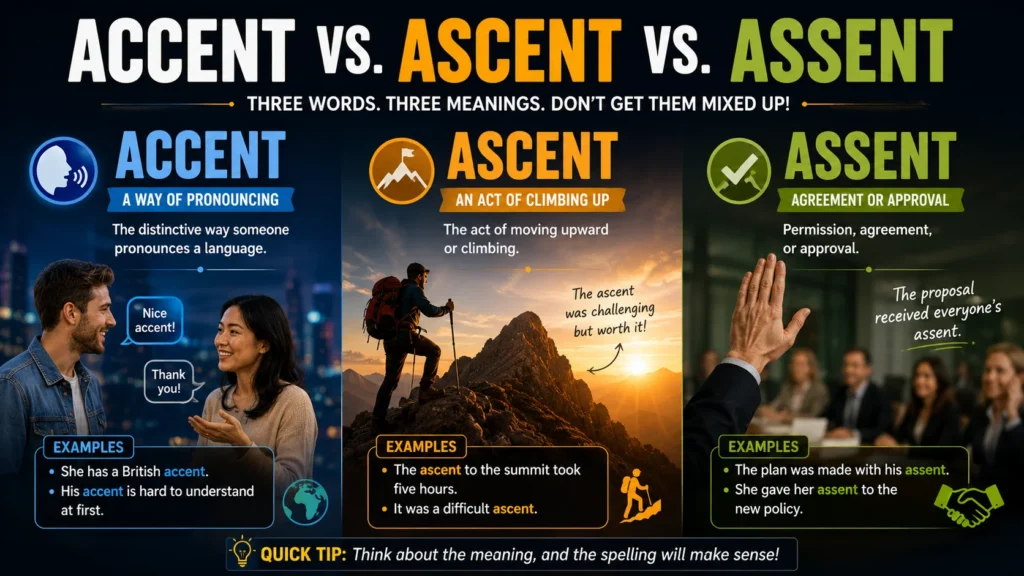
If accent, ascent, and assent keep getting mixed up, the problem is understandable. They look remarkably alike, and ascent and assent are pronounced /əˈsent/ in standard American English. Accent is different: as a noun, it is commonly pronounced /ˈæk.sent/, while the verb can have a different stress pattern. The spellings may differ by only a few letters, but the meanings live in completely different worlds.
The quickest way to separate them is simple:
| Word | Main meaning | Part of speech | Easy clue | Example |
| Accent | A way of pronouncing words; also emphasis | Noun, verb | Speech | She has a noticeable regional accent. |
| Ascent | Movement upward or a climb | Noun | Up | The hikers began their ascent. |
| Assent | Agreement or approval | Noun, verb | Agree | The board gave its assent. |
So, when you mean pronunciation or emphasis, use accent. When something moves upward, choose ascent. When someone agrees to an idea, plan, or request, assent is the word you want. Merriam-Webster defines ascent as rising or mounting upward and also uses it for advancement, while Cambridge defines assent as agreement or official approval.
Why Are Accent, Ascent, and Assent So Easy to Confuse?
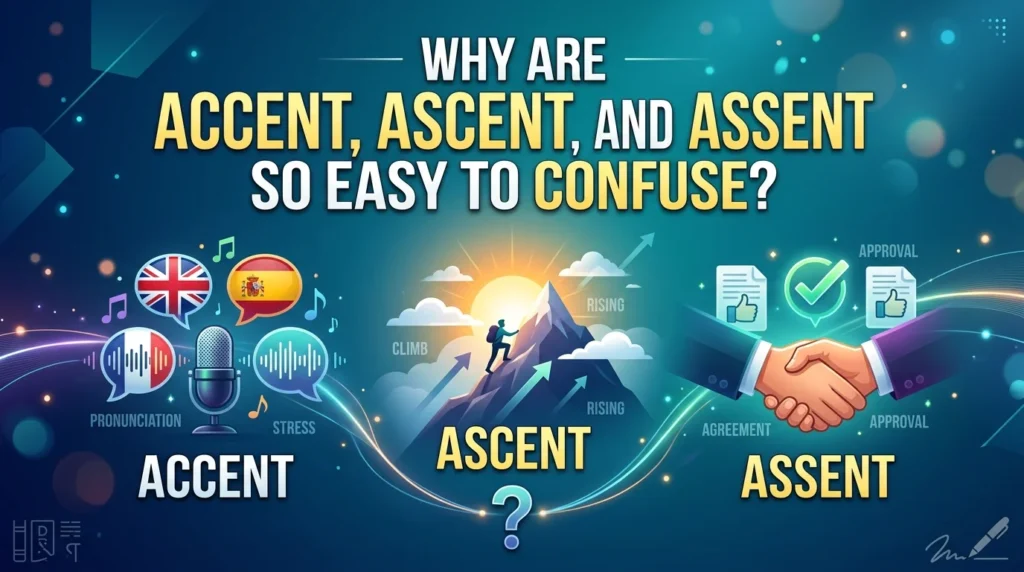
English has plenty of words that look or sound alike while carrying unrelated meanings. Accent, ascent, and assent are especially troublesome because the visual difference is small. A single letter can completely change the word you need.
There is also an important pronunciation detail. Ascent and assent are pronounced alike in standard US English: /əˈsent/. Accent, when used as the noun most people mean in this comparison, has initial stress: /ˈæk.sent/.
That means ascent and assent can be genuine homophones in American English. Accent is not normally a homophone of those two. This distinction matters because people sometimes describe all three as homophones simply because they look similar.
Are Accent, Ascent, and Assent Homophones?
Not exactly.
Ascent and assent are homophones because they have the same pronunciation but different spellings and meanings.
Accent is different in its common noun pronunciation:
- accent — /ˈæk.sent/
- ascent — /əˈsent/
- assent — /əˈsent/
The difference becomes obvious when you say them aloud.
Accent sounds like “AK-sent.”
Ascent sounds like “uh-SENT.”
Assent sounds like “uh-SENT.”
Pronunciation can vary somewhat by speaker or dialect, but the standard US dictionary pronunciations make the distinction clear.
Why Does Context Matter?
Suppose someone says:
“The group gave its ___ to the proposal.”
The answer has to be assent because the sentence describes agreement.
Now consider:
“The climbers began their ___ before sunrise.”
That requires ascent because the climbers are moving upward.
Finally:
“I could hear her Southern ___ immediately.”
Here, accent is correct because the sentence concerns pronunciation.
The surrounding words act like signposts.
Accent: Meaning, Grammar, and Usage
Accent has a wider range of meanings than many learners realize. In everyday English, it most often refers to pronunciation. However, dictionaries also recognize meanings involving stress, emphasis, written marks, music, and even visual design. Merriam-Webster traces the noun to Middle English and ultimately to Latin accentus, connected with singing or vocal modulation.
That broader meaning explains why you can encounter accent in several very different contexts.
What Does “Accent” Mean?
The most familiar meaning is a particular way of pronouncing a language.
For example:
- She speaks English with a French accent.
- His New York accent is easy to recognize.
- I noticed her British accent during the interview.
- The actor worked hard to develop an authentic Irish accent.
An accent can reflect where someone grew up, where they have lived, their linguistic background, or the communities they interact with. Having an accent does not mean someone speaks a language incorrectly.
In fact, every native speaker has an accent. The term simply describes patterns of pronunciation.
Accent can also mean emphasis. In speech, a speaker may place extra stress on a particular word to make an idea stand out.
For example:
“I said Tuesday, not Thursday.”
The speaker emphasizes Tuesday because that detail matters.
Merriam-Webster also lists accent as a mark used in writing, greater stress in music, and an emphasized feature in art or design.
Is “Accent” a Noun or a Verb?
Accent works primarily as a noun, but it can also function as a verb.
As a noun:
“She has a strong regional accent.”
Here, accent identifies a characteristic way of speaking.
As a verb, accent means to emphasize, highlight, or stress something.
“The designer used lighting to accent the room.”
It can also refer to stressing part of a spoken word:
“Accent the first syllable.”
Merriam-Webster lists both noun and verb forms and notes that the verb can mean giving something special attention or prominence.
One useful point for learners is that accent as a verb may be pronounced differently from the noun. The noun commonly carries stress on the first syllable, while the verb can carry stress on the second.
Accent in Language and Pronunciation
When linguists discuss accents, they are talking about patterns of pronunciation.
These patterns can include:
- vowel sounds
- consonant sounds
- rhythm
- intonation
- stress
- connected speech
- reductions
- syllable timing
For instance, speakers of different English varieties may pronounce the same vowel differently. Someone from one region may pronounce a word with a sound that differs noticeably from the version used by someone elsewhere.
That doesn’t automatically make one version more correct.
A common misconception is that an accent means a person speaks with “incorrect English.” That’s not how the term works. An accent is simply a systematic way of producing speech.
Accent vs. Dialect: What’s the Difference?
Accent and dialect overlap, but they aren’t interchangeable.
An accent mainly concerns pronunciation.
A dialect can involve pronunciation plus vocabulary, grammar, and sentence patterns.
Consider two speakers who use the same grammar and vocabulary but pronounce certain vowels differently. They may have different accents.
Now imagine two regional varieties that differ not only in pronunciation but also in vocabulary and grammatical structures. Calling those differences merely an accent would leave out important information.
A useful shortcut is:
| Term | Mainly refers to |
| Accent | Pronunciation |
| Dialect | Pronunciation, vocabulary, grammar, and usage |
This distinction becomes particularly useful when writing about regional varieties of English.
Accent Marks in Writing
The word accent doesn’t only belong to spoken language.
In writing, an accent mark is a diacritical mark that can indicate pronunciation, stress, pitch, or another feature of a letter. Examples include marks such as é, è, and ê.
These marks appear in many languages and can distinguish words or indicate how a letter should sound.
For English learners, this creates another possible source of confusion: accent can refer both to a feature of spoken language and to a written mark.
Those meanings are related historically and conceptually, but the context tells you which one applies.
Common Mistakes With “Accent”
A frequent mistake is using accent when the sentence actually describes upward movement.
Incorrect:
“The plane began its accent.”
Correct:
“The plane began its ascent.”
Another mistake is choosing accent when the intended meaning is agreement.
Incorrect:
“The committee gave its accent to the proposal.”
Correct:
“The committee gave its assent to the proposal.”
The best defense is to stop looking at the first few letters and ask what the sentence means.
Ascent: Meaning, Grammar, and Usage
Ascent belongs to a completely different semantic family. It describes movement from a lower position to a higher one. Merriam-Webster defines it as the act of rising or mounting upward and also gives meanings related to an upward slope, elevation, and advancement in status or reputation.
The word is a noun.
That grammatical point helps distinguish it from ascend, which is a verb.
What Does “Ascent” Mean?
In its basic sense, ascent means an upward movement or climb.
For example:
“The hikers began their ascent at dawn.”
The hikers are moving upward.
You can use the word for:
- mountains
- hills
- stairs
- aircraft
- roads
- slopes
- balloons
- figurative progress
The central idea never changes: something moves from a lower point toward a higher one.
Literal Meaning of “Ascent”
The literal meaning is easiest to visualize.
Imagine a mountain trail. The group starts near the bottom and gradually moves toward the summit. Their journey upward is their ascent.
You might say:
- “The final ascent was steep.”
- “The climbers completed their ascent before sunset.”
- “The aircraft began its ascent after takeoff.”
- “The steep ascent tested everyone’s endurance.”
Merriam-Webster specifically includes an upward slope or rising grade among the meanings of ascent.
So ascent doesn’t always describe the action of a person actively climbing. It can describe the upward route itself.
“The road has a difficult ascent.”
Here, the road isn’t “climbing” in a literal human sense. The noun describes its upward slope.
Figurative Meaning of “Ascent”
English often turns physical movement into a metaphor for progress.
That’s exactly what happens with ascent.
Someone can experience an ascent in status, reputation, influence, wealth, or career success. Merriam-Webster includes advancement in social status or reputation as a figurative meaning.
For example:
“Her rapid ascent in the company surprised everyone.”
Nobody is physically climbing a staircase. The sentence describes professional advancement.
You may also see phrases such as:
- ascent to power
- ascent to fame
- rapid ascent
- meteoric ascent
- political ascent
This figurative use gives the word a more polished or formal tone than everyday expressions such as rise or climb.
Ascent vs. Ascend
This distinction is extremely important.
Ascent is a noun.
Ascend is a verb.
Compare:
“The hikers began their ascent.”
“The hikers began to ascend the mountain.”
Both sentences describe upward movement, but the grammatical structures differ.
Merriam-Webster defines ascend as moving upward, rising from a lower level, or going up. It can be used both intransitively and transitively.
| Noun | Verb |
| ascent | ascend |
| Their ascent was difficult. | They ascended the mountain. |
| The aircraft began its ascent. | The aircraft ascended rapidly. |
A quick memory trick works well: ascent names the upward movement; ascend describes the action.
Ascent vs. Climb
Ascent and climb can overlap, but they don’t always sound equally natural.
Climb is more common in everyday speech:
“The climb was exhausting.”
Ascent often sounds more formal or descriptive:
“The ascent was exhausting.”
The difference becomes even clearer when grammar enters the picture. Climb can function as both a noun and a verb:
“We climbed the hill.”
“The climb took two hours.”
Ascent is primarily a noun:
“The ascent took two hours.”
You wouldn’t normally replace climbed with ascent because the sentence needs a verb.
Ascent vs. Descent
These two words form a useful opposite pair.
- Ascent = movement upward
- Descent = movement downward
For example:
“The aircraft began its ascent after takeoff.”
“The aircraft began its descent before landing.”
This contrast is one of the easiest ways to remember ascent.
Think of an elevator:
ascent → going up
descent → going down
The same relationship works figuratively:
“His rapid ascent to leadership was followed by a sudden descent in popularity.”
Common Mistakes With “Ascent”
The biggest mistake is confusing ascent with accent.
Incorrect:
“The mountain accent was exhausting.”
Correct:
“The mountain ascent was exhausting.”
Another common error involves ascend.
Incorrect:
“The hikers began to ascent the mountain.”
Correct:
“The hikers began to ascend the mountain.”
Or:
“The hikers began their ascent.”
The difference is grammatical, not merely spelling-based.
Assent: Meaning, Grammar, and Usage
Assent moves us away from physical direction and into the world of agreement.
Cambridge defines assent as official agreement or approval of an idea, plan, or request. It lists the word as both a formal noun and a formal verb.
The word is especially common in formal, professional, legal, governmental, and academic writing.
What Does “Assent” Mean?
To assent means to agree to something or give approval.
As a noun:
“The committee gave its assent to the proposal.”
As a verb:
“The committee assented to the proposal.”
The meaning is closely related to agree, but assent often carries a more formal tone.
Cambridge’s American dictionary describes the noun as agreement with an idea, plan, or request, especially after serious consideration.
That makes the word particularly useful when the agreement has some official, deliberate, or procedural quality.
Assent as a Noun
As a noun, assent refers to the agreement itself.
Common structures include:
- give assent
- receive assent
- with someone’s assent
- seek assent
- obtain assent
- nod of assent
For example:
“The directors gave their assent to the proposal.”
“The agreement required the client’s assent.”
“She nodded in assent.”
The noun is uncountable in its most common general use, although specialized legal usage can differ. Cambridge lists the standard noun as [U], meaning it is normally uncountable in that sense.
Assent as a Verb
Assent can also function as a verb.
The most important pattern to remember is:
assent to + something
For example:
“They assented to the terms of the agreement.”
“The manager assented to the proposed changes.”
Cambridge specifically gives assent to as the standard construction.
This is worth memorizing because learners sometimes try to use assent exactly like agree.
You can say:
“They agreed to the terms.”
You can also say:
“They assented to the terms.”
But you should not casually copy every grammatical pattern from agree onto assent.
Assent in Formal, Professional, and Legal English
You are more likely to encounter assent in formal writing than in casual conversation.
A business document might say:
“The transaction proceeded with the board’s assent.”
A formal report might say:
“The members assented to the revised terms.”
A legal context may use the word when describing a person’s agreement to a condition or arrangement.
This doesn’t mean the word is restricted to lawyers. It simply means that agree is usually the more natural choice in ordinary conversation.
Compare:
“Do you agree with this plan?”
with:
“Do you assent to this plan?”
Both can communicate agreement, but the second sounds considerably more formal.
Royal Assent
Royal Assent is a specialized constitutional term.
In the United Kingdom, a bill passed by Parliament must receive Royal Assent before it can become law. Cambridge describes Royal Assent as an official signature from the monarch.
This is a useful example because it shows how assent can move beyond ordinary agreement into a formal institutional process.
However, don’t assume that every use of assent has a constitutional meaning. In most contexts, it simply means agreement or approval.
Common Collocations With Assent
Collocations are word combinations that naturally occur together.
Useful combinations include:
- give assent
- seek assent
- receive assent
- with the assent of
- assent to a proposal
- assent to a request
- assent to the terms
- nod of assent
Learning these patterns can make your writing sound more natural because you aren’t building the sentence word by word.
Assent vs. Consent
Assent and consent overlap because both can involve agreement. Yet they aren’t perfect synonyms.
Assent emphasizes agreement or approval.
Consent often emphasizes permission or willingness, particularly when someone has the authority to allow something.
Compare:
“The board gave its assent to the proposal.”
This focuses on approval.
Now:
“The patient gave consent to the procedure.”
This focuses on permission.
The two words can overlap in some contexts, but context determines which one communicates the intended idea more precisely.
Common Mistakes With “Assent”
A frequent spelling error is:
“The committee gave its accent.”
If the committee is agreeing, the correct word is:
“The committee gave its assent.”
Another mistake is:
“The climbers began their assent.”
That would mean they agreed to something rather than climbed upward.
The correct sentence is:
“The climbers began their ascent.”
Accent vs. Ascent vs. Assent: Side-by-Side Comparison
Once the individual meanings are clear, the three words become much easier to separate.
| Feature | Accent | Ascent | Assent |
| Core idea | Speech, pronunciation, emphasis | Upward movement | Agreement or approval |
| Common grammar | Noun, verb | Noun | Noun, verb |
| US pronunciation | /ˈæk.sent/ as a noun | /əˈsent/ | /əˈsent/ |
| Related word | accentuate | ascend | agree |
| Opposite/contrast | — | descent | dissent |
| Typical context | Language and speech | Climbing and rising | Approval and agreement |
| Example | “Her accent was easy to recognize.” | “The ascent was steep.” | “They gave their assent.” |
The table reveals an important pattern: ascent and assent are the pair most likely to create pronunciation-based confusion.
They sound the same, but their meanings are worlds apart.
Difference in Meaning
Think of three mental pictures.For accent, picture someone speaking.For ascent, picture someone climbing.For assent, picture someone nodding yes.
Those images capture the central meanings remarkably well.
Accent = how something sounds.
Ascent = something goes up.
Assent = someone says yes.
That three-part distinction handles most everyday situations.
Difference in Grammar
Grammar provides another useful clue.
Accent can work as a noun:
“Her accent is distinctive.”
It can also work as a verb:
“The lighting accents the painting.”
Ascent is a noun:
“The ascent was difficult.”
The related verb is ascend:
“They ascended the mountain.”
Assent can be a noun:
“We received their assent.”
It can also be a verb:
“They assented to the proposal.”
Knowing these grammatical forms prevents many errors before they happen.
Difference in Pronunciation
For standard American English:
- accent — /ˈæk.sent/ as a noun
- ascent — /əˈsent/
- assent — /əˈsent/
So the most important pronunciation distinction is between accent and the other two.
Merriam-Webster gives accent with initial stress as a noun and ascent with the stress on the second syllable. Cambridge gives assent as /əˈsent/.
Difference in Spelling
The spelling itself contains useful clues.
Accent begins with acc-.
Ascent begins with asc-.
Assent begins with ass-.
The middle and ending sounds can make ascent and assent difficult to distinguish when listening. Writing gives you the missing information.
This is why strong vocabulary knowledge requires both sound and spelling. If you know only how a word sounds, homophones can trip you up.
Accent vs. Ascent vs. Assent: How to Choose the Right Word
When you’re unsure, don’t stare at the spelling and hope the answer appears. Ask what the sentence actually describes.
If You Mean Pronunciation or Emphasis, Use “Accent”
Use accent when the sentence concerns:
- pronunciation
- speech
- regional ways of speaking
- syllable stress
- emphasis
- certain written accent marks
Examples:
“She speaks with a noticeable accent.”
“The speaker placed an accent on the final word.”
“The design uses gold as an accent color.”
If You Mean Movement Upward, Use “Ascent”
Use ascent when something moves or rises upward.
Examples:
“The climbers began their ascent.”
“The aircraft’s ascent was smooth.”
“The company’s rapid ascent attracted attention.”
Remember that ascent is the noun.
If you need a verb, use ascend:
“The aircraft began to ascend.”
If You Mean Agreement or Approval, Use “Assent”
Use assent when someone agrees to or approves an idea, proposal, plan, request, or arrangement.
Examples:
“The board gave its assent.”
“She assented to the terms.”
“The proposal proceeded with the committee’s assent.”
Because assent is formal, everyday conversation often favors agree.
A Simple Context Test
Use these three questions:
Is the sentence about speech or emphasis?
→ Accent
Is something moving upward?
→ Ascent
Is someone agreeing or approving?
→ Assent
Try the test:
“The ___ of the mountain took six hours.”
Something is moving upward.
Answer: ascent
“The committee gave its ___ to the plan.”
The committee approved it.
Answer: assent
“Her ___ was easy to recognize.”
The sentence concerns speech.
Answer: accent
That’s the whole system in action.
Assent vs. Consent: What’s the Difference?
Because assent and consent both involve agreement, learners often treat them as interchangeable.
They aren’t always.
What Is Assent?
Assent means agreement or approval.
It often sounds formal and can describe agreement with a proposal, idea, request, or official arrangement. Cambridge specifically defines it in terms of official agreement or approval.
“The directors gave their assent to the proposal.”
What Is Consent?
Consent commonly refers to permission or agreement to something, especially when a person’s permission matters.
For example:
“The patient gave consent to the procedure.”
Here, the focus is permission.
Assent vs. Consent Comparison
| Word | Main focus | Typical tone | Example |
| Assent | Agreement or approval | Formal | The board gave its assent. |
| Consent | Permission or willingness | Neutral to formal | The patient gave consent. |
The meanings can overlap, so context matters. Don’t force an artificial distinction when ordinary usage allows both words.
Accent vs. Dialect: What’s the Difference?
The distinction between accent and dialect matters whenever you’re discussing language varieties.
An accent concerns pronunciation.
A dialect can involve pronunciation as well as vocabulary, grammar, and other language patterns.
For example, two speakers may use the same English words and grammar but pronounce certain sounds differently. They may have different accents.
A dialect can go further:
One group may say different words, use different grammatical patterns, and pronounce words differently.
That broader combination is a dialect.
A useful way to visualize the relationship is:
Language variety
│
├── Pronunciation differences → Accent
│
└── Pronunciation + vocabulary + grammar → Dialect
The terms aren’t competing labels. An accent can be one feature of a dialect.
Why Spell Check May Not Catch Accent, Ascent, and Assent Errors
Spell check is excellent at catching many misspellings. However, it can’t always determine whether you selected the wrong real English word.
Consider this sentence:
“The hikers began their assent.”
There is nothing inherently misspelled about assent. It’s a legitimate English word.
The problem is semantic. The sentence probably intends ascent because hikers are moving upward.
A basic spell checker may accept the sentence because every word is spelled correctly.
This is an important lesson:
Correct spelling doesn’t always mean correct word choice.
Grammar and spelling tools can help, but context remains essential.
When proofreading, ask:
“Does this word express the meaning I intend?”
That question catches mistakes that a simple spelling check may miss.
Common Grammar Mistakes With Accent, Ascent, and Assent
Mistake: Using “Accent” Instead of “Ascent”
❌ “The mountain accent was exhausting.”
✅ “The mountain ascent was exhausting.”
The sentence describes climbing, so ascent fits.
Mistake: Using “Assent” Instead of “Accent”
❌ “She speaks with a British assent.”
✅ “She speaks with a British accent.”
The sentence describes pronunciation.
Mistake: Using “Ascent” Instead of “Assent”
❌ “The committee gave its ascent to the proposal.”
✅ “The committee gave its assent to the proposal.”
The committee is agreeing, not climbing.
Mistake: Using “Ascent” Instead of “Ascend”
❌ “They will ascent the mountain tomorrow.”
✅ “They will ascend the mountain tomorrow.”
Or:
✅ “They will begin their ascent tomorrow.”
The first sentence needs a verb. Ascend supplies the verb, while ascent is a noun.
Mistake: Relying Only on Pronunciation
This mistake is especially common with ascent and assent.
Because they sound alike, you need to use context.
“The climbers began their ___.”
Only ascent makes sense.
“The board gave its ___.”
Only assent makes sense.
The sound alone can’t solve the problem. Meaning does.
How to Remember Accent, Ascent, and Assent
The best memory tricks don’t require complicated wordplay. You only need one strong idea for each word.
Accent = Speech
Connect accent with someone’s voice.
Think:
Accent → how you sound
If you’re discussing pronunciation, regional speech, or emphasis, accent is probably the answer.
Ascent = Up
Connect ascent with ascending.
Think:
Ascent → going up
The shared asc- beginning in ascent and ascend makes a useful spelling connection.
Merriam-Webster traces ascent as an irregular formation from ascend, while ascend itself comes from Latin roots associated with climbing.
Assent = Agree
Connect assent with agreement.
Think:
Assent → saying yes
If someone approves a plan or agrees to a request, assent may fit.
Picture the Meaning
Visual memory can make the distinction almost instant.
| Word | Picture this |
| Accent | Someone speaking |
| Ascent | Someone climbing |
| Assent | Someone nodding “yes” |
This works because each picture represents the word’s central meaning.
One-Minute Memory Test
Choose the correct word:
“Her Spanish ___ was easy to recognize.”
Accent
“The hikers started their ___ before sunrise.”
Ascent
“The board gave its ___ to the proposal.”
Assent
“The balloon began its ___.”
Ascent
“The speaker’s regional ___ was distinctive.”
Accent
“The directors ___ to the terms.”
Assented
If you can solve those without stopping to think, you’ve got the distinction.
Practice: Accent vs. Ascent vs. Assent
Practice works best when you focus on meaning rather than spelling.
Fill in the Blanks
- The climbers began their ______ before dawn.
- Her regional ______ was immediately noticeable.
- The committee gave its ______ to the proposal.
- The aircraft’s ______ was smooth.
- He speaks English with a noticeable ______.
- The directors ______ to the revised terms.
Answers
- ascent
- accent
- assent
- ascent
- accent
- assented
The pattern is consistent. Physical upward movement calls for ascent. Pronunciation calls for accent. Agreement calls for assent.
Correct the Mistakes
Consider these examples:
“The hikers completed their accent of the mountain.”
Correct:
“The hikers completed their ascent of the mountain.”
“The manager gave his ascent to the plan.”
Correct:
“The manager gave his assent to the plan.”
“Her British assent was charming.”
Correct:
“Her British accent was charming.”
“The aircraft began to ascent.”
Correct:
“The aircraft began to ascend.”
These examples show why vocabulary mistakes are often semantic rather than spelling mistakes.
A Practical Case Study: Choosing the Right Word
Imagine you’re editing a short travel article.
The original draft says:
“The hikers began their accent of the mountain after breakfast.”
At first glance, the sentence looks perfectly normal. Every word is spelled correctly. Yet something is wrong.
Ask the context question:
What are the hikers doing?
They’re moving upward.
Therefore, the correct noun is ascent:
“The hikers began their ascent of the mountain after breakfast.”
Now imagine a second sentence:
“The committee gave its ascent to the new hiking route.”
Again, every word is spelled correctly.
But what does the committee do?
It approves the route.
Therefore:
“The committee gave its assent to the new hiking route.”
Finally:
“The guide’s French assent was easy to recognize.”
The context concerns the guide’s speech, so:
“The guide’s French accent was easy to recognize.”
This small case study captures the central lesson:
meaning chooses the word.
The three words become much easier once you stop treating them as a spelling puzzle.
| Word | Definition | Grammar | Pronunciation | Best memory clue |
| Accent | Pronunciation, emphasis, or an accent mark | Noun, verb | Common noun: /ˈæk.sent/ | Speech |
| Ascent | Upward movement, climb, or rise | Noun | /əˈsent/ | Up |
| Assent | Agreement or approval | Noun, verb | /əˈsent/ | Agree |
The most useful distinctions are straightforward:
Accent belongs to the world of speech and emphasis. It can describe the way someone pronounces a language, the stress placed on a syllable, or something that receives emphasis.
Ascent belongs to the world of upward movement. It can describe climbing a mountain, an aircraft rising, a steep slope, or even someone’s rise in status or reputation.
Assent belongs to the world of agreement and approval. It works as both a noun and a verb, and the verb commonly appears in the structure assent to.
The final shortcut is worth remembering:
Accent = how you speak.
Ascent = how you go up.
Assent = when you agree.
Once those three ideas become automatic, the spelling stops feeling like a trap. You can hear ascent and assent as the same sound yet still choose correctly because the sentence tells you what the speaker means. And when you see accent, you can immediately connect it with pronunciation, emphasis, or a distinctive way of speaking.
That is the real key to mastering Accent vs. Ascent vs. Assent: don’t memorize three spellings in isolation. Connect each word to its meaning, grammatical role, and typical context. Then use the surrounding words as your final check.
It can describe the way a person or group pronounces a language, but it can also refer to stress placed on a particular syllable or word. In everyday English, this is the meaning you’ll encounter most often. English pronunciation also varies across regions and communities, so an accent isn’t a sign that someone speaks “wrong” English. Dictionaries recognize substantial pronunciation variation across geographical and social varieties of English.
What Does “Accent” Mean?
An accent is a recognizable pattern in the way someone pronounces words. You might notice an American, British, Southern, New York, Australian, or regional accent. The important point is that an accent describes how words sound, not necessarily which words someone uses or what grammatical rules they follow.
For example:
“She speaks English with a noticeable accent.”
The sentence tells you something about her pronunciation. It doesn’t necessarily tell you that she uses different vocabulary or grammar.
Accent can also mean emphasis. If a speaker stresses one part of a sentence more strongly than another, that emphasis can be described as an accent.
“The speaker placed an accent on the final word.”
Here, accent doesn’t mean a regional way of speaking. Instead, it means emphasis.
Is “Accent” a Noun or a Verb?
Accent can function as both a noun and a verb.
As a noun, it can describe a way of speaking:
“His accent is easy to recognize.”
It can also describe emphasis:
“The word carries an accent on the first syllable.”
As a verb, accent means to emphasize, highlight, or make something more noticeable:
“The lighting accented the painting.”
“The speaker accented the key phrase.”
The verb can also appear in contexts involving pronunciation and stress. This distinction matters because learners sometimes assume that accent only refers to regional speech. Its range is broader than that.
Accent in Language and Pronunciation
When people talk about someone’s accent, they usually mean recurring pronunciation patterns. These can involve vowels, consonants, rhythm, intonation, stress, and the way sounds connect during natural speech.
For example, two people can speak the same language while pronouncing certain sounds differently. One speaker may use a vowel sound associated with one region, while another uses a different vowel pattern. Both can communicate perfectly well.
English makes this especially noticeable because spelling and pronunciation don’t always match neatly. Merriam-Webster notes that English has substantial variation in pronunciation and that dictionaries record different accepted pronunciations across geographical dialects and varieties of speech.
That means you shouldn’t think of accent as a simple “correct versus incorrect” issue.
Instead, think of it as a pattern of pronunciation.
Accent and Regional Speech
Regional accents develop through communities and social interaction. People who grow up in the same area may share certain pronunciation features even when they don’t consciously notice them.
For example, a speaker’s accent may reveal clues about:
- where they grew up
- where they have lived
- which communities they interact with
- which English variety they learned
- their exposure to other languages
- social and cultural influences
However, you shouldn’t assume that an accent tells you someone’s exact location. People move, communities mix, and individuals can develop speech patterns influenced by several places.
A person’s pronunciation may also change over time. Someone who moves across the country or spends years around speakers of another variety may gradually adopt some of their pronunciation patterns.
Accent vs. Dialect: What’s the Difference?
Accent and dialect are related, but they don’t mean exactly the same thing.
An accent primarily concerns pronunciation. A dialect can include pronunciation along with vocabulary, grammar, and other language patterns.
Consider this simple distinction:
| Term | Main focus | Example |
| Accent | Pronunciation | Different ways of pronouncing the same word |
| Dialect | Pronunciation, vocabulary, grammar, and usage | A regional variety with its own words and grammatical patterns |
Someone can therefore have a different accent without speaking a different dialect.
For instance, two speakers might use exactly the same vocabulary and grammar but pronounce certain vowels differently. Their accents differ.
A dialect can involve much more than sound. It may include regional words, sentence structures, expressions, and pronunciation patterns.
This distinction becomes especially useful when you’re describing English varieties accurately.
Accent Marks in Writing
The word accent also appears in writing.
An accent mark is a type of diacritical mark placed above or near a letter. Common examples include é, è, and ê. Different languages use these marks for different purposes, such as indicating pronunciation, distinguishing words, or marking stress.
This meaning has nothing to do with having a “foreign accent” in speech.
For example, a learner might encounter an accented character in a French, Spanish, Portuguese, or other language text. In that setting, accent refers to the written mark rather than someone’s pronunciation.
So the word can appear in both spoken-language and written-language discussions.
Accent in Everyday Conversation
In ordinary conversation, accent most often refers to pronunciation.
You might hear:
“I love your accent.”
“She has a strong regional accent.”
“His accent changed after living abroad for years.”
These sentences all focus on speech.
The word can also describe emphasis:
“Put more accent on that word.”
In this case, the listener isn’t asking about someone’s regional pronunciation. They’re talking about stress or emphasis.
Context separates these meanings naturally.
Common Mistakes With “Accent”
The biggest mistake in this word family is using accent when you mean ascent.
Incorrect:
“The hikers began their accent up the mountain.”
Correct:
“The hikers began their ascent up the mountain.”
Why? Because the hikers are moving upward. The sentence has nothing to do with pronunciation.
Another common error occurs when accent replaces assent:
Incorrect:
“The committee gave its accent to the proposal.”
Correct:
“The committee gave its assent to the proposal.”
Here, the committee is agreeing to something.
A quick test can prevent both errors:
Speech or emphasis? → Accent
Movement upward? → Ascent
Agreement or approval? → Assent
Real-Life Examples of “Accent”
Here are several contexts where accent works naturally:
| Context | Example |
| Regional speech | “Her accent sounded distinctly Southern.” |
| Foreign-language influence | “His English accent reflects his first language.” |
| Pronunciation | “The teacher corrected the word’s accent.” |
| Emphasis | “She put an accent on the final phrase.” |
| Design | “The designer added an accent color.” |
| Writing | “The word contains an accent mark.” |
The central idea changes slightly depending on the context, but the word remains connected to emphasis, pronunciation, or highlighting.
A Useful Way to Remember “Accent”
If you need a fast memory trick, connect accent with speech.
Think:
Accent = how something sounds.
That simple association will help you distinguish it from the other two words. When you see ascent, think upward movement. When you see assent, think agreement.
One final detail is worth remembering: accent, ascent, and assent are not simply three interchangeable spellings. Their meanings, grammatical roles, and contexts differ. English pronunciation itself also varies among speakers and dialects, which is why context and spelling remain important when you’re choosing the correct word.
Ascent: Meaning, Uses, and Examples
Ascent is the word to use when something moves upward, climbs, or rises to a higher position. It is a noun, so it normally names the upward movement rather than describing the action itself. Major dictionaries define ascent as the act of climbing or moving upward, an upward slope, and, in some contexts, progress toward a higher position or status.
What Does “Ascent” Mean?
The simplest way to understand ascent is to connect it with upward movement.
“The climbers began their ascent before sunrise.”
The climbers are moving higher, so ascent fits naturally. You can use the word for mountains, hills, stairs, aircraft, and other situations involving upward movement.
For example:
- The plane began its ascent after takeoff.
- We started our ascent up the steep trail.
- The hikers completed their ascent before noon.
- The elevator’s ascent was surprisingly smooth.
Cambridge defines ascent as the act of climbing or moving upward. It also uses the word for a slope, path, or road that goes upward.
Literal Meaning of Ascent
The most direct meaning of ascent involves physical movement from a lower position to a higher one.
Imagine walking up a mountain. Your body changes position as you move higher. That upward journey is your ascent.
“The final ascent was steep and exhausting.”
The word doesn’t necessarily describe the entire journey. It can refer specifically to the upward portion.
You can also use ascent for aircraft:
“The aircraft’s ascent was smooth despite the strong winds.”
This usage is common because airplanes physically move upward after takeoff.
| Situation | Natural use |
| Mountain | ascent of the mountain |
| Hill | steep ascent |
| Aircraft | ascent after takeoff |
| Stairs | ascent of the stairs |
| Trail | difficult ascent |
| Climbing route | long ascent |
So whenever the central idea is going up, ascent should immediately come to mind.
Figurative Meaning of Ascent
Ascent doesn’t always involve physical climbing. English also uses it figuratively for progress, advancement, success, or movement toward a higher position.
For example:
“Her rapid ascent to leadership surprised everyone.”
Nobody is physically climbing a mountain here. Instead, the person is moving upward in terms of status or influence.
Merriam-Webster includes advancement in social status or reputation among the meanings of ascent. Cambridge similarly describes a figurative sense involving becoming successful or reaching a higher position.
You might therefore encounter expressions such as:
- ascent to power
- ascent to leadership
- rapid ascent
- political ascent
- social ascent
- ascent to fame
This figurative meaning creates a useful connection between physical and abstract uses. In both cases, something moves from lower to higher.
Ascent in Different Contexts
The meaning stays centered on upward movement, but the context can change.
In travel, an airplane makes an ascent.
“The plane began its ascent above the clouds.”
In mountaineering, a climber makes an ascent of a mountain.
“Their ascent of the peak took two days.”
In business, a company’s ascent can describe rapid growth.
“The company’s ascent in the technology sector attracted investors.”
In politics, someone’s ascent can describe rising influence.
“His ascent to the party leadership was unexpected.”
In social contexts, the word can describe movement toward a higher social position.
This flexibility makes ascent more useful than a simple synonym such as climb. A climb usually suggests physical movement, while ascent can work in both literal and figurative contexts.
Common Collocations With Ascent
Learning common word combinations makes ascent easier to use naturally.
Some useful collocations include:
- steep ascent
- rapid ascent
- successful ascent
- final ascent
- mountain ascent
- ascent of a mountain
- ascent to power
- ascent to fame
- ascent into the sky
- begin an ascent
- complete an ascent
- make an ascent
For example:
“The team prepared for a difficult mountain ascent.”
“The athlete’s rapid ascent to international fame attracted attention.”
Notice how the surrounding words tell you whether ascent has a physical or figurative meaning.
Ascent in Everyday Sentences
Although ascent can sound slightly formal, it appears naturally in many everyday situations.
Consider these examples:
“The plane’s ascent was surprisingly fast.”
“We reached the difficult ascent after an hour of walking.”
“The hikers stopped halfway through the ascent.”
“Her ascent to the top position happened quickly.”
“The road has a sharp ascent near the village.”
The word works particularly well when you want to describe the process or journey upward, rather than simply saying go up.
Ascent vs. Climb
Ascent and climb overlap, but they’re not always interchangeable.
Climb can function as both a verb and a noun:
“They climbed the mountain.”
“The climb was difficult.”
Ascent is primarily a noun:
“Their ascent was difficult.”
You wouldn’t normally replace the verb climb with ascent:
❌ “They ascent the mountain.”
✅ “They ascended the mountain.”
✅ “They began their ascent of the mountain.”
Cambridge lists climb and rise among synonyms related to the upward-movement sense of ascent.
The distinction becomes even clearer in figurative writing. You can say:
“His ascent to power was rapid.”
But climb often sounds more informal:
“His climb to the top was rapid.”
Both can work, but ascent often gives the sentence a more formal or polished tone.
Common Mistakes With Ascent
The most common mistake is confusing ascent with accent.
❌ “The hikers began their accent.”
✅ “The hikers began their ascent.”
The hikers aren’t talking about pronunciation. They’re moving upward.
Another common mistake is confusing ascent with assent.
❌ “The board gave its ascent to the plan.”
✅ “The board gave its assent to the plan.”
The board is agreeing, not moving upward.
Here’s the fastest way to separate them:
| Word | Core idea | Example |
| Accent | Pronunciation or emphasis | “She has a British accent.” |
| Ascent | Upward movement | “The plane began its ascent.” |
| Assent | Agreement or approval | “The committee gave its assent.” |
The spelling may look frustratingly similar, but the meanings are completely different.
Easy Memory Trick for Ascent
Here’s a simple memory trick:
Ascent = ascend = go up.
The verb ascend means to move upward, so the connection is straightforward:
ascend → ascent → upward
You can picture a mountain trail pointing toward the sky. That mental image makes the word much easier to remember.
Another useful trick is to associate ascent with altitude. When altitude increases, something moves higher.
So when you see a sentence involving:
mountains → planes → hills → rising → higher position → progress
consider ascent.
Real-Life Examples of Ascent
The word appears in physical and figurative situations alike.
Physical ascent:
“The climbers began their ascent of the mountain at dawn.”
Air travel:
“Passengers felt slight pressure during the aircraft’s ascent.”
Roads and paths:
“The steep ascent made the final kilometer difficult.”
Career progress:
“Her rapid ascent through the company earned widespread attention.”
Political advancement:
“His ascent to power changed the party’s direction.”
These examples all share the same underlying idea: movement toward a higher position. That is the key meaning to keep in mind when choosing ascent.
And remember the spelling pattern: ascent contains “asc”, just like ascend. That connection gives you a reliable shortcut whenever accent, ascent, and assent start looking too similar.
Merriam-Webster records ascent as a noun meaning rising or mounting upward, an upward slope, and advancement in status or reputation.
Assent: Meaning, Definition, and Examples
Assent is the word you need when someone agrees with an idea, plan, request, or decision or gives formal approval to it. Unlike accent, which relates to pronunciation or emphasis, and ascent, which describes upward movement, assent centers on agreement and approval. Cambridge Dictionary defines assent as official agreement or approval when used as a noun and as agreeing to or officially approving something when used as a verb.
What Does “Assent” Mean?
The clearest meaning of assent is agreement.
When someone gives their assent, they essentially say yes to something. The word often carries a more formal tone than everyday words such as agree or okay.
For example:
“The committee gave its assent to the proposal.”
This means the committee agreed to or approved the proposal.
You can also see the word in situations involving decisions, plans, requests, rules, contracts, or official actions.
“The board gave its assent to the new policy.”
“She nodded her assent.”
In both examples, the person or group expresses agreement.
A useful shortcut is:
Assent = agreement or approval.
That single connection separates it from the other two words in this commonly confused group.
Assent as a Noun
Assent commonly functions as an uncountable noun. It refers to agreement or approval rather than the person who agrees. Cambridge gives examples such as giving one’s assent to a proposal.
Common structures include:
- give assent
- give your assent
- receive assent
- with the assent of
- nod of assent
- express assent
- official assent
For example:
“The directors gave their assent to the plan.”
“The proposal received official assent.”
“She nodded in assent.”
The expression give assent to is especially useful because it clearly shows what someone agrees to.
“The members gave their assent to the revised agreement.”
Notice that assent usually works with to when you identify the thing being approved.
Assent as a Verb
Assent can also function as a verb. In this form, it means to agree to something or give official approval. Cambridge classifies this verb as formal and commonly shows it with the preposition to.
For example:
“The directors assented to the proposal.”
“The manager assented to the changes.”
“The parties assented to the terms of the agreement.”
The pattern is worth remembering:
assent to + noun
So you can say:
“They assented to the proposal.”
But don’t say:
❌ “They assented the proposal.”
Use to when the word introduces the thing someone agrees to.
The verb is also different from approve in grammar. Approve can take a direct object:
“The board approved the proposal.”
With assent, you normally use:
“The board assented to the proposal.”
That small grammatical difference can make your writing sound much more natural.
Assent in Professional and Legal Contexts
Assent appears frequently in formal, professional, governmental, and legal language because these settings often require precise expressions of agreement or approval.
For example:
“The parties assented to the terms of the agreement.”
“The committee gave its assent to the recommendation.”
“The government proceeded with the measure after receiving the necessary assent.”
Cambridge’s Business English Dictionary also records a legal use of assent for a document concerning the transfer of property to a beneficiary after someone’s death.
That specialized meaning is separate from the everyday meaning of agreement, so context matters.
In ordinary writing, however, you can usually understand assent as formal agreement or approval.
Assent in Everyday Communication
Although assent has a formal tone, you can still find it in ordinary communication.
Consider:
“He nodded his assent.”
This sounds more formal than:
“He nodded to show that he agreed.”
Likewise:
“She gave her assent to the plan.”
could simply become:
“She agreed to the plan.”
Both convey agreement, but assent sounds more deliberate and formal.
This makes it especially useful when you’re writing essays, reports, official documents, or formal explanations.
For casual conversation, however, agree, accept, or approve may sound more natural depending on the situation.
Common Collocations With Assent
Learning common combinations can help you recognize assent quickly.
| Collocation | Meaning |
| give assent | agree or approve |
| give your assent | formally agree |
| receive assent | obtain approval |
| official assent | formal approval |
| with the assent of | with someone’s approval |
| nod of assent | a gesture showing agreement |
| assent to a proposal | agree to a proposal |
| assent to the terms | agree to stated conditions |
| assent to a request | approve or agree to a request |
For example:
“The directors gave their assent to the proposal.”
“The organization acted with the assent of its members.”
“She gave a quick nod of assent.”
These patterns make the word easier to use without forcing it into sentences where a simpler word would work better.
Royal Assent
One of the best-known formal uses of assent is Royal Assent.
In the United Kingdom, a bill passed by Parliament requires Royal Assent before it becomes law. Cambridge specifically defines Royal Assent as the official signature or approval from the monarch.
This is a specialized constitutional term, so you may encounter assent in news reports, government documents, and discussions of parliamentary procedure.
For example:
“The bill received Royal Assent.”
Here, assent doesn’t mean casual agreement. It refers to a specific constitutional step.
This is also a good example of why context matters when learning vocabulary. The basic meaning remains connected to approval, but the surrounding institution gives the phrase its precise meaning.
Consent can mean permission or agreement, and it has important specialized uses in law and medicine. Cambridge defines consent as permission or agreement and also identifies specific legal meanings involving permission for certain activities.
Compare these examples:
“The committee gave its assent to the proposal.”
“The patient gave consent before the procedure.”
The first sentence focuses on formal agreement with a proposal. The second focuses on permission.
| Word | Main idea | Typical context |
| Assent | Agreement or approval | Proposals, decisions, formal matters |
| Consent | Permission or agreement | Permission, legal, medical, personal matters |
The distinction becomes particularly important in legal and professional writing. Consent can carry a much more specific meaning depending on the situation, while assent usually emphasizes agreement with something.
Common Mistakes With Assent
The most common spelling mistake is replacing assent with accent.
❌ “The committee gave its accent to the proposal.”
✅ “The committee gave its assent to the proposal.”
The committee isn’t discussing pronunciation. It’s expressing approval.
Another mistake is using ascent instead:
❌ “The board gave its ascent to the plan.”
✅ “The board gave its assent to the plan.”
Again, the meaning tells you which spelling belongs.
There’s also a grammatical mistake involving the verb:
❌ “They assented the proposal.”
✅ “They assented to the proposal.”
The preposition to is important when assent introduces the thing being accepted or approved. Cambridge explicitly illustrates the verb with the pattern assent to.
Easy Memory Trick for Assent
Try this simple association:
Assent = say yes.
Imagine someone reading a proposal and saying:
“Yes, I agree.”
That’s assent.
You can also connect assent with agreement:
Assent → agree → approve
Then compare all three confusing words:
| Word | Memory clue |
| Accent | Speech |
| Ascent | Up |
| Assent | Yes |
This three-word test is fast and practical.If you’re talking about someone’s pronunciation, choose accent.If something is moving upward, choose ascent.If someone agrees or approves, choose assent.
Real-Life Examples of Assent
Here are several examples showing how assent works in different situations:
Formal decision:
“The committee gave its assent to the recommendation.”
Business:
“The directors assented to the revised terms.”
Government:
“The bill received the required assent.”
Everyday agreement:
“She nodded her assent when asked whether she was ready.”
Contractual context:
“By signing the document, the parties assented to its terms.”
Parliamentary context:
“The legislation received Royal Assent.”
Each example centers on the same basic idea: someone agrees to or approves something. The surrounding context determines how formal or specialized that agreement is.
The easiest way to keep assent separate from accent and ascent is to focus on meaning rather than spelling. Accent relates to pronunciation or emphasis. Ascent describes upward movement. Assent expresses agreement or approval. Once those three core ideas become familiar, choosing the right spelling becomes much easier.
Accent vs. Ascent vs. Assent: Side-by-Side Comparison
If accent, ascent, and assent keep getting mixed up, focus on meaning rather than sound: one concerns speech, one means going up, and one means agreement.
The Difference Between Accent, Ascent, and Assent
These three words look remarkably similar, but they perform very different jobs in English. Accent usually refers to pronunciation, emphasis, or a distinctive feature. Ascent means upward movement or a climb. Assent means agreement or approval. Ascent and assent are pronounced alike in standard English, while accent has a different pronunciation.
| Word | Main meaning | Part of speech | Example |
| Accent | Pronunciation or emphasis | Noun, verb | “She has a strong accent.” |
| Ascent | Movement upward | Noun | “The plane began its ascent.” |
| Assent | Agreement or approval | Noun, verb | “The board gave its assent.” |
The easiest way to remember the distinction is to reduce each word to one central idea:
Accent = speech
Ascent = upward movement
Assent = agreement
That three-word association gives you a quick mental check whenever you’re unsure.
Accent vs. Ascent vs. Assent: Meaning
Accent
An accent describes a particular way of pronouncing words. It can also refer to emphasis placed on a syllable, word, or feature. As a verb, accent can mean to emphasize or highlight something.
“She speaks English with a noticeable accent.”
The sentence concerns pronunciation, so accent is correct.
Ascent
An ascent is an upward movement or climb. It can describe physical movement, such as climbing a mountain, or figurative progress, such as someone’s rise to power. Merriam-Webster specifically connects ascent with rising or mounting upward and identifies ascend as its related verb.
“The climbers began their ascent before sunrise.”
The hikers are moving upward, so ascent fits.
Assent
Assent means agreement or approval. It can be a noun or a verb.
“The committee gave its assent to the proposal.”
Here, nobody is climbing or discussing pronunciation. The committee is agreeing to something.
As a verb, the usual construction is assent to:
“The members assented to the new policy.”
This grammatical pattern is important because assent doesn’t normally take the approved item as a direct object.
Accent vs. Ascent vs. Assent: Grammar Differences
The words also differ in their grammatical behavior.
Accent can function as both a noun and a verb.
“He has a British accent.”
“The design accented the room.”
Ascent functions as a noun.
“The ascent was difficult.”
Its related verb is ascend:
“They ascended the mountain.”
Assent works as both a noun and a verb.
“She gave her assent.”
“She assented to the proposal.”
This distinction helps prevent errors such as:
❌ “They ascent the mountain.”
Instead, use:
✅ “They ascended the mountain.”
Or:
✅ “They began their ascent.”
Likewise:
❌ “The board assented the proposal.”
✅ “The board assented to the proposal.”
Accent vs. Ascent vs. Assent: Pronunciation Comparison
Pronunciation causes much of the confusion between these words.
Ascent and assent are homophones. They have the same pronunciation but different spellings and meanings. Grammarly gives both as /əˈsɛnt/, with stress on the second syllable.
Accent, however, has a different pronunciation in its common noun use:
- accent — /ˈæk.sent/
- ascent — /əˈsent/
- assent — /əˈsent/
So when you hear ascent or assent, you cannot rely on pronunciation alone. You need to use the surrounding words and meaning.
For example:
“The aircraft began its ___.”
The context points toward ascent.
“The committee gave its ___ to the plan.”
The context clearly points toward assent.
This is why spelling and context matter so much with homophones.
Example Sentences Compared
Seeing the words side by side makes the distinction easier.
Accent
“Her accent changed after she moved to another region.”
The sentence concerns pronunciation.
Ascent
“The hikers’ ascent became harder as the trail grew steeper.”
The sentence concerns upward movement.
Assent
“The manager gave his assent to the revised schedule.”
The sentence concerns approval.
Now consider all three in one sentence:
“He assented to the mountain trip after hearing about the difficult ascent, while his travel companion admired his Scottish accent.”
Each word has a completely different job:
- assented = agreed
- ascent = climb
- accent = pronunciation
This kind of sentence is useful because it places the three confusing terms in one meaningful context.
Quick Context Test
When you’re writing and suddenly hesitate between these spellings, don’t stare at the words. Ask one question:
What is the sentence talking about?
If the sentence concerns how someone speaks, choose accent.If it concerns going upward, choose ascent.if it concerns agreement or approval, choose assent.
| Ask yourself… | Choose |
| Is this about pronunciation? | Accent |
| Is this about emphasis? | Accent |
| Is something moving upward? | Ascent |
| Is someone climbing? | Ascent |
| Is someone agreeing? | Assent |
| Is someone approving a proposal? | Assent |
This test works because it focuses on meaning rather than spelling.
Commonly Confused Sentences
Here are some mistakes that look plausible but change the meaning completely.
Talking about pronunciation
❌ “She has a beautiful ascent.”
✅ “She has a beautiful accent.”
Unless you’re describing some unusual upward movement, accent is the appropriate word for speech.
Talking about climbing
❌ “The climbers started their accent.”
✅ “The climbers started their ascent.”
The climbers are moving upward.
Talking about agreement
❌ “The board gave its ascent to the proposal.”
✅ “The board gave its assent to the proposal.”
The board is approving the proposal.
Talking about a formal decision
❌ “The committee assented the proposal.”
✅ “The committee assented to the proposal.”
The verb normally takes to before the thing being agreed to.
Which Word Should You Use?
- climbing
- rising
- moving upward
- a mountain
- an aircraft gaining altitude
- figurative advancement
- agreement
- approval
- acceptance of a proposal
- formal authorization
- someone saying yes to something
A useful word family can make the choice even easier.
Ascent connects with ascend, ascending, and ascension. These words share the idea of moving upward. Merriam-Webster specifically recommends connecting the c in ascent with climb as a memory aid.
Assent, meanwhile, connects conceptually with consent and dissent, which concern agreement or disagreement. Dictionary.com also highlights this spelling relationship when explaining the distinction.
Mini Case Study: Choosing the Right Word
Imagine you’re writing about a hiking group.You want to explain that the hikers agreed to climb a mountain. You also want to describe their climb and mention one person’s speech.You could write:
“The hikers gave their assent to the plan before beginning their ascent. During the trip, everyone enjoyed listening to Maya’s distinctive accent.”
The sentence becomes easy to understand once each word connects with its central meaning.
Assent tells us that they agreed.
Ascent tells us that they climbed.
Accent tells us something about Maya’s speech.
Merriam-Webster uses essentially the same conceptual distinction: someone can assent to making an ascent.
A Simple Memory Table
Keep this table handy if these words regularly trip you up:
| Word | Think | Related word | Example |
| Accent | Speech | Pronunciation | “His accent is distinctive.” |
| Ascent | Up | Ascend | “The ascent was steep.” |
| Assent | Yes | Agree | “She gave her assent.” |
The spelling clue for ascent is particularly useful:
Ascent → Ascend → Up
For assent, think:
Assent → Agree → Approval
For accent, think:
Accent → Speech → Pronunciation
Once you attach each spelling to one central idea, the three words become much easier to separate.
Why Context Beats Sound
English contains many words whose sounds don’t tell you their meanings. Ascent and assent are a clear example because they sound identical while referring to completely different concepts.
That’s why relying entirely on how a word sounds can create mistakes.
Consider:
“The ___ was difficult.”
If you’re talking about a mountain trail, the missing word is ascent.
Now change the sentence:
“The committee gave its ___.”
If the committee approved something, the answer is assent.
The pronunciation hasn’t helped you. Context has.
This is particularly important when writing because readers see spelling rather than hearing your voice. Choosing the correct form makes your meaning precise immediately.
Accent, Ascent, and Assent at a Glance
Before moving on, remember this compact rule:
Accent is heard. Ascent goes up. Assent says yes.
That’s the entire distinction in a nutshell.
Accent belongs to the world of speech, pronunciation, emphasis, and sometimes visual highlighting.
Ascent belongs to the world of upward movement, climbing, rising, and advancement.
Assent belongs to the world of agreement, approval, and formal acceptance.
Once you stop treating these as three nearly identical spellings and start treating them as three separate concepts, the confusion largely disappears.
Conclusion
Understanding accent vs. ascent vs. assent becomes much easier when you connect each word with its core meaning. Accent relates to pronunciation, speech, emphasis, or a distinctive way of speaking. Ascent describes upward movement, whether you’re climbing a mountain, watching a plane rise, or describing someone’s rise in status. Assent means agreement or approval, especially in formal situations.
Although these words look similar, their meanings are clearly different once you pay attention to context. When you’re unsure which spelling to use, pause and ask what the sentence actually describes. Is it about speech? Choose accent. Is something moving upward? Choose ascent. Is someone agreeing or approving? Choose assent. With these simple connections in mind, you’ll be much less likely to confuse these commonly mixed-up words in everyday writing and conversation.
FAQs
What is the difference between accent, ascent, and assent?
Accent refers to pronunciation, speech patterns, or emphasis. Ascent means movement upward, such as climbing a mountain or an aircraft rising. Assent means agreement or approval. Although the three words look similar, their meanings and uses are completely different. Remembering accent = speech, ascent = upward movement, and assent = agreement makes the distinction easier to remember.
Is accent pronounced the same as ascent and assent?
No. Ascent and assent are homophones, meaning they have the same pronunciation but different meanings and spellings. Accent has a different pronunciation. This difference can help you recognize the words when speaking, but context remains especially important when writing because ascent and assent sound exactly alike.
What does accent mean in English?
Accent usually refers to the way someone pronounces a language. For example, a person may speak English with a regional or foreign accent. The word can also describe emphasis placed on a particular sound, syllable, or word. In other contexts, accent can mean something that adds emphasis or visual interest, such as an accent color.
What does ascent mean in a sentence?
Ascent means upward movement or a climb. For example, “The hikers began their ascent before sunrise” means the hikers started moving upward. The word can also have a figurative meaning, such as someone’s ascent to power, where it describes progress toward a higher position, level of influence, or status.
What does assent mean in English?
Assent means agreement or approval. As a noun, it refers to agreement, as in “The committee gave its assent.” As a verb, it means to agree to something and is commonly followed by to, as in “The members assented to the proposal.” The word often sounds more formal than simply saying agree.
Is ascent a noun or a verb?
Ascent is a noun. It describes the act or process of moving upward. Its related verb is ascend, which means to move or climb upward. For example, you can say, “The ascent was difficult,” but you should say, “They ascended the mountain,” rather than “They ascent the mountain.”
Is assent a noun or a verb?
Assent can be both a noun and a verb. As a noun, it means agreement or approval: “She gave her assent.” As a verb, it means to agree or approve: “She assented to the proposal.” When used as a verb, assent commonly takes to before the thing being accepted or approved.
How can I remember the difference between accent, ascent, and assent?
Use a simple three-part memory trick: accent = speech, ascent = up, and assent = agreement. You can also connect ascent with ascend, which means to move upward. For assent, think of saying “yes.” These associations give you a quick way to choose the correct spelling based on meaning.
Is accent vs. ascent vs. assent a homophone problem?
Partly. Ascent and assent are homophones because they sound alike but have different meanings and spellings. Accent is not pronounced the same way. The three words are often confused because their spellings look very similar. Paying attention to context is therefore essential when deciding which word belongs in a sentence.