
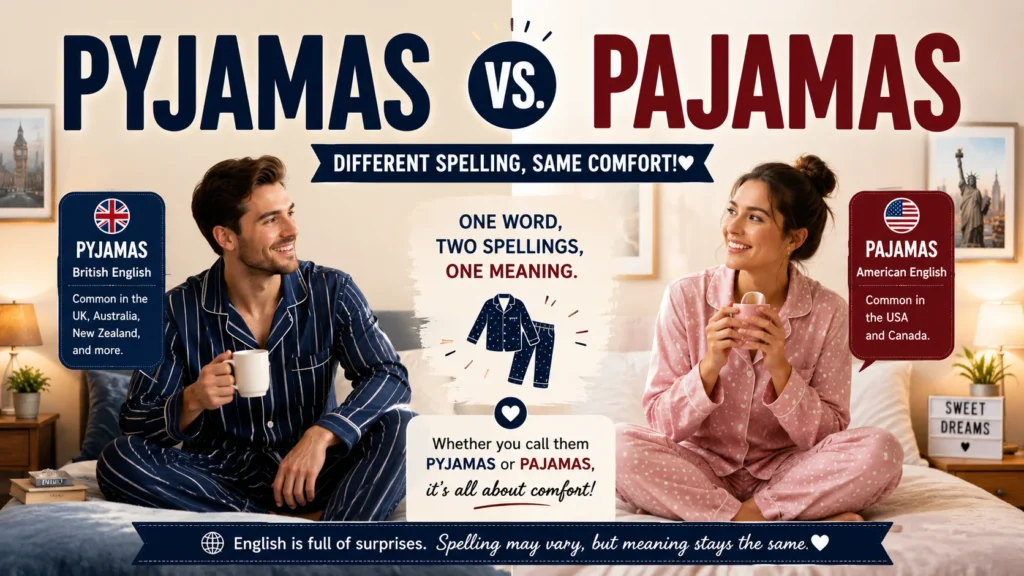
If you’ve ever wondered whether pyjamas and pyjamas describe different clothes, the answer is surprisingly simple: they mean the same thing. The difference is mainly a matter of regional spelling. Pyjamas is the standard form in American English, while pyjamas is the usual British English spelling. Cambridge Dictionaries explicitly identify pyjamas as the U.S. spelling of pyjamas and define both as soft, loose clothing worn in bed.
That small spelling change, however, opens the door to a much bigger story. The word has traveled across languages and continents, changed its spelling in English, and shifted from a term for loose trousers to the familiar sleepwear worn today. Understanding that history makes the spelling difference much easier to remember.
This guide breaks down pyjamas vs. pyjamas, including their meaning, spelling, pronunciation, history, regional usage, grammar, examples, and practical writing rules.
What Do Pajamas and Pyjamas Mean?
At the most basic level, pyjamas and pyjamas are names for sleepwear. The words generally describe comfortable clothing worn for sleeping or relaxing at home. A traditional set usually contains a loose-fitting shirt or top and pants or trousers. Cambridge defines pyjamas as soft, loose clothing worn in bed that consists of pants and a type of shirt, while its British English entry gives the corresponding form as pyjamas.
So, there isn’t a clothing difference hidden between the two spellings. If an American says, “I bought new pajamas,” and someone in Britain says, “I bought new pyjamas,” both people mean sleepwear.
Pyjamas and Pyjamas Have the Same Meaning
The easiest way to remember the distinction is this:
Pajamas = American English
Pyjamas = British English
The difference is primarily orthographic, meaning it concerns spelling, not the object itself.
| Feature | Pajamas | Pyjamas |
| Main English variety | American English | British English |
| Meaning | Sleepwear | Sleepwear |
| Singular form | Pajama | Pyjama |
| Plural form | Pajamas | Pyjamas |
| Main spelling change | a | y |
| Refers to different clothing? | No | No |
| Common informal abbreviation | PJs | PJs |
Cambridge lists pyjamas as the U.S. spelling and pyjamas as the UK spelling. Its definitions describe the same general kind of clothing.
This makes pyjamas vs. pyjamas similar to other American-British spelling pairs such as color/colour and favorite/favourite. The spelling signals the variety of English, but the underlying meaning remains intact.
What Exactly Counts as Pajamas?
Traditionally, pajamas consist of two coordinated pieces: a top and bottoms. The top may look like a shirt, while the bottoms usually resemble loose trousers or pants.
Modern sleepwear is much broader, though. Depending on the season, culture, and clothing brand, pajamas may include:
- Long-sleeved pajama sets
- Short-sleeved pajama sets
- Pajama pants
- Pajama shorts
- Cotton sleep sets
- Flannel pajamas
- Silk or satin pajamas
- Children’s pajamas
- Button-up pajama shirts
- T-shirt-style pajama tops
- Matching family pajamas
Not every item people casually call pajamas has to match perfectly. In everyday American English, someone might wear an old T-shirt with pajama pants and still say, “I’m wearing pajamas.”
The broader category is nightwear, also called nightclothes or sleepwear. Other garments can fall into that category, including nightgowns, nightshirts, robes, dressing gowns, and similar clothing. Cambridge’s vocabulary around pyjamas includes terms such as nightclothes, nightwear, nightgown, nightshirt, and robe.
Pajama and Pyjama as Singular Forms
One small grammatical point is often confusing.
Pajama is the singular form of pajamas in American English, while pyjama is the singular form of pyjamas in British English.
For example:
- “This pajama top is soft.”
- “This pyjama top is soft.”
- “These pajamas are comfortable.”
- “These pyjamas are comfortable.”
In ordinary conversation, however, people frequently use the plural forms because a conventional set contains multiple pieces.
You will also often hear a pair of pyjamas or a pair of pyjamas. That construction works much like a pair of pants or a pair of trousers.
Why Does “Pajamas” Usually Appear in the Plural?
English treats many garments made from two connected or paired parts as plural nouns. Pajamas commonly behaves this way in everyday usage.
For example:
“I need a new pair of pajamas.”
This doesn’t necessarily mean the speaker has two separate pajama sets. The phrase a pair of pajamas refers to one set.
The same pattern appears in British English:
“I need a new pair of pyjamas.”
The spelling changes, but the grammatical idea remains essentially the same.
What Does “PJs” Mean?
PJs is an informal shortened form of pajamas. It is especially common in casual American English, although the abbreviation is widely understood elsewhere too.
For example:
- “I’m already in my PJs.”
- “The kids need new PJs.”
- “She wore her PJs all morning.”
The abbreviation doesn’t describe a different garment. It simply provides a shorter, more conversational name.
The shortened form PJs is recorded in English from the 20th century, with etymological evidence dating its use to 1964.
Pajamas vs. Pyjamas: The Real Difference
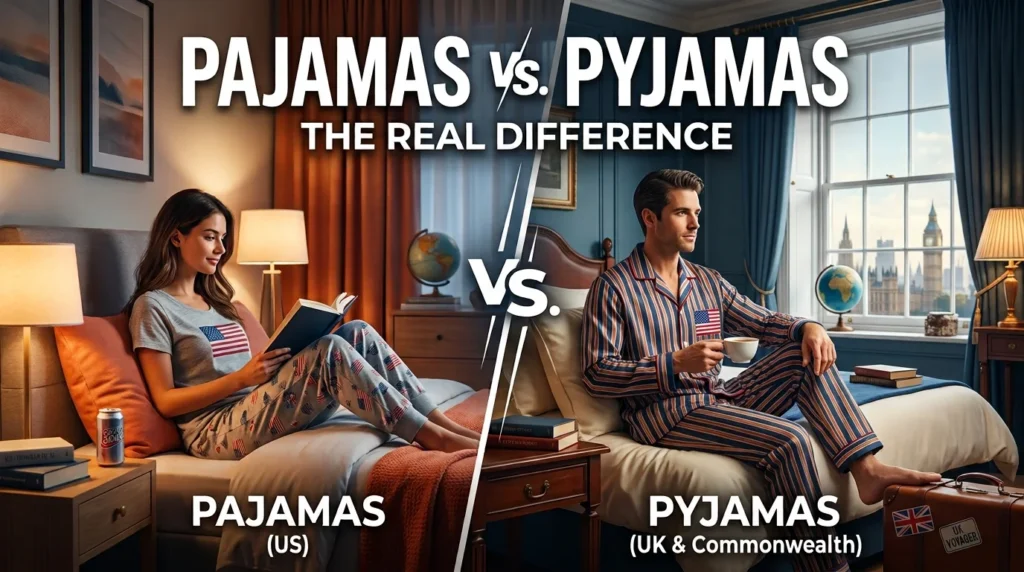
The real difference between pyjamas and pyjamas is spelling. Once that point is clear, most of the confusion disappears.
Pajamas Is the American Spelling
In American English, the standard spelling is pajamas.
You are likely to see it in:
- American dictionaries
- U.S. newspapers
- American school writing
- U.S. clothing stores
- Product descriptions
- American novels
- Online searches aimed at U.S. readers
- Expressions such as pajama party
For example:
“The children wore matching pajamas to the sleepover.”
An American editor would normally keep pyjamas rather than changing it to pyjamas.
Cambridge directly labels pyjamas as the US spelling of pyjamas, confirming that the distinction is regional rather than semantic.
Pyjamas Is the British Spelling
In British English, the standard spelling is pyjamas.
You will commonly see it in British writing, retail language, and everyday conversation.
For example:
“The children put on their pyjamas before bedtime.”
British English also commonly uses related forms such as:
- pyjama top
- pyjama bottoms
- pyjama set
- pyjama day
- pyjama party
The British spelling has the same basic meaning as the American spelling. Cambridge identifies pyjamas as the UK spelling of pyjamas.
Does the Spelling Change the Pronunciation?
The spelling difference doesn’t create a completely different spoken word.
Cambridge provides pronunciation information for both forms, with the main distinction remaining tied to regional English rather than a difference in what the garment means.
Regional accents can naturally affect pronunciation. That’s true for countless English words. You shouldn’t assume that changing a to y creates a separate pronunciation rule.
The practical lesson is simple: choose the spelling that matches your variety of English, rather than trying to invent a pronunciation difference that isn’t necessary.
Why Does One Version Use “A” and the Other “Y”?
English spelling often develops through historical borrowing, regional conventions, and pronunciation patterns. Pajamas/pyjamas is a particularly interesting example because the word entered English from South Asian usage rather than originating in English itself.
The modern American spelling became established as pyjamas, while British usage developed the spelling pyjamas. Etymological records show several early English spellings, including forms such as pai jamahs, pigammahs, and peijammahs.
So, the modern forms aren’t arbitrary. They represent the way different English traditions settled on different spellings over time.
A Quick Comparison
| Question | American English | British English |
| Standard spelling | Pajamas | Pyjamas |
| Singular | Pajama | Pyjama |
| Common phrase | Pajama pants | Pyjama bottoms |
| Informal term | PJs | PJs |
| Meaning | Sleepwear | Sleepwear |
| Difference in clothing | None | None |
| Difference in spelling | Yes | Yes |
If you’re writing for a specific audience, this table gives you the practical answer: use pyjamas for American readers and pyjamas for British readers.
Which Spelling Should You Use?
Choosing between pyjamas and pyjamas doesn’t need to become a guessing game. Start with your audience.
If you’re writing for readers in the United States, use pajamas. If you’re writing for readers in the United Kingdom, use pyjamas. When the audience is international, choose a consistent editorial style and consider which regional audience matters most.
Use “Pajamas” in American English
American English normally uses pajamas.
Consider these examples:
- “I bought a new pair of pajamas.”
- “The store sells children’s pajamas.”
- “She changed into her pajamas before bed.”
- “The school is having a pajama party.”
- “These pajama pants are made from cotton.”
The spelling should remain consistent throughout an article, product page, essay, or other piece of writing.
If an American article suddenly changes from pyjamas to pyjamas, readers may recognize the second spelling as British. That doesn’t necessarily make it wrong, but it can make the writing feel inconsistent.
Use “Pyjamas” in British English
British English normally uses pyjamas.
Examples include:
- “I bought a new pair of pyjamas.”
- “She changed into her pyjamas.”
- “The children wore their pyjamas to school for the charity event.”
- “These pyjama bottoms are very comfortable.”
- “The shop has a new pyjama set.”
Notice another regional distinction: Americans commonly say pants, while British English often uses trousers when referring to outer clothing. That difference makes the surrounding vocabulary just as important as the spelling of pajamas/pyjamas.
What About Canada?
Canadian English sits between American and British influences in many areas. Spelling preferences can therefore vary by word, context, publisher, and individual usage.
For a Canadian publication, the safest approach isn’t to assume that every word must follow either a purely American or purely British pattern. Instead, follow the publication’s established style guide.
This matters particularly in professional writing. A newspaper, university, company, or government organization may have its own editorial preferences.
What About Australia and New Zealand?
Australian and New Zealand English generally use many British-style spellings, so pyjamas is the expected form in standard usage.
However, English is not a rigid mathematical system. Informal speech, imported products, American media, brand names, and online content can introduce alternative forms.
For professional content, consistency remains more important than trying to police every casual variation.
What About India and South Asia?
The history becomes especially interesting in South Asia, because the English word itself has roots in the region.
The English word pajamas traces back through Hindi pajama, probably from Persian paejamah, with a literal sense related to leg clothing. Etymological sources identify the original garment as loose trousers tied at the waist and note that Europeans in India adopted the term.
That historical connection helps explain why the word can carry meanings beyond modern Western sleepwear in some South Asian contexts.
The key point is that language and clothing history overlap here. The word didn’t begin life as an English label invented for modern bedtime clothing.
Which Spelling Works Best for International Writing?
There isn’t one universal spelling that every English reader expects.
Instead, consider:
- Who will read the content?
- Where are those readers located?
- Which English variety does the publication use?
- Does the brand already use one spelling?
- Are you targeting regional search terms?
- Are you quoting a source or preserving a product name?
For an American website, pajamas should normally be the primary spelling. For a British website, pyjamas is generally more appropriate.
An international website can mention both forms naturally:
“Pyjamas, also spelled pyjamas in British English, are comfortable clothes worn for sleeping.”
That sentence establishes the terminology without repeatedly forcing both spellings into every paragraph.
The Origin and History of Pajamas and Pyjamas
The history of pajamas is far more interesting than the modern spelling suggests. The word didn’t originate as an English term for a matching bedtime set.
The Persian and Hindi Connection
Etymological evidence traces pajamas to Hindi pajama, probably borrowed from Persian paejamah. The Persian elements are associated with pae, meaning “leg,” and jamah, meaning clothing or garment. The resulting sense is roughly leg clothing.
That description makes sense when you consider the earlier garment.
The original pajama referred to loose trousers tied around the waist. They weren’t necessarily the matching shirt-and-pants sleepwear set that many people picture today.
This is an important distinction because modern meaning can hide a word’s older history.
The Original Garment Was Different From Modern Sleepwear
Historical pajama-style trousers were associated with clothing traditions in South Asia. European visitors encountered the garment and adopted both the clothing style and the word.
Etymological records date early English forms to around 1800, including pai jamahs and related spellings. The word was associated with loose trousers worn in India and later became connected with nightwear in European usage.
That creates a useful timeline:
| Period | Development |
| Earlier South Asian usage | A term for loose trousers |
| Around 1800 | Early English forms appear |
| 19th century | Europeans increasingly associate the garment with nightwear |
| By 1845 | Modern U.S. spelling pajamas is recorded |
| Modern English | Pyjamas and pyjamas become established regional spellings |
The transition wasn’t a single overnight change. Clothing styles evolved, English speakers adapted the word, and different English-speaking communities settled on different spellings.
How the Word Entered English
English has borrowed thousands of words from other languages. Food, clothing, technology, trade, and travel have all played major roles in that process.
Pajama is a strong example of language moving through cultural contact.
European communities in India encountered local clothing and terminology. The term then entered English in several spellings before the modern forms became more stable.
Early forms included:
- pai jamahs
- pajamahs
- pigammahs
- peijammahs
- pajama
- pyjama
- pajamas
- pyjamas
Those variations show that English spelling wasn’t always fixed. Writers often tried to represent unfamiliar sounds using the spelling conventions available to them.
From Trousers to Nightwear
The modern meaning developed through changes in how the garment was used.
The word originally described loose trousers. Over time, Europeans adopted similar clothing for nightwear, and the term became associated with sleep clothing.
Eventually, the familiar Western image emerged: a coordinated top and bottoms intended for sleeping or relaxing.
This is a classic example of semantic change, where a word’s meaning expands, narrows, or shifts through repeated use.
The historical path can therefore be summarized as:
South Asian garment → English borrowing → loose trousers → nightwear → modern sleepwear
That journey explains why today’s word carries more history than its simple bedtime meaning suggests.
Why British English Developed “Pyjamas”
British English developed the spelling pyjamas, while American English settled on pyjamas.
Etymological records specifically identify pyjamas as the chiefly British spelling and note earlier English spellings before the modern form became standard.
This wasn’t because British speakers created a different garment. It was a spelling development within a particular variety of English.
That distinction matters. Pyjamas isn’t the British name for one kind of pyjamas while pyjamas is the American name for another. They’re regional forms of the same word.
Using Pyjamas and Pyjamas Correctly in Real Writing
Knowing the definition is easy. Applying the correct spelling consistently is where writers sometimes stumble.
In Everyday Conversation
Both forms work naturally within their respective varieties of English.
American:
“I’m going to put on my pajamas and watch a movie.”
British:
“I’m going to put on my pyjamas and watch a movie.”
Neither sentence changes the type of clothing being discussed.
In casual conversation, speakers may also use PJs, jammies, or similar informal terms. These expressions can vary by region, age group, and social setting.
In Formal Writing
Neither pyjamas nor pyjamas is inherently more formal.
The correct choice depends on the variety of English used by the publication.
For example, an American academic paper should generally use pajamas if the word appears. A British publication may use pyjamas.
The same principle applies to:
- Reports
- Essays
- News articles
- Business documents
- Websites
- Instruction manuals
- Product descriptions
The goal isn’t to make the word sound sophisticated. The goal is to use the spelling that fits the chosen English variety.
In Academic Writing
Academic writing rewards consistency.
If you choose American English, use pajamas consistently. If you use British English, use pyjamas consistently.
Don’t switch spellings simply because one version appears more familiar.
For example, an American research paper might write:
“Participants reported wearing pajamas before going to sleep.”
A British paper could write:
“Participants reported wearing pyjamas before going to sleep.”
The factual meaning stays unchanged.
In Business and Marketing Content
For businesses, spelling can become more than a grammar issue.
Imagine an online clothing store selling sleepwear in the United States. Its category page might naturally use:
- Women’s Pajamas
- Men’s Pajamas
- Kids’ Pajamas
- Pajama Sets
- Pajama Pants
A British retailer might instead use:
- Women’s Pyjamas
- Men’s Pyjamas
- Kids’ Pyjamas
- Pyjama Sets
- Pyjama Bottoms
The surrounding vocabulary should match the same audience.
This makes the writing feel native rather than mechanically converted from another variety of English.
In SEO Content
Search behavior adds another practical consideration.
People don’t always search using the spelling preferred by an editor. A British reader may encounter American content containing pyjamas, while an American reader may see British websites using pyjamas.
That doesn’t mean you should repeat both spellings unnaturally.
A better approach is to establish the main regional form and mention the alternative where it genuinely helps.
For example:
Pyjamas, also spelled pyjamas in British English, are clothing worn for sleeping.
That single clarification can satisfy readers who know either spelling while keeping the article natural.
Search-focused writing should prioritize meaning, context, user intent, and useful coverage rather than stuffing every spelling variation into every heading.
In Product Descriptions
Product language should match the intended market.
For American customers:
Soft Cotton Pajama Set
For British customers:
Soft Cotton Pyjama Set
The product itself may be identical.
Only the terminology changes.
If a brand sells internationally, it can localize category names and supporting copy without manufacturing artificial differences between the products.
Common Mistakes With Pyjamas and Pyjamas
The spelling is simple, but several misconceptions appear repeatedly.
Mistake: Thinking They Describe Different Clothes
This is the biggest misunderstanding.
Pyjamas and pyjamas don’t normally refer to two different categories of clothing.
Both refer to sleepwear.
The spelling tells you something about the English variety being used.
Mistake: Assuming “Pajamas” Is Always Correct
There is no universal rule that makes pajamas the only correct spelling.
It’s standard in American English, but British English uses pyjamas.
Calling one form “correct” without considering regional English misses the point.
A British publication using pyjamas isn’t making a spelling error. An American publication using pajamas isn’t either.
Mistake: Assuming “Pyjamas” Is Old-Fashioned
Some American readers may find pyjamas unfamiliar because they primarily encounter pyjamas.
That doesn’t make the British form outdated.
It is a standard spelling in British English and appears in major dictionaries. Cambridge explicitly identifies it as the UK form.
Mistake: Mixing Spellings Without a Reason
Switching between pyjamas and pyjamas randomly can make writing look careless.
For example:
“She bought new pajamas. Later, she changed into her pyjamas.”
If the article is written entirely in American English, that switch is unnecessary.
However, there are legitimate reasons to preserve both forms. You might be discussing regional spelling, quoting someone, analyzing British English, or comparing search terminology.
The key is intentional consistency.
Mistake: Confusing Pajamas With All Nightwear
Not every type of nightwear is technically pajamas.
A nightgown, nightdress, nightshirt, or robe may serve the same general purpose but has a different garment structure.
Pajamas traditionally describe a set involving a top and bottoms, although modern clothing terminology can be flexible.
This distinction becomes particularly useful when writing product descriptions because shoppers may search for specific garment types.
Examples of Pyjamas and Pyjamas in Context
Seeing both forms in realistic sentences makes the difference easier to remember.
Examples Using “Pajamas”
- “I need to wash my pajamas tonight.”
- “She bought lightweight cotton pajamas for summer.”
- “The children wore matching pajamas.”
- “He changed into his pajamas after dinner.”
- “These pajama pants are comfortable enough for lounging.”
- “The store has a large selection of pajama sets.”
- “Everyone wore pajamas to the sleepover.”
These examples fit naturally into American English.
Examples Using “Pyjamas”
- “I need to wash my pyjamas tonight.”
- “She bought lightweight cotton pyjamas for summer.”
- “The children wore matching pyjamas.”
- “He changed into his pyjamas after dinner.”
- “These pyjama bottoms are comfortable.”
- “The shop has several pyjama sets.”
- “Everyone wore pyjamas to the sleepover.”
The meaning remains unchanged. The regional vocabulary simply shifts.
Everyday Conversation
An American speaker might say:
“Where did I leave my pajamas?”
A British speaker could say:
“Where did I leave my pyjamas?”
The conversational situation is identical.
Shopping
On an American website:
“Shop women’s pajamas in cotton, flannel, and satin styles.”
On a British website:
“Shop women’s pyjamas in cotton, flannel, and satin styles.”
Again, the spelling reflects the market rather than the garment.
Travel
A traveler might pack:
- Two sets of pajamas
- Comfortable socks
- A robe
- Slippers
A British travel article could list:
- Two sets of pyjamas
- Comfortable socks
- A dressing gown
- Slippers
The clothing needs haven’t changed.
Hospitality
Hotels may refer to sleepwear in different ways depending on their audience. A U.S. hotel guide might use pyjamas, while British hospitality content would generally favor pyjamas.
The broader category nightwear can work when the content needs to cover several types of sleep clothing.
Healthcare
Healthcare settings can use terms such as pyjama, pyjama, nightwear, or sleepwear, depending on region and context.
For example, a hospital-related document may discuss changing into clean sleepwear without needing to distinguish the regional spelling at all.
The important thing is to follow the institution’s chosen English style.
Related American and British Spelling Differences
The pyjamas vs. pyjamas distinction becomes easier when you see it as part of a broader pattern.
American and British English developed different spelling conventions for many words.
| American English | British English |
| color | colour |
| favorite | favourite |
| center | centre |
| theater | theatre |
| organize | organise |
| pajamas | pyjamas |
Not every spelling difference follows one simple rule, and English has plenty of exceptions. Still, these examples show why two established spellings can coexist without either one being an error.
Why Do These Differences Exist?
English spelling reflects centuries of language development, printing practices, dictionaries, education, migration, and cultural influence.
American English developed its own spelling preferences, while British English retained or developed different conventions.
The pajamas/pyjamas pair has an additional layer because the word itself entered English through another language and underwent multiple spellings before the modern forms stabilized.
So the spelling difference isn’t merely a modern preference. It reflects the longer history of English absorbing and adapting vocabulary.
A Useful Way to Remember the Difference
Think geographically:
Pajamas → United States → American English
Pyjamas → United Kingdom → British English
Then remember that both point to the same basic item: sleepwear.
That’s enough for most everyday situations.
You don’t need to memorize a complicated grammar rule.
Is “PJs” American or British?
PJs is an informal abbreviation of pajamas, and the form is widely recognizable beyond the United States.
For example:
“I’m staying in my PJs today.”
It’s casual, so it fits conversations, social media, advertising, children’s language, and informal writing better than highly formal documents.
The abbreviation has been documented since the 1960s.
Pyjamas vs. Pyjamas: Quick Reference
| Question | Answer |
| Are pyjamas and pyjamas the same thing? | Yes, in ordinary modern English. |
| What is the American spelling? | Pajamas |
| What is the British spelling? | Pyjamas |
| Do they have different meanings? | No, not normally. |
| Do they describe different clothing? | No. |
| What is the American singular? | Pajama |
| What is the British singular? | Pyjama |
| Can you say “a pair of pajamas”? | Yes. |
| Can you say “a pair of pyjamas”? | Yes. |
| What does PJs mean? | An informal short form of pajamas. |
| Where did the word originate? | English borrowed it from South Asian usage, ultimately linked to Persian. |
| What did the earlier garment refer to? | Loose trousers tied at the waist. |
| Which spelling should Americans normally use? | Pajamas |
| Which spelling should British writers normally use? | Pyjamas |
| Should you mix both spellings randomly? | No. Keep your regional style consistent. |
The shortest accurate answer to “What is the difference between pyjamas and pyjamas?” is therefore:
Pyjamas is the American English spelling, while pyjamas is the British English spelling. Both words refer to the same basic type of sleepwear.
The Origin and History of Pajamas vs. Pyjamas
The story behind pyjamas vs. pyjamas is more than a spelling difference. The word traveled from South Asia into English, changed form as different communities adopted it, and eventually became strongly associated with nighttime clothing. Modern dictionaries now treat pyjamas and pyjamas as regional spellings of the same word, with pyjamas used in American English and pyjamas in British English.
Where the Word Pajamas Came From
The modern English word has a history rooted in South Asian clothing. Etymological records trace pajamas to Hindi pajama, probably from Persian paejamah. The Persian expression literally relates to leg clothing, combining a word for “leg” with a word meaning clothing or garment.
That origin tells us something important: the original garment wasn’t necessarily the matching bedtime set most people picture today. Early English records describe pai jamahs as loose trousers tied at the waist. Europeans encountered and adopted the garment in India, particularly for nightwear.
This gives the word an interesting path through language and clothing:
Persian → Hindi → South Asian usage → English → modern American and British English
The clothing changed in use over time, and the word changed with it.
The Persian and Hindi Connection
The Persian connection is especially useful when explaining why the word looks unusual in English. Pajama wasn’t built from ordinary English roots. It entered English as a borrowed term, which helps explain why early writers experimented with several spellings.
The likely Persian source, paejamah, can be understood broadly as leg clothing. Hindi pajama then became the form that influenced English usage. Etymological sources connect the Persian element pae with “leg” and jamah with clothing or a garment.
The original idea was therefore closely tied to trousers, not necessarily to sleep itself.
That’s an important distinction when looking at the history of pyjamas vs. pyjamas. The modern meaning developed later.
What Did the Original Pajama Look Like?
Historical pajama garments were loose trousers designed for comfort and movement. They were commonly tied at the waist rather than constructed like modern Western pants.
The garment was associated with clothing traditions in India and other parts of South Asia. Europeans living in or visiting India encountered the style and adopted both the garment and its name. Etymological evidence specifically describes the early English term as referring to loose trousers tied at the waist.
Modern sleepwear can still preserve that basic idea of comfort and looseness. The difference is that today’s pajamas usually refer to a complete sleepwear outfit rather than simply loose trousers.
How the Word Entered English
English began recording forms of the word around 1800. Early spellings weren’t standardized, which was common when English speakers borrowed unfamiliar foreign words.
Historical forms include:
- pai jamahs — recorded around 1800
- pigammahs — recorded around 1834
- peijammahs — recorded around 1840
- pajamas — modern U.S. spelling established by the mid-19th century
- pyjamas — British spelling that became standard in British English
These dates show that English speakers didn’t immediately settle on one spelling. The modern forms emerged gradually.
That spelling history also explains why pyjamas vs. pyjamas isn’t a modern disagreement about which word is “correct.” Both forms developed within established English traditions.
From Loose Trousers to Modern Sleepwear
One of the most interesting parts of the word’s history is its semantic shift. A semantic shift occurs when the meaning or typical use of a word changes over time.
Early pajamas referred to loose trousers. Europeans in India adopted them, and the garment became associated especially with nightwear. From there, the term gradually became connected with the broader sleepwear outfit familiar today.
Modern dictionaries now define pajamas as soft, loose clothing worn in bed, commonly consisting of pants and a shirt. Cambridge gives the same basic meaning for pyjamas, identifying it as the British spelling.
The change can be summarized simply:
| Stage | Meaning or use |
| Earlier South Asian usage | Loose trousers |
| Early English borrowing | Loose trousers associated with South Asian dress |
| European adoption | Clothing increasingly associated with nightwear |
| Modern English | Sleepwear, commonly a shirt and pants |
| American English | Pajamas |
| British English | Pyjamas |
The modern meaning didn’t erase the older history. It simply became the dominant meaning in English.
Why Pyjamas and Pyjamas Have Different Spellings
Once the word entered English, different English-speaking communities developed their own spelling conventions.
The American spelling became pyjamas, while British English generally settled on pyjamas. Etymological records identify the modern U.S. spelling by 1845 and note that British spelling tends toward pyjamas.
This is why the difference between pyjamas vs. pyjamas is best described as a regional spelling difference.
It isn’t a difference in:
- garment type
- basic meaning
- intended use
- historical origin
- general definition
Instead, it reflects different conventions within two wide varieties of English.
Pajamas in American English
American English uses pajamas.
Cambridge explicitly identifies pyjamas as the US spelling of pyjamas and defines the word as clothes worn in bed, consisting of a loosely fitting shirt and pants.
That spelling appears naturally in expressions such as:
- pajama pants
- pajama set
- pajama party
- pajama top
- children’s pajamas
- women’s pajamas
- men’s pajamas
American readers generally recognize pyjamas, but they may see it as a British spelling.
Pyjamas in British English
British English uses pyjamas.
Cambridge labels pyjamas as the UK spelling of pyjamas. Its definition describes the word as soft, loose clothing worn in bed, usually consisting of trousers and a type of shirt.
British usage also creates related expressions such as:
- pyjama bottoms
- pyjama top
- pyjama set
- pyjama day
- children’s pyjamas
- women’s pyjamas
- men’s pyjamas
The garment remains the same. The spelling simply follows British English conventions.
The Evolution of Pajamas as Sleepwear
The modern idea of pajamas as a dedicated sleepwear set developed gradually rather than appearing fully formed.
Early versions were loose trousers. As Europeans adopted the garment, its connection with nighttime clothing became stronger. Eventually, the term became associated with the familiar combination of a loose top and bottoms used for sleeping.
That transition makes sense from a practical standpoint. Loose clothing already offered comfort and freedom of movement, qualities that work well for sleeping.
Over time, clothing makers developed matching sets, seasonal fabrics, different cuts, and styles designed specifically for nighttime use.
Today, pajamas can mean everything from lightweight cotton sets to thick flannel outfits.
Traditional Pajamas vs. Modern Pajamas
| Feature | Earlier pajama garment | Modern pajamas |
| Main form | Loose trousers | Usually a coordinated sleepwear set |
| Typical use | Clothing, later especially nightwear | Sleeping and relaxing |
| Construction | Loose and tied at the waist | Many styles and fastenings |
| Common modern fabrics | Not applicable in the modern sense | Cotton, flannel, silk, satin, blends |
| Regional spelling | Pyjamas |
This evolution is a good reminder that clothing words often preserve pieces of cultural history.
The History of the Spelling “Pyjamas”
The spelling pyjamas has its own historical development within English.
Early English spellings varied considerably. Etymological records list pai jamahs around 1800, pigammahs around 1834, and peijammahs around 1840. Eventually, British English moved toward the modern pyjamas form.
That process wasn’t unique to this word.
English has repeatedly absorbed foreign vocabulary and adapted it to local spelling habits. Once a particular spelling becomes common in books, education, newspapers, dictionaries, and everyday writing, it becomes easier for later generations to treat that spelling as normal.
That’s essentially what happened with pyjamas in British English and pajamas in American English.
Why American English Uses Pajamas
The American form pajamas became established by the mid-19th century. Etymological evidence dates the modern U.S. spelling to 1845.
The important point is that American English didn’t create a new word. It standardized one spelling of an already borrowed word.
This pattern appears across American English. Regional spelling systems often preserve particular forms while British English retains another.
So when an American writes:
“I bought new pajamas.”
the writer isn’t using a simplified or incorrect version of pyjamas.
They’re using the standard spelling associated with American English.
Why British English Uses Pyjamas
British English developed pyjamas as its conventional spelling.
Cambridge’s current dictionary continues to identify pyjamas as the UK form and pyjamas as the U.S. form.
That makes pyjamas completely standard in British writing.
A British sentence might read:
“I need a new pair of pyjamas.”
An American equivalent would be:
“I need a new pair of pajamas.”
The sentence changes only in regional spelling. The speaker isn’t talking about a different garment.
Pyjamas, Pyjamas, and Pronunciation
Spelling can make the two words look more different than they sound.
Cambridge lists pronunciation information for both pyjamas and pyjamas. The British spelling is given as /pɪˈdʒɑː.məz/, while the American entry includes regional pronunciation information.
Accent can influence how the word sounds, just as it does with many other English words.
The key distinction remains spelling rather than meaning.
If you’re learning English, don’t treat pyjamas and pyjamas as two vocabulary words that require two unrelated definitions. Learn them as regional forms of one word.
How “Pajamas” Became a Common Modern Word
Once sleepwear became more established in Western clothing culture, pajamas became an ordinary everyday word.
The modern concept covers far more than the original loose trousers. Clothing companies now sell pajamas in countless designs, materials, colors, and cuts.
Common categories include:
- Cotton pajamas
- Flannel pajamas
- Silk pajamas
- Satin pajamas
- Thermal pajamas
- Summer pajamas
- Children’s pajamas
- Matching family pajamas
- Pajama shorts
- Pajama pants
- Button-up pajama sets
This expansion illustrates another normal feature of language: once a word becomes familiar, speakers extend it to related products and situations.
The Rise of “PJs”
The informal term PJs adds another chapter to the word’s development.
Etymological records date PJs to 1964 as a shortened form of pajamas.
That gives English speakers a compact way to refer to sleepwear.
For example:
“I’m already in my PJs.”
The abbreviation is especially natural in casual contexts, including:
- Text messages
- Social media
- Family conversation
- Children’s language
- Informal advertising
- Lifestyle content
It doesn’t replace the formal spelling rules. If you’re writing a formal American document, pajamas remains the normal full form.
Regional Spelling Around the World
The pyjamas vs. pyjamas question becomes more interesting outside the United States and the United Kingdom.
English-speaking countries don’t always divide spelling into two perfectly sealed groups. Local education systems, publishers, media, brands, and cultural influences can affect usage.
United States
Pajamas is the standard American form.
You’ll commonly encounter:
- pajama pants
- pajama sets
- pajama party
- pajamas
- PJs
United Kingdom
Pyjamas is the standard British form.
Common expressions include:
- pyjama bottoms
- pyjama tops
- pyjama sets
- pyjama day
- pyjamas
Canada
Canadian English contains both American and British influences. Individual publishers and organizations may follow different style conventions.
For professional Canadian writing, the strictest rule is to follow the publication’s established style rather than assuming every word must follow one national template.
Australia and New Zealand
Australian and New Zealand English generally retain many British spelling conventions. Pyjamas is therefore the expected standard form in ordinary formal usage.
However, international media and commercial language can introduce alternative spellings.
India and South Asia
South Asia is especially significant because the word itself has roots in the region.
The historical pajama was not originally limited to bedtime. Its earlier meaning referred to loose trousers, and Europeans adopted the term in India.
That history makes the word an excellent example of how clothing, trade, language, and cultural contact influence one another.
A Historical Timeline of Pyjamas and Pyjamas
The development becomes easier to understand when viewed chronologically.
| Date or period | Development |
| Before English adoption | Persian and Hindi forms refer to clothing, particularly loose trousers |
| Around 1800 | Early English form pai jamahs appears |
| 1834 | Form pigammahs is recorded |
| 1840 | Form peijammahs is recorded |
| By 1845 | Modern U.S. spelling pajamas is established |
| Later English development | British usage settles on pyjamas |
| 1964 | Informal abbreviation PJs is attested |
| Modern English | Pyjamas and pyjamas function as regional spellings |
The timeline shows why today’s spelling difference can’t be understood simply by looking at the letters a and y.
It’s the result of centuries of linguistic movement and adaptation.
What the History Tells Us About Pyjamas vs. Pyjamas
The history gives us three clear lessons.
First, the word is a loanword with South Asian and Persian connections.
Second, its original meaning was closely connected with loose trousers rather than exclusively with modern sleepwear.
Third, the modern forms pyjamas and pyjamas represent regional English spelling traditions rather than different definitions.
Cambridge’s modern dictionary entries reinforce that point directly: pyjamas is the U.S. spelling of pyjamas, while pyjamas is the UK spelling of pyjamas.
Once you know that history, the spelling difference becomes much easier to remember.
Pajamas belongs naturally to American English. Pyjamas belongs naturally to British English. Both descend from the same linguistic journey, and both describe the familiar clothing worn for sleep.
Which Spelling Should You Use: Pyjamas or Pyjamas?
Choosing between pyjamas and pyjamas becomes much easier once you stop treating them as competing words. They are regional spellings of the same term. The better choice depends on who will read your writing, which English variety you follow, and where the content will appear. Dictionary sources consistently identify pyjamas with American English and pyjamas with British English.
For most writers, consistency matters more than trying to make one spelling universal. If your article targets readers in the United States, use pajamas throughout. If it targets readers in the United Kingdom, use pyjamas. For international content, you can mention both spellings once and then use one primary form according to your intended audience.
Use “Pajamas” in American English
Pajamas is the standard American English spelling. American dictionaries list it as clothing worn for sleeping, usually consisting of loose-fitting pants or shorts and a top. The word can also describe other comfortable clothing worn for sleeping or lounging.
You’ll naturally see pajamas in American phrases such as:
- pajama pants
- pajama set
- pajama top
- pajama party
- children’s pajamas
- men’s pajamas
- women’s pajamas
- matching pajamas
- flannel pajamas
- silk pajamas
The surrounding vocabulary often follows American usage too. For example, an American retailer might sell pyjama pants, whereas a British retailer is more likely to describe a similar item as pyjama bottoms.
This distinction becomes especially useful when you’re writing for a specific market. A U.S.-focused product page should sound like American English from beginning to end rather than switching between regional forms.
American Examples
“I bought a new pair of pajamas for winter.”
“These pajama pants are made from soft cotton.”
“The children wore matching pajamas to the sleepover.”
“She changed into her pajamas before watching television.”
All four examples use the spelling American readers normally expect.
Use “Pyjamas” in British English
Pyjamas is the standard British English spelling. Dictionary.com identifies it as the British form and defines it as loose-fitting nightclothes consisting of a top and trousers.
British English commonly uses related expressions such as:
- pyjama bottoms
- pyjama top
- pyjama set
- pyjama day
- children’s pyjamas
- men’s pyjamas
- women’s pyjamas
- matching pyjamas
- cotton pyjamas
- flannel pyjamas
Notice that the difference can extend beyond the word itself.
American English often uses pants, while British English uses trousers for the same general type of outer garment. Therefore, a British product description might say cotton pyjama bottoms, while an American description could say cotton pyjama pants.
Neither version is inherently better. Each one fits its audience.
British Examples
“I bought a new pair of pyjamas for winter.”
“These pyjama bottoms are made from soft cotton.”
“The children wore matching pyjamas to the sleepover.”
“She changed into her pyjamas before watching television.”
The meaning stays the same. Only the regional form changes.
Pajama vs. Pyjama: Singular and Plural Usage
There is a small grammatical detail worth understanding.
In American English, you’ll encounter pajama as the singular form or as a modifier before another noun:
- pajama top
- pajama shirt
- pajama bottom
- pajama set
The familiar standalone noun is generally pajamas.
British English works similarly with:
- pyjama top
- pyjama bottoms
- pyjama set
- pyjama shirt
The standalone form is normally pyjamas.
Some dictionaries treat pyjamas and pyjamas as plural nouns. Dictionary.com, for example, labels pyjamas as a noun used with a plural verb and gives pyjamas the same general plural-nightwear sense.
This explains why a pair of pyjamas and a pair of pyjamas sound natural.
Why “A Pair of Pajamas” Works
English commonly uses pair with garments that consist of two connected or corresponding parts.
Consider:
- a pair of pants
- a pair of trousers
- a pair of shorts
- a pair of pajamas
- a pair of pyjamas
So you can write:
“I bought two pairs of pajamas.”
Or, in British English:
“I bought two pairs of pyjamas.”
The noun pair provides the count, while pajamas/pyjamas identifies the clothing.
“Pajama” as a Modifier
You’ll often see pajama used before another noun even though pajamas is the common standalone form.
For example:
- pajama pants
- pajama party
- pajama set
- pajama top
Likewise, British English uses pyjama in compounds:
- pyjama bottoms
- pyjama party
- pyjama set
- pyjama top
This is normal English word formation. The first noun acts as a modifier that tells you what type of item follows it.
Pyjamas vs. Pyjamas in Other English-Speaking Countries
The United States and United Kingdom provide the clearest contrast, but English usage doesn’t stop there.
Different countries have developed their own combinations of British and American influence. Local dictionaries, publishers, schools, media organizations, and brands can all affect which spelling readers encounter most often.
Canada
Canadian English has influences from both American English and British English.
That makes it unwise to assume that every Canadian writer must follow one rigid spelling system. A Canadian newspaper, university, company, or publisher may follow its own editorial guide.
If you’re writing professionally for a Canadian audience, use the organization’s established style when one exists.
For general international content, consistency is usually the more useful rule.
Australia
Australian English generally follows many British spelling conventions, so pyjamas is the expected spelling in standard Australian usage.
You may still encounter pajamas because American entertainment, online shopping, software, international brands, and global websites expose Australian readers to American English.
That doesn’t make the American spelling the local standard. It simply reflects the amount of English-language content people encounter online.
New Zealand
New Zealand English also generally follows British-derived spelling conventions. Pyjamas is therefore the natural standard form for most local writing.
Again, global digital content can introduce pajamas into everyday exposure.
For formal writing, local style remains the safest guide.
India and South Asia
South Asia presents an especially interesting case because the word pajama has historical roots in the region.
The older garment referred to loose trousers, and the term entered English through South Asian usage. Modern English still reflects that history, while local languages have developed their own forms and conventions.
This means the word shouldn’t be viewed simply as an American or British invention. Its history reaches much further back.
In some South Asian contexts, pajama can still refer more specifically to a type of loose trousers rather than only to Western-style sleepwear. Dictionary.com preserves this older regional sense in its definition.
That distinction matters when discussing the word historically or cross-culturally.
Which Spelling Is Better for International Writing?
There isn’t a single spelling that automatically works best for every international reader.
Instead, choose based on audience and purpose.If you’re writing a U.S.-focused article, make pajamas your primary spelling. If you’re writing for a British audience, use pyjamas. If your site serves multiple English-speaking markets, mention the alternative spelling naturally.
A simple opening sentence can solve the problem:
Pyjamas, also spelled pyjamas in British English, are clothing worn for sleeping.
After that, you don’t need to repeat both forms in every paragraph.
A Practical Decision Guide
| Target audience | Recommended spelling |
| United States | Pajamas |
| United Kingdom | Pyjamas |
| Australia | Pyjamas |
| New Zealand | Pyjamas |
| Canada | Follow the publication’s style |
| India | Follow the audience and context |
| International | Choose one primary variety and mention the alternative |
| American SEO content | Pajamas |
| British SEO content | Pyjamas |
This approach keeps the writing natural while still making the regional difference clear.
Should You Use Both Spellings in One Article?
Usually, no.
If you’re writing an article for American readers, switching repeatedly between pyjamas and pyjamas can make the article look inconsistent.
For example, this is awkward:
“These pajamas are comfortable. Many people prefer pyjamas made from cotton. You can buy pajamas in several styles.”
The writer appears to be switching English varieties without a reason.
A cleaner version would use pajamas consistently:
“These pajamas are comfortable. Many people prefer pajamas made from cotton. You can buy pajamas in several styles.”
However, using both forms makes perfect sense when the article itself discusses pyjamas vs. pyjamas.
For example:
“American English uses pyjamas, while British English uses pyjamas.”
Here, the two spellings serve a clear informational purpose.
When Mixing the Spellings Makes Sense
There are legitimate situations where both forms belong in the same piece of writing.
Comparing American and British English
This is the obvious case.
If you’re explaining the difference, you need both forms:
Pyjamas is American English, while pyjamas is British English.
Quoting Someone
If you’re quoting a British source in an American article, you may preserve the original pyjamas spelling.
Changing the spelling inside a direct quotation can alter the source’s original wording.
Discussing Search Terms
A website targeting an international audience may need to explain both search variants.
For example:
“If you’re searching for pyjamas in the United States, you’ll often find products described as pyjamas on British websites.”
That provides useful context without keyword stuffing.
Preserving a Brand Name
A company may intentionally use Pyjamas even when selling to American customers.
If Pyjamas forms part of a registered brand name, product name, collection title, or official business terminology, don’t casually rewrite it as Pajamas simply to match regional style.
The exact name may be part of the brand’s identity.
Pyjamas vs. Pyjamas for SEO
Search optimization creates another reason to understand both forms.
People search according to their own language habits. Regional spelling can therefore affect the terms that appear in search queries.
Research into regional spelling conventions in information retrieval has found that search systems can behave differently when the spelling in a query and the spelling in documents don’t match. The study examined pairs such as American colour and British colour and found that spelling normalization can affect retrieval performance.
That doesn’t mean you should stuff pyjamas and pyjamas into every paragraph.
Instead, use semantic SEO sensibly.
Build Around Search Intent
A useful article can naturally cover related terms such as:
- pyjamas vs. pyjamas
- pajamas meaning
- pyjamas meaning
- American spelling
- British spelling
- sleepwear
- nightwear
- nightclothes
- pajama pants
- pyjama bottoms
- PJs
- pajama set
- pyjama set
These terms belong to the same topic because readers may use different expressions while looking for essentially the same information.
The goal is not to force every phrase into a sentence. The goal is to answer the questions people actually have.
Use Regional Terms Naturally
For American content, a heading such as:
Pajamas in American English
makes sense.
For British content:
Pyjamas in British English
works naturally.
If your article compares both varieties, a heading such as:
Pyjamas vs. Pyjamas: Regional Spelling
can cover the search intent directly.
This is stronger than creating dozens of nearly identical headings simply to repeat keyword variations.
A Simple Rule for Writers
If you’re still unsure, use this rule:
Write for your reader, not for the spelling dictionary alone.
Ask yourself where the reader is likely to be.
An American audience expects pajamas.
A British audience expects pyjamas.
An international audience can understand both, but consistent usage still makes the article easier to read.
American Writing Checklist
Use:
- pajamas
- pajama pants
- pajama set
- pajama party
- pants
- closet
British Writing Checklist
Use:
- pyjamas
- pyjama bottoms
- pyjama set
- pyjama party
- trousers
- wardrobe
These aren’t absolute vocabulary laws. They’re practical patterns that help your writing sound natural for its intended audience.
Pyjamas and Pyjamas in Product Marketing
The distinction becomes particularly visible in e-commerce.
Imagine two stores selling almost identical cotton sleepwear.
An American store might advertise:
Women’s Cotton Pajama Set
A British store might advertise:
Women’s Cotton Pyjama Set
Both descriptions tell the customer essentially the same thing.
The difference lies in regional language, not product specifications.
Why Consistency Matters in E-Commerce
A product page should maintain one language variety throughout its title, description, filters, category names, and supporting copy.
For an American audience:
Women’s Pajamas → Pajama Sets → Pajama Pants → Pajama Tops
For a British audience:
Women’s Pyjamas → Pyjama Sets → Pyjama Bottoms → Pyjama Tops
That consistency makes the store feel locally written.
It also prevents strange combinations such as “Women’s Pyjamas – Cotton Pyjama Pants” unless there’s a deliberate reason for using both terms.
Pyjamas vs. Pyjamas in Formal and Academic Writing
Neither spelling is more intelligent, formal, or grammatically correct by itself.
The correct choice depends on the English variety.
An American academic paper might say:
“Participants were asked whether they wore pajamas while sleeping.”
A British academic paper might say:
“Participants were asked whether they wore pyjamas while sleeping.”
The research statement remains the same.
The same principle applies to:
- Essays
- Reports
- Theses
- Articles
- Business documents
- Government writing
- Educational materials
- Technical documentation
If a university or publisher specifies American English, follow that instruction. If it specifies British English, use the British form.
Pyjamas, Pyjamas, and the Informal “PJs”
PJs offers a useful neutral shortcut in casual contexts.
The abbreviation is widely recognized and refers to pajamas/pyjamas. Dictionary sources identify PJs as an informal abbreviation.
Examples include:
“I’m staying in my PJs all weekend.”
“The kids need new PJs.”
“Don’t forget your PJs for the trip.”
It’s relaxed language, so it works especially well in conversation, social posts, lifestyle content, and casual advertising.
For a formal report, however, the full term usually reads better.
A Quick Reference for Choosing the Right Spelling
| Situation | Best choice |
| American newspaper | Pajamas |
| U.S. school assignment | Pajamas |
| U.S. clothing store | Pajamas |
| British newspaper | Pyjamas |
| UK school assignment | Pyjamas |
| British clothing store | Pyjamas |
| International comparison article | Both, used intentionally |
| Direct quotation | Preserve the source’s spelling |
| Brand name | Preserve the official spelling |
| Casual conversation | PJs is acceptable |
| SEO article for U.S. readers | Pajamas as primary term |
| SEO article for UK readers | Pyjamas as primary term |
The central rule is straightforward: match the spelling to the English variety you’re writing in.
The Bottom Line for Everyday Use
If you live or write in the United States, pajamas is the natural choice.
If you live or write in the United Kingdom, pyjamas is the natural choice.
In Australia and New Zealand, pyjamas is generally the expected local form. In Canada and other multilingual or internationally influenced environments, follow the relevant publication or institutional style.
Most importantly, don’t treat the two spellings as different words with different meanings. Modern English uses them as regional forms for essentially the same sleepwear.
Once that distinction clicks, pyjamas vs. pyjamas stops being a confusing spelling question and becomes a simple matter of audience, context, and consistency.
How to Use Pyjamas and Pyjamas Correctly
Knowing that pyjamas and pyjamas mean the same thing is only the first step. The next question is practical: how should you use each spelling in real writing? The answer depends mainly on your English variety, audience, and context. Cambridge lists pyjamas as the U.S. spelling and pyjamas as the UK spelling, while also treating both as plural nouns for clothing worn in bed.
In normal conversation, use the spelling that matches the English variety you speak or write.In American English, you might say:
“I need to change into my pajamas.”
In British English, the equivalent is:
“I need to change into my pyjamas.”
Neither sentence sounds more correct than the other within its own regional variety.
You may also hear PJs, especially in casual American English. Cambridge lists pj’s as an informal form associated with pajamas.
Common everyday expressions include:
- put on pajamas
- change into pajamas
- wear pajamas
- sleep in pajamas
- a pair of pajamas
- comfortable pajamas
- cotton pajamas
- matching pajamas
- wear PJs
British English uses the same patterns with pyjamas.
In Formal Writing
Neither spelling is automatically more formal.
The important thing is to follow the English variety used throughout the document. An American report can correctly use pyjamas, while a British report can correctly use pyjamas.
For example:
“Participants reported wearing pajamas before going to sleep.”
An equivalent British version would use pyjamas.
This principle applies to reports, essays, articles, business documents, and other formal writing. A regional spelling isn’t a mistake simply because another English variety uses a different form.
In Academic Writing
Academic writing benefits from consistency. If your institution or publisher requires American English, use pajamas. If it requires British English, use pyjamas.
Don’t switch between the two simply to add variety. In this case, variation can actually make the writing look less polished.
For instance, an American paper should normally keep:
“The participants wore pajamas during the overnight study.”
rather than switching later to:
“The participants wore pyjamas during the second session.”
The second spelling isn’t grammatically wrong. It simply doesn’t match the established American style.
In Business and Marketing Content
The choice becomes especially noticeable in e-commerce.
An American clothing company might use:
- Women’s Pajamas
- Men’s Pajamas
- Kids’ Pajamas
- Pajama Sets
- Pajama Pants
- Pajama Tops
A British retailer would more naturally use:
- Women’s Pyjamas
- Men’s Pyjamas
- Kids’ Pyjamas
- Pyjama Sets
- Pyjama Bottoms
- Pyjama Tops
This isn’t just a spelling preference. The surrounding vocabulary often changes with the regional variety too.
For example, pyjama pants sounds natural in American English, while pyjama bottoms is a natural British expression.
In Product Descriptions
Product descriptions should make the intended market obvious through consistent language.
An American product page might say:
Soft Cotton Pajama Set
A British product page could say:
Soft Cotton Pyjama Set
The clothing doesn’t need to be different. The wording simply needs to fit the customer.
This becomes particularly important for international stores. A company may sell the same sleepwear in several countries while changing the product terminology for each market.
In SEO and Online Content
Search-focused writing needs a slightly more careful approach.
People search using both pyjamas and pyjamas, depending on their location and language habits. Cambridge itself treats the terms as regional equivalents rather than separate concepts.
That means an article about pyjamas vs. pyjamas can naturally address both search forms without repeating them unnaturally.
Useful related terms include:
- pyjamas vs. pyjamas
- pajamas meaning
- pyjamas meaning
- American English
- British English
- sleepwear
- nightwear
- nightclothes
- pajama set
- pyjama set
- pajama pants
- pyjama bottoms
- PJs
A strong SEO article doesn’t need to force every variation into every paragraph. Instead, each term should appear where it genuinely helps answer the reader’s question.
Examples of Pyjamas and Pyjamas in Different Contexts
The easiest way to understand regional usage is to see the words functioning naturally in different situations.
Everyday Conversation
American English:
“Have you packed your pajamas for the trip?”
British English:
“Have you packed your pyjamas for the trip?”
The context stays the same.
Shopping
An American shopper might search for:
- women’s pajamas
- men’s pajamas
- pajama pants
- pajama sets
- kids’ pajamas
A British shopper is more likely to encounter:
- women’s pyjamas
- men’s pyjamas
- pyjama bottoms
- pyjama sets
- children’s pyjamas
Travel
When packing for an overnight trip, sleepwear is usually one of the basic clothing items to remember.
An American packing list might say:
- Pajamas
- Underwear
- Socks
- T-shirts
- Comfortable shoes
A British list could use:
- Pyjamas
- Underwear
- Socks
- T-shirts
- Comfortable shoes
The regional spelling changes, but the practical meaning doesn’t.
Hospitality
Hotels and other accommodation providers may use pyjamas, pyjamas, nightwear, or sleepwear, depending on their market.
A U.S.-focused hotel guide might say:
“Pack comfortable pajamas for your stay.”
A British travel guide might say:
“Don’t forget your pyjamas.”
The broader term nightwear can be useful when discussing several types of sleep clothing rather than a specific two-piece set.
Healthcare
Healthcare writing may refer to pajamas/pyjamas, nightwear, or other clothing depending on the exact context.
For example, a patient-information document could say:
“Bring comfortable sleepwear for an overnight stay.”
That wording avoids an unnecessary regional distinction when the spelling isn’t important.
If the document specifically discusses the garment, however, the organization should follow its normal English style.
Common Mistakes to Avoid
Mixing American and British Spellings
One of the easiest mistakes is switching between pyjamas and pyjamas without a clear reason.
Consider:
“She bought new pyjamas before the trip and packed her pyjamas in the suitcase.”
If the writer isn’t deliberately discussing regional English, the switch looks accidental.
Choose one form and stick with it.
Thinking They Have Different Meanings
Pyjamas and pyjamas don’t normally describe different types of sleepwear.
Cambridge directly identifies pyjamas as the U.S. spelling of pyjamas, while its British entry identifies pyjamas as the UK spelling of pyjamas.
So this isn’t like shirt versus trousers, where the words identify different garments.
It’s closer to colour versus colour: the regional spelling changes, but the basic meaning remains.
Changing Spellings Within the Same Article
Consistency matters even when both forms are correct.
If you’ve chosen American English, use pajamas consistently unless you have a specific reason to mention pyjamas.
The same applies in British English.
There are legitimate exceptions:
- You are comparing American and British English.
- You are quoting a source.
- You are discussing a British or American product.
- You are preserving a brand name.
- You are analyzing regional search terms.
Outside those situations, unnecessary switching adds noise.
Ignoring Your Audience
The best spelling isn’t determined by which version looks more familiar to you.
Think about the reader.
If your audience is mainly American, pajamas will feel natural. If your audience is mainly British, pyjamas will feel natural.
For an international audience, you can introduce both: Pyjamas, also spelled pyjamas in British English, are clothing worn for sleeping.
After that clarification, choose one primary form based on the audience you’re serving.
Pyjamas vs. Pyjamas in American and British English
The distinction becomes clearer when you compare the words alongside related vocabulary.
| American English | British English |
| pajamas | pyjamas |
| pajama pants | pyjama bottoms |
| pajama top | pyjama top |
| pajama set | pyjama set |
| pajama party | pyjama party |
| pants | trousers |
| closet | wardrobe |
| vacation | holiday |
This table shouldn’t be treated as an absolute rule for every speaker. English varies within countries too. However, these are useful patterns when creating content specifically for American or British readers.
How to Keep Your Writing Consistent
A simple editing check can prevent most problems.
Before publishing an article, search the document for pyjama and pyjama.
If you’re writing American English and find unexpected instances of pyjama, review them.
If you’re writing British English and find unexpected instances of pajama, do the same.
Also check related terms. A page that uses pyjamas but repeatedly says pyjama pants may need a closer editorial review.
A Practical Style Rule
Use this simple formula:
American audience → pajamas
British audience → pyjamas
International comparison → use both deliberately
Quotation or official name → preserve the original form
That rule handles the vast majority of real-world situations.
A Closer Look at Regional Meaning
Although the modern sleepwear meaning is shared, the singular forms pyjama and pyjama can also have a more specific regional meaning.
Cambridge defines pajama in American English as loose pants tied around the waist and worn by men and women in some Asian countries. It gives pyjama as the corresponding British form.
This is an important historical and cultural detail.
It means that the word can still refer to loose trousers in certain Asian contexts rather than exclusively to Western sleepwear.
For example, pyjama can appear in descriptions of South Asian clothing, including garments worn with traditional outfits. Cambridge’s examples include kurta pyjamas and describe pyjamas as baggy pants with a drawstring waist.
So while the everyday English meaning is usually sleepwear, the word has a broader cultural history.
Why Context Matters More Than Spelling
Imagine seeing the sentence:
“He wore loose pyjama trousers with a kurta.”
The context immediately suggests a South Asian garment rather than a modern Western sleepwear set.
Now compare:
“She put on her pyjamas before going to bed.”
The context clearly points to nightwear.
The same word family can therefore operate in different contexts.
That’s why good writing doesn’t rely on spelling alone. Context tells the reader what the word means in that sentence.
Pyjamas, Pyjamas, and Nightwear
Another common source of confusion is the relationship between these terms and broader words such as nightwear.
Pajamas/pyjamas usually describe a specific kind of sleepwear, often involving a top and bottoms.
Nightwear is broader.
It can include:
- Pyjamas or pyjamas
- Nightgowns
- Nightshirts
- Robes
- Dressing gowns
- Other clothing designed for sleeping or nighttime use
Cambridge’s entry for pyjamas places the term within the broader vocabulary category of nightwear, alongside garments such as nightgowns, nightshirts, robes, and dressing gowns.
This distinction is useful when writing product descriptions or educational content.
If you mean the specific two-piece garment, pajamas/pyjamas is more precise.
If you’re discussing the entire category of clothing worn at night, nightwear is broader.
Choosing the Right Term for Different Readers
A writer can make the content feel much more natural by thinking about regional expectations before writing.
For American Readers
Prefer:
pajamas, pajama pants, pajama set, pajama top, PJs
For British Readers
Prefer:
pyjamas, pyjama bottoms, pyjama set, pyjama top, PJs
For International Readers
Introduce both forms once, then choose a primary spelling.
For example:
“In American English, the word is spelled pyjamas, while British English uses pyjamas.”
That gives readers the information they need without turning every sentence into a spelling comparison.
Quick Reference for Correct Usage
| Situation | Recommended form |
| U.S. article | Pajamas |
| U.K. article | Pyjamas |
| American product page | Pajamas |
| British product page | Pyjamas |
| U.S. school assignment | Pajamas |
| U.K. school assignment | Pyjamas |
| International comparison | Pyjamas and pyjamas |
| Casual abbreviation | PJs |
| South Asian clothing context | Pajama/pyjama, depending on English variety |
| Direct quotation | Keep the source’s spelling |
| Brand or product name | Keep the official spelling |
The most useful rule is also the simplest: don’t change the spelling just because you can. Choose the form that fits the reader, then use it consistently.
That approach keeps pyjamas vs. pyjamas clear in everyday speech, formal writing, academic work, marketing, product descriptions, and online content.
Examples of Pyjamas and Pyjamas in Real-World Contexts
Understanding pyjamas vs. pyjamas becomes much easier when you see how the words work in actual sentences. The core rule is simple: pyjamas is the standard U.S. spelling, while pyjamas is the standard UK spelling. Both refer to soft, loose clothing worn for sleeping, and both can describe a top-and-bottom sleepwear set.
Examples Using “Pajamas”
In American English, pajamas is normally used as a plural noun. You can use it when talking about sleepwear generally, a particular set, or clothing worn around the house.
Here are natural examples:
- “I need to buy a new pair of pajamas.”
- “She changed into her pajamas before bed.”
- “These cotton pajamas feel comfortable in warm weather.”
- “He packed two pairs of pajamas for the weekend.”
- “The children wore matching pajamas at the sleepover.”
- “My favorite pajamas are soft and lightweight.”
- “She left her pajamas beside the bed.”
- “The hotel room had enough space for her suitcase and pajamas.”
- “These pajamas are made for cooler nights.”
Cambridge defines pajamas as soft, loose clothing worn in bed and consisting of pants and a type of shirt. It also gives pj’s as an informal abbreviation.
Using “Pajama” Before Another Noun
The singular-looking form pajama commonly works as a modifier.
For example:
- pajama pants
- pajama top
- pajama set
- pajama party
- pajama shirt
- pajama shorts
- pajama bottoms
Dictionary.com specifically notes that pajama without the final s functions as a modifier in expressions such as pajama pants, pajama top, and pajama party.
So these sentences sound natural in American English:
“She bought a blue pajama set.”
“The store sells lightweight pajama pants.”
“The school is holding a pajama party.”
This distinction is useful because learners sometimes assume that every reference to the clothing must use pajamas. In compound expressions, pajama is often the correct form.
Examples Using “Pyjamas”
British English uses pyjamas for the same basic clothing.
Natural examples include:
- “I need to buy a new pair of pyjamas.”
- “She changed into her pyjamas before bed.”
- “These cotton pyjamas feel comfortable in warm weather.”
- “He packed two pairs of pyjamas for the weekend.”
- “The children wore matching pyjamas at the sleepover.”
- “My favorite pyjamas are soft and lightweight.”
- “She left her pyjamas beside the bed.”
- “The hotel room had enough space for her suitcase and pyjamas.”
- “These pyjamas are perfect for colder nights.”
Cambridge identifies pyjamas as the UK form of the word and defines them as soft, loose clothing worn in bed, consisting of trousers and a type of shirt.
Using “Pyjama” Before Another Noun
British English uses pyjama as a modifier in much the same way American English uses pyjama.
For example:
- pyjama top
- pyjama set
- pyjama party
- pyjama trousers
- pyjama bottoms
- pyjama shirt
The spelling changes, but the grammatical function remains similar.
For example:
“She bought a comfortable pyjama set.”
“The children wore their pyjama tops during the party.”
“The shop has several styles of pyjama bottoms.”
Dictionary.com also explains that pyjama without s is used as a modifier in terms relating to pyjamas.
Pyjamas vs. Pyjamas in Different Contexts
The spelling becomes particularly clear when the same situation is expressed in American and British English.
| Context | American English | British English |
| General sleepwear | pajamas | pyjamas |
| One set | a pair of pajamas | a pair of pyjamas |
| Top | pajama top | pyjama top |
| Bottoms | pajama pants | pyjama bottoms |
| Matching set | pajama set | pyjama set |
| Party | pajama party | pyjama party |
| Casual abbreviation | PJs | PJs |
| Fabric example | cotton pajamas | cotton pyjamas |
The table shows something important: the spelling difference can appear alongside other regional vocabulary differences.
For instance, American English commonly says pyjama pants, while British English often uses pyjama bottoms. The garments are essentially the same, but the regional wording changes.
Everyday Conversation
Everyday speech is where these terms feel most natural.
An American speaker might say:
“I’m tired. I’m going to put on my pajamas.”
A British speaker might say:
“I’m tired. I’m going to put on my pyjamas.”
The meaning doesn’t change.
You could also hear:
“Where are my PJs?”
The abbreviation PJs is informal and can be used in casual speech and writing. Dictionary.com notes that pyjamas is commonly abbreviated informally as p.j.’s.
Example: Getting Ready for Bed
American English:
“After dinner, Maya brushed her teeth and changed into her pajamas. She then read for twenty minutes before going to sleep.”
British English:
“After dinner, Maya brushed her teeth and changed into her pyjamas. She then read for twenty minutes before going to sleep.”
The sentence structure can remain the same. Only the regional spelling needs to change.
Shopping Examples
Shopping is another place where regional spelling becomes obvious.
An American shopper might search for:
- women’s pajamas
- men’s pajamas
- kids’ pajamas
- pajama sets
- pajama pants
- silk pajamas
- cotton pajamas
- flannel pajamas
A British shopper might search for:
- women’s pyjamas
- men’s pyjamas
- children’s pyjamas
- pyjama sets
- pyjama bottoms
- silk pyjamas
- cotton pyjamas
- flannel pyjamas
Both groups are looking for essentially the same category of clothing.
Product Description Example
An American product description might read:
Soft Cotton Pajama Set
This lightweight pajama set includes a relaxed top and matching pants. The breathable cotton fabric makes it suitable for comfortable nights and relaxed mornings.
A British version could read:
Soft Cotton Pyjama Set
This lightweight pyjama set includes a relaxed top and matching bottoms. The breathable cotton fabric makes it suitable for comfortable nights and relaxed mornings.
The regional adaptation feels more natural because the surrounding vocabulary matches the spelling.
Travel Examples
Sleepwear often appears in travel conversations because people need to pack it for overnight stays.
An American traveler might say:
“I packed three pairs of pajamas for my vacation.”
A British traveler might say:
“I packed three pairs of pyjamas for my holiday.”
Notice that the regional difference isn’t limited to pajamas/pyjamas. Vacation and holiday also reflect American and British usage.
This is why context matters when creating localized content. Translating individual words isn’t always enough. A polished version should sound natural throughout.
Hotel Example
American:
“Don’t forget to pack comfortable pajamas for the hotel.”
British:
“Don’t forget to pack comfortable pyjamas for the hotel.”
Both sentences communicate the same practical advice.
Hospitality Examples
Hotels, hostels, hospitals, and other overnight settings may mention sleepwear in their guest information.
For example:
“Guests staying overnight should bring comfortable pajamas.”
A British version could say:
“Guests staying overnight should bring comfortable pyjamas.”
Alternatively, nightwear or sleepwear can be used when the exact type of garment doesn’t matter.
That distinction can be useful for businesses because sleepwear is broader than pajamas. A guest might bring a nightgown, nightshirt, robe, or another type of clothing designed for nighttime use.
Healthcare Examples
Healthcare writing often benefits from precise but simple terminology.
Consider these examples:
“Patients staying overnight should bring comfortable pajamas.”
“Patients staying overnight should bring comfortable pyjamas.”
Both are appropriate depending on the English variety being used.
A hospital serving an international audience might instead write:
“Patients staying overnight should bring comfortable sleepwear.”
That wording avoids a regional spelling issue entirely while keeping the instruction clear.
Family and Children’s Examples
Pyjamas and pyjamas frequently appear in family-related language.
American examples include:
- kids’ pajamas
- children’s pajamas
- matching family pajamas
- pajama party
- pajama day
- Christmas pajamas
British examples include:
- children’s pyjamas
- matching family pyjamas
- pyjama party
- pyjama day
- Christmas pyjamas
For example:
“The children wore matching pajamas for the family photo.”
British English would use:
“The children wore matching pyjamas for the family photo.”
This kind of context makes the regional distinction easy to remember because the word appears naturally rather than in isolation.
Common Mistakes in Example Sentences
One common mistake is treating pyjamas and pyjamas as if they refer to different garments.
For example, this explanation would be misleading:
“Pyjamas are worn at night, but pyjamas are a different type of sleepwear.”
That’s incorrect in ordinary modern English. Pyjamas is a variant spelling of pyjamas, with the British form being especially common. Dictionary.com explicitly describes pyjamas as an alternate spelling of pyjamas.
Another mistake is switching between spellings without a contextual reason:
“She bought new pyjamas and then changed into her pyjamas.”
If the sentence isn’t comparing English varieties, the switch looks like an editing error.
A cleaner sentence is:
“She bought new pajamas and then changed into them.”
Or, in British English:
“She bought new pyjamas and then changed into them.”
Examples Showing the Difference Clearly
Here are paired examples that demonstrate the distinction without changing the meaning.
| American English | British English |
| I bought new pajamas. | I bought new pyjamas. |
| These pajamas are soft. | These pyjamas are soft. |
| She packed her pajamas. | She packed her pyjamas. |
| He changed into his pajamas. | He changed into his pyjamas. |
| I need a pajama set. | I need a pyjama set. |
| She bought pajama pants. | She bought pyjama bottoms. |
| They planned a pajama party. | They planned a pyjama party. |
The examples show that the core meaning remains stable while spelling and related vocabulary may vary.
Examples in Formal Writing
Formal writing doesn’t require you to avoid either spelling.
An American research article could say:
“Participants were instructed to wear comfortable pajamas during the overnight observation period.”
A British publication could write:
“Participants were instructed to wear comfortable pyjamas during the overnight observation period.”
The important factor is style consistency.
If the publication follows American English, use pajamas. If it follows British English, use pyjamas.
Examples in Online Content
Online writing often targets readers from multiple countries, so both spellings can appear.
A useful introduction might say:
“Wondering about pyjamas vs. pyjamas? The two spellings refer to the same type of sleepwear. Pyjamas is standard in American English, while pyjamas is standard in British English.”
That sentence answers the search intent immediately.
Afterward, the writer can use the primary spelling appropriate for the intended audience rather than repeating both versions throughout the article.
This is especially useful for SEO because the page can naturally address both variants while remaining readable.
A Useful Case: One Product, Two Markets
Imagine a clothing company selling the same cotton sleepwear set in New York and London.
The American product page might use:
Women’s Cotton Pajama Set
The British product page might use:
Women’s Cotton Pyjama Set
The product itself doesn’t need to change.
The localized copy could also change:
U.S. version:
“Soft cotton pajama pants provide a relaxed fit for comfortable nights.”
UK version:
“Soft cotton pyjama bottoms provide a relaxed fit for comfortable nights.”
This is a good example of localization, not merely spelling correction. Localization adapts language to the expectations of a particular audience.
Quick Reference: Which Form Should You Use?
| If your reader is mainly from… | Use |
| United States | pajamas |
| United Kingdom | pyjamas |
| Australia | pyjamas in standard local usage |
| New Zealand | pyjamas in standard local usage |
| Canada | Follow the relevant style guide |
| International audience | Choose one primary variety and explain both |
| Academic institution | Follow its required English style |
| Brand-specific content | Follow the brand’s official spelling |
The simplest memory trick is this:
American → pajamas
British → pyjamas
Once that rule is clear, most usage decisions become straightforward.
Similar American and British Spelling Differences
Pyjamas vs. pyjamas belongs to a much larger pattern in English.
American and British English regularly use different spellings for the same word. Some familiar examples include:
| American English | British English |
| color | colour |
| favorite | favourite |
| center | centre |
| organize | organise |
| traveling | travelling |
| gray | grey |
| license | licence in certain British uses |
| pajamas | pyjamas |
These differences don’t normally mean that speakers are using different concepts.
Instead, they reflect the development of different English spelling conventions.
Why Do These Differences Exist?
English developed across different regions, and spelling was never completely fixed by a single authority.
Printing, dictionaries, education, migration, publishing practices, and regional language preferences all contributed to differences between American and British English.
Pyjamas vs. pyjamas fits neatly into this broader pattern.
The word entered English from South Asian languages, and English speakers adapted its spelling over time. Modern American and British forms eventually settled into their respective conventions. Dictionary sources continue to identify pyjamas as the U.S. form and pyjamas as the British form.
Quick Reference Table
| Question | Answer |
| Are pyjamas and pyjamas different words? | They are regional spellings of the same word in ordinary modern English. |
| Which spelling is American? | Pajamas |
| Which spelling is British? | Pyjamas |
| Do they have different meanings? | Generally, no. |
| Do they describe different clothing? | Generally, no. |
| Can both appear in one article? | Yes, when discussing regional usage or for another clear reason. |
| Should you switch between them randomly? | No. |
| What is the informal abbreviation? | PJs |
| What does pajama/pyjama do in compounds? | It commonly works as a modifier, such as pyjama set or pyjama set. |
| Which spelling should an American writer use? | Pajamas |
| Which spelling should a British writer use? | Pyjamas |
The practical lesson is simple: choose the spelling that matches your audience and keep it consistent. If you’re comparing the two varieties, use both forms deliberately and explain the regional distinction once. That approach keeps examples clear, natural, and grammatically sound.
Conclusion
Pyjamas and pyjamas may look like different words, but they describe the same type of sleepwear in modern English. The real difference comes down to regional spelling: pyjamas is standard in American English, while pyjamas is standard in British English and several other English-speaking regions. Their shared history also makes the word especially interesting, as it traces back through South Asian usage and ultimately to Persian roots. For everyday writing, the best choice is simple: match your spelling to your audience and stay consistent. If you’re writing for Americans, choose pajamas. For British readers, use pyjamas. When discussing both varieties, mentioning the two forms together is perfectly appropriate. Once you understand this small regional distinction, choosing the right spelling becomes easy, natural, and much less confusing.
FAQs
Are pyjamas and pyjamas the same thing?
Yes. Pyjamas and pyjamas generally refer to the same type of sleepwear. The main difference is spelling rather than meaning. Pyjamas is the standard American English form, while pyjamas is the standard British English form. Both commonly describe comfortable clothing worn for sleeping, such as a top paired with pants or bottoms.
Is pajamas American or British English?
Pajamas is the standard spelling in American English. British English normally uses pyjamas instead. Both forms are correct within their respective varieties of English. If you’re writing for an American audience, use pajamas consistently. For British readers, pyjamas will generally sound more natural and familiar.
Is pyjamas British or American English?
Pyjamas is primarily the British English spelling. It is also commonly used in other English varieties influenced by British spelling conventions, including Australian and New Zealand English. American English generally uses pajamas. The two forms have the same basic meaning and refer to sleepwear.
Why do Americans spell it pajamas?
The American spelling pajamas developed as English adopted and adapted the word from South Asian languages. American English eventually standardized the spelling with an a after the initial consonant. British English retained the y spelling, producing pyjamas. Neither spelling is an error; each reflects a different regional English convention.
How do you pronounce pyjamas and pyjamas?
The pronunciation can vary slightly according to regional accent, but pyjamas and pyjamas are generally pronounced very similarly. The spelling difference doesn’t create a major difference in meaning or pronunciation. Regional accents may affect vowel sounds, stress, or the final syllables, just as they do with many other English words.
Which spelling should I use in an American article?
Use pajamas when writing primarily for an American audience. This spelling matches standard U.S. English and will feel natural to American readers. You should also keep related terms consistent with American usage, such as pajama pants and pajama set. Use pyjamas only when discussing British English, quoting a source, or preserving an official name.
Which spelling should I use in British English?
Use pyjamas when writing in British English. It is the conventional British spelling and fits naturally with related expressions such as pyjama bottoms, pyjama top, and pyjama set. The American spelling pyjamas isn’t a different garment, but using pyjamas consistently will make British-focused writing sound more natural.
Do pyjamas and pyjamas have different meanings?
No, not in ordinary modern English. Pyjamas and pyjamas generally have the same meaning and describe clothing worn for sleeping. The distinction is mainly regional spelling. Some historical or cultural contexts may use related forms to describe loose trousers, but modern everyday English usually associates both spellings with sleepwear.
What is the correct plural of pajama?
The commonly used standalone form is pyjamas in American English and pyjamas in British English. Because the word is normally treated as a plural noun, English speakers often say a pair of pyjamas or a pair of pyjamas. In compounds, the singular forms pyjama and pyjama are commonly used as modifiers.
Where did the word pajamas come from?
The word has roots in South Asia and ultimately connects to Persian. It entered English through forms associated with Hindi and originally referred to loose trousers. Over time, English speakers increasingly associated the garment with nighttime clothing. The modern words pyjamas and pyjamas developed as regional English forms of this borrowed term.