

When you want to say “yes,” confirm something obvious, or show that you’re willing to help, of course is one of the most useful expressions in English. You’ll hear it in casual conversations, emails, movies, classrooms, and workplaces.
But there’s one small spelling problem that trips people up: of course or ofcourse?
The correct form is of course, written as two separate words. Ofcourse is a common misspelling and isn’t considered standard English.
That may seem simple, but the expression has several meanings and can change tone depending on how you use it. It can sound friendly and reassuring, but in the right context, it can also sound sarcastic or dismissive.
Let’s break down the spelling, meaning, grammar, history, and everyday uses so you can use of course naturally and confidently.
Quick Answer
Of course is the correct spelling. It is always written as two words in standard English.
Ofcourse is not the standard spelling. Although you may see it in informal messages, social media posts, or online writing, it should generally be treated as a spelling error.
The expression of course can mean:
- Certainly
- Naturally
- Yes
- Clearly
- As expected
- Without doubt
- You are welcome to do something
For example:
Of course, I can help you.
Here, of course means “certainly” or “yes.”
You can also use it to describe something that seems obvious:
Of course, water freezes at 32°F under standard atmospheric pressure.
In another context, it can reassure someone:
“Can I borrow your notes?”
“Of course!”
The key point is easy to remember:
Correct: of course
Incorrect: ofcourse
Understanding “Of Course” or “Ofcourse”: Which Is Correct?
The standard spelling is of course, with a space between of and course.
The expression consists of two ordinary English words that retain their separate forms. English has many expressions that look as though they might eventually become one word, especially when people type quickly. However, familiarity doesn’t automatically change standard spelling.
Compare these examples:
| Correct | Incorrect |
| of course | ofcourse |
| Of course, I’ll come. | Ofcourse, I’ll come. |
| Of course you can. | Ofcourse you can. |
| Of course not. | Ofcourse not. |
The incorrect version sometimes appears because people hear of course as one smooth sound in natural speech. When spoken quickly, the boundary between the two words can become less noticeable.
Typing habits can make the problem worse. Someone who frequently uses the expression in texts may type ofcourse without thinking about the spelling.
Still, standard written English keeps the two words separate.
Is “Ofcourse” Ever Correct?
In standard English, ofcourse is not the correct spelling of the expression.
You may encounter it online, particularly in informal posts, comments, usernames, captions, or messages. Its appearance in those settings doesn’t make it a standard English word.
For example:
Ofcourse I remember you.
This sentence should be written:
Of course I remember you.
The same rule applies in professional writing:
Of course, we can review the proposal tomorrow.
Not:
Ofcourse, we can review the proposal tomorrow.
If you’re writing an email, article, school assignment, report, application, or other polished text, use of course.
There’s no need to invent a special exception for texting. Informal communication may tolerate many spelling shortcuts, but ofcourse remains a nonstandard spelling rather than an accepted alternative.
What Does “Of Course” Mean?
The meaning of of course depends heavily on context and tone.
At its simplest, it expresses something the speaker considers certain, expected, obvious, or readily accepted.
It can also function as a response showing agreement or willingness.
Consider these examples:
“Are you coming with us?”
“Of course!”
Here, the speaker means “Yes, definitely.”
Now consider:
The sun rises in the east, of course.
Here, the expression suggests that the information is obvious or already expected.
Now look at:
“Could you send me the file?”
“Of course.”
This version expresses willingness or permission.
So, while of course has a fairly stable core meaning, its conversational function can change.
It can communicate:
- Agreement
- Certainty
- Obviousness
- Permission
- Willingness
- Reassurance
- Expectation
- Emphasis
That flexibility explains why native speakers use it so often.
“Of Course” Meaning When Something Is Obvious
One common use of of course is to point out something that should be obvious or naturally expected.
For example:
Of course, ice melts when it gets warm enough.
The speaker treats the statement as basic or expected knowledge.
Another example:
She was tired after working twelve hours, of course.
Here, of course tells the listener that her tiredness was hardly surprising.
The expression can appear at the beginning or end of a sentence:
Of course, he knew the answer.
He knew the answer, of course.
The placement can slightly change the rhythm and emphasis, but the central idea remains similar.
However, be careful with this use. Calling something “obvious” can sometimes make another person feel foolish for asking about it.
Compare:
Of course, that’s how it works.
Depending on tone, this could sound helpful or condescending.
A warmer version might be:
Yes, that’s right. Let me explain how it works.
Context matters.
“Of Course” as a Way to Agree
Of course frequently works as an enthusiastic or confident form of agreement.
For example:
“Do you want to come with us?”
“Of course!”
The response means something close to:
“Yes, definitely.”
It can also reinforce agreement inside a longer sentence:
Of course I agree with your suggestion.
Of course we should check the details first.
Of course she deserves a chance to explain.
The expression adds confidence to the statement. It can make the speaker sound certain rather than hesitant.
Compare:
I agree with you.
and:
Of course I agree with you.
The second sentence carries more emphasis. Depending on the situation, that emphasis can sound enthusiastic, reassuring, obvious, or even slightly impatient.
“Of Course” for Permission or Willingness
Another important use appears when someone asks for permission or assistance.
For example:
“Can I use your phone?”
“Of course.”
Here, of course means something like “Yes, that’s fine.”
You can also use it when offering help:
“Could you help me carry these boxes?”
“Of course.”
The speaker is not merely agreeing with a fact. They’re expressing willingness to do something.
This makes of course especially useful in friendly conversations.
For example:
“Can I ask you a question?”
“Of course. What’s on your mind?”
The expression reassures the other person that their request is welcome.
Another example:
“Would you like me to explain it again?”
“Of course.”
In this case, the response accepts the offer.
The Origin and History of “Of Course”
The expression of course has a long history in English and developed from the ordinary meanings of of and course.
The noun course has historically referred to a path, direction, or movement. We still use this sense today in expressions such as:
The ship changed course.
The river follows its natural course.
Over time, course also developed broader meanings involving the normal progression of events or the expected way something happens.
That idea helps explain the modern expression of course.
When someone says something happens “of course,” they present it as part of the natural, expected, or obvious order of things.
The phrase eventually became an established idiomatic expression rather than simply a literal reference to a physical course or route.
Today, speakers generally don’t analyze the phrase word by word when they use it. Of course functions as a familiar fixed expression with several related meanings.
Its historical development also helps explain why changing it to ofcourse doesn’t make sense in standard spelling. The established expression remains two words.
You don’t need to know its entire historical development to use it correctly, but understanding the basic idea can make the phrase easier to remember.
Think of of course as expressing something that follows naturally from the situation.
Why Do People Misspell “Of Course” as “Ofcourse”?
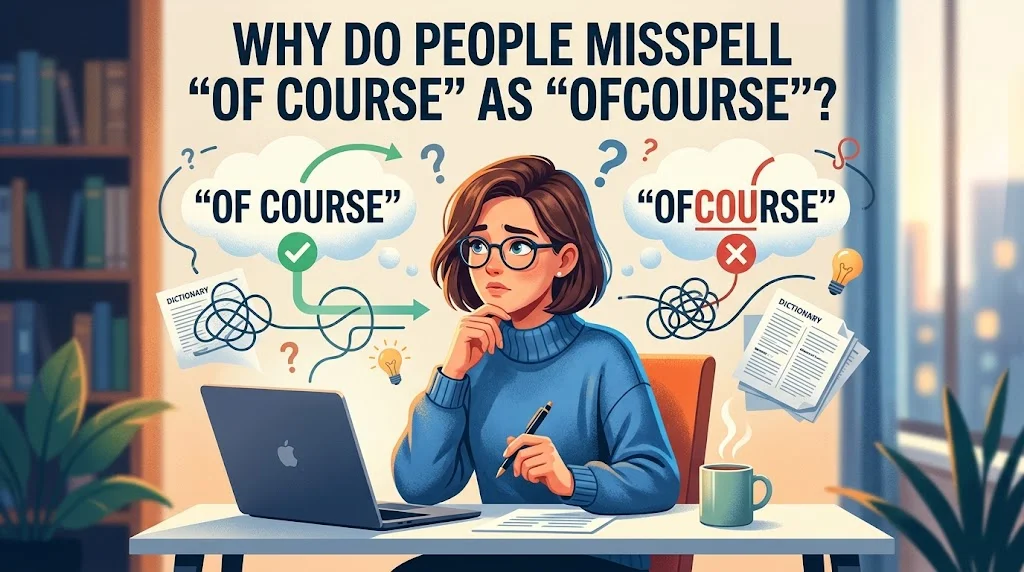
If of course is so common, why does ofcourse appear so often?
There are several practical reasons.
Fast Speech
In everyday speech, people often pronounce of course quickly.
The two words can sound tightly connected, especially in casual conversation. That can make learners assume they should be written as one word.
But pronunciation doesn’t determine whether two words are written separately.
English contains many expressions where word boundaries become less noticeable in natural speech.
Fast Typing
People also make spelling mistakes when typing quickly.
If you write:
Ofcourse I’ll be there.
your fingers may simply follow the sound of the expression rather than its standard written form.
This is particularly common when people type informal messages without proofreading.
Confusion With Other Compound Words
English has many compound words written as one word:
- sometimes
- somehow
- anyway
- nowhere
- everyone
- however
Learners may therefore assume that frequently used expressions eventually become single words.
But English spelling isn’t that predictable.
Some combinations remain two words even when speakers use them constantly.
Of course is one of them.
Memory Through Sound
Another reason is that learners may memorize the phrase by sound rather than visually.
If you mainly hear:
“uhv course”
you may not consciously register the space between the words.
A simple visual habit can solve the problem: whenever you write the expression, picture it as OF + COURSE.
Is “Of Course” One Word or Two Words?
Of course is two words.
That is the standard answer.
The first word is the preposition of, while course is a noun. Together, they form a familiar expression whose meaning depends on context.
Correct:
Of course, I’ll help you.
Incorrect:
Ofcourse, I’ll help you.
This distinction matters because spacing is part of spelling.
You wouldn’t normally combine unrelated words just because they frequently appear together. The same principle applies here.
A Quick Visual Trick
If you regularly confuse the spelling, remember:
of + course = of course
The phrase has the same two-word structure in every normal use.
Try these:
Of course I understand.
Of course you can come.
She was nervous, of course.
Of course not.
In all four examples, the spelling stays exactly the same.
How to Use “Of Course” in a Sentence
One reason of course can feel tricky is that it can appear in several positions.
You can place it at the beginning, middle, or end of a sentence. It can also stand alone as a response.
Its punctuation depends partly on how it functions in the sentence.
“Of Course” at the Beginning of a Sentence
When of course introduces a sentence as an introductory expression, a comma is often appropriate.
For example:
Of course, I remember your name.
Of course, we can discuss it tomorrow.
Of course, she was surprised by the news.
The comma helps separate the introductory expression from the main statement.
However, punctuation can vary depending on rhythm and grammatical structure. Not every occurrence of of course requires a comma.
For example:
Of course you can join us.
This is also natural, especially when of course is closely integrated with the rest of the sentence.
The important point is not to treat the comma as an automatic spelling rule. First identify how the expression functions in the sentence.
“Of Course” in the Middle of a Sentence
When of course appears in the middle of a sentence as a parenthetical expression, commas can help set it apart.
For example:
The plan, of course, depends on the weather.
She is, of course, welcome to stay.
Here, the phrase adds commentary rather than forming the essential grammatical structure of the sentence.
Removing it leaves a complete sentence:
The plan depends on the weather.
She is welcome to stay.
That’s a useful test.
If of course is inserted as an aside, punctuation often separates it from the surrounding sentence.
However, don’t add commas simply because you see the words of course. Their grammatical role matters.
“Of Course” at the End of a Sentence
You can also put of course at the end of a sentence.
For example:
He knew about the meeting, of course.
You can stay here, of course.
She was disappointed, of course.
At the end of a sentence, of course often adds an afterthought or emphasizes that the information should be expected.
It can also create a conversational tone.
Compare:
She was upset.
with:
She was upset, of course.
The second sentence suggests that her reaction was understandable or predictable.
“Of Course” as a Standalone Response
One of the most common uses of of course is as a complete conversational response.
For example:
“Can I sit here?”
“Of course.”
Or:
“Will you help me?”
“Of course!”
Or:
“Do you remember him?”
“Of course!”
The expression can stand alone because the surrounding conversation supplies the missing information.
The punctuation can communicate tone.
Of course. sounds calm and straightforward.
Of course! sounds warmer, more enthusiastic, or more emphatic.
Of course? can indicate surprise or uncertainty in a particular context.
So punctuation isn’t merely decoration. In short conversational expressions, it can influence how the reader interprets the speaker’s attitude.
“Of Course” in Formal and Informal English
Of course is widely used in both formal and informal English, but the context determines whether it sounds natural.
It is not inherently slang or overly casual.
You can hear it in a conversation between friends:
“Can you pick me up?”
“Of course.”
You can also see it in professional communication:
Of course, we can provide the requested information.
However, formal writing sometimes benefits from more precise wording, particularly when of course suggests that a claim is self-evident.
For example:
Of course, this method is more effective.
In an academic paper, a reader may reasonably ask, “Why is that obvious?”
A more precise version might be:
This method is more effective because it reduces processing time.
The second sentence gives evidence rather than simply presenting the conclusion as obvious.
In Casual Conversation
In everyday speech, of course is extremely natural.
You can use it to:
- Agree
- Reassure
- Give permission
- Offer help
- Confirm something
- Emphasize certainty
Examples:
Of course I’ll call you later.
Of course you can borrow my jacket.
Of course I remember that day.
Of course not!
The expression fits naturally into ordinary conversation because it is short, flexible, and familiar.
In Professional Communication
You can use of course at work, but tone deserves attention.
For example:
Of course, I’ll send the revised document this afternoon.
This sounds cooperative and helpful.
Another example:
Of course, we can schedule a meeting for next week.
That can sound perfectly professional.
But consider:
Of course, everyone knows that.
Depending on context, this may sound dismissive. It could suggest that the other person should already know the information.
A safer professional alternative may be:
Yes, that’s correct.
or:
Certainly. Let me clarify that point.
The expression itself isn’t unprofessional. The potential problem is the attitude it can imply.
In Academic Writing
Of course can appear in academic writing, but writers should use it carefully.
Academic prose generally values explicit reasoning. If you call a statement obvious, you may need to explain why it is obvious.
For example:
Of course, social media influences communication.
This is broad and unsupported.
A stronger academic sentence would provide a specific reason:
Social media influences communication by changing how quickly information is shared and discussed.
That doesn’t mean of course is forbidden in academic writing.
It simply means the phrase should serve a clear purpose.
If it adds emphasis without weakening precision, it may be appropriate. If it replaces evidence or reasoning, it’s better to remove it.
Common Ways to Use “Of Course”
The expression appears in several familiar patterns. Learning these patterns can help you recognize and produce natural English more easily.
“Of Course, I Can”
Of course, I can is a common way to accept a request.
For example:
“Can you review this document?”
“Of course, I can.”
It communicates willingness and confidence.
You can also shorten the response:
“Can you review this document?”
“Of course.”
The shorter version often sounds more natural in everyday conversation.
“Of Course You Can”
Of course you can is commonly used when giving permission or encouragement.
For example:
“Can I come with you?”
“Of course you can.”
It can also encourage someone:
“Do you think I can learn this?”
“Of course you can.”
Here, the phrase does more than give permission. It reassures the listener.
The speaker is saying that the possibility is real and that there’s no reason to doubt it.
“Of Course Not”
Of course not is the negative form of the expression.
It can strongly reject an idea or reassure someone that something is not true.
For example:
“Are you angry with me?”
“Of course not.”
Or:
“Did you break the computer?”
“Of course not!”
The tone matters.
A gentle Of course not can reassure someone.
An emphatic Of course not! can sound defensive or strongly dismissive of the suggestion.
“Of Course!”
When used alone with an exclamation mark, Of course! usually expresses enthusiastic agreement, permission, or willingness.
For example:
“Can I join you?”
“Of course!”
“Would you like some coffee?”
“Of course!”
However, the same words can sound sarcastic in a different context.
For example:
“Did you really forget the tickets again?”
“Of course!”
Here, the exclamation may signal irony rather than genuine agreement.
The words haven’t changed. The context and tone have.
“Of Course, There’s a Catch”
This pattern is often used when something seems positive but has an important limitation.
For example:
The job offers flexible hours. Of course, there’s a catch: the workload is heavy.
Here, of course introduces an expected complication.
It can create a conversational, slightly humorous tone.
Another example:
You can finish the project early. Of course, there’s a catch—you’ll need to work this weekend.
This use is common in storytelling, conversation, articles, and informal explanations.
“As a Matter of Course”
As a matter of course is a related expression, but it isn’t interchangeable with every use of of course.
It generally means something is done routinely, normally, or as part of an established procedure.
For example:
Employees receive safety training as a matter of course.
This means the training is normally or routinely provided.
Compare:
Of course, employees receive safety training.
This sentence expresses certainty or obviousness.
The meanings overlap slightly around the idea of normality, but their grammatical functions differ.
Of course is often a conversational expression of certainty, agreement, or willingness.
As a matter of course usually describes something done routinely or as standard practice.
That distinction becomes important in formal writing.
“Of Course” vs. “Certainly”
Of course and certainly can both express agreement, confidence, or certainty, but they don’t always sound the same.
Certainly often sounds more deliberate and formal. Of course usually feels more conversational and familiar.
Compare:
Of course, I can help you.
Certainly, I can help you.
Both sentences express willingness. However, of course sounds warmer and more conversational, while certainly can sound more polished or formal.
You might hear a friend say:
“Can you give me a hand?”
“Of course!”
In a professional setting, you might also hear:
“Certainly. I’ll take care of that.”
Neither expression is automatically better. The right choice depends on the situation and the tone you want.
When “Of Course” Works Better
Use of course when you want your response to sound natural and conversational.
Of course, you can stay with us.
Of course, I remember meeting her.
When “Certainly” Works Better
Certainly can be useful when you want a more formal or restrained tone.
Certainly, we can arrange an appointment.
The evidence certainly supports that conclusion.
A useful distinction is that of course can sometimes imply that the answer should have been obvious, while certainly usually focuses more directly on certainty.
“Of Course” vs. “Sure”
Sure is another common alternative to of course, especially in conversation.
Consider:
“Can you help me with this?”
“Sure.”
You could also say:
“Can you help me with this?”
“Of course.”
Both responses show willingness, but they have slightly different conversational flavors.
Sure is usually shorter, more casual, and very common in everyday American English.
Of course can sound warmer, more reassuring, or more emphatic.
Compare:
| Expression | Typical impression |
| Sure | Casual and direct |
| Of course | Reassuring and affirmative |
| Certainly | More formal or polished |
For example, a friend might naturally say:
Sure, I’ll pick you up.
Another person might say:
Of course, I’ll pick you up.
The first sounds relaxed. The second can sound more reassuring, as though helping is an obvious or welcome thing to do.
“Of Course” vs. “Absolutely”
Absolutely often expresses strong agreement or enthusiastic confirmation.
For example:
“Do you agree with the plan?”
“Absolutely.”
You can also say:
“Do you agree with the plan?”
“Of course.”
Both are affirmative, but absolutely often carries stronger emphasis.
Compare:
Of course, I’ll attend the meeting.
Absolutely, I’ll attend the meeting.
The first can sound natural and expected. The second can sound more emphatic or enthusiastic.
Absolutely is particularly useful when you want to remove any doubt.
Absolutely. I completely agree.
By contrast, of course may suggest that the answer was already obvious or expected.
“Of Course” vs. “Obviously”
These two expressions can overlap, but they have different conversational effects.
Obviously directly labels something as clear or easy to understand.
Obviously, we need more time.
Of course can imply that the same fact is natural or expected:
Of course, we need more time.
The difference becomes important when speaking to other people.
Obviously can sometimes sound blunt because it suggests that the listener should already understand the point.
Of course can also sound dismissive, but it often has a friendlier range of uses.
For example:
Obviously, you should check the instructions.
This may sound as though the speaker thinks the listener made an unreasonable mistake.
Compare:
Of course, you should check the instructions.
This can sound like gentle confirmation, depending on context.
Neither expression is always polite or impolite. Tone, relationship, and situation all matter.
“Of Course” vs. “Naturally”
Naturally can mean that something is expected or follows logically from a situation.
For example:
Naturally, she was nervous before the interview.
You could also say:
Of course, she was nervous before the interview.
Both suggest that her reaction was understandable.
However, naturally often has a more written or formal flavor.
Of course is more common in everyday conversation.
Compare:
Naturally, the company wanted to reduce costs.
with:
Of course, the company wanted to reduce costs.
The first may sound more analytical. The second sounds more conversational.
There is also another meaning of naturally: “in a natural manner.”
For example:
She speaks naturally in front of large audiences.
You cannot replace naturally with of course in that sentence.
So, although the expressions can overlap when discussing expected events, they are not complete synonyms.
“Of Course” vs. “Off Course”
This is one of the most important distinctions to understand because the two expressions sound similar.
Of course is an expression of certainty, agreement, expectation, or willingness.
Off course means away from the correct route, direction, or planned path.
The difference is just one letter, but the meanings are completely different.
“Of Course”
Use of course when you mean:
- Certainly
- Naturally
- Yes
- Clearly
- As expected
Examples:
Of course, I’ll help you.
Of course she knows the answer.
Of course not.
“Off Course”
Use off course when something has moved away from its intended route or direction.
For example:
The ship went off course during the storm.
The plane was slightly off course.
Our hiking group wandered off course.
Here, course refers to a route or direction.
The expression can also be used figuratively:
The project has gone off course.
This means the project is no longer progressing according to its original plan.
A Simple Comparison
| Expression | Meaning | Example |
| of course | certainly or naturally | Of course, I understand. |
| off course | away from the intended route | The boat drifted off course. |
A simple memory trick is to focus on the first word:
Of course = certainty
Off course = wrong direction
If someone says:
“Of course!”
they’re probably agreeing.
If someone says:
“The plane is off course.”
they’re talking about direction.
Common Mistakes With “Of Course”
Because of course is short and familiar, learners sometimes assume it is easy to use in every situation. Yet several mistakes occur frequently.
Writing “Ofcourse”
The most obvious mistake is combining the two words.
Incorrect:
Ofcourse, I’ll call you later.
Correct:
Of course, I’ll call you later.
Remember that of course always contains a space.
If you’re proofreading a document, search specifically for ofcourse. Word processors may catch it, but you shouldn’t rely entirely on automatic correction.
Confusing “Of Course” With “Off Course”
These expressions are easy to confuse because they sound similar.
Incorrect:
Off course, I can help you.
Correct:
Of course, I can help you.
The first sentence suggests “away from a route,” which makes no sense in this context.
On the other hand:
The boat is off course.
is correct because the sentence refers to direction.
Splitting the Phrase With a Comma
Another mistake is treating of course as though the two words should normally be separated by punctuation.
Incorrect:
Of, course, I’ll help you.
Correct:
Of course, I’ll help you.
The comma does not belong between of and course.
If a comma is needed, it normally appears after the complete expression:
Of course, I’ll help you.
Or around it when it functions parenthetically:
She will, of course, help you.
Never insert a comma simply because the phrase contains two words.
Overusing the Expression
Because of course is convenient, writers can use it too often.
Consider:
Of course, we need to plan ahead. Of course, we should check the budget. Of course, we need to contact the client. Of course, we have to meet the deadline.
The repetition quickly becomes distracting.
A stronger paragraph would vary the wording:
We need to plan ahead. We should also check the budget and contact the client before the deadline.
Use of course when it adds meaning, emphasis, reassurance, or conversational tone. Don’t add it to every sentence simply because it sounds natural.
Using “Of Course” When It Sounds Dismissive
This is a more subtle problem.
Imagine someone asks:
“Are you sure this is correct?”
You respond:
“Of course it’s correct.”
Depending on your voice, this might sound reassuring. But it could also sound irritated, as though the question was unnecessary.
Compare:
Of course it’s correct.
with:
Yes, it’s correct. Let me show you why.
The second version is often more supportive when someone genuinely needs clarification.
Written communication creates an additional challenge because readers cannot hear your voice.
That means of course can sometimes be interpreted more sharply than you intended.
Practical Examples of “Of Course” in Everyday English
The best way to understand of course is to see how its meaning changes across real situations.
Asking for Permission
Suppose a child asks:
“Can I play outside?”
A parent might respond:
“Of course, but finish your homework first.”
Here, of course gives permission, while the second part adds a condition.
Another example:
“Can I borrow your pen?”
“Of course.”
The speaker is granting permission.
Offering Help
Imagine a coworker asks:
“Could you help me carry these boxes?”
You might reply:
“Of course. Give me one.”
The expression communicates willingness.
Another example:
“Could you look over my presentation?”
“Of course. Send it to me when you’re ready.”
This sounds cooperative and friendly.
Confirming Information
You can use of course when confirming something you know to be true.
For example:
“Is Maria joining us?”
“Of course. She said she’d be here at six.”
Or:
“Do you remember where we parked?”
“Of course. We parked near the entrance.”
In these examples, the expression reinforces confidence in the answer.
Strong Denial
Of course not can strongly reject a suggestion or reassure someone.
For example:
“Did you tell anyone my secret?”
“Of course not!”
The response expresses strong denial.
Another example:
“Are you upset with me?”
“Of course not. We’re fine.”
Here, the expression is reassuring rather than defensive.
Expressing Something Expected
You can also use of course to describe something that naturally follows from a situation.
For example:
He was exhausted after the marathon, of course.
The speaker considers his exhaustion unsurprising.
Another example:
Of course, the roads were crowded during the holiday weekend.
The traffic was expected because of the circumstances.
This use often appears in storytelling and explanation.
“Of Course” in Workplace Communication
Of course is common in workplace conversations because it can make responses sound cooperative and approachable.
For example:
“Can you send me the updated figures?”
“Of course. I’ll send them before lunch.”
Or:
“Would you like me to prepare the report?”
“Of course, if you have time.”
It can also appear in meetings:
Of course, we need to consider the budget before moving forward.
However, professional communication requires some awareness of tone.
Imagine a manager asks:
“Does the client need the final version today?”
Replying:
“Of course they do.”
could sound unnecessarily sharp if the manager was genuinely asking for clarification.
A more neutral response would be:
Yes, they need it today.
Or:
Yes. The deadline is 4 p.m.
The issue isn’t that of course is unprofessional. It’s that the phrase can sometimes imply that the answer should have been obvious.
In Meetings
You can use the expression naturally in meetings:
Of course, we should review the risks before approving the proposal.
Of course, I’ll share the notes after the meeting.
Of course, we can revisit the timeline if needed.
These examples sound cooperative because the phrase supports the main message rather than replacing useful information.
In Customer Service
Customer service representatives may use of course to reassure customers:
“Can you help me update my address?”
“Of course. I can help you with that.”
This sounds welcoming.
However, customer-facing professionals should avoid using it in a way that makes a customer feel foolish.
For example:
“Of course you need to verify your identity.”
That could sound dismissive.
A better alternative is:
Yes, we’ll need to verify your identity before making the change.
The second version provides the information without suggesting the customer should already know it.
“Of Course” in Emails
You can use of course in emails, especially when responding positively to a request.
For example:
Of course, I’d be happy to review the document.
Or:
Of course. I’ll send the revised file by Friday.
These sentences sound friendly and professional.
However, consider the context before using the phrase.
If a colleague asks:
Could you explain why the deadline changed?
A response like:
Of course, the deadline changed because the client requested additional revisions.
can sound fine.
But:
Of course, you should already know that the deadline changed.
sounds dismissive.
In written communication, you should always consider how the reader might interpret your tone.
Email Example: Friendly
Hi Sarah,
Of course, I can review the proposal. I’ll send you my feedback tomorrow morning.
Best,
James
This sounds cooperative without being overly formal.
Email Example: More Formal
Of course, we can provide the requested documents. Please let me know if you need anything else.
This is professional while remaining approachable.
Email Example: When “Of Course” Is Better Omitted
Sometimes the phrase adds little:
Of course, attached is the report you requested.
A cleaner version is:
Attached is the report you requested.
The second sentence is more direct.
This is an important editing principle: use of course when it contributes to the tone or meaning, not merely because it is available.
Is “Of Course” Appropriate in Academic Writing?
Yes, of course can appear in academic writing, but it should be used thoughtfully.
Academic writing generally prioritizes clarity, evidence, precision, and logical support. The phrase can sometimes make an unsupported claim sound as though it is self-evident.
For example:
Of course, exercise improves health.
This is too broad for a serious academic discussion.
A more precise sentence might be:
Regular physical activity is associated with several health benefits, including improved cardiovascular fitness.
The second sentence gives the reader useful information instead of simply calling the claim obvious.
Still, there are contexts where of course can work.
For example:
The two methods differ in several important respects. Of course, the choice of method also depends on the research question.
Here, the expression functions as a transition and emphasizes a reasonable qualification.
Academic Editing Tip
When you see of course in academic writing, ask:
Does this phrase add useful meaning, or does it merely tell the reader that something is obvious?
If it adds nothing, remove it.
For example:
Of course, the results require further analysis.
can become:
The results require further analysis.
The second version is more direct.
This doesn’t mean academic writing must avoid conversational expressions completely. It means every phrase should have a clear purpose.
How Tone Changes the Meaning of “Of Course”
The words of course remain the same, but their tone can change significantly.
This is one reason learners sometimes misunderstand the expression.
A simple:
Of course.
could mean:
- Yes.
- Certainly.
- No problem.
- Naturally.
- Obviously.
- I’m surprised you asked.
- Yes, but you should already know that.
- I’m being sarcastic.
The surrounding situation usually tells you which meaning is intended.
Friendly
A friendly of course sounds welcoming.
“Can I sit with you?”
“Of course!”
The exclamation mark reinforces warmth.
Neutral
A neutral version simply confirms something.
“Will the meeting start at nine?”
“Of course. That’s the scheduled time.”
The expression adds certainty without strong emotion.
Reassuring
You can use of course to calm someone who is worried.
“Are you still going to help me?”
“Of course I am.”
Here, the phrase tells the listener that they have no reason to worry.
Sarcastic
Tone can completely reverse the apparent meaning.
Imagine someone forgets their keys for the third time:
“Of course you forgot your keys.”
The speaker may not be sincerely stating that forgetting the keys was expected. They may be expressing frustration or irony.
Similarly:
“Of course he arrived late.”
Depending on the context, this could mean the speaker genuinely expected him to be late or could be criticizing a repeated habit.
Potentially Dismissive
The phrase can also sound dismissive when someone asks a genuine question.
For example:
“Of course that’s the answer.”
If spoken sharply, it may imply:
“How could you not know that?”
That implication isn’t part of the dictionary meaning of of course. It comes from tone, context, and the relationship between the speakers.
When you want to sound especially considerate, replace a potentially dismissive of course with a direct but supportive response:
Yes, that’s correct.
Exactly.
Certainly. Let me explain.
Yes. Here’s how it works.
These alternatives can make your intention clearer.
Is “Ofcourse” Correct in Texting?
People sometimes write ofcourse in texts because texting encourages speed and informality.
You may see:
Ofcourse I’ll come 😂
or:
Ofcourse!
But frequent appearance in texting does not make ofcourse standard spelling.
If you want to write correctly, use:
Of course!
Informal communication may contain abbreviations, missing punctuation, slang, and deliberate spelling changes. However, when you’re writing for school, work, publishing, or a professional audience, standard spelling matters.
Even in casual texting, learning the correct form is useful because you can carry that habit into more formal situations.
A good rule is simple:
Texting can be informal, but “of course” is still spelled with two words.
Is “Of Course” American or British English?
Of course is used in both American English and British English.
It isn’t limited to one variety of English.
You can hear and read the expression across English-speaking regions, including the United States and the United Kingdom.
For example, both speakers might naturally say:
Of course, I can help you.
or:
Of course not.
The spelling also remains the same.
What may vary is the surrounding vocabulary, pronunciation, conversational style, or frequency of certain alternatives.
For example, sure is particularly common in American conversational English, while British speakers may also frequently use expressions such as certainly, of course, or sure, depending on context and individual preference.
But there is no American-vs.-British spelling distinction here.
Of course is standard in both varieties.
When Should You Avoid “Of Course”?
There’s no general rule saying you must avoid of course. It is a standard and useful English expression.
However, there are situations where another wording may be clearer.
When the Information Isn’t Actually Obvious
Avoid using of course to label something as obvious when your reader may reasonably need an explanation.
Instead of:
Of course, this process is complicated.
Try:
This process is complicated because it involves several approval stages.
The second sentence explains the claim.
When You Want a Completely Neutral Tone
If you’re worried that of course could sound dismissive, use a more direct expression.
Instead of:
Of course, that’s correct.
you could write:
Yes, that’s correct.
When You’re Writing Highly Technical Material
Technical writing often benefits from precision.
Instead of:
Of course, the device requires regular maintenance.
write:
The device requires regular maintenance to operate safely and reliably.
The second version communicates more useful information.
When You’ve Already Used It Repeatedly
Repetition can weaken your writing.
If a paragraph contains of course several times, remove unnecessary instances or replace some with direct statements.
Good writing doesn’t need the same conversational marker in every sentence.
Case Study: Choosing the Right Response
Imagine you’re working with a colleague who has just finished preparing an important presentation. They ask:
“Could you look over these slides before the meeting?”
Several responses are possible:
Of course. I’ll review them now.
Certainly. I’ll review them now.
Sure. I’ll review them now.
Absolutely. I’ll review them now.
All four responses are grammatically correct, but they create slightly different impressions.
Of course sounds cooperative and reassuring. It suggests that helping is a natural response.
Certainly sounds a little more formal and deliberate.
Sure sounds casual and straightforward.
Absolutely adds stronger enthusiasm or emphasis.
Now imagine a different situation.
Your colleague asks:
“Are we still meeting at 2 p.m.?”
You could say:
Of course. It’s on the calendar.
But that answer might imply that the meeting time should already be known.
A more neutral response would be:
Yes, we’re still meeting at 2 p.m.
This small difference shows why choosing an expression isn’t just about grammar. Tone and context matter too.
Situation 1: Asking for Help
“Could you help me move this table?”
Of course.
This is friendly and cooperative.
Situation 2: Confirming a Fact
“Is the office closed on Sunday?”
Of course, it is.
This can sound natural if Sunday closure is well established. However, if the listener genuinely doesn’t know, a more neutral response may be kinder:
Yes, the office is closed on Sunday.
Situation 3: Reassuring Someone
“Are you still coming to my graduation?”
Of course I am!
This sounds warm and reassuring.
Situation 4: Rejecting an Accusation
“Did you take my notebook?”
Of course not!
This strongly denies the accusation.
Situation 5: Responding to a Repeated Mistake
“He forgot his password again.”
Of course he did.
Here, of course may sound sarcastic. The speaker may be referring to a predictable habit rather than genuinely praising the obviousness of the event.
The lesson is simple: the same expression can communicate different attitudes depending on context.
Quick Comparison: “Of Course” vs. “Ofcourse” vs. “Off Course”
These three forms can cause confusion, especially for English learners.
| Form | Correct? | Meaning |
| of course | Yes | Certainly, naturally, or as expected |
| ofcourse | No | Nonstandard spelling of “of course” |
| off course | Yes | Away from the intended route or direction |
Consider these examples:
Of course, I’ll call you tonight.
This means “Certainly, I’ll call you tonight.”
Ofcourse, I’ll call you tonight.
This contains a spelling error.
The ship drifted off course.
This means the ship moved away from its intended route.
The distinction is worth memorizing because of course and off course are both legitimate expressions, while ofcourse is not the standard spelling.
A Three-Second Check
Before you use the phrase, ask yourself:
Am I expressing certainty or agreement?
If yes, you probably need:
of course
If you’re describing something that has moved away from a route or plan, you probably need:
off course
For example:
Of course, we should call her.
versus:
Our plan has gone off course.
The meanings are completely different.
Easy Ways to Remember “Of Course”
If you often type ofcourse, you can train yourself to remember the correct spelling with a few simple techniques.
Remember the Two-Word Pattern
The easiest method is to memorize:
of + course = of course
Think of the expression as two separate building blocks.
Of remains of.
Course remains course.
Put them together with a space:
of course
This visual pattern is more reliable than trying to remember the pronunciation.
Compare It With Similar Expressions
You can also remember the spelling by comparing of course with other familiar two-word expressions:
- of course
- of interest
- of value
- of importance
- of concern
- of benefit
These combinations keep their individual words.
You don’t write:
ofinterest
or:
ofvalue
The same principle applies to:
of course
This technique can help learners who tend to combine words simply because they hear them together.
Use a Quick Proofreading Test
When proofreading, search for:
ofcourse
If you find it, change it to:
of course
This is especially useful when editing long documents.
You can also scan for off course to make sure you used the correct expression.
For example:
Of course, the project is ready.
Correct.
The project has gone off course.
Also correct, but with a different meaning.
Memorize One Correct Sentence
Choose one sentence and remember it visually:
Of course, I can help you.
The next time you hesitate over the spelling, recall that sentence.
Then adapt it:
Of course, she understands.
Of course, we can wait.
Of course not.
Of course you can.
The spelling stays unchanged.
Common Learner Questions About “Of Course”
English learners often ask the same questions about this expression because its spelling, punctuation, meaning, and tone can be confusing.
Is “of course” one word or two?
Of course is two words in standard English. The correct spelling contains a space between of and course.
For example:
Of course, I’ll help you.
The spelling ofcourse is not standard. Even though people sometimes use it in informal texts or online writing, it should not be used in polished English.
Is “ofcourse” grammatically correct?
No. Ofcourse is not the standard spelling of the expression. The correct form is of course.
For example:
Correct: Of course, I understand.
Incorrect: Ofcourse, I understand.
This is primarily a spelling issue rather than a special grammatical variation. When writing professionally, academically, or formally, always separate the two words.
What is the correct spelling of “of course”?
The correct spelling is:
of course
It contains two words.
The phrase should not be written as ofcourse, and you should not place a hyphen between the words.
Correct:
Of course, that makes sense.
Incorrect:
Ofcourse, that makes sense.
Incorrect:
Of-course, that makes sense.
The standard form is simply of course.
What does “of course” mean?
Of course can mean certainly, naturally, yes, as expected, or without doubt, depending on the context.
For example:
“Can I come with you?”
“Of course!”
Here, it means “Yes.”
In:
Of course, the roads were busy during rush hour.
it suggests that the traffic was expected.
The expression is flexible, so context determines its exact conversational meaning.
Should “of course” have a comma?
Sometimes, but not always.
When of course functions as an introductory or parenthetical expression, a comma is often appropriate:
Of course, I’ll help you.
She will, of course, attend the meeting.
But when the expression is closely connected to the sentence, the comma may be omitted:
Of course you can come with us.
The key is to consider how the phrase functions in the sentence rather than automatically inserting a comma after it.
One rule is certain: never put a comma between “of” and “course.”
Can “of course” begin a sentence?
Yes. Of course can naturally begin a sentence.
For example:
Of course, we can discuss the issue tomorrow.
Of course, she knew about the changes.
Of course you can ask another question.
When it functions as an introductory expression, a comma often follows it. However, punctuation can depend on how tightly the phrase is connected to the rest of the sentence.
Starting a sentence with of course is grammatically acceptable in both casual and formal contexts, although formal writers may sometimes choose a more precise alternative.
Is “of course” formal or informal?
Of course works in both formal and informal English.
You can use it in everyday conversation:
Of course! Come on in.
You can also use it in professional communication:
Of course, I’ll send the documents this afternoon.
However, extremely formal or technical writing may benefit from more precise wording when of course simply labels a statement as obvious.
So the expression itself isn’t inherently informal. Context and purpose determine whether it fits.
What’s the difference between “of course” and “certainly”?
Both can express certainty or agreement.
Of course is generally more conversational and can also communicate reassurance, permission, or obviousness.
Certainly often sounds more formal or deliberate.
Compare:
Of course, I can help you.
Certainly, I can help you.
The first sounds warmer and more conversational. The second can sound more formal.
They overlap, but they aren’t interchangeable in every context.
What’s the difference between “of course” and “off course”?
Of course means something like “certainly,” “naturally,” or “as expected.”
Off course means away from an intended route, direction, or plan.
For example:
Of course, I’ll attend the meeting.
But:
The plane was slightly off course.
The first concerns certainty. The second concerns direction.
The expressions sound similar, but their meanings are entirely different.
Can “of course” sound rude or sarcastic?
Yes, depending on tone and context.
For example:
Of course you forgot again.
This could be a neutral observation, but it could also be sarcastic if the speaker is criticizing a repeated mistake.
Similarly:
Of course that’s what you think.
can sound dismissive if said with irritation.
However, of course can also be very warm:
Of course I’ll help you.
The words themselves don’t determine the attitude. Voice, punctuation, context, and the relationship between speakers all contribute to how the expression is understood.
Grammar and Sentence Structure With “Of Course”
Although of course is primarily a fixed expression, understanding how it fits into sentences can help you use it more naturally.
It can function in several ways depending on context.
As an Introductory Expression
At the beginning of a sentence, of course can introduce the speaker’s attitude toward the following statement.
Of course, we need more time.
The main clause is:
We need more time.
The expression adds certainty or emphasis.
As a Parenthetical Expression
It can appear in the middle of a sentence:
The manager, of course, approved the request.
Here, the expression is parenthetical. It adds commentary but isn’t essential to the basic sentence structure.
Remove it:
The manager approved the request.
The sentence remains complete.
As a Sentence Adverbial
Of course can also modify the whole statement rather than a single word.
For example:
Of course, the answer depends on the circumstances.
The expression tells us how the speaker views the entire proposition.
It isn’t saying that the word answer is “of course” or that the verb depends is “of course.” Instead, it signals the speaker’s attitude toward the complete statement.
As a Standalone Response
In conversation, of course can function independently:
“Can I ask you something?”
“Of course.”
The surrounding conversation supplies the context.
This is common with many conversational expressions. The phrase doesn’t need to be attached to a complete grammatical clause to communicate a complete response.
“Of Course” and Punctuation: A Practical Guide
Punctuation around of course depends on its role.
Here are several common patterns.
Beginning of a Sentence
Of course, I remember her.
A comma is common when the expression functions as an introductory comment.
Middle of a Sentence
I will, of course, keep you informed.
Commas set off the parenthetical expression.
End of a Sentence
I remember her, of course.
The comma can signal an afterthought or parenthetical comment.
Integrated Use
Of course you can stay.
No comma is required when of course is closely integrated with the statement.
The practical lesson is to avoid treating punctuation as a mechanical rule.
Don’t write:
Of, course
Never separate the two words.
Instead, determine whether the complete phrase is functioning as an introductory, parenthetical, or integrated element.
Can “Of Course” Be Used With Questions?
Yes. Of course can appear in responses to questions and can also appear in questions themselves, although its function changes.
For example:
Of course, would you like some coffee?
This can sound unusual depending on context because of course generally responds to an assumption, agreement, or preceding idea.
More natural examples include:
Would you, of course, like to join us?
This may sound formal or rhetorical.
In everyday conversation, speakers are much more likely to use of course in the answer:
“Can I join you?”
“Of course.”
Another useful pattern is:
“Of course?”
The question mark can signal surprise or a request for clarification.
For example:
“You know the answer, of course?”
Depending on intonation, the speaker may be checking whether the listener agrees with an assumption.
Can “Of Course” Be Used in Negative Sentences?
Yes.
The most familiar negative pattern is:
Of course not.
This means “Certainly not” or “No, definitely not.”
For example:
“Are you leaving without me?”
“Of course not.”
You can also place of course in longer negative sentences:
Of course, I don’t want you to worry.
She doesn’t expect us to finish today, of course.
The expression itself doesn’t make a sentence positive. Its meaning comes from the surrounding words.
Compare:
Of course I will help.
and:
Of course I won’t ignore the problem.
Both express certainty, but one is positive and the other negative.
“Of Course” With Different Verb Tenses
The expression works naturally with different verb tenses because it isn’t restricted to one particular grammatical structure.
Present
Of course, I know the answer.
Past
Of course, she knew what happened.
Future
Of course, we’ll be there tomorrow.
Present Perfect
Of course, he has already heard the news.
Past Perfect
Of course, they had expected some delays.
The expression remains unchanged while the verb tense communicates when the main event occurs.
This is another reason of course is so flexible.
“Of Course” With Modal Verbs
You can also combine of course with modal verbs such as can, could, will, would, should, and may.
Examples include:
Of course, you can stay.
Of course, we could discuss another option.
Of course, I will help.
Of course, we should check the figures.
Of course, you may ask questions.
The modal verb changes the exact meaning of the sentence, while of course adds certainty, agreement, permission, or emphasis.
For example:
Of course, you can come.
sounds like permission.
But:
Of course, we should leave early.
expresses agreement with or confidence in a recommendation.
“Of Course” in Dialogue and Storytelling
Writers often use of course in dialogue because it can reveal character attitude quickly.
Consider:
“Can you keep this secret?” Maya asked.
“Of course,” Daniel said.
The response suggests trust and willingness.
Now change the context:
“You forgot the tickets again.”
“Of course I did,” he muttered.
Here, the same expression may signal frustration or sarcasm.
Writers can also use it in narration:
The restaurant was packed, of course, because it was Friday night.
This creates a conversational storytelling voice.
In fiction, of course can therefore do more than communicate information. It can show:
- Confidence
- Surprise
- Resignation
- Humor
- Sarcasm
- Reassurance
- Irritation
- Familiarity
That emotional flexibility makes the phrase useful in dialogue.
Why “Of Course” Is More Than Just a Spelling Question
At first glance, the difference between of course and ofcourse seems like a simple spelling issue.
And at the spelling level, the answer is straightforward:
Of course is correct. Ofcourse is not.
But the expression is worth understanding beyond spelling because it carries pragmatic meaning. In other words, it tells listeners not only what you think but sometimes how you feel about what you’re saying.
Consider:
Yes.
Of course.
Absolutely.
Certainly.
All four can express agreement, but they don’t necessarily sound identical.
Yes is neutral and direct.
Of course may add reassurance or imply that the answer is natural.
Absolutely often adds enthusiasm.
Certainly can sound more formal.
That’s why strong English usage involves more than choosing grammatically correct words. You also need to consider what the expression suggests about your attitude.
A Practical Test for Using “Of Course” Correctly
Before using of course, run through three quick questions.
Question 1: Am I Expressing Certainty, Agreement, or Willingness?
If yes, of course may fit naturally.
Of course, I can help.
Question 2: Am I Accidentally Suggesting That Something Is Obvious?
If the other person may reasonably not know something, consider a more neutral response.
Instead of:
Of course you should know that.
try:
Yes, that’s the usual procedure.
Question 3: Am I Spelling It Correctly?
Check the phrase:
of course
Not:
ofcourse
And not:
off course, unless you mean away from a route or plan.
This three-question test catches most common problems.
“Of Course” in Everyday Conversation: Mini Dialogues
Seeing the expression in short conversations can make its different functions easier to recognize.
Agreement
“Do you agree with the plan?”
“Of course.”
Meaning: Yes, I agree.
Permission
“Can I use your laptop?”
“Of course, but please be careful.”
Meaning: Yes, you have permission.
Reassurance
“Will you still be there tomorrow?”
“Of course I will.”
Meaning: You don’t need to worry.
Strong Denial
“Did you tell him?”
“Of course not!”
Meaning: Definitely not.
Obvious Result
“She was tired after working all night.”
“Of course she was.”
Meaning: Her tiredness was completely expected.
Sarcasm
“He forgot the deadline again.”
“Of course he did.”
Meaning may be: This is exactly the kind of thing he always does.
The final example shows why tone matters so much. Without knowing the relationship between the speakers, you cannot always tell whether of course is sincere or sarcastic.
“Of Course” in Different Communication Situations
The expression of course works across many types of communication, but its effect can change depending on where you use it.
A conversation with a friend is different from a customer-service email. An academic paper is different from a text message. The words may stay the same, but the surrounding context changes how they sound.
With Friends
Among friends, of course is usually relaxed and natural.
“Are you coming to the game?”
“Of course!”
You can also use it humorously:
“Did you bring snacks?”
“Of course. What kind of friend would I be?”
Here, the expression feels casual and friendly.
With Family
Family conversations often use of course to show reassurance or agreement.
“Will you call Grandma?”
“Of course.”
“Can I have some of your popcorn?”
“Of course, but save me some.”
The phrase can make a simple response feel warmer.
With Teachers
Students may hear of course from teachers when asking for clarification:
“Can you explain this example again?”
“Of course. Let’s go through it step by step.”
This is a positive use because the expression welcomes the question instead of making the student feel uncomfortable.
In Customer Service
Customer-service workers can use of course to show willingness:
“Could you help me change my booking?”
“Of course. I’ll be happy to help.”
However, customer-service communication should avoid implying that a customer’s question is silly.
Compare:
Of course you need to provide your order number.
with:
Yes, we’ll need your order number to locate the booking.
The second response is clearer and less likely to sound dismissive.
When “Of Course” Sounds Too Strong
Sometimes of course adds more emphasis than you actually need.
For example:
Of course, I know where the store is.
If someone simply asks whether you know the location, the expression might suggest that their question was unnecessary.
A neutral response would be:
Yes, I know where it is.
Similarly:
Of course, that’s what we discussed.
could sound impatient.
A softer alternative is:
Yes, that’s what we discussed earlier.
The difference is subtle, but it matters in professional and sensitive conversations.
A Useful Tone Check
Before sending a message containing of course, ask:
Could the reader interpret this as “You should already know that”?
If the answer is yes, consider removing the expression or replacing it with something more neutral.
This is especially useful in emails because the reader cannot hear your voice or see your facial expression.
Can “Of Course” Be Sarcastic?
Yes. Of course can be sarcastic when the speaker uses it to highlight something predictable, ironic, or frustrating.
For example:
Of course he forgot his wallet again.
This could be a genuine observation, but it might also mean:
“That’s exactly the kind of thing he always does.”
Another example:
Of course the printer stopped working five minutes before the deadline.
The speaker probably isn’t celebrating the printer failure. They’re expressing frustration through irony.
How Context Creates Sarcasm
The expression itself doesn’t automatically create sarcasm.
Compare:
Of course, she passed the exam. She studied every night for months.
This is sincere. Her success was expected because she worked hard.
Now consider:
Of course, the printer broke again.
If the printer has a history of breaking at inconvenient times, the same phrase can become sarcastic.
The surrounding information determines the interpretation.
Can “Of Course” Be Used as a Polite Response?
Yes, especially when someone asks for permission, assistance, or confirmation.
For example:
“May I come in?”
“Of course.”
“Could you send me the address?”
“Of course.”
“Would you like me to explain?”
“Of course.”
In these situations, the expression can make a response feel welcoming.
Still, politeness depends on more than one phrase. A sharply spoken of course can sound irritated, while a warm of course can sound generous.
This is why language learners should study expressions in context rather than memorizing only dictionary definitions.
“Of Course” in Professional Emails: Better and Worse Uses
A professional email can contain of course, but placement and purpose matter.
Natural Use
Of course, I’d be happy to provide the additional information.
This sounds cooperative.
Natural Use With a Deadline
Of course. I’ll send the revised report by Thursday afternoon.
The expression confirms willingness, while the second sentence provides useful information.
Less Effective Use
Of course, you need to complete the form correctly.
This may sound like the recipient should already know the requirement.
A more professional alternative is:
Please make sure the form is completed correctly before submitting it.
The second version focuses on the action rather than the reader’s assumed knowledge.
“Of Course” and “Certainly” in Professional Writing
When writing professionally, you may sometimes choose between of course and certainly.
Consider:
Of course, we can arrange the meeting.
This sounds approachable.
Certainly, we can arrange the meeting.
This sounds slightly more formal.
Both are acceptable.
If you’re writing to a long-term colleague, of course may sound perfectly natural. If you’re responding to a formal request from a client, certainly may sometimes feel more polished.
But neither word should be selected simply because it sounds “more professional.” The most important goal is clarity and an appropriate tone.
“Of Course” and “Absolutely” in Conversation
These expressions often overlap when someone wants to give a strong positive response.
“Will you be there?”
“Of course!”
“Will you be there?”
“Absolutely!”
Both are affirmative, but the emotional emphasis differs.
Of course can suggest that the answer is obvious or expected.
Absolutely tends to emphasize strong agreement or enthusiasm.
Compare:
Of course I support the idea.
I absolutely support the idea.
The second version often sounds stronger.
This distinction becomes useful when you want to control the intensity of your response.
“Of Course” and “Sure” in American English
In everyday American English, sure is extremely common as a casual affirmative response.
For example:
“Can I borrow your charger?”
“Sure.”
You could also say:
“Of course.”
Both work, but they have slightly different flavors.
Sure is short, relaxed, and conversational.
Of course can sound more reassuring or enthusiastic.
You might therefore choose:
Sure, I’ll send it over.
for a casual exchange.
Or:
Of course, I’ll send it over.
when you want to emphasize willingness.
Neither is automatically more correct.
“Of Course” and “Obviously” Can Create Different Impressions
The difference between these expressions becomes especially important when correcting someone.
Suppose someone asks:
“Does this word need a capital letter?”
You could say:
Of course it does.
Or:
Obviously, it does.
The second response is more likely to sound blunt.
Obviously directly describes something as clear. If the listener didn’t know the answer, that wording can make them feel embarrassed.
Of course can also sound dismissive, but it has a wider range of friendly uses.
A particularly considerate response would be:
Yes, it does. Here’s the rule.
That answer gives the information without judging the question.
“Of Course” in Academic Discussions
Academic discussions require a balance between natural language and precise reasoning.
In spoken classroom discussion, of course is perfectly normal:
Of course, the historical context matters here.
A student might also say:
Of course, there are several ways to interpret the passage.
In a formal research paper, however, a writer should consider whether the expression adds anything.
Instead of:
Of course, the data show a significant difference.
a more precise version might be:
The data show a significant difference between the two groups.
The second sentence makes the claim directly.
The basic principle is:
Don’t use “of course” as a substitute for evidence.
If a fact is important, explain or support it.
Editing “Of Course” From Your Writing
Sometimes the best use of of course is no use at all.
When editing a paragraph, examine every occurrence.
Ask:
- Does it add certainty?
- Does it show agreement?
- Does it reassure the reader?
- Does it establish an expected result?
- Does it contribute to the speaker’s voice?
- Does it make the sentence unnecessarily conversational?
- Could it sound dismissive?
- Is it repeated too often?
If removing it changes nothing, you may not need it.
For example:
Of course, the company announced the results on Monday.
could simply become:
The company announced the results on Monday.
The shorter sentence is stronger if the expression contributes no useful meaning.
On the other hand:
Of course, I’ll help you.
loses some of its reassuring quality if you reduce it to:
I’ll help you.
Both are correct, but the first communicates a warmer attitude.
Good editing isn’t about removing every familiar expression. It’s about keeping the ones that serve a purpose.
A Quick Decision Guide for “Of Course”
When you’re unsure whether to use of course, follow this simple process.
Step 1: Identify Your Meaning
Are you trying to express:
- Certainty?
- Agreement?
- Permission?
- Willingness?
- Reassurance?
- Something expected?
If yes, of course may fit.
Step 2: Check the Tone
Ask whether you want to sound:
- Friendly
- Reassuring
- Confident
- Conversational
- Emphatic
If you want a very neutral tone, yes, certainly, or a direct statement may work better.
Step 3: Check the Context
A friendly conversation allows more flexibility than a formal academic argument.
In professional writing, make sure the phrase doesn’t imply that the reader should already know something.
Step 4: Check the Spelling
Always write:
of course
Never:
ofcourse
Step 5: Check the Punctuation
Don’t put a comma between the two words.
Correct:
Of course, I understand.
Incorrect:
Of, course, I understand.
Step 6: Read It for Tone
Read the sentence as though someone else wrote it.
Does it sound friendly?
Does it sound impatient?
Does it sound sarcastic?
Would another phrase communicate the same idea more clearly?
This final check is especially valuable in emails and workplace messages.
Common Sentences With “Of Course”
Here are some natural examples showing different uses of the expression.
Certainty
Of course, the answer depends on the situation.
Agreement
Of course, I agree with you.
Permission
Of course, you can use my computer.
Willingness
Of course, I’ll help you with the project.
Reassurance
Of course I remember you.
Strong Denial
Of course not! I didn’t take it.
Expected Result
He was tired after the long trip, of course.
Professional Communication
Of course, I’ll send the updated report this afternoon.
Academic Discussion
Of course, the findings need to be interpreted within their broader context.
Storytelling
Of course, everything changed the next morning.
These examples show why of course is so versatile. The phrase remains unchanged while its exact function comes from the surrounding sentence.
Correct and Incorrect Examples
A quick set of examples can make the spelling rule easy to remember.
| Incorrect | Correct |
| Ofcourse, I agree. | Of course, I agree. |
| Ofcourse you can come. | Of course you can come. |
| Ofcourse not! | Of course not! |
| Of-course, I’ll help. | Of course, I’ll help. |
| Of, course, I understand. | Of course, I understand. |
| The plane is of course. | The plane is off course. |
The last pair is especially important. If you’re talking about a plane, ship, route, or plan moving away from its intended direction, off course may be the expression you need.
Quick Reference Table
| Expression | Standard? | Main Meaning | Example |
| of course | Yes | certainly, naturally, as expected | Of course, I can help. |
| ofcourse | No | Misspelling of “of course” | Ofcourse, I can help. |
| off course | Yes | away from the intended direction | The ship went off course. |
| certainly | Yes | definitely | Certainly, I can help. |
| sure | Yes | yes, okay | Sure, I can help. |
| absolutely | Yes | definitely, strongly | Absolutely, I agree. |
| obviously | Yes | clearly | Obviously, the plan needs work. |
| naturally | Yes | as expected or in a natural way | Naturally, she was concerned. |
This table highlights an important point: of course has several close alternatives, but none matches every use exactly.
Why “Of Course” Remains So Common
There’s a reason this small expression appears constantly in everyday English.
It is short.
It is flexible.
It can express several kinds of certainty.
It works as a complete response.
It can soften a refusal or strengthen an agreement.
It can reassure someone in just two words.
For example:
“Can I ask you something?”
“Of course.”
That response immediately signals openness.
Likewise:
“Are you sure you’ll help?”
“Of course I will.”
The phrase reinforces reassurance without requiring a long explanation.
Its versatility makes it useful in conversation, storytelling, workplace communication, customer service, and many other settings.
Why “Ofcourse” Is Easy to Write but Easy to Catch
The spelling mistake is understandable because spoken English doesn’t always make spaces obvious.
When people hear:
of course
they hear one smooth phrase.
When they write it, however, standard English requires two words.
The good news is that this is an easy error to eliminate.
Every time you see ofcourse, mentally separate it:
of | course
That tiny visual pause can build the correct spelling habit.
If you use a word processor, you can also use its find-and-replace feature when editing a long document. Search for ofcourse and replace it with of course.
A Simple Memory Rule
If you remember only one rule from this article, remember this:
“Of course” is always two words when you mean “certainly” or “naturally.”
For example:
Of course, I’ll be there.
Of course you can ask.
Of course not.
She knew the answer, of course.
But if you mean that something has moved away from its intended route, use:
off course
For example:
The boat drifted off course.
That one-word difference can completely change the meaning.
Internal Linking Opportunities
For an English grammar and usage website, this article can naturally connect to related spelling, word-choice, punctuation, and phrase-comparison topics.
Useful internal-linking opportunities include:
- Of Course vs. Certainly — useful for comparing certainty and formality.
- Of Course vs. Sure — useful for conversational agreement and tone.
- Of Course vs. Absolutely — useful for differences in emphasis.
- Of Course vs. Obviously — useful for discussing implied obviousness and potential dismissiveness.
- Of Course vs. Off Course — useful for commonly confused expressions.
- Formal vs. Informal English — useful for explaining register and audience.
- Commas in English — useful for explaining punctuation around introductory and parenthetical expressions.
- Common English Spelling Mistakes — useful for placing ofcourse within a broader spelling guide.
- One Word or Two Words? — useful for related spacing questions.
- English Idioms and Expressions — useful for readers exploring fixed expressions and conversational phrases.
These links should appear where they genuinely help the reader move to a closely related topic. Avoid forcing links into sentences where they don’t naturally belong.
Final Takeaway: “Of Course” or “Ofcourse”?
The correct form is of course, written as two separate words. Ofcourse is a common misspelling, but it isn’t the standard form in English.
The expression of course can mean “certainly,” “naturally,” “yes,” or “as expected.” You can use it to agree, give permission, offer help, reassure someone, confirm information, or emphasize something you consider obvious.
Its grammar is flexible, too. It can appear at the beginning, middle, or end of a sentence, and it can stand alone as a conversational response.
The biggest challenge isn’t spelling. It’s tone. Of course can sound warm and reassuring, but depending on context, it can also sound sarcastic or dismissive.
So remember the simple rule: write “of course,” not “ofcourse.” Then choose the expression based on what you mean and how you want your words to sound.
Conclusion
When it comes to of course or ofcourse, the correct choice is simple: of course is the standard spelling, and it should always be written as two words. The expression is useful in everyday conversation, professional communication, emails, storytelling, and many other situations. Depending on context and tone, it can express agreement, certainty, permission, willingness, reassurance, or something expected.
The main thing to watch is tone. While of course can sound friendly and helpful, it may sometimes sound dismissive or sarcastic if the context suggests that something should have been obvious. It’s also important not to confuse of course with off course, which describes something moving away from its intended direction. Once you remember the two-word spelling and understand its different uses, you can use of course naturally, accurately, and confidently.
FAQs
Is “of course” one word or two?
Of course is two words in standard English. The expression should always have a space between of and course. The spelling ofcourse is a common mistake, but it isn’t considered standard English. For formal writing, schoolwork, professional emails, and published content, always write of course.
Is “ofcourse” correct spelling?
No, ofcourse is not the standard spelling. The correct form is of course, with two separate words. You may see ofcourse in casual texts, social media posts, or online comments, but its frequent use does not make it a standard spelling. For polished English, use of course.
What does “of course” mean?
Of course commonly means “certainly,” “naturally,” “yes,” or “as expected.” Its exact meaning depends on context. It can express agreement, give permission, show willingness, reassure someone, or emphasize that something seems obvious. For example, “Of course, I can help” expresses willingness, while “Of course not” expresses strong denial.
Should “of course” have a comma?
A comma may follow of course when it functions as an introductory expression, as in “Of course, I understand.” Commas can also surround it when it appears parenthetically: “She will, of course, attend.” However, a comma isn’t always necessary, as in “Of course you can come.” Never place a comma between of and course.
Can “of course” begin a sentence?
Yes, of course can naturally begin a sentence. For example, “Of course, we can discuss the issue tomorrow.” When it acts as an introductory expression, a comma often follows it. However, punctuation depends on how the phrase functions in the sentence. Starting a sentence with of course is grammatically acceptable.
Is “of course” formal or informal?
Of course works in both formal and informal English. It is common in everyday conversation, workplace communication, emails, and some academic contexts. However, highly formal or technical writing may benefit from more precise wording when of course simply suggests that something is obvious. Context and purpose should guide your choice.
What is the difference between “of course” and “certainly”?
Both of course and certainly can express agreement or certainty, but their tone can differ. Of course often sounds more conversational, familiar, and reassuring. Certainly can sound more formal or deliberate. For example, “Of course, I can help” sounds natural and friendly, while “Certainly, I can help” has a more formal tone.
What is the difference between “of course” and “off course”?
Of course expresses certainty, agreement, permission, or something expected. Off course means away from an intended route, direction, or plan. For example, “Of course, I’ll help you” expresses willingness, while “The ship went off course” means the ship moved away from its planned route.
Can “of course” sound rude or sarcastic?
Yes. Although of course is often friendly, tone and context can make it sound dismissive or sarcastic. For example, “Of course you forgot again” may criticize a repeated mistake. In contrast, “Of course I’ll help you” sounds reassuring. If you want a completely neutral tone, a direct response such as “Yes” may work better.
What are some alternatives to “of course”?
Depending on the context, alternatives include certainly, sure, absolutely, naturally, definitely, and yes. They aren’t always interchangeable because each can create a slightly different tone. Sure is often casual, certainly can sound formal, and absolutely can add strong emphasis. Choose the expression that matches your intended meaning and tone.