
Grammar

Mine as Well or Might as Well or Mind as Well? Which Is Correct?

Mine as Well or Might as Well or Mind as Well? Which Is Correct?

If you’ve ever wondered whether to write mine as well, might as well, or mind as well, you’re not alone. These expressions can sound surprisingly similar in everyday speech, especially when someone says them quickly. On the page, however, they are not interchangeable. The standard English expression is might as well. The difference becomes much […]

Mine as Well or Might as Well or Mind as Well? Which Is Correct? Read More »

To Fast or Too Fast? Grammar Explained With Clear Examples

To Fast or Too Fast? Grammar Explained With Clear Examples

If you’ve ever written “to fast” when you meant “too fast,” you’re certainly not alone. These two phrases sound almost identical in ordinary speech, yet they perform completely different jobs in English grammar. One can describe the act of going without food, while the other describes something happening at an excessive speed or rate. That

To Fast or Too Fast? Grammar Explained With Clear Examples Read More »

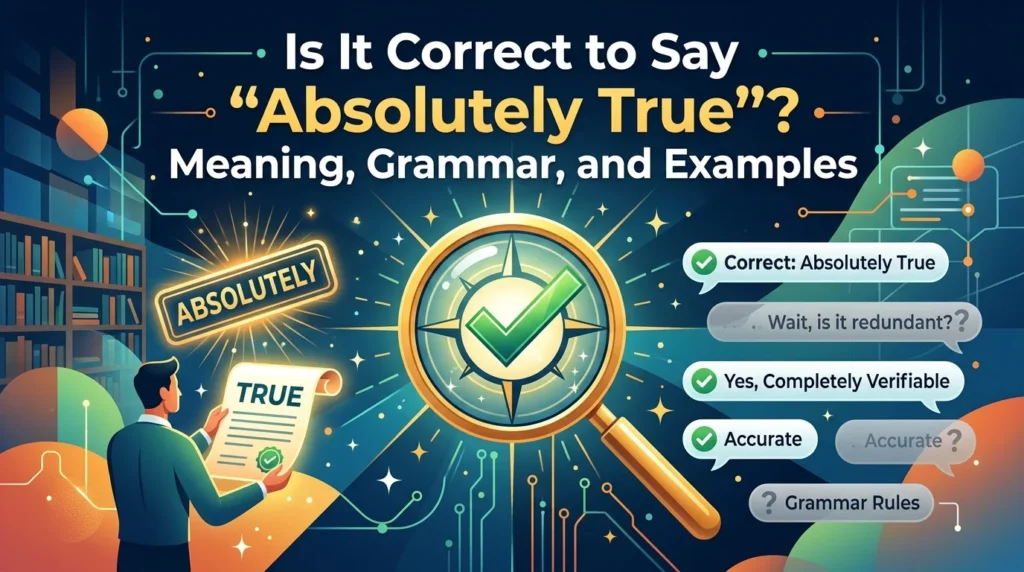
Is It Correct to Say “Absolutely True”? Meaning, Grammar, and Examples

Is It Correct to Say “Absolutely True”? Meaning, Grammar, and Examples

If you’ve ever wondered whether “absolutely ” sounds , the short answer is yes. “Absolutely true” is standard English, and native speakers use it to express complete certainty, strong agreement, or full confidence in a statement. The grammar behind it is straightforward: absolutely functions as an adverb, while true functions as an adjective. Oxford Learner’s

Is It Correct to Say “Absolutely True”? Meaning, Grammar, and Examples Read More »

What Are Staccato Sentences? Meaning, Examples, Uses, and How to Write Them

What Are Staccato Sentences? Meaning, Examples, Uses, and How to Write Them

When a writer wants every sentence to land with a sharp beat, staccato sentences can do the job. Short. Direct. Deliberate. This style breaks ideas into compact units that create noticeable pauses and a quick, sometimes tense rhythm. However, staccato writing isn’t simply a matter of making every sentence shorter. The real skill lies in

What Are Staccato Sentences? Meaning, Examples, Uses, and How to Write Them Read More »

Input or Imput: Which Is Correct? Meaning, Spelling, and Usage

Input or Imput: Which Is Correct? Meaning, Spelling, and Usage

Quick Answer: Is It “Input” or “Imput”? The standard spelling is input. If you are writing an email, academic paper, website, report, technical document, or everyday sentence, input is the form you should normally use. The word imput is sometimes seen because it resembles the way input may sound in fast speech, and Merriam-Webster records

Input or Imput: Which Is Correct? Meaning, Spelling, and Usage Read More »

Understanding Non-finite Verbs in English Grammar: Types, Uses, Examples, and Rules

Understanding Non-finite Verbs in English Grammar: Types, Uses, Examples, and Rules

English grammar becomes much easier when you understand what each verb form actually does. One especially useful group is non-finite verbs. These forms appear everywhere in English, from everyday conversation to academic writing, news reports, and literature. Yet they often confuse learners because they look like ordinary verbs while behaving differently inside sentences.A non-finite verb

Understanding Non-finite Verbs in English Grammar: Types, Uses, Examples, and Rules Read More »

Day Off vs. Off Day: What’s the Difference? (+ Examples)

Day Off vs. Off Day: What’s the Difference? (+ Examples)

If you’ve ever wondered whether to say “day off” or “off day,” you’re not alone. These two expressions contain the same words, yet their meanings can change when the word order changes. That small difference matters in everyday American English, especially when you’re talking about work schedules, school, sports, performance, or how you feel. A

Day Off vs. Off Day: What’s the Difference? (+ Examples) Read More »

Some of Whom or Some of Who? Here’s the Correct Version

Some of Whom or Some of Who? Here’s the Correct Version

If you’ve ever paused over and , you’re not alone. The two phrases look almost identical, yet standard grammar gives them different treatment. In formal English, is the established construction when whom refers to people in a group already mentioned. Some of who is generally not the standard form for that same structure. The difference

Some of Whom or Some of Who? Here’s the Correct Version Read More »

Hi there meaning in English

What Does “Hi There” Mean and Should You Use It?

If you’ve ever wondered what “hi there” means, the short answer is simple: it’s a friendly, informal way to greet someone. The phrase usually feels a little warmer and more conversational than a plain “Hi.” The Cambridge Dictionary classifies “hi” as an informal greeting and even uses “Hi, there!” as an example. Oxford likewise defines

What Does “Hi There” Mean and Should You Use It? Read More »