

If you’ve ever paused while typing alright or allright, you’re not alone. The two forms look close enough to confuse, especially because allright seems like a logical combination of “all” and “right.” However, standard English treats these spellings very differently. Alright is an established word, while allright is generally considered a misspelling. There’s another form worth knowing, too: all right. That two-word expression is fully established and remains the traditional choice in many formal contexts. So, when you need the quick answer, remember this: alright is a recognized spelling, all right is also correct, and allright should normally be avoided. The choice between alright and all right depends largely on meaning, context, and the writing style you’re using.
The Short Answer: Is this Correct?
The correct choice is alright, not allright, when you want the single-word form. For example, you can write, “Are you alright?” or “Everything will be alright.” The spelling allright adds an extra “l” and does not represent the standard form used in edited English.
However, there’s an important wrinkle. All right is also correct, and many editors prefer it, especially in formal writing. In fact, the two-word form has a long-established place in English. That means the real comparison isn’t simply alright vs allright. It is usually alright vs all right, with allright sitting outside the standard choices.
| Form | Status | Typical meaning | General recommendation |
| alright | Established word | Okay, satisfactory, acceptable | Fine in many contexts |
| all right | Established phrase | Okay, correct, satisfactory, completely right | Strong choice for formal writing |
| allright | Nonstandard spelling | Usually intended to mean “alright” or “all right” | Avoid |
The distinction matters because spelling and style aren’t always the same thing. A word can exist in modern English while a particular publication, school, employer, or style guide still prefers another form. The Associated Press, for example, maintains a regularly updated style system covering spelling, language, punctuation, usage, and journalistic style.
At a Glance
Think of these three forms as three doors that look almost identical from a distance. Only two lead into standard English usage.
Alright is a single word. It commonly means “okay,” “fine,” “satisfactory,” or “acceptable.” It also appears in conversational expressions such as “Alright, let’s go.”
All right contains two separate words. It can carry the same general sense of being okay or satisfactory, but it can also express the literal idea of something being completely or correctly right. The context determines the meaning.
Allright, by contrast, is generally not the spelling you should choose in standard writing. If you see it in a text message, comment, draft, or casual online post, it is usually a spelling mistake rather than a separate English word with its own meaning.
Here’s a useful way to remember the distinction:
Alright = accepted single-word form.
All right = accepted two-word form.
Allright = avoid it.
This rule becomes especially useful when you edit quickly. Instead of wondering whether allright might be an alternative spelling, replace it with alright or all right. Then consider the tone of the sentence before choosing between the two accepted forms.
What Does “Alright” Mean?
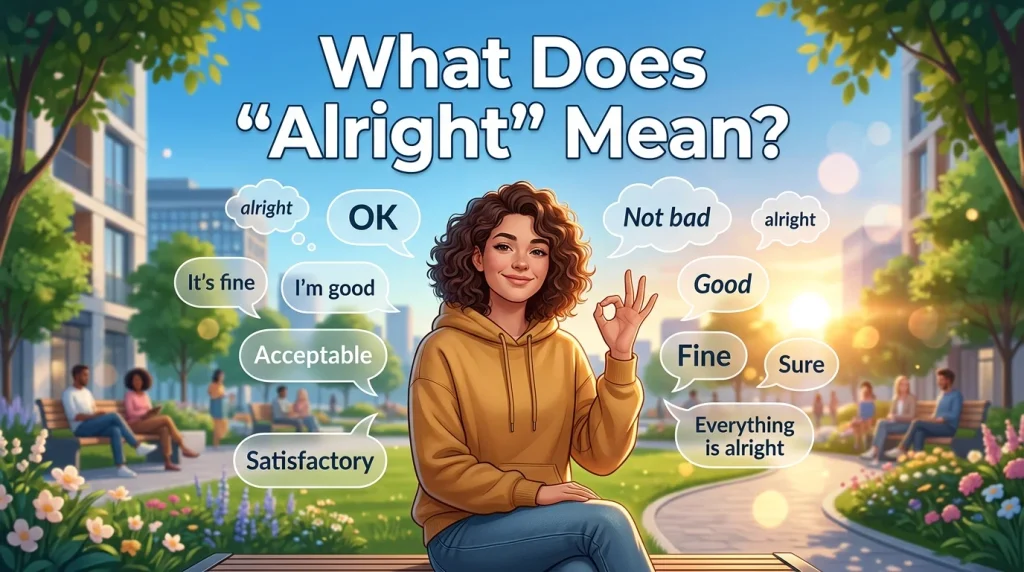
The word alright generally expresses the idea of something being acceptable, satisfactory, safe, or okay. It can also appear as an informal response that signals agreement or acceptance.
Consider the sentence:
“The presentation went alright.”
Here, alright suggests that the presentation went reasonably well. It doesn’t necessarily mean it was outstanding. The speaker simply considers the result satisfactory.
Now look at another example:
“Are you alright?”
In this sentence, the word can refer to someone’s physical or emotional condition. A person might ask it after an accident, an upsetting conversation, or an unexpected event.
The word can also introduce a decision or transition:
“Alright, let’s get started.”
Here, alright doesn’t describe a condition. Instead, it works as an interjection that signals agreement, acceptance, or movement to the next step.
That flexibility explains why alright appears so often in everyday communication. It can describe a situation, answer a question, reassure someone, or introduce an action.
Alright as an Adjective
An adjective describes a noun or gives information about a person, thing, or situation. In everyday usage, alright can describe something as acceptable or satisfactory.
For example:
- “The food was alright, but the dessert was excellent.”
- “The patient is alright now.”
- “The new arrangement seems alright.”
- “Everything looks alright from here.”
These examples don’t necessarily praise the subject. Instead, they communicate that the situation is acceptable or not seriously wrong.
That subtle difference can matter. If someone says, “The movie was alright,” they may mean they enjoyed it somewhat but wouldn’t call it remarkable. In casual conversation, the word can therefore carry a softer judgment than words such as “excellent,” “wonderful,” or “outstanding.”
Alright as an Adverb
Alright can also function in ways similar to an adverb, particularly in informal English. It may communicate that something happened satisfactorily or adequately.
For example:
- “The project turned out alright.”
- “She handled the situation alright.”
- “The trip went alright despite the delay.”
The exact meaning comes from the surrounding sentence. In one context, alright may suggest “satisfactorily.” In another, it may simply mean “without serious problems.”
When you write, don’t force the word into every sentence where “okay” could appear. Good writing depends on context. Sometimes fine, acceptable, satisfactory, or safe gives the reader a sharper meaning.
Alright as an Interjection
One of the most familiar uses of alright appears at the beginning of a sentence.
For example:
“Alright, we need to make a decision.”
Here, the speaker isn’t saying that something is satisfactory. Instead, alright signals a shift in the conversation. It can mean something like “okay,” “then,” or “let’s proceed.”
You’ll often see this use in dialogue:
“Alright, I’ll call you tomorrow.”
It can also agree:
“Alright, I’ll help you finish it.”
This conversational use explains why alright feels natural in texts, dialogue, casual emails, and everyday speech. It has a relaxed quality that fits informal communication particularly well.
Is “Allright” a Real Word?
For ordinary modern English writing, allright should be treated as a misspelling. The form usually appears when someone combines all and right into one word without realizing that English does not normally use that spelling.
For example:
❌ “Everything is allright.”
A standard correction would be:
✅ “Everything is alright.”
Or, particularly in formal writing:
✅ “Everything is all right.”
The important point is that allright does not become correct simply because readers understand what the writer means. English contains many spellings that look logical but aren’t standard. Familiar-looking combinations can trick your eye.
The same problem occurs when people assume that two words should become one because they frequently appear together. English has many compound words, but not every common word pair develops into a closed compound.
Why Do People Write “Allright”?
The confusion makes sense at first glance. A writer sees the phrase all right repeatedly and may naturally assume that it should become allright, just as many English expressions eventually become single words.
That assumption isn’t enough, though. Standard spelling depends on established usage, dictionaries, editorial conventions, and the development of the language.
There is another reason the mistake survives: pronunciation. In ordinary speech, alright and all right can sound very similar. When two spellings share essentially the same sound, hearing the correct form doesn’t necessarily tell you how to write it. English spelling frequently contains gaps between pronunciation and written form. Merriam-Webster’s pronunciation material notes that English orthography can create substantial differences between how words sound and how they are written.
Fast typing makes the problem even easier to understand. A person who writes “all right” hundreds of times may eventually type allright without noticing the extra letter. Autocorrect might not always catch such errors either.
The best solution is simple: don’t treat allright as a third spelling option. When you encounter it, decide whether the sentence needs alright or all right.
Alright vs All Right vs Allright
The three forms deserve separate treatment because they don’t have equal status.
Alright is the closed, single-word form. It is widely recognized and used, particularly in informal and conversational English.
All right is the traditional two-word form. It remains fully established and is often the safer option when you want a conservative or formal style.
Allright is generally a spelling error.
| Feature | Alright | All right | Allright |
| Written as | One word | Two words | One word |
| Standard status | Established | Established | Generally nonstandard |
| Meaning | Okay, satisfactory, acceptable | Okay, correct, satisfactory | Usually intended as “alright” |
| Common in conversation | Yes | Yes | No |
| Suitable for formal writing | Depends on style | Often preferred | No |
| Use in careful editing | Context-dependent | Strong choice | Avoid |
Meaning Comparison
In many sentences, alright and all right communicate essentially the same basic idea.
Compare:
“Are you alright?”
and
“Are you all right?”
Both can ask whether someone is okay.
Likewise:
“The report is alright.”
and:
“The report is all right.”
Both can mean that the report is acceptable.
Yet all right can sometimes carry a more literal sense. Consider:
“You got the answer all right.”
Here, the phrase can emphasize correctness. The meaning isn’t simply “acceptable.” It can suggest that the person answered correctly.
Another example is:
“She knew all right what the warning meant.”
In this construction, all right works differently from the casual adjective-like alright. Context does much of the heavy lifting.
Grammar Comparison
The forms also differ structurally.
All right is made from two separate words. Depending on the sentence, the phrase can perform different grammatical functions.
Alright behaves as a single lexical item. Modern usage gives it roles that overlap with several uses of all right, especially in informal English.
That distinction matters when editing. If you’re writing a formal academic paper and want the most traditional construction, all right gives you a straightforward choice. If you’re writing dialogue, a text message, or relaxed online copy, alright may fit the voice more naturally.
The key is consistency. Don’t switch randomly between forms simply because they look interchangeable. Choose according to your audience and the conventions governing the document.
Style Comparison
Style is where the debate becomes more interesting. The question isn’t always “Is alright a word?” Modern English usage recognizes it. The more practical question is “Is alright the form this particular audience or publication expects?”
That’s an important distinction.
A classroom assignment may follow a teacher’s preferred style. A newspaper may follow its newsroom stylebook. A company may maintain an internal editorial guide. A novel may use alright deliberately because the author wants natural dialogue.
The Associated Press describes its Stylebook as a reference covering spelling, language, punctuation, usage, and journalistic style. Its online version is updated throughout the year as editors develop or revise guidance.
So, when a style guide specifies all right, follow that rule. When the context allows modern informal usage, alright can be perfectly natural.
The one form that doesn’t need this debate is allright. In standard edited writing, there’s little reason to choose it.
Why Do People Confuse?
The confusion comes from several forces working together: sound, spelling patterns, typing habits, and inconsistent exposure to written English.
They Sound the Same
When you hear someone say alright or all right, pronunciation alone may not tell you which form belongs on the page. English spelling doesn’t always map neatly onto speech. Even educated speakers encounter words whose spelling cannot be predicted perfectly from pronunciation.
That’s why spelling questions often appear even when a word is extremely common.
If you’ve mostly encountered the expression in conversation, your brain stores the sound first. When you eventually write it, you reconstruct the spelling. That’s when allright can sneak onto the page.
English Loves Compound Words
English contains countless compounds. Words such as notebook, sunlight, and classroom show how separate words can eventually combine.
That pattern can create a misleading expectation:
all + right → allright
It looks reasonable. But spelling doesn’t work like a mathematical equation. A combination that seems logical isn’t automatically a standard word.
Fast Typing Creates Mistakes
Digital communication encourages speed. When people type quickly, they often reproduce familiar sounds instead of consciously checking every letter.
A person may write:
“Are you allright?”
because the phrase feels like one spoken unit.
The mistake becomes especially easy to miss when the writer reads quickly. The eye recognizes the intended meaning and sometimes skips over the extra letter.
Different Style Guides Give Different Advice
The alright debate isn’t simply about correct versus incorrect English. Style preferences also influence which accepted form writers choose.
Some contexts favor all right because it represents the traditional two-word construction. Other contexts accept or use alright, especially in informal and contemporary writing.
That difference explains why you might see both forms in reputable publications without either being treated as a typo. The spelling choice can reflect editorial policy rather than a writer’s lack of grammatical knowledge.
Online Content Isn’t Always Reliable
Search engines can show thousands of examples of a spelling without proving that the spelling is standard.
For example, seeing allright repeatedly on social media doesn’t establish it as a standard English word. User-generated content contains typos, informal spellings, rushed writing, and copied mistakes.
When accuracy matters, check a reputable dictionary or the style guide relevant to your audience. A professional style resource is designed to answer questions about usage rather than simply count how frequently a form appears online.
A Brief History of “Alright”
The spelling alright has been around since the 19th century, even though many editors and teachers have preferred all right for much of its history. Merriam-Webster records the first known use of alright as 1865 and explains that objections to the spelling often center on its relatively late development compared with older fused forms such as already and altogether.
That history helps explain why the debate can feel surprisingly stubborn. English has a long habit of turning familiar word combinations into single words. Yet those changes don’t happen on a fixed schedule. Some forms become standard quickly, while others remain disputed or informal for generations.
The pattern becomes clearer when you compare alright with words such as already, although, and altogether. Earlier forms of several common expressions appeared with spaces or other spellings before their modern forms settled. Merriam-Webster notes that alright developed later than these established fused forms, which helps explain why some traditionalists resisted it.
So, calling alright a modern invention would be misleading. It has a substantial history in written English. At the same time, its history doesn’t mean every editor must prefer it. Usage history and editorial preference are two different questions.
When Is “Alright” Appropriate?
The best choice depends on your audience, purpose, and preferred style. In casual communication, alright fits naturally because it sounds close to ordinary speech. In carefully edited formal writing, all right remains the safer traditional choice.
Merriam-Webster currently defines alright as an adverb or adjective and gives all right as its equivalent. It also notes that all right remains more common in published writing, although alright increasingly appears there as well.
That gives you a practical rule rather than an overly rigid one: alright isn’t simply a spelling mistake, but all right is usually the safer choice when formal editorial expectations matter.
Casual Writing
Casual writing gives alright plenty of room to breathe. Think about text messages, friendly emails, informal notes, comments, and relaxed conversations.
For example:
“Alright, I’ll meet you outside at six.”
The sentence feels natural because the word functions like a conversational signal. It tells the reader that the speaker agrees with the plan and is ready to move forward.
You might also write:
“The new restaurant was alright, but the service was slow.”
Here, alright means acceptable rather than exceptional.
That distinction is useful. If you tell someone a meal was alright, you’re usually giving a mild assessment. You’re not necessarily saying it was great.
Other casual examples include:
- “Alright, I’ll give it another try.”
- “The movie was alright.”
- “Don’t worry. Everything will be alright.”
- “Are you alright after the fall?”
- “It’s alright if you’re running late.”
In relaxed communication, these constructions sound familiar and natural.
Text Messages and Social Media
Digital communication has helped make alright highly visible. Short messages favor compact expressions, and people often write the way they speak.
Consider this exchange:
“Can you send the file tonight?”
“Alright, I’ll send it after dinner.”
The single-word form works smoothly because the conversation is informal.
Social media creates a similar environment. Posts, comments, captions, and direct messages rarely follow the same editorial standards as academic papers or professional publications. That doesn’t mean every informal spelling is correct, though. Allright remains a poor choice even in a casual message if you want standard spelling.
A useful distinction is:
| Context | Recommended choice |
| Text to a friend | alright is natural |
| Casual social post | alright can work |
| Formal business letter | all right is safer |
| Academic paper | Consider a more formal alternative |
| Published professional copy | Follow the publication’s style |
| Any context | Avoid allright |
The important point is that informality can affect alright, but it doesn’t make alrightstandard.
Fiction and Dialogue
Fiction provides another strong setting for alright. Writers often want dialogue to sound like real speech rather than polished academic prose.
Imagine a character has just received unexpected news:
“Alright, give me a minute to think.”
Changing that to all right wouldn’t necessarily make the sentence wrong. However, the visual and stylistic choice may affect the voice the writer wants to create.
Dialogue often reflects natural speech patterns, regional habits, age, personality, and social setting. A character who says alright may sound more conversational on the page.
This is one reason published books can contain alright even when a formal writing guide might recommend all right. The writer isn’t necessarily making a grammatical error. The spelling can be part of the voice.
The same principle applies to scripts and other creative work. Style isn’t always about choosing the most formal option. Sometimes the goal is to make language sound authentic.
Everyday Conversation
In ordinary conversation, the expression can perform several jobs.
You might use it to reassure someone:
“You’re alright. The cut isn’t serious.”
You might use it to check someone’s condition:
“Are you alright?”
You might use it to agree:
“Alright, I’ll come with you.”
You might use it to begin an action:
“Alright, everyone, let’s start.”
Cambridge Grammar also recognizes all right as an adjective, adverb, and discourse marker. As a discourse marker, it can introduce a new topic or action and can signal agreement.
These uses show why context matters more than a simple “one word versus two words” rule.
When Should You Avoid “Alright”?
If you’re writing something formal, all right is usually the safer traditional form. That doesn’t mean every modern dictionary rejects alright. It means formal writing often demands consistency with an established editorial standard.
For example, Merriam-Webster recognizes alright, while Oxford’s Advanced Learner’s Dictionary labels it informal or nonstandard and notes that some people prefer all right in formal writing.
This difference between dictionaries is worth understanding. A dictionary entry tells you how a word is used and recognized. A style guide may impose a stricter preference for a particular audience.
Academic Writing
Academic writing rewards precision and formality. Even when alright is recognizable, you may have better choices available.
Instead of writing:
“The results were alright.”
a formal paper might say:
“The results were acceptable.”
Or:
“The results were satisfactory.”
This approach does more than solve the spelling question. It gives the reader a more precise description.
If you specifically need the expression meaning “okay,” all right is generally the safer traditional spelling. Some academic writing guides recommend avoiding both forms because they can sound too informal. Scribbr, for example, advises using a more formal word such as adequate in academic writing.
That doesn’t create a universal grammar law. Instead, it reflects the expectations of academic style.
Business Communication
Business writing requires a little more judgment.
Suppose you’re writing a quick message to a coworker:
“Alright, I’ll update the spreadsheet.”
In a relaxed workplace chat, that may sound perfectly natural.
Now imagine you’re writing a formal proposal:
“The proposed schedule is alright for the client.”
The sentence sounds less polished than:
“The proposed schedule is acceptable to the client.”
Or:
“The proposed schedule is all right with the client.”
The first alternative provides greater precision. The second retains the familiar expression while using the more traditional spelling.
When your reputation, clarity, or formality matters, don’t choose a word simply because it sounds conversational. Match your language to the document.
Professional Documents
Professional documents include reports, policies, official correspondence, proposals, resumes, and formal statements. These materials usually benefit from conventional spelling and precise vocabulary.
If you need to use the expression, all right gives you the conservative option.
However, even that may not be the strongest choice in every sentence. Consider:
“The proposed changes are all right.”
This is grammatically understandable, but it tells the reader very little.
A stronger professional sentence might say:
“The proposed changes are acceptable under the current policy.”
The second sentence removes ambiguity and communicates a specific judgment.
That illustrates an important writing principle: correctness isn’t the only goal. Precision matters too.
Formal Publications
Publishers, newspapers, journals, and professional websites often follow house styles. Those styles can determine whether editors prefer alright or all right.
For that reason, don’t assume that a form appearing in one publication automatically fits another. A publication may use a particular dictionary, stylebook, or internal editorial policy.
If you’re writing for someone else, follow their rules first.
If you’re writing independently, all right is the safer traditional choice for formal prose. Alright remains available when the tone is conversational or when the publication’s style permits it.
In American English
For US English readers, all right remains a particularly safe choice in formal writing. At the same time, alright is established enough to appear in modern dictionaries and contemporary published examples.
Merriam-Webster lists alright as an adjective or adverb and records its first known use as 1865. Its usage note also says that all right remains more common than alright in published writing.
That gives American writers a practical hierarchy:For formal or highly edited prose: choose all right unless your style guide says otherwise.For informal prose: alright is widely understandable and can sound natural.For standard spelling: don’t use allright.
This approach avoids two common extremes. You don’t have to claim that alright is always wrong. You also don’t need to pretend that every editor treats it exactly like all right.
Examples of “Alright” in Sentences
Seeing the word in different sentence patterns makes the distinction easier to remember.
Everyday Examples
Here are natural examples of alright in casual contexts:
- “Are you alright after the accident?”
- “The weather looks alright for a short walk.”
- “Alright, let’s order dinner.”
- “I think the plan will be alright.”
- “It’s alright if you change your mind.”
- “The movie was alright, but the ending felt rushed.”
- “Everything is going to be alright.”
- “Alright, I’ll see you tomorrow.”
Notice how the word can express reassurance, agreement, acceptance, or a moderate evaluation.
Workplace Examples
In informal workplace communication, alright can also sound natural:
- “Alright, I’ll send the revised file.”
- “The draft looks alright to me.”
- “Are we alright to move forward?”
- “Alright, let’s discuss the next step.”
- “The presentation went alright despite the technical issue.”
For a formal report, however, stronger alternatives may be preferable:
“The presentation was satisfactory despite the technical issue.”
The second version communicates the evaluation more precisely and avoids an overly conversational tone.
Student Examples
Students often encounter this issue because classroom writing sits between everyday language and formal communication.
A student might write:
“The experiment went alright.”
In a personal reflection, that could be perfectly natural.
In a formal lab report, however, satisfactory, successful, or another precise adjective may communicate the result better.
For example:
“The experiment produced satisfactory results.”
That sentence tells the reader more than alright does.
Examples of Incorrect “Allright” Usage
The easiest way to recognize the problem is to compare incorrect and corrected versions.
| Incorrect | Better choice |
| “Are you allright?” | “Are you alright?” |
| “Everything will be allright.” | “Everything will be all right.” |
| “Allright, let’s begin.” | “Alright, let’s begin.” |
| “The project is allright.” | “The project is all right.” |
| “It’ll be allright tomorrow.” | “It’ll be alright tomorrow.” |
The correction isn’t always simply “change allright to alright.” Context may call for all right instead.
For example:
❌ “Everything is allright.”
Possible corrections:
✅ “Everything is alright.”
or:
✅ “Everything is all right.”
Both accepted forms can work in that sentence. The correct decision depends on style.
The key mistake is the extra “l.” Allright doesn’t become acceptable just because all and right are both real words.
Common Mistakes to Avoid
Assuming “Allright” Looks Logical
This is probably the easiest mistake to make. Since all and right frequently appear together, combining them feels reasonable.
English doesn’t guarantee that logic will determine spelling.
You can’t create a standard word simply by joining two familiar words. Established usage determines whether that combination becomes a recognized form.
So, although allright looks plausible, don’t use it.
Believing “Alright” Is Always Wrong
This belief is too absolute for modern English.
Merriam-Webster recognizes alright and gives it as a synonym of all right. Cambridge also notes that all right may be written as alright, while stating that the two-word form is more common.
The better lesson is this:
Alright is established, but all right is often the safer formal choice.
That rule reflects actual usage without turning a style preference into a universal grammar prohibition.
Using “Alright” in Every Situation
The opposite mistake can also cause trouble.
Just because alright is accepted doesn’t mean it works equally well everywhere. A research paper, legal document, corporate report, or formal application may require a more conservative style.
Before choosing the spelling, ask yourself:
- Who will read this?
- Is the writing formal?
- Does the publication have a style guide?
- Would a more precise word work better?
- Am I writing dialogue or formal exposition?
These questions take only a few seconds and can prevent unnecessary editing later.
Trusting Every Website
Online examples can be useful, but they aren’t automatically authoritative.
A webpage may contain a typo. A social media post may use deliberately informal spelling. A forum comment may repeat someone else’s mistake. Even a published source can use a word according to a particular house style.
When a spelling question matters, compare reliable sources rather than counting search results.
For example, current dictionary evidence shows that alright is recognized while all right remains the more established traditional form.
That distinction is much more useful than simply asking which spelling appears more often online.
Easy Memory Trick to Remember the Correct Spelling
When you’re deciding between alright, all right, and allright, one simple rule can save you from most spelling mistakes: never use “allright.”
Think of the choice as a two-door decision:
- All right = the safest and most traditional choice.
- Alright = an accepted modern form in many contexts, especially informal writing.
- Allright = avoid it in standard English.
A useful memory trick is to focus on the word right. It always keeps its normal spelling:
all + right = all right
If you want the more compact form, use:
alright
Never add an extra l before the r:
❌ allright
✅ alright
✅ all right
This distinction matters because all right remains more widely accepted in careful and formal writing. Cambridge identifies alright as a non-standard form of all right, while its grammar guidance notes that all right is more common.
A Quick Mental Test
Before you type the word, silently say:
“Is everything okay?”
If the answer is yes, your sentence may need all right or alright, depending on the style.
For example:
- Is everything all right?
- Is everything alright?
Both forms can appear in real English usage, although all right is the safer standard choice.
But this sentence is different:
- ❌ Is everything allright?
- ✅ Is everything all right?
The extra l has no place in the standard spelling.
The Three-Form Memory Chart
| Form | Use it? | Best description |
| all right | Yes | Safest standard form |
| alright | Yes, depending on style | Modern, informal, or less formal form |
| allright | No | Common spelling error |
If you’re writing something important and you don’t want to think twice, choose all right.
Quick Comparison Table
The three spellings may look closely related, but they don’t have the same status in standard English.
| Feature | All right | Alright | Allright |
| Standard spelling | Yes | Context-dependent | No |
| Two words | Yes | No | No |
| Common in informal writing | Yes | Yes | No |
| Suitable for formal writing | Yes | Often avoided | No |
| Used in conversation | Yes | Yes | No |
| Used in text messages | Yes | Very common | Usually a typo |
| Means “okay” | Yes | Yes | Intended, but misspelled |
| Means “satisfactory” | Yes | Yes | Intended, but misspelled |
| Can express agreement | Yes | Yes | No |
| Recommended for careful writing | Yes | Sometimes | No |
The important point is that alright and all right can communicate the same basic meanings. The main difference concerns spelling, style, and editorial preference rather than a completely different definition. Cambridge lists alright as a form of all right, while its grammar guidance says all right is more common.
Why “Allright” Does Not Get Its Own Meaning
A common mistake is to treat allright as another variation alongside alright and all right.
It isn’t.
The spelling allright usually appears because someone combines all and right and accidentally creates an extra l. It doesn’t become correct simply because English has many compounds.
Compare these examples:
- all right → correct
- alright → recognized alternative in many contexts
- allright → incorrect spelling in standard English
That distinction makes editing much easier.
Real-World Usage: Which Form Do Professional Writers Choose?
Professional writers usually care about more than whether readers understand a word. They also consider consistency, convention, audience, and editorial style.
That’s why all right remains an especially dependable choice in edited writing.
Imagine a writer preparing three different pieces:
- A text message to a friend.
- A novel containing casual dialogue.
- A formal business report.
The same idea could appear in all three:
“Everything is all right.”
In a text message, the writer might naturally choose:
“Everything’s alright.”
In fiction, either form may fit the character or narrative voice.
In a formal report, all right is usually the safer option.
This isn’t because alright suddenly becomes meaningless in formal contexts. Rather, many editors and style-conscious writers still prefer the traditional all right spelling. Cambridge similarly notes that all right is more common, while dictionaries may label alright as non-standard or informal.
Case Study: A Friendly Text Message
Suppose a friend asks:
“Are you alright?”
That spelling feels natural in casual digital communication.
You could reply:
“Yeah, I’m alright. Thanks!”
The message is conversational, short, and personal. There is little reason to make the wording sound formal.
Case Study: A College Assignment
Now imagine a student writes:
“The results were alright, but further research is needed.”
The reader will probably understand the sentence immediately. However, all right is the more conservative choice for academic writing:
“The results were all right, but further research is needed.”
Even better, depending on the intended meaning, the student could use a more precise word:
“The results were satisfactory, but further research is needed.”
That last version removes the stylistic debate completely.
Case Study: Professional Communication
Consider an employee writing:
“Please confirm that everything is alright before we proceed.”
The sentence is understandable, but a polished professional version would normally use:
“Please confirm that everything is all right before we proceed.”
For formal workplace communication, clarity and conventional usage usually matter more than saving one character or removing a space.
Case Study: Fictional Dialogue
Fiction works differently.
A novelist might write:
“You alright?”
That wording can help dialogue sound natural and conversational.
Another writer might use:
“Are you all right?”
Both can work depending on the character, setting, dialect, and editorial style.
Dialogue should sound like something the character would actually say. A formal spelling choice isn’t always the most realistic storytelling choice.
A Simple Decision Guide
When you’re unsure, don’t overthink the choice. Use the following decision process.
Step 1: Check Whether You Mean “Okay”
If alright/all right means okay, safe, well, satisfactory, or acceptable, you’re probably dealing with the expression all right.
Examples:
- “Are you all right?”
- “Everything is all right.”
- “The movie was all right.”
- “She’s doing all right.”
- “Is it all right if I leave early?”
Cambridge lists these meanings under all right, including satisfactory, safe, able to manage, and acceptable.
Step 2: Check Your Audience
Ask yourself who will read the sentence.
Casual audience?
You can encounter alright naturally.
Academic or professional audience?
Choose all right.
Creative writing?
Choose the form that fits the voice and style.
Uncertain audience?
Choose all right.
That final choice is especially useful because it avoids unnecessary controversy.
Step 3: Check the Spelling
Once you’ve selected your form, perform one final check:
all right
alright
not allright
If you see allright, correct it.
Step 4: Consider a More Precise Word
Sometimes the best solution isn’t either spelling.
For example:
“The presentation was alright.”
You could write:
“The presentation was satisfactory.”
Or:
“The presentation was acceptable.”
Or:
“The presentation went well.”
The right replacement depends on what you actually mean.
Decision Tree
Use this quick guide:
Do you mean “okay,” “safe,” “well,” or “satisfactory”?
→ Yes → Continue.
Is the writing formal, academic, professional, or carefully edited?
→ Yes → Use all right.
Is the writing casual, conversational, or stylistically informal?
→ alright may work, depending on your style guide.
Are you thinking about writing “allright”?
→ Stop → Change it to all right or alright.
This approach is much easier than memorizing dozens of isolated rules.
When “All Right” Is the Better Choice
There are situations where the traditional two-word form is clearly the safer option.
Choose all right when you’re writing:
- Academic papers
- Research assignments
- Formal reports
- Business documents
- Professional correspondence
- Official statements
- Carefully edited articles
- Formal applications
- Instructional materials
- Standardized educational content
For example:
“Is it all right to submit the report tomorrow?”
This sentence looks conventional and professional.
Another example:
“The patient appears to be all right after the procedure.”
In formal informational writing, the traditional spelling keeps the sentence stylistically neutral.
Why Formal Writing Favors the Traditional Form
Formal writing often favors established conventions over newer or more casual alternatives.
That doesn’t mean every reader will consider alright wrong. English usage changes over time, and dictionaries document forms that people actually use. However, if your goal is to avoid a style objection, all right is the safer choice. Cambridge’s current entries distinguish the forms and specifically describe alright as a non-standard form in its main dictionary entry.
Practice Zone: Test Your Understanding
Practice is one of the fastest ways to make the distinction automatic.
Fill in the Blanks
Choose all right, alright, or allright.
- Is everything ______ after the move?
- Don’t worry. I’m ______.
- She said the presentation went ______.
- Would it be ______ if I called tomorrow?
- He checked to make sure everyone was ______.
- The movie was ______, but it wasn’t memorable.
- ______, let’s begin the meeting.
- She typed “______” by mistake.
- Are you ______ with this arrangement?
- Everything will be ______ once we solve the problem.
Answers
- all right
- all right
- alright or all right
- all right
- all right
- all right or alright
- All right
- allright is incorrect; use alright or all right
- all right
- all right or alright
Notice that the exercise isn’t simply about identifying one “correct” spelling in every sentence. In many contexts, alright and all right can perform the same basic function, while allright remains the spelling to avoid.
Choose the Correct Spelling
Select the best option in each sentence.
1. “Are you ___ after the accident?”
- A. allright
- B. alright
- C. all right
Best formal choice: C. all right
Alright also appears in real-world English, especially informal usage.
2. “___, everyone, let’s get started.”
- A. All right
- B. Allright
- C. Allright
Correct: A. All right
The phrase works as a discourse marker that signals the beginning of an action or topic. Cambridge specifically describes this use of all right.
3. “The hotel was ___, but nothing special.”
- A. all right
- B. allright
- C. Both A and an informal use of “alright”
Correct: C
The meaning is “satisfactory, but not excellent.” Both all right and alright can appear, although all right is the safer standard form.
4. “Would it be ___ if I left early?”
- A. allright
- B. all right
- C. allright
Correct: B. all right
This is a common expression for asking whether something is acceptable.
5. “She told me that everything was ___.”
- A. all right
- B. alright
- C. allright
Correct: A or B
Both forms can communicate the intended meaning. Allright is incorrect.
Find the Mistake
Now look at these sentences and identify the problem.
Sentence 1
“I hope you’re allright.”
Correction:
“I hope you’re all right.”
The writer has incorrectly joined the two words and created an extra l.
Sentence 2
“Everything will be alright.”
This sentence isn’t necessarily a spelling mistake.
Alright is used in real English, especially in informal contexts. However, if the sentence belongs to formal writing, the preferred version is:
“Everything will be all right.”
Sentence 3
“Allright, let’s go.”
Correction:
“All right, let’s go.”
The opening expression is functioning as a discourse marker. The standard spelling is all right.
Sentence 4
“Are you alright with the new schedule?”
This isn’t automatically an error.
A formal revision would be:
“Are you all right with the new schedule?”
Both forms communicate the same basic idea.
Sentence 5
“The results were allright.”
Correction:
“The results were all right.”
The extra l makes the spelling incorrect.
What the Practice Shows
These exercises reveal an important point: the real debate is usually “alright” versus “all right,” not “alright” versus “allright.”
The form allright is much easier to handle. Remove it from your standard-writing vocabulary.
The more interesting question is whether to use alright or all right.
A practical rule works well:
Use “all right” when you want the safest standard choice.
That rule covers academic work, professional documents, formal communication, and most carefully edited writing.
For informal communication, alright may fit naturally. Cambridge documents it as a form used with the same basic meanings, although its main dictionary labels it non-standard.
The key is not to confuse modern usage with universal editorial acceptance. A word can appear frequently in everyday English while still being avoided by some editors, teachers, and style-conscious writers.
Is “Alright” Grammatically Correct?
The answer depends on what you mean by correct.
If you mean, “Does alright appear in real English and do reputable dictionaries recognize it?” the answer is yes.
If you mean, “Is alright the safest form for every kind of writing?” the answer is no.
Cambridge currently lists alright as a non-standard form of all right, while its grammar guidance explains that all right is more common. Other dictionaries and style resources may treat alright as an informal or increasingly accepted variant.
That difference explains why people sometimes receive conflicting advice.
Why Some People Say “Alright” Is Wrong
Traditional grammar instruction has strongly favored all right.
For generations, teachers and editors have treated the phrase as two separate words:
all + right = all right
Because all right has a long history as the established spelling, some style-conscious writers still reject alright.
This preference is especially common in formal writing.
For example:
Formal: The report is all right.
Informal: The report is alright.
The first version creates fewer questions about editorial style.
Why “Alright” Still Appears Everywhere
Language doesn’t remain frozen.
Writers shorten expressions, speakers create new forms, and frequently used combinations sometimes develop alternate spellings. Alright has become common enough that dictionaries document its actual use.
Cambridge’s dictionary includes examples such as “Everything will be alright” and “see if it’s alright,” while still labeling the form non-standard in its main entry.
That gives you an important lesson about English:
A word can be widely used without being the preferred choice in every context.
The same principle applies to many spelling and usage questions. Real-world language and formal editorial convention don’t always move at exactly the same speed.
Meaning Does Not Usually Change
One of the biggest misconceptions is that alright and all right always have completely different meanings.
Usually, they don’t.
Both forms can communicate ideas such as:
- okay
- well
- safe
- satisfactory
- acceptable
- agreed
- without problems
For example:
“Are you all right?”
and:
“Are you alright?”
communicate essentially the same question.
The important difference is usually style and spelling, not meaning.
Cambridge’s grammar guide specifically explains that all right can function as an adjective, adverb, and discourse marker. It also notes that alright can be used in place of it, although all right is more common.
Meaning: “Okay or Well”
“I’m all right.”
This can mean:
“I’m okay.”
It can also describe someone’s condition:
“She wasn’t feeling well earlier, but she’s all right now.”
Meaning: “Satisfactory”
The phrase can also mean something is acceptable but not exceptional.
“The restaurant was all right.”
This doesn’t necessarily mean the restaurant was excellent.
It often suggests something was good enough but not impressive.
For example:
“The food was all right, but the dessert was excellent.”
The contrast makes the meaning especially clear.
Meaning: “Safe”
You can use all right when talking about someone’s safety.
“Don’t worry. The children are all right.”
It can also describe whether someone arrived safely:
“Did you get home all right?”
This use is particularly common in everyday conversation. Cambridge lists safe or well as one of the established meanings of all right.
Meaning: “Acceptable”
The expression can also ask for permission or approval.
“Is it all right if I open the window?”
Here, all right means acceptable or permitted.
You could also say:
“Would it be all right if we started early?”
Again, the question isn’t about someone’s health. It asks whether the proposed action is acceptable.
“All Right” as a Discourse Marker
Another useful feature deserves attention.
All right can appear at the beginning of a sentence to signal a transition, agreement, decision, or change of activity.
For example:
“All right, let’s move on to the next question.”
Here, all right doesn’t mean that something is physically okay.
Instead, it signals:
“Okay, we’re ready to continue.”
You can use it to:
- Begin a new topic
- Start an activity
- Accept a suggestion
- Agree with someone
- Acknowledge a point
- Signal a decision
Examples include:“All right, let’s get started.”“All right, you have a point.”“All right, I’ll handle it.”“All right, everyone, take your seats.”
Cambridge specifically identifies this use of all right as a discourse marker for beginning a new topic or action and for showing agreement.
Why This Matters for “Alright”
You may also encounter:
“Alright, let’s get started.”
This is common in informal writing.
However, if you’re writing an academic essay, formal report, or carefully edited document, All right, let’s get started remains the safer traditional choice.
Is “Allright” Ever Correct?
In standard English, allright should not be used as the spelling of this expression.
This is the easiest part of the entire topic.
You don’t need to debate whether the sentence is formal or informal.
You don’t need to decide which dictionary prefers which form.
Simply remember:
❌ allright
Use one of these instead:
✅ all right
or:
✅ alright
The first is the safest choice when you’re uncertain.
Why “Allright” Looks Tempting
The mistake makes sense from a visual perspective.
English contains many compounds:
- already
- altogether
- although
- always
- almost
- anyone
- somebody
Because English often combines words, a writer may assume that allright should work too.
But English spelling doesn’t always follow a perfectly predictable pattern.
You can’t create a standard compound simply by removing a space.
For example, if you know:
all + ready = already
you might mistakenly assume:
all + right = allright
But standard usage does not support that spelling.
The accepted forms are all right and, depending on context and style, alright.
Common Editing Situations
Knowing the rule is useful. Applying it in real sentences is even better.
Here are several situations where the choice becomes clearer.
In a School Essay
Original:
“The experiment went alright.”
Safer revision:
“The experiment went all right.”
Even better when precision matters:
“The experiment produced satisfactory results.”
The best choice depends on what the writer actually wants to communicate.
In a Business Email
Original:
“Please let me know if this is alright.”
Conservative revision:
“Please let me know if this is all right.”
The second version follows the more traditional spelling and avoids distracting the reader.
In a Text Message
A friend might write:
“Are you alright?”
That wording is perfectly understandable and very common in casual communication.
The conversation doesn’t need the formality of:
“Are you all right?”
Both communicate the same basic question.
In Fiction
A character might say:
“Alright, what happened?”
The spelling can contribute to an informal conversational voice.
However, the author’s house style may still require all right.
The important point is that fiction gives writers more room to represent speech naturally.
How Editors Can Handle “Alright”
Editors often need a consistent policy rather than a personal preference.
If a publication uses all right, its editors should normally change alright throughout the document.
If a publication allows alright, editors should avoid changing every occurrence automatically.
Consistency matters.
Imagine a 2,000-word article that uses:
all right
alright
allright
all right
alright
The reader may notice the inconsistency even if every intended meaning is clear.
A cleaner editorial policy might be:
Use “all right” in formal content unless a quoted source or deliberate voice requires “alright.”
That approach creates a predictable standard.
A Practical Style Guide for Writers
If you’re writing regularly, create a simple internal rule.
| Writing situation | Recommended choice |
| Academic assignment | all right |
| Research paper | all right |
| Formal report | all right |
| Business email | all right |
| Professional article | all right |
| Casual email | all right or alright |
| Text message | alright is common |
| Social media | alright is common |
| Fiction dialogue | Depends on voice and style |
| Formal publication | all right |
| Any situation involving “allright” | Replace it |
This isn’t a universal law of English. It’s a practical writing strategy.
When you’re uncertain, all right gives you the most conservative option.
What Professional Writers Should Remember
Professional writing isn’t just about being technically understandable.
Good writing also considers audience expectations.
A reader may never misunderstand:
“The proposal is alright.”
Yet an editor may still prefer:
“The proposal is all right.”
The second form follows the traditional convention.
That distinction becomes important when you’re writing for:
- Publishers
- Schools
- Universities
- Businesses
- Government organizations
- Professional websites
- Formal reports
- Academic journals
For casual communication, the stakes are much lower.
If you text a friend:
“I’m alright.”
Nobody is likely to misunderstand you.
The problem usually begins when informal habits move into formal documents without editing.
Key Takeaways
The entire spelling question becomes much easier when you reduce it to a few practical rules.
Remember These Five Rules
1. “Allright” is not the standard spelling.
Don’t use allright in standard English writing.
2. “All right” is the safest choice.
Use it when you’re writing formally or when you’re unsure which style a reader expects.
3. “Alright” exists in real-world English.
It appears frequently in informal communication and is documented by major dictionaries, although some dictionaries label it non-standard.
4. “Alright” and “all right” usually have the same basic meanings.
The distinction is generally about form and style rather than a completely different meaning.
5. Context determines the best choice.
Formal writing favors all right, while casual writing may comfortably use alright.
The Golden Rule
If you remember only one sentence from this guide, make it this:
When in doubt, write “all right,” never “allright.”
That single rule will prevent the most common mistake.
Final Usage Checklist
Before publishing or submitting your writing, scan for these forms.
If You See “Allright”
Change it.
❌ “Everything is allright.”
✅ “Everything is all right.”
If You See “Alright”
Ask whether the context is formal.
Casual: “Everything is alright.”
Formal: “Everything is all right.”
If your style guide permits alright, you don’t necessarily need to change it.
If You See “All Right”
Usually, you’re already using the safest form.
“Are you all right?”
“That’s all right.”
“All right, let’s begin.”
These examples follow the traditional standard.
Related Grammar Topics
Once you understand alright vs allright, several other commonly confused forms become easier to recognize.
Useful topics to explore include:
- All right vs okay
- Alright vs all right
- Everyday vs every day
- Already vs all ready
- Altogether vs all together
- Anytime vs any time
- Maybe vs may be
- A lot vs alot
- Apart vs a part
- Into vs in to
- Anyway vs any way
- Sometimes vs some times
These pairs often create confusion because English frequently combines words, separates words, or changes spelling over time.
The best strategy isn’t to assume that every logical combination is automatically correct. Instead, learn the established form, consider the context, and choose the spelling that fits your audience.
For alright vs allright, the answer is especially straightforward:
Use “all right” when you want the safest standard form. Use “alright” when an informal or accepted modern style allows it. Never use “allright.”
Conclusion
Choosing between alright, all right, and allright becomes much easier once you understand the difference in standard usage. All right is the safest and most traditional choice, especially for academic, professional, and formal writing. Alright is also widely used in everyday communication and is recognized by major dictionaries, although it may be labeled non-standard or informal depending on the source.
The form allright, however, should be avoided. It is not the standard spelling of this expression. When you’re unsure which form to choose, remember the simplest rule: use all right for maximum safety, use alright when the style allows it, and never write allright. With that distinction in mind, you can write confidently and avoid one of English’s most common spelling mix-ups.
FAQs
Is “alright” or “all right” correct?
Both forms appear in English usage, but all right is the safer standard choice. Alright is widely used, particularly in informal communication, and dictionaries document it as a variant of all right. For formal, academic, and professional writing, choosing all right helps you follow the more traditional convention and avoids questions about style.
Is “allright” a correct English word?
No. Allright is not the standard spelling of the expression. Writers usually create this form by combining all and right incorrectly. Use all right as the traditional spelling or alright where that variant fits your style. If you see “allright” in an essay, email, or article, it should normally be corrected.
Why do people write “allright”?
People often write allright because English contains many legitimate compound words. They may assume that all + right should work the same way. Fast typing, autocorrect habits, and unfamiliarity with the expression can also cause the mistake. However, logical-looking combinations aren’t always standard English spellings, so allright should be avoided.
Can I use “alright” in formal writing?
You can encounter alright in formal or published material, but all right remains the safer choice for formal writing. Cambridge describes alright as a non-standard form of all right. Therefore, if you’re writing an academic paper, professional report, or formal document, choosing all right is the more conservative option.
Does “alright” mean the same thing as “all right”?
Usually, yes. Alright generally carries the same basic meanings as all right, including “okay,” “safe,” “well,” “satisfactory,” or “acceptable.” The main difference is spelling and style. Cambridge explains that all right can function as an adjective, adverb, and discourse marker, while alright is a variant form.
Is “all right” always written as two words?
In traditional standard usage, all right is written as two words. For example, you can write, “Are you all right?” or “Everything is all right.” The one-word spelling alright also appears in modern English, particularly in informal contexts. However, allright with two l’s and no space is not the standard form.
Is “alright” acceptable in text messages?
Yes. Alright is common in text messages, chats, social media, and other informal communication. For example, you might text, “Are you alright?” or “Alright, see you later.” In casual writing, this form often sounds natural and conversational. If you’re writing something formal, however, all right remains the safer choice.
How can I remember the correct spelling?
Use a simple three-part memory rule: all right is the safest standard form, alright is an accepted modern variant in many contexts, and allright is incorrect. The easiest visual reminder is to remember that the traditional expression is all + right, with a space between the words. Never add an extra l.
Which is better for academic writing: “alright” or “all right”?
All right is generally the better choice for academic writing. Academic English favors established and conservative usage, so the two-word form avoids unnecessary stylistic questions. For example, write “The results were all right” rather than “The results were alright.” When precision matters, an even clearer word such as “satisfactory” may sometimes work better.
What is the easiest rule for “alright vs allright”?
The easiest rule is: choose all right when you want the safest standard spelling, use alright when an informal style permits it, and never use allright. The first two forms can communicate the same basic idea, while allright is simply not the standard spelling. This rule works for everyday writing, schoolwork, and professional communication.