Introduction
Have you ever wanted to express excitement about an upcoming meeting, event, opportunity, or experience without repeating the same phrase? “I look forward to it” is a natural and widely used expression, but it isn’t always the best fit for every situation. Sometimes, you want to sound more enthusiastic. In other cases, you may need a polished phrase for a professional email or a relaxed response to a friend.
The good news is that English offers plenty of alternatives. Some communicate genuine excitement, while others express polite interest, anticipation, or readiness to begin. Choosing the right phrase helps you match your tone to the situation and communicate more clearly.
In this guide, you’ll discover 15 other ways to say “I look forward to it,” along with practical examples and tips for using each expression. You’ll also learn when the original phrase works best, how to use it professionally, and which alternatives sound natural in emails, conversations, and everyday situations.
What Does “I Look Forward To It” Mean?
The expression “I look forward to it” means that you feel pleased, interested, or excited about something expected to happen in the future. You might use it when someone invites you to an event, schedules a meeting, shares plans, or tells you about an upcoming opportunity.
The phrase communicates a positive attitude toward a future experience. Depending on the context, it can express mild interest, polite enthusiasm, or genuine excitement.
For example:
- “We’re having dinner together on Friday.” “That sounds great! I look forward to it.”
- “Your interview is scheduled for next Monday.” “Thank you for the information. I look forward to it.”
- “We’ll show you the new office when you visit.” “Wonderful! I look forward to it.”
In each example, the speaker expresses a positive expectation. However, the precise meaning depends on the situation and the relationship between the speakers.
Understanding the Meaning in Different Situations
Although the basic meaning remains the same, “I look forward to it” can communicate slightly different feelings depending on how you use it.
In professional communication, the phrase often expresses courtesy and interest. For example, after scheduling a business meeting, you might write, “I look forward to our discussion.” This shows that you’re prepared to participate and value the upcoming conversation.
In personal conversations, it can communicate warmth and enthusiasm. If a friend invites you to a concert, you could say, “I look forward to it!” The phrase acknowledges the invitation and shows that you’re happy about the plans.
In academic or formal settings, it can express interest in a future opportunity. A student might write, “I look forward to learning more about the program.” This sounds respectful while showing a willingness to engage.
The expression doesn’t always mean intense excitement. Sometimes, it simply communicates that you expect something to be worthwhile. If you want to express stronger emotions, alternatives such as “I’m thrilled about it” or “I can’t wait” may communicate your feelings more clearly.
Why “I Look Forward to It” Is So Common
One reason this expression remains popular is its versatility. It works in professional emails, friendly messages, formal conversations, and many everyday situations.
It also helps you respond positively without giving a long explanation. When someone shares good news or arranges a future event, a short response can acknowledge the plan and show interest.
Consider this exchange:
Person A: “I’ve scheduled our project review for Thursday afternoon.”
Person B: “Thanks for arranging it. I look forward to it.”
The response is polite, direct, and appropriate for a workplace conversation. It communicates interest without sounding overly emotional.
However, because the phrase is so common, you may want to use alternatives to make your writing feel more personal or specific. “I’m excited to discuss the proposal” tells the reader exactly what interests you, while “I’m eager to get started” emphasizes readiness for action.
The goal isn’t to avoid the original expression entirely. Instead, choose language that reflects your actual feelings and the context of your message.
Grammar: Why Is It “Look Forward to It”?
The expression follows a useful grammatical pattern:
Subject + look forward to + noun or pronoun
Examples:
- I look forward to it.
- We look forward to the meeting.
- She looks forward to the opportunity.
- They look forward to your response.
The word “to” in “look forward to” is a preposition, not the infinitive marker used in phrases such as “to learn” or “to attend.” That distinction matters when you want to follow the expression with a verb.
When a verb comes after “look forward to,” use the -ing form, also called a gerund.
Correct examples:
- I look forward to meeting you.
- We look forward to working with your team.
- She looks forward to hearing from you.
- They look forward to attending the conference.
Avoid writing “I look forward to meet you” or “I look forward to hear from you.” Those sentences are grammatically incorrect because the preposition “to” must be followed by a noun, pronoun, or gerund in this construction.
Understanding this pattern will also help you use many alternatives naturally. For instance, “I’m excited about attending the event” uses a gerund after the preposition “about,” while “I’m eager to attend the event” uses an infinitive after the adjective “eager.”
Is “I Look Forward to It” Different From “I’m Looking Forward to It”?
Both expressions communicate positive anticipation, but they use different verb forms.
“I look forward to it” uses the simple present tense. It’s common in professional writing, especially when closing an email or responding politely to a planned event.
Example: “Thank you for confirming the appointment. I look forward to it.”
“I’m looking forward to it” uses the present progressive tense. It often sounds more conversational and emphasizes how you feel about the upcoming event right now.
Example: “The concert is this weekend? I’m looking forward to it!”
The difference is subtle, and both forms can be appropriate in many situations. In formal emails, “I look forward to hearing from you” remains a conventional closing expression. In friendly conversation, “I’m looking forward to it” often feels relaxed and natural.
Choose the version that best matches your tone. You don’t need to treat one as universally correct and the other as incorrect.
Common Situations Where “I Look Forward to It” Is Used
The phrase fits many situations because it expresses positive anticipation without requiring an overly emotional response. Still, the most natural wording depends on what you’re anticipating and whom you’re addressing.
Understanding these common situations will help you decide whether to keep the original expression or choose a more specific alternative.
Professional Emails and Workplace Communication
In professional settings, “I look forward to it” can communicate interest, cooperation, and courtesy. It’s particularly useful after arranging a meeting, accepting an invitation, discussing a project, or confirming a future conversation.
For example:
“Thank you for scheduling the meeting. I look forward to discussing the project with you.”
This response acknowledges the arrangement and identifies what you expect from the meeting. It sounds more specific than a general statement of anticipation.
You can also use the phrase when responding to a potential business opportunity:
“Thank you for considering our proposal. I look forward to hearing your feedback.”
Here, the expression communicates professional interest while remaining courteous.
However, you don’t need to use it in every work email. If you’re replying to a colleague about a task that starts tomorrow, “I’m ready to get started” may be more direct. If you’re genuinely enthusiastic about a presentation, “I’m excited to share our findings” may communicate more energy.
Practical tip: In workplace communication, connect your anticipation to the next step whenever possible. This makes your message clearer and helps the reader understand what you’re looking forward to.
Meetings, Appointments, and Scheduled Events
The phrase is also useful when confirming an upcoming meeting or appointment. It shows that you acknowledge the arrangement and expect the interaction to be productive.
For example:
“Tuesday at 10 a.m. works perfectly. I look forward to our conversation.”
You could use the same expression after scheduling a consultation, attending a training session, or meeting someone for the first time.
For less formal situations, a warmer alternative may sound more natural:
- “I’m excited about our meeting.”
- “I can’t wait to catch up.”
- “I’m looking forward to seeing you.”
Each phrase carries a slightly different tone. “I’m excited about our meeting” communicates enthusiasm, while “I can’t wait to catch up” sounds friendly and personal.
Choose your wording based on the purpose of the event and your relationship with the other person.
Social Invitations and Personal Plans
When friends or family members invite you somewhere, “I look forward to it” is perfectly understandable. However, it can sometimes sound more formal than the situation requires.
Imagine that a friend says, “We’re going hiking together this weekend!”
You could reply:
“That sounds amazing! I can’t wait!”
This response communicates stronger excitement than “I look forward to it.” It also matches the informal nature of the conversation.
Other natural responses include:
- “I’m excited about it!”
- “That’ll be fun!”
- “I’m counting down the days!”
- “I’m really looking forward to spending time together.”
The best option depends on how enthusiastic you feel. If you’re simply confirming a plan, a short response may be enough. If you’re especially excited, choose a phrase that conveys that feeling.
Academic Opportunities and Learning Experiences
Students, teachers, and researchers often use “I look forward to it” when discussing upcoming classes, interviews, presentations, workshops, or educational opportunities.
For example:
“Thank you for inviting me to participate in the workshop. I look forward to learning from the speakers.”
This sentence sounds polite and shows interest in the experience.
You might also write:
“I look forward to discussing my research with the committee.”
Or, in a less formal setting:
“I’m excited to learn more about the program.”
The second example communicates enthusiasm more directly. It may work particularly well when applying for an educational opportunity or responding to an invitation from someone who expects a warm, personal reply.
Practical tip: In academic communication, specify what you hope to learn, discuss, or experience. A focused sentence often sounds more sincere than a general expression of anticipation.
New Projects and Professional Opportunities
When you’re about to begin a new project, join a team, or take on a responsibility, “I look forward to it” communicates a positive attitude toward the work ahead.
For example:
“Thank you for the opportunity to join the team. I look forward to contributing to the project.”
This response expresses appreciation and interest without exaggerating your enthusiasm.
If you want to emphasize readiness, however, another phrase may be more effective:
“I’m eager to get started and contribute to the team.”
This wording signals that you’re prepared to take action. It’s particularly useful when discussing a new role, project launch, or collaborative assignment.
Similarly, “I’m excited about what’s ahead” works when you want to emphasize the possibilities of a new opportunity rather than a specific task.
The key is to match your wording to your intention. Use a phrase about anticipation when you’re looking forward to an experience, and choose one about readiness when you want to emphasize action.
Is It Professional or Polite to Say “I Look Forward to It”?
Yes, “I look forward to it” is both professional and polite in most situations. It communicates positive anticipation without sounding too casual or overly emotional. You can use it when confirming a meeting, accepting a business invitation, discussing a project, or responding to a professional opportunity.
However, the phrase can sometimes sound generic if you use it repeatedly. Choosing a more specific alternative can help you communicate your interest more naturally.
When the Phrase Works Well Professionally
The expression works particularly well when you want to acknowledge an upcoming event while maintaining a respectful tone. It’s suitable for conversations with colleagues, managers, clients, business partners, and people you’re meeting for the first time.
For example:
- “Thank you for arranging the meeting. I look forward to it.”
- “I look forward to discussing the proposal with your team.”
- “Thank you for the invitation. I look forward to attending the conference.”
- “I look forward to working with you on this project.”
Notice how the last three examples identify the specific activity. This approach makes your message more informative and personal.
The phrase is also useful when you want to express enthusiasm without making your response sound overly casual. For instance, “I can’t wait!” might be perfect for a friendly conversation, but it may not fit every business email. “I look forward to it” offers a more neutral alternative.
Best practice: When possible, mention the meeting, project, event, or opportunity you’re anticipating. Specific wording helps your message sound thoughtful rather than automatic.
When You Should Choose a More Specific Alternative
Although the original expression is versatile, some situations call for a more direct or enthusiastic response. The best alternative depends on what you want to communicate.
If you want to express strong excitement, you might say, “I’m thrilled about the opportunity.” This works well when receiving good news or accepting an exciting invitation.
If you want to emphasize readiness, “I’m eager to get started” is often more appropriate. It suggests that you’re prepared to take action rather than simply waiting for something to happen.
If you want to sound collaborative, try “I’m excited to work together.” This phrase emphasizes the relationship and shared effort involved in a project.
Consider these examples:
- General anticipation: “I look forward to our meeting.”
- Strong enthusiasm: “I’m excited about our meeting.”
- Readiness to begin: “I’m eager to get started.”
- Collaborative interest: “I’m looking forward to working with you.”
- Interest in a specific outcome: “I’m excited to see what we accomplish.”
Each option communicates a slightly different message. Rather than choosing an alternative simply to avoid repetition, consider the feeling or intention you want to express.
Is the Phrase Appropriate in Formal Emails?
Yes. “I look forward to it” is appropriate in many formal emails, especially when you’re confirming an arrangement or responding to an invitation.
However, you should consider whether the pronoun “it” clearly refers to something in the conversation. If your email mentions several activities, the reader may not know which one you mean.
For example, this sentence is understandable:
“Thank you for the details. I look forward to it.”
But this version is more specific:
“Thank you for sharing the agenda. I look forward to discussing the proposed changes during our meeting.”
The second sentence tells the reader exactly what you anticipate. It also creates a clearer connection between your response and the upcoming event.
Here are a few useful alternatives for formal emails:
- “I look forward to our discussion.”
- “I look forward to meeting with you.”
- “I’m pleased to have this opportunity.”
- “I’m eager to discuss the next steps.”
- “I look forward to working together.”
Remember the grammar rule: “look forward to” takes a noun, pronoun, or gerund when the word “to” functions as a preposition. That’s why “I look forward to meeting you” is correct, while “I look forward to meet you” is not.
For email closings, “I look forward to hearing from you” is also a standard choice when you expect a response. Use it when it fits the purpose of your message rather than adding it automatically to every email.
Advantages and Disadvantages of Saying “I Look Forward to It”
“I look forward to it” has several advantages. It’s polite, widely understood, and suitable for many professional and personal situations. However, the expression also has limitations. Understanding both sides will help you decide when to use it and when a different phrase would serve you better.
Advantages of Using the Expression
One major advantage is its versatility. You can use the phrase when discussing a meeting, an invitation, a future project, a trip, or an upcoming experience. It works in both written and spoken English, although the tone may vary with the situation.
Another advantage is its polite, balanced tone. The expression communicates interest without sounding too emotional. This makes it useful when you want to remain professional while still showing a positive attitude.
Consider these examples:
- “I look forward to our next meeting.”
- “I look forward to learning more about the program.”
- “I look forward to seeing the final design.”
- “I look forward to collaborating with your team.”
Each sentence communicates anticipation while maintaining a respectful tone.
The phrase is also easy to understand. You don’t need complicated vocabulary to express a positive expectation, and most English speakers recognize its meaning immediately.
Finally, it can help maintain a friendly professional relationship. When you use it after accepting an invitation or arranging a discussion, you acknowledge the upcoming interaction and show that you’re approaching it positively.
When these advantages matter most: Use the expression when you need a reliable, courteous way to show interest without overstating your feelings.
Disadvantages of Using the Expression
Despite its usefulness, “I look forward to it” can become repetitive. If you use the same expression in every email or conversation, your communication may start to sound formulaic.
For example, imagine receiving several messages that all end with:
- “I look forward to it.”
- “I look forward to our meeting.”
- “I look forward to hearing from you.”
Each sentence is grammatically correct, but repeated use can make your writing feel predictable.
Another limitation is that the phrase doesn’t always communicate the intensity of your feelings. If you’re genuinely thrilled about a major opportunity, “I look forward to it” may sound restrained. In that situation, “I’m thrilled about the opportunity” conveys stronger enthusiasm.
The expression can also be vague when “it” has no clear reference. If you’ve discussed a meeting, a presentation, and a follow-up call, the reader may not know which event you mean.
Finally, the phrase emphasizes anticipation rather than action. If you want to show that you’re ready to begin a task, “I’m eager to get started” may be more effective.
These limitations don’t make the original expression wrong. They simply show why choosing language based on context can improve your communication.
How to Balance Enthusiasm With Professionalism
The best approach is to choose wording that reflects your feelings while respecting the situation. You don’t have to sound extremely excited in every message, but you should avoid making your responses feel impersonal.
Start by identifying your main intention. Are you expressing interest, confirming an arrangement, showing excitement, or indicating readiness? Once you know the purpose, choosing the right phrase becomes easier.
For example, if a colleague invites you to discuss a new proposal, you might write:
“Thank you for sharing the proposal. I’m eager to discuss the possibilities and explore our next steps.”
This sentence communicates interest and suggests active participation.
If you’re responding to a formal invitation, a simpler version may be more suitable:
“Thank you for the invitation. I look forward to attending.”
For a personal message, you could use a warmer expression:
“That sounds wonderful! I can’t wait.”
Each response fits a different context, but all three communicate a positive attitude.
You should also consider your relationship with the reader. A message to a close friend can be more expressive than one to a prospective client. Likewise, a brief acknowledgment may be sufficient when confirming a routine appointment, while a major collaboration may deserve a more thoughtful response.
The guiding principle is simple: Be specific when clarity matters, enthusiastic when the occasion calls for it, and professional when your audience expects a formal tone.
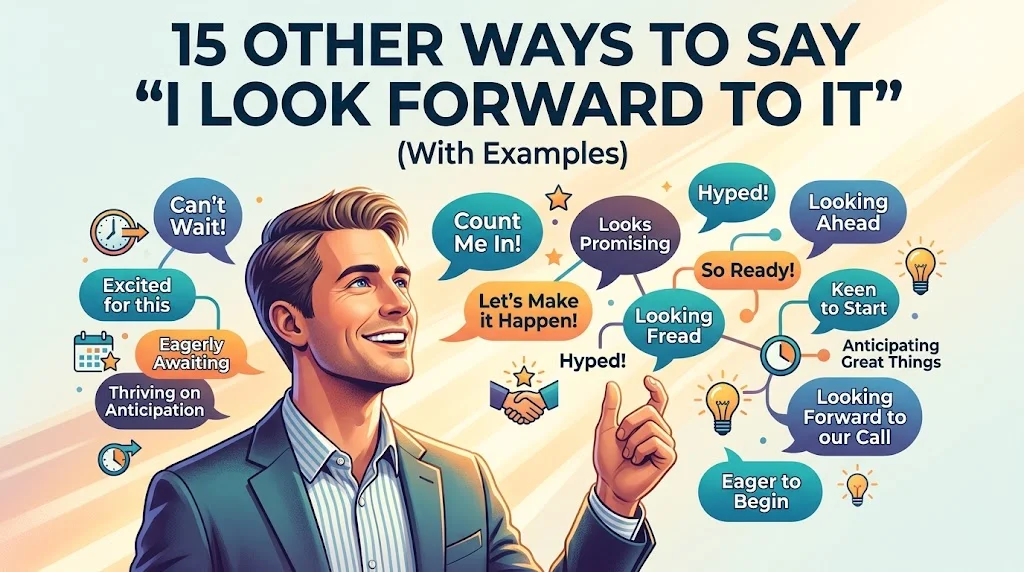
15 Other Ways to Say “I Look Forward to It”
There are many alternatives to “I look forward to it,” but they don’t all mean exactly the same thing. Some emphasize excitement, others communicate interest, and a few focus on preparation or readiness.
The following expressions will help you vary your language while keeping your message clear and natural. Each alternative includes its meaning, example sentences, and guidance on when to use it.
1. I’m Excited About It
“I’m excited about it” is a natural alternative when you want to communicate enthusiasm about something that will happen in the future. Compared with “I look forward to it,” this phrase places greater emphasis on your feelings.
It works well in personal conversations, workplace discussions, and messages about opportunities you genuinely find interesting. Although it can be used professionally, the level of enthusiasm should suit the situation.
Examples:
- “We’re launching the new website next week.” “I’m excited about it!”
- “You’ll meet the entire team during your first week.” “I’m excited about it.”
- “Our trip is finally confirmed.” “I’m really excited about it.”
The phrase is especially useful when you want your response to sound warm and sincere. It can also make a message feel more personal because it communicates an emotion rather than simply acknowledging a future event.
Professional example:
“Thank you for sharing the project timeline. I’m excited about the opportunity to contribute to this initiative.”
This sentence communicates enthusiasm while maintaining a professional tone.
When to use it: Choose this expression when you feel genuinely enthusiastic about an upcoming event, experience, or opportunity. If you want a more formal or restrained tone, “I look forward to it” may be the better choice.
2. I Can’t Wait for It
“I can’t wait for it” expresses strong excitement and impatience for something enjoyable or important to happen. It suggests that you’re so enthusiastic that waiting feels difficult.
This expression is generally more casual and energetic than “I look forward to it.” It’s particularly common in everyday conversations, friendly messages, and informal discussions about events or experiences.
Examples:
- “The concert is only two days away.” “I can’t wait for it!”
- “We’re going to visit the new restaurant on Saturday.” “I can’t wait for it.”
- “Your vacation starts next week.” “I know! I can’t wait.”
The phrase is most natural when the context already makes the anticipated event clear. If you want to be more specific, you can name the event directly: “I can’t wait for the concert” or “I can’t wait for our trip.”
In professional settings, use this expression selectively. It can sound friendly when discussing an exciting team event, but it may be too informal for a serious business email.
Professional example:
“I’m looking forward to the conference next month and the opportunity to connect with other professionals.”
This alternative keeps the positive meaning while sounding more measured.
When to use it: Choose “I can’t wait for it” when you want to express strong, informal enthusiasm. For formal communication, consider “I’m excited about it” or “I look forward to it.”
3. I’m Eager for It
“I’m eager for it” communicates a strong desire for something to happen. It suggests that you’re interested in the upcoming experience and keen to see it arrive.
The expression can sound more purposeful than “I can’t wait for it.” Depending on the context, it may convey excitement, motivation, or a strong sense of anticipation.
However, “I’m eager for it” is less natural in some everyday situations than more specific alternatives. English speakers often prefer “I’m eager to get started,” “I’m eager to learn more,” or “I’m eager to see the results.”
Examples:
- “The training program begins next month.” “I’m eager for it to begin.”
- “We’ll announce the results on Friday.” “I’m eager to find out the outcome.”
- “The new project starts next week.” “I’m eager to get started.”
These examples show how adding an infinitive or a clear action can make the sentence more natural and precise.
Professional example:
“I’m eager to begin working with the team and contribute to the upcoming project.”
This version highlights readiness and interest in taking action.
When to use it: Use this expression when you want to communicate strong interest or readiness, particularly in professional, educational, or goal-oriented situations. When possible, explain what you’re eager to do or experience rather than relying on “it” alone.
4. I’m Anticipating It
“I’m anticipating it” expresses the expectation that something will happen in the future. It can communicate interest, curiosity, or preparation, depending on the context. However, it doesn’t always convey the same warmth as “I look forward to it.”
The word anticipating often suggests that you’re thinking about an upcoming event or expecting a particular outcome. It’s useful when discussing plans, announcements, changes, or important developments.
Examples:
- “The company will announce its new product next week.” “I’m anticipating it with interest.”
- “We’ll receive the final report tomorrow.” “I’m anticipating its arrival.”
- “The conference promises several interesting presentations.” “I’m anticipating some valuable discussions.”
In everyday conversation, “I’m anticipating it” can sound slightly formal or unnatural if you simply want to express excitement. More specific wording often works better, such as “I’m anticipating a great experience” or “I’m looking forward to seeing the results.”
Professional example:
“I’m anticipating a productive discussion and look forward to reviewing the proposed solutions.”
This sentence works well in a business context because it expresses a positive expectation while keeping the focus on the purpose of the meeting.
When to use it: Choose this expression when you want to emphasize expectation, preparation, or interest in an upcoming outcome. If your main goal is to communicate happiness or excitement, “I’m excited about it” may sound more natural.
5. I’m Thrilled About It
“I’m thrilled about it” is a strong, enthusiastic alternative to “I look forward to it.” The word thrilled communicates intense happiness or excitement about an upcoming opportunity, event, or experience.
This expression works particularly well when something genuinely matters to you. For example, you might use it after receiving a job offer, being accepted into a program, or learning about an exciting personal opportunity.
Examples:
- “You’ve been selected to lead the new project.” “I’m thrilled about it!”
- “Your favorite band is coming to town.” “I’m thrilled about it.”
- “We’re moving into our new home next month.” “We’re thrilled about it.”
Because the phrase expresses strong emotion, it may sound excessive when you’re discussing a routine appointment or a minor task. Match your enthusiasm to the importance of the occasion.
Professional example:
“I’m thrilled about the opportunity to join your team and contribute to its upcoming initiatives.”
This wording expresses genuine excitement while remaining appropriate for a professional message, especially when responding to a job offer or important collaboration.
You can also make the expression more specific:
- “I’m thrilled about the opportunity.”
- “I’m thrilled to be part of the team.”
- “I’m thrilled about what we can accomplish together.”
When to use it: Use this phrase when you want to communicate strong positive feelings. For neutral business arrangements, “I look forward to it” may be more suitable. For major achievements or exciting opportunities, “I’m thrilled about it” adds warmth and personality.
6. I’m Counting Down to It
“I’m counting down to it” suggests that you’re eagerly waiting for a specific event or date. It creates a sense of excitement by emphasizing how close the event is getting.
The expression is informal and energetic. It’s particularly common when talking about vacations, concerts, weddings, celebrations, holidays, and other events people eagerly anticipate.
Examples:
- “Our vacation starts next Friday.” “I’m counting down to it!”
- “The wedding is only a week away.” “We’re counting down to it.”
- “The championship game is this weekend.” “I’m counting down the days.”
The expression often sounds more natural when you mention what you’re counting down to. For example, “I’m counting down to the concert” is clearer than “I’m counting down to it” when the context isn’t already obvious.
You can also say, “I’m counting down the days until we meet.” This version communicates excitement while making the anticipated event explicit.
Professional example:
“I’m counting down to the launch of our new product and look forward to seeing the team’s hard work pay off.”
This sentence conveys enthusiasm, although it may sound too informal for some corporate communications. In a more formal email, “I’m excited about the upcoming launch” would usually be a safer choice.
When to use it: Choose this expression when an event has a known date and you’re genuinely excited about its arrival. Avoid it in formal situations where a measured, professional tone is more appropriate.
7. I’m Enthusiastic About It
“I’m enthusiastic about it” expresses a positive attitude toward an idea, activity, opportunity, or plan. It suggests interest and willingness to participate rather than simply waiting for something to happen.
This expression can be useful in professional, academic, and collaborative settings. It communicates a positive outlook without the intense emotional emphasis of “I’m thrilled about it.”
Examples:
- “Would you like to participate in the research project?” “I’m enthusiastic about it.”
- “We’re introducing a new training program.” “I’m enthusiastic about the initiative.”
- “The team has proposed a different strategy.” “I’m enthusiastic about exploring it.”
Although the phrase is grammatically correct, naming the specific idea or opportunity often makes it sound more natural. For example, “I’m enthusiastic about the new strategy” is more informative than “I’m enthusiastic about it.”
You can also use the expression to show support for a shared goal.
Professional example:
“I’m enthusiastic about this collaboration and believe we can develop practical solutions together.”
This sentence communicates interest and a willingness to contribute. It works well in business discussions, project proposals, and messages about teamwork.
When to use it: Choose this alternative when you want to show a positive attitude toward a plan, project, or opportunity. It’s especially helpful when you want to communicate professional enthusiasm without sounding overly casual.
8. I’m Keen to See It Happen
“I’m keen to see it happen” expresses a strong interest in seeing a particular event, plan, or outcome become reality. It suggests that you support the idea and want to see progress.
The word keen is particularly common in British, Australian, and other varieties of English influenced by British usage. It’s also understood in American English, although American speakers may more often say “I’m eager to see it happen” or “I’m excited to see it happen.”
This expression is useful when discussing plans that require action, cooperation, or progress.
Examples:
- “We’re hoping to introduce the new program this year.” “I’m keen to see it happen.”
- “The community has proposed a new park.” “I’m keen to see the project move forward.”
- “Our team wants to improve the customer experience.” “I’m keen to see those changes implemented.”
The phrase works especially well when you’re discussing a goal rather than simply anticipating an enjoyable event. It emphasizes your interest in seeing a positive result.
Professional example:
“I’m keen to see the proposed improvements implemented and would be happy to help with the next steps.”
This wording communicates support and a willingness to contribute. In a US-focused professional email, you could replace keen with eager for a more familiar tone.
When to use it: Use this expression when you want to show support for a plan or express interest in seeing progress. It’s particularly effective in discussions about projects, improvements, and future developments.
9. I’m Delighted at the Prospect
“I’m delighted at the prospect” expresses happiness about the possibility of a future event or opportunity. The word delighted communicates pleasure, while prospect refers to something that may happen or become possible.
This phrase is more formal than “I’m excited about it.” It can be suitable for professional correspondence, formal invitations, and situations where you want to communicate warmth with a polished tone.
However, it can sound overly formal in casual conversation. In many situations, “I’m delighted about the opportunity” or “I’m pleased about the possibility” may feel more natural.
Examples:
- “We’d like you to join us for the awards ceremony.” “I’m delighted at the prospect.”
- “There may be an opportunity to work together next year.” “I’m delighted at the prospect of collaborating.”
- “The organization is considering you for the position.” “I’m delighted at the prospect of joining the team.”
Notice that adding of followed by a noun or gerund helps clarify what the prospect involves. For example, “I’m delighted at the prospect of working with you” is more specific than the shorter expression.
Professional example:
“I’m delighted at the prospect of collaborating with your team and contributing to the success of this initiative.”
This sentence communicates enthusiasm while maintaining a formal tone. It may work well when discussing a promising partnership or professional opportunity.
When to use it: Choose this expression when you want to convey polite pleasure about a future possibility. If the situation is informal or you want to sound direct and natural, “I’m excited about it” may be the better option.
10. It’ll Be a Pleasure
“It’ll be a pleasure” means that you expect to enjoy doing something or consider it a positive experience. Unlike “I look forward to it,” which focuses on anticipation, this expression emphasizes the pleasure you expect to receive from the activity.
It’s especially useful when accepting an invitation, agreeing to help someone, or responding to a request in a polite and professional manner.
Examples:
- “Would you be willing to speak at our event?” “It’ll be a pleasure.”
- “Could you meet with our new team members?” “It’ll be a pleasure.”
- “We’d love you to join us for dinner.” “It’ll be a pleasure.”
The expression can sound warm and courteous, but the context matters. When accepting a specific task, “It’ll be a pleasure to help” is clearer than simply saying “It’ll be a pleasure.”
Also, distinguish this phrase from “It would be a pleasure.” The latter often sounds more courteous or conditional, especially when responding to a request or extending an offer.
Professional example:
“It would be a pleasure to meet with your team and discuss how we might work together.”
This wording is appropriate for a business email because it expresses willingness without sounding overly familiar.
When to use it: Choose this alternative when accepting an invitation, offering assistance, or expressing willingness to participate. If you want to emphasize excitement about an event rather than the pleasure of taking part, “I’m excited about it” may be more precise.
11. I Await It With Interest
“I await it with interest” communicates that you expect something and are interested in finding out what happens next. It has a formal tone and is more common in carefully worded correspondence than in everyday conversation.
The verb await means to wait for something, usually with an expectation that it will arrive or occur. Adding with interest indicates that the anticipated event or information matters to you.
However, this phrase can sound stiff or old-fashioned in ordinary business communication. More natural alternatives include “I look forward to hearing the results,” “I’m interested to see how it develops,” or “I look forward to reviewing your findings.”
Examples:
- “The committee will publish its findings next month.” “I await the results with interest.”
- “We’ll share the final proposal after the review.” “I await it with interest.”
- “The research team is preparing its report.” “I await the findings with interest.”
These examples demonstrate why specifying the expected information improves clarity. In many cases, “I await it with interest” is less natural than “I await the results with interest.”
Professional example:
“I look forward to reviewing the final report and learning more about the findings.”
This alternative expresses the same general interest in a more contemporary, straightforward style.
When to use it: Use “I await it with interest” sparingly, particularly in formal or deliberately restrained writing. For most modern professional emails, a specific phrase such as “I look forward to reviewing the results” sounds more natural and direct.
12. I’m Eager to Experience It
“I’m eager to experience it” expresses a strong desire to take part in something or discover what it will be like. Unlike a general statement of anticipation, this phrase emphasizes the experience itself.
It works well when discussing travel, educational opportunities, new activities, professional events, or situations that offer something unfamiliar. It communicates curiosity and enthusiasm without sounding overly casual.
Examples:
- “You’ll get to try several new activities during the retreat.” “I’m eager to experience them.”
- “The program offers a unique approach to learning.” “I’m eager to experience it.”
- “You’ll be working with an international team.” “I’m eager to experience that collaboration.”
The phrase is particularly useful when you want to show that you’re open to learning or trying something new. However, it may sound less natural when the anticipated event is a routine appointment or a short conversation.
Professional example:
“I’m eager to experience the program firsthand and learn how its methods can improve our team’s workflow.”
This sentence shows curiosity while connecting the anticipated experience to a practical goal.
When to use it: Choose this alternative when you’re anticipating something that will give you new knowledge, enjoyment, or personal growth. If you’re simply confirming a meeting, “I look forward to our discussion” is usually more direct.
13. I’m Excited for What’s Ahead
“I’m excited for what’s ahead” expresses enthusiasm about future opportunities, experiences, or developments. Instead of focusing on one specific event, it suggests that you’re optimistic about what the future may bring.
This phrase is useful when starting a new job, joining a team, beginning a project, or entering a new stage of life. It sounds positive and forward-looking without requiring you to identify every detail of what you anticipate.
Examples:
- “You’re starting your new position next month.” “I’m excited for what’s ahead.”
- “Our team is entering a new phase of development.” “We’re excited for what’s ahead.”
- “You’ve made some big changes this year.” “I’m excited for what’s ahead.”
The expression works particularly well when the future involves several possibilities rather than one scheduled event. It communicates optimism, making it suitable for announcements, personal messages, and team updates.
Professional example:
“I’m excited for what’s ahead and look forward to contributing to the team’s continued progress.”
This sentence expresses enthusiasm while keeping the focus on collaboration and future goals.
When to use it: Use this phrase when you want to express optimism about a broader future. If you’re referring to a specific appointment or event, a more focused alternative will usually communicate your meaning more clearly.
14. I’m Pleased About What’s to Come
“I’m pleased about what’s to come” communicates a positive attitude toward future developments. It suggests that you’re satisfied with the direction things are taking and expect favorable experiences or results.
The word pleased is generally more restrained than thrilled or excited. As a result, this expression can work when you want to sound positive without showing intense enthusiasm.
However, it may sound slightly formal or less conversational than other alternatives. In many situations, “I’m pleased about the upcoming changes” or “I’m looking forward to the next stage” will sound more specific.
Examples:
- “The company is introducing several improvements.” “I’m pleased about what’s to come.”
- “We have some exciting developments planned for next quarter.” “I’m pleased about what’s to come.”
- “The next phase of the project will introduce new features.” “I’m pleased about what’s to come.”
These examples show how the phrase communicates a positive expectation without making an exaggerated emotional claim.
Professional example:
“I’m pleased about what’s to come and look forward to seeing how the proposed improvements benefit our customers.”
This response works when discussing future developments, particularly when you want to communicate measured optimism.
When to use it: Choose this expression when you feel positive about future changes or outcomes but want to maintain a composed tone. If you’re especially enthusiastic, “I’m thrilled about it” may better reflect your feelings.
15. I’m Eager to Get Started
“I’m eager to get started” communicates enthusiasm and readiness to begin an activity. Unlike “I look forward to it,” which primarily expresses anticipation, this phrase emphasizes action.
It’s particularly useful when starting a new job, joining a project, beginning a course, or accepting a responsibility. It tells the other person that you’re interested in moving forward rather than simply waiting for the opportunity.
Examples:
- “We’ll begin the project on Monday.” “I’m eager to get started.”
- “Your training program begins next week.” “I’m eager to get started.”
- “We’re ready to launch the new initiative.” “I’m eager to get started.”
This expression is suitable for professional emails because it communicates motivation and a willingness to contribute. It also works in casual settings when you’re excited about beginning a shared activity.
Professional example:
“Thank you for the opportunity to join the team. I’m eager to get started and contribute to the project’s success.”
This response is effective because it combines appreciation with readiness to take action.
When to use it: Choose this alternative when you want to communicate motivation, initiative, and enthusiasm about beginning something. If you’re anticipating an event that doesn’t involve immediate action, such as a concert or vacation, “I’m excited about it” may be more appropriate.
How to Choose the Best Alternative to “I Look Forward to It”
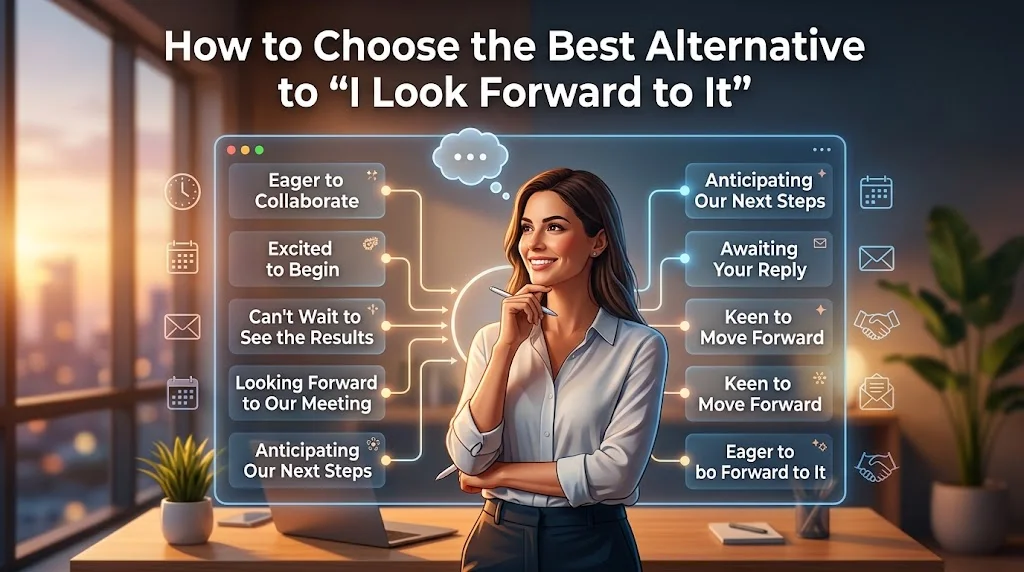
With 15 alternatives available, you might wonder which one you should use. The answer depends on your intention, audience, and level of enthusiasm.
A good alternative should sound natural in context. It should also communicate the right feeling without making your message too formal, too casual, or unnecessarily emotional.
Choose According to Your Level of Enthusiasm
Your choice of words can communicate how strongly you feel about an upcoming event.
If you’re mildly interested, “I look forward to it” is often sufficient. If you feel genuinely enthusiastic, “I’m excited about it” communicates more emotion. For something especially important, “I’m thrilled about it” may be a better fit.
Consider these differences:
- Polite and neutral: “I look forward to our meeting.”
- Warm and enthusiastic: “I’m excited about our meeting.”
- Highly enthusiastic: “I’m thrilled about the opportunity.”
- Motivated and ready: “I’m eager to get started.”
You don’t need to make every response sound enthusiastic. Choose language that accurately reflects your feelings.
Match the Phrase to Your Audience
The same expression can sound appropriate in one situation and awkward in another. Consider your relationship with the reader before choosing an alternative.
For example, when writing to a prospective employer, “I look forward to discussing the position” sounds professional and clear. When messaging a friend about a weekend trip, “I can’t wait!” may feel more natural.
Use the following table as a quick guide.
| Situation | Recommended phrase | Why it works |
| Formal business email | I look forward to it. | Polite and professional |
| Job opportunity | I’m eager to get started. | Shows motivation |
| Exciting personal event | I can’t wait for it. | Expresses strong enthusiasm |
| New experience | I’m eager to experience it. | Communicates curiosity |
| Future possibilities | I’m excited for what’s ahead. | Shows optimism |
| Professional collaboration | I’m excited to work together. | Emphasizes cooperation |
| Upcoming results | I look forward to seeing the results. | Clearly identifies the expected outcome |
| Accepting an invitation | It’ll be a pleasure. | Expresses polite willingness |
These are useful starting points, not strict rules. You can adjust the wording to suit your personality and the expectations of your audience.
Be Specific About What You Anticipate
One of the easiest ways to improve your writing is to replace a vague pronoun with the actual event, activity, or outcome.
For example:
- General: “I look forward to it.”
- More specific: “I look forward to our discussion.”
- More informative: “I look forward to discussing the marketing strategy with your team.”
The final version gives the reader a clearer idea of what you anticipate. It also shows that you’ve considered the purpose of the interaction.
The same principle applies to alternatives. Instead of writing “I’m excited about it,” you might say, “I’m excited about the opportunity to present our findings.”
Specific wording is particularly valuable in professional communication, where clarity often matters more than dramatic expressions of enthusiasm.
Consider Whether You Want to Emphasize Feelings or Action
Some alternatives emphasize emotions, while others highlight what you intend to do.
If you want to communicate happiness, try “I’m thrilled about it.” If you want to show curiosity, “I’m eager to experience it” may be appropriate. If you want to demonstrate readiness, “I’m eager to get started” is more effective.
For example, imagine that you’ve accepted a new role.
“I’m excited about the opportunity” communicates enthusiasm.
“I’m eager to get started” emphasizes readiness.
“I look forward to working with the team” communicates positive anticipation and a collaborative attitude.
All three sentences are appropriate, but each serves a slightly different purpose. Choose the one that best matches the message you want to convey.
Examples of Other Ways to Say “I Look Forward to It” in Real Situations
Understanding individual expressions is helpful, but seeing them in realistic situations makes it easier to use them naturally. The following examples show how you can apply these alternatives in professional emails, personal conversations, and everyday communication.
In a Professional Email
Suppose a client invites you to discuss a potential partnership. You want to sound professional while showing genuine interest.
Example:
“Thank you for arranging the meeting. I’m excited about the opportunity to discuss our potential collaboration and explore how we can work together.”
This response is more specific than “I look forward to it.” It identifies the purpose of the meeting and expresses enthusiasm about the possible partnership.
You could also write:
“Thank you for the invitation. I look forward to discussing the proposal with you.”
This shorter version is appropriate when you want a polite, straightforward tone.
When Starting a New Job
Beginning a new role often calls for a response that combines enthusiasm with readiness.
Example:
“Thank you for the warm welcome. I’m eager to get started and contribute to the team.”
This response communicates motivation and shows that you’re prepared to participate.
Another option is:
“I’m excited about the opportunity to join the company and look forward to working with everyone.”
This version balances enthusiasm with professional courtesy.
When Accepting a Social Invitation
Imagine that a friend invites you to a birthday party or a weekend trip.
Example:
“That sounds amazing! I can’t wait.”
The phrase sounds natural because it expresses strong excitement in a casual conversation.
You could also say:
“I’m counting down the days until we go!”
This alternative adds energy and emphasizes how eagerly you anticipate the event.
When Discussing an Upcoming Project
Suppose your manager announces that your team will begin a new project next week.
Example:
“I’m excited about the project and eager to get started.”
This response communicates both enthusiasm and readiness to act.
If you want to emphasize collaboration, you could write:
“I’m looking forward to working with everyone and seeing what we accomplish together.”
The second sentence highlights teamwork rather than focusing only on your personal excitement.
When Anticipating an Important Result
Perhaps you’re waiting for research findings, a business decision, or the results of a presentation.
Example:
“I’m looking forward to reviewing the findings and discussing the next steps.”
This wording identifies what you expect and shows that you’re interested in the work ahead.
You might also say:
“I’m interested to see how the results develop.”
This alternative is useful when you want to emphasize curiosity rather than excitement.
Common Mistakes to Avoid When Using These Alternatives
Choosing a suitable expression is only part of effective communication. You should also make sure the phrase is grammatically correct, appropriate for the situation, and consistent with the meaning you intend to convey.
Using an Expression That Sounds Too Casual
Phrases such as “I can’t wait” and “I’m counting down the days” communicate strong excitement, but they may not suit every formal message.
For example, a message to a prospective client that says, “I can’t wait for our business meeting!” may sound too informal depending on your relationship.
A more measured alternative would be:
“I look forward to our meeting and the opportunity to discuss the proposal.”
This sentence maintains a positive tone while remaining professional.
Choosing a Phrase That Overstates Your Feelings
Not every upcoming event deserves a statement of intense excitement. If you’re confirming a routine appointment, saying “I’m absolutely thrilled about it” may sound exaggerated.
Similarly, “I’m delighted at the prospect” can feel overly formal in a casual conversation.
Choose a phrase that reflects your genuine feelings. A simple expression is often more effective than one that sounds unnecessarily dramatic.
Forgetting the Grammar After “Look Forward To”
A common mistake is using the base form of a verb after “look forward to.”
Incorrect: “I look forward to meet you.”
Correct: “I look forward to meeting you.”
Incorrect: “I look forward to hear from you.”
Correct: “I look forward to hearing from you.”
Remember that “to” is a preposition in this expression. When a verb follows it, use the gerund form ending in -ing.
However, not every alternative follows the same pattern. For example, “I’m eager to meet you” is correct because the adjective eager takes an infinitive in this construction.
Repeating the Same Phrase in Every Message
Using “I look forward to it” occasionally is perfectly fine. Repeating it at the end of every email, however, can make your writing feel formulaic.
Instead, vary your wording when another expression better matches the context.
For example:
- “I look forward to our discussion.”
- “I’m eager to begin.”
- “I’m excited about the opportunity.”
- “I look forward to hearing your thoughts.”
The goal is not to replace every repeated expression with a synonym. It’s to communicate your meaning clearly and naturally.
Using “It” When the Meaning Is Unclear
The pronoun “it” works when the reader already knows what you mean. If the conversation includes several possible events, the reference may become confusing.
Instead of writing, “I’m excited about it,” consider naming the specific event:
“I’m excited about the upcoming product launch.”
Likewise, “I look forward to it” can become “I look forward to reviewing the final proposal.”
Specific references reduce ambiguity and make professional messages easier to understand.
Tips for Using “I Look Forward to It” and Its Alternatives Naturally
Keep these practical tips in mind whenever you want to express anticipation.
- Match your tone to the situation. Use measured wording in formal emails and more expressive phrases with friends.
- Be honest about your feelings. Don’t use an intensely enthusiastic phrase unless it reflects your actual reaction.
- Name the event when clarity matters. Specific wording helps your reader understand what you anticipate.
- Check the grammar. Remember the gerund after “look forward to,” but follow the grammatical pattern required by each alternative.
- Avoid unnecessary variety. You don’t need to replace a perfectly suitable phrase just to make your writing different.
- Emphasize action when appropriate. “I’m eager to get started” works particularly well when you want to demonstrate initiative.
- Keep professional messages concise. A clear sentence often communicates more effectively than a long expression of enthusiasm.
Conclusion
Choosing the right alternative to “I look forward to it” can make your communication sound more natural, engaging, and personal. Whether you’re writing a professional email, accepting an invitation, or talking about an exciting opportunity, the right expression helps you convey your feelings clearly. Phrases such as “I’m excited about it,” “I can’t wait for it,” and “I’m eager to get started” offer different ways to express enthusiasm, anticipation, and readiness.
Remember that not every alternative fits every situation. Some expressions work best in casual conversations, while others maintain a polished, professional tone. Consider your audience, the context, and how strongly you want to express your feelings before choosing your words.
You don’t have to avoid the original phrase, either. “I look forward to it” remains a polite and versatile choice. Simply use these alternatives when they communicate your meaning more precisely and help your writing feel fresh and sincere.
FAQs
What is another way to say “I look forward to it”?
You can say “I’m excited about it,” “I can’t wait for it,” “I’m eager for it,” or “I’m thrilled about it.” The best alternative depends on your tone and situation. For professional communication, “I look forward to our discussion” is clear and polite. For casual conversations, “I can’t wait!” sounds more enthusiastic and relaxed.
Is “I look forward to it” professional?
Yes, “I look forward to it” is professional and polite. It works well in emails, meeting confirmations, business discussions, and formal invitations. For greater clarity, mention the specific event or activity you anticipate. For example, “I look forward to discussing the proposal” sounds more informative than “I look forward to it” when the context isn’t clear.
How can I say “I look forward to it” in a formal email?
You can write “I look forward to our meeting,” “I look forward to discussing the proposal,” or “I look forward to working with you.” These expressions sound professional and identify what you anticipate. Choose wording that matches your purpose, and avoid overly enthusiastic phrases if the email requires a formal, measured tone.
What is a more enthusiastic way to say “I look forward to it”?
“I’m thrilled about it,” “I can’t wait,” and “I’m really excited about it” communicate stronger enthusiasm. Use these expressions when you genuinely feel excited about an event, opportunity, or experience. “I can’t wait” is more casual, while “I’m thrilled about the opportunity” can also work in professional messages.
Is “I’m looking forward to it” better than “I look forward to it”?
Both expressions are correct, but they can create slightly different impressions. “I look forward to it” is common in professional emails and formal communication. “I’m looking forward to it” often sounds more conversational and emphasizes your current anticipation. The best choice depends on your audience, context, and preferred tone.
Can I say “I can’t wait for it” in a professional email?
Yes, but it depends on the situation and your relationship with the recipient. “I can’t wait for it” sounds enthusiastic and informal, making it suitable for friendly workplace messages. In a formal email to a client or senior professional, “I look forward to our meeting” or “I’m excited about the opportunity” may be more appropriate.
What is the difference between “eager” and “excited”?
“Eager” often emphasizes a strong desire or readiness to do something, while “excited” focuses more on positive feelings about an event or experience. For example, “I’m eager to get started” highlights motivation. “I’m excited about the project” emphasizes enthusiasm. Both expressions can be appropriate in personal and professional communication.
Is “I’m eager for it” grammatically correct?
Yes, “I’m eager for it” is grammatically correct, although it may sound less natural than more specific alternatives in some contexts. You can say “I’m eager to get started,” “I’m eager to learn more,” or “I’m eager to see the results.” These expressions explain what you want to do or experience.
What grammar rule applies to “look forward to”?
When a verb follows “look forward to,” use its -ing form because “to” functions as a preposition. For example, “I look forward to meeting you” and “I look forward to hearing from you” are correct. Avoid “I look forward to meet you.” The expression can also be followed by a noun or pronoun, as in “I look forward to it.”
How can I avoid repeating “I look forward to it” in my writing?
Choose alternatives that reflect your actual meaning. Use “I’m excited about it” to express enthusiasm, “I’m eager to get started” to show readiness, or “I look forward to our discussion” to be more specific. You can also name the event directly. Vary your wording when it improves clarity, but don’t replace a perfectly natural phrase just for variety.