

Sleeve vs Sleave: The Quick Answer
Have you ever wondered whether to write sleeve or sleave when describing a shirt, jacket, or dress? These words look almost identical, so it’s easy to mix them up while typing or writing from memory. However, they don’t serve the same purpose in modern English.
Sleeve is the correct, standard spelling when you mean the part of a garment that covers the arm. You use it when talking about short-sleeve shirts, long-sleeve tops, jacket sleeves, and similar clothing features. The word also appears in expressions such as “roll up your sleeves” and “have something up your sleeve.”
Sleave, by contrast, is a rare word associated with historical textile terminology, particularly loose or untwisted silk thread. Most people won’t need it in everyday conversation or ordinary writing.
Consider these examples:
- Correct: She bought a dress with long sleeves.
- Incorrect in ordinary clothing contexts: She bought a dress with long sleaves.
- Specialized historical use: The text describes sleave as a form of loose silk thread.
The easiest rule is simple: when you’re talking about clothing, choose sleeve. Use sleave only when its specific historical or technical meaning fits your subject.
What Does “Sleeve” Mean?
Definition of Sleeve
The word sleeve is a noun that usually refers to the part of a piece of clothing designed to cover some or all of the arm. Depending on the garment, a sleeve may extend to the wrist, stop above the elbow, or cover only the upper arm.
Sleeves come in different shapes, lengths, and styles. A T-shirt might have short sleeves, while a winter coat usually has long sleeves to provide additional warmth. Some dresses have fitted sleeves, whereas others feature loose, flowing, or puffed designs.
The word also describes several objects that function like a protective covering or outer layer. For example, a protective sleeve can hold a laptop, a document sleeve can store papers, and a record sleeve can protect a vinyl disc.
Here are a few examples:
- The tailor shortened the sleeves of my jacket.
- He wore a shirt with rolled-up sleeves.
- Please put the important documents inside a plastic sleeve.
- She bought a protective sleeve for her tablet.
In each example, sleeve refers to a covering or a part that surrounds or protects something.
The word can also appear in figurative expressions. When someone has “something up their sleeve,” they have a secret plan, hidden advantage, or unexpected idea. When a person “rolls up their sleeves,” they prepare to work hard.
Understanding these different uses makes it easier to choose the right word in both everyday conversation and professional writing.
How to Pronounce “Sleeve”
The word sleeve is pronounced /sliːv/ in the International Phonetic Alphabet (IPA). It has one syllable, and the vowel sound is the long “ee” sound heard in words such as see and green. The final sound is a voiced /v/, made by placing your upper teeth lightly against your lower lip while allowing your voice to vibrate.
The pronunciation is important because the word’s spelling can be less familiar to new English learners. Although sleeve contains the letters “ee,” the sound is straightforward once you recognize the pattern.
Try saying it slowly, then use it in a sentence:
- “My sleeve is wet.”
- “The shirt has a loose sleeve.”
- “Please roll up your sleeve.”
In normal speech, the word is pronounced as one smooth syllable rather than as separate sounds.
Because sleave is rare, many readers may never encounter it outside historical or specialized writing. Don’t assume that changing the vowel letters in sleeve creates an acceptable alternative spelling for ordinary clothing descriptions.
Origin and History of the Word Sleeve
The word sleeve has a long history in English. It developed from Old English slīefe, which referred to a sleeve or covering for the arm. Its spelling and pronunciation evolved over time, but its central connection to clothing remained.
As clothing styles changed, the sleeve became an important part of garment design. Different sleeve shapes helped people adapt their clothing to weather, work, social customs, and fashion. Some designs prioritized movement, while others emphasized decoration or status.
Today, the word is used far beyond traditional clothing. A sleeve may be a fabric part of a shirt, a paper covering for a document, or a protective layer for an electronic device. The common idea is that a sleeve covers, encloses, or protects something.
The word also developed a place in figurative English. Expressions such as “have something up your sleeve” use the image of hiding an object in a sleeve to suggest keeping a plan or surprise secret.
Knowing this history helps explain why sleeve has so many uses. It also reinforces why the standard spelling matters: in modern everyday English, sleeve is the familiar word for a garment covering the arm.
Common Uses of Sleeve
You can use sleeve in many situations, from shopping for clothes to describing protective covers and discussing work.
In clothing and fashion, the word identifies the part of a garment that covers the arm. Common combinations include shirt sleeve, coat sleeve, short sleeve, and long sleeve. For example, “The jacket has adjustable sleeves” describes a practical feature of the clothing.
In shopping and product descriptions, sleeve can help explain the style or fit of an item. A retailer might advertise a long-sleeve sweater, a sleeveless dress, or a shirt with wide sleeves. Correct spelling helps customers understand exactly what they’re buying.
In protective coverings, a sleeve may hold or protect an object. Examples include a laptop sleeve, a document sleeve, and a record sleeve. In these contexts, the word doesn’t refer to clothing, but it still describes a covering.
In everyday expressions, sleeve often carries a figurative meaning. Someone who has a trick up their sleeve has a hidden plan. Someone who rolls up their sleeves is ready to make an effort.
For example:
- My sweater sleeves are too long.
- She placed her laptop in a padded sleeve.
- We need to roll up our sleeves and finish the project.
- He has another idea up his sleeve.
These examples show how widely sleeve is used in modern English. If you’re describing an arm covering, a protective case, or one of these common expressions, sleeve is almost always the spelling you need.
How to Use “Sleeve” in Everyday English
The word sleeve appears in conversations about clothing, fashion, storage, and practical work. Although its most familiar meaning relates to garments, you can also use it for protective coverings and in several common expressions. Understanding these contexts helps you choose the right word and avoid spelling mistakes.
Sleeve in Shirts, Jackets, Coats, and Dresses
The most common use of sleeve refers to the part of a garment that covers the arm. Sleeves can vary in length, shape, and design depending on the type of clothing and the look the designer wants to create.
For example, a short-sleeve T-shirt is suitable for warm weather, while a long-sleeve shirt may offer more coverage on cooler days. Jackets and coats generally have sleeves that extend toward the wrists, although their shapes and lengths can differ.
Fashion descriptions often use specific terms to explain sleeve styles. These include fitted sleeves, puff sleeves, bell sleeves, and raglan sleeves. Each term describes a different shape or construction.
Consider these examples:
- The tailor adjusted the sleeves of my suit jacket.
- She wore a floral dress with puff sleeves.
- This cotton shirt has short sleeves and a relaxed fit.
- His winter coat has long sleeves that cover his wrists.
- The designer added wide sleeves to give the blouse a flowing shape.
In each sentence, sleeve or sleeves is spelled with the letters “ee.” Writing sleave in these contexts would be a spelling error.
When describing clothing, remember that the singular form refers to one sleeve, while the plural form usually refers to two or more. For example, you might say, “One sleeve is torn,” or “Both sleeves need repairs.”
Short-Sleeve and Long-Sleeve Clothing
The expressions short-sleeve and long-sleeve are common in clothing descriptions. They indicate whether a garment has sleeves that end above the elbow or extend farther down the arm. The exact length can vary according to the design.
You’ll often see these expressions in online stores, product labels, fashion catalogs, and everyday conversation. Correct spelling is especially important in product listings because shoppers use these words to find particular styles.
Examples include:
- I’m looking for a short-sleeve shirt for summer.
- He wore a long-sleeve T-shirt under his jacket.
- The store has short-sleeve and long-sleeve options.
- She prefers long-sleeve dresses for cooler weather.
You may also see short-sleeved and long-sleeved. These forms are widely used when describing a person or garment.
For instance:
- He wore a short-sleeved polo shirt.
- She bought a long-sleeved sweater.
Both forms are correct, but their grammatical structures differ slightly. Short-sleeve shirt uses short-sleeve as a compound modifier before the noun. Short-sleeved shirt uses the adjective short-sleeved to describe the garment.
Avoid writing short-sleave shirt or long-sleave shirt. Neither is the standard spelling for these clothing descriptions.
Sleeves on Bags, Devices, and Protective Covers
Although people most often associate sleeve with clothing, the word also describes coverings designed to protect or hold other objects. These uses are common in technology, office supplies, music, and packaging.
A laptop sleeve is a padded cover that helps protect a computer from scratches, dust, and minor bumps. A document sleeve holds papers and helps keep them clean or organized. A record sleeve protects a vinyl record when it isn’t being played.
The same idea appears in other products. A tablet sleeve can protect a device during travel, while a card sleeve can hold a trading card or collectible. In each case, the sleeve acts as a cover or container.
Here are some examples:
- I bought a padded sleeve to protect my laptop.
- Keep the contract in a transparent document sleeve.
- The record sleeve has artwork from the original album.
- She placed her tablet inside a protective sleeve before packing it.
- Collectors often use card sleeves to protect valuable trading cards.
These examples demonstrate that sleeve has a broader meaning than a part of clothing. However, the spelling remains the same across these modern uses.
If you’re writing a product description, email, report, or shopping list, use sleeve when you mean a protective covering. The unusual spelling sleave isn’t a suitable substitute.
Sleeve in Technical and Specialized Contexts
In technical writing, sleeve can refer to a cylindrical covering, a protective component, or a part that fits around another object. The exact meaning depends on the field.
For example, an engineer might discuss a pipe sleeve that protects or guides a pipe through a wall. An electrical technician might use the term for an insulating sleeve that covers a wire connection. In manufacturing, a sleeve may fit around a shaft or another mechanical component.
The term also appears in packaging and printing. A product sleeve can wrap around a box or container, while a book or record sleeve may protect the item or display printed information.
Examples include:
- The contractor installed a sleeve around the pipe.
- The technician replaced the damaged insulating sleeve.
- The packaging includes a cardboard sleeve with the product details.
- The mechanic checked the protective sleeve around the component.
In these situations, the word describes a covering or component rather than clothing. Still, the standard spelling is sleeve.
When working with specialized terminology, context matters. A technical dictionary or industry reference can help you confirm the precise meaning of a term. However, there’s no general reason to replace sleeve with sleave in modern technical writing.
Common Expressions With “Sleeve”
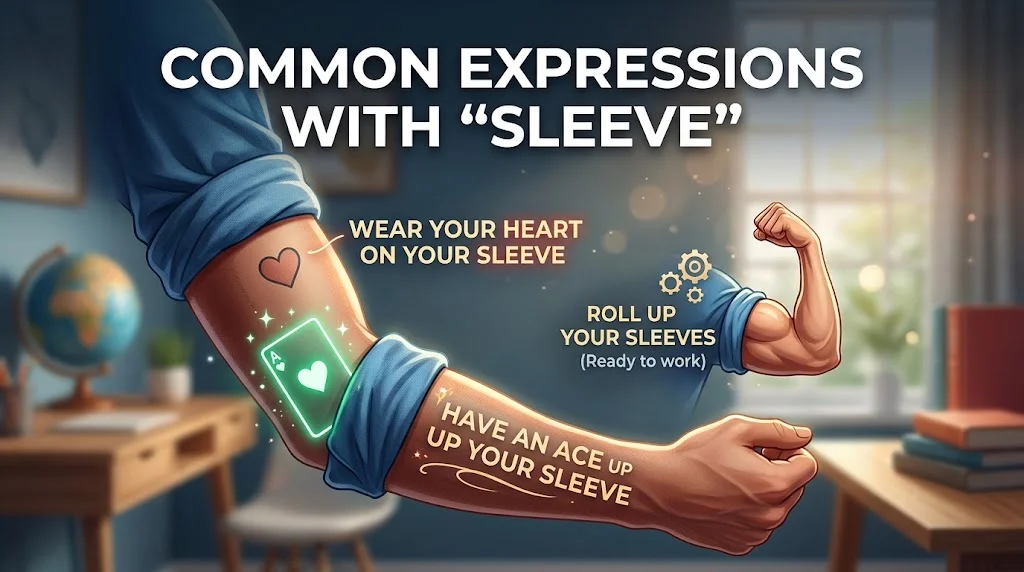
The word sleeve appears in several familiar English idioms. These expressions don’t always refer to actual clothing. Instead, they use the idea of a sleeve to communicate a hidden plan, determination, or emotional openness.
Learning these expressions will help you understand everyday conversations and use English more naturally.
Have Something Up Your Sleeve
The expression “have something up your sleeve” means to have a secret plan, an unexpected idea, or an advantage that other people don’t know about.
The expression creates an image of someone hiding something in a sleeve and revealing it at the right moment. In modern English, the phrase is usually figurative rather than literal.
For example, a business owner might have an alternative strategy ready if negotiations fail. A student might have another approach to solve a difficult problem. In both cases, the person has an idea that hasn’t yet been shared.
Examples:
- I think our coach has another strategy up his sleeve.
- She always has a clever solution up her sleeve.
- The company may have a new product up its sleeve.
- Don’t worry; I’ve got a backup plan up my sleeve.
The phrase can sound playful, confident, or slightly suspicious, depending on the situation. It may describe a helpful surprise, but it can also suggest that someone is being secretive.
Notice the spelling in every example: sleeve is correct because the expression refers to the familiar word, even when used figuratively.
Roll Up Your Sleeves
“Roll up your sleeves” means to prepare to work hard or deal with a task directly. The expression comes from the practical act of moving long sleeves away from your hands and wrists before doing physical work.
Today, people often use the phrase for mental work, teamwork, and difficult projects as well as manual tasks.
For example, a manager might tell a team to roll up their sleeves before a busy deadline. A student might use the phrase when preparing for a demanding exam period.
Examples:
- We need to roll up our sleeves and finish this report.
- The volunteers rolled up their sleeves to clean the park.
- If we want to meet the deadline, everyone must roll up their sleeves.
- She rolled up her sleeves and started repairing the fence.
The phrase usually communicates determination and a willingness to make an effort. It’s common in both informal conversation and professional settings, although it may sound more energetic than formal alternatives such as “begin the work” or “make a concerted effort.”
Don’t confuse the figurative meaning with a literal description. If someone physically folds their sleeves upward, you can say they are rolling up their sleeves. If they are preparing to tackle a challenging task, the phrase works figuratively.
Wear Your Heart on Your Sleeve
“Wear your heart on your sleeve” means to show your feelings openly rather than hiding them. Someone who wears their heart on their sleeve may express happiness, sadness, affection, or disappointment in a way that other people can easily recognize.
The expression is often used to describe people who are emotionally honest or expressive. Depending on the context, this openness can be seen as a positive quality or as a sign that someone is vulnerable.
For example, a person might openly celebrate a friend’s success or visibly show disappointment after receiving bad news.
Examples:
- She wears her heart on her sleeve and rarely hides her emotions.
- He wore his heart on his sleeve when he thanked his family.
- You don’t have to wear your heart on your sleeve to be sincere.
- My brother wears his heart on his sleeve, so everyone knows when he’s excited.
This idiom doesn’t mean that a person literally displays a heart on their clothing. It uses sleeve symbolically to describe how someone reveals their emotions.
As with the other expressions, sleeve is the correct spelling. Replacing it with sleave would make the familiar idiom incorrect.
Examples of Sleeve Idioms in Context
Understanding idioms becomes easier when you see how they work in complete conversations. The same word can appear in different expressions, each with a distinct meaning.
Conversation one: A surprise plan
“Do you know what Maya is planning for the celebration?”
“Not yet, but I think she has something up her sleeve.”
Here, the phrase suggests that Maya has a secret idea or surprise.
Conversation two: A busy project
“We have only two days left to complete the presentation.”
“Then let’s roll up our sleeves and divide the work.”
In this conversation, the idiom encourages people to start working seriously.
Conversation three: An emotional reaction
“Did Daniel enjoy the farewell party?”
“Definitely. He wears his heart on his sleeve, and he was visibly moved by everyone’s speeches.”
This example uses the expression to describe Daniel’s open display of emotion.
These idioms are useful because they allow speakers to communicate ideas in a natural, memorable way. They also reinforce the correct spelling of sleeve in expressions that appear frequently in English.
Whenever you use one of these phrases, remember that the word keeps its standard spelling regardless of whether its meaning is literal or figurative.
What Does “Sleave” Mean?
The word sleave is real, but it is not a common alternative to sleeve. It belongs mainly to historical and specialized textile vocabulary. In older usage, sleave referred to loose, untwisted, or loosely arranged silk thread. You may encounter it in historical dictionaries, older literary works, or discussions of traditional textile production.
This distinction matters because many people assume that sleave is simply a spelling mistake for sleeve. In everyday writing, that assumption is usually reasonable when the context involves clothing. However, in a historical text about silk or thread, sleave may be intentional.
For example, a modern clothing description should say, “The jacket has wide sleeves.” A historical discussion of textile materials might use sleave to describe a form of loose silk fiber.
The two words look similar, but they have different meanings and uses. If you’re writing about shirts, coats, dresses, or protective covers, choose sleeve. Reserve sleave for the rare contexts in which its specialized meaning is relevant.
Definition and Historical Meaning of Sleave
Historically, sleave referred to loose silk thread or silk fibers that had not been fully twisted into a finished thread. Older textile terminology used the word when discussing the preparation, handling, or structure of silk.
Traditional textile production involved several stages, and the condition of a fiber or thread could affect how it was handled and used. Terms such as sleave helped distinguish particular materials or forms of thread within that specialized vocabulary.
Unlike sleeve, which remains a familiar modern English word, sleave is rarely needed in ordinary conversation. Most modern readers will encounter it only when studying older texts, historical crafts, or specialized descriptions of textiles.
Consider these illustrative examples:
- The historical glossary defines sleave as a form of loose silk thread.
- The textile historian examined the reference to sleave in an old document.
- The passage uses sleave in its historical sense rather than as a misspelling of sleeve.
These examples demonstrate the word’s specialized use. They are not typical sentences you’d expect to hear during an everyday conversation about clothing.
It’s also important not to confuse the word with sleeve simply because both contain similar letters. A historical word can remain valid in a narrow context without being interchangeable with a common modern word.
If you encounter sleave in an older book, check the surrounding passage before correcting it. The author may be using a genuine historical term rather than making a spelling error.
Sleave as a Textile Term
The historical connection between sleave and silk explains why the word sometimes appears in discussions of fabric, spinning, and textile craftsmanship. In this context, it refers to a form of loose or untwisted silk material, not a garment component.
Textile terminology often includes words that are unfamiliar outside the trade or historical period in which they developed. Some remain widely used, while others become rare as manufacturing methods, materials, and everyday vocabulary change.
For example, a modern tailor would normally discuss the sleeves of a coat, the fabric of a dress, or the thread used to repair a seam. A researcher examining an older textile description might encounter sleave because the source uses terminology that was meaningful in its own period.
Here are a few examples of how the term might appear in historical or specialized discussion:
- The researcher investigated how sleave was described in an old textile manual.
- The glossary explained the historical distinction between loose silk and finished thread.
- The passage used sleave as a technical term connected with silk fibers.
The key point is that sleave belongs to a narrow vocabulary. You generally don’t need it when discussing modern clothing, fashion trends, or ordinary sewing tasks.
If you’re writing for a general audience, explain the word when you use it. Readers may assume it’s a typo unless the historical or technical context makes its meaning clear.
Is Sleave Used in Modern English?
Sleave is extremely uncommon in modern everyday English. Most speakers use sleeve when referring to the part of a shirt, jacket, or dress that covers the arm. They also use sleeve for protective coverings, such as laptop sleeves and document sleeves.
You are unlikely to hear someone use sleave during ordinary conversations about shopping, fashion, or tailoring. When it appears today, the context is usually historical, literary, or related to specialized textile terminology.
This doesn’t mean that the word is automatically incorrect whenever it appears in a modern document. A writer might discuss an old textile process, quote a historical source, or explain an obsolete term. In those situations, sleave may be the appropriate choice.
Compare these examples:
- Modern clothing: The shirt has short sleeves.
- Modern product description: This padded sleeve protects your tablet.
- Historical discussion: The author uses sleave as a textile term.
The first two examples require sleeve. The third may legitimately use sleave because the subject is historical terminology.
When editing a sentence, consider the meaning before changing the spelling. If the writer means an arm covering, correct sleave to sleeve. If the word appears in a historical explanation of silk or thread, verify its meaning before editing it.
How Sleave Differs From Sleeve
The main difference between sleave and sleeve is their meaning and modern usage. Although the words look similar, they serve different purposes.
Sleeve is a common modern word for a covering, especially the part of a garment that covers the arm. It can also refer to a protective covering for an object. You will see it in everyday conversations, online shopping descriptions, workplace instructions, and familiar idioms.
Sleave is a rare historical term associated with loose or untwisted silk thread. Its use is much more limited, and many modern readers will never need to write it.
Compare the following sentences:
| Sleeve | Sleave |
| The coat has a torn sleeve. | The historical text refers to sleave. |
| She rolled up her sleeves before cooking. | The glossary explains the old textile term sleave. |
| I bought a sleeve for my laptop. | The researcher studied the word in a textile history. |
The difference isn’t merely a matter of spelling preference. Each word has its own meaning, and one cannot normally replace the other.
A useful rule is to look at the subject of your sentence. If you’re discussing clothing or a protective cover, write sleeve. If you’re examining a historical textile term involving silk, sleave may be correct.
Sleeve vs Sleave: Side-by-Side Comparison
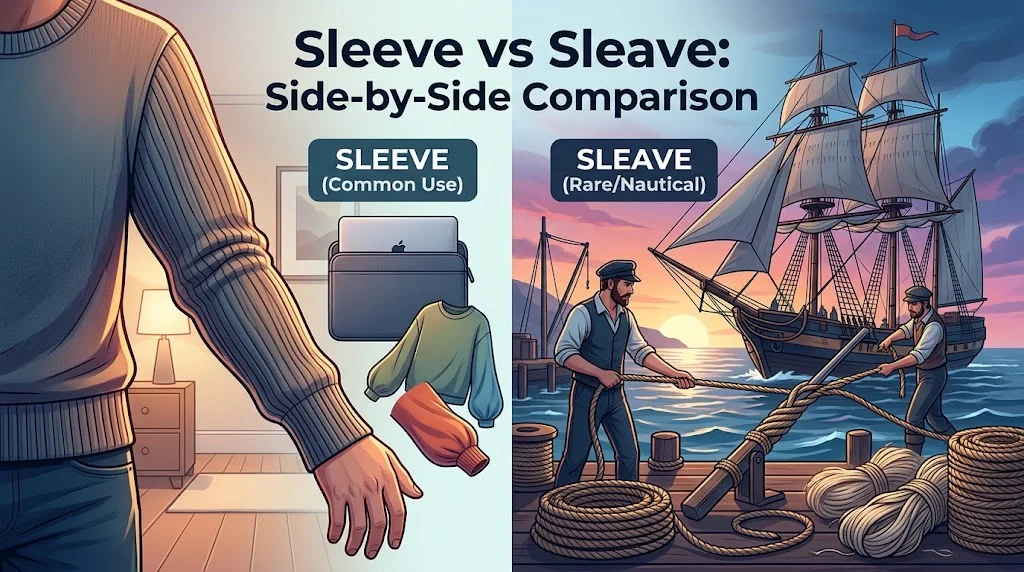
A direct comparison makes the difference easier to remember. Both words are spelled with six letters and begin with the same five-letter sequence, but their meanings and everyday usefulness differ considerably.
| Feature | Sleeve | Sleave |
| Main meaning | A garment part or protective covering | A rare historical textile term |
| Common today? | Yes | No, very uncommon |
| Used in clothing descriptions? | Yes | Not as a normal spelling |
| Used in protective product names? | Yes | Generally no |
| Historical textile usage | May appear in historical sources | Associated with loose or untwisted silk thread |
| Common in conversation? | Yes | Rarely |
| Example | The jacket has long sleeves. | The glossary defines sleave. |
Meaning, Spelling, Usage, and Frequency
The word sleeve is the standard choice in modern English whenever you mean a garment part or protective cover. It’s used in both American and British English, and there is no regional spelling difference that makes sleave a normal alternative.
The word sleave has a narrower role. It is associated with historical terminology, particularly descriptions of silk thread or fibers. Because it is so rare, using it in an ordinary clothing sentence will usually look like a spelling mistake.
For example, if you write “I need a new sleeve for my jacket,” readers will understand that you mean part of the garment. If you write “I need a new sleave for my jacket,” readers will probably assume you’ve misspelled the word.
Context can change that judgment. A textile historian writing about an old silk-making process may have a good reason to use sleave. In that case, the word carries a specific meaning rather than functioning as a variant of sleeve.
Example Sentences Compared
Seeing both words in context helps you recognize when each one is appropriate.
Correct uses of sleeve:
- The left sleeve of my shirt has a small tear.
- He bought a waterproof sleeve for his laptop.
- She rolled up her sleeves and began painting.
- The dress has decorative sleeves made from lace.
- Please place the document inside a protective sleeve.
Specialized uses of sleave:
- The historical glossary identifies sleave as a textile term.
- The researcher explained the use of sleave in an older description of silk.
- The writer preserved the word sleave when quoting the original historical source.
The first group contains ordinary modern examples. The second group illustrates the type of context in which the rare word may be relevant.
Remember that sleave should not be used merely to make a sentence sound more formal or unusual. Its meaning is specific, so it belongs only where that meaning fits.
Which Word Should You Use in Modern Writing?
For nearly all everyday writing, choose sleeve. Use it when describing clothing, fashion, tailoring, product features, protective covers, or common expressions.
For example, write “short-sleeve shirt,” “long-sleeve sweater,” “laptop sleeve,” and “roll up your sleeves.” These are standard expressions that readers will recognize immediately.
Choose sleave only when you have a specific reason to use the historical or specialized textile term. If you’re discussing an old document, an antique textile, or the history of silk production, consult a reliable historical dictionary or specialist source to confirm that the word fits the context.
When editing someone else’s work, don’t automatically replace every instance of sleave. First, determine whether the writer is describing clothing or referring to a historical term. That small check can prevent you from correcting a legitimate word by mistake.
For most readers, the practical takeaway is straightforward: sleeve is the correct spelling for ordinary modern use; sleave is a rare historical term with a distinct meaning.
Sleeve vs Sleave: Examples in Sentences
Examples make it easier to understand when to use sleeve and when the rare word sleave may be appropriate. Although the spellings differ by only one vowel, their meanings are not interchangeable. In modern English, sleeve is the standard choice for clothing and protective coverings, while sleave belongs mainly to historical or specialized textile terminology.
Everyday Clothing Examples
When you’re talking about shirts, jackets, dresses, or coats, use sleeve. The word describes the part of a garment that covers the arm.
Consider these examples:
- The sleeve of my jacket caught on the door handle.
- She prefers shirts with loose sleeves.
- My new sweater has long sleeves and ribbed cuffs.
- The tailor shortened one sleeve to improve the fit.
- He rolled up his sleeves before washing the dishes.
- This dress has short sleeves and a round neckline.
- One sleeve is longer than the other.
- The child wiped his hands on his shirt sleeve.
Each sentence uses the standard spelling sleeve or its plural form sleeves. Replacing either form with sleave would be incorrect in these contexts.
You can also use sleeve when describing a garment’s style or construction. For example, a fashion designer might create a dress with puff sleeves, a blouse with bell sleeves, or a jacket with fitted sleeves.
These details help readers picture the garment more clearly. Correct spelling also makes descriptions easier to understand, especially in product listings, sewing instructions, and fashion articles.
Examples From Shopping and Product Descriptions
The word sleeve is common in online shopping because it describes both clothing features and protective products. Using the correct spelling helps customers find what they need.
Here are some examples:
- This cotton shirt features short sleeves and a relaxed fit.
- The long-sleeve sweater is available in several colors.
- Buy a padded laptop sleeve to protect your device.
- The tablet sleeve has a soft lining and a secure closure.
- This protective document sleeve keeps important papers clean.
- The record sleeve features artwork from the original album.
- The dress has sheer sleeves with embroidered details.
In every example, sleeve is the appropriate spelling.
Imagine that an online clothing store advertises a “long sleave shirt.” A customer may still understand the description, but the error makes the listing look less professional. It could also affect searches for the correctly spelled phrase.
A better listing would say:
Long-Sleeve Cotton Shirt — Lightweight, Comfortable, and Easy to Style
This version uses the standard spelling and describes the product clearly. The same principle applies to product titles, website categories, advertisements, and inventory records.
If you’re writing for an online store, proofread common clothing terms carefully. A small spelling error can make an otherwise useful description appear unreliable.
Examples of Figurative Expressions
The word sleeve also appears in idioms that communicate ideas beyond clothing. These expressions are widely used in everyday English.
Have something up your sleeve
- Our coach has another strategy up his sleeve.
- She always has a practical solution up her sleeve.
Both examples suggest that someone has a hidden idea or plan.
Roll up your sleeves
- We need to roll up our sleeves and finish this assignment.
- The volunteers rolled up their sleeves and cleaned the playground.
Here, the expression means to prepare for hard work.
Wear your heart on your sleeve
- He wears his heart on his sleeve and openly shares his feelings.
- She wore her heart on her sleeve when she thanked her friends.
This idiom describes someone who expresses emotions openly.
These phrases have established meanings, so you should preserve the standard spelling. Writing “have something up your sleave” or “roll up your sleaves” would introduce a spelling mistake.
Learning common expressions is a useful way to remember sleeve. Once you recognize these phrases, you’re less likely to confuse the word with the rare spelling sleave.
Historical or Specialized Examples of Sleave
Unlike sleeve, sleave is not a normal word for a garment part. Its historical meaning is associated with loose or untwisted silk thread, so it may appear in discussions of older textile practices.
The following illustrative sentences show the kind of context in which the word may be used:
- The historical glossary explains the meaning of sleave in textile terminology.
- The researcher examined an old passage that referred to sleave.
- The book preserves the original use of sleave when discussing silk production.
- The editor checked a historical dictionary before interpreting the term sleave.
These examples are designed to illustrate the word’s specialized context. They shouldn’t be taken as evidence that sleave is a common term in modern textile manufacturing.
If you find sleave in a historical document, consider the period, subject, and surrounding sentences before deciding whether it is a typo. A rare word can be legitimate when the writer uses its specific historical meaning.
For ordinary writing, however, the distinction remains clear: use sleeve for clothing and protective coverings.
Why Do People Confuse “Sleeve” and “Sleave”?
The confusion between sleeve and sleave is understandable. Both words begin with the same letters, have the same length, and look similar at a glance. Someone typing quickly may replace one vowel with another without noticing the error.
The difference becomes more important when you consider how frequently the words appear. Most English speakers regularly encounter sleeve, but few encounter sleave. As a result, a person who sees the rare spelling may assume it is an alternative form of the familiar word.
Understanding the reasons for this confusion can help you avoid mistakes when writing, editing, or checking spelling.
Similar Spelling and Letter Patterns
The two words share five of their six letters in the same order. The main difference is the vowel in the middle: sleeve contains “ee,” while sleave contains “ea.”
Because English has many words with similar letter patterns, readers may not immediately notice which spelling is correct. For example, leave, sleeve, and sleave share some visual features, but that similarity doesn’t make their meanings interchangeable.
The correct spelling depends on the word you intend to use, not simply on which letter pattern looks familiar.
Compare these examples:
- Correct: The sleeve needs repairing.
- Incorrect in a clothing context: The sleave needs repairing.
- Correct: Please leave the jacket on the chair.
Reading each sentence carefully helps you identify the intended meaning. If the sentence describes part of a jacket, sleeve is the right choice.
Similar Pronunciation
In many accents, sleeve and sleave may be pronounced similarly if the rare word is encountered, which can make the distinction harder to remember from sound alone.
However, the safest approach is not to rely on pronunciation to determine the spelling. English contains many words whose spellings differ even when their sounds are similar. The intended meaning and standard written form are more reliable guides.
If you’re writing a sentence about clothing, think of the familiar word sleeve and its common forms, such as sleeves, sleeved, and sleeveless. These related words reinforce the correct spelling pattern.
For example:
- She wore a sleeveless dress.
- His shirt has long sleeves.
- The tailor repaired the sleeve.
Recognizing these related forms makes the spelling easier to remember.
Spelling From Memory
People often make spelling mistakes when they rely on memory rather than checking a word. This is especially common with unfamiliar letter patterns, words typed quickly, and terms that aren’t used often.
Someone may remember the general appearance of sleeve but accidentally write sleave. The mistake can remain unnoticed if the sentence still makes sense to the reader.
To reduce these errors, use a simple proofreading method:
- Read the sentence slowly.
- Check whether the word refers to clothing or a protective covering.
- Confirm the standard spelling if you’re unsure.
- Review the entire phrase rather than checking the word in isolation.
For example, if you’ve written “short sleave shirt,” pause and consider what you’re describing. Since the sentence refers to clothing, the correct phrase is “short-sleeve shirt” or “short-sleeved shirt.”
This method is especially helpful when writing website content, product descriptions, school assignments, or professional emails.
The Rarity of “Sleave”
Another reason for confusion is that sleave is rarely used in modern everyday English. People are much more familiar with sleeve, so they may assume that the less familiar form is simply an alternative spelling.
In ordinary clothing contexts, that assumption leads to an error. However, a historical textile reference may use sleave intentionally.
This creates an important distinction for editors and readers. If a sentence describes a shirt, coat, dress, or laptop cover, sleeve is the appropriate word. If a historical source discusses loose silk thread, sleave may have a specific meaning.
The best approach is to consider the context instead of treating every unfamiliar word as a typo.
Common Spelling Mistakes With “Sleeve”
Many mistakes involving sleeve occur in short clothing descriptions. These errors are easy to overlook because the intended meaning is usually clear, but correct spelling still matters.
Short Sleeve vs. Short Sleave
When describing a shirt with sleeves that end above the elbow, use short-sleeve or short-sleeved, depending on the sentence.
Correct examples:
- I bought a short-sleeve shirt for summer.
- He prefers short-sleeved polo shirts.
- The store sells short-sleeve T-shirts in several colors.
Incorrect example:
- I bought a short-sleave shirt for summer.
The incorrect form uses the rare spelling sleave where the clothing word sleeve is required.
Long Sleeve vs. Long Sleave
The same rule applies when describing clothing with longer sleeves.
Correct examples:
- She wore a long-sleeve top to work.
- He bought a long-sleeved shirt for the winter.
- This long-sleeve sweater is soft and comfortable.
Incorrect example:
- She wore a long-sleave top to work.
Remember that long-sleeve and long-sleeved are both used in modern English. Choose the form that fits your sentence, but always spell the key word as sleeve.
Sleeve Shirt and Similar Phrases
Writers sometimes use incomplete or awkward phrases when describing garments. For instance, “sleeve shirt” may be unclear if the writer intends to specify a particular sleeve length.
More natural choices include:
- Short-sleeve shirt
- Long-sleeve shirt
- Short-sleeved shirt
- Long-sleeved shirt
- Shirt with rolled-up sleeves
The best phrase depends on the meaning you want to convey. If you simply want to describe a shirt with sleeves, you can write “a shirt with sleeves.” If you want to specify their length, use short-sleeve or long-sleeve.
Avoid using sleave in these phrases unless you’re discussing the rare historical term in its proper context.
Singular vs. Plural
Another common mistake involves the singular and plural forms of sleeve.
Use sleeve when referring to one:
- The right sleeve is torn.
- A button fell off the sleeve.
Use sleeves when referring to more than one:
- Both sleeves need repairs.
- The jacket has wide sleeves.
The spelling changes by adding “s” to form the plural. It doesn’t change to sleaves or sleave.
Related forms include sleeved and sleeveless. For example, a sleeved dress has sleeves, while a sleeveless dress does not.
How to Decide Between Sleeve and Sleave
If you’re unsure which word to use, start by identifying the meaning of your sentence. In almost every ordinary modern context, sleeve is the correct choice.
Use Sleeve When Talking About Clothing
Choose sleeve for shirts, jackets, coats, dresses, sweaters, and other garments. It is also the right word for common expressions and protective coverings.
Examples:
- The sleeve of his jacket is stained.
- She bought a dress with lace sleeves.
- I need a padded sleeve for my laptop.
- Let’s roll up our sleeves and get started.
These examples all require sleeve or a related form.
Use Sleave Only in Its Specific Historical or Technical Sense
Use sleave only when the context supports its rare meaning, especially in historical discussions of loose or untwisted silk thread.
If you’re unsure whether the word is appropriate, consult a historical dictionary or a reliable specialist reference. Don’t choose it simply because it looks similar to sleeve.
A Simple Memory Trick
Think of the double “e” in sleeve as part of the familiar word you use every day when talking about clothing. Remember common combinations such as long-sleeve shirt, short-sleeved top, and sleeveless dress.
You can also connect the word with familiar expressions:
- Roll up your sleeves.
- Have something up your sleeve.
- Wear your heart on your sleeve.
These phrases reinforce the standard spelling.
Related Words and Useful Forms
Understanding related forms of sleeve makes it easier to write accurately.
Sleeve and Sleeves
Sleeve is singular, while sleeves is plural.
- The sleeve is too tight.
- The sleeves are too long.
Sleeved and Sleeveless
Sleeved describes something that has sleeves, while sleeveless describes something without them.
- She wore a long-sleeved blouse.
- He chose a sleeveless shirt for the warm weather.
Long-Sleeve and Short-Sleeve
These expressions commonly describe garment styles.
- The store sells long-sleeve shirts.
- I prefer short-sleeve tops in summer.
Common Collocations With Sleeve
Common combinations include shirt sleeve, coat sleeve, long sleeve, short sleeve, protective sleeve, laptop sleeve, and document sleeve. Learning these phrases helps you recognize the correct spelling in different contexts.
Sleeve vs Sleave in American English
In American English, sleeve is the standard spelling for the part of clothing that covers the arm and for protective coverings. The same spelling is used in British English, so this is not a case where regional spelling preferences determine the choice.
Examples in American English include:
- He bought a short-sleeve shirt.
- She rolled up her sleeves.
- The laptop fits inside a protective sleeve.
Writing sleave in these contexts would generally be considered a spelling error. The rare historical word remains distinct and should be used only when its specific meaning is relevant.
A Practical Context Test
Before choosing between sleeve and sleave, ask yourself what the word describes.
Is It Part of a Shirt, Jacket, Coat, or Dress?
If yes, use sleeve. For example, “The dress has embroidered sleeves” is correct.
Does It Cover or Surround an Object?
If you’re describing a laptop cover, document holder, or similar protective covering, use sleeve.
Are You Describing Long or Short Clothing?
Use long-sleeve, short-sleeve, long-sleeved, or short-sleeved, depending on the sentence. Don’t substitute sleave.
Are You Discussing Rolling Up Your Arms’ Clothing?
The common expression is “roll up your sleeves.” It means either physically moving the sleeves upward or preparing to work hard.
Are You Discussing an Old Textile Term Involving Loose Silk?
In that specialized context, sleave may be appropriate. Check a reliable historical or textile reference if you’re uncertain.
Conclusion
Understanding the difference between sleeve and sleave can help you avoid a common spelling mistake and write more confidently. Although these words look similar, they have different meanings and uses. Sleeve is the correct, standard spelling when you’re talking about the part of a shirt, jacket, coat, or dress that covers the arm. It also describes protective coverings, such as laptop sleeves and document sleeves, and appears in familiar expressions like “roll up your sleeves.”
Sleave, on the other hand, is a rare historical term associated with loose or untwisted silk thread. It’s not an alternative spelling for sleeve in everyday English.
When you’re writing an email, describing clothing, creating an online product listing, or completing a school assignment, remember to use sleeve for ordinary modern contexts. If you encounter sleave in an older text, check its meaning before correcting it. With this simple distinction, you’ll know which word fits your sentence.
FAQs
Is sleeve or sleave the correct spelling?
Sleeve is the correct spelling when referring to a garment part or protective covering. For example, you would write “long sleeve shirt” or “laptop sleeve.” Sleave is a rare historical word associated with loose or untwisted silk thread. It isn’t a standard alternative spelling for sleeve in modern everyday English.
What does the word sleeve mean?
A sleeve is usually the part of a shirt, jacket, coat, or dress that covers the arm. The word can also describe a protective covering for an object, such as a laptop, document, or vinyl record. It appears in common expressions, including “roll up your sleeves” and “have something up your sleeve.”
What does sleave mean?
Sleave is a rare historical term associated with loose or untwisted silk thread. It may appear in older texts or specialized discussions of traditional textile production. Most people don’t use it in everyday conversation. When describing clothing or protective coverings, use sleeve instead.
Is sleave ever a correct English word?
Yes. Sleave is a genuine but uncommon English word with a specialized historical meaning. It may be appropriate when discussing older textile terminology or interpreting a historical source. However, it isn’t correct as a replacement for sleeve in ordinary descriptions of clothing, fashion, or protective covers.
Should I write short sleeve or short sleave?
Use short sleeve or short-sleeved, depending on how the phrase fits into your sentence. For example, “I bought a short-sleeve shirt” and “I bought a short-sleeved shirt” are both standard. Short sleave is incorrect when describing clothing because sleave doesn’t mean a garment part.
Is long-sleeve shirt correct?
Yes. Long-sleeve shirt is a common and accepted clothing description. You can also write long-sleeved shirt. Both phrases describe a shirt with long sleeves. The important point is to use the correct spelling, sleeve, rather than sleave.
What is the plural of sleeve?
The plural of sleeve is sleeves. For example, you can say, “The sleeves of my jacket are too long.” The spelling changes by adding an “s” to the singular form. Sleaves isn’t the correct plural when you’re referring to clothing sleeves.
Is sleeve spelled differently in American and British English?
No. American and British English both use sleeve for a garment part or protective covering. There is no standard regional spelling difference that makes sleave an acceptable alternative in these contexts. You can confidently use sleeve in everyday writing for either variety of English.
What does “roll up your sleeves” mean?
“Roll up your sleeves” can describe physically pushing your sleeves upward. It also works as an idiom meaning to prepare for hard work. For example, “We need to roll up our sleeves and finish the project” means everyone should make an effort and get the work done.
How can I remember the difference between sleeve and sleave?
Remember that sleeve is the familiar modern word for clothing and protective coverings. Think of common phrases such as “long-sleeve shirt,” “laptop sleeve,” and “roll up your sleeves.” Reserve sleave for its rare historical meaning involving silk thread. Checking the context can help you choose correctly.