
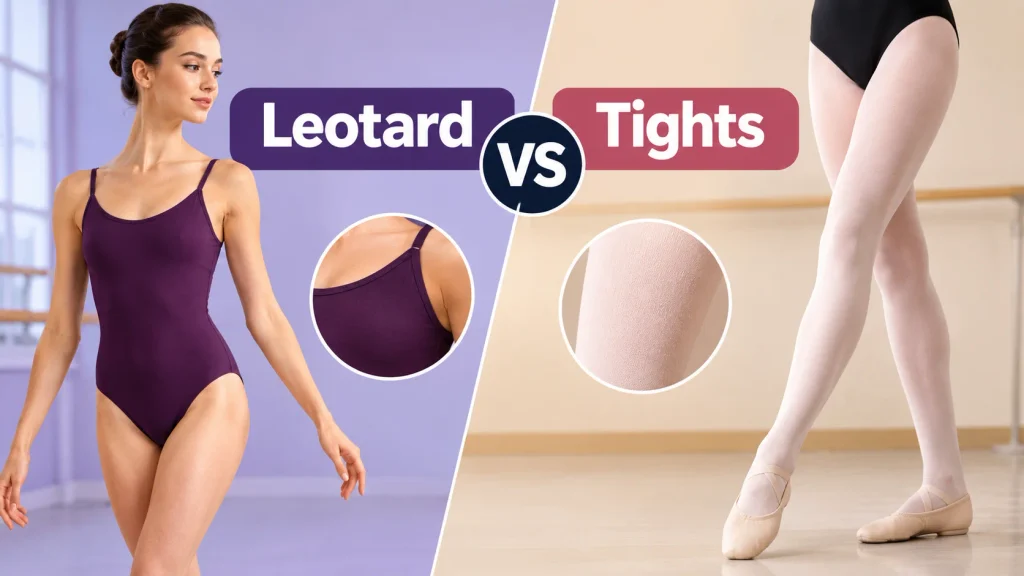
When you compare leotard vs tights, the biggest difference is simple: a leotard covers the torso, while tights primarily cover the legs. They can serve different purposes, but they’re also often worn together.
A leotard is a one-piece garment that fits closely around the body and usually extends from the shoulders or upper torso to the hips or upper thighs. Tights are close-fitting garments that extend from the waist down the legs, with different styles ending at the feet, ankles, or other points.
Both are common in dance, gymnastics, figure skating, and other activities that require freedom of movement. However, they aren’t interchangeable in every situation.
Quick Answer: Leotard vs Tights
A leotard is a fitted one-piece garment that covers the torso and typically leaves the legs exposed. Tights are fitted garments that cover the legs and may extend over the feet, depending on the style.
Here’s the simplest comparison:
| Feature | Leotard | Tights |
| Main coverage | Torso | Legs |
| Garment type | One-piece | Legwear |
| Typical length | Shoulders to hips or upper thighs | Waist to feet or ankles |
| Common uses | Dance, gymnastics, skating | Dance, skating, warmth, layering |
| Can be worn alone? | Often | Usually depends on the outfit |
| Can be worn together? | Yes | Yes |
For example:
The dancer wore a leotard for class.
She wore tights underneath her dance skirt.
The ballet student wore a leotard and tights together.
So, if you’re wondering which one covers the legs, the answer is tights. If you’re asking which one provides a fitted one-piece base for the torso, that’s the leotard.
What Is a Leotard?
A leotard is a close-fitting, one-piece garment designed to cover the torso while allowing the wearer to move freely.
Traditional leotards typically have no separate trouser legs. They fit around the chest, waist, and hips and may have different sleeve and neckline designs.
Leotards are strongly associated with dance and gymnastics, but they’re not limited to those activities. You may also see them in figure skating, acrobatics, stage performance, and other movement-based activities.
The close fit has a practical purpose. Loose fabric can get in the way during activities that involve stretching, jumping, turning, or rapid changes in position. A fitted garment also makes the body’s movement easier to observe.
For example:
The dancer wore a black leotard to ballet class.
The gymnast changed into her competition leotard.
She chose a long-sleeve leotard for the colder studio.
The defining feature is the garment’s one-piece construction and torso coverage.
What Parts of the Body Does a Leotard Cover?
A leotard generally covers the torso, including the chest, abdomen, back, and hips. The exact coverage depends on the design.
Some styles have narrow shoulder straps. Others have short or long sleeves. Necklines can also vary from relatively high to more open designs.
The lower part of the garment usually extends between the legs and around the hips, but it doesn’t continue down the legs like tights do.
That’s one of the easiest ways to distinguish the two.
Think of the basic structure this way:
Leotard = torso coverage
Tights = leg coverage
The two garments can then be combined when a dancer or athlete needs coverage over both areas.
What Are Leotards Used For?
Leotards are designed for activities where movement, comfort, and a secure fit matter.
They are commonly used for:
- ballet
- contemporary dance
- modern dance
- gymnastics
- figure skating
- acrobatics
- stage performances
- dance rehearsals
- movement classes
Different activities may call for different leotard designs.
A ballet school, for example, might have a specific dress code regarding color, sleeve length, or neckline. A gymnast’s leotard may have a more performance-oriented design with decorative details. A dancer performing on stage may wear a costume-style leotard designed to complement the choreography.
The garment itself remains recognizable because of its close-fitting, one-piece construction.
Why Do Dancers and Gymnasts Wear Leotards?
Leotards allow dancers and gymnasts to move without dealing with loose clothing around the torso and hips.
That matters when an activity involves:
- stretching
- jumping
- turning
- bending
- lifting the legs
- rolling
- balancing
- rapid changes in direction
A fitted garment can also make body alignment easier to observe. In dance classes, teachers often need to see the position of the student’s shoulders, back, hips, and legs.
For gymnastics, secure clothing is especially important because athletes perform movements involving rotation, inversion, and contact with equipment.
A leotard can therefore function as practical athletic clothing rather than simply a costume.
Common Leotard Styles
Leotards come in many designs, but the basic one-piece construction remains the same.
Sleeveless Leotards
Sleeveless leotards leave the arms uncovered and are common in dance and gymnastics.
They can provide a broad range of movement around the shoulders and arms, which is useful for activities involving arm positions and upper-body movement.
For example:
The studio requires students to wear a sleeveless leotard for class.
Short-Sleeve Leotards
Short-sleeve designs provide more upper-arm coverage while retaining a fitted shape.
They may be useful when a dancer wants slightly more coverage or when a studio’s dress code calls for sleeves.
Long-Sleeve Leotards
Long-sleeve leotards cover the arms down toward the wrists.
They’re often useful in cooler environments or when a performance calls for greater coverage. They can also serve as a practical base layer during rehearsals.
Tank Leotards
A tank leotard typically has wider shoulder straps and a sleeveless design.
This style is common in dance because it provides a simple, unrestricted design while keeping the torso securely covered.
Different Necklines and Back Designs
Leotards can also vary significantly around the neckline and back.
Some have higher necklines for greater coverage. Others feature scoop necks, open backs, mesh panels, or decorative details.
These differences can affect appearance, ventilation, and the overall feel of the garment, but they don’t change the basic definition of a leotard.
What Are Tights?
Tights are close-fitting garments designed primarily to cover the legs. Depending on the style, they may cover the feet completely, leave the feet exposed, or provide an opening that allows the wearer to switch between covered and uncovered feet.
Tights are commonly worn for dance, figure skating, theater, everyday clothing, and warmth.
Dance tights are often made from stretchy materials that allow the legs to move freely. They may be worn with a leotard, skirt, dress, shorts, or another garment.
For example:
The ballet dancer wore pink tights with her leotard.
She changed into black tights for the performance.
The skater wore tights underneath her costume.
Unlike a leotard, tights don’t normally provide torso coverage.
What Parts of the Body Do Tights Cover?
Tights generally cover the legs from the waist or hips downward.
The exact coverage depends on the style.
Footed tights cover the legs and feet.
Footless tights stop around the ankles.
Convertible tights have an opening that allows the wearer to cover or expose the feet.
Stirrup tights leave part of the foot exposed while using a strap under the foot to help keep the garment in place.
This variety makes tights adaptable to different activities and preferences.
The central idea remains the same: tights are primarily legwear.
What Are Tights Used For?
Tights have many uses beyond dance.
They can provide:
- leg coverage
- warmth
- modesty
- a smooth base under costumes
- protection from friction
- support during movement
- a consistent appearance during performances
In ballet, tights can help create a clean visual line from the dancer’s legs to the feet. In figure skating, they can be incorporated into a costume or worn for practice. In everyday clothing, tights may be paired with dresses or skirts.
The appropriate type depends on the activity.
A dancer may need specialized tights designed for repeated movement and stretching. Someone wearing tights casually may care more about opacity, softness, appearance, and comfort.
Common Types of Tights
Different tights serve different purposes, so “tights” doesn’t describe only one specific garment.
Footed Tights
Footed tights cover the entire foot.
They’re common in ballet and other dance settings where a continuous line from the leg to the foot is useful.
Footless Tights
Footless tights cover the legs but leave the feet exposed.
This can be useful when dancers need direct contact between their feet and the floor.
Convertible Tights
Convertible tights are designed with an opening, usually around the underside of the foot, that allows the wearer to switch between a footed and footless configuration.
This makes them particularly practical for dancers who need flexibility during rehearsals or changing conditions.
Stirrup Tights
Stirrup tights cover most of the foot but leave the heel and much of the foot exposed. A strap passes beneath the foot to help keep the garment positioned.
They can provide some of the visual coverage of tights while allowing easier access to the foot.
What Are Tights Made Of?
Tights are usually made from stretchy fabrics or blends designed to move with the body.
Common materials include:
- nylon
- elastane or spandex
- polyester
- microfiber
- cotton blends
The exact fabric affects stretch, softness, opacity, breathability, durability, and recovery.
For example, a dance tight needs enough stretch to accommodate large movements without becoming uncomfortable. It also needs to recover its shape after repeated stretching.
Leotards use many of the same fibers, especially when they’re intended for dance or gymnastics. However, the construction and coverage of the garment are still different.
Stretch and Recovery
Stretch is important for both leotards and tights.
A good stretch fabric allows the wearer to bend, extend, squat, jump, and move without feeling restricted.
Recovery refers to the fabric’s ability to return toward its original shape after being stretched.
This matters because dancewear can experience repeated movement during every class or rehearsal.
A garment that stretches easily but doesn’t recover well may eventually become loose or lose its original fit.
Breathability and Moisture Management
Physical activity can generate heat and sweat, so fabric choice also matters.
Breathable materials can help manage moisture and make dancewear more comfortable during extended practice.
The ideal fabric depends on the activity, studio conditions, personal preference, and garment design. A heavy or poorly ventilated material may feel uncomfortable during intense movement, while a lightweight stretch fabric may be more suitable for active use.
Durability and Wear
Dancewear often experiences repeated stretching, washing, friction, and movement.
Durability therefore matters when choosing both leotards and tights.
Tights can be particularly vulnerable to snags, runs, thinning, and wear around high-friction areas. Leotards may experience fading, fabric thinning, stretched straps, or loss of elasticity over time.
Proper washing and care can help extend the useful life of either garment.
Leotard vs Tights: The Main Difference
The easiest way to understand leotard vs tights is to focus on where each garment provides coverage.
A leotard covers the torso.
Tights cover the legs.
They are therefore not simply two names for the same type of clothing.
A leotard is a one-piece garment that forms a secure base around the upper and central part of the body. Tights are legwear that extends downward from the waist or hips.
Their purposes can overlap because both are useful for dance and other movement-based activities. However, they perform different clothing functions.
Coverage Is the Biggest Difference
Coverage is the clearest distinction.
A basic leotard leaves most of the legs uncovered. Tights extend down the legs and may cover the feet.
When worn together, they provide much more complete coverage:
Leotard + tights = torso and leg coverage
This combination is especially familiar in ballet and other dance settings.
Construction Is Different
A leotard is constructed as a single garment with a torso section and a bottom section that passes between the legs.
Tights are constructed as legwear with two fitted legs connected at the waist or upper hip area.
This difference in construction affects how each garment fits and how it is layered.
Their Purposes Overlap, but Aren’t Identical
Both garments are designed to support movement, but they don’t solve exactly the same problem.
A leotard provides a secure upper-body base and keeps the torso covered during movement.
Tights provide leg coverage, warmth, and a smooth layer that can work with other dancewear.
That’s why dancers often wear both rather than choosing one instead of the other.
The right choice depends on the activity, dress code, weather, desired coverage, and personal comfort.
Leotard vs Tights: A Simple Comparison
| Question | Leotard | Tights |
| Does it cover the torso? | Yes | Usually no |
| Does it cover the legs? | Usually not | Yes |
| Is it one piece? | Yes | Yes, as legwear |
| Can it be worn with the other? | Yes | Yes |
| Common in ballet? | Yes | Yes |
| Common in gymnastics? | Yes | Less central |
| Main purpose | Torso coverage and secure movement | Leg coverage and layering |
| Can it provide warmth to the legs? | No | Yes |
| Can it be worn as a base layer? | Yes | Yes |
The easiest distinction is still the most useful one:
Leotards cover the torso. Tights cover the legs.
Once you understand that difference, the rest of the comparison becomes much easier.
Leotard vs Tights for Ballet
Ballet is one of the clearest examples of how leotards and tights work together. A typical ballet outfit may include a leotard, tights, ballet shoes, and sometimes a skirt or other approved layer. The exact dress code depends on the studio, teacher, age group, and class level.
A leotard gives the dancer a close-fitting base layer. It covers the torso without adding loose fabric that could interfere with movement. Tights cover the legs and create a smooth, continuous look from the hips toward the ankles or feet.
Why Ballet Dancers Wear Leotards
Ballet teachers need to see the dancer’s body alignment. A close-fitting leotard makes it easier to observe the position of the shoulders, back, hips, and waist.
This matters during exercises such as pliés, tendus, développés, and port de bras. Loose shirts can hide posture and alignment, while a properly fitted leotard gives the teacher a clearer view.
Leotards also stay close to the body during movement. They don’t need constant adjustment in the same way a loose top might.
Why Ballet Dancers Wear Tights
Ballet tights provide leg coverage while maintaining a close fit. They allow teachers and dancers to see leg lines, foot positions, and movement clearly.
Depending on the class and studio, dancers may wear footed tights, footless tights, or convertible tights.
Footed tights extend over the feet and are commonly paired with ballet slippers. Footless tights stop around the ankles, leaving the feet exposed. Convertible tights have an opening that allows the dancer to move between a footed and footless setup.
Tights can also provide warmth during class, especially when the studio is cool. They may offer a little more coverage without adding bulky layers.
Wearing a Leotard and Tights Together
A leotard and tights often make a practical combination for ballet. The leotard covers the torso, while the tights cover the legs.
This combination also creates a streamlined silhouette. That can be useful when a teacher needs to observe movement and alignment.
Some dancers may add a ballet skirt, warm-up shorts, leg warmers, or another approved layer. However, studios often have specific dress codes, so the required combination can vary.
Footed vs. Footless Ballet Tights
The choice between footed and footless tights depends on the dancer’s needs and the class requirements.
Footed tights cover the entire foot and work naturally with ballet slippers. They also create a continuous appearance from the leg to the foot.
Footless tights leave the feet uncovered. This can be useful when dancers need direct contact with the floor or want to change footwear easily.
Convertible tights offer both options. A small opening near the sole allows the dancer to expose the foot without removing the tights.
Choosing for Ballet Class or Performance
For a regular ballet class, comfort, fit, movement, and studio requirements usually matter more than fashion.
A performance may have a completely different costume requirement. Dancers might wear a particular leotard, tights color, or costume design chosen by the choreographer or production team.
The important point is that leotards and tights aren’t competing garments in ballet. They usually serve different functions and can complement each other.
Leotard vs Tights for Contemporary and Modern Dance
Contemporary and modern dance often allow more variation in clothing than traditional ballet classes. However, the best choice still depends on the technique being taught, the teacher’s preferences, and the type of movement.
A dancer may wear a leotard alone, tights with a fitted top, both together, or another close-fitting dance outfit.
Leotards in Contemporary Dance
A leotard can be useful when dancers need freedom around the arms, torso, and hips. Because the garment stays close to the body, it doesn’t create loose fabric during floorwork or large movements.
A fitted leotard can also help instructors observe alignment. This is especially useful when dancers are working on posture, weight shifts, turns, or technical exercises.
However, contemporary dance often involves floorwork, rolling, sliding, and contact with the floor. Some dancers may prefer additional layers for comfort or warmth.
Tights in Contemporary and Modern Dance
Tights provide leg coverage while preserving a close fit. They can be useful during technique classes where teachers need to see leg alignment and movement.
Footless tights may be especially practical for dancers who want their feet uncovered during floorwork.
Some dancers also layer tights underneath a leotard or fitted dance top. Others choose different combinations depending on the temperature, studio surface, and movement vocabulary.
Layering for Movement and Visibility
Layering can change how comfortable a dancer feels during class.
For example, a dancer might start with a leotard and tights, then add warm-up pants before class. Once the body is warm, the extra layer can be removed.
The key is to avoid clothing that restricts movement or becomes distracting. Dancewear should generally stay secure while allowing the dancer to bend, stretch, jump, roll, and turn.
Contemporary dance doesn’t have one universal outfit. The activity and studio expectations should guide the choice.
Leotard vs Tights for Gymnastics
Gymnastics places different demands on clothing because athletes perform rapid movements, rotations, jumps, balances, and inversions.
A leotard is especially common in gymnastics because it provides torso coverage while staying securely in place during movement.
Tights are less central to traditional gymnastics competition attire, although they can be used in training, warm-ups, or particular settings.
Why Are Leotards Common in Gymnastics?
Gymnastics requires a wide range of motion. Athletes may move from standing to handstands, rolls, flips, and other positions within seconds.
A properly fitted leotard stays close to the body. It reduces the amount of loose material that could shift during these movements.
A leotard also allows coaches to observe body position. This can help when working on technique, posture, and alignment.
Competition rules may also specify the type of attire athletes can wear. Therefore, a gymnast shouldn’t assume that any dance leotard or everyday clothing is acceptable for competition.
Tights in Gymnastics
Tights can be useful in gymnastics, particularly during training or warm-ups. They can provide extra leg coverage and warmth without creating the loose shape of ordinary pants.
However, whether tights are appropriate depends on the gym, activity, coach, and competition rules.
For example, a gymnast might wear tights during a warm-up before changing into required competition attire. Another athlete may prefer fitted training clothing that leaves the legs uncovered.
Training vs. Competition
Training clothing is often more flexible because the goal is comfort, safety, and effective movement.
Competition clothing may have specific requirements. Teams and governing organizations can establish rules concerning garment design, coverage, logos, and other details.
That means the answer to “Should I wear tights with a leotard for gymnastics?” isn’t always the same.
For everyday training, the choice may come down to temperature and comfort. For competition, the applicable rules should take priority.
Movement, Security, and Coverage
Gymnastics clothing needs to stay secure. A garment that shifts, rides up, or requires repeated adjustment can become distracting.
A well-fitting leotard provides close torso coverage while leaving the legs relatively unrestricted. Tights add leg coverage when appropriate but aren’t a substitute for the secure construction of a gymnastics leotard.
Leotard vs Tights for Figure Skating
Figure skating introduces another interesting difference between leotards and tights. Skaters need clothing that supports movement while also working with costumes, boots, and performance requirements.
A skater may wear a skating dress, fitted training top, leggings, or tights depending on the situation.
Leotards and Skating Costumes
A traditional leotard isn’t necessarily the standard outer garment for figure skating. Skating costumes often have their own designs and may combine a fitted bodice with a skirt or other decorative elements.
Still, the basic principle behind a leotard can be useful: close-fitting clothing allows freedom of movement without unnecessary loose fabric.
Skaters perform spins, jumps, edges, bends, and extended movements. Clothing needs to move with the body rather than fight against it.
When Are Tights Worn in Figure Skating?
Tights are common in figure skating, particularly as part of performance outfits or training layers.
They can cover the legs while maintaining a smooth, fitted appearance. Some skating tights are designed to work with skates and boots, making them different from ordinary everyday tights.
The exact style depends on whether the skater is training, competing, performing, or simply skating recreationally.
Footed, Footless, and Over-the-Boot Tights
Figure-skating tights come in several designs.
Footed tights cover the feet and can be worn inside skating boots.
Footless tights stop around the ankles, leaving the feet uncovered.
Over-the-boot tights extend over the skating boot. They can create a smooth visual line while helping cover the boot and lower leg.
The right option depends on the skater’s outfit, activity, and personal preference.
Performance vs. Practice
Performance clothing often has a visual purpose in addition to a practical one. Color, silhouette, decoration, and coverage may all contribute to the overall costume.
Practice clothing tends to focus more on comfort, warmth, movement, and durability.
This difference explains why a skater might wear a simple fitted outfit during practice but a more elaborate costume with tights during a performance.
Leotard vs Tights: Design and Freedom of Movement
Although both garments are fitted, they solve different clothing problems.
A leotard primarily covers the torso, while tights primarily cover the legs. That difference affects how each garment supports movement.
Leotard Design and Movement
A leotard is designed as a one-piece garment. It usually extends from the shoulders or upper torso down through the hips and leg openings.
Its close fit helps keep the garment in place when the wearer bends, stretches, jumps, or turns.
Different designs can change the feel of a leotard. Sleeveless styles provide more exposed arm area. Short-sleeve and long-sleeve versions provide additional coverage. Necklines and back designs can also affect comfort and ventilation.
A properly fitted leotard should move with the body rather than pull sharply across the shoulders, torso, or leg openings.
Tights Design and Movement
Tights are designed primarily around leg coverage and stretch.
Their fabric needs enough elasticity to accommodate movements such as bending the knees, extending the legs, squatting, jumping, and pointing the feet.
Different tights provide different levels of coverage and support. Footed tights cover the feet, while footless tights leave them exposed. Convertible tights offer more flexibility between the two options.
The waistband also matters. A waistband that digs into the skin can become uncomfortable during long rehearsals or classes.
Which Is More Flexible?
It’s difficult to say that one garment is simply “more flexible” than the other because they cover different parts of the body.
A leotard needs to accommodate movement through the torso, hips, shoulders, and arms. Tights need to stretch with the legs and hips.
In many activities, the garments are most useful together because each covers a different part of the body.
For example, a ballet dancer may need a fitted leotard for torso coverage and tights for leg coverage. A gymnast may rely primarily on a leotard because unrestricted leg movement and secure torso coverage are especially important.
Coverage vs. Freedom of Movement
More coverage doesn’t automatically mean less freedom of movement.
Modern dancewear can provide substantial coverage while remaining highly stretchy. The real issue is the garment’s fit, fabric, construction, and design.
A poorly fitted leotard can restrict movement even if the design itself is appropriate. Likewise, tights that are too small may pull at the waist or restrict comfortable movement.
That’s why choosing between a leotard and tights isn’t simply a question of which garment is “better.”
Instead, consider where you need coverage, how you need to move, and what the activity requires.
Layering and Movement
Wearing both garments can create a practical layered system.
A leotard can provide a secure base for the upper body, while tights cover the legs. Additional layers can be added for warmth before or after activity.
However, too many layers can become uncomfortable. Bulky clothing may interfere with movement, trap heat, or require frequent adjustment.
For dance, gymnastics, and skating, a simple principle works well: choose fitted layers that stay secure and allow your full range of motion.
The best combination depends on the activity, temperature, dress code, and your own comfort.
How Should a Leotard Fit?
A leotard should feel secure without feeling restrictive. Because it covers the torso and hips as one piece, the fit needs to work across several areas at once.
A properly fitted leotard should stay in place when you bend, stretch, jump, turn, or raise your arms. You shouldn’t need to pull it down or adjust it repeatedly during movement.
Check the Torso Length
Torso length is one of the most important parts of leotard fit.
If the torso is too short, the garment may pull upward at the shoulders or create uncomfortable pressure around the leg openings. You may notice constant tension when you move.
If the torso is too long, the fabric may bunch around the waist or seat.
The right size should allow the leotard to lie smoothly against your body without excessive pulling or loose fabric.
Check the Shoulders and Armholes
The shoulder area should feel secure but comfortable.
If the straps dig into your shoulders, the leotard may be too small or the design may not suit your body shape. If the straps fall away from your shoulders, the garment may be too large or poorly fitted.
Armholes should also allow free movement. You should be able to raise your arms without feeling excessive pulling around the chest or shoulders.
Check the Leg Openings
The leg openings should stay in position without digging painfully into the skin.
A little compression is normal with many dance and gymnastics garments. However, deep marks, discomfort, or restricted movement can signal a poor fit.
The garment should also provide enough coverage for the activity. A leotard that shifts excessively during movement isn’t a practical choice, even if it looks correct while standing still.
Check the Seat and Waist
The fabric should sit smoothly around the waist and seat.
You shouldn’t see excessive bunching, sagging, or pulling. When you move through a deep bend or stretch, the leotard should continue to feel secure.
Remember that different brands use different patterns and fabric combinations. Your usual clothing size doesn’t always guarantee the best leotard size.
How Should Tights Fit?
Tights should fit closely enough to stay in place while still allowing comfortable movement.
The right fit depends partly on the type of tights. Ballet tights, gymnastics tights, skating tights, and everyday fashion tights may have different construction and sizing.
Check the Waistband
The waistband should remain secure without creating painful pressure.
If the waistband constantly rolls down, the tights may be too loose, too short in the rise, or unsuitable for the activity.
If it digs deeply into the skin or feels restrictive, the tights may be too small.
A good waistband should stay in place during movement without becoming the main thing you notice while wearing the garment.
Check the Length
The length should match the style.
Footed tights should reach the feet without excessive fabric bunching. Footless tights should sit comfortably around the ankle. Convertible tights should allow the opening to sit correctly when the foot is exposed.
Excess fabric around the ankles can become uncomfortable, especially when paired with close-fitting dance shoes.
Watch for Sagging and Wrinkles
Tights should generally lie smoothly against the legs.
Sagging around the knees, ankles, or seat can indicate that the size or style isn’t right. Excessive wrinkles may also become irritating during repeated movement.
However, not every wrinkle means the tights are too large. Stretch fabrics naturally form some folds when the body changes position.
The important question is whether the tights remain comfortable and secure throughout the activity.
Consider Stretch and Compression
Tights need enough stretch to follow the body’s movement.
If the fabric feels extremely tight when you bend or extend your legs, the garment may be too small or may not provide enough elasticity for your activity.
Some specialized tights are designed with compression or stronger support. Those should be evaluated based on their intended purpose rather than compared directly with lightweight everyday tights.
Can You Wear Tights With a Leotard?
Yes. Wearing tights with a leotard is common, especially in ballet and other dance settings.
The two garments complement each other because they cover different areas.
The leotard provides torso coverage, while the tights provide leg coverage. Together, they create a fitted outfit that allows the dancer to move without loose clothing getting in the way.
Why Dancers Wear Both
A dancer may wear both for several reasons:
- Coverage: Tights cover the legs while the leotard covers the torso.
- Warmth: Additional leg coverage can help during cooler classes.
- Movement: Both garments stay relatively close to the body.
- Visibility: Teachers can still observe body alignment and leg movement.
- Dress codes: Some studios require or strongly prefer the combination.
The exact requirements vary. A beginner class may have fewer clothing restrictions than a performance group or advanced program.
Choosing the Right Tights
If you’re pairing tights with a leotard, consider the activity first.
Ballet may call for footed, footless, or convertible tights. Contemporary dance may favor footless styles when dancers spend more time barefoot. Figure skating has its own tights designed around skates and boots.
Color can matter, too. A studio or performance may require a particular shade.
Most importantly, the tights should stay secure and allow you to move naturally.
When You Might Not Need Both
Not every activity requires a leotard and tights together.
A warm dance class may allow a leotard without tights. A gymnastics practice may use a leotard as the primary garment. A dancer doing contemporary floorwork may prefer a different combination that leaves the feet exposed.
Dress codes, temperature, movement style, and personal comfort all influence the choice.
Can You Wear a Leotard Without Tights?
Yes. A leotard can be worn without tights when the activity, dress code, and environment make that practical.
For example, some dancers may wear a leotard with bare legs during warm classes or rehearsals. Gymnasts commonly wear leotards without tights, depending on training requirements and team rules.
A leotard without tights provides less leg coverage. That can be useful when you want maximum contact between your legs and the air, floor, or other surfaces.
However, bare legs may not be comfortable in a cold studio. Some activities may also have dress codes that expect tights or another form of leg coverage.
The important distinction is that a leotard doesn’t require tights to function as a leotard. Tights are a separate garment that can be added when you need their coverage or benefits.
Can You Wear Tights Without a Leotard?
Yes. Tights can be worn without a leotard, depending on what you’re wearing with them.
For example, tights may be paired with a dance top, skirt, dress, tunic, or another fitted garment. They can also be worn as part of certain training outfits.
However, tights don’t provide the same torso coverage as a leotard.
This distinction matters in dance and gymnastics. If an activity requires a secure one-piece garment, wearing tights with an ordinary top may not meet the dress code.
Tights as a Standalone Layer
Tights can serve as a standalone lower-body layer in many outfits.
A dancer might wear tights with a fitted tank top. A skater may wear tights with a skating dress. Someone wearing a casual dress might use tights for additional leg coverage.
The garment remains useful because its main function is leg coverage and flexibility.
Why Tights Don’t Replace a Leotard
A leotard connects the upper and lower portions of the outfit. Tights don’t.
That’s why the two aren’t interchangeable, even when they are made from similar stretchy materials.
If you need a fitted garment covering the torso and hips, tights alone won’t provide that coverage.
Leotard vs Tights: Pros and Cons
Both garments have practical advantages, but their benefits are different.
| Garment | Main advantages | Possible drawbacks |
| Leotard | Secure fit, torso coverage, freedom around the legs, useful for observing alignment | Can feel restrictive if poorly sized, limited leg coverage |
| Tights | Leg coverage, warmth, stretch, smooth fit, multiple styles | Can sag, roll, or feel restrictive if poorly fitted |
| Leotard + tights | Full fitted coverage, warmth, coordinated dancewear | May feel too warm in some settings, requires two garments |
Advantages of a Leotard
A leotard keeps the upper body covered while leaving the legs relatively unrestricted.
It’s particularly useful when an activity requires frequent bending, jumping, stretching, or inversion.
The one-piece design also reduces the chance of a shirt riding up during movement.
Advantages of Tights
Tights provide flexible leg coverage without the bulk of many loose pants.
They can also add warmth during dance classes, rehearsals, skating sessions, or other activities.
Different designs make them adaptable. You can choose footed, footless, convertible, or specialized styles depending on what you need.
Advantages of Wearing Both
The biggest advantage is complementary coverage.
The leotard covers the torso. The tights cover the legs. Together, they create a fitted base layer that works well for many dance environments.
Still, wearing both isn’t automatically necessary. The right combination depends on the activity and dress code.
Common Misconceptions About Leotards and Tights
Because both garments are often worn by dancers, people sometimes use the terms as though they mean the same thing.
They don’t.
Are Leotards and Tights the Same Thing?
No.
A leotard is primarily a one-piece garment covering the torso and hips. Tights are close-fitting legwear.
They can be worn together, but they perform different functions.
Do Leotards Cover Your Legs?
Usually, a standard leotard leaves most of the legs exposed.
The leg openings generally sit around the upper thighs or hips. Some specialized one-piece garments may provide additional coverage, but a traditional dance or gymnastics leotard isn’t designed like full-length tights.
If you need full leg coverage, tights or another lower-body garment may be added.
Are Tights the Same as Leggings?
Not necessarily.
Tights and leggings can look similar, but they often differ in fabric weight, opacity, construction, and intended use.
Traditional tights are frequently thinner and more closely associated with dance, performance, hosiery, or layering. Leggings are generally more substantial and may function as standalone pants.
The distinction isn’t absolute, though. Modern clothing designs can blur the line.
Are Tights Pants?
In everyday clothing, tights and pants are generally treated as different categories.
Tights are usually designed as close-fitting hosiery or legwear. Many styles are thinner and more form-fitting than pants.
Leggings can be worn as pants or as a separate clothing layer, depending on their design and the setting.
Whether a particular pair of tights can be worn as outerwear depends on its opacity, construction, intended use, and local dress expectations.
Are Leotards Only for Dancers?
No.
Leotards are strongly associated with dance, but they’re also widely used in gymnastics and can appear in other movement-based activities and performance settings.
The design may change according to the activity.
A gymnastics leotard, for example, may be designed differently from a ballet leotard because the athlete performs different movements and may follow different competition requirements.
Are All Tights the Same?
No.
Tights vary in construction, thickness, opacity, foot coverage, stretch, waistband design, and intended activity.
Ballet tights aren’t necessarily identical to fashion tights. Figure-skating tights may have features that make them suitable for skates and boots. Convertible tights serve a different purpose from standard footless tights.
Choosing the right type matters as much as choosing the right size.
Can Tights Replace Dancewear?
Tights can be part of a dance outfit, but they don’t replace every type of dancewear.
If a class requires a leotard, tights alone won’t provide the required torso coverage.
Likewise, a dancer who needs a specific costume or uniform should follow the applicable requirements rather than assuming any fitted clothing will work.
Does Every Class Require Both?
No.
Some classes may require a leotard and tights. Others may allow a leotard without tights, tights with a fitted top, or another approved outfit.
The answer depends on the studio, teacher, activity, age group, and dress code.
When you’re unsure, checking the class requirements before buying clothing can save money and prevent uncomfortable surprises.
Leotard vs Tights: Fit Matters More Than Appearance
A garment can look good while standing still and still be unsuitable for movement.
Dancewear and performance clothing need to work while the body is active.
A leotard that pulls at the shoulders or tights that slide down during movement can quickly become distracting. In contrast, well-fitted garments tend to stay where they should.
That’s why fit should be evaluated through movement rather than appearance alone.
Try bending, stretching, raising your arms, walking, and sitting if you’re checking a new garment. The goal is to make sure the clothing supports the activity instead of becoming something you have to manage constantly.
For leotards and tights alike, secure fit, comfortable stretch, appropriate coverage, and activity requirements should guide your decision.
Leotard vs Tights: What’s the Difference?
Choosing between a leotard and tights becomes easier when you focus on what each garment is designed to do. A leotard mainly covers the torso, while tights mainly cover the legs.
You don’t always have to choose one or the other. In many activities, wearing both makes sense.
The best option depends on the activity, required coverage, fit, comfort, temperature, fabric, and dress code.
Choosing Between a Leotard and Tights
Before buying dancewear, think about what you actually need from the garment.
Do you need torso coverage? Leg coverage? Both? Do you need to move freely during jumps, turns, stretches, or floorwork?
These questions quickly narrow down your choices.
Choose a Leotard When You Need:
A leotard is usually a practical choice when you need:
- Secure torso coverage
- A close-fitting one-piece garment
- Freedom around the legs
- Clothing that stays in place during movement
- A clear view of body alignment
- A suitable base for dance or gymnastics
- Minimal loose fabric
A leotard can work especially well for ballet, gymnastics, and other movement-based activities where a secure upper-body garment matters.
Choose Tights When You Need:
Tights may be the better fit when you primarily need:
- Leg coverage
- Additional warmth
- A close-fitting lower layer
- Flexible fabric for stretching and movement
- Foot coverage
- A layer under a costume, skirt, or dress
- A choice between footed, footless, or convertible designs
Tights can be useful in ballet, contemporary dance, figure skating, and other activities where fitted legwear is appropriate.
Choose Both When You Need:
Sometimes the simplest answer is to wear both.
A leotard and tights provide complementary coverage. The leotard covers the torso, while tights cover the legs.
This combination is especially common in ballet and other dance settings.
Wearing both can also provide more warmth than wearing a leotard alone. However, it may be unnecessary in warm environments or activities where bare legs are preferred.
Always consider the specific dress code before deciding.
Leotard vs Tights: Activity Guide
Different activities create different clothing needs.
| Activity | Leotard | Tights | Often Worn Together? |
| Ballet | Common | Common | Yes |
| Contemporary dance | Common | Common | Sometimes |
| Modern dance | Common | Common | Sometimes |
| Gymnastics | Very common | Sometimes | Depends on setting |
| Figure skating | Specialized fitted garments/costumes | Common | Depends on outfit |
| Dance rehearsal | Common | Common | Often |
| Casual dance practice | Optional | Optional | Depends on preference |
This table is a general guide rather than a universal dress code. Studios, teams, competitions, and instructors may have different requirements.
What to Look for When Buying a Leotard
Buying a leotard isn’t just about choosing a color or design.
Because the garment covers the torso and connects to the leg openings, fit and construction are especially important.
Consider the Activity
Start with the activity.
A ballet leotard may emphasize clean lines and comfortable movement. A gymnastics leotard may need to remain secure during inversions, tumbling, and other high-movement skills.
A recreational leotard may have more relaxed requirements than a competition garment.
If you’re buying for a class, check the dress code first.
Check the Torso Fit
The torso should feel secure without excessive pulling.
Raise your arms. Bend forward. Stretch. Move through a few positions that resemble the activity.
Watch for uncomfortable tension across the shoulders, chest, waist, or leg openings.
A leotard that feels comfortable only while standing still may not be the right size or cut.
Examine the Fabric
Common leotard fabrics include nylon, polyester, elastane, and other stretch blends.
Look for fabric that has enough stretch for the activity while recovering its shape after movement.
For demanding activities, durability also matters. Frequent washing, stretching, and repeated use can place considerable stress on dancewear.
Check the Coverage
Think about how much coverage you actually need.
Some leotards are sleeveless. Others have short or long sleeves. Necklines and back designs also vary.
A studio may require a specific style, color, or level of coverage.
If there is no strict dress code, choose a design that provides the coverage and comfort you prefer without interfering with movement.
Consider the Neckline and Back
The neckline and back can affect both comfort and appearance.
A high neckline provides more coverage. A lower or open-back design may offer greater ventilation.
The best choice depends on the activity and your comfort.
Make sure straps and openings stay secure when you move.
Check the Gusset and Lining
Some leotards include a gusset or lining for additional comfort and coverage.
This can be particularly useful during long classes or rehearsals.
A lined garment may also provide more confidence when stretching, bending, or moving through demanding positions.
What to Look for When Buying Tights
Tights require their own checklist because different types serve different purposes.
A pair designed for ballet may not be the best choice for figure skating or everyday wear.
Select the Right Type
First, decide whether you need:
- Footed tights
- Footless tights
- Convertible tights
- Specialized skating tights
- Dance tights
- Everyday fashion tights
The right type depends on your activity and footwear.
Check Opacity
Opacity matters when tights are being used for dance, performance, or everyday clothing.
Some tights are intentionally sheer, while others provide more substantial coverage.
For a dance class, the studio may have a specific expectation. For everyday wear, opacity can affect whether the tights work as a layer under a skirt or dress.
Always consider the garment’s intended use.
Consider the Waistband
A waistband should stay secure without becoming uncomfortable.
Try sitting, bending, walking, and stretching if possible.
If the waistband rolls down repeatedly, the style or size may not be right for you.
If it creates excessive pressure, look for a different size or construction.
Think About Durability
Tights can be vulnerable to runs, snags, stretching, and repeated washing.
Durability matters even more when they’re worn several times each week.
If you’re buying tights for regular dance training, consider fabric quality, reinforced areas, and how frequently you’ll use them.
A slightly higher upfront cost can sometimes make sense when the garment is designed for repeated activity.
Consider Stretch and Recovery
Good activity-specific tights should stretch with movement and return reasonably well to their original shape.
This matters during deep bends, leg extensions, jumps, and other movements.
Tights that lose their shape quickly may begin to sag or wrinkle more than they did when new.
A Practical Example: Choosing Dancewear for Ballet Class
Imagine you’re starting a weekly ballet class.
The studio requires a fitted outfit that allows the instructor to observe your alignment. You need something comfortable enough for pliés, tendus, jumps, and stretching.
A fitted leotard provides the torso coverage you need. Ballet tights provide leg coverage and keep the lower-body clothing close to the skin.
You might choose footed tights if you’re wearing ballet slippers and want continuous coverage over the feet.
Another dancer might prefer convertible tights because they want the option to expose their feet during parts of class.
If the studio allows both options, comfort and personal preference can help determine the final choice.
The important thing is to follow the class requirements rather than buying based only on what looks attractive.
A Practical Example: Choosing Clothing for Gymnastics
Now imagine a beginner joining a gymnastics program.
The athlete will practice rolls, handstands, jumps, balances, and other movements. Loose clothing could shift during these activities.
A fitted gymnastics leotard can provide secure coverage while allowing the arms and legs to move freely.
Tights might be useful during warm-ups or training if the gym permits them, particularly in cooler conditions.
However, if the gym has a specific uniform policy, that policy should determine what you wear.
This example shows why the activity matters. A garment that works perfectly for ballet isn’t automatically the right choice for gymnastics.
Common Usage Questions About Leotards and Tights
Is a Leotard Better for Ballet Than Tights?
The two garments have different functions, so “better” depends on what you need.
A leotard provides torso coverage and a secure one-piece fit. Tights provide leg coverage.
Many ballet dancers wear both because they solve different clothing needs.
Is a Leotard Better for Gymnastics?
A leotard is commonly used in gymnastics because it provides secure torso coverage without adding loose fabric.
However, the appropriate design depends on the type of gymnastics, training environment, and applicable dress code.
Competition attire may have specific requirements that differ from ordinary practice clothing.
Can You Wear a Leotard and Tights Together?
Yes.
This is a common combination, particularly in ballet and other dance settings.
The leotard covers the torso, while tights cover the legs. Together, they create a fitted outfit that provides broader body coverage.
Are Dance Tights Different From Regular Tights?
They can be.
Dance tights are designed with movement and repeated activity in mind. They may differ in stretch, durability, waistband construction, opacity, and foot design.
Everyday fashion tights can serve a different purpose and may not provide the same durability or movement characteristics.
Which Is More Comfortable?
Comfort depends on fit, fabric, temperature, activity, and personal preference.
Some people prefer a leotard because it stays securely in place. Others prefer tights because they provide leg coverage without covering the torso.
A poorly fitted version of either garment can be uncomfortable.
Do Tights Keep You Warm?
They can provide additional warmth compared with bare legs, particularly when made from thicker or more substantial fabric.
However, warmth varies greatly by material and construction.
Tights designed for performance may prioritize stretch and movement rather than maximum insulation.
Can You Wear Leggings Instead of Tights?
Sometimes, but they aren’t always interchangeable.
Leggings are generally thicker and more substantial than traditional tights. They may also be designed to function as standalone lower-body clothing.
Whether leggings are appropriate depends on the activity and dress code.
A ballet studio, gymnastics facility, or performance organization may specify particular clothing.
What Should a Beginner Wear to Dance Class?
Start with the class requirements.
If the studio requires a leotard and tights, follow those guidelines. If the dress code is flexible, choose fitted, comfortable clothing that allows your instructor to see your movement.
For a beginner, comfort and proper fit usually matter more than buying an expensive outfit immediately.
Leotard vs Tights: What Matters Most?
The most important difference isn’t simply how the garments look.
It’s what part of the body they cover and how they function during movement.
A leotard is primarily a fitted one-piece garment for the torso and hips. Tights are fitted legwear designed to cover the legs.
That distinction explains why they often work well together.
When choosing between them, consider these factors:
- Activity: Ballet, gymnastics, skating, and contemporary dance have different needs.
- Coverage: Decide whether you need torso coverage, leg coverage, or both.
- Fit: The garment should stay secure without restricting movement.
- Comfort: Fabric, seams, waistbands, and temperature all matter.
- Flexibility: Choose materials that support your range of motion.
- Durability: Frequent training requires clothing that can handle repeated use.
- Dress code: Studio, team, school, or competition requirements may determine your options.
- Layering: You may need different combinations during warm-up, training, and performance.
A Simple Rule to Remember
If you need torso coverage in a secure one-piece garment, think leotard.
If you need close-fitting leg coverage, think tights.
If you need both, you can wear a leotard with tights.
The words describe different garments, not two names for the same thing. Once you remember that basic distinction, choosing the right dancewear becomes much easier.
Conclusion
Understanding the difference between a leotard and tights is simple once you focus on what each garment covers. A leotard is a fitted one-piece garment that mainly covers the torso and hips, while tights provide close-fitting coverage for the legs. They aren’t interchangeable, but they can work very well together.
For ballet, contemporary dance, gymnastics, and figure skating, the right choice depends on the activity, dress code, comfort, fit, and amount of coverage you need. A leotard may provide the secure fit and torso coverage you need, while tights can add warmth and flexible leg coverage. In many dance settings, wearing both creates a practical and comfortable outfit.
Ultimately, choose dancewear that stays secure, supports natural movement, and suits your activity. Once you understand the basic difference between a leotard and tights, choosing the right combination becomes much easier.
FAQs
What is the main difference between a leotard and tights?
The main difference is the area each garment covers. A leotard is a fitted one-piece garment that covers the torso and hips while usually leaving the legs exposed. Tights are close-fitting legwear that covers the legs. They can be worn separately or together, depending on the activity, dress code, temperature, and personal preference.
Can you wear tights with a leotard?
Yes, wearing tights with a leotard is common, particularly in ballet and other dance activities. The leotard provides torso coverage, while tights cover the legs. This combination can offer warmth, comfortable movement, and a streamlined appearance. The specific type of tights, such as footed, footless, or convertible, depends on the activity and footwear.
Can you wear a leotard without tights?
Yes, a leotard can be worn without tights. This is common in some gymnastics settings and may also be suitable for dance classes or rehearsals, depending on the dress code and temperature. Wearing a leotard alone leaves the legs uncovered, which can provide a cooler and less layered option when full leg coverage isn’t necessary.
Can you wear tights without a leotard?
Yes. Tights can be worn with a dance top, dress, skirt, tunic, or another suitable garment. However, tights don’t provide torso coverage, so they cannot replace a leotard when a class or activity requires a fitted one-piece garment. Whether tights alone are appropriate depends on the activity, outfit, and applicable dress requirements.
Are leotards and tights the same thing?
No, leotards and tights are different garments. A leotard is a one-piece garment that primarily covers the torso and hips, while tights are designed mainly to cover the legs. Their materials may be similar because both often use stretchy fabrics, but their construction, coverage, and intended functions are different.
Are tights the same as leggings?
Not necessarily. Tights are generally thinner and more closely associated with hosiery, dancewear, performance clothing, or layering. Leggings are usually thicker and more substantial and can often be worn as standalone lower-body clothing. However, modern clothing designs can overlap, so the exact distinction depends on fabric, opacity, construction, and intended use.
What should you wear for ballet: a leotard or tights?
Many ballet dancers wear both a leotard and tights because the garments provide different types of coverage. The leotard covers the torso, while tights cover the legs. However, ballet dress codes vary between studios and classes. Always check the instructor’s requirements before choosing an outfit, especially for performances or formal training programs.
Are leotards commonly worn for gymnastics?
Yes. Leotards are commonly associated with gymnastics because their fitted design provides secure torso coverage while allowing a broad range of movement. They stay relatively close to the body during jumps, rolls, handstands, and other skills. Specific training and competition requirements can vary, so gymnasts should follow the rules of their particular program.
What type of tights are best for dance?
The best tights depend on the dance style and the requirements of the class. Ballet dancers may choose footed, footless, or convertible tights, while contemporary dancers may prefer footless styles for floorwork. Look for comfortable stretch, a secure waistband, suitable opacity, and durable construction. The studio’s dress code should also guide your choice.
How should a leotard and tights fit?
Both garments should feel secure without restricting movement. A leotard should sit smoothly across the torso, shoulders, waist, and leg openings without excessive pulling or bunching. Tights should stay comfortably around the waist and legs without sagging or creating painful pressure. Try moving, stretching, bending, and walking to check the fit before regular use.