
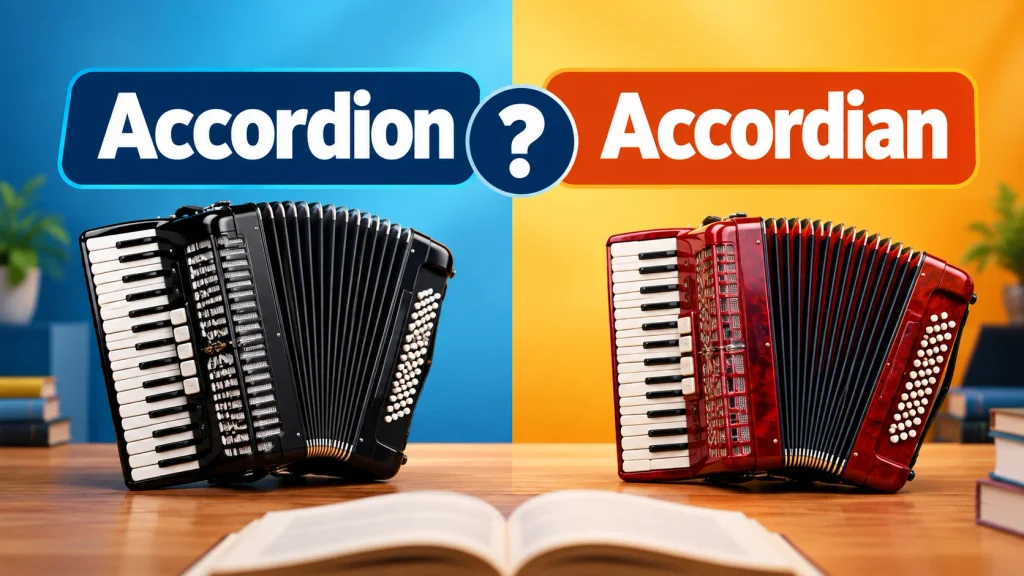
What’s the Difference?
If you’re unsure whether the word is accordion or accordian, the correct spelling is accordion. The spelling accordian is a common misspelling.
The difference is only one letter, but that small difference matters. Standard English uses accordion with -ion near the end:
Accordion ✅
Accordian ❌
The word usually refers to a musical instrument played by expanding and compressing a bellows while pressing keys or buttons. However, you’ll also see accordion used to describe things that fold, expand, or contract in a similar way.
For example:
- She learned to play the accordion as a child.
- The document uses an accordion design.
- I keep my receipts in an accordion folder.
- The website has an accordion menu for its FAQ section.
The spelling does not change according to the meaning. Whether you’re talking about music, folders, printing, physical structures, or web design, the standard spelling remains accordion.
Quick Comparison
| Spelling | Correct? | Typical use |
| accordion | Yes | Musical instrument and anything described by its folding or expanding structure |
| accordian | No | Common spelling mistake |
| accordion folder | Yes | Folder with expandable sections |
| accordion menu | Yes | Expandable website interface |
A simple rule can settle the question quickly: Use accordion, not accordian.
What Does Accordion Mean?
Accordion is most commonly a noun referring to a musical instrument. It has a bellows in the middle and keyboards or buttons on one or both sides. The player expands and compresses the bellows while operating the keys or buttons to produce sound.
The word also appears in descriptions of objects and designs that resemble the folding, expandable shape of an accordion.
That broader use explains why you may encounter phrases such as accordion folder, accordion door, accordion partition, and accordion menu.
The underlying idea is similar in each case: something can expand and contract through connected folds or sections.
Accordion as a Musical Instrument
The most familiar meaning of accordion is the musical instrument.
A traditional accordion has several major parts, including bellows, keys or buttons, reeds, and valves. When the player moves the bellows, air passes through the instrument and causes reeds to vibrate.
For example:
- My grandfather played the accordion at family gatherings.
- She bought a small accordion for her music lessons.
- The musician played the accordion during the festival.
- He has practiced the accordion for several years.
In these sentences, accordion is a straightforward noun naming the instrument.
The spelling remains accordion regardless of whether the sentence describes a professional musician, a beginner, a particular instrument, or a style of music.
Accordion as a Descriptive Term
Accordion can also describe something that folds, expands, or contracts in sections.
This use comes from the physical appearance or movement associated with an accordion. The individual folds allow the object to expand and contract.
For example, an accordion folder has multiple expandable sections. An accordion partition can be extended or compressed. In digital design, an accordion menu lets users expand and collapse sections of information.
Consider these examples:
- The brochure has an accordion fold.
- She organized the documents in an accordion folder.
- The room uses an accordion partition.
- The website displays its answers in an accordion menu.
Here, accordion does not refer to the musical instrument itself. Instead, it describes a shape, structure, or function that resembles the instrument’s folding bellows.
This is important because you might see the word in many different subjects. The context changes, but the spelling does not.
Why Is “Accordian” a Common Misspelling?
Accordian is not the standard spelling, but it is an easy mistake to make.
The main problem is that the word’s pronunciation can make the vowel sequence near the ending less obvious. When people hear a word rather than see it written, they sometimes reconstruct its spelling based on familiar letter patterns.
That can lead to accordian instead of accordion.
The incorrect form can look especially tempting because English contains many words with -ian endings. For example:
- Canadian
- musician
- librarian
- historian
- technician
Because -ian is a familiar pattern, some writers may unconsciously place the a before the final n in accordion.
But accordion has a different spelling pattern:
a-c-c-o-r-d-i-o-n
The ending is -ion, not -ian.
Pronunciation and Spelling Confusion
English spelling does not always provide a perfect guide to pronunciation. That makes words like accordion easier to misspell.
When people say the word quickly, the final syllables may not sound as clearly separated as they appear in writing. A learner who has mostly heard the word spoken may therefore write accordian based on what seems natural.
This is a useful reminder that pronunciation and spelling are related, but they aren’t identical.
You can know exactly what a word sounds like and still spell it incorrectly.
The safest approach is to learn the standard written form as a complete word:
accordion
Once you recognize that spelling, you don’t need to rebuild it from pronunciation every time you write it.
Why “Accordian” Looks Plausible
The misspelling accordian looks plausible because it follows a pattern that English readers already recognize.
Compare the visual forms:
accordion
accordian
The incorrect version moves the a into the final sequence and removes the o that belongs before n.
That single change can be easy to overlook during fast writing or proofreading.
The problem becomes even more noticeable when someone types quickly. A writer may know the word perfectly well but produce accordian simply because the fingers follow an incorrect spelling pattern automatically.
This is why spelling familiarity matters. The more often you see the correct form, the easier it becomes to recognize the incorrect version.
How to Remember the Correct Spelling of Accordion

The easiest way to remember accordion is to focus on the final letters.
Think:
accord + ion = accordion
This is a useful memory aid, not a claim that the modern word should be analyzed as a simple accord + -ion formation. The important point is visual: the standard spelling contains -ion, not -ian.
Another useful technique is to connect the spelling with familiar words or phrases you already recognize.
For example:
accordion folder
accordion menu
accordion music
Seeing the correct spelling in common phrases helps reinforce it.
Use the “-ion” Memory Trick
When you hesitate between accordion and accordian, remember the final sequence:
-ion
Then write:
accord + ion → accordion
The incorrect form uses -ian:
accordian ❌
The correct form uses:
-ion ✅
You can apply this memory trick whenever you need to write the word quickly.
For example:
The musician brought her accordion to the performance.
Or:
I bought an accordion folder for my paperwork.
The more often you use the correct form in complete sentences, the more automatic the spelling becomes.
Break the Word Into Parts
Longer words can be easier to remember when you look at their visual structure instead of trying to memorize every letter separately.
For accordion, notice the sequence:
accor + dion
You can also mentally emphasize the ending:
accordion → -ion
The important distinction is between:
accordion ✅
and
accordian ❌
If you tend to make this particular mistake, pause briefly before writing the final letters. That tiny check can prevent the error.
Put the Correct Spelling Into a Sentence
Another effective way to remember accordion is to use it naturally.
Instead of memorizing the word by itself, create a sentence such as:
My uncle plays the accordion beautifully.
Then try a different context:
I store old documents in an accordion folder.
And another:
The website uses an accordion menu.
These examples reinforce the fact that accordion keeps the same spelling across different meanings and contexts.
That is especially useful because the word appears outside music. Once you recognize accordion in folders, websites, printing, and physical structures, the spelling becomes easier to recall.
The key is simple: whenever you see or write this word, choose accordion with -ion.
A Simple Spelling Rule to Remember
When you’re choosing between accordion and accordian, don’t let pronunciation or the familiar -ian pattern decide the spelling.
Use this rule:
Accordion is the correct standard spelling. Accordian is a misspelling.
The rule remains true whether you’re discussing the musical instrument or something designed to fold and expand like one.
If you remember only one detail, remember the ending:
accordion → -ion
That small visual cue can save you from one of the most common spelling mistakes associated with this word.
Accordion in Context
The word accordion appears in more places than discussions about music. Its broader meaning comes from the distinctive folding and expanding structure of an accordion.
When something has connected sections that expand, collapse, fold, or unfold, accordion can describe that design.
You might see the word used with:
- accordion folder
- accordion partition
- accordion door
- accordion fold
- accordion brochure
- accordion menu
- accordion interface
The important spelling point remains the same in every example.
You write:
accordion ✅
Not:
accordian ❌
The context may change, but the spelling does not.
For example, a musician may play an accordion, while an office worker may organize receipts in an accordion folder. A web designer may create an accordion menu. These uses look different, but all use the same standard spelling.
Accordion as a Musical Instrument
The musical meaning is the most familiar use of accordion.
An accordion is a portable instrument that produces sound as the player moves its bellows and operates keys or buttons. Different accordion designs are used in various musical traditions and styles.
You might encounter sentences such as:
- She learned the accordion when she was young.
- The performer carried his accordion onto the stage.
- My neighbor plays the accordion at local events.
- The band added an accordion to the arrangement.
In each sentence, accordion is the name of the instrument.
The plural is also straightforward:
accordion → accordions
For example:
Several accordions were displayed in the music shop.
Notice that the spelling of the singular word remains unchanged before the plural ending.
Accordion as a Physical Structure
The word accordion can describe a physical structure that folds or expands in connected sections.
Think about the bellows of the musical instrument. They contain a series of folds that allow the structure to expand and contract. Objects that use a similar design may therefore be called accordion structures.
For example, an accordion partition can separate a large room when extended and create a more open space when folded back.
An accordion door works in a similar way. Instead of swinging outward like a conventional door, it folds into sections as it opens.
You may also see descriptions such as:
- accordion-style wall
- accordion partition
- accordion door
- accordion shade
- accordion screen
Consider these examples:
The conference room has an accordion partition.
The restaurant installed an accordion door between the dining areas.
The portable screen folds into an accordion shape.
In these examples, accordion describes the form or movement of the object. It does not refer to the musical instrument itself.
Accordion in Printing
Accordion is also an important term in printing and graphic design.
An accordion fold is a folding method in which a sheet is folded back and forth in alternating directions. The finished piece can expand into a longer surface and then collapse into a compact stack.
This technique can be useful for brochures, maps, programs, menus, promotional materials, and other printed items.
For example:
The designer created an accordion fold for the travel brochure.
The map uses an accordion fold, making it easier to carry.
The company printed its product guide as an accordion brochure.
The word is particularly useful here because the folded paper resembles the expanding and contracting structure associated with the musical instrument.
Accordion Fold vs. Ordinary Fold
A regular folded brochure might simply fold once or twice. An accordion fold uses repeated folds in alternating directions.
That difference gives the printed material several connected panels.
Imagine opening a folded brochure and pulling the panels apart one after another. The piece expands into a longer strip. When you close it, the panels collapse back together.
That folding action explains the term accordion.
Importantly, it doesn’t create a new spelling.
You should still write:
accordion fold
not:
accordian fold
Accordion Folders
An accordion folder is a type of organizational folder with multiple expandable sections.
Instead of keeping everything in one flat pocket, the folder opens into several compartments. You can use those sections to separate bills, receipts, invoices, forms, notes, or other documents.
For example:
I keep my tax documents in an accordion folder.
She organized the receipts by month in an accordion folder.
The office uses accordion folders for archived paperwork.
The term makes sense because the folder expands into connected sections, much like an accordion.
Why “Accordion Folder” Is Easy to Misspell
The phrase accordion folder sometimes appears in searches, product descriptions, office documents, and informal writing. Because the word can sound less clear when spoken quickly, writers may accidentally type accordian folder.
That form is still incorrect in standard English.
Correct:
I bought an accordion folder for my receipts.
Incorrect:
I bought an accordian folder for my receipts.
The meaning is usually obvious either way, but correct spelling is important in product descriptions, professional documents, educational materials, and other polished writing.
Accordion in Web Design
One of the most important modern uses of accordion appears in web design.
An accordion is an interface component that lets users expand and collapse sections of content. Usually, the page initially shows headings or short labels. When a user clicks one, additional information appears.
For example, a website’s FAQ page might display:
What are your business hours?
What payment methods do you accept?
How can I contact customer support?
When a visitor selects one question, its answer expands underneath it. Selecting the heading again may collapse the answer.
This design is called an accordion because the sections expand and contract in a way that resembles the folds of a physical accordion.
You may see phrases such as:
- accordion menu
- accordion interface
- accordion component
- accordion panel
- accordion section
- accordion FAQ
The spelling is always:
accordion
How an Accordion Interface Works
A typical website accordion contains several expandable sections.
Each section usually has a heading or button. Clicking that control reveals hidden content. Depending on the design, opening one section may close another, or multiple sections may remain open at the same time.
For example:
Click the question to open the answer.
The user doesn’t leave the page. Instead, the content expands within the existing interface.
This approach can help organize large amounts of information without displaying every detail at once.
An FAQ page, for instance, might contain twenty questions. Showing every answer immediately could make the page feel crowded. An accordion allows visitors to open only the answers they want to read.
From an SEO and usability perspective, the quality of the content still matters. Calling something an accordion doesn’t automatically make the interface better. The design should remain understandable and accessible to users.
“Accordion Menu” vs. “Accordian Menu”
The correct phrase is accordion menu.
Accordion menu ✅
Accordian menu ❌
The mistake happens because the writer may remember the sound of the word but not its exact spelling.
For example:
The developer added an accordion menu to the mobile navigation.
Not:
The developer added an accordian menu to the mobile navigation.
This distinction matters in technical writing because interface terminology needs to be consistent. A developer, designer, technical writer, or content editor may encounter the term repeatedly throughout a project.
If one document uses accordion menu and another uses accordian menu, the inconsistent spelling can look like two different technical terms even though only one is standard.
Accordion Usage Examples in Sentences
Seeing accordion in different sentences makes its spelling easier to remember.
The following examples show how the word works in several contexts.
Music Examples
The musician played the accordion during the performance.
She has been learning to play the accordion for two years.
The band used an accordion to add a distinctive sound to the song.
He carefully packed his accordion before leaving the venue.
In each case, accordion is the name of the musical instrument.
Folders and Organization
I use an accordion folder to organize important documents.
She placed each month’s receipts in a separate section of the accordion folder.
The office keeps client records in labeled accordion folders.
Here, accordion describes the folder’s expandable structure.
Printing Examples
The designer chose an accordion fold for the brochure.
The travel guide opens into a long accordion-fold display.
The museum’s visitor map uses an accordion fold.
Here, accordion describes the way the printed material folds.
Website Examples
The FAQ page uses an accordion menu to organize common questions.
Click the heading to expand the accordion.
The designer added an accordion component to the product page.
Each accordion section contains additional information.
Here, accordion refers to an expandable digital interface.
Why the Same Spelling Works in Every Context
It can be tempting to think that a word might change spelling when its meaning changes. English doesn’t generally work that way.
The noun accordion names the instrument. The same word can also function as a modifier in compounds such as accordion folder and accordion menu.
The meaning comes from context.
Compare these sentences:
She played the accordion at the concert.
She stored the documents in an accordion folder.
The website uses an accordion menu.
The first sentence concerns music. The second concerns organization. The third concerns web design.
Yet the spelling is identical in all three:
accordion
This is why learning the word as a complete spelling pattern is more useful than trying to memorize separate spellings for each meaning.
A Practical Way to Check the Word While Writing
If you’re typing quickly and suddenly wonder whether the word ends in -ion or -ian, stop for a second.
Ask yourself:
Am I writing accordion?
Then check the final sequence.
accordion → -ion ✅
accordian → -ian ❌
This takes only a moment and can prevent an avoidable spelling error.
The same check works whether you’re writing about a musician, a folder, a printed brochure, or a website.
Once the correct spelling becomes familiar, you probably won’t need to pause at all.
The key remains simple:
Accordion is correct in every standard context. Accordian is not.
Accordion vs. Accordian: Common Mistakes to Avoid
The spelling accordion is straightforward once you recognize the correct letter pattern. However, accordian appears often enough to cause confusion, especially when people write the word from memory.
The most common mistake is simply replacing the o before the final n with an a.
Correct:
accordion ✅
Incorrect:
accordian ❌
This error doesn’t usually indicate a misunderstanding of the word’s meaning. Most writers who use accordian know exactly what they mean. The problem is spelling.
You may see the misspelling in informal messages, quickly typed documents, search queries, captions, product descriptions, or drafts that haven’t been proofread.
The safest habit is to memorize the standard form as a whole:
accordion
Incorrect vs. Correct Forms
A quick comparison makes the difference easy to see.
| Incorrect form | Correct form |
| accordian | accordion |
| accordian folder | accordion folder |
| accordian menu | accordion menu |
| accordian fold | accordion fold |
| accordian instrument | accordion instrument |
| accordians | accordions |
The key difference is the sequence near the end of the word.
accordion contains -ion.
accordian contains -ian.
That distinction remains important even when the word appears inside a longer phrase.
For example:
The designer created an accordion menu.
Not:
The designer created an accordian menu.
Likewise:
She bought an accordion folder.
Not:
She bought an accordian folder.
Once you know the standard spelling, you can correct the word regardless of the context.
Why Context Doesn’t Change the Spelling
One common source of confusion is the fact that accordion has several uses.
It can refer to a musical instrument, a folded physical structure, a printing technique, an organizational folder, or a web interface.
However, different meanings don’t create different spellings.
For example:
He plays the accordion.
She uses an accordion folder.
The brochure has an accordion fold.
The website contains an accordion menu.
The word looks exactly the same in each example.
This is a useful general spelling principle: when a word takes on a related meaning in another context, you shouldn’t automatically change its spelling.
Instead, look at how the word is conventionally written.
For accordion, the standard spelling stays the same:
accordion
The context tells you what the word means. It doesn’t tell you how to spell it.
Is “Accordian” Ever Correct?
In standard English, accordian is not the accepted spelling of the musical instrument or the related descriptive term.
If you’re writing an article, school assignment, business document, product description, technical guide, or professional email, use accordion.
You may occasionally encounter accordian online or in other written material. Its appearance doesn’t make it a standard alternative spelling. It can simply be a typographical or spelling error that has been repeated.
There can also be unusual cases involving proper names, usernames, trademarks, or other names created by individuals or organizations. A particular name may intentionally use an unconventional spelling. That doesn’t change the standard English spelling of the common noun.
So, for ordinary English usage:
Accordion = standard spelling.
Accordian = misspelling.
This distinction is especially important when you’re proofreading content for publication. A spelling error can remain unnoticed when the intended meaning is obvious, so don’t rely only on whether the sentence makes sense.
Why Correct Spelling Matters
A single spelling mistake rarely prevents readers from understanding a sentence. If someone writes accordian, most readers will probably understand that they mean accordion.
Still, correct spelling matters.
Good spelling improves clarity, consistency, credibility, and readability. This becomes especially important in professional and technical writing.
Imagine a product page repeatedly describing an accordian folder. Customers may understand the phrase, but the spelling error can make the page look less carefully edited.
The same issue can appear in:
- educational materials
- technical documentation
- product catalogs
- websites
- brochures
- business reports
- marketing copy
- online stores
- user guides
Correct spelling also makes information easier to search and organize. Standard terminology is more consistent across documents and systems.
If you’re writing professionally, there’s little reason to use accordian when accordion is the established spelling.
Accordion in Technical Writing
Technical writing often uses accordion as a descriptive term.
Web developers may discuss an accordion component, accordion panel, or accordion interface. Designers may document how an accordion expands and collapses. Technical writers may explain how users interact with an accordion on a website or application.
Because technical documents often repeat the same term many times, a spelling mistake can become especially noticeable.
For example:
The accordion component contains four expandable sections.
Each accordion panel displays additional information.
The user can expand or collapse each accordion section.
Using accordian throughout a technical document would reproduce the same spelling error repeatedly.
A careful technical editor should therefore check the spelling at the first occurrence and remain consistent throughout the document.
Accordion in Educational Writing
Students may encounter accordion in assignments about music, design, printing, organization, or technology.
For example:
The accordion is a portable musical instrument.
Or:
The brochure uses an accordion fold.
Or:
The website organizes its information with an accordion interface.
In an academic or educational setting, spelling accuracy is part of clear written communication.
A teacher can understand accordian, but that doesn’t make it correct. Students should learn the standard spelling and use it consistently.
If you’re studying English as a second language, don’t feel discouraged by this mistake. English contains many words whose spelling isn’t immediately obvious from pronunciation. The solution is to build familiarity with the written form.
Accordion vs. Accordian: A Practical Spelling Test
When you’re unsure about the spelling, use a quick visual test.
Write both forms mentally:
accordion
accordian
Now look at the ending.
Which one contains the familiar -ion sequence?
accordion.
Which one changes the sequence to -ian?
accordian.
The standard form is the first one.
This test is useful because it doesn’t require you to remember a complicated grammar rule. You’re simply checking the established spelling pattern.
The Five-Second Proofreading Trick
When proofreading, search specifically for:
accordian
If you find it, replace it with:
accordion
This is often faster than trying to identify the mistake while reading every sentence carefully.
The trick is particularly useful in long documents. You might use a document editor’s search function to find every occurrence of accordian and then check each result.
For example, if a technical guide contains the following:
Click the accordian menu to view the options.
A quick search reveals the problem immediately.
Change it to:
Click the accordion menu to view the options.
You can also search for related mistakes if you’re proofreading a document containing several variations.
The important point is to check the exact spelling rather than relying entirely on spell-check software. A word may occasionally escape automatic correction if the software doesn’t recognize the intended term or if the error appears in an unusual context.
Accordion vs. Accordian for English Learners
English learners can find accordion confusing because pronunciation doesn’t always make the spelling obvious.
If you’ve heard the word several times but haven’t seen it written often, accordian may seem reasonable.
That’s a normal kind of spelling difficulty.
A useful strategy is to learn the word visually and in context rather than memorizing its sound alone.
Learn phrases such as:
play the accordion
accordion folder
accordion fold
accordion menu
These phrases give you repeated exposure to the correct written form.
Over time, your brain starts recognizing accordion as a familiar visual pattern.
A Useful Learner Exercise
Try completing these sentences with either accordion or accordian.
She plays the ______ at family gatherings.
I bought an ______ folder for my documents.
The website uses an ______ menu.
The brochure has an ______ fold.
The answer is accordion in every sentence.
That’s important because the meaning changes slightly in each example, but the spelling remains identical.
You can make the exercise more useful by writing the full sentences yourself.
For example:
My cousin plays the accordion.
I keep my receipts in an accordion folder.
The FAQ uses an accordion menu.
Writing the word repeatedly in meaningful contexts helps reinforce its spelling better than copying it in isolation.
A Common Learner Question: Why Isn’t It “Accordian”?
A learner may reasonably ask why the word isn’t spelled accordian if that version seems closer to the way the word sounds.
The short answer is that English spelling isn’t always a direct representation of pronunciation.
Words develop and retain conventional written forms. Once a standard spelling becomes established, speakers learn that spelling as part of the vocabulary of the language.
The same principle applies to many English words whose pronunciation doesn’t make every letter obvious.
With accordion, the standard written form is simply:
accordion
It’s better to treat the spelling as a vocabulary fact than to invent a new spelling from the sound.
Don’t Let the “-ian” Pattern Mislead You
One reason accordian looks convincing is that English has many words ending in -ian.
For example:
- historian
- librarian
- electrician
- Canadian
- politician
Seeing these words can make accordian feel familiar.
But familiarity isn’t enough to establish spelling.
Accordion belongs to its own established spelling pattern. The final sequence is -ion, so adding an a before the final n creates the wrong form.
When in doubt, don’t rely on the spelling of a different word. Check the actual word you’re trying to write.
Common Typing Errors With Accordion
Spelling mistakes can happen even when you know the correct form.
Fast typing is one reason. When you’re writing quickly, your fingers may produce a familiar but incorrect letter sequence.
You might also make the mistake when switching between ideas. For example, you could type accordian automatically while writing about a website’s accordion menu.
Other factors include:
- writing from pronunciation
- unfamiliarity with the word
- limited exposure to the written form
- typing too quickly
- skipping proofreading
- relying on memory alone
None of these changes the standard spelling.
The practical solution is simple: become familiar with accordion, notice the -ion ending, and proofread for the common accordian error.
A Quick Correction Exercise
Look at each sentence and identify the spelling problem.
The musician played an accordian during the show.
Correct it:
The musician played an accordion during the show.
Another example:
The website uses an accordian menu.
Correct it:
The website uses an accordion menu.
And one more:
I bought an accordian folder for my receipts.
Correct it:
I bought an accordion folder for my receipts.
In every case, only the spelling needs to change. The meaning of the sentence remains clear.
That makes accordion vs. accordian a good example of how a small spelling error can appear across completely different contexts.
The Easiest Way to Avoid the Mistake
If you frequently confuse these two forms, don’t try to memorize a long explanation.
Remember one visual cue:
accordion ends in -ion.
Then connect that spelling with familiar phrases:
play the accordion
accordion folder
accordion fold
accordion menu
Once you recognize the correct form in several contexts, accordian will start to look noticeably wrong.
That visual familiarity is often more useful than trying to reconstruct the spelling from pronunciation every time you write it.
Accordion vs. Accordian in Formal and Informal Writing
The spelling accordion is correct in both formal and informal English.
You don’t need a different spelling when writing a casual message, a school assignment, a business document, or a technical article.
For example, an informal sentence might say:
My brother plays the accordion.
A formal sentence might say:
The report describes the historical development of the accordion as a musical instrument.
Both use the same spelling.
The main difference between formal and informal writing is usually tone, vocabulary, sentence structure, and level of detail. It isn’t the spelling of accordion.
The form accordian should not be used simply because the writing is casual. Informal writing can contain intentional abbreviations, slang, and relaxed expressions, but a common misspelling remains a misspelling.
Accordion in Business Writing
Businesses may use accordion in several practical contexts.
A company might sell an accordion folder, describe an accordion brochure, or explain an accordion-style display. Digital businesses may also discuss an accordion menu or accordion interface.
For example:
The sales team stores client documents in accordion folders.
The marketing department designed an accordion brochure for the new product.
The website uses an accordion menu to organize product information.
Correct spelling matters in business communication because documents often represent an organization publicly.
A spelling error in a product description, brochure, presentation, or website can make the material look less polished.
If the word appears repeatedly, the error becomes even more visible. A single typo can quickly turn into ten identical typos throughout a document if nobody catches it during editing.
That makes accordion a useful word to add to your proofreading checklist when the subject involves folding structures, organization, printing, or web design.
Accordion in Educational Writing
Educational writing may use accordion when discussing music, printing, graphic design, architecture, office organization, or technology.
For example:
The student chose the accordion for her music project.
The brochure uses an accordion fold to create several panels.
The website’s accordion menu keeps the information organized.
Students should use accordion in essays, reports, presentations, and assignments.
Even if the reader understands accordian, the incorrect spelling can still reduce the quality of the writing.
Teachers, editors, and readers expect standard spellings in polished academic work. Learning the correct form now can also prevent the same mistake from appearing repeatedly in future assignments.
Accordion in Technical Writing
Technical writing requires especially consistent terminology.
A software manual might explain an accordion component. A web-development guide might describe an accordion interface. A design specification might refer to an accordion panel.
For example:
Select the heading to expand the accordion panel.
Each accordion section contains additional product information.
The developer configured the accordion component to allow multiple sections to remain open.
In these situations, accuracy matters because technical readers expect terminology to remain consistent throughout a document.
If one section calls it an accordion component and another calls it an accordian component, the inconsistency can look like a terminology problem.
There is no need to introduce such confusion. Use the established spelling accordion throughout.
Common Sentence Patterns With Accordion
Learning a word through sentence patterns can make spelling and usage easier.
Here are some common structures.
“Play the Accordion”
Use play when talking about performing music on the instrument.
She learned to play the accordion.
He enjoys playing the accordion.
My uncle used to play the accordion professionally.
“An Accordion Folder”
Use accordion folder when describing an expandable organizational folder.
I need an accordion folder for these documents.
She keeps receipts in an accordion folder.
“Accordion Fold”
Use accordion fold for a repeated back-and-forth folding method.
The brochure uses an accordion fold.
The designer selected an accordion fold for the map.
“Accordion Menu”
Use accordion menu when discussing an expandable digital interface.
The FAQ uses an accordion menu.
Click the heading to open the accordion menu.
These patterns reinforce an important point: the word stays accordion no matter what comes after it.
Quick Reference: Accordion vs. Accordian
If you need a fast answer, use this table.
| Form | Standard English? | Example |
| accordion | Yes | She plays the accordion. |
| accordian | No | This is a common misspelling. |
| accordion folder | Yes | I bought an accordion folder. |
| accordion fold | Yes | The brochure uses an accordion fold. |
| accordion menu | Yes | The site has an accordion menu. |
| accordian folder | No | Replace it with accordion folder. |
| accordian menu | No | Replace it with accordion menu. |
The quickest answer is therefore:
Accordion is correct. Accordian is incorrect in standard English.
The Easiest Memory Cue
If you regularly confuse the two spellings, focus on the final letters.
Remember:
accordion → -ion
Not:
accordian → -ian
You can connect the spelling to a simple phrase:
Play the accordion.
Then use the same visual pattern in other expressions:
accordion folder
accordion fold
accordion menu
This works because you’re learning the word in real phrases rather than treating it as an isolated string of letters.
You don’t need a complicated grammar rule. You simply need to recognize the standard spelling.
A Five-Second Editing Checklist
When proofreading a document that contains accordion, use this quick checklist.
Check the spelling.
Make sure the word is written as accordion.
Check the ending.
Look for -ion, not -ian.
Check related phrases.
Review terms such as accordion folder, accordion fold, and accordion menu.
Search for the common mistake.
Use your editor’s search function to find accordian.
Check consistency.
Make sure every occurrence uses the same standard spelling.
This process takes only a few seconds in a short document. In a long article or technical guide, it can save considerable editing time.
How to Correct “Accordian” in Your Writing
Suppose you discover several instances of accordian in a document.
You don’t need to rewrite the surrounding sentences. In most cases, simply replace the misspelling with accordion.
For example:
The site contains an accordian menu.
Becomes:
The site contains an accordion menu.
Or:
She bought an accordian folder.
Becomes:
She bought an accordion folder.
Or:
He learned to play the accordian.
Becomes:
He learned to play the accordion.
The meaning doesn’t need to change. Only the spelling does.
This is a useful editing principle for many spelling errors: if the intended word is obvious, correct the form without unnecessarily changing the sentence.
Why “Accordion” Is the Better Choice for Professional Communication
Professional writing benefits from standard spelling because readers shouldn’t have to stop and interpret obvious errors.
Imagine reading a software manual that repeatedly says accordian menu. You may understand the meaning immediately, but the mistake can distract you from the instructions.
The same applies to business documents.
Compare:
Click the accordion menu to display additional options.
with:
Click the accordian menu to display additional options.
The first follows standard spelling. The second contains an avoidable error.
Professional communication doesn’t require complicated vocabulary. It requires accuracy, consistency, and clarity.
Using accordion correctly is a small part of that larger goal.
A Practical Example: Editing a Website Description
Imagine you’re reviewing the following website copy:
Our FAQ page uses an accordian menu to keep answers organized. Visitors can click each section to see more information. The accordian design helps reduce clutter and makes the page easier to scan.
The meaning is clear, but accordian appears twice.
A careful editor would change both instances:
Our FAQ page uses an accordion menu to keep answers organized. Visitors can click each section to see more information. The accordion design helps reduce clutter and makes the page easier to scan.
Notice that nothing else needs to change.
The interface is still the same. The explanation is still the same. Only the spelling has been corrected.
This example also shows why proofreading matters. A spelling error can easily appear more than once when the same term is central to the subject.
Accordion vs. Accordian: Final Spelling Rule
There’s no complicated rule you need to memorize.
When you’re choosing between accordion and accordian, choose:
Accordion ✅
Avoid:
Accordian ❌
The correct spelling contains -ion.
That remains true when the word refers to:
- the musical instrument
- a folded physical structure
- an accordion fold
- an accordion folder
- an accordion brochure
- an accordion menu
- an accordion interface
- an accordion component
The meaning may change with the context, but the spelling stays the same.
Final Takeaway
Accordion is the standard and correct spelling in English. Accordian is a common misspelling, even though it may look natural because of pronunciation and familiar -ian word patterns.
The easiest way to remember the correct form is to focus on the ending:
accordion → -ion
Once you recognize that pattern, the spelling becomes much easier to reproduce.
You can also reinforce it through familiar expressions such as play the accordion, accordion folder, accordion fold, and accordion menu.
Whether you’re writing about music, printing, office organization, or web design, the same rule applies. Don’t change the spelling based on context.
If you ever hesitate, pause for a second and check the final letters. Accordion is the form to use in standard English.
Conclusion
Choosing between accordion and accordian is simple once you know the correct spelling. Accordion is the standard English form, while accordian is a common misspelling. The correct word uses -ion near the end, and that spelling stays the same whether you’re talking about a musical instrument, accordion folder, accordion fold, or accordion menu.
If you often hesitate over this word, focus on the visual pattern rather than pronunciation. Remember accordion, and reinforce it through familiar phrases such as “play the accordion” or “accordion folder.” A quick proofreading check can also catch accordian before you publish or submit your writing.
Whether you’re writing an email, school assignment, business document, technical guide, or website, accordion is the form to use. Once this spelling becomes familiar, you’ll rarely need to think twice about it.
FAQs
Is “accordion” the correct spelling?
Yes. Accordion is the standard and correct spelling in English. It refers primarily to a musical instrument and can also describe objects or designs that fold or expand in sections. Accordian is a common misspelling and should be avoided in standard writing, including academic, professional, technical, and published content.
Is “accordian” an accepted spelling?
No. Accordian is not the standard English spelling of the word. It commonly appears as a spelling mistake because the pronunciation can make the ending seem unclear. In standard English, use accordion with -ion. An unusual proper name or trademark could intentionally use another spelling, but that doesn’t make it the standard common noun.
Why do people spell accordion as “accordian”?
People often write accordian because the pronunciation doesn’t make every letter obvious. The familiar -ian pattern in many English words may also influence the mistake. Fast typing and relying on sound rather than visual memory can contribute as well. Learning the complete spelling accordion makes this error much easier to avoid.
How do you remember the spelling of accordion?
A simple memory cue is to focus on the ending: accordion contains -ion, not -ian. You can also remember familiar phrases such as play the accordion, accordion folder, and accordion menu. Seeing the correct form in several contexts helps make the spelling familiar and easier to recall naturally.
What does accordion mean?
Accordion most commonly refers to a musical instrument with bellows and keys or buttons. The word can also describe something that folds, expands, or contracts in connected sections. Examples include an accordion folder, accordion fold, and accordion menu. The exact meaning depends on the context, but the spelling remains accordion.
Is “accordion” used outside music?
Yes. Accordion is widely used outside music as a descriptive term for folding or expandable structures. Common examples include accordion folders, accordion partitions, accordion folds, and accordion menus on websites. These uses are connected to the folding and expanding appearance of an accordion’s bellows.
Is “accordion menu” or “accordian menu” correct?
Accordion menu is correct. An accordion menu is a website interface that allows users to expand and collapse sections of content. Accordian menu contains the same common spelling error as accordian. In web design, technical documentation, and website content, use accordion menu.
Is “accordion folder” the correct phrase?
Yes. Accordion folder is the standard phrase for a folder with expandable sections or compartments. It is commonly used to organize documents, receipts, forms, and other paperwork. The spelling remains accordion, not accordian, regardless of whether you’re discussing office supplies, organization, or document storage.
Does the spelling change depending on the meaning?
No. The spelling stays accordion regardless of the context. You can use it for the musical instrument, a physical folding structure, a printing technique, an organizational folder, or a website interface. Context determines the meaning, but it doesn’t change the established spelling of the word.
How can I quickly check whether I wrote accordion correctly?
Look at the ending of the word. The correct spelling is accordion, which contains -ion. If you see accordian, you’ve found the common misspelling. When proofreading a longer document, searching specifically for accordian is a quick way to find and correct every occurrence.