

When two words sound exactly alike but have different spellings and meanings, it’s easy to choose the wrong one in writing. Loot and lute are a perfect example. They sound the same, but they describe completely different things.
Loot can refer to stolen, captured, or valuable goods. It can also work as a verb meaning to steal goods, especially during a period of disorder, war, or unrest. Lute, however, is a musical instrument with strings, a rounded body, and a long neck.
So, if you are writing about stolen treasure, you need loot. If you are discussing an old stringed instrument, you need lute.
The tricky part is pronunciation. Both words are pronounced the same in standard English, which means you cannot always choose the spelling by listening. You have to look at the meaning and context.
What’s the Difference?
The simplest distinction is this:
- Loot means goods that have been stolen or taken by force, or the act of stealing such goods.
- Lute means a stringed musical instrument traditionally associated with European and Middle Eastern musical traditions.
Consider these two sentences:
The soldiers carried away valuable loot after the battle.
The musician played a beautiful melody on the lute.
The pronunciation does not help you distinguish the words because loot and lute are homophones. Their spelling and meaning do the work instead.
At a Glance
| Word | Meaning | Part of Speech | Example |
| Loot | Stolen, captured, or illegally taken goods; to steal goods | Noun and verb | The thieves escaped with the loot. |
| Lute | A traditional stringed musical instrument | Noun | She learned to play the lute. |
A useful way to remember the difference is to connect loot with stolen treasure and lute with music.
Quick Difference Between Loot and Lute
Although these words sound identical, their meanings have nothing to do with each other.
Loot belongs to contexts involving stealing, warfare, robbery, destruction, or valuable goods. For example, a historical account might describe soldiers taking loot from a conquered city. A video game might also use loot for items a player collects after defeating an enemy.
Lute, on the other hand, belongs to the world of music. A lute is a plucked string instrument with a distinctive rounded body. It has played an important role in the musical traditions of several cultures and historical periods.
Here is the easiest mental comparison:
Loot = stolen or taken goods
Lute = stringed musical instrument
The difference becomes especially important in writing because spell-check may not catch the mistake. Both loot and lute are correctly spelled English words. If you use the wrong one, your sentence may still look grammatically correct.
A Simple Definition of Loot and Lute
What Does “Loot” Mean?
Loot generally refers to valuable goods taken from someone, especially through theft, force, or during conflict. As a verb, to loot means to steal goods, often from a place during a period of disorder.
For example:
- The invaders took valuable loot from the city.
- Several shops were looted during the unrest.
- The pirates divided the loot among themselves.
- The game rewards players with loot after each battle.
Notice that the word can describe either the things taken or the action of taking them.
What Does “Lute” Mean?
A lute is a musical instrument belonging to the family of stringed instruments. Traditional lutes typically have a rounded or pear-shaped body, a neck, and strings that are plucked.
For example:
- The musician played a Renaissance lute.
- She heard the gentle sound of a lute during the performance.
- The museum displayed an elaborately decorated lute.
- He studied the history of the European lute.
Unlike loot, lute is normally used as a noun.
Why Do People Confuse Loot and Lute?
The biggest reason is simple: they sound the same.
When you hear someone say either word, pronunciation alone does not tell you which spelling they mean. You need the surrounding sentence to understand the intended meaning.
Imagine hearing this sentence:
“The player found some loot.”
If you only hear the sentence, you know the speaker means valuable items or rewards. But if someone says:
“The musician played the lute.”
the context makes the meaning clear.
English contains many pairs like this. Words can share pronunciation while having completely different spellings and meanings. These words are called homophones.
The challenge becomes greater when both spellings are legitimate words. A spelling checker might not flag a sentence such as:
The musician played the loot.
The sentence is grammatically formed, and loot is spelled correctly. The problem is semantic. A lute is the instrument.
That is why context matters so much with homophones.
What Does “Loot” Mean?
The word loot has two closely related grammatical uses. It can be a noun or a verb.
As a noun, loot means goods or valuables that have been stolen or taken, particularly during war, conflict, robbery, or disorder.
As a verb, loot means to steal goods or valuables, especially from a place during a period of chaos.
Loot as a Noun
When loot is a noun, it names the goods or valuables that have been taken.
For example:
- The thieves divided the loot.
- The museum recovered some of the stolen loot.
- The pirates hid their loot on a remote island.
- The soldiers returned with valuable loot.
In these sentences, loot refers to something rather than an action.
You can often identify this use by looking at what comes before the word. Expressions such as the loot, some loot, or valuable loot clearly show that the word is functioning as a noun.
One useful grammatical detail is that loot is often treated as a mass noun when referring to stolen goods collectively.
For example:
The pirates buried the loot.
You would not normally need to say “loots” when referring to a collection of stolen goods.
However, the plural loots can occur in specialized or unusual contexts when referring to separate instances or types of looting, but ordinary English generally uses loot as an uncountable collective noun.
Loot as a Verb
Loot can also function as a verb.
When someone loots a place, they steal valuable goods from it. The verb is especially common in descriptions of war, riots, invasions, disasters, and other situations involving disorder.
For example:
- The attackers looted the village.
- Several stores were looted during the unrest.
- The invaders looted the palace.
- Criminals entered the building and looted it.
The verb can appear in several forms:
| Form | Example |
| Base form | They loot abandoned buildings. |
| Third-person singular | He loots the store. |
| Past tense | They looted the warehouse. |
| Present participle | The group was looting nearby shops. |
| Past participle | Several businesses had been looted. |
This distinction is important because some learners assume loot can only refer to stolen property. It can also describe the act of stealing.
Origin and Etymology of Loot
Loot has an interesting history. The English word came from loot, a word in Hindi and Urdu meaning plunder or stolen property. It ultimately traces back to Sanskrit lōtra, referring to booty or stolen goods.
The word entered English during the period of British involvement in South Asia and became established in English usage during the eighteenth century.
Today, loot is a familiar word in many varieties of English. Its meaning has also expanded beyond historical or military situations. Modern speakers may use it when discussing theft, crime, historical plunder, or even rewards in video games.
That last use is especially common in gaming.
A player might say:
I found some great loot after defeating the boss.
Here, loot does not necessarily mean stolen property in the real-world sense. Instead, it refers to valuable items or rewards obtained during gameplay.
Common Meanings and Uses of Loot
The meaning of loot depends heavily on context.
War and Military History
Historical writing frequently uses loot to describe valuables taken by victorious soldiers or invading forces.
For example:
The army returned with gold, artwork, and other loot.
In this context, the word can describe property taken during conquest or military conflict.
Theft and Robbery
Loot can also refer to property stolen during a crime.
For example:
The police recovered the stolen loot.
Here, the focus is on the valuables taken by criminals.
As a verb:
The burglars looted the building.
The word describes the act of taking property.
Riots and Civil Unrest
News and historical writing may use loot and looting when describing property theft during civil disorder.
For example:
Several businesses were damaged and looted during the unrest.
In this context, loot describes goods taken illegally, while looting describes the act.
Piracy
Stories about pirates often use loot to describe treasure or valuables captured from ships or settlements.
For example:
The pirates divided the loot among the crew.
This is one reason people often associate the word with treasure.
Archaeology and Cultural Heritage
The word can also appear in discussions about artifacts that were illegally removed from archaeological sites or cultural institutions.
For example:
Scholars debated the return of cultural loot taken during colonial-era conflicts.
In formal writing, terms such as plunder, stolen artifacts, or illegally removed objects may be more precise depending on the situation.
Video Games
Modern gaming has given loot another very common meaning.
In many games, loot refers to items a player obtains after completing a task, defeating an enemy, opening a chest, or exploring an area.
For example:
The dungeon contains rare loot.
We collected better loot after defeating the final boss.
This gaming meaning does not necessarily imply that the player has committed real-world theft. It is a specialized use based on the broader idea of obtaining valuable goods.
What Does “Lute” Mean?
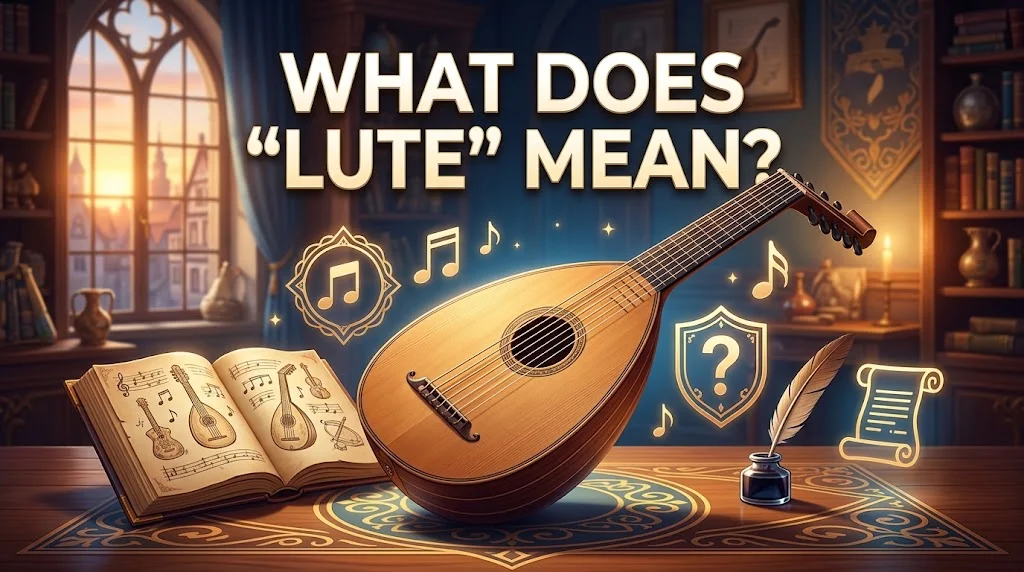
A lute is a stringed musical instrument that has been used in various forms across different cultures and historical periods.
Traditional lutes generally have a hollow body, a neck, and strings that are plucked. Different lute traditions have developed distinctive shapes, tuning systems, numbers of strings, and playing techniques.
The European lute became particularly important during the Renaissance and Baroque periods. It was used for both solo performances and accompaniment.
For example:
The musician performed a Renaissance piece on the lute.
The word can also refer more broadly to related instruments found in different musical traditions.
Origin and Etymology of Lute
The English word lute has a long linguistic history. It came into English through Old French lut, which developed from medieval Latin lūt, ultimately connected with Arabic al-ʿūd, the name of a related stringed instrument.
The history of the word reflects the long exchange of musical traditions across Europe and the Middle East.
The modern English lute therefore has a very different linguistic history from loot, even though the two words eventually developed the same pronunciation in English.
That is an important point: similar sound does not mean similar origin or meaning.
What Kind of Instrument Is a Lute?
A lute is a plucked string instrument.
Its traditional design usually includes:
- A rounded or pear-shaped hollow body
- A neck
- Strings stretched along the instrument
- A soundboard
- A bridge
- Tuning mechanisms
The precise design varies depending on the historical period and cultural tradition.
The European Renaissance lute, for example, differs in construction and use from instruments in the broader lute family found elsewhere.
You can think of the lute as part of a large family of historical string instruments rather than as one completely uniform instrument.
This distinction is useful because the word lute can refer to different related instruments depending on the historical or musical context.
Parts of a Lute
Although lutes vary, several basic components are commonly discussed when describing them.
Body
The body is the hollow section that helps produce and amplify the instrument’s sound. Traditional European lutes often have a rounded or bowl-shaped body.
Neck
The neck extends from the body and provides the area where the player places the fingers to change the pitch of the strings.
Strings
The strings are plucked to produce sound. Historical lutes could have different numbers and arrangements of strings depending on their design and period.
Soundboard
The soundboard is the surface that vibrates when the strings are played. It plays an important role in projecting the instrument’s sound.
Bridge
The bridge supports the strings and transfers their vibrations to the body of the instrument.
Knowing these terms can help you recognize lute in music-related writing. If a sentence mentions strings, a musician, Renaissance music, plucking, or a historical instrument, lute is likely the word you need—not loot.
Loot vs. Lute: The First Context Test
When you are unsure which spelling to use, stop listening to the word and examine its meaning.
Ask yourself:
Is this sentence about stolen or collected goods?
If yes, use loot.
Is this sentence about a musical instrument?
If yes, use lute.
For example:
The adventurers searched the chest for valuable loot.
The sentence is about valuable items.
Now compare:
The musician carefully tuned the lute before the performance.
The sentence is about an instrument.
The words sound identical, but the surrounding ideas make the spelling obvious.
That is the key lesson with loot vs. lute: sound tells you very little, while context tells you almost everything.
Loot vs. Lute: Pronunciation
One reason loot and lute cause confusion is that they are pronounced the same in standard English. Both contain the long oo sound, represented by /uː/ in the International Phonetic Alphabet.
The spelling is different, but the pronunciation is essentially identical:
- Loot — /luːt/
- Lute — /luːt/
The final t sound is also the same.
This makes the pair a true example of homophones. If someone says either word aloud without giving you any context, you cannot determine the spelling simply by hearing it.
You need to consider what the speaker means.
Pronunciation Tips for English Learners
The vowel in both words is the same long oo sound found in words such as food, moon, and blue.
To pronounce the sound naturally, keep your lips rounded and hold the vowel slightly longer than a short vowel. Then finish with the t sound.
One common mistake is shortening the vowel too much. Another is confusing the vowel with the sound in words such as foot or book, which use a different vowel in most varieties of English.
Practice the two words together:
loot — lute
Then place them in contrasting sentences:
The pirate found the loot.
The musician played the lute.
The pronunciation stays the same, but the meaning changes completely.
Are Loot and Lute Homophones?
Yes. Loot and lute are homophones because they have the same pronunciation but different spellings and meanings.
A homophone does not have to share the same spelling. In fact, different spellings are one of the features that make many homophone pairs difficult for English learners.
Consider some familiar examples:
- to, too, and two
- there, their, and they’re
- flower and flour
- pair and pear
- blue and blew
- new and knew
Like these pairs, loot and lute sound alike but represent different words.
Why Loot and Lute Sound Alike
The two words have different histories, but modern English pronunciation has brought them together.
Their spellings preserve differences that are important for written meaning. When you read the words, the spelling immediately tells you which meaning is intended. When you hear them, however, context has to do the work.
That is why homophones can be especially challenging in writing.
A person may know exactly what they mean but still type the wrong spelling because they are relying on sound.
Homophones vs. Homographs
It helps to distinguish homophones from homographs.
Homophones are words that sound alike but have different meanings and often different spellings.
Homographs are words that share the same spelling but can have different meanings or pronunciations.
For example:
- Loot / lute → homophones
- bat / bat → homographs with different meanings
- lead / lead → homographs that can have different pronunciations and meanings
Understanding these terms makes it easier to discuss spelling problems accurately.
Loot vs. Lute in Grammar
Although the two words sound alike, they behave differently in grammar.
Loot can function as both a noun and a verb.
Lute is normally a noun referring to a musical instrument.
This grammatical difference provides another useful clue when choosing the correct spelling.
Using Loot as a Noun
As a noun, loot refers to stolen, captured, or otherwise taken valuables or goods.
Examples include:
The thieves hid the loot in an abandoned building.
The archaeologists studied records describing the loot taken from the site.
The pirates divided the loot among themselves.
The game gives players valuable loot after difficult battles.
In these examples, loot names something.
The word is commonly treated as an uncountable or mass noun when referring to stolen goods collectively.
For instance:
The police recovered a large amount of loot.
You would not normally say:
The police recovered many loots.
Instead, use a phrase such as pieces of loot, items of loot, or a more specific noun such as stolen goods when individual objects need to be counted.
Using Loot as a Verb
As a verb, loot means to steal goods or valuables, usually from a place.
Examples:
The invaders looted the city.
Several stores were looted during the unrest.
The criminals looted the warehouse.
The building had been looted before authorities arrived.
The verb can be used in different tenses:
Present:
Criminals sometimes loot abandoned properties.
Past:
The attackers looted the village.
Present progressive:
The crowd was looting nearby stores.
Present perfect:
Several businesses have been looted.
The meaning remains connected to the unlawful taking of goods.
Using Lute as a Noun
Lute is a noun.
It refers to a stringed instrument, so it can appear after articles and adjectives just like other countable nouns.
Examples:
He owns a lute.
She played the lute beautifully.
The museum displayed an old lute.
They studied several historical lutes.
Unlike loot, the noun lute can be counted.
You can say:
The museum has three lutes.
That grammatical difference can also help you distinguish the words.
Why “Lute” Is Not Normally Used as a Verb
In standard contemporary English, lute is normally encountered as a noun when referring to the musical instrument.
So, if your sentence describes someone playing, tuning, buying, making, or displaying the instrument, lute is the noun you need.
For example:
She tuned the lute before the concert.
Do not choose loot simply because the two words sound identical.
The surrounding vocabulary provides the answer.
Loot vs. Lute in Different Contexts
Context is the most reliable way to distinguish these homophones. Once you identify the subject of the sentence, the correct spelling usually becomes obvious.
Historical and Military Context
Historical writing frequently uses loot when discussing valuables taken during warfare or conquest.
For example:
The invading army carried away gold and other loot.
The word may also appear as a verb:
The army looted the conquered city.
By contrast, lute may appear in historical writing when the subject is music.
For example:
Court musicians often performed on the lute.
Both words can occur in historical discussions, but their meanings remain completely separate.
Theft and Robbery
When discussing criminal activity, loot is the appropriate word.
For example:
The robbers escaped with the loot.
Or:
The criminals looted several stores.
The word connects to stolen property or the act of stealing.
A sentence about robbery would almost never require lute unless the instrument itself happened to be among the stolen objects.
Riots and Civil Unrest
Loot and looting can appear in reports about civil unrest.
For example:
Several stores were damaged and looted.
Here, looted functions as a verb describing the act of taking goods from the businesses.
If a report were discussing a musical performance taking place during the same event, it might mention a lute, but that would be an entirely different meaning.
Piracy
Historical accounts of piracy commonly use loot when describing treasure or valuables taken by pirates.
For example:
The crew divided the loot after returning to the island.
This context makes loot easy to identify.
If you see words such as pirates, treasure, stolen goods, ships, or booty, the intended word is likely loot.
Archaeology and Cultural Heritage
In discussions of cultural heritage, loot can refer to artifacts or valuables illegally removed from archaeological sites or cultural institutions.
For example:
Researchers documented artifacts that had been taken as loot.
You may also encounter phrases such as looted artifacts, looted antiquities, and cultural looting.
The context may be academic or professional, but the basic meaning remains the same.
Video Games
Gaming has given loot an especially common modern meaning.
In a video game, loot can mean items or rewards obtained by a player.
For example:
The boss dropped rare loot.
We found some valuable loot in the chest.
The player collected better loot after completing the mission.
Here, the word does not necessarily describe real-world theft. Instead, it refers to items obtained during gameplay.
This is one of the most familiar modern uses of loot.
Music and Musical History
When the topic is music, lute is the correct word.
For example:
The composer wrote music for voice and lute.
The museum has a collection of Renaissance lutes.
The performer demonstrated how the lute was played.
Words such as strings, music, instrument, composer, Renaissance, performance, and musician strongly point toward lute.
How to Use “Loot” Correctly
The easiest way to use loot correctly is to connect it with valuables that have been stolen, captured, or obtained.
Correct Examples of Loot as a Noun
The police recovered the stolen loot.
The pirates buried their loot on the island.
The museum returned some of the recovered loot.
The player found rare loot inside the chest.
The soldiers carried away valuable loot.
Each sentence uses loot to identify goods or items.
Correct Examples of Loot as a Verb
The criminals looted the store.
The attackers looted several buildings.
The abandoned house had been looted.
The thieves planned to loot the warehouse.
The group was accused of looting local businesses.
Here, loot describes an action rather than an object.
Common Expressions With Loot
You may encounter loot in several familiar combinations:
- stolen loot
- valuable loot
- war loot
- pirate loot
- recovered loot
- looted artifacts
- looted goods
- loot a store
- loot a building
- loot a city
In gaming, you may also see phrases such as:
- rare loot
- valuable loot
- loot drop
- loot chest
- collect loot
- find loot
The exact expression depends on the context, but the spelling remains loot whenever the meaning involves goods or the act of taking them.
How to Use “Lute” Correctly
Use lute when you are referring to the musical instrument or related musical traditions.
Correct Examples of Lute
The musician played the lute during the performance.
The museum owns an eighteenth-century lute.
She studied the history of the European lute.
The performer carefully tuned the lute.
The painting shows a musician holding a lute.
In every example, the context is musical.
Lute in Musical Contexts
The word lute commonly appears alongside vocabulary related to music and historical performance.
You might see phrases such as:
- lute player
- lute music
- lute performance
- lute strings
- Renaissance lute
- baroque lute
- lute repertoire
- lute maker
These combinations provide strong context clues.
For example:
The lute player performed a Renaissance composition.
The word player immediately signals that lute refers to an instrument.
Famous Historical References to the Lute
The lute has a long history in European music and appears in discussions of Renaissance and Baroque culture. It is also represented in paintings, manuscripts, literature, and historical records.
The instrument is associated with composers and performers from periods when plucked string instruments played an important role in court, domestic, and artistic music.
This historical connection makes lute particularly common in writing about:
- Renaissance music
- Baroque music
- Early music
- Historical instruments
- European art
- Music history
- Traditional performance practices
Common Mistakes With Loot and Lute
Because loot and lute sound identical, spelling mistakes can happen even when the writer understands the sentence perfectly.
Mistake 1: Choosing the Word Based Only on Sound
This is the most obvious mistake.
A writer may know that the word sounds like /luːt/ but not remember whether it is spelled loot or lute.
For example:
The pirate hid his lute.
If the intended meaning is stolen treasure, this is incorrect.
The correct sentence is:
The pirate hid his loot.
The problem is not pronunciation. It is word choice.
Mistake 2: Forgetting That Loot Can Be a Verb
Some learners know loot only as a noun.
They might understand:
The thieves escaped with the loot.
But they may hesitate when they encounter:
The thieves looted the store.
Both uses are correct.
As a noun, loot refers to the goods. As a verb, loot describes the act of taking those goods.
Mistake 3: Treating Lute as a Verb
Because loot can be a verb, some learners may incorrectly assume lute can work the same way.
In ordinary modern English, lute is primarily a noun when it refers to the instrument.
If you mean the instrument, write:
She played the lute.
not a made-up verb form based on the spelling.
Mistake 4: Depending Only on Spell-Check
Spell-check tools are useful, but they cannot always distinguish homophones.
A sentence containing loot may be grammatically and orthographically valid even when you intended lute.
For example:
He played the loot at the concert.
A basic spell-checker may not flag loot because loot is a correctly spelled English word.
This is why proofreading requires more than checking for red underlines. You also need to check whether the word fits the meaning of the sentence.
Practical Memory Tricks for Loot and Lute
If you frequently confuse these words, a simple mental association can make the difference easier to remember.
Memory Trick 1: Treasure vs. Tunes
Think:
Loot = treasure
Lute = tunes
The words are not identical in meaning, but the association gives you a quick mental shortcut.
If the sentence is about stolen valuables, choose loot.
If it is about music, choose lute.
Memory Trick 2: Pirates vs. Musicians
Picture a pirate with a chest full of stolen treasure.
That is loot.
Now picture a musician holding a historical stringed instrument.
That is a lute.
Visual associations can be more memorable than trying to memorize dictionary definitions.
Memory Trick 3: The Letter Connection
Look at the middle of each word:
loot has two os.
lute has a u.
You can connect the double oo in loot with the idea of a collection of goods or treasure.
For lute, connect the word with music and its historical instrument.
The spelling itself does not tell you the meaning perfectly, but a personal memory association can help you recall the correct form quickly.
Quick Decision Guide: Loot or Lute?
When you need to choose between these homophones, ask one question:
What am I talking about?
If you are talking about stolen, captured, or collected valuables, choose loot.
The pirates divided the loot.
If you are talking about stealing goods, choose loot.
The criminals looted the store.
If you are talking about a stringed musical instrument, choose lute.
The musician played the lute.
If the sentence contains words such as treasure, stolen, pirates, robbery, war, gaming, or looting, loot is likely correct.
If it contains words such as music, strings, musician, instrument, Renaissance, or performance, lute is likely correct.
The fastest rule is simple:
Loot is about goods or taking goods. Lute is about music.
Once you remember that distinction, this homophone pair becomes much easier to handle in both casual and formal writing.
Loot vs. Lute in Modern English
Although loot and lute have been part of English for a long time, they appear in very different areas of modern language.
Loot is much more common in everyday English. You may encounter it in conversations about crime, history, war, gaming, or valuable possessions. Its use as a verb is also well established.
Lute is more specialized. It usually appears in discussions of music, musical history, historical instruments, museums, performances, and early music.
This difference in frequency can sometimes make the pair easier to distinguish. If you see the word in a gaming article, news report, or discussion about stolen property, loot is probably intended. If you see it in a sentence about a musician or historical instrument, lute is the natural choice.
Loot in Everyday Conversation
In everyday conversation, loot can refer to stolen or valuable goods, but its meaning can also be more casual depending on the context.
For example:
The kids found some great loot at the yard sale.
In this sentence, loot is being used playfully to mean valuable or desirable things someone obtained. It does not necessarily imply theft.
Gaming has made this casual sense especially familiar:
I got some amazing loot from that mission.
Here, the word simply means useful or valuable game items.
The broader idea is valuable things obtained, although the traditional meaning remains connected to stolen or plundered goods.
Loot in News and Historical Writing
News and historical writing often use loot more literally.
For example:
Authorities recovered artwork that had been taken as loot.
Or:
The building was damaged and looted during the unrest.
Historical sources may also discuss war loot, looted artifacts, or valuables taken during conquest.
In formal writing, the word should be used carefully because loot can carry a strong implication of unlawful or forceful taking. Depending on the context, writers may instead use terms such as spoils, plunder, stolen property, or confiscated goods.
The best choice depends on exactly how the property was acquired.
Lute in Modern Musical Discussions
The word lute remains relevant today even though it is associated strongly with historical music.
Modern musicians and scholars may discuss:
- Renaissance lutes
- Baroque lutes
- lute construction
- lute performance
- lute repertoire
- lute makers
- historical performance
- early music
For example:
The ensemble specializes in Renaissance music performed on period instruments, including the lute.
You may also encounter modern musicians who perform newly composed music on lutes or related instruments.
The instrument may be historical, but the word itself remains part of contemporary English vocabulary.
Formal and Informal Usage
Loot works in both formal and informal contexts, although its tone depends on how it is used.
In a historical article:
The invading forces seized considerable loot.
In casual gaming conversation:
I found some awesome loot.
Both are natural, but the second is much more informal.
Lute, meanwhile, tends to appear in more specialized contexts. A musician, historian, museum curator, or music student may use it naturally, while someone discussing everyday activities may rarely need the word.
That difference in frequency does not affect spelling. It simply tells you where you are more likely to encounter each word.
Related Words You May Confuse With Loot and Lute
Understanding related vocabulary can make the distinction even clearer.
Loot vs. Plunder
Loot and plunder overlap considerably. Both can refer to valuable goods taken through theft, warfare, or force.
For example:
The invaders took valuable loot.
The invaders carried away valuable plunder.
Plunder can also function as a verb:
The soldiers plundered the city.
Similarly:
The soldiers looted the city.
The two words are often interchangeable, although their exact tone and context can vary.
Loot vs. Spoils
Spoils can refer to goods or advantages gained through victory, especially in war.
For example:
The soldiers divided the spoils of victory.
Loot generally carries a stronger association with stolen or illegally taken property.
The distinction can matter in historical and academic writing. When describing a particular event, choose the term that most accurately reflects the circumstances.
Lute vs. Lyre
A lute and a lyre are both stringed musical instruments, but they are not the same instrument.
A lute generally has a body with a neck extending from it.
A lyre typically has a frame with strings stretched between sections of the instrument.
Both have ancient histories, but their designs and playing traditions differ.
So, if a sentence specifically refers to a lute, do not automatically replace it with lyre simply because both are historical stringed instruments.
Lute vs. Guitar
The lute is sometimes compared with the guitar because both are stringed instruments that can be played by plucking the strings.
However, they have different historical development, construction, and musical traditions.
A guitar generally has a flat-backed body and a long neck, while traditional European lutes commonly have a rounded bowl-shaped back.
The comparison can help learners visualize the lute, but the two words should not be treated as synonyms.
Loot, Plunder, Spoils, and Ransack
These words are related, but they do not all function in the same grammatical way.
Loot can be both a noun and a verb.
Plunder can also be a noun and a verb.
Spoils is commonly a noun referring to things gained through victory or conflict.
Ransack is primarily a verb meaning to search a place thoroughly and often damage it while looking for something.
For example:
The thieves ransacked the house and stole valuable items.
The house is ransacked, while the stolen items may be called loot.
Understanding these distinctions can improve both vocabulary and sentence accuracy.
Similar Homophones Worth Learning
Learning loot vs. lute can also help you recognize other English homophones.
Loose vs. Lose
Loose means not tight or securely fixed.
The screw is loose.
Lose means to misplace something or fail to win.
Don’t lose your keys.
These words have different pronunciations, unlike loot and lute, but they are frequently confused in writing.
New vs. Knew
New means recently made, acquired, or discovered.
She bought a new phone.
Knew is the past tense of know.
I knew the answer.
They sound alike but have different spellings and grammatical functions.
Blue vs. Blew
Blue is a color.
The sky was blue.
Blew is the past tense of blow.
The wind blew all night.
Again, context determines the intended word.
Break vs. Brake
Break can mean to damage something or interrupt something.
Be careful not to break the glass.
Brake refers to a device used to slow or stop a vehicle.
Press the brake gently.
These words demonstrate how different meanings require different spellings.
Pair vs. Pear
Pair refers to two matching or related things.
I bought a pair of shoes.
Pear is a type of fruit.
She ate a ripe pear.
Like loot and lute, they sound alike but represent completely different concepts.
Real-Life Examples of Loot and Lute
Seeing the words in realistic sentences can make the distinction easier to remember.
Historical Example
The invading army returned with gold, jewels, and other loot.
Here, loot refers to valuables taken during conflict.
News-Style Example
Police recovered stolen artwork believed to have been part of the criminal group’s loot.
The word refers to stolen property.
Video Game Example
The player opened the treasure chest and discovered rare loot.
Here, loot means valuable game items.
Musical Example
The performer played a Renaissance lute during the concert.
The context clearly involves a musical instrument.
Everyday Conversation Example
I came home with some great loot from the weekend market.
This is a casual use of loot for desirable things obtained.
Compare it with:
My friend collects historical lutes.
The subject is musical instruments, so lutes is correct.
Academic Writing Example
Researchers examined evidence of cultural loot removed from the region during earlier conflicts.
In this sentence, loot refers to valuable cultural objects taken from their original location.
Meanwhile:
Music historians have studied the development of the lute across different European traditions.
The musical context clearly calls for lute.
Loot vs. Lute in Academic Writing
Academic writing requires special attention to word choice because a homophone error can change the meaning of a sentence.
Suppose a student writes:
The researcher examined a medieval loot.
If the intended meaning is a musical instrument, the sentence is incorrect.
It should be:
The researcher examined a medieval lute.
However, if the paper discusses stolen valuables:
The researcher examined records describing medieval loot.
Now loot is appropriate.
Academic writing also requires attention to precision. Although loot and plunder can overlap, a historian may choose one based on the specific circumstances being described.
Likewise, a music historian may need to distinguish among lute, lyre, oud, and other stringed instruments.
When writing academically, do not select a word simply because it sounds right. Confirm that its meaning matches the evidence and context.
Loot vs. Lute in Historical Context
The two words can appear in historical discussions, but they lead readers in very different directions.
Loot often appears in accounts of conquest, warfare, theft, piracy, and cultural property.
Lute appears in discussions of music, art, court life, instruments, and cultural traditions.
For example:
The conquerors seized gold and other loot.
versus:
Court musicians entertained the royal household with the lute.
Both sentences could occur in a historical article, yet their meanings are completely unrelated.
This makes context an excellent spelling guide.
If the surrounding paragraph talks about armies, treasure, stolen property, or conquest, look closely at loot.
If it discusses composers, musicians, instruments, performances, or Renaissance art, consider lute.
Loot vs. Lute in Everyday Writing
In ordinary writing, you are more likely to encounter loot than lute.
You might write about:
finding loot in a game
recovering stolen loot
discussing pirate loot
describing looted property
You are less likely to write about a lute unless you are discussing music or history.
However, frequency should not become your only decision-making tool. A less common word can still be exactly right.
For example:
The musician carefully carried the lute into the rehearsal room.
Even though lute is less common than loot, the musical context makes the correct spelling obvious.
Internal Learning Opportunities for Related Vocabulary
The loot vs. lute distinction is useful beyond this single pair because it introduces several broader vocabulary lessons.
First, English spelling often preserves historical differences even when pronunciation changes.
Second, context is essential when words share a pronunciation.
Third, grammatical function can help identify a word.
Fourth, learning words in phrases is often more effective than memorizing isolated spellings.
For example, remember:
- valuable loot
- stolen loot
- loot a building
- rare loot
- play the lute
- Renaissance lute
- lute player
- lute music
When you learn the word together with its typical context, the spelling becomes easier to retrieve.
Expert Tips for Remembering Loot and Lute
You do not need to memorize a complicated rule to distinguish these homophones. A few practical habits can make the difference automatic.
Focus on Meaning, Not Sound
Since the pronunciation is identical, listening will not solve the problem.
Ask what the word means.
If it refers to goods, stealing, treasure, or rewards, choose loot.
If it refers to an instrument, choose lute.
Build a Visual Association
Imagine a treasure chest when you see loot.
Imagine a musician holding a stringed instrument when you see lute.
Visual memory can make homophones easier to recall.
Learn Each Word in a Sentence
Instead of memorizing:
loot = stolen goods
try remembering:
The pirates divided the loot.
Instead of memorizing:
lute = instrument
remember:
The musician played the lute.
Sentence-level learning gives you grammatical and contextual information at the same time.
Watch for Context Clues
Certain words strongly signal the intended meaning.
For loot, look for:
pirates, thieves, stolen, treasure, robbery, war, plunder, gaming, valuables, looting
For lute, look for:
music, musician, strings, instrument, performance, Renaissance, composer, concert, melody
These clues are not absolute rules, but they can make the correct spelling much easier to identify.
Key Takeaways Before You Continue
The most important facts about loot vs. lute can be summarized simply.
Loot is a noun referring to stolen, captured, or valuable goods. It can also be a verb meaning to steal or take goods.
Lute is a noun referring to a stringed musical instrument.
Both words are pronounced /luːt/ in standard English.
Their different spellings are therefore essential in written communication.
Loot commonly appears in discussions of theft, war, piracy, history, cultural property, and video games.
Lute commonly appears in discussions of music, musical history, historical instruments, and performance.
The most reliable way to choose between them is to focus on meaning and context rather than sound.
A Quick Comparison Before Practice
| Point | Loot | Lute |
| Pronunciation | /luːt/ | /luːt/ |
| Meaning | Stolen, captured, or valuable goods; to steal | A stringed musical instrument |
| Part of speech | Noun and verb | Usually a noun |
| Common context | Theft, war, piracy, history, gaming | Music, history, performance |
| Example | The thieves escaped with the loot. | She played the lute. |
| Memory clue | Treasure | Tunes |
The table gives you the essential distinction at a glance. If you can remember treasure versus tunes, you can usually choose the right spelling without hesitation.
Practice Exercises: Loot or Lute?
The best way to remember a pair of homophones is to use them in context. The following exercises will help you practice choosing between loot and lute based on meaning, grammar, and surrounding clues.
Before looking at the answer key, try to complete each sentence yourself. Pay attention to whether the sentence describes valuable or stolen goods or a musical instrument.
Fill in the Blank
Choose loot or lute to complete each sentence.
- The pirates divided the valuable ______ among the crew.
- The musician carefully tuned her ______ before the concert.
- The game rewarded the player with rare ______.
- The museum displayed a beautifully preserved medieval ______.
- Police recovered some of the stolen ______.
- The performers included a violin, a flute, and a ______.
- The thieves escaped with the ______.
- The historian wrote about the development of the European ______.
- The player searched the abandoned building for useful ______.
- The invaders returned with gold and other ______.
The key is to avoid choosing a word based on how it sounds. Both choices sound alike, so the meaning of each sentence provides the answer.
Choose the Correct Word
Select the correct word in each sentence.
The musician played the (loot / lute) during the performance.
The pirates buried their (loot / lute) on a remote island.
The player discovered valuable (loot / lute) inside the chest.
The museum acquired an old (loot / lute) from a private collection.
The criminals were accused of (looting / luting) several stores.
The composer wrote music for the (loot / lute).
The police recovered stolen (loot / lute).
The historical painting shows a musician holding a (loot / lute).
The sentences deliberately include both words in contexts that make the correct spelling clear.
Identify the Incorrect Sentence
Read each sentence and identify the one that uses loot or lute incorrectly.
The pirate hid his loot beneath the floorboards.
The musician played the lute beautifully.
The museum displayed an eighteenth-century lute.
The thieves escaped with the lute after robbing the store.
The last sentence is the one that requires attention. If the writer means stolen goods taken during the robbery, loot is the appropriate word.
A corrected version would be:
The thieves escaped with the loot after robbing the store.
The sentence could contain a lute if the stolen object happened to be a musical instrument, but in that case the context would need to make that specific meaning clear.
Rewrite the Sentence
Correct the spelling in each sentence without changing the intended meaning.
The musician practiced the loot every afternoon.
The pirates divided the lute among themselves.
The player collected rare lute after defeating the enemy.
The historian studied the history of the European loot.
Each sentence requires you to identify whether the subject is connected to music or valuable goods.
Possible corrections include:
The musician practiced the lute every afternoon.
The pirates divided the loot among themselves.
The player collected rare loot after defeating the enemy.
The historian studied the history of the European lute.
The final sentence shows why context is so important. Both spellings are valid English words, so the surrounding meaning determines the correct choice.
Answer Key
Fill in the Blank Answers
The answers are:
- loot
- lute
- loot
- lute
- loot
- lute
- loot
- lute
- loot
- loot
The pattern is straightforward once you identify the subject.
Sentences about pirates, stolen goods, valuables, games, and conquest use loot.
Sentences about musicians, instruments, museums, and music history use lute.
Choose the Correct Word Answers
The correct choices are:
- The musician played the lute during the performance.
- The pirates buried their loot on a remote island.
- The player discovered valuable loot inside the chest.
- The museum acquired an old lute from a private collection.
- The criminals were accused of looting several stores.
- The composer wrote music for the lute.
- The police recovered stolen loot.
- The historical painting shows a musician holding a lute.
Notice how none of these answers depends on pronunciation. Every decision comes from context.
Identify the Incorrect Sentence Answer
The sentence that needs correction is:
The thieves escaped with the lute after robbing the store.
If lute refers to the musical instrument, the sentence is grammatically possible, but it does not express the expected meaning of stolen goods.
If the intended meaning is the property taken during the robbery, use:
The thieves escaped with the loot after robbing the store.
This is an important lesson about homophones. A sentence can be grammatically well formed while still using the wrong word.
How to Avoid Loot and Lute Mistakes
The easiest way to avoid mistakes is to create a meaning-based habit.
Before choosing the spelling, ask:
Am I talking about goods or music?
If you are talking about goods, especially stolen, captured, valuable, or game-related goods, choose loot.
If you are talking about music or a historical stringed instrument, choose lute.
This method is more reliable than trying to remember which spelling “looks right.”
Use the Noun-or-Verb Test
There is another useful clue.
If the word is being used as a verb meaning to steal goods, it must be loot.
For example:
The criminals looted the store.
You cannot use lute for this meaning.
If the word is naming a musical instrument, it is lute.
The musician played the lute.
This grammatical distinction can help when the context is not immediately obvious.
Learn Common Word Combinations
Collocations can also make the correct spelling easier to recall.
Common combinations with loot include:
- stolen loot
- valuable loot
- pirate loot
- war loot
- recovered loot
- rare loot
- loot a store
- loot a building
- collect loot
- find loot
Common combinations with lute include:
- play the lute
- lute player
- lute music
- lute strings
- Renaissance lute
- historical lute
- lute performance
- lute maker
- lute repertoire
- lute instrument
When you learn these combinations as complete phrases, you are less likely to confuse the individual words.
Loot vs. Lute in Professional and Academic Writing
Precision matters even more in professional and academic writing.
A spelling mistake involving a homophone can change the meaning of an otherwise polished sentence.
Consider:
The researcher examined a collection of medieval loot.
This sentence suggests stolen, captured, or otherwise taken goods.
Now compare:
The researcher examined a medieval lute.
This sentence refers to a musical instrument.
The difference is only one letter, but the meaning changes completely.
Historical Writing
Historians may use loot when discussing property taken during war, conquest, or political conflict.
They may use lute when discussing music, court culture, instruments, or artistic traditions.
Museum Writing
A museum label might say:
The collection includes a Renaissance lute.
Another exhibit could discuss:
Artifacts recovered from sites affected by historical looting.
The subject determines the spelling.
Gaming and Technology Writing
Technology and gaming publications frequently use loot.
For example:
Players can earn rare loot by completing difficult missions.
This is now a well-established modern meaning.
Using lute in this context would change the meaning and likely confuse readers.
Loot vs. Lute: A Five-Second Decision Rule
When you are writing quickly, you do not need to stop and analyze the entire sentence.
Use this short test:
Step one: Ask what the word represents.
Step two: If it represents stolen, captured, valuable, or game-related goods, use loot.
Step three: If it represents a stringed musical instrument, use lute.
Step four: If the word is an action meaning “steal goods,” use loot.
Step five: Read the sentence again to make sure the surrounding words support your choice.
For example:
The player opened the chest and found rare ______.
The word player and chest suggest a game, so the answer is loot.
Now:
The musician opened the case and removed the ______.
The word musician points toward an instrument, so the answer is lute.
This context-first method is fast enough to use while writing emails, essays, articles, assignments, and social posts.
Why Spell-Check Cannot Always Solve the Problem
Many writers assume that spelling software will catch every mistake. Homophones show why that assumption is unreliable.
Consider:
The musician played the loot.
Every individual word is spelled correctly. The sentence is grammatically possible. A standard spell-check system may therefore accept it.
Yet if the intended meaning is a musical instrument, the sentence is wrong.
The correct version is:
The musician played the lute.
This is a contextual word-choice error, not a simple spelling error.
The same problem occurs with many homophones. Automated tools can identify misspelled words, but they may not understand your intended meaning in every sentence.
That is why human proofreading still matters.
How Context Makes Homophones Easier
Context provides clues that pronunciation cannot.
Consider this sentence:
The pirate discovered a chest full of ______.
Words such as pirate and chest strongly suggest loot.
Now consider:
The musician placed the ______ beside the chair.
The word musician suggests lute.
You can also look at verbs and adjectives around the word.
Words such as stolen, valuable, recover, divide, and capture point toward loot.
Words such as play, tune, music, strings, concert, and musician point toward lute.
This is why reading the entire sentence is often enough to resolve the spelling.
Loot vs. Lute: Frequently Confused Meanings
It is useful to separate the main meanings one final time.
Loot can mean:
- stolen goods
- valuable goods taken during conflict
- rewards or valuable items in a video game
- the act of stealing goods
Lute means:
- a traditional stringed musical instrument
- by extension, related musical traditions or repertoire
There is no meaningful semantic overlap between the two words in ordinary usage.
Their confusion comes primarily from pronunciation.
Quick Reference for English Learners
| If the sentence is about… | Use |
| Stolen goods | loot |
| Pirate treasure | loot |
| War plunder | loot |
| Robbery | loot |
| Stealing from a store | loot |
| Video game rewards | loot |
| A stringed instrument | lute |
| Renaissance music | lute |
| A musician playing an instrument | lute |
| Historical musical instruments | lute |
This table gives you a simple context-based rule without requiring you to memorize complicated grammar terminology.
Loot vs. Lute: Final Decision Guide
Use loot when you mean stolen, captured, valuable, or game-related goods.
The pirates divided the loot.
Use loot when you mean the act of stealing goods.
The attackers looted the building.
Use lute when you mean the traditional stringed instrument.
The musician played the lute.
If you are unsure, look at the words around the blank.
Are they connected to treasure, theft, pirates, war, robbery, or gaming?
Choose loot.
Are they connected to music, instruments, musicians, strings, performances, or Renaissance history?
Choose lute.
Quick Recap
Loot and lute are homophones. They sound the same but have different spellings, meanings, and grammatical uses.
Loot can be a noun or a verb. As a noun, it refers to stolen, captured, or valuable goods. As a verb, it means to steal goods, usually from a place.
Lute is normally a noun. It refers to a traditional stringed musical instrument with a rounded body and neck.
The two words are pronounced /luːt/, so pronunciation cannot tell you which spelling to choose.
The best strategy is to focus on meaning and context.
Think:
Loot = valuables or taking valuables
Lute = musical instrument
Once you connect each spelling with its meaning, loot vs. lute becomes a much easier homophone pair to recognize and use correctly.
Conclusion
Understanding loot vs. lute becomes much easier once you stop relying on sound alone. These two words are homophones, so they share the same pronunciation, but their meanings, spellings, and uses are completely different. Loot can function as a noun or a verb and usually relates to stolen, captured, or valuable goods, while lute is a noun referring to a stringed musical instrument. Context provides the strongest clue when you’re deciding which word belongs in a sentence.
If you’re writing about stolen goods, rewards, or taking valuables, loot is the word you need. If you’re discussing music, instruments, or musical history, choose lute. A simple memory trick can also help: think of loot as treasure and lute as tunes. With regular exposure to examples and context, this homophone pair becomes easy to recognize, spell, and use correctly.
FAQs
Are loot and lute homophones?
Yes. Loot and lute are homophones because they are pronounced the same way in standard English, /luːt/, but they have different spellings and meanings. Loot generally refers to stolen, captured, or valuable goods and can also function as a verb. A lute is a stringed musical instrument associated with a long history of music.
What does loot mean?
Loot can mean valuable goods that have been stolen, taken, or captured, especially during conflict or disorder. It can also be used as a verb meaning to steal goods from a place. In modern video games, loot often refers to useful or valuable items that players obtain as rewards, even when no actual theft is involved.
What does lute mean?
A lute is a stringed musical instrument with a rounded or pear-shaped body and a neck. Traditional European lutes played an important role in Renaissance and Baroque music. The broader lute family includes related instruments from different musical traditions. Unlike loot, the word lute is normally used as a noun in modern English.
Is loot a noun or a verb?
Loot can be both a noun and a verb. As a noun, it refers to stolen, captured, or valuable goods. As a verb, it means to steal goods, often from a place during conflict, disorder, or a similar situation. The sentence structure usually makes it clear whether loot is being used as a noun or verb.
Is lute a noun or a verb?
Lute is normally used as a noun in contemporary standard English. It names a type of stringed musical instrument. For example, you might read about a musician playing a lute or about the lute’s role in Renaissance music. Treating lute as a verb in ordinary modern English will usually lead to an incorrect word choice.
How do you pronounce loot and lute?
In standard English, loot and lute are pronounced the same way: /luːt/. The difference is entirely in their spelling and meaning. Both contain the long “oo” vowel sound found in words such as “food.” Because their pronunciation is identical, context is especially important when identifying the correct word.
Why are loot and lute spelled differently?
Loot and lute have different spellings because they come from different linguistic histories and developed as separate English words. Loot entered English through South Asian language influence, while lute has a separate history connected with the name of a family of stringed instruments. Their identical pronunciation does not mean they share an origin.
Can loot be used in a sentence?
Yes. Loot can appear naturally as either a noun or a verb. For example, “The soldiers divided the loot” uses loot as a noun, while “The thieves tried to loot the store” uses it as a verb. In gaming, you might also hear players discuss collecting loot after completing a challenge or defeating an opponent.
What is another word for loot?
Depending on the context, possible alternatives to loot include plunder, spoils, stolen goods, or booty. These words are not always interchangeable, so the surrounding sentence matters. Loot can also have a modern gaming meaning that refers to rewards or items obtained during gameplay, making context especially important when choosing a synonym.
Is a lute similar to a guitar?
A lute and a guitar are both stringed instruments, but they are not the same instrument. They differ in body shape, construction, historical development, and traditional playing styles. A lute typically has a rounded or pear-shaped body and a distinctive neck. The guitar developed along a different historical path and has its own characteristic structure and sound.